Nationals Arm Race

"… the reason you win or lose is darn near always the same – pitching.” — Earl Weaver

Gonzalez linked with PED-clinic; are we worried?

22 comments

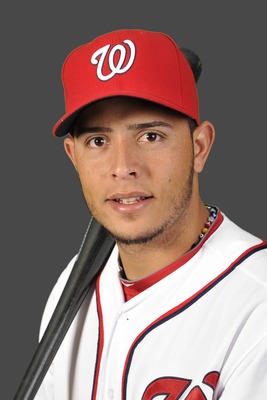
Gio Gonzalez may be in a bit of trouble. Photo Joy Absalon/US Presswire via usatoday.com

As announced early on January 29th, 2013, an anti-aging clinic in Miami run by Anthony Bosch has been accused of being a PED factory and the Miami New Times has published an extensive report after reviewing documents, spreadsheets and hand-written customer notes that were obtained by the newspaper from a former employee.

The relevance to the Nationals?  Gio Gonzalez appears in the documentation multiple times, along with his father.  And while the evidence directly linking Gonzalez to specific orders for HGH, Testosterone or Anabolic steroids is non-existant (unless the code “1.c.1 with Zinc/MIC” can be proven to mean a banned substance), generally speaking where there’s smoke, there’s fire with respect to PEDs and baseball players these days.  In James Wagner‘s WP article today on the topic, he found a doctor who speculated that MIC may stand for a combination of three compounds that are used frequently in weight loss routines, and definitely NOT illegal.

Even if Gonzalez is completely innocent, this report automatically besmirches his career.  Which is either a shame or will be justice.  Time will tell.  At least there doesn’t seem to be direct, provable evidence that Gonzalez (or his relations) purchased illegal products, a small light for Nats fans at the end of this particular tunnel.

Of immediate importance to the team; is this going to lead to a suspension?  Doubtful, based on evidence seen so far.  But certainly this should give players pause; what is the reputation of the clinics that I use?  Tom Verducci‘s immediate reaction is that this is a “severe” incident and notes that the new CBA allows suspensions even without positive tests.

The bigger scalp of course belongs to Alex Rodriguez, who the evidence seems to show bought HGH as recently as 2012.   *sigh*   He’s stated that he quit PEDs in 2003.  The report makes him look really, really bad.  For the slugger, at this point in his career and with the statements he’s already made on PED usage, to get caught again would be nothing short of amazing to me (he’s denied it, of course).  The arrogance and stupidity of his getting caught again would be the absolute nail in his public relations coffin.   At least the career HR record that Rodriguez once seems an absolute shoe-in to capture now seems safe; he likely misses most of his season with hip surgery (his age 37 year) and he’s averaged just 110 games and 17 homers the last two seasons.   The likelihood of his hitting 116 more home runs at this point seems nil.  I’m not going to go as far as some national writers though, who are saying they think Rodriguez’s career is over (David Schoenfield in particular).

Some pundits are already predicting that this will be the next Balco.  I think i’ve got PED fatigue.

Written by Todd Boss

January 30th, 2013 at 9:53 am

Ladson’s inbox 1/28/13

13 comments

Espinosa's shoulder injury is the big news this week. Photo AP Photo/Nick Wass

These Inboxes are coming fast and furious!  Its almost like we’re just a few days away from Pitchers and Catchers reporting or something.  I should do an inbox response.  Except nobody emails me any questions.   Sometimes I wonder who emails Bill Ladson some of these questions, frankly, especially the people who keep asking about who the manager will be in 2014.  Anyway, here’s his 1/28/13 inbox and how i’d have responded.

Q: What is the status of Chris Marrero? Does he figure to contribute in the Major Leagues at all this year?

A: The phrase “what have you done for me lately” never seems more appropriate than when talking about Chris Marrero.   In November 2007 he was listed by Baseball America as our #1 prospect.   #1 over the likes of Detwiler, Zimmermann, Maxwell, Clippard, Desmond, Peacock, Norris and even Bernadina.    A season-ending injury in 2008, slow progress up our system and then last off-season’s torn hamstring have now dropped him to the Nats #23 ranked prospect overall.  #23 puts him behind “prospects” such as Corey Brown and right above 7-year minor leaguer Carlos Rivero.

The status of Marrero is this: he’s stuck at first-base, seemingly can’t play anywhere else, but doesn’t hit nearly enough homers in order to be a MLB first baseman.  So he seems sort of in a quandry.  Unless he suddenly turns into a 30-home run hitter over-night, or figures out how to play another position, he’s really in a tough spot.  On the Nats depth chart at 1B, he seems to be no better than 4th right now (LaRoche, Moore, Tracy).  That doesn’t bode well for him contributing at the MLB level.  It seems to me that the only way he’s playing meaningful minutes at first this year is if both LaRoche and Moore come down with season-ending injuries.

On the bright side; despite us hearing about him for years, he’s only 24.  But he’s running out of time.  He’ll burn his 3rd and last option in 2013 and isn’t going to be eligible for a 4th.  Marrero needs to hit lights out in AAA this year, get an injury on the big club and gets some big-league ABs, and build trade value.

Ladson has answered this question before and repeated his answer; he thinks Marrero needs to be traded.  Great idea!  Now, who exactly is going to trade for him right now?  And what exactly could the Nats get in return?  These sort of things matter when looking at trade candidates and it irritates me when they’re not taken into consideration by supposed “professionals” in the field.

Q: Given Danny Espinosa’s torn rotor cuff and disappointing second half last season, is there any chance Steve Lombardozzi will become the Opening Day starting second baseman?

A: Boy, the revelation that Danny Espinosa has a torn rotator cuff is big news to me.  Even though its in his non-throwing shoulder (obviously; if it was in his right shoulder he’d likely have had the surgery as soon as it happened), you have to think this affects his hitting.  In fact, the blog Nationals Review did just this yesterday in a great bit of analysis: before the estimated injury date Espinosa was hitting 255/.321/.416.  Afterwards (including his awful playoffs): .156/.241/.234.  That’s rather definitive, even if “after injury” only included a few weeks of the regular season and a 5-game series.

I think the injury gives the team a built-in excuse to replace him if he starts off the year struggling.  Opening Day though?  No way; Davey Johnson is a players’ manager, is old-school and will go with the team at hand unless someone gets hurt in Viera.  Ladson says lets see what happens in Spring Training.  I think that’s the baseball writer equivalent of an Economist saying, “It depends.”

Q: Do you think Johnson will sit Espinosa more often this season because of his injury?

A: Doubtful; he’s either going to produce or not.  If he doesn’t produce, look for him to be sent to the DL for surgery.  I don’t see him getting sat sporadically.  Ladson says that Espinosa won’t let that happen.  Last time I checked though, Espinosa was the player and Johnson was the manager.  So I’m not sure how he can make that command decision.

Q: What role do you foresee Christian Garcia playing this year?

A: I see Christian Garcia starting the year as a starter in AAA and then one of two things happening; either he hurts himself again, thus destroying the whole starter experiment.  Or, someone in the MLB bullpen gets hurt or gets ineffective (ahem, Henry Rodriguez anyone?) and Garcia-as-starter is scrapped as he’s brought up to pitch meaningful innings.  Ladson says he expects Garcia to be a bullpen member and doesn’t buy into the starter experiment.

Q: Assuming 2013 is Johnson’s final year, do you think his replacement will come from inside or outside the organization?

A: I just don’t get how people are obsessing over the 2014 manager.  Call me when the World Series is over and AFTER Johnson actually retires.  Ladson predicts someone from within.

Q: After Adam LaRoche’s contract runs out, could Ryan Zimmerman move across the diamond to first base and let Anthony Rendon play third?

A: This is exactly what I believe should happen.  My ideal world has Rendon hitting his way into a utility infielder role this year, pushing for more playing time next year (perhaps even forcing the Nats hand at 2nd base), and Zimmerman logically moving across the diamond to alleviate his mental issues with routine throws and to protect his body from the constant pounding he gets at 3rd.  Ladson wants Zimmerman at 3rd for a long time, apparently forgetting that Zimmerman increasingly has difficulty making routine throws and being incredibly fragile.

Q: What are the chances of the Nats opening the season with Bryce Harper in right field and Jayson Werth in left?

A: Zero.  But, honestly, Werth in left is a better defensive team.  Harper‘s so good in center while Werth‘s range is eroding in right, it just makes more sense to switch them up.  Why won’t it happen on opening day?  Deference to the veteran.  Deference to the contract.  I expect the OFs to switch around and get each of them playing time in all three positions.  Ladson says that Harper is more comfortable in left while Werth is an “above-average” right fielder.  Uh, not according to UZR/150, which had Werth at a very poor -14.2 in 2012.  Harper belongs in RF but it won’t happen overnight.

William Taft??

6 comments

Is William Taft a more random choice for the 5th racing president?  Who here, prior to today, would have even named Taft as a short-list candidate?

Aside from the fact that, last time I checked, there was still only four presidents on Mt. Rushmore, did we really need a 5th racing president?  Does this mean we’ll be introducing a new president every few years from now on?  Does this mean that eventually we’ll have a dozen charicatures of former statesman “racing” to the finish line (inexplicably greeted by a giant felt Lizard, to pay homage to the ever present commercialism rampant in today’s game)?

I will say that after reading Dan Steinberg‘s article in the Saturday Washington Post, that I understand the selection a bit more.  I fully admit that I had no recollection of Taft’s presidency in general, nor did I remember that he and Teddy Roosevelt had a massive argument (which of course is now ripe for mocking during every race), nor that Taft is apparently responsible for both throwing out the first pitch and (by urban legend) establishing the 7th inning stretch.  I’m a bit more on-board now.

However, had I known that making a change was in the works, I think I would have gone in a different direction.  I would have either selected arguably the last remaining inarguable “great” president this country has had (Franklin Roosevelt), or I would have dumped all four of our existing presidents and simply created characatures of the last four sitting presidents to do the racing.  Imagine a race with Barack Obama, the  younger George W. Bush, Bill Clinton and the older George Bush.  How funny could that be?  On a nightly basis you could have each president’s predecessor messing with his successor, or you could play off of each president’s nuances.  There’s equal balance between Republicans and Democrats here, and I’m sure that W. wouldn’t mind being the “Teddy Roosevelt” lovable loser of the group 🙂

Written by Todd Boss

January 26th, 2013 at 9:33 am

Verducci effect for 2013 announced

8 comments

Verducci predicts Nats fans may be reliving this ugly moment. Photo credit unknown.

SI sportswriter Tom Verducci published his 2013 iteration of the “Verducci Effect” article this week, and our own Stephen Strasburg is on his watch list.

The questions we’ll address in this article are these: Should we be worried as Nats fans about Strasburg?  And, do you even believe in the Verducci effect?

Cutting and pasting from his article, here’s the Verducci Effect defined (or the “Year-After Effect” as he calls it, so as humbly not to refer to the theory by his own name as the rest of us do):

The Year-After Effect, as I called the risk after a big innings jumps, is not a scientific, predictive system. It’s a rule of thumb to identify pitchers who may be at risk because of a sharp increase in workload. The older the pitcher, the bigger the body type and the closer to the 30-inning threshold is their increase, the less they seem to be at risk.

Of importance here is his own admission; this is a “rule of thumb,” not a scientific analysis, he limits his candidates to pitchers age 25 or younger, and he picks players instead of doing an across-the-board analysis of all eligible players (this is important as we talk about whether the effect is statistically supported).  He identified 14 such players in his 2012 iteration of this analysis and 9 of them suffered injuries or “significant regression.”  He has a similar track record in his previous years; of the 69 pitchers he’s identified in the last 7 years as being at risk, 55 of them have now suffered injury/posted significantly worse ERAs.  That’s about an 80% succeessful prediction clip.

Strasburg pitched 68 MLB innings and another 55 1/3 in the minors for a total of 123 1/3 2010 innings.  He threw 159 1/3 in 2012, for a total increase of 36 innings from his previous professional high, or a 22.6% increase.  Generally speaking Verducci’s threshold is in the 15-20% range.  Strasburg isn’t the most “at-risk” pitcher on the list; that would be Chicago’s Chris Sale, who amazingly threw 121 more innings in 2012 than he ever had before, being converted from the bullpen to a starter last year.   But Strasburg definitely increased his workload in 2012, and he’s likely to be increasing it again in 2013, with no stated limit on innings for the coming season.  If he averages the same number of innings per start this year as he did last year (5.69) he’ll end up with roughly 187 2/3 innings in 2013, which would be another 15% increase over his previous career high.  Most likely we’ll see him averaging closer to 6ip per outing, which would put him at about 200 innings and representing another 20% increase in innings.

Do we think this is dangerous territory?  Should we be worried?  All signs point to “No;” there’s not a person in the baseball world who would claim that the Nats have been anything but ultra-conservative with Strasburg since the moment he was signed.  His surgery, his recovery, and especially the heavily criticized “shut-down” in September of last year.  The team chose to be less competitive in the short term in order to attempt to be a better, stronger team in the long term.  Given his gradual ramping up of innings and his carefully managed recovery, I expect to see a similar season that Jordan Zimmermann just gave, two years removed from the same surgery.  No injuries, a strong season but with some evident fatigue at season’s end.


A better question may be this: does the Verducci effect actually exist?

This January 2012 Deadspin.com article pretty nicely summarizes all the criticisms associated with the effect.  A few more links are in this article at AmazingAvenue.  This study done by The Hardball Times that looked at ALL pitchers age 25 or younger, divided the pitchers into two groups (those who did and did not throw 30 more innings and thus usually qualify for Verducci analysis) and studied the results.    They found that the overall performance didn’t seem to be different between the two groups.

So, if the effect doesn’t exist, why does Verducci have an 80% prediction success rate?  If the statistical differences between the two groups are identical, then why isn’t Verducci’s prediction rate closer to 50%?

The answer lies in the following statement: Verducci’s articles don’t present themselves to be a macro statistical analysis, and they doesn’t approach the problem in the same way that statisticians do.  Instead, he finds candidates that qualify and then passes judgement based on his professional opinion about whether they’re a “watch candidate.”  Which I think is a perfectly fine way to do an analysis piece like this.  Of the 11 pitchers he selected this year, 4 are from 2012 playoff teams, another 2 are from teams in the ultra-competitive AL East, and 2 more experienced such extremely high jumps in innings that even a non-statistical observation would conclude they’re injury risks for 2013.  I don’t think this kind of analysis is unreasonable frankly.  He clearly “cherry picked” these candidates but for good reason; they were for the most part either severely driven or were pitching a lot of higher-than-average leverage innings for the bulk of the year, all the while throwing deeper into seasons than ever before.

Its a combination of statistics and opinion; most critics of the theory use 100% statistics to claim that the effect doesn’t exist.  But that’s the rub that I keep coming back to when talking about the use of statistics in baseball; human behavior (aka, baseball players) doesn’t operate on a spreadsheet, and statistics cannot and will not entirely predict all situations in the future.  You can’t just say that the effect doesn’t exist because you can’t prove it exists statistically.  In this case, there’s clearly an analysis/opinion portion of the effect that takes into consideration immeasurable factors that (in Verducci’s opinion) lead to more stress and a higher probability of injury.  Plus, Verducci admits that “body type” and age do factor into his opinion; meaning that a guy with a big body (and by inference he likely means that a bigger body that takes stress off the shoulder) is more likely to be able to weather a larger workload.  Roger Clemens versus Tim Lincecum.  I’d also assume he’s looking at mechanics along the way (and Verducci is on record for being critical of Strasburg’s mechanics, as I discussed in this March 2011 post).  Statistics can’t measure mechanics, or body type, clearly portions of Verducci’s analysis.

Let me put it a different way: would anyone be the slightest bit surprised to see Sale come down with a shoulder injury in 2013?  I certainly would not.  And that’s the essence of the article, to provide a baseball opinion, and one of the reasons I still put stock into it while others waste time trying to disprove it.

Lets just hope Strasburg is one of the 20% he’s wrong about…

Written by Todd Boss

January 25th, 2013 at 10:56 am

Ladson’s inbox 1/22/13

7 comments

Does Boras run the Nats? The national narrative certainly seems to think so. Photo Ezra Shaw/Getty images via espn.com

I love a diversion.  Bill Ladson’s inbox is always a diversion.  Here’s 1/22/13’s edition.

Q: Why do the Nationals need another closer in Rafael Soriano?

A: My posted opinion about the deal from 1/15/13.  Did they “need” another closer?  Probably not.  But, innings sent to Rafael Soriano cascades downwards and means that innings that would be given to lesser relievers will now be pitched by Clippard and Storen (assuming one of them isn’t moved of course), and overall the bullpen is improved.  I wonder if Ted Lerner didn’t pull a George Steinbrenner/Dan Snyder-esque move and force a player signing as a reaction to a singular event (aka Storen’s NLDS game 5 meltdown).  Its possible I suppose.  If so, you hate to see moves like this, because it undermines the GM and leads to poorly constructed rosters.  Ladson belives this is a reactionary move to the NLDS bullpen meltdown in total, not just Storen’s misfortunes.

Q: It seems like Washington takes all of Scott Boras’ clients and puts them on its roster.

A: I hate this Urban Myth that now pervades anyone’s analysis every time the Nats sign a Scott Boras client.  Check the proof: MLBtraderumors keeps a player agent database and guess what?  The Nats don’t even have the most clients of Boras.   The Nats have 7 Boras clients but Boston has 8.  Plus, three of the 7 Boras clients the Nats have were no-brainer 1st round draft picks (Harper, Strasburg and Rendon, and you could even argue a 4th such Boras pick in Goodwin that the team would have taken at that point in the draft irrespective of his representation) that the team was likely going to draft and sign no matter who represented them.  The fact is this: the Nats have become a premier FA destination, Boras represents a lot of good players on the FA, and the Nats have hired some of his players.  When Boston or Texas hires a Boras client, you don’t suddenly hear people sarcastically asking, “Does Boras run the Red Sox?” now do you?  I think its great that Rizzo and Boras have a good working relationship, because other teams/GMs do not, and it affects the quality of their teams as a result.  Ladson defends my point as well, saying similar things to what I’ve pointed out.

Q: Does the Nationals’ front office regret not making Edwin Jackson a qualifying offer? It seems he would have signed elsewhere and the Nats would have received a compensation pick that would help the farm system.

A: Great Question!  One I asked in this space myself on 11/5/12.  I honestly think the team believed that Edwin Jackson, who had a history of signing one year deals, would have taken the contract.  Either that or there was a hand-shake deal in place stating that the team wouldn’t extend the offer.  I don’t truly believe the latter part of this, because (as others have pointed out) it’d be illegal as per the latest CBA.  Either way, I thought it was a mistake at the time and the Nats indeed missed the opportunity to gain an extra pick.  Ladson believes point #1; he thinks the team was afraid that Jackson would take the deal.

Q: If there was one thing that could hold the Nationals back from winning the World Series this year, what would it be?

A: I’ll give you two things that could prevent the team from winning.  1) Injuries in our Rotation and 2) bad luck.  We’re very thin in terms of starters and a season-ending injury to one of our big names would be a bad impediment.  And, the playoffs are crap-shoots; 83 win teams (St. Louis in 2006) can get hot and win it all while 116 win teams (Seattle in 2001) get beat easily before ever getting to the World Series.   That being said, even a starter injury probably wouldn’t be fatal to this team’s chances of making the playoffs; the Mets and Marlins are moving backwards, the Braves seem to be treading water, and the Phillies are getting older by the day.  The division is there for the taking even without winning 98 games again.  Ladson says injuries.

Q: Is it true that the Nationals are interested in Kyle Lohse and plan to put Ross Detwiler in the bullpen?

A: Man, I hope not.  I like Kyle Lohse but there’s a reason he’s still on the FA market despite a TON of teams needing pitching help (and it isn’t just because of the lost draft pick).  He’s really not THAT good.  He had (easily) his best season last year, the definition of a contract year if there ever was one.  Career 98 ERA+.  I think he’s a good fit for a team that needs a 3rd starter, but the Nats aren’t that team.  I made my arguments for keeping Ross Detwiler in the rotation on 1/16/13, when rumors swirled about the team looking at Javier Vazquez.  Who would you rather roll the dice with?  A young, up and coming power lefty or a soft-tossing righty who’ll be 34 next year?  I think buying another $12M/year starter and pushing Detwiler to the bullpen just for the reason of “needing another lefty” in the bullpen is arbitrary and would be a waste of Detwiler’s promising 2012.  Ladson agrees, saying that Davey Johnson likes Detwiler in the rotation.

Q: Would Mark DeRosa be a viable managerial candidate for the Nationals in 2014?

A: Random question.  What makes you think Mark DeRosa won’t still be playing in 2014?  Plus, what ties does he have to this organization that would make you think that the Nats think he’s the heir apparent?  I mean, if we’re talking about former players who have put in the time with this organization, look no further than Matt LeCroy, who played for the team and has been managing in our minor league system for years.  Personally, I think the team will go with a “celebrity manager” when the time comes.  Ladson expresses some surprise at the question as well.

Q: After he was acquired from the Athletics for Michael Morse, where does A.J. Cole fall on the Nationals’ list of prospects?

A: I’d say he’s probably 3rd in line, after Rendon and Goodwin.  That’s about where he was when he was still in the system, and despite his rough 2012 in the California league he’s still very promising.  Ladson says 3rd, as does mlb.com’s rankings for the team.

Q: What did you think of what the Nationals received for Morse? Could they have gotten more — a Major League lefty reliever in addition to a starting prospect? Is the problem that Morse only had a total of two good seasons?

A: I think the Nats got what they could for Morse, frankly.  I would have liked to have seen a MLB lefty and a starting pitcher prospect in the lower-to mid minors.  Lots of people were using the Josh Willingham trade as a comp; both players are similar (both are good offense, no defense type guys in the last year of an affordable contract).  Willingham netted us a mlb reliever and a high-minors OF prospect.  However Morse’s defensive inabilities preceed him reputationally, and many scouts perceive his 2011 as a one-off instead of a ceiling of potential.  Ladson says they made a great deal.

Updated Nats Resource Links and their impact

11 comments

With the slew of off-season activity nearly complete, I’ve updated some of the tracking worksheets that I maintain related to the Nats roster.  From non-tenders, FA signings and re-signings, trades and Arbitration settlements a lot has changed in terms of the Nats payroll, expected WAR estimates and 40-man options statuses.  All these resources are now updated in Google Docs.  Links (which should also be along the right-hand side of the page):

Here’s the implications that the last few months have had in each case:

Nats WAR Estimate Impact: We last visited this topic on 1/3/13 and I had a 2013 fWAR best case estimate of 57.6, equating to a 103 win season.  Now we’ve replaced Michael Morse‘s 3-win estimate with Adam LaRoche‘s 3.5 win estimate and added in Rafael Soriano‘s 1.2 fWAR estimate and are looking at a fWAR estimate of 59.1 and a 105 win capable team.  As with before, this doesn’t mean i’m predicting 105 wins; i’m saying that if everyone plays to their potential and nobody gets hurt, its hard not to see this being a 105 win team as constructed.

Nats 2013 Payroll Impact: When we last visited this topic on 12/3/12, we were sitting on a 2013 estimated payroll of just $88M.  Since then, we re-signed LaRoche, signed Dan Haren, stunningly signed Soriano and settled a slew of pre-arbitration settlements (most of which seemed to trend higher than MLB’s estimates for the players).  I’m now estimating the Nats 2013 payroll to be $121,823,500 (but see the caveat in the next paragraph).  There are still two payroll figures to be announced/decided: Zach Duke‘s 2013 pay has yet to be disclosed (I’m using an estimate of $1.5M) and Jordan Zimmermann was not able to settle with the team ahead of the filing deadline (i’m using an estimate of $4.9M for him).  The team filed at $4.6M while Zimmermann filed at $5.8M, meaning they’re $1.2M apart at current.  The midpoint would be $5.2M, meaning that the overall payroll could creep even higher and hit $122M.

Coincidentally, I’m not sure how to treat Soriano’s deal from a payroll perspective.  2 years, $28M but as we’ve learned half that money is deferred.  The spreadsheet shows it as a $14M aav contract but he’s only being paid $7M this year.  With the deferred money, the calculated AAV of the contract is only in the $11M/year range.  Cots shows $14M/year right now on its main page, but it hasn’t fixed its internal google XLS’s yet.  I think the right way to go would be to show $7M being paid this year and next, and then when the deferred payments kick in show them as the annual $2M payments that they’ll be.  So maybe the current payroll isn’t $121M but closer to $114M.  I’ll be curious to see how the sites like Cots and Usatoday (the two main sites that publish team payroll figures) treat this contract going forward.

Option Status: We last visited this topic on 11/14/12, before the non-tenders of Flores, Lannan and Gorzelanny, before the Rule-5 additions and before all the signings.   New signings Haren and Soriano are both 5+ year vets so Options don’t matter.  Interestingly, Duke has 6+ years of service time and signed a MLB deal, meaning he cannot be assigned to AAA withouth is consent and/or passing through waivers; the team is clearly counting on him to be in the MLB bullpen the whole year.  The most interesting options cases now belong to Ryan Mattheus and Craig Stammen, both of whom have options and both of whom (despite Stammen’s new 2 year deal) could be affected by the crowded bullpen.  I think we’re all under the assumption that Christian Garcia is starting the year in AAA; he has 3 options to use and may be on the train back and forth often in 2013.  I remain curious as to what the team will do with Carlos Rivero, who hit well in AAA and even better in winter ball, but has no options remaining and doesn’t have a single day of MLB service time.

Lastly (unrelated to the Nats), I’ve updated somewhat my “Best versus Winner” xls with the results from the NFL playoffs over the weekend.  For the 9th straight year in the NFL, the Superbowl winner will NOT be the team that also had the best regular season record.  This year, Denver and Atlanta shared the best regular season record and both were eliminated before reaching the Superbowl.  I keep track of this particular finding for all four major sports and generally have found that very infrequently does the team with the best record in any sport actually take the year end title any more.  Baseball has only seen it a few times in the last 20 years.

I’ve got a draft post that has an overview of all the random documents and spreadsheets that I’ve uploaded to Google Docs over the years (including the 4 discussed in this post).  I”ll publish it during a slow period this winter.

Adult Baseball in the DC Area

20 comments

We’ve mentioned local area baseball leagues a lot lately in posts here.  I talked about my own experiences playing youth and adult baseball in my “All Virginia post” and many of the readers here have shared experiences playing in the local leagues in the comment sections of that post and in the comments section of a late December post.

I thought it’d be of service to readers to summarize information of known adult leagues for anyone who is perhaps interested in getting back to playing, or who knows someone looking for a team.  If you’re looking for a place to play this summer, now is the time to reach out and start making contacts/sign up to play.

I’ll list these leagues in perceived order of talent/skill/intensity from highest to lowest.  Each site also has links for those who may want to look into playing or watching.  I’m not including any youth, AAU, travel, American Legion, Babe Ruth or Cal Ripken (not to be confused with the Cal Ripken collegiate league) baseball here; we’ll start with College-age Adult baseball.

1. DC-Area Summer Collegiate Leagues: The wood-bat Cal Ripken Collegiate League has teams from DC, Maryland and Virginia and is the successor to the long-running Clark Griffith League, which formerly was one of the longest running wood-bat leagues in the nation.  The Clark Griffith league suspended operations in 2010 and has not been able to re-start itself.  Meanwhile the Cal Ripken league has flourished and expanded, taken some of the former Griffith teams and now has 10 teams competing.  The marquee team is the Bethesda Big Train, named after Walter Johnson and whose home games are at the fantastic Shirley Povich field in Bethesda (also the home-stadium of Georgetown University).  If you havn’t seen games at Povich, you should take a drive up there one night this summer and take in a game.  The quality of play is good (the players are either Division-1 college players or elite HS prospects) and the field is great.

The Cal Ripken league is a step down from the famed Cape Code League in terms of summer college talent … but then again nearly every other wood bat summer league is a step down as well.  Of the dozens of summer leagues out there, most pundits would rank the Cal Ripken league as a 3rd tier quality league (2nd tiers being leagues like the Valley League, the Northwest league, the Alaska league or the Coastal Plains leagues).  But the Cal Ripken league definitely has its share of pro alumni.

Eligibility: you must have college eligibility left to play in this league.  High Schoolers are eligible but rare.  Teams are competitively assembled and hand selected.

2. The Industrial League: The Industrial League is the most elite level of adult baseball in the area, filled with ex-Collegiate players and ex-Pros to serve as close to a “semi pro” league as we have in the area.  The current incarnation of the Industrial league plays Wood Bat and is the combination of two long-standing leagues (the “Industrial League” and the “Credit Union” league).   The old Credit Union used to play with Aluminum, but went to Wood fully upon its dissolvement.  There’s only a handful of teams; this league used to be much healthier.  The “history” page on the website is informative and gives some great background on the league itself and its origins.

By way of comparison; industrial teams used to scrimmage the Clark Griffith teams and would get wiped out.  Not so much because of talent, but because of depth.  These college summer league teams have full rosters and massive bullpens.

Eligibility: no restrictions; anyone can play at any age.  No restrictions on time sitting out if you are an ex-pro.

3.  DCMSBL/MABLDC Mens Senior Baseball League: a large adult baseball league (the 2nd largest Adult league in the Nation according to MSBL’s records) with divisions ranging from 19 and up to 55 and up.   DCMSBL started in 1991 (this year is its 25th anniversary) with just a 30+ division and now has dozens of teams split amongst 19+, 25+, 35+,45+,55+ and a wood-bat only league that crosses age divisions.  In 2012 the league had no less than 75 teams among all these divisions (each team has to have a minimum of 15 registered players, meaning there’s more than 1100-1200 players in the league).  Note: MABL stands for Mens Adult Baseball League, which was formerly the under 30 adult league now rolled into one organization).

The DCMSBL amateur league is pretty decent baseball.  The 19-and up is essentially a low-end collegiate summer league (though not nearly as talented as Cal Ripken).  There is some overlap with teams in the Industrial league and the Cross-age group woodbat leagues.  The 25 and up division has a large number of ex-college players and ex-pros, and the 35-and up teams have more than their fare share of ex-major leaguers as well.  Its not uncommon to face a guy in the 25+ division who was a starter for his Division-1 college team for 4 years and is just a few years removed from that level of competition.  There’s enough teams so that there are “upper” and “lower” divisions of play within each age group.  From an intensity standpoint, the “upper” divisions are quite competitive each year while the “lower” divisions are less intense but certainly not a “beer drinking” division like you’d see if you were playing softball.

Teams are organizing right now for play that starts in the first week of April.  There’s a player waiting list that you can sign up for at the website www.dcmsbl.com.

Note: there is also the Chesapeake MSBL that covers the Annapolis, Southern Maryland and Howard county areas with similar rules and talent levels to DCMSBL.  The two leagues play an all-star game at season’s end in one of the local minor league stadiums (this year in Frederick).

Eligibility: ex-professionals must sit out a year (I believe) before being eligible to play.

4. DC Wood Bat League, formerly associated with NABA and which absorbed teams from the old WARBL.  It had 12 teams for 2012 but in prior years had as many as 20 teams.  There seems to be some overlap between DCWood and DCMSBL teams, and this league definitely has had some talented teams in the past.   They play longer schedules than the DCMSBL guys.

Readers who know this league: how does it fare competition wise to DCMSBL?  I have suspected it is slightly lower in skill level but have no direct experience one way or the other.

Eligibility: 19+, no known pro restrictions.

5. Ponce de Leon league, owned and operated by Bob Duff, serves as an excellent low-key competitive league for players to play.   There are a slew of very specific competition rules that control the flow of games, prevent blowouts and limit the ability of pitchers to dominate the league.  But this league also guarantees participation and is a great option for guys who havn’t played in years or who are nervous about the intensity of the above leagues.

It is now affiliated with the DC Wood bat league somehow; this is a new affiliation and I don’t know all the details other than what’s on the websites.

Ponce has two age divisions; 30+ and 48+.  You have to be at least 30 and cannot pitch unless you’re at least 36 in the younger division.

Eligibilty:  30+ with restrictions as noted above.  No known pro restrictions.

6. Eastern Women’s Baseball Conference: the EWBC is an Adult Womens baseball league with teams from DC to Baltimore that plays competitively.  I must admit; I had not heard about them until prompted by suggestions.

7.  Other leagues that I’ve heard of that may or may not still be around:  I know there’s a small league in Southern Maryland called the Charles St. Mary’s League. It plays wood bat and has been around since the 1940s.  I can’t tell if this is what remains of the old “Chesapeake Independent Baseball League” or not.  The CIBL was also colloquially known as the Chicken Leagues and was truly semi-pro baseball; guys would get paid to come out and play.  As mentioned, the old Credit Union got rolled into the Industrial league a few years back.  WARBL got rolled into NABA.

Some of these links come courtesy of Bob Schnebly‘s website.  Schnebly has been involved in DC area amateur baseball for years; we ran into him in the Credit Union/Industrial league in the early 1990s.  His website is an interesting read for those familar with him or baseball in the area.


I’d love to hear from you if you’re familiar with any other area leagues that I may have missed, or if you have some thoughts on the post here.

Written by Todd Boss

January 22nd, 2013 at 8:49 am

Off Topic: my thoughts on Lance Armstrong

2 comments

Sorry Lance, your 7 titles are no longer. Photo AP via si.com

(Editor’s note: on this holiday workday when nobody’s likely reading baseball blogs, I’m clearing a topic that i’ve been collecting links and thoughts on for the better part of a year.   For months and months I’ve collected URLs for stories related to Armstrong.  I think part of this post is merely a cathartic cleansing of this draft blog post from the my WordPress instance so that I don’t have to look at it any longer.  But if you’re interested, read on.  This is a nice little timeline of events that led to his downfall at the end).

For months and months, I defended Lance Armstrong as being somewhat victimized by what I thought was an over-zealous pursuit of him based on evidence that wasn’t “court of law” worthy.   I think at the beginning I may possibly have thought he didn’t cheat, I definitely defended him in arguments among friends, saying that hearsay and testimony did not equate to scientific evidence in my mind.   The Tyler Hamilton interview on 60 minutes was pretty damaging though, and I began to waver in my beliefs that perhaps Armstrong was just the sole guy in a sea of cheaters.  After the federal case was dropped but the USADA case kept going, I began literally to feel like some sort of national witch hunt was underway, and my defense of Armstrong was less about his guilt or innocence and more about not agreeing with the vendetta that was clearly against him in the eyes of certain people (the head of the USADA Travis Tygart, Christine Brennan at the USA Today, etc).

Coincidentally, I hadn’t felt this way since the Pete Rose situation, where I felt like former baseball commisioner Bart Giamatti spent far too much time going after Rose, to the point where the pursuit of Rose felt like it was a personal vendetta.  (Coincidentally, if you’ve read the Dowd report, and if you’re familiar with the Rose situation, you’ll realize that my “feelings” were really misplaced.  My Dad in particular has zero sympathy for Rose, nor does a lot of the baseball community, and after going back and reviewing the literature at the time I realize that my “memory” of the time period was skewed.  I was a bit too young to really understand the issues at hand).  For the USADA’s head, I thought this was similarly a personal vendetta gone wrong.   I wasn’t alone; see the links below for congressional outrage over the findings this summer from those who thought the same vendetta thoughts.

Its clear now, I was foolish to ever defend him, even in casual sports-fan conversations.  Not only was he a fantastic cyclist and an inspiration to an entire generation of cancer fighters and survivors, he was also apparently the ring-leader of the greatest doping scheme ever concocted.  He tested negative for PEDs hundreds and hundreds of times over his career.  He kept clean while hundreds of his fellow riders were found to be dirty.  That’s an achievement.

What I don’t get is this: why would Armstrong admit to this now?  He’s already stripped of his wins, he’s already banned from competitions, he’s already resigned from Livestrong, he’s already lost his sponsors, and he’s already being sued by former sponsors and others looking to recoup losses.  What is his motivation now?  I mean, you’ve lied for 10 years, why not continue to live the lie at this point and keep the bravado up.   I don’t know.  Perhaps its just as simple as releasing the burden of guilt.  But what has changed now in January of 2013 vis-a-vis this guilt versus the last decade or so?  Does he really want to get his name cleared just so he can compete in triathalons on the side?   Does he think that he can get his ban reduced now, after all that has happened?

Apparently the question was asked and answered in the 2nd part of the interview (which I havn’t gotten to yet; having a newborn at home gets in the way of little things like TV, sleep, etc) and the answer seems to be “Guilt.”  Guilt on Armstrong’s part as he watched his 13-yr old son defend his father’s honor to a friend.  His confessions seem more understandible now.  This point is confirmed in this link here (which is also on the below timeline).

Personally, I view cycling similarly to the way I view all the runners in the 1988 Olympic game 100meter final.  The entire sport was a mess (is still a mess?), and if you weren’t cheating you weren’t trying to win.  That’s a shame to say, but by most accounts it seems to be true.   I’m not as concerned about his legacy or his wins or records; just like Barry Bonds‘ 73 homer season, we’ll always have to explain away his accomplishments as being artificially accomplished.  I don’t have children who are old enough to have idolized Armstrong and who now need to be told that he cheated, so perhaps i’m more than a bit jaded.  I’m also not a massive cycling fan who now feels cheated by this admission.

Here’s the collection of links that more or less follow the timeline, starting mostly with Hamilton’s 60 minutes interview, which seems to really have set off the chain of events that led to his Oprah Winfrey interview.

I think this about covers it.  I’m publishing this blog posting and probably will never talk about Armstrong  again.  And in about 15 minutes, i’m guessing America will do the same.

Written by Todd Boss

January 21st, 2013 at 11:01 am

Earl Weaver Passes

leave a comment

Weaver during one of his 96 career ejections. photo unknown via examiner.com

A quick post to note the passing Earl Weaver, long-time Orioles manager and one of the great characters in the game.  Weaver passed away over the weekend at the age of 82.

The tagline of this blog (located at the top left of the page) has always been an Earl Weaver quote related to pitching:

“… the reason you win or lose is darn near always the same – pitching.”

Weaver may have been remembered for his antics on the field and legendary rages against umpires, but he was also a pitching strategy pioneer.  As is noted in the link above, Weaver was one of the first managers to track pitcher-hitter matchups as a method of managing his bullpen.  He may have advocated the 3-run homer as the best offensive strategy, but he definitely advanced pitching strategy during his career.

Former Oriole Ken Dixon is a player in the local DCMSBL league and pitched for Weaver in the mid 80s.  We asked him once at a golf event what his favorite memory of Weaver was and he told the following story (paraphrased from memory): Dixon said he was pitching in a game one day and was really struggling.  Weaver was fuming at him in between innings, and when he got into another jam Weaver came out to the mound to (as Dixon thought) remove him from the game.  Instead, Weaver arrived at the mound and was so furious with the situation he just cursed and carried on like a crazy uncle, never really talking directly to Dixon.  Eventually, he left the mound without really saying anything of substance to Dixon (or taking him out).

Written by Todd Boss

January 20th, 2013 at 5:38 pm

Are players from the 1980s under-represented in the Hall of Fame?

16 comments

Can Jack Morris eventually be the first “1980s Starter” to make the Hall? Photo John Iacono via si.com

First off: I’m not a “small hall” guy.  (How can you, when looking at the litany of obscure players the Veteran’s Committee has already enshrined while the current ballot has literally a dozen names that you can make an argument for?)  So naturally I want to see enshrinement for a larger number of the “marquee” names in baseball’s history.  I view the Hall of Fame as a museum dedicated to the game, and recognizing all the eras of the game for better or for worse.  I’m for expanding the current ballot and If I had a vote i’d be maxing out the 10 names with a desire to put a couple more guys on.

I’m also distinctly of the opinion that maybe the era of baseball just prior to today’s is underrepresented in Cooperstown.  Specifically, my theory is that the massive boom in offense that the game has seen in the last 20 years coupled with a distinct shift in the way pitching staffs are managed has led to voters and fans to discount and dismiss the accomplishments of players specifically from the 1980s.

MLB.com has a show called “Prime 9,” where they list the best 9 players/teams related to certain topics.  Recently they showed the “Best 9 players of the 1980s” by position, and it led me to use that list as a starting point for a discussion of marquee players from the 1980s and to decide whether or not the decade is under represented in Cooperstown.

Here’s Prime 9’s top player by position and their Hall of Fame status.  Throughout this entire article, Blue == Hall of Fame players while Red == non-Hall of Fame Players.

  • RF: Dwight Evans: fell off HoF ballot on his 3rd attempt in 1999.  Max votes: 10.4% in 1998.
  • CF: Dale Murphy: fell of HoF ballot on his 15th attempt this year in 2013.  Max votes: 23.2% in 2000.
  • LF: Rickey Henderson: 1st ballot HoFamer in 2009 with 94.8% of the vote.
  • SS: Cal Ripken Jr: 1st ballot HoFamer in 2007 with 98.5% of the vote.
  • 3B: Mike Schmidt: 1st ballot HoFamer in 1995 with 96.5% of the vote.
  • 2B: Ryne Sandberg: 3rd ballot HoFamer in 2005 with 76.2% of the vote.
  • 1B: Don Mattingly: on current ballot, his 13th attempt.  Max votes: 28.2% in 2001, his first year on the ballot.
  • C: Gary Carter: 6th ballot HoFamer in 2003 with 78% of the vote.
  • SP: Jack Morris: on current ballot, his 14th attempt.  Max votes: 67.7% this year.

Four of the Nine players listed as “Best of the Decade” are not in the Hall of Fame.   I think there’s something wrong here.  I know Morris is incredibly polarizing and probably never gets in, while the other three guys (Evans, Murphy, Mattingly) each had knocks against them related to durability and peak that prevented them from being enshrined.  Perhaps these are future Veteran’s committee picks.

I know the above list is arguable; perhaps those players aren’t necessarily the “best” at their positions for the decade.  So lets talk about the leading candidates per position who didn’t make the Prime-9’s list, and their own HoF status.  The MLB show didn’t distinguish between SP and RPs so I’ve separated them out below, nor did they distinguish between the OF positions like they did for the team selected above.

I’ve included the guys in the above “Prime 9” list in the lists below for ease of analysis by position.

(Coincidentally; as you read the vote percentage totals, keep in mind that a voting percentage of less than 1% means that the player got only a handful of votes from the 500+ votes tallied each year, a woefully small number).

Outfielders:

  • Dwight Evans: fell off HoF ballot on his 3rd attempt in 1999.  Max votes: 10.4% in 1998.
  • Dale Murphy: fell of HoF ballot on his 15th attempt this year in 2013.  Max votes: 23.2% in 2000.
  • Rickey Henderson: 1st ballot HoFamer in 2009 with 94.8% of the vote.
  • Andre Dawson: 9th ballot HoFamer in 2010 with 77.9% of the vote.
  • Tim Raines: on current ballot, his 6th attempt.  Max votes: 52.2% this year.
  • Dave Parker: fell of HoF ballot on his 15th attempt this year in 2011.  Max votes: 24.5% in 1998.
  • Fred Lynn: fell off HoF ballot on his 2nd attempt in 1997.  Max votes: 5.5% in 1996.
  • Kirk Gibson: fell off HoF ballot on his 1st attempt in 2001 with only 2.5% of the voting.
  • Dave Winfield: 1st ballot HoFamer in 2001 with 84.5% of the vote.
  • Kirby Puckett: 1st ballot HoFamer in 2001 with 82.1% of the vote.
  • Tony Gwynn: 1st ballot HoFamer in 2007 with 97.6% of the vote.
  • Pedro Guerrero: fell off HoF ballot on his 1st attempt in 1998 with only 1.3% of the voting.
  • Jim Rice: 15th ballot HoFamer in 2009 with 76.4% of the vote.
  • Daryl Strawberryfell off HoF ballot on his 1st attempt in 2005 with only 1.2% of the voting.
  • Jack Clarkfell off HoF ballot on his 1st attempt in 1998 with only 1.5% of the voting.
  • Andy Van Slyke: fell off HoF ballot on his 1st attempt in 2001 without receiving a single vote.

This makes for 16 total outfielders on the “Best of the decade” list.  Of those 16 outfielders, 10 are not in the Hall of Fame.  Would you say that the position is under-represented in the Hall if only 6 outfielders from an entire decade of the sport are enshrined?   Maybe, maybe not.   To say nothing of the fact that 2 of these 6 HoFame 80s outfielders (Rice and Dawson) were heavily criticized upon enshrinement for being voted in based on remnants of “old man” statistics.

Jack Clark you say?  50 Career WAR.  That’s nothing to shake a stick at.  Higher than a number of Hall of Fame hitters.  I remember him being more of a power hitter than he turned out to be.  He just couldn’t stay healthy; only 5 seasons where he played close to a “full season” in 18 years in the league.   I remember him fondly from my childhood; my family is from San Francisco and I always rooted for the Giants as a kid.

Middle Infielders:

  • Cal Ripken Jr: 1st ballot HoFamer in 2007 with 98.5% of the vote.
  • Ryne Sandberg: 3rd ballot HoFamer in 2005 with 76.2% of the vote.
  • Garry Templetonfell off HoF ballot on his 1st attempt in 1998 with only 0.4% of the voting.
  • Ozzie Smith1st ballot HoFamer in 2002 with 91.7% of the vote.
  • Alan Trammellon current ballot, his 12th attempt.  Max votes: 36.8% last year.
  • Robin Yount1st ballot HoFamer in 1999 with 77.5% of the vote.
  • Lou Whitaker: fell off HoF ballot on his 1st attempt in 2001 with only 2.9% of the voting.
  • Dave Conceptionfell of HoF ballot on his 15th attempt this year in 2008.  Max votes: 16.9% in 1998.

Lots of baseball pundits have lamented Whitaker’s fate, while plenty others vociferiously argue for Trammell, who had the misfortune of being both the 2nd best offensive SS (to Ripken) and the 2nd best defensive SS (to Smith) of his era simultaneously, thus being overshadowed by both.   Conception was about an equal at the plate to Ozzie Smith but only about half the Gold Gloves, but still seems like he deserved a bit more credit than he got in the voting.

Third Basemen

  • Mike Schmidt: 1st ballot HoFamer in 1995 with 96.5% of the vote.
  • Wade Boggs: 1st ballot HoFamer in 2005 with 91.9% of the vote.
  • George Brett: 1st ballot HoFamer in 1999 with 98.2% of the vote.
  • Paul Molitor: 1st ballot HoFamer in 2004 with 85.2% of the vote.
  • Terry Pendleton: fell off HoF ballot on his 1st attempt in 2004 with only 0.2% of the voting.
  • Tim Wallachfell off HoF ballot on his 1st attempt in 2002 with only 0.2% of the voting.
  • Buddy Bellfell off HoF ballot on his 1st attempt in 1995 with only 1.7% of the voting.

Four first ballot hall of fame 3rd Basemen played in the era (even if most consider Molitor primarly a DH later in his career) which is saying something considering there are only 12 full time 3rd baseman in the Hall from all of history.  The all-star game starters for the entire decade were almost entirely Schmidt, Boggs and Brett.  The others I fully acknowledge are “stretches” but did each have several all-star appearances during the decade.

First Basemen

  • Don Mattingly: on current ballot, his 13th attempt.  Max votes: 28.2% in 2001, his first year on the ballot.
  • Steve Garvey: fell of HoF ballot on his 15th attempt this year in 2007.  Max votes: 42.6% in 1995.
  • Eddie Murray: 1st ballot HoFamer in 2003 with 85.3% of the vote.
  • Keith Hernandez: fell off HoF ballot on his 9th attempt in 2004.  Max votes: 10.8% in 1998.
  • Mark McGwireon current ballot, his 7th attempt.  Max votes: 23.7% in 2010.

Not much to say here: There seemed to be a definite lack of quality first basemen for the decade; only one is enshrined in the Hall.  Many of the all-star 1B appearances early in the decade went to aging stars Rod Carew and Pete Rose, who by that point in their long careers had been moved to first base for defensive purposes. McGwire’s issues are obvious (and he’s clearly more well known for his exploits in the 1990s, so its arguable if he even belongs in this 1980’s centric discussion).

Catchers

  • Gary Carter: 6th ballot HoFamer in 2003 with 78% of the vote.
  • Carlton Fisk2nd ballot HoFamer in 2000 with 79.6% of the vote.
  • Lance Parrishfell off HoF ballot on his 1st attempt in 2001 with 1.7% of the voting.
  • Benito Santiagofell off HoF ballot on his 1st attempt in 2011 with 0.2% of the voting.
  • Darrell Porterfell off HoF ballot on his 1st attempt in 1993 with zero (0) votes.
  • Tony Penafell off HoF ballot on his 1st attempt in 2003 with0.4% of the voting.
  • Bob Boonefell off HoF ballot on his 5th attempt in 2000. Max votes: 7.7% in 1996.
  • Terry Kennedyfell off HoF ballot on his 1st attempt in 1997 with exactly one (1) vote.

Yes, I’m really stretching for 1980s catchers.  Basically Carter made the all-star team every year for the NL while Fisk made half the All Star Starts for the AL during the same time.  The backups were generally catchers having a decent first half, many of whom never made an other all-star team.  Boone was better than you remember, hence his hanging around the bottom of the ballot for a few years.

Closers/Relievers

  • Lee Smith: on current ballot, his 11th attempt.  Max votes: 50.6% in 2012.
  • Bruce Sutter: 13th ballot HoFamer in 2006 with 76.9% of the vote.
  • Dennis Eckersley:  1st ballot HoFamer in 2004 with 83.2% of the vote.
  • Rich Gossage: 9th ballot HoFamer in 2008 with 85.8% of the vote.
  • Jeff Reardonfell off HoF ballot on his 1st attempt in 2000 with 4.8% of the voting.
  • Tom Henkefell off HoF ballot on his 1st attempt in 2004 with 0.6% of the voting.
  • Dan Quisenberryfell off HoF ballot on his 1st attempt in 1996 with 3.8% of the voting.
  • Kent Tekulvefell off HoF ballot on his 1st attempt in 1995 with 1.3% of the voting.
  • Willie Hernandezfell off HoF ballot on his 1st attempt in 1995 with 0.4% of the voting.

I’m not going to vociferously argue for Relievers/Closers to be inducted, since I think they’re mostly overrated in terms of their contributions to wins.  But I will say that a couple of these guys were far better than you remember.  Take Tom Henke: career 157 ERA+, which was better than either Sutter or Gossage PLUS he had more career saves (311 for Henke compared to 310 for Gossage and 300 for Sutter).   How exactly are two of these three guys Hall of Famers while Henke got exactly 6 votes out of 515 his first time on the ballot?   These voting patterns just seem drastically inconsistent.


All the above though pales in comparison to what we’re about to see.

Starters

  • Jack Morris: on current ballot, his 14th attempt.  Max votes: 67.7% this year.
  • Steve Carlton: 1st ballot HoFamer in 1994 with 95.6% of the vote.
  • Dave Stewart: fell off HoF ballot on his 2nd attempt in 2002.  Max votes: 7.4% in 2001.
  • Frank Violafell off HoF ballot on his 1st attempt in 2002 with 0.4% of the voting.
  • Rick Sutcliffefell off HoF ballot on his 1st attempt in 2000 with 1.8% of the voting.
  • Dave Steibfell off HoF ballot on his 1st attempt in 2004 with 1.4% of the voting.
  • Bob Welchfell off HoF ballot on his 1st attempt in 2000 with 0.2% of the voting.
  • Brett Saberhagen: fell off HoF ballot on his 1st attempt in 2007 with 1.3% of the voting.
  • Orel Hershiser: fell off HoF ballot on his 2nd attempt in 2007.  Max votes: 11.2% in 2006.
  • Dwight Goodenfell off HoF ballot on his 1st attempt in 2006 with 3.3% of the voting.
  • Mike Scott:  fell off HoF ballot on his 1st attempt in 1997 with 0.4% of the voting.
  • Rick Reuschelfell off HoF ballot on his 1st attempt in 1997 with 0.4% of the voting.
  • Fernando Valenzuelafell off HoF ballot on his 2nd attempt in 2004.  Max votes: 6.2% in 2003.
  • Nolan Ryan: 1st ballot HoFamer in 1999 with 98.8% of the vote.
  • Denny Martinez: fell off HoF ballot on his 1st attempt in 2004 with 3.2% of the voting.
  • Bert Blyleven14th ballot HoFamer in 2011 with 79.7% of the vote.
  • Jimmy Keyfell off HoF ballot on his 1st attempt in 2004 with 0.6% of the voting.
  • Ron Guidryfell off HoF ballot on his 9th attempt in 2002.  Max votes: 8.8% in 2000.
  • John Tudor: fell off HoF ballot on his 1st attempt in 1996 with 0.4% of the voting.
  • Roger Clemenson current ballot, his 1st attempt.  Max votes: 37.6% in 2013.

Here is where I think I really have a problem with the Hall of Fame treatment players in the 1980s; I think the entire generation of Starting Pitchers has been generally underrated and overlooked.  Look at this list of pitchers and look at the number of guys who failed to even stay on the ballot for more than one season.  Meanwhile, you can argue that the three guys who ARE on this list who are in the Hall of Fame (Carlton, Ryan and Blyleven) all actually “belong” to the 1970s; they just happened to have longer careers that bled into the 1980s.  Clemens appears here because his late 80s debut was so strong but clearly he’s a player of the 90s, and his reasons for non-inclusion thus far are obvious.

Do you mean to tell me that NONE of these other 1980’s starters merits inclusion to the Hall of Fame?  That an entire decade of starting pitchers doesn’t historically merit inclusion?  I’m not going to argue that all (or most) of these players belong, but it is kind of shocking that so many of the leading pitchers of that era were given so little consideration.

My biggest beef may be with Saberhagen.  Here’s the side-by-side stats of Saberhagen and a Mystery pitcher we’ll identify in a moment:

Wins Losses IP K’s ERA ERA+ bWAR
Saberhagen 167 117 2562 2/3 1715 3.34 126 56
Mystery Player 165 87 2324 1/3 2396 2.76 131 50.3

Pretty close, no?  Saberhagen contributed more WAR and was nearly this player’s equal in ERA+, which adjusts to the eras.  Mystery player’s W/L record is better … but then again, havn’t we learned that wins and losses are meaningless stats now?   A couple more facts here: Saberhagen won two Cy Young awards while the Mystery player won Three.  Saberhagen led the league in ERA just once while Mystery player did it 5 years in a row.

The Mystery player here (if you havn’t already guessed) is none other than Sandy Koufax.  Now, I’m certainly not saying that Saberhagen is the equal of Koufax, certainly not when you look at Koufax’s last 5 seasons or his 4 no-hitters.  My point is this: Koufax was a first ballot hall of famer … and Saberhagen got 7 votes out of 545 ballots.   Saberhagen may not be a Hall of Famer but he deserved to be in the discussion longer than he was.

Others have mentioned the lack of support for Dave Steib, who had a relatively similar statistical case to Saberhagen.  Similar career bWAR (53.5), similar ERA+ (122), and similar injury issues that curtailed his career.  Steib’s award resume isn’t as impressive (zero Cy Youngs but 7 All-Star appearances in his first 11 seasons), and he was basically done as an effective player by the time he was 33.

There are some other surprises on this list too.  Jimmy Key you say?  Go look at his career stats and you’ll be surprised just how good he was.  186-117, a 3.51 ERA (which sounds mediocre) but a career 122 ERA+.  A couple of stellar seasons (two 2nd place Cy Young votes).   I’m not saying he’s a hall of famer, but I am saying that he was better than you remember.  There’s absolutely pitchers in the Hall with worse ERA+ than Key’s.


Coincidentally, you can make the argument that many of these players really “belonged” to a different decade, if you wanted to really just focus this discussion on the 1980 decade.

  • Fisk, Boone, Conception, Parker, Lynn, Rice, Garvey, Carlton, Ryan, Reuschel and to a certain extent Winfield were really players who mostly “belong” in the 1970s.
  • Blyleven and Brett’s careers equally spanned both the 70s and 80s.
  • Gooden, Van Slyke, Puckett, McGwire, Clemens and Pendleton had careers that started the late 80s but who flourished mostly in the 1990s.

But, I think the point is made, especially when it comes to pitchers.  So I left all these players in.


Here’s a couple other ways to look at the best players of the 1980s.  Here’s a list of the top 20 positional players by “Win Shares” for the decade (data cut and pasted from an online forum).  As with above, blue=hall of famer while red indicates not.

1. Rickey Henderson 289
2. Robin Yount 274
3. Mike Schmidt 265
4. Eddie Murray 250
5. Tim Raines 246
6. Dale Murphy 244
7. Wade Boggs 237
8. Dwight Evans 230
9. George Brett 229
10. Keith Hernandez 221
11. Pedro Guerrero 221
12. Cal Ripken 219
13. Alan Trammell 219
14. Gary Carter 215
15. Jack Clark 213
16. Lou Whitaker 205
17. Andre Dawson 204
18. Ozzie Smith 204
19. Paul Molitor 198
20. Dave Winfield 193

Most HoFame pundits lament the lack of support for Raines specifically, but it is interesting to see how high up both Murphy and Evans fall on this list.

Now, here’s Pitcher WAR accumulated in the 1980s.  I took this data from a posting on BeyondtheBoxScore blog back in 2010, who was arguing (of course) why Jack Morris didn’t deserve to be in the hall of fame.  However, the table here also illustrates nicely who were really the best pitchers of the decade, and most of these guys are in the list above.

Rank Name bWAR From To Age Wins Losses
1 Dave Stieb 45.2 1980 1989 22-31 140 109
2 Bob Welch 35.1 1980 1989 23-32 137 93
3 Fernando Valenzuela 34.8 1980 1989 19-28 128 103
4 Bert Blyleven 34 1980 1989 29-38 123 103
5 Orel Hershiser 32.8 1983 1989 24-30 98 64
6 Roger Clemens 32.3 1984 1989 21-26 95 45
7 Nolan Ryan 30.8 1980 1989 33-42 122 104
8 Dwight Gooden 30.2 1984 1989 19-24 100 39
9 John Tudor 29.7 1980 1989 26-35 104 66
10 Bret Saberhagen 29 1984 1989 20-25 92 61
11 Charlie Hough 28.7 1980 1989 32-41 128 114
12 Jack Morris 27.9 1980 1989 25-34 162 119
13 Mario Soto 27.3 1980 1988 23-31 94 84
14 Teddy Higuera 27.3 1985 1989 26-30 78 44
15 Rick Sutcliffe 26.7 1980 1989 24-33 116 93
16 Rick Reuschel 25.7 1980 1989 31-40 97 82
17 Steve Carlton 25.6 1980 1988 35-43 104 84
18 Ron Guidry 25.5 1980 1988 29-37 111 72
19 Frank Viola 25.1 1982 1989 22-29 117 98
20 Dan Quisenberry 24.6 1980 1989 27-36 53 43
21 Mark Gubicza 24.6 1984 1989 21-26 84 67

I’m not sure why he ran this list to 21 players; perhaps he really likes Mark Gubicza.

Notice the same 3 names appear here as appeared above for Hall of Fame starters.  Also notice the surprisingly high appearances of players like Soto and Higuera; I didn’t even include them in the above analysis, perhaps providing my own bias because certainly I wouldn’t have included these two in any conversation about the best pitchers of the 80s.  But the point is now made statistically; of the 20 best pitchers by WAR for the entire decade, only 3 are enshrined in the Hall.

I havn’t done this analysis for other decades but I’d be surprised if other decades were so underrepresented.  Think about how many obvious hall of famers pitched in the 1990s;  Just off the top of my head: Clemens, Mussina, Maddux, Glavine, Smoltz, Johnson, Pedro, Schilling and perhaps eventually Hoffman and Rivera.   Maybe guys like Cone and Pettitte deserve more thought.  Lee Smith is still on the ballot.  That’s a lot of names for one decade as compared to what’s happened to the 1980s guys.


So, after all this, do we think the 1980s players are underrepresented in the Hall?  I count 17 positional players, 3 relievers and 3 starters from the era.  Perhaps the answer is, “there’s plenty of positional representation but the Starters are not fairly represented.”

Why are there so few starters from this era enshrined?  Did we just see a relatively mediocre time period in baseball with respect to starting pitchers?  Did we just get unlucky with the longevity and injury issues related to the best pitchers of the era (Hershiser, Saberhagen, Steib)?  Did changes in bullpen management that came about in the 90s (lefty-lefty matchups and more specialized relievers) combined with increasing awareness/sensitivety to pitch counts (100 pitches and you’re out) contribute to this fact?   If you’re a starter and the assumption is that you’re pitching 9 innings no matter what your pitch count is, you’re going to approach the game differently and pitch with a different level of effort than if you knew you were getting the hook after 100 pitches and/or in roughly the 6th or 7th inning.  Did this contribute to more mediocre-appearing ERAs for starters of this era?  Is that a good argument to use, as compared to 90s’ and modern pitchers who go all-out for 7 innings and then sit (versus starters of the 90s, who would often face the 3-4-5 of the opposing team a FOURTH time in the late innings while sitting on 140 pitches)?

What do you guys think?