Nationals Arm Race

"… the reason you win or lose is darn near always the same – pitching.” — Earl Weaver

Archive for the ‘Minor League Pitching’ Category

Span for Meyer; Understand it but don’t entirely like it

38 comments

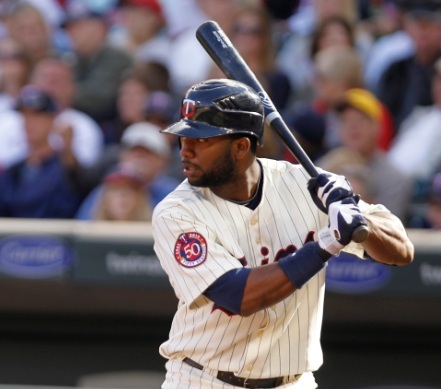
The team gets the lead-off hitter it has needed for years in Denard Span. Photo Bruce Kluckhohn/Minnesota Twins via twitter

At least Nats fans can start understanding the team’s off-season plans a little more clearly now.  The first domino has fallen.  The Nats acquired Denard Span from Minnesota for Alex Meyer yesterday.

I’ve argued against a center field acquisition for a while now.  Here’s three primary reasons why:

1. I don’t feel the Nats needed a center fielder.  Bryce Harper put up a 17.6 UZR/150 in 715+ innings while showing a plus-plus arm (both statistically and for any casual observers).   He’s just turning 20.  There is no reason to think he cannot ably patrol center for at least the next few years.  I’ve used this analogy before, but I feel like its the Yankees approaching Mickey Mantle after his first season in center and saying, “Hey Mick, we like you in center but we have this barely above league average guy At least until point #2 possibly comes to play:

2. Brian Goodwin, along with Destin Hood, Eury Perez, Michael Taylor and any other marginal OF prospect the team has is now effectively blocked for at least the next 3 years and possibly longer.  Span is signed through 2014 (with a very affordable 2015 option), Jayson Werth signed through 2017, and Harper is under team control through at least 2017.   There’s your outfield for the next 3 years guaranteed, 2/3rds of which is locked up for the next 5.  I just feel that the better path would have been to let Harper play CF until Goodwin or Perez seems ready (clearly Godwin is an upper-end prospect who has impressed ever since he was drafted, and the team didn’t add Perez to their 40-man roster just to give him the extra salary) and just make do with a slugger in left field.

3. The loss of Alex Meyer represents the best healthy starter arm in the entire system, a system which is becoming thinner and thinner (with this trade on the backs of the Gio trade I’d guess the Nats are now going to be in the bottom 5 farm systems when rankings start coming out).  You can argue whether or not Meyer was going to stick as a starter (see the “bright side” points below), but inarguably this weakens the farm system in general and further weakens a specific problem that may pop up sooner than later; starting pitcher depth.  If one of our big 4 suffers a spring training injury, it is difficult to see who may step up and be counted on for starts.

This move clearly forces the Nationals hand on Michael Morse, and now the team may end up negotiating from a point of weakness if they need to move him.  The decision path for the team now is clearly “Morse or LaRoche” at first base.  If the team does bring back Adam LaRoche suddenly Morse is without a lineup spot and his trade value diminishes quickly.  If the rumors are true that LaRoche is “only” seeking a 3 year deal, the Nats should stumble over themselves to offer him a 3 year deal (3yrs $40M seems more than fair based on what LaRoche did for us last year) and lock up the plus-defender/middle of the order bat.

This move also cannot be a happy day for Tyler Moore; he’s clearly set on being a backup now in 2013 no matter what happens with Morse/LaRoche, despite promising numbers in 2012.   Well, unless the team fails to re-sign LaRoche AND moves Morse (which I suppose is still possible but would make little sense), which would then install Moore as the every day first baseman.  Between Moore, Morse possibly being out of a position and Goodwin being blocked for years to come, you have to think we’re going to see some more moves involving these players (hopefully to acquire a starter, or some starter depth in the minors).


Now, on the bright side (since I’ve been accused of being too negative in my analysis), I will say the following:

1. We did not give up a ton for Span.  I like Meyer, but I’m afraid he may not stick as a starter.  The scouting knock on him has always related to his tall frame and repeatability of his delivery.  He has a funky leg kick and slightly weird mechanics, further muddying the waters.  Lastly he’s a huge guy and he (at first glance in videos) seems to really throw standing up and doesn’t use a ton of his lower body.  All of this spells “reliever” in his future.  If Meyer tops out as a fireballing reliever, this trade looks even better.

2. Span inarguably fills a need; a high OBP leadoff hitter.  He’s a .357 career OBP guy with speed and who hits lefty, a nearly perfect fit for what this lineup needs at the top.  Leadoff hitters generally come from one of three positions: CF, SS and 2B.  If the team decided it NEEDED a leadoff guy, and with Desmond and Espinosa locked into the SS and 2B slots for the time being, clearly the only place the team could go was a center-fielder.  The USAToday article linked at the top said it best (paraphrasing): this move is as if you bought a new chair for your living room, which forced you to have to move around your furniture.  You didn’t necessarily need the new chair, but it certainly makes your living room look better.  This move enables Werth to move further down in the lineup and return to his power stroke.

3. We didn’t spend good money after bad on BJ Upton or Michael Bourn, who’s 5yr/$75M demands would have been a real waste of money.  Span’s contract is great: 5yrs for $16.5M guaranteed plus a $9M option in 2015.   The Nats acquired a desired resource without appreciably increasing payroll, allowing them to focus (perhaps) on a FA starter.

Initial reaction to the trade in the Baseball World seems mixed, which is great since it probably indicates that this is a pretty fair trade all in all.  Keith Law doesn’t like it of  course, but that’s because Law believes every low-minors big arm is turning into Justin Verlander (Law also thought the Gio Gonzalez trade was a “huge win” for Oakland because they got AJ Cole, the same AJ Cole who put up a 7.82 ERA in high-A this year and was forced to repeat Low-A).  Meanwhile Dave Cameron calls this a “huge win” for Washington, focusing on Span’s numbers and mentioning the same concerns about Meyer that I do.  Rob Neyer pays a complement to Mike Rizzo and the Nats and says the team is well-positioned for several years.  Ken Rosenthal talks about the about-face the franchise has done in the last 3 years in the eyes of potential Free Agents, specifically Zack Greinke, who declined the Nats trade offer 2 years ago but now could be the final piece in building a juggernaut.


Coincidentally, those who think this moves Harper to LEFT field may be mistaken.  Werth’s defense in right has inarguably slipped (he posted a -14.2 UZR/150 in right this year, a significant drop from his previous decent-to-good seasons there).  I think Harper should play right field, with his gun for an arm protecting against 1st-to-3rd runners while Werth should immediately put up great UZR numbers in left.  Possible lineup in 2013 (assuming for now that LaRoche is leaving):

  1. Span (L) – CF
  2. Werth (R) -LF
  3. Zimmerman (R) – 3B
  4. Harper (L) – RF
  5. Morse (R) – 1B
  6. Desmond (R) – SS
  7. Espinosa (S) – 2B
  8. Suzuki (R) – C
  9. Pitcher.

L-R-R-L-R-R-S-R for good balance.  I could also see Desmond and Werth switching spots in the lineup.  Harper to cleanup may be a bit early, but without adding another lefty bat the lineup could have too many right-handed hitters in a row.

Now, what if LaRoche re-signs?  Then suddenly this lineup has pretty good balance.  With LaRoche in the fold i’d probably go like this:

  1. Span (L) – CF
  2. Werth (R) -LF
  3. Harper (L) – RF
  4. Zimmerman (R) – 3B
  5. LaRoche (L) – 1B
  6. Desmond (R) – SS
  7. Espinosa (S) – 2B
  8. Suzuki (R) – C
  9. Pitcher.

That’d be a slight modification over where these guys hit last year, but would give nearly perfect lefty-righty balance.


In the end, you have to give up something you value to get something you value.  The Nats made a good trade, despite my thinking they didn’t need to make the trade in the first place.  They’re an improved team on the field for 2013.

2013 Projected Pitching Staffs and Rotations; entire Nats system

7 comments

After finishing the evaluation of all 6 minor league pitching staffs, plus finally finishing (and posting yesterday) the MLB season review,  here’s an entirely too-early projection of what the staffs and rotations may look like in 2013.  This post assumes for the time being that all major and minor league FAs will opt out and we’ll be looking to fill spots.  In these cases I’ll mark FAs to be as needed, though we very well may acquire these players in trade.

Note: some of these projections are slightly different from the original reviews posted in the per-level links, to account for moves, performances and roster moves that have already happened or seem set to happen this off-season.  I’ve also made some slight adjustments in order to make the rotations and bullpens work at each level.

(notations: FA = free agent, MLFA == Minor League Free Agent)

Staff Review links: MLB is here, AAA is here, AA is here, High-A is here, Low-A is here, Short-A is here, GCL is here.

  • MLB Rotation: Strasburg, Gonzalez, Zimmermann, Detwiler, FA or other acquisition
  • MLB Bullpen: Clippard, Storen, Mattheus, Stammen, Garcia, a FA left-hander (possibly Burnett), a FA long-man (possibly Gorzelanny).
  • MLB notables Out of Organization: Jackson, Burnett, Gonzalez, Lannan, Wang

MLB Narrative: 4/5ths of the rotation are no-brainers.  The 5th starter is the question mark for 2013.  Do we re-sign Jackson and pay him more as a 5th starter than our big 3 guys?  It doesn’t seem so after the team declined to give him a Qualifying Offer.  Do we trade from depth (RH relief, middle infield) and find a 5th starter that way?  Do we find a 5th starter from within?  Meanwhile the bullpen is now full of hard throwing righties, but we could lose all 3 of our lefties.  We may need to work the phones to retain these guys, or else we’re on the FA market.  I think (despite my discussion about converting Garcia to a 5th starter) that he’ll remain in the bullpen and may bump Henry Rodriguez out of a job.  One of our two closer-quality guys (Clippard and Storen) could be moved, cashing in on their value, which could open up a spot for a FA acquisition or a promotion from AAA.

Lots to be decided this off-season for Mike Rizzo, and this hasn’t even mentioned the dominos that will fall if/when the team makes a contract decision on Adam LaRoche.

  • AAA Rotation: Roark, Maya, Broderick, Meyers, Perry
  • AAA Bullpen: Tatusko (swingman), Arneson (swingman), Severino (loogy), Davis, Lehman, Nelo (closer), Martin,  Mandel

AAA Narrative: We have a lot of long-serving minor leaguers here; as it stands now only a few of them are even 40-man roster guys (Maya, Perry, Garcia).  The modern AAA roster construction is one of “spare parts” and prospects; do we have enough prospects to cover for injuries at the MLB level?  Which one of these AAA starters would Nats fans feel comfortable filling in were one of our starters to go down with injury?  Perhaps the Nats need to work on some starter depth via trade.  Brad Meyers was just returned from the Yankees after a season-long DL stint after being Rule-5 drafted, and seems likely to slot right back into the AAA rotation when he’s healthy.  Perry seems set to get a 4th option and should slot in here, looking to convert back to being a starter.  Broderick is a former Rule-5 pick and was claimed from St. Louis, who dumped him late last season.  I don’t think he’s anything more than a 4-A starter, but the organization seems to like him.

  • AA Rotation: Rosenbaum, Holder, Gilliam, Karns, Grace, Demny (swingman?) or MLFA?  Solis if he’s healthy?
  • AA Bullpen: Frias, McCoy, Selik (maybe high-A again), Holland (setup), Wort (closer), VanAllen (loogy), Demmin (maybe high-A again), an org arm or two to fill in.

AA narrative: We have a couple of interesting candidates in the AA rotation to start, but what may be more interesting is to see whether the likes of Gilliam and Demny hold onto their spots with the talent ready to rise up out of high-A.  Meanwhile, the bullpen has some interesting arms to keep an eye on.  I forgot to mention Solis in the AA write-up but remembered him here.  Two big questions for me in this AA rotation for 2013: 1) is Rosenbaum for real or is he going to sputter out before reaching MLB potential?   And, 2) Is Nathan Karns ready to make the leap?  I think Karns can quickly put his name in the mix to get promoted to AAA based on his performance in 2012.

  • High-A Rotation: Swynenberg, Ray, Meyer (maybe AA?), Schwartz (maybe low-A), Rauh (maybe low-A)
  • High-A Bullpen Competition: Barrett (maybe AA) , Testa, Smoker (loogy), Hill, Meza (perhaps a starter?), Holt, Hawkins, Bates, Mirowski
  • High-A bullpen Release candidates: Olbrychowski, McCatty, Applebee

High-A narrative: there’s too many arms for too few slots right now in all three of the A-levels.   There’s a ton of release candidates, and some guys who could be higher or lower.   I’d love to be a fly on the wall at the organizational meetings where all this evaluation is done.  Meyer dominated High-A last year; could he start in AA?   Barrett (by virtue of his AFL appearance) may also be AA material.

The same goes for the Low-A team below: I’ve got 5 logical rotation candidates, another 4 guys who make sense to be in the low-A rotation, and a slew of guys who seem to have earned their way to the low-A bullpen.  But there’s only 7 slots to go around.

  • Low-A Rotation: Turnbull, Jordan, Purke (if healthy), Monar, Mooneyham
  • Low-A Rotation Competitors: Hansen, Lee (loogy if not), Encarnation, McGeary (if finally healthy)
  • Low-A Bullpen Competition: Anderson, Estevez, Dupra, McKenzie, Henke, Davis, Boyden, Benincasa, Hudgins, Dicherry, Mudron

We acknowledge the folly of trying to predict short-season staffs which will mostly be populated with 2013 draftees, especially under the new CBA that shortens negotiation times, making it more likely college seniors are drafted (who sign quickly with zero leverage) and get playing.  That being said, there will definitely be guys who stay in extended spring training for a couple months and then get placed on these rosters along with new draftees.  Here’s some guesses based on 2012 performances; all blank spots filled by 2013 draftees or by some of the guys who drop down from low-A.

  • Short-A Rotation: Baez, Pineyro
  • Short-A Bullpen: Smith (if not released), Fischer, Medina, Pena, Mendez

GCL blank spots filled by younger 2013 draftees (HS, Juco and college juniors/seniors from smaller schools) and by rising DSL grads.

  • GCL Rotation: Mieses (if not released), Barrientos, Vasquez
  • GCL Bullpen: Heredes

Nats 2012 Minor League Rotations: Guesses and Results

5 comments

Yunesky Maya led the Nats minor league starters for the 2nd straight summer. Photo Jim McGregor/Syracuse Chiefs via milb.com

I stumbled across this post, titled “Updated Minor League Rotation Predictions for 2012,” posted March 1st 2012, while looking for something else last week.  And I thought to myself, hey now that I’ve finished the reviews of the minor league teams, lets see how I did predicting the rotations at the beginning of the season!   I’ve also culled through the post-2011 season review posts for some preliminary guesses at the time.

(Note: I linked to NationalsProspects.com Luke Erickson‘s guesses in the above link for another perspective in the 2012 spring training).

Players are bolded the first time they’re mentioned, but not afterwards.

AAA:

  • Sept 11 Guess: Maya, Milone, Stammen, Meyers, Peacock, Martis
  • Mar 12 Guess: Stammen, Maya, Arneson, Ballard, Buschmann
  • Opening Day Rotation: Atkins, Roark, Maya, Lannan and Duke
  • 5 guys with the most starts in 2012: Maya, Roark, Duke, Lannan, Atkins

What happened?  My prediction was way, way off; only Maya was the constant, but we knew that the second he proved he couldn’t get out MLB hitters last fall.  The team traded two of its probable AAA starters (Peacock and Milone), lost a third to the Rule-5 draft (Meyers, who honestly we probably will get back once the Yankees are done screwing around with him) and a 4th to Minor League Free Agency (Martis).  Meanwhile, who knew that Lannan wasn’t going to make the MLB opening day roster?  Then, the team released Buschmann before he appeared in a game (he played 2012 in the Tampa Bay organization).  Ballard was a starter, just not in AAA.  Stammen, in a surprise to me, made the conversion from AAA starter in 2011 to MLB bullpen guy and had a great  year.  Lastly, instead of using more internal options like Roark the team signed two MLFAs in Duke and Atkins.  I suppose I could have guessed that the team would go with Roark before Arneson as a starter (given Arneson’s rubber-armed handling in 2011).  It just goes to show how much the creation of AAA teams has changed over the years.

AA:

  • Sept 11 Guess: Rosenbaum, BronsonDemny, Olbrychowski,  Solis
  • Mar 12 Guess:  Rosenbaum, Bronson, Demny, Olbrychowski, Gilliam
  • Opening Day Rotation: Gilliam, Demny, Mandel, Rosenbaum and Ballard
  • 5 guys with the most starts in 2012: Rosenbaum, Demny, Gilliam, Perry, Ballard/Pucetas

We were a bit closer here, getting 3 of the 5 guesses right.  Sammy Solis would absolutely have been in this rotation if not for his Tommy John surgery; we’ll cross our fingers for him to return in 2013.  When Solis went out, org-arm Mandel filled in.  Evan Bronson is still with the organization on Milb.com but never threw an inning in 2012 and isn’t on the Big Board.  I can’t find a single bit of google information indicating if he’s still with the team or not.  Weird.  Meanwhile I had just guessed too high for Olbrychowski; he spent most of 2012 as a starter in Potomac.  Nobody could have guessed that we’d have traded Balester for Perry, that Perry would have stunk as a reliever, and then would show up in AA remaking himself as a starter.  Ballard and Pucetas were MLFA pickups designed to fill holes in the system, though based on his prior experience I had Ballard pegged in the AAA rotation.

High-A:

  • Sept 11 Guess: Selik, Grace, Purke, Meyer, Hill, Karns
  • Mar 12 Guess:  Selik, Grace, Purke, Meyer, Hill
  • Opening Day Rotation: Winters, Hansen, Olbrychowski, Grace and Swynenberg
  • 5 guys with the most starts in 2012: Grace, Ray, Swynenberg, Olbrychowski, Karns

I was far off here as well; Purke got hurt, Meyer, Hill and Karns started lower than I would have guessed  and Selik was converted to a reliever.  I was right only on Grace (thought technically I thought Olbrychowski would be a starter, just not back in Potomac).  Winters was a MLFA (the fifth such MLFA who has appeared as a primary starter in our top three levels; is this a statement of some sort?).  As we’ll see in a moment, I was right about Hansen, just wrong about the level.  Lastly Swynenberg came out of nowhere; he was effective in middle-relief in low-A; who knew he’d win a spot in the high-A rotation?  I thought Ray would have done a few turns in low-A; instead he debuted in Potomac and struggled to make the jump.  I lost faith in Karns between September 2011 and March 2012; as it turned out he was one of the 5 top starters (in terms of appearances) for the year while putting in a career season.

Low-A:

  • Sept 11 Guess: Hansen, Jordan, Cole, Ray, Estevez, McGeary
  • Mar 12 Guess:  Turnbull, Hansen, Ray, McGeary, Karns
  • Opening Day Rotation: Estevez, Dupra/Karns, Meyer, Turnbull/Hill, McKenzie
  • 5 guys with the most starts in 2012: Hill, Meyer, Turnbull, Estevez, Hansen

What happened?  The team traded Cole.  Jordan was injured more than we were led to believe in late 2011 (he had Tommy John surgery after the season was over).   I predicted Hansen, Ray, Hill, Estevez, Meyers and Dupra would be starters, just got the levels wrong.   My Mar 12 guesses were somewhat accurate in that we got Turnbull and Karns right.  McGeary struggled through yet another injury filled season and may be nearing the end of his baseball career.  I thought Estevez was getting squeezed out with all these high-profile starters rising up.  I figured McKenzie had lost his starting shot; clearly his performance in 2012 should end his chances at getting another 2013 starting shot.  I guess the lesson here is that it can be awful difficult to determine the difference between a High-, Low- and Short-A guy.

Short-A:

  • Sept 11 Guess: Manny Rodriguez, Dupra, Baez and two draft picks.
  • Mar 12 Guess:  Manny Rodriguez, Dupra, Baez and two draft picks
  • Opening Day Rotation:  Jordan/Medina, Baez, Monar, Encarnation, and Smith
  • 5 guys with the most starts in 2012: Encarnation, Monar, Lee, Mooneyham, Fischer/Pineyro

My guess of 3 returners and 2 draft picks wasn’t entirely accurate; there wasn’t a single 2012 draft pick in the 2012 opening day rotation.  We got Baez pegged correctly but the rest of the predictions were off.  Manny Rodriguez, a converted infielder, spent the whole year on the 60-day DL.  Dupra was in high-A.  Meanwhile, a couple of guys dropping down from Low-A (Jordan, Encarnation) comprised the rotation at the beginning of the season.  Monar was a repeater from 2011 who didn’t get a ton of innings last  year.  Eventually some 2012 draftees (Mooneyham, Fischer and others) got starts as expected, and helped drive Auburn to the playoffs.

GCL:

  • Sept 11 Guess: Mieses, King, Encarnation, Medina, Marcelino
  • Mar 12 Guess:  Mieses repeating plus 4 guys from DSL and the 2012 draft.
  • Opening Day Rotation:  Mieses, Barrientos, Pineyro, Vasquez, and Schwarz
  • 5 guys with the most starts in 2012: Vasquez, Mieses, Hudgins, Selsor, Pineyro/Schwartz

Finally we got one right (well, right from Mar 12 guess anyway).  The GCL rotation was Mieses, 3 DSL graduates and one 2012 draftee.  Eventually more 2012 draftees (Hudgins, Selsor and others) consumed most of the rest of the starts.  King disappeared from the rosters; he’s still in the organization but was never assigned this season.  Injured?  Disciplinary issues?   There seems to be so much inconsistency in the DSL graduates that it almost isn’t worth tracking them until they appear in a higher level.  Honestly, this is why I don’t really follow the Dominican Summer League teams either.

Phew; that’s a lot of Nats minor league starters.  As it showed, its really, really difficult to predict this stuff from a computer in Northern Virginia, scouting the stat lines.  But its really fun, so we’ll continue to do it :-).

GCL/Rookie Pitching Staff Year in Review; 2012

one comment

The biggest story in the GCL was also its worst; Giolito injury. Photo Eric Dearborn via win-for-teddy blog

Click here for the 2011 version of this post, for a look at how things were last year.

Here’s the GCL version of the 2012 season pitching staff review.  I’m going down the line from top to bottom; AAA is here, AA is here, High-A is here, Low-A is here and Short-A is here.  As with the other reviews, we’ll look at the main rotation, the substitute and spot starters, then focus on key relievers.  Rehab appearances are generally not mentioned.  The lower you get in the minors, the harder it is to really pass judgement on a player’s real capabilities or career outlook, so take some of these evaluations with a grain of salt.  They say not to depend on small sample sizes and I agree; we’re doing after-the-fact analysis on a small sample size of a half a pro season in most cases.  This is especially true with Short-A and the GCL, where most of the roster are 2012 draftees.   So “outlook for next season” is almost entirely a guess for these players.  A ton of them will be left in extended spring to compete for next year’s short-season team, while a ton more will be released without much fanfare.

The rotations in the lower minor leagues are also not nearly as clean as in the upper-levels.  Lots of times the “starter” is slated to go as many innings as the “reliever,” a way to get two starter candidates longer stretches of innings.  We’ll try to take that into consideration as we move forward.

GCL starters.  The rotation started the season with Mieses, Barrientos, Pineyro, Vasquez, and Schwartz.   Lets see how the original rotation and other primary starters fared.

  • Adalberto Mieses put in his second poor rookie league season, posting a 5.05 ERA in 41 innings over 13 appearances and 6 starts.  He hasn’t appreciably improved over last year, which saw him put up similar numbers in the same league.  Outlook for next Season: GCL rotation competition or released.
  • Joel Barrientos pitched 45 innings as a swing-man/spot starter and posted respectable numbers (4-1 with a 3.00 era).  Especially considering that he turned 19 about a month ago.  The fact that he’s a tall lefty (though he must look emaciated; 6’2″ 145lbs?) is a bonus.  Outlook for next Season: Perhaps the low-A bullpen but more likely repeating GCL as a starter.
  • Ivan Pineyro dominated the GCL for 5 starts and got bumped up to short-A.  Outlook for next season: (from the Short-A post): Repeating short-A in the rotation.
  • Daury Vasquez was the GCL work horse, leading the staff in starts and IP.  The DSL grad actually improved on his 2011 DSL numbers (a hard feat), putting in work-man like stats of 4-6, 4.10 ERA in 52 2/3 inningsOutlook for next Season: He has  yet to turn 20, so I’d guess he repeats GCL as a starter.
  • Blake Schwartz didn’t seem to merit a two-level promotion, but he out-performed his 5 GCL starts in Hagerstown.  Outlook for next season: (from low-A post): high-A rotation, based on his status as a college senior grad.
  • Casey Selsor was drafted as an OF but threw 41 1/3 GCL innings in 2012 to a 6.10 ERA.   He was a college senior draftee who couldn’t get guys out in GCL; not a good sign for his future.  Outlook for next Season: low-A bullpen competition or released.
  • Wil Hudgins pitched mostly in the GCL after getting picked in the 22nd round this year and was pretty effective in 10 appearances and 6 starts.  4-3, 2.21 era and a great k/bb ratio of 25/3 in 36 2/3 innings.  Unfortunately, Hudgins is a college senior draftee throwing in the rookie league, so anything other than dominance is viewed as failure.  Outlook for next season: low-A bullpen competition.
  • Dixon Anderson threw a bunch of “rehab” innings in the GCL before finishing out the year in low-A.  Outlook for next season: (from Low-A post): competing for low-A rotation, dropping to bullpen.
  • Lucas Giolito, 2012’s #1 draft pick, threw 2 innings after rehabbing a partially torn UCL all summer and fully blew it out.  Tommy John surgery, see you in 2014.


  • Other guys who got spot starts here and there (non-rehab):
    • Anthony Marcelino appeared in one game, the 2nd GCL game of the season, pitched 4 innings and was subsequently released.  (?!).  I have no idea why.  Very odd; he worked through an injury all of 2011 and seemed ready to compete in 2012.
    • Kylin Turnbull, 2011’s 4th round pick who signed late and didn’t play in 2011, threw a few starts in the GCL to work out some kinks before returning to Hagerstown.
    • Wirkin Estevez threw three 3-inning rehab starts mid-season before returning to Hagerstown.
    • Ronald Pena made three “starts” of 2 innings each despite really being a reliever and then finished the season in short-A.
    • Andy Santana was relatively awful in 13 appearances and 2 starts; a 6.46 era in 23 2/3 innings.  It is hard to see a future for him after basically failing the rookie league two years in a row.
    • Gilberto Mendez looked pretty good in 33 1/3 GCL innings: 34/4 k/bb ratio and a 3.24 era.  He wasn’t nearly as effective upon reaching short-A.

GCL Relievers: taking a look at the relief corps at the end of the season.  These are done in order by IP for any reliever who didn’t get at least one start.  I’m basically ignoring any reliever who threw 9 or fewer innings in the GCL or who didn’t get a spot-start and is already mentioned above.

  • Inocencio Heredes threw 31 innings of good relief in the GCL this year, improving on his 2011 showing.   Outlook for next Season: maybe competing for a full-season bullpen spot but likely repeating GCL.
  • Kevin Dicherry was a college senior draftee who served as the closer in the GCL.  Good numbers, as you would expect.  He needs to be challenged.  Outlook for next Season: low-A bullpen competition.
  • Mike Mudron threw 24 relief innings in the GCL after he was drafted in the 32nd round as a college senior.  Outlook for next Season: low-A bullpen competition.

Summary

We all know by now that GCL is essentially used for two things: an entry point for graduating Dominican Summer League guys plus a first stop for the younger guys each draft class (High schoolers, juco guys and college guys from smaller programs).  Lots of guys never make it past the GCL, so there’s a lot of churn.  Records are nearly meaningless since so many rehab guys pass through working on a pitch or working out kinks.

Auburn/Short-A Pitching Staff Year in Review; 2012

9 comments

Brett Mooneyham was probably the biggest name in Auburn this year. Photo unknown via mlbdraftcountdown.wordpress.com

Click here for the 2011 version of this post, for a look at how things were last year.

Here’s the Short-A version of the 2012 season pitching staff review.  I’m going down the line from top to bottom; AAA is here, AA is here, High-A is here, and Low-A is here. As with the other reviews, we’ll look at the main rotation, the substitute and spot starters, then focus on key relievers.  Rehab appearances are generally not mentioned.  The lower you get in the minors, the harder it is to really pass judgement on a player’s real capabilities or career outlook, so take some of these evaluations with a grain of salt.  They say not to depend on small sample sizes and I agree; we’re doing after-the-fact analysis on a small sample size of a half a pro season in most cases.  This is especially true with Short-A and the GCL, where most of the roster are 2012 draftees.   So “outlook for next season” is almost entirely a guess for these players.  A ton of them will be left in extended spring to compete for next year’s Auburn team, while a ton more will be released without much fanfare.

The rotations in the lower minor leagues are also not nearly as clean as in the upper-levels.  Lots of times the “starter” is slated to go as many innings as the “reliever,” a way to get two starter candidates longer stretches of innings.  We’ll try to take that into consideration as we move forward.

Auburn starters.  The rotation started the season with Jordan/Medina, Baez, Monar, Encarnation, and Smith.   Lets see how the original rotation and other primary starters fared.

  • Taylor Jordan got 6 rehab-ish starts for Auburn before finishing the season in Low-A post Tommy John surgery. Outlook for next season: (from low-A post) Low-A rotation again.
  • Gregory Baez made 3 starts and was clearly hurt in his last one (giving up 5 runs and 5 hits in a 1/3 of an inning) before hitting the DL, where he’s stayed the rest of the season.  No word on the actual injury.  Outlook for next season: get healthy, try out the Short-A rotation again.
  • Blake Monar was one of two guys who stayed in the rotation from start to finish, ending the season with a 2-3 record and a 3.29 ERA.  He averaged a K/inning, but gave up too many walks (30 in 54 2/3 innings) which drove up his WHIP.  That being said, he kept the ball in the park (only one HR in those 54+ innings) and worked around his base runners effectively (his FIP was lower than his ERA).  I think Monar is a good lefty starter prospect for 2013 and beyond.  Outlook for next season: low-A rotation with a look towards promotion to Potomac.
  • Pedro Encarnation gave low-A a shot but couldn’t cut it, so he dropped to Short-A.  He improved on 2011’s short-A outing by starting the whole season and putting up a 4.20 ERA that was better than it seemed (his FIP was 3.59).  Outlook for next season: a repeat of 2012; he’s getting another shot at the low-A rotation, probably dropping to bullpen.
  • Nicholas Lee made the jump from wild bullpen lefty in 2011 to effective starter in 2012.  He was 3-1 with a 3.77 ERA in 62 mostly starting innings.  He cut down on his walk rate, he kept his stellar K/inning rate, and kept the ball on the ground (2 homers in 62 innings and a 1.48 go/ao ratio).  Per Nationalsprospects, he’s “not a hard thrower and scouts love his change-up.”  His FIP was nearly a point below his ERA, indicating that he was even more effective than we thought.  I like this guy; his only issue is being an undersized lefty, and thus having a tendency to be type-cast as a Loogy.  Outlook for next season: Low-A bullpen; I can’t see him sticking as a starter.
  • Brett Mooneyham was the 2nd biggest name out of our 2012 draft, going 3rd round out of Stanford (and after having gotten picked by the Nats twice before).  He’s a big, projectionable lefty who was effective in his first 10 pro appearances (2-2 with a 2.55 ERA).  But where’s the dominance?  Only 29 Ks in 42 innings.  I tend to agree with John Sickels‘ analysis, as stated here.  I’ll quote: “Just like in college: looks like a pitcher, good arm, but doesn’t dominate the way you think he should.”  Outlook for next season: Low-A rotation.
  • David Fischer was an 18th round 2012 draft pick who started the year in the bullpen and ended it in the rotation (probably to make up for promotions).  Numbers were soso; 4.96 ERA in total, slightly better in 8 starts.  I’m not sure he’s done enough to win a rotation spot in any 2013 team.  Outlook for next season: Repeating short-A in the bullpen.
  • Ivan Pineyro dominated the GCL, moved up to short-A and was not as effective, getting shelled his last two outings to balloon his ERA to 5.50 in 34 1/3 short-A innings.  It took him a year to solve GCL, perhaps it’ll take him 2013 to solve short-A.  Outlook for next season: Repeating short-A in the rotation.
  • Brian Rauh earned a quick promotion out of Short-A and finished the year in Hagerstown. Outlook for next season: (from the low-A post): low-A rotation.


  • Other guys who got spot starts here and there (non-rehab):
    • Silvio Medina got four spot starts amongst 16 short-A appearances and was something of a “wild thing;” 9 hit batsmen and 5 wild pitches to go with 20 walks in 47 innings.  His 4.98 ERA was well-earned.  He did average a K/inning.  The DSL graduate turned 22 and finished his 3rd pro season.  Outlook for next season: I could see him trying the low-A bullpen despite his numbers; he can always drop back down if he can’t cut it there or loses out amongst stiff competition.
    • Jason Smith had one spot start and 11 other appearances; he was basically awful in all of them, to the tune of a 7.94 ERA in 22 2/3 innings before getting shut down in early August.  This 2011 undrafted free agent was good in 2011 in the rookie-league but couldn’t make the jump in 2012.  Outlook for next season: short-A bullpen, if not released.
    • Wil Hudgins pitched mostly in the GCL after getting picked in the 22nd round this year.  Outlook for next season: see GCL post.

Auburn Relievers: taking a look at the relief corps at the end of the season.  These are done in order by IP for any reliever who didn’t get at least one start.

  • Travis Henke pitched most of the year in long-ish relief for Auburn and was pretty effective: 7-1, 2.78 ERA and good ancillary numbers.  Outlook for next season: low-A bullpen competition.
  • Cody Davis is a fighter; non-drafted 2011 FA who is just 5’9″ and 170 (hell, that’s my size.  Well, not the weight part anyway) but puts up good numbers from the hill.  2012: 50 Ks in 42 innings and a 3.64 ERA.  He faces an uphill battle though because of his size.  He’s got nothing left to prove though in either short-season league.  Outlook for next season: low-A bullpen competition.
  • Derek Self was the Auburn closer and had effective numbers, but not the dominant K/9 rates you’d expect.  Stats: 3.27 ERA in 33 innings and 16 saves.  He’s got the same issue Mooneyham does; big arm (92-95mph), projectionable frame (6’3″ 205lbs), but missing dominance.  Maybe he needs another pitch, or 20lbs of muscle on his body.   Nonetheless, there’s no reason to think he won’t move up next season.  Outlook for next season: low-A bullpen competition, though I doubt he sticks as a closer.
  • The Nats took a flyer on local product Michael Boyden and it may be paying off; he had a 1.07 ERA in 33 2/3 innings between the two short season teams.    That ERA was slightly lucky; he had 17 walks in 25 short-A inningsOutlook for next season: low-A middle-reliever.
  • Robert Benincasa showed power stuff with impeccable control in his limited time in Short-A.  23 1/3 innings, 32 Ks and just 3 walks.  Great season.  Can’t wait to see what this 7th rounder in 2012 out of Florida State can do at the next level.  Outlook for next season: low-A bullpen.
  • Jack McGeary threw a total of 9 1/3 pro innings in 2012, only coming off the DL in early August.  Outlook for next season: low-A rotation competition for what may be his final season in the organization.
  • Richie Mirowski threw 7 innings in short-A before finishing the season in low-A.  See Low-A post.
  • Ronald Pena and Gilberto Mendez each started the year in the GCL and got a cup-of-coffee in Auburn.  Both seem to feature as short-A bullpen candidates in 2013.
  • Other Relievers who appeared in Short-A (not including Rehabbing MLBers).  Some of these guys threw fewer than 10 innings on the year, not nearly enough to write-up.  Outlook for next season for all of these guys seems the same: another season in the low minors, struggling to make an impact.
    • Elliott Waterman 22 walks in 25 innings.  Needs to improve.
    • Bryan Harper had big K/9 rates but not much else.  He’ll need more than a famous younger brother.
    • Andrew Wall was mediocre in a handful of relief innings after signing as a non-drafted FA this year.
    • John Peters threw a handful of innings for Auburn but ended the year in GCL.

Summary

Auburn made the playoffs behind the strength of its pitching.  All up and down the staff you see dominant performances.  This bodes well as these guys matriculate to Hagerstown and beyond in 2013.

Hagerstown/Low-A Pitching Staff Year in Review; 2012

7 comments

Closer Aaron Barrett was one of the best stories of the year for Hagerstown’s pitching staff. Photo unknown via thephilosophersstone2011.blogspot.com

Click here for the 2011 version of this post, for a look at how things were last year.

Here’s the Low-A version of the 2012 season pitching staff review.  I’m going down the line from top to bottom; AAA is here, AA is here, High-A is here. As with the other reviews, we’ll look at the main rotation, the substitute and spot starters, then focus on key relievers.  Rehab appearances are generally not mentioned.  The lower you get in the minors, the harder it is to really pass judgement on a player’s real capabilities or career outlook, so take some of these evaluations with a grain of salt.

The rotations in the lower minor leagues are also not nearly as clean as in the upper-levels.  Lots of times the “starter” is slated to go as many innings as the “reliever,” a way to get two starter candidates longer stretches of innings.  We’ll try to take that into consideration as we move forward.

Hagerstown starters.  The rotation started the season with Estevez, Dupra/Karns, Meyer, Turnbull/Hill, and McKenzie.   No less than 18 different guys started a game for Hagerstown this year (two of them on rehab assignments).  Lets see how the original rotation and other primary starters fared.

  • Wirkin Estevez was 5-2 with a 5.76 ERA in 12 low-A starts in the early and later parts of the season; he missed two full months with an unspecified injury.  He was no better after returning than before.  He was frequently victimized by the long ball, giving up 6 in 60 innings.    Outlook for next season: he’s young (turned 20 in March, if you trust D.R. birthdays) and he was effective last year in short-A.  He returns to low-A, but is dumped to the bullpen in the face of a glut of competition for rotation spots.
  • Brian Dupra got absolutely lit up in 11 appearances (8 starts) in April and May before suffering a season-ending injury 5/31.  Line on the season: 3-4 with a 7.17 era in 37 2/3 innings.  Outlook for next season: bullpen arm in Low-A.
  • Nathan Karns threw 44 outstanding innings in low-A before he was deservedly promoted to Potomac.  We discussed him at length there.  Outlook for next season: (from high-A post): AA rotation.
  • Alex Meyer was 7-4 in 18 starts for Hagerstown before getting promoted to Potomac.  We discussed him at length there. Outlook for next season: (from High-A post): High-A rotation again with an eye towards quick promotion to AA.
  • Kylin Turnbull got his first pro innings in 2012, being a relatively high draft pick (4th rounder) in 2011.  The 21-yr old lefty gave Hagerstown 89 mediocre innings, going 4-5 with a 5.16 ERA.  Not bad for a first full season.  He gave up a lot of hits though, and his whip was 1.51.  That’s lots of base-runners turning into lots of runs.  He was sent down mid-season to the rookie league to work on “mechanics,” returning the last day of the season (for some reason) to put in one relief appearance. Outlook for next season: Repeating low-A (in the rotation) looking for improvement.
  • Taylor Hill was the Hagerstown workhorse, leading the staff in innings pitched with 124.  He went 10-6 with a 4.92 era on the year.   Outlook for next season: I worry for the 2011 6th round college senior; unless he can be a bit more dominant on the mound, he’s not long for pro baseball.  He is relatively young for a college grad; he’ll be entering his 3rd pro season and turning 24 in March.  I’d guess he’ll get moved to the high-A bullpen in 2013 as a nod to his age/experience.
  • Chris McKenzie had his third straight rough year in the starting rotation, failing to improve on last year’s low-a showing.  Final stats: 2-3 with an ugly 8.64 ERA in 26 appearances and 8 starts.   Outlook for next season: the organization can’t give him a rotation spot again can they?  Low-A bullpen.
  • Bobby Hanson fared little better in low-A than he did in high-A, getting demoted mid-season.  After 11 starts and a 4.55 ERA he hit the DL, where he’s stayed the rest of the season.  Outlook for next season: As pointed out in the High-A post, he’s young but he’s entering his 6th pro season and has yet to really master low-A.  He’s a big lefty though (6’6″, 235lbs) so the team probably salivates at his potential.  He’s just not as dominant as he needs to be.  I’d guess he’s getting another shot at the low-A rotation in 2013.  But it may be his last shot.
  • Taylor Jordan was a favorite of mine after his stellar 2011 season in low-A.  Unfortunately he had to get Tommy John Surgery (done in mid September 2011), so 2012 is a come-back/rehab year.  He seemed to be back really, really early though; he got his first 2012 start 9 months after surgery.  On the year: 3-7 with a 5.13 ERA in 15 starts and 54 1/3 innings.  You can’t beat that for a rehab year.  Outlook for next season: leading the low-A rotation with an eye towards a quick high-A promotion in 2013.
  • Brian Rauh, the first 2012 draft pick mentioned in this series (and as it turned out one of only two 2012 draft picks to make it as high as low-A).  Rauh got 8 starts with Hagerstown in August after getting a quick bump up from short-A.  Results were ok: he was 3-3 with a 4.89 ERA in 8 games as a starter.  He only really had one bad start (his last) and would have had better season stats otherwise.  His K/9 rates were good and he may be an excellent find in the draft (he was an amazing 30-1 during his college career at Division III Chapman; check out his mini bio at milb.com).  Outlook for next season: low-A rotation.
  • Blake Schwartz, The 2nd, and last 2012 draftee pitcher to make it to Low-A this year was pretty good upon promotion to Hagerstown, going 1-1 with a 3.05 ERA in 7 late season starts.  The Nats have had some great luck with small-college pitchers (see Jordan Zimmermann and Ross Detwiler) and hope to continue with the likes of Rauh and Schwartz (from Oklahoma City University, an NAIA school).  Outlook for next season: high-A rotation, based on his status as a college senior grad.
  • Matthew Purke, as most Nats fans know, had three wild appearances in May before getting shut down on the season with continuing shoulder issues.  Outlook for next season: get healthy, try low-A rotation again.
  • Dixon Anderson, coming back from an injury that cost him all of 2011, looked good in a too-small-of-a-sample size of innings (26 between GCL and low-A).   He’s a big right-hander with good k/9 rates who was a little wild in low-A.  I wonder if he features more as an eventual reliever.  Outlook for next season: competing for low-A rotation, dropping to bullpen.


  • Other guys who got spot starts here and there (non-rehab):
    • Christian Meza had 36 appearances, 3 spot starts and a good 2.97 era in 88 low-A innings on the year.   A tall lefty with excellent K/9 rates, he excelled in 3 spot starts but remained mostly a middle-to-late innings reliever.  Outlook for next season: I’d try to feature him as a starter honestly, but i’d guess he ends up in the high-A bullpen.
    • Pedro Encarnation got a few innings in low-A after moving up from Short-A.  Outlook for next season: see short-A write-up.
    • Jason Smith got a call-up/spot start mid-season and got shelled.  Outlook for next season: see short-A write-up.

Hagerstown Relievers: taking a look at the relief corps at the end of the season.  These are done in order by IP for any reliever who didn’t get at least one start.

  • Gregory Holt gave the Suns 78 workman-like innings in 41 games, finishing the year with an era of 4.12.    Unfortunately it seems that result was rather lucky; his FIP was 5.18, a full point higher.   He’ll have to improve to stay in the organization.  Outlook for next season: high-A bullpen.
  • Ben Hawkins continues to be a late-round steal (he was a 36th round draft pick in 2011 out of baseball juggernaut West Florida) for the team, putting up a 3.55 ERA in 58 1/3 innings over 30 appearances, giving the team nearly a k/inning as a lefty.   He continues on a great 2011 as well.  He’s more than just a loogy, routinely putting in 2-3 innings per outing.   Outlook for next season: high-A bullpen.
  • Colin Bates closed a few games, was effective for most of the season (2.79 era in 51 2/3 relief innings) and has given the organization no reason not to move him up the chain.  He’s a little under-sized (6’1″, 175lb) and that may have him flying  under the radar as a prospect.   Outlook for next season: high-A bullpen.
  • Aaron Barrett got promoted to high-A after tearing through Low-A with 52 Ks in 34 innings.   See the high-A write-up for more. Outlook for next season: (as copied from high-A writeup) AA bullpen.
  • Richie Mirowski is another feather in the southwestern Nats draft staff’s hats; a 45th round pick in 2011 out of Oklahoma Baptist University was neat and effective upon reaching low-A this year.  He had a 2.00 era in 27 relief innings.  He had a few more walks than you’d like to see, but had over a K/inning to go with it.  45th round picks are usually throw-away picks on high schoolers who you don’t expect to sign; they’re not generally guys who put in sub 3.00 eras in successive seasons.  Outlook for next season: move him up; high-A bullpen
  • Other Relievers who appeared in Low-A (not including Rehabbing MLBers): Outlook for next season for all of these guys seems the same: another season in the low minors, struggling to make an impact.
    • Wilson Eusebio was inexplicably promoted after putting up a 6.78 ERA in 28 innings.
    • Bobby Lucas, GWU product and local kid, wasn’t good this year; a 7.67 ERA in 29 innings.  He was also incredibly wild; 36/31 k/bb in those 29 innings.
    • Alex Kreis had a 5.88 era in 26 innings for Hagerstown.  Nearly a 2.00 whip; he needs to improve.
    • Todd Simko, 2011 21st rounder, got 19 mostly wild innings in before going down with a season-ending injury in May.
    • Leonard Hollinshad a mostly nondescript 2012 season; he was a 29th rounder out of Juco in his first pro season.  He needs to show more swing-and-miss (only 8 Ks in 18 innings) capability to move up in this organization.
    • Travis Henke got lit up in 3 low-A innings and got dumped back to short-A.

Summary

Hagerstown had a mixed bag of starters early (some good, some bad), but got help down the stretch from 2012’s draft class.  It wasn’t enough for them in the end; losing out in the playoffs.

Potomac/High-A Pitching Staff Year in Review; 2012

2 comments

Nathan Karns parlayed his first healthy pro season into an Organizational POTY award. Photo Potomac Nationals official via milb.com

Click here for the 2011 version of this post, for a look at how things were last year.

Here’s the High-A version of the 2012 season pitching staff review.  I’m going down the line from top to bottom; AAA is here, AA is here.  As with the other reviews, we’ll look at the main rotation, the substitute and spot starters, then focus on key relievers.  Rehab appearances are generally not mentioned.

Potomac starters.  The rotation started the season with Winters, Hansen, Olbrychowski, Grace and Swynenberg.  Lets see how the original rotation and other primary starters fared.

  • Kyle Winters, an off season minor league free agent pickup, was Potomac’s opening day starter.  But he wasn’t long for the rotation; he got shelled en-route to posting a 7.02 era in 8 starts before getting released.  It does not seem like anyone else picked him up (except perhaps in Indy ball).  Lets be honest; it is never a good sign to have minor league free agents playing significant roles on high-A ball clubs.  Outlook for next season: in another organization or out of baseball.
  • High-A proved to be too much for Bobby Hansen, who put up a 5.85 ERA in 6 starts (9 total appearances) before being moved back to Low-A, where he spent 2011.  He’s young; he has yet to turn 23, so even low-A isn’t the worst place for him.  But he’ll be entering his 6th pro season in 2013 and you’d like to see him throw more than 50 innings in a season.  Outlook for next season: see the Low-A post.
  • Adam Olbrychowski wasn’t able to build on his 2011 season in High-A, regressing badly and posting a 6.24 ERA in 26 appearances (16 starts).  He lost his rotation spot halfway through the season and didn’t fare well out of the pen.   This trade didn’t work out for either team really (the Nats traded Justin Maxwell to the Yankees for Olbrychowski    in January 2011 and released him themselves; he now plays for Houston).  Outlook for next season: either one last shot in the High-A bullpen or released.
  • Matthew Grace put in his third year as a full-time starter with the Organization, and he continues to be hit or miss.  On the season he posted a 9-12 record with a 4.84 ERA and 83/48 k/bb ratio in 141 1/3 innings, but you never know what you’re getting with him.  His final start of the season featured 8 shutout innings, but his first start in August was a 3-inning 9 hit meltdown.  Outlook for next season: the organization stuck with him after a 5.17 ERA in a full season of low-A; no reason to think they won’t continue to stick with him in 2013.  AA rotation, perhaps re-peating High-A if the numbers don’t work out.
  • Matt Swynenberg was in and out of the rotation, not really excelling as either a starter or a reliever on the year.  7-5, 4.92 ERA on the season.   He was a bit unlucky on the season; he had a .343 BABIP and his FIP was a bit lower than his ERA.   Outlook for next season: he’s still young (turned 23 in February) and has plenty of time to improve.  And, given that he was a 28th round draft pick, anything he contributes is absolute gravy to the organization).   Look for him to be leading the High-A rotation in 2013 with an eye for mid-season promotion.
  • Robbie Ray was last year’s sensation, an 19-yr old dominating in Low-A.  He clearly suffered from a sophomore slump, going 4-12 with a 6.56 ERA in 22 “starts” (I put that in quotes since he had one 5-inning “relief” appearance in June).  What happened?  His K’s were down, Walks up, HRs up, BABIP unlucky, and his FIP was a full point and a half lower than his ERA.  So it wasn’t as bad as it looked.  Plus, he’s only 20 in high-A, where a lot of college guys take a year and a half to get to.  I’m not worried at all; i’ll bet he’s back to being dominant in 2013 repeating the level.  Outlook for next season: back in the High-A rotation.
  • Nathan Karns finally got a healthy full season of pitching under his belt after getting paid 3rd round money as a 12th round draft pick in the high-spending 2009 draft, and the organization finally got a look at what Karns can do: A 2.17 ERA in 24 appearances (18 starts) across 116 innings between low- and high-A.  This was no fluke either; all his advanced stats support his performance and give reason to believe he’ll continue to develop.  He was named the Organization’s Pitcher of the  Year for 2012, usually a great indicator of future success for this team.  He’s a big guy with a great pitching frame (6’5″, 230lbs) and an even better mustache (see his profile picture at milb.com).  I think Karns may be our best or 2nd best starter prospect right now.  A ight concern may be his hitting the DL in mid-August after a couple of mediocre outings; I’d guess that he’s reached an innings limit for the season and was shutdown with an unspecified injury.  This may also explain why he’s not appearing in the AFL after such a season.  Outlook for next season: AA rotation.
  • Trevor Holder finally got promoted past high-A after repeating the league for the 4th time in 2012.  He got 10 starts in Potomac before being moved up mid-season.  He was pretty good in his 9 starts in High-A this year: 3-3 with a 3.72 ERA. Outlook for next season: (from the AA post): AA Rotation.
  • Alex Meyer excelled in 7 late-season starts in Potomac after throwing 90 innings in low-A to start the  year.  Final high-A stats: 3-2 with a 2.31 ERA in 39 innings.  His ancillary numbers declined slightly moving from low- to high-A (as one would expect), but his core capabilities seem to be the same.  He’s a HUGE guy (6’9″) and the downward plane on his fastball makes it incredibly difficult to hit in the air (only 6 homers allowed in 139IP).  A lot of pundits (myself included) were critical of Meyer starting in low-A as such an advanced draft prospect, but his numbers in high-A (a more legitimate evaluation of his skills age- and experience-wise) give great hope.  The organization has had him working on mechanics all year, worried that such a big guy was going to struggle to repeat his delivery (as highlighted by this Baseball America article, subscribers only sorry).  After being basically a 2-pitch guy in college, Meyer has reportedly added a 2-seam fastball that he throws at the same velocity as his 4-seamer to go with an 87-mph change-up.  Suddenly he’s a 4-pitch guy (2 plus-plus, one plus and one fringe) and that gives him a great chance of remaining a starter.  A 6’9″ throwing upper 90s has to look like 100+ to a hitter based on his release point, and despite most scouts opinion that he’d make a fantastic shut-down closer with his 2 plus-plus pitches, he has more value to the team as a starter.  Outlook for next season: I think he starts in High-A rotation again with an eye towards quick promotion to AA.
  • Robert Gilliam underperformed in AA, got demoted to high-A and gave Potomac 7 up-and-down starts down the stretch.   Final numbers in Potomac: 1-2, 4.25 ERA in 36ip.  Outlook for next season: (cut-n-pasted from AA post): The team likes him as a starter; i’m guessing they give him another whirl in the AA rotation with Meyer sitting in High-A waiting in the wings.
  • Taylor Hill got three late-season starts after toiling all year in Hagerstown.  Outlook for next season: see Low-A post.

  • Other guys who got spot starts here and there (non-rehab):
    • Ryan Demmin served as the mop-up/swing man for the team, giving them a K/9 reliever with a 4.57 ERA on the season.  He got a couple of spot starts but only went 7 innings between the two.  He gives up a lot of hits but doesn’t walk guys.  He could continue to be a useful middle reliever.  Outlook for next season: Likely the high-A bullpen again, though he could slot up to AA if the numbers don’t work out.
    • Paul Applebee, as with Demmin, was used mostly as a long man and got a spot start before going down with injury in June.  He wasn’t great when he did pitch (5.00 era in 36ip), but he’s been useful in the organization for a while.  Outlook for next season: High-A mop-up guy again, not knowing how severe his arm injury is.

Potomac Relievers: taking a look at the relief corps at the end of the season.  They used an awful lot of them.

  • Neil Holland continued an excellent string of seasons for this organization since being drafted in 2010.  He was close to unhittable in 2012: a 1.64 era in 60 innings and a sub 1.00 whip.  That’s fantastic.  Outlook for next season: see if he can repeat his performance in AA.
  • Rob Wort had, frankly, a pretty amazing season as Potomac’s closer.  He had an era of 2.38 over 56 2/3 innings, and had 13 saves.  That’s not why he was amazing; He had 95 Ks in those same 56 2/3 innings.  That is a 15.09 K/9 rate!!  For a 30-th round draft pick (i.e., a guy who was never really expected to make it out of rookie camp), that’s incredible.  Outlook for next season: closer in AA.
  • Joe Testa couldn’t repeat his excellent 2011 Potomac results, putting up an ugly 5.17 era in 38 IP.  The ugly part?  A perfect 1-1 ratio of walks to strikeouts on the year (31 walks, 31 Ks).  He turning 27 in December and is entering his 6th minor league season; I think its safe to say 2013 is a “show me” year for Testa. Outlook for next season: hard to see him moved up to AA; I see him repeating in the High-A bullpen, perhaps a pure Loogy.
  • Cameron Selik looked to have “figured out” the bullpen after being a starter for most of 2011, and had a fantastic 34/3 k/bb ratio in 22 high-A innings.  He earned a promotion, but begged out of his AA debut with what probably was a torn Lat.  He didn’t pitch again after June 5th.  A shame, since it would have been nice to see how he fared upon reaching AA. Outlook for next season: I’d start him in the High-A bullpen again to make sure he’s healthy, then promote him up to AA.
  • Aaron Barrett has gone from unknown 9th rounder to organizational top prospect in one season; after tearing through Low-A with 52 Ks in 34 innings, he allowed just 2 runs in 17 high-A innings to close out the  year.  His performance earned him a trip to the Arizona Fall League along with a number of other high-profile Nats prospects.  Outlook for next season: As with Selik, I’d imagine he belongs in the AA bullpen; we’ll see if the numbers work out.  If not he starts in Potomac looking for a quick jump.
  • Josh Smoker, the Nats poster child for NOT drafting high school arms early, threw a grand total of 9.2 innings between three levels this year.  Its hard to believe, but he’ll play his 6th minor league season in our system in 2013 and then he’ll likely move on.  Outlook for next season: if healthy, High-A bullpen to try one last time to resurrect his Nats career.
  • Other Relievers who appeared in High-A of note (not including Rehabbing MLBers): Outlook for next season for all of these guys seems the same: either continued “org guy” middle reliever or minor league FA in another organization.
    • Adam Carr, a 28-yr old in high-A after spending most of 2011 in AAA.  Org arm.
    • Jimmy Barthmaier looked great in 19 High-A innings; he should since he’s 28 and in his 8th minor league season.
    • Shane McCatty struggled through a 6-week mid-season injury and an 8.83 ERA in high-A.  Nepotism seems to indicate that he’ll get another shot in 2013, deserved or not.
    • Wilson Eusebio was promoted twice, both times inexplicably based on his performance, and ended up getting lit up in Potomac.  He may be out of baseball after 2012.

Summary

Summary Potomac’s 5 opening day starters finished the season with these ERAs: 7.02, 5.85, 6.24, 4.84 and 4.92.  Thankfully guys like Meyer, Holder and Karns replaced some of these starts with decent ones later on in the season.  They got great performances up and down the bullpen though, which helped the team to remain in playoff contention late into the 2nd half (despite their sub .500 record).  At least they were dominant at home (21-13 first half, 21-15 second half), giving the Potomac fans a lot to cheer for.

Outlook for next season: see the Low-A post.

Harrisburg/AA Pitching Staff Year in Review; 2012

one comment

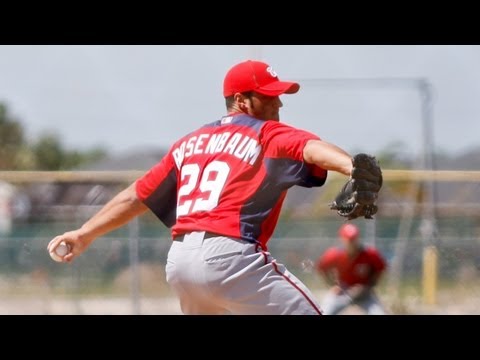
Danny Rosenbaum led the Senators staff in 2012. Photo via wn.com

Click here for the 2011 version of this post, for a look at how things were last year.

Here’s the AA version of the 2012 season pitching staff review.  I’m going down the line from top to bottom; AAA is here.  As with the other reviews, we’ll look at the main rotation, the substitute and spot starters, then focus on key relievers.  Rehab appearances are not discussed.

Harrisburg starters.  The rotation started the season with Gilliam, Demny, Mandel, Rosenbaum and Ballard.  Lets see how the original rotation and other primary starters fared.

  • Robert Gilliam, the “forgotten man” in the mega Gio Gonalez trade in December, made the opening day start for Harrisburg but didn’t live up to his billing.  He got 13 starts before going to the bullpen, and then eventually getting demoted to Potomac.  Season AA numbers: 3-7, 6.38 ERAOutlook for next season: The team likes him as a starter; i’m guessing they give him another whirl in the AA rotation.
  • Paul Demny took a step back in his progressive career with the Nats, going 6-8 with a 5.43 ERA in 23 starts before moving primarily to the bullpen at the end of the season.  He’s still very young (just turned 23) but he’s finishing his 5th pro season and 2013 will be his “walk year.”  Interestingly, the Nats named Demny one of their AFL participants, an odd selection based on his performance this season. Outlook for next season: as with Gilliam, I’d be surprised if Demny remains a starter.  AA bullpen as a swingman unless the team needs a 5th starter.
  • Jeff Mandel started the year in the Harrisburg rotation and put in 11 middling starts before getting moved to AAA to replace an equally ineffective Mitch Atkins.  This marked the third straight season he had started in AA and moved to AAA, a sure sign of an organizational arm who filled in where needed.  Outlook for next season: see AAA post.
  • Danny Rosenbaum was supposed to be the Ace, the Star of this rotation.  He was the highest-ranked prospect and was the Organization’s best starting pitching prospects.  He didn’t really live up to his billing, going 8-10 with a 3.94 ERA and a 1.31 whip in 26 starts.  He looked great his first 10 starts and then struggled the rest of the season.  He turns 25 in the off-season and is Rule-5 Eligible.  I think the team has to protect him.  Outlook for next season: Added to 40-man roster ahead of the Rule-5 draft but back in AA to start 2013, with an eye on a mid-season promotion to AAA.
  • Mike Ballard was a Minor League Free Agent signed from Baltimore (after failing to make it in the Houston organization after 5 minor league seasons).  You would have thought he’d have been in AAA but started the season in the AA rotation.  After 12 up-and-down starts he got absolutely pounded on June 13th, hit the DL with “elbow discomfort” and has been there ever since.   Final season stats: 1-5, 4.31 ERAOutlook for next season: released.  You hate to cut a guy with a season-ending injury, but business is business.
  • Ryan Perry, astutely acquired for Collin Balester (who failed to impress in Detroit and was DFA’d earlier this year) in spring training and he competed for the MLB bullpen.  He featured briefly, was ineffective and was optioned to AAA.  The team took a look at his repertoire and decided to try to convert him to a starter in AA.  The results?  Pretty good; a 2.84 ERA and 1.11 whip in 13 AA starts.  Outlook for next season: here’s the problem with Perry; he’s out of options for 2013.  He was added to a 40-man roster in April 2009, and burned options in 2009, 2011 and this year.   So he has to either make the MLB club or be DFA’d at the end of spring training.  So look for Perry to compete for the #5 starter job or be considered trade bait in the off-season.
  • Kevin Pucetas is another Minor League Free Agent who probably was too experienced for AA (as with Ballard); he spent the previous 3 seasons in the Pacific Coast League.  For Harrisburg in 2012 he was excellent out of the pen early (posting a 1.59 era in 34 relief innings) and then was relatively mediocre in 12 starts (5-5 with a 4.81 ERA).  You have to think he was merely filler for a gap in pitcher development in this system and will be looking for work elsewhere for 2013.  Outlook for next season: with another organization.
  • Trevor Holder finally looked like he was putting things together early in Potomac, earned a mid-season promotion to Harrisburg and put up a 3.78 ERA in 10 starts (9 actual starts plus a 10th game where the “starter” went one inning on a rehab assignment).  The knock on Holder was that he was a total signability pick in 2009 after the team spent big on Strasburg and Storen.  It is good to see him putting some things together.  Outlook for next season: AA rotation.
  • Ryan Tatusko got 8 starts in 27 appearances in a long-man/spot-starter/swingman role for the team.  He was slightly better as a reliever versus a starter (his splits showing a 2.72 ERA with greater than a k/inning as a reliever, a 4.50 ERA in his 8 starts).  I have always liked Tatusko (not the least reason of which is that he writes a blog) and was eager to see him contributed after he came over (with Tanner Roark) in the Cristian Guzman trade.  But his time with the organization may be at an end; he just finished his 6th minor league season and he took a step back with the organization.  Outlook for next season: I thought he’d have been in AAA by now; perhaps 2013 is the year.  AAA swingman.
  • Other guys who got spot starts here and there (non-rehab):
    • Brian Broderick: the team’s former rule-5 pick never made it with St. Louis, and when he was released the Nats picked him up.  He got a handful of appearances down the stretch and finished the season with 3 starts.  The team clearly likes the guy and seems willing to give him a chance.  Outlook for next season: AAA rotation.
    • Austin Bibens-Dirkx, he had a couple starts early before getting promoted up to AAA, where he probably should have started the season based on his experience.   Outlook for next season: (as copied from the AAA post): with another organization.
    • Adam Olbrychowski got called up to make the last start of the season.  Outlook for next season: see High-A post.
    • Of note: Chien-Ming Wang made no less than NINE rehab starts in AA (and fifteen overall minor league rehab starts).  You can argue whether or not the organization was “bending” the DL/service time rules or not; either way I can’t see how Wang stays with this team for 2013 and beyond.

Harrisburg Relievers: taking a look at the relief corps at the end of the season.  They used an awful lot of them.

  • Marcos Frias finishes his 6th pro season taking a step back from his 2011 numbers in high-A.  On the year, a 4.82 ERA in 65 1/3 relief innings.   He’s still very young, being a DSL graduate and yet to turn 24.  Technically he’s rule-5 eligible but its hard to see a team taking a flier on a RH reliever without knock-out stuff.  Outlook for next season: back in AA bullpen.
  • Erik Davis was generally excellent all season for Harrisburg, posting a 2.52 ERA in 64 1/3 relief innings.  He earned a late season promotion to AAA.  The former starter and trade bounty for Alberto Gonzalez technically is rule-5 eligible but the risk of losing him seems slight.  Outlook for next season: AAA bullpen, looking to become the next Christian Garcia.
  • Patrick McCoy had a pretty good season out of the pen in Harrisburg; 7-3 with a 3.70 era in 58 1/3 innings.  He was rule-5 eligible in 2011 but didn’t get picked up.  Now he’s one year from being a Minor League Free Agent.  Outlook for next season: AA or perhaps AAA bullpen, whoever needs a left hander.
  • Hector Nelo, who was released by Texas in April of 2011, finished the year with strong numbers as the team’s primary closer.  He had a 2.73 era and 16 saves in 52 2/3s innings over 47 appearances.  More importantly his K/9 rates really jumped from 2011.   He’s the kind of big-time arm that Mike Rizzo loves (he can reportedly hit 100mph) and should get some looks going foward.  He’s tied to the organization for one more season.  Outlook for next season: the closer in AAA.
  • Rafael Martin was as unbelievably bad statistically in 2012 as he was good in 2011.  How do you go from a 1.65 ERA across 2 organizations in 2011 to a 6.69 ERA in 2012?  Perhaps the answer is either a late-season injury or fatigue; in his last four appearances in AA this season he gave up 11 earned runs; the 6 appearances before that just one.  He’s no spring chicken though; he’s already 28 and is far far too old for AA at this point.  Outlook for next season: bullpen in AAA and hoping for a rebound to 2011’s numbers.
  • Cameron Selik pitched 1/3 of an inning in AA before a season-ending injury.  Outlook for next season: See High-A writeup.
  • Pat Lehman got promoted to AAA.  Joe Testa got demoted to High-A.  See those write-ups for outlooks.
  • Other Relievers who appeared in AA of note (not including Rehabbing MLBers): Outlook for next season for all of these guys seems the same: either continued “org guy” middle reliever or minor league FA in another organization.
    • Zech Zinicola came back to the team after being rule-5 drafted in late 2009, and remains an organizational arm.
    • Jimmy Barthmaier split time between AA and high-A.  Org arm.
    • Corey VanAllen was demoted down from AAA and then got hurt in July.   Org arm, maybe a loogy in AA again.

Summary

Harrisburg struggled to find a good consistent group of starters.  My guesses on what role these guys will play next season list too many guys getting dumped into the bullpen, so it may be interesting to see who gets another shot at starting in 2013.  Unfortunately these injuries and inconsistencies cost the team a near-certain 2nd half playoff spot.

Syracuse/AAA Pitching Staff Year in Review; 2012

4 comments

Free John Lannan! Photo Luis M. Alvarez/AP

Click here for the 2011 version of this post.

This is the first of 6 organizational reviews of the pitching staffs of our various affiliates for the 2012 season.  Unlike in 2011, I didn’t follow nearly as closely as I would have liked, so a lot of this is “analysis in arrears.”  This is also a lot of “scouting the scoreline,” which isn’t always a fair way to evaluate pitchers, but a full year’s worth of work is also a big enough sample size to pass some judgement.  I’ll try to evaluate pitchers at the level at which they spent the most time and will offer guesses for next season.  Also, rehab appearances are not mentioned or given analysis in these posts.  After reviewing all the staffs at each level, I’ll cull the above predictions into a summarized 2013 projected staff throughout the system.

Syracuse starters.  The rotation started the season with Atkins, Roark, Maya, Lannan and Duke.  This wasn’t exactly the way these guys would have lined up 1-5 (since Lannan was dumped to the AAA roster at the end of Spring Training unexpectedly) but this is the order in which they appeared to start the season.  Lets talk about these 5 guys plus other prominent starters for the year.

  • Mitch Atkins: Syracuse’s opening day starter stuck in the rotation for most of the year, posting a 5.28 ERA while going 6-9 in 20 starts.  He improved on his season numbers with a handful of relief appearances down the stretch, finishing the year with a combined ERA of 4.87 in 118 1/3 innings pitched.  This minor league Free Agent pickup from Baltimore’s organization never gave the team a reason to consider calling him up, and probably is out the door in the off-season.  Outlook for next season: Minor League Free Agent again, likely with another team.
  • Tanner Roark: He posted an ugly W/L of 6-17 on the year in 28 games (26 starts).  He had a 4.39 ERA with a 1.41 whip in 147 2/3 innings on the year.  He had pretty good K/9 numbers (130 Ks in those 147 innings) but also walked a goodly number of guys (47).  He mostly got promoted after a similar season statistically in AA by virtue of the AAA depth being shredded by the Gio Gonzalez trade.  Outlook for next season: He’s Rule-5 eligible but not yet a 6-year free agent.  I guess its possible he gets picked up, but he’s not worth protecting.  I think he gets one more season starting in AAA before reaching minor league free agency.
  • Yunesky Maya: After getting several shots at the major league level in 2011, Maya was buried in AAA for 2012.  There he toiled a complete season as a starter, posting an 11-10 record in 28 starts.  His era and whip were respectable (3.88 and 1.19 respectively), but his softer-tossing ways did not lead to the kind of swing and miss stuff craved by the current regime (just 89 Ks in 167 innings despite his ability to throw everything but the kitchen sink).  He improved upon a rough early start to the season with a series of gems in August … but would routinely follow up a gem with a stinker.  The big club has learned its lesson and left him off the expanded roster.  Outlook for next season: Maya has just one more year on his 4yr/$8m contract, after which he’ll be cut loose to try his wares elsewhere.  But he’ll be back toiling as AAA’s #1 starter in 2013.
  • John Lannan, as most Nats fans know, was the surprise cut from 2012’s major league team and basically served as injury insurance the entire year.  He did not necessarily help his own cause in AAA, putting up mediocre lines of 9-11, 4.30 era, 1.44 whip and barely 5 k/9 despite a MLB-average pedigree.  He did however perform excellently in two spot starts in the majors, setting himself up to be the Stephen Strasburg replacement in September’s stretch run.  I’d cough up his poor performance to  a season-long disappointment over his predicament; he’s got to be the highest paid guy in the minors (now that Kei Igawa‘s contract expired).  Outlook for next season: Lannan is just about a 100% guarantee to be non-tendered at the arbitration deadline and certainly looks to sign on with another club.
  • Zach Duke: Unlike Lannan, Duke took advantage of his time in AAA and DID regain some value; he posted a 15-5 record in 26 starts and 164 innings.  The rangy left-hander was cut loose by Arizona after the 2011 season and did enough with Syracuse this year to earn a September call-up.  Outlook for next season: Likely a free agent again and likely to use 2012’s performance as a springboard with another team looking for starter help.
  • Jeff Mandel, a long time Nats farm hand, started the year in AA to provide some starter depth before coming back to AAA and eventually replacing Atkins in the rotation.  He was 6-3 with a 2.41 ERA in 11 Syracuse starts and filled in effectively down the stretch. Outlook for next season: He’s finishing up his 6th minor league season and didn’t get a 40-man call-up (at least not yet).  He has one more year of team control before hitting minor league free agency.  AAA rotation.
  • Other guys who got spot starts here and there (non-rehab):
    • Erik Arneson, who continues his 2011 role of organizational swiss army knife, filling in with innings wherever possible.  Outlook for next season: probably continues to be the Nats org guy; he’s still effective in AAA.
    • Austin Bibens-Dirkx, who got a couple spot starts before getting released and eventually getting picked up by Colorado Springs (AAA affiliate of Colorado) to finish out the season.   Outlook for next season: with another organization.
    • Kevin Pucetas got called up from AA to make one spot-start.  Outlook for next season: See the AA wrap up for more details.

Syracuse Relievers: taking a look at the relief corps at the end of the season.

  • Christian Garcia has turned into one of the Organization’s great stories of 2012, posting a 0.86 ERA in 52 1/3 innings between AA and AAA after being claimed off waivers from the Yankees in late 2011.  This performance earned him a well-deserved call-up to the big club as rosters expanded.  Additionally, he’ll be featured in the Arizona Fall League as one of our three pitcher representatives.  Outlook for next season: He’s got a big arm, can bring it 97-98, and should be in the mix to be a middle-relief arm for the Nats bullpen in 2013.  He likely replaces what the team sought in Brad Lidge and provides insurance against injury (or, in Cole Kimball‘s case, failure to recover from injury).
  • Atahualpa Severino put in a decent season for Syracuse (2.81 ERA in 48 ip), but clearly he lost favor with the team.  Instead of considering Severino (who was on the 40-man at the time), the Nats picked up Mike Gonzalez off waivers and promoted him up to the big club.  Furthermore, Severino was DFA’d off the 40-man and passed through waivers without being claimed, never a good sign for a long-serving minor leaguer.  Outlook for next season: Minor League Free Agent, though the fact that nobody claimed him when he got DFA’d means he’s likely an Org guy from here on out.  But, LOOGYs live forever, and he can bring it, so maybe he gets a shot elsewhere.  He’s clearly been passed over in this organization.
  • GWU grad Josh Wilkie was having a so-so start to his Syracuse season (his 4th year in the league) before getting suspended 50-games in June.  [Editor Note: thanks to Mark L. for pointing this out].  Wilkie was summarily released after his suspension ended.  Outlook for next season: with another organization.
  • Ryan Perry failed to make the big club out of spring, pitched briefly in Syracuse’ bullpen before getting sent to Harrisburg to re-make himself as a starter.  Outlook for next season: see the AA version of this post.
  • Mike MacDougal made his “triumphant return” to the organization after washing out of Chicago’s AAA affiliate in Iowa.  He struck out 14 and walked 8 in 10 innings for Syracuse (about what I expected); no word on how many WP he threw.  Outlook for next season: minor league free agent again.
  • Erik Davis got 8 late season appearances after toiling mostly in AA and earning a promotion.  Outlook for next season: see the AA version of this post.
  • Other Relievers who appeared in AAA of note (not including Rehabbing MLBers): Outlook for next season for all of these guys seems the same: either continued “org guy” middle reliever or minor league free agent in another organization.
    • Hassan Pena improved on his 2011 stint in AAA but still looks like a middle-of-the-road minor league reliever.  He was suspended at the end of the season for suspected “team rules violations,” a question mark for him going forward with the organization.
    • GWU grad Pat Lehman continued his march up the organization, earning a quick promotion up to AAA and posting respectable numbers there.
    • Corey VanAllen got demoted and then hurt.
    • Rafael Martin also got demoted after a crummy start.
    • 2012 Minor League free agent signings Jeff Fulchino and Waldis Joaquin didn’t throw a single inning in 2012, spending it entirely on the 7-day DL.

Summary

Syracuse should have had a better record than it ended up with (70-74) given the quality of the starters on this team (a long time MLB starter in Duke, a career sub 4.00 ERA starter in Lannan and a guy on an $8M contract in Maya).  But at the same time, a combination of trades and a “gap” in organizational development led the team to have to fill a significant portion of this staff with minor league free agents, so it may have been inevitable that the team would have struggled.

Outlook for next season: S

Giolito to have TJ surgery; Not good

17 comments

Giolito scheduled for TJ surgery, to the surprise of few apparently. Photo Eric Dearborn via win for teddy blog

Frequent readers of this blog have told me lately that i’m too pessimistic, that I’m “not having fun” with the team and its best record in baseball.  Fair enough; its kind of difficult to write opinion pieces on a team in first place.  But even given that, i’ve tried to write some more positive stuff lately.

However, beware; this is going to be another negative post.  Because we just learned that our 2012 #1 draft pick Lucas Giolito needs to have Tommy John surgery after just TWO professional innings.

I made my point the day we drafted Giolito; you can read this June 5th post or read this executive summary; Giolito by himself wasn’t a bad risk, but combining him with Matthew Purke (on the DL all year) and Anthony Rendon (who has had significant injuries in 3 out of the last 4 seasons) puts all of this team’s proverbial eggs into one dangerous basket.  I thought it was negligent to draft an injury risk, given the major injury risk drafted just the previous year in Purke and the ongoing injury issues of Rendon.

Make no mistake; the Nats essentially sacrificed most of this draft for the express purpose of freeing up enough money to sign Giolito out of his UCLA committment.  Check out the known bonuses paid in the top 10 rounds; most of them were below-slot and a number of college seniors (with no leverage) were picked.  Now, every team in the majors was also doing this (an unanticipated side effect of the new CBA draft rules that are not are good for the game, at all, as with most of the new CBA when it comes to amateur players), but the consensus in the industry was that the Nats essentially “punted” the 2012 draft in the hopes of signing Giolito.

Which would be great, if Giolito was healthy.  But he wasn’t.  Here’s a tidbit that I didn’t know: I listened to a Baseball Prospectus podcast two weeks ago and one of Kevin Goldstein‘s guests was none other than Lucas Giolito’s father.  The conversation/intervew was great; Giolito talked about what it was like having a superstar baseball kid growing up, what it was like having a little leaguer who could throw 78mph as a 12yr old, and what it was like having a 16-yr old rising HS junior at the Area Code games.  He also talked through their whole spring of 2012, from the injury to getting drafted to the decision to sign.  All interesting stuff.

One tidbit I learned though, having not heard it anywhere else previously, was this: Lucas didn’t have a “sprained UCL” as was widely mentioned at the time.  According to his father, he had a PARTIAL TEAR of the UCL, NOT a sprain.  And the Nats drafted him anyway.  Knowing this, is it ANY surprise whatsoever that the kid blows out the elbow 2 innings into his pro career??   Lets get this straight; a kid who throws 100mph has a partial tear of the main tendon that allows him to throw 100mph, and we think this tendon is just going to magically heal itself?  A normal person may heal that tendon to the point where you can live your life and not be bothered.  A professional pitcher, upon tearing that tendon, is always going to have a weakness that eventually will require surgical repair.

Lets face it; the Nats have had some good fortune with their pitchers having TJ surgery lately and coming back.  Zimmermann and Strasburg examples 1A and 1B.  Former top prospect Jack McGeary had it and is still in the low minors, struggling to regain his form, an example of a guy who didn’t exactly come back roses from the surgery.  Taylor Jordan and Sammy Solis both had it earlier this year, one representing a promising underrated arm and the other representing a significant blow to the farm system depth, and they’ll be more test cases.  And now we have Giolito.

I read another nats blog this morning who cheerily said something along the lines of, “Well, he’ll get the surgery and we’ll have a 20-yr old in 2014 who can throw 100mph.”  That statement represents the absolutely 100% best case scenario here.  Tommy John recoveries are pretty high percentage wise, but they’re not 100%.  18yr olds pitchers who get cut aren’t exactly 100% to return to their prior form either.  He may never come back from this surgery, he may never regain his velocity.

Prospect development in baseball is already risky enough; a huge percentage of first rounders never even make the majors.  But that being said … first rounders who DO make the majors are the core of the stars in this league (don’t believe me?  Get a list of the 20 best pitchers and look at their draft position; more than half of the “Aces” in this league were first round picks).  My point is (and was in June) that we should have drafted a safer guy, a known quantity, so that we actually have something to show for the 2012 draft in a few years time.