Nationals Arm Race

"… the reason you win or lose is darn near always the same – pitching.” — Earl Weaver

Archive for the ‘Baseball in General’ Category

How much live action occurs in each sport? Ball in Play studies summarized

131 comments

How much live action actually occurs in each major sport?

Note: if you’ve found this and want to make a comment about how football is such a more exiting sport than soccer, or think this is some sort of anti-football post … then you’re missing the point.  This is about LIVE ACTION stats and the viewing experience.  If you love Cricket, you’ll sit there for 5 hour test matches where there’s fractions of periods of real action.  If you love football, then you’ll sit there for hours on end.  That’s not the point here.

Editor Post-publishing Update: this was originally published in July of 2013.  Over the years I have updated this post with additional information, resulting in adjusted numbers from the original.  I’m always looking for more and better information and am all ears if you have links to these kinds of studies.


I’ve never been the biggest NFL fan, despite living in a distinctly football town here in Washington DC.  But in the past few years or so, slowly my patience for watching an entire NFL football broadcast has ended.  Notice how games used to be slated for 1pm and 4pm on Sundays?  Now they’re 1pm and 4:15pm, or maybe even 4:25pm, with seemingly all that extra time now devoted to commercials.  Every time there’s a time-out, a break in play, after every challenge, there’s more commercials.  My friends and I have a joke.  I’ll ask “Hey, what time is the 8:00 game?”  And instead of the answer being obvious … the answer is 8:15 or 8:30 or whenever they’ve now pushed the late Sunday night game thanks to the 4:00 games running late (you know, since they  now start at 4:15 or 4:25 or whenever they’re slated to start).

Ironically, the same distinct lack of action complaint is easily seen in baseball broadcasts.  So I can’t be casting too many hypocritical stones against my football-following brethren (this is a Baseball-focused blog after all).

I got to wondering; just how many frigging commercials do they really show in NFL games these days?  This pursuit led to the larger issue: How often is the ball actually in play in an NFL game?  How often are the fans just sitting there watching crowd shots or replays or pictures of cheerleaders or head coaches looking constipated?

So I started looking far and wide for “Ball in Play” studies for the 5 major professional sports to compare and contrast the TV viewer experience.  Here’s what I’ve found (all sources are listed at the bottom and referenced inline).  For some sports (Hockey and Basketball) it is relatively easy to assume that, if the clock is running, there’s action.  For the others, with either a lack of a clock (Baseball) or significant periods of inactivity while the clock is running (Soccer to some extent but especially in Football) the details are harder to come by.

  • Baseball: Per the 2013 WSJ study, Baseball games feature 17 minutes and 58 seconds of action.  Baseball games have been increasing in length (thanks in part to the eighteen annual 4-hour marathons between the glacial Boston Red Sox and equally glacial New York Yankees) over the years.  But, the amount of action has stayed roughly the same.  A 1952 TV broadcast showed about 13 minutes of action but just 9 minutes 45 seconds of commercials. The latest WSJ study found that fully 42 minutes and 41 seconds of between-inning inactivity would be purely commercial time on TV broadcasts.  That means there’s nearly 5 times as many commercials now than 50 years ago.  2015: thanks to new pace of play rules, the average length of a baseball game dropped by 6 minutes from 20142017 update: ESPN published a study of the 2017 playoffs, which have been dragging.  The average MLB playoff game in 2017 has been going 3hrs, 35mins, which is up 10 minutes from 2016 and an astonishing 21 minutes from 2015.  I get that playoffs are more strategic, that pitchers are on quick hooks b/c there’s a finite amount of time, but this 3hrs 35mins is brutal.
  • Football: Per the WSJ 2010 study, NFL games feature about 11 minutes of action.  The amount of action in football games has been roughly the same since the early 1900s.  There was roughly 13 1/2 minutes of action in 1912, and slightly less in the 2010 study.  Other studies have shown that football generally ranges between 12-17 minutes of action.  Personally I tracked one quarter of an NFL playoff game  a few years ago with these numbers: in 50 minutes of clock time we saw exactly 250 seconds of action (4 minutes, 10 seconds) accompanied by no less than 20 commercials.  And this turned out to be a relatively “easy” quarter: one time out, one two-minute warning and two challenges/reviews.  It could have been a lot worse.  More recent studies have found that things are worsening for the NFL: WP’s Fred Bowen counted the ads in a 2014 NFL game and had seen an astounding 152 advertisements during the game.  152; that was more ads than plays from scrimmage.  Update for 2015: the early returns on the first few weeks of the season show a huge up-tick in penalties, which have slowed the game by four minutes from 2014 and average times are now at 3hrs 10minutes for games.  2017 update: the NFL has made some tweaks and the average game length through 2 weeks is down significantly, to 3hrs 4mins from 3hrs 15minutes in 2016.
  • Basketball: NBA games average 2 hours and 18 minutes in actual time.  Working backwards (since the clock only runs when the ball is in play and we know there’s exactly 48 minutes of play time) we know that there’s 138-48 = 90 minutes of “down time” of some sort in a typical NBA game.  Not all of that is commercial time but all of it is inaction.  I cannot find any documentation of typical number of commercials so i’ve just split the difference between on-screen inaction and off-screen commercials in the table below.  If you’re a big-time NBA watcher and feel this isn’t fair, please comment as such.
  • Hockey: The Livestrong piece below (side note: why is Livestrong doing “ball-in-play” studies on Hockey?) quotes average NHL games being 2hours and 19minutes in the 2003-4 season.  Working backwards from this, you have three 20-minute periods and two 17 minute intermissions, which leaves 46 minutes of remaining idle time.  Given that the idle times in Hockey are not nearly as long as those in basketball, I’m going to estimate that about 2/3rds of that 46minutes is commercials.
  • Soccer: Per the Soccerbythenumbers.com website 2011 study, between 62 and 65 minutes of ball-in-play action is seen on average in the major European pro leagues per game.  For the table below i’ll use 64 minutes as an average.  The duration of pro soccer games is relatively easy to calculate: they fit neatly into a 2 hour window by virtue of its 45minute halves, 15 minute break and an average of 3 minutes added-time on either side of the halves.  45+45+3+3+15 = 111 minutes of a 2 hour/120 minute time period.  Thanks to a bit of fluff on either side of the game, you generally count a soccer broadcast to last 1 hour and 55 minutes.  In the table below i’ve assumed that a huge portion of the intermission is commercial; in fact it is a lot less since most soccer broadcasts have a half-time show and highlights.  So if anything, the # of commercials in soccer broadcasts is less than listed.  Post 2014 World Cup Update: FIFA estimates that the group stage games averaged 57.6 minutes of action per game (if i’m reading their stat page correctly).  I’ll use this as the number going forward, even though World Cup games might be a bit “slower” than your average pro soccer game due to the careful, tactical nature of most of the matches.

So, in summary, here’s how the five major sports look like in terms of Ball in Play and # of commercials the viewer is forced to endure in a typical broadcast:

Sport Clock Duration Amt of Action % of Action Amt of Commercial Time Est # of 30-second commercials # of commercials/hour
Baseball 2hrs 56mins 17mins, 58secs 10.21% 42.68 85 29
Football 3hrs 10mins 11mins 5.79% 75 150 47
Soccer 1hr 55mins 57.6mins 50.09% 19 38 20
Basketball 2hrs 18mins 48mins 34.78% 45 90 39
Hockey 2hrs 20mins 60mins 42.86% 30 60 26

From this you can clearly see that watching Soccer gives you the most amount of live “Action,” though cynics and soccer-haters would probably claim that a lot of that action is “dead action,” defenders passing the ball around and not the type of action you see in other sports.  I’m a soccer fan and would rather have this type of “dead action” than what we see in the NFL: one 3 second running play then more than 30 seconds of watching players stand around before running another 3 second running play.  Don’t be fooled; there’s plenty of dead action in other sports too that gets counted as “live action” here … players walking the ball up the court in slow motion for 10 seconds in Basketball, the dumping of the puck to the end of the ice to facilitate a line shift in Hockey, etc.  So this kind of analysis is not an exact science.

Soccer is easily the most predictable of the five sports to plan a viewing experience around; you know for a fact that a regular-season/non-Overtime game is going to be over within 2 hours.  All the other sports can go into over-time and lengthen the time commitment.

Professional Football is at the bottom of all of these Viewer-experience measures: it is the longest broadcast, shows the least amount of game action and forces around 50 commercials an hour onto its viewers.  And the NFL is only getting worse; recent years have seen the introduction of new commercial breaks where none existed before (after a kickoff being the most ridiculous, but the mandated booth reviews at the end of halves now gift-wrap new commercial breaks to broadcasters at a game’s most critical time).

Thoughts?  If you have better information I’m all ears.  I’ve had very good suggestions to add to this data stuff like College Football, College Basketball and Tennis.  Perhaps some day with more research we’ll revisit.


Sources:

Written by Todd Boss

July 17th, 2013 at 8:20 am

One Team Hall of Famers: a dying breed?

3 comments

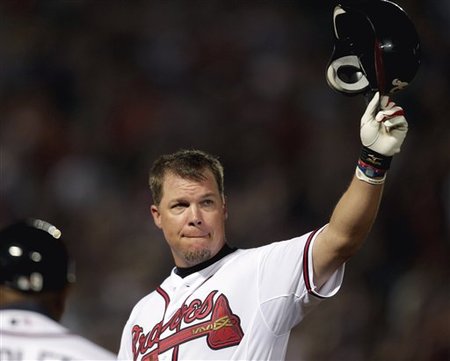
Chipper Jones at his retirement game.  Photo via lostthatsportsblog

Chipper Jones at his retirement game. Photo via lostthatsportsblog

I was listening to a podcast this past weekend and the host mentioned something in passing related to Chipper Jones being the last of a dying breed: one-team Hall-of-Famers.  In the modern age of free agency, we’re seeing iconic players such as Albert Pujols (and in other sports lately, Paul Pierce and Peyton Manning) switch teams mid-to-end of their careers and sullying their legacy in their original city.

It got me thinking: who in baseball right now are the best remaining chances of guys being single-team Hall of Famers?

Using the Current Baseball-Reference Active career WAR leaders as a guide to finding players (and using Baseball Prospectus’ Cots Salary database to quote contract years), lets take a look.  The players are listed in descending order of total career WAR.  The first few names are obvious.  Then there’s a group of younger guys who have yet to play out their arbitration years and who could easily jump ship and sign elsewhere in free agency; i’ll put in a complete WAG as to the chances of the player staying with one team their entire career.

Hall of Fame Locks and Likelys

1. Derek Jeter, New York Yankees.   100% likelihood he retires as a Yankee, and 100% likelihood of being a first ballot hall of famer.

2. Mariano Rivera, New York Yankees.  As with Jeter, he’s 100% to retire as a Yankee (having already announced his retirement) and should be a first ballot hall of famer as inarguably the best late-inning reliever the game has known.

3. Yasiel Puig, Los Angeles Dodgers.  Just kidding.  Come on, you laughed.

4. Joe Mauer, Minnesota Twins.  Its hard to envision someone being more of a franchise player than Mauer; born in Minnesota, High School in Minnesota, 1st overall draft pick by the Minnesota Franchise.  Massive contract with full no-trade through 2018.  I think Mauer will be a Twin for life.   Hall of Fame chances?  Looking pretty good; already has an MVP and has a career .323 BA for a catcher, pretty impressive.

5. Robinson Cano, New York Yankees.  He’s about half way through his career, but his numbers and accolades keep piling up.  Pretty soon we’re going to look up and he’s going to have 400 homers and a career BA above .300 as a 2nd baseman with a slew of top 5 MVP finishes, and we’ll be asking ourselves where Cano ranks in the pantheon of baseball 2nd basemen.  Here’s the canonical list of 2nd basemen elected to the hall of fame in the last 50 years: Roberto AlomarRyne Sandberg, Rod Carew and Joe Morgan.  Do you think Cano belongs there?  Now, will Cano stay a Yankee?  We’ll soon find out: he’s just played out his two option years and has not been extended.  Are the Yankees preparing to let him walk?

6. Justin Verlander, Detroit Tigers.  He’s struggled this year as compared to his typical lofty achievements, but he already owns the career trifecta of awards (RoY, MVP, Cy Young).   He’s signed through 2019 with a 2020 option, at which point he’ll be 37.    He probably won’t get to 300 wins but he could broach 250 with excellent career numbers.  Will he stay with Detroit?  It seems like a safe bet.

Honorable Mentions: Juston Morneau: early numbers supported it, but he has aged fast.  Update 9/1/13 traded away from Minnesota in a waiver-wire deal; no longer eligible.


Borderline Hall of Fame Guys

1. Todd Helton, Colorado Rockies.   He turns 40 in August, has played his entire career with Colorado and is in the final year of a two-year deal.  His production has vastly tailed off the last two years and I can’t see him playing again after this season.  But, we haven’t heard any retirement news either, so I wonder if he’s going to be one of these one-teamers that tries to play one season too long.  Chances of Hall-of-Fame:  33%.   I think he’s going to have the same issues that Larry Walker is having; despite a career 134 OPS+ his home OPS is nearly 200 points higher than his road OPS, and I think writers will believe him to be an offensive juggernaut borne of Denver.

2. Chase Utley, Philadelphia Phillies.  He’s struggled with injuries four seasons running now, but otherwise has great career offensive numbers for a 2nd Baseman.  Even if he gets healthy, he may fall short of the Hall of Fame for similar reasons to those of Jeff Kent.   And, Utley doesn’t have an MVP.  However, Utley may be falling off this list because his name is prominently mentioned in trade-rumors if the Phillies decide to sell.

3. David Wright, New York Mets.  He’s in his 10th season with the Mets and is signed through 2020, so his chances of being a career one-teamer seem high.  Not 100% though; He’ll be 37 at the end of this deal and may want a couple more seasons; will he be productive enough and stay healthy enough to earn another short-term deal that late in his career?  Is he trending towards the Hall of Fame?  Probably not; he’s got plenty of All Star appearances, Gold Gloves and Silver Sluggers but relatively little MVP love.  In this respect he needs his team to be better.

4. Jimmy Rollins, Philadelphia Phillies.  Rollins is the subject of a long, long running joke amongst my close friends.  One die-hard Philly fan made his argument that Rollins was a sure-fire Hall of Famer, and the rest of us mocked him for being such a homer.   In reality, his Hall of Fame case likely ends up being really debatable.   He has a smattering of career accomplishments but not nearly as many as (say Barry Larkin, the most recent elected SS).   Now, does Rollines remain in Philadelphia?  Probably; he’s signed through 2015, at which point he’ll be 37.  I can see Philadelphia keeping him on board with a 2 year deal at that point.


Too Early to tell Guys

1. Felix Hernandez, Seattle Mariners.  Signed through 2019 for just absolutely ridiculous money (he’ll make $27M in the year 2019).  Of course, he’s just 27 now so he’ll still have some career left by then.  Will he stay in Seattle?  A good bet.  Will he continue to look like a hall-of-famer?  Also a good bet, despite his velocity loss.   But like any other guy who’s only 27, its hard to project 10-15 years down the road, especially for pitchers.

2. Dustin Pedroia, Boston Red Sox.  Pedroia doesn’t seem like a guy who is mentioned in the same breath as hall-of-famers, especially when compared to Cano above.  But here’s what Pedroia has that Cano doesn’t: A Rookie of the Year award AND an MVP award.  Pedroia has bounced back in 2013 from a couple of injury-plagued years and has put him self back in position to gain MVP votes if Boston makes the post-season.  Will he stay in Boston?  Seems like hit; he seems like a classic career Red Sox Captain-in-the-making.

3. Ryan Braun, Milwaukee Brewers.  Great production, career accolades, signed to a long-term deal for a mid-market team.  He has all the makings of being a classic one-team Hall of Famer …. except for the small fact that he’s a) already tested positive for banned substances and b) is becoming public enemy #2 (behind Alex Rodriguez) because of his arrogance in being caught up in the Biogenesis scandal AFTER beating the testing rap.  He could win 3 more MVPs and I don’t see him making the hall-of-fame until some veteran’s committee 75 years from now posthumously puts in all these PED cheaters of the 90s and today.

4. Evan Longoria, Tampa Bay Rays.   He’s signed with options through 2023.  He’s always on the short list of the best third basemen (offensively and defensively) in the majors.   He’s already had a series of all-time highlight moments in his career.  But from a cumulative accolades stand point, he’s very much lacking.  While he won the 2008 Rookie of the Year award, the closest he’s come to an MVP is 6th, and his 2013 All-Star snub means he’s only appeared in the game 3 times.  I think he’s going to need a run of healthy, strong seasons to really put his name in the HoF mix.

5. Ryan Zimmerman, Washington Nationals and Troy Tulowitzki with Colorado: both guys are here for the same reasons: they are each team’s “Face of the Franchise” and are likely never going to play anywhere else.   They’re both signed to very long term deals.  In Zimmerman’s case, he’s a local guy.  As for Hall of Fame chances, right now they look very negligible for both players.  Not because they’re not good, but because both are too inconsistently injured to put together the full seasons needed to stay in the minds of all-star and MVP voters.  They are what Longoria is heading towards: injury plagued solid players who are the cornerstone of their teams for a 15 year stretch.

6. Joey Votto, Cincinnati Reds.  Here’s a fun fact: Votto trails our own Ryan Zimmerman in career war despite being a year older.   He’s signed with Cincinnati with options through 2024, at which point he’ll be 41, so he’s almost guaranteed to be a one-team guy.  Will he accumulate enough accomplishments to be a Hall of Famer?  So far so good.  He’s one of the most feared hitters in the league and seems to be getting better.

7.  Matt CainCole HamelsJered Weaver: all three of these guys have nearly identical career WARs, all are signed for relatively long-term deals, all are on most people’s shorter lists of the best starters in the game, and all are between 28-30 right now.   But ironically, I don’t see any of them as hall-of-famer calibre talent when compared to the next small jump up in talent in the league right now (see the next player).

8. Clayton Kershaw, Los Angeles Dodgers.  It is foolish to speculate on the Hall of Fame chances of a 25 year old pitcher.  But Kershaw seems to be a safe bet to sign the largest pitcher contract in history with the nouveaux-rich Dodger’s ownership group, so he could continue to pitch in the cavern of Dodger stadium for another 10 years and start to really approach some hall-of-fame mandate numbers.  Ask yourself this; who would you rather have for the next 10 years, Kershaw or Stephen Strasburg?


Summary: In all of baseball, just two HoF one-team locks.   A couple more good bets for being career one-teamers but by no means HoF locks.  So yeah, it seems like the one-team hall-of-famer is going the way of the Reserve Clause.

How do the Angels Prospect trades look now?

10 comments

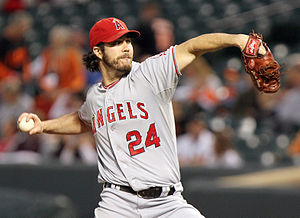
The Angels traded the farm to get Dan Haren a few years ago; would they make that same trade again?  Photo unknown via wikipedia

The Angels traded the farm to get Dan Haren a few years ago; would they make that same trade again? Photo unknown via wikipedia

When Jean Segura took off this season (especially well-known to fantasy baseball players, who were able to suddenly get a top-10 guy off the waiver wire), people asked, “Where’d he come from?”  Well, like many other rising stud prospects this season he was once the property of the Los Angeles Angels.  But the Angels have not valued their prospects much lately, and have traded away a slew of talented guys chasing after the playoffs in the last few years.
Here’s a quick look at the Angels’ prospect-involved trades as of late:
  • July 2010: Traded Patrick Corbin, Tyler Skaggs, Rafael Rodriguez and Joe Saunders -> Arizona for Dan Haren.
  • Nov 2011: Traded Tyler Chatwood -> Colorado for Chris Ianetta
  • July 2012: Traded Jean Segura and 2 minor leaguers -> Milwaukee for Zack Greinke rental
  • Nov 2012: Traded Jordan Walden -> Atlanta for Tommy Hanson
So, what do they have to show for these prospects-for-veteran trades?  After making the playoffs in 2009 but losing in the ALCS:
  • In 2010 with Haren, they finished in 3rd place, two games under .500 and 10 games back of the divisional winner Texas.
  • in 2011 with Haren in the rotation for a full season, they finished in 2nd place, again 10 games back of Texas.
  • in 2012 with both Haren, Ianetta and the Greinke rental they finished in 3rd again, 4 games out of the wild card.

And now in 2013 they’re scuffling despite hundreds of millions of dollars spent in the FA market on Albert Pujols and Josh Hamilton. The only things they have left to show for all the above trades are Ianetta’s .213 batting average and an injured Hanson.  But now they’re missing three potential front-line starter prospects, a closer-quality reliever and one of the more dynamic young infielders in the game.  Oh, and to fill in for those missing starters they’ve

When the San Francisco giants traded uber starter prospect Zach Wheeler for a 2 month rental of Carlos Beltran in 2011 in a failed attempt to get back to the playoffs, scouting pundits and Giants fans howled in derision.   Its harder to criticize the Giants moves in general (two World Series in the last three years) , but now with Tim Lincecum looking like the highest paid middle reliever in baseball history and with regular AAA pitcher tryouts to fill Ryan Vogelsong‘s 5th starter spot, you can only wonder what that team would look like with the newly promoted Wheeler slotting in behind their big guns Matt Cain and Madison Bumgarner.

Some GMs over-value prospects and hoard them, while some under-value them and have no problem flipping them for proven major league talent.  What I’m afraid of as a Nats fan, right now, is our GM panicking and trading away (ala the Angels over the past few years) even more of our long-term prospect depth chasing the short-term goal.  Especially if we trade away guys and then still don’t make the post-season.  I realize this is a hedge towards the rumors we’re hearing about how Mike Rizzo is “heavily working the phones,” but I don’t think we should break the bank and trade one of our best prospects for 3 months worth of a guy like Matt Garza.

Virginia Region and State High School Results and Recaps

leave a comment

We posted at the end of the District tournaments on May 23rd the results of the Virginia local district championships.  I admittedly took a larger interest this year because of the success of my own alma mater high school Madison, and followed the subsequent regional and state tournament closely.  Here’s a recap of those two tournaments, which culminated with the State final being played yesterday 6/9/13 in Chantilly.

The Regional tourney kicked off May 24th with this slate (home teams are the higher seeds, here’s the bracket):

  • T.C. Williams (11-10) @ Oakton (17-4): a tough matchup for Oakton if TC Williams throws their ace Alec Grosser.
  • Stone Bridge (11-11) @ Yorktown (17-5)
  • Stuart (15-6) @ Langley (13-9)
  • Robinson (10-12) @ South County (14-8)
  • Edison (12-10) @ Madison (21-1)
  • Chantilly (11-12) @ Lake Braddock (17-4): Lake Braddock has high-end pitching prospect Thomas  Rogers finally back from TJ surgery, adding a surprise element to this storied franchise and defending State champ.
  • West Potomac (12-8) @ Centreville (15-4)
  • Marshall (8-14) @ W&L (13-10); also a tougher matchup here if Marshall throws its lefty ace Mitch MacKeith

5/24/13 results: first round done, here’s the Northern Region tourney first round results:

  • Oakton d T.C. Williams 9-1 (I guess Grosser wasn’t a factor)
  • Stone Bridge d Yorktown 1-0 (an upset per seedings and records)
  • Langley d Stuart 8-2 (Stuart’s great season comes to an end)
  • South County d Robinson 6-1 (a traditional power ends a disappointing season)
  • Madison d Edison 13-1 (a predictable blow-out for the region’s #1 seed)
  • Lake Braddock d Chantilly 8-2 (Chantilly’s cinderella run ends)
  • Centreville d West Potomac 8-2 (no upsets here, setting up an interesting quarter final match)
  • Marshall d Washington & Lee 7-0 (an upset by record but perhaps not by overall capabilities)

2nd round Matchups on Monday 5/27/13

  • Oakton v Stone Bridge: Oakton beat Stone Bridge 6-2 earlier in the season and is favored here.
  • Langley v South County: no prior meetings between the teams, but South County is streaky and has one 5 straight.  Close game.
  • Madison v Lake Braddock: close matchup by record, no prior meeting but Madison has the advantage playing at home.
  • Centreville v Marshall: Centreville beat Marshall away 8-4 to open the season; Centreville favored here.

5/27/13 Results: Big upsets in the Regional quarters:

  • Lake Braddock takes out #1 Seed Madison 9-6 on home turf behind Thomas Rogers, recovered from TJ Surgery.
  • South County edges Langley 4-3 in 13 innings.  Wow.
  • Oakton steamrolls Stone Bridge 13-5, is now the new favorite to win the region with Lake Braddock.
  • Marshall edges out Centreville 5-4, continuing their cinderella run.

Regional Semis on 5/29/13 are set: Its now looking like and Oakton-Lake Braddock regional final.  5/29/13 results: Indeed both Oakton and Lake Braddock won easily and both advance to the State tournament.

  • Oakton d South County 8-1
  • Lake Braddock d Marshall 16-5

Regional Final: predicting Oakton but wouldn’t be surprised either way.  5/31/13 result: Lake Braddock batters its way to another Regional crown 14-7.

With the Regional losses for both Great Bridge and Madison, both teams have now dropped out of top-25 rankings in BaseballAmerica and USAToday‘s early June rankings.   Great Bridge and now Lake Braddock are Honorable Mentions in USAToday, implying a top 50 national ranking for now.

Virginia AAA State Tournament: with the 5/30/13 Regional results, the 8 participants in the state tournament are now known.  From each of the four State Regions:

  • Northern Region (Fairfax, Arlington counties): Lake Braddock, Oakton
  • Northwest Region (Loudoun, Prince William, Fauquier counties): Hylton, Patriot
  • Central Region (Richmond): Douglas Freeman, Hanover
  • Eastern Region (Norfolk/Va Beach): Kellam,Great Bridge

Weird how Great Bridge loses early in its own district tournament but still advanced to the Regional tournament, which it subsequently looks to win.

State Quarter finals to be held Tuesday 6/4/13: Lake Braddock v Patriot, Oakton v Hylton, Freeman v Great Bridge and Hanover v Kellam.  The semis and final are at Westfields High School friday and saturday June 7-8th.

6/4/13 State Quarter final results: local teams and the favorite go through to the semis.  Results:

State Semis are Friday 6/7/13 at 3pm and 7pm.

Semis and Final ResultsBoth NoVa local teams were beaten in the State Semis, setting up a Great Bridge-Hanover state final and two of the best arms in the state.  In the state final, Richmond area Hanover prevailed over a Conner Jones-less Great Bridge 3-1.  Despite a 5-run lead on Friday night against Lake Braddock, Great Bridge left Jones throw 2 2/3 innings in the semi, leaving him ineligible to appear in the championship.   This seemed like rather questionable strategy, considering the way Hanover used their ace Casey to save the friday night game and to pitch the bulk of the state championship game.  If you’ve never heard of Casey, you will next year.  Only a junior, he’s already up to 93 on the gun, was a PerfectGame pre-season undergrad All-American and has an early UVA commit.  I’m sure about this time next year we’ll be hearing about Casey’s draft value much as we’ve heard about Jones’ all this spring.

Congrats to Hanover and Derek Casey for a 2013 Virginia State Baseball Title.

Written by Todd Boss

June 10th, 2013 at 10:17 am

Local Prep Baseball: Oakton & Madison win District titles; Regional tourney set

leave a comment

Despite going to Madison, I've never seen this seal until googling it.

Vienna High School baseball continues its dominant ways, with the #1 DC-area Ranked Madison Warhawks and their next-door neighbor rival Oakton Cougars both taking home district tournament titles on 5/20/13.

Madison blew through the Liberty District, getting a bye into the semis, winning in the semis against Stone Bridge 11-0 (with their starter taking a perfect game into the 7th) and then beating the #2 seed Langley Saxsons 11-2 in the final.  Oakton beat a couple of Northern Virginia heavyweights in Robinson and Chantilly, the latter in walk-off fashion, for their Concorde District title.

The wins for Madison lately have vaulted them into some national prominence.  They’re #20 in the latest Baseball America top 25 poll (mostly b/c so many upper-ranked teams were dropped after losing in their state playoffs).  Honestly though I have a hard time putting Madison over Great Bridge HS (#22 in Baseball America), knowing what I know about that Chesapeake team (namely, Conner Jones).   USAToday’s latest ranking (dated May 8th so its way out of date) has Great Bridge #17 and Madison as a honorable mention.  I’m hoping for a Madison-Great Bridge state final.  Update: USA Today’s 5/22/13 rankings now have Madison at #22 nationally with Great Bridge dropping out entirely due to their playoff loss to Western Branch.   So much for a Madison-Conner Jones state final I guess.

Both Madison and Oakton advance to the Northern Regional tournament, along with their fellow district quarter and semi-finalists.  No schedule yet but the pool of teams looks like this:

  • District champs: Madison, Oakton, South County, Washington & Lee
  • District finalists: Langley, Chantilly, Lake Braddock, Yorktown
  • District qtr finalists: Stone Bridge, Marshall, TC Williams, West Potomac, Centreville, Robinson, Edison and Stuart

The Regional tourney kicks off tomorrow night with this slate (home teams are the higher seeds, here’s the bracket):

  • T.C. Williams (11-10) @ Oakton (17-4): a tough matchup for Oakton if TC Williams throws their ace Alec Grosser.
  • Stone Bridge (11-11) @ Yorktown (17-5)
  • Stuart (15-6) @ Langley (13-9)
  • Robinson (10-12) @ South County (14-8)
  • Edison (12-10) @ Madison (21-1)
  • Chantilly (11-12) @ Lake Braddock (17-4): Lake Braddock has high-end pitching prospect Thomas  Rogers finally back from TJ surgery, adding a surprise element to this storied franchise and defending State champ.
  • West Potomac (12-8) @ Centreville (15-4)
  • Marshall (8-14) @ W&L (13-10); also a tougher matchup here if Marshall throws its lefty ace Mitch MacKeith

Guessing on the seeds: Madison #1, Oakton #2, South County #3 and Washington & Lee #4.  Centreville #5, Langley #6, Yorktown #7, Lake Braddock #8.  This is slightly different from the district final results (Centreville and Chantilly seem switched if I’m reading the bracket correctly).   Madison gets an advantage by virtue of hosting its entire half of the draw plus the Regional semis and Final next week.  Regional Final set for 5/31 at 6:30pm at Madison.

Predictions for the tournament: all the home teams hold serve in the first round, then Oakton, South County, Madison and Centreville into the regional semis with an all-Vienna regional final next friday.

5/24/13 results: first round done, here’s the Northern Region tourney results:

  • Oakton d T.C. Williams 9-1 (I guess Grosser wasn’t a factor)
  • Stone Bridge d Yorktown 1-0 (an upset per seedings and records)
  • Langley d Stuart 8-2 (Stuart’s great season comes to an end)
  • South County d Robinson 6-1 (a traditional power ends a disappointing season)
  • Madison d Edison 13-1 (a predictable blow-out for the region’s #1 seed)
  • Lake Braddock d Chantilly 8-2 (Chantilly’s cinderella run ends)
  • Centreville d West Potomac 8-2 (no upsets here, setting up an interesting quarter final match)
  • Marshall d Washington & Lee 7-0 (an upset by record but perhaps not by overall capabilities)

2nd round Matchups on Monday 5/27/13

  • Oakton v Stone Bridge: Oakton beat Stone Bridge 6-2 earlier in the season and is favored here.
  • Langley v South County: no prior meetings between the teams, but South County is streaky and has one 5 straight.  Close game.
  • Madison v Lake Braddock: close matchup by record, no prior meeting but Madison has the advantage playing at home.
  • Centreville v Marshall: Centreville beat Marshall away 8-4 to open the season; Centreville favored here.

I’m holding to my predictions made before round 1 for the semis.  Oakton, South County, Madison, Centreville.

5/27/13 Results: Big upsets in the Regional quarters:

  • Lake Braddock takes out #1 Seed Madison 9-6 on home turf behind Dan Rogers, recovering from TJ Surgery.
  • South County edges Langley 4-3 in 13 innings.  Wow.
  • Oakton steamrolls Stone Bridge 13-5, is now the new favorite to win the region with Lake Braddock.
  • Marshall edges out Centreville 5-4, continuing their cinderella run.

Regional Semis on 5/29/13 are set: Its now looking like and Oakton-Lake Braddock regional final.  5/29/13 results: Indeed both Oakton and Lake Braddock won easily and both advance to the State tournament.

  • Oakton d South County 8-1
  • Lake Braddock d Marshall 16-5.

Regional Final: predicting Oakton but wouldn’t be surprised either way.  5/31/13 result: Lake Braddock batters its way to another Regional crown 14-7.

With the Regional losses for both Great Bridge and Madison, both teams have now dropped out of top-25 rankings in BaseballAmerica and USAToday‘s early June rankings.   Great Bridge and now Lake Braddock are Honorable Mentions in USAToday, implying a top 50 national ranking for now.

Virginia AAA State Tournament: with the 5/30/13 results, the 8 participants in the state tournament are now known.  From each of the four State Regions:

  • Northern Region (Fairfax, Arlington counties): Lake Braddock, Oakton
  • Northwest Region (Loudoun, Prince William, Fauquier counties): Hylton, Patriot
  • Central Region (Richmond): Douglas Freeman, Hanover
  • Eastern Region (Norfolk/Va Beach): Kellam,Great Bridge

Weird how Great Bridge loses early in its own district tournament but still advanced to the Regional tournament, which it subsequently looks to win.

State Quarter finals to be held Tuesday 6/4/13: Lake Braddock v Patriot, Oakton v Hylton, Freeman v Great Bridge and Hanover v Kellam.  The semis and final are at Westfields High School friday and saturday Jule 7-8th.

6/4/13 State Quarter final results: local teams and the favorite go through to the semis.  Results:

State Semis are Friday 6/7/13 at 3pm and 7pm.

Semis and Final Results: Both NoVa local teams were beaten in the State Semis, setting up a Great Bridge-Hanover state final.  In the state final, Richmond area Hanover prevailed over a Conner Jones-less Great Bridge 3-1.  Despite a 5-run lead on Friday night against Lake Braddock, Great Bridge left Connor Jones throw 2 2/3 innings in the semi, leaving him ineligible to appear in the championship.   This seemed like rather questionable stragegy, considering the way Hanover used their ace Derek Casey to save the friday night game and to pitch the bulk of the state championship game.  If you’ve never heard of Casey, you probably will next year.  Only a junior, he’s already up to 93 on the gun and has an early UVA commit.  I’m sure about this time next year we’ll be hearing about Casey’s draft value.

Congrats to Hanover and Derek Casey for a 2013 Virginia State Baseball Title.

Written by Todd Boss

May 23rd, 2013 at 12:55 pm

Which NL playoff contenders are helped/hurt by Interleague Schedule?

leave a comment

Spurred into action by this Dave Cameron SI.com piece, where he postulates that Atlanta isn’t as well constructed as other NL playoff contendors (including Washington) for constant intraleague because they don’t have a natural power hitter on the bench (like we do in Tyler Moore and/or Chad Tracy), I asked myself this question:  Which probable NL playoff contenders are going to be helped or hurt by their intraleague schedules this year?

(Note: I’ll skip the obvious answer to Cameron’s above question: who cares how well constructed you are when you start the season 12-1?  And, had Cameron waited about a week to write this the answer may have very well been Atlanta’s out-of-nowhere find Evan Gattis, who clearly can serve as an interleage DH very ably).

Going down the line, looking just at intraleague opponents you get this list (3 game sets unless denoted):

  • Washington: Home to Chicago White Sox, Detroit (2), Baltimore (2), Minnesota.  Away to Cleveland, Baltimore (2), Detroit (2), Kansas City.
  • Atlanta: Home to Kansas City (2), Minnesota, Toronto (2), and Cleveland.  Away to Detroit, Toronto (2), Kansas City (2), Chicago White Sox.

Head to head, you have to say that Washington has a slight inter-league advantage over Atlanta; they have to play defending AL champs Detroit 6 times to our 4, they have to play Toronto four times instead of our Baltimore (a slightly tougher matchup).  The games involving Cleveland and Chicago are probably a wash.  Atlanta’s “natural rival” right now is Toronto to our Baltimore, which likely hurts them this season.

  • Cincinnati: Home to Los Angeles Angels, Cleveland (2),  Seattle, Oakland (2).   Away to Oakland (2), Texas, Houston, and Cleveland (2).
  • St. Louis: Home to Kansas City (2), Texas, Seattle, Houston (2).  Away to Kansas City (2), Houston (2), Oakland, Los Angeles Angels.

St. Louis doesn’t play a single AL team until May 27th, and plays 8 of their 10 away AL games IN A ROW in mid June.  This is a pretty massive scheduling advantage that lets them modify their roster for one big AL road trip and basically not have to worry about the away AL games the rest of the season.  Head to head as compared to Cincinnati, you’d have to give a slight edge to St. Louis again, for getting those two extra games versus Houston.  Otherwise these two slates look pretty even.

Either way they’re both considerably more difficult than what the NL East teams face, thanks to the games against the AL West playoff-calibre teams.   Half their games are against LA, Texas and Oakland while the Nats only have to worry about 4 Detroit games (unless you think that Baltimore is going to be a playoff team again, which I don’t).

  • San Francisco: Home to Oakland (2), Toronto (2), Baltimore, Boston.   Away to Toronto (2), Oakland (2), Tampa Bay, New York Yankees.
  • Los Angeles: Home to Los Angeles Angels (2), New York Yankees (2), Tampa Bay, Boston.   Away to Baltimore, Los Angeles Angels (2), New York Yankees (2), Toronto.

Ouch; the NL West guys have AL East heavy interleague schedules this year.  I’d say that the Giant’s slate is slightly harder; Tampa Bay and the Yankees and four games against Toronto versus three for the Dodgers.  Oakland vs Angels as a natural rival seems like it will be slightly harder on the Dodgers (but, Oakland is starting right where they left off and may be a playoff team at the Angels’ expense again).

But again, either way you have to think the NL West teams are worse off than the NL East teams this year for interleague looking at their slate.

All of this may be helpful to teams trying to get a wild card spot, which we all hope will be Atlanta and not us.  Because we all now know what can happen if you slip to the one-game wild card play-in.  Just ask Atlanta and Texas what happened last year, when two teams who I thought both had the capability of winning it all were knocked out in a coin-flip game.

By the way, today on April 12th, the NL standings after 9 games basically already mirror the above scenarios in terms of Division leaders and wild card contenders.  The only anomoly would be Arizona being in 2nd place by a game in the NL West.  The cream rise to the top quickly it seems.

Written by Todd Boss

April 17th, 2013 at 9:52 am

MLB 2013 Predictions

8 comments

Opening day has past and I forgot to post the obligatory “predictions” piece for 2013.  Here’s some far-too-early predictions on who makes the playoffs this year.  For comparison purposes. here’s the Si.com Writer’s slate of predictions, with lots of success predicted for our Nats.  My predictions below look awfully similar to Si.com’s Baseball Preview standings too.

(For a trip down memory lane, here’s a link to my 2012 seasonal predictions, and as you may have guessed, I was way off).

  • AL East: Tampa Bay
  • AL Central: Detroit
  • AL West: Los Angeles Angels
  • AL Wild Cards: Toronto, Oakland

AL East Narrative: The year the Yankees died; they’re too old, too dependent on aging arms and aging bats, and did next to nothing to improve in the off-season (though they did just pick up Vernon Wells, the Angels’ 4th outfielder.  Great!)  For a team that makes hundreds of millions of dollars of profits a year from the stadium and their TV station, they seem awfully worried about a few million dollars of luxury tax.  (see *ahem* Los Angeles Dodgers *cough*).  I think Baltimore regresses back to the .500 team they should have been in 2012 (they too failed to appreciably improve their playoff team), and Boston seems stuck in some weird middle-ground for the time being.  Toronto seems greatly improved but falls slightly short of the champ.  Tampa is left standing in the AL East; they won’t miss James Shields that much with their amazing pitching depth and can call up the next version of Trout/Harper in Wil Myers in mid June.

In the AL Central, Kansas City’s short sighted trade will net them a .500 record, but isn’t nearly enough to catch the Tigers, who return their whole rotation, get back Victor Martinez and add a possibly underrated Torii Hunter to add to their formidable lineup.  How they only won 88 games last year still amazes me.  The White Sox could challenge, but what have they really done this off-season either?   On the bright side, all these teams get to feast on Cleveland and Minnesota, both of whom look to lose 90+ games.

In the AL West, the Angels (who had the best record in baseball post Trout-callup) continue where they left off and bash their way to a 90 win divisional title despite serious questions in the rotation.  Texas hasn’t replaced what they lost in the last two off-seasons in terms of either hitting (Josh Hamilton) or pitching (C.J. Wilson, Ryan Dempster, or Colby Lewis)  but should still compete for the 2nd wild card.  But, absent signing Kyle Lohse (too late; he went to Milwaukee) or doing something to augment their starting pitching, I see trouble in the back of their rotation.  Meanwhile, Seattle made one curious move after another this off-season, all to finish in 4th place.  And Houston will challenge the 1962 Mets for futility, to the benefit of the entire division.

Wild Cards: Toronto has bought themselves a playoff team with their wholesale purchase of half the Marlins team.  However, I wouldn’t be surprised to see both WCs come out of the AL west, who get to feast on two pretty bad teams.  For the time being i’ll predict that Oakland and Texas duke it out to the wire, with Oakland pipping them for yet another surprise playoff appearance.  Oakland won the division last year; who would doubt them again this year with a very young pitching staff having one additional year of experience?  I think it comes at the expense of Texas this year instead of the Angels.

How about the NL?

  • NL East: Washington
  • NL Central: Cincinnati
  • NL West: San Francisco
  • NL Wild Cards: Atlanta, St. Louis

NL East Narrative: Despite some people thinking that Atlanta has done enough to get by the Nats, I don’t quite see it.  The Upton brothers are high on potential but so far relatively low in actual production except in fits and spurts.   Philadelphia can make a decent run up to perhaps 88 wins … but it won’t be enough, and reports of Roy Halladay‘s declining velocity are more than troubling.  Meanwhile the Marlins are going to be historically bad; in the past when they’ve done sell-offs they had marquee crops of rookies to rise up.  Not this time; their farm system is decimated and they didn’t really get back the A-1 prospects of all their salary dumps that they should have.  The only way the Nats don’t cruise to a title would be significant injuries in the rotation, for which they have little insurance.

In the NL Central, St. Louis’ loss of Chris Carpenter may be just enough to knock them out of the divisional race, where Cincinnati looks like the most complete team outside of the Nats in all of baseball.   Pittsburgh is a couple years (and a couple of pitching aces in Jamison Taillon and Gerrit Cole) away from really competing, the Cubs are content losing 95 games, and Milwaukee still looks like the same team that barely was .500 last year (even given the Kyle Lohse signing).

In the NL West; who would bet against the Giants at this point?   Despite the ridiculous payroll, I don’t think the Dodgers are really that good and they’re hoarding starting pitchers for too few spots (though, looking at the Spring Training performance of some of these guys … they’ll likely not fetch what the Dodgers need).  Arizona keeps trading away its best players to get marginal prospects who happen to fit Kirk Gibson‘s mold of a “gritty player” … and they seem to be set to be a 3rd place team again.  Colorado and San Diego seem to be in various states of disarray, again.

Wild Cards: Atlanta may be a 96 win wild card.  Meanwhile, despite losing Carpenter the Cardinals can slot in any one of a number of high-powered arms to replace him in the rotation and continue to draw from what is now the consensus best farm system in the majors.  They’ll sneak into the wild card much as they did last year and commence bashing their way through the playoffs.

AL Playoff predictions:

  • WC play-in: Toronto beats out Oakland, whose youngsters will be completely baffled in a one-game playoff versus R.A. Dickey.
  • Divisionals: Toronto beats intra-divisional rival Tampa Bay, while Detroit takes advantage of a weakened Los Angeles rotation and takes a close series.
  • ALCS: Detroit outlasts Toronto in the ALCS on the strenght of its starting pitching.

NL Playoff predictions

  • WC play-in: Atlanta beats St. Louis in the play-in by NOT allowing an infield-fly pop up to fall in this year.
  • Divisionals: Washington outlasts Atlanta in one brutal divisional series, Cincinnati gets revenge on San Francisco in the other.
  • NLCS: Washington over Cincinnati; they’re just slightly better on both sides of the ball.

World Series: Washington’s proclivities to strike out come back to haunt them as the Tigers excellent starting pitchers dominate.   Can’t be too confident in our Nats; i’d love to be wrong and send out Davey Johnson a winner.

Awards: this is just folly to do pre-season awards picks but here’s a quick run through without much commentary:

  • AL MVP: Mike Trout gets the award he should have won last year
  • AL Cy Young: Justin Verlander as he wins 24 games in the weak AL Central
  • AL Rookie; Wil Myers, who rakes once he gets called up in June
  • AL Manager: Joe Madden, who guides Tampa to the best record in the AL.
  • NL MVP: Joey Votto, though I wouldn’t be surprised to see Bryce Harper in the mix either as the default “best player on a playoff team” voting scheme takes over.
  • NL Cy Young: Stephen Strasburg, who won’t have as good of numbers as Clayton Kershaw but gets the nod because of east coast bias.
  • NL Rookie: Jedd Gyorko, though Julio Teheran could finally have it figured out.
  • NL Manager; I have no idea; this usually just goes to the most “surprising” team and I don’t see many surprises in the NL this year.  Bruce Bochy.

Why does MLB want to damage its sport with an International Draft??

14 comments

First we saw what happened to Puerto Rico as a Baseball talent source once it was included as a US territory and made part of the Rule 4 Amateur Draft.  In a nutshell; all the US teams closed whatever academies they may have had on the island and cut back on scouts because there was no longer any competitive advantage to being there and developing talent, and thus the number of players from Puerto Rico has drastically fallen as compared to 20 years ago.  The best article on this topic i’ve seens is by Jorge Castillo of the New York Times in Jan 2012.

Next we saw the gutting of the Amateur draft compensation limits, along with limits on International free agency spending as ramroaded into the latest CBA.  These guidlines were seemingly put in by cheap owners with poor executive staffs who were tired of having the lower payroll teams eat their lunch by spending a few more million dollars on scouting and player development to gain competitive advantages.  You know, instead of just having tens of millions of extra dollars handed to them by Regional Sports Networks in large markets (Jerry Reinsdorf, i’m looking at you here, complicit with the notoriosly cheap Bud Selig).

Now this; now we’re hearing that MLB is actually considering putting in place an International draft.  A June 1st deadline exists to take action and apparently both sides (the owners and the Players association) seem to be in favor of this draft in some form.  MLB is so interested in getting an international draft that they’re willing to give (per Buster Olney) “significant concessions” to the players union (up to and including higher minimum salaries and lowering the time to arbitration) in order to make it happen.  The Union’s argument (as it always has been) goes along the following; amateurs and foreigners aren’t union members, so to hell with them.  If we can guarantee ourselves more money, lets do it.

Why is this bad?

Simply put, I do not trust MLB executives and the collective penny pinching, revenue hounding ownership-driven management of the sport to put in place the appropriate resources to off-set what is sure to be a massive pull-out of Latin American countries by all 30 teams if an International Draft is put in place.  What possible incentives would a team have to develop talent in a place like the Dominican Republic via a privately funded academy, if their rivals could just swoop in and draft them after they’ve been developed for years on end?   I feel that an international draft would destroy the pipeline of Latin American talent into the sport, and it would significantly harm the future of Baseball.  It would be like Puerto Rico, only on a grand scale for every country south of the Rio Grande.

All so that the owners can save a few million dollars.  The average MLB salary last year was $3.2M, or less than most teams now have as budgets for the entire annual Rule 4 draft.  Pennies all-told when compared to the typical 9-figure payrolls they maintain and the hundreds of millions of dollars they earn from gate, concessions, parking, merchandise and TV revenues.

I’m not saying the current situation where 16 year olds are signed and then discarded as washed out 19 year olds in America (and left with no English skills, little education and no future) is good.  I’m not saying that a system controlled by underworld Buscones is good either.  But I have no faith that MLB will take the proper steps and will invest enough money in these countries to offset the impact of a draft.  Zero faith; this is after all the same instution that is currently trying to kill pensions for non-uniformed employees!

I don’t entirely understand why the Players Association is for this either; don’t they understand the long term ramifications of these policies?  I mean, amateurs aren’t part of the union … but EVERY major league player once was an amateur and faced all these same issues (whether they were subject to the Rule 4 draft or they had to deal with international free agency or had to deal with the Posting system).   Are the players so myopic in pursuit of short-term financial gains that they can’t see what the long term effects will be?

Now, the above alarmism being said, there are pretty significant barriers to an international draft.  Take for example the situation going on in Mexico.  Mexican clubs demand large transfer fees for their players, and nearly every player of any consequence over the age of 13 “belongs” to a club (much like the old Reserve Clause in the majors, only its even MORE restrictive); how would you draft someone who has a price tag associated with them?  The issues with the Mexican league are detailed and highlighted in this excellent SportsonEarth.com story by Jorge Arangure Jr about a lawsuit being filed on behalf of a Mexican prospect who is alleging that he’s being tied to a Mexican club via forged documents.  Meanwhile a “handshake” deal exists between MLB and the Japanese league preventing MLB teams from signing Japanese players as youths so as to allow them to go through the “posting system,” which enriches clubs in the country.  How do you handle Japanese players in the draft?  Does the posting fee count against the international FA limit?  It clearly doesn’t now, allowing teams to spend tens of millions of dollars just to acquire the rights to negotiate with Japanese FAs (who come from the industrialized and wealthy Japan) but meanwhile FA teenagers from impoverished Latin American countries now face cap limits on bonuses that often times were little more than a few thousand dollars.  How is this situation in any way justifiable?

This isn’t Professional Basketball, where professional leagues are now established and are popular the world over and an international draft in the NBA makes sense because player development occurs naturally without the required investment of the US professional league.  There’s no summer-long pro baseball in the Dominican Republic or Venezuela where so many of these players come from; there’s barely organized amateur baseball there outside of the academies run by teams.  Sure there’s Winter leagues … but are these winter leagues more for returning players from stateside or showcases for local talent?

If you take these Latin American academies away … you will destroy baseball in the country.  And you’ll shut down the pipeline of talented players coming to play in America, which will lessen the sport.  Is that really what these owners want?

(Here’s some additional reading material on the topic: Maury Brown‘s BizofBaseball take, MLBTradeRumors’ running blog of updates on the topic, and Jay Jaffe‘s op-ed piece).

Written by Todd Boss

March 21st, 2013 at 9:24 am

Miami New Times piles on Loria, Selig

7 comments

These links are a bit dated, but I thought they were interesting reads.

  • The Miami New Times has refused to divulge their sources to MLB, mostly because (as far as I can tell) they’re still pissed at Bud Selig for allowing his buddy Jeffrey Loria to screw Miami.  This “Press Release” reads more like a disgruntled blogger than it does an official communique.

In either case, any worries that people may have had about Gio Gonzalez or anyone else getting suspended for their roles in the Biogenesis case seem unfounded.  How can MLB suspend anyone if they don’t have any evidence in their hands?

Written by Todd Boss

March 19th, 2013 at 10:18 am

WBC Second Round Review

leave a comment

Following up on the First Round Review post, lets look at the 2nd round, which establishes the 4 teams battling it out in San Francisco for the 2013 World Baseball Classic championship.

Here’s the two semi-finalist “pools” and how they finished up:

Pool 1: Japan, Netherlands, Cuba, Chinese Taipei

Japan cruises through the 2nd round and advances with two quick wins, while Chinese Taipei shows it is a one-trick (or in this case, a one pitcher) pony and gets wiped out by Cuba in an elimination game. Meanwhile the Netherlands continued to surprise, giving Cuba a rare international loss in the opening round and then following it up with a come-from-behind win in the do-or-die game, scoring 2 in the 8th and 1 in the 9th to win 7-6 and ensure their trip to San Francisco.  Nats and former Nats were all over this game, as Shairon Martis pitched, Randolph Oduber played left field and Roger Bernadina sat out after getting a HBP in the previous night’s game).  Still, another huge upset for the Netherlands to advance at the expense of both Cuba and South Korea in this tournament.  In the final seeding game, Japan took care of business and will play the Runner-up of Pool 2 in the WBC semis.

Pool 2:  Dominican Republic, Puerto Rico, USA, Italy

Italy gave the D.R. a scare in the first game, but Puerto Rico did not do the same to Team USA, getting dominated behind 5 shutout innings from Gio Gonzalez.  The D.R. then came up clutch in the long-anticipated USA matchup, getting to USA closer Craig Kimbrel and dinging him for two runs in the top of the 9th to steal away a win in a game where neither team really hit that well.   Italy’s cinderella run came to an end at the hands of Puerto Rico, setting up a loser-goes-home rematch with USA.  In that game on 3/15/13, the US team just didn’t show up; allowing journeyman Nelson Figueroa to shut them down on just 2 hits through 6 innings and failing to either hold the rag-tag P.R. team or to score any runs when needed.  Ryan Vogelsong didn’t pitch badly but didn’t shut down the Puerto Rican team, and the USA goes home, losing 4-3.  In the seeding game, the D.R. took care of business (as Japan did against lesser competition) and set-up the semis as follows.

Semis Preview.

Japan goes against Puerto Rico in one semi while the Dominican Republic goes against Netherlands in the other.  At least we have a clear-cut final ahead of us, with the two dominant teams in the world (outside of the US of course) setup to play a potentially awesome final.  I disasgree with those that think it was a “good thing” the US failed to get to the semis; I think viewership and interest would have been much higher had the US team made the semi-finals.  Either way, I’m predicting that the D.R. takes out Japan in the final.

Written by Todd Boss

March 13th, 2013 at 10:41 am