Nationals Arm Race

"… the reason you win or lose is darn near always the same – pitching.” — Earl Weaver

Archive for the ‘Baseball in General’ Category

What one game would you travel back in time to see?

9 comments

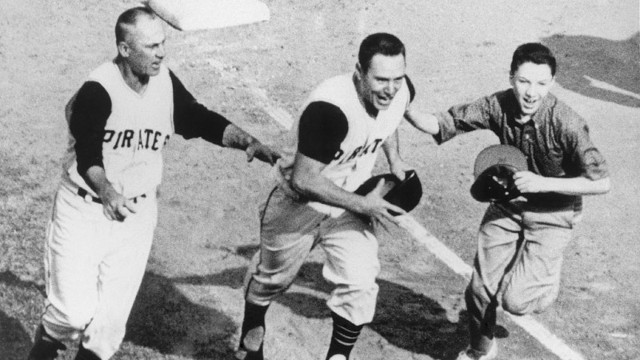
Bill Mazeroski rounding third after hitting his 1960 Walk off Homer. Photo Getty Images

This is a great topic and a great article from ESPN’s Jim Caple yesterday.  What single baseball game would you want to travel back in time to see?

Caple surveyed a variety of people, from movie stars to current players to fellow baseball columnists, and listed their choices.  His article makes for a great read.  Some of the choices were great.  I won’t spoil all of them here; you have to read the article.

For me, the knee jerk answer was immediately one of two games:

  1. Babe Ruth‘s “Called Shot” game from the 1932 World Series (Game 3), or
  2. Game 7 of the 1960 World Series, which may have been the greatest game in the history of Baseball, featuring Bill Mazeroski‘s walk off home run.

The Called shot game is kind of a baseball cliche; it is one of those lasting legends of the game.  But the only reason to go see that game would be to answer this question; the game itself wasn’t that great.  The box-score reveals a game where the Yankees jumped out to a quick 3-0 lead on the called shot, the Cubs fought back but then back-to-back homers from Ruth and Lou Gehrig put the game away and it was never close after that.  I’d want to go back for the first INNING of that game, see the homer, then go to the 1960 game :-).

As it turns out, I’m not really that interested in finding out whether Ruth really called his shot for this reason: the Boss family happens to have a bit of inside information, believe it or not, on the game itself and whether or not it really occurred.  You see, we’re family friends with none other than the son (and grandson, who is my age and who i’ve known since childhood) of former baseball commissioner Kinesaw Mountain Landis, and he was actually AT THE GAME as a child guest of his father.  And I’m pretty sure he’ll tell you that Ruth did call the shot.

So, for me, I’d want to see the 1960 game.  Check out the box score from Game 7 of the 1960 world series.  Here’s the Recap:

  • Pittsburgh jumps to a 4-0 lead early.
  • Yogi Berra and Mickey Mantle help spark a 4-run rally in the 6th to take a 5-4 lead.
  • The  Yankees extend their lead to 7-5 in the top of the 8th.
  • The Pirates rally for FIVE runs in the bottom of the 8th for a 9-7 lead.
  • The Yankees’ two hall of famers Berra and Mantle manage to drive in the tying runs in the top of the 9th to make it 9-9.
  • Mazeroski blasts a walk-off homer on a 1-0 count to lead off the bottom of the 9th and win the world series.

What a game!!  For all of us who thought last year’s Game 6 was amazing, this game looked even more amazing.  Plus you’d get to see two legends in Mantle and Berra.

Read the article and tell me in the comments what game you’d want to travel back for.  Disco Night?  1975 Game 6?  Don Larsen‘s perfect game?  Jackie Robinson‘s debut?  How about Game 7 of the 1924 series, a 12-inning affair featuring a slew of Hall of Famers and was also the last time Washington won a World Series?

More and more I’m liking the 2nd Wild Card

8 comments

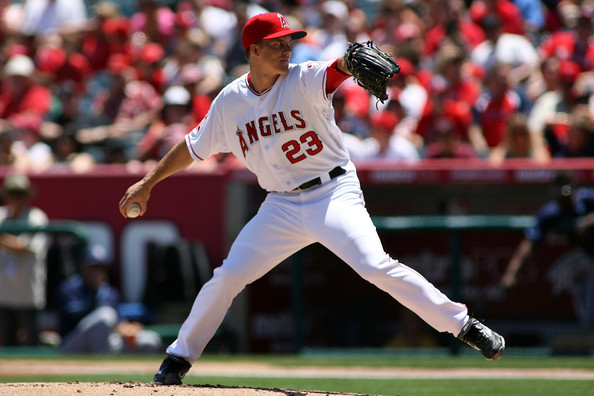
Will the Greinke acquisition get the Angels out of the WC game? Photo Jeff Golden/Getty Images

Baseball Purist Alert: this opinion piece may not entirely please you.

I have to admit; as a life-long baseball fan I find myself constantly being at odds with myself over the “purity” of the game dating to its roots versus the natural progression of modern baseball as it adjusts to the current  sports climate.  Every change we’ve seen, from divisional play to wild cards to instant replay seems like an attack on the sanctity of the National Pasttime, and the sport which routinely traces its roots to stars from 70 years ago.

The latest Collective Bargaining Agreement added a second Wild Card in each league, and a one-game playoff between the two wild-card teams to advance into the divisional series.  Some purists were aghast with the addition of yet another non-divisional champ to the post season party.  However, as we’ve seen this season play out the second wild-card inarguably has some side-effects that I think are good for the game.  Lets talk about these intended (or unintended) impacts:

1. The additional Wild Card has kept more teams in the Playoff Race.  Here’s the standings as of 7/31/12 (a fantastic new feature I found at baseball-reference.com; you can pull standings as of any date in the history of the game).  8 of the 16 teams in the NL and arguably 9 or 10 of the teams in the AL were technically still “in” the race for a playoff spot.  More teams in the playoff race means longer sustained fan interest and less tanking or selling off of assets.

2. By virtue of #1, more teams were trying to improve at the Trade Deadline.  You can argue that more teams in the playoff hunt meant that fewer teams were sellers, and that lead to gridlock at the trade deadline.  But, some surprise selling teams (namely Miami and Philadelphia) injected new life to the trade deadline and had some teams making significant and crucial pickups.

3. An additional Wild Card still leaves Baseball with the lowest percentage of its teams in Post Season Play.  Hey; at least we’re not the NBA, where more than half the teams make the playoffs.  It still means something to make the playoffs, which is important.

4. The play-in game will be fantastic.  Nothing is as amazing as a one-game playoff to advance, and some of baseball’s most historic moments have come during these games.  Who would know who Bucky Dent was if not for his amazing home-run in the 1978 playoffs?  Both teams will be sending their Aces, both teams will be playing like its Game 7, and the neutral fan will be in heaven.

5. The additional Wild Card will mean that teams will play harder, longer into the season.  Why do you think we’re seeing the massive trade-deadline arms race between Western divisional rivals in both leagues?  The Angels/Rangers and the Dodgers/Giants were by far the most active teams at the deadline because they all know that the difference this year between winning the division and the wild-card is significant.  In years past we’ve seen teams almost not care if they won the division or dropped to the wild card; you were guaranteed not to meet your divisional rival until the LCS and the home field advantage in baseball is so slight that sometimes you could argue that playing away in a short series is more advantageous.

Why?  In a short series, its pretty easy to “steal” a game on the road and then hold serve and win 2 straight at home, knowing that the pressure is on the favorite and knowing that the under-dog can drop a game at home but still get a 5th/deciding game on the road.  In a 7-game series the same rule of thumb applies; its really difficult to get a 3-game sweep, but its really easy to get a 2-game split.  Especially considering that the home-field advantage in baseball is only about 56% but has been as low as 52% in the past decade (see this link at Baseball-Reference.com, which has the home-team winning percentage over the years).

Now we see the immedicate impact; the Angels and Rangers absolutely do not want any part of a coin-flip game with the 2nd wild card for this reason.  Primarily because…

6. The one-game play-in will significantly impact the advancing Wild Card Team.  You have to think that teams will send their Ace/#1 starter to the hill in the play-in game.  Why possibly save him for a series that you may not get to?  As a result, the wild card winner advances to play either the #1 seed or the #2 seed (if the #1 team is in their same division) having already spent their big arm.

Why do I see this as a good thing?  Because one major beef I’ve always had with Wild Cards is their relatively easy path to advance to the World Series.  Up until the last day of last season, the Cardinals were not even set to be a playoff team, and then they run to the World Series title.  We’ve already talked about the relatively small home field advantage baseball teams have.  Wild Card teams, more often than not, come into the playoffs “hotter” than the divisional champ that they then face.  This results in a significant number of Wild Card “upsets” in our history of divisional play and having Wild Cards advance far further than I’d normally like to see them, at the expense of divisional winners losing short series.  In the 17 years of divisional play/wild cards we’ve had:

  • 5 Wild Card WS champions (including most recent St. Louis Cardinals plus 3-straight from 2002-4)
  • Another 5 Wild Card WS runner-ups (including 3 straight from 2005-7)
  • Overall, 10 of 34 World Series participants being Wild Cards, a rate of nearly 30%.
  • 18 Wild Cards overall who won their Divisional Series out of 68 such series being played, a success rate of more than 25%.

Perhaps this is one last vestige of “baseball purism” in me, but I think the game needs to have more World Series winners who not only won the 8-team (now 10-team) playoff derby, but who also succeeded all year long and won their divisions.  Only three times in the divisional era has the team with the best record also won the World Series, 3 times out of 17 (the spreadsheet linked here is also available in the links section to the right-hand side of the blog, called “Best versus Winner.”  It needs updating for 2011 and 2012 champions in all sports, but shows just how infrequently the best regular season team wins in any sport.  A side effect of expanded playoffs in all sports, true, but a concerning trend for any sport purist).

In any rate, I’m hoping that the diminishing of the Wild Card one-game winner means that fewer Wild Cards run through the playoffs, which will lead to more “deserving” World Series participants.


Do I wish that Baseball would revert to the old, old days where there was one division and two pennant winners?  No, of course not.  In fact, I think Baseball would be best served by adopting the NFL’s 8 division alignment with 2 wild cards for a very neat post-season tournament where the two best teams got byes (in the link above, I posted some possible alignment possibilities when the whole re-alignment discussions really took hold in July 2011; my two expansion target cities were San Antonio and Portland).  But expansion in Baseball seems like such a difficult proposition that it may never happen (for the reasons explained in this post).  But the 2nd wild card seems to be setting up baseball fans for an exiting and “fairer” post season in 2012 and beyond.

Written by Todd Boss

August 7th, 2012 at 1:47 pm

Rays not exactly Fundamental

2 comments

After watching the Nats take 2 of 3 from the Rays this week, I’m left with one major thought: The Rays are one of the worst fundamental baseball teams I’ve seen play here.  For all the rumors of how Joe Maddon is a genius, his team certainly made mistake after mistake defensively.  Just in the 3rd inning of the game tonight they made three basic defensive mistakes:

BJ Upton failed to properly prepare himself to throw home after catching a sac fly and was (for some inexplicable reason) surprised to see Danny Espinosa tagging up and scoring easily.

Carlos Pena took a cut-off throw and failed to pay any attention to Ian Desmond, who alertly scampered to 2nd base without a throw.

Matt Moore didn’t pay frankly any attention to Espinosa while on second base, allowing a double steal to occur, both runners of which eventually scored and proved to be the lead-changing runs that turned the game.

The Rays are the 2nd worst team in terms of errors in the league.  There’s specific questions about the constant shifts put in play by Maddon against players not necessarily known as pull hitters.   Their current third basemen situation is atrocious; a throwing error in the first game, a simple catch missed in the 2nd game (when Bryce Harper ran from 2nd on a ball to the shortstop) and a fielding error in the 3rd game.  Yes I know they’re missing Evan Longoria … but the Nats are missing their highest paid player right now too in Jayson Werth.  And, they clearly are pushing the limits of the rulebook as evidenced by the Joel Peralta pine-tar incident.

The Rays were probably lucky to avoid the sweep frankly; they got a win with their ace David Price giving up 4 runs in 7 innings while our soon-to-be-demoted #5 starter Chien-Ming Wang conspired to give away a game possibly for the last time for this team as a starter.

Seems to me the Rays need to tighten up their professionalism.

Has anyone ever signed a “good” $100M+ contract?

leave a comment

Werth's wrist issue has not helped his cause with pundits who ridiculed his contract in the first place. Photo AP/Richard Lipinski via cbssports.com

One of the things that’s always irked me as a Nats fan is the continual presence of Jayson Werth‘s 7yr/$126M contract on the ever present lists of “Worst Contracts in Baseball.”  Or the fact that when Ryan Zimmerman signed his $100M extension, an anonymous front office member was quoted as saying that the Nats now had “two $100M contracts but no $100M players.”  (paraphrased from memory, can’t find the original quote).

Lets face it: professional baseball (and to an extent most Professional Sports) is a unique industry when it comes to paying for performance.  Most players perform in their peak professional years for pennies on the dollar (especially those in pre-arbitration years) as compared to their general “worth” on the Free Agent market.  Teams can lock up players for at least 6 years and sometimes 8-9 years (depending on the amount of time they spent in the minors) once they are signed.  In most cases players are first reaching free agency in their early 30s, whereas most would agree that a player’s peak performance age is probably in the 27-28 timeframe.  That means that by the time a star  is finally ready to cash in and sign that life-defining guaranteed contract …. they’re mostly on the downside of their career.  This means that teams are almost always paying for players’ decline years, and it almost always means that teams are generally regretting these huge contracts almost the moment they’re signed.

Teams that want to add through Free Agency thus are almost always paying ahead for past performance.  And usually this means that, especially by the end of a long FA contract, teams are vastly overpaying for the performance they’re getting on the field.

So I asked this question; has anyone ever signed a “good” $100M+ contract?  Good meaning, did the player perform up to the value of the contract the entire way through it?  A group of friends of mine argued about the same topic while drinking beer in the bleachers at Nationals Park last week; lets revisit the conversation.

According to Cot’s site (now at Baseball Prospectus), there have been 35 such contracts of $100,000,000 or more.  I’ve divided these contracts into three categories: those that are in the past or are sufficiently worked through in 2012 as to pass judgement, those that were signed starting with 2011 (so they only have a season and a quarter to judge), and those that started in 2012 or in the future.  Of these 35 contracts, they break down as follows:

  • Old enough to be Judge-able: 20
  • Started in 2011: 5
  • Started in 2012 or in the future: 10 (lots of big contracts handed out this past off season).

How would you judge these contracts?  Lets go by category: The rank is the rank of all time total value amongst all of these 35 contracts.

Category 1: Judgeable $100M contracts

Rank Player Amount (Years) Knee Jerk Opinion on value
1 Alex Rodriguez $275,000,000 (2008-17) Future Albatross: paying A-rod $28M at age 41
2 Alex Rodriguez $252,000,000 (2001-10) Great production for most of this contract
6 Derek Jeter $189,000,000 (2001-10) Hard to Argue Jeter wasn’t worth it…
8 Mark Teixeira $180,000,000 (2009-16) 2009 was great; a .242 hitter since.
9 CC Sabathia $161,000,000 (2009-15) Continues to be one of the best pitchers in baseball.
10t Manny Ramirez $160,000,000 (2001-08) One of the greatest per-dollar value large contracts ever
14 Miguel Cabrera $152,300,000 (2008-15) Great value so far; perennial MVP candidate
16 Todd Helton $141,500,000 (2003-11) Early part of contract good; last few years meager.  A push
17 Johan Santana $137,500,000 (2008-13) Major injuries plaguing contract
18 Alfonso Soriano $136,000,000 (2007-14) Considered one of the worst contracts in baseball
20t Vernon Wells $126,000,000 (2008-14) Severely underperforming; one of most immovable contracts
20t Barry Zito $126,000,000 (2007-13) 5th starter stuff, bumped from rotation by career minor leaguer
25 Mike Hampton $121,000,000 (2001-08) Major disappointment, traded twice
26t Jason Giambi $120,000,000 (2002-08) Great early value in NY; injuries and lack of production late.  A push
26t Matt Holliday $120,000,000 (2010-16) Quietly earning this contract.
29 Carlos Beltran $119,000,000 (2005-11) Injuries plagued middle of contract; good value otherwise
30 Ken Griffey Jr. $116,500,000 (2000-08) Missed most of 3 seasons mid-contract, constantly hurt
32 Kevin Brown $105,000,000 (1999-2005) 72 Wins for $105M, missed parts of 4 seasons.
33t Carlos Lee $100,000,000 (2007-12) Decent performance if not spectacular; Too much $/year though
33t Albert Pujols $100,000,000 (2004-10) If anything, underpaid during this stretch.

Category 2: Too Early to really tell (signed/started in 2011) Contracts:

Rank Player Amount (Years) Early Reports Are..
7 Joe Mauer $184,000,000 (2011-18) Injuries early in contract; struggling so far in 2012.
12 Troy Tulowitzki $157,750,000 (2011-20) Hard to argue with production; injury prone though
15 Carl Crawford $142,000,000 (2011-17) Played relatively poorly in 1st yr, hurt 2nd.
20t Jayson Werth $126,000,000 (2011-17) Wide-spread opinion of major over-pay; out most of 2012
26t Cliff Lee $120,000,000 (2011-15) One of the best pitchers in baseball

Category 3: 2012 and Future Extensions

Rank Player Amount (Years) Industry Opinion seems to be…
3 Albert Pujols $240,000,000 (2012-21) Future Albatross?  Slow 2012 start, tons of money in late 30s
4 Joey Votto $225,000,000 (2014-23) Too much for too long?
5 Prince Fielder $214,000,000 (2012-20) Bad body won’t age well
10t Matt Kemp $160,000,000 (2012-19) Best player in baseball rocketed out of the gate in 2012.
13 Adrian Gonzalez $154,000,000 (2012-18) Red Sox issues in general dragging him down but was good in 1st season
19 Matt Cain $127,500,000 (2012-17) Lot of money to a pitcher with a career W/L record below .500
23 Ryan Howard $125,000,000 (2012-16) Achilles heel injury to start; $25m/ year for decline
24 CC Sabathia $122,000,000 (2012-16) Continues to be one of the best pitchers in baseball.
31 Jose Reyes $106,000,000 (2012-17) Concerned about contract year boost in productivity?
33t Ryan Zimmerman $100,000,000 (2014-19) Great player if healthy … but seemingly never healthy

Conclusions

  • Of the 20 judge-able $100M contracts, 10 were unquestionably bad, 7 were good and the other 3 were arguable one way or the other (which, is still “bad” in that they weren’t huge successes).
  • 3 of the 5 2011 contracts are widely panned as of this moment.
  • Of the 10 nine figure contracts starting this year or later, at least 4 have been badly panned and really only Matt Kemp‘s contract looks like a winner from the onset.  Then again, judging a 6 year contract on 2 months of production is (goes without saying) the definition of a small sample size.

I’ve only identified 11 of these 35 contracts that were either “worth it” or which seem to be trending well.   So the answer to my blog question is definitely, “Yes, there have been a handful of 9-figure deals worth the money.”  However, 18 of these 35 contracts were either patently bad or are trending that way soon.  The other 7 that I’ve put somewhere in the middle may very well be considered losses; when you commit $100M as a franchise you expect near Hall of Fame productivity.

The lesson that I take away is this: a 6-9 year commitment for $18-$25M/year should be a guaranteed lock of productivity for your team, but as these contracts show it almost seems like a coin flip as to whether your franchise-defining contract will actually work out.  That’s scary stuff to consider as a GM and/or an owner.

Bonus Analysis: Team by Team: 18 of the 30 teams in baseball have rolled the dice on a 9 figure salary; how have they fared?

Team Ttl good bad indifferent
Boston 3 1 1 1
Chicago Cubs 1 1
Cincinnati 2 1 1
Colorado 3 1 1 1
Detroit 2 1 1
Houston 1 1
Los Angeles Angels 1 1
Los Angeles Dodgers 2 1 1
Miami 1 1
Minnesota 1 1
New York Mets 2 1 1
New York Yankees 6 3 2 1
Philadelphia 2 1 1
San Francisco 2 1 1
St. Louis 2 2
Texas 1 1
Toronto 1 1
Washington 2 2

Look how many teams have tried once or twice and failed every time.   And notice that sometimes even a “good” contract can still be crippling.  Alex Rodriguez earned every penny of his massive contract in Texas … but the owners capped payroll and couldn’t build a good team around him, so the contract was viewed as a massive anchor for the team.  He had to be traded so that the team could rebuild (and as it turned out, be sold to a more competent owner).

Back to our Nats: Washington has handed out two 9-figure deals and both (while still early) are being panned in the media.  Werth‘s wrist injury and Zimmerman‘s continual dings aren’t helping.  Lets just hope that the kids keep competing and driving us forward.

Opinions?

Written by Todd Boss

May 25th, 2012 at 8:43 am

Johnny Damon: Hall of Famer? Not for me

5 comments

Johnny Damon during his Boston reign. Photo unknown via metsmerized.com

With recent news that Johnny Damon has convinced another team (for 2012 its the Cleveland Indians) to give him more at-bats so that he can continue his march towards the magic 3,000 hit plateau, and with today’s Rob Neyer column that already assumes Damon is a hall of famer and asks, “Which cap will be on his Cooperstown plaque,” I have this to say:

How is it possible that Johnny Damon is a hall of fame player?

Here’s a few metrics for you:

  • All Star Apperances: TWO!  Two times he’s been considered amongst the best 60 or so active players.
  • Top 5 MVP votes: Zero
  • Top 10 MVP votes: ZERO
  • Top 20 MVP votes (as in, one of the 32 writers involved threw him a 10th place vote here and there): 4 times.
  • Career OPS+: 105.  As in, compared to his fellow players he’s only about 5% better at the plate.
  • Career OPS: .789, below the .800 line of respectability for modern day hitters.
  • Defensive awards: Golden Gloves and Silver Sluggers: Zero.

I’m sorry, but in what world is this a hall of fame career?  Damon is the epitome of an accumulator, averaging nearly 700 plate appearances and 188 hits per year over his career and staying relatively healthy (never playing less than 140 games per year since his debut in 1996).  105 OPS+!  If he was a gold-glove calibre middle infielder maybe that’d be acceptable, but he’s a sub-par defensive outfielder who has never sniffed a defensive award.

I also go back to my tried-and-true argument related to All Star appearances and MVP voting; how can a player possibly be considered one of the greatest players of all time if he rarely, if ever, was considered one of the best players of his own time, on a year to year basis?  Great players earn all star appearances even in down years, while middling players never earn them.

For everyone who has vehemently argued against Jack Morris, essentially on the strength (weakness) of his career ERA (and by implication, ERA+) … I wonder who hypocritically is arguing FOR Damon.  Oh wait; Rob Neyer is.

Am I crazy?  Who out there thinks that Damon is worthy of a copper plaque in Cooperstown?

(caveat: after reading the comments in the Neyer article, it occurred to me it was possibly a spoof.  As in, an entire tongue-in-cheek article.  If so, my reading comprehension skills are at fault and I rescind this criticism.)

Written by Todd Boss

April 17th, 2012 at 6:58 pm

MLB 2012 Predictions

3 comments

Opening day is upon us.  Why not put in some quickie predictions on who makes the playoffs this year?

  • AL East: New York Yankees
  • AL Central: Detroit
  • AL West: Los Angeles Angels
  • AL Wild Cards: Tampa, Texas

Narrative: I think the Yankees have enough to win the East; they have the same offense and seem to have improved their starting pitching.   Detroit should more or less cruise to the Central title; perhaps Minnesota could scare them for a wh ile but they have almost no quality starting pitching and Mauer and Morneau are not exactly health guarantees.  I think the Angels have bought their way into an AL West title, but wouldn’t be surprised if it came down to the wire.

Wild Cards: I think Texas (or LA) easily qualifies for a wild card, given the number of games both teams will have against their incredibly weaker divisional rivals Seattle and Oakland.  Meanwhile, Tampa seems to be in far better position than anyone else in the AL; they’re going to be tough to beat night to night because of pitching.  Meanwhile Boston seems adrift; they went from a 2011 wild-card shoe-in to an off-season punchline within one series in Baltimore.  They have done almost nothing to improve and have made a few puzzling moves in the off-season.

How about the NL?

  • NL East: Philadelphia
  • NL Central: Milwaukee
  • NL West: San Francisco
  • NL Wild Cards: Atlanta, Cincinnati

Narrative: Despite Philadelphia’s injuries on offense, they still have the class starting pitching and don’t seem to be taking that big a step back by depending on Worley to replace Oswalt‘s innings.  They don’t win 100 games, but they’ll eke out a divisional title.  The NL Central may be the most interesting race of any division; who knows how the losses that Milwaukee and St. Louis have absorbed versus the gains of Cincinnati may play out.  For now I’m guessing that all three teams end up in the 86-88 win range, but Milwaukee’s superior pitching and still-good offense win out.  In the west, its hard to imagine San Francisco faltering again, but we’ll see.  I know Arizona won comfortably last year, but they’re putting an awful lot of faith in two relatively weak starters (Saunders and Collmenter).

Wild Cards: I just can’t pick against Atlanta; they mostly have stood pat but they should have been the WC last year.  Based on Washington’s lack of addressing their own offensive needs in the off-season plus all the injuries we’ve had so far this spring, its real tough to suddenly give this team 10 more wins.  I think Cincinnati may sneak into the 2nd wild card ahead of a team like Arizona or Washington by virtue of a few more games against weakened NL central competition (Chicago and Houston).

AL Playoff predictions:

  • WC play-in: Tampa beats Texas in the play-in (Matt Moore is untouchable)
  • Divisionals: Angels outlast Tampa, Yankees get revenge on Detroit
  • ALCS: Los Angeles batters tired New York pitching for an AL Crown

NL Playoff predictions

  • WC play-in: Atlanta beats Cincinnati in the play-in
  • Divisionals: Philadelphia beats San Francisco in a bunch of 2-1 games, while Milwaukee barely beats Atlanta
  • NLCS: Philadelphia outlasts Milwaukee

World Series: the Angels have too much on both sides of the ball, match Philly’s pitching ace-for-ace while providing superior hitting and we have a ton of Rally Monkey/bang sticks in October.

Written by Todd Boss

April 6th, 2012 at 10:24 am

Movie Review: Moneyball

10 comments

Brad Pitt playing the part of Billy Beane. Photo movie still via splatf.com

Yes I know, I’m probably one of the last people out there who take the time to write a baseball-themed blog to actually see the movie Moneyball, the film adaptation of Michael Lewis‘ seminal baseball book by the same name.  We took some time last weekend during a period of relaxation to order it on PPV from DirecTV and watch it.  Here’s some thoughts;

First, I’ll freely admit that I struggled to appreciate the movie for two primary reasons:

  1. I read the book, several times over, digesting the analysis that Lewis offered for the success of the Athletics in the early 2000s, following the narrative of Billy Beane‘s rise from backup outfielder to advance scout and eventually the front office at such a young age and reading along for the primary story line revolving around the strategy employed during the infamous 2002 draft.
  2. I could not get over the distraction of so many parts of the story being purposely changed (changing Paul DePodesta‘s character to be the fictitiously named Peter Brand) or outright fabricated (the entire storyline involving Beane’s daughter).

I’ll leave aside my primary criticism of the book in general; as I’ve stated in this space and in other forums, Lewis really did not discuss the fact that the 2002 Athletics were blessed with a quartet of starters that has only been matched a few times in the last 40 years or so, and they were a huge part of the team’s success.  For me, yes the construction of the hitters on that team was unique and interesting, but that team doesn’t win 103 games without three starters who each posted a 125 ERA+ or (in some cases significantly) better.

From a movie critique stand point, I thought Brad Pitt did a pretty good job of portraying the engimatic Billy Beane, if anything toning down the violent temper as it was portrayed in the book.  Jonah Hill‘s portrayal of the DePodesto character was, to me, bland and lacking depth.  I was really surprised to see him get an Oscar nomination for Best Supporting Actor frankly.

The entire storyline in the movie about Beane getting into the fight with the head scout was completely manipulated from how it really happened; in the movie they were talking about free agents but in the book they were talking about amateur players during the 2002 draft.  I suppose from a storyline perspective the conflict needed to occur when it did; a movie that was supposed to tell the tale of how Beane selected all these undervalued players in order to make the 2002 on-field team win wouldn’t really work if the primary conflict was about a bunch of 21yr old draftees that wouldn’t even feature in the majors (if at all) for 3-4 years onward.  But as someone who knows the actual details, it made understanding the storyline that the movie was telling that much more difficult.

In the end, my wife thought it was a “good movie” so its subsequent accolades seem in order.  Hollywood can’t really make a movie that appeals to the fraction of 1% of baseball fans who read that book and understood its statistical analysis.  You have to appeal to the masses for commercial success.

But I found myself struggling to decide whether I thought the movie was “good” or not.  It was entertaining.  The actors were ok, I guess.  I know many have criticized the Art Howe portrayal in the movie … but then again many criticized the portrayal of Howe in the book as well.  Lewis seemed to belittle many people in the book as a way of playing up his primary character.  But nothing about the movie really convinced me it was a seminal movie, that it was some great masterpiece of filmmaking that was worthy of an Oscar nomination for Best Picture.

What did you guys think?

Written by Todd Boss

March 9th, 2012 at 3:28 pm

Ask Boswell 3/5/12

4 comments

Here’s Tom Boswell‘s weekly Monday chat from 3/5/12.  Of the baseball questions he took, here’s how I’d have answered them.  While lots of questions pertained to the recent Gregg Williams “bounty” issues and whether or not the Redskins partook during his time here, the starting of spring training has got Nats fans pretty excited.

As always, questions are edited for clarity and I write my own answer prior to reading his.

Q: What do you think the Nats w/l record will be?  Can they win 90 games?

A: For a team that won 80 last year (though their pythagorean W/L record was slightly worse), I don’t think its a stretch to assume they can improve another 10 games.  Mark Zuckerman did a nice little WAR analysis and showed that full seasons from Zimmerman, LaRoche and Strasburg, along with the new additions of Gonzalez and Jackson *should* give the team at least another 10 wins, perhaps a bit more.  That’s assuming basically that everyone else performs at the same levels they did last year, and it assumes that the WAR stat directly translates to wins on the field.  In reality, you have to plan for some people to step up while others step back.  Can we assume that Morse will hit 30 homers again?  Its a tough one to assume; he could break a leg and suddenly our offense is in tatters.

That’s why I’ve been a bit more conservative, predicting 8 more wins for this team and have them at 88-74 with this squad.  If the team is in the WC hunt, and they augment the offense, or if Harper comes up and produces … suddenly that’s a 90-91 win team.  Boswell didn’t really answer this question, just went off on Strasburg tangents.

Q: Who is your opening day starter?

A: barring injury it has to be Strasburg.  I think your initial 5-man rotation goes like this, in this order: Strasburg, Gonzalez, Zimmermann, Jackson and Wang.  This gives you a decent righty-lefty matchup at the top.  Perhaps you replace Wang with Lannan and have Jackson go out 5th to get a true R-L-R-L-R rotation.  Or perhaps Davey Johnson doesn’t care about lefty/righty matchups.  I’m more interested to see who the home opener starter is, since it happens 7 games into the season.  Right now it looks to be Gonzalez, which would be great, but early season rain-outs can greatly affect rotation orders.  Boswell says Strasburg but had a good caveat; if its 30 degrees and snowing in Chicago on opening day Strasburg probably won’t go.

Q: Where is this team’s Lenny Dykstra-esque scrappy mean streak player?

A: Honestly, the Mets-to-Nats comparisons may not ever bee 100%.   I don’t see a Dykstra type on this roster.  Mostly because this roster still does not have a center fielder/lead off type, which is exactly what Dykstra was.  Boswell says that Werth may still fill this role.

Q: Why didn’t the team keep Bixler and Nix?

A: Bixler is a good question; for reasons unknown the team designated him for assignment in the off-season while still possessing 40-man room (inexplicably; they did this a number of times, losing Kimball at one point but also losing two decent players in the Rule 5 draft).   Nix they probably thought was replaceable on the FA market … or at least obtainable for cheap.  There does always seem to be a number of halfway decent corner outfielders on the market who are available for less than what Nix got.  Boswell says Nix’s 2yr contract was the problem … the Nats want flexibility for 2014.  No mention of Bixler.

Q: If Tyler Clippard is our “MVP,” why isn’t he being paid more?

A: Two reasons; clearly the questioner doesn’t understand the whole arbitration process.  Just because Clippard is our best pitches doesn’t equate to him being the highest paid player.  Veterans always make more than pre-arb guys; don’t forget the players belong to a Union, and Union members reward longevitiy.  Secondly; Clippard unfortunately is a commodity player; he’s a non-closer reliever who doesn’t rack up saves and thus won’t ever be compensated like a Jonathan Papelbon or a Mariano Rivera, despite his value to the team.  Its an unfair world in some respects, and I just hope that the Nats do him right and keep paying him while he’s productive for the team.  Boswell mirrors my two thoughts but then also says that relievers are starting to become aware of newer stats like WPA that value Clippard highly (1st in the NL last year, above big name starters like Roy Halladay).

Q: What are your thoughts on the extra wild card?

A: Baseball purists may whine and complain, but the modern professional sports scene in this country, fortunately or unfortunately, places a ton of emphasis on playoffs versus regular season accomplishment.  Even with these two additional WC teams, Baseball still has the fewest of its teams reaching the regular season of any of the four major sports.  And, in a sport where payroll disparities may not determine the World Series victor every year they clearly help predict the playoff contendors (Yankees: one missed playoff appearance since 1994), having more teams in competition for the playoffs is good for the sport.  Frankly I’d like to see Baseball go to a 32-team/8-division structure similar to the NFL and adopt the NFL’s exact playoff structure.  The problem there is finding two more markets without cannibalizing the NY or LA market.  Boswell says “time will tell,” but also admits that he hated the first WC round initially but likes it now.  He also points out something I hadn’t thought of; the importance of your #3 starter with a new round of playoffs.

Q: Should the team just skip Strasburg’s start every few times to extend his 160IP limit until the end of the season?

A: It isn’t a bad idea; Zimmermann skipped one start and hit his 160IPs at roughly September 1st.  So skipping a few more starts for Strasburg would put him well into September.  But I don’t think he’ll be served well by jacking around his days rest.  Starters depend on getting into routines in order to pitch their best.  Honestly I think this situation may very well play it self out naturally; even in 2010 Strasburg had two separate DL stints; if he spends 30 days or so on the DL at various times we’ll get a full season out of him.  Boswell agrees with me on the not-skipping-a-start theory.

Q: How secure is Ramos as the #1 catcher?

A: I’d say he’s pretty secure.  Flores may have had a good winter, but winter leagues aren’t exactly MLB quality.  Flores’ injury history has more or less derailed his career, and that’s unfortunate.  The team has found a solid #1 in Ramos and will stick with him, with Flores getting his typical 1 or 2 starts a week.  The inclusion of Derek Norris in the Gonzalez package also spoke volumes about where this team thinks it is in terms of catcher depth, as does the 40-man addition of Maldonado, a journeyman catcher who now benefits from a distinct lack of upper-level minor league catcher depth.  Look for the team to make catcher a focus in the 2012 draft to start back up the catcher pipeline.  In the mean time, I doubt Flores will be trade bait even if he performs amazingly well, at least until we find another catcher in the wings.  Boswell says Ramos is as #1 as any #1 can be.

Q: Who are the best catchers ever?

A: For a combination of defense, calling games, arm strength as well as offense, i’d go with Johnny Bench.  But you also have to throw in Ivan Rodriguez in his prime.  Mike Piazza was notoriously bad defensively.  Jorge Posada was subpar defensively in his later years but was a monster bat.  I’d include other names from the past few decades like Carlton Fisk. Before Fisk and Bench, there was a dearth of HoF inductees from the catcher position for some 30 years, to Yogi Berra who is probably the benchmark for all-around catchers (with Bench).   Boswell says Bench as well, but mentions Varitek with Posada.  Interesting.

Q: What is the team going to do with Ian Desmond?

A: I’d guess that 2012 is the make it or break it year for Desmond.  If he’s hitting .220 at the all-star break without significant value proven at the SS position, the team may make a change.  Move Espinosa to SS, install DeRosa as starting 2B, look to move Desmond and perhaps make Lombardozzi the utility guy.  I also find it very interesting that Anthony Rendon is getting reps at both 2B and SS; if that kind of hitter can slot in at short stop on even an as-needed basis he could be even more of a dangerous prospect than he already is.  Boswell agrees; this is a big year for Desmond.

Q: If catcher is so important, why did we move Bryce Harper away from the position?

A: one word: longevity.  Yeah he was a catcher growing up but catchers get the crap beat out of them, have constant injury concerns, and the wear and tear of catching affects their hitting.  With such a bat potential, he needs to be on the field and playing 162 games.  That being said, I was slightly surprised that he didn’t at least try to stick at C for at least a little bit of his career … but understand the reasoning stated.  Boswell said the same things I said, but added that scouts didn’t really think he was a natural catcher anyway, so he got moved to the OF quickly.

Q: What would MLB’s response be to the same “bounty” scandal going on in the NFL?

A: Hard one; its not like purposeful bean-balls without context are common in the MLB.  And the game is just too random to purposely try to spike someone, or slide into them on purpose, or to purposely hit a catcher.  These plays are so bang-bang and so naturally occurring to baseball players who have played all their lives that they’re hard to script.  If it was found out to be happening?  Long suspensions.  Boswell thinks such a situation would be lifetime bans, if proven.

Q: Strasburg has never pitched more than 7 innings, at any level, ever.  Is this a concern?

A: I have a hard time believing this, but won’t challenge the questioner since I’m not entirely in a position to go searching through the guy’s college career.  Is it a concern?  eh.  Its modern baseball.  No more 150 pitch games, no more 38 start seasons.    Little leaguers have pitch count/innings limits, high school teams only play twice a week.  College rotations you go once a week.  I’d only be concerned if he showed any inclination of slowing down later in games, which he doesn’t.  Boswell isn’t concerned.

Why is baseball so intent on killing their international talent pools?

7 comments

Bud Selig continuing to ignore the facts to save a buck. Photo via ajc.com

Bud Selig continues to push for an international draft.

Why can’t he see what irrevocable damage this would do to the game of baseball??  The cause and effect of including Puerto Rico into the domestic rule-4 (aka amateur) draft is pretty clear; when the province (a former hotbed of baseball prospects) was added to the US draft, MLB teams no longer had any incentive to host baseball academies on the island, which then led to almost no money being sent to develop amateur players, which has led to a startling drop-off of talent being drafted out of the territory.

If the same is done for the ENTIRETY of the world, what do you think will happen in developing baseball countries like Venezuela, Dominican Republic and the like?  Every MLB team will close up shop, stop spending money to develop and scout players, and we’ll stop seeing the massive inflow of foreign talent.  Its that simple.  An international draft works in Basketball because it is far more of an international sport than Baseball; there’s significant pro leagues world wide and a massive interest in developing players.  So there’s no need for NBA teams to setup basketball academies in places like Germany or Spain; they already exist and are funded by international amateur/olympic organizations.

The same situation doesn’t exist in baseball, and our sport has already suffered for Selig’s blatant pandering to tight fisted owners.  Clearly Jerry Reinsdorf was behind the limits of amateur bonus money negotiated into the last CBA and clearly is behind this international draft effort as well; for reasons unknown Reinsdorf and Selig are so myopic they cannot see the long term damage this will do to the sport: in order to save just a few million dollars here and there in signing bonuses they want to do billions of dollars in long term damage to the sport.

The most recent CBA already took the first steps towards hurting small-market teams and shutting the door on two-sport stars by putting in artificial and (in my opinion) unneeded limitations on bonus monies.  In a sport that clearly has massive revenue discrepancies between big city teams in New York, Los Angeles, Chicago and the like versus places like Kansas City, Pittsburgh, Tampa Bay and Oakland, why would the league purposely eliminate the primary way that these small market teams can improve themselves?  Its as if Selig called up the owners of large market teams with incompetent GMs and said, “Hey guys, how can we screw these teams to overcome our own incompetencies that we’re paving over by spending $150M/year in payroll?”

It really is infuriating…

How could we fix this issue, if an international draft was forced upon the sport?  I’d be ok with an international draft if, somehow, the draft rules were modified so that teams that developed talent in their own private academies were somehow given the ability to keep their own talent.  Perhaps a modified draft where international prospects were graded by independent talent evaluators and teams could burn one of their own amateur draft picks by taking one of their own?  How about an expansion-type draft situation where teams could protect a number of players ahead of each amateur draft, and then at the end of each round they could protect one additional player?

Written by Todd Boss

March 3rd, 2012 at 9:38 am

Braun appeal: Opinion and a part of the story few are talking about…

9 comments

Braun eloquently defended himself but left out a key part of the story that would have changed a lot of opinions. Photo Norm Hall/Getty Images via bleacherreport.com

(editor’s note: I updated and clarified two points in this post on 2/29/12 at 14:00 after receiving feedback from Will Carroll; apologies for misrepresentation.  He does not work for Baseball Prospectus and Braun’s testosterone RATIOs were elevated, not his testosterone levels).

I suppose I have to put my 2 cents in on Ryan Braun.

Here’s what I think; I’m less concerned about the fact that Braun got off on a supposed technicality (though that opinion has now changed given the information discussed further down below) than I am about the breaches in the process.  He suffered a career-damaging leak during what was supposed to be a confidential process and to that I say, shame on whoever leaked the information and double shame on ESPN for their TMZ-style reporting on the matter.  You want to be so cavalier with a person’s life and credibility?  I say you should be 100% culpable to your divulgions and should face financial punishment when Braun inevitably sues you for your leaks (as he has said he will do).

My view on drug testing and these self-appointed anti-doping organizations is incredibly skeptical; much like the NCAA, they self-aggrandize and preach about how they’re trying to keep sports clean, but then don’t acknowledge the irreversable damage done to athletes reputations when false positives, confidential leaks, and mistakes in the process come about.  Braun’s test was supposedly 10 times higher than what had EVER been measured before in baseball testing, and he had tested clean dozens of times before; why isn’t anyone talking about these two points together and asking the question, “gee, maybe something was actually wrong in this case?”   Why is everyone focused on how Braun “beat the system” but not questioning why, as he’s pointed out, he didn’t change his performance, didn’t gain a pound, and tested clean dozens of times previously?  Testing organizations TRY to find people who are cheating because it validates their existences, and when questionable evidence or results arise, instead of looking at things dispassionately they will always take the viewpoint that best supports their corporate missions.

This is related to my problems with the ongoing witch hunts surrounding Lance Armstrong as well; you have banned and proven liars in Tyler Hamilton and Floyd Landis who conveniently claim that Armstrong has cheated, yet you have Armstrong’s body of literally hundreds and hundreds of clean tests with absolutely no evidence of any positive test, ever.  At some point I’ve just kinda said, “Enough.”  Come to me with incontrovertable proof of a positive test or stop talking.  Interviews and “he said, she said” evidence is just that; hearsay.

(Note that the collector has released a statement describing what he did that fateful night and it sounds like he did nothing out of the norm, but his admittance that he stored the samples “in his basement” as opposed to a refrigerator certainly gave me pause).

We’re also seeing ridiculous theories on why the appeal was successful.  Deadspin is reporting that the arbitrator purposely blew the appeal to keep getting work (if i’m reading the article right).  I’ve read a theory that somehow Selig engineered this because of his relationship with Milwaukee.  I guess in the absence of anything besides what we learned from MLB’s ridiculous statement (saying they were “incredibly disappointed” in the arbitration finding seems to be unneccesarily vindictive) and Braun’s attack on the process (which also seemed over-stated; I don’t think its “fatally flawed,” just poorly worded), we’re left to our own imagination.


Now, that rant being said, check out this link at Hardballtimes from writer Mat Kovach. Apparently, Braun’s lawyers decided to see what would happen to Braun’s urine if they repeated the exact same scenario that led to the positive test … and after replicating the 3-day storage conditions before the samples were FedEx’d they found that a different urine sample showed the same elevated testosterone ratio levels!  I think a LOT of the outrage over Braun would disappear if this fact was more widely known.  In fact, frankly if this IS the case i’m not sure why Braun’s camp isn’t leading with this fact.  The narrative behind this story would go from “he got off on a technicality” to being “he got off because his sample was tainted” in a hurry.

Other sources on this topic include this link at Chad Moriyama‘s blog but apparently the person who really discovered this is Will Carroll.  Carroll has published a Kindle-reader story for 0.99 on Amazon and, well, its worth the 99 cent fee to buy and read (proceeds go to the Jimmy V fund).  You don’t need a Kindle reader; if you buy it right now you can read it via Kindle’s “cloud reader.”  For any of you who still have doubts on the case, you MUST read this story.

In fact, I’m still amazed that Carroll’s findings aren’t more well known.  The kindle article says that Carroll wrote it on behalf of si.com, so perhaps this is a future Sports Illustrated article (either in print or online or both).  I hope so; this story needs to have more traction.  To any the holier-than-thou baseball columnist or blogger stating that they “still think Braun is guilty,” I say simply, “read this article.”  To me its 100% incontrovertable proof that Braun’s sample was clean and that the conditions of its handling led to the positive test.

I just wish this was part of the narrative, instead of the tired “he beat the system” reporting that has dominated the story.

(Post-story update: Apparently Braun’s sample contained Synthetic Testosterone at advanced levels.  This particular fact puts a different spin on the entire defense of Braun above, honestly.   I’m less inclined now to defend the process and more at odds with the synthetic positive test.  That’s unfortunate.)

Written by Todd Boss

February 29th, 2012 at 9:15 am