Nationals Arm Race

"… the reason you win or lose is darn near always the same – pitching.” — Earl Weaver

Archive for the ‘Baseball in General’ Category

End of Season 2010 Award Candidates/Guesses (updated with Winners)

leave a comment

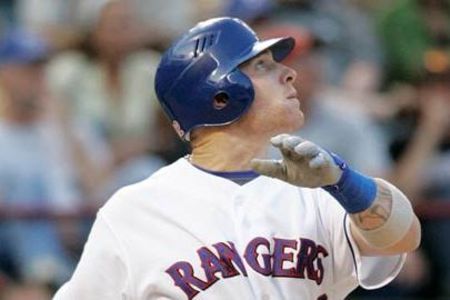
Josh Hamilton hits another homer. Photo: www.graphicshunt.com

Nov, 2010 Update: actual award winners:

Candidates and Guesses on the award winners for the 4 major categories per league.  I originally wrote this towards the end of the season, and now am updating it based on how the season finished out.

AL MVP: Josh Hamilton (Cano 2nd unless voters get all NY-starry eyed).  Miguel Cabrera getting is putting up serious numbers but the all around play of Hamilton is hard to miss.

AL Cy Young: Felix Hernandez.  Back in late august I had CC Sabathia winning this, but Felix’s statistics pitching for such a poor team are overwhelming.  Mid summer, this was David Price‘s award to lose and, well, he’s lost it.  Cliff Lee was putting in a pretty strong summer as well but has really struggled since getting to Texas.  Guys like Clay Buchholz (who led the Majors in ERA for a bit) and Trevor Cahill looking so strong.  Lots of good starter performances in the AL this year.

AL Rookie: Neftali Felix, who has been lights out for the Rangers as their closer.  Guys like Austin Jackson and Brendan Boesch have tailed off.  Daniel Bard really isn’t in a position as a setup guy to be the impact player the others are.  Reaching the post season and putting up good numbers there didn’t hurt.

AL Mgr: I’m going with Minnesota’s Ron Gardenhire.  He coaxed 94 wins out of a team with a ho-hum pitching staff, a team that lost its closer in the pre-season and which didn’t have its leading slugger for the 2nd half of the season.  Ron Washington also gets some credit, having taken a team with very little payroll to the top of their division.  Its a bit less impressive though since the Rangers were already projecting to be a pretty good team.

NL MVP: Joey VottoPujols may be an equal, but Votto will win the “hey lets give it to someone else” crowd.  I guess Adrian Gonzalez will come in a distant third.

NL Cy Young: Roy Halladay, who has been consistently and quietly awesome so far this year.  Again this was another’s to lose (Ubaldo Jimenez) and indeed he has lost it, performing so badly in the last month that I considering dropping him from my fantasy team.  Wainwright is up there for consideration as well.  Latos, Josh Johnson, and Hudson are also having great seasons.

NL Rookie: Buster Posey.  Yes he only came up in june, but to immediately slot in as the catcher, calling games for a rotation of elite starters AND being  your teams cleanup hitter is impressive.  That they made the playoffs and eventually won the World Series with Posey at the helm is even more impressive.  In August this award was absolutely going to Jayson Heyward, but he tailed off and wasn’t nearly as exciting towards the end of the season as in the beginning.  Jamie Garcia is in third place; it is hard to argue with a potential Cy Young candidate.   Mike Stanton, Gaby Sanchez and even Stephen Strasburg were up for consideration at various times.  Mike Leake‘s accomplishments are pretty noteworthy (not a day in the minors and making the MLB rotation on a playoff-bound team).  Just a great rookie class in the NL this year.

NL Manager: Bud Black, though some serious consideration goes to Dusty Baker for the job he’s done in Cincinnati.  But (in a similar story to Texas) to take a team nearly dead last in payroll to the top of a division with big time talent is tough.  Bobby Cox has also done a nice job turning around Atlanta.

Giants win continues a “Best Team not Winning the World Series” Trend…

one comment

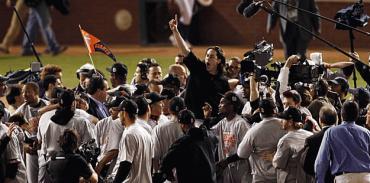
Photo by Carlos Avila Gonzalez / San Francisco Chronicle

The SF Giants finished with the 5th best record in the majors.  Clearly they were an elite team and won their division, but finished the season five games worse than the same Phillies that they dispatched in 6 games in the NLCS.

Their victory in the World Series continues an interesting trend in Baseball, and in most of the other major sports in this country for that matter, where the team with the best record in the regular season does not win the year end title.  I call it the “wild card” effect on professional sports.  Each major sport has a playoff structure that allows in “wild card” teams that have a chance to win the year end title despite not even being able to win their own division throughout the regular season.

Here’s a quick rundown of the best Baseball teams in the regular season (by overall record) versus who won the WS.  I’ve got the data going back to 1990, a convenient starting point since the Wild Card was instituted in 1994.  Bolded means that the best team won the WS:

year MLB WS Winner MLB Best Reg Season Team per league
2010 San Francisco Philadelphia, Tampa Bay
2009 New York New York, LA Dodgers
2008 Philadelphia LA Angels, Chicago Cubs
2007 Boston Boston, Arizona
2006 St. Louis NY Yankees, NY Mets
2005 Chicago WS St. Louis, Chicago WS
2004 Boston St. Louis, NY Yankees
2003 Florida (Miami) NY Yankees, Atlanta
2002 Anaheim (LA) NY Yankees, Atlanta
2001 Arizona (Phoenix) Seattle, Houston
2000 New York SF Giants, Chi WS
1999 New York Atlanta, NY Yankees
1998 New York NY Yankees, Atlanta
1997 Florida (Miami) Atlanta, Baltimore
1996 New York Cleveland, Atlanta
1995 Atlanta Cleveland, Atlanta
1994 (no WS, player strike) Montreal, NY Yankees
1993 Toronto Atlanta, Toronto
1992 Toronto Atlanta, Toronto
1991 Minnesota (Minneapolis) Pittsburgh, Minnesota
1990 Cincinnati Oakland, Pittsburgh

Since 1990, only THREE times has the team with the best regular season record won the World Series.  The fantastic 1998 NY Yankees team, the 2007 Boston Red Sox and last year’s 2009 Yankees team.  This year, the Rays fell to Texas and the Phillies fell to the Giants, meaning the two best teams in the league didn’t even make the World Series.  This “wild card” effect resulted in one of the regular season teams ever (the 2001 Seattle Mariners) not even reaching the World Series (falling at the hands of the Yankees, who then lost to the wild card Diamondbacks).  Several times wild card teams have won the WS out right (Florida in 97 and the 04 Red Sox as other examples), meaning that our WS champion would not have even qualified for the playoffs just a few years earlier.  For some reason I find this troubling.

Are the other major sports even worse?   Both the NBA and NHL allow in more than half the league’s teams to the playoffs.  In the MLS, half the teams qualify and then play a “home-and-home” first round of playoff games, essentially negating any home-field advantage earned by winning your division (ridiculous frankly; why have any value to the regular season?)   Football seems to have a pretty well-regarded playoff system right now but the imbalanced talent in the 2010 season may result in deserving AFC 10-6 teams being left out in favor of 8-8 NFC teams.  Here’s a quick breakdown of our major leagues and the percentage of teams allowed into the playoffs.

Ttl Teams # Playoff teams Pct
mlb 30 8 26.67
nfl 32 12 37.5
nba 30 16 53.33
nhl 30 16 53.33
mls 16 8 50

Baseball still has the stringiest playoff-qualifications, even post 1994 wild card expansion.  Now Bud Selig wants to add in more wild card teams in what is clearly a money-grab for his fellow greedy owners (a third of whom are basically refusing to field a competitive team and are sucking in revenue sharing dollars like a trust fund kid).

So, how many times do the other leagues crown their best regular season team as champs?  The answer may surprise you.  Here’s a similar table going back to1990 for all the major sports.   Here’s the summary.  Since 1990:

  • 3 times the best Baseball Team won the World series
  • 6 times the best Football Team won the Super Bowl
  • 8 times the best Basketball Team won the NBA championship
  • 5 times the best Hockey Team won the Stanley Cup

How’s that for parity?  I used to knock the NHL for the proclivity of #8 teams knocking off #1 seeds in the playoffs (something that’s only happened twice in the NBA).  The NHL is infamous for having teams “built for the playoffs” and it not really being a surprise when a team like last year’s Washington Capitals lose in the first round of the playoffs.  However, look at baseball.  Only three times in 20 years has the best team won the World Series.  This fact gives credence to Billy Beane’s comment that the playoffs are indeed a crapshoot and GMs should build towards making the playoffs and then crossing their fingers.

Anyway you slice it, the Giants earned this World Series victory by beating the best.  I would have personally loved to see a NY Yankees-Philadelphia series (as would have every TV executive at Fox) and it would have crowned a champion that truly was one of the two best teams this year in the regular season.  But this series was definitely entertaining in its own right and featured some great pitching (the topic of my next blog posting…)

Written by Todd Boss

November 2nd, 2010 at 5:34 pm

Posted in Baseball in General

Tagged with

Contract Value for FA Starting Pitchers; the Cliff Lee lesson-to-be

4 comments

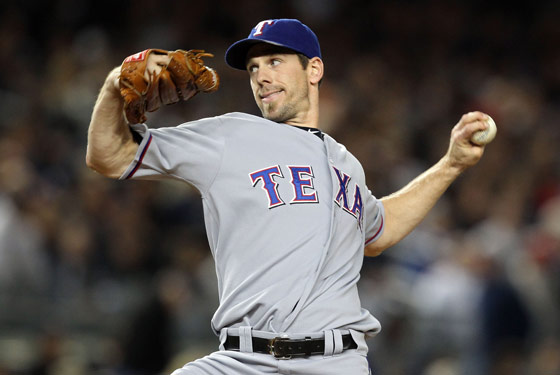
Cliff Lee. Photo: Al Bello/Getty Images

As Cliff Lee continues to dazzle in the post season (his most recent effort being his 8inning, 2hit 13k gem against the most potent offense in Baseball, your NY Yankees), rumors of his purported price tag in the Free Agency market continue to reach spiraling heights.  The most common numbers thrown out start at 5yrs, $25M per.  One author at Forbes thinks he may approach $200M for 6 years combining salary and endorsements.

If you are trying to compare talent to contract value, then you have to start with the highest paid pitchers at current.  CC Sabathia is at $23M/year, Johan Santana is at $22.9M/year on average, and Roy Halladay took a slight discount to sign with Philadelphia (and be able to live in his offseason Odessa home 2 extra months of the year and drive to Spring Training) and is making $20M/year on his new deal.  Clearly, Cliff Lee has shown that he belongs at least at the $20M/year scale.  But how much higher makes sense financially for the signing team?

Forgetting for the moment that payroll means very little to a team like the New York Yankees (unfortunately his likely destination), lets talk about the value of the Free Agent contract and whether a team that gives out a $25M/year contract can ever really get their money’s worth.  Baseball is filled with horror stories of huge FA contracts that went bust.  Names like Zito, Dreifort, Pavano, Neagle, and Hampton fill general managers and fan’s heads with dispair.

How bad were these contracts?  I put together a spreadsheet with every significant starting pitcher FA contract that I could find, then cross referenced it by the Pitcher’s Won/Loss record during the duration of the contract.  See below: the table is sorted in reverse order of $/win.  In addition to the major FA contracts, I also arbitrarily added every “Ace” starter in the league, resulting in names like Lee, Jimenez, Price and Buchholz being in this list despite not being major FA pitchers (yet).  Their inclusion illustrates one of my major conclusions below.

Pitcher Team Total Value (includes club options) $$/year Avg Contract Term W/L $ per win
Kei Igawa New York Yankees $46,000,000 $9,200,000 2007-11 2-4 $18,400,000
Jason Schmidt Los Angeles Dodgers $47,000,000 $15,666,667 2007-09 3-6 $15,666,667
Kei Igawa New York Yankees $20,000,000 $4,000,000 2007-11 2-4 $8,000,000
Darren Dreifort Los Angeles Dodgers $55,000,000 $11,000,000 2001-05 9-15 $6,111,111
Russ Ortiz Arizona Diamondbacks $33,000,000 $8,250,000 2005-08 7-22 $4,714,286
Roger Clemens New York Yankees $28,000,022 $28,000,022 2007 6-6 $4,666,670
Carl Pavano New York Yankees $39,950,000 $9,987,500 2005-8 9-8 $4,438,889
Denny Neagle Colorado Rockies $51,000,000 $10,200,000 2001-05 19-23 $2,684,211
Jake Peavy San Diego Padres $52,000,000 $17,333,333 2010-12 7-6 $2,476,190
Carlos Silva Seattle Mariners $48,000,000 $12,000,000 2008-12 15-24 $2,400,000
Mike Hampton Colorado Rockies $121,000,000 $15,125,000 2001-08 56-52 $2,160,714
Chan Ho Park Los Angeles Dodgers $65,000,000 $13,000,000 2002-06 33-33 $1,969,697
Barry Zito San Francisco Giants $126,000,000 $18,000,000 2007-13 40-57 $1,800,000
Johan Santana New York Mets $137,500,000 $22,916,667 2008-13 40-25 $1,718,750
Pedro Martinez New York Mets $54,000,000 $13,500,000 2005-08 32-23 $1,687,500
Carlos Zambrano Chicago Cubs $91,500,000 $18,300,000 2008-12 34-19 $1,614,706
Gil Meche Kansas City Royals $55,000,000 $11,000,000 2007-11 29-39 $1,517,241
Daisuke Matsuzaka Boston Red Sox $103,000,000 $17,166,667 2007-12 46-27 $1,492,754
Kevin Brown Los Angeles Dodgers $105,000,000 $15,000,000 1999-2005 72-45 $1,458,333
A.J. Burnett New York Yankees $82,500,000 $16,500,000 2009-13 23-24 $1,434,783
Roger Clemens New York Yankees $18,000,000 $18,000,000 2005 13-8 $1,384,615
Felix Hernandez Seattle Mariners $78,000,000 $15,600,000 2010-14 13-12 $1,200,000
John Lackey Boston Red Sox $82,500,000 $16,500,000 2010-14 14-11 $1,178,571
Jarrod Washburn Seattle Mariners $37,000,000 $9,250,000 2006-09 32-52 $1,156,250
Chris Carpenter St. Louis Cardinals $50,800,000 $12,700,000 2008-11 33-13 $1,154,545
Kevin Millwood Texas Rangers $60,000,000 $12,000,000 2006-10 52-62 $1,153,846
C.C. Sabathia New York Yankees $161,000,000 $23,000,000 2009-15 40-15 $1,150,000
Roy Oswalt Houston Astros $73,000,000 $14,600,000 2007-11 52-36 $1,123,077
Bartolo Colon Los Angeles Angels $51,000,000 $12,750,000 2004-07 46-33 $1,108,696
Mark Buehrle Chicago White Sox $56,000,000 $14,000,000 2008-11 41-35 $1,024,390
Ryan Dempster Chicago Cubs $52,000,000 $13,000,000 2009-12 26-21 $1,000,000
Derek Lowe Atlanta Braves $60,000,000 $15,000,000 2009-12 31-22 $967,742
Mike Mussina New York Yankees $88,500,000 $14,750,000 2001-06 92-53 $961,957
Justin Verlander Detroit Tigers $80,000,000 $16,000,000 2010-14 18-9 $888,889
Josh Johnson Florida Marlins $39,000,000 $9,750,000 2010-2013 11-6 $886,364
Pedro Martinez Boston Red Sox $92,000,000 $15,333,333 1998-04 117-37 $786,325
Bronson Arroyo Cincinnati Reds $25,000,000 $12,500,000 2009-10 32-23 $781,250
Josh Beckett Boston Red Sox $42,000,000 $8,400,000 2007-10 55-29 $763,636
Daisuke Matsuzaka Boston Red Sox $52,000,000 $8,666,667 2007-12 46-27 $753,623
Ted Lilly Chicago Cubs $40,000,000 $10,000,000 2007-10 54-21 $740,741
Zack Greinke Kansas City Royals $38,000,000 $9,500,000 2009-12 26-22 $730,769
Tim Lincecum San Francisco Giants $23,000,000 $11,500,000 2010-11 16-10 $718,750
Mike Mussina New York Yankees $22,141,452 $11,070,726 2007-08 31-19 $714,240
Matt Cain San Francisco Giants $27,250,000 $9,083,333 2010-12 13-11 $698,718
Roy Halladay Toronto Blue Jays $40,000,000 $13,333,333 2008-10 58-31 $689,655
Derek Lowe Los Angeles Dodgers $36,000,000 $9,000,000 2005-08 54-48 $666,667
Cole Hamels Philadelphia Phillies $20,500,000 $6,833,333 2009-11 22-22 $621,212
Jason Schmidt San Francisco Giants $40,000,000 $8,000,000 2002-06 71-36 $563,380
Brandon Webb Arizona Diamondbacks $28,000,000 $5,600,000 2006-10 56-25 $500,000
Jon Lester Boston Red Sox $43,000,000 $7,166,667 2009-14 34-17 $421,569
Adam Wainwright St. Louis Cardinals $36,000,000 $6,000,000 2008-13 50-22 $360,000
Cliff Lee Cleveland Indians $23,000,000 $4,600,000 2006-10 67-44 $343,284
Ubaldo Jimenez Colorado Rockies $23,750,000 $3,958,333 2009-14 34-20 $232,843
David Price Tampa Bay Rays $11,250,000 $1,875,000 2007-12 29-13 $64,655
Clay Buchholz Boston Red Sox $443,000 $443,000 2010 17-7 $26,059

Comment on Won/Loss records; yes I know that individual pitcher wins are not a great indicator of a starter’s worth.  However, they do reasonably indicate over the course of a longer term period the value of that pitcher to a team.  Perhaps a better argument is free agent dollars per quality start (despite the quality start measuring basically a mediocre start of 3ER or less in 6ip or more by a pitcher, it does generally correlate well to team wins andveven to a “real” quality start of 2ER or less in 6IP or more).  At some point I’ll re-run the analysis and count up QS per FA dollar to see how it compares.

Note for the purposes of this argument:

  • The Contract total value is averaged over the life of the contract, even if the payments are different during different years.
  • The W/L record is for the pitcher over the life of the contract, not necessarily for the original signing team.
  • If the contract is current (i.e., runs from 2009-2012) then I’ve only counted the completed regular seasons.
  • There are no off-season records taken into play.
  • I entered in both Japanese Pitchers (Igawa and Matsuzaka) with massive posting numbers twice; one factoring the posting fee and the other not.  Without the fee Dice-K looks halfway decent but with it he’s overpriced (something all Boston fans probably already knew about their highly paid #5 pitcher).

Conclusions.

– If  you can get 1 win per $1M expended, you are doing about average it seems.  Anything above $1.25M and you are looking at a questionable contract.

– It is difficult to look at any contract below $1M/victory and say that the team made a bad deal.

– The absurdly low $/victory values for David Price and Clay Buchholz demonstrate as clearly as possible the value of the pre-arbitration superstar.  Tampa Bay (who did a similarly shrewd deal with Evan Longoria, buying out the arbitration years and tying the player to the club past the 6-year pre-FA window) now gets Cy Young-quality starts from Price for the next two years at 1/20th his market value.  Buchholz is even more evident; at a pre-arbitration salary of $443,000 for 2010, he went 17-7 and gave the Red Sox #1 starter capabilities.  On the open market he’s worth at least $15M/year at that level of productivity.

– The worst FA contract ever given to a starting pitcher wasn’t one of the aforementioned infamous culprets; it belongs to one Kei Igawa.  The Yankees paid the posting fee of $26M just to negotiate with him, then signed him to a 5 year, $20M contract.  For that outlay of $46M guaranteed, the Yankees have gotten a record of 2-4 over parts of two seasons, and he hasn’t appeared in a MLB game since June of 2008.  Luckily the Yankees can afford it; this kind of FA mistake would cripple a mid-to-small market team for years.

Jason Schmidt‘s 3yr, $47M deal with the LA Dodgers is the largest $$ bust in terms of a pure FA play, not counting the vagarities of the Japanese posting system.  Schmidt had ironically just finished an incredibly efficient deal with San Francisco, where he went 71-36 over 5 seasons on a $40M contract (resulting in a very good $/win number of $563,380).  Six games into his Dodger career he went onto the DL list with shoulder injuries that eventually cost him the rest of 2007 and all of 2008.  He tried to regroup in 09, failed to make the team out of spring, made a few starts and was back on the DL.  All told, 3 wins in 10 starts for $47M.

– Some of the infamous deals do appear close to the top of this list; Neagle’s $51M for a 19-23 record.  Dreifort’s $55M deal resulting in a grand total of 9 wins and only 26 starts.  Ironically, the highest single season salary was Roger Clemen‘s $28M deal with New York in 2007.  For that money the Yankees got a middling 6-6 record.

– Are there any major FA deals that ARE paying off?  Well, you have to dig deep.  CC Sabathia has won 40 games for the Yankees in the first two years of his $23M/year deal, which is easily the best 9-figure deal.  However, it is early; we need to check back in years 6 and 7 of this deal.  Mussina went 92-53 for the Yankees after he signed his $88M deal in 2001.  Verlander won 18 games this year for his $16M annual salary and looks like a good bet to continue that trend.

– The BEST long term FA deal ever signed has to be Pedro Martinez‘s 6year $92M deal.  He went 117-37 between 1998-2004, won 3 Cy Youngs, had 2 Cy Young runners-up, and in the year 2000 posted an ERA+ of 291, which accounts for the best modern-day single-season pitching performance in the history of the game.

Bringing this back to Cliff Lee; the conclusion is thus; he may earn a $25M/year deal but the odds of his continuing to win 20-22 games/year for the duration of the contract and thus inflating the $/win value will eventually prove that contract to be an albatross (even more so if he misses significant time to injury at some point).
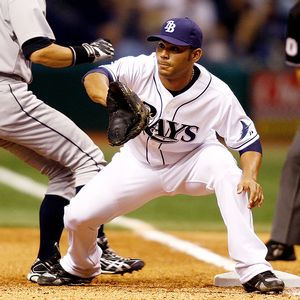
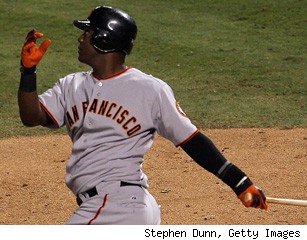
Interesting thoughts about the Giant’s roster construction…

one comment

As I watch the NLCS and its surprising results so far (Cody Ross with a Reggie Jackson-esque performance thus far, Roy Halladay getting beat, etc), you can’t help but notice some interesting items about the Giants roster and its makeup.

1. The Giants THREE highest paid players (Zito, Rowand, Guillen) are not even on the post season roster, and their 4th highest paid player (Renteria) is not the starter at short.

2. The position players that the Giants are depending on are all either developed internally (Posey, Sandoval) are retread/journeyman free agents on one-year deals (Torres, Uribe, Huff, Fontenot) or total reclamation projects (Burrell who was DFA’d earlier this season and Ross who they got on waivers).

3. Almost their entire pitching staff is home grown. Lincecum, Cain, Sanchez, Bumgarner plus setup/closer
combo of Romo and Wilson are all original SF draft picks. Only #5 Starter Zito is an (infamous) FA acquisition.

Here’s a quick table of Giants “primary starters” player acquisition methods:

SF (postseason 2010) acquisition method
Buster Posey Draft
Aubrey Huff FA
Freddy Sanchez Trade Prospects
Pablo Sandoval FA (intl)
Juan Uribe FA
Pat Burrell FA (dfa’d)
Andres Torres FA
Cody Ross Waivers
Tim Lincecum Draft
Matt Cain Draft
Jonathan Sanchez Draft
Madison Bumgarner Draft
Barry Zito FA
Sergio Romo Draft
Brian Wilson Draft
Drafted/Developed 8
Traded Prospects 1
Traded MLBs 0
FA/Waivers 5

By way of comparison, the Nationals opening day roster featured only FOUR such home grown players (Zimmerman, Desmond, Lannan and Stammen).

The Giants list their 2010 payroll at $96M, of which $42M is allocated to those 3 guys not even rostered.  Imagine what this team would look like if that $42M was properly allocated.

I think what this shows is that, with enough development time and effort put into your pitching staff you can get to the playoffs even with near replacement players in most of your fielding positions. Hope for the Nats, since this seems to be the direction Rizzo is going with his 2009 and 2010 pitcher heavy drafts. 8 of the first 11 picks in 2009 were arms, and while only 4 of 2010’s top 10 picks were arms there was significant funds paid to Solis, Cole and Ray.

Can the Nats turn these two drafts (plus other prospects) into a Giants-esque rotation? Strasburg, Zimmermann, Solis, and Cole all project to be #1 or #2 starter quality per scouting reports. Those four, plus live arms in the pen like Storen, Holder and Morris could be our future. 3-4 years out future, but still promising.

Or am I too rosy glasses colored?

MLB Payroll and Parity: only 2 of Baseball’s $100M teams make Playoffs

leave a comment

Now that the regular season is over, lets take a look at the opening day payrolls and how the teams finished up:

Team 2010 Team salary (src: usatoday baseball salary datbase) 2010 record rank playoff status Salary Rank
$206,333,389 3 AL WC 1
Boston Red Sox $162,447,333 10 2
Chicago Cubs $146,609,000 23 3
Philadelphia Phillies $141,928,379 1 NL East 4
New York Mets $134,422,942 20 5
Detroit Tigers $122,864,928 15 6
Chicago White Sox $105,530,000 11 7
Los Angeles Angels $104,963,866 17 8
San Francisco Giants $98,641,333 5 NL West 9
Minnesota Twins $97,559,166 4 AL Cent 10
Los Angeles Dodgers $95,358,016 17 11
St. Louis Cardinals $93,540,751 12 12
Houston Astros $92,355,500 22 13
Seattle Mariners $86,510,000 29 14
Atlanta Braves $84,423,666 6 NL WC 15
Colorado Rockies $84,227,000 14 16
Baltimore Orioles $81,612,500 27 17
Milwaukee Brewers $81,108,278 21 18
Tampa Bay Rays $71,923,471 2 AL East 19
Cincinnati Reds $71,761,542 6 NL Cent 20
Kansas City Royals $71,405,210 26 21
Toronto Blue Jays $62,234,000 13 22
Washington Nationals $61,400,000 24 23
Cleveland Indians $61,203,966 24 24
Arizona Diamondbacks $60,718,166 28 25
Florida Marlins $57,034,719 17 26
Texas Rangers $55,250,544 8 AL West 27
Oakland Athletics $51,654,900 15 28
San Diego Padres $37,799,300 8 29
Pittsburgh Pirates $34,943,000 30 30

What we see here is some direct relationship between payroll and performance at the very top and bottom of this table: the Yankees certainly bought their way into the playoffs while the Pirates certainly played their way to the worst record in the league with the lowest payroll in baseball.  But how do you explain the other 28 teams in between?

First lets talk about the high end of the spectrum.  The Red Sox slumped at the end of the season to the 10th best record but were only a game worse than the AL West winning Rangers.  Several high payroll teams (Cubs, Mets, Tigers) continue to show why long term contracts for aging veterans are not the way to win in modern baseball.  Well, unless you’re the Yankees and you buy enough of them to cover for mistakes (see Vazquez, Javier).  The two LA teams are both in the upper ends of the payroll spectrum but faltered this year for different reasons (the Angels with injuries and key FA losses and the Dodgers with ownership ridiculousness).

At the other end of the spectrum, the Padres and Rangers are in the beginning stages of where Tampa and (to a lesser Extent Florida) are now; teams that gutted themselves, developed their teams through superior drafting and player development (even with the Lee trade most scouting pros believe the Rangers still have the best or 2nd best farm system) and kept payroll low.  If you have superior drafting capabilities and develop players, soon you’ll have a good young team, cost contained, that outproduce multi-million dollar free agents.  Also, Kudos to the Atlanta Braves for smartly spending money and continuing to produce quality major leaguers.  A team that spends $84M on payroll certainly can’t complain about being poor, but to produce a playoff success with a young team and with more players in the wings (Mike Minor comes to mind)

A good number of teams fall more or less in line with their payroll productivity.  St. Louis underperformed this year but finished with the 12th best league record and the 12th highest payroll.  Milwaukee, Arizona, Washington, Cleveland, Colorado and Philadelphia all basically finished in line with their payroll output.

However, when a team with the second lowest payroll (Padres) misses out on the playoffs on the last day of the season, arguments for a salary structure in the major leagues basically goes out the window.  Why would you penalize a team for excelling at player development and shrewdness in the amateur market by going to an NFL-esque salary structure?  If the Rays can consistently outperform a higher payroll team like Toronto with more expensive personnel, shouldn’t the message be to teams to get better management and a better plan?  The real lesson learned is that no matter what your payroll, incompetence in the front office will turn a $100M payroll into a poor team (see the NY Mets for the past few years).  Each of the GMS of the teams with the 5 biggest “negative” deltas between payroll and record (San Diego, Texas, Tampa, Cincinnati and Oakland) are on the short lists of anyone’s GM of the year candidates.  Meanwhile, the Executives of the 5 “positive” delta teams (the Mets, Cubs, Mariners, Orioles and Tigers) are being questioned or (in Minaya‘s case) already out the door.

The Yankees continue to spend a ridiculous amount of payroll (at $200M+, that is nearly 7 times what Pittsburgh spent last year) and look to add to that amount with rumored FA chases of Cliff Lee and Carl Crawford.  This cannot be healthy for the competitive spirit of the other teams playing in the AL East.  But if there doesn’t prove to be a direct correlation between payroll and results, how can anyone realistically ask for a salary cap?

Team 2010 Team salary (src: usatoday baseball salary datbase) 2010 record rank playoff status Salary Rank
$206,333,389 3 AL WC 1
Boston Red Sox $162,447,333 10 2
Chicago Cubs $146,609,000 23 3
Philadelphia Phillies $141,928,379 1 NL East 4
New York Mets $134,422,942 20 5
Detroit Tigers $122,864,928 15 6
Chicago White Sox $105,530,000 11 7
Los Angeles Angels $104,963,866 17 8
San Francisco Giants $98,641,333 5 NL West 9
Minnesota Twins $97,559,166 4 AL Cent 10
Los Angeles Dodgers $95,358,016 17 11
St. Louis Cardinals $93,540,751 12 12
Houston Astros $92,355,500 22 13
Seattle Mariners $86,510,000 29 14
Atlanta Braves $84,423,666 6 NL WC 15
Colorado Rockies $84,227,000 14 16
Baltimore Orioles $81,612,500 27 17
Milwaukee Brewers $81,108,278 21 18
Tampa Bay Rays $71,923,471 2 AL East 19
Cincinnati Reds $71,761,542 6 NL Cent 20
Kansas City Royals $71,405,210 26 21
Toronto Blue Jays $62,234,000 13 22
Washington Nationals $61,400,000 24 23
Cleveland Indians $61,203,966 24 24
Arizona Diamondbacks $60,718,166 28 25
Florida Marlins $57,034,719 17 26
Texas Rangers $55,250,544 8 AL West 27
Oakland Athletics $51,654,900 15 28
San Diego Padres $37,799,300 8 29
Pittsburgh Pirates $34,943,000 30 30

Written by Todd Boss

October 11th, 2010 at 9:40 am

The best “5-tool” player of all time? (updated)

20 comments


The 400 homer/10 gold glove club question (see post on August 10th 2010 here) spurred a different question into my mind.  Who is baseball’s greatest 5-tool player?  For those of you who don’t know what the 5 tools are:

  • Speed; indicated by stolen bases statistically.
  • Fielding/Defense: indicated by gold gloves somewhat, even though the Gold Glove voting process is known to be bad.
  • Arm: no real statistical measure, just rumors and observations.
  • Hitting for average: career batting average
  • Hitting for power: career homers

My dad and I were talking about this same question and he says the answer is Willie Mays.  And I have a hard time disagreeing with him.   He was fast (338 career SBs), he was a fantastic center fielder (12 straight gold gloves), he was known to have a cannon for an arm, he hit a career .302 with 3283 hits and belted 660 homers.

Who else might be in the conversation?  Lets take a look at some of the candidates:

  • Barry Bonds: Career batting .298, 762 homers, 2935 hits and 514 steals.  8 gold gloves, ending a streak suddenly in 1999.  Which is also probably when he started juicing (his homers per season jumped from 34 to 49 to 73 in 1999-2001).   The only thing Mays had on Bonds was his arm.  Bonds always played left field, where you can “hide” poorer outfielders who don’t necessarily need the range of a center fielder or the cannon arm of a right fielder (to prevent first to third base runners).  But Bonds had significantly more steals and homers (whether or not you discount them).
  • Ken Griffey Jr.: Definitely up there in the argument.  Clearly he was fantastic defensively (10 straight gold gloves) and had a great arm.  Great power (630 career homers).  Only 184 career steals and a lifetime .284 BA with 2781 hits dings him in comparison to Mays.

Here’s some names that have multiple of the tools, but are missing one or two key ones:

  • Babe Ruth: Great power and average combo, he obviously had a good arm starting as a pitcher, but he had zero speed and ate himself so large that he could barely play the outfield.
  • Ted Williams is always an interesting test case for the “What could have been?” question.  He hit .344 with 521 homers and a really good argument that had he not lost 3 full seasons in his absolute prime to WWII (plus most of two others to Korea in his mid 30s) that he’d be closer to 700 homers for his career.  But he was known to be a defensive liability and had only 24 sbs for his career.
  • Mickey Mantle: famously said that “if 40/40 was so impressive, I’d have done it every year.”  And its hard not to doubt him.  Playing in a time when there wasn’t much of a need for him to steal bases, he still ended up with 153 on the career and routinely had 15-20 each season.  He retired with 500+ homers, a career ba of .298, a legendary reputation for roaming centerfield in Yankee stadium and an even more legendary reputation for drinking himself out of baseball prematurely at the age of 36.
  • Joe DiMaggio: one of the best pure hitters of the 20th century.  Career .325 BA, 361 homers.  Lost 3 years in his absolute prime to the WWII and retired incredibly early at 36.  Played a great center-field (his time predates gold gloves).  but very very few stolen bases.
  • Stan Musial: one of the “lost players” of the 20th century, in that it is easy to forget his name when talking of the all time greats.  3600 career hits, 475 homers, career .331 BA.  Great hitter.  Played center field for 20-some years for St. Louis.  But as with DiMaggio, very few SBs.
  • Bobby Bonds: nearly a 40/40 man one year but strikeout rate is so excessive.

How about some more modern players?

  • Paul Molitor another guy to think about.  504 career SBs, .306 BA, only 234 homers but not much on the defensive side, having been mostly a DH for the last half of his career.
  • Alfonso Soriano: his 40/40 season was legendary (there was preliminary talk of him doing a 50/50 season, which hasn’t even been approached), and he’s currently got 309 career homers and 271 career SBs.  A scatter brained hitter though,  defense so bad that he’s barely holding on in left field, and zero arm.
  • Jose Canseco: another 40/40 guy.  462 career homers and 200 career Sbs.  .266  hitter though.  Good arm in right but never a good fielder (remember the infamous ball bouncing off his head over the fence for a homer?).
  • Vladimir Guerrero: another near 40/40 guy.  Probably worth of further consideration; retired with 449 homers, 181 SBs, a career .319 hitter.  But was literally one of the worst baserunners of all time and was poor defensively despite a strong arm.
  • Carlos Beltran: injuries have just killed him; a former speed/power hitter and one of the first mega contract guys.
  • Brady Anderson: most people regard his 50 homer season either a fluke or (more likely) the result of early PEDs.  But the fact remains that only he and Barry Bonds have ever put up seasons which had both 50 homers and 50 sbs.
  • Craig Biggio: 414 sbs, 291 homers, .281 career BA, 4 gold gloves at 2nd base.   2nd baseman though, presumably b/c he never had the arm for Short.
  • Rickey Henderson: obviously fast as the career leader in SBs.  .279 career BA.  He twice hit 28 homers while leading the league in SBs.  One gold glove and two silver sluggers, and a liability as a left fielder.  Maybe not.

here’s a couple “what if” guys, as in what if they hadn’t been injured or otherwise sullied their careers:

  • Bo Jackson: A hip injury picked up while playing his hobby football ended his career basically at the age of 28.  But he was electric.  Who can forget his legendary all star homer, a bomb to dead center that went 448 feet.  Bo never won a gold glove but he played a premium defensive position in Center and certainly had the arm to play right.  He just missed a series of 30/30 seasons, maxing out with 32 homers and 27 steals).  He did not hit for average though, not at all.  Best full season BA was a paltry .272.
  • Josh Hamilton: After well documented troubles with drugs and the law, this former 1-1 draft pick currently is leading the Majors in batting average (.356), has 26 homers, and plays a very very good center field.  He could hit 96 on the gun in high school.  His failing is SBs; only a handful on the year.  But in a league that so often chews up and spits out flash in the pan players, it is refreshing to see Hamilton succeed.  Visual Baseball though discounts both his speed and his range.
  • Daryl Strawberry: had a 39 homer, 36 sb year.
  • Eric Davis: career year in 1987, hitting 37 homers and stealing 50 sbs.  His first 2 full seasons produced a .286/.389/.560 with 64 HR and 130 SB in 147 attempts.  Decent average, great power, great speed, with some clear capabilities in the outfield.

In January 2010, Visual Baseball introduced some really neat visualizations that graphically show each player’s strengths and weaknesses.  I’d love to see a tool that allows people to plug in individual players, but in their analysis two 2010 players popped up as being very close to the perfect 5-tool player:

  • Ben Zobrist: based on his 2009 stats he hit for average (.297) and power (27 homers).  He had 17 steals.  He showed pretty amazing flexibility by playing every outfield position besides pitcher and catcher at some point.  Unfortunately, he’s take a pretty significant step backwards in 2010, sligging nearly 200 points less.  Odd.
  • Carl Crawford: He’s already lead the league 4 times in SBs and has been hitting an average of 13-15 homers a season.  Not nearly Mays-esque stancards but very solid.  .305 Batting average with healthy slugging percentages.  Left fielder though, but his Visual Baseball graph shows significant range and arm.

And finally, something to think about:

  • Alex Rodriguez: 600 career homers, .303 career BA.  300 career steals, a couple of Gold Gloves, and a pretty good arm while playing short.  Posted probably the best ever 40/40 season in 1998 (42 homers, 46 sbs).  Too bad he had to go and juice it up so that his career is forever sullied.

In the end, I’d have to still put Mays, with a shameful shrug of the shoulders when considering both Bonds and Alex Rodriguez.


2017 Post-publishing update: this post was initially done in 2010.  There’s several up-and-coming players who are putting their names into this discussion.

Here’s two additional links to consider that were done after this post was published in 2011 at Baseball America.

http://www.baseballamerica.com/online/majors/news/2011/2612208.html

http://www.baseballamerica.com/online/majors/best-tools/2011/2612185.html

My dad and I were talking about this same question and he says the answer is Willie Mays.  And I have a hard time

How’s that anit-trust exemption looking now?

leave a comment

A couple of interesting “leaks” have occurred this week, and enterprising investigative baseball reporters like Yahoo’s Jeff Passan and Baseball Prospectus’ Joe Sheehan (though writing for Sports Illustrated online here) have summarized a couple of startling baseball economics issues that might have some serious impact on the baseball landscape, the upcoming Union negotiations, and owner relationships in general.

First, the Passan article.  In essence, he criticizes the Marlins (and by proxy the Nationals for doing mostly the same thing) for browbeating the town of Miami into mostly funding their baseball stadium.  His criticism lies with the essense of the Sheehan article, namely that the Marlins claimed to be losing money while actually earning a TON of money and thus not spending as much as they “could” have to help with the ballpark financing.  The Marlins arguments are not helped by reports such as this one, or the release of Forbes baseball team valuations, or the fact that MLB and the players union basically told the team they had to spend more money in the spring of 2010.

The Sheehan article points out a fundamental flaw in baseball’s revenue sharing system; specifically that teams who want to make money can keep payroll low, be non contenders and take in millions in revenue sharing.  He singles out the Pirates, who made a large showing of deliberately trading away all its vets in the last two years, trading away near-arbitration eligible players and flat out releasing Matt Capps last year to save $500k in anticipated arbitration salary increases.  And it is hard not to argue with him.

What should be done?  First and foremost, you have to think that some owners are going to have something to say to their fellow owners.  Why should the Yankees be writing checks to Pittsburgh that are going straight into their owner’s pocket?  I agree 100% that revenue sharing money should be spent on the team.  No ifs ands or buts.  I can see this argument spilling over into an NFL-esque revenue sharing issue (where the wealthy teams like Washington, Dallas and New England are tired of evenly splitting revenues with other teams that don’t market as aggresively).

Relocation doesn’t seem to be an option.  A recent article in the St. Petersburg Times discussing the Rays possibilities of moving highlighted the issue: When the Expos moved to Washington, the last remaining obvious baseball market candidate was filled.  The next largest  major market without a major league baseball team is Portland, which is far smaller in terms of households and population than Tampa, Pittsburgh, and other so called “small markets.”  Frankly it would make more sense for a relocating team to move to Brooklyn, Riverside or even back to Montreal than it would to move to a place like Charlotte, Las Vegas, Portland or San Antonio.  Even Sacramento is a better option (and no one ever talks about moving a team there, not with the issues the Oakland A’s are having).

Honestly there is no good answer, just as there is no good answer on a salary cap/floor.  Get better owners (oh wait, the good ole boys club of Bud Selig prevents that too, resulting in shadier back room deals every time a team is sold.  See the Loria transaction in acquiring the Marlins in the first place).

*sigh*.

Written by Todd Boss

August 25th, 2010 at 1:15 pm

Obligatory Clemens post, post-indictment

leave a comment

Every other blogger and pundit on the net seems to have pipped up about Roger Clemens recent federal indictment on charge of perjury for lying to congress.  So here’s my take:

What a mess.  Others have stated it the same way that I would.  The hubris of an athlete assuming that he is above even congress is really amazing.  In some ways I hope Bonds and Clemens go to jail to pay for their crimes.

In other ways, I wish that the syndrome of “middle aged white sportswriters eviscorating baseball players for destroying the records of their boyhood heros” would just pass.  Yes, every home run record from the mid 90s to the early 2000s is a joke.  Yes, the career record now held by Bonds is tainted.  McGwire is getting tepid HoF support despite being a significant hitter *before* the advent of Steroids.   Sammy Sosa‘s records now look just shameful (especially when combining steroid usage with his corked bat suspension).  And you know what?  There’s nothing we can do about it.

Alex Rodriguez probably will go down as the greatest hitter to ever play the game.  And a serious candidate to overtake Willie Mays as the greatest 5-tool player of all time.  Yet his admission of steroids use will taint his legacy just like every other player who comes up for Hall of Fame voting over the next 5 years.

I tried to think of a comparison.  Swimming records that fell with regularity with the use of (now banned) body suits.  Perhaps track and field records which still stand from systematic drug usage in the 80s by eastern bloc athletes?  How about Baseball pitching records before/after the deadball era.  Or how about pitching records from 1968, the year before the mound was lowered and Bob Gibson posted a 1.12 era (and somehow had NINE losses??).  Aren’t these records still in play, with the discussion topic that immediately follows?  How about the infamous “astericks” homer record by Roger Maris, put in place to protect the legacy of Babe Ruth by somehow discounting the amazing accomplishments of Maris.  Nobody talks about that now.

But it will never go away.  We are baseball fans, and iconic “numbers” now are ruined.  755.  61.  Nobody knows what the most touchdown passes thrown in a season is and nobody remembers that “number” like you know 61 homers or 755.  And we’ll continue to talk about it for the rest of our lives.

Written by Todd Boss

August 20th, 2010 at 12:58 pm

Nats Transactions for today …

leave a comment

Nieves out for the birth of his kid, so wonder kid/future Nieves replacement Wilson Ramos (booty in the Matt Capps trade) comes up and gets a start today.  Ironically (and potentially an omen) Ramos gets #3, which has been Flores‘ number since he was picked up in 06.  Hmmm.  Doesn’t bode well for Flores’s future here.

Willingham to the DL, done for the year but coinciding with Morgan‘s return.  So we’ll be throwing out an outfield of Bernadina, Morgan and Morse for the time being.  Not bad.

But I did see an interesting note that the Rockies are getting ready to flat out release Brad Hawpe.  Why?  Partly because they know they can’t resign him in the off season and are wary of offering him arbitration.  But mostly becuase he’s underperformed this year and the Rockies want to play a up and comer named Eric Young Jr. Either way, his numbers are not THAT bad, i hope we sign him just so we could offer him arbitration and get the draft picks (he projects as a type A) or even if he accepts arbitration he’s better than Morse in right field, right?

Probably though, he signs on with a contender to be a 4th outfielder.

Who has the best Playoff Rotation?

leave a comment

In a short series (if you went to a 3-man rotation in the playoffs, as lots of teams do), who scares you the most?

Candidates:

  • Philadelphia: Halladay, Hamels and Oswalt
  • Boston: Lester, Beckett, Buchholz.  tough.  If they were all performing that is.  Beckett seems off this year.
  • NY Yankees: Sabathia, Burnett and Hughes; this was supposed to be Vazquez but once again the best rotation that money can buy, didn’t.
  • St Louis: Carpenter, Wainwright and Garcia.  Wow.
  • San Francisco: Lincecum, Cain and Zito/Sanchez/Bumgarner; again, that’s tough.
  • Tampa Bay: Price, Garza, Shields (with Sonnanstine/Hellickson thrown in there).  Scary tough, which is why they’re beating out the Red Sox right now.

For my money, it has to be Philly slightly followed by St. Louis.  How is that team gonna get beat this off season?  Of course, they have to MAKE the playoffs for it to matter.  Ironic that the 3 best rotations in the AL are all in the east.  Chicago’s is decent but more veteran laden.  Texas’ starts with Lee and ends with a guy who was playing in Japan this time last year (Colby Lewis).  I don’t think Minnesota’s guys are scaring anyone.  How scary is it that Toronto has two guys with one-hitters this year (Marcum, Morrow) but is buried in FOURTH place in the AL east.  That’s a tough division.