Nationals Arm Race

"… the reason you win or lose is darn near always the same – pitching.” — Earl Weaver

Archive for the ‘Draft’ Category

CWS Super-Regionals recap and CWS field

leave a comment

We’re through the initial field of 64, through the regional play, and now we’re through the super regionals.  Here’s a review of the action from the 6/6/14 weekend and a look at our CWS field of eight for 2014.

From a draft perspective, the super-regionals feature a number of high profile guys, as noted by MLB.com’s Joey Nowalk here.  Tyler Beede, Max Pentecost, Brandon Finnegan, UVA’s trio of 1st-2nd rounders (Derek FisherMike Papi and Nick Howard) and Maryland’s ace/2nd rounder Jake Stinnett are all names to watch.  Lots of good pitching in this super-regional.

Here’s how the super-regionals went down: we’ll look at these regionals in the original order of the top 8 national seeds.  Blue identifies the super-regional winners.

  • UC Irvine at #16 Oklahoma State: In Stillwater UC Irvine once again proved doubters wrong, sweeping two games quickly on the road to qualify for Omaha.
  • College of Charleston at Texas Tech: Texas Tech squeaked by Charleston 1-0 in the opener despite a stellar performance from local kid Taylor Clarke (8ip, 5 hits, 1 run).  Texas Tech won the 2nd game of the regional by the same score; Charleston’s pitching staff gave up 2 runs in 18 innings and lost both games.  Texas Tech to Omaha.
  • #3 Virginia hosting Maryland: Maryland (behind 2nd round pick Stinnett) shocked UVA in the opener 5-4, putting 5 runs on Virginia’s ace Nathan Kirby and knocking him out in the 5th.  Does Maryland have the pitching though to hold off the consensus CWS favorites?  Not in the 2nd game; Uva roared back to win 7-3 and force the tiebreaking game.  There UVA continued to batter the Maryland pitching staff and advanced to Omaha 11-2.
  • Stanford at #13 Vanderbilt: Vanderbilt destroyed Stanford in the opener (they were up 10-0 by the end of the 3rd) but Stanford took game 2 to force a super-regional tie-breaker.  In game 3 Vanderbilt jumped all over Stanford’s starter en route to 5 first inning runs and an eventual easy win.
  • Kennessaw State at #12 Louisville: Louisville outmatched the upstart Kennessaw State team and won two straight to return to Omaha.
  • #6 Louisiana-Lafayette hosting #11 Ole Miss: In game one Louisiana-Lafayette’s offense put 9 runs up in the first 3 innings and held on for a 9-5 win.  But Ole Miss fought back to win game 2 and force the tiebreaker.  In the deciding game, Ole Miss broke open a close, rainy game with 4 in the ninth to advance 10-4.
  • #7 TCU hosting Pepperdine: TCU got 6 decent innings out of its ace (and first round pick) Finnegan and held on for a 3-2 opening win.  Pepperdine forced the tiebreaker with its own 3-2 win in game 2.  In the decider, TCU won a back-and-forth affair by taking the lead with 2 runs in the top of the 9th and survived a rally to advance.
  • Texas hosting Houston: Texas took both games from Houston 4-2 and then 4-0 to qualify for Omaha.

CWS Field: UC Irvine, Vanderbilt, Louisville, and Texas on one side, Texas Tech,Virginia, Ole Miss and TCU on the other.

Interesting field; There’s just 2 national seeds left in this field (and just four overall), the lowest number of advancing seeds in the history of the tournament.  Its very much tilted to the lower side, with the two remaining national seeds in one bracket.

Quick predictions: Vanderbilt on one side, UVA on the other with Virginia as national champs.  Why not, eh?

Who are the Nats targeting at #18 plus Mock Draft review of top5 picks

25 comments

Lots of pundits think the Nats are taking Fedde at #18.  Photo via chicagonow.com

Lots of pundits think the Nats are taking Fedde at #18. Photo via chicagonow.com

The annual amateur/Rule-4 draft is upon us.  Wendy Thurm posted a nice overview of the festivities, kicking off today, June 5th.   Who is going at the top, and who do we think the Nats are going to take with their first round draft pick (#18 overall?)

Lets check in with some experts and pundits.  Unlike in years past, there’s no real consensus #1 overall pick this year thanks to a host of factors.  But the top-5 is relatively consistent no matter who the pundit.  We’ll talk about predictions for the first few picks plus who they think the Nats will end up with.  (Link to the draft order for the first few rounds to show all the missing picks and supplemental additions from MLB.com).  Note that all the Keith Law and Jim Bowden links are ESPN insider.  Profiles on the frequent top-5 picks and the names being associated with the Nats potential picks are below the list of pundit’s mock drafts:

  • MLBDraftInsider’s Chris Crawford has done a host of Mock Drafts this spring (the sixth version dated 5/28/14 and the “near final” version on 6/2/14, his penultimate mock on 6/3/14, his “really final” board on 6/4/14 and his “final mock ever” on 6/5/14)  and in his last mock has come down on the Nats taking Hoffman. Predicted top 5 in final mock: Aiken, Rodon, Nola, Conforto, Gordon.  Same movements that Law is projecting at the final minute.
  • ESPN’s Keith Law put out his first mock draft on 5/16/14, his second on 5/27/14, his third on 6/4/14 and his final/last on 6/5/14 and had the Nats on Erick Fedde, calling it a “lock” in the industry.  Top 5 in the latest mock: Aiken, Rodon, Nola, Conforto, Gordon (only list on here without Kolek in top 5).
  • MLB.com’s Jonathan Mayo posted a mock on 5/16/14, another on 5/30/14.  One last one 6/5/14.  In his latest he went Aiken, Jackson, Rodon, Kolek, Gordon.  He has the Nats taking Jeff Hoffman, saying that it could come down to “financials” and who is willing to go over-slot.
  • MLB.com’s Jim Callis posted his latest mock on 5/23/14 and one last one 6/5/14.   He went Aiken, Jackson, Rodon, Gordon, Kolek.  He has the Nats on Hoffman as well, but in the description basically says he says Hoffman could go top 10 and/or the Nats could take Fedde.
  • MinorLeagueBall’s Matt Garrioch posted his first mock draft early (3/10/14), his second on 5/19/14.  His top 5: Rodon, Kolek, Aiken, Jackson, Gordon.  He has the Nats on Kyle Schwarber.
  • ESPN’s Jim Bowden posted his Top-10 picks on 5/28/14, trying to think like the GM of each top-10 picking team, and went Rodon, Aiken, Kolek, Jackson and wildcard Freeman.
  • BaseballAmerica’s John Manuel has posted mock drafts on 5/9/14, 5/16/14 and v3.0 on 5/25/14 and his final the day of the draft 6/5/14.  His top 5 in his most recent mock: Aiken, Rodon, Kolek, Conforto, Gordon, with the Nats on Fedde.
  • GradingontheCurve’s Shaun Kernahan put up his mock draft 5/29/14.  He went Aiken, Rodon, Kolek, Jackson, Gordon with the Nats on Gatewood.
  • MinorLeagueBall did a community Mock Draft on 5/30/14 (so, not full of expert opinion but interesting nonetheless to see what the crowd-sourced opinion on players is).   They went Aiken, Jackson, Rodon, Kolek, Gordon with the Nats taking Conforto.  Based on where Conforto is now being projected, there’s little chance he survives to #18.
  • BaseballInstinct’s Thomas Belmont has a top-200 draft board that isn’t a mock draft but lists top 5 as Aiken, Jackson, Kolek, Rodon and Toussant.  #18 is Grant Holmes, who I would be surprised if the Nats picked despite his pedigree.  He posted his mock draft on 6/4/14 where he follows his board, but I have a problem with his rankings considering what the professional reporters above are showing for top 5 and for the Nats.
  • PerfectGame’s Patrick Ebert posted a bunch of mock drafts; in his last one on 6/4/14, he went top-5 of Aiken, Rodon, Kolek, Gordon, Nola with the Nats on Bradley Zimmer.
  • Si.com’s Dave Perkin (a former professional scout who does some writing) posted a last-minute mock 6/5/14 online.    He goes Aiken, Rodon, Kolek, Freeland, Jackson with the Nats on Beede.  I like this scenario.

How do I think the top 5 will go?  I like Aiken #1, Rodon to the Marlins (for the cuban-american/quick to the majors factors), then Kolek.  From there I have no idea; the Cubs by all accounts want a college arm but the next best one (Nola) isn’t worth the #4 spot.  Maybe they take a college bat (Conforto?), maybe they go BPA.  I’m guessing they bite the bullet and play the hand that they’ve been dealt and get Jackson or Gordon 4th, with the other going 5th.

ACTUAL DRAFT RESULTS: Aiken, Kolek, Rodon, Schwarber and Gordon.  Who was closest?   hard to tell; Schwarber came out of nowhere, and nearly everyone had Rodon before Kolek.

A quick overview of the names in discussion for top 5 selection:

  • Carlos Rodon: lhp from NC State; was the heavy consensus 1-1 overall pick all winter, but a rough spring and high pitch counts have dropped him on most people’s mock boards.  Scout.com has a detailed scouting report and video.  Scouting Video from Keith Law.
  • Brady Aiken is a prep lhp from San Diego who could be just the third high school pitcher ever picked #1 overall.  Scout.com has a detailed scouting report and video.  Keith Law scouting video.
  • Alex Jackson is a prep C also from the San Diego area.  Scout.com has a detailed scouting report and video.  Scouting video from Keith Law.
  • Tyler Kokek is a prep RHP from Texas with big time stuff; 100mph velocity on his fastball.  Scouting video from Keith Law.
  • Aaron Nola is a polished RHP friday starter for LSU who may not overpower you with velocity, but is a good pitcher.  Scouting Video from Keith Law.
  • Nick Gordon is a prep SS from Florida.  Scouting Video from Keith Law.
  • Michael Conforto is a junior OF from Oregon State.
  • Kyle Freelan is a lhp junior starter from Evansville.  He has good velocity, a good slider and great control.
  • Max Pentecost is a C from Kennesaw State who may be a stretch to go top-5 but should be top-10.
  • Touki Toussaint is a prep RHP from Miami, FL who is considered the second best prep RHP arm behind Kolek; he doesn’t quite have the velocity but he has better secondary stuff.

MLB.com reports that seven of these guys will be in-studio during the draft (all high schoolers), including a couple that may drop out of the first round (could be a bit embarassing for both them and MLB).

The names associated/predicted with the Nat’s #18 overall pick:

  • Erick Fedde was UNLV’s friday starter before going down with the dreaded Tommy John injury, diagnosed on 5/10/14.  Before his injury Fedde was projected in the same general area where the Nats are picking … which makes me question this prediction.  I could understand if Jeff Hoffman falls (a projected top -5 pick) to #18 grabbing him … but here I don’t know if I’d agree with picking a guy who you won’t see for a year and a half in uniform.  Though that being said, BA had Fedde ranked #8 in their top-200 pre-injury draft rankings, so perhaps grabbing him at #18 could be appropriate.
  • Tyler Beede: RHP Vanderbilt starter, who was a projected top-10 pick thanks to his amazing sophomore season (14-1, 2.32 ERA and a Golden Spikes finalist), before a rough season (7-7, 3.49 ERA and 92/41 k/BB in 91 innings) dropped his draft status.  He turned down a big bonus out of HS as a Toronto 1st rounder and that apparently (combined with unknown/unstated “make-up” issues) has him dropping fast.  Personally, I think he could be a steal at #18.  BA’s Aaron Fitt profiled Beede on 5/29/14.  Scouting Video from Keith Law.
  • Kyle Schwarber, C/1B power hitter from Indiana.  Listed as 6’0″, 240.  .340/.450/.623 on the year with 12 homers, 27/41 K/BB ratio in 215 ABs.  Great numbers if he’s really a catcher; some listed him as C, others at 1B.  Question: Big10 baseball isn’t exactly the SEC; are his stats padded thanks to playing a bunch of weak programs all year?
  • Jeff Hoffman was ECU’s friday starter and a consensus top-5 predicted pick (perhaps as high as #3) before being felled by TJ surgery (diagnosed on 5/8/14).  I think he’s a huge long-shot to make it to #18 because Toronto picks twice in the top 11 picks and it makes complete sense for them to use their 2nd pick to take Hoffman, save some slot money and basically temper their draft risk by virtue of having a second high pick.  Scouting Video from Keith Law.
  • Jacob Gatewood is a prep SS from Fresno, California who has a ton of power for a middle-infield bat (he won the prep home run derby held during last year’s all-star game festivities), even if he has to move off Short to 3B.  Gatewood gets some mention as a potential Nats pick, but this seems very much out of Mike Rizzo‘s style.  I cannot see the Nats taking a high school player unless someone falls to them unexpectedly.  Scouting Video from Keith Law.
  • Casey Gillaspie is a 1B from Wichita State with huge power numbers in 2014: .389/.520/.682 with 15 homers and 28/58 K/BB ratio in 211 ABs.  But, like with Schwarber, do you draft a guy who is already locked into first base?  Are his numbers a mirage thanks to the weaker Missouri Valley Conference?
  • Michael Chavis is a prep OF/3B from Georgia who Crawford has the Nats taking in his mock draft … but which I cannot believe will happen.  I just don’t see Rizzo taking a HS player, practically ever, unless there’s huge upside or value.
  • Brandon Finnegan: friday LHP starter for national seed TCU.  Undersized but a big-time arm.  Not the prototypical pick for Rizzo (he likes big, tall guys).
  • Grant Holmes is a big RHP prep pitcher from South Carolina who likely goes before #18, but if he’s sitting here he could get a look.
  • Bradley Zimmer is an OF with a brother already in pro ball from San Francisco.

Who do I like for the Nats at #18?  Honestly, I think picking TJ surviver Fedde at #18 might be an overdraft.  Now, if Hoffman fell there I’d grab him … but most pundits put Hoffman at #11 (Toronto’s extra 1st rounder).  I’d love to take a crack at Tyler Beede; he was so good last  year and I don’t think he’s forgotten how to pitch.  I like Finnegan too.  Maybe they go with a college bat.  But one thing seems certain; I just cannot see one of these HS names at #18.  I think they’ll take someone whose quicker to the majors.

ACTUAL DRAFT RESULTS: In what may have been the worst kept secret of the draft, Nats take Fedde.


CWS Regional Results w/ Draft Prospect highlights

leave a comment

College Baseball’s Field fo 64 was winnowed to just 16 over the 5/30/14 weekend, setting up Super Regionals to be played the weekend of 6/13/14.  Here’s a recap of the action.  There were a TON of upsets all throughout the weekend.

MLB.com/Cash Kruth posted a nice summary of top100 draft prospects in action over the past weekend; using that as a guide as well as focusing on some other big time names and local teams here’s a recap of the weekend’s action.

We’ll review the 16 regionals in order of the national seeds.  Blue is the host city and Red is the winner.

  1. In the Corvalis regional (host/seed: Oregon State) the #1 overall seed survived a nail-biter against North Dakota State in a game where they threw their 3rd string arm (Andrew Moore, who struck out 14 in his 8 innings).  They will be tough to beat with their two aces (Jace Fry and Ben Wetzler, who both sport 11-1 records with sterling ERAs on the season) going in the next to games, irrespective of who they play.  However day 2 featured a shocker: UC Irvine destroyed the #1 overall seed 14-2, getting to Fry for 6 runs in 6 innings.  Huge upset there.  Oregon State now will need to advance out of the loser’s bracket and stretch their pitching staff to advance.  On 6/1/14 Oregon State got by UNLV behind Wetzler’s complete game 4-hit, 1-run, 10-K outing and then blanked UC Irvine in the first game of the regional final behind a nifty 2-hit shutout from long-man/4th starter Scott Schultz.  In the do-or-die game on 6/2/14, the #1 seed’s luck ran out as UC Irvine cobbled together innings and held off Oregon State’s offense 4-2.
  2. In the Gainesville regional (host/seed: Florida): Long Beach State beat UNC behind sophomore Andrew Rohrbach‘s 8 shut out inning effort; he allowed a run in the 9th before getting pulled.  UNC sophomore Trent Thornton gave up 6 runs in less than four innings and UNC couldn’t come back.  And in the night cap perhaps the biggest upset of day one occurred when dangerous 4th seed College of Charleston beat the #2 overall seed/host Florida 3-2.  Local kid Taylor Clarke started for Charleston but was removed mid-way in the 5th thanks to uncharacteristic wildness; he had walked five and put 12 guys on-base but survived with only 1 run allowed.  The shocks continued in day 2 as UNC neatly dispatched Florida 5-2, eliminating the #2 overall seed.  College of Charleston took care of business over Long Beach State to take control of the regional, and ended up advancing on 6/1/14 when they beat Long Beach a second time.  Huge upset of Florida, even if Charleston was badly under-seeded.
  3. In the Charlottesville regional (host/seed: Virginia): UVA blitzed Bucknell to open the tournament behind 7 shutout innings from mid-week starter Artie Lewicki, a strategic move leaving UVA’s ace All-American Nathan Kirby to pitch in the winner’s bracket game on 5/31/14.  There they face Arkansas, who squeaked out a win over local favorite Liberty.  In day 2, Liberty went two-and-out while UVA shut out Arkansas behind Kirby’s 8-inning 1-hit gem 3-0.   Arkansas worked their way to the final of the regional, but there they ran into UVA’s saturday starter Brandon Waddell, who threw 6 2/3rd mostly clean innings while UVA exploded for 6 in the third to put the regional away 9-2.
  4. In the Bloomington regional (host/seed: Indiana): Stanford opened with an upset win over Indiana State behind a complete game 4-hit, 1-run performance from freshman Cal Quatrill while host Indiana cruised to a win.  In the winner’s bracket game Indiana took control of the regional with a win over Stanford.  Stanford stormed back from the loser’s bracket and took out Indiana in the first game of the regional final, forcing one extra game on 6/2/14.  Indiana ended up losing the winner-take-all game in pretty heartbreaking fashion, losing 5-4 to the Pac-12 team when Stanford scored 2 runs in the bottom of the 9th to advance.
  5. In the Tallahasse regional (host/seed: Florida State), Kennesaw got the first win of the tournament when sophomore Travis Bergen threw 8 2/3 shutout innings over Alabama and beating their Ace Spencer Turnbull.  Then the most surprising result of the day occurred in the night-cap when Georgia Southern embarrassed Florida State 7-0 in a game where they outhit the national seed 16-2 and their hurler (junior lefty Sam Howard) threw a 2-hit shutout.  Howard is a relative unknown, not even on MinorLeagueBall’s top 350-list of draft prospects; he made himself some money today.  On day 2, Alabama put Florida State two-and-out in a shock 6-5 win, while little known Kennesaw State scored 8 runs in the 11th inning to out-last Georgia Southern in a weird-looking box score 13-5.  Kennesaw’s big-time prospect (and likely upper-first round pick) Max Pentecost went 4-5 in the game with two walks to power his team.  On Sunday Alabama stormed back, blanking Georgia Southern and then beating Kennesaw State to force the extra do-or-die game.  However in the winner-take-all match Kennesaw State advanced over their SEC rival
  6. In the Lafayette regional (host/seed: Louisiana-Lafayette): Mississippi State beat San Diego State to open the regional and then in a huge upset Lafayette and their huge offense was shutout by little-known Jackson State 1-0.  Louisiana-Lafayette faces an up-hill climb now.  Louisiana took care of business over Stephen Strasburg‘s alma-mater in the elimination game and gets another shot at Jackson State, who couldn’t match up with their SEC opponent in the winner’s game.  Lafayette stormed through the elimination games, showing the offense they’re known for, beating Jackson State 11-1 and then Mississippi State 14-8 to force the extra 6/1/14 game.  Louisiana-Lafayette made up for their earlier mis-steps by taking an early 4-0 lead and holding on for a 5-3 victory to advance.
  7. In the Fort Worth regional (host/seed: TCU), hosts TCU had to go to 11 to get their opening win (with 1st round talent Brandon Finnegan striking out 12 in 7+ innings), after which they’ll face upstart Sam Houston State.  In the winner’s bracket game, TCU advanced 3-2 over Sam Houston in a TWENTY-TWO inning game, the 2nd longest game in NCAA  history.  On 6/1/14, Sam Houston got back to the regional final but TCU held on to win the regional and advance.
  8. In the Baton Rouge regional (host/seed: LSU) the seeds held to form on day one, with Houston and LSU advancing.  On day 2, LSU took charge with an 5-1 defeat over Houston.  Meanwhile, Houston worked its way back through the loser’s bracket and outlasted LSU in extra inning to force the extra winner-take-all game on 6/2/14.  There, Houston blitzed LSU 12-2 to get the upset regional win.
  9. In the Houston regional (host/seed: Rice): local team George Mason held the lead over Rice in the 8th inning but senior lefty starter Jared Gaynor fell apart in the 8th, let in 6 runs and Rice won 7-2.  Rice moves on to play powerhouse Texas while George Mason will have to contend with SEC team Texas A&M to survive.  There GMU didn’t have the horses and was eliminated 7-3 by TAMU, while Texas handled Rice in extras.   On 6/1/14, Rice was eliminated in extras, and then TAMU forced an elimination game on 6/1 over Texas, but that was as close as TAMU got, as Texas took the winner-take-all game 4-1.
  10. In the San Luis Obispo regional (host/seed: Cal Poly): Cal Poly (behind Matt Imhof) and Pepperdine advanced to setup an all-California mid-major winner’s bracket game.  There, Pepperdine’s ace LHP Aaron Brown (a likely 4th-5th rounder) pitched a gem to upset Cal Poly 2-1.   Sacramento State embarrassed Pac-12 power Arizona State in the loser’s bracket final, setting up a rematch with the host for the right to go after Pepperdine.  Cal Poly made its way back to the regional final and a rematch with the Waves, but were handled 10-6 late sunday night and Pepperdine advances.
  11. In the Oxford regional (host/seed: Ole Miss): Ole Miss’s starting shortstop has some DC roots: Errol Robinson was featured over the weekend.  the 5/30/14 games were rained out, forcing a delayed start.  On Saturday 5/31/14 the two top seeds easily advanced to the winner’s bracket game.  There Ole Miss held on for a 2-1 victory and will face Washington again in the regional final on 6/1/14.  There, Ole Miss took another low-scoring/extra innings game to win the regional 3-2.
  12. In the Louisville regional (host/seed: Louisville): Louisville and Kansas advanced on day one.  Louisville took care of business over Kansas in day 2, setting up a re-match between Kansas and Kentucky to try to oust Louisville out of the loser’s bracket.  Kansas got the better of Kentucky in their elimination game, but was handled 4-1 by Louisville in the regional final.
  13. In the Nashville regional (host/seed: Vanderbilt): Oregon just destroyed Clemson to open the regional 18-1 and then host Vanderbilt similarly destroyed Xavier 11-0 (with 1st round talent Tyler Beede throwing 8 shutout innings and striking out 14) to setup an intriguing winner’s bracket game.   Vanderbilt controlled Oregon on day two while Xavier surprised Clemson.   Oregon made their way to the regional final, but were beaten again 3-2 by a Vanderbilt team that won its 3 regional games by a combined score of 21-4.
  14. In the Columbia Region (host/seed: South Carolina): Maryland scored 3 in the bottom of the 9th (two by virtue of bases-loaded HBPs, including the walk-off winning run) to upend ODU in the opener, bailing out their ace Jake Stinnett‘s good but not good-enough 8-inning 3 earned run performance.    They next face host South Carolina.  In day-2 ODU unfortunately went two-and-out at the hands of Campbell but the big news was Maryland’s upsetting of #15 seed South Carolina 4-3.  Maryland is now in a great position to advance out of the regional where they could play local rival UVA in the super regional.  On 6/1, South Carolina fought their way back to the regional final, where they were pounded 10-1 by Maryland for the regional upset.  Not only was this a regional upset … but this was the first time South Carolina had lost at home in something like 27 games.  In the Baseball America CWS preview, they didn’t even bother talking about this series because “South Carolina doesn’t lose at home.”  Well, South Carolina lost twice to Maryland and the Terps are moving on.
  15. In the Coral Gables regional (host/seed: Miami), host Miami struggled mightily with the below .500 Bethune-Cookman team, winning 1-0 on a walk-off wild pitch in the 9th.   They face Texas Tech next, who also struggled (comparatively speaking) with the scholarship-less Ivy league champs from Columbia.  In the winner’s bracket game Miami’s offense was exposed again as Texas Tech shut them out 3-0 to take the driver’s seat.  Miami blitzed Bethune-Cookman to make it back to the regional final, where they were losing 1-0 in the 8th inning when play was suspended on 6/1/14.  Things got no better and Texas Tech finished off Miami 4-0 on 6/2/14.  All three of Florida’s seeds are now eliminated, a huge surprise.
  16. In the Stillwater regional (host/seed: Oklahoma State): Cal State Fullerton showed why they were likely under-seeded with an opening 5-1 win over Nebraska, though they depended on a grand-slam to take the lead for good.  Meanwhile host Oklahoma State rolled to an easy victory over small school Binghamton.  In the winner’s bracket on day 2, Oklahoma State put some doubters at bay by winning a slugfest over Fullerton 13-7 to take over the driver’s seat.  Fullerton beat Nebraska to get another shot at the Cowboys, but were beaten by Oklahoma State in the regional final 6-4.

Summary of Regionals statistically:

  • 9 seeds/hosts upset, while just 7 seeds/hosts advanced out of 16.  This includes your overall #1, #2, #4, #5 and #8 seeds eliminated, some two-and-out.
  • 4 number of #2 seeds advancing, 4 number of #3 seeds and 1 #4 seed (College of Charleston) advanced to the super regionals.
  • 7 = number of regionals forced into the “extra” deciding game.
  • 9 number of #4 seeds who didn’t finish 4th in their regional (Georgia Southern, Xavier, Youngstown State, Bucknell, Campbell, Jackson State, Sacramento State, Bethune-Cookman and College of Charleston)
  • 13 = the number of extra inning games (out of 103 total played this weekend), including a 22-inning monster between TCU and Sam Houston State.  The TCU regional featured 3 extra-inning games plus a 2-1 9-inning game.
  • Biggest upsets: clearly the two Florida national seeds (#2 Florida and #5 Florida State) getting blown out and going winless in their regionals.  But the fact that all three Florida hosts were upset is pretty amazing.  Oregon State losing as the #1 overall seed is pretty shocking (even if some thought they were over-seeded).
  • Most surprising regional winner: Has to be Kennessaw State, despite its upper first round talent Penecost.  College of Charleston may have been the only #4 seed to advance, but many thought they were at least a #3 seed and maybe even a weak #2.   These were the two highest RPI teams advancing, both in the 50s.
  • The #1 ranked RPI team (UVA) and the #1 ranked Baseball America team (Louisiana-Lafayette) both advanced and are on the same side of the potential CWS bracket.
  • Exactly ONE Regionals that went pure chalk; the Ole Miss Regional.  Every other regional featured some sort of upset.
  • My predictions: just 6 out of 16 predicted correctly.  There were just a ton of upsets this weekend.

Conference Breakdowns of the teams in the Super Regionals:

  • 2 ACC teams (out of 7 that made full field).
  • 2 SEC teams (out of 10 that made full field).  This is pretty amazing; the SEC had 10 teams and 5 hosts and just two advanced.
  • 4 Big-12 teams (out of 5 that made full field).  This is the big news for me; four of the Big-12’s five teams won their regional and the lone outlier (Kansas) finished 2nd to Louisville.
  • 1 Pac-12 teams (out of 5 that made full field).  Very poor showing for the Pac-12 this year.
  • 1 Big-West teams (out of 4 that made full field).  And the Big West advancer was a shock upset in UC Irvine.
  • Both American Athletic Conference teams advanced (Louisville and Houston)
  • The remaining 4 are from one-bid conferences: Kennessaw State (Atlantic Sun), Louisiana-Lafayette (Sun Belt), Pepperdine (West Coast), and College of Charleston (CAA).

(Link at CollegeBaseballBlog that has the full field conference breakdowns)

Super Regional Matchups:  With all these upsets, figuring out the hosts was tough.  The 8 hosts were announced late 6/2/14.

  • UC Irvine at #16 Oklahoma State
  • College of Charleston at Texas Tech
  • #3 Virginia hosting Maryland
  • Stanford at #13 Vanderbilt
  • Kennessaw State at #12 Louisville
  • #6 Louisiana-Lafayette hosting #11 Ole Miss
  • #7 TCU hosting Pepperdine
  • Texas hosting Houston

Super Regional Predictions:  Clearly we’ve under-rated the Big-12 teams, and now they’re hosting four super-regionals.  In each case the’re hosting an up-start/regional upset winner.  I like all four to advance to Omaha.  I think I like the two SEC teams as well; I like Ole Miss upsetting Louisiana-Lafayette.  UVA won’t be beat and for me is the clear CWS favorite right now (The BA guys liked UVA as their pre-tournament favorite despite their losses in the ACC and their dropping in the final top 25 ranking).  Lastly I think Louisville can hold off the surprising Kennessaw State.

Predictions: Oklahoma State, Texas, Louisville and Vanderbilt for one side of the CWS.  UVA, Ole Miss, TCU and Texas Tech on the other.  A very Texas CWS ahead.

College Baseball Daily’s predictions: Oklahoma State, Texas, Louisville, Stanford, UVA, Louisiana-Lafayette, TCU and Texas Tech (with some disagreement here and there).


Resources: d1baseball.com has all the regional results on one page. Their live scoreboard is great and is up-to-the-minute all throughout the weekend with links to the ESPN box scores.

CWS Field of 64 announced; teams and analysis

one comment

CWS 2014 logo

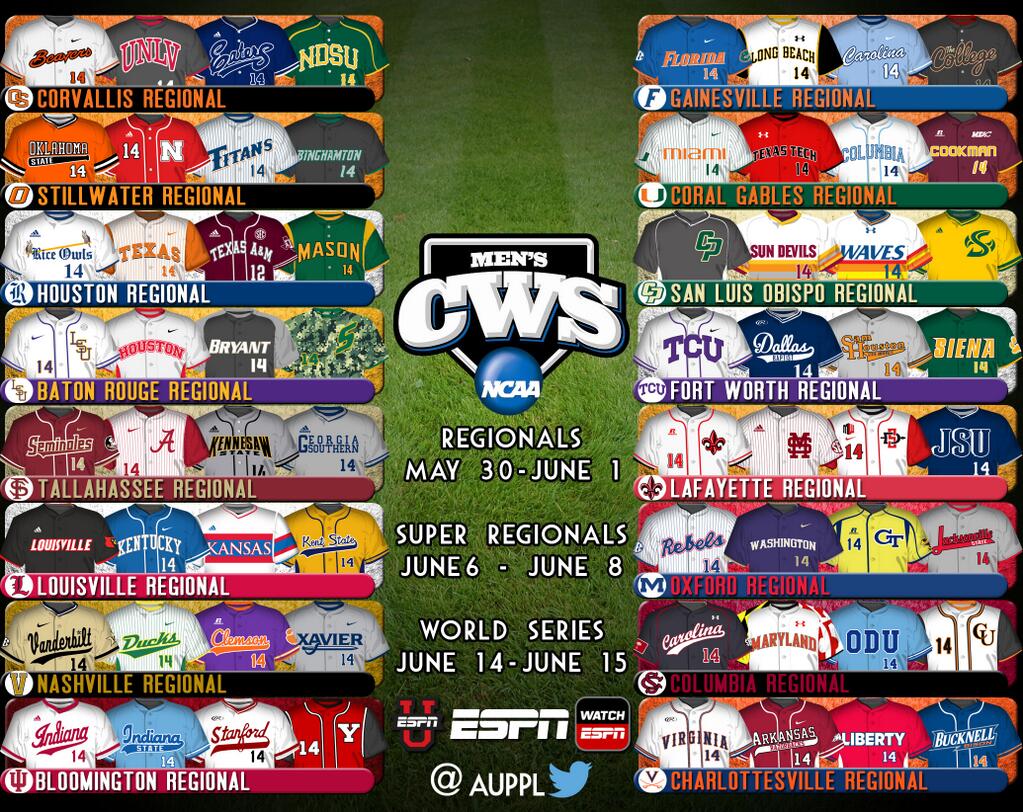
Hot on the heels of our “local college team” post earlier this week, the full 64-team field has been announced.  (here’s a cool picture of all 64 uniforms in the tourney)

A preliminary announcement earlier on 5/26/14 stated the 16 regional hosts, each of whom is also automatically in the field.  The full field announcement came later in the day (link from College Baseball Blog and nicely formatted regional pairings from BaseballAmerica).  Oregon State got the #1 overall seed in the field of 64 and the Top 16 National seeds are:

  1. Oregon State: Pac-12 regular season champ (no tourney)
  2. Florida: SEC Eastern Division and overall regular season champion, Conference tourney runner-up
  3. Virginia: 2nd ACC coastal division
  4. Indiana: Big-10 regular season and conference tourney champion.
  5. Florida State: ACC Atlantic division champion.
  6. Louisiana-Lafayette: Sun Belt regular season and conference tourney champion.
  7. TCU: Big-12 2nd place regular season, conference tournament Champion
  8. LSU: 2nd SEC Western division, conference tourney champion.
  9. Rice: Conference USA regular season and conference tourney champion.
  10. Cal Poly: Big West regular season champ (no tourney)
  11. Ole Miss: SEC Western Division champion
  12. Louisville: American Athletic Conference regular season champion, Conference tourney runner-up
  13. Vanderbilt: 3rd SEC Western division
  14. South Carolina: 2nd SEC Eastern division,
  15. Miami: ACC Coastal Division and overall regular season champion,
  16. Oklahoma State: Big-12 regular season champion, Conference tourney runner-up

By inferring the stated match-ups of regional hosts, we infer the 9th-16 national seeds from the regional hosts: The 16 regional hosts *usually* are also the top 16 seeds of the tournament, though there have been some deviations from this in the past.  However these seem accurate based on RPI rankings and typical top-25 votes.

Seeding Analysis: I thought Oregon State was slightly over-seeded at #1; I think you have to put Florida or Florida State there based on their record, Strength of Schedule (SoS) and the conferences they play in.   Otherwise in some form or fashion I think your top 8 seeds are correct.   Some are complaining about Indiana but their RPI and BA ranks are top 8 material and there’s no team seeded 9-12 that can make a real strong case to rise.   I think teams like Houston, Washington and Texas were pretty hard done by not getting at least a regional host/9-16 seed.  How does the Pac-12 get the #1 overall seed but its 2nd best team doesn’t even rate a top 16 seed?  Meanwhile Houston is 10th in RPI and #15 in the latest BA poll, and they have to go to LSU to compete against a championship-calibre team.

(Note: CollegeBaseballBlog is reviewing every regional this week ahead of the weekend games.  Click here for an example).

Easiest RegionalsMiami, who in their 42nd consecutive CWS appearance gets Ivy league champ Columbia as its regional THREE seed and a team with a losing record as its 4th seed.  Of course, Miami’s prize will be a super-regional matchup with my tournament favorite Florida and a likely trip home.   Oregon State’s regional looks incredibly straight forward; its #2 and #3 seeds are from smaller baseball conferences and its #2 seed (UNLV) just lost their friday starter (Erick Fedde) to Tommy John.   Indiana’s regional looks pretty easy all things considered, and Florida State’s regional isn’t difficult, with middling SEC team Alabama and small conference schools to contend with.

Hardest Regionals: LSU; they get Houston, a team that should have been seeded as well as conference champ Bryant.  Oklahoma State got no favors with Nebraska and traditional power Cal-State Fullerton.  Rice gets #12 RPI ranked Texas to go with Texas A&M.  Ole Miss gets 14th ranked and under-seeded Washington to go with 25th ranked Georgia Tech and a pesky 4th seed in Jacksonville State.   Florida has three teams ranked inside of the RPI #50 in its regional; no cupcakes here and it includes the best #4 seed in the tourney (College of Charleston with local favorite Taylor Clarke).  TCU gets baseball powerhouse Dallas Baptist to go along with Sam Houston State, a team ranked in and out of the top 25 all year.  Lastly Louisville has a regional that looks like a fantastic basketball tournament; they have Kentucky, Kansas and Kent State.  Kentucky and Kansas were in the top 25 as recently as earlier this month and this could be a very competitive regional.

Snubs: West Virginia was the highest RPI ranked team left out (#38) but that was mostly on their SoS; they were barely a .500 team overall and were just 9-14 in divisional play.  Next in RPI rankings missing out were Mercer (#46), UCF (#48), and UC Santa Barbara (#50).  Central Florida likely was the “last team out” and Clemson/UC Irvine were the “last teams in.”  Duke may feel a bit unfairly done by; they finished ahead of two other NCAA teams in the conference standings.  CAA champ William & Mary just didn’t have the SOS to get in after losing the conference tournament.   Wright State won its conference going 25-4 in division only to lose the tournamnet to the team that finished dead last in conference play (Youngstown State).

(Links to other analysis from CollegeBaseballDaily blog, BaseballAmerica cool facts and tidbits, and BaseballAmerica field of 64 analysis by Aaron Fitt).

Local Rooting Interests: #3 overall seed and regional host UVA.  Liberty (#3 seed in Charlottesville region), Old Dominion (#3 seed in South Carolina’s region), George Mason (#4 seed in Rice’s regional), and U of Maryland (#2 seed in South Carolina region).  Tough matchup for Liberty.  Maryland returns to the tournament for the first time in 43 years, an amazing fact.  George Mason not only has to travel to Dallas, but they get two top 12 ranked teams in Rice and Texas.  Its hard to envision any of these teams besides host UVA advancing.

Big-time draft prospects to watch: Many of the biggest names in the upcoming draft failed to make the tourney (Carlos RodonBradley ZimmerSean Newcomb and Jeff Hoffman).  But you will have:

  • Aaron Nola, LSU’s friday night starter for the 2nd year running
  • Max Pentecost catches for Kennesaw State.
  • Michael Conforto, an OF with #1 seeded Oregon State
  • Brandon Finnegan, TCU’s #1 starter (a lefty who may be in Washington’s sights if he drops to #18 in the draft)
  • Tyler Beede, Vanderbilt’s #1 starter, who was a first rounder in 2011 out of HS but who failed to sign and has purported “make-up” issues (though finding links to whatever his transgressions may be are difficult)
  • Kyle Schwarber, Indiana’s backstop
  • Erick Fedde‘s team (UNLV) is in the tourney but he isn’t; he had Tommy John surgery a couple of weeks back.  Remember this name; more than one pundit has the Nats drafting him in 2 weeks time.
  • UVA has three 1st-2nd rounders of note as discussed here frequently: Derek FisherMike Papi and Nick Howard.

See more of the guys in play by scanning down MLBdraftInsider’s latest mock draft.  And mlb.com posted its link to the Tourney teeming with talent.

Regionals run from Friday 5/30/14 to Monday June 2nd (if needed).

My Regional winner predictions: I’ll go chalk with national seeds 1-8.  After that most of the 9-16 seeds could be in trouble:

  • I think Texas beats out perennially over-ranked #9 Rice.
  • I think #10 Cal Poly doesn’t have the SoS to compete with either Arizona State or Pepperdine and will get beat.
  • I like Washington over #11 Ole Miss.
  • I think Kentucky can outlast #12 Louisville.
  • I think #16 Oklahoma State could be in trouble with Cal State Fullerton looming as a pretty tough #3 seed.
  • I worry about small-conference #6 Louisiana-Lafayette’s lofty ranking (they’re #1 in the final BA poll) but they got a pretty easy regional.
  • Despite Houston’s pedigre I don’t think they can beat out #8 LSU, and someone has to go through Aaron Nola.  And despite some complaints with #4 Indiana’s seeding their bracket is pretty easy.

Other pundit regional predictions: CollegeBaseballBlog and MinorLeagueBall/Chris Slade.

But no matter what happens, I hope they bring along the “Bat Dog” for one of the regionals 🙂


Useful College Baseball links to use: BaseballAmerica, and their top-25 lists.  d1baseball.com is fantastic and is the best place to get updated information on day-to-day data, standings, and tournament results.  PerfectGame.org has the best data on college players in their vast prep database.  Warrennolan.com has the best guesses on college baseball RPIs.  NCBWA does top-30 polls and other analysis.

If Hoffman is there at #18, do you take him?

20 comments

Jeff Hoffman gets some terrible news; would you still draft him?  Photo via ECU Media Relations department.

Jeff Hoffman gets some terrible news; would you still draft him? Photo via ECU Media Relations department.

News came down on 5/7/14 that likely top-5 pick Jeff Hoffman, a RHP starter for East Carolina University, has a small tear in his UCL that will require Tommy John surgery (also reported here on PerfectGame and discussed on MLBTradeRumors).  Yet another high-profile starter in the sport befelled by this injury.   Keith Law believed that the Chicago Cubs (picking 4th overall) were highly likely to be drafting Hoffman … and now are re-making their draft strategy on the fly.

Here’s the question of the day: If you’re Mike Rizzo and you’re the Washington Nationals, and Hoffman drops to you picking in the first round at #18 … do you consider taking him?

Despite this injury, Hoffman likely will be drafted and will sign.  Why?  Because even if he gets the surgery tomorrow, he’s looking at least at a 12-month recovery time, which means he’d miss his entire senior season.  He could red-shirt so that he could play a 5th college season, but by the time he were to do that, he’d be pushing 23 and will have missed two full years of pro development time compared to his contemporaries.  If he signs a pro contract, he can rehab under the care of a pro baseball team that likely has had numerous other pitchers go through this surgery instead of rehabbing on his summer break from school, likely away from his college coaching and training staff.  Who may never have had to deal with an injury like this frankly.  By the time he recovers, it’ll be just in time for him to debut on a short-season squad in 2015 after having worked out since February in a team’s spring training facility.

If he’s getting any sort of decent representation, they’ll advise him to sign.

Now the question is; how far does he drop in the draft?  Mid first round?  End of the first round?  Further?  He’ll drop on everyone’s draft board; the question is just how much.  Law predicts he drops from about 4-5 to about #25 overall, citing players like Kyle Gibson and last year’s Sean Manaea as examples of players who got drafted while injured in recent years.

There is another important precident here, and it involves the Nats.  Lucas Giolito was in the discussion of going 1st overall in the 2012 draft before injuring his arm, and the Nats grabbed him at #16.  After attempting to rehab the arm all summer, Giolito’s one pro outing that year was stopped short and he had the surgery.   He returned ahead of schedule, got in 36 pro innings in 2013, and started this year in the low-A full season rotation.  One of the reasons Giolito signed was because of the Nats track record with the injury and its recovery, and its reputation for putting the player’s concerns over the teams (see Strasburg Shutdowngate and the similar handling of Jordan Zimmermann and Taylor Jordan).   Now, Hoffman is no Giolito; he’s older, his stuff reportedly isn’t quite as good, and ECU isn’t exactly in a powerhouse conference so the possibility exists that his stats are augmented.  But that’s why teams have scouts, and despite all of this he is widely considered the 2nd-best college pitching prospect in this draft (after Carlos Rodon).

I think the Nats might be tempted to grab a top 5 talent at #18, knowing that he’ll be ready to go by 2015’s short-season.  The question is whether they value that committment at #18 overall over another player.  My gut reaction is that the Nats will skip him and go a different direction, and that someone with a comp 1st round pick will grab him knowing that they have another first rounder in the bag.  But if he’s still hanging around in the mid-2nd round … I think he’d be a great roll-of-the-dice pick.

Local 2014 draft-prospects; mid-spring Update

one comment

Bukauskas is rocketing up the draft boards. Photo Bill Kamenjar/InsideNova.com

Bukauskas is rocketing up the draft boards. Photo Bill Kamenjar/InsideNova.com

This is the 2nd post in a periodic spring-long series looking at DC/MD/VA draft prospects for the 2014 season.

The pre-season review is here, going mostly on far-too-early lists of prospects from various sources.  Now that we’re a good way through high school and college seasons, its a great time to re-visit some names.  UVA remains ranked #1 in the BaseballAmerica college poll (ranking as of 5/5/14) on the backs of two guys we’ll talk about here.  But the big local baseball prospect news is all about one name in particular.

Lets talk about the three leading names that seem to be potential top-3 round picks in the coming amateur/Rule-4 draft.

  • Jacob Bukauskus, RHP from Stone Bridge HS in Ashburn has just shot up draft boards and gathered a ton of local attention.  He’s reportedly up to 98 on the gun and has given up just one RUN so far this season.   ESPN’s Keith Law drove to NoVa to see him a couple of weeks ago and filed this report (insider only), predicting he’ll be picked at the end of the first round.   The blog BaseballDraftReport wrote 1,000 words on Bukauskas here.   And the Washington Post’s Tariq Lee wrote a nice feature for WP’s AllMetSports.com and the paper a few weeks back on the prospect.  If you want to see Bukauskas, your time is running out for the regular season.  He’s throwing Stone Bridge’s mid-week games and goes tonight (5/6/14).  Stone Bridge’s schedule is here; they play at Tuscarora HS in Leesburg tonight, then are home to Broad Run on 5/13, and then play away to Freedom-South Riding on monday 5/19 before the post-season tournaments start.  Law has him ranked #29 in his early May Draft-preview, but broke a story this past week that has Bukauskas telling sources he wants to go to college (he’s committed to UNC).  I said it before; you don’t generally graduate a year early so you can turn down $1.5M and go to college; I still firmly believe someone is drafting him early and paying him well.   Likely Drafted at the end of the first round by all reports.
  • Derek Fisher‘s lofty pre-season status took a huge hit when he broke his hamate bone this season; he’s only played in 21 games this year.  But he seems to have returned from the injury and teams have a pretty good knowledge of how players react to this injury (they’re generally hampered for a year or so and their power numbers diminish badly).  Bad timing for Fisher; he could have made himself some money thanks to a thin crop of college bats this year.  Stats for the year: .325/.372/.513 with 2 homers, 12/4 K/BB in 21 games/80 at-bats.  Not a ton of walks but also not a ton of strike-outs considering his slugging.  Law has him ranked #17 in his early May draft-preview.  Likely Drafted later in the first round if teams aren’t scared off by his hand injury.
  • Mike Papi has rocketed up draft boards this spring; going from being considered the 3rd or 4th best draft prospect on his own team to being talked about as an early 2nd round pick.  His slash line: .289/.446/.493 with 8 homers, 32/40 K/BB ratio in 46 games and 152 ABs.  That’s nearly a 1.000 OPS using the BB-Core bats.  Law has him ranked #38 in his early May draft preview.  Likely Drafted in the early to middle second round.

A note on UVA: they were pre-season #1 and have maintained that high ranking using a weekend rotation of three SOPHOMORES.  They might be matriculating a bunch of hitters this spring, but they’re going to be a major force on the mound.  Add to their rotation two big-name freshman that we talked about in draft-posts last year (namely, Alec Bettinger and Connor Jones) and the Cavaliers look like they’ll have a historic pitching corps in 2015.

Other names on Keith Law’s top 100 early may draft-preview:

  • Nick Howard, RHP from UVA.  (#59)
  • Jake Stinnett, RHP from Maryland (#89)

Mock Draft links for several sites/blogs that do such things.  Most draft pundits are now off of NC State’s Carlos Rodon as 1-1 thanks to his diminished velocity and over-use this season (he’s had several outings that had him at 130+ pitches to the abject horror of some scouting personnel).  Most experts now have San Diego LHP prep pitcher Brady Aiken as the likely #1 overall pick, meaning that baseball will go another year without ever having a prep RHP selected 1-1 overall.

  • BaseballDraftReport.com’s top HS pitchers list Bukauskas as the 5th best HS pitching prospect in the land.  That’s pretty heady praise considering that the guys listed ahead of him are all top-10 draft pick talents or close to it.
  • MLBDraftInsider.com does Mock First round drafts: this 4/15/14 link has Bukauskas and Papi in the top 50.  By this 5/5/14 version, Fisher is back, Bukauskas is rising and Papi is holding steady as an early 2nd rounder.
  • MLB.com has a top 100 list of draft prospects in some rough order put together by their staff (presumably including Jim Callis and Jonathan Mayo) and they’ve got nice little write-ups on the prospects.

Fyi: here’s links to the latest Nationwide High School Polls; not a lot of love for DC/MD/VA high-schools here.

  • Baseball America top 25 high schools: only Western Branch HS in Chesapeake is mentioned for local schools.  That link was dated 4/22/14; the new rankings due out 5/6/14 show Cosby replacing Western Branch in the top 25 behind their top player Hunter Williams.
  • USA Today top 50 high schools: Western Branch #23.  Rankings are as of 4/30/14; new rankings due out 5/7.
  • MaxPreps/Freeman top 25.  Interestingly Freeman has Midlothian’s Cosby HS as #3 in the land.   Max Preps has FOUR VA schools ranked in the mid-30s right now: Freeman, Cosby, Woodside and Western Branch (in that order).  Rankings as of 5/4/14.
  • PerfectGame.org top 50: only Western Branch listed, at #43 (as of 5/5/14)

So, no national love for Bukauskus’ Stone Bridge right now; I’m guessing they’ll have to make some regional noise before getting any notice.  They also play in a pretty weak baseball district (playing a bunch of newer Loudoun County schools) and don’t have to face NoVa powerhouse programs like Lake Braddock and Robinson on a regular basis.  Local All-Met rankings have Stone Bridge (13-1) at #1 and Madison #2, fitting in that Madison’s sole local loss was to Stone Bridge in the season opener.  Local baseball factories St. Johns and Riverdale Baptist are in the top 5, along with a slew of Maryland schools.  I’m hoping these two teams get a chance to meet in the regional tournament; I have no idea if Stone Bridge has a strong enough #2 to make it there.  It could make waiting to see Bukauskas risky; would you throw  him in the first district/regional game or try to save him for a tougher match up?

Can’t wait for regionals and I can’t wait for a shot to see Bukauskas live.

Local draft-prospects to keep an eye in for the 2014 draft

6 comments

UVA's Derek Fisher is likely a mid-first round pick, the area's highest projected for 2014.  Photo via pennlive.com

UVA’s Derek Fisher is likely a mid-first round pick, the area’s highest projected for 2014. Photo via pennlive.com

I enjoyed writing about our local players and their draft prospects in 2013 (full 2013 draft results for players with DC/MD/VA ties here).  So here we go for a similar look in for 2014.  Believe it or not, local High Schools kick off play this week, despite the 6 inches of snow we just got.  Perfect Game just released their pre-season All-Atlantic Region team (and the Washington Post All-Met team did a nice review of it);  it  includes some names listed below in our local section.

I’ll talk about local prep kids, then MD/VA college prospects and then branch out to a larger MD/VA prep collection of players mentioned on various draft prep lists (links to which are at the bottom).

Here’s some names to keep an eye on for the 2014 season:

Washington DC Area Local Prep Players

  • Jacob Bukauskas, a 16-yr old rising senior (he reclassified to skip a year of HS) who plays for Stone Bridge HS in Ashburn, is already up to 93 on the gun in showcase events and is going to graduate early to qualify for the 2014 draft.  He is committed (incredibly early) to UNC, but you generally don’t graduate HS a year early so you can go play 3 years in college.  #162 on MinorleagueBall’s list.  Pre-season PG all-Atlantic 1st  team.
  • Justin Morris is a C from DeMatha HS who plays for the newly crowned 2013 PerfectGame national champions EvoShield Canes.  He’s a Maryland commit but may improve his draft stock with a strong 2014 spring.  #295 on minorleagueball’s list.  Pre-season PG all-Atlantic 1st  team.
  • Tommy Doyle is a big (6’6″) RHP from my home town of Vienna, playing at Flint Hill Academy in Oakton.  PG has him at 91 and he’s committed to UVA.  I wonder if the competition he’ll face at the small private school Flint Hill will hamper scouting efforts.  Not in minorleagueball’s top 300.  Pre-season PG all-Atlantic 1st  team.
  • Brodie Leftridge, a CF from Highland, MD (outside of Columbia) but going to local power St. Johns Prep.  Committed to Tennessee.   Profiles as a leadoff/CF type; ran a sub 6.6 60 per perfect game.  Ranked #256 on MinorleagueBall.com.   Pre-season PG all-Atlantic 1st  team.

Slim pickings of local HS guys this year unfortunately.  I may have to venture out to Ashburn to see Bukauskas throw.

College Guys in MD/VA:

  • Derek Fisher is a lefty corner outfielder at UVA who passed up 6th round money out of HS and now projects as a possible mid 1st rounder.  Law has him higher than others, ranked 14th on his top 50.  MLBDraftInsider has him 16th, as does minorleagueball.  But we have seen relative talent ranking does not always equate to draft positioning in the modern bonus-limit era.  Minorleaguebaseball.com posted this profile of Fisher in early Feb, with a pretty detailed overview of his game and a prediction for middle-of-the-first round.  Nonetheless, he profiles as a good college bat in a draft that doesn’t have a ton of them, and he’ll probably go high.
  • Mark Zagunas, C from Virginia Tech, #41 on MinorleagueBall’s list.
  • Nick Howard, RHP from UVA, #111 on MinorleagueBall’s list.  He’s a weekend starter, but may be in trouble of losing his spot thanks to two standout sophomore starters who look to be your friday/saturday guys and the addition of freshman Connor Jones (who was a 1st round talent last year out of HS).
  • Brandon Downes, CF from UVA, #145 on MinorleagueBall’s list.
  • Mike Papi,1B/corner OF from UVA, #176 on MinorleagueBall’s list.
  • Troy Stokes, OF from UMaryland, #209 on MinorleagueBall’s list.
  • Brandon Cogswell, ss/2b from UVA, ranked #225 on MinorleagueBall’s list.
  • K.J. Hockaday, SS from Harford Community College (which is in Bel Air, MD; I had to google it).  #235 on MinorleagueBall’s list.
  • Jake Stinnett, sr RHP from UMaryland, has started the season strong and is getting some notice.

Five players in the top 225 draft prospects on UVA’s squad; no wonder they’re getting some heady pre-season praise (#1 on Baseball America’s pre-season rankings, ahead of NC State which boasts two potential top 5 overall picks).  Keith Law wrote specifically about UVA’s talent pool 2/25/14, saying that they’ll likely have their top five guys drafted in the first 3 rounds this year.

High School MD and VA Guys, from around the rest of the State

  • Charlie Cody is a 3B from the same Great Bridge HS in Chesapeake that just graduated Connor Jones.  He’s committed to UVA.  Sullivan has him as the #34 HS prospect in the country in mid 2013.  He is known for his speed: a 6.6 60 time.  It should be interesting to see how he fares this spring and whether his stock rises enough to merit a top draft pick.  Here’s some video of a couple at-bats from baseballinstinct.com.  Ranked only #208 on MinorleagueBall’s list.  Pre-season PG all-Atlantic 1st  team.
  • Jeff Harding is a senior RHP from Cambridge, MD committed to South Carolina.  PG has him up to 94 on the gun but he’s really undersized (listed as 5’11” 165).  Sullivan lists him as #44 HS prospect in the nation in mid 2013.   Minorleague ball has him at #75.  He seems like a good bet to head to school.  Fair or not, pitchers are considered too small these days unless they’re 6’4″.  Pre-season PG all-Atlantic 1st  team.
  • Hunter Williams is a two-way lefty player from Cosby HS in Chesterfield, VA who has skills both on the mound at at the plate.  He’s limited to first base in the field, which may make it tougher for him to get drafted and developed.  91 on the gun.  Another UNC commit, it should be interesting to see which way he focuses.  Minorleagueball has him at #103.  Pre-season PG all-Atlantic 1st  team.
  • Jack Gerstenmaier is a SS from Freeman HS in Richmond with a UVA commit.   #232 on MinorleagueBall’s list.   Pre-season PG all-Atlantic 1st  team.
  • Devon Fisher is a solid catching prospect from Portsmouth, VA who is either at Greenbriar Christian Academy (a decent baseball development school) or Western Branch (per PG).  UVA committed.  He’s rising in the ranks by virtue of good showcase efforts.  Pre-season PG all-Atlantic 1st  team.
  • Hunter Taylor is a C from a small HS on the Delmarva peninsula in Olney, VA (which I had to look up), who also plays with EvoShield and is committed to South Carolina.  Pre-season PG all-Atlantic 1st  team.
  • Chase Pinder (brother of Va Tech 2013 2nd rounder Chad Pinder) is a senior SS from Poquoson, VA, committed to Clemson.  Pre-season PG all-Atlantic 1st  team.
  • Taylor Lane is a taller SS/3B prospect also from Great Bridge HS in Chesapeake, committed to Florida.  Pre-season PG all-Atlantic 1st  team.
  • Troy Stokes is an undersized OF with power from Calvert Hall College in Baltimore with a Maryland commit.  Pre-season PG all-Atlantic 1st  team.
  • Derek Casey is an RHP from Mechanicsville, VA with a UVA commit.  Ranked #223 on MinorleagueBall.com.  Pre-season PG all-Atlantic 1st  team.

Lots of local guys on EvoShield; click here http://canesbaseball.net/canes-alumni/ for a look at their alumni.  AAU/Travel baseball is taking over the world.  Also, every guy listed here was on PG’s All-Atlantic team, so that’s clearly a good list to start from for prep interest.

A reminder; there’s almost no baseball talent within the District itself.  The DCPS baseball programs are in terrible shape (as talked about in this excellent WP Magazine article from a couple weeks ago), and the colleges within the city limits that do play baseball (GW, Georgetown in Division I, Gallaudet in Division III NEAC Conference and Catholic in Divison III Landmark Conference) are generally not power-house programs.

Lastly, Here’s some links to draft prep lists that profile national high school talents.


National High School Baseball Powers

4 comments

(Useless blog information: this is my 700th post!)

USA Today just came out with their pre-season 2014 top -25 High School Baseball rankings (to go along with Baseball America’s pre-season top 50 and Maxpreps.com’s top 100 pre-season rankings), and a number of familiar national High Schools are on the various lists.  I thought it was a good time to publish the review of Local and National high school baseball powers that I’ve had in draft status for a while.

I touched on the topic of High Schools who consistently generate talent briefly in January 2013, when I penned a post delving into the best players the State of Virginia has produced.  If you’re interested in the best producing Virginia High Schools there’s a section in that January 2013 post on the topic.  Despite having some significant talent come out of the state recently, there is no high school in our area that comes close to producing what some of these schools in Florida, California and Texas do.  At the bottom here I’ll talk briefly about significant local schools.

Lets take a look at some of these baseball factories and look at some of the big-time talent they’ve produced lately.  I’ll freely admit that this is mostly analysis of teams that have been good lately … but i’ve tried not to fall into the habit of picking a team that just happens to be good now by looking at the performances of these teams over the past 4-5 years.  Suffice it to say; one class of great players can make a team very highly ranked for a year or two, but you need to consistently develop players to constantly be considered among the best programs in the country.

Here we go.  In each case if they’re pre-season ranked I’ll use a quick short-hand so as not to repeat typing the same things over and over.  (X,Y,Z) after each high school mean’s the team is pre-season ranked by in order by USA Today, Baseball America and Max Preps.

  • Archbishop McCarthy HS, Southwest Ranches, Fla (#1,7,1); They have won four consecutive Florida 6a titles and are the 2014 preseason#1 ranked team by USA-Today   They’ve had no less than eight draftees in the last four drafts, including two first rounders (presumptive 3B starter in Detroit Nick Castellanos and Nick Travieso in 2012).  This is a seriously good baseball program.
  • Harvard-Westlake HS in Studio City, California (Los Angeles) (7,8,7).  Alma Mater of our own Lucas Giolito, but was also home to another 2012 first round pick Max Fried.  Can you imagine a high school team with two first round pitching prospects?  Also the alma mater of current MLBers Josh Satin and Brennan Boesch, both of whom were drafted out of Cal-Berkeley, and 2013 2nd round pick Austin Wilson out of Stanford.  A good pedigree of recent high-end talent.
  • The Woodlands HS in The Woodlands, Texas (#29,NR,NR). Alma Mater to 2011 #2 overall pick Jamison Taillon and 2011 3rd round pitcher Bryan Brickhouse.  More recently, home to 2013 3rd rounder Carter Hope.   All three of these guys were big-time right-handed pitching prospects.  Also home to two current MLBers: Kyle Drabek (a 2006 1st round pick) and Paul Goldschmidt (an 8th round pick after going to college).   They’re a bit down this year, but have been highly ranked for years.  Defending Texas 5-A champs, no small feat.
  • American Heritage HS, Plantation, Fla. (#3,24,14).  Began gaining notice after producing both #3 overall 2008 pick Eric Hosmer and (former) Nats prospect Adrian Nieto in 2008; since has produced another 6-8 draft prospects.  Enters 2014 with a preseason #3 ranking from Usa-Today and should match up well with Archbishop McCarthy (if they are scheduled to play).
  • Owasso (Okla.) HS. (#4,4,2) 2014 Preseason USA-today #4 team who went 36-0 last season and returns seven starters.   Recent alumni include two first round draftees in St. Louis’ Pete Kozma and the likely more impactful Dylan Bundy, Baltimore’s #1 prospect, who reached the majors by age 20 and is currently rehabbing a Tommy John injury.
  • Barbe HS, Lake Charles, LA (#8,6,6).  Getting some pre-season 2014 credit thanks to a slew of Division 1-signed talent; had three players drafted from its 2010 team.  Of local interest to yours truly because Lake Charles is where my wife hails from and where we go married.
  • Bishop Gorman HS, Las Vegas: (#12,13,9) his sports powerhouse is also routinely nationally ranked in Football and Basketball, and has matriculated a handful of local players lately (including supplemental 1st rounder Joey Gallo in 2012).   They were the defending Nevada state champions seven times before losing in the final last year.  This is not however the alma-mater of our own Bryce Harper: he went to Las Vegas HS, which doesn’t have nearly the alumni pedigree as Gorman.
  • Archbishop Moeller HS, Cincinnati (#17,30,10).  Moeller has a very rich history; its alums include Buddy Bell and his sons, Ken Griffey Jr and Barry Larkin.  They’ve had at least 11 alumni play pro-ball.  And they’re back in the national scene, ranked #17 pre-season by USA-Today for 2014.
  • Rancho Bernardo, San Diego: (NR, #3, #24): this school’s nickname is “the Factory,” so I had to put it in here.  Home to 3 current major leaguers (including Cole Hamels) and a whole slew of recent draftees.
  • Venice (Fla.) HS (#15,1,4).  A johnny come-lately to the party: they’re also a defending Florida state champ (in a different class than Archbishop McCarthy) and are the #1 ranked pre-season team by Baseball America.  Not a ton of alumni history here, but they are #1 in one of the three main publications i’m using as reference here.
  • Broken Arrow (Okla.) HS (NR,#15,NR): Broken Arrow had three members of its 2011 team picked, including upper 1st round talent Archie Bradley.  They’ve had a few MLB alumni and are routinely in the latter stages of the Oklahoma state tournament.
  • St. Francis HS Mountain View, CA (#27,2,12): some interesting spread between the three rankings for St. Francis, based in Mountain View, CA.  They have a slew of alumni currently playing college or pro ball and are #2 in Baseball America’s pre-season rankings for 2014.
  • Seton Hall Prep, West Orange NJ: (NR on any 2014 list) the rare cold-weather school with significant pro matriculation.  Detroit’s Rick Porcello hails from Seton Hall Prep, though the most famous New Jersey native in the majors (Mike Trout) attended a different HS (Milleville HS) and is the first player from his HS to make the majors since the 1940s.

Some of the all-time great producing High Schools not already mentioned:

  • Hillsborough HS in Tampa (NR on any 2014 list) boasts 41 pro alumni and 10 with MLB experience, including Gary SheffieldDwight GoodenCarl Everett and former Nat Elijah Dukes.
  • Jesuit HS, Tampa: (#26,NR,NR).  Another high school in Tampa that has a huge alumni base in pro ball; 10 major leaguers and 74 players in pro-ball (per baseball cube).
  • Lakewood HS in Orange County (NR on any 2014 list) has 57 pro alumni and 12 MLB experienced players, though not nearly of the name quality of Hillsborough’s graduates.  However, it has had a great run as of late, having graduates play in three straight World Series.
  • Sarasota HS in Florida (#37,NR,NR) also boasts 57 pro player alumni, 14 MLB pros including our own Ian Desmond.
  • There’s a HS in Oakland called McClymonds that has two Hall of Fame alumni (Frank Robinson and Ernie Lombardi), a host of other famous names from 60s and 70s but which hasn’t generated a pro player since the mid 1970s.  Per its wikipedia page it only has about 250 students now; I wonder if they even still field a baseball team.
  • Polytechnic HS in Long Beach (NR on any 2014 list) has 47 pro alumni but an astonishing 18 guys with MLB experience, headlined by Hall of Famer Tony Gwynn and possibly future hall of famer Chase Utley.
  • Mater Dei HS, Santa Ana, Calif. (NR on any 2014 list): 9 major leaguers among at least 40 pro alumni, including Washington’s Danny Espinosa.
  • Special Mention: the Puerto Rican Baseball Academy is technically a high school and easily has the highest number of drafted players (111 in baseball Cube’s records).  Most recently, 1-1 pick Carlos Correa is an alumni, though he’s one of just two 1st rounders out of this school that I can see.


DC Area Local

Its hard to say if there’s a local “baseball factory” school; certainly one does not exist like the Florida and California schools mentioned here.  But there are a couple of programs in the DC area who play significant schedules and who recruit heavily in the baseball circles:

  • Riverdale Baptist HS, Upper Marlboro MD.  They have quite a few players in the NCAA ranks but few who have lasted long in the pros.
  • St. John’s HS (Washington, DC); they’ve had some recent draft success and have sent players to good schools.

Past these two schools, it does seem like certain local public programs are always doing well.  Dematha is getting some national ranking mentions pre-season but doesn’t have the baseball pedigree that they have in Football and Basketball.  Vienna programs Oakton and Madison HS are constantly in the mix locally and state-wide, a product of a fabulous youth program that feeds into both those schools.  Finally, the two largest schools in the area (Lake Braddock and Robinson) routinely advance far in the regional tournaments, thanks in part to an enrollment that rivals some colleges.  But they’re hardly “factories” like the above school, nor do they put out the kind of upper-end players that Florida and California schools can.


For some historical perspective, here’s a slew of links to pre- and post-season rankings that i’ve collected for the past few years, with #1 national team and any local schools noted.

Other useful links for High School baseball analysis;

Did I miss any?  Please discuss.

Post-publishing Update Mar 2015: digging around thebaseballcube.com, I found this link of historical rankings of HS by BA over the years.  Will use this link if I ever re-visit this post.

The Phillies are purposely sabotaging college player eligibility

19 comments

The NCAA always pegs this needle.

The NCAA always pegs this needle.

I started this post as a rant about the NCAA … but now I’m not sure who i’m more disgusted by, them or the Phillies organization for what was divulged today.

An interesting story popped up today; Oregon State Friday starter Ben Wetzler has been suspended by his school while the NCAA investigates his utilization of an “agent” while negotiating with the Philadelphia Phillies last summer.  The Phillies drafted him in the 5th round (when his name was apparently “Ben Holmes”) after he went 10-1 with a 2.25 ERA for Oregon State last year but did not sign.

The interesting part?  The NCAA received this “tip” from none other than the Phillies organization.

CollegeBaseballDaily had the tip off, leading to this story from Oregonlive.com.  BaseballAmerica’s Aaron Fitt has tweeted about it extensively and has some head-shaking points as cut-n-pasted here from Fitt’s twitter feed.  However it was the reaction from MLBDraftInsider’s Chris Crawford (and the post on NBCHardballTalk by Craig Calcaterra) that I agree with here: Crawford basically thinks the Phillies did this kid a huge disservice for no other apparent reason than revenge or spite.  And I completely agree with Crawford’s point that whoever the Phillies draft this year should tread incredibly carefully when it comes to negotiations, because the organization really doesn’t look good here.

The story is now getting legs, and I personally hope the vitriol towards the Phillies management group continues.  Ruben Amaro should be ashamed.  Read the Philly.com link; apparently they Phillies also did this with their 6th round pick from last year, who also refused to sign.  What the hell??   Why would a team worth hundreds of millions of dollars go out of its way to try to wreck the seasons of a couple of kids??


I post this story for another reason besides the Philadelphia organization looking really immature and petty, and its to complain about the NCAA.  I really can’t stand the continuing hypocrisyof the NCAA and all its examples of two-faced enforcement of rules, and this situation just highlights one more example of why I think the organization paints too broad a brush stroke on an issue related to amateurism.   Crawford points it out plainly; *every* single kid who gets drafted and who still has eligibilty left uses some sort of “agent” or “advisor” in order to negotiate.  They have to; you’re talking about a situation worth potentially millions of dollars with one side (the MLB teams) who enjoys anti-trust and anti-competitive advantages over any non-union player who wants to play professional baseball and who clearly has gone out of their way over the years to drive down amateur bonuses in order to save comparative pennies on the dollar.

But the big bad NCAA says that “hiring an agent” is instant grounds for nullification of eligibility for NCAA sanctioned athletics.

See the problem these kids face here?

Does the NCAA really expect a 20-yr old kid (hell, how about a 17-yr old HS grad?) to go stare down a career baseball executive/general manager 3 times his age in order to negotiate for his best interests??  Does anyone think that would lead to fair market values being granted to these kids?

I think some sort of “negotiating window” needs to be put into play here, so that situations like this don’t happen again.  If you’re a kid with college eligibility left and you’re drafted by a team (no matter what the sport), there should be an official time period where you can receive professional advice while negotiating a potential contract.  These 30-day or 60-day contracts end with either a pro contract or a kid going back to school.   I really don’t see the down side of a situation like this, nor why the NCAA would have any issue with it.  It would allow fair representation of a player’s interests without running into the situation that is occuring here with Wetzler.

I think it points to a larger issue that keeps popping up with regard to NCAA rules; the continuing criticism of just how non-sensical the rules are for athletes on “scholarship.”  When I was in college, I had a job.  I could earn some spending money.  But if you’re an athlete on scholarship …whoops can’t do that.  If I was presented with a multi million dollar job opportunity after my junior year in college and I was just a regular kid, absolutely I could hire a lawyer on contingency to help negotiate; if the contract fell through was I banned from returning to school?  Nope.  So why is this Wetzler kid being banned from playing baseball?

What is the NCAA *really* trying to protect here?  Do they really think that the college baseball game (which is, what, the 4th or 5th most important college sport in this country?) is going to undergo some drastic, life altering change for the worse because some kid decided to get some professional advice while negotiating a future contract??  I just don’t get it.

(Note: there is some precident here; Andy Oliver was suspended by the NCAA based on an allegation by a former agent in 2008, sued and won $750k.  That didn’t stop the NCAA’s tactics in this matter … clearly a larger punitive award was needed.   A year later James Paxton was banished from school over this exact same issue and had to play independent ball instead of completing his senior season.   This clearly cost Paxton; he went from being a 1st round pick to a 4th rounder; I’m not sure if he sued or not.  This situation needs to be resolved).

Editor Update: months later on 5/30/14, Phillies scouting director Marti Wolver came out with an amazingly lame “defense” of his actions.   Law has noted that (per his discussions with people in the industry) little has come of the expected backlash against the Phillies organization.  But, we haven’t had the draft yet.

Written by Todd Boss

February 20th, 2014 at 10:01 am

Thoughts on Keith Law’s organization and prospect rankings

28 comments

Giolito is rising the ranks of prospects baseball-wide.  Photo unk via federalbaseball.com

Giolito is rising the ranks of prospects baseball-wide. Photo unk via federalbaseball.com

I’ll admit it; I’m a sucker for prospect lists.

Every time I see an organizational ranking published (whether it be from BA/John Callis, BP/Jason Parks, ESPN/Keith Law, MLB/Jonathan Mayo, John Sickels or whoever, I put the rankings into a big spreadsheet and do comparison analysis (I’d publish on Google Docs it except that Law’s stuff is ESPN insider only and I wouldn’t want to get into trouble).   Every time any of these guys puts out organizational top 10s, I capture that too into one big file too.

So, this week is an exciting time because one of the leading prospect voices out there has published his annual rankings lists.  Keith Law published his System rankings 1-30 on 1/28/14 and published his Top 100 prospects list on 1/29/14.  The links themselves are ESPN-insider, which I believe is well worth the pittance of a cost per year just to get access to Law and Buster Olney‘s stuff (among others).

Law has our system ranked 18th this time around, a slight increase from last year’s ranking of 21.   In the five years that I’ve been capturing Law’s organizational rankings, this is as high as he’s had the system ranked believe it or not; his 2012 rankings (where Baseball America famously had us ranked #1) came out after the big Gio Gonzalez trade and thus we didn’t get the high ranking we would have expected (Law said he dropped the system from a top 5 ranking b/c of that trade).

So, how do we explain how the system went from #21 to #18 given all that has happened in the last year?   Borrowing from the comment I made at NationalsProspects.com when Luke Erickson noted the same Law publishing, lets analyze where we were in January 2013 versus now as a system:

In Law’s 2013 writeup for the team, he noted that he liked Washington’s top 5 prospects but that there was a significant gap afterwards.  Going back and looking at my notes, Law’s top 5 guys went:

  1. Anthony Rendon
  2. Brian Goodwin
  3. Lucas Giolito
  4. A.J. Cole
  5. Nathan Karns

Then the gap, then Law ranks 6-10 as went Matt Skole, Christian Garcia, Carlos Rivero, Matthew Purke and Michael Taylor. So, no mention of Taylor Jordan or Ian Krol, both of whom graduated and performed more than ably in the majors in 2013.  There was no mention of Robbie Ray, who Law never liked and never gave much credit to even when in 2011 he was out performing Cole in the low minors despite being the same age and same draft class, but who was regarded enough in Detroit to basically fetch a 4-win established MLB pitcher in Doug Fister.  There was no mention of Jeff Kobernus, who did get some MLB innings but isn’t considered a real prospect.  No mention of Nats minor league batter of the year Billy Burns (again, not really a prospect in lots of evaluator’s eyes).  No mention of Eury Perez as a top 10 candidate, and obviously no mention of Tanner Roark (who in January 2013 pretty much everyone saw as an organizational arm playing out the string to minor league free agency).  Law did say at the time that if Sammy Solis got healthy again he’d be back in the running for his top 100.  Amazingly Rivero, a waiver claim who ended the year demoted to AA, was his 8th best prospect for the system, quite an indictment.  Well, either that or a blind spot for Law, who is more impressed by tools in lower-minors kids than capabilities in prospects in the upper minors.

So, given that our top 10 last year in Law’s minds (in order):

  1. Rendon graduated to a starting job in the majors
  2. Goodwin struggled in a 2-level jump
  3. Giolito ably recovered from injury
  4. Cole impressed at AA after a promotion
  5. Karns made the leap to the majors but struggled
  6. Skole missed the entire season due to a freak injury
  7. Garcia missed basically the entire season with yet another injury
  8. Rivero was demoted to AA and is now a MLFA
  9. Purke pitched mostly a full season but did not dominate as expected
  10. Taylor impressed in high-A and was added to the 40-man

… and considering the litany of graduations/trades/exoduses out of the system (Rendon, Jordan, Krol, Ray, Rivero, Burns and Roark all ineligible for a 2014 analysis), how do you explain the fact that he thinks the system is basically treading water?

You have to think Law’s top 5 for the system now starts Giolito/Cole/Goodwin but then who knows where it goes from there.  I know from chat responses that Law is down on Purke now and that he didn’t ever really rate Jake Johansen or Drew Ward as 2013 draft picks.  Does Karns still qualify as a prospect?  Yes I believe so.   Solis came back and performed post injury but was he that impressive in 2013?

Perhaps Law’s thinking goes like this: he likes our top 3 prospects (clearly; Giolito, Cole and Goodwin all made Law’s minor league-wide top 100 list with Giolito at #21).  Law rates these top 3 guys as strong enough to make up for the graduations from last year.  Then there likely is a gap, then perhaps a small grouping of Karns and Solis, both of whom Law likes and both of whom he probably believes would make either #5 starters or good bullpen guys.  Then after that a grab bag to include Skole, Taylor, Perez and perhaps a couple guys from our 2013 draft class (Austin Voth?).  The problem with the back side of this theoretical top 10 list is that it includes a slew of players who were hurt or who treaded water in 2013.

What do you think?  And if your answer is some variation of, “Todd you spend too much time over-analyzing prospect lists and you just proved your own point by showing that a guy like Taylor Jordan can go from high-A to a MLB-average ERA+ and never appear on anyone’s prospect lists therefore prospect lists are useless” …. well I’m not going to argue against you that vociferously 🙂  I’d probably respond by saying something to the effect of, “Its frigging january, what else are we going to talk about?”