Nationals Arm Race

"… the reason you win or lose is darn near always the same – pitching.” — Earl Weaver

Tanner Roark where have you been all my life?

5 comments

Tanner Roark living the dream.  Photo via milb.com

Tanner Roark is making a case to stick with the big club. Photo via milb.com

So, after yet another excellent outing Friday night in Kansas City, Tanner Roark now has 4 wins, a miniscule 1.10 ERA, a ridiculous 349 ERA+ and has pitched 16 innings and only given up 10 hits.  By way of comparison, in 12 MLB innings Nathan Karns gave up 17 hits, 6 walks and 10 earned runs.  On Friday night he stranded two runners he inherited from the wholly ineffective Gio Gonzalez and then pitched through the 8th inning giving up just one hit against a hot offense who had pounded our 2012 Cy Young candidate.

Tanner Roark, where have you been all my life??

Small sample sizes, yes.  But Roark has been effective in 5 of his 6 of his appearances thus far (his worst outing was in his hometown; understandable as his family looked on).  He hits corners, he doesn’t walk guys, he works inside, he gets a ton of jams and flairs.  He has decent enough velocity and stuff, which is less important than being able to command your pitches.  90mph at the knees on the black is better than 96mph over the middle of the plate (ask Greg Maddux what he thinks of command versus velocity).

Are we looking at a potential 5th starter for 2014?  At some point in the off-season we’re going to have this discussion.  Clearly the team has more than one viable candidate for a 5th starter.  The days of paying Edwin Jackson and Dan Haren tens of millions of dollars to be mediocre-to-ineffective 4th starters looks like it may be over.   Ross Detwiler‘s up and down career may put him in jeopardy of losing his rotation spot next spring.  At the very least Roark seems to have an inside track on the long-man/spot starter role that just a few weeks ago we thought was Ross Ohlendorf‘s to lose.

Stay tuned; with the Nats out of it September is going to be a great time to feature Roark in a starting role (along with perhaps Karns and maybe even someone like Danny Rosenbaum or even the surprising Caleb Clay) as an audition for 2014.

By way of comparison, in 12 MLB innings Nathan Karns gave up 17 hits, 6 walks and 10 earned runs.

What will Shark fans do now?

8 comments

Bernadina's Aug2012 catch in Houston remains a franchise highlight.  Photo zimbio.com

Bernadina’s Aug2012 catch in Houston remains a franchise highlight. Photo zimbio.com

I guess that’s the biggest question mark in the wake of yesterday’s deal, where the Nats released the longest serving member of their franchise Roger Bernadina and traded for a decent bench player in David DeJesus and at least $2.5M worth of contract obligations for  PTBNL.

Update: Ken Rosenthal is speculating that the Nats brass may have made this trade because of a “waiver wire mistake.”  DeJesus is apparently already back out on waivers again.  If this is the case … then I’ll really criticize Mike Rizzo here.  If you put in a claim on a Chicago Cubs guy, a team CLEARLY shedding any and all payroll, you have to think they were going to accept the claim.  There seems to be more to this story that seems to cast the Nats front office in a questionable light.

For me, Bernadina was a case study in a guy who was just slightly below a good MLB hitter.  He wasn’t a 4-A guy; he showed that in spurts he could hit in the majors.  But when given full time opportunities in 2010 and 2011 he just couldn’t get it done.

An, in yet another comment that seems to indicate how out of touch Davey Johnson is this season, he was quoted by Amanda Comak as saying that Bernadina is “still kind of a young player” as part of his explanation for why he just couldn’t get it going this season.  Really?  Kind of a  young player?  Aged 29.  Played in the majors parts of 6 seasons, has more than 1300 major league plate appearances to go with another 3300 plate appearances in the minors, and playing professionally in our system for a decade.   Sorry Davey, he’s not a young player anymore.  He is what he is; a streaky hitter who was probably lucky last year and unlucky this year, who had his shots to be the full time CF here and just couldn’t hit enough to stick.  Great fielder, by all accounts a great guy.

Why release him instead of DFA him?  Probably a classy move by the Nats here; by outright releasing him there’s no waiver process, no shenanigans that have been going on related to teams trying to rig the waiver/DFA process.  Bernadina was almost guaranteed to be non-tendered this coming off-season anyway, so why not make him a FA now and give him a shot to catch right back on with a team right away?

ps: useless programming note: this is the 600th post at NationalsArmRace!  Too bad its on such a down note.

Update: 2 days after his release, Bernadina has signed with Philadelphia after receiving calls from “10 teams.”  Good for him; he should get playing time in Philly and maybe he can parlay that into another MLB gig elsewhere.

Written by Todd Boss

August 20th, 2013 at 9:35 am

Ask Boswell 8/19/13 edition

7 comments

Arod, the greek tragedy figure. Photo John Munson/The Star-Ledger via nj.com

Arod, the greek tragedy figure. Photo John Munson/The Star-Ledger via nj.com

With somewhat of a lack of topics to write about lately, I turned to find a relatively deep Ask Boswell discussion on the Washington Post website 8/19/13.  Tom Boswell takes baseball questions, I provide my own answers.

As always, I’ll write answers here before reading his, and edit questions for clarity.  All stats quoted are as of 8/19/13.

Q: Leave it to the Red Sox to make A-Rod into a sympathetic figure!

A: Agree.  I wouldn’t normally have tuned into the expected 4.5 hour 8pm Sunday night game between Boston and New York, but just happened to see the first Alex Rodriguez at bat last night.  My immediate thought: Ryan Dempster‘s actions were pretty gutless and he should have been immediately ejected.   You throw at a guy once and miss?  You’ve made your point.  You had your chance to make a statement and missed.  But then throw two more balls inside then blatantly drill the guy on 3-0?  Sorry; that’s just bush league.  The umpires badly mismanaged that situation; Dempster should have been immediately ejected.  Joe Girardi had a very legitimate point at the time, and continued with very intelligent observations afterwards (where, paraphrased, he said that Dempster was a union rep, should have known better, and if he had a problem with the process of his own players’ union the time and place was elsewhere, not on a nationally televised game).

So, yeah, Alex Rodriguez did earn sympathy there.  How poetic was his home-run later in the game?  Were it me, I would have milked it for everything it was worth, making it a poster child for every egregious home-run celebration.  Bat flip, slow trot, kisses to the stands, fist pumps and multiple pointing to the sky.  But that’s just me.

Boswell doesn’t really say much about the question other than stating the obvious about the athlete and the situation.

Q: Wouldn’t it be better to show up the Braves by actually beating them once in a while, rather than throwing at them?

A: Not the point.  As I posted in this space over the weekend, there’s a code in the game that the Nats, for some unknown reason, were not keeping to.  Kudos to Stephen Strasburg for finally standing up for his own.  It has nothing to do with wins or losses on the field, it has to do with protecting yours.  Boswell says the Justin Upton plunking was done perfectly, but then questions the ejection for what a lot of people thought were just very wild pitches to Andrelton Simmons.

Q: Why did the Nats not keep Oliver Perez?

A: Who said it was just the Nats decision?  Oliver Perez piched as a starter for our AA team in 2011 and then signed another minor league deal with Seattle for 2012.  Only then he converted to a reliever and has had success since.  We don’t really know what happened; maybe the Nats offered to keep him but wouldn’t promise a AAA spot or a spring training invite.  Maybe Perez saw our rotation for 2012 and thought Seattle would give him a better shot at a MLB job.  Honestly I don’t remember a single word at the time indicating that either side wanted a 2012 deal.  Perez was good but not great in AA for us in 2011 (3-5, 3.09 ERA. 1.3 whip in 15 starts), far less than a guy who was once a very effective MLB starter.  Maybe we just though he was washed up.  Boswell questions whether a guy with a 4.25 ERA is even worth discussing.  Fair point

Q: Who would the Nationals “third-string” catcher be? If, for instance, Suzuki got injured and Ramos pinch-hit. -Who would be the preferred position player to pitch if they ran out of pitchers? 

A: Great question.  3rd string catcher?  I have no idea, maybe Steve Lombardozzi.  I do remember the team saying that despite Bryce Harper‘s youth position being predominantly catcher that he was not an option.  Pitcher?  Boy, another who knows.   I can’t remember a single positional player who has taken the mound for the Nats since they moved here.  The best guess would be a utility guy, either Lombardozzi or Scott Hairston.  Boswell guesses the same names I do.

Q: Do you think the Nats will make a serious effort to keep him next year? (I’m already writing off 2013) I’m sure he wants to play every day, but given Ramos’ physical issues that isn’t out of the question.

A: Kurt Suzuki is gone.  His $8.5M option for next year is way, way too much for what he has become; a once-a-week catcher.  Even given Wilson Ramos‘ fragility, you just can’t waste money at the backup catcher position.  Look for a 2014 spring training fight between Sandy Leon and Jhonatan Solano for the #2 catcher spot, and look for the team to add a lot of depth in the minor league ranks in the off-season.  Boswell notes the horrific catcher ERA of Suzuki compared to Ramos, and predicts a minor FA signing this coming off-season.

Q: Is there a more insincere human being in sports than A-Rod? Has he always been like this?

A: The above answer was my weekly quota of Alex Rodriguez discussion.  I will say this though; how do you really KNOW that A-rod is an “insincere human being?”  Do you know him personally?  Or are you just following the media narrative?  Boswell makes a good point; the damage he’s done to the game outweighs any sympathy you could have for him.

Q: You’ve said in the past the Nats would return to their career averages…eventually. Are the Nats reverting to their mean, or is this the new mean?

A: If 2012 was the high, maybe 2013 is the low.  Lets hope for somewhere in the middle for 2014.  Hell, i’ll settle for league average.  I did a quick little runs-scored analysis at the end of June that showed where the Nats record would have been if they had a league-average offense (tied for 1st place) or their 2012 offense (best record in majors).  You could quibble with the math, but I think we all know what has let down the team this year.  Boswell summarizes many of the same points I made … and then has some great stats isolating the bench’s collapse this year.

Q: Given Haren’s performance since returning from the DL, does Rizzo make him a qualifying offer for 2014?

A: Good question.  I just don’t see how you can give Dan Haren a qualifying offer.  The Q.O.  amount is going to increase; lets assume its $14M/year.  Would you give a guy with this stat line $14M?  7-11, 4.79 ERA?  Probably not (those are his season numbers).  His last 8 games (since coming off D/L?)  3-2, 2.25 ERA.   Yeah, that’s worthy of a Q.O.   Maybe the team avoids having to make a decision and flips him to someone needing a starter for September, since he passed through waivers.  That’d be advantageous to Haren too, meaning his signing next off-season won’t have compensation associated with it.  In any case, I think the performance of Taylor Jordan has clearly made Haren expendible, giving as good as or better performance for 1/26th the cost.  Use that $13M towards some hitting.  Boswell says no.

Q: When does Drew Storen replace Soriano as the Nats closer?  (After another blown save).

A: When Soriano’s contract is over.  You bought him, you’ve gotta use him.  Rafael Soriano‘s m.o. was always “good when he’s the closer, sullen underperformer when not.”  He was a poor signing when they got him, and continues to be wasted money.  But hey, its not my money.  Boswell agrees.

Q: When Magic Johnson’s group purchased the Dodgers, he was going to fire Mattingly, whom you said would be a very good manager. Does he still want to fire Donnie, now that the Dodgers have gone 42-8, the best MLB win stread in 100 years? Would you like to see him managing the Nats?

A: Well of course Don Mattingly isn’t going to be fired; he’s now neck and neck with Clint Hurdle for manager of the year.  I don’t have a good sense for what kind of manager he is; after Davey Johnson‘s laissez-faire attitude I know what kind of manager I do want; I want someone with some emotion.  Girardi proved a lot to me last night; lighting into an umpire who failed to control the game.  That’s the kind of emotion I want in my skipper.  Boswell gives some good managerial candidates.

Q: Who are the young pitchers the Nats thing are coming soon?

A: From AAA on downwards, here’s a few starters to keep an eye on: Nathan Karns, A.J. Cole, Robbie Ray, Taylor Hill, Sammy Solis, Matthew PurkeBlake Schwartz, Jake Johansen, Austin Voth and Lucas Gilioto.   Almost every guy on this list has performed well and/or earned a promotion in 2013.   Boswell points some of these guys out and then mentions that we need to produce some hitting too.

Q: Should I be worried that the Nats are going to become the new Caps, a talented team who just lacks the discipline to get it done when it matters?

A: No, because at its heart this is still the same basic team of guys who nearly won 100 games last year.  They need a new voice in the skipper’s office, one who reverses the course of Johnson and who properly motivates them.  Boswell says not to judge a team because of 3/4’s of one disappointing season.

Q: Zim’s surgically-repaired shoulder clearly affected his throwing this year — whether physically or mentally. However, his power numbers at the plate are down too, and we haven’t seen his usual late summer hot streak. Do you think his shoulder affected his hitting? If so, what’s the prognosis for next year for Zim’s hitting?

A: If his shoulder really is/was as bad as everyone seems to think, then yeah you can derive all sorts of bad performance indicators from it.  Next year?  Who knows; he should be healthy.  Of course, he was promised to be healthy by spring training of THIS year.  It takes me back to what I now perceive as disinformation from the team about the whole shoulder issue from the onset.  Either way, I think he’s playing 3B for this team in 2014 no matter what (well, unless the team somehow unloads Adam LaRoche).  Boswell shows some good stats showing Zimmerman’s consistency over the years, then goes on to rave about Jayson Werth.

Q: Will baseball be ruined by the addition of instant replay or have the times changed?

A: I think times have changed.  But from all accounts, the implementation will be typical of everything MLB does; half-done, ham-handed, inefficient and not going nearly as far as its counterparts.  Boswell isn’t a fan.

Q: With two years under his belt, he has a 3.00 ERA and a pretty good 27-19 record. He doesn’t hit 100 mph anymore. He hasn’t proven so far to be anything better than mediocre in the clutch. Not a bad track record, of course, but not anywhere near great. He’s 25 years old now. Is it time to adjust expectations?

A: Is this a baiting question?   Quotes ERA and W/L record as the sole ways to evaluate a pitcher (especially a pitcher who hasn’t yet pitched a full season).  What proof is there that he’s “mediocre in the clutch?”  He’s still the highest or 2nd highest average fastball of any starter in the league despite dialing it down, he’s still a league leader in K/9.  His ERA+ is still significantly above average both for this year and for his career.  What more do you want from the guy?  Ask any baseball pundit to give you a list of his top 5 starters in the league and he’s still on it.   Boswell gives some great historical stats, putting Strasburg in pretty elite company thus far.

Q: Why has Bryce Harper not made the 20 year old leap we expected him to? Did the collision with the wall in LA derail his entire season?

A: A fair point; everyone saw his splits pre and post-LA wall.  His lefty splits are abhorrent.  But he hasn’t been the second coming of Mike Trout.  Maybe we just need to appreciate him for what he is right now.  Boswell mirrors what I said.


Why aren’t the Nats getting Harper’s back??

19 comments

Harper reacts to his purposeful drilling by Julio Teheran on 8/7/13.  Photo HarperBryce hbp Teheran Aug2013 Evan Habeeb-USA TODAY Sports

Harper reacts to his purposeful drilling by Julio Teheran on 8/7/13. Photo Evan Habeeb-USA TODAY Sports

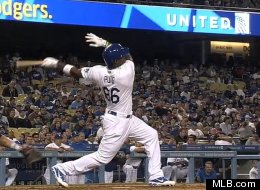
Julio Teheran blatantly drilled Bryce Harper after he thought Harper showed him up after hitting a long bomb on August 7th.  There was no question the pitch was purposely thrown at Harper.  (By the way; watch the video of that home run and try to find the objectionable action there.  Maybe he pauses slightly, maybe he tosses his bat away instead of dropping it, maybe he runs slower than normal.  Not one of these actions comes even close to what some guys in this league do on EVERY homer, ahem Yasiel Puig).

What did the Nats do in response?  Nothing.

Last night, Harper was hit not just once but TWICE.  First in the 4th inning on an errant Alex Wood curveball, then again in the 8th when Luis Avilan threw a ridiculous pitch behind Harper’s head.

What did the Nats do in response?  Again, nothing.

The Nats broadcast team (as heard in the link for last night’s game above) said it right: “What is going on??”

I don’t care if Harper got hit with a curve (not on purpose) and a wild fastball (probably not on purpose, since it put the go-ahead runner on base in a tight game).  I don’t care what the situation is; YOU HAVE TO RESPOND in kind.  Enough is enough.  That’s three straight plunkings of our best guy by the same team inside of a week.

The reaction of the Atlanta crowd was rather telling.  Pathetic in that they cheered the HBP and then gave Avilan a standing ovation.  However also telling because the message is clear; the Nationals ball club, for whatever reason, is not responding in kind to their best hitter getting repeatedly thrown at.

What is going on??  Why aren’t the Nats protecting Harper?  Why aren’t they responding to these HBPs?

The correct response to the August 7th event would have been to hit Justin Upton in the middle of the back the next time he came to the plate.  First pitch.  Plain and simple.  Why Upton?  Because it was Upton who just the night before did the exact same thing that Harper was accused of, only it took him LONGER to prance around the bases.  If Harper got hit because the Braves thought he was too slow around the bases, then how exactly do they excuse Upton’s trot, which was 4 seconds longer?  And the correct response last night was to absolutely drill the first guy up in the bottom of that inning.  No questions; first pitch, in the back.

I don’t know what the hell Davey Johnson is doing.  Why wasn’t he out on the field last night, defending his player?  Why wasn’t he calling out Atlanta’s manager Fredi Gonzalez?  Why isn’t he ordering a response??   Why isn’t he showing any of the passion you would expect from a hall of fame manager who should know better?  Better question; why aren’t Harper’s teammates taking any initiative here and doing what should be done?  Where’s the leadership on this team?  Where’s the leadership in this clubhouse??

If your answer is, “well it was a close game and the Nats couldn’t afford to purposely put a runner on base” then my response is this: 59-62.  That’s the team’s record right now.  You want another couple numbers?  15.5 (games out of first place with 6 weeks of the season to go), or how about 9.5 (games out of the wild card behind a team clearly better than them).  The point is this; the season is over.  They’re playing out the string.  Time to start standing up for yourselves, protect your teammate, show some g*d d*mn spine, and protect your best hitter for the future.

I can’t image what Harper is thinking about his manager and his teammates right now.  If it were me, I’d be asking my manager and my teammates point blank to their faces why i’m not being protected.  It almost makes you wonder if his teammates flat out don’t like him.  Is that what’s going on?  Is the Nats clubhouse, which I’ve accused many times of being dysfunctional, even worse than we thought?

If you don’t think beanball justice has a role in the game, then you’ve either never played the game or don’t understand this aspect of it.  The Nats are sending a message that its ok to go after their guys.  That’s a really bad precedent to create.


Written by Todd Boss

August 17th, 2013 at 12:19 pm

Lincecum’s pending Free Agency; what’s he worth?

20 comments

What would you pay Lincecum in 2014?  Photo via SD Dirk flickr via wikipedia

What would you pay Lincecum in 2014? Photo via SD Dirk flickr via wikipedia

An interesting question was posed in an ESPN chat a while ago that I made a note on to come back to.

Should the Giants offer Tim Lincecum a qualifying offer, or just cut him loose without any compensation ties this coming off season?  And a better question: if you were a GM looking for pitching this coming off-season, what would you offer him?

First some stats.  Lincecum is in the last year of a 2yr/$40.5M deal signed to avoid his last two years of arbitration.  This is on the heels of a 2yr/$23M deal that took out his first two years of arbitration.  He’s already north of $60M in career earnings before hitting his first pure free agent contract.  But he’s at a cross-roads.

Take a look at the progression of his career stat-wise: 2 straight Cy Youngs before even hitting his first year of arbitration (which, if you remember, was a Super-2 year because the Giants apparently cannot read a calendar; this little snafu cost them probably $20M in salary).  He went from an ERA+ of 171 in 2010 to last year’s bottoming out season, where he posted a 68 ERA+, a 5.18 ERA and was pulled from the rotation in favor of Barry Zito (an insult to end all insults) in the playoffs.

Garrett Hooe at FederalBaseball just posted a great analysis as well, including insight into Lincecum’s breakdown of mechanics, his velocity loss and other things.  His analysis is great; no need to replicate it here.

In 2013 he’s regained some of his performance but not enough; he’s still pitching like a 5th/6th starter.  His month-by-month splits give no help: he was decent to good in April, awful in May, decent to good in June, mediocre in July and so far has been lights out in August.  The offensively-challenged Nats just tagged him for 6 runs in 6 innings en route to his 12th loss of the season.

Overall, his velocity is down, he has weird mechanics, and he’s clearly deviating from those weird mechanics as of late.  What GM out there is willing to give him a shot, given those two parameters?  Probably more than a few frankly, given his pedigree, but at what cost?

The answer to the second question (what is his value on the FA market) drives the answer to the first question (whether to offer him a QO).   I went looking for some comparisons from last year’s FA market to try to estimate what his market may be this coming off season and found the following data points of interest:

  • Freddie Garcia pitched to an 80 ERA+ (matching Lincecum’s in 2013) but had a 5.18 ERA in New York.  He’s also older (35 versus 29).  He signed a combo minor/major league deal that pays him $1.3M this year.
  • Dan Haren had an 89 ERA+, as 12-13 record with a 4.33 ERA last year and signed a one-year, $13M deal with the Nats.    But he was a near Cy Young winner just two years prior and was hurt most of 2012 (that was what we kept telling ourselves when we all talked ourselves into this signing anyway).
  • Jorge de la Rosa, coming off a lost season to injury but a great 2011, signed a 1 year $11M deal.
  • Joe Saunders pitched to a 101 ERA+ between two teams, is slightly older and is almost the definition of a MLB average pitcher (career ERA+: exactly 100.  career ERA: 4.20).  He signed a 1yr $6.5M deal with Seattle.
  • Speaking of MLB average guys; Gavin Floyd also owns a career ERA+ of 100, and had exactly that for the White Sox in 2012.  His contract?  1yr, $9.5M.
  • Jason Marquis was awful last year; 8-11 with a 5.22 ERA and a 72 ERA+.  He got a 1year $3M deal to come back to San Diego and regain value.  Fun fact: Marquis is a career 94 ERA+ pitcher, has a career ERA over 4.50, has a CAREER bWAR of 5.5 (that’s about half of what Mike Trout had in bWAR just last season) and yet has more than $50 million in career earnings.  Wow.  I’m in the wrong business.
  • Joe Blanton was pretty awful for two teams in 2012, going 10-15 with a 4.71 ERA, yet somehow earned a 2yr/$15M contract extension from the Angels.  Blanton, by the way, is 2-13 this year.  I’m not sure how exactly Blanton got anything more than a couple million dollars, to say nothing of a 2 year contract.  I question the sanity of the Angels management.

Ok.  So using these examples from last year’s FA market … uh, I have no idea what Lincucum is worth.  I’d say he’s better than Blanton, so that mean’s he’s better than $7.5M/year.   But that was such an awful contract that I don’t see how you can use it as a benchmark. Meanwhile, if Gavin Floyd’s consistency year over year is  worth $9.5M, then how do you value the possible jeckyl and hyde that you’re going to get from Lincecum?

If I was a GM, looking at his body of work and his last two seasons, I probably would end up somewhere between Floyd’s $9.5M and de la Rosa’s $11M on a one-year deal.  As they say, there are no bad one-year deals, and if it goes south its just money.  1year, $10M on a career-saving flier taken by some NL team out there willing to roll the dice and spend some cash.

Probably not the Nationals though, not after the Haren experience and considering what Taylor Jordan has given the team in a 5th starter role this year.  You’d have to think Mike Rizzo heads into the off-season with his 3 big guns under contract, his 4th guy Ross Detwiler on the mend, with Jordan penciled into the 5th starter and with the likes of Nathan Karns, Taylor Hill, and Caleb Clay providing the first line of reinforcements in AAA.

So I predict the Giants will not offer him a qualifying offer, thus cutting ties with one of their most iconic players in the last 25 years.  It will be a sad time in San Francisco head-shops everywhere.

Ladson Inbox 8/12/13

17 comments

The drumbeat to move Zimmerman to first continues.  Photo AP via tbd.com

The drumbeat to move Zimmerman to first continues. Photo AP via tbd.com

Hey, its been a while since MLB Nats beat reporter Bill Ladson did an inbox.  With the Nats season now relegated to “playing for pride,” I’m guessing this inbox is going to be chock full of questions about the future.  Lets dive in.

As always, I write my response to each question before reading his, and edit questions for clarity/conciseness.  All stats mentioned are as of 8/13/13.

Q: Do you think the Nationals could trade Adam LaRoche, move Ryan Zimmerman to first base, Anthony Rendon to third base and sign a free-agent second baseman like Robinson Cano?

A: Wow, that’s a lot of moving parts.  Lets take this wish list of proposed personnel moves one by one:

  • Trade Adam LaRoche: we’d likely not get a whole heck of a lot for a 33 turning 34 year old first baseman who clearly took a step back in 2013.  LaRoche currently ranks 22nd among league-wide first basemen in wRC+, barely above the league average.  By way of comparison, Mark Reynolds is ranked 25th and was just flat-out released after passing through waivers.  So, no I don’t think there are a lot of teams out there willing to pony up the $14M he’s owed next year ($12M in salary, $2m of a buyout of his 2015 option).   This signing has really set the team back offensively.  Though to be fair, Michael Morse (who would have slotted in at 1B had the team not been able to re-sign LaRoche) is also posting about the same wRC+ numbers and has missed half the season with yet another injury.
  • Move Ryan Zimmerman to first base: yes I think this is going to happen eventually, but not this off-season.  I think you handle the transition of a gold-glove winning player off his chosen position carefully and with consideration to the clubhouse ramifications.  I don’t think it played well in Texas’ clubhouse when a former gold-glove winning shortstop Michael Young was moved to third against his wishes, and he made way for a superb defender in Elvis Andrus.  Zimmerman would be making way for a relative unknown (though presumed gifted) defensive replacement.  I think the Nats brass is chalking up 2013’s subpar defensive season to Zimmerman’s lingering shoulder issue, which has exacerbated his already problematic throwing motion and associated mental issues.  I see Zimmerman giving it a fresh start in 2014, and if it becomes clear it isn’t working out we look at spring training 2015 as a position transfer.
  • Move Anthony Rendon to third: it likely happens eventually.  But him moving to third has to wait for the first two bullet points to happen, so again I’m predicting perhaps 2015.  I think more time at 2B will give him more confidence and his errors will subside.  So far his range at 2B is passable (UZR/150 of 0.5 in 448 innings), but that’s a far cry from what Danny Espinosa was offering there (UZR/150 of 12.0 this year, which would have been good for 2nd in the league.  He posted a 9.9 in a full-season last year).  But, by the time Rendon is set to move to 3rd he may very well just stay at 2nd.  He seems like he’s the right size and shape to play 2nd.
  • Sign Robinson Cano.  There’s no question Cano will be the marquee FA this coming off-season, but I don’t think he signs with Washington for two main reasons.  First, the Yankees just cannot let the one remaining good offensive player they have leave, and I believe they’ll over-pay him to stay.  Secondly, whoever signs Cano is making a potentially classic free agency mistake; overpaying a guy in his down years.  Look at the 9 figure deals signed lately for position players, and look at how many of them are almost immediately regrettable.  Albert PujolsRyan HowardJosh HamiltonCarl Crawford and our own Jayson Werth.  All of those deals routinely listed as the worst contracts in the game.  I believe Mike Rizzo is smart enough and forward thinking enough not to hamstring the team with another contract.

So, my answer to this scenario is “not going to happen.”  Ladson says “call me in the off-season.”

Q: How do you defend your previous support of Danny Espinosa?

A: Um, you can’t. Espinosa has now had nearly 1600 major league plate appearances and has a career slash line of .230/.303/.396.  He just cannot hit batting left handed (career splits: he’s 40 batting points and 75 slugging points lower batting left-handed).  He’s hitting .219 in AAA since being demoted.  He faces serious concerns about where his career is going right now.  Yes he’s a great defensive player, but that only gets you halfway to a MLB job these days. Ladson says Espinosa has been hurt this whole time and when he’s healthy he’s good.  But he also admits that Espinosa’s time playing full-time for the Nats is probably at an end.

Q: Is Denard Span a bust?  He has a low on-base percentage and he hasn’t been stealing many bases.

A: Yes, I think its safe to say that Denard Span has been a bust.   He never really stole that many bases (17 last year, career high of 26), but certainly he has posted much better OBP numbers (.342 last year, .350 career).  What has happened to him in 2013?  Who knows.  He has stated that he likens this year to his rookie year, having to learn a whole new league of pitchers.  That could be fair; and could lead to a rebound in 2014.   I do know this; .313 OBP from the lead-off spot just doesn’t cut it.  To make matters worse, his defensive stats have dropped off too; his UZR is down, his DRS is down.  That’s really not a good sign; you can put up with a #8 hitter batting .260 with no power if he provides great value in the field.  If not, then you’re better off bringing up a minor leaguer to see what he can do.  This is another concern for Rizzo heading into the off-season; is this a one-off, an adjustment season for Span, or is this the start of his decline phase?   Ladson extolls Span’s defense, admits he’s not getting on base and postulates the Nats could go after Shin-Soo Choo in the off-season to replace him.  I think Ladson needs to look at the defensive numbers on Choo before advocating that; he’s dead last in UZR/150 for center-fielders right now, by a significant margin.  Now, if you got Choo and moved Bryce Harper back to center?  I’d be for that 100%.  Make Span your 4th OF, wave good-bye to Roger Bernadina and move on.  

Q: Do you think Drew Storen will be traded? His relationship with the Nationals doesn’t seem the same since he blew the save last year against the Cardinals during the National League Division Series.

A: Traded?  No.  Re-called and put into a lesser bullpen role?  Absolutely.  I think once Drew Storen fixes whatever mechanics issue that has been plaguing him, he comes right back to a Ryan Mattheus type role in the pen.  Storen’s ERA in Syracuse is unsightly so far (unlucky small sample size; he’s given up 4 runs on just 7 hits), but he’s got 11 k’s to 0 walks in 6 innings.   AAA hitters aren’t exactly challenging him, if he’s struck out half the guys he’s faced.  If the team was considering him in trade … you’d have to think they would want to get him back up to the majors to regain value anyway.  Ladson thinks he can regain value and can be a MLB closer again.

Q: Will the Nationals consider going after Michael Morse when he becomes a free agent at the end of the year? He would have helped the Nats’ offense this year, splitting time between the outfield and first base. What do you think?

A: As much as I like Morse and have complained about losing him … you have to realize who he is.  He’s an oft-injured slugger who has no position on an NL team.  If we signed Morse, where exactly does he play?  I guess you could platoon him with LaRoche at first or with Span in the outfield … but as a righty he’d play bat twice a week.   I think Morse signs on as a DH with an AL team for surprisingly low money.  If Seattle offers him a Q.O. I’d be shocked.   Ladson doesn’t think he would have helped the team, nor does he see any way he gets signed.


Movie Review: Trouble with the Curve

4 comments

(Slow news week; i’m posting some posts that have been sitting in draft mode for a while).

As mentioned in my previous baseball movie review, we’re a bit behind on watching movies.  If it weren’t for DVRs, I don’t think we’d have any idea what was going on in the modern entertainment world.  After writing the review of the movie 42, I suddenly remembered that we also recently saw Clint Eastwood‘s Trouble with the Curve.  So lets dive in with a review.

Story and Acting: I did not like the story, all in all.

Yes, we get it.  Moneyball (and Billy Beane) invented modern stats-based scouting.  But did it have to be so ham-handedly rammed down our throats?  The entire storyline revolves around the fact that Eastwood’s character is an old-school baseball scout, and he’s old.  Meanwhile the scouting office is apparently run by an uber stat-guy (played by Matthew Lillard, currently starring in the new series The Bridge on AMC) who has the ear of the owner.  But lets face it; if you’ve got a top 3 first round pick, we’re talking millions of dollars and a significant portion of your franchise’s near-immediate future at stake.  You’re not just sending one scout; you’re sending your area scout, your cross checker, your scouting director and your General Manager.

Not to mention, you absolutely cannot depend on stats alone when scouting high school players.  There’s so much variation in talent between teams, even in good baseball areas, that statistics are completely deceiving.  Keith Law mentioned a time where he went to a HS game in Georgia to scout a guy and, during warmups, the opposing team had a 3rd baseman who literally could not throw the ball across the diamond.  The prospect’s team was ahead 15-0 after three innings and the slaughter rule was put into effect.  What value would those stats have for that prospect, good or bad?  College guys are favorites of sabre-slanted scouting directors because there’s a known body of work.  If a guy plays in (say) the SEC, you know what kind of competition he plays against on a week in/week out basis and can properly judge his stat line.

The story needlessly made the star slugger an arrogant, entitled jerk.  He could just as well have been portrayed as a shy kid who wasn’t aware of his own skills or limitations.  The villian wasn’t the draftee; it was the front office executive who undermined Eastwood.  I guess the counter argument would be that if the draftee wasn’t a bad kid he’d have to be a good kid, and then you’d be rooting for him and against Eastwood’s interpretation of his limitations.

Did the Amy Adams character have to be undermined by a younger, whiter guy?  Did they have to add in blatant sexism to this story?  Couldn’t have Adam’s character just taken off from work with some implicit pushback from management in order to make the story work?

Another problem: do we really think that scouts “keep tabs” on “their guys” after they start playing?  If you’re an area scout in the rural mid-atlantic, you don’t have time to take in random minor league games to track your players.  You’re on the road every day scouting players and burning the road trying to get to the next game.  I found that to be somewhat unbelievable.

I’m not even bothering to mention the Justin Timberlake character, whose inclusion added nothing except a cheap romance storyline for the ladies.  I guess that’s a good enough reason.

Lastly, what did the “finding of the janitor” have to do with this story?  That made no sense; you could have made the point that the high draft pick couldn’t hit a curveball  just as easily by having him whiffing on curveballs being thrown by a BP pitcher.  After watching the climactic scene you could have easily have asked, “well is he missing the curve because its so amazing, or because he can’t hit a curve?”   I suppose the plot device was there to enable the Adams character an out of her lawyer job, serving as the janitor’s agent.

Baseball Sequences:

The climax of the movie is about a scouting sublety; watching a hitter’s hands moving when he’s faced with a breaking pitch.  This leads to the title of the movie and to the prospect’s downfall at the end.  That’s great and all, but difficult to show, especially in an actor playing a baseball player and not a player himself.

I’d be curious to see the draftee’s stat line in this movie; he seemed to go 15-15 with 15 homers in play sequences.  I guess it wasn’t enough to just show this kid getting hits; he had to be the best slugger of all time in po-dunk North Carolina or wherever they were supposed to be playing.

Otherwise, there really wasn’t much actuall baseball to watch here; it was a “baseball movie” in topic only.

Conclusion:

A poor movie.  I’m surprised Eastwood came out of acting retirement so that he could reprise his Gran Torino gruffy, grunting character and put him on a baseball field instead of a run down neighborhood in Detroit.  I like Eastwood, I like his movies and wanted to like this one.  But I just could not.

I know its probably been a few months (years?) since you’ve seen the movie, but what did you guys think?


Written by Todd Boss

August 13th, 2013 at 8:46 am

MVP Races getting interesting…

leave a comment

I usually don’t do post-season award analysis until, well, the post-season.  But this year the MVP races seem like they could end up being really interesting.  So lets take a look at who’s in the hunt.

The MVP candidates year in and year out generally are chosen by the voters using these criterion (fair or not):

  1. Best player on the Best teams
  2. Outstanding performances from players on non-playoff teams.
  3. Generally position players, except in a year when no position player really stands out.
  4. East Coast Bias.

I’m not going to get into an argument about whether the “MVP” means the “best player” or “most valuable” here.  I’ll leave that to the multitude of other people who can’t get over this distinction.  For me, the “MVP” still is a subjective award not entirely driven by the guy with the best WAR on the season.  There are plenty who cannot get over the fact that Mike Trout had s uch a fantastic statistical season last year and didn’t win the MVP.  Not me; I don’t see how you can be the “MVP” of a league when your team finishes 20 games out of first.

If the season ended today, your 5 playoff teams per league would be:

  • NL: Divisional Winners Atlanta, Pittsburgh, Los Angeles with St. Louis and Cincinnati meeting in the wild card game.
  • AL: Divisional winners Boston, Detroit and Oakland with Tampa Bay and Texas meeting in the wild card game.

The NL playoff picture seems mostly set; the two wild card leaders have a decent lead on Arizona that seems, well not insurmountable but surprisingly strong.  The AL picture is a bit more unsettled; lots can still  happen in the AL East, and there’s three teams within 4.5 games of the wild card right now (Cleveland, Baltimore and Kansas City).  And that’s to say nothing of the Yankees, who are in the hunt but seem more of a sideshow these days than a contender.

So, using these guidelines, lets look at the leading players that are likely to be in the MVP race.  All stats are as of 8/10/13.  Per team, lets look at the “leading” player both statistically and “honorarily.”

Lets start with the NL:

  • Atlanta: Andrelton Simmons leads the team in bWAR, with almost all of it coming on the defensive side of the ball.   He’s hitting .243 and your voter base just doesn’t have an appreciation for defensive exploits just quite yet.  Justin Upton started out scorching hot and still has great stats on the year, but has cooled so significantly that I don’t believe Atlanta has an MVP candidate.  They have 4-5 really solid hitters and solid pitching driving them to their divisional title.
  • Pittsburgh: it begins and ends with Andrew McCutchen, a serious leader for the award right now.  He’s tied for the league lead in bWAR and is having an outstanding season.  Starling Marte has broken out this year but nobody denies that this is McCutchen’s team.  Pedro Alvarez leads the NL in homers but is otherwise good, but not great, in other offensive statistics.
  • Los Angeles Dodgers: Yasiel Puig leads the team’s hitters in bWAR while taking the league by storm, but he’s only slightly ahead of Hanley Ramirez, who is having a relatively quiet break through season.  But neither guy has played in half the team’s games, leaving a lot of pundits to call for Clayton Kershaw, who is tied with McCutchen for the NL lead in bWAR to get MVP votes.  While I don’t advocate this scenario, it would not surprise me to see Kershaw win the Cy Young and get a top-5 MVP finish.
  • St Louis: Yadier Molina continues to be the transcendent catcher in the NL and is the “spiritual leader” of the Cardinals, but he has gone down with injury and may be losing MVP steam.  He no longer even leads his own team in bWAR (Matt Carpenter does), but remains a good candidate.
  • Cincinnati: the obvious candidate here is Joey Votto, But something seems like Cincinnati’s scuffling as of late combined with the flashier candidates out there will lead to Votto getting votes but not the award.

Other NL Candidates to consider:

  • Arizona’s Paul Goldschmidt is in the top-10 in league bWAR for the Diamondbacks, but unless this team makes a huge run to the playoffs he’s merely going to be a top-10 vote getter.
  • Milwaukee’s Carlos Gomez is tied for the league lead in bWAR, but his streakiness and his team’s place in the standings is going to make it tough for him to get anything other than a top 10 finish.
  • New York‘s David Wright is also putting together a great season, sitting in the top 10 in league bWAR almost entirely on the back of his bat (surprising given his prowness at third).  As with Gomez, the Mets position in the standings hurts him badly.  And his recent D/L trip (which seems like it may end his season) ends his chances.

My opinion of the NL voting right now: McCutchen, Kershaw, Molina, Votto, Gomez.


Over in the American league, the playoff situation may be murky, but the MVP race is pretty straight-forward.  There is a lot to shake out in terms of the playoff positions and the candidates from those teams don’t seem to stand out as much.  But as with 2012, there are two leading MVP candidates and we seem set to have the same arguments this year as last.  But lets go team by team:

  • Boston is being led by their two best players, Jacoby Ellsbury and Dustin Pedroia.  They are both top-10 in bWAR and are having excellent seasons.  Voters likely won’t be able to tell between them and they’ll split the vote with both guys getting top-10 MVP seasons.
  • Detroit: Is there any question?  Miguel Cabrera, who despite negative defensive bWAR is leading the AL.  Max Scherzer will get serious Cy Young consideration but not MVP votes, not with Cabrera and other candidates.
  • Oakland: Jody Donaldson has become the latest “who is that?” player that Oakland has found to drive them to a pennant in a division they have no business competing in.  But east-coast bias and lack of star-power will work against him.
  • Tampa Bay: It has to be Evan Longoria, once again, the face of the franchise.  But as with year’s past, he’s toiling in relative obscurity in front of half the fans that should be supporting a team this good.  And a lot of credit will go towards Wil Myers‘ call-up, taking away Longoria votes.
  • Texas: the story of Adrian Beltre‘s career; he’s a darn good player and nobody gives him enough credit.  Texas has shed many of its name players over the past few seasons, but Beltre continues to provide great value on both sides of the ball.  The transcendant player on Texas this year is Yu Darvish, who will struggle in the Cy Young race (subject of anohter post).

Other AL Candidates to consider:

  • Baltimore may very well sneak into a WC slot as they did last year, entirely on the backs of two guys.  Chris Davis is having a great power season while Manny Machado is having a historic 20-year old season in general.  Both guys have top-10 bWAR seasons and, as with the Boston guys, may split votes here.  Machado in particular looks like he’s already put himself in the “Trout-Harper” discussion for most transcendent young player in the game.
  • Los Angeles Angels: Here we go again.  Mike Trout has put “sophomore slump” naysayers to shame, posting as good or better numbers across the board in 2013.  Interestingly, Trout’s defensive component in 2013 is significantly hurting him whereas in 2012 it gave him a huge boost; his defensive component in bWAR is actually *negative* for 2013.  A topic for another day, the ridiculous swings we see in defensive advanced stats.  In any case, as with 2012 I think Trout’s team’s underperforming will hurt him and he will lose out again.  It is what it is.

My opinion of the AL voting right now: Cabrera, Trout, and then I have no idea.  Right now I’d probably go Machado, Ellsbury and Davis.


There’s still a lot of season to go, so lots could still happen. But I’m putting early markers on McCutchen and Cabrera. Both well deserved.

Virginia Little League loses in Regional Final

22 comments

P1010276

The LLWS slogan on one of the fields in Williamsport. Photo my own circa Oct 2011.

The Virginia State champ Tuckahoe American Little League from Henrico (West Richmond) made it to the Southeast regional final before losing to Tennessee 5-3 in the championship game on ESPN last night 8/9/13.   A disappointing loss for Virginia, who had beaten the same team in pool play earlier in the regional.   Tennessee will now represent the region in the 2013 Little League World Series (LLWS) in Williamsport, PA.  If you’ve never seen the facilities in Williamsport, they are fantastic and a worthy place to watch a baseball game, youngsters or not.

Tuckahoe had cruised through the Virginia State tournament, beating West Springfield in the final and outscoring opponents 35-3 along the way.   They also cruised relatively unscathed to the regional championship before Tennessee got their revenge.

Virginia has not placed a team in the LLWS 1994, when South Central Springfield made it to Williamsport and lost in the US final.

Tuckahoe is quite a Virginia Little League powerhouse; 4 state championships since 2001 and a 3 time regional champion/Little League World Series participant.

My own quasi-personal connection/interest to Little League right now stems from my 12-year old alumni year in 1983, when my home Vienna Little League all-star team handily won the state and then lost in the regional final to eventual LLWS champs Marietta, Georgia.  Our home-team lost on an error in the bottom of the 6th, letting in two runs to turn a 3-2 lead into a 4-3 loss.  Vienna has made one LLWS appearance back in the early 70s but is still a great program and I hope one day my own child can play in the system.


Written by Todd Boss

August 10th, 2013 at 10:24 am

Posted in Local Baseball

Tagged with

Would you rather have Houston or Durham’s rotation, revisited

leave a comment

At the beginning of the season, Houston’s MLB rotation looked so weak that I asked in this space whether you would prefer to have the Houston Astros MLB rotation or the Durham Bulls (AAA affiliate of Tampa) Opening Day rotation?

Now, more than 2/3’s the way through the season, lets take another look.  Here’s some quick links for reference: Houston’s B-R stats, Tampa’s B-R stats, Houston’s Fangraphs Stats, Tampa’s Fangraphs stats and MILB’s Durham stats.

All stats as of 8/6/13.

So, here’s how Houston’s opening day rotation has performed thus far:

Rank Name Age 2013 Stats as of 8/6/13 Notes
1 Bud Norris 28 (MLB) 7-9, 3.89 ERA, 1.394 whip, 106 ERA+, 3.95 fip Traded to Baltmore
2 Lucas Harrell 28 (MLB) 5-12, 5.37 ERA, 1.668 whip, 76 ERA+, 5.41 fip Demoted to bullpen July 9th
3 Philip Humber 30 (MLB) 0-8, 9.59 ERA, 2.019 whip, 43 ERA+, 5.81 fip Demoted to AAA May 11th
4 Erik Bedard 34 (MLB) 3-8, 4.29 ERA, 1.44 whip, 96 ERA+, 4.42 fip Team is 6-14 in his starts
5 Brad Peacock 25 (MLB) 1-4, 7.25 ERA, 1.583 whip, 57 ERA+, 6.57 fip Demoted to AAA April 30th

Here I see one #4 starter (Norris), one #5 starter (Bedard), one guy who wouldn’t make any other team’s rotations (Harrell) and two abject failures in Humber and our own former farmhand Peacock (though it should be noted, Peacock just got recalled, threw 7 innings of 3-run ball, struck out 10 guys and lowered his ERA nearly a full point).

Now, here’s the same stats for Durham’s opening day rotation, showing MLB stats where I could:

Rank Name Age 2013 Stats as of 8/6/13 Notes
1 Chris Archer 24 (MLB) 6-4, 2.65 ERA, 1.085 whip, 144 ERA+, 4.22 whip Promoted June 1, 12 starts thus far
2 Jake Odorizzi 23 (AAA Dur): 8-5, 3.73 ERA, 1.20 whip Has 3 spot starts in May and June with a 6.00 ERA in 18 MLB innings
3 Alex Colome 25 (AAA Dur): 4-6, 3.07 ERA, 1.31 whip 3 spot starts in May/June with a 2.25 ERA in 16 mlb innings
4 Mike Montgomery 23 (AAA Dur): 46-5, 4.28 ERA, 1.43 whip injured earlier in year, in minors all year.
5 Alex Torres 25 (MLB) 4-0 0.26 ERA, 0.612 whip, 1470 ERA+, 1.64 fip Has given up 1 ER in 34 MLB innings pitching out of the pen.

Durham’s opening day rotation has matriculated one mainstay to the Tampa rotation in Chris Archer (he has the best adjusted ERA+ of any of Tampa’s rotation right now) and a second guy in Alex Torres who has given up exactly one run in 34 mlb innings this year.  Alex Colome had three effective spot starts, Jake Odorizzi had 3 relatively ineffective MLB spot starts, and Mike Montgomery missed some time with an injury and has not yet debuted.  It should be noted that both Odorizzi and Montgomery are just 23 and still a bit young for the big stage.

So, which rotation would you rather have now?  It isn’t like the Ray’s AAA guys Montgomery or Odorizzi could do any worse than what Houston’s 4th and 5th starters did this season.  And you can clearly see that Archer’s performance trumps Norris’, and Torres’ amazing bullpen work is better than Bedard’s 96 ERA+ work.

The Rays continue to have the best pitching development system in the majors, even ahead of St. Louis, who turns out mid-90s hurler after mid-90s hurler.