Nationals Arm Race

"… the reason you win or lose is darn near always the same – pitching.” — Earl Weaver

First Look: Tanner Roark

17 comments

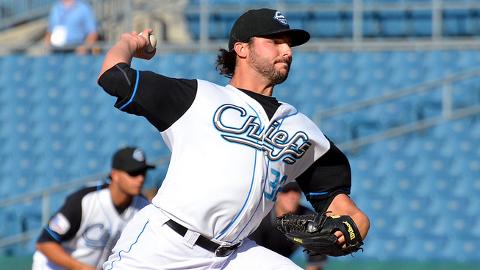
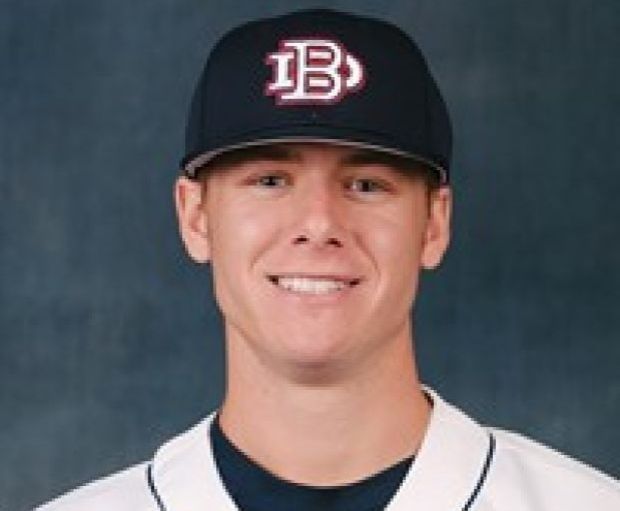
Tanner Roark living the dream.  Photo via milb.com

Tanner Roark living the dream. Photo via milb.com

A few days ago I was playing amateur GM and ended up predicting the 8/6/13 roster moves, where Ross Detwiler was transfered to the 60-day DL and Tanner Roark was called up to provide some bullpen cover while Ross Ohlendorf is on the mend.  Roark’s body of work both this season and over the past few warranted his call-up, and his mixture of success both in the starter role and in a long-relief role in AAA make him the perfect candidate to replace Ohlendorf for the time being.

A quick side note: whenever I see someone, after years and years of toiling in the minors, finally get the call-up I’m reminded of the storytelling of Dirk Hayhurst in his 2nd book Out of My League, where he described all the logistics and feelings of getting his first callup.  Of particular interest; the pay.  I’m sure Roark was compensated like a typical minor league veteran in AAA; probably making $1,500 a month or so (which was about what Hayhurst said he made).  Upon signing a MLB contract, you immediately start getting paid a pro-rated amount of a minimum MLB salary, which is $490,000 a season.  Well, you can quickly see that a guy getting called up immediately starts making significantly more money.   30-40 TIMES more money.  More money per day in the majors than he was making in a month in the minors.   So I say good for Roark and good for every guy who finally gets a shot at the bigs.

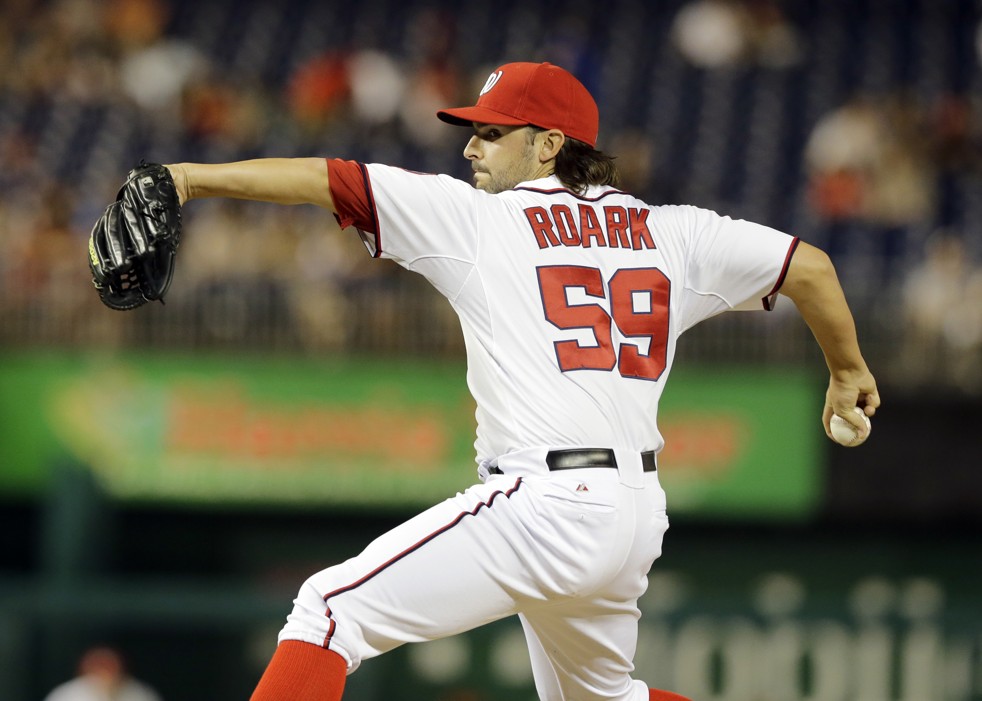
Lets take a look at Roark’s first appearance… which came last night on 8/7/13 in relief of a curiously ineffective Jordan Zimmermann, who needed 88 pitches to complete 4 innings as the Nats officially waved the white flag on the season, getting swept at home by the team they’re chasing for the division lead and falling to 15 1/2 games out of first.

Roark had a great MLB debut.  He came in to face Atlanta’s 4-5-6 hitters and pitched a 1-2-3 inning.  He got a Brian McCann to fly out on a relatively well struck ball, then badly jammed Chris Johnson to get a simple grounder to short, and then got Dan Uggla to reach for a first pitch fastball for an equally weak grounder to second.  Coming back out to face the bottom of the order he effectively jammed BJ Upton, who flared a flyball into shallow center field that Denard Span couldn’t quite come up with in a sliding catch attempt, then  he jammed Andrelton Simmons to get a simple pop-up to first.  Lastly for his coup-de-gras, he induced a popped-up bunt attempt from his opposite number Kris Medlen, made a diving catch and then doubled off Upton, who was (I guess) running on the play.

Not a bad debut, at all.

The scouting reports on Roark said that he’d work mid 90s in relief, low 90s as a starter, and that’s exactly what we saw.  Per the pitch f/x data, He threw 12 fastballs on the night which averaged 94.46, peaking at 95.52.  He only threw three sliders, bouncing the first and probably ruining his confidence in the pitch.  10 of 15 pitches were for strikes, and that ratio should have been higher; his first batter he didn’t get a borderline call on the outside corner and the ump flat out missed a low strike.  He seemed to have pretty good movement on the 4-seamer (-7.10″ average horizontal movement, which for comparison purposes almost as much as Medlen, a guy who relies almost exclusively on his movement, got on his 2-seamer last night).  He certainly worked the corners effectively, only really giving up one well hit ball (that to McCann, who benefitted from being way ahead in the count thanks to the ump’s missed strike calls).  You don’t have to throw 100mph if you can effectively work the ball inside and out.

He was almost too effective; 15 pitches to get through 2 innings meant he didn’t really work much of his repertoire.  I’m sure he has at least a third pitch, but we never got to see it.  Roark’s spot in the order was up, and he was out (as he was being pinch hit for, I wondered internally when the last time Roark got an at-bat was.  Turns out he has 18PAs for Syracuse this summer; I didn’t realize the minor league pitchers got any at-bats).

It was hard not to like what we saw from him last night.  Is he going to continue to be effective, can he stick in the majors?  Hard to tell.  Ian Krol giving up two hits and a walk in a third of an inning didn’t help his cause much, a similiarly ineffective appearance to his 7/31 outing.  Fernando Abad has basically blown the last two games in which he’s appeared.  But these two guys are blessed as being left-handers, so they possess value that a righty does not, and may not really be candidates to make way once Ohlendorf comes off the D/L.  So we’ll see.

Meanwhile Tanner, use some of that MLB meal money to go get a haircut!  🙂

PS.  One more thought on this series since i’ve got nowhere else to put it; I’m disappointed we didn’t see retaliation of some sort last night for the BS of the night before.  I’m sorry; you HAVE to protect your best player out there, and i’m not surprised to hear reports and see evidence that Bryce Harper was on edge last night with his own manager.  As J.P. Santangelo succinctly pointed out; not protecting one of your own players can and does blow up clubhouses.  I think somebody on Atlanta needed to get hit last night (likely McCann).  I’m more than a little worried right now about the state of the clubhouse, given this lack of reaction.

Do I have to write an Alex Rodriguez opinion piece?

4 comments

All A-Rod, all the time.  Photo John Munson/The Star-Ledger via nj.com

All A-Rod, all the time. Photo John Munson/The Star-Ledger via nj.com

I’ve got Alex Rodriguez over-load.

Here’s links that summarize the past week’s rumors and activities in the A-Rod case: first he was going to get banned for life, then we were down to MLB “seeking” to ban him for life, then MLB and A-Rod were negotiating a suspension, then he faced a minimum 214-game suspension, then officially it was a 211-game ban, which of course he immediately appealed.

So, what do I think of all of this?

Honestly, I’m happy A-rod is fighting this.   You know why?   Because I want to see exactly what evidence MLB has here.  MLB basically went out and BOUGHT this evidence, they went out of their way to pursue via a sketchy legal strategy the Biogenesis guys in order to get evidence with which to pursue these players.  Something about that just doesn’t sound kosher to me.  Clearly the evidence is compelling (why else would have Ryan Braun and the 12 other players just rolled over and accepted their suspensions?) .. but its all secret right now.  I hope A-Rod forces discovery and forces this evidence and all the mechanisms that went into procuring it to the light.

If he (or any of these other 12 players who just accepted suspensions) used the substances, where’s the proof?  Are there positive tests?   Why is it “bad” for A-Rod to attempt to cover things up but its “ok” for MLB to pay to “uncover” the evidence?

I mean, don’t get me wrong,  I’m certainly not excusing A-rod here, nor do I think he’s clean.  But something is just not right about the lengths to which MLB is going after the guy.  There’s a CBA in place with pre-agreed upon punishment for PED violations; 50 games for one positive test, 100 games for two.   How does MLB arrive at exactly “211” games?  Where is that number in the CBA?  Plus there’s this: so far we have ZERO positive tests for any of these guys, and they all seem to be just taking well timed suspensions so as to either a) be able to get back for the playoffs or b) not extend into 2014 if possible so their free agency market isn’t impacted.

Initially he was to be “banned for life.”  For what??  Pete Rose gambled on the outcome of games in which he was a participant.  Members of the 1919 Chicago White Sox fixed and threw games to for profit.  Those are “ban for life” types of offenses.  Steve Howe‘s “lifetime ban” only followed SEVEN different suspensions, all for known test failures, and even that “lifetime ban” was rescinded.  How is whatever A-Rod could have possibly done here on the same level as these situations?  Doesn’t this seem like MLB and Bud Selig in particular are specifically going after Alex Rodriguez?

I dunno.  Maybe its because I detest Selig and everything he and his cronies do to the sport I love.  Maybe its because I detest how Baseball operates with its little backroom deals and constant deceptions about finances and player movement.  Maybe its this ridiculous anti-trust exemption that has outlived its legal usefulness for about 50 years yet continues to protect the interests of multi-millionare team owners.

I’m entirely convinced Selig is colluding as we speak with the Yankees owners to ban A-Rod.  I’m entirely convinced Selig coordinated league wide collusion to get Barry Bonds out of the game (Bonds had a 169 OPS+ in his final season; you mean to tell me there was NO team that could have used his bat, even on a free agency flier?  B.S.)  Selig enabled a huckster in Frank McCourt to run the Dodgers into the ground and still profit by hundreds of millions of dollars.  Selig enabled Jeffrey Loria to destroy a baseball market inside of 2 years, and this after Selig gifted the Florida franchise to Loria and allowed him to pillage the Montreal franchise on the way out.   Selig continues to inexplicably force the Oakland A’s to play in an awful stadium in order to protect San Jose “territory rights” that Oakland themselves GAVE to San Francisco years ago.  And it was Selig who gave this sweetheart/ridiculously short sighted MASN TV deal to placate Peter Angelos which is now, in a completely predictable turn of events, locked in a stalemate with the two sides $100M off.  Baseball teams cry about poverty but privately make tens of millions of dollars on the backs of tax payers in publicly funded stadiums.  It is entirely slimy and reprehensible.

Slimy and reprehensible.  Just like A-Rod, in all likelihood.

Maybe I shouldn’t care at all; two sides, each slimier than the next, duking it out to preserve, what exactly?  A-Rod’s incredibly over-paid salary?  A-rod’s “place” in the history of the sport, long since destroyed along with every other hall-of-fame calibre player form the last 30 years?  The sanctity of the game, long since lost at the altar of home runs in the late 90s and early 2000s?  Or is it the zealotry of a manipulative commissioner who works at the behest of and makes decisions driven by cheapskate-but-millionare owners trying to save a buck or two while trying to save themselves from themselves?

A bit cynical, I am about this.


Written by Todd Boss

August 7th, 2013 at 6:50 am

July 2013: Minor League Monthly Rotation Review

25 comments

A.J. Cole is having a good 2013. Photo: AP Stock

A.J. Cole is having a rebound 2013 for sure. Photo: AP Stock

Here’s this month’s Minor League Rotation Review post.  Here’s April 2013May 2013, and June 2013‘s posts for history.

For each level, I’ll put out the rotation members, their “letter grades” per start for this month only, and then throw in a quick link to show their seasonal stats for context.  For each team there are 3 distinct groups of starters: the top group of 5-6 Starters per level is the “current rotation” as best as I can figure it, then the next section of pitchers are swing-men or spot-starters or guys who had “2nd start” or longer outings worthy of grading, followed by a 3rd group of guys who are generally no longer with the team (either by D/L, promotion, demotion or release).  I’ve only listed the third category if something transactionally has happened to the player this particular month.

All stats mentioned (ERAs, Whips, K/9 rates, etc) are as of 8/1/13 and may have slightly changed by the time of this posting.


AAA Rotation: click here for Syracuse Milb.com stats

  • Maya: B+,D,D-,A-,B+,A
  • Tatusko: D,A,B,C+,B,B
  • Rosenbaum: B,C-,A,D,D
  • Roark: B+,C+,C-,A-,A
  • Clay: A,A,D+/inc (rain),B,C
  • Mandel: D->back to bullpen
  • Robertson: F

Discussion: Syracuse has had the most stable rotation of the whole system.   Which is ironic because (if I’m interpreting their service time correctly) 4/5ths of this rotation are minor league free agents this coming off season.   Only Danny Rosenbaum is tied to the organization past this year, having already “survived” one rule-5 draft, but I think we can read the tea-leaves in terms of his future with the organization.  The bright side of this turnover will be the rightful promotion and challenging of several AA pitchers right now, to start grooming the true MLB injury replacements that we just did not have in-house this year (with apologies to Chris Young who really did not work out and Ross Ohlendorf, who has but in a non-starting role thus far).

Yunesky Maya has shown signs of life lately, putting up a few good performances in the latter part of the month.  Tanner Roark seems like he could be a useful swing-man on the MLB roster if called into action; he’s performed ably since returning to the rotation.  Caleb Clay continues to impress; how did he not success in Boston’s organization?

In the bullpen, Xavier Cedeno has excelled since his waiver claim from Houston but suffered from bad timing and bad luck; the two loogies called up (Abad and Krol) have both excelled.   Cedeno is likely another 6-year MLFA heading elsewhere this coming off-season.  (Note: Cedeno has just been called up to cover for Ohlendorf’s “dead arm” D/L trip).


AA: click here for Harrisburg Milb.com stats

  • Karns: A,A (inc),A,A,B-,B-
  • Gilliam: A-,A+,D+,B,B,C-
  • Cole: A+,A
  • Ray: B+,A++,D,D,B-
  • Hill: A,B,A-,B,B,D+
  • Herron: D
  • Swynenberg: A-
  • Grace: B
  • Demny: -> D/L, to bullpen, demoted
  • Treinen: D->d/l,C+,B+ -> D/L

Discussion: Harrisburg’s rotation is now down to just one of the 5 guys who opened the year there; Nathan Karns has recovered from his MLB stint and long layoff and is back to dominating; if it weren’t for the full-deck in AAA Karns may have been promoted by now.   Blake Treinen (another original rotation guy) is on his second D/L stint of the month but has kept his numbers respectable.  Robert Gilliam continues his up-and-down season, moving between stellar and sub-par starts (which is reflected in his 4.09 ERA in AA).

The next generation though seems upon us: A.J. ColeRobbie Ray and Taylor Hill are all on the same path this year: succeeded in High-A, pushed to AA and are now succeeding there.  Cole’s first two starts in Harrisburg could not have gone better, and Ray’s numbers are still good despite a couple of rough starts.  Remember; both Ray and Cole were “really young” at the season’s onset for High-A; now they’re among the youngest guys in all of AA and still producing.  This is great news going forward for this farm system, especially considering that another of the opening day Potomac starters (Taylor Jordan) is now effectively pitching in the majors.  I know this is the Harrisburg section, but think about the success of Potomac’s original 5 this year.


High-A:  click here for Potomac Milb.com stats

  • Purke: A-,F-,C-,D-,D,B+
  • Demny: D,D/inc (2 innings)
  • Solis: A-,D,A-
  • Schwartz: A,D,C-,B+,C+,B+
  • Rauh C,A,D,B+,A,D/inc (2/3 inning)
  • Fischer: A,B
  • Holt: A
  • Ray: -> promoted
  • Pineyro: A -> traded
  • Cole: D,B+/inc,A- -> promoted
  • Frias: B,F -> bullpen -> released 7/24/13

Discussion: The churn in the Potomac rotation continues.   They’ve not gotten starts from 15 different non-rehab assignment players.   And they keep on chugging, holding an 8 game lead in the division on August 1st after winning the first half.  Potomac’s two significant/important names of course are Matthew Purke and Sammy Solis.   Purke has looked hittable in High-A, his ERA skewed by one really bad outing but still not as dominant as you’d like someone with his pedigree to be.  Meanwhile Solis’ latest “return” seems to be going pretty well; he maintains a 2.65 ERA in Potomac while trying to build up arm strength.   Blake Schwartz is now the longest tenured rotation member and has pitched excellently so far in 2013.  He could be quite a find if he continues to develop (he was a 17th round pick who mostly pitched in Division II in college).

Meanwhile, Paul Demny‘s career faced a significant setback upon his demotion from Harrisburg.  He now sits back in High-A, a level at which he pitched a full season in 2011.  It may be time for Demny to try a conversion to relief, as it seems that he may be stalled as a starter.  He had great K/9 rates as a starter; it seems he may make a very effective reliever.


Low-A: click here for Hagerstown Milb.com stats

  • Turnbull: F,D,A,C-,A,D
  • Encarnation: A+,C,A,D,A-,B+
  • Mooneyham: B+,B-,D,B,A+
  • Dickson: A,F,C+,B+
  • Lee: A,B+,C-,B+,A-,B+
  • RPena: B,B+
  • Harper: | | | B,B+
  • Meza: B
  • Purke: -> promoted
  • Anderson: -> d/l

Discussion: with Dixon Anderson‘s D/L trip, Pedro Encarnacion now becomes the senior statesman of Hagerstown.   Both guys have pretty similar numbers; good ERAs (3.20-3.30) and good whips (1.17-1.19).   Encarnaction continues his slow march up the farm system, having gotten further along than most every DSL graduate in recent  years.   Brett Mooneyham continues to dominate a league that he’s over-qualified for.    Kylin Turnbull continues to get pounded in a league that he should be handling.  Ian Dickson (who we got in trade for Henry Rodriguez) has done decently well since being added to the rotation; outside of one blow-up he’s given up just 4 runs in 20 innings over 5 starts.  Not a bad return so far for a guy we were going to cut anyway (and who the Cubs took about 5 weeks to DFA themselves).


Short-A: click here for Auburn Milb.com stats

  • Johansen: A,A,B+,B+,A
  • Barrientos: D,C+,C- -> D/L,F
  • Orlan: F-,B-,A,A,F
  • DWilliams: B-,F,D,C-
  • Voth: A,C+,B/inc (1ip),A-
  • Ullmann: | | | F,B+
  • Hollins: B,B+
  • Bafidis: D+
  • Medina: A-
  • Selsor: B,D,D -> demoted to bullpen
  • Hudgins: D+,A- -> retired !?
  • Turnbull: C -> promoted

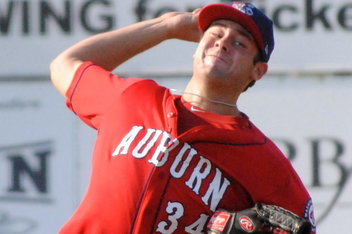
We’re seeing some big ERAs in Auburn so far.  Robert Orlan; 5.19 ERA.  Joel Barrientos: 4.66.  Deion Williams: 9.42.  Ugh.  More interesting to me are the 2013 draftee performances thus far.  2nd rounder Jake Johansen has been good; sub 1.00 ERA, sub 1.00 whip and about a K an inning so far.  He’s been a bit wild (28/14 K/BB ratio but has been consistently stingy when it comes to runs.  5th rounder Austin Voth has been sharp; 17/1 K/BB ratio in 14 innings so far in Short-A.  Lastly Ryan Ullman, a 30th round pick has had up and down starts so far in his 13 short-A innings.

I remain baffled with Will Hudgins abrupt retirement; he had 12 innings of relatively decent relief in 2013 and then tweeted out his retirement.   He hasn’t tweeted since, and when I mentioned it in the daily NationalsProspect.com post I didn’t get anyone who knew anything else.  Hopefully the retirement was not injury or illness related.


GCL: click here for GCL-Nationals Stats on MiLB.com

  • JRodriguez: F,A,A,B,B+
  • Silvestre: C-,A,F,A
  • Giolito: D/inc (only 1/3 inning),B,A-,D/inc (2/3 inings),D
  • Suero: B,B+,A
  • Valdez: A
  • Ott: B,B,C
  • DeRosier: B,B-
  • KRodriguez: B,B+,B+,C+
  • Pivetta: B-,B+,A
  • Spezial: A
  • Webb: A
  • Voth: A -> promoted
  • Ullmann: A,D+ -> promoted

It almost isn’t worth trying to grade out these GCL pitchers; most of the time they’re going 2-3 innings per “start” or per long relief stint.  If you pitch 3 scoreless innings, is that an “A?”   Lucas Giolito now has 6 “starts” but only a total of 12 combined innings thrown.   DSL grads Wander Suero and Jefry Rodriguez have looked promising.  Kelvin Rodriguez has good numbers in his combined mid-relief stints but relatively few strike outs (only 9 in 21 1/3 innings).


One lesson learned from 2013: you can never have enough starting pitching

17 comments

If Detwiler is out for the year, the Nats have a problem. Photo: Haraz Ghanbari/AP via federalbaseball.com

If Detwiler is out for the year, the Nats have a problem. Photo: Haraz Ghanbari/AP via federalbaseball.com

We all knew the Nationals had a glaring, acknowledged weakness heading into the 2013 season; almost no quality starting pitching depth in the high minors.  We non-tendered former opening day starter John Lannan in lieu of paying him somewhere between $5M-$6M dollars to toil in Syracuse again.  We non-tendered former starter Tom Gorzelanny despite his excellent 2012 season for us instead of paying him a few millions dollars a year to continue to be the 7th guy out of the pen.  We traded away top starting pitching prospect Alex Meyer to acquire a center-fielder that (in my oft-stated opinion) we didn’t need.  We were blinded by the excellent but short-sample-sized performance of Zach Duke upon his call-up last September and chose to make him not only the sole lefty in our 2013 pen, but the long-man/spot starter as well.

And we talked ourselves into it.

In 2012 our primary rotation made 150 of 162 starts.  Those 12 missed starts were made by Chien-Ming Wang (five starts) in a quickly-aborted glimpse to see if the many millions of dollars invested in his recovery over the past few years were going to pay off (they did not), by Lannan (six) for a couple of mid-season spot starts and his Stephen Strasburg replacement plan in September, and one by Gorzelanny the day after the team clinched the division (editor note: mistakely originally put “pennant.”  Duh).  That’s it; otherwise the rotation was solid, consistent, and one of the best in the majors by any statistical measure.

Was it just hubris that led us to believe that the same thing would happen in 2013?  That our vaunted rotation (which I certainly thought was the best in the majors before the season started) would steamroll through another 150+ starts in 2013 as we marched to the inevitable World Series title?  Maybe so.

The latest blow is the news that Ross Detwiler‘s herniated disk may very well keep him out for the rest of 2013.  Taylor Jordan has been more than ably filling in for Detwiler … but in a familiar twist Jordan is facing an innings restriction limit.  After August 4th’s start he’s got 40 2/3 major league innings in 2013 to go with 90 1/3 in the minors for 131 total on the year.  He only threw 54 1/3 all of 2012 coming back from Tommy John surgery, and this year easily marks a professional career high (he’s never thrown more than 100 professional innings).  He’s going to get shut down, soon (in about four more starts per the Washington Times’ Amanda Comak, which would put him just about at the same 160ip limit that both Strasburg and Jordan Zimmermann pitched to the year after their own TJ surgeries).  This leaves the team right back where they were on May 20th, when the whole “find a competent 5th starter” charade started.

Duke failed and was released.  Yunesky Maya got his last attempt at pitching in the majors and was outrighted (a move long overdue in the opinion of many Nats followers).  Nathan Karns got three bites at the apple and returned to AA with a 7.50 ERA.  Ross Ohlendorf gave us a fantastic spot start in a double header last week… and just went on the D/L after not being able to dial it up more than 85mph in his last appearance.  The only other 40-man starter in the whole of the minors is Matthew Purke, currently posting a 6.35 ERA in high-A.

Hey, at least Dan Haren suddenly resembles the 2009 version of himself, having tossed 14 innings oof one-run ball en route to winning his last two starts.  A month ago we were talking about releasing him.

So, what should the team do when Jordan is shutdown?  It sounds to me like in the short term we’ll go back to Ohlendorf as the 5th starter (assuming of course his recent “dead arm” injury doesn’t turn into much more than a quick D/L trip).   However, despite Ohlendorf’s excellent work for us thus far, lets not forget why he was available on a minor league deal in the first place; his ERAs in 2011 and 2012 were 8.15 and 7.77 respectively.  Odds are that he’s not likely to be that effective going forward.

Plus, Ohlendorf’s time in the rotation means the bullpen will need another guy … presumably one that can pitch long relief to replace Ohlendorf.  I’m not entirely sure any of the other relievers on the 40-man but in the minors (Drew StorenErik Davis or Tyler Robertson) fits the bill.  Craig Stammen has absolutely done that role in the past, but I think Stammen’s value to this team now lies in his 7th inning “bridge reliever” role, getting the team from a short start to the 8th/9th inning guys.

If Detwiler is indeed out for the year I think he should be immediately transferred to the 60-day D/L (opening up a spot on the 40-man roster) and I’d like to see Tanner Roark  get a look-see as the long man in the bullpen.  He’s put up very good numbers in AAA this season in a swing-man role and faces minor league free agency this off-season.  Or, I wouldn’t be opposed to keeping Ohlendorf in the pen and giving Danny Rosenbaum a shot at the 5th starter.  He’s been the most effective AAA starter all year and, despite not being that overpowering, could turn into another Tommy Milone-esque lefty starter that we could leverage in trade.  We may not have fantastic depth in the upper minors, but you never know who may suddenly be an effective MLB pitcher (see Krol, Ian).

(Editor’s note: after I wrote this mid-weekend MASN’s Byron Kerr wrote and posted almost identical analysis).

Atlanta’s pending starting pitching concerns

2 comments

Is Medlen quickly approaching an innings limit?  Photo unknown via totalprosports.com

Is Kris Medlen quickly approaching an innings limit? Photo unknown via totalprosports.com

When Atlanta lost bulldog staff Ace Tim Hudson to a gruesome ankle injury last week, the Braves were able to immediately plug in the promising Alex Wood to the rotation and not really miss a beat, at least in the short term.  But an interesting point mentioned by Buster Olney in his daily ESPN Baseball Tonight podcast highlighted a dilemna that the Braves may face later this season.

Specifically; they’re depending on a lot of young arms right now who are projected to blow past 2012 and/or career innings totals, and the team may be facing a critical decision when it comes to managing innings and workload as this season progresses.  This is very much of a Tom Verducci-effect concern, which admittedly some people do not subscribe to, but some of these potential workload increases are so substantial that they cannot be ignored.

Here’s a table showing the number of innings their current set of younger starters have thrown this year (in all levels) as compared to last year (innings as of 8/1/13).  The season right now is basicaly 2/3’s over (108 of 162 games played), so I’ve used a simple 33% addition to current workloads:

Starter Age 2013 Innings to date 2013 projected 2012 ttl innings Projected delta Projected delta % increase
Mike Minor 25 144 191.52 179.33 12.19 6.36%
Julio Teheran 22 126 167.58 137.33 30.25 18.05%
Kris Medlen 27 125 166.25 151.33 14.92 8.97%
Alex Wood 22 95.33 126.7889 154.33 -27.53 -21.70%

However, this may be too simplistic a projection.  Each of their starters has about 10 starts left.  Lets assume each of them goes an average of 6 innings in each of these starts.  Now the 2013 projected totals rise a bit;

Starter Age 2013 Innings to date 2013 projected factoring 6ip/start for 10 starts 2012 ttl innings New projected delta New projected delta %
Mike Minor 25 144 204 179.33 24.67 13.76%
Julio Teheran 22 126 186 137.33 48.67 35.44%
Kris Medlen 27 125 185 151.33 33.67 22.25%
Alex Wood 22 95.33 155.33 154.33 1.03 0.67%

Mike Minor has never had any injury concerns and only really faces a small increase in the number of innings he will throw, but if he gets much above 200 innings there may be some concerns.   If he hits 204 innings, that’s a 13% workload increase over last year.

Likewise with Kris Medlen; if he makes 10 more starts and averages 6 innings a start, he’s looking at more than a 20% workload increase over last year.  Medlen is technically still coming back from Tommy John surgery done on 8/18/2010, though it isn’t as much of a concern this year as it was last (when they worked him out of the bullpen before installing him in the rotation later in the year).  A potential 20% innings increase year to year has got to be concerning for a guy with a TJ surgery in his background.

Meanwhile, Julio Teheran doesn’t have any injury history to fend with … but he’s looking at a pretty significant jump over his 2012 inning totals.  His career high was in 2011 with about 160 between the minors and majors.   But if he continues in the rotation he’ll start to get up there towards the 180 innings range, a pretty significant jump over last year.

Lastly there’s Wood, their 2nd round pick in 2012’s draft.  He has rocketed up the farm system, dominating the Sally league in his draft year, skipping high-A, then dominating AA before getting the call-up.  When you add in his college workload to his 2012 minor league numbers, he may be right in line to pitch the same number of innings as lastyear.  There’s just the small concern of a guy who this time last year was making his professional debut in low-A continuing to be effective for a major league team in a pennant race.

This analysis doesn’t include any innings analysis for Hudson (out for the year), Paul Maholm (currently on the D/L) or Brandon Beachy (just coming back from injury and without innings limitations this late in the season) since they’re either unavailable or don’t have any inning limit concerns.  Beachy had his Tommy John surgery on 6/21/13 and, while he should be healthy, still may not be 100% (to this point, his first start back was a debacle, giving up 7 runs in 3 2/3 innings).   Maholm is on the D/L now but should be off within a couple weeks (he has a “Wrist Contusion”), but he’s also their least effective starter on the year.  And of course Hudson is out until at least next spring with his broken ankle at best; his career in jeopardy at worst.

What should they do?

As you can imagine, their problem may be exacerbated because somebody has to throw post-season games (I think its safe to assume the Braves are making the post-season at this point).

This is why some questioned the Braves lack of pursuing a starter in the trade market to replace Hudson and keep Wood in the minors.  Of course, the Braves probably didn’t want to do this knowing they had Beachy coming off the D/L and Maholm returning soon too (probably pushing Wood back to AAA).   But if Teheran runs out of innings, the Braves are looking at a post-season rotation that isn’t exactly a world-beater (Minor-Maholm-Beachy and Medlen?).  Then again, that hasn’t stopped them while building a double-digit lead in the NL East.

It should be interesting to see if the Braves end up with a Stephen Strasburg shutdown-gate of their own as we head into September.

July 2013 Monthly Review of Nats Rotation by Opponent

one comment

Zimmermann really struggled in July. Photo Manuel Balce-Ceneta/AP

Zimmermann really struggled in July. Photo Manuel Balce-Ceneta/AP

[Editor’s note: duh, I published this with the wrong title; just fixed 8/2/13]

Continuing a monthly series of look-backs at our starters (here’s Apr 2013May 2013June 2013, July2013 posts), here’s a monthly glance at how our rotation is doing from a Starting Pitching standpoint. As with previous posts, we’ll have “Grades” per outing, the team’s performance per opposing starter sliced and diced a few ways, and other per-starter stuff that I like to track.

MLB Rotation Per-Start Grades (click here for Nats overall season stats)

  • Strasburg: A,C,F,B,A+,D
  • Gonzalez: C+,A,A+,B,F-
  • Zimmermann: C-,C,B,F-,D
  • Haren: C-,A+,D,A
  • Jordan: B-,C-,B,C+,A
  • Ohlendorf: B long relief,A spot start
  • Detwiler: B- -> D/L

Quick Summary:  A month where we had a handful of really shocking blow-up starts.  Gonzalez‘s 11 run debacle  yesterday, Strasburg‘s 2 inning/7 run meltdown being the most shocking examples.  Only rookie Taylor Jordan kept an even keel, never pitching that badly and only really pitching excellently in his last start (also, not coincidentally his first win).  I will say it is good to see Dan Haren putting in some good-to-great starts; that may really help.  Ross Ohlendorf‘s injury yesterday better not be serious; Jordan’s innings limit is fast, fast approaching.

Performance By Opponent Starting Pitcher Rotation Order Number

A look at the opposing team’s rotation ranked 1-5 in the order they’re appearing from opening day.  This table changes at the all-star break and honestly must be taken with a grain of salt, since guys like Clayton Kershaw are now the “#3 starter” because their turns were skipped coming out of the all-star game.

Starter # Record Opposing Starter in Wins Opposing Starter in Losses
1 2-3 Gallardo, Burnett Hamels, Nolaso, Sanchez
2 2-3 Lee, Slowey Peralta, Greinke, Verlander
3 1-4 Harvey Lohse, Kendrick, Kershaw, Liriano
4 2-1 Marquis, Gee Cole
5 2-3 Hand, Torres Lannan, Fernandez, Morton
5+ 2-2 Cashner, Erlin Eovaldi, Mejia

Quick thoughts: given the aforementioned caveat of having Justin Verlander listed as a #2 and Kershaw listed as a #3, the team more or less performed as you’d expect.  A 1-4 record against opposing teams’ #3 starters is really skewed by the likes of Harvey, Lohse, Kershaw and Liriano in that grouping, all four guys being their team’s current aces.  This table is becoming less and less meaningful as rotations get scattered as the season goes along.

Performance By Opponent Starting Pitcher Actual Performance Rank Intra-Rotation

A ranking of opposing teams’ rotations by pure performance at the time of the series, using ERA+ heavily.

Starter # Record Opposing Starter in Wins Opposing Starter in Losses
1 3-4 Lee, Harvey, Cashner Sanchez, Lohse, Kershaw, Fernandez
2 1-2 Hand Kendrik, Liriano
3 4-2 Gallardo, Burnett, Marquis, Gee Greinke, Eovaldi
4 1-4 Erlin Nolasco, Peralta, Verlander, Morton
5 2-2 Slowey, Torrez Hamels, Cole
5+ 0-2 Lannan, Mejia

Quick Thoughts: the Nats actually held their own very well against other teams’ best performing guys.  They hung losses on Matt Harvey somehow, and hung a loss on Cliff Lee.  Less impressive was the collapse against AAA-callup Jenrry Mejia or the no-show against former teammmate John Lannan.

Performance By Opponent Starting Pitcher League-wide “Rank”
A team-independent assignment of a league-wide “rank” of what the starter is. Is he an “Ace?” Is he a #2?

Starter # Record Opposing Starter in Wins Opposing Starter in Losses
1 2-4 Harvey, Lee Kershaw, Grienke, Verlander, Hamels
2 0-3 Sanchez, Liriano, Fernandez
3 2-3 Gallardo, Burnett Lohse, Nolasco, Cole
4 0-1 Kendrick
5 6-4 Cashner, Hand, Marquis, Gee, Erlin, Slowey Eovaldi, Peralta, Morton, Lannan
5+ 1-1 Torres Mejia

Quick thoughts: despite a supposedly “weak” schedule the team faced a lot of big-time names in July.  Six of the 27 games went against league-wide Aces, a tall order for any team.  They also got whitewashed by the near-Aces/#2 starters, losing all three games against these types.  More disappointing?  Only a 6-4 record against league-wide #5 pitchers, the kind of guys that are nearly interchangeable with AAA players.  Maybe John Lannan isn’t really a #5 starter (probably not; he’s probably more of a #4), but the rest of these guys?

Records by Pitching Advantage

Start-by-start advantages in my own opinion and then looking at the results.

Wash 4-6 Zim-Gallardo, Gio-Cashner, Zim-Marquis, Stras-Erlin Det-Lohse, Stras-Nolasco, Zim-Kendrick, Stras-Eovaldi, Stras-Peralta, Zim-Mejia
Even 3-3 Gio-Burnett, Jordan-Hand, Jordan-Torres Gio-Verlander, Stras-Sanchez, Stras-Liriano
Opp 4-8 Jordan-Slowey, Ohlendorf-Harvey, Haren-Gee, Gio-Lee Zimm-Kershaw, Gio-Greinke, Haren-Fernandez, Jordan-Hamels, Haren-Lannan, Jordan-Cole, Haren-Morton

A sign of how our season has gone:  I gave opponents the clear advantage in 12 of our 27 games this month.    Compare this to April, when I only gave our opponents the advantage in TWO of our first 27 games.  We’re to the point where Haren and Jordan are automatically underdogs nearly every time they take the mound, and we face enough power arms where our big three may not always be favored to win either.

Matchup analysis

Looking at the opposing starter rank that our guys are going up against to see how their competition fares.

Nats Starters Opponents matchup analysis Nats Record under starter
Strasburg Two #2s, a #3 and three #5s 1-5
Gonzalez Three Aces, a #3 and a #5 3-2
Zimmermann An Ace, a #3, a #4 and two #5s 2-3
Haren one #2, three #5s 1-3
Detwiler one #3 0-1
Jordan An Ace, a #3 and three #5s 3-2
Ohlendorf An Ace in Harvey 1-0

Instead of classifying by rotation order in this table, this is by “league wide rank.”  And we see some very interesting information.

  • The team was only 1-5 in Strasburg’s 6 starts this month, and he wasn’t exactly going against an all-star collection of opposing starters.  That’s a big-time area of concern.  It all comes down to run support.
  • Gio meanwhile had to face up with three of the best 20 pitchers in the league and still managed to have a winning record during his starts.
  • Zimmermann, as we see in his grades, tailed off badly this month.
  • Haren, despite facing off mostly against other #5 quality guys, still conspired to lose 3 of his four starts.
  • Jordan, as we all know, has really surprised everyone and has been helping the team win.
  • Ohlendorf faced off against one of (if not the) major’s best hurlers and the team got a win in his spot start.


Is it time to fire Davey Johnson?

12 comments


Davey Johnson can't get this team in gear.  Is it time to go?  Photo Getty via mlb.com

Davey Johnson can’t get this team in gear. Is it time to go? Photo Getty via mlb.com

I know this is blasphemous to say.

I know it’ll never happen, not under this GM and not under this ownership group, both of whom have far more respect for Davey Johnson than to give him such an ignominious end to his time here.

And I know that Johnson is as good of a manager as is out there.  I may have been critical of his decisions here and there (especially related to yanking starters on low pitch counts), but I recognize he’s a Hall of Famer and cannot argue against his career accomplishments.

But I’m beginning to believe that the only way to shake this team out of its current malaise is to change the message coming from the top.

They tried demoting players who weren’t hitting (Danny EspinosaTyler Moore).   They’ve tried calling up their best remaining prospects (Anthony Rendon, Nathan Karns and Taylor Jordan).  They’ve tried cleaning house of underperforming relievers (Henry RodriguezZach Duke, and Drew Storen).  They’ve tried changing key staff (firing Rick Eckstein).  They’ve tried ridiculous lineups (your best power hitter Bryce Harper leading off??)   Nothing has made a difference; the team has basically been playing .500 ball for weeks and weeks now.

For whatever reason, this team of players, picked by every baseball pundit out there to make the playoffs and by a good portion to make it to or win the World Series, is now 10 games out of of the divisional lead.  They’re 10 games back of Atlanta, which themselves has only played .500 ball since mid April after a 12-1 start.  The Nats just finished June and July playing 50 games in a row against teams that missed the 2012 playoffs (perhaps not the best bench mark, since Pittsburgh has the best record in baseball this year, but still), and finished the stretch 5 games south of .500.

The team looks like its sleepwaking through games.  They look like they have no voice, no spark, no sense of urgency.  No leadership.

The trade deadline won’t help at all; the Nats have practically no tradeable assets.  Their only FAs to be are Dan Haren and Chad Tracy.  Kurt Suzuki has a 2014 option that clearly won’t be exercised, so he counts too.  But who is out there lineing up for these 3 guys?  Meanwhile, despite their offensive woes, there’s really not a spot on the field that can be improved through trade.  Go around the field and you’ve got players on deals that at least extend through 2014 (LaRoche and Span), or  you’ve got guys on major contracts (Zimmerman and Werth) or you’ve got cornerstone younger players (HarperRamosDesmond and Rendon).  Who are you going to replace?  Maybe you think about trading Rafael Soriano (after all, the last thing a losing team needs is a high-priced closer) but a quick glance at the teams in playoff contention does not easily find a team in need of a closer (the best candidate may be Pittsburgh, who just lost their closer Jason Grilli to a forearm injury, but they’re not exactly rolling in dollars nor likely to take on an $11M/year guy).

Maybe its time to bring in a new voice, and see if he can scare this team into an August and September run.

Sorry Davey; you know how the old saying goes.  You can’t fire 25 players, but its pretty easy to fire the manager.

Taylor Jordan: Never too soon to think about the future…

4 comments

Jordan is making a case for his future with this organization.  Photo via wffn.net/hueytaxi on flikr.com

Taylor Jordan is making a case for his future with this organization. Photo via wffn.net/hueytaxi on flikr.com

I’ll file this as one of the “Patently Obvious” responses that have come out of Mike Rizzo‘s mouth in response to a reporter’s question, but Rizzo went “on record” as saying that Taylor Jordan will “get every opportunity to be in the mix for the rotation next year” per beat reports (this example from Byron Kerr) after Jordan got his first major league victory in Sunday 7/28/13’s 14-1 blow-out of the Mets.

Well, of course he’ll get a chance to compete for the rotation.   He’s pitching a hell of a lot better right now than $13M man Dan Haren, for approximately 1/30th of the cost.  What GM doesn’t want that??

One of the big reasons I started this blog was to talk about the development of Nats minor league pitchers.  Back in the dark days, when the team was spending $15M on the FA market to acquire 5th starters like Jason Marquis, I became convinced that the single most valuable commodity in Major League Baseball (in terms of talent development and acquisition) was the pre-arbitration starting pitcher.   Our farm system had the “Loria/Bowden” holes in terms of player development in the 2007-2009 time frame and for a few years the team couldn’t develop an effective starter, instead relying on guys like Marquis and on other minor league/low-end free agent signings (think Tim ReddingDaniel Cabrera, and the aging Livan Hernandez being examples).   Rizzo came in, put the emphasis on drafting and development, and now the opening day rotation features 3 home-grown guys and a fourth in Gio Gonzalez who was acquired by trading other home-grown guys.

One of my biggest data-collection projects was the information behind my regular “Pitcher Wins on the Free Agency Market” post.   After looking at pretty much every significant FA pitcher signing that baseball has ever had, and calculating salary versus wins, it became clear that teams are historically doing well if they get about one win per $1M spent on a FA pitcher.  Sign a guy for $13M a year?  You hope to get 13 wins out of him.

But this analysis also shows just how valuable the pre-arbitration, cost-controlled starter is.  Consider Clay Buchholz for Boston in 2010; he goes 17-7 in his 3rd active year, earning the MLB minimum of $443,000.  That 17-win capability eventually earned him a $12-$13M/year contract, but while he was getting the minimum he was winning games for Boston for pennies on the dollar versus what it would have cost Boston to purchase that capability on the open market.

Combine this point with the continually dwindling talent available on the FA market these as teams lock up their players earlier and more frequently, and the price for pitching just continues to go higher.  Zack Greinke signed a 6 year $147M contract paying him more than $24M annually last summer partly because he was the only significant pitcher out there.  Grienke is talented, don’t get me wrong, but outside of his unbelievable 2009 season he’s basically pitched like a #3 starter.   Even this year, he’s pitching to a rather pedestrian 103 ERA+, just barely above the league average of adjusted ERA for starters.  Not exactly what you expect for that kind of money.  The 2014 Free Agent Market in terms of pitching is looking equally as bare as 2013.   The best guy out there may be Matt Garza, who again is talented but is also injury prone and not exactly a league-wide Ace.   Get past Garza and you’re looking at inconsistent (Ricky Nolasco or Phil Hughes), injury plagued (Shawn Marcum or Colby Lewis), just old guys (Freddy Garcia, Hiroki Kuroda) and pure wild cards (Tim Lincecum or Scott Kazmir).

There’s a reason Tampa went nearly 8 full seasons without having a Free Agent acquisition start a game for them; they know exactly what it means to develop effective starters, and they have a stableful of them.  Trade away James Shields and Wade Davis?  No problem; just call up Chris Archer and Alex Colome (never mind the rest of their Durham rotation).

So, back to Jordan.  If the Nats can find an effective 4th or 5th starter from their farm system right now, it frees them from the one-year hired gun strategy of Haren and Edwin Jackson.  It gives them the flexibility to continue to allow their best prospects in the lower minors to develop (i’m thinking specifically of A.J. ColeRobbie RaySammy Solis, and Matthew Purke, though Cole and Ray aren’t exactly in the “low” minors anymore with their promotions to AA).  It gives them the depth they did not have this year to cover for a starting pitcher injury.   It gives them time to let Nathan Karns figure out if he’s going to be a starter or a reliever at the MLB level.  It gives them added payroll flexibility can go towards fixing holes in the short term.  Longer term it allows the team to spend money on extending the core guys, or allows them to consider whether the rising price tag on someone like Ross Detwiler is worth paying (much like they cut loose John Lannan last year).  If you’re going to pay market value for Strasburg and Harper, then you’re going to need some low-cost players who can contribute to counter balance the payroll.

Or, and it wouldn’t surprise me to see this either, it gives Rizzo interesting trade chips that he could package with other guys to acquire the Haren/Jackson hurler instead of buying him.

Two years ago we acquired Gonzalez for two near-to-the-majors starters, a surplus catcher prospect and a low-minors/high profile arm.  Right now it seems like we could put nearly the same package together (Jordan, Karns, Jhonatan Solano or Sandy Leon and then a decent arm from A-ball, or maybe even a Ray or Cole) and move them for such a resource.  I wouldn’t put it past Rizzo; Jordan may be looking good right now, but his peripherals don’t project as a “Rizzo Guy.”  Neither did Tommy Milone so he got shipped out; will Jordan be a 5th starter candidate in 2014 or trade bait?

Personally, I’d like to see Jordan succeed.  He’s a great success story; unhearalded 9th rounder coming off an injury that most of us thought was good, but who also thought that finishing the year successfully at high-A would have been a great achievement.  Instead he blows through high-A and AA ball and is now more than holding his own in the majors.

Storen to the minors… did he deserve it?

6 comments

Storen will look to re-group in AAA..  Photo Andrew Harnik/washingtontimes.com

Storen will look to re-group in AAA.. Photo Andrew Harnik/washingtontimes.com

Talk about a fall from grace.  Drew Storen went from being the closer for a 98 win team in Oct, 2012 to being optioned to the minors after Friday 7/26/13’s doubleheader.

On the face of it, it makes sense.  This team is struggling, Ryan Mattheus is off the D/L, and there were 8 relievers for 7 spots.  Storen’s numbers in 2013 have been abhorrent: a 5.95 ERA and a 1.512 whip in 42 1/3 innings.  The team isn’t scoring any runs, so the last thing they need is a reliever who can’t hold a close lead right now.

A look deeper into Storen’s numbers though reveals a very tough-luck case.  Looking at his advanced stats from Fangraphs, he’s got a .346 BABIP right now, 45-50 points above the league average and a good 60 points above his career average.  He’s been very unlucky on balls in play.  This contributes to the huge gap between his ERA (5.95) and his FIP (4.16), and especially his xFIP (3.59).  This expected FIP by they way is significantly better than Rafael Soriano‘s current xFIP (4.26).  The point?  Storen has been unlucky so far this season and, were he given the chance to allow his appearances to regress to the expected mean, he likely would have pitched a ton better going forward.

Side Note:  Luigi De Guzman (aka “Ouij”) from Natstradamus did a fantastic bit of data mining, looking at Storen’s detailed pitch f/x data to delve into the reasons for Storen’s downfall.  Definitely go over there and read that piece.

Steve McCatty was quoted during Saturday’s broadcast as saying that he wanted Storen to work on his mechanics.  Specifically, Storen used to vary his left leg motion between the straight legged approach and a conventional knee bend.  This is confirmed by beat reporter James Wagner‘s story to the same.  Makes sense to me: the straight leg kick causes him to be slower to the plate, making it harder for him to hold runners.  The Nats as a team are already struggling to hold runners in general.  Plus, I’ve privately wondered if the varying leg kick causes him to struggle to hold his mechanics.  McCatty alluded to this, wondering if Storen’s control is affected.

On a different note; I’ve said this before, but I cannot help but think that Storen’s mental state has been in question ever since the acquisition of Soriano.  Buying Soriano on the FA market was essentially management telling Storen either a) we don’t trust you anymore after your game 5 meltdown, or b) we don’t think you’re good enough to be our closer any more.  It was an public and embarrassing demotion, and not every guy will take it in stride.  Tyler Clippard may have had an easier time with it since he was already an established 8th inning guy, and he was never really in line this season to be the closer.  These are the kind of man-management issues I think us casual fans forget about; just like you have problems in your office, so do players have problems in the clubhouse.

So, tough break for Storen.  Two straight awful appearances plus the blown save in 7/20’s Los Angeles game conspired to get him sent to the minors.  Lets hope he regroups, clears his head and is ready to come backup when the next spot in the bullpen opens up.


Written by Todd Boss

July 29th, 2013 at 7:02 am

Ryan Zimmerman; Mr. Walkoff

4 comments

Zimmerman's 9th career walk-off homer couldn't have come at a better time.  Photo Greg Fiume via amazingavenue

Zimmerman’s 9th career walk-off homer couldn’t have come at a better time. Photo Greg Fiume via amazingavenue

Its been a little while since Ryan Zimmerman hit a walk-off home-run (about two years) but on Friday night 7/26/13 he delivered again, giving the Nats a second walk-off win in two days.

In his Washington career he’s had some memorable walk-off homers:

  • A 2-run walk-off against Chien-Ming Wang on Fathers Day 2006 against the Yankees, a game in which the team set its long-running regular season attendance record (only surpassed on Opening day 2013).
  • A 2-out, 2-strike come-from-behind homer against Florida on the 4th of July that same year.
  • Perhaps his most amazing walk-off homer; the game-winner in the Nats Stadium opener in April 2008, a leading candidate for “Best Nats game of all time.”

Zimmerman had accumulated no less than eight walk-off homers by the end of his 6th professional season in 2011, and he seemed a sure bet to shatter the all time MLB record for such events.  The long-standing record for career walk-offs was shared by this quintet of Hall-of-Famers at 12: Jimmy Foxx, Mickey Mantle, Babe Ruth, Stan Musial and Frank Robinson before one Jim Thome hit his 13th in June of 2012 to take over the career lead just before he retired.  Friday’s was Zimmerman’s 9th, and you’d have to think he remains a good bet to possibly take over the career lead before his career (which is seemingly only about half way done) is over.

The current active leader in walk-offs is another noteworthy name; David Ortiz connected for his 11th such walk-off homer on 6/6/13, as detailed by Billy-Ball.com.  Ortiz’ most noteworthy walk-off homers though are the post-season variety, not captured by these regular season records.

Zimmerman has had a 2 year walk-off drought; will we see another moment of magic later this year?

Written by Todd Boss

July 27th, 2013 at 1:59 pm