Nationals Arm Race

"… the reason you win or lose is darn near always the same – pitching.” — Earl Weaver

Nats Rule-5 Draft History; updated for 2013

8 comments

Jesus Flores remains our most successful Rule 5 Draftee.  Photo Toni Sandys/Washington Post

Jesus Flores remains our most successful Rule 5 Draftee. Photo Toni Sandys/Washington Post

(I should have published this in early December but got caught up in a glut of other posts; posting this now in lieu of just trashing it).

The Nats for years were heavy participants in the Rule-5 draft, thanks to some pretty awful teams and some shrewd scouting.  In November 2011 I did a Rule-5 Draft history, and I thought I’d update it for the last few drafts, now that 2013’s draft is complete.  Borrowing a chunk of the text for the previous years from the previous post, here’s a list of the Rule 5 drafts since 2005, with our players taken/received noted and with some thoughts on how the player turned out for either side.  Note I’m mostly only doing this analysis for the major league section of the rule 5 draft; there’s just far too little eventual MLB success to be found in the AAA and AA sections of the Rule 5 draft to do the analysis.  I will note some notables who get snapped up in the minor league section for the later years.

2004 Rule 5 Draft (ahead of the 2005 season)

  • Tony Blanco: 1B; drafted from Cincinnati.  He batted .177 as a 1st baseman backup while eating a roster spot all season, then we cut him from AAA after 2007.  He kicked around Colorado’s system for a year and has been playing in Japan ever since.  Verdict: failure.
  • Tyrell Godwin: CF, drafted from Toronto.  Prior to the 2005 season, the team traded another minor leaguer to keep his rights, so this really played out less like a Rule-5 pickup in that Godwin didn’t have to stick on the 25-man roster all year.  He played a grand total of 3 games for the Nats, kicked around AAA for a while an hung them up in 2007.  Verdict: failure.

2005 Rule 5 Draft

The Nats did not draft anyone, but had a player taken who went on a whirlwind tour of MLB organizations before getting returned mid 2006.

  • Chris Booker was rule-5 drafted by Detroit, who immediately sold him to Philadelphia, who then waived him in May of 2006 with the intent of returning him … except that Kansas City picked him up, hung onto him for a couple months and eventually returned him to Washington.  The Nats eventually called him up but he was relatively ineffective and he washed out of the game (seemingly due to injuries) after 2008.

2006 Rule 5 Draft

  • Jesus Flores, C, drafted from the New York Mets, stuck with the team all year despite having only played high-A ball in the minors.  Despite his eventual injury issues that plagued him for the better part of 3 seasons, Flores remains the best example of a “found gold” prospect that can be had in the Rule 5 draft.   After the Nats DFA’d him last off-season, he bounced around both LA and Tampa’s AAA teams in 2013 but did not appear in the majors. Verdict: success.
  • Levale Speigner RHP (a closer) was drafted from Minnesota and, as with Booker above, eventually was traded for by the Nats so they could keep him and stash him in the minors.  After some awful outings for the big team, he passed through waivers mid 2008 and was released from AAA in 2008, bounced around a couple other organizations, and retired after 2010.  Verdict: failure.

The Nats lost one player in this draft:

  • Alejandro Machada was drafted by Minnesota just a month after the Nats had re-signed him to a minor league contract.  So Machada didn’t have to stay on their active roster.  And indeed he didn’t; he was injured all of 2007 and stayed with Minnesota’s AAA team until 2009, never again broaching the majors.

2007 Rule 5 Draft

  • Matt Whitney: 1B/3B, Drafted and then eventually returned back to Cleveland, who eventually made the former 1st rounder a ML free agent and we signed him after the 2008 season.   We cut him after the 2009 season and he retired after 2010.  Verdict: failure.
  • Garrett Guzman: LF/RF: after Rule-5 selecting him, the team eventually traded a PTBNL for him to Minnesota, then we cut him outright and nobody picked him up.  He played two years of Independent ball and was out of baseball after 2010.  Guzman is more infamously known as the player who was caught having sex with an underage girl while playing for our AA team in Harrisburg in 2008, likely the reason why nobody picked him up after his DFA.  Verdict: failure.

The Nats lost one player of note in the minor league phase in this draft:

  • Brett Campbell was drafted by Milwaukee in the AAA phase of the rule-5 draft.  Milwaukee released him in spring training of the subsequent 2008 season and Campbell never played another inning of pro baseball.  This seems especially odd to me: he was drafted in 2004 and rose all the way through the Nats system to debut in the majors by Sept of 2006.  He pitched in just two games in 2006, and returned to the minors in 2007.  Was he hurt?  He was only 26 when he apparently hung them up.  Oddity.

2008 Rule 5 Draft

  • Terrell Young: Drafted with the #1 pick in the Rule 5 draft from Cincinnati.  He got hurt, never played for us, and was eventually returned to the Reds.   His injury was severe enough that he was out of baseball after being drafted; he has no professional games after 2008.  Verdict: failure.
  • Ricardo Nanita, selected in the minor league phase, played most of 2009, then went to the Mexican league, then got picked up by Toronto in minor league free agency and has been there ever since, playing all of 2013 in Buffalo.   Verdict: failure.

The team lost two players in the minor league phase:

2009 Rule 5 Draft

  • Jamie Hoffman; OF, Drafted with the #1 pick in the Rule 5 draft from Los Angeles Dodgers and immediately traded for Brian Bruney in a pre-arranged deal.  NY returned him to the Dodgers later that spring.   Bruney, meanwhile, immediately went to arbitration and lost with the team in the spring of 2010, was awful out of the gate, and the team outright released him before the end of May.   Verdict: failure, all the way around this transaction.

The team lost one player in this draft:

  • Zech Zinicola was drafted away from us by Toronto, who eventually returned him to the Nats without any Toronto appearances.  His selection was probably due to Dana Brown‘s hiring in Toronto, going from Washington’s Scouting Director to being a special assistant to the GM in Toronto.  Zinicola remained in our farm system until 2013, when he was released.

2010 Rule 5 Draft

  • Elvin Ramirez, RH reliever, drafted from the New York Mets: he was injured in spring training and spent the entirety of the season on the DL.  Interestingly, the team returned him to New York in October, long before they needed to, and with New York this year he made his way to the majors for some appearances.  If the team drafted him, why not keep him through spring training of 2012 to see if he was worth keeping?  It just seemed odd to give up on the draft pick while procedurally you could still keep him.  Verdict: failure.
  • Brian Broderick, RH Starting Pitcher, Drafted from St. Louis and stuck into the 2011′s bullpen as the long-man/mop-up guy.  He was awful, he was costing the team wins, and was eventually returned to St. Louis before May was out.   However, St. Louis waived him towards the end of 2012 and we picked him back up.  I projected him to be one of our AAA starters in 2013 but he struggled and ended the season in AA and likely will be cut loose this off-season. Verdict: failure.

The team lost one player in the 2010 draft:

  • The Phillies drafted Michael Martinez away from the Nats, and he stuck on their roster as a backup middle infielder.  His batting lines are awful though, and the Nats clearly had depth at middle infield at the time, so losing this player was not that big of a deal.  Even now, with his career .187 batting line, he couldn’t have helped us.

2011 Rule 5 Draft

The Nats did not take anyone for the first time in years, but had two players themselves taken.  Neither player drafted was a surprise; I posted at the time that I thought both these players should have been protected.

  • Brad Meyers (RH starting pitcher) was drafted by the New York Yankees, but he suffered an injury in spring training and was DL’d all year.  He was returned to the Nats and subsequently missed all of 2013 too.  I listed him as a “release candidate” in my 2014 rotation projections, not knowing if he’s healthy or if he can win a AAA rotation spot at this point with the talent we have matriculating upwards.
  • Erik Komatsu was drafted by St. Louis (in retaliation for our taking Broderick the previous year?), made their 2012 opening day roster, played for a while before being waived, got picked up by Minnesota, and by Memorial Day was returned to Washington in a whirlwind set of transactions.  I think he remains a minor league caliber player, with too little offense for a corner outfield position but not enough speed to play center.

2012 Rule 5 Draft

Again, the team did not select anyone but got poached for four players in the major and minor phase.

  • LHP Danny Rosenbaum was drafted by Colorado to take part in their unique rotation experiment (where guys work up to a certain pitch count each night).  Rosenbaum didn’t make the Rockie’s pitching staff out of spring training (somewhat an indictment of Rosenbaum’s skills; Colorado’s rotation was one of the worst in the majors in 2013) and he was returned to Nats.  As most readers here know, Rosenbaum toiled in AAA a full season, putting up good but not great numbers, and seems like he’s destined to repeat that season for us again in 2014.
  • Utility player Jeff Kobernus was drafted by the Boston Red Sox, traded to Tigers and then eventually returned to Nats.  Kobernus turned out to be quite the speedster, stealing nearly a base every other game in the minors and earned a call-up to the big team in 2013.  At this point the team must feel relatively lucky to have gotten Kobernus back, given his call-up and possible future role as a backup.
  • In the minor league phase, Nats draft bust Jack McGeary was taken by the Red Sox.  He threw 21 ineffective innings in short-A and low-A for Boston in 2013.  He’s from Boston, so it was a nice gesture, but it just doesn’t look like he’s ever going to recover from his arm issues.  Hey, at least he got his Stanford education and his bonus money.
  • The Dodgers poached Hector Nelo from the Nats AA team and stuck him on their own AA team … where he promptly made the all-star game again and had another excellent season.  I’ll be honest; I do not know the minor league rule-5 protection rules, but I wonder why an all-star player was exposed, no matter what his age.

2013 Rule 5 Draft

Once again, the team did not select anyone in the major league phase.  We did lose one player in the MLB phase:

  • Adrian Nieto was the 2nd overall pick in the major league phase, by the Chicago White Sox.  As commenters noted though, it seemed like an odd pick for the White Sox, who have a couple of younger developing catchers in their system.  Meanwhile Nieto has never played above A-ball but did  hit .285/.373/.449 this season.  Those are pretty good numbers for a catcher … even if he’s an old 24 in A-Ball.  I speculated in the comments of other posts that perhaps the White Sox just needed some catching help during the split squad games in 2014’s spring training, because the odds of Nieto sticking on a MLB roster for a full year seem incredibly slim.  I didn’t even mention him in my own pre-Rule5 analysis piece for all of this reasoning.  Its hard not to see him getting returned to the Nats by April 1st.

In the minor league phase, the Nats took a couple of players for organizational depth: Theo Bowe, a AA outfielder from Cincinnati and Martires Arias, a low-A right-hander from the New York Mets.  As mentioned above, these minor league acquisitions are essentially $12,000 purchases and the Nats now own these contracts.


Summary: we’ve drafted 10 guys in the MLB phase Rule 5 draft since 2005, and I’d classify 9 of the 10 draftees as eventual failures.  Not a great track record.  Plus its safe to say that most every player drafted FROM us has been a failure for the drafting team  (the exceptions perhaps being Martinez or possibly Nelo).  Clearly the Rule 5 draft isn’t a great way to reliably find players.  Why do we do so much analysis on it?  I dunno, because its fun?  Because its December and we’re desperate for Baseball news?  Fair enough 🙂


Have we seen the last 300-game winner? (updated post 2013 season)

4 comments

Sabathia remains the best chance for another 300-game winner .. Photo wiki/flickr chris.ptacek

Sabathia remains the best chance for another 300-game winner .. Photo wiki/flickr chris.ptacek

Welcome to the latest installment of  the “Will we ever see another 300-game winner” post.

(Aside; yes I know the limitations of the “win” statistic.  However, nobody looks at a 20-game winner on the season or a 300-game winner for his career and excuses it as a statistical aberration; the pitcher win will continue to be important to players and in the lexicon of the game for years to come, despite Brian Terry‘s #killthewin campaigns).

Of the 24 pitchers in the game’s history to have reached the 300-game plateau, 4 of them have done it in the last decade (they being Randy Johnson, Roger Clemens, Greg Maddux, and Tom Glavine).  However, there exists a distinct belief in the game that we may not see another 300-game winner for some time, thanks to pitch count obsessions, innings limits, 5-man rotations, NL small-ball managing, match-up relievers and generally a huge rise in bullpen usage over the last 20 years.

In the past year, I’ve collected some topical reading related to this post:

When we first broached this topic (in April 2009), Sabathia was still the best bet (outside of Randy Johnson, who sat at 296 before the 2009 season began), but it didn’t look that good for anyone else to reach the plateau, and a couple of the names we guessed as having an outside shot (Ervin Santana and Scott Kazmir) seem like ridiculous choices now.  When we most recently broached this topic (at the end of the 2012 season), we explained some statistical models we and others were using to try to predict who may have the next best shot at reaching the mark.  We concluded that Sabathia and Hernandez were both pretty good guesses at the time to reach the plateau.

How are things looking now?

I maintain a spreadsheet (uploaded to google and/or available via the links to the right of this page) that ranks candidates using a couple of formulas inspired by Jay Jaffe (see 2012’s post for the full thought process behind them).  Basically Jaffe’s prediction models assume that the pitcher can win X games per year after a set age (in Jaffe’s case, his simple formula assumes pitchers win 15 games/year until their age 42 season, a relatively optimistic projection and hence why he self-titles it using the words “blindingly optimistic”).  I’ve used a couple other methods to rank pitchers (calculating average number of wins past the age of 18 or 23, but since some guys get drafted out of HS and debut at 20 or 21 these projections end up looking ridiculous), in order to find candididates to put into the discussion.  I also don’t really even consider a guy until he gets to 50 career wins, so there’s no wild speculation about someone like Shelby Miller (15 wins in his age 22 season) or Jose Fernandez (12 wins in his age 20 season).

So, without further ado, here’s a list of starters right now who are in the conversation of possibly reaching 300 wins in their career and my % chance opinion of getting there.

pitcher age wins % Chance of making 300 wins
CC Sabathia 32 205 75%
Clayton Kershaw 25 77 50%
Felix Hernandez 27 110 10%
Justin Verlander 30 137 10%
Madison Bumgarner 24 49 5%
Trevor Cahill 25 61 5%
Zack Greinke 29 106 5%
Mark Buehrle 34 186 1%
Rick Porcello 24 61 0%
Yovani Gallardo 27 81 0%
Matt Cain 28 93 0%

Thoughts per starter:

  • CC Sabathia remains the pitcher with the best chance of reaching 300 wins, but i’ve downgraded his probability from last year’s 90% to just 75% right now.  Why?  Well read no further than the link about his 2013 decline, where his FB velocity dropped, his ERA rose and he posted a sub 100 ERA+ value for the first time in his career.  He still won 14 games, but his win totals have declined four years in a row.   On the plus side, he’s a workhorse pitching for a team that historically has a great offense, which enables him to get wins despite an inflated ERA (he had 4 or more runs of support in 20 of his 32 starts in 2013 … Stephen Strasburg just started crying).   It still seems entirely plausible he can average at least 10-12 wins for the next 7 seasons and hit the milestone before hanging them up.
  • Clayton Kershaw improves his probability of hitting the plateau from last year to this year based on two factors: First, he has clearly stepped up and is now the pre-eminent starter in the game and seems set to continue to post 16-20 win seasons for the extended future.  Secondly, the Dodgers now spend money like no other, ensuring a winning team that gets Kershaw victories even if he’s not pitching his best.  He was “only” 16-9 in 2013; I would expect him to put up more wins each season in the next few years, and I wouldn’t be surprised to see him with 160 career wins before he’s 30.
  • Felix Hernandez‘s chances have plummetted; going from 75% last year to just 10%.  Why such a precipitous drop?  Two factors; first he took a noted step back in FB velocity this year, to the point where pundits were questioning his arm strength.  Secondly, he signed a massive deal to stay in Seattle … and Seattle right now is not a winner.  It has a completely dysfunctional ownership and management group and seemingly has no idea how to put together a baseball team.  They’re competing in a division of teams with better management willing to spend more money, and these factors are going to continue to have Hernandez put up the 13-14 win seasons he has been doing for the last four years.  He’s already 27: if he’s doesn’t have back to back 20 win seasons his chances are kaput.
  • Justin Verlander, like Hernandez and Sabathia, also had a curious drop in performance in 2013, leading me to drop his 300-game chances from one in three to one in ten.  At age 30 he has logged just 137 wins and has gone from 24 to 17 to 13 in the last three seasons.  If he can right the ship and get back to the 18-20 game win plateau, he can get his 300-game mojo back, but at age 30 he’s less than halfway there, so chances are looking pretty slim.
  • Madison Bumgarner appears here mostly because of his advanced win totals at such a young age; he already has 49 career wins before his 24th birthday.  He’s averaging 14 wins a season so far, and with a 14 win average in every season between now and his age 40 year he’d hit his mark.  But I have his chances right now at only 5%; its just too early to really tell if Bumgerner will have the endurance and continued success to get there.  Plus, is Bumgarner an elite starter or more in the mold of a Mark Buehrle (i.e., a durable lefty who grinds out 13-14 win seasons for a decade)?
  • Trevor Cahill is in nearly the same boat as Bumgarner, except that I don’t think he’s quite as good.  In fact, Cahill seems like he’s bound for Mark Buehrle territory (see below); an innings eating guy who is always right around the 13-12 mark each season.  If he does this for the next 15 years, he may get close.  I give him a slight chance.
  • Zack Greinke has gone from not even being considered to having a 5% chance.  Why?  Well he’s signed a huge long term deal with a very good team AND he now pitches in both the NL and in a pitcher’s park.   In 2013 he put up a very quiet 15-4 record and I think with his stuff and his health he could put up multiple 16-18 win seasons.  That’d get him to the mid 200s by the time he’s nearing 40 … maybe enough to have him go for it while pitching into his early 40s.  Or maybe not; by the time he’s 40 he’ll likely have nearly $250M in career earnings and may just buy a ranch somewhere.
  • Mark Buehrle‘s career 162 game average W/L record (14-11) is identical to Bumgarner’s.  In his last 5 season’s he’s won 13 games four times and 12 games once.  I have given him a 1% chance of hitting 300 on the off-chance that he pitches well into his mid 40s, continues to put up 4th starter figures and finishes with a career record of something like 302-285.  He doesn’t miss many starts, so perhaps he’s that durable.
  • The last three guys mentioned (Rick PorcelloYovani Gallardo and Matt Cain) are all given 0% chances at this point but are listed thanks to their advanced win totals by their mid 20s.  Cain’s sudden drop off in 2013 (a common theme in this list) has seemingly cost him any shot at reaching 300 wins despite his normal sturdiness.  Gallardo had a 10% chance last year and drops to zero thanks to my having almost no confidence that he is a good enough pitcher to accumulate enough wins going forward.  And Porcello remains essentially a 5th starter who just happened to matriculate to the majors at the tender age of 20.  I can see him having a career similar to Buehrle’s; long tenures of near .500 record. In fact, ironically Porcello’s 162-game average W/L record is identical (14-11) to Buehrle’s … which is also identical to Bumgarner and very close to Cahill’s.  I think there’s something clearly “accumulator” in nature to all these guys.

What has happened to some of the candidates from last year not mentioned yet?

  • Roy Halladay went from a near Cy Young season in 2011 to retirement in just two short seasons.  Shoulder injuries are a killer.  He retires with 203 wins.
  • Chad Billingsley lost nearly the entire 2013 season to injury, scuttling what dim chances he had.  He’s now not even guaranteed a spot in LA’s high powered rotation.
  • A bunch of veterans who already had little chance (but were mentioned anyways) have now retired: Jamie MoyerLivan HernandezAndy Pettitte, and Kevin Millwood.
  • Tim Hudson is an interesting case; he sits at 205 wins, lost a chunk of last season to injury but signed on in a pitcher’s park in SF.   He’s gotten 17,16 and 16 wins the last three seasons in his mid 30s; can he just continue to get 16-17 win seasons and suddenly be looking at 300 wins by the time he’s 42?  Maybe, but he’s going to have to be good these next two seasons.

Thoughts?  Do you care about 300 winners like I do, or is it just an anachronism of baseball history that will go the way of 300 strikeouts, 30-wins and hitting .400?


Ladson inbox 1/2/14

7 comments

Espinosa's role with the Nats is still a major concern for fans. Photo AP via mlb.com

Espinosa’s role with the Nats is still a major concern for fans. Photo AP via mlb.com

Ah, what a great way to bring in the new year, with another edition of Bill Ladson‘s inbox (dated 1/2/14).

As always, these are real questions from presumably real people, and I answer here before reading Ladson’s answer.

Q: Do you think that Denard Span will be the leadoff hitter, with maybe Ian Desmond batting second? If so, shouldn’t the order be reversed since Desmond is a much better offensive player?

A: The answer to this question goes to the evolving lineup construction question and a rising opinion in the Sabre ranks that states that a team’s “best” hitter should be batting 2nd.  Joe Sheehan discussed why the Reds specifically should have been batting Joey Votto 2nd instead of 3rd in this July 2013 article on SI.com, but his arguments were less about Votto and more about the idiocy of Dusty Baker‘s insistence on batting a sub-par hitter ahead of Votto all year.  The real proof is from Tom Tango in his publication The Book, which is summarized in this 2009 BeyondtheBoxScore post by Sky Kalkman.  Basically the argument is that a #2 hitter is slightly more important situationally than a #3 hitter, based on the fact that the #2 hitter bats more frequently than the #3 hitter, often bats with the bases empty and thus needs to be both a high OBP and a high average guy to be able to either set things up for the #3/#4 guys behind him or to do something with the #1 guy who just got on base ahead of him.

Now that being said, nothing trumps a good OBP in the lead-off spot.  Last year our best OBP guy was Jayson Werth, but he also had the best average AND hit 25 homers.  Hmm; maybe Werth is your #2 hitter right now.   Desmond’s OBP was slightly better than Span’s on the season (.331 to .327), but Desmond hits for a ton of power.  Span is the prototypical lead-off hitter; he’s a lefty, he’s fast, and he normally gets on at a .350 OBP clip (career .351).  So right now if it were me I’d be batting Span 1, Werth 2 and Desmond somewhere around #5.

Todd Boss the Nats manager puts out this line-up opening day: Span-Werth-Zimmerman-Harper-Desmond-LaRoche-Ramos-Rendon-Strasburg.  Good lefty/righty balance, has your best all-around hitter in the #2 hole and your best power hitter in the #4 hole, with Desmond getting more ABs than LaRoche right now and the rest of the lineup cascading down normally.

Ladson posts his lineup, which uses more conventional thinking and has LaRoche batting before Desmond.  I think he’s wrong there; LaRoche was clearly not a better hitter than Desmond and has no business batting ahead of him in this lineup right now.

Q: The Nationals recently signed D.C. native Emmanuel Burriss to a Minor League contract. Is he a viable candidate for a backup role with the club in 2014?

A: I think the Emmanuel Burriss signing was about AAA depth, not a real attempt to find a utility infielder who can contribute at the MLB club.  Look at his 2013 slash line: .213/.270/.221.  Wow, that’s really bad.   Of course, that’s still better than what Danny Espinosa did last  year … Presumably Burriss is competing with Espinosa and Zach Walters for that backup middle infielder spot.  Burriss’s problem is that he’s a minor league/non 40-man signing while both Espinosa and Walters are already on the 40-man … so for the time being I see him with fellow locally-tied minor league signee Wil Rhymes (he went to college at W&M) as Syracuse’s middle infield.  Ladson thinks he’s a candidate but not a starter … and then predicts that the team will be trading Espinosa.

Q: If Espinosa makes the team as a bench player, my concern is his clubhouse attitude. Do you think management shares this concern as well?

A: Great question; who here knows Espinosa personally to see how he may react?  Who here works in the Nationals organization and can effectively judge Espinosa’s character, given everything that’s happened to him in the past year (injuries, performance, loss of starting job and demotion)?  Not me, and presumably nobody reading this, so its all just fan speculation.

So, given that I don’t know anything about the guy, here’s what I think: He has to realize that a) he’s no longer a starter here and b) he’s not even guaranteed a bench spot thanks to his 27 OPS+ hitting last year.  But, he also has to realize that his best shot at this point of regaining a starter job in the majors is going to be to perform, and perform ably, wherever he gets his chance, and thus either improve his trade value to make him more valuable to other organizations or possibly to force his way over someone in the Nats organization.  That chance may end up being full time in AAA but it’ll be better for him if he’s at least a backup in the majors.  If he doesn’t realize these things, then his representation is doing him a massive disservice (and I don’t think Scott Boras is bad at his job).  So my guess is that he’ll swallow his pride knowing he has to be in the majors to show that he can produce in the majors and will embrace his role.

There’s also the small issues of money and  service time; he’s making peanuts in AAA versus what he makes riding the bench in the majors.  And, if he makes the bench for at least 2 months or so in 2014 he accrues enough service time to hit arbitration following next season … which means either a pay raise or freedom to move to another organization where he may not be as blocked as he is in Washington.  So no matter what, it is in his best interests professionally and financially to make the team, no matter what the role, out of spring training.

One last point: just ONE injury anywhere in the infield opens a massive swinging door for him to not only get playing time but likely to start.  He has to be ready.

Ladson says Espinosa works hard and that Jayson Werth would get him in line if he had an attitude problem.  

Q: What is the situation behind the plate? Ever since Ivan Rodriguez retired, it seems that’s been an injury-riddled spot. Why aren’t the Nationals making any moves for a backup catcher?

A: Catcher is an injury-riddled spot for nearly everyone in the league; the guys get beat up and miss time no matter if they’re the best or worst guy in the league.  I’m guessing the team is actively in the market for backup catchers, but so are a bunch of other teams.   I still count 10 catchers out there available in free agency and I’m guessing teams in need are all still jockeying for position with the better and lesser candidates.  I’m sure we’ll sign at least one more guy to be in the mix with Jhonatan Solano, Sandy Leon and Chris Snyder.  Plus there’s this: nearly every catcher who can still crouch will get a spring training gig because there’s just so many arms that need to throw simaltaneously for these teams.  So we’re sure to see more guys sign up.   Ladson says they’re trying to acquire more catcher depth but have been unsuccessful.

Q: How come Zach Walters is not being given a decent shot at making the team out of Spring Training? He has pop and is adequate defensively.

A: I don’t think people are saying that; I think the consensus seems to be that the backup infielder spot is Espinosa versus Walters right now.  Who would you rather have?  I think i’d lean towards one more chance for Espinosa (the guy did hit 20 homers in 2011 after all) and then either trade him or move him out.  The concern with Walters (despite his 29 homers in AAA in 2013) is his strike-outs; they’re pretty high.  You put up with 1 K/game if  you get 30 homers … not if you get 10.  He hit nearly 30 in AAA; can he do that in the majors?  Ladson points out an important note; new manager Matt Williams knows Walters from when they were both in the Arizona system.  Hmm.  Will that have an effect?

Q: Would you try to get Eric O’Flaherty on the Nats if you were Mike Rizzo?

A: I’m not sure I would; he had TJ surgery in late May 2013 (5/21/13 specifically), meaning he’s looking at likely a May 2014 return date.  So he’s likely missing the first 2 months of the season, and even then he’s on a shorter leash next season.  Is this what the Nats need?  My guess is that he re-signs an incentive deal with Atlanta out of some sort of professional courtesy for having gotten injured on their watch.  Ladsons agrees with me and thinks he goes back to Atlanta.

Q: Shouldn’t the Nats bid on pitcher Masahiro Tanaka?

A: Bid yes.  Go crazy and blow $20M/year on the guy?  No way.  Scouting reports thus far seem to indicate that Masahiro Tanaka is good but not Yu Darvish-good.  And this team needs to start thinking about extending its own known quantity guys versus blowing that money on a lottery ticket like Tanaka.  My guess is that a team with deeper pockets (Los Angeles, New York) or a team with more desparation (Seattle) agrees to pay Tanaka just ridiculous amounts of money.   Ted Lerner seems to be indicating we’re nearing the team’s payroll budget and we’re going to start having to get creative fitting in some of these mid-to-upper level talents we have now accumulated.  Ladson doesn’t really consider the merits or consideration of Tanaka, instead just saying the rotation is set.  I’m not sure that was the question.


Nationals Arm Race Best Stories for 2013; Happy New Year!

2 comments

On the last day of 2013, I thought I’d take a quick peek back at the posts and discussion that shaped the blog this year.  Here’s a highlight reel by month of the most read and commented-upon posts in this space, as well as recaps of major events and personal favorite entries.

January 2013:

February 2013:

March 2013:

April 2013:

May 2013:

June 2013

July 2013

August 2013

September 2013

October 2013

November 2013

December 2013

Happy New Year!  Its been fun.


2014 Hall of Fame Ballot Obligatory Post

21 comments

Its Morris' 15th year; its now or never.  Photo John Iacono via si.com

Its Morris’ 15th year; its now or never. Photo John Iacono via si.com

Before starting, if you hadn’t heard Deadspin has bought a Hall of Fame vote this year and is going to submit it as populated by crowd sourcing.  Click on this link to go to Deadspin.com’s page to vote.  Voting at deadspin ends on 12/28/13 and all hall of fame ballots are due to be mailed back to the BBWAA by 12/31/13.  The class of 2014 will be announced later in January.

Everyone else has a post about how they’d vote if they had a BBWAA ballot.  Here’s mine.  Only its slightly different from how i’ve done these in the past.

Joe Posnanski has put out a survey in October 2013 that anyone can take that simply asks you to rank the 2014 candidates 1-10.  It is an interesting exercise because it very quickly highlights the depth of the ballot, since as everyone knows, there are many very deserving candidates who are outside the top 10 and who may very well fall off the ballot this year because of the glut of candidates.  It also makes you think; if you rank your candidates 1 to 10 … how many names would you be leaving off your ballot that you’d want to vote for?

So, instead of doing a “who’s on/who’s off” post like i’ve done in years past (and like everyone else does) here’s a different take driven by Posnanski’s ranking question.

My first 8 “Yes Votes” were relatively easy: Maddux, Bonds, Clemens, Thomas, McGwire, Bagwell, Glavine, Piazza.  I don’t think there’s one of those 8 candidates who shouldn’t be a slam dunk hall-of-famer based on baseball accomplishments.   (That most all of them likely do not get in because of PED suspicions is another story).  The only one of my top 8 that doesn’t match with Posnanski’s survey results is McGwire (replace him with Raines, everyone’s favorite Bert Blyleven-style charity case for getting more support).

Then I got stuck.  Who were the last 2 I’d put on the ballot?  Lets look at the rest of the 2014 ballot:

  • Voting No altogether: Walker, McGriff, Palmeiro, Smith, Sosa and anyone else new to the ballot this year not otherwise mentioned.  Why are these No votes?  See 2012 and 2013’s links for my reasoning on the 5 names here, all of whom are repeats.
  • Remaining Pitchers in order that I’d likely vote them in: Schilling, Morris, Mussina
  • Remaining Hitters in the order that I’d likely vote them in: Raines, Martinez, Kent, Biggio, Trammell

So I guess my last two would likely be Schilling and Raines, or perhaps Raines and Martinez.

Man, tough ballot this year.

If there wasn’t a 10-person limit, then I’d go crazy and probably vote for 16 candidates, basically the first 8 plus all the other “remaining” players above.   I’m by no means a “small hall” person, and I’m also not obsessed with the stat-driven arguments against Morris.  I think all these guys merit a plaque in Cooperstown.

Coincidentally, to all those people who write 1,000 words on all the things the BBWAA should do to fix the congestion issue (expand beyond 10 names, remove the 5% threshold), just stop wasting your time.  Year after year the BBWAA stays in the news for weeks at a time exactly because they refuse to change the standards.  Why would they relent now?

If you want to read how I’ve weighed in on the Hall votes in year’s past, here’s some links:

And lastly, I have a huge draft post dated from Dec 2011 with pictures from my actual visit to the Hall of Fame that I started but never finished (mostly because adding pictures to WordPress is a huge pain in the *ss).  Maybe I’ll get bored, finish it up and post that in conjunction with the 2014 class announcement.

Happy Holidays!

6 comments

Happy holidays to everyone who reads and (especially) participates here.  I really enjoy our conversations and I hope you do too.

I hope you and yours are well this holiday season.

Written by Todd Boss

December 25th, 2013 at 1:33 pm

Posted in Non-Baseball

Tagged with

2014 Projected Pitching Staffs and Rotations; entire Nats system

22 comments

Mr. Detwiler's 2014 assignment will have cascading effects for MLB and AAA.  Photo Haraz Ghanbari/AP via federalbaseball.com

Mr. Detwiler’s 2014 role will have serious cascading effects for MLB and AAA. Photo Haraz Ghanbari/AP via federalbaseball.com

OK here we are.  We did seven comprehensive pitching staff reviews (the GCL review is here, which has links to the other 6 reviews) in order to arrive at this post.

So, without further ado, here’s what I’m predicting for all seven systems right now, absent any more deals (like say for a MLB lefty or another starter or trading a closer to Chicago):

 MLB Level

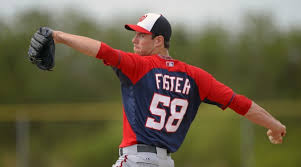
  • MLB Rotation: Strasburg, Gonzalez (L), Zimmermann, Fister, Detwiler (L)
  • MLB Bullpen: Soriano, Storen, Clippard, Stammen, Blevens (L), Ohlendorf, Roark
    MLB out of Org: Haren, Duke (L), Abad (L), Krol (L), HRodriguez

Discussion: the 5th starter competition could shake out so many different ways, that it almost is not worth predicting.  I can see any of the following scenarios playing out:

  • Detwiler gets one last shot at the 5th starter as the incumbent, pushing Jordan to AAA and Ohlendorf/Roark to the bullpen (my current prediction).
  • Jordan wins the 5th starter, pushing Detwiler to the bullpen as a power lefty by virtue of his lack of options.  This would push (likely) Roark to AAA.
  • Roark wins the 5th starter, continuing his blistering sub 2.00 ERA pace from September, pushing Detwiler to the bullpen and Jordan to AAA.
  • Less likely, Karns wins the 5th spot, which pushes Detwiler to the bullpen and Roark & Jordan to AAA.
  • Even more less likely, Ohlendorf wins the spot, which pushes Detwiler to the bullpen but lets Roark stay as the long man/spot-starter.
  • Mike Rizzo shocks us again with another starter acquisition; Detwiler goes to the bullpen, Ohlendorf stays as long man, and Roark & Jordan are in AAA.

Why am I predicting Detwiler will win the rotation spot?  Partly because of options, but partly because I’ve sort of come back around on him after looking more closely at his 2013 season.  He had a decent to good 2012; he posted a 118 ERA+ and even if his advanced FIP/SIERA didn’t indicate he was quite that good, he was still more than a servicable 5th starter.  Then in his first seven 2013 starts he was also very good (he had a 2.53 ERA in his first 7 starts and 42 2/3 innings … he got hurt in his 8th start).  The rest of his season was a mess, with him fighting injury and ballooning his seasonal ERA from 2.53 to more than 4.00 in five more starts.   If he comes back healthy to start 2014, why wouldn’t we expect more of the same performance that he had at the start of 2013?  For these two reasons, I think Detwiler breaks camp as the 5th starter.  Now …. I have zero confidence that he’ll remain healthy enough to keep his spot in the rotation, but that’s a problem for another day.  And a problem for which this team has plenty of coverage.

Another scenario that could affect this predition: Rizzo acquires yet another lefty reliever (latest rumors were about Scott Downs before he signed elsewhere, but I’m sure a trade could be arranged), which complicates any of these predictions because it means one less spot for either Ohlendorf or Roark.  For a team that seems so obsessed with left-handed relievers, we sure have let a bunch of them go in recent years (Duke, Abad, Krol this year, Gorzelanny, Lannan, Burnett and Gonzalez last year).  Maybe we should just hang on to one or two of these guys?  I will say this: I do NOT believe that the Nats will choose Xavier Cedeno and his 6 2013 MLB innings for the Nats over Roark just because he’s left handed at this point.

Personally, I think Roark and Ohlendorf pitched like big leagers last year and deserve to stay in the majors until they prove otherwise.  Ohlendorf’s recent $1.25M deal seems to indicate he’s more likely to stick than Roark, but perhaps the long-man/spot starter competition is open as well.  This pushes previous stalwards in the bullpen (specifically Ryan Mattheus ) to AAA.   I will say this though: if you expect to win, you have to go north with your 25 best guys no matter how much they make or their option status.  And at the end of last year, that undoubtedly included Tanner Roark.  So thats why I’m going with Roark in the pen to start the season.

One other wrinkle; does Rizzo trade one of Storen or Clippard to Chicago, who desperately needs a closer?  This seems less likely, especially for a team that has World Series aspirations, but the truth is this team is paying a LOT of money into its bullpen ($25M and counting), has three closer-quality guys, and potentially a log jam of righties (see the AAA bullpen prediction for more).  I see this as less likely unless Chicago sends back pieces that we really need, but rumors get started because GMs are talking, so maybe this still happens.  But if a guy like that is traded, then that re-opens a slot for the deposed Mattheus or possibly the newly healthy an electric Garcia.   I think these are lesser possibilities and both those guys are pushed to AAA to begin the season.

I’m sure this section garners plenty of discussion; have at it in the comments 🙂

AAA Level

  • AAA Rotation: Jordan, Karns, Rosenbaum (L), Young, MLFA or two?
  • AAA Bullpen: Barrett, Mattheus, Garcia, Davis,  Cedeno (L), Robertson (L), Herron (AA?), Alfaro, Stange, Delcarmen
  • AAA Release candidates: Meyers, Lehman
  • AAA out of Org: Maya, Tatusko, Clay, Mandel, Torra, Broadway, Crotta, Lowe, Kimball, Accardo, Bramhall, Romero (L)

Discussion

So, the projected AAA rotation has one hold over in Rosenbaum, two “promotions” in Jordan and Karns, and then a whole bunch of question marks.  Is Chris Young healthy enough to pitch this year?  Is Brad Meyers?  Right now i’ve got Meyers as a release candidate, figuring that he hasn’t been healthy in two years and may be finished.  I have to think that the team will give a couple of lower-level free agents minor league contracts to try to pitch their way back into the league, much as they have done with the likes of Zach Duke, Ross Ohlendorf and Young in the last couple of off-seasons.  There’s plenty of guys out there who may make sense; a quick glance at the current list of free agents offers intriguing names (think of someone like a Joe Saunders or a Barry Zito or an Aaron Harang; do you think these guys are getting guaranteed contracts for 2014?).  I’m predicting that at least one or two of these types of guys get MLFA deals and end up in the AAA rotation, though I suppose at least one guy i’m projecting from the AA rotation could start in AAA.

The AAA bullpen has a couple of MLB-quality arms in Ryan Mattheus and Christian Garcia who we know can contribute at the MLB level but who end up here because of a numbers game at the big club.  The AAA closer likely is Aaron Barrett, newly added to the 40-man and looking to make his mark.  Erik Davis is here, who I kind of soured on last season but his numbers in small MLB samples were good and I think he can contribute in a Craig Stammen sort of way going forward.  We have a couple of hold-over loogies in Xavier Cedeno and Tyler Robertson, the latter of which successfully passed through waivers and was outrighted to Syracuse last month.   We already have three off-season MLFA signings (Gabriel Alfaro, Daniel Stange, Manny Delcarmen) who all project as righty middle relievers, making it seemingly less likely that the team will retain some of its own MLFAs (the likes of Ryan Tatusko and Jeff Mandel being longer serving Nats minor leaguers who pitched decently in 2013).

But as you can see there’s more candidates here than there is room on the Syracuse roster (10 for 7 spots, and that’s assuming that Pat Lehman doesn’t make the cut either).  There will be injuries and D/L stints among these guys, but there may also be some releases next March.

Still, a AAA rotation led by Jordan and Karns (and possibly Ohlendorf and/or Roark if another move is made at the MLB level) leaves Syracuse with a pretty good staff to start the season.  And I like the fact that we have one reasonably accomplished MLB starter (Jordan) waiting in the wings to go along with a guy who might get there soon (Karns), to go with potentially a couple other former major league guys who are working their way back.

AA Level

  • AA Rotation: Cole, Hill, Solis (L), Schwartz, Treinen (AAA?)
  • AA Bullpen: Benincasa, Mirowski, Holland,  Swynenberg, Grace (L), Bates, KPerez, Gilliam (swingman), Spann (L)
  • AA release candidates: Perry, Selik, Demny, RMartin
  • AA out of Org: Broderick, Ray, McCoy, Frias, Holder, Bray

Discussion

We’ll see this trend again and again; despite the fact that the likes of A.J. Cole and Taylor Hill reached AA last year, the organization seems to like seeing these guys “beat the level” a second season in a row before moving guys up.  And so I see these guys in AA again.  Sammy Solis here is no surprise; he’s nearly 26 and has been mentioned as a MLB bullpen candidate already.  Meanwhile for the time being i’ve got Blake Treinen here, repeating the level, but can also see him moving up to AAA.  His numbers were good but not *that* good last year, and I left him in AA assuming that the team will try out some re-treads in the AAA rotation.  Lastly Blake Schwartz gets a deserved promotion after leading Potomac in IP, wins and starts last year.

In the bullpen I think Robert Benincasa is your closer to start, with Richie Mirowski and Neil Holland continuing to put up dominating late-innings relief.  All three guys should be pushing for promotions to AAA.  We’re a little light on lefties here admittedly.  A couple of injury-prone guys in Ryan Perry and Cameron Selik are listed as release candidates in the face of a number of guys meriting placement here.  Paul Demny and Rafael Martin have been around forever and may also be release candidates at this point, but they also could (at least in Demny’s case) convert to relief and try to rekindle their careers.  Lastly, there’s newly acquired Matthew Spann, the bounty for the Nats gambit on David Dejesus near the end of last season.   He’s a lefty who looks like he could start but i’ve got him in the bullpen for now.

High-A Level

  • High-A rotation: Purke (L), Anderson, Mooneyham (L), Encarnacion, Bacus, Turnbull (bullpen?) (L)
  • High-A bullpen: Wort (AA?), Holt (AA?), Fischer, Henke, Mendez, Harper (L), Davis, Thomas (L), RPena (swingman), Dickson (swingman)
  • High-A release candidates: Dupra, Rauh (starter?), Meza (L)
  • High-A out of org: Pineyro, Hawkins

Discussion

I don’t think there’s too many surprises in this rotation: Matthew Purke leads the line and should push for a promotion mid-season.  If he doesn’t dominate High-A at this point it may be time to think about moving him to the pen.   The same can be said about Brett Mooneyham and especially Kylin Turnbull, two guys who (by now) should have accomplished this level.   Otherwise the rest of this projected rotation are three guys who succeeded in Low-A in 2013: Dixon AndersonPedro Encarnacion and Dakoda Bacus.

In the bullpen, at this point i’m not sure who the closer candidates are to start the season.  Perhaps Greg Holt starts in the role.  Perhaps low-A phenom Gilberto Mendez gets a shot at closing.  Both Holt and Rob Wort may belong in AA at this point; Wort began 2013 there but there’s a lot of relievers in that AA section who would have to get hurt/be released to make room for these two guys right now.  There’s a couple of decent swingmen candidates here in Ronald Pena and Ian Dickson both started for long stretches in Hagerstown and could be useful guys in Potomac.    There’s a lot of names in the mix here for this bullpen; from here on down there could be plenty of releases come the end of spring.


Low-A Level

  • Low-A rotation: Giolito, Johansen, Voth, Lee (high-A?) (L), Orlan (L)
  • Low-A bullpen: Self (high-A?), Selsor (swingman), Ullmann, Pivetta, Simms, Hollins, Napoli (L), Bafidis (L), Suero (swingman), Valdez, Walsh (L), Aries
  • Low-A release candidates: Joyce, Waterman, Boyden
  • Low-A out of org: McKenzie, Smith

Discussion

I like this rotation, a lot.  Two of our best prospects, a third guy in Austin Voth who impressed last year, a guy in Nick Lee who probably deserves a high-A rotation spot and then Auburn’s staff leader in Robert Orlan.  Jake Johansen may find himself needing a promotion quickly, if he’s all that he’s cracked up to be.

The bullpen is going to be tough; basically every college aged short-season guy who pitched well in 2013 is named in this bullpen competition.  There’s a couple of interesting DSL graduates in Wander Suero and Phillips Valdez, some big arms in Ryan Ullmann and Nick Pivetta, and some polished college-aged lefties in David Napoli, Cory Bafidis and Jake Walsh.   I have 15 names here for 7-8 spots; Viera’s extended spring training could be busy this year.


Short-A Level

  • Short-A rotation: Barrientos, JRodriguez, Silvestre (high-A?) (L), and then 2013 draftees and/or drop-downs from Low-A
  • Short-A bullpen: DWilliams, Cooper, KRodriguez, Derosier, Webb (L), Spezial (L), 2013 draftees and drop-downs from Low-A
  • Short-A release candidates: Sylvestri, Grisz
  • Short-A out of org: Hudgins, Simko, Dicharry

GCL Level

  • Rookie Rotation: Ott (L), 2013 draftees and DSL graduates
  • Rookie bullpen: RLopez, 2013 draftees and DSL graduates
  • Rookie release candidates: DRamos, MRodriguez

Discussion

Its frankly impossible to predict the short-season squads, since (especially Auburn) they exist to park newly signed draftees.  However, I do see a ton of guys who competed and succeeded in the GCL this year who won’t necessarily make the Hagerstown squad, and I see them forming a good chunk of the Auburn squad.   The rest of the Auburn squad will be populated with upper-end 2014 draftees and losers from the Hagerstown pitching staff competition.  More of the same with the 2014 GCL squad, which was heavily tilted with DSL graduates this year.  The Nats tend to focus on college arms and thus only small college guys are generally put in the GCL in their draft year.

Ladson’s inbox 12/19/13

9 comments

Harper behind the plate?  Photo GQ magazine Mar 2012

Harper behind the plate? Photo GQ magazine Mar 2012

Well, it isn’t like I didn’t have enough content to publish this week (with 7 seasonal reviews coming out, each of them between 1500 and 3000 words).  But Nats mlb.com beat reporter Bill Ladson had to come out with an inbox on 12/19/13, so lets do some rare weekend posting so we can talk about the system-wide pitching staff projections on monday.

As always, these are real questions from (presumably) real people.  I write my response here before reading his to avoid bias, and edit questions for clarity.  Here we go:

Q: Are the Nationals done as far as improving the team for next year?

A: I don’t think so: I still see a veteran catcher, a better backup infielder, and another lefty in the pen as possible acqusitions.  On my little “off-season Nats todo-list” the only one of these that I think *must* happen is the backup catcher.  Per mlbtraderumors.com 2014 FA Tracker I see some names still out there that could work: John Buck i’ve heard in rumors somewhere, and someone like Kelly Stoppach could work.  Honestly I havn’t done a ton of research on veteran backup catchers, so these may be awful suggestions.

Right now whose your backup infielders?  Are you ready to go to war with either Zach Walters or Danny Espinosa in that role?  Steve Lombardozzi got 300+ plate appearances in 2013, more the year before.  Jerry Hairston got 238 PAs in 2011 while Alex Cora ot 172.  Basically the point is this: your backup infielder is going to get a LOT of at-bats.  You need to have someone reliable.  I would not entirely call either Walters (lack of experience) or Espinosa (apparent lack of capability) proven right now.

I don’t see the need to go all out for another lefty reliever, but i’m also not Mike Rizzo.  We have some options internally that we could use.

Ladson mentions middle infield and a backup catcher as well, and then surprises me with his mention of Shin-Soo Choo, a personal favorite of mine who I’d love to see here hitting lead-off and playing LF in the short-term.  But not in center, where he proved he was awful last year, and not for 7 years and 9-figures like he seems to be set to get.  I’d be absolutely shocked if the Nats committed those kind of dollars for Choo, given his age and likely fall-off.

Q: With MLB looking to ban home-plate collisions, could you see the Nats giving Bryce Harper a chance behind the plate if Wilson Ramos can’t stay healthy? 

A: No way.  It isn’t just about collisions; its the wear and tear, its taking a guy’s bat out of the lineup once or twice a week.  Harper was never going to be a full time catcher, not with his once-in-a-generation premium bat.  Ladson agrees.

Q: Do you think pitchers Nathan Karns, Lucas Giolito and A.J. Cole will be used in spot starts this season?

A: Karns yes, Cole doubtful and Giolito no way.   It all comes down to 40-man roster manipulations.  Right now Karns is on the roster so he can get called up and down every week and it has no effect on anything but his service time accumulation (which teams have shown lately that they’re less and less concerned about).  Cole, if he dominates in AA could see a similar call-up to what Taylor Jordan and Karns got last year … except that the team has significantly more starter depth this year.  Maybe Cole can be a 9/1/13 call-up; he is rule-5 eligible after the 2014 season and will have to be added to the 40-man roster anyway.  As for Giolito, there’s just no way he’s sniffing the majors until he’s ready.  Right now he’s the prize asset in the farm system and he needs to develop so that he can arrive in the majors right as the team needs to make some key decisions on personnel.   Ladson agrees.

Q: Could you please explain to me why Zach Walters is only No. 11 on the list of the Nats’ top prospects? The numbers he put up last season are pretty amazing.

A: Mostly people seem to be concerned about his OBP, which has dropped at every level and was only .286 in Syracuse last  year.  He has always struck out a ton; 134 in 134 games last year, more or less averaging a K/game for his ML career.  That being said … you don’t find guys who can hit 29 homers and play Shortstop on trees.  And last I checked, you trade off some OBP and some excessive K’s for guys who can hit a ton of bombs.  Maybe scouts are just in denial.  Lots of people think the team should flip him now based on his 2013 season, but if he can do anything close to those numbers in the majors he’s doubly-valuable.  Ladson thinks he’ll be ranked much higher in the 2014 rankings.

Q: Who do you think will win the fifth spot in the Nationals’ rotation?

A: That’s the question of the off-season.  We’ve argued about it over and again here, and will again next week when I post system-wide predictions.  We’ll save the arguments for then.  Ladson says Tanner Roark, which surprises me frankly.  Lets save arguments on this for my big prediction piece next week.

Q: Do you think Espinosa will be a valuable backup for the Nats?

A: Boy I hope so.  But something holds me back; what has changed from the point he was demoted til now?  He hasn’t gotten his shoulder fixed.  He hasn’t stopped switch hitting.  All he did was go to Syracuse and continue to hit poorly.  Why at this point would we think he’s going to do anything better than what he’s already shown us he can do?  Ladson expresses some doubts too.


GCL/Rookie Pitching Staff Year in Review; 2013

7 comments

Giolito was the story of the GCL for the 2nd straight year.  Photo unk via federalbaseball.com

Giolito was the story of the GCL for the 2nd straight year. Photo unk via federalbaseball.com

This is the 7th and final in the 2013 Pitching staff review series.  I don’t like double posting stuff this comprehensive but I wanted to get this out before the w/e.  This is the review of the GCL/Rookie league’s pitching staff for 2013.  Other parts of the 2013 series:

For some historical perspective, here’s 2012’s version (Lucas Giolito was the feature pitcher) and 2011’s version (Jack McGeary the feature pitcher) of this post specifically for Auburn/Short-A.  Yes, Giolito was the GCL “man of the year” for the second year in a row.  This may be unfair to many of the DSL grads who pitched great for the GCL this year, especially the likes of Jefry Rodriguez and Wander Suero.  Also; good luck finding a picture of Jefry Rodriguez to use for your blog; any google search with “Rodriguez” and “baseball” is so over-inundated with pictures of more famous Rodriguez’ (Alex, Ivan, even Henry) that I gave up looking.

All stats are courtesy of either milb.com’s GCL’s 2013 Stats page or via Fangraph’s GCL 2013 page.  Also useful here are the Big Board and the Nats Draft Tracker since so many of these lower-minors guys are recent draftees.

A caveat before starting this post: this is short-season ball, so nobody’s got more than a few dozen innings.  The staff leader had 49 innings.  So yes this is absolutely going to be some “Small Sample Size” analysis.  Which in some cases is unfair to the player (to the good or to the bad).  It is what it is.

GCL starters.  The rotation started the season with Suero, Jefry Rodriguez, Silvestre, Voth and Valdez.  It ended with JRodriguez, Silvestre, Suero, Ott and a slew of 5th/6th starters here and there.   Lets take a look at the starters:

  • Wander Suero dominated the GCL this year, throwing lots of 4-5 innings outings in relief of other “starters” and leading the team in IP.  Final numbers: 8-1 with a 1.65 ERA.  His first season in the USA after 3 DSL seasons was a huge success and his age (22) should help him move upwards.  Outlook for next season: Low-A bullpen/spot-starter.
  • Jefry Rodriguez was the opening day starter and made 12 starts all told for the GCL, going 3-0 with a 2.45 ERA anda a 43/20 K/BB ratio in 48 innings.  The 19-yr old DSL graduate looked great all year, even if he averaged only about 4 innings an outing.   He improved his K/BB rate marketdly from his 2012 DSL season and should keep on moving upwards.  Outlook for next season: XST and then Short-A rotation (I don’t think he can crack the low-A rotation).
  • Hector Silvestre was the staff ace, going 7-0 with a 1.82 ERA in 13 games (8 starts) over a team leading 49 1/3 innings.  He was absolutely dominant all August, throwing 26 scoreless innings to finish out the year (including the playoffs).  The 20-year old lefty has a ton of potential.   Outlook for next season: XST and then Short-A rotation.
  • Austin Voth had two quick outings in the GCL before moving on up to Auburn.  See the short-A writeup for more. Outlook for next season: Low-A rotation.
  • Philips Valdez had a few starts but worked mostly out of the pen en route to a dominant 1.95 ERA and 0.87 whip in 32 IP.  He’s another older DSL signee who, like Suero, could make an impact a couple levels above GCL next year.  Outlook for next season: Low-A bullpen competition, perhaps falling back to Short-A.
  • Nick Pivetta started 3 games in Viera but averaged less than 4 innings a start before getting bounced up to Auburn.   See the short-A writeup for more.   Outlook for next season: Low-A bullpen.
  • Deion Williams failed in Auburn and got just 13 innings in the GCL this year.  He’s young (just turned 21) so he has a bit of time to sort things out.  Outlook for next season: XST and another shot at Short-A in the bullpen.
  • Lucas Giolito went 2-1, 1.94 ERA with 39/14 k/bb in 36 2/3 innings, 28 hits mostly in the GCL.  All Nats prospect fans should know of Giolito’s status these days; he has come back from surgery, pitched effectively in the rookie league and was lights out in 3 starts in short-A (one run conceded in 14 innings).  Per comments and scouting reports his velocity is back, he seems healthy, and he could be just a season away from being breathlessly talked about as one of the best prospects in the game.  Outlook for next season: Low-A rotation.
  • Travis Ott went 3-0, 4.03 ERA with 32/12 K/BB in 29 innings in the GCL, 24 hits.  The rare mid-20s round high schooler who signs, Ott was used as a starter in the GCL and was mostly good all year.  His seasonal numbers were skewed by one bad outing where he gave up 6 earned runs in 1 2/3 innings in mid-July.  This tall, lanky left-hander (6’4″ 170lbs) seemingly has room to grow and is very young; he turned 18 at the end of June.  Looks like the Nats might have a find here.   Outlook for next season: XST  and repeating GCL; he’s only 18 and could use the seasoning.
  • A slew of relievers got one start here and there; its kind of hard to assign GCL guys to “the rotation” when they get a start and only pitch 3 innings.  Instead, they’re discussed in the reliever section.
  • Rehabbing Starters from other levels: Brad Meyers got two re-hab starts for GCL this year, Chris Young, Ryan Mattheus, Cole Kimball, and Sammy Solis got one each.

GCL Relievers: this section is done mostly by IP, though we’ll start with the clear “closer” for the GCL Nats.

  • Jake Walsh got 8 saves in 16 games, posting a 1.40 ERA with 17/5 K/BB in 19 1/3 innings closing in the Rookie League.  He was promoted to Hagerstown on 9/3/13 to provide lefty bullpen coverage in the playoffs.    He was probably too old and too experienced for the rookie league but showed enough promise to get a two-level call-up for the post-season.  Outlook for next season: low-A bullpen loogy competition.
  • Kelvin Rodriguez was a middle reliever for the GCL nats, throwing 29 innings across 13 outings and posting a 3.07 ERA.  He wasn’t quite as dominant as some of his DSL graduates, and I suspect it will keep him (despite his age) in XST to start 2014.   Outlook for next season: XST and then Short-A bullpen.
  • Matt Derosier was 2-1, 2.43 ERA with 20/5 K/BB in 19 relief innings mostly in the GCL, 24 hits.   Derosier may have been a Juco guy but he’s young; he turned 19 in July of this year.  After a brief stint to start the season in Auburn he pitched in middle relief for the GCL Nats, getting at least 4 long enough stints to earn a “grade” in my monthly starter grades.   He posted good, solid numbers, nothing flashy, nothing bad.  A 4/1 K/BB ratio is great.  He’ll move up next year, looking to stick as a younger member of the bullpen in short-A.  Outlook for next season: short-A bullpen.
  • David Ramos posted an ugly 6.35 ERA in 22 middle relief innings for the GCL Nats.  His first state-side season could be his last, given his age (22).  Outlook for next season: XST and repeating the GCL bullpen, release candidate.
  • Joey Webb went 2-0, 1.89 ERA with 25/6 K/BB in 19 innings in the GCL, 13 hits.   Webb comes from a very small baseball school (NAIA’s Menlo College in California) and may not have been ready to compete with a bunch of Division I guys in Short-A, despite already being 23.   Outlook for next season: short-A bullpen.
  • Elliott Waterman bounced down and then back out of the GCL this year.  See the short-A write-up for more.  Outlook for next season: Low-A bullpen loogy competition, release candidate.
  • Niko Spezial went 1-0, 3.32 ERA with 21/8 K/BB in 19 relief innings mostly in the GCL, 16 hits.  Spezial started the season with Auburn but got the quick demotion after just 3 1/3 relatively non-descript innings.  A college senior draftee, he did not belong in the rookie league.  Nonetheless he pitched effectively for the record-setting GCL Nats.  Spezial needs to show how he fares against someone his own age, which hopefully he’ll get a chance to do in 2014.   Outlook for next season: short-A bullpen, release candidate.
  • Michael Boyden posted a 4.61 ERA with 15/14 K/BB in 13 2/3 innings, 17 hits for GCL.  14 walks and 17 hits equates with a balloned 2.27 whip for this 23-year old in the rookie league (which means he’s likely throwing against guys 4-5 years younger than he is).  It is hard to understand why he was back in the GCL after having shown he could handle Short-A in 2012.  Either way, his control issues from last year caught up with him in 2013 and I don’t think he’ll be long for the organization.   Outlook for next season: Low-A bullpen loogy competition, release candidate.
  • Ryan Ullmann started in the rookie league, being a senior coming from an NAIA school, but by season’s end he was in the Auburn rotation.  See the short-A write-up for more.    Outlook for next season: Low-A bullpen.
  • Cory Bafidis briefly worked in the GCL bullpen.  See the short-A write-up for more  Outlook for next season: Low-A bullpen.
  • Justin Thomas threw 3  innings in Viera during his tour of the Nats farm system in 2013.  See low-A post for more.  Outlook for next season: High-A bullpen competition.
  • Other Relievers who got 10 IP or less:
    • Rehabbing relievers from other levels: Pat Lehman, Rafael Martin, Cameron Selik, Brian Broderick, each of whom got a handful of innings.
    • Mike Sylvestri was dominant in his 9 innings of GCL work after getting demoted from Auburn.  See Short-A write-up for more.
    • Luis Reyes was called up from the DSL to make an appearance in late August; he gave up 3 runs on 4 hits in 4 innings and was sent back to the D.R.
    • Andrew Cooper threw 2 innings in Viera then bounced up to Auburn.  See Short-A write-up for more.
    • John Simms threw 2 innings in Viera then bounced up to Auburn.  See Short-A write-up for more.
    • Lastly, infielder Kyle Attl threw 1/3 of an inning somewhere along the line, giving up a homer before getting an out for an ERA of 27 and a FIP of 42.20 on the season.

Summary

The GCL Nat’s record breaking season was borne on the backs of a slew of arms rising to the GCL from the DSL, and despite some of them being slightly “old” for the level they helped the team achieve greatness in 2013.  This also marks a great collection of DSL graduates that should start matriculating upwards, moreso than we’ve had to follow in quite a while.

(Editor’s Note: I corrected Jefry Rodriguez’ name after the fact; thanks to commenter Melissa).

Auburn/Short-A Pitching Staff Year in Review; 2013

9 comments

Jake Johansen was the star of Auburn's pitching staff this year.  Photo via DBU website

Jake Johansen was the star of Auburn’s pitching staff this year. Photo via DBU website

This is the 6th in the 2013 Pitching staff review series, here’s a review of Auburn/Short-A’s pitching staff for 2013.  I’m posting Auburn and GCL today to finish off the series this week.  Other parts of the 2013 series:

For some historical perspective, here’s 2012’s version (Brett Mooneyham was the feature pitcher) and 2011’s version (Nathan Karns the feature pitcher) of this post specifically for Auburn/Short-A.

All stats are courtesy of either milb.com’s Auburn’s 2013 Stats page or via Fangraph’s Auburn 2013 page.  Also useful here are the Big Board and the Nats Draft Tracker since so many of these lower-minors guys are recent draftees.

A caveat before starting this post (and we’ll say this same thing in the GCL post): this is short-season ball, so nobody’s got more than a few dozen innings.  The staff leader had 56 innings.  So yes this is absolutely going to be some “Small Sample Size” analysis.  Which in some cases is unfair to the player (to the good or to the bad).  It is what it is.

Auburn starters.  The rotation started the season with Turnbull, Johansen, Selsor, Orlan and DWilliams.   Those 5 opening day rotation members were acquired by the team as follows: 2011 Draft, 2013 draft, 2012 draft, 2012 draft and 2011 draft.  I mention this because a common thought process is that Short-A spots are “saved” for college draftess in the current year, but this year only one current-year draftee started in the Short-A rotation (and it was our #1 pick).  The Auburn rotation ended with Barrientos, Giolito, Selsor (sort of), Orlan, Simms and Ullmann.  As with the rest of the system, Auburn graduated a ton of hurlers throughout the season.  Lets take a look at the starters:

  • Kylin Turnbull faced two demotions to end up as Auburn’s opening day starter, not a great start to his 2nd pro season.  He posted a 1.96 ERA in his first four Short-A starts and returned to Hagerstown.  See Low-A write-up for more.   Outlook for next season: High-A’s rotation competition but likely slipping to bullpen.
  • Jake Johansen was the Nats first 2013 pick, a big tall righty from a small Texas school with a 99 mph fastball.  He did not disappoint in pro ball, posting a 1.92 ERA with 51/23 K/BB in 51 2/3 innings between Auburn and Hagerstown.  After signing quickly for slot (very quickly, like in 24 hours or so), Johansen joined short-A Auburn and was essentially unhittable through 10 starts.  He was promoted up to low-A, got hit around in two starts and finishes the season with a 1.92 ERA, and a sub 1.00 WHIP.  Johansen is walking too many batters, but still flashes a dominant fastball.  Scouts continue to believe he’ll end up in the bullpen (a lazy narrative assigned by default to any player over 6’5″ with a significant fastball .. with the constant “big guys cannot repeat their mechanics” excuse.  Nobody talks about how LeBron James can’t “repeat his mechanics” as he dominates the NBA and he’s 6’8″ playing the point … just a slight tangent on my irritation with broad-stroke scouting narratives), but until that situation presents itself Johansen will stay as a starter.  Outlook for next season: Low-A’s rotation, looking for a push to Potomac mid-season.
  • Casey Selsor was 0-6, 4.29 ERA with 30/14 in 42 1/3 innings, 56  hits for Auburn.  He started the season in Auburn’s rotation, got demoted to the bullpen after 6 starts, but eventually made his way back into the rotation in some sense by the time the season was over.  He gave up a ton of baserunners, but his BABIP was high.  Despite a 4.29 ERA his FIP for the year was just 3.15.  So he pitched better than his stats look.   Outlook for next season: Low-A bullpen as a swingman.
  • Robert Orlan was 1-5, 3.65 ERA with 47/22 K/BB in 56 2/3 innings, 54 hits for Auburn.  Orlan was the leading innings-eater for Auburn in 2013 after missing the whole 2012 season following TJ surgery.   Orlan kept the ball down, pitched better than his ERA shows (3.38 fip) and shows no reason not to continue up the chain and compete for rotation jobs in full season ball next year.   Outlook for next season: Low-A rotation.
  • Deion Williams has now fully transitioned to the mound after being a hitter in 2011.   But the jury is out as to whether he can stick; in 8 Auburn starts he got shelled, going 0-6 with a 9+ ERA and was dumped back to the rookie league.  He’s young (just turned 21) so he has a bit of time to sort things out.  Outlook for next season: XST and another shot at Short-A in the bullpen.
  • Joel Barrientos tried to make the jump from rookie ball to short-season and got hammered: in 11 appearances (8 starts) he was 1-5 with a 7.08 ERA, getting demoted to the bullpen later in the season.  The DSL grad just turned 19, so patience is expected with his progression.  He did well enough in the GCL in 2012; he needs to make the leap to the next level. Outlook for next season: XST and another shot at Short-A rotation.
  • Austin Voth was clearly started too low for his draft pedigree (Pac-12 College Junior) and it showed, as he went 3-0, 1.75 ERA with 55/6 K/BB in46 1/3 innings between three levels.  He pushed his way through two promotions on the season, ending up in the Hagerstown rotation.  Two key stats on Voth to keep in mind: he had more than a 9/1 K/BB ratio on the season and he gave up zero home-runs in his 55 innings on the year.  And these stats were done with pretty normal looking BABIPs; his FIP values were lower than his ERAs in short- and low-A.  I like this guy and I think he could be a find.  He finished 2nd in the Pac-12 to Mark Appel in strikeouts last year after all.  Outlook for next season: Low-A rotation and also looking for a mid-season bump to Potomac.
  • Ryan Ullmann began the season in the rookie league, being a senior coming from a Division III school, but by season’s end he was in the Auburn rotation.  He got 6 starts in Auburn with some up and down results (3 decent, one ok, two bad) that resulted in a 5.30 ERA all told.   You can’t teach size (he’s 6’6″, 230).  Ullmann closed in college and may return to the pen, despite his K/9 not being strong.  Outlook for next season: Low-A bullpen, maybe Short-A again.
  • Nick Pivetta sported a 1-1, 3.41 ERA with 18/12 K/BB in 29 innings between GCL and Short-A.  Pivetta started 5 games for Auburn but averaged less than 4 innings a start.   For such a big guy (6’5″ 220) with such a reported fastball (upper 90s in short spurts) I would have hoped for more K’s (18 in 29 innings).   Outlook for next season: Low-A bullpen, possibly as a closer so he can maintain higher velocity in shorter outings.
  • Lucas Giolito, as any Nats fan knows, returned from TJ surgery and pitched in both the GCL and for Auburn.  In three Short-A starts he gave up just 9 hits and one run.  See GCL’s post for more.  Outlook for next season: Low-A rotation.
  • Other’s who got 1-2 starts here or there:
    • Blake Treinen got two rehab starts.  See the AA-post for more.
    • John Simms got two spot starts at the end of the season; see the reliever section.
    • Chris Young got a rehab start; see the AAA post for more.
    • Reynaldo Lopez gave up 7 runs in an inning and a third, got demoted to the GCL and he didn’t throw another inning all year.  Odd.   Outlook for next season: GCL bullpen.

Auburn Relievers: We’ll go by the assumed closers then by IP.

  • Leonard Hollins had 6 saves and a 2.91 ERA with 36/16 in 46 1/3 innings, 48 hits mostly for Auburn.   The submariner made a successful jump to short-A out of the GCL, and still has not given up a professional home-run.  All we have to do now is figure out if he’s “Leonard” or if he’s “L.J.” since milb.com and Fangraphs differ in their names for him.  Outlook for next season: Low-A bullpen.
  • David Napoli went 1-0, 1.14 ERA with 28/10 K/BB in23 relief innings in Auburn, 16 hits.  He had a very wild reputation coming out of college, but seems to have toned it down at Auburn to become an excellent relief pitcher.   I’m a little disappointed to see him already get converted to relief, but his size and stuff seems to point towards situational lefty anyway.  I’m also very excited in particular to see Napoli succeed; he was a clear “draft punt” pick, a college senior taken between the 6th and 10th rounds and given a miniscule signing bonus so as to play by the new CBA drafting bonus cap rules.  Outlook for next season: Low-A bullpen, perhaps even higher if Potomac needs lefties.
  • Jake Joyce went 1-3, 5.22 ERA with 25/12 K/BB in 29 relief innings in Auburn, 37 hits.  Joyce was unlucky (.381 babip) and his FIP reflects that (3.03 versus 5.22 era), but he still gave up a ton of base-runners (1.67 whip) and a ton of air-outs (0.62 GO/AO on the year).   Like Napoli,  Joyce was a senior sign for very little money, but he didn’t perform nearly as well.  He could seem rather expendible if he doesn’t start strong in 2014.   Outlook for next season: Low-A bullpen competition, release candidate.
  • John Simms worked mostly as a long-man for Auburn, getting two starts at the end of the year.  All told, he went 0-4, 5.70 ERA with 34/7 K/BB.  His walks were low but hits were high.  His ERA looks ugly but look beyond the top layer and you discover that Simms actually didn’t pitch that badly this year.  A ridiculously high BABIP of .438 contributed to his inflated short-A ERA; his FIP was just 2.38.  Combine that with his 5/1 K/BB ratio and he has the makings of at least a good reliever in the system.   Outlook for next season: Low-A bullpen.
  • Andrew Cooper was 2-1, 3.86 ERA with 16/7 K/BB in 25 2/3 relief innings mostly in Auburn, 29 hits.  His Auburn-only numbers were worse.  Drafted as a project, and so far he’s pitched like a project.  His numbers aren’t bad or great in any direction.  I’d suspect the team knew he needed some complex time so I could see him staying in Viera until next season’s short-A starts up and repeating the level.  Outlook for next season: XST and then Short-A bullpen again.
  • Cory Bafidis went 2-0, 2.73 ERA with 22/13 K/BB in 26 1/3 relief innings mostly in Auburn, 18 hits.  He got pushed to low-A too early, settled into short-A where he probably belonged to begin with, and pitched relatively well for 20 innings.   Outlook for next season: Low-A bullpen loogy competition, perhaps falling back to Short-A again.
  • Will Hudgins started the year in Hagerstown’s bullpen, was demoted to Auburn, and abruptly retired in July.   Outlook for next season: out of baseball.
  • Other Relievers who got 10 or fewer innings:
    • Justin Thomas threw 3 1/3 innings in Auburn during his tour of the Nats farm system in 2013.  See low-A post for more.  Outlook for next season: High-A bullpen competition.
    • Mike Sylvestri started the season in Auburn, got shelled (12 runs in 8 2/3 innings) but then dominated the GCL.   He’s undersized (5’10″, 180) and could have trouble getting out of rookie ball (as evidenced by his short-A experience).  Outlook for next season: XST and then Short-A bullpen again, release candidate.
    • Ben Grisz threw 8 scoreless innings in his return to the organization after missing the 2nd half of 2011 with some unknown “off-field issue” and then the entire 2012 season with some sort of injury (discussed here in this 4-minute interview with awful audio).   He’s an NDFA turning 23 with just 28 pro innings in 3 years; clearly he needs to do something in 2014.  Outlook for next season: XST and then Short-A bullpen, release candidate.
    • Elliott Waterman got hammered in his early outings for Auburn this year before getting demoted to rookie ball.  He pitched better in the GCL, eventually earning a call-back to Auburn but has not appeared since 8/31/13.  He’s still relatively young (does not turn 23 until November) and he’s a big tall lefty, but he’s putting too many guys on base and not getting enough swing and miss stuff to stick as a situational arm.  He may get one more spring training but it wouldn’t surprise me to see him cut loose if he doesn’t make a full-season team in 2014.  Outlook for next season: Low-A bullpen loogy competition, release candidate.
    • Todd Simko threw a grand total of 6 innings for Auburn and was released.
    • Kevin Dicharry threw 4 1/3 innings and then was released 7/1/13.   Without any knowledge of how well he recovered from the arm issues he had in college, this seems like an incredibly quick release considering how well he pitched (even if he was overaged) last year in the GCL.
    • Niko Spezial started the season with Auburn but got the quick demotion after just 3 1/3 relatively non-descript innings.  See the GCL write-up for more.
    • Matt Derosier briefly started the season in Auburn he pitched in middle relief for the GCL Nats.  See the GCL write-up for more.
    • Christian Garcia threw one inning of re-hab work.  See the AAA write-up for more.l
    • Catchers Erick Fernandez and Andruth Ramirez each threw a bit of bullpen-saving mop-up work, as did OF Greg Zebrack.

Summary

In the end, Auburn featured three starters who will form the bulk of what could be a pretty special Hagerstown rotation next year.  Not surprisingly, the rest of the rotation and the bulk of the bullpen was comprised of mid-to-late round draft picks, college seniors and other long-shots, and as a result the team struggled on the year.  But from a player development perspective, we may have a few decent players coming out of Auburn this year.

Editor note; corrected Ullmann’s entry after publication per comments; had said NAIA school, corrected to identify Concordia as a Division III school