The next stop on the off-season transaction bus is the “Non Tender Deadline,” by where players under club control (whether it be pre-arbitration or arbitration-eligible) need to be offered contracts (tendered) by 11/21/25 or else they officially get cut-loose and become free agents. The players don’t have to SIGN said contracts, just be offered one.
Its the same and DFA’ing a guy, of which we’ve already done a ton of so far this off-season. In fact, technically every single pre-Arb player is a tender decision this week as well, though only the Arb-eligible guys are being analyzed here.
So, do we actually have any non-tender candidates on the roster at this point? Yeah we do.
Lets run through the arbitration-eligible players from high-to-low 2025 salary and make some guesses.
Resouces in use to write this:
- Cots for 2025 salaries
- MLBTraderumors for 2026 arbitration estimates.
- Also, since this is the first time we really start talking about Options w/r/t player roster flexibility, here’s Roster Resource and the list of players’ options.
- Here’s the Big Board for depth chart squinting
Like last year, we had 9 arb-eligible candidates to discuss heading into the off-season. The team DFA’d a couple of non-tender candidates early in Alfaro and Thompson, both of whom refused outright and are on the open market. Of the remaining seven, here’s some thoughts (they’re listed in order of 2025 salary):
- Luis Garcia: $4.5M in 2025, projected for $7M in 2026 and still has a 4th Arb year thanks to just hitting the Super-2 cutoff. RJ Anderson at CBSsports listed Garcia as one of the 10 biggest non-tender decisions any team faces, and for good reason. $7M for what he gives us seems like a lot. He’s barely league average in OPS+, had a .289 OBP last year, gives us really, really bad defense (-17 DRS in 2025 … as a 2nd baseman?!), and has had “challenges” on the base paths and showing hustle. He’s probably more suited to play 1B … but you don’t put a guy with a .701 OPS figure at 1B. Another wrinkle: Garcia has zero options remaining, which doesn’t really mean that much since he’s clearly entrenched in the lineup, but it does remove any 26-man roster flexibility. However, if you cut Garcia, who are you replacing him with? Tena? Nunez? We have three guys at AA who could have stepped up in 2025 (Made, King, Wallace) and made a play for 2B, but all three need more minor league time. So, for me, for the time being I think he gets tendered and 2026 turns into his make or break season, unless the FO is committed to buying a replacement.
- MacKenzie Gore: $2.89M in 2025, projected for $4.7M in 2026. I’m slightly surprised Gore’s projected arb salary is this low; ask yourself what he’d get on the open market, right now. He’s our most valuable trade chip, and I wouldn’t be surprised to see him part of a big GM-meeting bonanza trade. The 2025 all star is a lock to be tendered.
- Josiah Gray: $1.35M in 2025, projected for $1.35M again in 2026. Miss a year, pick right back up where you were. I guess Gray has no real recourse to demand more than $1.35M in salary after a year where he was paid that to basically recover from surgery. No real discussion here; obviously a 2nd or 3rd starter for $1.35M is a bargain, even if he ends up doing a 95 ERA+.
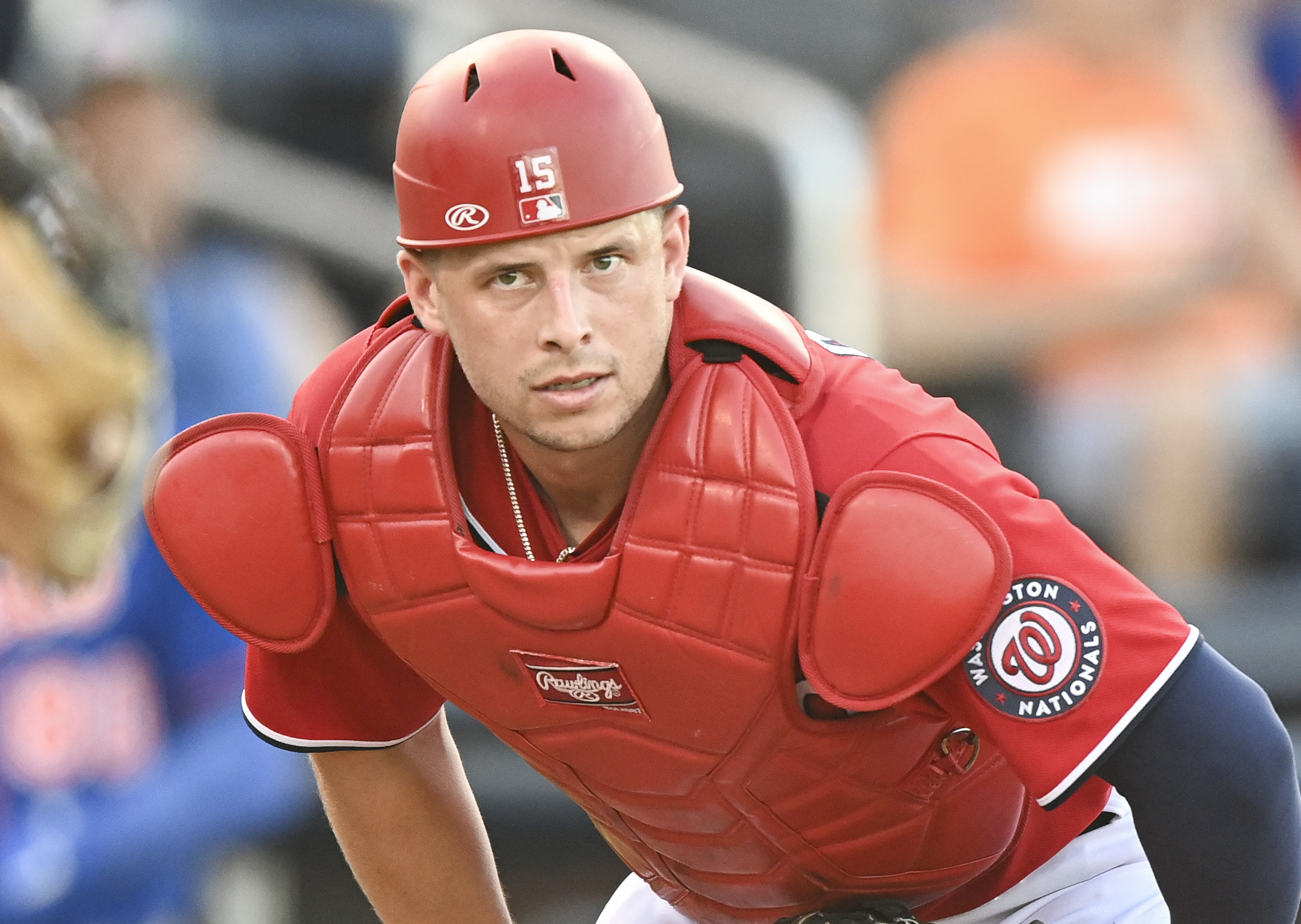
- Riley Adams: $850k in 2025, projected for $1.5M in 2026. There’s certainly a lot of animosity amongst some readers here towards Adams and his 59 OPS+ given that we have Millas, and have had Millas, waiting in AAA for years. Certainly Adams did himself no favors when he couldn’t step up and take the catcher job upon Ruiz’ concussion issues last year. Instead, Millas came up and slugged to a 127 OPS+ figure before breaking his index finger in mid August, ending his 2025 season. However, the truth is that we can’t depend on Ruiz right now, and it seems short-sighted to cut one of the only 3 catchers you have on the 40-man roster and the next closest legitimate catching prospect is a 2024 draftee in Lomavita, even if he was decent in AA. If you cut Adams, you’re basically guaranteed to be shopping for a backup Catcher on the FA market, and can you get something better than Adams there? I think you tender him for insurance, and if you find a better insurance policy who you can option to AAA as needed, you cut him at that point.
- CJ Abrams: $780k in 2025, projecting to $5.6M in 1st year of Arb. No surprise here; he basically had an identical year at the plate in 2025 as he had in 2024 when he was an All Star, only this year he didn’t manage to get himself sent home from school for misbehavior at season’s end. Like his double play partner Garcia, he’s awful defensively (-6 DRS, -11 total zone) with a slew of throwing errors, and it seems like it’s just a matter of time before he moves to 2B (though it may take a couple years, since all our best SS prospects are in Low-A). In the meantime, obviously you tender the guy.
- Cade Cavalli: $760k in 2025, projecting to $1.3M in 2026 first year of arb. Hard to believe, but he’s already arbitration eligible. This is what happens when you let a guy do all his injury rehab on the60-day DL. As for tendering, no argument here; he’s going to be in the rotation, he’s a 1st rounder, and he’s a huge part of the future.
- Jake Irvin. $774k in 2025, projecting to $3.3M in 2026. Ouch; $3.3M for one of the worst starters in the league? $3.3M projection seems high; how did Gore only get $2.89M in his first Arb year with far better 2024 numbers? I dunno; this seems like its a high projection. Nonetheless, some are calling this a clear non-tender. Ok sure, but what choice does the team have? Yes he had awful numbers, but he took the ball every 5 days and ate up the innings. His first two seasons in the Majors weren’t half bad: 92 ERA+ and in 2024 a 1.19 WHIP in 33 starts. One would think he could get back to that level of performance, which would be a bargain at $3.3M. Personally I think the team should eventually put him in the bullpen if he can’t get back to a 4th starter level, and would a $3M middle reliever be too much? Perhaps. But, if you non-tender the guy you’re telling me that one of these healthy current 40-man arms is taking his place: Lord, Williams, Lao, Eder. Not seeing it. Unless the new GM is planning on a big FA splash, but then the team still needs relievers. I’d tender him.
So, of the 7 guys:
- Locks to tender: Gore, Gray, Abrams, Cavalli
- No good reason not to tender right now: Garcia, Irvin
- In jeopardy of being Non-Tendered: Adams
Conclusions: Honestly, for the arguments made above, I’d tender all seven right now, and if you can find a replacement for Adams or Irvin, so be it. I can’t see cutting loose all three of Garcia, Irvin, and Adams.
Post non-tender deadline update: On 5pm on 11/21, the Nats announced they tendered all seven candidates. So, nobody cut loose yet.
Post Publishing updates: corrected Josiah Gray’s name per JohnC comment.;
Good write up. Quick note: Josiah’s last name is “Gray.”
With Adams the other problem is that he and Ruiz are out of minor league options. Millas still has one option remaining. So if you’re thinking that you need to hold onto all three, you’re backing yourself into a bit of a corner where the best catcher of the three (Millas, largely by default) is the one that likely goes to AAA.
I’m on the fence about Garcia. I’d be inclined to tender him because it keeps him in the fold while they pursue other options. But if they decide not to tender him a contract I wouldn’t be upset about it.
John C.
20 Nov 25 at 11:54 am
Grey/Gray: damn i do that all the time. Lemme correct.
Honestly, I can see the argument for non-tendering all three, and I can see the argument for tendering all three. I fully admit i “like” our home grown guys and would rather keep them than cut them, which sometimes clouds this analysis.
My simple thinking about Adams is this: if Ruiz is still concussed (he was out an awfully long time last year … and speaking from a bit of concussion experience once you’d had a couple, it’s really “easy” to get another one. I think we hold onto Adams through spring training, waiting to see if Ruiz still has issue, and if Ruiz is ready to go boom drop Adams at the end of March, put Millas up there, and figure out a backup plan at that point. It’s not a ton of money to buy that insurance policy.
Todd Boss
20 Nov 25 at 12:31 pm
Here’s something I don’t understand about the process. If someone gets non-tendered, they immediately become a free agent, right?
But if a player is DFA’d, and they pass through waivers, then they can be outrighted to AAA and kept in the system. (Unless they have 5+ years of service or have been outrighted before – but the former only applies to players in their last year of arb, and the latter is a relatively rare case.)
Take Adams. If the team is prepared to non-tender him, why not instead expose him to waivers a month ago or a week ago? Do players with 7+ years of service (minors and majors combined) automatically become MiFAs if not on the 40? That doesn’t seem to be how it works during the season, and there seems to be a specific date (11/6, this year) where all the potential MiFAs become so, and that’s two weeks before the non-tender deadline. So if 11/6 is “the date were any minor league player with enough service time becomes a MiFA”, then Adams could have been DFA’d on the 7th and then have already been outrighted to AAA well before tomorrow’s tender deadline.
There must be something that I’m missing, because this would apply to dozens of players every year.
SMS
20 Nov 25 at 12:31 pm
@SMS good questions, and I sense its case by case by player. There’s a couple more rules related to this time period: https://www.mlb.com/glossary/transactions/outright-waivers
– players with 5+ can reject outrights
– players with 3+ who have already been outrighted can also refuse outright
– apparently there’s a non-waiver period leading up to Rule-5 where there’s restrictions on these moves. I can’t find exact rules.
Lets take our three non-tender candidates:
– Adams: 0 options, 3.171 service time, never been dfa/outrighted, but 2017 draft year: So, he can’t be optioned w/o being DFA’d/waived, but he’s got more than enough combined service time that he’d automatically be a MLFA.
– Garcia: 0 options, 4.14 service time, never been DFA/outrighted, July 2016 IFA signing, so like Adams he’d immediately be MLFA
– Irvin: 2 options, 2.152 service time, never been DFA/outrighted, 2018 draft year. So once again he’d be MLFA.
Maybe its that simple; they basically have to be non-tendered b/c they’d immediately be MLFA by total service time.
Todd Boss
20 Nov 25 at 1:20 pm
@Todd – That makes sense if the rule is something like “any player with 7+ years of combined service time can elect to become a MLFA at any point from 5 days after the WS until 4 weeks before the start of ST”.
But if it’s “any player with 7+ years of combined service time can elect to become a MLFA 5 days after the WS” then Adams (and whoever) will have missed their chance and won’t be able to exercise that right for another year.
I’m pretty sure that, during the season, a player who can’t refuse an outright assignment, isn’t allowed to simply become a MLFA instead of going to AAA because they have enough combined service time. But, during the offseason, maybe it does work that way.
I don’t know. I’m sure the teams know their business, and that this is like the non-public versions of the minor league rosters that govern minor league R5 picks and we had to hash out last year when we lost Cronin. I just wish all the minutiae like this was publicly accessible.
Anyway, on the specific names – I’m fine with non-tendering Garcia too, but only if the reason is to make room for better players at 2B, 1B, and DH. Internally, if you’re optimistic, you can cover 2B with Nunez and DH with a Wood-led committee of outfielders getting partial days off but, even as unpromising as it sounds, there is no one currently in the system who would be a better plan A than Garcia at 1B. I’ll be pretty pissed if the plan is to cut Garcia, bring Bell back or whoever at $3M and have the Lerners pocket the difference. Garcia has the same or better failure rate and way more upside.
For the catchers, we talked about last week over on Harper’s blog, but my main fear is that they are stuck on the logic of “Millas has options. We need at least 3 catchers. And Millas isn’t an all star or anything, so let’s keep him in AAA and delay any irreversible decisions.” I hear you on the long tail effects of Ruiz’s concussions (and honestly, bringing him back quickly from the first one last year was maybe the most inexcusable decision that I’ve ever seen the Nats make. He was very clearly not right. I’m sure he was begging to play, but that doesn’t mean he’s fit to play. Ugh.), and Ruiz would get through waivers in any case, so tendering Adams doesn’t mean that’s how they’re thinking, but it will certainly increase my lever of concern if he’s tendered.
SMS
20 Nov 25 at 2:42 pm
MLB pipeline senses Garcia is going to get non-tendered as well:
https://www.mlb.com/news/non-tender-candidates-2025-2026-mlb-free-agents?p=0&partnerId=it-20251121-15782042-mlb-1-B&utm_id=it-20251121-15782042-mlb-1-B&lctg=20739465
Todd Boss
21 Nov 25 at 12:19 pm
If the Nats non-tender Garcia will be interested to see the level of interest/bidding on him by the rest of MLB. He was a 2.2 WAR player, had a 114 OPS+ and was below average, but not dreadful, as a 2nd baseman in 2024. Garcia also doesn’t strikeout (or walk) a lot. Then again, at 25, he is essentially a positionless player, and his bat isn’t good enough to play 1B or DH regularly.
Pilchard
21 Nov 25 at 3:00 pm
they will all be back. I think that’s good on a few levels.
FredMD
21 Nov 25 at 6:09 pm
https://www.mlb.com/news/nationals-re-sign-riley-adams-tender-contracts-to-7-players
All 7 tendered, and they went ahead and avoided arb with Adams (terms not disclosed yet).
Todd Boss
21 Nov 25 at 6:58 pm
keeping Garcia at a projected 7M+ sends a rare good signal regarding ownership’s willingness to spend. if you dive into his situational stats there’s a lot of value in his bat.
I could see him at 1B.
the demotion in 2023 seemed to help for a while. maybe someone gets through to him once and for all.
FredMD
22 Nov 25 at 8:34 am
Question for the group, in this season of optimism… If the Nats are to spend in FA this year to get the next Jayson Werth (good but not a superstar, clubhouse leader), who would/should it be? I think my vote would be for Bellinger.
MG
25 Nov 25 at 7:16 am
@MG – in that context, I’d convince the O’s to let us negotiate an extension with Adley Rutschman and flip Gore to them to get him.
FredMD
25 Nov 25 at 7:59 am
@MG: If i’m looking to make a splash, i need to identify areas where I want to stick with a prospect/existing player vs areas i’m willing to buy talent over someone:
– High value prospects/players keeping in place: Crews, Lile, Wood, House, Abrahms playing in order CF, RF, LF, 3B, and SS respectively.
– that means i’d be willing to buy a FA to play: 1B, 2B, C.
– Maybe you move Abrams to 2B to buy a SS … but then you’re paying a ton more in FA dollars.
On the pitching side:
– keep: Gray, Gore, Cavalli
– want: 2 starters
Here’s the top 50 FAs
https://www.mlbtraderumors.com/2025/11/2025-26-top-50-mlb-free-agents-with-predictions.html
and here’s ALL the FAs:
https://www.mlbtraderumors.com/2025/10/2025-26-mlb-free-agents.html
So, here’s who could be targets:
– Catcher: not much here; I’m guessing Realmuto goes back to Philly. Best other option is Caratini, who’s a career backup who might be decent.
– 1B: Alonso isn’t coming here. Nor is Bellinger. I would have said Naylor before he signed. We’re not really a destination for either of the japanese players. Maybe someone like Rhys Hoskins
– 2B: not much here either. Polanco? Maybe a loser-level SS to move over like Kim? I dunno; this is pretty thin too.
– SP: mlbtraderumors does have us pursuing a couple of SPs Imanaga and Little. I don’t think we’re in the 9-figure deal market.
I dunno. It just seems like a super thin FA class.
Todd Boss
25 Nov 25 at 2:59 pm
One quick corrective to above: Werth and Carl Crawford got the largest contracts of the 2011 FA class. They were paid like superstars, whether they were or not.
1. Carl Crawford, 7/$142M
2. Jayson Werth, 7/$126M
3. Adrián Beltré, 5/$80M
4. Victor Martinez, 4/$50M
5. Mariano Rivera, 2/$30M
Crawford ultimately was paid a staggering $43M to buy out the last two years of his contract and go away. Werth generated a total of 9.0 bWAR with the Nats, nearly all of it in 2013-14.
Then there’s Beltré, who generated 29.2 bWAR across those five years (age 32 through 36) on his way to Cooperstown. But the Nats had Zim as a cornerstone at 3B in 2011. Through his age-25 season in 2010, Zim had accumulated 24.5 bWAR. For comparison, through his age-25 season, Beltré had 23.5.
KW
25 Nov 25 at 5:10 pm
For the earlier discussion, I really don’t understand tendering guys like Garcia (particularly at that price point) and Irvin. Irvin started 33 games . . . but generated -0.4 bWAR in those 180 innings. That’s less than zero in more ways than one. Garcia is empty calories at the plate, consistently under .300 OBP, and can’t play 2B. They’ve got a SS who can’t play SS who needs to move to 2B. No way in heck Garcia should be the 1B.
I would be very interested in going after Bichette and moving Abrams to 2B . . . except Bichette doesn’t play SS particularly well either. Bregman seems like a good culture-change type guy, and Toboni would have had contact with him in Boston, but it would take a premium contract to woo him away from signing with a contender. (I would have no objection to moving House to 1B/DH.)
There are plenty of starting pitchers on the market. Go sign two of them and then we’ll know they’re serious.
But really, I don’t expect the Lerners to suddenly start spending. So reconstruction by trade seems the more likely route. Gore is the juiciest trade chip . . . but of course moving him would add the need of getting yet another decent starter.
Among the young hitters, I see Lile as the best combination of desirable plus expendable, mainly because he doesn’t have a defensive position. If he stays, he should be the DH, and likely a pretty good one. I don’t think Hassell or Young has much value at the moment. Trading Wood or Crews seems unlikely unless it’s an offer you can’t refuse. House is somewhere in between — not untouchable, but seemingly of limited trade value until he establishes himself.
With Sykora and Susana hurt, there aren’t a lot of trade options of high value in the minors. I’d trade Willits in the minute, but I know that others disagree. Clemmey would have value, but how much is unknown. King’s value is diminished right now. The Nats really need to hang onto Lomavita and hope he develops.
KW
25 Nov 25 at 10:42 pm
Todd, completely agree with your analysis on the needs and likelihood of getting any major FAs. And KW, yes this is blind optimism that the team will spend. But I guess that’s what prompted my question. I don’t recall anyone thinking Werth was a legit target for the Nats in 2011. Yes they had at least been making big offers to guys like Mark Texeira, but we weren’t expecting a “superstar” signing. Signing FA SPs doesn’t fit the bill of “culture changer/clubhouse leader” which was why I gravitated toward 1B/DH as the best spot to go for it. Would Bellinger decline a chance to go back to the Yankees or Dodgers if the pay day was bigger here? At least he’d improve the defense and has had his share of ups/downs as a hyped-star that had to re-invent himself.
I dunno, just hoping for something to break the cycle and renew some optimism I guess…
Happy Thanksgiving all!
MG
26 Nov 25 at 7:23 am
My guess of who the Nats might be able to “overpay” while still not breaking the bank would be Alonso. He generated very little interest on the FA market last offseason at the price point/years that Boras wanted. The market for 1B/DH boppers has been depressed for several years. I have no idea whether Alonso is a “clubhouse leader.”
The Phillies seem more intent on bringing back Schwarber than the Mets do in being passionate about Alonso. Alonso is two years younger, so giving him an extra year or two on the contract wouldn’t be as risky. He sure looks like he spends a lot of time keeping himself in shape.
KW
26 Nov 25 at 8:17 am
I suspect the tenders of Garcia (2B) and Irvin (SP) show an indication of how weak the FA market is, especially for 2B.
Irvin wasn’t half bad in 2024. He was just really bad in 2025. Is it worth a $3.3M gamble that he turns it around in 2026? Absolutely. I mean, what are you paying on the FA market to replace him? Probably 4x that for a veteran who may be marginally better.
Is it better to see if any one of half a dozen internal options flourishes instead?
Todd Boss
26 Nov 25 at 10:21 am
It’s not so much these particular submarginal tendered guys, it’s the general message of doing the same thing over again and expecting a different result. I mean, Irvin had the worst FIP among qualified starters, by a wide margin. Even if he can be “fixed,” he’s still probably a reliever. If he was non-tendered, he likely would have had to take a minor-league contract with another team.
It’s quite true, though, that the middle-infield options on the FA market aren’t good at all. The Nats aren’t going to sign Bichette, and even if they did, they’d then have two shortstops who really should play 2B. If they move Abrams to 2B, I guess they could sign Ha-Seong Kim for a couple of years while waiting on King and/or Willets. Kim (SS)/Abrams (2B) would be quite superior defensively to Abrams (SS)/Garcia (2B), although it would be fair to wonder whether Kim will hit much better than Garcia. He certainly would get on base at a better clip.
Other than Bichette and Kim, there truly is very little on the FA market at SS or 2B, hardly anyone I would consider an everyday regular. Arraez (2B) is basically just Garcia with better contact. Law called him “one of the most overrated players of the century.”
I just hate the thought of the Nats running it back with the defensive disaster of the Abrams/Garcia combo. That’s cruel and unusual punishment to your pitching staff.
KW
26 Nov 25 at 12:51 pm
The other problem with Arraez is that he’s pretty strictly a DH/1b at this point. Replacing Garcia with Arraez at 2b while leaving Abrams at SS might actually be worse defensively than leaving the Abrams/Garcia combo intact.
The Nats aren’t going to sign Bregman, Bichette, or Schwarber. Those guys are going to have other, contending teams piling money up for them. There is a better, but still small, chance that the Nats sign Alonso and/or Realmuto. Even signing both of them and a pitcher might push the Nats close to .500. Catcher defense would improve, but adding Alonso to Abrams/Garcia would be brutal defensively.
John C.
26 Nov 25 at 3:31 pm
My main interest in Alonso would be as a DH. Can one justify the numbers that Boras will want for him as a DH? I really don’t know. Schwarber probably will get a higher AAV, for whatever that’s worth.
I have no interest in Arraez for the Nats. It’s going to be interesting to see who actually pays him, and how much. He doesn’t fit the analytics models at all.
I thought about Realmuto. But dang, a 35-year-old catcher with a ton of mileage . . . He’s been slipping at the plate, and he’s never been particularly good at framing. Maybe he’s got one or two decent years left. He seems like he would be a good “culture change” guy, but the word is that the Phillies want to keep him, so he’ll probably stay. The consensus seems to be 2/$30 for him, but the Nats would have to go higher to get into consideration.
That’s the thing, though: the fans say “spend, spend, spend,” but when you look at who’s actually available, how particular players might fit, and whether they would come to a team that would need to make a lot of moves to be a semi-contender, then it becomes a lot harder.
Even if I were another team with all the money in the world, I’d be skeptical of giving Tucker $400-500M. I don’t see him as that kind of bell cow. Bellinger was .241/.301/.414 away from the Bronx. Bichette will want a contract comparable to those of top-tier SS of recent years, but he shouldn’t be a SS. Bregman weirdly hit 114 OPS points better away from Fenway than he did at home.
On a happier note, the starting pitching market seems to be healthier than the position-player one, and one would hope that the Dodgers won’t be absurdly driving up the prices this year.
KW
26 Nov 25 at 5:38 pm
I do wonder whether the Phils are repeating their time around 2010 when they started overpaying a lot of aging guys to keep the band together and fell apart rather quickly.
KW
26 Nov 25 at 5:40 pm
An area overlooked in the “Spend money” narrative is via extensions of the handful of guys quickly using up their cost-controlled years.
Gore, Abrams and Wood have played well enough to justify a big extension. While Crews, House, Lile and maybe even Cavalli have enough hype to justify an extension but at a more reasonable rate.
The free agent market isn’t great, for sure. And when good, but not great, SPs like Cease command $210m, I really cannot see that convincing the Lerners to shell out money. But where we could very easily drop $210m is on two extensions of Gore, Abrams and Wood. Lock down their peak years, and try to start extending the competitive window a bit longer. Because right now Abrams and Gore are slated to depart right around the same time the next wave of prospects (Sykora, Susana, Willits) are scheduled to arrive, meaning any production from them will just be offset by the losses of Gore and Abrams, leaving us perpetually stuck in this rebuilding mode.
Will
27 Nov 25 at 4:40 am
In terms of free agency, this is my “ideal but grounded in realism” winter:
– Ha Seong Kim (a 3ish year, $15m AAV seems reasonable)
– the best defensive catcher you can buy
– two of the “best of the rest” SPs designated by MLB (ideally 1 RHP and 1 LHP):
RHPs: Tatsuya Imai, Michael King, Zac Gallen, Merrill Kelly, Chris Bassitt, Lucas Giolito, Nick Martinez, Zack Littell, Tyler Mahle, Cody Ponce, Justin Verlander, Zach Eflin, Walker Buehler, Max Scherzer
LHPs: Ranger Suárez, Tyler Anderson, Foster Griffin, Patrick Corbin, Jose Quintana, Andrew Heaney, Nestor Cortes (but obviously not Corbin)
– literally a dozen RPs. We have 3 of 8 spots in the bullpen “locked” in (Ferrer, Beeter and Henry). Poulin and Pilkington looked interesting, but relievers are volatile. They probably won’t next year. We have 3-5 major league openings. Sign like 12 RPs to vie for those spots. Most will likely command MILB contracts, but I’d hope a couple would command real contracts like the disastrous trio of Lopez, Sims and Poche did last year. Others will sign ST invite contracts and opt out. But some will emerge unexpectedly and turn into valuable trade pieces like Harvey, Garcia and Finnegan in recent years. Keep doing that.
Will
27 Nov 25 at 4:51 am
Sorry, one more point. A way the Nats could reimagine this statement signing, à la Jayson Werth, is by making a statement of intent to become more involved in the East Asian market.
Paying over the odds for Tatsuya Imai or filling the void at 1B by signing Munetaka Murakami. Or crazier yet, signing BOTH!
It’ll be hard to supplant the West Coast teams due to their proximity and large Japanese populations, but money talks. And DC isn’t a backwater city.
Will
27 Nov 25 at 5:51 am
Happy Thanksgiving, one and all! I am thankful for baseball, and sites like this one, as an oasis from the mishegoss that surrounds us.
@Will: I agree on exploring extensions. But of course you need to convince the player to sign the extension, and the Nats have no control over that. Particularly given that Gore and (I believe) Wood are Boras clients. Other than Strasburg, I’m not aware of any Boras client that signed an extension before hitting free agency. TL;DR: it’s not solely up to the Nats.
And of course when the Nats do sign a player to an extension (Zimmerman, Strasburg II, Ruiz) that didn’t stop folks from smoothly pivoting to criticizing the team for signing the “wrong” players to extensions!
John C.
27 Nov 25 at 11:47 am
Happy Thanksgiving to all! Let’s hope we have more Natitude to be thankful for by this time next year.
Re extensions, Crews is also a Boras client, so also not happening. Abrams is Roc Nation, but . . . do we know enough about where he’s headed to make a long-term commitment? His OBP isn’t where it needs to be, complicated by a lack of willingness to take walks. His defense isn’t where it needs to be. And if he moves to 2B, his value goes down. Like Garcia, the talent that got him to the majors so quickly did him no favors in learning the finer points of the game. He sure seems to have the talent to elevate to another level, particularly at only 25, but it will only happen if he puts in serious work at fine-tuning.
And as John C. points out, extensions can be as much “damned if you do” as “damned if you don’t.” They’re gambles, both on sustained/improving success and on staying healthy. (And the truly odd free agent case of Corbin, where he stayed healthy but got so much worse.)
Among free agents, Ha-Seong Kim is a similar situation. In 2025, he hit .214 for the Rays but .253 for the Braves, neither in a particularly large sample size. One number is viable/playable, the other one isn’t, which is why TB waived him.
And I agree with Will, a pitching market where Cease can get $210M is a weird market. But that was also sort of his projected price point. (Interesting note on Cease: BR had him at only 1.1 WAR for 2025 while FG had him at 3.4. That’s a heck of a difference of opinion on how to rate his value.) Still, a $26M AAV for one of the, if not the, top pitcher on the market bodes well for more affordability down the food chain. (It should be noted that there is no ace on the market this winter.)
I really hope that the Nats are willing to invest in a couple of $15-20M AAV starters. The nickel/dime approach of the last few years is maddening.
Again, there are no guarantees. But at this point, I’d take the show of faith of dropping $35-40M total on a couple of guys even if their arms fall off on the first day of Spring Training. At least it would feel like we’re trying to be an MLB franchise.
Toboni should have a read on Giolito (and his late-season medicals), and perhaps Dustin May, coming from the Boston camp. Law has Giolito way down at #41 on his list, writing that “he’s better than the one-year, make-good class of free agent starters, but probably is looking at two-year deals as he did after 2023.” Right now that would work for the Nats.
I’m all with Will in hoping that the Nats will start seriously playing in the East Asian market, but as with spending even for mid-level contracts, I won’t believe it until I actually see it.
KW
27 Nov 25 at 8:20 pm
Agreed that it’s easier said than done to sign some of these extensions, but it does appear to be a problem that is especially difficult for the Nats compared to most other franchises. Toboni’s flagship achievement in Boston was reported to be negotiating Roman Anthony’s extension, which is part of a wider effort by the Sox to lock down their young talent. Not just Anthony, but Garrett Crochet, Brayan Bello, Kristian Campbell, Ceddane Rafaela, Garrett Whitlock (and Rafael Devers) signed long term extensions in recent years. The Red Sox are one of the best at extending players at relativel good prices, but there’s plenty of others teams doing the same. The Braves were one of the first to do this masterfully. The Mariners have signed Julio Rodriguez, Cal Raleigh, JP Crawford and Andres Munoz long term. The Brewers have locked down All Stars in Chourio and Peralta (and a bit of a bust in Ashby). Even the Poverty Pirates have locked down two of their best players long term in Keller and Reynolds. And that’s not even touching on the big market teams like the Yankees, Dodgers and Astros who have also done it with their best internally produced players.
Given how much of this has been a priority for Boston under Toboni’s tenure, and the strong youth-focused approach he’s signalling through his hires so far, I think developing and retaining talent will be a primary focus of his. But it will be a big test to see if he can strike a deal, and not have it blow up in his face, like the Ruiz extension.
On Abrams, I don’t think his value drops by moving to 2B. On the contrary, he becomes a better, more valuable player. I don’t know how much we can assume he’d improve moving to 2B from SS, but if we assume he’d be a league average defensive 2B while maintaining the 106-107 wRC+ bat he’s put up in each of the past two seasons, he’d add around 0.5 WAR to his total.
It’s hard to understate how bad his glove has been at SS. Since 2022, his glove have been worth -37 FRV. This is 5th worst in the majors in that period. All the others are lumbering bat-first OFs (Castellanos at -45, Schwarber -41 and Benintendi -38) or miserable defensive catchers (Ruiz at -44, and not far behind is Riley Adams at -30 in an exceptionally smaller sample size). The next worst infielder is Pete Alonso way down at -22, and the next worst SS is JP Crawford at -21. Abrams is close to twice as bad as the next middle infielded defensively. And if anything, he’s gotten WORSE not better with time. His FRV has gone -7, -7, -14 to -9 in successive seasons. There is no discernible improvement via reps. He’s not learning to play SS.
If Abrams was moved to 2B in 2025 and played average 2B defense (which is an assumption), and everything else remained the same. He’d have been worth around half a WAR more (3.1 to 3.6). It’d be a win-win for everyone. The Nats improve their defense (literally anyone at SS would be an improvement on Abrams), and Abrams would (hopefully) be an all around better, more valuable player, who could likely command more money in free agency (or in extension negotiations).
Will
28 Nov 25 at 4:21 am
Concerning Abrams, my comment about value going down was contract-wise. One simply isn’t going to get a Lindor/Correa/Seager/Turner contract as a second baseman. As for value to the Nats, Abrams absolutely would be “worth” more to the Nats as a competent 2B instead of a gosh-awful SS. But the Nats would want to pay him less if they extended him as a 2B.
Before he took the QO, estimates for Gleyber Torres were running at around $18M AAV, which would make him one of the highest-paid second basemen. If the Nats were talking non-arb-year extension numbers with Abrams, that’s the number ballpark, around $15-18M per. But if he’s being negotiated with as a SS, the number likely would be $5M+ more per year. I would probably give Abrams $15M x 8 years = $120M, although it would be a gamble. But I wouldn’t give him “shortstop numbers.”
Gore could demand more, AAV in the $20-25M range. I would rather pay higher AAV in exchange for fewer years, as contract length increases risk.
I would be really surprised if Wood’s camp would even consider extending, mainly because he has the prospect of exploding into $500M+ territory, all the more since he would hit free agency younger than 30.
It would be really hard to think about extensions for Crews or House because neither has done much at the MLB level yet. Would you offer Crews the Roman Anthony deal? Would Boras consider it? Actually, considering Crews’s mediocre pro numbers, I think he’d have to consider it. Crews sure isn’t looking like the next Bryce that Boras and the Nats hope he will be.
All of that said, Toboni is going to have to make some gambles, both on extensions and free agents. The Nats are too far in the ditch to escape any other way, all the more in a league where a few teams will radically outspend the others.
KW
28 Nov 25 at 8:59 am
Signing guys to Extensions: I think actually Rizzo was quite adept at playing the extension game. He’s had to face several high-profile/major dollar decisions in his tenure here and I think he made the “right” decision in pratically every case:
– 2012: Ryan Zimmerman: resigned: 8yrs/$100M: got 2-3 good seasons, locked down an important franchise player, got 13.9 bWAR in total. win.
– 2012: Gio Gonzalez: extended: 5yrs/$42M: 21 win season, 21 bWAR, anchor of rotation for all of our mid 2010s run; huge win.
– 2015: Jordan Zimmerman: let walk: signed 5yr/$110M contract with Detroit and was terrible, going 1-13 in his last full season there. Dodged a bullet
– 2015: Ian Desmond: let walk, signed QO-laden 1year deal with Texas, then signed 5yr/$70M with Colorado, which he had negative bWAR, opted out of 2 years of, never played after age 33; dodged a bullet
– 2017: Stephen Strasburg: resigned: 7yr/$175M; arguably best pitcher in the league in 2017, again in 2019, started out looking great.
– 2018: Bryce Harper: let walk, Lerners prominently involved in negotiations: signed 13yr/$330M and has given Philly an MVP, 26+ war, multiple playoff appearances so far: probably a “miss” but there’s extenuating circumstances here.
– 2019: Anthony Rendon: let walk, signed 7yr/$245M with Angels; disaster
– 2019: Stephen Strasburg: opted out of 2017 deal, then resigned to 7yr/$245M; disaster
We never got to the extension discussion phase with our major extension candidates after this, b/c we traded them while they still had value. This included:
– 2021: Max Scherzer: 3 years/$130M by Mets after we traded him: injury plagued 3 season stint with Mets, Texas.
– 2021: Trea turner: 11 years/$300M by Phillies
– 2021: Kyle Schwarber: projecting to sign huge deal this off-season
– 2022: Juan Soto: 15 years/$765M eventually with Mets
I think that’s it and i’m not missing anyone … just looking at this list, most every one of the guys we “let walk” turned into a contract we’re happy we avoided, while the guys we extended were defensible … with the exception of the post 2019 Strasburg deal.
Todd Boss
28 Nov 25 at 10:57 am
Since Boras and Harper will never tell, we’ll never know what really went on with the Bryce negotiations. That was a weird situation from start to finish, ending with what didn’t seem to be nearly as good a deal as he could have gotten, just so he could be the “highest paid player” literally for one week, until Trout did his extension. Plus Bryce ended up in the City of Brotherly Hate.
I wasn’t a Bryce hater, would have been glad to see the Nats retain him and have him get his ring here. That said, without the extra money that Harper’s departure created, perhaps the Nats wouldn’t have signed Corbin, and a strong argument could be made that they wouldn’t have made the playoffs in 2019 without him. Everything changes everything.
It also should be noted that the Phils still owe Harper for six more years and $153M, during which he’ll be an overpaid 1B/DH. His defense at 1B already is terrible. Those super-long contracts almost never age/end well.
As I noted earlier, with the talk that the Phils want to re-sign Schwarber and Realmuto, there are a lot of echos of what happened 15 years ago when they kept the band together (except for Werth) but everyone suddenly went over the hill.
KW
29 Nov 25 at 3:18 pm
FWIW, Harper isn’t a “terrible” defensive 1b. His +1 OAA is actually in the 73rd percentile per StatCast. He was -3 by DRS this season, but had been +5 the season before.
At some point, he may well become a defensive liability at first. It may even be soon. But he’s not terrible yet.
John C.
30 Nov 25 at 12:59 pm
Its hard to believe but Harper is already 1/2 through that contract. 13yrs/$330m. He’s already given the Phillies 26 bWAR (which is a big chunk of that $330M in “free agent value”), an MVP, and they’ve made the playoffs 4 years running. Not to mention the intangibles: he’ll wear a Phillies cap in the Hall of Fame, and he’s sold approximately one billion jerseys to every Phillies meathead bro between Villanova and the Delaware Memorial bridge.
On his move to 1B … remember, he moved there to help that team and stay in the lineup; he was playing through a TJ recovery and their regular 1B (Hoskins) blew out his knee in and playing 1B allowed the team a ton of positional flexibility.
And agree; he was a 5 DRS in 2024, -3 DRS in 2025; that’s not terrible. I mean, he’s no Pete Alonso at 1B (-9 DRS, last in the league).
Todd Boss
1 Dec 25 at 12:33 pm
Now, all that said … did the Nats “dodge a bullet” with that deal, or do we wish we still had him?
I do agree; without moving harper the team never signs Corbin, and without Corbin I agree i’m not sure this team makes the playoffs or wins the playoffs (remember he had two major “holds” in deciding games in the 2019 run). But, if the team signs Harper pre 2109 maybe they sign a lesser starter but don’t stumble out of the gates and have a more conventional path to the playoffs. who knows.
Does this team bottom out after 2020 season with Harper? maybe we’re still a playoff team through the end of Soto’s reign. Who knows.
Do you trade the 2019 title for a team that’s still relevant in 2025? i dunno. Because more and more it’s sounding like the guys we got for Soto, who have enabled us to … still be a last place team … are now on the trade block. So we’re back to square 1, perhaps even before square 1.
Todd Boss
1 Dec 25 at 1:16 pm
I don’t think that contract is in the “dodged a bullet” category. But, more importantly, I don’t think that contract was available to the Nationals. Harper/Boras spent the entire 2018/19 offseason desperately hoping that they could get a bidding war going. The plan was for Harper to get >$400M (“don’t sell me short’). The bidding war never materialized. They waited 2-3 weeks into Spring Training before settling for the Phillies offer (which wasn’t much better, if at all, than the contract that the Nats had offered). If the Nats had jumped back in at any point Harper/Boras would have gotten the bidding war they wanted and the price would have spiked.
John C.
1 Dec 25 at 5:13 pm
Did we dodge a bullet by not re-signing Harper? Absolutely not. Harper is a future HoFer. You tend want HoFers in your line up.
Also, it’s not like the savings we made in lieu of Harper were used wisely. Since Harper walked, we opted to spend $385m for a grand total of 2.2 WAR from Strasburg and Corbin. Then the Lerners got cheap, and now here we are. Harper’s 26 WAR would’ve definitely made the Nats a much better team from 2020 onward, and probably have extended the window longer than 2019.
I also don’t think you can say in this alternate reality that the Nats definitely don’t win a WS by resigning Harper. Corbin contributed 5.1 WAR in 2019, Harper 4.5 WAR. That’s nearly a wash. Perhaps resigning Harper completely avoids the Nats infamous 19-31 start (Harper had a .920 OPS in April of 2019, for example)? Or maybe Harper single-handedly carries the Nats through the playoffs in 2019. He’s damn near tried in Philly with an outrageous slash of .311/.431/.659 in 4 playoff seasons. It’s all too hypothetical to say, but we can be sure that Harper has been a better baseball player than all but around 20 other hitters since 2019. There’s no way to construe that as a bad thing.
Will
1 Dec 25 at 5:16 pm
— For Harper’s defense, I was going by his -8.2 defensive fWAR. Of course per this number, he hasn’t had a positive defensive score since 2012!
— No, I wouldn’t trade the 2019 title for anything.
— Makes me sad to think of Bryce in HOF wearing that damn P.
— Harper bWAR thus far: 27.7 with Nats (7 years), 26.3 with Phils (7 years, incl. COVID season). His 54.0 bWAR is 7.2 more than Stanton, for a contemporary comparison.
— No, the team wouldn’t have gotten off to a better start in 2019 with Harper, unless he was going Othani and coming out of the bullpen every other day. Know how many guys pitched for the Nats in 2019? Thirty-one (including Parra and Dozier). (Dozier’s ERA was better than Rosenthal’s.)
— It’s really hard to see how the team would have stayed relevant even if it had signed Harper. Kieboom, Robles, and Fedde didn’t pan out, top draft picks from 2017 and 2018 did even worse, a lot of guys got old really quickly, Starlin Castro blew up in their face, etc. In retrospect, it’s actually surprising how competitive they managed to stay through mid-2021 before the wheels fell off.
But that stuff isn’t worth relitigating. I’m much more interested in how we get out of the ditch. It’s going to be hard until they actually start spending again.
KW
1 Dec 25 at 5:38 pm
@KW – FG’s Def stat is not defensive wins above replacement; it’s defensive runs above average. And it includes the positional adjustment. Bryce’s -8.4 is like the 3rd best among fulltime first basemen.
@John C – I think you’re certainly right that Bryce only settled for that contract when forced to, and that the same deal (or even $20M more or something) wouldn’t have gotten Bryce extended or signed early in the offseason. But I’m not sure why you’re assuming that the Nats could only have gotten him by going way higher. How would Boras have turned 2 teams willing to go to, say, $350M into a runaway bidding war?
Finally, I agree that the counterfactuals are too complicated to work out with any confidence, but let’s stipulate that it’s unlikely that Bryce would have kept us in playoff contention the last few years. I’d still have loved watching him play and winning a few more games these last several years. And I’d looking forward to him going into the HOF as a Nat. I’ll take that over the Lerners having $3.5 billion instead of $3.1 billion any goddamn day.
SMS
1 Dec 25 at 7:05 pm
https://www.espn.com/mlb/story/_/id/47166190/mlb-offseason-2025-2026-trade-candidate-player-rankings-skubal-marte-buxton-peralta
Both Gore and Abrahms on the list of likely trade candidates, author puts both odds in 30-35% range.
Then, back to harper Contract negotiations with Nats: the problem is, Nats wanted him to take a ton of deferred money b/c that was their MO at the time. We know of two deals:
– Last day of 2018 regular season: 10yrs/$300M with $100M deferred over 33 years (!), putting present day value of 10yr/$244 or $24.4 AAV
– after Harper rejected, Nats came back with a second deal: 12yrs $250M, still with some deferrals that paid out until like 2072 (!). I can’t find a present day valuation but it was probably around 20% lower, so call it 12yrs/$200M or $16.6M AAV
– Then he signs with Philly: 13yrs/$330m … with no deferrals, no trade. AAV and present value AAV of $25M.
My take on the negotiations remains the same: While the first offer they gave Harper looked great, the deferrals were excessive. And, it was treated as a BAFO, not a starting point. Now, Boras/Harper are not blameless here; by all accounts they basically ignored the offer and didn’t talk to the Nats team for a month, until well into FA. Ok that’s fine; that’s Boras working up a market for his player; that’s what Boras does, but I don’t think it sat well with the Lerners.
Then the Nats screwed themselves with the low-ball offer later in the off-season, trying to “play the market” instead of nurturing the relationship with the player. It was just outright insulting to lower their offer trying to take advantage of the lack of a market for the player, and that sealed the deal for Harper leaving. While, in the end, the Phillies AAV offer looks almost identical to the original 10yr/$300M offer the nats gave … that offer was gone.
If Harper had the choice at that moment to pick either 10/300 with deferrals or 13/330 with no deferrals, maybe he sticks around. Why quibble over 600k/year in AAV when you have a chance to play for your hometown team for 20 years and basically be THE name associated with the franchise for a century?
Todd Boss
2 Dec 25 at 9:39 am
Todd, do you have a source for those contract figures? Not being snarky, honestly curious. I’ve never seen stuff laid out quite that precisely.
Getting mad at the Lerners for “losing” Harper is a bit odd when at the time it was reported that Rizzo had a deal worked out to trade Harper to Houston at the 2018 deadline and the Lerners killed the deal.
@SMS – of course the Nats could have signed Harper if they had gone “way higher.” What we don’t know is how high they would have had to go. Assuming that $350M would do it … I mean, OK? When we start talking alternate history we’re firmly in “choose your own adventure” territory because anyone can stake out a position/storyline, say “prove me wrong,” and sit pretty because it’s literally impossible to do that. We can’t go back and re-live those years to see what WOULD have happened.
I remember people arguing to me that Mikey Morse would have remained a 30+ HR monster if the Nats hadn’t “broken his heart” by trading him. Based, I guess, on the fact that he was so much better for the Nats than anyone else. He had 3.4 bWAR in 2011, 4.7 bWAR in 2010-11 but only totaled 3.8 bWAR in a 13 season career.
John C.
2 Dec 25 at 1:24 pm
@John C – I’m not the one making claims about counterfactuals. You’re the one postulating that, had the Nats expressed renewed interest in Harper in March of 2019, it would have ignited the bidding war that Boras wanted and spiked the cost up to $400M. I just don’t see the mechanism for that.
Of course the consequence of “the Nats re-entering the bidding” could very well have simply been driving up the cost to the Phillies by $20M or whatever. And I’m not even sure at that point if Harper would have preferred DC to Philadelphia all-else-equal. But I do know you can’t be pulled into a bidding war against your will. You lose the auction.
Also, I’m not mad at the Lerners for losing out on Harper. At that point they were still supporting the team in a respectable way. It wasn’t until the on-field product cratered that they steered hard into rent-seeking. I still don’t agree that’s the proper way to run a franchise, but no one can accuse the Lerners for pulling the funding on a winning team, Loria-style.
My point was that, if you ignore interesting but thoroughly unknowable speculation about the 2019 championship and/or an extended window of contention, signing Harper would gained Nats fans an exciting and excellent player to watch and root for and cost Nats fans a few hundred million of the Lerners’ money. It’s hard for me to understand a fan who wouldn’t make that trade.
SMS
2 Dec 25 at 2:02 pm
As I’ve said, I’m A LOT more interested in what’s ahead than what’s in the rear view mirror. So I’m a lot more interested in the Gore and Abrams trade rumors.
We’ve been talking off and on about a potential Gore trade since before the trade deadline. He has two years of control left, a valuable asset. Abrams has three years of control left, will only be in his age-25 season. I don’t pay attention to everything, but this is the first float of him that I’ve encountered.
I’ve been for a Gore trade for a while, but I’ll say up front here that it only makes sense if there’s a significant score in return. The same goes with Abrams. These aren’t expiring contracts, so there’s no desperation to move them. Trading these guys would be about trying to multiply your assets. I’m OK with getting prospects in return, but they need to be guys who can come up in ’26 or ’27. We can’t just keep kicking the can on down the road again and again.
Another issue with Abrams specifically is what I mentioned above relative to an extension: would a team still give you shortstop value for him, or would they offer (lesser) 2B value? That said, we’re talking about a guy who has posted 106 and 107 wRC+ the last two seasons, so he’s not going to get star-level value, particularly with the defensive issues. The trade partner would have to be a team that still sees significant developmental upside with him. I do think he still has considerable room for improvement with the right coaching and work ethic.
The immediate issue with trading Abrams, team-construction-wise, is that the organization has very little in-house with which to replace him, and as discussed above, the middle-infield free agent crop is terribly thin.
My feeling with Gore is that he’s more at his peak development-wise than Abrams is, so there’s not as great a concern that the Nats would be giving up someone who might get significantly better. The caveat to that is the poor infield defense Gore has endured, which is compounded by his competitive agitation when things don’t go right. In fact, the difference between his ERA and his FIP speak to the lack of defensive support.
A reason to be more aggressive in shopping Gore is if some folks think his second-half swoon was more trend than fluke.
As with Abrams, there also would be the issue of replacing Gore. Yes, Gray should be back and reasonably healthy, but he isn’t Gore. Cavalli isn’t proven yet. With their injuries, Susana and Sykora are late-’27/’28 to possibly help at the MLB level. So unless you’re trading Gore and/or Abrams for basically MLB-ready starting pitching, you had better have a promise of $35-40M to spend on free agent starters. (That’s not an unreasonable number at all, but considering the spending of the last three years, it certainly can’t be expected until there’s a notable change in operations.)
If the return is good, I wouldn’t be against moving either/both guys. But there’s also no reason to be desperate to move them, and some legit concerns about back-filling for the next year or two.
KW
2 Dec 25 at 2:54 pm
@JohnC: sources for the two Nats offers were in a Barry Svrluge article 4/1/19 that kind of summarized the whole saga.
https://www.washingtonpost.com/sports/nationals/how-bryce-harper-went-from-im-gonna-be-a-national-to-were-going-to-philly/2019/04/01/8727f018-5495-11e9-9136-f8e636f1f6df_story.html
Todd Boss
2 Dec 25 at 4:00 pm
MLBtraderumors is all over a Gore trade. They list him as #1 in their trade ranks and reported today that the new GM is working the phones.
https://www.mlbtraderumors.com/2025/12/nationals-have-discussed-mackenzie-gore-with-multiple-clubs.html
and
https://www.mlbtraderumors.com/2025/11/mlb-rumors-top-trade-candidates-offseason.html
Todd Boss
2 Dec 25 at 4:02 pm
It would be malpractice for Toboni NOT to be gauging the level of interest out there. IF they get a Crochet-level offer (remember, that trade was made before Crochet had his first full, healthy season in 2025) it would be hard not to take it. But a handful of lottery tickets ain’t gonna cut it.
John C.
3 Dec 25 at 3:24 pm
First half ’25 Gore was fairly comparable to ’24 Crochet, but not second-half Gore. But of course full-season Gore was way better than full-season Cease, who apparently is worth 7/$210M. I do think that some of the better teams will look at Gore and think they can get more out of him (a la Crochet).
The return for Crochet included three guys who debuted in the majors in 2025 plus the Bosox’s 1/12 draft pick from the 2024 draft. I’m not sure the Nats could get quite that level of return for Gore, but that’s what I want readiness-wise — NOT low-minors guys, but ones who are on the cusp.
Gore would be a super-attractive piece for a contender, all the more the big-spending ones who could plug in a #2-3 starter for the bargain price of around $4.7M. They also would be less concerned about likely not being able to extend him because they’re in win-now mode.
KW
3 Dec 25 at 7:32 pm
Don’t bury me for these thoughts, just very randomly spitballing with some of the teams that have been said to be interested in Gore.
— Would you do Gore straight up for Yesavage and his six years of control, or Yesavage plus one prospect? Other than him, the Jays don’t have much in the way of higher-level prospects who are close to the majors.
— Would you do Gore plus Abrams for Chourio? Probably crazy talk, but you never know. The Brewers could put Abrams at either SS or CF. Or heck, we could throw in Hassell as well to give them 60% of the Soto haul. Beyond something wild like that, most of the Brewers’ top prospects are very young and not really what the Nats need.
— I have no idea why the 71-win Pirates are being mentioned as a potential suitor for Gore’s services. That deal would make no sense to me at all. But hey, if they want to do something with Konnor Griffin, we’d take that call.
— Interest from the Royals makes more sense, coming off 82 wins in a very winnable division. I don’t see enough that the Royals would have to trade, though, either young players on the MLB roster or top prospects near the majors.
— Of the (supposed) contenders who need pitching, the Mets probably have the most top prospects who are close to the majors. The Phils could offer Andrew Painter and Aidan Miller, plus other stuff. Alas, A.J. Preller doesn’t have enough to offer. The Giants could headline an offer with Vienna kid Bryce Eldridge, who might challenge Wood for the K lead. Toboni’s Red Sox have a number of top-100 prospects who he would know well.
— If the Tigers want to trade Skubal and then pick up Gore, the Nats got a long look at McGonigle in the AFL, who split time at SS on the same team with Seaver King. McGonigle posted video-game stats in the AFL. The Tigers have four players in the MLB.com top 37, all young, but all very high-ceiling.
KW
3 Dec 25 at 8:25 pm
I think the Red Sox are a really good trade partner for Gore. With their recent success in extending (pre)arb eligible guys (including but not limited to Crochet), they might think they can do the same with Gore. Their rotation is also a mess outside of Crochet.
They’ve already made the template with the Crochet deal. And they still have the young talent to make a deal without trading any truly untouchable guys.
Tristan Casas is the obvious first piece. He doesn’t have a future in Boston, and immediately plugs the Nats biggest hole at 1B. But the Nats still need close to 2 top 100 prospects in addition to Casas, because in the 100 games since his 2023 breakout, Casas hasn’t looked nearly like a top 100 prospect.
The Sox still have good talent. Franklin Arias is a consensus top 50 prospect. He plays above average SS, but Trevor Story is still signed for 2 more years, and they already had to move Marcelo Mayer off SS for that reason. When Story goes, they can move him back, if necessary. Arias is already in AA, and should be ready soon, to meet KW’s desire.
Then the Sox have 2 top tier SP prospects, in Payton Tolle and Kyson Witherspoon (’25 draft pick who we should all be familiar with). Witherspoon is a fringe top 100 arm, while Tolle is rated much higher (#28 according to MLB). Tolle is too much of an ask, but Witherspoon feels more appropriate.
Sox get: Gore
Nats get: Casas, Arias and top SP (preferably Witherspoon)
I think the Sox might insist that’s too much, in which case we could downgrade Witherspoon to a lesser SP prospect, like Luis Perales or, if Toboni is really confident in his new player dev team, Kyle Harrison.
The Sox stabilize their rotation, and the Nats get a MLB ready or near ready 1B and SS, and perhaps a replacement in the rotation for Gore.
Will
4 Dec 25 at 8:17 am
two good articles in the Athletic this week: what has happened to the double and what goes into evaluating talent
outfielders playing deeper with studies going on on how they might regulate where they can play à la infielders on the dirt and equally aligned.
the value of makeup in evaluating talent. it was mostly centered on Valdez and the issues he’s facing but it also mentioned James Wood and how he was perceived as too laid back. to contradict this the article referenced rave reviews from SD and WAS on his work ethic.
FredMD
4 Dec 25 at 8:32 am
I would think that the Red Sox would be pretty scared to trade with Toboni … he knows their players too well.
I think i’d value Yesevage a lot higher than Gore right now; i’d take Yesevage at min salary for 8 more years over Gore right now with 2 arb years 1000%
Todd Boss
4 Dec 25 at 11:59 am
Agreed on Yesavage. There’s no chance the Jays entertain that offer. Yesavage today looks like a better pitcher than Gore. He’s also 4 years younger, significantly cheaper, and 4 more years of control. Gore+Abrams might do it, but that doesn’t help anyone. The Jays rotation is pretty set right now with Gausmann, Cease, Yesavage, Bieber and now Ponce, plus a bunch of mediocre guys likewith Berrios and Lauer.
Will
4 Dec 25 at 1:55 pm
I agree that the Jays have a lot of arms, all the more after adding Ponce. But how many of them are really dudes, and completely healthy? I agree that it’s unlikely that they would go after Gore, but if they’re truly World Series or bust, they can’t look at that list and really believe that they’re going to win it with that staff.
I chuckled at Todd’s comment about Toboni knowing the Bosox “too well.” I guess that’s why Bowden quickly acquired Wily Mo Pena and Austin Kearns, and why Rizzo brought so many former Snakes here to die (Max excepted of course). In fairness, Kearns was a pretty decent player when he came to DC, as was Felipe Lopez, and the Nats only gave up junk in that particular trade.
KW
5 Dec 25 at 12:26 pm
Austin Kearns might have been a pretty decent player when he came to DC, but it didn’t last. He put up a total of 2.8 bWAR over four DC seasons. My brother and I used to call him Austin “Rally Killer” Kearns. Felipe Lopez was an OK (not great) player everywhere BUT DC. For the Nats he put up -2.0 bWAR over three seasons. Blech. On another site we used to refer to him as FLop.
John C.
5 Dec 25 at 12:33 pm
Bowden and Rizzo certainly plucked their “favorites” from Cincinnati and Arizona, respectively. Maybe that’s all they could get when they called up their former teams’ and asked for super-secret deep cut prospects …
I dunno. Maybe its overrated “knowing” another team’s system.
I have this text file with lists of trades by team, by GM. It goes back to 2004; i think i initially made it to pass judgement on GMs but it’s really amazing to scan through. Here’s some triva questions for you guys:
Numbers/counts of trades goes back to 2005:
#1: What is the team that Nats have gone longest since our last trade with them? name the team and the franchises last trade year with them.
#2: Besides the answer to #1, there’s just one other team where we’ve not made multiple trades over the past 20 years; name it. One trade, in 2007, involving two minor leaguers.
#3: Which NL East team have we done the most business with since 2005 with 8 trades?
#4: What team have we made the MOST trades with? this should be easy but guess the number of trades we’ve executed with them.
Todd Boss
5 Dec 25 at 12:59 pm
Interesting, and directly related, from Buster Olney: “It makes sense for teams that have trade candidates under team control into 2027 to weigh offers now because they might struggle to get proper value for those players next July, given the labor uncertainty after the season. That means players such as Mackenzie Gore of the Nationals — and Paul Toboni, Washington’s president of baseball operations, said in a “Baseball Tonight” podcast interview Wednesday that he has talked with Gore about hearing his name in trade rumors — and Kwan of the Guardians.”
Also from Olney: “The very elite guys, such as Kyle Schwarber, will get their money. But there are early indications that a lot of the teams that are traditionally aggressive might be more conservative this winter, perhaps because of the looming labor situation — and that could lead to more trades, rather than investments in free agents, as teams look to plug holes.”
From Olney and Passan at the Winter Meetings: https://www.espn.com/mlb/story/_/id/47201350/mlb-winter-meetings-2025-offseason-free-agency-trade-intel-rumors-updates-buster-olney-jeff-passan
KW
5 Dec 25 at 1:28 pm
Todd, I’m guessing that #1 or #2 is the Orioles. The other team I can’t remember much trade activity with is the Astros, although they were nearly the trade partner for Bryce in 2018.
For #3 I’d guess the Marlins. I can’t remember much with the Braves, and the main one with the Mets was the Blevins dump. We got Howie the Hero from the Phils, but also the DC Strangler (for whom we gave up the still-good Nick Pivetta).
Presumably #4 is the A’s. I have no idea of the number but I’d guess in the ballpark of 20. Can’t think of many recent ones, though.
KW
5 Dec 25 at 1:59 pm
I read an interesting analysis/opinion about the looming labor issues. And it was this: they claimed that every major MLB strike in our recent history has ended essentially when Congress stepped in and threatened the anti trust exemption. And then they commented that, in today’s political climate, the odds of the president or congress pushing back on the MLB owners and threatening such an anti-business move seems impossible, hence we should be prepared for a long and damaging strike. And the owners know it, and will use this, even it if costs a season, to drive what they want (salary cap) into place.
Todd Boss
5 Dec 25 at 2:44 pm
Toboni lands a heck of a return for a reliever:
https://www.fangraphs.com/players/harry-ford/29958/stats?position=C
MLB.com has already slotted Ford in as the Nats’ #2 overall prospect. He’s exactly the near-ready type of prospect we’ve been discussing. His minor-league career OBP is an astounding .405. He’s also stolen as many as 35 bases in a season, although they shut down is running at AAA this year for some reason.
KW
6 Dec 25 at 9:30 pm
Ford profile on MLB.com: https://www.mlb.com/milb/prospects/nationals/harry-ford-695670
KW
6 Dec 25 at 9:32 pm
Maybe Rizzo isn’t the only GM who can make a good trade!!
I’ve been a huge fan of Ferrer since his DSL days, but relievers are fundamentally fungible, and yet the market price of relievers has gotten quite out of hand. Ferrer, Harvey and Garcia, good but not great relievers, have returned HUGE prospects hauls, and Ford looks to be the best yet.
Love this deal. But what does this mean for Ruiz and Adams? Both are out of options.
This here thread was discussing whether Adams would get tendered what feels like a long time ago. He was, even if I’d disagreed, meaning Toboni might see some unrealized value in his one skill: bat speed. If there was ever a moment to cut bait on Ruiz, it’d be Toboni making yet another definitive end to the Rizzo Era (error?). It’s hard to believe that even at a mere $6.25 annually, Ruiz’s salary is a gross overpay. But then again, he’s still 2 years younger than Adams, with at least some past hype. If they see Adams as a bit of a project, you could make a similar car for Ruiz.
In any case, though, one of these guys won’t make the OD roster.
The real loser in all of this is yet again Drew Millas. Millas looks a lot like an older Ford, at least bat-wise. Wonder if he has any trade value?
Will
7 Dec 25 at 8:03 am
Ruiz is still owed $37M. It’s doubtful that he’s tradeable, even with the Nats pitching in part of his future salary. So . . . we just have to hope that the new staff that fix him. Probably not, but you never know.
With Millas still having an option, it figures that the hope will be that Ford and Ruiz can split time, unless Millas flat out beats out Ford in the spring.
Tendering Adams made no sense a couple of weeks ago and even less now. I doubt he can be moved, as no team will want to add him to its 40-man. If non-tendered he would not have gotten an MLB contract. The Nats likely will have to DFA him.
Ford is on the M’s 40-man so will have to be added to the Nats’.
As for Ferrer, value of a reliever is so difficult to judge. fWAR had his as 1.4, second-best on the team among pitchers other than Gore. But bWAR had him at a mere 0.1. His ERA was pedestrian (4.44) but FIP was quite good (3.03), presumably meaning he got terrible defensive support.
KW
7 Dec 25 at 9:59 am
Bang! Great trade out of the blocks. If you can get literally anything as a last place team for your own “closer” who, for most good teams might just be a middle reliever, then that’s just gravy. I’ll take that 10 times out of 10.
Adams getting layered: well, like I said in the non-tender discussion, tendering him basically was a $1M gamble that we survive the spring training with two healthy options better than Adams. Honestly, I’m still not confident that a guy who missed time twice last season with concussion issues will be someone you can count on. $1m is *nothing* to a $100M payroll for an insurance policy.
Havn’t looked at the prospect return yet, but https://www.mlb.com/milb/prospects/nationals/ yeah … they have Ford above Sykora right now, just below Willits. #2 overall system prospect for a reliever?? yes please.
Todd Boss
7 Dec 25 at 10:04 am
Todd, just sayin’ that, for better or worse, relievers are extremely valuable.
I myself don’t totally understand it either, but we’ve now completed like 5 RP trades in the past 2-3 years for a surprisingly big prosepct haul.
It’s something to consider when assessing prospect value.
Will
7 Dec 25 at 10:19 am
Relievers are valuable …. if you have a good enough team to GET to said relievers to hold on to leads.
I don’t think we have that. I think we have a bunch of starters who are as likely to give up 5 runs in 5ip as they are to hand a lead to whatever relievers we happen to have. So, for me, with the current state of this team, a closer (or even a decent setup guy) is a luxury we are wasting. I also think we’re about to get a lot weaker in our starting rotation, b/c we’re seemingly set to trade our 2025 Ace at the winter meetings and will in the near term replace him with Trevor frigging Williams.
Perhaps i’m too cynical on relievers … well, yes i fully admit i’m cynical on relievers. I scoff at people who “rank” any reliever prospect, ever. Relievers are failed starters, simply put. Mariano Rivera; hall of fame reliever; in reality was a one-pitch failed starter who got shelled in the low minors before he specialized. So, yeah we have Ferrer; throws 100 but didn’t even have a 9 K/9 rate for us and you could tell me he’d be amazing or awful next season and you could make an argument both ways.
Getting a top catching prospect is gold. Would you like to see something depressing? Here’s a list of our “starting catchers” for the entire history of the franchise since moving here … and how they were acquired:
– 2025: Riley Adams (trade)/Kiebert Ruiz, trade
– 2024: Kiebert Ruiz (trade)
– 2023: Kiebert Ruiz (trade)
– 2022: Kiebert Ruiz (trade)
– 2021: Yan Gomes (trade)
– 2020: Yan Gomes (trade)
– 2019: Kurt Suzuki (FA)/Yan Gomes (trade)
– 2018: Matt Wieters (FA)
– 2017: Matt Wieters (FA)
– 2016: Wilson Ramos (trade)
– 2015: Wilson Ramos (trade)
– 2014: Wilson Ramos (trade)
– 2013: Wilson Ramos (trade)
– 2012: Jesus Flores (Rule-5)
– 2011: Wilson Ramos (trade)/Ivan Rodriguez (FA)
– 2010: Ivan Rodriguez (FA)
– 2009: Josh Bard (FA)
– 2008: Jesus Flores (Rule-5)
– 2007: Brian Schneider (Draft)
– 2006: Brian Schneider (Draft)
– 2005: Brian Schneider (Draft)
That’s right: we have not developed a catcher in this organization since Brian Schneider, who was a 1995 draft pick by Montreal a decade before the team moved here. NOT ONE. We havn’t had a catcher that we drafted make the majors since 2016 draftee Tres Barrera, and of all the catchers we’ve ever drafted who’ve made the majors (Barrera, Reetz, Kieboom, Nieto, Norris) none have been impactful for us. I don’t have the IFA tracker built back to 2005, but the best recent example of an IFA catcher we developed was Pineda, who was basically a 4-A guy.
So, I’m happy to have Ford, i’m happy to see Lomavita making progress, happy to see a couple other guys making prospect lists as catchers (Bazzell, Jones, Maxwell maybe, Hernandez) … but to trade a fungible reliever for a top catcher prospect is just a great move to me.
Todd Boss
7 Dec 25 at 10:49 am
I agree with Todd on Adams. I too was mildly surprised and confused when he was tendered, but the hope is that a $1M sunk cost doesn’t stand in the way of anything, and it was just a safety net in the case that the team gets to March without better options.
According to his player page on FG, Adams’s deal is a split contract that will pay him $500k if he’s in the minors. Now, without options, that only kicks in if he’s outrighted, and that means that outcome was explicitly contemplated during negotiations. I find that encouraging. (And I don’t think that’s a feature of most ML contracts – please correct me on that if on of you knows otherwise.)
Re Ruiz, I think we all believe that he would pass through waivers. So while he likely still has – assuming he sufficiently recovers from the concussions – the inside track to opening day C1, I’m not sure they’re going to give him all the runway in the world to show improvement.
It’s probably too much to hope for, but I think Ford and Millas would be a perfectly reasonable catching pair. Maybe we see it by the all star break.
SMS
7 Dec 25 at 11:15 am
@Todd – I don’t think anyone is saying that this wasn’t a good trade.
I think Will’s point was that we should maybe rate our relief prospects a bit higher than we do given the exchange rate that we’re seeing in the trade market.
And I do think there’s some sense to that. But my worry is that, because of their small sample sizes and statistical volatility, scouting the statline on relievers is a much less productive project than it is for starters and position players.
Amateurs like us always are going to overly rely on the stats we have available. We don’t have full access to peripheral data, to physical projection models, to scouting reports, to evaluations during practice, etc. And I think that puts us in an especially tough spot when it comes to evaluating relief pitching.
So in terms of how to practically change our prospect ratings to account for these RP valuations, I think it’s more straightforward to, for example, penalize Susana less for his relief risk than it would be to recognize which fringe pitching prospect would be convertible to an effective reliever. I just don’t think we’re well equipped to handle that latter project.
SMS
7 Dec 25 at 11:33 am
If Adams is indeed on a “split contract,” he can be cut in spring training with only 30 days’ pay: https://www.mlb.com/glossary/transactions/non-guaranteed-contract
Ruiz, however, is guaranteed $36.9 million no matter what happens. FWIW, in 2025, Ruiz hit .294/.333/.392 with 107 OPS+ against LHP (only 57 OPS+ vs. RHP). Those are playable numbers. The fly in that ointment is that they don’t align with his career splits. But it’s worth hoping that he at least could platoon against LHP, which would be the lesser half of the platoon.
KW
7 Dec 25 at 12:14 pm
Millas has an option. Adams does not, but I concur that the split contract that they worked out should give him a $500k incentive to accept an assignment to AAA if the team DFAs him. A “can Ruiz play again?” insurance policy in case the answer is “no.” This gives the team some options depending on Ruiz’s health/ability and whether Ford seems to be ready to go from Day One.
On the latter point it’s at least possible that, if Ford holds his “top 100 prospect” position, the Nats would have a shot at a PPI pick if he breaks camp with the team and flourishes.
There’s really no way of knowing how this is going to unfold between now and Opening Day, but the team is in a much better situation to deal with the catcher position than it was two days ago.
John C.
7 Dec 25 at 12:46 pm
Yes, SMS, that was my point. A good reliever, just 2 years removed from prospect status, just netted us a top 50 prospect.
While RPs are usually failed SPs, they aren’t always; Ferrer was a reliever from day one. But also, if you extend the same logic, every non-SS infielder is too a failed SS. Every corner OF, a failed CF. That’s not reason alone to dismiss them.
That relievers contribute significantly less playing time is indeed a mark against them. And yet, in spite of this, the Mariners just gave us a top 50 prospect for a pretty unexceptional one! The A’s traded an actual elite reliever, albeit still a failed starter, in Mason Miller, for the #3 prospect, Leo de Vries, in baseball.
All I’m saying is that with these trades in mind, and dozens of others just like them, it’s perhaps not justified scoffing at the idea that relief pitching prospects have real value.
SMS, you’re right that it’s hard to figure out who’s an exceptional talent, and who’s just benefiting from a funky delivery and low-quality opposition. But I don’t think that problem is unique to relievers. Prospect watchers have been fooled badly by Elijah Green and Keibert Ruiz, just to name two, in recent years. There’s definitely more volatility with relievers, and this can be factored into prospect ratings, but I don’t think it alone is reason enough to dismiss relievers as prospects altogether. Especially when they’re being routinely traded for elite prospects. That by itself demonstrates their value.
Will
8 Dec 25 at 6:03 am
I think there are two big issues in terms of reliever “value”: (1) relievers’ performance is extremely volatile and hard to predict year-over-year (I think this derives from the fact that most relievers are failed starters because they can’t stay healthy long enough to handle the workload–or were designated relievers in the first place because of health concerns); and (2) relievers are much more valuable to teams in the playoff hunt than the also-rans (unlike position players and starting pitchers, whose value is less volatile and can be counted on more readily to produce in ~X years when the team improves).
For a club like the current Nats, the best way to get value out of players who look like promising relief pitchers is “SELL ASAP.” Converting value that’s currently tied up in a volatile asset like a relief pitcher into position player or starting pitcher assets is almost always a wise move for a team that’s not going to sniff the playoffs for at least a year. The last regime actually did this fairly well and it’s good to see the new regime doing it also.
Of course, you have to make the right deal and we don’t know whether Ford will be good or whether Ferrer could have fetched something better. But turning any RP into a good catching prospect is an awesome trade in my book!
Derek
8 Dec 25 at 11:12 am
It’s rarely talked about unless a reliever flat breaks down, but at least some of the volatility has to be related to workload. Ferrer pitched in 72 games this past season. Counting the games he warmed up, he was up and throwing hard for at least half the Nats’ games.
Tyler Rogers was the MLB leader with 81 appearances. A total of 36 guys appeared in at least 70 games, and an astounding 91 had at least 60 outings. Simple math tells you that’s an average of three guys per team throwing in at least 60 games. Even with all the modern arm care and recovery techniques, that has to take a toll. It would also go a long way toward explaining why a reliever can be good for a couple of seasons, worn out for a couple, and then regenerate.
Also, the numbers I mentioned are regular season only. It’s not surprising that many teams that went deep into the playoffs, including the two in the World Series, often were relying on different guys out of the ‘pen than the ones who had been their workhorses during the regular season.
KW
8 Dec 25 at 5:09 pm
I thought i’d take a quick look at some of the stuff we’ve gotten back for our Relivers in Trade lately (and rough prospect rank within our system once arrived):
– Dec 2025: Ferrer nets us #2 Ford and #90 Lyon
– July 2025: Finnegan nets us Josh Randall (#30) and RJ Sales (#40)
– July 2025: Andrew Chafin and Luis Garcia net us Jake Eder (#35), Sam Brown (#40)
– July 2024: Dylan Florio nets us Andres Chapparo (not really a prospect)
– July 2024: Hunter Harvey nets us Cayden Wallace (#10-12) & #39 pick, which turns into Lomavita (#9-10)
– Dec 2024: Robert Garcia gets us Nathaniel Lowe (not a prospect)
Before this we’re going back to 2021 when Daniel Hudson got us Mason Thompson & Jordy Barley, and Brad Hand got us …. the topic du jour Riley Adams.
Definitely we’ve turned relievers into value.
Todd Boss
8 Dec 25 at 5:18 pm
I’ve always understood Todd’s position not as “relievers have minimal value” but rather “relief prospects have minimal value”.
And I can admit that for every Ferrer who has more than justified his top 30 rankings and generated considerable value for the org, there’s 3 or 4 Brzykcys who fizzle out and leave for basically nothing.
So I’d like to reframe this question as, should we change anything about how we evaluate relief pitching prospects because of this recalibration around reliever value? Todd’s top two relievers in the recent ranking were Beeter (41st) and Cranz (42nd). Does anyone think that they should be 10-15 spots higher? If not those guys, then who?
Like I said, the part that I can get my head around better is not discounting starting pitching prospects so much for reliever-risk. This means injury risk guys like Cavalli, Henry, and Susana, but it also means guys with below average command like Clemmey, or guys who are overly reliant on 1 pitch. If Ferrer can get a solid FV50 back, then the 25th percentile outcome on all those guys is probably more valuable than we were thinking.
SMS
8 Dec 25 at 5:59 pm
SMS–yours is an interesting question. One window into the answer: do other clubs *ever* trade prospects who are pitching out of the bullpen in the minors? I’m sure it’s happened, but it seems rare.
It’s absolutely the case that minor league guys who end up pitching out of the MLB bullpen turn into valuable assets–every trade deadline involves real prospect weight exchanged for MLB relief pitchers. But clubs seem unable to exchange these guys for value in return unless and until they actually perform in the majors. Why?
I think the answer is in the volatility, which is itself related to relievers’ inherent injury risk, which (as KW points out) is in part related to usage. It really doesn’t make sense to invest in players who might become good MLB relief pitchers if the failure rate on such guys is relatively high. From that perspective, it’s almost incoherent to “plan your future MLB bullpen” the way you would with your starting pitcher roster, unless your approach to planning is to collect a lot of good starting pitcher prospects and count on some of them to turn into viable bullpen pieces.
So, ultimately, I cosign your understanding of Todd’s position: guys who are mostly throwing their minor league innings out of the bullpen just don’t have much value as prospects.
Derek
8 Dec 25 at 6:55 pm
SMS, again what you’re describing isn’t unique to RPs. That for every Ferrer you have 3-4 Brzykcys is a fundamental precept of baseball prospects. For every James Wood, you have 3-4 Carter Kiebooms too. For every Paul Skenes, you have 3-4 Forrest Whitleys. I definitely agree there’s more volatility with RPs (not just for prospects for ALL RPs), which I think is probably linked to their limited usage, and therefore small sample sizes, so some statistical noise/luck can make them look really good or really bad. However, this doesn’t appear to actually affect their value, when you look at the returns we’ve received for 3 months of use of some of the names Todd listed.
Regarding which RPs should be higher. If Cranz hadn’t just blown his arm up, I’d include him, but Beeter definitely I’d argue should be higher. Looking at some of the names ahead of him, guys like Jackson Kent, Davian Garcia, Riley Cornelio, these aren’t stars. If everything falls into place, they’re probably as good as Jake Irvin and Mitchell Parker, which is at best competent innings eaters. Meanwhile, I think there’s a pretty good chance (though definitely not the most likely outcome) that next year Beeter is an above average RP. If he could repeat that in 2027, well then we’ve seen what sort of value other teams have of that performance (top 50 overall prospect).
I also haven’t yet written off Ribalta and Grissom (though has there been any reporting on his injury?), and Pablo Aldonis looks mightily interesting. They’re ones I’d also put in the mix. Then a tier below you have another batch of guys like Schultz, Bloebaum, Beeker, etc. who need to show their stuff translates against age appropriate/higher level MILB bats, but could jump up a tier with a good 2026.
Will
9 Dec 25 at 4:42 am
I’ll freely admit: i’m a cynic about Relievers, both as prospects (limited ceiling) and as actual MLBers (major volatility). I think the “save” statistic is BS. I think the Hold statistic is even more BS.
https://www.fangraphs.com/leaders/major-league?pos=all&lg=all&qual=y&type=8&season=2025&month=0&season1=2025&ind=0&stats=rel
There’s the leaders for all RPs in 2025: Cade Smith was the MLB leader in fWAR at 2.7. Edwin Diaz, ranked 9th in the majors in fWAR, signed a 5yr/$102M contract (!??!) two years ago and actually opted out this year, looking for more money. That’s a 20M AAV for a 2-win player. By way of comparison, Jose Ferrer gave us 1.4 fWAR along with his 100mph fastball and his 4.48 ERA, and may have matched Diaz’ fWAR had he been the closer all year.
I was beyond furious when the Nats gave up a first rounder in 2013 so as to buy a 2year closer FA in Rafael Soriano … when we already had a closer in Drew Storen … and who eventually took back over the closer role by the time Soriano’s contract was up. Because that’s exactly what happens with relievers: one year Storen has a 5era, the next year its 1.12.
We won a world series in 2019 with most of our bullpen sporting ERAs in the 4s and 5s. https://www.baseball-reference.com/teams/WSN/2019.shtml
Anyway. I think my general rule of thumb for reliever prospect ranks is simple: no way are they ever in my top 30, and if we’re not in a position to compete for a championship we should trade every reliever we have of value for more prospect depth.
Todd Boss
9 Dec 25 at 10:46 am
Diaz sends his regards from his new address in Chavez Ravine, where he’ll be making $23M per. If you’re trying to stay under the tax line, that might not be a smart move, but when you’ve got unlimited resources, why does it matter?
They still owe Tanner Scott $56M across the same time frame.
That would be the same Scott who was so bad that he wasn’t even on the postseason roster. He’s the most recent poster child for how there are no guarantees on contracts for relievers.
KW
9 Dec 25 at 4:27 pm
(this is Todd logged in from browser, not WP-admin screen)
No surprises in draft lottery; nobody jumped us. So that’s good. We get #11 overall in the first
https://www.mlbtraderumors.com/2025/12/white-sox-win-draft-lottery.html
I have an early post building for the 2026 draft; it has a pretty consensus 1-1 right now but otherwise not much to report.
https://www.mlbtraderumors.com/2025/12/white-sox-win-draft-lottery.html
Todd Boss
9 Dec 25 at 7:56 pm
Too bad we’re getting repeatedly punished by the new anti-tanking rules, and then doubly punished by timing it badly (getting 1-1 in the weakest draft class in a ling time). We could’ve had Kurtz instead of King in 2024. But it’s all the more reason the WASHINGTON Nationals have little justification to act like a poverty franchise.
Nevertheless, put me on the early record for being a fan of Drew Burress at Georgia Tech. He’s put up incredibly good numbers both as a freshman and sophomore. He should be in the discussion for 1-1
Will
10 Dec 25 at 5:34 am
I’m pretty sure that no one could “jump” the Nats out of the #11 pick. FWIW two teams did jump up from the teens – the Giants, slotted #12, will draft #4. And the Royals, slotted #13, will draft #6. But after the first nine picks the rest are allocated in order of record, worst first. So the three “lottery ineligible” teams (Rockies, Nats, Angels) therefore were going to go #10-12 regardless.
John C.
10 Dec 25 at 12:29 pm
The last time the Nats picked #11 (2021), a guy who had been in 1/1 discussion (House) fell all the way to them, so you never know. At the time I thought he was the best hitter in the draft. He still may prove to be, although he seems to have more competition from below (Jackson Merrill at 1/27, James Wood at 2/62) (damn, the Padres made hay) than above.
It hadn’t registered in talk over the last week that the guy picked right after House was . . . Harry Ford, another Atlanta area product.
KW
10 Dec 25 at 5:11 pm
I was traveling a lot during October and missed KLaw’s glowing report on Seaver King:
https://www.nytimes.com/athletic/6738529/2025/10/23/seaver-kind-esmerlyn-valdez-arizona-fall-league-hitters-scouting/
Wow, that all makes me feel a lot better. King “had the best week of any player I saw in Arizona, playing 70 (on the 20-80 scouting scale) defense at shortstop and using the whole field well. He did that while showing the above-average power that made him the No. 10 pick in the 2024 draft.”
Also of note: “King’s 2025 regular season was derailed in spring training by a specific Nationals coach encouraging him to change his swing to pull the ball in the air more. . . . I’m not sure what the motivation would be to take a first-round pick who was very good in his pro debut and try to change his entire approach before the next season. Sending King to the AFL gave him a chance to reset everything, and now he looks like a potential star again.”
That’s all very, very encouraging, all the more that he should be able to stick at shortstop and be above average there.
KW
11 Dec 25 at 8:11 pm
And good luck to the O’s with Chris Davis 2.0, LOL. Yes, I had some interest in Alonso for the Nats for the right price, but $31M a year for five years for a guy who should only DH is positively insane.
Speaking of the Charm City Nine, the O’s are among the teams mentioned as a potential trade destination for Gore. Would they REALLY trade with us? I guess we don’t have to worry about it being over Peter’s dead body anymore. The conversation would start with Basallo, and their signing of a 1B might make them more open to that conversation. With the acquisition of Ford, the Nats don’t need him to catch.
I also liked the profiles of two of their 2025 draft picks, Ike Irish and Wehiwa Aloy. Both have the bats to potentially move through the minors quickly. I have no interest in Bradfield.
On a more radical level, I don’t know what it would take to get Jackson Holliday into the conversation. He’s blocked at SS by Gunnar. Gore and Abrams (to play 2B) for Holliday and Basallo? That’s sort of insane, but the O’s get win-now guys while the Nats get very high-level, basically ready, long-controlled talent, which is what they need. They also then would have the flexibility to trade Willits, probably as part of a deal for pitching.
Yes, I’m crazy, I confess. But it sure would shake things up.
KW
11 Dec 25 at 8:42 pm
KW, just to temper reviews, there was a surprisingly bleak scouting report posted by MLB Pipeline on King at the end of the AFL, that caught my attention (HT to Pilchard for sharing): https://www.mlb.com/news/top-30-arizona-fall-league-prospects-2025
“10. Seaver King, SS, Scottsdale (WSH No. 7)
King can do a little bit of everything, making regular contact while showing 15-homer power and the athleticism and arm strength to play all over the diamond. He hit .359/.468/.563 with six steals in 18 games, though he could get more out of his advanced bat-to-ball skills if he toned down his aggressive approach. Scouts don’t see him as more than an average shortstop and wonder how long the Nationals will keep him there.”
This is literally the first I’ve seen reporting that King is anything worse than an average defensive SS, whereas some scouting reports call him a plus defender. If King’s defense isn’t nearly as good as reported, that would put a HUGE dent in his prospect value.
I’m not going to dismiss it outright, because this is Jim Callis, and not some random schmo, but I’ll need to see another scout repeat this before I take it too seriously. But still, it’s something to keep an eye out for.
Will
12 Dec 25 at 6:37 am
Wow, what a difference in opinion between Law and Callis, or at least between Law (who watched four games) and whatever scouts Callis consulted.
I guess we’ll find out in 2026. I wouldn’t see King as a high-priority trade candidate this offseason anyway coming off a devalued 2025, unless some other team took a Law-like view of him in greater Phoenix.
But when they trade for Jackson Holliday, it won’t be an issue to move King to 2B (LOL).
KW
12 Dec 25 at 10:46 am