Nationals Arm Race

"… the reason you win or lose is darn near always the same – pitching.” — Earl Weaver

Minor League Rotations Cycle #5: good/bad/inconclusive

4 comments

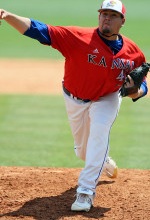
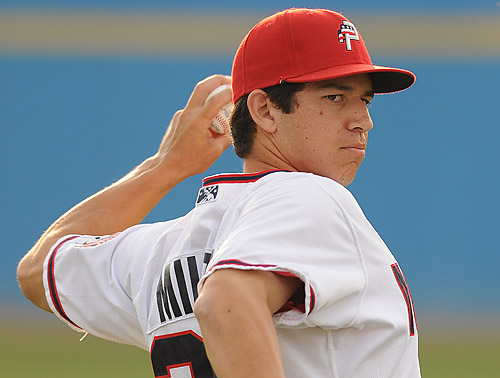
All Tom Milone has done since getting drafted, is win. Photo: Tom Priddy/Four Seam Images/milb.com

Here are the daily links from NationalsProspects, for reference below:

Good

  • JD Martin rebounded on 5/2 from his previous crummy starts, throwing 5 1/3 innings, giving up 5 hits and a walk but conceding no earned runs.  He didn’t exactly dominate Rochester (1K) but Martin isn’t exactly a swing-and-miss pitcher.
  • Ryan Tatusko threw a dominant start on 5/2: 6⅔ IP 2H 0R 3BB 9K.  A bit wild, but 9Ks over 6+ innings is a good sign.
  • Potomac Ace Danny Rosenbaum put in a decent performance on 5/2; 7IP 3H 0R 3BB 4K.  He wiggled out of a bases-loaded jam in the third and then retired 10 straight to close out 7 complete.
  • Chris McKenzie pulled himself out of the coach’s doghouse with his 7IP 4H 0R 1BB 2K performance on 5/2.  I’d like to see more swing-and-miss out of him, but 7 scoreless is good enough in my book.
  • Brad Peacock had another ho-hum great outing on 5/3:  7IP 2H 0R 1BB 8K.   His season numbers are almost comically good right now.   1.16 era, 0.76 whip.  36/4 k/bb ratio in 31 innings.  One has to think he’s the next to move up to AAA.  His performance earned a mention on Baseball America’s hotsheet (h/t to Steven Biel at FJB for the link)
  • Brad Meyers, as with Peacock, put in another solid outing on 5/4: 7IP 8H 2R 2ER 0BB 7K.  It wasn’t quite as dominant as in the past, but it was good enough to earn him a promotion (see notes below).
  • Tom Milone had a fantastic rebound start on 5/5 for Syracuse: 7IP 4H 1R 1ER 1BB 11K.  Eleven strikeouts in 7 innings for the young left-hander.

Bad

  • Mitchell Clegg‘s outing is only in the “bad” section because there isn’t an “unbelievably bad” section.  Here’s his line from his 5/3 start in Potomac: 3⅔ IP 13H 11R 7ER 1BB 1K 1HR.  Thirteen hits in 3 2/3’s inning; that’s like a line from one of my adult baseball leagues.

Mediocre/Inconclusive

  • We’ll give Taylor Jordan and incomplete for his 5/3 outing, shortened when he took a line-drive off his non-pitching elbow.  Line upon exit: 2⅓ IP 3H 1R 1ER 0BB 0K.  He ended up going on the DL as a precaution, allowing the team to add 2010 draft pick Neil Holland for his first appearance in full season A ball.
  • Trevor Holder may be holding onto his starter’s job a bit longer, after putting in a serviceable 5/4 start in Potomac.  Line: 5+ IP 5H 2R 2ER 0BB 3K.  He was ejected in the top of the 6th for arguing a safe/out call at first.  His performance was probably closer to good than bad; the hits were well scattered, the 2nd earned run was charged to him when his replacement (Dean Weaver) walked, hit a guy and then walked a run home in a situation that had to drive the starter crazy.
  • Shairon Martis was able to improve on his bad form, but still put in a relatively mediocre AA start on 5/5.  Line: 5IP 7H 3R 2ER 3BB 5K 1HR.  That’s 10 baserunners in 5 innings for a former major league starter.  He doesn’t seem to be in immediate jeopardy of losing his rotation spot, but it could come soon.
  • Paul Demny got no offensive support and took the loss despite his quality start for Potomac on 5/5.  Line: 6IP 4H 2R 2ER 4BB 3K.  The walks knocked this to the “so-so” category.
  • Bobby Hansen put a lot of baserunners on, but his hitters bashed their way to a Win for him for Hagerstown on 5/5.  Line: 5IP 8H 2R 2ER 1BB 3K.
  • Craig Stammen gave up quite a few hits on 5/6, and it ended up costing him.  9 hits through 6 innings, but what did him in was the two hits he gave up to open the 7th, which were subsequently inherited and scored on his reliever’s watch.  So in the end, not the worst outing of his career but bad enough to tag him with a loss.
  • Erik Davis started out his outing dominantly (facing the minimum through four), but leaked a couple runs in the 5th before giving up another 3 (though they ended up being unearned) in the 6th.  Final line: 5⅔ IP 4H 5R 2ER 3BB 3K.
  • Matt Grace had a quality start on 5/6, but too many walks pushed his performance into the mediocre.  Line; 6⅓ IP 6H 2R 1ER 3BB 3K.

Relievers of Note and other Thoughts

  • Per a flurry of Potomac roster moves on 5/4, Cameron Selik got a well deserved promotion to Potomac.   Whose rotation spot does he take?  My guess is Holder‘s, since it seems to match up with Selik’s normal rest.  That and Holder was probably the worst of the existing Potomac starters, Clegg’s awful night notwithstanding.
  • Continuing the promotions news, on 5/5 Brad Meyers earned a long-deserved promotion to AAA.  I’m guessing that JD Martin makes way in the Syracuse rotation, though the corresponding move seems to have been to demote Matt Chico to Harrisburg.
  • Chico’s demotion may be a death knell for his career; after falling off the 40-man and being removed from the rotation, he’s put in a mediocre 5+ ERA so far as a middle reliever and now a 27 (soon to be 28) yr old in AA.  That’s not good.
  • Dean Weaver pops up as well, having been reinstated (and promoted from last season’s final destination) in Potomac from the opening day DL/extended spring training.
  • Ryan Mattheus, somewhat of a forgotten man in Harrisburg, got a 1 1/3 inning save where he struck out all four guys for outs on 5/2.
  • Paul Applebee filled ably on very short notice, taking the mound after his starter got knocked from the game and gave Hagerstown enough quality long relief to preserve the win.  His 5/3 line: 3⅔ 2H 1R 1ER 0BB 0K 1HR.  He still has an ugly 6.16 era on the season.  Perhaps its his mustache; its reminiscent of the rookie on the state police force who is trying to grow something to fit in.
  • Kyle Morrison was released from Potomac earlier this month.  Not that he was a massive part of the future, but it seems to me that if we’re basing these release decisions on some combination of age/performance, how does Morrison go with a 9k/9 ratio while his cohort Adam Olbrychowski has conspired to walk as many guys (10) as he’s struck out and is a year older?
  • Tough outing for Cole Kimball on 5/6, needing 50-some pitches to get through 2 innings and allowing both his inherited runners to score, costing his team the game.

Trends

AAA trends:
Maya        bad,soso,soso,good,great,good
Detwiler    good,good,soso,soso,bad,soso
Milone    good,soso,soso,bad,great
Stammen    good,soso,great,bad,soso
Meyers
(Arneson    soso)
(Mock        good,bad,really bad->DL)
(Martin     bad,bad,good->demoted for Meyers)

AA Trends:
Martis     bad,bad,soso
EDavis    good,soso,good,bad,soso
Tatusko    soso,bad,bad,soso,good,bad
Peacock    soso,good,great,good,very good,bad
Arneson
(Barthmaier    bad)
(Atilano    soso,bad->DL)
(Meyers    good,bad,good,great,good,good->promoted)

High-A Trends:
Rosenbaum    soso,good,good,soso,good,good
Holder    soso,bad,bad,soso,soso
Frias        good,good,bad,soso
Demny        good,bad,good,good,soso
Clegg        soso,soso,soso,unbelievably bad,
Selik        soso
(Bronson    good,soso)
(Caldera bad,bad->released)

Low-A Trends:
Grace        good,bad,bad,bad,good,soso
Cole        soso
McKenzie    good,bad,bad,bad,good
Ray
Hansen    soso,good,very bad,very good,soso
(Applebee    bad,soso,bad)
(Selik    good,good,good,great,good->promoted)
(Jordan    good,soso,good,good->dl)

Top 3 deserving promotion: Peacock, Lehman and Manno
Top 3 whose jobs are in jeopardy: Clegg, McKenzie, Holder

Written by Todd Boss

May 9th, 2011 at 4:52 pm

We gave up Willingham for *this*?

10 comments

Rodriguez getting ready to fire in another pitch that he has no idea where its going. Photo via humorfeast.blogspot.com

Here’s Henry Rodriguez‘s outing on Sunday 5/8: 6 batters faced, 3 walks, 2 wild pitches, one weak grounder and two strike outs.  1 inning pitched, 1 earned run on zero hits.  27 pitches but only NINE for strikes.

This gives him, as of Sunday, a grand total of 5 innings pitched on the year.  In those 5 innings he’s only given up 1 run (today’s) and three hits.  He also has 7 strikeouts in those 5 innings.  But he now has 6 walks and 3 wild pitches in those same 5 innings.  His ERA may be nifty (1.80) but his WHIP is the same (1.80), which is really bad for a late-innings reliever.

Adding insult to injury, as Steven at FJB pointed out tonight, Steve McCatty and Jim Riggleman’s comments about the reliever are rather ridiculous.  Per WashingtonTimes.com beat reporter Amanda Comak‘s story, Riggleman said that Rodriguez “needs to get sharper before we can get him into bigger spots.”  Hmm; isn’t that what spring training is for?  Oh yeah, Rodriguez showed up 3-weeks late, but the Nats couldn’t do jack about it except invent an injury to stash him on the DL to start the season since he’s out of options despite a grand total of 36 mlb innings in his career.

He’s now replaced Brian Broderick as the lowest-leverage use reliever in the Nats bullpen.  In other words, the guy you would be least likely to bring into a close game.  For a team already carrying a rule-5 reliever, this shortening of the bullpen means that manager Jim Riggleman is now basically playing with a 5-man pen on any night where the team has a lead or the game is close.  And, as noted several times in this space, Rodriguez’s lack of options handcuffs the team’s roster flexibility.

How about the other player we got in the Willingham deal?  Corey Brown?  Oh, he’s hitting .202 in AAA.  But, he’s gotten hits in his last four games, so there’s that.

Yes, we are talking about small sample sizes.  We’re only 5 weeks into the season.  But no matter how slowly Willingham is starting off himself in Oakland, he’s still out-performing our current left field platoon.  Oh, and his 5 homers would be leading the team, and his 104 ops+ would be 3rd best on the squad (behind injured Ryan Zimmerman and part-time catcher Wilson Ramos).

Did Rizzo make a god-awful deal?  Or is it too early?  Or do I keep needing to tell myself, “hey, this team isn’t winning in 2011, so this is the best season to experiment with guys like Rodriguez to see what you have?”  Sure; i tell myself that all the time.  But this team has potential; they’re nearly .500 despite their horrible offense.

But in the end, it seems to me that we’ve traded our #5 hitter, a guy who always produced for us and who was a popular clubhouse guy, for a reliever we can’t use, and a minor league outfielder who’s in danger of getting benched in Syracuse.

http://www.washingtontimes.com/blog/nationals-watch/2011/may/8/henry-rodriguez-wildness-comes-heat/

Written by Todd Boss

May 9th, 2011 at 10:20 am

Posted in Majors Pitching

Nats Rotation Cycle #7: good/bad/inconclusive

4 comments

Gorzelanny, our #5 pitcher, is starting to look like our #1. Photo Ed Wolfstein

After a surprising 3-1 series at home against San Francisco, and after a fantastic run through the rotation, the team hits the road for 3 straight divisional series away and a set of games that could easily define their season.  How did our pitchers fare?  Not terribly well.  A sweep in Philadelphia gave the team a worst-case start to this critical road trip, but they then took two of the first three in Florida (surprisingly; they’ve been awful in Miami for years).

Here’s how our pitchers looked this go-around:

Good

  • Jordan Zimmermann may not have gotten the win for his 5/6 outing (box/gamer) but he pitched pretty well.  6ip, 2 runs for a “real” quality start.  Zimmermann’s k/9 rate is way way down from his performances in the past; he’s only got 24 in 41 innings.  By way of comparison in 2010 he had 27 in 31 on the comeback trail, and in 2009 he had 92 in 91 innings.  Unless he’s purposely pitching to contact this drastic reduction in Ks/9 is worrisome.
  • Tom Gorzelanny had his third straight good-to-great outing, beating the Marlins on 5/7 (box/gamer).  He only gave up 2 hits through 7 innings, though a walk and a homer tagged him with 2 earned runs.  Gorzelanny is turning into a find for this team.  He’s the only starter who has yet to really have a bad outing and continues to pitch really well.

Bad

  • Jason Marquis couldn’t follow up on his 5-hit gem and got pounded at the “Link” in Philadelphia on 5/4 (box/gamer).  Line: 5ip, 10hits (!), 7runs (6 of which were earned) and only 2ks.  Ugh.  His first “meltdown” of the season.
  • If Marquis’ start was bad, then I guess John Lannan‘s needs a new category.  Lannan becomes the first Nats pitcher not to complete the 5th inning this season, only lasting 2 innings in an ugly 5/5 loss (gamer/box).  Line: 6runs on 7 hits in 2innings completed (he faced 6 consecutive batters without retiring one to open the 3rd inning).

Mediocre/Inconclusive

  • Livan Hernandez is Mr YoYo.  One good outing, one medicore one.  One great outing, then one bad.  On Tuesday 5/3 he had an off night (gamer/box), getting battered around for 10 hits and an additional 4 walks (two of which were intentional, and one of THOSE was clearly against his wishes when facing Ryan Howard).  In the end, it wouldn’t have mattered since his offense mustered only one run (on a solo shot from Michael Morse).  Final line: 6 1/3, 10hits, 4 runs, 4 bb, 4ks and a loss.

Starter Trends

MLB Trends (through 5/7)
Lhernandez    good,bad,good,good,bad,good,soso
Marquis    good,good,good,soso,great,bad
Lannan    good,soso,soso,bad,soso,good,really bad
Zimmermann     good,good,good,bad,bad,good,good
Gorzelanny    soso,good,soso,good,great,good

Relievers of Note

  • One day after a relatively electrifying MLB debut for the team, Henry Rodriguez showed what we can probably expect in the longer term.  On 4/30, he threw 11 fastballs that averaged 98.7mph and got two strikeouts in a clean 1 inning of work.  On 5/3 he threw 24 pitches, walked two guys, allowed a hit and got no strikeouts.  He showed a change up (a 90mph changeup, nice), but could not control his slider.  I think the jury is still out on this guy.  But he had to be a pretty amazing change of pace after Livan for 6 innings.  On 5/5 he got stretched out a bit but had another typical up and down session; 2 hits and a walk and 3Ks in 2 innings.
  • Tyler Clippard had a pretty good line on friday 5/5: 6 batters faced, 6 strike outs.  Adam Kilgore reviewed the outing here.  He now has 27 Ks in 21 innings so far and an ERA+ of 301 on the season.
  • Storen continues to be electric in the closer role.  He’s given up just one earned run in 17 appearances thus far, good for an 805 ERA+.  Can’t ask much more out of your fireman.

Thoughts on the offense

The continued deficiency of the offense is reaching troubling areas.  We’re a month into the season; no more excuses about “slow starts” or “getting back into the swing of it.”  As of 5/7, the team is 5-17 when scoring four runs or less (and 10-0 when scoring five or more).  This sounds great; all we need to do is score 5 or more runs a game and we’re the ’29 Yankees.  If your offense is already struggling, and they know they have to score a ton of runs to have a shot, team morale could fade fast.

Overall Summary

Amazingly, the team hovers near .500 despite having the 15th or 16th NL ranked offense in most categories.  They’re batting as a team 79 OPS+, putting them 20% below average.  Rick Ankiel is taking his .221 batting average onto the DL for a couple weeks, giving Roger Bernadina his best yet chance to own Center field and the leadoff position.  If he were to succeed, it may be a great kick start for the team.

Written by Todd Boss

May 8th, 2011 at 1:22 pm

How old is “too old” for pitchers in the minor leagues?

10 comments

Cameron Selik dominated in Hagerstown before his Promotion, but was he "too old" for the level? Photo Eastcountysports.com

When looking at minor league teams and trying to assess talent, the notion of age and experience becomes important.  Quite simply, an older more experienced player will have the advantage over younger counterparts.  Even if the relative skill levels are the same, with age and with professional playing experience comes baseball wisdom that gives the older player the advantage.

So, when looking at prospects at various levels one has to take into account the players age, their number of years of professional experience, and their injury history along with performance to properly judge a player.

So the question really is, “How old is ‘too old’ for a player at a particular level.

I have always used a rule-of-thumb measurement advocated by John Sickels at minorleagueball.com for looking at player ages (I cannot find the original Sickels posting but have seen it attributed to him in several forums).  That rule-of-thumb is as follows:

  • AAA: Typical Age range is 23-24.  Age 25 depends.  26+ is old
  • AA: 22-23.  24 depends.  25+ is old
  • High-A: 20-22.  23 depends.  24+ is old
  • Low-A: 19-21.  22 depends.  23+ is old
  • Short-A: 19-20.  21/22 for draft year guys only.  22+ is old
  • GCL: 17-19.  20 for draft year guys only.  21+ is old

But does this scale make sense, especially for pitchers?  Lets consider two draft scenarios (note; we’re specifically NOT taking into account any injuries for the purposes of this “ideal case” argument, at least not yet):

1. You draft a high schooler at age 18.  Even if he signs quickly you’re probably not going to get a lot out of him his 18-yr old season because he’s already pitched a number of innings for his HS team.  So his probable progression as a prospect should be:

  • Age 18/Draft year: a few innings in the Rookie League
  • Age 19: Rookie League if he’s a normal with an eye towards moving up to short-A if he succeeds.
  • Age 20: Low-A
  • Age 21: High-A
  • Age 22: AA
  • Age 23: AAA

That’s 5 full pro seasons, by which time the former HSer is 23, should have traversed the entirety of the minor league system, is aged 23 and is just reaching rule-5 eligibility.  In fact, this progression is probably exactly how the rule5 rules were arrived at.

2. You draft a college junior at age 21.  Again, even if he signs quickly he’s finishing off a long college season so you don’t want to kill him, but this is exactly why the short season leagues exist.  So his normal progression would be:

  • Age 21/Draft year: Short-A or possibly Rookie League
  • Age 22: Low-A
  • Age 23: High-A
  • Age 24: AA
  • Age 25: AAA

At which point he’s got 4 pro seasons and is also just reaching rule5 eligibilty.

HOWEVER; note that Sickel’s “rule of thumb” rules essentially rules any college draftee who is following a normal progression through the minors in the “depends” status.  To say nothing of a prospect who may suffer a major injury that costs them a season.  Plus, I don’t think a player can really be considered “too old” at age 22 in his first full season of pro ball in low-A, even if he’s going against a bunch of former HSers who are 2 years younger but playing in their third pro seasons.

So, perhaps the rule of thumb isn’t exactly correct.  Lets dig deeper and look at the actual rosters of minor league teams.

Here is a statistical analysis of age levels of every pitcher on the roster of the International, Eastern, Carolina and South Atlantic league (where the AAA, AA, High-A and Low-A affiliates of the Nationals play).  I took the rosters as they stood on 5/4/11 and calculated the average age, captured youngest and oldest, then grabbed the 25th, 50th (median) and 75% quartile age of the population.

2011 Statistics (Pitchers only) International Eastern Carolina South Atlantic
Level AAA AA High-A Low-A
average–> 27.24 25.30 23.51 22.41
youngest–> 20.27 19.96 19.96 18.88
25th Quartile –> 25.22 24.11 22.33 21.56
50th Quartile (median) –> 26.61 25.05 23.50 22.52
75th Quartile –> 28.47 26.32 24.45 23.33
oldest–> 36.87 31.81 28.46 28.70
% on the 40-man roster –> 32.64% 12.65% 0.89% 0.53%

Caveats to this data: it isn’t the entirety of the Minor leagues.  But for the International, Eastern and South Atlantic league it represents a sizeable portion of those leagues (14, 12 and 14 of the 30 teams at that level).  The Carolina league only has 8 of 30 high-A teams and may not be entirely representative of the high-A population.  A task for a rainy day.  Also, these are age-analysis of Pitchers only.  I did not take into account any rehab stints, but these older major leaguers will just skew the average age, and won’t affect he quartile ages that much.

Now, based on this analysis of this data, i’ll now say that anyone in the 0-25th quartile to be “really young” for that level, 25th-50th to be “young” for the level, 50th-75th to be “old” for the level, and 75th-100th quartile to be “really old” for that level.  Based on these new bench marks, here’s the new rule of thumbs:

AAA AA High-A Low-A
Really Young 25.22 or younger 24.11 or  younger 22.33 or younger 21.56 or younger
Young 25.22 – 26.61 24.11 – 25.05 22.33 – 23.50 21.56 – 22.52
Old 26.61 – 28.47 25.05 – 26.32 23.5 – 24.45 22.52 – 23.33
Really Old 28.47 or older 26.32 or older 24.45 or older 23.33 or older

Ironically, this list doesn’t look a whole lot different than Sickel’s rules of thumb. Perhaps he wasn’t that far off to begin with.

I’ll follow-up this post with a quick age-analysis of the starters in our system, to give context to their status and accomplishments.  To answer the first question about Cameron Selik, at age 23.7 he was “really old” for Low-A, and right now falls slightly into the “old” category for low-A.  So, while he was pitching fantastically in Hagerstown he also was one of the oldest pitchers in that league (161 out of 187 ranking).

Written by Todd Boss

May 6th, 2011 at 12:06 pm

Nats Rotation Cycle #6: good/bad/inconclusive

3 comments

Marquis' 5-hit shutout is the best outing we've seen since Strasburg. Photo: Ap via silive.com

The team is rocked by the news that star Ryan Zimmerman will miss another 6 weeks, on top of the last 17 games he’s already missed, due to a torn abdominal muscle.  To add insult to injury, the team is in a very difficult part of the schedule (SF at home, then away to Philadelphia, Florida and Atlanta 3 series in a row) that could very well see them plummet to the basement of the division.  Can their rotation help keep them near .500?

Good

  • As he tends to do, Livan Hernandez followed up a sub-par outing with an excellent one, going 8 complete innings (Washington’s longest starter outing of the year), giving up 3 runs (2 earned) and spelling the burned-out bullpen in a 4-3 win over the Mets in the 4/28 series finale (box/gamer).  Livan gave up 7 hits and a walk to go with 5 strikeouts on the night.  He’s now averaging 6.5 IP per start (best on the staff) and though his Fip/Xfip are slightly worst than MLB median he’s holding steady for the team.
  • Jason Marquis put in easily the best start of the season, and his best start for this team, pitching a 5-hit shutout on 4/29 (box/gamer).  He struck out 7, walked none, and needed just 96 pitches to finish off the light-hitting Giants.  The defeat of the Giants and ace Tim Lincecum continued an interesting pattern for the team of competing well against the opposing team’s ace (they’re 4-2 against the nominal “ace” of opposing rotations, beating Lincecum, Josh Johnson, Yovanni Gallardo, and Kevin Correia while falling to Derek Lowe and Roy Halladay).  If Marquis continues to pitch this well, the Nats could face a difficult decision later on in the season (trade or re-sign?).
  • John Lannan pitched 6 very efficient innings before fading in the 7th long enough to give up a 2nd run, which proved to be enough to get him the loss on Saturday 4/30’s day game (box/gamer).  Final line: 6 2/3, 6 hits, 3 walks (one intentional) and 2 runs.  But he had given up just 4 hits and zero walks through 6 complete, a very dominant performance.  The 7th came apart on him very quickly, and he managed to load the bases and walk in the go-ahead run before Clippard could take the mound and escape the jam.  Riggleman called for a somewhat questionable intentional walk before Lannan managed to walk in the winning run.
  • Jordan Zimmerman‘s line wasn’t that dominant for Sunday 5/1’s game (box/gamer); 6ip, 6hits, 2 walks, 4ks and 2 runs.  However watching the game you got a different story.  Both runs scored by virtue of a fluke-y bloop double that hit the left field line from a weak-hitting left-handed hitter.  One of the walks was intentional.  And 3 of the 6 hits he gave up were either infield singles or weakly hit balls.  So Jordan gets a quality start and his 2nd best game score of the season.
  • Tom Gorzelanny nearly matched Marquis’ gem with his 8-inning, 3-hit and no walk performance on Military night, 5/1 (box/gamer).  The game took his season ERA down a full run (from 3.97 to 2.93).  I had to quibble a bit with the in-game management though from Riggleman; see this op-ed piece for my thoughts.

Trends

MLB Trends (through 5/2)
Lhernandez    good,bad,good,good,bad,good
Lannan    good,soso,soso,bad,soso,good
Zimmermann     good,good,good,bad,bad,good
Marquis    good,good,good,soso,great
Gorzelanny    soso,good,soso,good,great

Thoughts on the offense

  • Laynce Nix is starting to make a statement for this team, putting up a 150 OPS+ through part time action thus far.  He made his biggest statement yet in Friday’s start against Lincecum, punishing an 0-2 mistake from the young San Francisco Ace for an early 2-run homer.  However it was a foul-ball blast later in the game that everyone is talking about; Nix absolutely crushed an inside fastball about 10-feet foul, but it glanced off the THIRD deck of the Nats stadium.  Estimates put it at 450 feet or so, an incredible distance at a stadium that has seen scant balls hit in that area.  WP beat writer Adam Kilgore discussed this same point in the NatsJournal blog friday.  Nix gets so few at bats versus lefties that it is difficult to ascertain how his splits look, but with Mike Morse continuing to struggle (he’s not even slugging .300 from the left fielder spot) it may behoove the team to roll the dice and give Nix some full time opportunities.
  • Can someone explain the role that Matt Stairs so excellently fulfills that he deserves a 25-man roster spot and $850k?  He gets 4 at bats a week, has yet to get a hit, and has more strikeouts than walks.  Wouldn’t there be more value in putting a player on the roster in his place who could actually *help* the team?

Overall Summary

All 5 starters threw what i’d call “good” or “great” starts, and the team went 4-1 in those starts.  That’s great news.  The hitters continue to struggle, with 6 of our 8 regulars hitting .233 or below.  These guys need to snap out of it soon.

Written by Todd Boss

May 4th, 2011 at 12:54 pm

Quibbles about Riggleman’s moves in the Gorzelanny game

4 comments

If you let Gorzelanny bat in the 7th .. then why don't you let him finish the game? Photo: AP

I was lucky enough to be in attendance at Monday, 5/1’s Nats win over the Giants and saw Tom Gorzelanny‘s best performance of the year.

However, once again I had to question the in-game management from Jim Riggleman.  Gorzelanny was cruising along and sat at somewhere around 78 pitches through 7 innings, having only given up 2 hits.  Meanwhile Madison Bumgarner had absolutely shut down the Nationals, perfect through four and having only given up one hit through 6.  In the bottom of the 7th, Miguel Tejada blows a simple 2-out grounder that opened the floodgates and allowed 2 runs to score (I was there; it was a blatant error and the crowd actually boo’d the official scorer giving the play a hit).

Suddenly, the Nats have the bases loaded situation against a pitcher clearly on the ropes … only the pitcher’s spot is coming up.  What does Riggleman do?  He lets Gorzelanny bat, lefty-against-lefty, with the bases loaded and 2 outs.  Predictably he weakly grounds out to the pitcher to end the rally.

So, old-school types would say, “ok well Riggleman thinks Gorzelanny is going to finish the game, if you’re leaving him in to clearly end a big rally.”

But here’s what I didn’t get: Gorzelanny starts the 8th inning and ONLY THEN does the bullpen get working.  Coffey is up, Burnett is up.  Gorzelanny gets into some trouble in the 8th, giving up a hit and a walk, but gets through the inning and is sitting at 95 pitches.  You look out into the bullpen now, and Storen is warming up.  The Nats go down in the eight inning, and suddenly you see Storen trotting to the mound.

What the heck is going on?  If you were NOT going to let Gorzelanny finish the game, then why did you let him bat in the 7th?   But, by letting him bat you were tacitly telling your pitcher, ” you did a great job tonight, go get the complete game.”  Only you yank him with 95 pitches and without even going back out to start the 9th inning.

Something’s inconsistent here.  As far as I could tell, one of 3 things was going on:

  1. Riggleman just forgot to get someone warmed up and was caught off guard by the Nats rally in the 7th.  Suddenly Gorzelanny was at the plate but nobody was warmed up and he had to bat.
  2. Riggleman has no right-handed pinch-hitting options, only Stairs and Nix on the bench (he couldn’t burn Pudge as the 2nd catcher), so he figured neither of them would give a good at-bat against Bumgarner, so why not go with Gorzelanny.
  3. He fully intended to allow Gorzelanny to go for the complete game, only he saw something during the 8th inning that told him, “hey, Gorzelanny is spent and we need to get him out of there.”

As it turned out, the team won the game.  But in my opinion you trade an inning of your starter in that situation for a chance to blow open the game.  Why else do we have a highly paid pinch hitting specialist sitting on the bench all game??  If the Nats had blown that game by not trying to get a hit in that bases-loaded situation, I would have been pretty irritatated.

At the same time … I understand the veteran mentality mentality of letting guys finish games, or letting them try to get complete games.  Its shows a level of respect and professionalism to your players.  But if that’s what you’re doing … then do it!  Don’t yank the guy after one more inning like its just another ball game.

What do you guys think?

Written by Todd Boss

May 3rd, 2011 at 4:30 pm

Posted in Majors Pitching

Minor League Rotations Cycle #5: good/bad/inconclusive

3 comments

Manno-maniacs are excited about his great start. Photo Mark Brisco via flickr.com

Here are the daily links from NationalsProspects, for reference below:

Good

  • Brad Peacock continues his strong start to the season, going for 7IP 5H 1R 1ER 1BB 7K 1HR on 4/28.   His and Meyer’s continued performances are drawing the interest of the big club’s beat reporters, as Adam Kilgore posted this story over the weekend.
  • Brad Meyers didn’t have an overpowering strike out night, but did have an excellent effort on 4/29: 8IP 6H 1R 1ER 0BB 4K.  As noted in Kilgore’s article, he now has 31Ks and 0BBs on the season.  That’s pretty durn good.
  • Taylor Jordan improved to 5-0 on the season with a clean outing on 4/28: 5IP 5H 1R 1ER 2BB 4K.  Not the greatest outing but enough to get the win for Hagerstown.
  • Bobby Hansen rebounded nicely from a crummy outing to have a very good one on 4/29: 6IP 2H 1R 1ER 1BB 6K.  If you take out his 4/23 start he’s given up 3 earned runs in 17 innings on the season.  He could be one to watch, absolutely.
  • Yunesky Maya finally broke out in Syracuse, throwing 8 scoreless innings and giving up just 3  hits in 4/30’s victory.  It was clearly the most dominant he’s looked in a Nats affiliate uniform.  71 of 104 pitches for strikes, 11 ground ball outs.  I would have liked to have seen this game because it sounds like he finally had it going.
  • Paul Demny had an odd outing on 4/30: he pitched 5 scoreless but he seemed less than dominant.  He gave up 3 hits and 3 walks, but had only 1 strike out and gave up a number of fly ball outs.  This may be one of those games you had to see in order to properly judge it.  I’ll give him a “good” outing though by virtue of no runs and so few hits.
  • Cameron Selik continues to put his name in the mix for organizational pitcher of the month by getting his third victory and his 5th straight good-to-great outing.  Line on 4/30: 6IP 8H 1R 1ER 0BB 7K.  His numbers through 5 starts are ridiculous: 29ip, 1 run, 30 ks and 3 walks.
  • Evan Bronson had a nice little outing on Sunday for Potomac: 5IP 2H 1R 1ER 2BB 4K.  This was Bronson’s first start of the season and it seemed to be a spot-start (because of the 4/27 double-header).  He may be a candidate to replace the struggling Holder though, in Potomac’s rotation.
  • Matt Grace had a similarly good outing on sunday for Hagerstown: 6IP 2H 0R 3BB 3K.  It is nice to see Grace rebounding from 3 sub-par outings.

Bad

  • JD Martin did himself no favors and got hammered again on 4/27, giving up 6 runs (on 3 homers) in less than 5 innings.
  • Chris McKenzie‘s awful outing on 4/27 was delayed after he gave up 7 runs in the first inning and a third he pitched.  Oddly the game isn’t to be completely replayed; they resumed it the next day.
  • Paul Applebee may not have gotten an official “start” in 4/28’s rain-resumed game, but it was essentially a spot start situation.  He did not do well; 4 runs on 5 hits and a walk in 4 2/3s.
  • Lefty Tom Milone got bliztzed on 4/28, failing to get out of the 3rd.  Line; 3⅔ IP 10H 7R 7ER 1BB 2K.  Ugly.
  • Craig Stammen got beat around by the long ball on 4/29: 6⅔ IP 6H 5R 5ER 1BB 6K 2HR.
  • Shairon Martis put in his second disappointing start in a row on 4/30: 4⅓ IP 8H 3R 0ER 3BB 5K.  For a guy who was in Washington’s 2009 rotation, its amazing that he cannot get guys out now in AA.  Is he hurt?
  • Wow, what happened to Ross Detwiler on sunday 5/1?  2⅔ IP 9H 7R 7ER?!  That’s so out of character for a guy who was in serious contention for a MLB rotation slot that you almost have to believe he was hurt or sick or something.  He’s trending the wrong way for sure (see trends section below).
  • Erik Davis struggled on sunday, getting knocked around for 5IP 10H 6R 5ER 1BB 5K in Harrisburg.

Mediocre/Inconclusive

  • Erik Arneson‘s spot start in AAA on 4/27 (to provide cover in a DH) wasn’t half bad: 5 innings pitched, 8 hits and 3 runs.
  • Ryan Tatusko improved from his last outing, but still put in a mediocre appearance on 4/27 (9 hits and 4 runs in less than 6 innings).  Where has last year’s 1.72 era-throwing pitcher gone?
  • Mitchell Clegg held the fort down for 4 innings, but couldn’t finish the 5th, getting battered around for the loss on 4/27.
  • Danny Rosenbaum put in a decent performance in the 2nd half of 4/27’s double-header, getting some unlucky hits and giving up 3 runs (2 earned) on 4 hits and 6ks in 5 innings.
  • Trevor Holder put in a mediocre outing on 4/28: 6IP 8H 4R 3ER 2BB 3K.  I feel like his time in the high-A rotation is ticking.
  • Marcos Frias had a meltdown on 4/29, going for 5⅔ 8H 5R 4ER 2BB 6K 1HR.  He improves from a “bad” rating by virtue of the strikeouts, barely.
  • Potomac’s Ryan Demmin may be holding on to his job by a thread after a second meltdown within a week.  He got torched for 3 homers and gave up 5 runs in an inning of work on 4/30, the second time in a week he put up a comparable line.  He’s young and a lefty, but he’ll have to throw scoreless outings for the rest of the season to get his ERA back to respectability.

Relievers of Note and other Thoughts

  • Arneson’s promotion was rather odd to me: why promote a middle reliever to AAA to make a spot start?  Perhaps the organization didn’t want to interrupt the flow of the AA rotation right now.  Or perhaps they knew Arneson had AAA experience from last year and plan to use him in the AAA bullpen regardless.  Or perhaps he’s coming right back down to AA at some point.  Update: he was returned right back to AA when Bernadina came back from the majors.  Arneson may end up being this year’s version of Jason Jones, a minor league veteran at 28 who pitched at 3 different levels for the team last year.
  • Josh Smoker continues to show improvement in his new role.  He had 3Ks in an inning and a third on 4/29 and has given up just one run in 7 appearances on the season.  It is still disappointing that the supplemental-first rounder is now a loogy in high-A, but at least he’s showing more value than in years past.
  • Christopher Manno keeps on mowing them down in Hagerstown: his line for the season now stands at 11 1/3 ip, 6 hits, 2 runs both unearned, 19ks and 2bbs.  That’s a pretty good line.

Trends

AAA trends:
Maya        bad,soso,soso,good,great
Detwiler    good,good,soso,soso,bad
Martin     bad,bad
Milone    good,soso,soso,bad
Stammen    good,soso,great,bad
(Arneson    soso)
(Mock        good,bad,really bad->DL)

AA Trends:
Meyers    good,bad,good,great,good
Martis     bad,bad
EDavis    good,soso,good,bad
Tatusko    soso,bad,bad,soso
Peacock    soso,good,great,good
(Barthmaier    bad)
(Atilano    soso,bad->DL)

High-A Trends:
Rosenbaum    soso,good,good,soso
Holder    soso,bad,bad,soso
Frias        good,good,bad,soso
Demny        good,bad,good,good
Clegg        soso,soso,soso
(Bronson    good)
(Caldera bad,bad->released)

Low-A Trends:
Selik        good,good,good,great,good
Grace        good,bad,bad,bad,good
McKenzie    good,bad,bad,bad
Jordan    good,soso,good,good
Hansen    soso,good,very bad,very good
(Applebee    bad,soso,bad)

3 pitchers who are earning a promotion: Meyers, Peacock, Selik

3 pitchers who need to be worried about their jobs: Martin, Martis, Holder

Written by Todd Boss

May 3rd, 2011 at 3:49 pm

Looking ahead: what to do with Marquis?

5 comments

Marquis is putting himself in a very enviable position with his great start to 2011. Photo Al Bello/Getty images via bleacherreport.com

As Jason Marquis was putting the finishing touches on his 5-hit shutout last Friday, I got a hypothetical question from Jason, a buddy of mine: If Marquis continues this great start, what should the team do with him?

To review the facts at hand:

  • Through 5 starts, he’s 3-0 with a 2.62 era and 1.165 whip.  That’s good for a 149 ERA+.
  • More importantly,this performance does not seem to be the product of luck or chance; his FIP and xFIP are excellent (2.47 and 3.13 respectively).  By way of comparison, the MLB best FIP last year was 2.41 (Josh Johnson), and the best xFIP was 2.92 (Roy Halladay).  Lastly his BABIP is .306, so if anything he’s been slightly unlucky on batted balls.  So he’s definitely pitching at a very elite level.
  • He’s in the 2nd year of a 2yr/$15M deal ($7.5M each year).
  • He’s 32, and turns 33 in August.

I think the answer is, “trade him for prospects” and here’s why.

  1. I don’t think he’s part of the long term solution for this team.  We’ve got too many up-and-coming arms in the minors to block them with a veteran.
  2. He’ll be 33 at the end of the season, and may be looking for a 3 year deal if he pitches well enough.  I’m not sure the team wants to commit to a career 98 ERA+ guy for 3 years.
  3. Despite his fantastic start, and even if he continues, I just don’t think he’s that good of a pitcher.  He’s got a career ERA in the 4.50 range.  He’s generally been considered a durable, low K/9 but high K/BB innings eater, the kind of guy you make your 4th or 5th starter.
  4. He’s in a contract year, and he’s shown some tendencies to pitch better when he’s playing for his next contract.  The best season of his previous 3year deal was in the final year of that deal in Colorado.
  5. The Nats are not going to compete in 2011.  We’re struggling to stay at .500, have very little offense right now, and are certain to trade their veteran/one-year contract guys at the deadline.  This is one of the main reasons we made room and retained guys like Chad Gaudin and Laynce Nix at the expense of Balester and Bernadina.

The counter arguments?  If Marquis’ 2011 performance is really more in line with what he’s capable of, then he could be a really valuable addition to a 2012 rotation that (at this point) seems to include Strasburg, Zimmermann, Lannan, and Gorzelanny.   He’s throwing 91-92 with serious downward movement (sink) right now and he’s really difficult to hit against.  Perhaps he’s turned a corner and escaping the altitude in Colorado really has enabled his sinker to become closer to unhittable.

He’s pitching at a higher level than his $7.5M AAV contract (seemingly on pace for another 14-15 win season), and could be considered a real bargain if we could sign him to a comparable number for 3 more years.

But, if Marquis is retained it leaves little room for advancement for any of a slew of AAA and AA prospects we have overachieving right now in the organization.  The question becomes this; would you rather pay for the proven starter or roll the dice with rising prospects who cost one-twentieth the salary?  Honestly, the most valuable commodity in baseball is the pre-arbitration ace starter (think Clay Buchholz going 17-7 in 2010 and getting paid $443k) and it may be worth the gamble.  But these AA arms are just prospects; despite having sparkling k/9 numbers in AA, there’s no guarantee that translates to the majors.  Some GMs want the known quantity versus the unknown gamble, and there’s a very legitimate argument that keeping Marquis gives us the “known quantity.”

I think the move is to flip Marquis to a contender at or before the trade deadline.  Honestly, wouldn’t the New York Yankees LOVE to have him to shore up their rotation?  And wouldn’t he love to go to New York, since he hails from New Jersey and reportedly still lives there in the off season?  Trade him, get some higher-end prospects that are quick to the majors (think the Wilson RamosMatt Capps deal last year) and prepare for 2012.

Written by Todd Boss

May 2nd, 2011 at 9:57 am

Posted in Majors Pitching

Bryce Harper and the massive target on his back.

5 comments

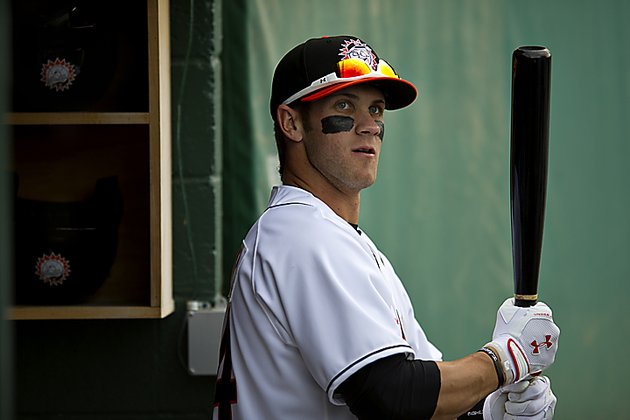
Harper, not quite showing the massive target on his back. Photo: Drew Angerer/The Washington Times

With another “incident” involving Bryce Harper hitting the airways, and another round of media members using no originality or doing any analysis and immediately judging Harper based on his “make-up,” I thought i’d comment.  This relates to a benches-clearing incident at West Virginia on 4/26/11.

Here’s two video links of the latest incident.  One from the RF stands, another from behind the plate (thanks to Zuckerman’s natsinsider site and csnwashington.com).  Watch very closely the first video; the strikeout occurs, Harper stands in place dropping his equipment, and while showing no reaction, no emotion and saying nothing the plate umpire advances towards the opposing pitcher, takes off his mask, and starts to tell him (the opposing pitcher) to back off.  Only after all this happens does Harper hear some “magic words” and react. By which time both benches were starting to run towards each other.  There was no brawl, just some general milling around.

Now you tell me: how is that POSSIBLY Harper’s inciting anything?  Yes, perhaps it started with Harper’s solo shot in the first, with him and the catcher clearly trading words.  Again; who is to say who said what to whom first?  For all we know Harper may have been talking trash, and for all we know the catcher may have said something along the lines of, “lucky hit you punk*ss” to Harper as he crossed the plate.

Because of his bonus, his precociousness, his 40-man roster spot, his SI cover and his accomplishments to date, Harper has such a massive target on his back that its almost impossible to judge these incidents unless you’re there, one the field, taking in the whole context of the incident.  It is absolutely unfair to post stories about what happened in Charleston with headlines like, “Harper sparks brawl in minor league game.” Then starts the whole nonsense about his “makeup.”  Each incident gives National pundits more ink to post their “concerns” over his make up, his maturity, blah blah.

People want to talk about the kid’s “makeup.”  Fine; lets talk about it.  Lesse; he graduated high school 2 years early, he’s devoutly Morman and reportedly has never drank, smoked, chewed or otherwise caroused in his life (how many of these stud-athletes-all-their-privileged-lives can say that?).  He’s got an incredible work ethic and has yet to show one iota (as far as I can tell) of behavior that indicates he’s resting on his laurels or that he’s entitled to anything that he has been given.  The Washington Post magazine did a fantastic article on Harper, his family and his upbringing a few months back, and I dare any reader to come away from that article with anything but the utmost respect for this kid and his family.

He had two ejections in his college season; one was clearly, absolutely the result of his jealous opposing team lobbing baseballs at him and doing other bush league BS in the pre-game to try to get his goat.  The second ejection was a ridiculous over-reaction from an umpire who couldn’t wait to show this hot-shot kid who was boss after he made an egregiously bad 3rd strike call (on a ball that may have been in the opposing batters box it was so far outside).  Harper didn’t slam his helmet, he didn’t turn around an scream at the umpire; he showed some displeasure over the call and then drew a line in the dirt.

You watch the videos and make your own conclusions.

Perhaps you can argue something along the lines of, “well he should know better.  He should turn the other cheek and take all this abuse because he should know how the media is going to spin it.”  Really?  At the age of 17, during your senior year of high school, were YOU that world-weary and have that kind of wisdom?  I seriously doubt it.  The problem with the media’s TMZ-esque coverage of our young athletes these days is that we continually forget that, well, they’re KIDS.  If you did something dumb as a 21yr old, well you’re a dumb*ass 21-yr old.  If a 21-yr old 2nd year NBA player does something dumb, its yet another example of a privileged athlete setting a bad example for kids who look up to him.  It is never fair reporting, and never takes into account the realities of any of the situations these kids find themselves in.

As it stands, yeah Harper probably will continue to get into jawing matches with guys who are jealous of where he has gotten himself so early and so well.  Its human nature to covet that which you so desperately want but do not yet have.  And yeah, perhaps Harper needs to turn the other cheek better.  But to blame him for these incidents and lay them at his feet whenever he naturally stands up for himself is just lazy reporting.

I’m a Harper fan.  I’m continually amazed at what he accomplishes at his age.  His college season was amazing.  So far in low-A he’s recovered from a slow-start and is currently hitting .323/.425/.645.  Playing against guys routinely 3-4 years older than him.  If he were any other normal baseball prospect in the country, he’d be finishing up his senior year in high school and getting ready for the draft.  Instead, he’s tearing up low-A ball and may very well end up in Potomac on the fast track to the majors before his 18th birthday.  All that being said, I WANT confidence and swagger out of my future slugger.  The clean-up hitter is never a soft-spoken, lead by example guy.  It is always the ego-driven, confident big-hitter who leads the way offensively for his team.

But lets try to put things in context before we judge him.

Written by Todd Boss

April 29th, 2011 at 2:55 pm

Posted in Nats in General

Nats Rotation Cycle #5: Good/Bad/Mediocre

leave a comment

Gorzelanny puts in his best outing of the year. AP Photo/Frank Franklin II via sbnation.com

Rotation Cycle #5 notes: The team gets back Todd Coffey from the DL and says good-bye (for now) to Collin Balester.  Because of the rain-outs from last week, Jason Marquis‘s turn got skipped, which is unfortunate since he’s the most effective starter we have right now.  Meanwhile, another rain-out on Friday 4/21 was rescheduled to a previous off day on Monday 4/25, a gift for John Lannan, who got to pitch on normal rest.  Lets see how these guys fared.

Good

  • Depending on how much credence you give to stadium guns, Drew Storen hit 97 during his 4/24 save.  Just to make sure, I looked up the pitch f/x data, and sure enough he maxed out at 97.1 while averaging 96.1 for his 7 four-seamers on the day.  For some reason, I didn’t realize he could bring it that heavy.  If he’s gaining speed, that’s great news for his closing career.  He’s got a fantastic start to the season; an ERA and Whip below 1.00, 3 saves and a slew of dominant performances.  As a side note, boy i’d love to see him in the rotation…
  • Tom Gorzelanny put in his best performance of the year in the opening game of the Mets series (box/gamer) only to watch Sean Burnett melt down in the 9th (well, technically Tyler Clippard blew the “win” for Gorzelanny first) and cost both him and his team the win.  Line: 6 1/3, 5 hits, 1walk 1run and 4Ks.  Amazingly (for Gorzelanny) he was only at 85 pitches when he was pulled.  Normally he’s nearing 100 pitches at the end of the 5th.  He lowered his ERA by a full point and took his ERA+ from 74 to 101 with this one outing.  His fip/xfip are starting to look better as well.  One area of concern is his BABIP; currently at at amazingly low .200.  At some point this will rise and he’ll take some lumps.

Bad

  • Livan Hernandez‘s 450th career start is one he’d like to have back.  He gave up 5 runs in the first, 7 overall (4 earned thanks to several errors by his defense) and he took an ugly loss on 4/23 (box/gamer).  Line: 6ip, 9hits, 7 runs (4 earned), 4bbs and 2ks.  Livan, a creature of habit, had his typical pre-game routine thrown off by an hour-long rain delay and then apparently short notice to get ready to go.  He commented as much to beat reporters and even pseudo-accused the Pirates of playing some gamesmanship with the notification timing (seemingly, his opposite number Jeff Karstens got plenty of notice to begin his warmup).  Either way, it was only the 2nd “meltdown” our starters have thrown all year (I define a “meltdown” as a pitcher who gives up as many or more runs as innings pitched during an outing) as opposed to the FOURTY they managed to throw in 162 games last year.
  • Chad Gaudin managed to get through 2/3 of an inning without giving up a run on monday, but not without some embarrassing moments.  He managed to throw not one but two balls behind the backs of opposing hitters.  He was flat-out aiming several other pitches, including a slider that probably would have been disintegrated by better hitters.  Unfortunately, he just looks like he’s lost confidence in his command, and he must be reading the writing on the wall (i.e., that he’s most likely gone when Henry Rodriguez is done with rehab).  Update: he was placed on the 15-day DL when Rodriguez was re-instated on 4/27, and I commented about the move here.
  • Not a good start from Jordan Zimmerman, who continued the Nats starter streak of pitching into the 5th inning on 4/26 against the Mets (box/gamer), but only barely.  He gives up 5 runs on 9 hits in just 5 1/3 inning.  On the bright side, he was throwing lots of strikes (53 of 73 pitches for strikes) and his pitch count was very low (73 through 5 1/3, putting him on pace to at least finish 7).  Perhaps he was trying to pitch to contact tonight instead of trying to blow guys away.  Zimmermann still has 2nd best FIP and xFIP values of the rotation, so he’s not the real problem right now.
  • Doug Slaten may have a 0.00 era at current, but he’s got a 1.80 whip and allowed both runners he inherited from Zimmermann to score on 4/26, essentially sealing the 6-4 loss for the team.  1.80 whip is just too many baserunners for a matchup-guy and he needs to work on getting clean outings.  In his defense, his BABIP is absurdly high (.438), so he may just be unlucky in the early part of the season.
  • Sean Burnett and Tyler Clippard both conspired to waste Gorzelanny’s great start, each getting a blown save on 4/27.  Burnett’s was completely egregious; he blew a 1-run game in the 9th, gave up FOUR runs and forced the team to burn Storen on a night he was scheduled to have off.  If there’s any question who the “closer” is for this team now, I think we have our answer.

Mediocre/Inconclusive

  • Jason Marquis struggled with his control all day on 4/24 (gamer/box), but scattered 10 baserunners over 6 innings and managed to only give up 3 runs.  Meanwhile his hitters backed him up enough to get the win.  He nearly didn’t make it out of the 5th inning; he was probably one more baserunner from getting yanked before qualifying for the win.  But he gutted the inning out and finished the 6th upon throwing his 100th pitch.  His day included a 55-mph floater that he just tossed in to avoid a balk after slipping mid-way through his rotation … the  batter (Neil Walker) just watched it into the mitt for a called strike and then looked as if he’d just passed up on the pitch of a lifetime.
  • John Lannan was victimized by a short rain delay, which seemed to throw him off his game, leading to a 4-run 4th inning and a loss on 4/25 (gamer/box).  He went 5 2/3 all told, and was bailed out of the 6th inning by reliever Todd Coffey.  Not his worst start, but enough to cost his offensively-challenged team a win.  Lannan is putting a lot of guys on base (whip of 1.538 on the season) and is probably our least effective pitcher right now.  He’s only had one really “good” outing out of 5 so far this year.

Trends

As with the minor league rotations, here’s the trends of our starters so far.  Livan is doing what we normally expect; throwing in a really bad outing intermixed with good ones.  Lannan’s trends are troublesome; he’s only really had one dominating outing all year.

MLB Trends:
Lhernandez    good,bad,good,good,bad
Lannan    good,soso,soso,bad,soso
Zimmermann     good,good,good,bad,bad
Marquis    good,good,good,soso
Gorzelanny    soso,good,soso,good

Written by Todd Boss

April 29th, 2011 at 11:34 am