Nationals Arm Race

"… the reason you win or lose is darn near always the same – pitching.” — Earl Weaver

Whose Rotation Job is really at stake?

7 comments

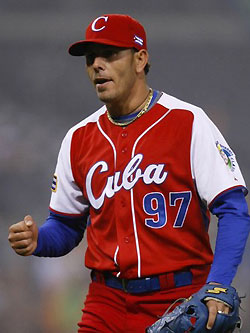
If Maya really turns it on this spring ... will he be in the rotation? Photo via thenatsblog.com

Most Nats pundits (including this one, as posted here) seem to think the Nats opening day rotation is a foregone conclusion.  Livan Hernandez is getting the ball opening day, then will be followed in some order (probably close to the following order to break up Lefty-Righties) Jordan Zimmerman, John Lannan, Jason Marquis, and then newly acquired former Cub Tom Gorzelanny.  MLB beat writer Bill Ladson believes Yunesky Maya will win the spot and Gorzelanny will pitch out of the bullpen, but for the most part this is the agreed-upon opening day rotation.

This leaves 2-3 leading starter candidates (possibly $8M signee Yunesky Maya, former #1 draft pick Ross Detwiler and former 19-game winner Chien-Ming Wang) to fend for AAA or rehab starts.  Some even put non-roster spring training invitee Chad Gaudin into the mix (personally I do not; the last time he was a full time starter was in 2009 pitching in the cavernous San Diego park and he put up a horrible 5.13 era).

The question is; is JUST the #5 spot open for competition?  Here’s some quick thoughts and stats on the “leading 5” guys.

1. Livan Hernandez had a renaissance season, and a historic one among the opinions of the FIP/saber metric guys.  At various times during the season there was nearly a point and half gap between Livan’s actual ERA and his expected fielder-independent-pitching values.  This gap is normally attributed to “luck” by stat heads, who insist that pitchers eventually return to the mean.  By the time the season was over Livan had regressed backwards somewhat but still finished with an inexplicable gap between his actual and expected values.  ERA of 3.66, FIP of 3.95 and xFIP of 4.76 with a BABIP of .293.

Can he do it again in 2011?  He’s a year older and theoretically a year closer to obsolescence, but he isn’t the type of pitcher who ages badly.  He only throws mid 80s to begin with, and a combination of easy arm motion and zero injury history leds credence to his statement that he wants to be the “Jamie Moyer” of right-handers.   There’s no reason to think he won’t repeat his 2010 performance … until you look at his 2007-9 pitching stats.  There may be worry here after all.  He’s a survivor though and I can’t see him getting demoted out of this rotation.

2. Jordan Zimmermann has a lot of expectations on his arm this year.  We know what we get with him; mid 90s fastball, good movement on his off speed stuff, about 8.5 k/9.  What we don’t know is whether or not he’s closer to Matt Cain or if he’s closer to Garrett Mock.  Its hard to analyze his two MLB seasons because of the arm injury; in 2009 he was clearly hurt during his last few starts and he was clearly rusty at the end of 2010.  His 2nd game back he struck out 9 and only gave up one hit through 6 complete … and then got hammered in three straight games. He finished the season strong though; putting in a couple of really nice performances in late sept/early october (his last two game scores were both 60+)

Which Zimmermann will we see in 2011?  We are all optimistic that he’s healthy, that his time has come, and that he’ll be the strong #2 that we expect.  But temper your expectations; he’s yet to pitch a 100 innings in a season (and only maxed out at 134 in his only full professional season to date, 2008).  Until I see an injury-free, dominant season he’s just another prospect.

3. Jason Marquis.  His contract ($7.5M for 2011) earns him a spot right now, not his performance.  He was pretty good for Colorado in 2009, and decent in Chicago the two years before that.  Suddenly he gets to Washington and he forgets how to pitch.  Was it all the bone chips in his elbow or were there other things going on?

After his return post surgery in August, he had 10 starts.  Isolating just for those 10 starts (a neat little feature at baseball-reference.com, frankly) we discover that he was 2-6 with a 4.29 era and a mediocre 1.50 whip.  Most of that damage was done in an ugly game in Philly where he only retired one batter.

So, the question is, Is Marquis back to his 2007-2009 form?  If he isn’t, and he starts putting up lines like he did on April 18th of last year (7 batters up, 7 batters scored for an infinite ERA on the day) how short is his leash?

4. John Lannan.  Staff Aces usually don’t get sent to AA to work on their mechanics mid-season, but something was clearly amiss with Lannan’s game.  His last four starts prior to being sent down were awful; in one game he gave up 4 walks and 10 hits in fewer than 5 innings.  Luckily, Lannan’s time in the minors seemed to help; he only had two “bad” starts after returning in August and in his last 10 starts posted a 6-3 record with a 3.42 era and 1.24 whip.  These numbers easily eclipse his career numbers and eclipse his rather consistent numbers for the whole of 2008 and 2009’s seasons.

The question is (as it is with most of our starters): what version of Lannan are we getting?  Is it June 2010 Lannan or is it July 2009 Lannan (a day he shut out the Mets on 7 hits).  Lannan has one option remaining, so we could send him back down again if the train runs off the tracks.  More likely is that Lannan has figured out what was wrong and will be our most consistent starter for the 3rd year out of 4 running.

5. Tom Gorzelanny.  Cut loose by the Cubs for a relative bargain (one higher end but stalled prospect, one decent mature arm and one rough higher-ceiling youngster).  Why?  Partly because he was probably 6th or 7th in line for rotation spots on the North Side (Dempster, Zambrano, Garza, Wells and Silva followed by a promising rookie Coleman).  He’s not bad; 2010’s 7-9 season featured a 4.09 era but a bloated 1.496 whip for a slightly better than league average 106 era+.  He would have been our 2nd or 3rd best starter last year.

But which Gorzelanny are we getting?  2010’s version of passable production or 2008’s god-awful 6.66 era season with Pittsburgh?  There isn’t much wiggle room for him; he’s out of options and he’d block another deserving bullpen candidate if he falters.


Best Case for the team: Hernandez continues to pitch like its 1997, Zimmermann pitches league average or better and doesn’t get hurt, Lannan continues where he left off last fall, and Marquis/Gorzelanny product up to their capabilities.

Possible real-world case: We get career-norm results out of Livan, Lannan and Marquis (our leading vets), but Zimmerman suffers an elbow strain and Gorzelanny gets bumped to the bullpen in the spring training, giving both Maya and Detwiler immediate rotation spots.

Worst Case: Marquis gets released, Gorzelanny gets shelled, and Zimmermann gets hurt.  We’re calling up Maya, Detwiler and rushing Wang back from rehab.  And our safety net includes 3 guys we DFA’d over the winter and the likes of Stammen, Balester and Mock.

Lets hope we get some best case spring training results.
Written by Todd Boss

February 22nd, 2011 at 4:45 pm

Posted in Majors Pitching

Edmonds or Sheffield for the Hall?

2 comments

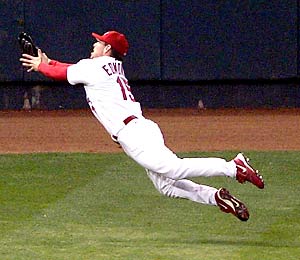
Will Jim Edmonds' defensive capabilities lift him to HoF status? Photo: www.vivaelbirdos.com

I know it is cliche, and that every baseball writer pens the same article whenever a big name retires.  But these opinion pieces are still fun to write and argue about.  So argue away.

Within the past week, two notable hitters hung up their spikes.  Gary Sheffield was forced to admit (much like Barry Bonds, Jermaine Dye and other aging DH-only players quickly being obsoleted in the fast, new, young MLB) that no team would hire him after sitting out all of 2010 and officially filed the paperwork with the league.  Meanwhile, Jim Edmonds retired from a lingering achilles heel injury that prevented him from suiting up in 2011.

For the sake of this article, we will exclude consideration of the fact that Sheffield has admitted to PED/Steroids use and thus probably faces little chance of making the hall.  Lets talk about their performances on the field.

Case 1: Gary Sheffield

Sheffield hails from the famous Hillsborough High School in Tampa, which also produced the likes of Dwight Gooden, Carl Everett and (infamously) Elijah Dukes.  Sheffield’s career numbers are strong.  He retires with a CAREER OPS+ of 140.  That’s essentially an entire career of production at the average level of what Ryan Zimmerman gave the Nats last season.  He hit more than 500 homers while also having more than 250 stolen bases.  He has a career slash line of .292/.393/.514, which is also great.  His hall of fame monitor and standard scores (Bill James’ creations that try to measure whether a player is HoF worth) both easily put him in. His closest comparison on baseball-reference is Mel Ott.  That’s heady company.

Awards: 9 times an all star, 7 times getting MVP votes (a 2nd, two 3rd and a 6th place finish).  5 silver sluggers.  Played 3B early, RF middle and LF/DH late in his career.  His best season was in 1997, finishing with a ridiculous 189 OPS+ for the Marlins but only finishing 6th in the MVP voting.

Beyond the Boxscore printed out an interesting Visual Hall of Fame graphic that essentially shows that Sheffield’s best seasons of his 22-yr career were in the latter part of his career, consistent with a steroids user who was able to beat back the hands of time and not diminish as he aged.  In the same way that Bonds did not tail off as he entered his late 30s.

Regardless of the steroids, I think he’s a hall of fame player.  He was a feared, ferocious hitter who clearly had 5-tools (though not quite at the 5-tool level of someone like Willie Mays or Ken Griffey).  He was a game changer who bounced around the league but produced wherever he was.  Unfortunately because of a prickly relationship with sports writers and implications in the BALCO scandal, his only chance of entrance will be 30 years from now by a veteran’s committee.  He’ll be on a very busy 2014 hall of fame ballot (other first timers on that ballot include near locks Greg Maddux, Frank Thomas, and Tom Glavine, along with borderline cases Jeff Kent and Mike Mussina).

Case 2: Jim Edmonds

Edmond’s case is less about pure offensive merit but weighing the benefits of a player who can produce at a high offensive level AND provide fantastic defense.  Edmond’s career offensive numbers are good but not amazing; in 17 major league seasons he hit 393 homers, had a respectable career slash line of .284/.376/ .527, and a career OPS of 132.

Those numbers compare pretty favorably to Sheffield’s career lines when you consider that Edmonds was considered among the best 2-3 outfielders in the game for the middle 10 years of his career.  He earned 8 gold gloves for his work in centerfield and has a litany of high-light reel catches to his credit. He was excellent defensively but this did not correlate to raw speed on the base-paths; he retired with only 67 stolen bases for his career, averaging just four a year.   His diving catches helped contribute to his demise; he was frequently injured, missed the entirety of 2009 and hung it up because he was not going to be medically cleared to play this year.

Career Achievements: 8th in his Rookie voting, 4 time all star, 6 times receiving MVP votes (a 4th and a 5th place vote his best achievements).

Bill James’ Hall of Fame metrics are not quite as kind to Edmonds; he falls short in both the Monitor and the Standard.  His most similar player comparison is to one Ellis Burks, not really a flattering comparison.

Is he a hall of famer?  I say “probably.”  When grading the defensively minded players (shortstops, catchers and athletic center fielders) you have to balance offensive and defensive.  With Edmonds, he’s nearly the hitter of Sheffield with fantastic defense. I’m concerned by the lack of MVP consideration, and lack of all-star selections.  If a player isn’t routinely considered among the best players in the game, how can he be a hall of famer?

He’ll be on the 2015 ballot along with first timers (and locks) Randy Johnson, Pedro Martinez and John Smoltz.  So he may have to wait to get in but he should merit it.

Vegas Over/Under wins for 2011

3 comments

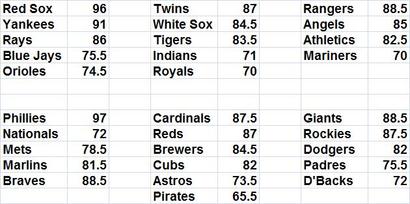
Courtesy of Beyond the Boxscore, here’s a quick look at Vegas Over/Unders for teams for 2011.


First thoughts looking at this:

– The AL East looks all jacked up.  The Yankees look high.  91 wins versus 86 for the Rays?  I don’t think the Rays are going to fall that far.  Meanwhile Toronto won 86 games last year … do we think the trades of Marcum and Wells are going to cost them 10 wins?  And the Red Sox might actually be low.  They come into 2011 healthy and stacked.

– NL East: 97 wins is tough to argue with for Philly … but why isn’t Atlanta in the 90+ game range?  They won 91 last year and should only improve as their young guys get better.

– Oakland; won 81 games last year, added hitting, has one of the deepest young rotations in the game … and only is predicted to improve a game and a half?  I think they’re winning closer to 90 than 80 games this year.

– An aside about Detroit; what exactly are they getting for their money?  $133M in payroll last year bought them a .500 season, and while they have some very bad contracts coming off the books they’re still in the 9-figure range.

– Milwaukee: this one shocks me.  Only 84.5?  They added Greinke and Marcum, two guys who will give them a shutdown 1-2-3 rotation.  And they have a battering ram middle of the order (Weeks, Fielder, Braun and Hart).

– Lastly the Nats at 72 wins.  Hmm.  3 game improvement over last year.  I’d bet the over… I’ll predict that we improve 5-6 games over last year’s team.  I think simply the opportunity of getting a few more “competent” starts out of guys like Marquis, Zimmermann, and Gorzelanny versus what we got out of Atilano, Martin and Olsen last year will make a huge difference.  Yes we’ve lost some offense, but we’ve also improved defensively across the board.

Written by Todd Boss

February 20th, 2011 at 8:41 am

Ladson’s inbox: 2/18/11 version

10 comments

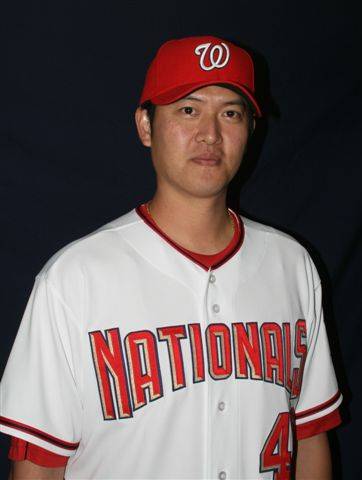
Is Wang bamboozling the Nats? See last question/answer. Photo copyright the Washington Nationals

(Nats blogger Harper at Nationals Baseball used to post his own answers to Ladson’s inbox questions in the past.  I always loved the idea and have been emulating it.  See here for last week’s version.  Thanks to the commenter who let me provide proper attribution…)

Q: With Adam Dunn and Josh Willingham out of the picture, do you think Jayson Werth and Adam LaRoche can pick up the slack on offense?

A: Not likely.  In Dunn and Willingham we have given up an awful lot of offense.  Dunn’s 38 homers, 103 rbis and 138 ops+, while Willingham’s injury-shortened season had him producing at a 129 ops+ rate.  Both these figures were top-10 in the NL (if qualifying).  Werth posted a career-best 145 OPS+ last  year in a hitters park; before that he was routinely producing at the 128-130 OPS+ range.  Meanwhile LaRoche is coming off a career-worst OPS+ value of just 106 (albeit in a pitcher’s park in Arizona).  He can be expected to produce a bit better than that, but he’s also an incredibly slow starter.

Remember; Werth and Laroche were brought in not only for offense but for their stellar defense.  Rizzo seems convinced that you can make up for less offense with better defense.  2011 will be a grand experiment.

Q: The other day the Twins announced that they were open to trading Francisco Liriano. Because he wasn’t able to bring in a No. 1 starter, do you think general manager Mike Rizzo would go after Liriano pretty hard? I have a feeling the Twins might want Ian Desmond though.

A: Liriano is an ace-quality starter who is one of the best strikeout pitchers in the game.  He should be completely recovered from injury.  If offered Liriano straight up for Desmond you have to make that deal (we move Espinosa to short, play hairston for a year and bring up Lombardozzi or Kobernicus more quickly).  Desmond has promise but he’s not Derek Jeter.

Q: It looks like Albert Pujols will be available via trade or free agency. What are the odds the Nationals get him? And don’t say LaRoche to me, because he’s a fine player, but he’s not Pujols.

A: Pujols won’t be traded.  That would be the equivalent of St. Louis telling its fans that they purposely got rid of the best hitter since Ted Williams.  He’ll hit FA, and St. Louis will come up with the money.  Or maybe they won’t and they’ll offer him enough money that the franchise looks like they tried and that the blame will fall on Pujols for being greedy.

Even if he DID hit free agency, I think a 10 year $280M contract (probably what it takes to get him) would be a franchise crippling mistake for the Nats.  In the last few years of that deal he’ll be an aging defensive liability stuck with an untradable amount of money.  You cannot have half your payroll tied up in two guys.  Ask Texas how that went when A-Rod made $25M and the rest of the team combined made the same.  The Nats need to stick to the plan, develop players and grow the payroll organically.

Q: If the Nationals are to trade Nyjer Morgan, could they trade him to the D-backs for Justin Upton?

A: Chalk this up to “dumb trade rumors.”  Why in the world would Arizona trade away a cost contained young proven major league outfielder for a headcase, malcontent, undisciplined player who only had a .319 OBP from the lead off position in 2010?  Upton’s name was all over trade rumors a few months back and he didn’t move because Arizona would have to be blown away by the offer.  We’re talking multiple high-end prospects, not a below replacement-level centerfielder.

Q: Michael Young recently asked the Rangers to trade him. If Texas is willing to eat some salary and take a Danny Espinosa or a Stephen Lombardozzi in exchange, Young would be a great acquisition for D.C. What do you think?

A: Where would he play?  He’s too old and slow to feature at middle infield any longer, and we already have a 1st baseman and 3rd baseman under contract.  He’s declining at the plate. Oh and he makes a ridiculous amount of money and he has a limited trade list of teams he’ll accept trades to. And he earns his 10 and 5 rights soon, giving him full no-trade.

The Young-Texas situation is a mess, but you cannot blame Young for acting the way he has.  He is a leader on that team, has been there forever.  He has moved positions several times (for Kinsler, Soriano and Andrus), and then the team goes and buys a 3rd baseman in Beltre and tells Young he’s going to be mr utility/occasional DH guy.  We’re talking about a 6-time allstar with a gold glove at shortstop in 2008.  The Rangers really should have managed expectations with him prior to acquiring his replacement.  Poor general management there.

Q: Matt Stairs, who has excelled over the years as a pinch-hitter, is a non-roster invitee with the Nationals. Should Rizzo devote a roster space to someone relegated to pinch-hitting duties?

A: No way.  Stairs got a roster invite on a complete shot-in-the-dark whim.  Why would we possibly waste a 25-man spot on a guy who can only pinch hit?  Doesn’t this completely go against Rizzo’s pro-defense concept?  If you have Morse in the super-utility role he can come out and get the big hit … but he can also play 4 positions for you.  Stairs can play one: the bench.

Q: Why did Rizzo go out of his way to tell the media that Chien-Ming Wang would be 100-percent ready for Spring Training, when everyone knew he wouldn’t be?

A: Maybe it was a Taiwanese translator error.  Because 4 hours into spring training we’re already hearing that Wang will start on the DL because he doesn’t have the shoulder strength.

Well, what the hell was he doing all winter?  Wasn’t the idea for him to GAIN the shoulder strength he needed over the winter months and show up in Viera ready to go?  Now we’re hearing that he’s “taking it slow” and expects to start on the DL.  Now, if he is healthy and can contribute, then starting on the DL actually helps the team (Wang is out of options and cannot just be assigned to AAA without visiting waivers).

It is concerning though; did we just give him more money to sit around and rehab another season?  I’m starting to wonder if this isn’t some sort of immoral story he’s told the team to milk one more paycheck out of baseball before returning home.

Written by Todd Boss

February 18th, 2011 at 2:24 pm

Nats GCL 2010 Rotation Review

one comment

Unlike in years past, the Nats rookie league in 2010 existed in large part to provide rehab starts for guys coming back from injury.  By my count, 14 of the 56 starts in GCL last year were either rehab starts or “extended spring training” starts for guys that were headed for upper levels.  This may have been due to the lack of young starting pitcher prospects available to us, since the starts we did get from prospects in the GCL (Hanks, Meza, KLopez, King) were as unimpressive as the starts we got out of Vermont.

That being said, here’s how the GCL staff ended 2010 (GCL usually goes with a 6-man rotation)

Rotation: Hanks 20, Meza 20, KLopez 20, King 20, Encarnacion 21
(rotation order: King, Meza, Hanks, Encarnacion, KLopez
bullpen: MRivera, Baez, Gallo, MRivera, Dupuis, Santiago, Navarro, Gerler, Serino, Meister, Mower, Grace
spot starts: Baez 18, Grace 21
promotions: Hansen, Barthmaier, CMartinez, OHernandez, Ott
up-and-back:
demotions:
dl: Garrett, Karns, Manno
cut/retired:

Livan’s 1/2 brother Orlando “El Duque” Hernandez spent some time baffling 19 year olds in the GCL before moving on up the system.  He was signed (in all likelihood) to grease the skids for signing his compatriot Yunesky Maya, and quit the AA team in a huff when he didn’t get a Sept 1 callup.  Personally I would have called him up to see what he had; he’s an ageless mechanic who very well may have entertained the bullpen for a few weeks and a couple dozen meaningless games.

Here’s the rest of the guys who got starts in the GCL:

  • Tyler Hanks: 20yr old 17th round juco pick, a former teammate of Bryce Harpers.  Decent numbers (4-1, 3.59 era) in a mixture of relief and starting appearances.  2011 Outlook: He’ll probably get a shot at the short-A rotation.
  • Christian Meza 20yr old 25th round juco signing in 2010 who put up some of the best numbers of our GCL rotation.  1.52 era and 23 Ks in 23 2/3 innings to earn a quick callup to short-A.  He’s a slighter framed lefty who could be a diamond in the rough.  2011 outlook: he seems destined for the bullpen, so I’ll guess he moves to Hagerstown’s bullpen.
  • Kelvin Lopez 20yr old international signing who lead the team in IP for 2010.  Not very impressive numbers though; 4.44 era, 26/12 k/bb in 42 innings.  2011 outlook: based on his age I’d guess he features in the short-A rotation competition.
  • Brandon King 20yr old 27th round high schooler in 2009 who had just awful numbers in the GCL in 2010.  10.32 era but only 11 innings pitched.  I cannot remember if he was injured at some point between now and his draft date but seem to remember that he was.  2011 outlook: We gave him a rather large bonus ($250k, or about 4th round money) so we’ll probably continue to test him out.  I can see him back in GCL for 2011.
  • Pedro Encarnacion 21yr old DSL grad who had mediocre numbers with little power (he had nearly as many Ks as BBs).  2011 outlook: may be near the end of his Nats career.  Perhaps converted to a bullpen guy in short- or low-A.
  • Gregory Baez 18yr old lefty DSL graduate.  He’s tall, skinny and throws hard (40 ks in 38 innings).  2011 Outlook: stays in extended spring for a bit and then gives short-A rotation a try.
  • Matthew Grace 21yr old lefty starter out of UCLA, an 8th round draft pick in 2010.  Not the greatest numbers in the GCL or in 2 starts in Vermont in 2010, but he’s a better pedigree than the others.  2011 outlook: will be in the low-A rotation.

For 2011, there are two big names from the 2010 draft A.J. Cole and Robbie Ray that probably start in the GCL.  Both are high-ceiling high school arms that the Nats paid good money to buy out of college commitments and both should be interesting watches.  Will they end up like McGeary, Smoker and Willems as high school flame-outs?  The Nats don’t have a single example of a high school arm panning out since they moved to DC, so the odds are against them (this sounds very Billy Beane-esque, as his Moneyball quotes frequently insulted those GMs that did draft high school arms early).  Suffice it to say, the risks are high with any high schooler and especially with pitchers.

The 2011 draft is supposed to be deep and talented, especially with college arms.  Here’s hoping the Nats fare well and re-stock the lower leagues with arms.

Written by Todd Boss

February 18th, 2011 at 1:33 pm

Vermont’s 2010 Rotation in review

one comment

The Nationals are moving on to a new short-A facility for 2011 (and by all accounts the move is welcomed, as Vermont’s stadium was reportedly among the oldest in the country still in use).  So for 2011 we’ll be referring to “Auburn” instead of “Vermont.”

Here’s how the Vermont pitching staff ended up the 2010 season:

Rotation: Jenkins 22, Hansen 21, Swynenberg 21, Jordan 21, McKenzie 21/Bates 22
(rotation order: Jenkins, Jordan, Swynenberg, Hansen, McKenzie/Bates)
bullpen: Bates, Barrett, Cahill, Crane, Eusebio, Gibson, NHerrera, Holland, Selik, Zellers, Demmin
spot starts: Bates 22, McKenzie 21
promotions: Graham, Hicks, McCatty, Ott
up-and-back:
demotions:
dl: Garrett
cut/retired:

Short A teams generally exist to be the first professional destination of newly drafted college juniors and seniors.  The draft is in the beginning of June, and the short-A season usually starts around the 19th of the month, giving teams a couple weeks to draft, sign, and logistically ship its college players out.  In fact, no less than 10 of the pitchers we drafted in 2010 were assigned to the Vermont squad.

Unfortunately, very few of these pitchers really impressed in 2010.  Of the 13 guys who had at least one start in short-A, only four of them had an ERA under 4.  Hicks (who had one start and moved up to low-A), Mattheus (in a rehab stint), Demmin (who got a spot start but was sparkling in a relief mode), and Ott (who pitched for 3 levels for the team in 2010 after signing as an undrafted free agent).  Lets talk about what may happen to the rest of these guys:

  • Chad Jenkins 22yr old lefty 2009 17th round pick out of Juco, posted a 4.67 era but was wild, walking 34 guys in 54 innings.  His lefty status saves him.  2011 Outlook: May make the low-A rotation but will be on a short leash.
  • Bobby Hansen 21yr old lefty 2008 18th round pick out of high school, now entering his 3rd pro year.  You don’t normally see high schoolers sign when drafted that late.  He’s a big guy (6’5″ 220) and he projects well, but has yet to really throw impressive numbers in GCL or short-A.  2011 Outlook: probably starts in short-A again after an extended spring.  Could get a look in the low-A rotation.
  • Matt Swynenberg 21yr old righty 2009 28th round juco pick who isn’t really impressing anyone with his ERA or his low K/9 rates.  2011 outlook: seems bound for the Hagerstown bullpen.
  • Taylor Jordan 21yr old 9th round pick in 2009 out of juco.  Similar numbers and outlook to Swynenberg.  Slightly more valuable to the team (9th round versus 28th).  2011 Outlook: may get one more shot to stick in the short-A rotation.  Otherwise bound for the bullpen.
  • Christopher McKenzie 21yr old 13th round 2010 pick out of juco; his 2010 numbers were awful.  He posted nearly a 2.00 whip and nearly a 9.00 era.  2011 outlook: hard to see him anywhere but a bullpen somewhere.  Will need to show his value or he’ll get released.
  • Colin Bates 22yr old righty 2010 23rd round pick out of UNC.  5.40 era but showed great swing and miss and good control (45/8 k/bb in 48 innings).  2011 Outlook: Because of his K rate I could see him getting another look in 2011 as a starter somewhere in the system.  Perhaps Hagerstown, perhaps again in Short-A depending on who we draft.

For the most part its rather difficult to predict who is going to be in the 2011 Short-A rotation until we reach the draft; it will be part 2011 draftees and part high school/Juco guys moving up from the GCL.  As we will see in the last installment, the GCL rotation wasn’t much better than Vermonts in 2010, but there will be a couple names that move up.

Written by Todd Boss

February 18th, 2011 at 9:36 am

Hagerstown’s 2010 Rotation in Review

3 comments

Here’s a look at Hagerstown’s pitching staff in 2010.

End of Season Rotation: Demny 21, Hicks 20, Bronson 23, Applebee 22, Ott 22
(rotation order: Demny, Hicks, Applebee, Ott, Bronson)
bullpen: Wort, Arnold, Vasquez, Weaver, Morrison, Erb, Graham, Garcia, McCatty
spot starts: Smoker 22 (demoted for Ott)
promotions: Holder, Rosenbaum,
up-and-back:
demotions: Gibson
dl: McGeary (TJ surgery, out for a while), Clegg
cut/retired: Willems

Hagerstown’s 2010 staff held three of our system’s biggest disappointments; Colton Willems, Jack McGeary and Josh Smoker.

One of the stories of the season was the abrupt retirement of Colton Willems, the latest reminder of the absolute train wreck our 2006 draft was (slight tangent; only 3 players from that draft have even made it onto our 40-man roster; Marrero, Carr and Kimball, and none of these are really expected to compete for 2011 mlb spots).  Willems was a supplemental #1 pick whose stuff as a starter seemed to plateau in the low-A league.  He wasn’t able to get guys out in high-A in 2009, and was converting to be a reliever for the 2010 season when he retired.  His 2010 numbers were bad, but he probably should have given it more time.

Josh Smoker’s status as a flame out prospect is nearly as bad as Willems.  He was a 2007 supplemental #1 pick has yet to show he can get guys out above the rookie league, and while he was slowed by an arm injury in 2009 his performance in 2010 (3-10 with a 6.50 era in low-A) may have buried his career in baseball.  2011 Outlook: fully converted to a reliever in Hagerstown, where he has to show he can get guys out or he will be released.

Another story of the season for the Nats franchise in general was the arm injury suffered by Jack McGeary.  McGeary was having a decent start in low-A before blowing out his elbow and getting Tommy John surgery.  McGeary was considered a drafting coup of the 2007 draft, signing for 1.8M as a 6th rounder with 1st round talent.  But through parts of four pro seasons he’s never really shown the talent to match his pedigree and even post TJ surgery I doubt he will ever pan out.  I can see the Nats hanging on to him until he recovers and giving him another shot based on prior investment and his age, but his days seem numbered.

Hagerstown’s two elder statesmen (Holder and Rosenbaum) both moved up to high-A mid season, leaving a relatively young staff.  Lets talk about each guy:

  • Mitchell Clegg: Despite not being in the rotation at the end, Clegg was clearly the best of what was left of Hagerstown’s mediocre rotation.  He was 9-3, 3.48 era, 1.26 whip before a premature end to his season.  2011 Outlook: I think he starts in Hagerstown again, with the idea of a quick jump up to high-A if the likes of Bronson or Applebee falters.
  • Paul Demny: Pitched a full season in Low-A, 27 starts, compiling mediocre numbers (6-10, 4.23 era, 1.35 whip, 106/47 k/bb in 129 ip).  He improved upon his 2009 season in Hagerstown though, but probably not enough to merit a promotion to high-A.  2011 Outlook: he may have peaked in terms of talent, but he should start in Hagerstown once again.  If he pitches well, a quick trip to Potomac.  If not, he may find himself moved to mop up duty for the rest of his days.
  • Graham Hicks: put up mediocre numbers as a 20-yr old in low-A for the first time (1-6, 5.27 era) but he’s a lefty with a live arm (58 ks in 66 ip).  2011 outlook: we traded Hicks along with Morris and Burgess for Gorzelanny this off season.  I suspect he’ll start in Chicago’s low-A franchise.
  • Evan Bronson: he put up pretty weak numbers (4-2, 5.40 era and less than 4.5 K’s/9) after faring better in high-A.  I don’t quite understand his demotion based on his performance in high-A, and perhaps that factored into his bad low-A performance.  He was pretty dominant as a bullpen guy in short-A in 2009; perhaps he returns to that role eventually.  2011 outlook: he’s a bit old for the level and seemed to be able to handle high-A last year, so I can see him starting there in 2011.
  • Paul Applebee: 6-6, 4.29 era in a mix of starting and relief appearances in 2010.  He clearly is a starter though, and a lefty to boot, so I can see him continuing to get looks.  2011 outlook: I’m predicting he takes the 5th slot in Potomac, unless someone like Lehman or Holder gets pushed down to take that spot.  If so I can see him being a long man out of the bullpen or a spot starter.

A couple other guys had spot starts in 2010: Billy Ott had two mediocre starts but may be given a rotation spot in 2011.  Sammy Solis pitched 4 shutout innings before going off to the Arizona Fall season; he almost certainly starts in Low-A with the idea of moving up quickly and finishing the year in AA.

Hopefully Hagerstown sees better pitching in 2011 than it did in 2010.  At least you’ll get to see Bryce Harper blast a few balls to right-center before he starts his inexorable march towards the majors.

Written by Todd Boss

February 17th, 2011 at 2:10 pm

Posted in Minor League Pitching

Tagged with

Potomac’s 2010 Rotation Season in review

9 comments

(slight server crash yesterday took down the site for the day.  I’ll post two a days tmrw and friday to clear the books of the “season in review” posts I have queued up).

Potomac, the high-A affiliate of the Washington Nationals won the 2010 Carolina League for the 2nd time in the past three years, which is a great indication of the quality of our lower-end minor leaguers.  We put together a rather “mature” high-A team though; most scouts believe that high-A squads should be in the 20-22 age range, and 24 year olds are considered “old” for the level.  Which makes sense; a 24yr old in his 2nd or 3rd professional season pitching against high school draftees 3-4 years younger should immediately have the advantage in terms of experience and capabilities.

That being said, lets take a look at the 2010 pitching staff in Potomac:

  • 2010 Rotation end-of-season: Lehman 24, Holder 23, Frias 22, Alaniz 24, Barthaimer 26
  • (rotation order: Holder, Lehman, Frias, Alaniz, JJones)
  • bullpen: CMartinez, Dill, Phillibaum, Alaniz, McCoy, VanAllen (why?), Barthmaier, Testa
  • spot starts: Alaniz 24, Barthmaier 26, JJones 28
  • promotions: Kimball, Peacock, Alaniz (and back), Leatherman, Dials
  • up-and-back:
  • demotions: Garcia, Bronson
  • dl: Jaime, Fabian, Beno, Rosenbaum 23 (would be #4), Morris 24 (would be #1)
  • cut/retired: Atwood, Pecina, JEstrada

Brad Peacock was Potomac’s supposed “ace” and was promoted after 18 starts (I say supposed since his high-A line was 4-9, with a 4.44 era and 1.03 whip).  The starting rotation was rather decimated by injuries by the end of the season, with both AJ Morris and Danny Rosenbaum on the DL.  Bronson was demoted down to Hagerstown after putting up decent-to-mediocre numbers in high-A (4-7, 3.88 era, 1.31 whip).  Lets talk about the rest of the squad:

  • Patrick Lehman (5-4, 4.84 era, 1.32 whip, 88/28 k/bb in 87ip).  Lehman enters his third professional season with the Nats after being a 13th round draft pick in 2009 out of GW.  He has clearly exceeded expectations for a pitcher coming out of such an unheralded school and It would be great to see him continue to move up.  2011 Prediction: I had initially thought he was a good candidate to move up to AA (based on his age and performance prior to high-A) but now I’m thinking he”ll start in Potomac again and try to improve on his era and whip numbers.  His K/9 is great though but may be a side effect of being slightly “old” for high-A.
  • Trevor Holder (3-3, 4.09 era, 1.39 whip, 52/22 k/bb in 70 ip).  Holder’s selection in the 2009 draft caused howling from draft pundits; he was clearly an overdraft for the third round, was a college senior with little leverage and his draft bonus was less than half of his contemporaries.  And thus far in his pro career, he has done little to change people’s opinions on the matter.  His 2009 pro numbers were awful, and while he succeeded in Hagerstown he was clearly a man among boys.  2011 Prediction: as with Lehman, Holder is too old to “hold” on to a high-A rotation spot but probably does not merit a AA rotation spot.  I can see him being moved to the AA bullpen.  I don’t see him as anything more than an organizational guy at this point.
  • Marcos Frias (7-5, 5.69 era, 1.53 whip, 55/39 k/bb in 91 ip).  Frias is one of the few international signings the Nats have that has moved beyond DSL/GCL status lately.  He was pretty good in Hagerstown in 2009 but his success did not translate to the better High-A classification.  He’s still young (22) but is entering his 5th pro season in the system and his time may be running out.  2011 Prediction: High-A rotation but needs to show some progress asap, else he risks getting moved to the bullpen or cut outright once we draft our 2011 crop of arms.
  • Adrian Alaniz (8-4, 2.61 era, 1.11 whip, 101/26 k/bb in 107 ip).  Alaniz was an enigma pitcher in the system in 2010.  He had 24 High-A appearances but didn’t move into the starting rotation til injuries took out Morris and Rosembaum.  What’s odd about Alaniz is that he proved he could handle high-A pitching in 2008, going 9-0 with a 2.62 era before getting promoted that season.  His stuff has never really translated to AA though, and he was moved out of the rotation in 2009.  Now he’ll be 26 to begin the season and his future is murky.  He needs to show he can pitch at the AA level.  2011 Prediction: AA bullpen, where he must succeed or his time with the organization will be at an end.
  • Jimmy Barthaimer (4-1, 3.62 era, 1.33 whip in 5 spot starts towards the end of the season).  Barthaimer was a minor league waiver claim, having gotten released by Pittsburgh’s Altoona franchise mid season.  He’s got major league time, so it isn’t surprising he would compete well against high-A guys.  2011 outlook: if he’s with the organization, he’ll probably be a AAA bullpen guy.

Other starters of note in Potomac for 2010:

  • AJ Morris: a leader of the staff before suffering an injury, he was 5-3, 3.88 era on the year (including a number of relief starts).  Morris was a very promising 4th round draft pick after having a fantastic senior season at Kansas State, but was moved to the bullpen when his stuff didn’t seem to be translating to success as a starter.  2011 Outlook: Morris was traded to Chicago Cubs in the Gorzelanny deal.
  • Danny Rosenbaum: another top notch starter for Potomac, going 3-2 with a 2.09 era before going down with injury.  So far Danny has more or less dominated GCL, low-A and high-A.  An injury derailed his 2010 season but so far he’s looking like a steal of a 22nd rounder.  The fact that he’s a lefty is even better.  2011 outlook: Rosenbaum is the opening day starter for Potomac but should quickly earn a promotion up to AA.  He’s a sleeper in the system.
  • Juan Jaime: he was set to be the Ace of Potomac before a major arm injury cost him all of 2010.  He was lights out in short-A and low-A in 2009, and was put on our 40-man roster in Nov of 2009 to protect him.  However, the Nats tried to sneak him off the 40-man roster, only to see him claimed by Arizona.  2011 Outlook: good luck to him as he rebuilds his career in the Diamondback’s organization.
  • Robinson Fabian: another Dominican prospect who we got in the Joe Biemel trade; he was looking decent in 8 starts before going down with injury.  2011 outlook: he’ll get another shot to show he can perform in High-A, but he’s starting to age out of prospect status (he just turned 25).

We’ll talk about Evan Bronson in the low-A post, even though he got a number of high-A starts.

Written by Todd Boss

February 17th, 2011 at 9:37 am

Harrisburg 2010 Pitching Season in Review

3 comments

Most scouts now believe that AA is the premier talent league in the minors.  AAA stores spare middle infielders and older players playing out the string while AA houses the rising talents, the up and comers that may never see the light of AAA.  Our own Jordan Zimmermann advanced straight from AA into the major league rotation.  So the AA rosters are important for the future development of the team.

Here’s what Harrisburg’s pitching staff looked like at the end of the 2010 season (age is as of 12/31/10):

  • End of Season Rotation: Peacock 22, Milone 23, Thompson 23, Roark 24, Tatusko 25
  • (rotation order: Thompson, Peacock, Milone, Tatusko, Roark, Peacock)
  • bullpen: Kimball, Pena, RMartin, Spradlin, Dials
  • spot starts:
  • promotions: Storen, Strasburg, Chico, Mandel, Garate, Arneson, JJones, Carr, Bisensius
  • up-and-back: Thompson, Lannan (demoted from mlb), Leatherman, Kown.
  • demotions:
  • dl: Meyers (would be #1), Novoa, Zinicola, CJames, JJones, Leatherman
  • cut: OHernandez

Here’s the 2011 outlook for the starters in AA:

  • Brad Meyers (1-0, 1.47 era, 0.98 whip, 35/7 k/bb in 30.2 innings) started out the season as the Ace of the squad and gave the team 6 strong starts before going down with injury.  He was similarly dominant at the end of 2009 for Harrisburg as well. 2010’s injury was unfortunate for Meyers in terms of career development; at 25 he’s now “old” for Harrisburg and he’s entering his 5th professional season.   I’d really like to see what he can do for this team.  2011 Prediction: starts in AA despite his proven success there in both 2009 and 2010, with an eye to quickly move up and take over for whatever AAA starters does not pan out.  With any luck he’ll earn a Sept 1 call up.
  • Tom Milone (12-5, 2.85 era, 1.16 whip, 155/23 k/bb in 158 ip) had a fine season and should push for a move up to AAA.  He had nearly identical numbers in AA in 2010 as he did in Potomac the year before in terms of ERA and W/L record, but suddenly in AA he became a swing-and-miss strikeout guy.  He’s younger than Meyers and a lefty, yet has fantastic K/9 numbers and seems like a great candidate to move up in this organization.  2011 Prediction: a glut of pitchers above him and his young age seems set to start Milone in Harrisburg again, with a look to quickly move him up as with Meyers.  But his performance in AA seems to indicate he’s a rising talent, and his lefty arm doesn’t hurt.
  • Aaron Thompson (4-13, 5.80 era, 1.59 whip, 95/53 k/bb in 136ip).  Thompson had an absolutely disastrous season.  He couldn’t strike guys out, he got blasted night in and night out, and it wasn’t a surprise when the Nats, facing a series of required 40-man roster moves, chose him as one of the DFA victims.  2011 Prediction: He was claimed by Pittsburgh off of waivers and is no longer in the organization. Even if he hadn’t been claimed by another team, in all likelihood he was out of the starter picture for the team.
  • Tanner Roark (11-6, 3.77 era, 108/42 k/bb in 141 ip for two AA teams).  Roark pitched pretty well once he came over from Texas, but his Midland numbers were just mediocre.  He’s slightly old for the level but is only entering his 4th professional season.  I’d like to see more K/9 numbers out of him but he’s still a solid starter.  2011 Prediction: i’m predicting he moves up to AAA but he’s basically in the same boat as both Meyers and Milone; he’d be repeating a level and he may be ready to move up.  I’m predicting he moves up but will be on a short leash, targeted for replacement by either Meyers or Milone.
  • Ryan Tatusko (12-3, 2.63 era, 94/53 in 136 ip for two AA teams).  Tatusko had markedly better numbers than his traded teammate.  But similarly to Roark he does not have lights out stuff.  2011 Prediction: based on his age and experience I think he gets moved up to AAA but will be in the same situation as Roark; he’ll have to perform or get moved to the bullpen.

I like both Meyers and Milone and think they’ve earned promotions.  We’ll have to see what happens in Viera.

Written by Todd Boss

February 15th, 2011 at 10:45 am

Harper to Center Field? Music to my ears

2 comments

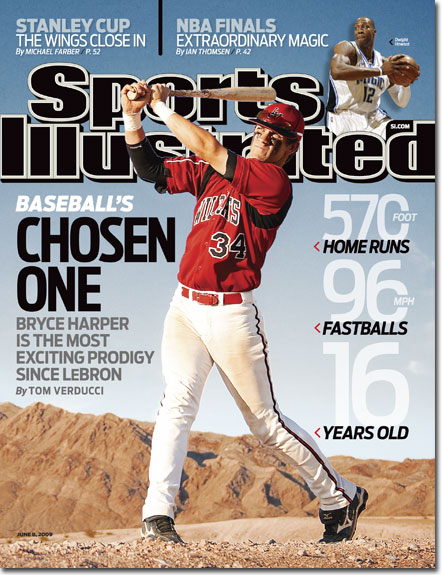
The Chosen One ... in Center? Photo: Sports Illustrated

CBSsports.com’s Evan Brunell has an interesting story out there quoting our precocious #1 draft pick Bryce Harper about a possible position change coming.  Apparently the plan is to move the kid to Center Field and groom him there instead of at Right.  And it is music to my ears.

I initially thought that Jayson Werth would make way and move to Left when the kid was ready to come up.  But that really makes little sense for Werth and for the team.  Werth is a plus defender in right, has a good arm and can man that position for most of his 7 year contract.  You can “hide” poorer defensive players in left field (see Ramirez, Manny) since they don’t have to stop the first to third base runner.  Meanwhile, we clearly have an issue in Center field in terms of productivity and there are not a lot of upper-end defensive centerfielders in this league who can also hit.  Certainly there are very very few who can hit for power.  If Harper can play a serviceable center field that might be the best possible move for him.

Using rotoworld.com’s depth chart rankings, here’s the canonical list of starting centerfielders in the league right now, organized by their hitting prowness:

Light Hitting speedster types: Jacoby Ellisbury, Alex Rios, Austin Jackson, Lorenzo Cain, Peter Borjous, Denard Span, Coco Crisp, Julio Borbon, Rajai Davis, Dexter Fowler, Chris Coughlan (if he can transition to the position), Carlos Gomez, Nyger Morgan, Michael Bourn, Cameron Maybin, Andres Torres,

Slightly better than light hitting guys: Shane Victorino, Andrew McCutchen,

Medium Power (20 homer guys): Adam Jones, Curtis Granderson, Franklin Gutierrez, BJ Upton (maybe), Nate McLough (when he’s not in AAA), Chris Young, Marlon Byrd, Drew Stubbs, Colby Rasums (if LaRussa will play him).

Power hitters/30-30 guys: Grady Sizemore (if healthy), Carlos Beltran (when he was younger), Matt Kemp.

So, basically there’s ONE center fielder in the game who seems to be a safe bet to hit 30 homers on a regular basis.  More than half the starters in Center in baseball will be lucky to hit more than a handful of homers this year.

If Harper shows up in the league with 40 homer power, he could be a very special guy.

Written by Todd Boss

February 14th, 2011 at 3:40 pm

Posted in Nats in General