Nationals Arm Race

"… the reason you win or lose is darn near always the same – pitching.” — Earl Weaver

Archive for the ‘matthew purke’ tag

My answers to Boswell’s chat questions 8/15/11 edition

2 comments

Tom Boswell must have been on vacation; he hasn’t done a chat in weeks.  Well, he caught up and more on August 15th’s version.  Here’s how i’d have answered the questions he took.  As always, the “questions” posed are edited here for levity and clarity, and I write my “answer” before reading his.

Q: Why is Espinosa struggling at the plate?

A: Probably because the league’s pitchers are adjusting to him the 2nd time around.  Plus, there’s a lot of at-bats for advance scouts to learn from and formulate plans of attack.  This is a constant adjustment cycle that hitters and pitchers do throughout the year and throughout their careers.  There could also be a normal rookie fatigue factor; you play 30 games in a HS season, 60-or so games in a college season, around 70 games in a short-season minor league, and around 140 games in a full-season minor league.  To say nothing of the incredible jump in talent from even AAA to the majors.  So, some regression is to be expected as the season winds down.  Boswell agrees with the adjustments angle and gives some tips for Espinosa to follow.  I hope he was reading the chat 🙂

Q: Will the Nats get to 77 victories?

A: With a .479 winning percentage as of 8/15/11, that puts them on a pace for 77 wins (rounding down since they’re one game ahead of their pythagorean won-loss record).  I would say that the team will likely fail to reach that threshold though; September is going to see debut starts given to guys who have never seen the majors, and the transition is usually pretty tough.  I see a few extra losses thrown in there to bring down our win totals to the 73-74 range.   Boswell sticks by his pre-season prediction of 75.  Its looking like a good prediction.

Q: How has Davey Johnson performed so far?

A: I’d say he’s been awful.  Even given that Riggleman’s record was improved by a winning streak, the numbers are clear.  Riggleman was .500 with this team, Johnson is 17-24 (as of 8/15/11).  I think he’s poorly managed the bullpen and is poorly handling his starters.  On more than one occasion he’s let a starting pitcher make the 3rd out in the 6th, only to yank him one walk or one hit into the 7th.  This makes no sense to me!  Why give away that at-bat and that out (remember; you only get 27 outs in a game) especially if there’s runners on base and you still have hitters off the bench.  What was the point of “strengthening the bench” if you never use those hitters?  Grr.   Boswell agrees with me somewhat, and notes that Johnson quickly ended the lineup manipulations under Riggleman.  I’m not going to kill Riggleman for trying those lineup mods; they did lead to a very hot streak for this team.  Another interesting fact; the team has given up 10+ runs 6 times so far under Johnson but only twice before that under Riggleman; why is that?  The implication seemed to be that Riggleman was over-using Storen and Clippard.

Q: Will Purke sign by the deadline?

A: I didn’t think so: I was wrongBoswell had no answer, just said he’d be watching at midnight on 8/15/11.

Q: Should MLB allow close/controversial plays to be replayed on the scoreboard?

A: Good question: right now presumably these plays are NOT shown on scoreboards to prevent further fan-distress and histronics from the argumentative players and managers.  So, clearly when a play is not shown on the board the tacit message sent to all who are watching is, “oh they’re not showing the play so the umps must have blown it.”  It doesn’t seem to really cause that much grief in the NFL, which plays replays instantly (since they have 35 seconds to kill after every play).  So I think MLB should just show replays of all plays and not editorialize.  Boswell seems to agree.

Q: In 2013, what are the chances that this is the lineup we see every day: Ramos, Morse, Rendon, Espinosa, Zimmerman, Harper, CF, Werth?

A: Pretty close in my estimation.  We don’t have positions listed but the implication is that Harper is playing LF, Morse 1B and Rendon 2nd.  2013 may be a tad too early for Rendon; it may be a safer bet to put Lombardozzi at leadoff/2nd.  I think Harper should be trained as a center fielder.  Rendon should be able to transition to LF if need be, but it may be a waste of his abilities.  Otherwise this looks pretty close.  Boswell says there’s a pretty good chance, talks about Rendon a bit then gets more digs into Desmond despite his not being named here.

Q: Is there any significant relationship between payroll outlay (Nats 9th from bottom) and w/l record (14th from bottom)?

A: (links to use here: list of payroll by team, and the current MLB standings 1-30.   Nats are, as of 8/16/11 18th in W/L and22nd in total payroll.

There is definitely a relationship in general between payroll and won/loss records; I don’t think its a coincidence that the 3 highest payrolls (NYY, Boston, Philadelphia) are also the 3 best teams.  However that middle ground is where the direct correlation breaks down.  The Chicago Cubs have the 6th highest payroll and are 27th in won/losses.  Meanwhile the Tampa Bay Rays are 29th in payroll but have the 9th best record playing in the AL East.  This middle ground is where teams can use superior General Managers, superior scouting and overall organizational improvements to be better than they appear.  With respect to the Nationals current positions, I’ll say two things.

  1. Yes we’re clearly doing “better” than our payroll would indicate, a sign that Rizzo is getting good value for his contract dollars.
  2. Its despicable that a team with owners as wealthy as the Lerners, playing in a $600M stadium that was given to the team, and playing in the wealthiest per-capita area with a top 8 population center in the country isn’t spending more on this team.

Q: Is Batting Average not that good of a stat to use to judge hitters?  (in the context of Jayson Werth’s .226 value)

A: Batting Average needs context, yes.  A well-hit line drive directly at a 3rd baseman is really a better hit ball than a weak tweener ground ball that gets through for a hit.   If looking at the BA, you really should look at the BABIP (which for Werth is now .281 on the season, decent and closer to league norms than earlier, but still below his career .314) and his breakdowns of line drives, grounders and flyballs.  Here we see that Werth’s LD% is about on a par with his season last year, but his fly balls are way down.  Makes sense; more of his flyballs were turning into homers at the cozy Philadelphia park.  The stat I really use the most is OPS+, which normalizes the OPS (on base percentage plus slugging) to the league averages and is read more or less as a percentage value as compared to MLB average.  Werth’s number there is currently 98, meaning his OPS is about 2% worse than the league norm.  Now, this isn’t great (he’s being paid like on of the top 10 players in the league and was 5th in the NL in OPS+ last year), but it isn’t Adam Dunn.  Boswell points out that Werth’s slugging % is down and that he’ll be here til the next president is in office.

Q: Was Strasburg an injury waiting to happen?

A: Unknown; the injury he suffered (to his elbow) was NOT the injury that all these inverted-W and/or shoulder loading freaks drone on and on about.  So, until Strasburg’s shoulder blows out (as Prior’s did), we won’t know.   Boswell agrees

Q: What is going on with Zimmerman’s throwing motion?

A: Looks to me like the team has tried to address his biggest problem; making the un-pressured throw accurately.  It happens; you get a ball, have all the time in the world, and fire a ball over your first baseman’s head.  Then it gets into your head and you’re in trouble.  If this weird motion works (and it certainly seems to) then more power to him.  You’ll notice, by the way, that he never makes a throwing error when pressured or on the run.  At least not that I can remember.  Boswell Agrees.

Q: Should/Will the Nats go after Jose Reyes this off season?

A: Should they?  I don’t think so; depends on if they think Desmond has any future or if they can move over Espinosa and call up Lombardozzi.  It’d be foolish to spend $12M/year on a leadoff hitter who is only slightly better than your $440k/year in-house options.  Will they?  We’ll see.   Boswell thinks they shouldn’t and lists a few more good reasons.

Q: Would you trade all the National’s young pitchers for the Orioles’?

A: No.  Way.  Baltimore has a habit of destroying young arms lately.  And I like the upside of our slew of prospects versus theirs.  Boswell says no way.

Q: Zimm/Morse/Werth in 2012 vs Zimm/Dunn/Willingham in 2010?

A: Offense only?  You take the latter.  That was three guys with OPS’s in the 140s back to back to back.  Werth did it in his contract year but not before or since really.  Morse is a breakout guy this year; can he continue?  Can Zimmerman stay healthy?
Nationals future considerably brighter w/ 2011 draft signing successes.

14 comments

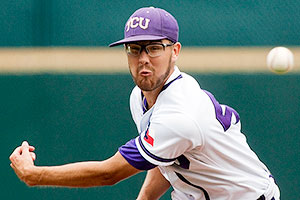
Frankly, I did not think we could get Purke signed. Photo AP/Nati Harnik

Upon starting to read Nationals press releases post 8/15/11 signing deadline, I was ecstatic and surprised by what transpired last night.  We got the first five draft picks signed for a total of about $16.5M spent.

Anthony Rendon and Alex Meyer were never in doubt in my opinion; neither was going back to school to try to marginally improve on their draft standing.  (Nor was Kylin Turnbull, our 4th rounder, who got a $325k deal out of Juco).  Rendon got a major league deal (i.e., an immediate spot on the 40-man roster), which probably was to be expected given his stature and his agent Scott Boras.  My guess is that Boras is starting to press for 40-man spots for his marquee players more and more and fighting less and less for these massive bonuses knowing that the 40-man spot accelerates the time it takes for these prospects to reach free agency by 2-3 years or more.

Brian Godwin got a $3M deal, or $1M more than it took for Meyer to sign.  Clearly the Nats had to buy him out of another year in college, where he and his counsel thought he could become a top-10 talent.

Most surprising: the signing of Matt Purke.  When Purke announced he wasn’t going to pitch in the Cape Cod league, I figured right then he wasn’t going to sign.  Why would he take a 3rd round money or slightly higher (somewhere between $425k and $800k) as a bonus when he got offered $6M out of high school and knows that a dominant junior season would put him in the discussion for #1 overall in 2012’s draft (and the probable $7-8M deal it would guarantee, as Gerrit Cole just got from Pittsburgh).  What the public didn’t know came out in the press releases: Purke let the Nats do not only an in-depth physical but an MRI with the injected dye to highlight injuries within his shoulder.  Purke also did private throwing sessions for the team.   They guaranteed him a 40-man roster spot as well (also incredibly surprising), but as mentioned above probably traded bonus money for that spot.

The usage of 40-man spots as a negotiating tool leaves the Nats slightly roster hampered; we now have 7 spots (and one rule5 draftee) on the roster who have never appeared in a major league game and seem set to start 2012 in the minors (Purke, Severino, Carr, Marrero, Rendon, Harper and Corey Brown).

However, Nats fans can now salivate at the selection of upper-ceiling arms that the team will be able to select from in a few years.  We can add Purke and Meyer immediately to this list: Strasburg and Zimmermann (1st and 2nd rounders) seem set to be the 1-2 for this rotation for the next several years.  Sammy Solis (2nd rounder) has looked ok in Potomac in his first year.  Youngsters AJ Cole (4th) and Robbie Ray (12th) have both looked fantastic in low-A.   “Found money” starters Brad Meyers (5th), Tom Milone (10th) and Brad Peacock (a draft-and-follow 41st rounder) are all pitching at AAA with varying degrees of success but all well younger than their AAA counterparts.   Even 2007’s high-end arms not already mentioned (Ross Detwiler 1st, Josh Smoker 2nd and Jack McGeary in the 6th) are not out of the running and all may feature at least as bullpen arms in the future.

How about a 2014 rotation of Strasburg, Zimmermann, Purke, Peacock and some high-priced ace FA?  That sounds pretty good.

Nats at #6 take … Alex Meyer? Or Trever Bauer?

4 comments

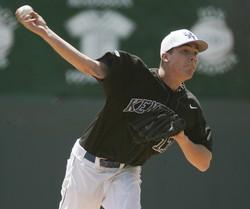
Is Alex Meyers set to be our next 1st round draft pick? Photo: lex18.com

The consensus view on the draft and the Nationals Mike Rizzo‘s draft proclivities seems to fall along two lines of thought:

  • The 2011 draft is heavy on good college arms.  And…
  • Rizzo likes college arms.

So, the odds are he’s taking a college arm at #6.  Lets look at the top college arms available.  These are in rough order of their probable draft position.  All these pitchers are either college juniors or draft-eligible sophomores.

1. Gerrit Cole, Ucla.  Some concerns about his performance this year are knocking him from a consensus 1-1 position to possibly sliding to 5th (if you believe Keith Law‘s mock draft; see below).  If he got to the Nats, it’d be a steal.  But it comes with some concerns.  As in, how does a guy hitting 100mph only have a 9 k/9 rate?  Strasburg had comparable stuff and was striking guys out at nearly twice that rate.

2. Danny Hultzen, Uva.  Most have him going #3 overall to Arizona, some think Pittsburgh is getting scared off both Cole and Anthony Renden and will take him as a value pick, fast to the majors.  Despite his being a local guy, I’m not sure I want him if I’m the Nats.  Lefty, solid pitcher, fast to the majors sure.  But there’s some stories about his training methods and inflexibility to take coaching that are red flags in my opinion (see Trevor Bauer).  There’s also stories about a meddlesome father out and about, though I’d have a hard time that would translate to the pro game.

3. Trevor Bauer, Ucla.  Ucla’s “other” starter is actually going before Cole on some draft boards.  This, I don’t get.  He’s good, and he has a strong arm, but his ridiculous preparation methods and mid-inning throwing is so unorthodox that it may spell doom to whatever organization has to deal with him.  If he’s already telling people “don’t draft me if you want to change my preparation” then how will he ever take constructive criticism or coaching?  To say nothing of the 150-160pitch outings he’s frequently had this season.  He does have a ridiculous 189 Ks in 127 innings this year.  Here’s one scouting report on Bauer for your perusal.

4. Alex Meyer, Kentucky.  Fangraphs.com scouted and did an extensive report on Meyer, his stuff, and his outlook just this week, reviewing his Florida start.  Rizzo likes big body, power arms out of college and Meyer absolutely fits that bill.  Here’s a profile at mlbdraftinsider.com.  Here’s another at mlb.com by Jonathan Mayo.  The major thing that scares me about Meyer is his sudden reversal of fortunes over his first two college seasons.  How does a guy have a 7+ era as a sophomore then suddenly start throwing lights out (2.94 era, 110ks in 101 innings) as a junior?  Who is the real Meyer?

5. Sonny Gray, Vanderbilt. Good stuff, good results, bad body.  Just as with pro quarterbacks, no GM likes to take a sub-6-foot right hander.  Most think he’s headed for the bullpen … if so how could you possibly draft him this high?  A top5 overall pitcher better have future Ace starter potential.

Anyone below this point isn’t going to get past the Nats, since Anthony Rendon probably goes 1st or 2nd and one of the big-time high school prospects (among them possibly Bundy, Starling or Archie Bradley) may go top 5 as well.  Of the arms below; if any of them fall to #23 we may snap them up despite really needing bats in the farm system.

  • Jed Bradley, Georgia Tech.  Good lefty, good league.  Some think he’s top3, others think he’s lasting til the teens.
  • Matt Barnes, UConn.  I’m sure he’s a great pitcher but playing in the Big East isn’t exactly like playing in the SEC.
  • Taylor Jungmann, UTexas.  Stock is falling.
  • John Stilson, Tamu.  lots of K/9 in a good league.  Unfortunately he just destroyed his shoulder and probably won’t even be drafted.  He’ll be lucky to recover from a SLAP tear.
  • Matthew Purke, TCU.  Has had injury concerns all year but has a top-5 talent arm.  I’d wonder if the Nats would roll the dice at #23 or possibly in the supplemental round on him.  Keith Law posted today (insider only) that his price tag won’t be worth what he has shown this year, and I’m guessing he returns to school for his junior year.  More likely he’ll play in the Cape, try to re-gain his mojo and earn his (likely) $6M demand.

Lots of draft pundits are putting the Nats onto Kentucky right-hander Alex Meyer at the #6 spot.  According to some reports, the Nationals were initially targeting him at #23, but a strong 2011 season has him shooting up the draft boards.  If not Meyer, a lot of other mock drafts have us on Trevor Bauer, which scares me for reasons mentioned above.

Here’s some good mock drafts to refer to:

Final thoughts

I think Meyer may end up being an overdraft, but its hard not to fall in love with a big body and a big arm.  You can’t teach MPH.  Bauer (as Passan says) may be Lincecum 2.0 and certainly has amazing k/9 rates this year, but i’d be afraid of his unconventionalism.  Videos of his mechanics aren’t that crazy, and he definitely has a great arm.  We’ll see if the Nats go this way or surprise everyone.