Nationals Arm Race

"… the reason you win or lose is darn near always the same – pitching.” — Earl Weaver

Archive for the ‘Majors Pitching’ Category

Would you have pulled Zimmermann?

25 comments

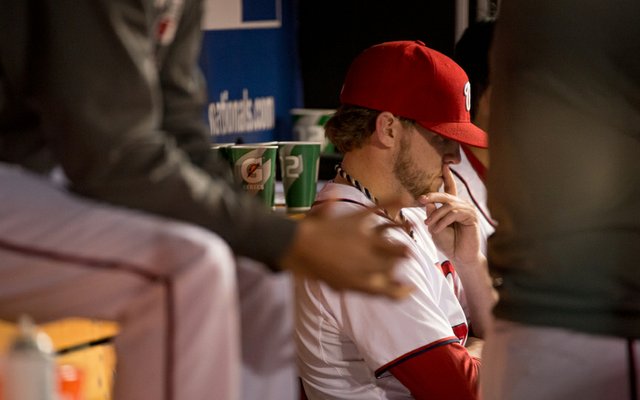
This picture is 2 years old; replace it with a red jersey and you would have thought it was last night.  Photo Andrew Harnik/washingtontimes.com

This picture is 2 years old; replace it with a red jersey and you would have thought it was last night. Photo Andrew Harnik/washingtontimes.com

On his 100th pitch of what I certainly thought was going to be a 3-hit shutout masterpiece to resurrect this playoff series for the Nats, Jordan Zimmermann missed on a fastball up to Giants #2 hitter Joe Panik, issuing his first walk and just the fourth base-runner of the night.

I was not entirely shocked to see Matt Williams trot to the mound, but I also wasn’t happy.  As my wife can attest, I uttered the following phrase: “I think he’s going to regret taking him out.”

Sure enough.  Another Drew Storen meltdown, another blown 9th inning lead that led to the team snatching defeat from the jaws of victory.

To be fair; this isn’t entirely about second guessing.  You can quite easily make the argument to put in Storen as thus: Storen has been lights out for the entire year.  The Giant’s most dangerous hitter (Buster Posey) was coming to the plate.  You would rather have Posey going at a fresh Storen than getting his 4th look at Zimmermann (most starters’ third time through the lineup averages inflate wildly, to say nothing of their 4th).  It was righty-versus-righty.

Well, sometimes you can over-think things.  Certainly Tom Boswell feels that way, based on his column this morning.

On the other hand, if the following scenarios had played out, I’m not sure anyone would have argued against the strategy.

  1. After giving up the walk, Williams walks out to talk to Zimmermann, he stays in and gives up the Posey single, *then* Storen comes in and gives up the run-scoring double to Pablo Sandoval.  You’ve yanked the starter after putting two guys on, and you’ve gone to your closer in the highest-leverage situation of his career and he got unlucky.  That’s still harsh on Storen, but more understandable.
  2. After giving up the walk, Williams leaves Zimmermann in like a total old-school manager and watches him subsequently give up the single and then the double, all while his closer warms up in the bullpen.  That would have led to the reverse second-guessing; why leave him in when you’ve got your closer ready to go?

Major league manager; sometimes you just can’t win.  Williams had a quick hook last night.  Don Mattingly had an excruciatingly slow hook two nights ago, letting his ace Clayton Kershaw give up *SIX* hits in the 7th inning of the Dodgers-Cardinals series before relieving him, and then watched his reliever give up a 3-run homer to turn a 6-2 lead into a 7-6 deficit.  That’s “lose your job” kind of decision making (if the Dodger’s don’t get out of the NLDS).

You guys know what I follow and am most interested in; starting pitching.  So you probably know what I would have done; stick with my starter.  But sometimes it isn’t that simple.  So I’m not going to kill Williams for last night.  I do think Storen’s future with this team is in serious doubt; would you throw him again this post-season?  Would you trust him going forward?  Fool me once, shame on you, fool me twice …. and I see Storen in a new uniform next year.

I spent 6+ hours watching that baseball game (practically the first time all summer I have watched a game from start to end).  The longer I watched, that more and more looked like it was going to be the inevitable disappointment, as Yusmiero Petit looked like the second coming of Roger Clemens and the Nats hitters looked like a AAA team at the plate for much of the night.  A deflating end to a long night.  Tanner Roark gave up the game-winning homer on a mistake (he missed over the plate while trying to hit the outside corner and Brandon Belt destroyed it), but the offense had more than their share of walk-off opportunities.

The Nats have a long road ahead; they match up with the Giant’s Ace next, have to win 2 straight on the road just to get it back to a 5th game.  Lets see if they have what Tim Hudson implied they may not have: I can’t say it here in a PG blog but it rhymes with “Walls.”  🙂
Divisional Series Pitching Matchups & Predictions

5 comments

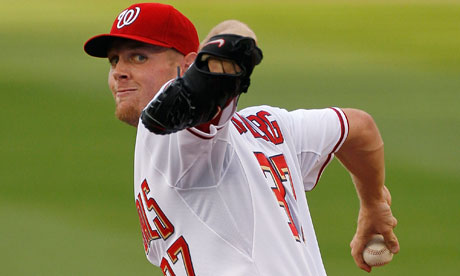
Strasburg's first post-season start is upon us. Photo unk via thewifehatessports.com

Strasburg’s first post-season start is upon us. Photo unk via thewifehatessports.com

Last year I went nearly game-by-game, night-by-night with predictions and analysis of the playoffs.  Can’t do that this year, but I am doing some quickie starter match-up analysis to do some Divisional Series match-up predictions.  The current list of probables is mostly guess work, with the help of MLB.com’s probable pitcher page.  Also using depth charts to make guesses on the probables.

Lets start with the home team.

Washington-San Francisco

Potential Pitching Match-ups:

  1. Game 1: SF@Wash: Jake Peavy vs Stephen Strasburg
  2. Game 2: SF@Wash: Tim Hudson vs Jordan Zimmermann
  3. Game 3: Wash@SF: Doug Fister vs Madison Bumgarner
  4. Game 4: Wash@SF: Gio Gonzalez vs Ryan Vogelsong (if necessary)
  5. Game 5: SF@Wash: Peavy vs Strasburg (if necessary)

The WP’s James Wagner has a nice “how do the Nats fare against Peavy and Hudson” story on 10/2/14 with per-National stats against Peavy and Hudson for the first two games.  And Wagner also just announced the rotation order for the Nats.

Yes, it seems like we’re going to see Strasburg & Zimmermann at home instead of Stras-Gio.

Looking at the match-ups, its easy to say “advantage Washington.”  Strasburg has been hot.  Zimmermann has been even more hot.  We then throw the underrated Fister against Giant’s best starter, then come back with Gio in game 4 on the road, where he’s  going against the erratic Vogelsong.  Hudson has had the Nat’s number for years, but he’s been a train wreck in the 2nd half of 2014.  Peavy has been a bulldog for San Francisco since the trade, but was nearly a 5.00 ERA in the AL.

I’m predicting Washington sweeps the first two at home, loses Bumgarner’s start, then beats SF in game 4 to wrap up the series 3-1.


St. Louis-Los Angeles Dodgers

  1. Game 1: Stl@LAD: Adam Wainwright vs Clayton Kershaw
  2. Game 2: Stl@LAD: Lance Lynn vs Zack Greinke
  3. Game 3: LAD@Stl: Hyun-Jin Ryu vs John Lackey
  4. Game 4: LAD@Stl: Dan Haren vs Shelby Miller (if necessary)
  5. Game 5: Stl@LAD: Wainwright v Kershaw again (if necessary)

St. Louis has already announced that Michael Wacha is *not* in the post-season rotation, which is a huge blow for their chances to out-last the Dodgers.  The game 1 match-up might be the pitching matchup of the post-season, with perennial Cy Young candidate Wainwright going against the likely MVP in Kershaw.  Lynn has gone from being barely a 5th starter to being the #2 guy on St. Louis’ staff, but I don’t know if he’s got enough to get St. Louis the split against Greinke.  Missing Wacha means that St. Louis will have to depend on both Lackey and Miller.  Long odds there.

This series might end up being a sweep frankly; I think LA has the distinct pitching advantage here.  And not having Wacha’s dominance from previous post seasons makes it tough.  Dodgers in a sweep or 3-1 if the Cards can get to either Greinke or Ryu.


Detroit-Baltimore

  1. Game 1: Det@Balt: Max Scherzer vs Chris Tillman
  2. Game 2: Det@Balt: Justin Verlander vs Wei-Yin Chen
  3. Game 3: Balt@Det: Bud Norris vs David Price
  4. Game 4: Balt@Det: Miguel Gonzalez vs Rick Porcello (if necessary)
  5. Game 5: Det@Balt: Tillman-Scherzer (if necessary)

The 96-win Orioles get rewarded with having to face three Cy Young winners in the first three games.  Their rotation mates are underrated (3rd best ERA in the 2nd half) but certainly not in the same class as what Detroit puts up there.  Baltimore’s best case is to get a split at home, then a split away and get to the 5th game.  I don’t see it: I think this series hinges on whether Verlander is Cy Young-Verlander or inexplicably-bad-lately Verlander.  I’m guessing the former; Detroit wins this series in a sweep or perhaps 3-1.


Kansas City-Los Angeles Angels

  1. Game 1: KC@LAA: Jason Vargas vs Jered Weaver
  2. Game 2: KC@LAA: Yordano Ventura vs Matt Shoemaker
  3. Game 3: LAA@KC: C.J. Wilson vs James Shields
  4. Game 4: LAA@KC: Weaver vs Jeremy Guthrie (if necessary)
  5. Game 5: KC@LAA: Shoemaker v Vargas (if necessary)

The Angels are struggling into the playoffs and have announced they’re going with a 3-man rotation.  Weaver’s history of going on 3 days rest is spotty; one decent start and one blow-out.  Meanwhile the Royals burned their #1 guy in the WC game AND threw Ventura enough to have people question Ned Yost‘s sanity (even moreso than they already were with his multiple bunting).  But the Angels hit, and the Royals’ guys won’t be able to completely put them at odds.

I think the 3-man rotation will backfire, and whether the Royals throw Guthrie or Danny Duffy in game 4 won’t make a difference; they’ll hit Weaver at home and push this to a 5th game, where everybody will be on deck.  Angels in 5.


Lets see if these probable pitchers hold up to guesses made on 10/1/14.

Rotation Reviews of your 2014 Playoff Teams

leave a comment

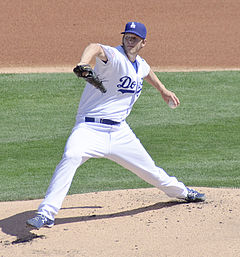
Will the Nats be staring down Kershaw in the playoffs? Photo via wiki.

Will the Nats be staring down Kershaw in the playoffs? Photo via wiki.

Here we are.  After a crazy trade deadline in July, and an August and September that featured the division leaders (in most cases) solidifying their positions and extending their leads, the playoffs are upon us.

Lets take a look at the rotations of the playoff teams (despite the fact that the four Wild Card teams are just one-man pitching staffs until they win the play-in game).  Who lines up best?  For each team i’ve tried to line the pitchers up one through five, with the 5th guy being the one headed to the bullpen.

(Quick useful links: AL full standings on b-r.com, NL full standings, and post season schedule at MLB.com).

Trade deadline 2014 acquisitions highlighted in blue.  Pre-season acquisitions highlighted in Green for context.

NL Division Champs:

  • Washington: Strasburg, Gonzalez, Zimmerman, Fister, Roark (yes this is how I think it will shake out despite Roark’s great season-long performance; we posted on this separately)
  • St. Louis: Wainwright, Lynn, Wacha, Miller, Lackey (Masterson to the bullpen when Wacha came back)
  • Los Angeles: Kershaw, Greinke, Ryu, Haren, Hernandez, Wright (Beckett hurt, done for year, Ryu coming back, should be ok for playoffs so I’ve inserted him as the #3.  Maholm, Billingsley, Fife hurt all year).

Just look at what the Dodgers have tried to do to keep their rotation afloat in terms of player acquisition over the past couple of years.  I’d like to have their budget.  They will have no less than eleven capable, MLB-experienced starters once they’re all healthy.  Yes Kershaw is unbeatable, but as pointed out earlier this year, they are basically a .500 team otherwise.  Their 4th and 5th starters have been below replacement for much of the past month but they’re getting back Ryu right in time for the playoffs.   St. Louis’ rotation looks just as strong as it has been for the past few years; Wainwright quietly has 20 wins and a 2.38 ERA on the season.  Lynn has been great.  Only Miller has struggled but still has a league-average ERA+.

It is hard not to look at the Nationals’ rotation and claim they’re the deepest one-through-four, despite Gonzalez’s struggles.   I’d take our #4 (Fister) over anyone else’s #4, I think our #3 matches up just as favorably to anyone els’es #3, and Strasburg has a 1.34 ERA in September as the #1.

NL Wild Card:

  • Pittsburgh: Liriano, Cole, Locke, Volquez, Worley (Morton dinged up late Sept, made way for Cole).
  • San Francisco: Bumgarner, Hudson, Petit, Vogelsong, Peavy (Lincecum to bullpen for Petit, Cain out all year)

The NL WC pitching match-up will be Bumgarner-Liriano.  Both teams manipulated their rotations at season’s end to preserve their aces for the coin-flip game.  We’ll do a separate prediction piece.

NL Also-Rans;

  • Atlanta:  Teheran, Minor, Santana, Harang, Wood (Beachy, Floyd, Medlen out all year)
  • Milwaukee: Lohse, Garza, Gallardo, Peralta, Fiers (Nelson and Estrada to bullpen)

The Braves fell so far, so badly in September that they were nearly surpassed by the lowly NY Mets for 2nd place in the NL East.  That’s crazy.  But they still remain here as an also-ran because they were in the wild card race until mid-September.  I still think it is crazy what they were able to accomplish given the starting pitcher injuries they suffered in spring training and don’t quite understand why Frank Wren was fired.  If you want to fire him for his crummy FA contracts so be it; but the man engineered a team that made the playoffs three of the past five years.  Harsh treatment if you ask me.  Insider comments seem to think that Wren lost an internal power-struggle involving Fredi Gonzalez.


And here’s what we’re looking at in the AL:

AL Division Champs:

  • Baltimore: Tillman, Norris, Chen, Gonzalez, Gausman (Jimenez demoted to BP)
  • Detroit: Scherzer, Verlander, Sanchez, Price, Porcello
  • Los Angeles: Weaver, Wilson, Shoemaker, Santiago, Rasmus, LeBlanc (Richards injured, Skaggs hurt)

It is hard to look at these rotations and comprehend where these teams currently stand:

  • How is Baltimore leading the AL East by 12 games?  None of these guys are a league-wide “Ace.”
  • How is Detroit not pulling away from the AL Central with this collection of arms?  Of course, you could ask this question of Detroit over and again the past few years; with a stacked lineup and stacked rotation they have just barely won their (usually) weak division year after year.
  • How does Los Angeles have the best record in the majors with a non-drafted FA and a waiver claim in their Sept rotation?  Would you favor this rotation over Detroit’s?

I guess it doesn’t matter; these teams have bashed their way to their titles and should continue to hit in the post-season.  Apparently the O’s aren’t going to go with Gausman in their playoff rotation despite his good seasonal numbers.  It may be a case of veteran manager going with the veterans, as Gausman’s numbers are pretty much in line with most of the rest of the Baltimore rotation.  The injury to Richards really hurts the Angels: Weaver may be close to an Ace but Wilson showed he is hittable in the post-season and lord knows what will happen when LA has to throw their #3 and #4 choices.

AL Wild Cards:

  • Kansas City: Shields, Duffy, Ventura, Guthrie, Vargas
  • Oakland: Grey, Samardzija, Lester, Hammel, Kazmir

AL Wild Card looks like a knock-out match-up of Shields and Lester; the A’s burned Grey yesterday to get the win that put them in the playoffs.  Oakland has to be kicking themselves; how did they go from (easily) the best team in the majors for the first half to struggling to hang onto the WC spot?   On paper replacing 3/5ths of the rotation (out with Chavez, Milone, Pomeranz and Straily, in with Samardzija, Lester and Hammel) sounded like a great idea … but to me the team’s chemistry was clearly un-balanced.  At least they held on to the spot and avoiding a one-game play-in against Felix Hernandez.

AL Also-Rans:

  • Seattle: Hernandez, Walker, Iwakuma, Paxton, Young (Elias out for year)
  • New York: McCarthy, Greene, Kuroda, Capuano, Pineda (with Tanaka finally coming back at season’s end.  Nova and Sabathia gone all year with injuries).

All Seattle needed to do was *get* to the wild card game … and they’d have great odds of advancing behind ace Hernandez.  But struggled to the finish line.  Meanwhile Cleveland and New York would have been mentioned here a week ago, but both squads just ran out of time to make comebacks.  I’ll give NY credit: they played 7 games better than their pythagorean record with huge chunks of their rotation gone for the season and depending on guys who’s names I had to look up.

Coming soon; a review of the WC matchups with predictions.


Written by Todd Boss

September 29th, 2014 at 8:58 am

Nats playoff rotation: who will be in and who should be in?

18 comments

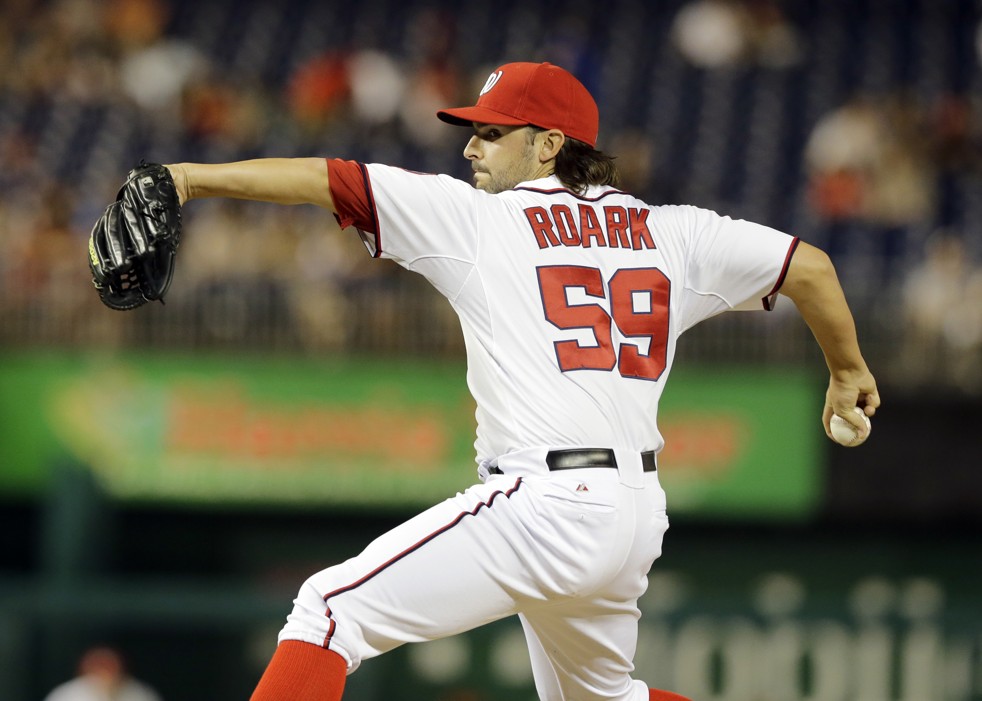
Roark may be odd-man out in the playoffs.  Photo Alex Brandon/AP via wp.com

Roark may be odd-man out in the playoffs. Photo Alex Brandon/AP via wp.com

The NL East champion Nationals have a problem that lots of teams would like to have: they have 5 great starter options for 4 post-season rotation spots.  Who should we pick, and in what order should they pitch?

(all stats are as of 9/23/14 courtesy of baseball-reference.com)

Option 1: stick with the season-long rotation.  Strasburg-Gonzalez-Zimmermann-Fister with Roark heading to the bullpen.

Pos Name W L W-L% ERA ERA+ FIP WHIP G GS IP BB SO BB9 SO9 SO/W
SP Stephen Strasburg 13 11 0.542 3.23 116 2.98 1.139 33 33 209 42 235 1.8 10.1 5.6
SP Gio Gonzalez* 9 10 0.474 3.74 100 3.13 1.233 26 26 151.2 54 150 3.2 8.9 2.78
SP Jordan Zimmermann 13 5 0.722 2.78 135 2.75 1.117 31 31 190.2 28 172 1.3 8.1 6.14
SP Doug Fister 15 6 0.714 2.55 147 4.07 1.123 24 24 155 24 89 1.4 5.2 3.71
SP Tanner Roark 14 10 0.583 2.85 131 3.49 1.102 30 30 192.1 39 137 1.8 6.4 3.51

This is likely what happens regardless, since manager Matt Williams is old school and likely sticks with his veterans over the “new guy” in Roark.  Thanks to four off-days between their last regular season game (Sunday 9/28) and the first game of the playoffs (Friday 10/3) it doesn’t even matter what order these guys have been pitching in; even the guy who goes Sunday (scheduled to be Gio) would have four full days of rest prior to the NLDS opener.

Option 2: Go with the four best starters in terms of season-long performance: Zimmermann-Fister-Strasburg-Roark with Gonzalez the odd-man out.

Looking at the above stats, this would be your top four going strictly by a subjective opinion looking at the “old school” stats of W/L record and ERA.  But a closer look at the FIPs show this to be faulty logic; despite his excellent numbers Fister has the highest FIP of the starters despite having the best ERA+ figure.  Plus, you really don’t want to leave out your sole lefty starter in a playoff series.

Option 3: Go with the hottest hands. Strasburg-Zimmermann-Gonzalez-Roark with Fister in the pen.

Here’s the stats for the last 5 starts for each guy:

Pos Name Team W Team L W-L% ERA babip BAA WHIP G GS IP BB SO BB9 SO9 SO/W
SP Stephen Strasburg 3 2 0.6 1.34 0.28 0.21 0.802 5 5 33.66 2 33 0.535 8.82 16.5
SP Gio Gonzalez* 3 2 0.6 3.41 0.25 0.22 0.958 5 5 31.33 4 23 1.149 6.61 5.75
SP Jordan Zimmermann 5 0 1 2.03 0.3 0.23 1.032 5 5 31 4 32 1.161 9.29 8
SP Doug Fister 3 2 0.6 3.26 0.27 0.27 1.352 5 5 30.33 9 12 2.671 3.56 1.333
SP Tanner Roark 2 3 0.4 3.13 0.3 0.28 1.169 5 5 31.66 3 19 0.853 5.4 6.333

Taking a look at each starter’s last 5 starts, a couple things become clear: Strasburg, as we have all seen, is on fire; just two walks in 33+ innings and a 1.34 ERA.  Its ridiculous that the team hasn’t won all five of his games.  Washington has won all five of Zimmermann’s starts.  Meanwhile, Fister looks like the weakest link here, with the highest whip and the fewest Ks in the closing run.  Roark’s finish hasn’t been too bad, but his peripherals put him behind Gio.

Option 4: Look at the home-road splits to pick starters.  Strasburg-Roark-Zimmerman-Fister

Here’s the season long home/away splits for our starters.

Pos Name Split W L W-L% ERA G GS IP BB SO WHIP SO9 SO/W
SP Gio Gonzalez* Home 4 3 0.571 3.88 12 12 65 23 63 1.3 8.7 2.7
SP Gio Gonzalez* Away 5 7 0.417 3.63 14 14 86 31 87 1.2 9 2.8
SP Stephen Strasburg Home 8 3 0.727 2.7 17 17 110 17 133 1.1 10.9 7.8
SP Stephen Strasburg Away 5 8 0.385 3.82 16 16 99 25 102 1.2 9.3 4.1
SP Tanner Roark Home 6 6 0.5 2.5 14 14 90 23 61 1.2 6.1 2.7
SP Tanner Roark Away 8 4 0.667 3.17 16 16 102 16 76 1.1 6.7 4.8
SP Doug Fister Home 7 2 0.778 1.95 10 10 69 10 47 0.9 6.1 4.7
SP Doug Fister Away 8 4 0.667 3.05 14 14 85 14 42 1.3 4.4 3
SP Jordan Zimmermann Home 6 2 0.75 2.81 16 16 96 16 78 1.2 7.3 4.9
SP Jordan Zimmermann Away 7 3 0.7 2.76 15 15 94 12 94 1 8.9 7.8

This isn’t so much about picking who is better at home; its going with those who have the best away records.  Zimmermann and Fister both give a better chance of winning on the road and make sense as game #3 and #4 starters.  Meanwhile both Strasburg is less effective on the road versus at home.   This scenario leaves us without Gio though, our sole lefty, so it probably isn’t viable.

Option #5: play match-ups with the opponent.  Unfortunately, I’m hoping the team clinches the top seed, which means they go against the wild card winner … and while we’re pretty sure we know who the WC teams are (San Francisco and Pittsburgh) at this point … we don’t know who will host the play-in game, nor who they’ll be throwing.   Washington took the season series against both squads (4-3 over Pittsburgh, 5-2 over San Francisco), and the timing of those series are also interesting:

  • Nats dropped 3 out of 4 in Pittsburgh in May when playing poorly.
  • Nats swept Pittsburgh 3 straight in August at home as they began to solidify their lead in the division.
  • Nats won 3 out of 4 in San Francisco in June when they were still a .500 team.
  • Nats won 2 out of 3 at home in August in a slug-fest of a series.

Fister beat Liriano in Pittsburgh in May; Strasburg, Zimmermann and Treinen all lost.   Then, Roark and Fister pitched effectively in August while Gio was run-of-the-mill.

Against San Francisco; Strasburg, Fister and Roark all pitched great in ATT Park (only Treinen got beat).  Then at home, Strasburg was awful, Fister mediocre and Zimmerman effective in the August series.

Does that tell us much?  Not really.


In the end, I think it’s going to be the same rotation that we lined up on opening day, in the same order. Luckily for us, that means our hottest pitcher (Strasburg) getting the ball in game #1 and #5, it means our two starters who are best away from home will get the ball in games #3 and #4 at the opponent’s park, and it gives us a decent balance of lefty/righty in the first two games at home.  No room for Roark though, which is a shame considering his performance on the year.

So much for cutting edge analysis 🙂


Written by Todd Boss

September 23rd, 2014 at 3:08 pm

Statistics, Deception and Boswell

11 comments

In case you weren't aware, Clayton Kershaw is really good.  Photo via wiki.

In case you weren’t aware, Clayton Kershaw is really good. Photo via wiki.

Was casually reading Tom Boswell‘s article in the post today (which can be summarized as “1,000 words on why you don’t want to face Clayton Kershaw in the playoffs, duh) and he posted the following intriguing statistic as part of his argument:

  • In games started by Kershaw, the Dodgers are 19-4
  • In games NOT started by Kershaw, the Dodgers are 59-58

Ergo, the Dodgers are really beatable when they don’t throw Kershaw.

This sounded like a great stat.  Until you dive a little deeper and you do the same analysis for our own first place/better record than the Dodgers team.

Los Angeles is, as of the moment of this writing, 78-62.  By starter, their team record breaks down like this:

  • Kershaw: 19-4
  • Ryu: 15-9
  • Greinke: 14-13
  • Haren: 13-14
  • Beckett: 9-11
  • Other randoms: 8-11

All others besides Kershaw and Ryu: 44-49
All others but Kershaw: 59-58

Pretty compelling, eh? They’re a losing team when not throwing one of their two aces in Kershaw or Hyun-jin Ryu.   Surprisingly, the team under their supposed #2 Zack Grienke sports just a .500 record on the year through 27 starts despite his known quality.


Lets do the same analysis for the Nationals, currently sporting a better record of 79-59 and having just beaten the Dodgers two out of three at their house.  Here’s the Nats team record under each starter this year:

  • Zimmerman: 19-9
  • Fister: 14-7
  • Gio: 13-10
  • Stras: 16-13
  • Roark: 15-12
  • Jordan: 1-4
  • Treinen: 1-4

All others besides Zimmermann and Fister: 46-43.

Hmm.  So, much like the Dodgers, if you play the Nats and you’re not facing one of OUR two best pitchers, we’re basically a .500 team.

I guess the point is this: in a sport where a team that is winning 57% of its games has the best record in the majors, the margins for winning and losing are pretty slim.  Or maybe the point is this: you can use stats to support pretty much whatever hypothesis you wish to postulate.

I think everyone knows that beating Kershaw is nearly impossible, and facing him twice in a short series may be the difference between advancing and going home.  But then again, this is the same Kershaw who has (believe it or not) a career 4.23 ERA in the post-season and got hammered by the Cardinals for 7 runs in 4 innings in last  year’s NLCS.   I guess that’s why they play the games.

But, I think it is also safe to say that the series in Los Angeles showed why it’d be one heck of an NLCS if the seedings held and the two top NL teams  held form in the divisional series.  Lets hope it comes to pass.

No surprises in Sept 1 call-ups, yet

29 comments

Treinen returns to the Nats for the September run.  Photo via zimbio.com

Treinen returns to the Nats for the September run. Photo via zimbio.com

[A quick note; a combination of a dead-time for issues that I like to write about and a new consulting engagement has conspired to mean very little activity here.  Now that the minor league seasons are ending though, I look forward to some wrap-up posts looking at the starters.  Apologies for the lack of posts/activity here].

9/1/14 came and went, and there was little drama in the Nats call-ups.  All six players called up were a) already on the 40-man roster, and b) already had MLB service time this year.

  • Pitchers: Blake Treinen, Aaron Barrett and Xavier Cedeno.
  • Catcher: Sandy Leon
  • 1B/OFs Tyler Moore and Steven Souza

So, nobody shocking thus far.  In fact, its almost easier to talk about the remaining 40-man players they did NOT call up than the ones they did.   In fact, lets do just that.  Here’s the players still on the 40-man but not initially called up:

  • Taylor Hill: hey, somebody’s got to start for Syracuse in the playoffs, right?  He may be approaching an innings limit anyway.
  • Sammy Solis: still rehabbing, no where near ready for prime time.
  • Felipe Rivero: only a handful of AA starts since his long D/L stint.
  • Ryan Mattheus: completely ineffective this season (5.80 ERA), likely on his way to a DFA/outright this off-season.
  • Jhonatan Solano: hey, somebody’s got to catch for Syracuse in the playoffs, right? 🙂
  • Michael Taylor: many think he’s ready for prime time; would you start his service time clock so he can ride the pine in September?  I wouldn’t.
  • Jeff Kobernus and Eury Perez: with Moore and Souza call-ups, there’s already 7 outfielders … no need for two more right?

I can still see some value in calling up Perez for his speed, but almost nobody else at this point from this list.

What about those in Syracuse that had great seasons but are not on the 40-man?  Tougher call: You’d have to clear room to add someone right now, and the team seems to have made its moves to that end already in Matt Thornton and Nate Schierholtz.  But, if someone wanted to congratulate minor league vets like Brandon Laird (.300/.350/.490 for Syracuse this year), Rafael Martin (0.80 ERA in 33+ AAA innings) or Matt Grace (a combined 1.17 ERA over 77 innings in AA and AAA this year) with a September call-up and a month’s worth of MLB per diems, I wouldn’t disagree.  I just think it’d be kind of hard to find the space.  I would support a DFA of Mattheus right now to make room; after that is tougher.  You’d have to cut the likes of Kobernus or perhaps a MLB veteran like Jerry Hairston and/or Kevin Frandsen to make room based on performance.  And I don’t think a players’ manager like Matt Williams is cutting any veterans to make room for some 25-yr old he’s never met in AAA.

Nonetheless; there’s some baseball to play and some impact to be had by these 9/1 call-ups.  I think Barrett and Treinen are going to slip right back into the bullpen.  Cedeno could take away lefty-lefty opportunities that Jerry Blevins has been squandering all year (speaking of someone who may be on his way to a DFA this off-season…).  I could see Moore getting some playing time spelling Adam LaRoche at first (he seems like a better offensive option there than Frandsen, who has been the sub of choice lately when LaRoche gets a blow).  I’m excited to see what Souza brings to the table too; he led the Chiefs in steals this year despite missing 40% of the season; he isn’t just some big 6’4″ slugger.

Seven game lead this morning after last night’s win and a guaranteed road-trip split.  That’s fantastic, especially considering who they’ve been playing and beating (ahem, Felix Hernandez having his hat handed to him).

Post trade-deadline playoff contender rotations

2 comments

This year’s MLB trade deadline was crazy.  Never before have so many big-time names moved teams.  And certainly I cannot remember so many big-time pitchers relocating mid-season as well.

Lets look at the playoff contender rotations as they stand right now, with Trade deadline acquisitions highlighted in blue.

NL

  • Washington: Strasburg, Gonzalez, Zimmerman, Fister, Roark
  • Atlanta:  Teheran, Minor, Santana, Harang, Wood
  • Milwaukee: Lohse, Garza, Gallardo, Peralta, Nelson
  • Cincinnati: Cueto, Latos, Bailey, Leake, Simon
  • St. Louis: Wainwright, Masterson, Lackey, Lynn, Miller
  • Pittsburgh: Liriano, Morton, Locke, Volquez, Worley
  • Los Angeles: Kershaw, Greinke, Ryu, Beckett, Haren
  • San Francisco: Bumgarner, Hudson, Lincecum, Vogelsong, Peavy

St. Louis clearly did the most in the NL, acquiring two mid-rotation guys to help cover for the injured Michael Wacha and Jaime Garcia, but it is hard to look at their rotation and say they’d have the advantage over some of their potential playoff rivals.  San Francisco lost its ace (thought he hasn’t pitched like an Ace since signing his new deal) Matt Cain, and his replacement was not inspiring confidence (Yusmiero Petit), so they added former Cy Young winner Peavy (who is pitching better than his 1-11 W/L record .. but not a lot better).  Otherwise the NL playoff contenders mostly stood pat.  There was some small surprise that the free-spending Dodgers wouldn’t try to improve upon the suddenly underperforming Josh Beckett and/or the “fool-me-once” Dan Haren.  They’ll struggle to get through the #3 and #4 starts of their planned playoff rotation to get back to their co-aces Kershaw and Greinke (who was good but not shut-down in last year’s playoffs).  The home-town Nats may find themselves with an uncomfortable decision to make if they make the playoffs; which starter to send to the pen?  Roark is the least renound and the least tenured … but he has clearly been more effective than other rotation members.

It continues to amaze that the Braves are competing, given the losses they’ve faced in their rotation.  They are missing (arguably) their planned #2, #3 and #5 starters in Kris MedlenBrandon Beachy and Gavin Floyd but are getting by thanks to two mid-spring acquisitions (Santana and Harang) and the surprise performances of youngsters Wood and David Hale (who didn’t merit his demotion to the bullpen).

AL

  • Baltimore: Tillman, Norris, Chen, Gonzalez, Gausman
  • Toronto: Buehrle, Dickey, Happ, Strohman, Hutchinson
  • New York: Kuroda, Phelps, Capuano, Greene, McCarthy
  • Detroit: Scherzer, Verlander, Sanchez, Price, Porcello
  • Kansas City: Shields, Duffy, Ventura, Guthrie, Vargas
  • Oakland: Grey, Samardzija, Lester, Hammel, Kazmir
  • Los Angeles: Weaver, Wilson, Richards, Shoemaker, Santiago
  • Seattle: Hernandez, Iwakuma, Paxton, Elias, Young

I didn’t include fringe playoff contenders such as Cleveland or Tampa Bay here; both of those rotations were purged and weakened, and their odds of catching one of these listed WC contendors is long.  Oakland completely re-made their rotation here, attempting to keep up with Detroit, who now features the last three AL Cy Young winners to go along with Sanchez (who finished 4th last year in a season where he led the league in both ERA and FIP).  That’s quite a lineup.  Meanwhile Seattle likely finishes 10 games back of the Angels and could end up facing them in the coin-flip wild-card game … and could end up throwing the best pitcher in the AL at them (which has been noted as a significant down-side to the 2nd wild-card matchup; who wants to see a team lose out to a divisional rival that they bested by so many games in a play-in game?).

New York is the “Atlanta” of the AL this year; they currently have four planned rotation members on the D/L and (likely) out for the year (CC Sabathia, Ivan Nova, Michael Pineda and Masahiro Tanaka).   Their 4th and 5th starters were a 14th and 15th round pick respectively.  They’ve been outscored by nearly 30 runs on the year yet somehow have a winning record.  It seems like just a matter of time before their luck runs out and they settle back below .500.

Who would you rather go to war with, Detroit or Oakland’s rotation?   Probably Detroit’s rotation, given its depth one to four.  But the ALCS could be one heck of a series.


What’s eating Stephen Strasburg? Some stats and some thoughts

52 comments

Strasburg's  having a weird season. Photo unk via thewifehatessports.com

Strasburg’s having a weird season. Photo unk via thewifehatessports.com

Knee-jerk question: who is the best starter on the Washington Nationals?  Who do you call the team’s “Ace?”

For years its been Stephen Strasburg, even when Gio Gonzalez and Jordan Zimmermann were getting Cy Young votes (Gio 3rd place in 2012 and Jordan 7th place in 2013).  Its been Strasburg even when Zimmermann makes two consecutive all-star teams and the team acquires Doug Fister, who is 13th in the majors in accumulated fWAR over the past four seasons.  Its still Strasburg despite the fact that #5 starter (and someone who people in this space argued rather vociferously for “stashing” in AAA this year in lieu of other pitchers) Tanner Roark leads the team in victories right now.

(all stats on baseball-reference.com and/or fangraphs.com as of 7/31/14).

But this year, something is amiss with Strasburg.  He’s having a complete jeckyl-and-hyde season in many ways.  To wit;

  • He leads the starters in FIP and xFIP,  (indeed; among qualified starters right now in MLB, he’s 11th in FIP and 4th in xFIP, training just leading Cy Young favorites Clayton Kershaw, Felix Hernandez and Masahiro Tanaka).
  • He leads the Nats starters in fWAR.
  • He leads the NL in strikeouts with 10 more than his closest competitor Johnny Cueto.

I dunno.  If someone told me that a starting pitcher was leading the league in Ks, was 4th in xFIP, 11th in FIP and was 6th in velocity i’d say you had a pretty darn good pitcher.  But he’s been arguably the Nats *least* effective starter this year all in all.

Yet he’s just 7-9 on the season with a 3.55 ERA (one 1/100th of a point better than Zimmermann for last on the Nats rotation).   He has the worst WHIP of any of our starters at 1.240.  The team is just 11-12 in his starts.

So what the heck is going on?  Here’s some interesting statistical splits:

  • Compared to last year, his K/9 is up, his BB/9 is down.  That sounds good.  But his ground ball percentage is down and his line drive percentage is up.  Batters are putting better wood on the ball.  Which leads to…
  • His current BABIP against is an astoundingly high .345.  That’s the third highest BABIP of any qualified starter this year and a good 50 points higher than the league average.
  • Why are hitters getting such good wood on him?  Here’s a hint: for reasons unknown, batters are squaring up his fastballs like never before.  Checking his Pitch F/X data: he’s got a batting average against (BAA) of .294 on his four-seam fastball and an astounding .350 against his two-seam fastball.  Both of those figures are 50 points higher than the comparable BAA for those two pitches from 2013.
  • His velocity is down.  Which is kind of like saying that a model has gained a few pounds, but still.   Last years’ avg MPH on his two fastballs were 95.2 and 95.3.  This year?  94.5 and 94.6.  That’s just 7/10ths of a mph, and even with his loss of velocity he’s still easily in the top 10 in the league in average fastball velocity (6th in four seam velocity among starters), but its still declining.  In his 5 pro seasons his 4-seam average fastball velocity has gone from 97.6 to 96.0 to 95.8 to 95.2 to his current 94.5.

It sounds to me like a combination of slightly declined fastball velocity and some bad luck has led to hitters squaring up his fastballs more this year, resulting in more line drives, higher BABIP and more runs.  That more or less explains the huge delta between his ERA and his FIP.  But why?  Pitch F/X isn’t showing much of a change in fastball movement from last year to this year, so it is hard to argue that he’s lost movement on his fastball.  Could it all just be about location?

A couple more split-related observations (some of these we’ve seen during broadcasts):

  • Home ERA: 2.62.  Away ERA: 4.68.  Yeah, but lots of pitchers have big home/away splits.
  • First Inning ERA: 5.09!  Second Inning ERA: 4.30.  He’s getting hit early and often.
  • He’s improving as the game goes on; his stats against the order the second time through are significantly better than the first time through, something you don’t normally see.

If he’s so bad in the first inning, is he just having difficulties getting loose and finding his spots?  Is he falling behind and grooving fastballs and getting more line drive hits?  Why is he so significantly worse on the road?

On the bright side, the combination of an inflated BABIP and a huge delta between xFIP/FIP and his ERA does tend to indicate that there should be some regression back to the mean.  Maybe we’ll start seeing a bunch more of 7ip, 4hit, 2walk, 10K outings and he’ll break off a slew of dominant starts to help the Nats pull away in the division, just in time to lead the charge with a  home-field start in game 1 of the playoffs.

Thoughts?  Are you worried?  What else do you think is causing his troubles this year?

With Tanaka’s injury, will Yankees come calling?

16 comments

Free Ross Detwiler!  Photo Haraz Ghanbari/AP via federalbaseball.com

Free Ross Detwiler! Photo Haraz Ghanbari/AP via federalbaseball.com

Heard an interesting trade idea floated in Buster Olney‘s daily podcast last week while talking with Keith Law.

In light of Masahiro Tanaka‘s possible season-ending injury further depleting the Yankees rotation (which is already without projected 2014 starters CC SabathiaMichael Pineda and Ivan Nova and is depending on two 15th round picks who you couldn’t pick out of a lineup in Shane Greene and Chase Whitley right now), could the Yankees come calling the Nationals looking for Ross Detwiler in trade?

Despite all their rotational issues, the Yankees at the All-Star break sit 5 games back of a weak AL East and just 3.5 back in the Wild Card.  The Yankees don’t “pack it in,” ever, and have never shied away from spending to get what they need.  They’ve already made one shrewd starter acquisition in Brandon McCarthy (traded for cash and ineffective starter Vidal Nuno) and look like they could now use another (Greene has looked ok, but Whitley has not, and the Yankees starting pitching depth in the minors looks pretty bleak).

I’m on record saying the Nats should cash in on Detwiler.  And I still am.  My arguments are still the same; opportunity cost of an underutilized and replaceable pitcher versus filling a need for a team trying to mask issues at second base and a thinned farm system.  And i’m not alone (Adam Kilgore in April and May on the topic, Thomas Boswell said that “Detwiler has been wasted” in his June 23rd chat).  There’s now more than a few options for a Detwiler replacement in our system, a guy who can start or relieve, throw low-leverage innings in blowout wins or losses and still develop.  In fact, I’ll bet that our most recent 40-man addition Taylor Hill would *love* that role right now instead of pitching in upstate New York (even if the Chiefs are in first place).   If you wanted a lefty like-for-like replacement, look no further than Aaron Laffey, off-season MLFA who’s 11-3 for Syracuse on the season and who has 6 years of MLB experience starting and relieving.  Heck, maybe the Nats can trade Laffey if they’re so committed to Detwiler; Laffey pitched briefly (and somewhat effectively) for the Yankees in late 2011.

Why not see if the Yankees can give up something that the Nats could use?  Minor league depth.  Backup middle infielder.  Something, anything.

Detwiler, in the meantime, looks like he could be a nice fit in Yankee Stadium.  Lefties mitigate the short-porch in right field there, and Detwiler’s sinking fastball sports a decent ground ball rate (45.7% this year, right in line with his career average of 46.5% but below his 50% figure the last year he was healthy and starting in 2012) that could help keep the ball in the park.

(coincidentally … while googling for one of the links above, I discovered this link at the Washington Nationals Fan Forum: someone took my 5/9/14 article on this same topic and posted it there, where it got a ton of commentary.   Well shoot; why didn’t those people come and comment here?  I would have loved the discussion.  I had no idea it was there.  But the conversation continues today.  I’ll post this link there and see what happens).


State of the Nats at the halfway point

37 comments

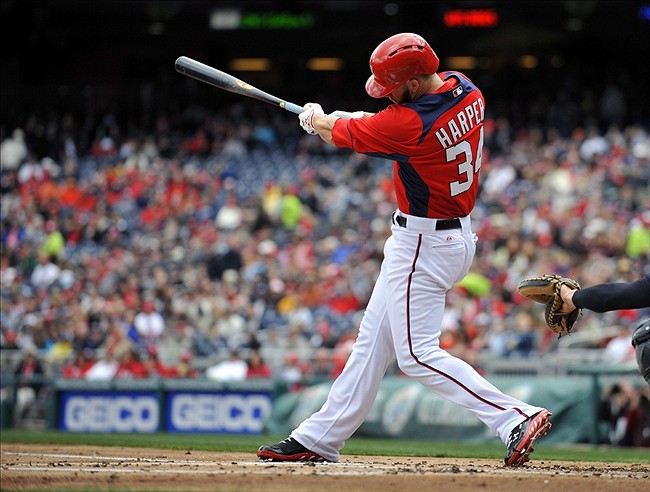
Harper's run production in the middle of the order should spark this team now that he's back.  Photo via fansided.com

Harper’s run production in the middle of the order should spark this team now that he’s back. Photo via fansided.com

When Bryce Harper was reinstated from the D/L on 6/30/14, an interesting situation occurred:  The Nationals were at full strength for the first time, all year.

That’s right.  With Doug Fister starting the season on the D/L, even those who think that the team was at “full strength” for the first 7 innings of the first game (that’s how long it took before a Nationals offensive starter got hurt) aren’t quite right.  This team has been hampered and has been covering for injuries to its best available squad since the first day of the season.  Here’s a review of the tale of the injury tape for the ideal 25-man roster of this team so far in 2014:

  • Doug Fister; strained shoulder 3/23/14, missed 34 games
  • Wilson Ramos: broken hand on 4/1/14, missed 32 games
  • Scott Hairston; oblique strain on 4/6/14, missed 26 games
  • Denard Span, concussion on 4/12/14, missed 7 games
  • Ryan Zimmerman, broken thumb on 4/13/14, missed 44 games
  • Bryce Harper: torn thumb tendon on 4/27/14, missed 56 games
  • Adam LaRoche: strained quad on 5/11/14, missed 14 games
  • Gio Gonzalez, shoulder strain on 5/18/14, missed 27 games
  • Ramos again, this time a hamstring strain on 6/11/14, missed 14 games

2/5ths of the rotation and 5/8ths of the starting offense have at one time or another been on the shelf so far this year.  More than 250 games lost.  Ironically the oldest player on the team (Jayson Werth) has been one if its healthiest (he’s only missed 4 games this year).  And (knock on wood) there hasn’t been a single bullpen injury, likely one of the main reasons the Nats bullpen is among the best in the game this year.

The Nats (at the time of this writing) sit 1/2 a game out of first behind nemesis Atlanta, but have several reasons to be optimistic about catching them:

  • The Nats have a +39 run differential right now, while the Braves have a zero run differential.  That means that the Nats should be 9 games above .500 (according to pythagorean records) while the Braves should be a .500 team.  The Nats have been unlucky while the Braves have been quite lucky.  You could expect these situations to reverse themselves over the rest of the season.
  • The Nats are just 2-7 in extra inning games and 9-13 in one-run games.  You’d normally expect both of these W/L records to be near .500 and is likely the real reason behind the above run differential issue.
  • Despite the heart of their batting order missing dozens and dozens of games, the offense is not doing half bad: the Nats as a team are 8th out of 15 in the NL in WRC+, 8th in runs scored, 8th in wOBA, 10th in batting average, and are 10th in homers despite Zimmerman having just THREE on the year.
  • While the Offense treads water, the Pitching has been fantastic.  Our starters are 5th in the NL in ERA, 1st in FIP, 2nd in xFIP, 2nd in SIERA.  The bullpen has been equally as good (a huge improvement over last year):  2nd in NL ERA, 1st in FIP, 6th in SIERA.
  • The starters lead the NL in FIP despite Stephen Strasburg‘s “struggles;” ironically despite his having a .500 record an a 3.70 ERA he has the best FIP of any Nats starter.   He’s just been victim of circumstance while he pitches.   Blake Treinen has been fantastic covering in the rotation, and the team has found an excellent 5th starter in Tanner Roark.  Games that were “thrown away” time and again last year by Dan Haren and a litany of poor-performing minor league call-ups have been handled with aplumb this year.

Where do we go from here?

The Nats schedule from here on out eases significantly; as of the time of this writing the last three months look like this:

  • July: 10 of 25 games against teams with winning records right now
  • August: 12 of 28 games against teams with winning records right now … and that includes teams that very well may have losing records by the time we get to them.
  • September: Just 9 of 27 games against teams with winning records right now, including the final 11 against Marlins and Mets teams likely to be playing out the string with 40-man call-ups from AAA and key young arms sitting due to inning limits.

For this Nats fan, its hard to see the same struggles we saw last year; I see a team finally getting their squad back together, having a solid July and perhaps a dominant closing to the season to fulfil its promise.  I like where this team stands right now (even with the tepid split in Chicago last weekend) and look forward to the next few months.