Nationals Arm Race

"… the reason you win or lose is darn near always the same – pitching.” — Earl Weaver

Archive for the ‘Majors Pitching’ Category

Maya DFA and outright; the end of an era

19 comments

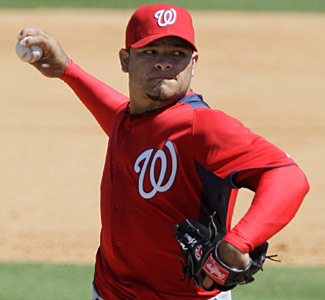
Maya's outright likely ends his MLB career. Photo via thenatsblog.com

Yunesky Maya got his final shot at glory, getting a call up last week to provide long-relief cover while Ross Detwiler was on the mend.   He failed, giving up a game-winning  home-run and retiring just one batter in his 5/21/13 appearance in San Francisco, leading to his DFA a few days later.  He cleared waivers and was outrighted to AAA on 5/27/13.  The outright likely signals the end of Maya’s major league career and makes for a difficult road back to the majors for him at any point in the future.

Maya will play out the string in Syracuse (unless promotions create for a roster squeeze, then its highly likely he could be flat out released) and will be looking for work elsewhere next year, likely in the Independent or Mexican leagues.  He retires with this career MLB stat line: 1-5 with a 5.80 ERA, 1.576 whip and a career ERA+ of 69.  He had flashes of decency, sometimes even brilliance, in AAA over parts of several years, but even this year seems more indicative of his overall talent (in 8 AAA starts as of the time of this writing he’s just 1-4 with a 5.07 ERA)

Maya signed a 4 year/$8M international free agent contract in 2010 after defecting from Cuba.  The Nats fended off several interested teams (reportedly including the Yankees) to acquire his services and Maya was supposed to be the marquee re-entry for this franchise into the international FA market after the entire Smiley Gonzalez/Dominican Republic debacle.  I’ve already classified Maya’s contract as one of the worst FA deals Mike Rizzo has ever signed, and this DFA is the icing on the cake.  At least it only took Rizzo 3 and a half years to own up this failure and DFA him (sarcasm).

How did the Nats miss on this signing?  Reportedly, Maya was said to be throwing much harder during scouting trips than he ended up being capable of throwing once he reported to Nats camp.   See this post in June 2011, which summarizes all the issues Maya had while getting his longest MLB look and has links to his Pitch F/X data.  Maya never was able to throw with the same velocity that the scouts said, and his control was never good enough to make up for the difference.  He’s not a big guy, so he has zero downward plane on his pitches and they have a tendency to flatten out and become rather hittable.

As I noted in my annual look at Pitcher Wins on the FA market, Maya’s single MLB victory for the Nats $8M investment now represents one of the worst average $/win contracts ever signed.  Luckily for the Nats, it was just an $8M contract, not a $50M contract like other candidates for “Worst FA pitching contract ever signed.”

You hate to pile onto a guy.  I eagerly watched his September 2010 debut and wrote it up in length here.  The guy has 8 pitches.  We were hoping for Yu Darvish and we got .. well we got some guy who couldn’t get MLB hitters out on a regular enough basis to keep his job.

Written by Todd Boss

May 30th, 2013 at 7:28 am

First Look: Nathan Karns

19 comments

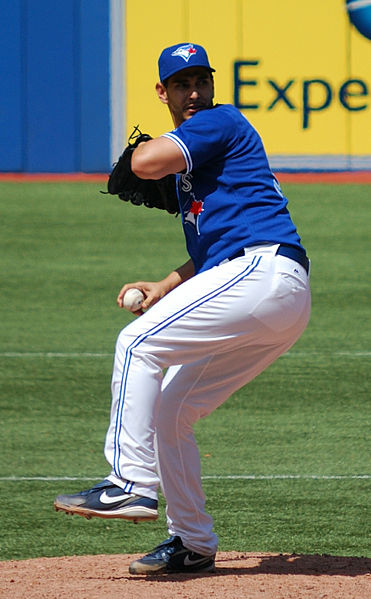
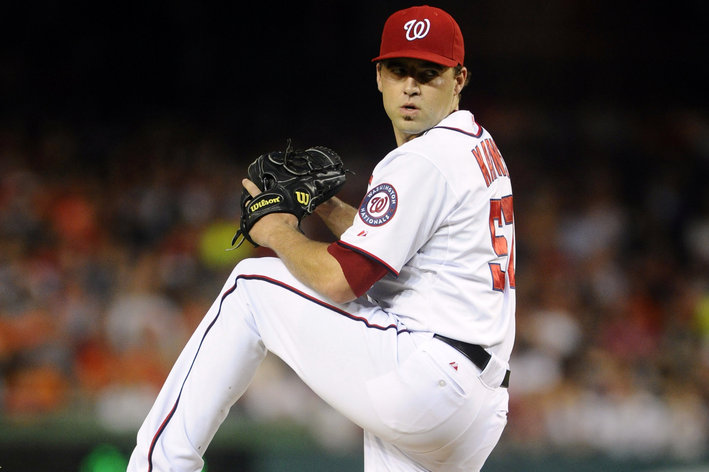
Karns looked good enough considering the circumstances in his debut. Photo Brad Mills-USA TODAY Sports

A surprise callup for Nathan Karns resulted in an up-and-down performance on 5/28/13.  He showed a power fastball that averaged 94.7 and peaked at 97.36.  He struggled with his curve on the night, only throwing 7 of 16 for strikes as the ball seemed to slip out of his hand (he throws a knuckle-curve and the combination of humidity, steady rain and his own perspiration conspired against his grip all night).  He threw a few changeups here and there but mostly worked his 4 seam fastball.

He worked around a very tight strike zone in the first (look at the ball/strike plot for the first inning: the first pitch he threw and a 2-strike call that was within the strike zone by literally 6 inches were missed calls) to get a 1-2-3 inning.   Yes he missed his spot, but the ball was clearly a strike.  Robot Umpires now!  😉  He got touched for a run in the 2nd off of a couple of well-hit balls before reaching back and getting a key strikeout of the Baltimore #8 hitter (and then finishing off the helpless #9 AL pitcher Kevin Gausman for two of his three Ks on the night).  He continued to get weaker ground ball outs in the 3rd before getting touched up for a couple of runs and a couple of bombs in the 4th.

He was running on fumes by the middle of the 5th, having sat out a lengthly weather delay, having thrown 85 pitches and seeing his velocity dipping.  His only two walks on the night were the last two guys he faced, a telling sign.  He was lifted for Zach Duke (the guy whose performance was so bad in his own spot start that he couldn’t keep this role above a AA player), who “stole” the Win from Karns with a clean 5-out performance.  That sucks for Karns frankly; he had a 7-3 lead with the bottom of the order coming up; you couldn’t try to let Karns get that double play to get a victory?

On the night; he induced a number of weaker ground ball outs (especially to 2nd base; Steve Lombardozzi was really busy on the night).  His fastball just seemed “heavy” to the hitters, and despite giving up a few hard hit balls he also got a number of weaker hit balls and wristed floaters into the outfield.  I’d like to see more strikeouts (just 3 on the night).   Pitch F/X says he throws both a 2-seamer and 4-seamer; I didn’t see any difference in any of his fastballs though and the velocity looks too similar to be distinct (I think the horizontal movement delta was why Pitch F/X classified the balls differently; I just think some of his pitches had more horizontal movement than others).  So right now Karns is what we though he is; a good fastball, a plus curve when he can grip it, a relatively unused changeup and no 4th pitch.  After this little stint I think the team sends him back to AAA to learn another pitch.  Why not incorporate a 2 seamer and try to get some sink?  He throws basically overhand (his curve is a 12-to-6 er) and a power 2-seamer could be an effective change of pace to his 4-seamer moving horizontally.  Or try a split-fingered fastball to see if his over-the-top delivery can get some drop?

In the end; He pitched pretty durn well for a guy with just a handful of minor league starts above A-Ball.  He did well enough to earn another start.  And he’ll need all the help he can get; that start is next sunday in Atlanta against the first place and streaking Braves.  He was clearly nervous in his MLB debut and the conditions didn’t help; lets see how he does after a regular turn and in more “calm” conditions.

Written by Todd Boss

May 29th, 2013 at 9:33 am

First Look: Kevin Gausman

leave a comment

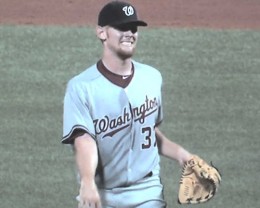
Kevin Gausman made his MLB debut on 5/23/13 just a year after pitching in the SEC. Photo unk via orioles-nation.com

With no Nats game on Thursday 5/23/13, and with a vested interest in newly promoted Orioles starter Kevin Gausman (my vested interest being that I was considering nabbing him in my fantasy league), I watched his first start against Toronto.

First thoughts; Wow.  I know Gausman’s line wasn’t that great last night, but I just pulled up his  Pitch F/X data on the night and am impressed.  He threw 63 fastballs on the night with an AVERAGE speed of 97.26.  By way of comparison, right now Stephen Strasburg leads the majors in average fastball velocity at 95.4.  This kid was holding that average velocity through 60+ fastballs and 90 pitches on the night.  That’s some serious heat.  His mechanics were clean, the arm action easy, and he easily kept his mechanics while pitching from the stretch.  Gausman has good size (6’3″ 190) and has raced through the minors to make this debut in 2013, only the 3rd guy out of last year’s draft to do so (Mike Roth, Paco Rodriguez).

He has a fantastic change-up with reverse action away from left-handed hitters (this was what his scouting report said too): 84mph average.  That’s a 13mph delta between his 4 seamer and his change up.  That’s just silly.  In a recent post I posted a table of average velocities for the pitches of some of the league’s top pitchers; the best fb-ch delta out of that group of hard-throwers was Samardzija‘s 11.6 mph delta.  Strasburg’s is only 7.4mph difference and he’s considered to have a completely unhittable change up.  Gausman’s change is almost too slow; hitters sitting on 98mph may actually have enough time to re-adjust to his change.  Though that being said, he got a lot of strikes and some silly swings on the change on the night.

He didn’t really use his curve that much; 11 times out of his 89 pitches (pitch f/x gives him both a slider and a curve, but the speeds look the same and the speed delta has to be a curve; his slider would be nearer 91mph).  At one point he threw 4 straight changeups, which directly led to a walk b/c the hitter (Colby Rasumus) knew what was coming and laid off.  I bet this kid has never thrown four straight changeups in his entire life.  Wasn’t a fan of that At-bat nor the pitch calling from Weiters.  He may need to develop a 4th pitch, or at least work on his curve, despite how plus his firs two offerings may be.

The hits he gave up were a combination of legitimate and lucky.  Later on Rasmus laced a 2-0 fastball that he could sit on (he’s a dead-red fastball hitter who got a fastball in a fastball count, another poor job of calling that at-bat again from Weiters).  Lind wristed an 0-2 pitch for a hit on a hanging curve.  He gave up at least two other 2-strike hits when he missed his spot.  Lawrie bunted and Chris Davis misplayed the play, calling off the pitcher only to let the ball try to go foul and it didn’t.  That led to a bases-loaded no outs situation in the 4th and he was lucky to get out of that with only one run.  Even the 5th inning homer he gave up seemed weak; Arencibia didn’t seem like he got it all; it was an inside pitch that he wristed out.  He hit the ball 369 feet as it turns out; Toronto is an easy place to hit down-the-line homers like this.  Hittracker classified the homer as being “plenty long” and it would have been out of 22/30 parks in the league, so maybe it wasn’t as lucky as I’m characterizing it.

I was slightly surprised to see Gausman get yanked after 5innings.  He was through the meat of Toronto’s order and was facing 8-9-1 in the 6th on only 89 pitches. Looking at the score, yes you’d understand him getting pulled.  Looking at his stuff and what had transpired?  I’d have given him another inning with a short leash (one baserunner and you’re out).   Showalter had seen enough though, brought in a couple of relievers who promptly conspired to give up a grand slam to Encarnacion and blow the game.  Loss for Gausman in his MLB debut.

Final line: 5ip, 7hits, 2 walks, 5 Ks and 4 earned runs. 89 pitches 58 strikes for a 65% clip.   He had a 49/5 K/BB ratio in the minors this year, an amazingly good ratio for someone with 99mph heat, so the two walks were uncharacteristic.    Very much looking forward to his next outing.

Ask Boswell 5/20/13 Edition

13 comments

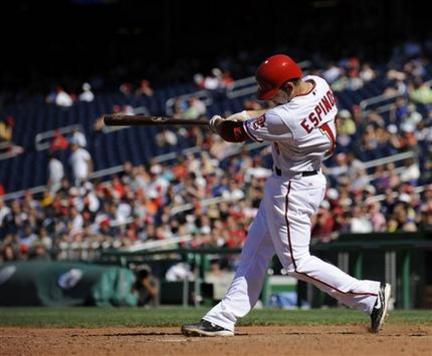
The drum is banging for Espinosa's benching. Photo AP Photo/Nick Wass

Another week, another set of disappointing results for our weary Nats (losing two games in San Diego?  come on), coupled with a troubling set of injuries, and Nats fans are a bit nervous.  Lets see what kind of questions Tom Boswell got in his weekly chat, 5/20/13 edition.

As always, I write a response here before reading his, and sometimes edit questions for clarity.

Q: You can have Stephen Strasburg or Jordan Zimmermann for the next eight years, but only one. Which do you pick?

A: Has it come to this for poor Stephen Strasburg?   As I pointed out in this space last week, Strasburg isn’t any worse or different of a pitcher right now; he’s just been really unlucky this year.  Despite Jordan Zimmermann‘s dominance so far in 2013, I still think Strasburg has better stuff and a  higher ceiling.  I’d still go with Strasburg.  Boswell also goes with Strasburg based on age and the last three years stats.

Q: Nick Markakis has proven to be a solid veteran but, possibly due to injuries, not the star the Orioles envisioned when they gave him the big contract extension. Do you think this may be Ryan Zimmerman’s fate?

A: Great question.  Nick Markakis has been injury plagued … but only the last two years.  Before that he was very solid, rarely missed a game, and had some really good numbers.   Ryan Zimmerman only has managed to play three full seasons and has missed significant time in 5 others.  Zimmerman is being paid a 9 figure salary but may not really be a 9-figure player honestly.  I’ll freely admit; after injuries and now his arm issue, i’ve really fallen off the Zimmerman bandwagon.  So yes, in a way I agree with the questioner.  Boswell sort of agrees too.

Q: Is it time to really worry about the Nats? The most errors in the majors, the hitting remains spotty at best, and they can’t score enough runs to win when their best pitchers give extra-quality starts.

A: I’m definitely worried.  They should have swept the Cubs.  There’s no dishonor in losing to two Aces in Los Angeles (Kershaw and Greinke), but then to come to San Diego and lose to a no-name journeyman in Eric Stults and a rookie in Andrew Cashner (no matter now promising he may be), is troublesome.  They now travel to San Francisco with no pitching advantage in any of the three games and look like they could easily get swept the way they’re hitting.  Of course, that being said, I must also remind myself of my 4/24/13 post that talked about our very tough early schedule … and remind myself that the Nats go 8 weeks in June and July without playing a playoff team.  So we just have to scuffle around .500 until then.   I’ll say this though; if we don’t go somthing like 20-8 in June, we’ll have different issues.  Boswell says its May 20th, relax (paraphrasing 🙂 )

Q: I’m puzzled by his use of the bullpen. Last year, every guy seemed to get an inning or two of work every few days. (Of course, last year every guy was also reliable.) The postgame analysis yesterday talked about how rusty they were and chalked it up to the starters going long. To me, it seems more about the relievers being brought in (or not) at all the wrong times. Thoughts?

A: Ah, a question after my own heart.  I have complained about Davey Johnson‘s management of the bullpen twice this year already, after both Detwiler and Gonzalez had excellent efforts wasted when they got pulled too early.  I’m just not getting the bullpen usage at all.  In Johnson’s defense, he just hasn’t had enough blowouts (wins or losses) in order to really get his fringe guys work.  Zach Duke has exactly 2/3s of an inning this entire MONTH.   Stammen may be our best reliever and he’s only getting one appearance a week right now.  Henry Rodriguez got only his second appearance in May in yesterday’s blow out.  So yes, that’s nearly half his bullpen that is inarguably rusty.  In some ways its a good problem to have; it means their starters have been going deep and there’s not been a need for 6th and 7th innings of work.   Rodriguez has brought his inactivity upon himself frankly, but I think Stammen needs some of these later inning stints right now.  Boswell agrees that the bullpen management has been poor this year.

Q: Is it acceptable for a manager or GM to tell a player that he is not a switch hitter at the big league level? Espinosa has always looked better from the right side of the plate. Career he is .221 from left side and .264 from right. Considering his struggles, maybe someone should tell him he’s a right handed batter. No shame in that after all.

A: A great question, one that continues to follow Danny Espinosa. He has not “turned the corner” in 2013 as some had hoped; instead he’s bottomed complete out.  A 90-100 OPS+ figure is ok if you’re hitting for power; this year he’s sitting at a 33 OPS+ with an embarassing slash line.  June 1st I think the hammer comes down and Espinosa goes to the bench in favor of Steve Lombardozzi. That being said, Lombardozzi isn’t exactly lighting the world on fire either right now, so maybe both guys sit in favor of Anthony Rendon or maybe even a call-up Jeff Kobernus, who has been hitting well in AAA.  As for the question in hand; can a GM “tell” a player to stop switch hitting?  Probably not; Espinosa has presumably never faced a top-level right hander from the right side; I’d have to think that forcing him to stop switch hitting would make him even worse.  At the very least that change happens in the off-season/spring training, not in the middle of a slump.  Boswell posts a very eloquent answer about what the team may do with Espy/Lombo but doesn’t answer the core question.  Maybe it isn’t answerable.

Q: Nats pitchers giving away Stolen Bases: This is getting ridiculous. It has been a serious problem since last year, known to everyone. Didn’t anyone of the pitching staff work on this in the off-season?

A: The coaching staff said they did.  I havn’t really noticed.  Lets runs some quick numbers out of Baseball-Reference.com:

2012 Starter SBs SBs CSs SB%
Strasburg 14 2 88%
Gonzalez 12 1 92%
Zimmermann 10 2 83%
Jackson 7 5 58%
Detwiler 3 2 60%

Yes, the rotation last year generally speaking was not holding runners on.

2013 Starter SBs to 5/20/13
Strasburg 5 1 83%
Gonzalez 2 2 50%
Zimmermann 5 1 83%
Haren 2 0 100%
Detwiler 1 0 100%
2013 Starter SBs extrapolated full season
Strasburg 18.3 3.7 83%
Gonzalez 7.3 7.3 50%
Zimmermann 18.3 3.7 83%
Haren 7.3 0.0 100%
Detwiler 3.7 0.0 100%

So, Strasburg isn’t appreciably improving in this regard, but Gonzalez has really worked on it.  Zimmermann looks about the same.  Haren is not quite as good historically as Jackson at holding runners, but the variations in the factors may have something to do with that as well.  All in all, I don’t think its as bad as it was last year.  Boswell’s answer verbatim: “They worked on it. They ain’t fixed it.”

Q: Just looking at Strasburg’s pitching in comparison to other elite speedballers in the league and I find one glaring item: the speed of his pitches in relation to the fastball . His off-speed pitches seem to hover too close to his fastball. Verlander, Wainwright, Kershaw, et.al., all throw 90’s fastballs, 70-85 curve and change-ups. Is this something that is missing from his arsenal?

A: Is this true?  Lets do a little Pitch F/X analysis.  All these numbers are average speeds for the pitch type for 2013 only for the pitchers named in the question plus a handful of other hard-throwers:

(Quick glossary lesson for pitch F/X: FA = 4-seam fastball.  FT = 2-seam fastball.  SI = Sinker, usually ends up being the same thing as a FT.  CU=Curve, SL=Slider, CH=Change up and FC = Cut-Fastball).

FA FT/SI CU SL CH FC FA-CU Delta FA-CH Delta
Strasburg 95.5 95.3 79.7 88.1 15.8 7.4
Samardzija 94.9 94.3 82.9 83.3 91.1 12 11.6
Harvey 94.7 94.4 82.3 89.1 86.4 12.4 8.3
Zimmermann 93.7 93.6 77 86 86.6 16.7 7.1
Verlander 93.5 93.3 78.7 85.3 86.7 14.8 6.8
Darvish 93 92.7 66.7 81.8 86.9 89.3 26.3 6.1
Kershaw 92.5 73.6 84.5 85 18.9 7.5
Hernandez 91.1 91.4 80.5 84.2 88.7 91.9 10.6 2.4
Wainwright 90.9 90.6 74.9 83.7 87.3 16 7.2

Strasburg’s delta between his curve and his fastball is 15.8.  That’s an almost identical delta to Wainwright and is better than Verlander.  Kershaw‘s delta is ridiculous, but his curve is also his signature pitch.  Meanwhile Darvish‘s curve is almost comedically slow and he rarely throws it.   Strasburg’s Fastball-Change up delta is also very consistent with the top pitchers in the league, and is “better” than the likes of Verlander and Darvish.

So, I’m calling BS on this question.  I don’t see any problem with Strasburg’s arsenal or the delta between his pitches.  He throws a ridiculous, unhittable 88 mph circle change that breaks a foot; ask yourself whether or not MLB hitters want to see that pitch right after the see him hump it up to 98mph.  Boswell says his stuff is fine and give some similar numbers, including some Vertical and Horizontal pitch F/x discussion that I only alluded to.

Q: What Logic did Davey have leaving both Haren and Mattheus in past their effectiveness. Haren? Well okay, sometimes he shapes up as the game goes on. HOWEVER! Leaving Mattheus in for that long when he kept getting pinged and dinged was ridiculous! Was this essentially a forfeit to save the bullpen for when Duke pitches tonight?

A: The chances of a team overcoming a 6-7 run deficit are astronomically low.  So much so that most teams just go into autopilot once a big enough lead is opened up by either team.  That’s why there’s so many “unwritten rules” regarding doing things with big leads; guys are mentally checked out and just trying to avoid the embarassment.  The same can be said for bullpen use.  Once one guy gets hammered, if the next guy does too you just kind of throw in the hat and just let guys work it out.  What use would it have been to replace Mattheus after the Padres had scored 12 runs?  You let the guy work on his craft, get some innings in, and move on to the next game.   Boswell says, yes this was basically Johnson giving up.

Q: Boz, my 13-year-old is convinced that the Nats are finished (and that he could play second base better than Danny Espinosa, but that is another story). Baseball seasons are long, and Dad is confident but quietly getting concerned with the way the records look in the NL that a second-place finish in the NL East will not result even in a wild card. At this point in the season, what things do we really know with certainty about this team?

A: What do we know?  I think we know the following:

  • We still have 4 very good starters (Gio will get it back and post another 120 ERA+ season).
  • We know Haren is a weakness
  • We know Harper is no one-season wonder and is improved.
  • But we also know that Harper has not been the same since his first injury scare about a month ago.
  • We know we have some issues on defense and in the bullpen, and have all year.
  • We know our schedule gets easier.
  • But we also know that the Braves have cooled off and despite our iffy run we’re just a couple games out of first place in our own division.
  • I don’t trust either Pittsburgh, Arizona or Colorado to continue to play even .500 ball, so I’m not worried about a 2nd wild card coming from a weird place.
  • And lastly, we know there’s a lot of baseball to be played.

Boswell talks about our starters and Harper, and the re-iterates my last point.  There’s 100 games to play!

Q: Did the addition of Soriano contribute to Storen’s struggles?

A: I think it had to; after a demoralizing game 5 loss the team replaces you and demotes you in the off-season.  Wouldn’t you struggle in your job if that happened to you?  I think we’ve talked about this before so I won’t go into great detail.  Boswell’s heart wasn’t in the answer either; he just noted that Storen’s first save since his Game 5 meltdown was this week.

Q: Seems like you left out what may be the sanest idea for the Nats’ offensive woes in your column: move Rendon to second base permanently and call him at the All Star break if he’s still mashing at AA and Espinosa still can’t hit a slow pitch softball.

A: He did, but I didn’t; see above.  Boswell admits this is eventually going to be an option.


Injuries and Idiocy lead to interesting Call-ups

23 comments

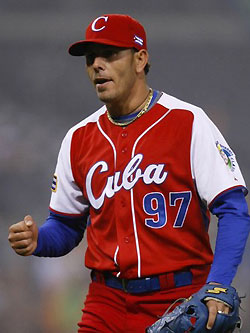
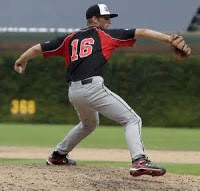
Unbelievably, Maya gets another MLB shot. Photo Al Bello/Getty Images

Hey, we’ve all been there Ryan Mattheus.

But clearly Mattheus never watched Bull Durham; Crash Davis‘ last lesson to Ebby Calvin ‘Nuke’ LaLoosh involved exactly what Mattheus just did to himself.  If you’re going to punch something … NEVER punch with your pitching hand.

And then in an even worse move, Mattheus hid the injury from his manager until it was too late to call up someone, meaning the team was short a reliever for last night’s SF game (a predictable 8-0 loss as Zach Duke even more predictably got hammered for 7 hits and 4 earned runs in just 3 1/3 innings).

We may even have an issue with Henry Rodriguez, who apparently “grimaced” as he was throwing one of his FOURTY SEVEN pitches last night, a ridiculous amount of pitches for a max-effort guy who should normally be throwing half that in an outing.  Don’t be surprised to see news of him hitting the D/L either.

So, with the bullpen shredded and now devoid of basically anyone who can throw significant long innings for the next couple of days, the team called up Yunesky Maya to provide some cover.  Maya has been awful in AAA so far this year (1-4 with a 5.07 era) but he’s the best option on the 40-man roster for what they need right now.   They’re also planning on calling up lefty Fernando Abad, one of their slew of lefty minor league free agents who has been excellent in AAA this year.   Abad will likely be a one-for-one replacement for Mattheus when he hits the D/L and has earned his way back to the majors.  Abad will require a 40-man move; he will be the 40th guy on the roster.  Maya likely switches places again with Eury Perez once the bullpen can catch its breath.

A better more interesting question may involve the fate of Duke.  He’s been awful this year, barely appears because of it, and when he is called upon to provide the one thing the team needs from him (an effective spot start) he fell on his face.  He’s not given this team anything close to what Tom Gorzelanny gave us for the past few years, and I’m beginning to wonder if the team really made the right decision keeping Duke over Gorzelanny.  Duke only makes $700k a year (versus the 2yr/$5.7M deal that Gorzelanny got from Milwaukee) but with the marginal value of a “Win” on the open market being in excess of $5M these days, have the Nats ended up being penny wise but a pound foolish?

Regardless of the “hindsight is 20/20” analysis with Duke versus Gorzelanny, I have a feeling we may be seeing another move in the near future; the DFA of Duke and the call up of either J.C. Romero or newly acquired Xavier Cedeno. Both are lefties, both are veterans, both are pitching really well in Syracuse, and both seemingly can do no worse than Duke has done.  This isn’t as exciting as seeing a prospect get called up (for example; Danny Rosenbaum or Erik Davis), but with any more injuries we may get there.

R.A. Dickey and his “Nasty Pitch” on 60 Minutes Sports

one comment

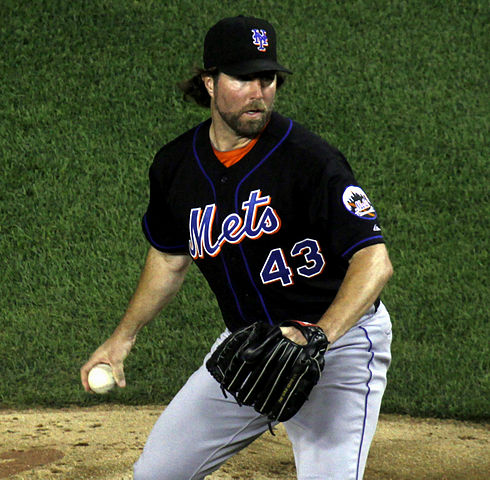
R.A. Dickey and his knuckleball were on 60 minutes last month. Photo via wiki/flickr user dbking

R.A. Dickey and his knuckleball were featured on 60 Minutes Sports last month and we just got around to watching it off the DVR.  If you missed it, the full segment is available online at cbsnews.com via this link.

Now, we’re not talking very in-depth reporting here (Lesley Stahl is the reporter, not exactly known for doing heavy hitting pieces), but the parts about Dickey and the physics of the knuckleball are fun.  They talk about Dickey’s “dark past” in the intro but I don’t recall them going into it (you can read his wiki page for a quick summary).  They interview a couple of university researchers who specialize in physics and engineering and demonstrate some cool stuff about the knuckler.  They interview Phil Neikro.  And of course Dickey himself is a good interview, though they don’t really go that deep into his life or his pursuits.

One funny bit that I learned from the piece: Dickey wouldn’t even join the team when they went to Colorado because he knew the thinner air there destroyed his knuckler.  Makes sense to me; when you see the knuckler in the wind-tunnel on the piece, its fascinating to see how the air particles move around the ball.  Also funny was the time that Dickey had to run across the street from Shea stadium to get a “korean nail salon” to work on his hand after he tore/broke a nail on the mound; he apparently literally ran over there in full uniform straight out of the stadium.

Anyway; good quick watch.

Written by Todd Boss

May 20th, 2013 at 7:46 am

Strasburg leads the league in ERA in Losses

5 comments

Unlucky Stephen. Photo allansgraphics.com via free-extras.com

Thanks to the Billy-Ball.com website for this interesting phenomena:

We know Stephen Strasburg has been suffering from some pretty crummy run support so far in 2013 (2.7 runs per start, and it took the team 7 games to score more than 3 runs for him).  What’s also interesting is the table in the above link; Strasburg leads the league in ERA in losses.  He’s got a 3.38 ERA in his 5 losses.

Whats special about that?  Well, most pitchers have dazzling ERAs in their Wins, awful ERAs in their losses, and mediocre-to-bad ERAs in their no-decisions.  Through his first nine starts though Strasburg doesn’t really show this.

  • in 2 wins: 0.60 ERA; he’s given up just 6 hits in 15 innings.  Pretty much unhittable.
  • in 2 No-Decisions: 4.15 ERA
  • in 5 losses: 3.38 ERA.

Compare these numbers to what he did last year:

  • in 15 wins: 1.88 ERA
  • in 7 No-Decisions: 3.12 ERA
  • in 6 Losses: 7.39 ERA.

By and large you see his 2012 numbers for nearly every starting pitcher; when they’re on, they win.  When they’re off, they lose.  Usually the No-decision ERA gives you a relatively decent indicator as to the “true” talent of the pitcher.  I’ve never seen a loss ERA as low as his 2013 number frankly, and it seems to support what we’ve kind of know all along about Strasburg’s 2013 season; no run support, lots of errors and unearned runs behind him, and a lot of bad luck have contributed to an ugly W/L line.

Given these numbers, there’s just no way his W/L record continues to be this bad.

Written by Todd Boss

May 18th, 2013 at 2:18 pm

Posted in Majors Pitching

Tagged with

Davey Johnson: Over Manager

13 comments

If I'm Gonzalez today I'm having a serious conversation with my manager. Photo Joy Absalon/US Presswire via usatoday.com

A quote from MLB’s game recap of yesterday’s Nats 2-1 loss to the Cubs:

It’s just the way I manage,” Davey Johnson said of his decision [to remove Gio Gonzalez for a pinch hitter in the 7th]. “You can chalk it up to me. You don’t like it, chalk it up to me. It didn’t work out.

Well, this post is going to criticize that decision, because not for the first time this season Johnson removed a highly effective starter on a relatively low pitch count only to watch lesser pitchers blow the game.

If I was Gonzalez (or Ross Detwiler, whom Johnson did this too earlier in the season against the Braves and which I commented on in this space in mid April, or Stephen Strasburg, who got yanked on opening day after throwing just 80 pitches; a decision I defended at the time but now see as the start of a pattern), I’d be really pissed, and I’d be demanding a change.  Gonzalez was perfect through 6 innings, and was through 7 complete on just 85 pitches.  He had 7-8-9 coming up in the eighth inning.  What POSSIBLE reason was there to remove him from the game??

Johnson intimated that the reason he pinch hit for Gonzalez was because he “sensed an opportunity” to break open a close game.  What opportunity was that?  To bring up a cold, ineffective pinch hitter (as is most of the Nats bench right now) to feebly wave at 3 pitches instead of allowing Gonzalez to hit?  I can defend pinch hitting for your pitcher there … IF you have guys on base and if there’s a real scoring opportunity.  To lead-off an inning against a new, fireballing reliever??  No way.

Johnson’s job is to WIN GAMES.  Not to worry about whether the bullpen is getting enough work.  Hey bullpen guys; you want work?  Be better pitchers and become starters.  Or go play for a team with lesser starting pitching.  Otherwise sit in the outfield and wait your turn.

I’m tired of watching our crummy bullpen throw away golden starts, and i’m sure the starters are as well.  Yeah there was an error thrown in there.  Yeah there were bloop hits and some unlucky seeing-eye singles.  Doesn’t matter.  Johnson helped turn a W into an L.  That may not sound like much, but its only mid May and this has already happened more than once.  It only takes one extra loss to cost a playoff spot.

Written by Todd Boss

May 13th, 2013 at 10:06 am

Nats Starter Matchup Monthly Analysis

4 comments

Ross Detwiler has been helping to keep the team afloat all year. Photo: Photo by Marc Serota/Getty Images

In the same spirit of grading the Minor League starters from yesterday’s post, here’s letter grades for each of the starts in April for our MLB rotation:

MLB Rotation:

  • Strasburg: A,D-,A-,B-,C+,B-
  • Gonzalez: A,B+,F,D,A+,D-
  • Zimmermann: B,B+,A,B-,A+
  • Haren: F,D,D-,C-,B+
  • Detwiler: A,A-,A-,B-,C-

Discussion: Nats YTD Stats are here for reference

We’ve all been watching the games, so nothing surprising here.   Jordan Zimmermann has quietly been one of the best starters in the NL so far.  He’s working on a .861 WHIP and has 5 straight Quality Starts.  This is reflected in his grade scores above.   Meanwhile. Dan Haren‘s early struggles are slowly turning into workable outings.  Ross Detwiler‘s Sunday loss was “death by paper cuts” and his 11 hits allowed wasn’t as bad as it looked in the box score.  I’d like to see some more consistency out of Gio Gonzalez; is he an 8ip-1hit guy or is he 7 runs in 5 innings guy?  There really hasn’t been an in-between for him.  Lastly Stephen Strasburg hasn’t pitched that badly (one bad outing out of 6) but has gotten almost no run support, contributing to his ugly W/L record.


Now here’s some fun Starting Pitcher Matchup analysis.  I’ve been keeping track of the opposing starter we’ve faced each night and ranked them three different ways:

  • Their Rotation Order intra team: the opening day starter for a team is their “#1” and the other four guys are ranked 2-5 as they appear in the opposing rotation.
  • Their Ranked Performance intra-team: at the time of their series with the Nats, the 5 starters on a team are ranked 1-5 on pure in-season performance.  The guy with the best season stats at that time is ranked #1, the guy with the worst #5.
  • Their Subjective League-Wide “Rank” as a pitcher: a subjective look at whether the opposing starter is a league wide “Ace,” a near-Ace or #2, and the like.

I also kept track on a night-to-night basis a quick opinion on whether I felt the Nats had the Starting Pitching Advantage (or if it was an even-matchup, or if I felt the opposing team had the pitching advantage) and tracked how we did.

Here’s some analysis based on our opposing pitcher each night.  It provides some interesting insight into the team’s performance so far.


Rotation Order Stats

Starter # Record Opposing Starter in Wins Opposing Starter in Losses
1 2-4 Nolasco (2) Cueto, Hudson (2), Wainwright
2 2-3 Slowey, Peavy Maholm, Harvey, Garcia
3 5-0 Leblanc (2), Floyd, Hefner, Arroyo
4 1-3 Bailey Bailey, Sanabia, Gee
5 3-3 Leake (2), Axlerod Teheran (2), Miller
5+ 0-1 Cingrani

In other words, the Nats are 2-4 versus opposing team’s “Aces,” 2-3 against their #2’s, etc.

(Note: a “5+” pitcher means a starter who was not on the opening day roster for a team.  We’ll see a ton more 5+’s as more starters go down with injury and are replaced by minor league call-ups).

Not all #1 starters are made the same, nor are #5 starters.  The team has the expected losing record against other team’s #1s, but also has a relatively weak record against other team’s #4 and #5 starters.  Some of this is thanks to Haren‘s weak matchup as our #4 starter, and some of this is because guys like Homer Bailey, Shelby Miller and Tony Cingrani aren’t exactly bottom tier starters in this league (we’ll see this later on with the “League Wide Rank” table).


I initially started tracking this ranked-opposing starter analysis to prove to a friend that a team’s “Ace” doesn’t always go against another team’s “Ace.”  And you can see how quickly team’s rotations get mis-matched versus one another thanks to the unbalanced schedule and irregular off-days:

Strasburg Three vs #1, Two vs #2, One vs #5
Gonzalez Three vs #2, Two vs #3, One vs #1
Zimmermann Three vs #3, Two vs #4
Haren Two vs #4, Three vs #5
Detwiler Two vs #5, Two vs #1, One vs #5+

Detwiler’s #5 rotation spot is now matched up essentially with the #1 spot of a lot of his opponents (the one #5+ spot was Cingrani, who took Cincinnati’s #1 spot from Johnny Cueto when he hit the D/L), and has been since mid April.  Thankfully our #5 has been pitching like a #2 all year.

You can kind of tell what has happened to the Nats versus opponents in terms of schedule off-days just by looking at this list; clearly the Nats stayed on schedule with their opponents for at least the first three turns through the rotation, then jumped ahead a day for two turns,


Ranked Performance intra-team

1 2-3 Nolasco (2) Cueto, Maholm, Harvey
2 2-1 Peavy, Bailey Miller
3 2-4 Slowey, Floyd Hudson, Bailey, Wainwright, Cingrani
4 4-2 Leblanc (2), Hefner, Arroyo Hudson, Garcia
5 3-4 Leake (2), Axlerod Sanabia, Teheran (2), Gee

In other words, the Nats are 2-3 against opposing teams’ best pitcher at the time of the series, 2-1 against the opposing team’s 2nd best performing pitcher at the time of the series, etc.

As with the above, not all #1s are the same.  Ricky Nolasco is perhaps the 4th starter on a good rotation but he’s the best Miami has.  Believe it or not Adam Wainwright was only the 3rd best starter on St. Louis’ team at the time of our series (behind both Jake Westbrook and Shelby Miller), despite my believing him to be an “Ace” in this league (see the next table).


League-Wide “Rank”

Starter # Record Opposing Starter in Wins Opposing Starter in Losses
1 0-3 Cueto, Harvey, Wainwright
2 1-5 Bailey Bailey, Hudson (2), Miller, Cingrani
3 4-2 Nolasco (2), Peavy, Floyd Maholm, Garcia
4 1-0 Arroyo
5 7-4 Slowey, LeBlanc (2), Axelrod, Leake (2), Hefner Sanabia, Gee, Teheran (2)

In other words, the Nats are 0-3 against MLB “Aces,” 1-5 against MLB “near aces” or #2’s, etc.

This table really shows how the team has truly done against the elite pitchers in this league.  We can argue in the comments section about my subjective ranking of pitchers (is Matt Harvey truly an “Ace” in this league?  Probably not yet, but he sure is pitching like one.  Is Julio Teheran really a #5 pitcher in this league?  Not on talent, but certainly on performance thus far), but I’m happy with my rankings for pitchers overall.

For comparison purposes with our own team talent-wise, I have Strasburg as a league-wide #1, Gonzalez and Zimmermann as #2s, Detwiler as a #3 (but rising) and Haren as a #4 (but falling; he was a #2 just a couple years ago).

The Nats have managed just one victory over Aces or near-Aces in this league so far (and that was by virtue of Zimmermann‘s one-hitter victory over Homer Bailey: you don’t win 1-0 games in the Majors very often).  They’re 12-6 against everyone else.

The team’s bigger concern should be games dropped to the #5 pitchers.   For every loss to an Ace, you have to make up for it by beating up on the lesser starters in this league.  You just cannot lose to guys like Alex Sanabia or Dillon Gee.


Performace against Expectations by Advantage

By “Advantage” Record Matchups in Wins Matchups resulting in Losses
Wash 10-6 Stras-Hudson, Stras-Garcia, Haren-Sanabia, Zimm-Gee, Detwiler-Teheran, Stras-Teheran
Even 3-6 Zimm-Bailey, Detwiler-Nolasco, Haren-Leake Stras-Cueto, Stras-Harvey, Detwiler-Wainwright, Detwiler-Cingrani, Gonzalez-Hudson, Gonzalez-Maholm
Opp 0-2 Haren-Bailey, Haren-Miller

In games where I thought Washington had the clear starting pitching advantage head-to-head, we still managed to lose 6 times.  Those losses are listed above: three times we dropped games where Strasburg was pitching against lesser opponents.  You can quibble whether Strasburg-Tim Hudson is an even matchup or not, but certainly Strasburg vs Teheran or Jaime Garcia is a mis-match on paper.

In games where I thought the pitching matchup was even, the team still went just 3-6.  Again, Strasburg ended up with some tough matchups against other fellow “Aces,” while Detwiler ran into a couple of hot-hands.

The two games where I thought our opponent had the clear advantage heading into the game both involved Haren going up against near-aces from Cincinnati and St. Louis; we lost both games easily as expected.


April Conclusion: The Nats have faced some good teams with some good pitching thus far; they need to do a better job cleaning up against opposing teams’ #5 starters.

This analysis doesn’t even start to look at the offense; with better run support Strasburg may be 4-1 instead of 1-4.  And it doesn’t look at the bullpen or our defense of course; two areas that have turned Wins into Losses pretty quickly for the team.

Whats eating Stephen Strasburg?

3 comments

What's eating Gilbert Grape? Photo: howtowatchsports.com

Our Ace, and “Best in the League” by many pundits pitcher Stephen Strasburg is now 1-4 on the season with relatively pedestrian (for him) numbers so far (3.16 ERA, 3.32 FIP, 3.65 xFIP).

So what’s the problem?  Or, more importantly, what is NOT the problem?

First off; I think its safe to say we can ignore his inflated FIP and xFIP numbers for now.  As I pointed out in this April 4th post about my issues with fWAR, FIP focuses entirely on the “Three true outcomes” that a pitcher entirely controls and really does a poor job of measuring pitchers who induce a whole slew of weak ground balls (like Strasburg does).   This is easily seen by looking at the two example cases in the 4/4/13 post to see how FIP measures a guy who strikes out 9 but gives up 5 earned runs higher than a guy who strikes out just a few but gives up zero runs in an outing.

I also do not buy the opinions I’ve heard in various forums and podcasts that hitters are “squaring him up” a lot this year.  You heard this a lot after his 4/19/13 loss to the Mets, when he gave up back-to-back homers to Ike Davis and Lucas Duda in the 6th (two of the three homer’s he’s given up this year, the third being an out-of-this-world chest-high fastball just clubbed out by Evan Gattis).    I don’t buy this because observation has shown that he gives up a TON of bloops, dinks, infield nubbers, etc.  He also has a very low Line-Drive percentage right now; just 14.9% of the balls hit off of him so far this year have been classified as “line drives,” or hard-struck balls.

Dave Cameron of Fangraphs had a piece on ESPN talking about Strasburg and the Nats “pitch to contact” strategy that shows essentially that pitch-to-contact guys don’t really throw that fewer a number of pitches than guys who just try to strike you out.   Is Strasburg’s change in style leading to issues for him?  So far it doesn’t seem so: he’s averaging about 6 1/3 innings per start and has been right around 110 pitches each of his last four despite still going deeper into the game.  But his K/9 is absolutely down (from 11.1 last year to 8.0 this year).

No, I think Strasburg’s issues are these three items.

1. Bad first innings.  Tom Boswell had a great piece on this earlier this week, talking about how a lack of a first pitch strike has really cost Strasburg this year.  And he’s right; pretty much the absolute worst thing you can do as a pitcher is to show a hitter your fastball for a ball at 0-0.   Not only does the hitter get the timing down pretty well on your fastball, but he also gets ahead in the count.  Boswell is probably right in saying that hitters are now trying to jump on the first fastball they get, knowing that getting behind in the count against him is near-certain demise; but Strasburg has to make that adjustment too.  He can’t nibble on first pitch fastballs; he has to be smarter than that.

Strasburg has given up 15 total runs in 5 games this year; fully EIGHT of them have come in the first inning.  That just cannot continue.

2. Bad luck; we’ve watched his games, and he’s not exactly getting pounded when he gives up most of these runs.   Check out the game-logs for his losses:

  • April 7th; 6 runs given up to Cincinnati: in the first he gave up his runs after two infield singles and a walk turned into a 2-rbi double, the only well-hit ball of the inning.  He gave up 3 more in the 6th on some better hit balls and had one runner score after he departed.
  • April 13th: 6 innings pitched, zero earned runs and a loss; Ryan Zimmerman threw away a routine 3rd out and the next guy up clubbed a homer.  Yes, he gave up a homer (it wasn’t as if he made a bad pitch there; Gattis just crushed it) but he never should have been in the position in the first place.
  • April 19th: Two more unearned runs in the first when Desmond booted the first ball of the day; a weak dribbler up the middle.  He gave up two more hits in the 1st but only Buck‘s was really a line-drive.   By the 6th inning he gave up two bombed homers; no bad luck there.
  • April 24th: the lead-off double was earned, but the rest of the hits in the first were opposite field shorter line drives, with the required Nationals infield error thrown in to ensure unearned runs contributing to his day.

Only four of his 15 runs allowed were deemed to be unearned, but we’ve watched the games.  Zimmerman’s error against the Braves decided that game.  Desmond’s error against the Mets set the tone.  The team went down 3-0 in the first against both Cincy and St. Louis at a time when the offense was struggling.  Just can’t do that.  Speaking of the offense…

3. Lack of Run Support.  In his five starts, Strasburg’s offense has scored this many runs for him: 2,3,1,1, and 2.  That’s 1.8 runs per game!  Maybe Bob Gibson in 1968 could have gotten wins with that little run support, but certainly not Strasburg.  The Nats YESTERDAY gave Gio Gonzalez nearly the same total run support that Strasburg has gotten all year.

Written by Todd Boss

April 26th, 2013 at 11:12 am