Nationals Arm Race

"… the reason you win or lose is darn near always the same – pitching.” — Earl Weaver

Archive for the ‘Majors Pitching’ Category

What does Rodriguez’s “shelving” mean for this team?

8 comments

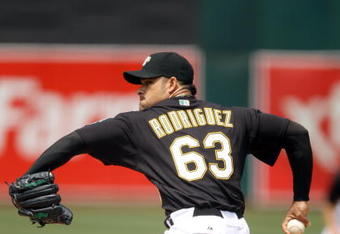
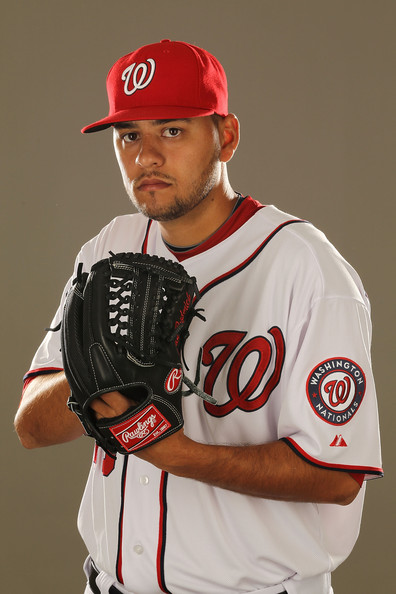
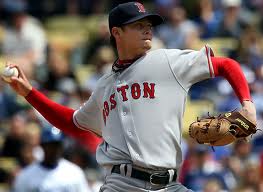
Rodriguez's tenure as a Nat has been so rough so far, I can't even find a picture wearing our uniform. Photo: Ezra Shaw/Getty Images via bleacherreport.com

When the Nationals traded Josh Willingham for power arm Henry Rodriguez and minor league outfielder Corey Brown in December, the team and its fans thought we were getting a good outfielder prospect plus a valuable power arm, back of the bullpen type in exchange for a defensively challenged left fielder who couldn’t stay healthy (that is certainly the glass-is-half-empty analysis of Willingham’s contributions to this team, but so be it).

Brown was always set to repeat AAA, having struggled there last year after dominating lower levels of the minors.  He still may feature in our outfield at some point if our slew of LF/CF options fail us and he plays well to start the season.  His ankle injury certainly is not helping him prepare for 2011, but he’s not the real prize of the Willingham trade.

Rodriguez, after showing up for spring training 2 weeks late and not getting into a game for another week, is now “being shelved” to work on his mechanics.  A week before opening day.  Here’s his stats for the spring thus far: 2 1/3 innings, 7.71 era, 3 hits, 3 walks and only about half the pitches he’s thrown being in the strike zone.  The coaching staff report that his mechanics are out of whack, that he cannot repeat his delivery and he’s been doing nothing but bullpen work for the past 5 days.

Great.

Rodriguez has no minor league options.  The Athletics knew this and the Nationals knew this upon trading their starting left fielder, #5 hitter and top OPS producer from 2010.  Now this roster inflexibility is set to cause a serious issue for this team.  We can’t just “invent” an injury for Rodriguez to store him on the DL; last time I checked my orthopaedic surgeon didn’t treat “mechanical flaw” as an injury.  So, instead of leaving someone deserving on the opening day roster (say, Collin Balester or even Drew Storen, not that he’s been 100% deserving based on his spring performance but remember he did appear in 50+ games last year rather effectively, especially for a rookie), we’re going to probably lug him around for a while and look for incredibly low-priority outings for him to “remember” how to pitch again.

I know all of Willingham’s faults.  He’s injury prone, he was arbitration eligible and his salary was escalating, he hasn’t ever played a full season without time off for injuries.  More importantly to Rizzo, he was a severe defensive liability, even in a position that traditionally can “hide” poor defenders.  And Rizzo from the onset has seemed dead set on fielding a team of track stars, no matter what the cost.

But none of those reasons factor in the most important point; Willingham can mash the ball.  In two seasons in Washington he had OPS+ figures of 129 and 127 (which would have ranked him about 20th in the NL had he qualified each year) and hit in the 5th hole protecting Adam Dunn admirably.  You don’t just give up that much offense unless you KNOW you’re getting something of equal value in return.

Right now, we’re not getting anything close to equal value for him.  And it may have larger ramifications for the team that breaks camp in a week or so.

Written by Todd Boss

March 23rd, 2011 at 11:09 am

Spring Training Games Week 3: Nats Pitcher good/bad/inconclusive

5 comments

There is always a risk of over-emphasizing early spring training statistics.  But as an analyst or even a fan of a team, you’re in a catch 22.  There are players out there clearly pitching to make the team and thus their statistics and results are important.  Meanwhile, you have to keep in mind that for every homer Mike Morse hits off a legitimate major league starter, he’s hitting another one off a guy who is a non-40 man minor league filler player who is pitching that game just to fill out the innings.  So, when looking at these results we try to put the performance into context.  If a pitcher is going against a split squad and is facing 3 regulars and 6 minor leaguers, his performance obviously has a caveat.

In the 3rd week of spring training though, starters are getting “stretched out” and the teams are starting to look more like what they will in the regular season.  So the good/bad/inconclusive starts to be more important.  The Nats also managed to lose 6 of these 7 games, a troubling sign for the beginning of our season.

Here’s links to Week 1 and Week 2‘s Good/Bad/Inconclusive posts.  And below are the links to running commentaries (when available), wrap-ups from beat reporters and box scores (if I can find them):

The Good

  • Doug Slaten: he had nice rebound appearance against the Tigers on 3/14.  If he mis-fires, we always have Ron Villone (kidding. Maybe.)
  • Tom Gorzelanny: looked significantly improved on 3/15 over his first appearance.  Final line; 4 IP, 2 H, 1 R, 3 BB, 4 K, 65 pitches, 36 strikes.  He clearly tired in the last inning, issuing two of the three walks and the run.  No radar gun readings to be found but the observers say he looked like a completely different pitcher.  Good.
  • Brian Broderick: two quick, easy outings later in the week gives him only 1 earned run in 10 2/3 innings this spring.  He’s looking like a steal of a rule5 pick and may just make this team as the long-man.  Or perhaps at the expense of Drew Storen (see further down).

The Bad

  • Elvin Ramirez: this rule-5 acquisition has yet to appear in a game and now has a sore-shoulder that may necessitate his starting the season on the DL.  I know that Rule-5 draft picks are low-risk and low-cost, but on a team like the Nationals they don’t make a lot of sense.  We’re not deep enough so that we can “hide” a guy all year (as we did with Tony Blanco back in 2005), and there are more deserving pitchers on this team for the few spots that aren’t guaranteed.  Perhaps we can negotiate a trade with the Mets to keep him if the team really likes him.  More likely he starts the year on the DL and gets returned if we cannot negotiate a deal.
  • Craig Stammen‘s 3/15 outing was probably enough to guarantee his trip to Syracuse.  He gave up 3 runs on 4 hits and a walk against a decent Mets lineup.  He’s looking like 4th best out of 4 for the last bullpen spot.
  • Tyler Clippard: His 3/16 outing was seriously disturbing.  1ip, gave up 4  hits (3 for extra bases), 2 walks, 5 runs … a disaster.  He was quoted as saying that he “lost his concentration” but one would have to think that after perhaps the third or fourth baserunner he’d get it back in a hurry.  He wasn’t exactly facing the elite of the league either in the 9th inning against (possibly) the worst team in the majors.
  • Drew Storen: after a bounce back performance earlier in the week, Storen gets absolutely hammered by a bunch of Cardinals scrubs you’ve never heard of on 3/18.  Not good.  I’m beginning to wonder if he even makes the team at this rate.

The Inconclusive/Worrisome/Concerning

  • Henry Rodriguez: On March 13th our possible-closer-acquisition pitcher was FINALLY set to appear in a game.  He promptly lays an egg; 1/3 of an inning, 3 walks and a hit.  Clocked at 97 though, so there’s that.  Management has to be irritated with this situation; the guy has no minor league options and is basically guaranteed to be on the team, yet misses weeks of camp and shows up not in full throwing shape.  If this guy bombs out (as the centerpiece of the Josh Willingham deal), we’ll have given up an awful lot of offense for next to nothing.  In his next appearance on 3/17, he looked remarkably better; got his fastball up to 99, threw a couple wild pitches but got some Ks on a great 90mph change-up.  Most described him as “effectively wild.”  Which is the real Rodriguez?
  • Colin Balester: Why has Balester only gotten 5 innings in 2 weeks?  His role on this team (presumably to me) is to be the long-man out of the bullpen, the Miguel Batista role from last year.  He’s being treated more like an 7th/8th inning guy.  Is this indicative of his lowered chances of making this team?  Perhaps the plan is to have option-less Gorzelanny in that role with Balester back in AAA (he has one option left).  He did pitch 2 scoreless on 3/19 to finish up the week but seems destined for AAA to start the year.
  • Ross Detwiler took a step back from his spring performances on 3/16 with this line: 3 IP, 4 H, 3 R, 2 ER, 2 BB, 71p, 43 strikes.  He gave up 4 consecutive base-runners, struggled with a basic sacrifice attempt from the opposing pitcher, and reportedly wasn’t as crisp with his fastball velocity as in days past.  Perhaps just an off day.
  • Yunesky Maya: He showed nearly the velocity we want out of him on 3/17 against a strong Braves lineup (peaking at 92, sitting between 88-91 mostly).  Not quite the 93 we were told he was hitting in the DWL but perhaps he was on a fast gun.  He fell victim to that which plagued him last year; the big inning.  He needs to find a way to mitigate the damage if he gets down in an inning.
  • Jordan Zimmermann: 5 scoreless innings on 3/13 to run his spring training streak to 11.  Good velocity, good movement on his curve.  His 3/18 Outing was not as nice: 4 ip, 6 runs, 8 hits, 2 walks, 0 strikeouts, 2 wp, 69 pitches and 44 strikes.  He was reportedly very wild and very hittable.
  • Jason Marquis: He continued his great spring, goes 5 IP, 1 ER, 3 H, 2 BB, 4 K, 53 pitches, 38 strikes against the tigers on 3/14.  And then he got absolutely hammered on 3/19, giving up 9 hits and 3 walks in less than 4 innings (3.2 IP, 6 ER, 9 H, 3 BB, 1 K, 1 WP, 79 pitches, 45 strikes).  The first inning of 3/19 seemed to be part bad defense, part unlucky grounder locations, but he did have trouble locating his pitches all game.

Lots of “inconclusive” this week, as guys who looked good before put in bad performances.  Lots of pitchers complain about a “dead arm” period late in spring training and perhaps that’s what we’re seeing overall.  Next week’s games will be revealing.

Written by Todd Boss

March 19th, 2011 at 8:28 pm

Posted in Majors Pitching

What to do with Brian Broderick?

10 comments

Brian Broderick on Media Day. Photo by Al Bello/Getty Images North America/zimbio.com

Commenter Mark L asked whether or not I was “ignoring” rule-5 draftee Brian Broderick‘s performance thus far when considering the bullpen competition in response to a post previewing the Nats 3/15/11 game against the Mets.

I don’t know if i’m “ignoring” Broderick’s performances thus far … I just have a reaaaaaaly hard time believing he’ll be on the 25-man roster based on the inflexibility of keeping a rule5 guy, given the roster inflexibilities we already have with several other players.  Here’s my reasoning:

  • We have 3 guys who already essentially HAVE to stay on the 25-man roster because of a lack of options: Clippard, Burnett, and Henry Rodriguez.  Two of these guys are bullpen mainstays and would have been there anyway, but the acquisition of Rodriguez has complicated matters for the team.  As mentioned before, he showed up late for spring training and has not necessarily looked fantastic so far.  If we could possibly find a way to DL him if he’s not ready to go on April 2nd (“tired arm?”) , a lot of problems would be avoided.
  • We have a 4th guy in Coffey who signed a major league deal and has enough service time that he could (and probably would) refuse a AAA assignment, so he either stays on the 25-man roster or we light his $1.35M on fire.
  • We have to have a loogy; Slaten seems almost certain to be that guy.  I guess you could argue that we really don’t need a loogy, that Burnett could be that guy or even Gorzelanny if he gets bumped out of the rotation.  But Burnett’s value is not as a one-out guy and Gorzelanny is a starter.
  • Storen is supposed to be “the closer.” He may be struggling this spring but there’s nothing about his 2010 performance that says he does NOT deserve to be in that position for this team. Admittedly he does have options and can be sent down but i’d be awfully mad if we sent a first round draft pick down so we could keep some untested minor leaguer on the active roster.

So, if we keep Broderick, he’s the 7th guy in the pen and has to stay there all season.

That’s your 7 spots essentially wrapped up. So now here’s the rest of the picture and why this could become rather complicated for the team:

  • If Gorzelanny struggles in the starter’s role, he has no options and would have to go to the bullpen. Who makes way?  We can’t really cut Gorzelanny out right without admitting that the move backfired greatly for the team, having given up 3 decent prospects just a few months ago.
  • If we want to use Gaudin, who has looked great so far in spring training, he’d have to be first added to 40-man (and then we’d have to drop someone else or move them to 60-day dl). And then he’s more or less stuck on the roster too; he’s got 5+ years of service time, no options and can reject an assignment back to AAA. Based on the fact that he signed a minor league deal with us, one could assume that he is ok with starting the season in AAA, but other teams have scouts too and might be taking notice of his achievements so far.  However again, if Gaudin is the 7th guy who makes way for him?
  • Balester: he certainly performed well last year; 28ks in 21 ip in the same role we’re talking about here.  Before the rule5 draft I had him locked into that long-man role. Has he done anything this spring to cost him this spot?  No but he has one more minor league option and may lose out nonetheless.
  • Stammen; he clearly can give you innings since he’s always been a starter, and his advanced stats last year were not THAT bad. But he too has options and seems to be pitching his way to AAA this spring.

Honestly, I think what the Nats need to do is make a deal with StL, trade them someone for Broderick and then stash him at AAA til you need him. Return him to the starters role where he was 11-2 last year in AA and maybe we’ve found a real cheap 5th starter for the future.

Big Spring Training Game today for Nats Pitchers

3 comments

Per new Washington Times beat reporter Amanda Comak’s post this morning, here’s today’s pitching lineup:

SP – Tom Gorzelanny – 1 start, 2.1 innings, 5 H, 3 R (2 ER), 3 BB, 1 K, 7.71 ERA
RHP Craig Stammen – 6 IP, 5 H, 1 R (1ER), 2 BB, 5 K, 1.50 ERA
RHP Henry Rodriguez – 0.1 IP, 1 H, 1 R (1ER), 3 BB, 27.00 ERA (keep in mind he’s only made one appearance)
RHP Brian Broderick – 7.2 IP, 4 H, 1 R (1ER), 0 BB, 1 K, 1.17 ERA
RHP Collin Balester – 5 IP, 5 H, 3 R (2ER), 2 BB, 4 K, 3.60 ERA
RHP Cole Kimball – 6 IP, 4 H, 1 R (1ER), 1 HB, 1 BB, 5 K, 1.50 ERA

Nearly every guy on this list has some serious question marks in terms of performance thus far in the Spring.  Gorzelanny almost certainly has a rotation spot guaranteed but has not shown us nearly the capabilities he was known for pre-trade.  Stammen‘s role with this team and his future with the organization is cloudy; clearly he’s not being considered as a starter any more but there’s way too many guys for a bullpen role.  Rodriguez showed up late, has no options and is pretty much guaranteed a bullpen spot … so he better be worth it.  Broderick is a rule5 guy on a team that absolutely cannot afford to keep a rule5 guy (making you wonder why bother to pick them up?), but he’s looked good this spring and you have to wonder if he’s going to be acquired or kept at this point. Balester (like Stammen) seems to be falling behind in the race for the long-man out of the bullpen competition, which is odd considering his very good 2010 numbers.

Only Kimball seems destined to know his fate already; he’s bound for the AAA closer role, having performed admirably at both high-A and AA last year.  It is only a matter of time before he gets called up and slots into the back of our bullpen.

Can’t wait to hit refresh on that #Nats twitter tag!

Written by Todd Boss

March 15th, 2011 at 11:22 am

Posted in Majors Pitching

Spring Training Games Week 2: Nats Pitcher good/bad/inconclusive

7 comments

Marquis has looked arguably the best of any starter this spring. Photo: AP/silive.com

After the 2nd week of games and the official halfway point of Spring Training, here’s some quick comments on how some various pitchers have looked in the second week of Spring Training Games.  I’ve been keeping running commentary all week as each game happens.  The link to my week one’s thoughts/observations is here, posted on 3/6.

Also, here’s perma- links to the NatsJournal blog‘s running game comments as well as box scores (when I could find them).

The Good

  • Jason Marquis: 4 ip, 2 hits and a walk against Atlanta on 3/9 to continue his scoreless inning streak further into spring training.  Lots of ground balls, meaning he has his sinker back.
  • Adam Carr: 6 up and 6 down on 3/8.  This didn’t stop him from being cut from the major league squad, but a bright future awaits this fellow.
  • Brian Broderick: continues to pitch well, but his Rule5 status complicates his ability to make this team (see my whole missive on Gorzelanny and his job-by-option-status post here).
  • Cole Kimball: big time right handed power pitcher showing his worth by continuing to punch guys out with regularity.  Could be first in line to replace a bullpen member who goes down with injury or non-performance.
  • Ross Detwiler: Struck out 5 in 3 innings against a strong Braves lineup on 3/6.  Stretched out to 4 innings on 3/11 and added a few more K’s (along with a couple runs) but reportedly looked decent.  I agree with a couple other bloggers on this point; we talk about how Detwiler is competing for the 5th spot, but is it really Lannan that is in trouble?  (see further down for Lannan comments).
  • Todd Coffey: Struck out the side on 3/9, had 2 more K’s in a 1-2-3 inning on 3/7.  Looks like he may be a decent replacement for Batista/Peralta from last year’s bullpen.
  • Chad Gaudin: looked good against a very weak Mets team 3/10, pitching 5 shutout innings scattering a few hits and walks  (final numbers: 5ip, 6K, allows 4 hits with a walk. 78 pitches 52 strikes, thanks to Craig Heist).  Despite this he has no chance at the MLB rotation.  I presume he’ll be in the AAA rotation to start the season and seems to be putting himself above other AAA starters such as Chico and Martis in the pecking order.

The Bad

  • Atahualpa Severino: bombed on 3/8, he’s looking like he’s gonna be 2nd best in the Loogy race to Slaten.  He’s already been optioned to AAA and may be vulnerable to being removed from the 40-man roster.  That being said…
  • Doug Slaten got rocked himself on 3/9.  He’ll be given some room since he was so successful last year, but we need one of these two guys to own that Loogy role.  We don’t want to waste Burnett on man-to-man matchups.  In other news, the Nats signed Ron Villone to a minor league deal this week, which i’m predicting is partly (as Kilgore says) because they like him and part Loogy insurance.
  • Garrett Mock: didn’ t help his cause by giving up a bomb against the Astros.  He’s now given up 4 hits and 5 walks in 2ip.  He’s looking like AAA bullpen fodder and possibly not long for the 40-man.  I don’t care how good his “stuff” is; if he can’t compete against fringy roster guys in the middle innings of a spring training game, then he cannot be counted on in real games come April.  Update: cut from the major league squad and will get into the AAA rotation.
  • John Lannan:  Did not look good in his 3/12 start; too many walks and too many hard hit balls.  For the spring he’s sporting nearly a 9.00 ERA.  With Detwiler looking so strong, is Lannan in peril of starting the season in the minors?

The Iffy or Possibly Concerning.

  • Jordan Zimmerman‘s 3/8 start “looked” good but those on hand used words like “shaky” and “hit hard.”  His fastball was 92-94 though.  For Zimmermann, the velocity is the key.  We know he has good stuff; we just need to know his fastball is recovered from TJ surgery.
  • Yunesky Maya‘s 3/7 start was shaky at best.  5  hits and a walk in 2 2/3s innings versus a weaker Astro’s lineup.  He threw again on 3/12, gave up an unearned run and seemed to struggle with his fastball locations (the unearned run was on a 3-base error that Cano smoked but Bernadina dropped).  He pitched 4 complete, gave up 2 hits, walked 3 and struck out 3 (some with his loopy 12-6 curve ball).
  • Drew Storen got lit up again on 3/7 but we had word that the coaches told him to spot his fastball.  Well, that may explain why.  Hey McCatty; tell us when he’s really trying out there so we know what is going on.  He recovered for a decent outing on 3/10, punctuated with 3 straight Ks against AAA competition.
  • Tom Gorzelanny: my post questioning his acquisition garnered quite a spirited response.  The comments i’m about to make probably will too.  His first outing in the spring did not exactly vindicate his nearly-guaranteed active roster spot.  His line: 2.1 IP, 3 R, 2 ER, 5 H, 3 BB, 1 K against a weakened Astros split squad.   He only managed 23 strikes in 47 pitches.  Nobody seems to have mph readings but he was clocked only in the upper 80s earlier this week.  For him to stick and be successful we need to see a return to 92-93.
  • Livan Hernandez: his 3/11 start did not garner confidence, apparently getting hit all around the park.  Bad defense behind him (and some generous scoring) made his line (3ip, 7hits, 1bb, 1k, 3ER) look worse than it was.  We know that Livan will put up a stinker every once in a while; just can’t make it a habit.

Written by Todd Boss

March 13th, 2011 at 9:52 am

The importance of Home grown Starting Pitching

5 comments

Clay Buchholz provided the best Wins/salary in the majors last year. Photo baseballrumormill.com

A few weeks back si’s Tom Verducci posted an article discussing the value of starters over closers.  One of the points that he made in the article related to the general fact that Ace Starters are more likely to be with the same team that developed them than being free agent acquisitions in the modern game.  In Verducci’s article, he analyzed the 20 best pitchers by ERA from last season and found that 13 of them are still with their original organization.  Furthermore, 10 of them were first round draft picks.

Modern baseball teams are being built more and more through the draft.  Last year’s World Series champions San Francisco featured 4 home grown starters, each of whom would slot in as the best or 2nd best pitcher on most every other rotation in the league.  Tampa Bay rode a slew of home-grown (and cheap!) starters to the 2nd best record in Baseball over the past 3 years.  And now we clearly see Mike Rizzo trying to build up his starting pitcher cache in the minors through mid-season trades and a focus on pitching in the past couple drafts.

I thought I’d take this point a bit further, as it relates to a topic that I have found more and more fascinating.  The New York Yankees and their $200M payroll struggled to find starting pitching in the off season and are now essentially conducting tryouts in spring training for the #4 and #5 starter spots in their rotation.  How did they find themselves in this predicament?  The answer is thus; it has been years since they developed a home-grown Ace starter.  Their best pitcher (CC Sabathia) was a (very) expensive Free Agent, their 2nd best a home grown rookie (Phil Hughes) and their third best (AJ Burnett) another pricey free agent.  Arguably it has been since either Chien-Ming Wang or possibly Andy Pettitte that the Yankees have developed a starter worthy of mention.  Now, the Yankees have certainly bought themselves a whole lot of offense that will mask their weaknesses in the rotation, but the fact remains that they could easily miss the playoffs in 2011 despite their payroll if the first three members of their rotation do not pitch well.

Lets look at the “Aces” in baseball, and take a look at their acquisition methods and their contract status.  Here, “Home Grown” means the team that developed the pitcher, not necessarily the team that drafted him.  When prospects get traded, I credit the acquiring team for developing and delivering the player to the majors.

  • Home Grown: Johnson, Hamels, Wainwright, Jimenez, Lincecum, Cain, Lester, Buchholz, Price, Verlander, Liriano, Felix Hernandez, Jered Weaver.
  • Free Agent Acquisition: Halladay, Lee, Carpenter, Sabathia.
  • Trade Acquisition: Oswalt, Santana, Greinke.

Of these 20 “Aces,” 13 are still with their developing organization.  Four Free Agent acquisitions for big money, and three traded Aces that cost their teams plenty (though in retrospect the Johan Santana trade isn’t looking that bad for the Mets).

Another side-point was Verducci’s findings that 10 of the top 20 pitchers by ERA last year were first rounders.  I find that piece of information really amazing, given the notorious “crapshoot” mentality of baseball Drafts.  Here’s a quick followup analysis of the Initial Acquisition method of my 20 “Aces” and determining draft or international free agent. Here, we’ll put “supplemental first rounders) into the “1st round” category.

  • Draft: 1st Rounder: Hamels, Halladay, Carpenter, Wainwright, Greinke, Lincecum, Cain, Buchholz, Price, Sabathia, Verlander, Jered Weaver.
  • Draft: top 5 rounds: Johnson (4th), Lee (4th), Lester (2nd).
  • Draft: 6th round or later: Oswalt (23rd).
  • International Free Agents: Santana, Jimenez, Liriano, Felix Hernandez.

So by my analysis, 12 of the best 20 pitchers in the game were first round picks.  Only Oswalt looks like a complete diamond in the rough find.  For all the talk about how the draft is a crap shoot (hey, Albert Pujols was a 13th round pick), it really seems apparent that these first rounders paid off handsomely.

Here’s one more look; of the 13 “home grown” aces, lets look at their current contract status.  All data per Cot’s fantastic salary database site.

  • Johnson: 4 years/$39M (2010-13)
  • Hamels: 3 years/$20.5M (2009-11), but he has a 4th arbitration year in 2012.
  • Wainwright: 4 years/$15M (2008-11), plus 2012, 2013 club options (this contract is in complete peril though, since the club can terminate at the end of 2011 when Wainwright is on the DL.  That essentially kills $21M guaranteed to Wainwright in 2012 and 2013.  Tough, tough break for the player).
  • Jimenez: 4 years/$10M (2009-12), plus 2013-14 club options (the club options are very reasonable for an Ace)
  • Lincecum: 2 years/$23M (2010-11), but these are just his first two arbitration years.  Two more to go to take him through 2013.
  • Cain: 3 years/$27.25M (2010-12)
  • Lester: 5 years/$30M (2009-13), plus 2014 club option
  • Buchholz: 1yr/$480K (est): Still on a pre-arbitration contract, possibly the best value in baseball right now.  Controlled through 2014 by the Red Sox.
  • Price: 6 years/$8.5M (2007-12).  Wait, actually THIS may be the best deal in baseball, since Buchholz will probably garner a massive first-year arbitration award in 2012 just as Price’s 6 year deal ends.  However, Price can void the contract and file for arbitration as soon as he becomes eligible, presumably for the 2012 season.
  • Verlander: 5 years/$80M (2010-14)
  • Liriano: 1 year/$4.3M (2011).  Still in his arbitration years, under club control through 2012.
  • Felix Hernandez: 5 years/$78M (2010-14)
  • Jered Weaver: 1 year/$7.37M (2011).  He lost his arbitration hearing this year after going “only” 13-12 but leading the league in strikeouts and coming in 5th in Cy Young voting.  Under club control through 2012.

And, adding in the non-home grown players for a complete picture of the future Ace starter FA market:

  • Halladay: 3 years/$60M (2011-13), plus 2014 option
  • Lee: 5 years/$120M (2011-15), plus 2016 option
  • Carpenter: 5 years/$63.5M (2007-11), plus 2012 club option
  • Sabathia: 7 years/$161M (2009-15) but he can opt out after the 2011 season
  • Oswalt: 5 years/$73M (2007-11), plus 2012 club option
  • Santana: 6 years/$137.5M (2008-13), plus 2014 club option
  • Greinke: 4 years/$38M (2009-12)

So, here’s a quick summary of when these Aces may hit the FA market:

  • After 2011: Wainwright (but he’ll be post-TJ surgery), Sabathia (probably)
  • After 2012: Cain, Liriano, Weaver, Oswalt, Carpenter, Greinke, Hamels
  • After 2013: Johnson, Lincecum, Santana (probably)
  • 2014 or Beyond : Jimenez, Lester, Buchholz, Price, Verlander, Hernandez, Halladay, Lee

Notice how teams are locking up these Ace pitchers for the long haul.  We’re likely to have perhaps just an injury reclamation project in Adam Wainwright and opt-out 100% certain to return to the Yankees Sabathia as the sole major  free agent candidates this coming off season.  I’ve read differing opinions on whether or not Sabathia opts out of his contract (he’d be abandoning $92M of guaranteed pay over 4 years) but I’d be surprised (shocked actually) if he did NOT opt out, especially if he has a third consecutive year of similar production to his first two for the Yankees.  You would have to think he could easily merit a contract north of Cliff Lee’s $24M/year for 7 additional years.  7yrs/$170M or so.

Lastly, lets look at the 8 playoff teams from last  year and investigate how many of their starters were home grown:

  • Giants: 4 of 5 homegrown (Lincecum, Cain, Sanchez, Bumgarner).  1 FA in Zito
  • Rangers: 3 of 5 home grown (Wilson, Hunter, Feldman), 1 trade acquisition (Lee), and one FA (Lewis)
  • Yankees: 1 home grown (Hughes) and 4 Free Agents (Sabathia, Burnett, Pettitte, Vazquez)
  • Phillies: 1 home grown (Hamels), 3 traded acquisitions (Halladay, Oswalt, Blanton) one FA (Moyer).
  • Rays: 4 home grown (Sheilds, Neiman, Price, Davis) one trade acquisition (Garza)
  • Twins: 3 home grown (Baker, Blackburn, Slowey) one FA (Pavano) and one trade acquisition (Liriano).
  • Braves: 3 home grown (Hanson, Jurrgens, Medlen/Minor), one FA (Lowe), one trade acquisition (Hudson)
  • Reds: 3 home grown (Leake, Bailey/Wood, Cueto), two trade acquisitions (Arroyo and Harang).

Six of the Eight playoff team used rotations that were mostly home grown.  Most of the trade acquisitions here were trading of prospects (either the acquiring team using prospects to acquire a proven Vet, as with Hudson, or the acquiring team acquiring and developing the player, as with Garza).

What is the lesson, after all this analysis?  Draft well, develop well, and then lock down your Aces for the long haul.  That is the pathway to success.  There are some exceptions of course (the Phillies have acquired 2 Aces by leveraging their very good farm system depth, and still have enough lower-level depth to rank among the best farm systems in baseball.  And the Yankees of course have bought themselves a good portion of their team).  But looking at the playoff teams last year, most of them were draft-heavy on starters.

Coincidentally; the Nats 2011 rotation by way of comparison?  2 drafted (Lannan, Zimmermann), 2 FAs (Livan and Marquis) and one trade acquisition candidate (Gorzelanny).  This would look far better of course if we were using two key drafted/developed players (Strasburg, Detwiler or even Maya).

Here’s hoping that the Nats’ higher-end starting pitcher draft picks (Strasburg, Zimmermann Solis, Cole, and Detwiler) become the core of our rotation for years to come.
Does Verducci’s article about Strasburg’s Mechanics worry you?

4 comments

This is an image I hope we don’t see again.

In an article that seemingly came out of nowhere, Si.com columnist Tom Verducci posted this missive on 3/8/11 with ominous warnings to Nationals fans everywhere.  He believes that Stephen Strasburg has a fatal flaw in his mechanics related to the timing of his stride forward off the rubber versus his release point that may continue to plague the pitcher even after his post Tommy John surgery recovery.

I say this article comes out of nowhere since I would have expected to see this posted back in August 2010, when every other pundit posted their own theories as to why “the best pitching prospect ever” suddenly blew out his elbow.  I reviewed some of those explanations at the time but thought (and still do think) that his injury was less about his release point and more about pitch selection.  I think that Strasburg (and more importantly his catchers) fell in love with his change-up after discovering what a devastating pitch it was (imagine facing a 91-mph screw ball that moves a foot into the right handed hitter).  Suddenly he was throwing a ton of circle changes and placing unexpected, here-to-fore unseen stress directly on his elbow ligament.  When a hurler goes from pitching one day a week in a protected environment where he can get by throwing mostly fastballs to overpower college hitters to suddenly throwing only about 58% fastballs (per Verducci’s research) at the Major league level every 5 days, sudden injury onset can occur.

Verducci touches on the preponderance of off-speed pitches Strasburg was throwing in the article but focuses on the “late cocking” of the arm as the primary culprit of the injury.  He then lists a number of pitchers who exhibit this same late arm cocking with (conveniently) a ghastly list of arm and shoulder injuries that followed.

Here’s my problem with this type of cherry picking of arm injuries; as Mike Rizzo pointed out in the article, you can probably find a similar subset of pitchers who exhibit the same late-cocking of the arm who have NEVER had an arm injury.  Rob Neyer posted a similar opinion in a Verducci-followup piece.  Similarly, those who subscribe to the “Inverted W” pitching mechanical flaw fail to point out that, while there are plenty of examples of pitchers who show the inverted W behavior (most notably in most examples is Mark Prior but Strasburg exhibits the same mechanics as well), there are also plenty of pitchers who do the same motion but who never have had a serious injury.  People always forget to mention this fact and their articles always come off with the message that “if you exhibit this, you are doomed.”

John Smoltz was listed as a pitcher who had this fatal mechanical flaw (he also has inverted W syndrome) and listed as an “example” of what can happen.  Yes Smoltz blew out his elbow in his early 30s and missed an entire major league season.  But he also pitched until he was 42, made over 700 major league starts, won 213 games and saved another 154 while he was in the closer role theoretically “protecting” his arm.  If Strasburg gives the Washington franchise those kinds of numbers between now and the year 2030 (when he too will be 42 years of age) I will never quibble.

For me, shoulder injuries are the injuries that you really worry about.  Look at Chien-Ming Wang right now; he’s throwing in the low 80s 2+ years on from shoulder surgery.  The Nats have taken fliers on several other post-shoulder injury starters over the past few years (Brian Lawrence, Ryan Drese, John Patterson) with limited success.  However, pitchers seem to be able to recover from Tommy John surgeries with much better regularity.  I realize our own Shawn Hill had the TJ surgery and never really came back, but the list of successful pitchers who have had the TJ surgery is long.  3 of the top 5 NL Cy Young candidates last year (Josh Johnson, Tim Hudson and now Adam Wainwright) have had the TJ surgery, as did 2009 NL cy Young winner Chris Carpenter.  Our own Jordan Zimmermann seems to be nicely recovering, although it is far too soon to conclude that his surgery was a success.

I sometimes wonder what modern medicine could have done with Sandy Koufax, who abruptly retired at age 30 after a Cy Young winning season where he made 41 starts and went 27-9.  His retirement reason was listed as “arthritis in his pitching elbow” and he had symptoms that included massive hemorrhaging in his arm; was this a condition that would be easily solved today?

For Strasburg, as with pretty much any baseball pitcher, in many ways every pitch could be your last.  Modern medicine can fix all kinds of injuries and modern technology can pin point the wheres and whys of why some guys may last and some guys may be flashes in the pan.  But in the end, some guys physiologically are more durable than others, some guys can throw a ball through a brick wall for 25 years (see Ryan, Nolan) and others break down after just a few professional games.  Lets just hope for the best once Strasburg comes back.

http://en.wikipedia.org/wiki/Tommy_John_surgery#List_of_notable_baseball_players_who_underwent_the_surgery

Why exactly did we acquire Gorzelanny?

16 comments

Gorzelanny warming up; the closest we've seen of him on the mound. Photo: Copyright Ed Wolfstein

As I said in my good/bad/indifferent post over the weekend, I cannot fault a guy for getting sick at an inopportune time.  But newly acquired Tom Gorzelanny needs to get caught up to his competition for the 5th rotation spot very quickly, before he loses out on the competition altogether.  When two of your main competitors for the 5th rotation spot are showing up in Viera with crisp stuff and a good work ethic, and you cannot make it into a game because you’re so far behind … well you better step it up when you do get some innings.

I’m beginning to wonder though; Why did the Nats make the Gorzelanny acquisition?  He’s out of options, meaning that if he does NOT win the 5th starter role he either has to go to the bullpen or be exposed to waivers to pass him through to AAA.  Both scenarios are bad for the team; Gorzelanny would take away a bullpen spot from another deserving candidate if he is kept (likely Balester in the long man/spot starter role), and odds are that he’d be claimed if we exposed him to waivers, basically meaning we gave up 3 prospects for a few weeks of his Spring Training time.  Plus, Gorzelanny’s splits as a reliever aren’t really that promising.   The number of innings he’s pitched in relief over the past few years are probably not enough to make a judgement but he certainly hasn’t been immediately lights out in the role.

Meanwhile, the rest of the competitors for the #5 spot are taking big steps ahead.  Maya looked great in the DWL and has looked good so far this spring.  Detwiler‘s last outing was dominant, with lots of strikeouts and scouts raving about the speed on his pitches.  Gaudin‘s overall numbers look bad but he pitched 3 strong innings against the Yankees.  Only Wang seems to be out of the 5th starter competition for now (he’ll likely spend more time on the DL, which is fine for our roster construction purposes since he won’t burn a 25-man slot).

I suppose it is possible (acceptable?) that we traded away three prospects for the chance to let him compete with Maya, Detwiler, Gaudin and Wang for the #5 rotation spot.  But here’s the thing; if the Nats really though Wang was healthy and that Maya was improving and that Detwiler was going to live up to his promise … why sign a journeyman veteran without options, knowing that his inflexibility would affect the rest of your team’s construction?

Written by Todd Boss

March 7th, 2011 at 12:01 pm

Posted in Majors Pitching

Nats Pitching so far; the good, the worrisome and the incompletes

7 comments

Is this the year Jordan Zimmermann makes the leap? Photo dcist.com/(AP Photo/Manuel Balce Ceneta)

The Nats spring training games so far have certainly seemed more promising this year than last.  Beat reporters talk about a more professional attitude, they talk about there being more talent in camp, and Riggleman talks specifically about having to “cut major league pitchers” when 25-man decision time rolls around.

At the risk of over-analyzing the first 6 spring training games, lets talk about some of the good, the worrisome and the “yet to be determined” performances of some key members of the pitching corps.  For reference, here’s a quick link to the Grapefruit league pitching stats for the team.

The Good

  • Livan, Zimmermann, Marquis: our 1-2-3 rotation members all looked decent to good in their first ST starts.  Marquis faced a weaker lineup but got lots of ground-outs (good indication for his sinker).  Zimmermann faced a tougher lineup of first-stringer Cardinals but worked his way out of jams.
  • Maya and Detwiler: starters-in-waiting both had decent first outings.  Maya has looked crisp, Detwiler’s new mechanics are giving him more bite on his fastball, and both may very well muscle their way into the rotation discussion.  Detwiler contined his good work today, getting 5 K’s in 3 innings against a strong Braves lineup to continue to put himself in the discussion for the rotation.
  • rule 5 pickup Broderick: 3ip and only two hits to show for it, albeit pitching later in games against scrubs.  Still, one has to wonder if Broderick can muscle his way into the bullpen discussion.

The Bad

  • Chad Gaudin: I realize that a 27-yr old hard-throwing player on a minor-league deal would be like found-gold if he pans out (sorry for that pun), but I don’t get testing him out at the expense of other arms in camp.  That being said, Gaudin has not looked great so far.  He’s had two up and down sessions, possibly undone by some untimely errors in the field.
  • Garrett Mock: I am not the only blogger in the Natmosphere who cannot quite understand the obsession the coaches and managers have with Mock.  Again this year, we’re hearing statements like, “2nd best arm in the organization” [behind Strasburg].  Here’s Mock’s first outing: 2/3 of an inning, 2 hits, 3 walks, 0 strikeouts with his vaunted “arm,” and 5 runs (only 1 earned because of an error in the field).  At some point you have to disregard the potential and focus on the results, and make a decision on those results.  Mock has been disappointing fans and coaches for years, and I hope we don’t overlook some other prospect to give Mock his next opportunity.
  • Drew Storen: Two outings, two innings pitched and two shellackings for our closer-in-waiting.  Not a good start for Storen, who needs to show some dominance to wrest control of the closer job away from 103-mph throwing Henry Rodriguez (who appears in the next section).  I’ve read someone postulating that Storen may start the season in the minors; i doubt that based on his 113 era+ figure and  8.9 k/9 numbers last year.  But if he wants that closer job, he needs to step up.
  • Chien-Ming Wang: *sigh*.  Another multi-million dollar contract on 100% spec, another spring training where it looks like this poor guy is done.  He’s reportedly only reaching the low 80s and had to cut his last session short because of “tightness” in his surgically repaired shoulder.  This may be more good money after bad.

The Incomplete/Unknown/Concerning because we don’t know anything yet

  • Tom Gorzelanny: I guess I can understand when a guy gets sick and it sets him back.  But when your two main competitors for the 5th rotation spot are showing up for ST with crisp stuff and a good work ethic, and you cannot make it into a game because you’re so far behind … well you better step it up when you do get some innings.
  • Elvin Ramirez and Henry Rodriguez.  I’ve gone off on this rant before in various comment sections.  But here goes again; how in the hell do these baseball players possibly suffer from these Visa issues year after year?  It really seems simple to me: if you know you need to be in another country, FOR YOUR JOB, on Feb 1st, aren’t you preparing all your paperwork and getting everything in line to make said trip on time?  It boggles my  mind that guys are delayed for weeks.  Spring Training is only 2 months long; if you are a pitcher and you miss the first two weeks, there is NO way you can catch up in time to really show what you have.   As far as the team goes, it is doubly insulting since Rodriguez has no options and HAS to make this team, so in reality he could have pulled a Brett Favre and skipped the entirety of spring training and basically still had a job.  Meanwhile, rule-5 pickup Ramirez might as well be returned to the Mets now.  How can he possibly out-pitch one of Storen, Clippard, Burnett, Coffey, Rodriguez, Slaten or Balester right now to make this team?  Plus, in reality he also has to outpitch Broderick (another rule5 guy) and Gorzelanny (out of options if he loses out on the 5th rotation spot) to make this team.
http://mlb.mlb.com/stats/sortable_player_stats.jsp?c_id=mlb&baseballScope=mlb&subScope=teamCode&teamPosCode=MON&statType=2&timeSubFrame=23&sitSplit=&venueID=&Submit=Submit&timeFrame=1

Written by Todd Boss

March 6th, 2011 at 1:48 pm

Posted in Majors Pitching

Starting versus Closing

5 comments

Should we try Clippard as a starter? Absolutely! Photo: NationalsDailyNews/Meaghan Gay/DCist.com

Baseball writer extraordinaire Tom Verducci posted a fantastic article today talking about Neftali Feliz‘s proposed move from the Rangers closer to the starting rotation.  The article touches on a topic that I’ve been meaning to write about for a while; Starting versus Closing.  It also is literally the best summation I’ve seen yet describing why the save is over-rated, closers are overpaid and why you’d rather have starters versus relievers.

Lets face it; for the most part relievers are failed starters.  A few get drafted or signed as relievers (Washington’s Drew Storen being one local example), but most starters are drafted as starters and work their way through the minors as starters.  Some starters discover that they can’t develop secondary pitches, but their primary pitches are so fantastic that the club (rightly) turns them into relievers.  This especially allows hard-throwers (think someone like Joel Zumaya) to have a career despite the fact that they only really have one pitch and throw with such effort that they could not possibly last 6+ innings.

Minor league relievers definitely make the majors, but most often as either LOOGYs or rubber-armed replaceable right-handers (think Miguel Batista) out of the bullpen.  In recent  years the desire to have more and faster throwing arms out of the bullpen has led to more pitchers opting to become relievers sooner, but they still are converted out of starting roles for either performance or fragility.

Two items from his story that I’d like to comment on:

1. Managers don’t use Closers in the most high-leverage situations. I could not agree more.  When is the best spot to use your best, most reliable reliever?  In a one-run game in the 6th when your starter runs out of gas and loads the bases with one out?  Or at the beginning of the 9th inning of a 5-3 lead?  Verducci is right; managers in the modern game are slaves to the save statistic and will not bring in their closer unless its a “save situation.”   But he also notes what is common knowledge; that you could be putting out the 12th man in your bullpen and probably have only a slightly worse chance of getting 3 outs without losing the game for your team.  Per the article, 94% of 2-run leads in the 9th inning are won irrespective of who you put out there, and that percentage has not changed significantly over the past 50 years of baseball.  Joe Posnanski also wrote about this same topic in November with similar results, finding that teams in the 50s closed out games with the same regularity as teams now, but without high-priced one-inning closers.

Luckily for the Nats, we look to have 3-4 different guys who are of sufficient quality who we CAN bring in to a game in the 6th and get a high-leverage situation.  Storen, Clippard, Burnett or newly acquired Henry Rodriguez all seem to fit the bill.  But that doesn’t mean that we don’t have a manager in Riggleman who is in the “slave to the save” category.  Matt Capps was brought in to be the closer and he closed games.  That’s it.  It is safe to say that if Riggleman decides on a closer, that’s going to be his role and that’s that.

The save stat is ridiculous and most people know it.  You can get a save in a game where you give up 2 runs and 5 hits in a 1/3 of an inning.  You can get a save when you perform mop up duty but let the score get too close while you rubber-arm your way through a meaningless blowout.  The save takes nothing about the pitcher’s performance into account; only whether or not the game ended while he was on the mound and the win was preserved.

But the save stat, and its monster creation the specialized one-inning closer, are here to stay.  Prospects come up through the ranks specifically to be closers, free agent players will only play for certain teams if given “the chance to close.”  Closers are well paid, and their pay is directly tied to this flawed save statistic.  Statisticians have tried to create a better set of metrics for middle relievers (“Holds” mostly) but the reality is that closers have high leverage in salary situations while middle relievers are lucky to get paid a bit more than the veteran’s minimum.  Verducci touches on this ridiculousness, pointing out that Papelbon‘s higher salary in 2011 than Cole Hamels despite the relative levels of production for their teams.

Ironically, some Major League managers *know* this fact, but continue to trot out their best reliever for a 3-out save at the beginning of the 9th inning in a 3-run game.  They do the same as the other 29 managers because the radical idea that backfires directly leads to termination.  No manager is willing to risk their job to try to do something the right way.  To say nothing of the reaction of a highly-paid FA closer who is suddenly told he’s going to be primarily used in the middle of the 7th to clean up the starter’s mess.

It makes you wonder if there’s a better way.  Here’s two radical suggestions:

1. Comprise a bullpen with no named closer role, and tell the entire 7-man bullpen they’re doing closer-by-committee.  It may infuriate fantasy baseball players and the union (since saves translate to salary for their FAs), but it probably placates an entire roster of wanna-be closers.  Imagine if 5 of the 7 guys in your bullpen (leaving out the LOOGY and long-man) know they may be brought in to rescue a game in the 6th or close it out in the 9th, and their roles change on a daily basis based on use.  That to me is a far better situation than pre-naming a closer (which invariably is the best guy out there) and then never using him until the 9th.

2. Comprise an ENTIRE pitching staff of long-men relievers.  Imagine if you didn’t have starters at all, but an entire bullpen of guys who were geared to pitch 2-3 innings every other night.  You would never have a need for specialized closers or even high-priced starters.  You’d rotate through who got the start, the starter would go 2-3 innings, then the next guy would go, and you’d repeat this until the game was over.  It’s kinda like spring training but all year.  Since these guys are only throwing 2-3 innings, they should be able to repeat this task multiple times in a week.

There’s 54 regular innings to be had per week mid-season (6 games at 9 innings per).  54 innings divided out by 12 guys in the pen means about 4.5 innings per WEEK per pitcher.  If you split those 4.5 innings up across three games you’d be pitching (say) 2 innings on monday, 1 on thursday then 1.5 on saturday.  That’s pretty manageable.  Plus if everyone else is doing the same, you can rotate through the guys and slightly adjust based on how they’re pitching that day.

Plus, think about how CHEAP this pitching staff would be.  12 middle relievers could not possibly cost your team more than about $15-20M annually in salary, even if they were mostly on veteran contracts.  Roy Halladay makes more than that in 2011 just by himself.

Coincidentally, this is exactly what Tony LaRussa tried at one point in the early 90s with the Athletics.  Unfortunately his experiment ended quickly, failing less because of execution and more because of lack of support from his players and management.  Its just a matter of time before someone tries it again.


Here’s the second item i’d like to comment on:

2. Starters are FAR more valuable than Relievers or Closers.  Last year in the midst of Clippard’s fantastic middle-relief run I asked myself, “Why isn’t Clippard in the rotation?”  He pitched 91 innings spread out over 78 appearances and only gave up 69 hits.  He maintained an 11.1 K/9 ratio, which is better than any starter in 2010.  91 innings was good for 4th on the entire staff in 2010.

The leading argument i’ve read for Clippard staying in the bullpen relates to the nature of his stuff.  He’s got a sneaky good fastball, a decent curve but his bread and butter pitch is the change-up.  Apparently the knock on him is that hitters adjust to him more quickly and thus he makes more sense in a relief role.  In a starting role hitters would be getting their third crack at him in the 5th or 6th inning, right when he’s tiring and right when he’s vulnerable.  In relief, he can “show” all his pitches in one at bat and work each batter individually, then leave the game before his “stuff” is exposed.

Clippard was a starter his entire minor league career, and his minor league numbers were pretty good.  He always maintained a small hits-to-IP ratio, a good k/9 ratio.  It wasn’t until he reached the majors that suddenly he couldn’t start.  I think perhaps he’s either gotten pigeonholed or he’s psychologically set in the reliever mind-frame now.

A quality starter gives your team 6+ innings, works through the opposing team’s batting order nearly 3 full times and keeps your team in the game.  6-7 innings at a 3.00 era is invaluable for your team’s psyche as it tries to win game after game.  Leaving just 2-3 innings a night for a bullpen staff of 7 means that there’s fewer days when your staff is over worked and you have to give up games for lack of bullpen arms.

How about using career WAR as a bench mark?  I don’t really like the career WAR analysis (since it is an accumulator stat and a mediocre guy with 22 years of experience appears to be better than the best pitcher of his day who only had a 15 year career).  But it is telling in this situation.  Here’s a link to career WAR for pitchers at baseball-reference.com.  And here’s the rank of the 5 best relief pitchers of all time (the 5 relievers currently in the hall of fame), along with the rankings of some of their active contemporaries who seem likely for the hall.

Lname Fname Career WAR Rank
Smoltz John 38
Eckersley Dennis 46
Rivera Mariano 69
Wilhelm Hoyt 121
Gossage Goose 133
Hoffman Trevor 215
Wagner Billy 238
Sutter Bruce 315
Fingers Rollie 325

Smoltz and Eckersly both started for large portions of their career, hence the high rank.  Mariano Rivera is clearly (in my mind) the greatest reliever who has ever played and his career WAR shows.  But notice how low closer-only guys like Sutter and Fingers are on this list.  Both are currently below modern day starters Ted Lilly and Kevin Millwood, again guys who are hardly listed as being among the game’s elite.

By means of comparison, Trevor Hoffman, who is ranked 215th all time is ranked just ahead of one Freddie Garcia in all time WAR.  Now, is Freddie Garcia a serious hall of fame candidate?  Not likely; he’s currently on a minor league contract offer with the Yankees after nearly washing out of the game two years ago.


Oh, coincidentally, I absolutely think Felix should be in the rotation.  As should Aroldis Chapman in Cincinnati.  Because they’ll be able to help your team win on a much more frequent basis.  You always want the chance of 180 innings of quality versus 60.  Its that simple.