Nationals Arm Race

"… the reason you win or lose is darn near always the same – pitching.” — Earl Weaver

Archive for the ‘Nats in General’ Category

Ask Boswell 5/20/13 Edition

13 comments

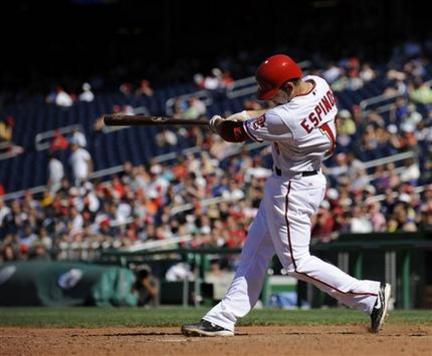
The drum is banging for Espinosa's benching. Photo AP Photo/Nick Wass

Another week, another set of disappointing results for our weary Nats (losing two games in San Diego?  come on), coupled with a troubling set of injuries, and Nats fans are a bit nervous.  Lets see what kind of questions Tom Boswell got in his weekly chat, 5/20/13 edition.

As always, I write a response here before reading his, and sometimes edit questions for clarity.

Q: You can have Stephen Strasburg or Jordan Zimmermann for the next eight years, but only one. Which do you pick?

A: Has it come to this for poor Stephen Strasburg?   As I pointed out in this space last week, Strasburg isn’t any worse or different of a pitcher right now; he’s just been really unlucky this year.  Despite Jordan Zimmermann‘s dominance so far in 2013, I still think Strasburg has better stuff and a  higher ceiling.  I’d still go with Strasburg.  Boswell also goes with Strasburg based on age and the last three years stats.

Q: Nick Markakis has proven to be a solid veteran but, possibly due to injuries, not the star the Orioles envisioned when they gave him the big contract extension. Do you think this may be Ryan Zimmerman’s fate?

A: Great question.  Nick Markakis has been injury plagued … but only the last two years.  Before that he was very solid, rarely missed a game, and had some really good numbers.   Ryan Zimmerman only has managed to play three full seasons and has missed significant time in 5 others.  Zimmerman is being paid a 9 figure salary but may not really be a 9-figure player honestly.  I’ll freely admit; after injuries and now his arm issue, i’ve really fallen off the Zimmerman bandwagon.  So yes, in a way I agree with the questioner.  Boswell sort of agrees too.

Q: Is it time to really worry about the Nats? The most errors in the majors, the hitting remains spotty at best, and they can’t score enough runs to win when their best pitchers give extra-quality starts.

A: I’m definitely worried.  They should have swept the Cubs.  There’s no dishonor in losing to two Aces in Los Angeles (Kershaw and Greinke), but then to come to San Diego and lose to a no-name journeyman in Eric Stults and a rookie in Andrew Cashner (no matter now promising he may be), is troublesome.  They now travel to San Francisco with no pitching advantage in any of the three games and look like they could easily get swept the way they’re hitting.  Of course, that being said, I must also remind myself of my 4/24/13 post that talked about our very tough early schedule … and remind myself that the Nats go 8 weeks in June and July without playing a playoff team.  So we just have to scuffle around .500 until then.   I’ll say this though; if we don’t go somthing like 20-8 in June, we’ll have different issues.  Boswell says its May 20th, relax (paraphrasing 🙂 )

Q: I’m puzzled by his use of the bullpen. Last year, every guy seemed to get an inning or two of work every few days. (Of course, last year every guy was also reliable.) The postgame analysis yesterday talked about how rusty they were and chalked it up to the starters going long. To me, it seems more about the relievers being brought in (or not) at all the wrong times. Thoughts?

A: Ah, a question after my own heart.  I have complained about Davey Johnson‘s management of the bullpen twice this year already, after both Detwiler and Gonzalez had excellent efforts wasted when they got pulled too early.  I’m just not getting the bullpen usage at all.  In Johnson’s defense, he just hasn’t had enough blowouts (wins or losses) in order to really get his fringe guys work.  Zach Duke has exactly 2/3s of an inning this entire MONTH.   Stammen may be our best reliever and he’s only getting one appearance a week right now.  Henry Rodriguez got only his second appearance in May in yesterday’s blow out.  So yes, that’s nearly half his bullpen that is inarguably rusty.  In some ways its a good problem to have; it means their starters have been going deep and there’s not been a need for 6th and 7th innings of work.   Rodriguez has brought his inactivity upon himself frankly, but I think Stammen needs some of these later inning stints right now.  Boswell agrees that the bullpen management has been poor this year.

Q: Is it acceptable for a manager or GM to tell a player that he is not a switch hitter at the big league level? Espinosa has always looked better from the right side of the plate. Career he is .221 from left side and .264 from right. Considering his struggles, maybe someone should tell him he’s a right handed batter. No shame in that after all.

A: A great question, one that continues to follow Danny Espinosa. He has not “turned the corner” in 2013 as some had hoped; instead he’s bottomed complete out.  A 90-100 OPS+ figure is ok if you’re hitting for power; this year he’s sitting at a 33 OPS+ with an embarassing slash line.  June 1st I think the hammer comes down and Espinosa goes to the bench in favor of Steve Lombardozzi. That being said, Lombardozzi isn’t exactly lighting the world on fire either right now, so maybe both guys sit in favor of Anthony Rendon or maybe even a call-up Jeff Kobernus, who has been hitting well in AAA.  As for the question in hand; can a GM “tell” a player to stop switch hitting?  Probably not; Espinosa has presumably never faced a top-level right hander from the right side; I’d have to think that forcing him to stop switch hitting would make him even worse.  At the very least that change happens in the off-season/spring training, not in the middle of a slump.  Boswell posts a very eloquent answer about what the team may do with Espy/Lombo but doesn’t answer the core question.  Maybe it isn’t answerable.

Q: Nats pitchers giving away Stolen Bases: This is getting ridiculous. It has been a serious problem since last year, known to everyone. Didn’t anyone of the pitching staff work on this in the off-season?

A: The coaching staff said they did.  I havn’t really noticed.  Lets runs some quick numbers out of Baseball-Reference.com:

2012 Starter SBs SBs CSs SB%
Strasburg 14 2 88%
Gonzalez 12 1 92%
Zimmermann 10 2 83%
Jackson 7 5 58%
Detwiler 3 2 60%

Yes, the rotation last year generally speaking was not holding runners on.

2013 Starter SBs to 5/20/13
Strasburg 5 1 83%
Gonzalez 2 2 50%
Zimmermann 5 1 83%
Haren 2 0 100%
Detwiler 1 0 100%
2013 Starter SBs extrapolated full season
Strasburg 18.3 3.7 83%
Gonzalez 7.3 7.3 50%
Zimmermann 18.3 3.7 83%
Haren 7.3 0.0 100%
Detwiler 3.7 0.0 100%

So, Strasburg isn’t appreciably improving in this regard, but Gonzalez has really worked on it.  Zimmermann looks about the same.  Haren is not quite as good historically as Jackson at holding runners, but the variations in the factors may have something to do with that as well.  All in all, I don’t think its as bad as it was last year.  Boswell’s answer verbatim: “They worked on it. They ain’t fixed it.”

Q: Just looking at Strasburg’s pitching in comparison to other elite speedballers in the league and I find one glaring item: the speed of his pitches in relation to the fastball . His off-speed pitches seem to hover too close to his fastball. Verlander, Wainwright, Kershaw, et.al., all throw 90’s fastballs, 70-85 curve and change-ups. Is this something that is missing from his arsenal?

A: Is this true?  Lets do a little Pitch F/X analysis.  All these numbers are average speeds for the pitch type for 2013 only for the pitchers named in the question plus a handful of other hard-throwers:

(Quick glossary lesson for pitch F/X: FA = 4-seam fastball.  FT = 2-seam fastball.  SI = Sinker, usually ends up being the same thing as a FT.  CU=Curve, SL=Slider, CH=Change up and FC = Cut-Fastball).

FA FT/SI CU SL CH FC FA-CU Delta FA-CH Delta
Strasburg 95.5 95.3 79.7 88.1 15.8 7.4
Samardzija 94.9 94.3 82.9 83.3 91.1 12 11.6
Harvey 94.7 94.4 82.3 89.1 86.4 12.4 8.3
Zimmermann 93.7 93.6 77 86 86.6 16.7 7.1
Verlander 93.5 93.3 78.7 85.3 86.7 14.8 6.8
Darvish 93 92.7 66.7 81.8 86.9 89.3 26.3 6.1
Kershaw 92.5 73.6 84.5 85 18.9 7.5
Hernandez 91.1 91.4 80.5 84.2 88.7 91.9 10.6 2.4
Wainwright 90.9 90.6 74.9 83.7 87.3 16 7.2

Strasburg’s delta between his curve and his fastball is 15.8.  That’s an almost identical delta to Wainwright and is better than Verlander.  Kershaw‘s delta is ridiculous, but his curve is also his signature pitch.  Meanwhile Darvish‘s curve is almost comedically slow and he rarely throws it.   Strasburg’s Fastball-Change up delta is also very consistent with the top pitchers in the league, and is “better” than the likes of Verlander and Darvish.

So, I’m calling BS on this question.  I don’t see any problem with Strasburg’s arsenal or the delta between his pitches.  He throws a ridiculous, unhittable 88 mph circle change that breaks a foot; ask yourself whether or not MLB hitters want to see that pitch right after the see him hump it up to 98mph.  Boswell says his stuff is fine and give some similar numbers, including some Vertical and Horizontal pitch F/x discussion that I only alluded to.

Q: What Logic did Davey have leaving both Haren and Mattheus in past their effectiveness. Haren? Well okay, sometimes he shapes up as the game goes on. HOWEVER! Leaving Mattheus in for that long when he kept getting pinged and dinged was ridiculous! Was this essentially a forfeit to save the bullpen for when Duke pitches tonight?

A: The chances of a team overcoming a 6-7 run deficit are astronomically low.  So much so that most teams just go into autopilot once a big enough lead is opened up by either team.  That’s why there’s so many “unwritten rules” regarding doing things with big leads; guys are mentally checked out and just trying to avoid the embarassment.  The same can be said for bullpen use.  Once one guy gets hammered, if the next guy does too you just kind of throw in the hat and just let guys work it out.  What use would it have been to replace Mattheus after the Padres had scored 12 runs?  You let the guy work on his craft, get some innings in, and move on to the next game.   Boswell says, yes this was basically Johnson giving up.

Q: Boz, my 13-year-old is convinced that the Nats are finished (and that he could play second base better than Danny Espinosa, but that is another story). Baseball seasons are long, and Dad is confident but quietly getting concerned with the way the records look in the NL that a second-place finish in the NL East will not result even in a wild card. At this point in the season, what things do we really know with certainty about this team?

A: What do we know?  I think we know the following:

  • We still have 4 very good starters (Gio will get it back and post another 120 ERA+ season).
  • We know Haren is a weakness
  • We know Harper is no one-season wonder and is improved.
  • But we also know that Harper has not been the same since his first injury scare about a month ago.
  • We know we have some issues on defense and in the bullpen, and have all year.
  • We know our schedule gets easier.
  • But we also know that the Braves have cooled off and despite our iffy run we’re just a couple games out of first place in our own division.
  • I don’t trust either Pittsburgh, Arizona or Colorado to continue to play even .500 ball, so I’m not worried about a 2nd wild card coming from a weird place.
  • And lastly, we know there’s a lot of baseball to be played.

Boswell talks about our starters and Harper, and the re-iterates my last point.  There’s 100 games to play!

Q: Did the addition of Soriano contribute to Storen’s struggles?

A: I think it had to; after a demoralizing game 5 loss the team replaces you and demotes you in the off-season.  Wouldn’t you struggle in your job if that happened to you?  I think we’ve talked about this before so I won’t go into great detail.  Boswell’s heart wasn’t in the answer either; he just noted that Storen’s first save since his Game 5 meltdown was this week.

Q: Seems like you left out what may be the sanest idea for the Nats’ offensive woes in your column: move Rendon to second base permanently and call him at the All Star break if he’s still mashing at AA and Espinosa still can’t hit a slow pitch softball.

A: He did, but I didn’t; see above.  Boswell admits this is eventually going to be an option.


From Nats to Oblivion: updated for 2012 team

18 comments

Lidge is one of the newest members of the Nats-to-Oblivion club. Photo unknown via baseballasreligion blog

Several years ago (November 2010) Mark Zuckerman posted a fascinating analysis he titled “From Nats to Oblivion.”  It chronicled the astoundingly high number of players that the early incarnations of the Nats were using who, once the Nats released them, never again appeared on a MLB roster.  I thought the analysis was so interesting that I kept up the same data and have been keeping it up-to-date with the whereabouts of Nats-to-Oblivion candidates ever since.  So with apologies to Mark for stealing his idea, here’s an interesting visit to the Nats darker past.

Now, it is nearly impossible for a team to field an entire year’s worth of players who fall into this “Oblivion” category.  Every MLB team has guys playing out the string or near retirement, and every MLB team calls up guys through out the season from the minors who eventually show themselves as unable to compete on the MLB level and who never make it back.   Our 2011 team (sitting at 13.6% but likely to eventually be lower) is about as close to a 10% level as we may get; roughly 4 or 5 guys who give you at bats or innings in a given year probably won’t ever play again.

For your reminiscing pleasure, here is the summary data updated to the 2012 team.

  • 2012: 24 position, 19 pitchers, 43 total.  8/43 = 18.6% candidate ratio
  • 2011: 20 position, 24 pitchers, 44 total.  6/44 = 13.6% candidate ratio
  • 2010: 20 position, 26 pitchers, 46 total.  12/46 = 26.0% never appeared again
  • 2009: 25 position, 30 pitchers, 55 total.  11/55 = 20% never appeared again
  • 2008: 25 position, 25 pitchers, 50 total.  8/50 = 16% never appeared again
  • 2007: 21 position, 26 pitchers, 47 total.  12/47 = 25.5% never appeared again
  • 2006: 28 position, 29 pitchers, 57 total.  20/57 = 35% never appeared again
  • 2005: 30 position, 25 pitchers, 55 total.  16/55 = 29% never appeared again

Look at the 2006 season; 35% of the players who played for the team that year never played another Major League game.  That’s still astounding to me.  Read on for a detailed look back at some of the very bad players that have put in significant time for this team.


2012 (8 candidates)

Total Players used: 24 position, 19 pitchers, 43 total.  8/43 = 18.6% candidate ratio right now

Candidates

  • Brad Lidge: Retiring post 2012
  • Jesus Flores; signed ML deal with Los Angeles Dodgers for 2013
  • Cesar Izturis; signed ML deal with Cincinnati for 2013
  • Brett Carroll: signed ML deal w/ Pittsburgh for 2013
  • Chien-Ming Wang: signed ML deal w/ New York Yankees for 2013 late
  • Ryan Perry: Wash AAA 2013
  • Corey Brown: Wash AAA 2013
  • Carlos Maldonado: Wash AAA 2013

I think its clear that at least a few of these guys are going to re-appear on a MLB roster at some point, so this “candidate ratio” is likely to be lowered.

Favorite Nats-to-Oblivion story: Brad Lidge, who gave it one last shot and failed spectacularly.  When you lose your stuff, its gone and gone fast.  I’ll readily admit I thought the signing was a great one but it just didn’t work out.  I really hoped that Lidge would be a servicable 7th inning guy and mentor to Drew Storen and Tyler Clippard, being one of the great closers of his day.  It didn’t work out that way.


2011 (6 candidates)

Total Players used: 20 position, 24 pitchers, 44 total.  6/44 = 13.6% candidate ratio right now…

Candidates

  • Ivan Rodriguez – retired after 2011
  • Matt Stairs — retired after 2011
  • Alex Cora — never signed in 2012
  • Cole Kimball — Nats 60-day DL in 2012, XST in 2013
  • Brian Broderick — Stl AAA, waived now Nats AAA in 2012, AA in 2013
  • Atahualpa Severino — Nats AAA, DFA’d off 40-man in 2012, signed w/ KC for 2013

As with the 2012 candidates, I wouldn’t be surprised to see this list get lowered slightly.  A couple of these guys remain in the system and Cole Kimball remains on the 40-man.  Atahualpa Severino could see time if KC’s loogy situation falls apart.

Favorite Nats-to-Oblivion story: Matt Stairs: He made the 2011 roster despite having almost no defensive capabilities and, as it soon became evident, almost no remaining abilities at the plate.  He somehow hung onto his roster spot until August 1st despite having just one extra base hit in 74 at-bats on the year.  I remember one game in particular; we were at the stadium going against the hated Phillies and they left Roy Halladay in to attempt to finish a shutout with a 3-0 lead (Game was on 4/13/11).  Nats rally, score 2 runs to make it 3-2.  Stairs comes up pinch hitting for Jerry Hairston with guys on 1st and 2nd with one out; he promptly watches three straight fastballs go right down the middle of the plate without moving his bat.  I’ve never been so p*ssed at a player at the ball-park.  Ivan Rodriguez then promptly struck out on 3 pitches as well, looking strike 3 into the mitt and then arguing vehimently with the ump over the game-ending call which gave Halladay the complete game victory.


2010 (12 players)

Total Players used: 20 position, 26 pitchers, 46 total.  12/46 = 26.0% never appeared again

Players:

  • Willy Taveras; played AAA for Col in 2011, retired prior to 2012
  • Kevin Mench; retired after 2010
  • Jamie Burke; retired after 2010
  • Luis Atilano: in CIN org, AAA in 2012, not signed by Apr 2013
  • Scott Olsen; in CWS org, AAA 2012, Not signed by Apr 2013
  • JD Martin; in MIA org AAA 2012, in TB AAA 2013
  • Tyler Walker; indy league 2011, no stats for 2012
  • Jesse English; indy league 2011, 2012.  Mexican League 2013
  • Matt Chico; indy league 2012, not signed Apr 2013
  • Joe Bisenius; in Mexico 2011-12, no signed Apr 2013
  • Garrett Mock: Houston AAA 2012, AZ AAA for 2013
  • Jason Bergmann: indy 2011, Col AAA 2012, Indy again in 2013

I had to recently remove a couple of names from this list after they re-appeared on 2013 MLB rosters (example: Justin Maxwell who was Houston’s opening day center fielder.  That ought to tell you all you need to know about Houston’s team this year).

Favorite Nats-to-Oblivion story: Jamie Burke: The 2009 Nats were so thin at Catcher by the end of the season that we literally bought a spare catcher in Burke from Seattle so we could have some coverage at the end of the season.  Burke re-signed on for 2010 and appeared in exactly one MLB game.  He was released after the season and retired.


2009 (11 players)

Total Players used: 25 position, 30 pitchers, 55 total.  11/55 = 20% never appeared again

Players:

  • Elijah Dukes: released and never picked up for 2010.  Arrested in 2011, 2012, out of baseball.
  • Alex Cintron; playing in Mexico 2012
  • Jorge Padilla; in SD org, AAA in 2012
  • Shairon Martis: in Min org, AAA 2012, Minnesota’s AAA 2013
  • Ron Villone, 2011 playing indy ball, retired prior to 2012
  • Julian Tavarez; retired after 2009
  • Logan Kensing; in Pits org, AAA 2012, Col AAA 2013
  • Zack Segovia; in Det org AA in 2012, not signed Apr 2013
  • Mike Hinckley: Tor org in 2011, retired prior to 2012
  • Steven Shell; KC org in 2011, retired prior to 2012
  • Victor Garate; MIL org and Indy ball in 2012, Mexican league 2013

Favorite Nats-to-Oblivion story: Ron Villone, who proved that a crafty lefty with a halfway decent fastball can have a long career in this game.  He had 63 appearances at age 39 for the 2009 Nats and got re-signed for 2010.  He didn’t make the team though, labored in Syracuse the whole season and was released.  Despite being 41 years old, he headed to Indy ball for one last shot but washed out after just a few outings in 2011.

It wouldn’t be a retrospective on poor Nats players if we didn’t briefly talk about Elijah Dukes though.  I think its safe to assume that he’s the only guy on this list that has served more time in jail than has played in the minor leagues, attempting to get back to the show.


2008 (8 players)

Total Players used: 25 position, 25 pitchers, 50 total.  8/50 = 16% never appeared again

Players:

  • Kory Casto; 2009 AAA, 2010 in Ariz AA, retired.
  • Dmitri Young: some rehab in low minors 2009, retired.
  • Rob Mackowiak: 2009: some indy, bounced around AAA, that’s it.
  • Johnny Estrada; flat out quit after 2008
  • Odalis Perez; refused his 2009 contract, never resigned
  • Levale Speigner; 2009 in Florida’s AA/AAA, then 2010 in Seattle AAA.  done.
  • Ray King; retired after 2008
  • Chris Schroder; 2009, 2010 bounced around AAA with Oakland, Fla.

Favorite Nats-to-Oblivion story: Odalis Perez, though I’m tempted to say either Mackowiak or Estrada, possibly the two worst FA signings of the whole Jim Bowden era (and that’s saying something).  But nothing beats the Perez story.  He was the Nats Opening Day Starter in 2008; hell he was the first guy to get a start in the Nationals Stadium.  He pitched well; in 30 starts he was 7-12 with a 4.34 ERA and a 99 ERA+ for a god-awful team.  But apparently he got really pissed when the team only offered him a non-guaranteed Minor League deal for 2009.  So he held out, the Nats said “fine with us” and released him, and nobody else picked him up.  And he never played another game.  I’m not sure if that was a sign that he was just that bad (not one team wanted to even give an opening day starter a look the subsequent year?), or if there was some sort of MLB general manager omerta that conspired against him.  Either way, Perez played again, not even in Winter Leagues as far as I could find.  Sometimes a player has to swallow his pride, and Perez apparently could not.


2007 (12 players)

Total Players used: 21 position, 26 pitchers, 47 total.  12/47 = 25.5% never appeared again

Players:

  • Nook Logan; indy league 2008, 2010.
  • Robert Fick: Cut from the Padres in ST 2008, full year indy league 2009, retired.
  • D’Angelo Jimenez: AAA all of 2008, 2009.  Mexican league and Indy league 2010-2012
  • Tony Batista: Wash AAA 2008, then released
  • Michael Restovich: 2008 in Japan, AAA 2009-2011, retired
  • Brandon Watson: AAA 2008-9, indy league 2011, retired.
  • Mike Bacsik: 2008 AAA, 2011 indy league, now a broadcaster.
  • Jason Simontacchi; 2008 indy league, 2010 again.
  • John Patterson; cut in ST 2008, immediately signed w/ Texas but never played again.
  • Ryan Wagner: AAA 2008-9, released and presumably retired.
  • Arnie Munoz; went to mexican league, retired > 2010
  • Chris Booker: AAA in 2008, then retired/released.

Favorite Nats-to-Oblivion story: Mike Bacsik, who was destined to be a career 4-A guy before Washington picked him up and gave him 20 starts in 2007.  Bacsik was on his 6th minor league organization when he arrived in Syracuse and pitched his way up to the major leagues.  He was overmatched badly; he had a 5.11 ERA and just a 3.4 K/9 rate.  But he did get his moment in the headlines by giving up Barry Bonds‘ 756th career homer one night in San Francisco in August.  Contrary to accusations on the topic, I do not believe Bacsik “served up” the homer.  If you check the play index, Bonds hit the 7th pitch of the at-bat in a 3-2 count for that homer.  Bacsik didn’t purposely give up a homer on the 7th pitch of an at-bat; he just ran out of pitches to show Bonds that weren’t going to get pulverized.

A quick comment though on John Patterson: I remember being absolutely shocked at his release in 2008’s spring training.  He was cut on 3/20/08, right in the middle of Spring Training with no warning and having just thrown his Grapefruit innings.   He was healthy, recovered from surgery, ready to be the ace of that staff and start showing off the potential that he showed in 2005 (you know, when he 4-hit the Dodgers with 13 punch outs and posted the best Game-Score performance in Nats history).  He signed a ML deal with Texas after his release by the Nats, but he couldn’t answer the call and never appeared again, getting released in mid May.  I guess his third arm surgery in 7 years just left him unable to compete at any level and he hung ’em up.


2006 (20 players)

Total Players used: 28 position, 29 pitchers, 57 total.  20/57 = 35% never appeared again

  • Damian Jackson; dnp 2007, indy league 2008-9
  • Bernie Castro: AAA all of 2007, 8 then retired.
  • Alex Escobar: Wash minors 2007-8, then retired.
  • Brandon Harper: Wash AAA all of 2007, then released/retired.
  • Wiki Gonzalez: CWS AAA all of 2007, indy league 2008, retired.
  • Henry Mateo: AAA or Indy league 2007-2009, mexican league from 2010-current 2013
  • George Lombard: AAA 2007-9, some indy league, retired.
  • Mike Vento: 2007 Wash AAA, indy league 2008, back with Syracuse 2009, retired.
  • Melvin Dorta; various minor leagues 2007-2010, indy league 2011, retired.
  • Luis Matos: AAA 2007, Mexican League 2008-2012.  ? 2013
  • Pedro Astacio; retired after 2006
  • Felix Rodriguez: dnp 2007, indy league 2008-9, retired.
  • Zach Day: AAA 2007, briefly A+ 2008, retired.
  • Beltran Perez; wash minors AA/AAA 2007-8, released and never played again.
  • Joey Eischen; released off of Washington and retired.
  • Travis Hughes; AAA in 2007, played in Japan 2008, indy leagues 2009, 2011.
  • Ryan Drese: various minor leagues 2007-8, indy league 2009-2010, Baltimore AAA 2011, released/retired.
  • Kevin Gryboski: AAA 2007-2008, retired/released.
  • Brett Campbell: Wash AA 2007, released/retired.
  • Santiago Ramirez: Japan in 2007, Mexican league 2008, indy 2009, retired.

Favorite Nats-to-Oblivion story: Joey Eischen, who bounced around the league in his 20s before settling in Montreal and moving south with the team.  He was known to be a “character” in the clubhouse and to give good quotes to reporters (google “Joey eischen quotes” and you’ll find some of his classics).   By 2006 though the years had taken their toll on his shoulder; he had 19 walks in 14 2/3 innings through the end of May had blown his rotator cuff.  The team put him on the 60 day D/L and called up one Bill Bray.   Eischen never got off that D/L; he was released in the off-season and never played again.  For 2013, he’s listed as the pitching coach of Colorado’s high-A Affiliate in Asheville.


2005 (16 players)

Total Players used: 30 position, 25 pitchers, 55 total.  16/55 = 29% never appeared again

Players:

  • Carlos Baerga; retired after 2005
  • Junior Spivey: bounced around AAA 2006-7, indy ball in 2009, retired.
  • Tony Blanco; Nats minor leagues 2006-7, Colorado AA in 2008, in Japan from 2009-present.
  • Wil Cordero; released mid 2005, signed on with the NY Mets but never made it out of AAA.  Retired after 2005.
  • Deivi Cruz; released after 2005, cut from St. Louis 2006 ST, played indy ball, retired.
  • Jeffrey Hammonds; retired in June 2005 mid-season.
  • J.J. Davis: Traded to Colorado as part of the Preston Wilson deal, sent to Colorado’s AAA, then released after the season and never played again.
  • Rick Short; Granted FA after the 2005 season to play in Japan, played there til 2009.
  • Kenny Kelly; AAA in 2006 and 2007, released and retired.
  • Keith Osik; a backup catcher, got 4 ABs in 2005, released and retired.
  • Tyrell Godwin; after just THREE MLB at-bats in 2005, spent all of 2006 and 2007 in AAA, released and retired.
  • T.J. Tucker; released after 2005, tried one year of indy ball in 2008, retired.
  • Joe Horgan; released after 2005, played one year of AAA with Florida, released, retired.
  • Matt White; AAA in 2006-7, Japan 2007-8, tried indy ball in 2010, hung ’em up.
  • C.J. Nitkowski; AAA in 2006, then went to Japan 2007-8, Korea 2009-10, back with the Mets AAA team in July 2012.  Not signed for 2013
  • Antonio Osuna: dnp in 2006, Mexican league 2007-9.

Favorite Nats-to-Oblivion story: Rick Short, who got his MLB debut at the age of 32, after 11 very long seasons in the minors with many different teams.  He got a couple of call-ups in June and July to provide cover, and then played out the string after a Sept 1 roster expansion call-up.  In that off-season, he returned to Japan (where he’d played one full season prior), and played four more years in the Japanese League and retired in 2009.

Though it merits talking about a couple other guys here. Tony Blanco; he was a rule-5 draftee who the Nats carried the whole of 2005 so they could keep his rights.  He was awful; he had a .177 batting average as the 25th guy off the bench.  In 2006 he couldn’t even cut it in AA and played most of the year in High-A.  After 2007 the Nats summarily released him from their minor league organization altogether.   He found his calling though; he signed on in Japan in 2009 at age 27 and continues to play there today.  You have to wonder if he may very well earn another MLB shot.

Jeffrey Hammonds was well known to Washington baseball fans by virtue of his pedigree with our northern neighbors in Baltimore; he was a 1st round draft pick in 1992 out of Stanford, broke in with the MLB team the following year and was a role player on the powerhouse Baltimore teams of the mid 1990s.   He bounced around the league afterwards though, signing on with the newly relocated Washington franchise for the 2005 debut season but he hung ’em up after a slow start here.  He was only 34 when he retired.

Nats early schedule partly to blame for .500 Record

9 comments

A quick thought, stemming from the comments of the previous post.  I’m looking at the starters that the Nats have gone up against to contribute to their current .500 record and they’ve gotten beat by some pretty tough guys.  Johnny Cueto, Adam Wainwright, and Matt Harvey (despite his small sample size) are all “Aces” in this league, among the best in the game.  Meanwhile guys like Tim Hudson, Homer Bailey, Shelby Miller and Paul Maholm (not normally, but so far in 2013) are all “near aces” or what I like to call #2 starters in the game.

The Nats have gone up against all of these guys and come away with 7 of their 10 losses (as of 4/24/13).  There’s no shame in losing to a dominant starter like Harvey or Wainwright.

(Now, as for why the Nats other three losses are against such pedigree’d pitchers as Dillon Gee, Julio Teheran and Alex Sanabia, well, that’s probably another blog entry…).

Anyway, the opposing pitchers have highlighted this blog post’s point: The Nats have had a very tough April schedule.  I didn’t really notice it until last week when I saw who the next three opponents were: St. Louis, Cincinnati and Atlanta.  Nothing like 11 straight games against 2012 playoff teams while you’re struggling to make your fanbase nuts.

Here’s a quick monthly broken-out guide to the Nats schedule (and a link to the entire schedule in list form) when looking at 2012 playoff teams to get a sense of how tough April is for us:

Month Games #vs 2012 playoff teams Pct
April 27 15 55.56%
May 28 12 42.86%
June 27 2 7.41%
July 26 2 7.69%
Aug 27 9 33.33%
Sept 27 6 22.22%
ttl 162 46 28.40%

Look at how front-loaded this schedule is, and then look at what this team is up against in June and July.  15 of 27 games in April against 2012 playoff teams; Cincinnati twice, the Braves twice and a 3-game set vs St. Louis.  That’s a lot of games against very good teams.  It’s no wonder we’re exactly a .500 team right now.

But then look at June and July; just four total games against 2012 playoff teams (two against Atlanta a the beginning of June and then two in Detroit at the end of July).  The Nats are going to have nearly 8 straight weeks of games in the middle of the season against teams that not only missed the playoffs last year, but in many cases were downright awful and are on pace to be just as awful this year. Teams like Minnesota, Colorado, San Diego, Miami, and Pittsburgh.  Plus a bunch of games against teams from our own division that we know are going to be struggling to be .500 clubs all year (namely, New York and Philadelphia).  They also will go an entire month (from August 19th to September 16th) without playing a 2012 playoff team.

Now, the above table analysis doesn’t take into account that there are still dangerous teams out there on the schedule.  Kansas City is improved for 2013.  The Phillies are not going to be an easy out.  We’ve got an extra game thrown in against Milwaukee (a team with a winning record last year).  Los Angeles and Arizona aren’t going to be easy teams to beat either.   But we shouldn’t forget that this Washington team won 98 games themselves last year and should be the bully on the playground this year.

In a previous post I showed a scenario where the Nats can break-even on season series against the “good” teams in the league but be dominant against the lesser teams in the league and end up with a significant amount of victories (north of 100 wins) on the season.  Now, so far we’re not exactly breaking even against Atlanta, St. Louis or Cincinnati, but we have been somewhat holding serve against lesser teams like Miami and the White Sox.  We just need to get through this early stretch.

I’m not saying, by the way, that this team doesn’t have concerns.  The team isn’t hitting well, especially our #4 and #5 hitters (only the most important ones).  Dan Haren has been absolutely awful as compared to expectations so far.  Strasburg has looked hittable.  Gonzalez has been pitching scared.  The bullpen has been erratic.  The defense has been ghastly (they lead the league in Errors right now).  And I havn’t exactly been the biggest fan of Davey Johnson‘s managing thus far.   But right now these are small sample sized concerns that can (and should) iron themselves out.

The message is this, all is not lost.  Its early.  The Nats are going to struggle for the next week to keep up with Cincinnati and especially in Atlanta.  We will likely have a losing record on May 1st (I personally see us splitting the home Cincy series and losing 2 of 3 in Atlanta).  But we need to be patient and wait to see how this team performs as it enters its “easy stretch” in a couple months.  A win in June is just the same as a win in April, and a .500 month can be easily offset by a .700 month or two later in the year.

Nats Trivia: Home Opener and Record Attendance Figures

leave a comment

(posting this after updating for 2013’s home opener)

Here’s some fun trivia that I’ve collected over the years related to the Nats home opener Attendance and attendance records at the stadium in general.

Nats Trivia: capacity of Nats park?
– 41,888 at opening
– 41,546 in 2010
– 41,506 in 2011
– 41,487 in 2012
– 41,418 in 2013

(RFK capacity: 45,596 per wikipedia/ballparks.com)

Nats All-time Record attendance?

45,966 10/12/12 game 5 2012 nlds

Other/Previous Attendance Records
– 45,274 Opening Day 2013 (new Regular Season record for Nats park)
– 45,017 10/10/12 first home playoff game
– 44,685 8/20/11 vs Phillies (longer standing Nats park record)
– 41,985 6/24/09 vs Boston. (Nats reg-season record standard bearer for a while)
– 45,157 Fathers day 2006 vs Yankees (long standing Regular season Record)
– 45,596 RFK franchise opener (long standing franchise attendance record)

Opening Day Attendances through the years
2013: 45,274 (1:05 monday game, 60 and beautiful)
2012: 40,907 (1:05 thursday game 56, partly cloudy)
2011: 39,055 (1:05 thursday game, 41 degrees and overcast)
2010: 41,290 (1pm game monday, beautiful weather 80s and sunny): phillies invasion
2009: 40,386 (3pm game on a monday, chilly 53degr and overcast).
2008: 39,389 (season and stadium opener), 8pm sunday night, Braves, nat’l tv but cold.
2007: 40,389 (in rfk, 1pm game vs Florida, 72degrees
2006: 40,516 (in rfk, tuesday day game vs Mets, 72degr and sunny)
2005: 45,596 (in rfk, debut of entire franchise, 62degr and clear, evening game).

Opening Day Box Scores

2013:
http://washington.nationals.mlb.com/mlb/gameday/index.jsp?gid=2013_04_01_miamlb_wasmlb_1&mode=recap&c_id=was#gid=2013_04_01_miamlb_wasmlb_1&mode=box
http://www.baseball-reference.com/boxes/WAS/WAS201304010.shtml

2012: http://washington.nationals.mlb.com/mlb/gameday/index.jsp?gid=2012_04_12_cinmlb_wasmlb_1&mode=wrap&c_id=mlb#gid=2012_04_12_cinmlb_wasmlb_1&mode=box

2011: http://www.baseball-reference.com/boxes/WAS/WAS201103310.shtml

2010: http://mlb.mlb.com/mlb/gameday/index.jsp?gid=2010_04_05_phimlb_wasmlb_1&mode=wrap

2009: http://washington.nationals.mlb.com/news/wrap.jsp?ymd=20090413&content_id=4251894&vkey=wrapup2005&fext=.jsp&team=home&c_id=was

2008: http://washington.nationals.mlb.com/news/wrap.jsp?ymd=20080330&content_id=2467836&vkey=wrapup2005&fext=.jsp&team=home&c_id=was

2007: http://washington.nationals.mlb.com/news/wrap.jsp?ymd=20070402&content_id=1874785&vkey=wrapup2005&fext=.jsp&team=home&c_id=was

2006: http://washington.nationals.mlb.com/news/wrap.jsp?ymd=20060411&content_id=1394878&vkey=wrapup2005&fext=.jsp&team=home&c_id=was

2005: http://nationals.mlb.com/news/wrap.jsp?ymd=20050414&content_id=1015977&vkey=wrapup2004&fext=.jsp&c_id=was

Written by Todd Boss

April 16th, 2013 at 9:39 am

Posted in Nats in General

Tagged with

Braves sweep shows some areas of concern

13 comments

Its a long season.  The Nats swept the Braves in Atlanta last year in May and the Brave still won 94 games.  This isn’t the end of the world.

However.

Each of the 3 losses this weekend exposed some very specific issues with the team and its manager that aren’t necessarily new, but which are coming to the foreground.  In order:

Friday’s Loss: Over-managing the Pitching Staff:  Once again Davey Johnson pulled a highly effective starter on a miniscule pitch count only to watch his bullpen blow up.  Worse, this is the second straight time its happened to Ross Detwiler, who now has given up exactly one earned run in 13 innings (on a solo homer) and has two No Decisions for his efforts.  No wonder he was visibly frustrated when told he wasn’t going back out.  I defended the decision to pull Strasburg after 80 pitches on opening day in various forums, but I cannot defend the decisions now, knowing that our bullpen was DEAD LAST in the majors in ERA heading into the weekend (I believe they’ve “improved” to 29th by the time of this posting).

I think Johnson has to start relying on his starters to go deeper into games until the bullpen sorts itself out.  Or, to put it differently, I don’t want to see a starter yanked unless he’s sitting on 115 pitches or the lineup is getting ready to turn over a 4th time.   It just does not make sense to pull an effective starter after 90 pitches right now.

Saturday’s Loss: Zimmerman’s Worsening Throwing Arm.  We’re 12 games into the 2013 season and Ryan Zimmerman already has 3 throwing errors.   His throwing error on Friday contributed to the collapse but his air-mailing the throw saturday on a simple, routine play directly led to two unearned runs and a deflating feeling for the Nats.   Opposing scouts are starting to openly question why the Nats are keeping Zimmerman at the position, after watching his throws.  I don’t know if he’s still hurt, if he’s got a Chuck Knoblock mental thing going on, or if he’s just spent far too much time trying to mechanically fix the issue instead of just being a natural athlete, but it isn’t working.  Strasburg‘s line on Saturday: 6IP, 5 hits, 7 Ks, 0 earned runs … and a Loss.  I know this game isn’t entirely on Zimmerman; you have to score to win, but giving a bulldog veteran like Tim Hudson (and his amazing career record when given a lead) 2 free runs is never a good idea.

Unfortunately, there’s nothing the team can really do about this.  You can’t sit your #4 hitter (despite how crummy he’s hitting; see the next point).  There’s no place to stick him now or in the immediate future thanks to the Adam LaRoche re-signing blocking 1B for the next two years.  And he’s a $100M player who clearly isn’t playing like one.

Sunday’s Loss: Where’s the offense?  I know the team generally is doing pretty well; we’re middle of the league right now in terms of Homers, BA, and OPS.  But most of that is thanks to Bryce Harper‘s fast start.  We have two key middle-of-the-order guys who are just not getting it done.  Specifically, LaRoche and Zimmerman.  You just cannot win consistently with your middle of the order guys hitting .147 and .220 respectively.   To make matters worse, there seems to be no hope in sight for Danny Espinosa, and with a MLB-ready guy who had a great spring and is lighting up AA in Anthony Rendon seemingly an able replacement, you have to wonder how long the team is going to let their #7 hitter continue to hit .175 with a known tear in his shoulder.  Paul Maholm is a decent pitcher … but he’s not Cy Young.  He went 7+ and gave up just four measly hits on the afternoon in a game where the Nats looked like they gave up frankly.  One more throwing error tossed in by Zimmerman for good measure.


We didn’t really even talk about how the Nats had the distinct Starting Pitching matchup advantage in all three games but lost them all.  Sometimes your aces just get whacked (Strasburg in Cincinnati, Gonzalez on Sunday); you have to roll with it and try to outscore your opponent in those games.

Nor have we talked about concerns with the bullpen; what is going on with Clippard and Storen?  But the Bullpen is one of those areas that can look really bad with a couple of small sample sized bad outings, so we won’t over-react too much.

But, I think there’s some concerns here that are a bit above those of the “well its just mid April” variety.

A “Sweeping” Change for the Nats

6 comments

So, I know “small sample sizes” and all that, but he’re something I found interesting upon watching the Nats finish their second sweep of the series against the White Sox.

Last year early on, the Nats had a bad tendency to drop the final game of series that they were on the verge of sweeping.  Check out the 2012 Nats game-by-game results: time and time again they won the first two (or three) games in a series then dropped the finale.  In April and May of 2012 this happened against the Chicago Cubs, Cincinnati, Houston, San Diego, Philadelphia, Cincinnati again, and then Philadelphia again.  That was 7 straight attempts at sweeping a series where they dropped the 3rd game (I’m not counting the 2-game mini series sweeps they had along the way).  They also threw in a couple other series where they won 2 of 3 but lost the first game instead of the last.  Finally on May 25-27th they finished off a series sweep in Atlanta (and then promptly got swept in Miami the next series).

So far in 2013, they have had two inferior opponents (Miami and the White Sox) on the ropes and then promptly  swept them.  No let down in the final game; they powered through and got the 3rd win in the series.

Why is this important?  Because these extra wins against these crummy teams will make a difference down the road.   If you sweep every sub .500 team (or come close to it) and then break even against your playoff contenders, you’re a 110 win team.   Check out this possible result-grid for the Nats 2013 season (put in with approximate records with the team splitting with any playoff calibre team and then dominating or sweeping the lesser clubs):

Team W L
ARI 3 3
ATL 10 9
BAL 2 2
CHC 6 1
CHW 3 0
CIN 4 3
Cle 3 0
COL 6 1
Det 2 2
KC 2 1
LAD 3 3
MIA 15 4
MIL 5 2
Min 3 0
NYM 15 4
PHI 10 9
PIT 4 3
SDP 6 1
SFG 3 3
STL 3 3
Record 108 54

Looks pretty good doesn’t it?  And this assumes we break even with Philadelphia … who I think is really weakened this year and could be fodder for the Nats once the games come around.  Can this team take 15 of 19 games against Miami and the Mets?   Well, they beat the Mets 14-4 last year and they’re about the same team, and Miami is (of course) significantly weaker than the team that had a season split with the Nats last year.  So yeah I think those are decent predictions.

I also feel these 3rd game of 3 wins are important because perhaps last year they were, for lack of a better term, “embarassed” to be suddenly in the dominant position as a team, and I think mentally this prevented them from really putting their foot on the throat of an opponent and finishing them off.  Perhaps they were of the mind-set going into a 3-game series of thinking, “wow it’d be great if we won 2 of 3 here” and then they mentally let up in the finales after winning the first two games.

Now, the Nats are serious.  And they’re getting wins where they should be getting wins.  I can’t wait for this weekend’s series against what is looking like the 2nd best team in baseball (behind us of course 🙂 ).

Written by Todd Boss

April 12th, 2013 at 3:13 pm

Posted in Nats in General

Tagged with

Does Andrus’ new contract really affect Desmond?

2 comments

Is Desmond really a 9-figure contract waiting to happen?? Photo Drew Kinback/Natsnq.com

A few days ago Elvis Andrus signed an 8yr/$120M contract with Texas that had some heads shaking in the industry.   Here locally, the immediate focus was on our own pre-free agency shortstop Ian Desmond and what his future FA value may be in light of this monster deal.

Sidenote: I just don’t get the Andrus contract.  You mean to tell me you can’t find another shortstop in the minors who can field nearly as well as Andrus and hit 15% below MLB replacement level (his career OPS+ is 84)?  Or at least find one who you can get away with paying just a couple million dollars a year at best.   What am I missing in Andrus that makes him worth this kind of money?  Is it all about his defense?  Meanwhile Texas has one of the best prospects in all of baseball (Jurickson Profar) in the minors featuring as a middle-infielder who could have naturally replaced Andrus at short … instead they’ll waste his talents at 2nd base and likely move Ian Kinsler to the outfield at some point in the future.  Dumb.

Does the Andrus contract really affect Desmond’s value?  So it may, according to The Washington TimesAmanda Comak.  MLBtraderumors weighed in on the topic as well, claiming that Andrus “may not have as much pop” as Desmond but is clearly better defensively, and has been consistently “good” for four years.

Is that all really true?  Is Andrus really that much better of a player than Desmond?  Lets take a quick peek at some value, hitting and defensive stats for both players.  I’m using 2009-12 for Andrus (all full seasons) and just 2010-12 for Desmond (again, just using full seasons for comparison purposes):

Andrus OPS+ Andrus bWAR Andrus fWAR Andrus uzr/150
2009 82 3.6 3.1 13.3
2010 72 1.4 2 1.8
2011 89 4.1 4.1 7.5
2012 91 3.7 3.9 8.5
Desmond OPS+ Desmond bWAR Desmond fWAR Desmond uzr/150
2010 89 1.1 0.9 -9.2
2011 80 1.5 1.2 -4.5
2012 126 3.4 5 6

Using just the full seasons, we can see that Andrus has always been a weak hitter; even when Nats fans were burning Desmond in effigy for being such a bad hitter in 2011, he was still for the most part as good as Andrus ever was.  And that was before 2012 when Desmond broke out and hit like a middle-of-the-order guy.

How about Defensively?  Andrus’ career numbers at short show a very good defender while Desmond shows a defender on the improvement, nearly matching Andrus’ UZR/150 rating in 2012.  Is Desmond THAT much behind Andrus defensively at this point?

How about Value?  Note i’ve put in both WAR figures because this is one of those examples where I cannot defend baseball-reference’s war calculations; how does Andrus have a BETTER 2012 WAR than Desmond given that they’re nearly identical in defensive metrics but Desmond vastly outhit Andrus?  Fangraph’s war does show this accurately, putting Desmond’s war at 5.0 to Andrus’ 3.9.

Yes I get that Andrus has now performed ably for 4 straight seasons while Desmond has been exceptional for only one.  Is that a $100 million dollar difference?   But ask yourself this question; if Desmond hits at a 110-120 OPS+ clip for the next two years AND continues to be a positive UZR/150 defender … is he a 9-figure player?  I guess so in today’s market.

Written by Todd Boss

April 8th, 2013 at 10:00 am

DC-IBWA Pre-2013 Season Predictions

leave a comment

I took part in the DC-IBWA’s pre-season survey this year (despite this blog being missing from the “participants” page on the result link…) along with many of our fellow Nats bloggers.  The full results are here; I gave both a player and a guess on the totals, and compared my guesses to the poll results.

1) Who will lead the Nats in home runs in 2013? Bryce Harper, 35hrs.  Makes sense that Harper takes the lead; Morse is gone, Zimmerman has only shown 30-homer power in one injury-free season and I think Harper is a dangerous bet for a 30/30 season in 2013.  (Harper was the poll leader as well).

2) Who will lead the Nats in RBI?: Adam LaRoche, 105rbi.  The #5 hitter behind a slew of high OBP guys in front of him is going to get plenty of RBI opportunities.  Most people said Zimmerman; I just constantly worry about his ability to play 162.

3) Who will lead the Nats in stolen bases? Ian Desmond, 25sbs.  Most people guessed Span, but he hasn’t been the SB machine that people think.  Desmond is a better bet.

4) Who will lead the staff in wins? Stephen Strasburg, 20wins.  As good a guess as any.  It wouldn’t surprise me to see any of our top 3 pitchers broach 20 wins.

5) Who will make more appearances for the Nats this season: Rafael Soriano, Drew Storen, Tyler Clippard or Craig Stammen? Tyler Clippard, 70games.   The addition of Soriano allows Clippard to go back to his work-horse self, and he’ll lead the team in appearances again.  Soriano will only get save opps, Storen is too close to being the closer to get the workhorse treatment, and Stammen isn’t going to throw unless the starter gets yanked early.   (Clippard was the poll leader as well)

6) Who will get more at bats for the Nats this season: Kurt Suzuki or Wilson Ramos? Hmmm.  Tough one.  I’ll go with Suzuki with 400ab.  I don’t think Ramos can stay healthy.  I could be wrong; Ramos seems to have won the starter role at least from the onset.  Poll favored Ramos.

7) Which minor leaguer are you most interested in keeping tabs on this season? Matt Purke.   We know what our top two guys can do for the most part (Rendon and Goodwin).  Giolito is basically out all year and Cole needs a full season in A-ball to regain confidence.  Purke needs to show us something in 2013.  He seems to be healthy, and we need to know if the monetary investment is going to pay off.  A close second may be Matt Skole; can he make the leap from over-aged low-A slugger to a legitimate power prospect who could take over 1st when LaRoche’s contract ends?  So far from spring training, it seems like the answer could be a yes.  (Poll winner was Rendon easily).

8 ) Date of Anthony Rendon’s Major League debut? July 1.  Long enough to ensure one additional year and avoid super-2.  The club gives Espinosa 3 full months to show he’s healthy and can hit better than .240.  I could easily see more Espinosa struggles, a DL trip to repair his shoulder and Rendon taking over 2B for the 2nd half.  I hope not; he’s my fantasy shortstop :-).   Poll winner was Sept 1.

9) How many all-stars will the Nats have? Who? 4; Strasburg, Gonzalez, Harper and Desmond.  The Poll results were all over the road, but lots of support for Zimmerman to re-gain his all-star stature.  Problem is … there’s a few big names at third base in the NL that Zimmerman would have to out-perform to get votes.  David Wright and Pablo Sandoval first among them, perhaps David Freese and Chase Headley as well.

10) Total wins and what place in the division? 100 wins, 1st in division.  Most people have the team pegged for slightly fewer.

Essay: What should be the single most important development for the Nats this season?

I think the overall health of the Rotation is going to be the biggest factor for the team.  We have no starting pitching depth to speak of, and a lengthy injury to any of the front line pitchers will affect our win total.

Happy 2013 season! Nats Win!

6 comments

Strasburg gets the Nats off to a quick victory. Photo via centerfieldgate.com

A great opening to the Nats 2013 campaign.  A beautiful day at the park to sneak away for a 1pm game time (not that I got to; meetings, meetings).

Stephen Strasburg looked completely dominant, retiring 19 overmatched Marlins in a row after a game-opening single and departing after 7 complete innings on just 80 pitches.  He relied on location as opposed to power on the day, recording just three strikeouts but getting a ton of weak grounders for outs.  If this had been September in the midst of a playoff push he’d likely have thrown the complete game (or at least one more inning considering that the other two hits he gave up were to the middle of Miami’s order in the 7th; he was set to face 6-7-8 in the 8th for “easier” outs).  But its April; no need to burn pitches/IP now when we’ll need them later.

Tyler Clippard comes in, shaky at the start but gets the outs he needed for the hold.  And we get our first look at new closer Rafael Soriano in an ideal situation for a closer; 2 run lead, leading off the 9th inning.  He didn’t disappoint, punching out two to get the save.

On the offensive side, Bryce Harper continues right where he left off with his torrid Grapefruit league campaign by clubbing homers in his first two at-bats.  Wow; that’s a way to start your season.  Who says that Spring Training stats are meaningless?  🙂

Nothing more today.  A good first day of the season.

ps: 500th post!  I had to post something fun for the record books.

Written by Todd Boss

April 1st, 2013 at 4:50 pm

My top 5 Nats Games seen in person

6 comments

As we get started for a new season of Nats baseball, one with incredible promise and high expectations, I thought I’d put out a fun post for retrospection for all us Nats fans.  What are some of the best Nats games you’ve seen in person?  This post is inspired by a post from William World News, he himself inspired by another post (so this is transitive blog post inspiration here).

Here’s my Best 5 Nats games seen in person, in no particular order:

1. Nats Park Opener 2008: I caught a 4am flight from a Vegas bachelor party to make it.   We had nosebleeds up in the left field bleachers but Dad and I stayed for the whole game.  Jon Rauch blew the save and gave up the lead in the top of the 9th and we all groaned; it was late on a Sunday night and very cold.  Dad and I had metro’d down and started making our way back to the train, thinking that with the cold there may be a long set of extra innings when suddenly Ryan Zimmerman blasted a walk-off homer to win the game.  Very special game.

2. Ramon Ortiz taking a no-hitter into the 9th on September 4th, 2006 at RFK.  We basically saw the greatest game of Ortiz’s career as he shutdown the powerful St. Louis Cardinals on zero hits through eight.  Ortiz also managed to hit the SOLE home run of his career that night.  In the top of the 9th he gave up a hit … and then promptly served up one of the longest home runs I’d ever seen to Albert Pujols, who blasted a ball to dead-center field at RFK that landed in the upper bleachers.  Before Pujols had rounded first base Frank Robinson was out of the dugout to pull Ortiz and let Chad Cordero get the save.  Looking at the box score it was an awfully fast hook; there were 2 outs in the 9th, the Nats were ahead 4-1 and Ortiz was only on 95 pitches.  Why not let him get the CG?  Still a special game.

3. Fathers Day versus the Yankees 2006: Zimmerman walk off again for come-from behind victory, closest RFK ever came to being full outside of the 2005 opener.  The stadium was absolutely buzzing that day and I was dutifully in tow with my own father (along with good friend Pat Boyd and his dad, a diehard yankee fan).  The same group was also at the 2012 Nats-Yankees series, and we saw the game where Bryce Harper struck out 5 times.

4. NL East clincher Oct 1st, 2012; entire crowd singing “Take On Me” when Michael Morse came to the plate, and then despite being behind in the 9th the Nats clinched the division when the Braves lost, which was announced in the middle of the 9th inning as the mobile-phone enabled crowd started cheering and the announcers were forced to post it on the scoreboard.  The Nats were listless that game, getting just 4 hits off of Kyle Kendrick in 7 innings and seemed distracted.  But it was all worthwhile for the champagne celebration afterwards.

5. First home game as a franchise: April 14 2005.  The new Washington franchise played its first 9 games on the road, ostensibly to give the Nats their own stage for their first home opener.  Thanks to George W. Bush‘s attendance, the line to get into the stadium was an hour long and we missed the first inning entirely.   But we got in, the team won behind 8 strong innings from Livan Hernandez and a tradition was started.

Coincidentally, Zimmerman now has 8 career walk-off home runs, a distinct penchant for the dramatic.  Which is a ton considering that the career record is 13, belonging to Jim Thome.  Can Zimmerman keep getting these marquee home runs and put his name on this list?   He seems to have a long career ahead of him and plenty of time to hit a handful more walk-offs (myworldofbaseball has a nice description of each of Zimmerman’s 8 walkoffs).

Games I wish I had been to:

Strasburg‘s debut: June 8, 2010; my family was in South Africa for the World Cup 2010 so we missed it.  However, I remember my dad distinctly telling me Strasburg’s line on the day.  7ip, 14Ks, 0bbs.  And I thought he was kidding.

– Teddy Wins!  After years of losing, many people had given up hope that Teddy would ever win.  I thought personally his best shot was his Bobblehead day, when “secret service” members guarded him as he tried to finally cross the finish line first.  But it was not to be and I thought perhaps he’d never win.  As it turned out, the prerequisite to Teddy winning was the Nats themselves winning a title, a fitting end to his losing streak.

– Any of the 2012 playoffs, but especially NLDS Game 4 walk-off.  Probably the most special moment in the Nats short history.  I did not “win” any playoff tickets out of my season ticket groups and watched the game from home, on tape delay.  Amazing finish.  I have a photo of Jayson Werth stomping on home plate framed in my son’s room now; ironically its the same photo that now adorns the side of Nats Stadium.

– Final game at RFK: I may have been there frankly.  That was a long time and a lot of losses ago.  If I was there, It didn’t turn out to be nearly as special as it could have been.

What are your best Nats game memories?