Nationals Arm Race

"… the reason you win or lose is darn near always the same – pitching.” — Earl Weaver

Archive for the ‘Nats in General’ Category

MLB 2012-13 Off Season calendar

2 comments

Just as an FYI, I’ve created a link to a spreadsheet of key events, dates and deadlines for this coming MLB off-season.   A quick summary of those dates is listed below.  With the new CBA and new rules regarding contracts and options, I still have some guesses as to when the exact date for some contract specific items are.  Feel free to comment/provide feedback if you know the exact date.

Bolded/Italicized Events are post-2012 season awards, official or otherwise.

Date Event Nats Specific Impact
Oct 19th, 2012 MLB Comeback Players of the Year AL and NL Adam LaRoche possibly getting some votes?
Oct 23rd, 2012 Sporting News Comeback Players of the Year AL and NL Dunn, Posey winners
Oct 25th, 2012 Fielding Bible Awards given
Oct 28th, 2012 Roberto Clemente Award given Zimmerman nominated
Oct 28th, 2012 Last actual day of 2012 World Series; official end of 2012 season n/a
Oct 29th 2012 Official start of FA period (12:01am the day after the last game of the WS) LaRoche, Jackson, Burnett, Gonzalez, Duke, DeRosa
October 30th, 2012 Rawlings AL & NL Gold Glove Announcements Desmond, LaRoche are finalists
Nov 1st, 2012 Team and player options must be decided three days after the end of the World Series.  10/31/11 at midnight LaRoche, Burnett have options from the Nats.
Early November? Clubs have to re-set their 40-man rosters, moving all 60-day DL players back to active.  Happened in the past about 11/9.  May be changed date w/ new CBA
Nov 2nd, 2012 5pm: Deadline to make Qualifying offers for your own Fas (average of top 125 salaries or $13.3M for 2012).  5 days after end of WS Nats likely to make Qos to both Jackson and LaRoche, neither of whom is likely to take the deal and thus guaranteeing the Nats draft pick compensation if we lose both guys.
Nov 2nd, 2012 HoF “Veterans Committee” releases ballot.  Officially announced12/3/12
Nov 3rd, 2012 5 days after WS ends: Free agent filing period and exclusive negotiating window ends at 12:01 a.m. ET. Free agents can sign with any team. LaRoche, Jackson, Burnett, Gonzalez, Duke, DeRosa
Nov 3rd, 2012 Free Agency granted to all eligible Minor League free agents (5 days after the end of the WS).  Eligibility done on service time; 6 years ML service for college draftees or 7 years ML service for HS draftees or free agents under the age of 18. http://www.baseballamerica.com/blog/prospects/2012/11/minor-league-free-agents-2012/ has full list; notable names include Arneson, Pucetas, Severino, VanAllen
Nov 4th, 2012 Wilson Defensive Player of the Year awards, given by MLB to best defensive player on each club. Adam LaRoche wins the award for the Nationals.
Nov 5th, 2012 MLBPA announces “Players Choice” awards: Player of the year, Comeback Player of the year, etc No Nats awarded MLBPA’s version of the BBWAA awards.
Nov 7th, 2012 BBWAA Award Nominees announced on MLB networks
Nov 7-9, 2012 GM Meetings, Palm Springs, California for 2012 Rizzo may be laying groundwork for big FA signings.
Nov 8th, 2012 Last day for players to accept arbitration from current club. Would the Nats offer arbitration to its Fas?
Nov 8th, 2012 Louisville Slugger Silver Slugger Awards LaRoche, Desmond likely candidates.
Nov 9th, 2012 12 Days after WS ends: Players must accept or reject Qualifying Options LaRoche only Natioanls FA to get a QO.
Nov 12th, 2012 AL, NL Jackie Robinson Rookie of the Year Awards Harper or Willey?  We’ll see if Harper’s great finish gets him the award.
Nov 13th, 2012 AL and NL Manager of the Year Johnson should get the NL manager of the year for the Nats winning 17 more games than 2011.
Nov 14th 2012 AL and NL Cy Young Gio Gonzalez in the discussion but likely to lose out.
Nov 15th 2012 AL and NL Most Valuable Player No real Nats MVP candidates; perhaps LaRoche gets some top 5 votes.
Nov 15-18th, 2012 WBC Qualifier #4, Taiwan (Chinese Taipei, New Zealand, Phillipenes, Thailand)
Nov 15-19th, 2012 WBC Qualifier #3, Panama City (Brazil, Columbia, Nicaragua, Panama)
Mid November, 2012 Sporting News Executive of the Year announced I think Mike Rizzo is NL GM of the year.
Mid November, 2012 Owners Meetings, ? Location for 2012
Nov 20th, 2012 Day to file reserve lists for all Major and Minor League levels.  In other words, Last day to add players to 40-man to protect them from the Rule5 Draft A host of rule-5 eligible decisions pending for Nats; Rosenbaum, Karns, Kobernus, Hood, etc.
Nov 30th, 2012 Midnight: Deadline for teams to Tender contracts to arbitration eligible players.  If not tendered, those players immediately become free agents. Lannan, Gorzelanny, Flores possible non-tenders here.
Early December, 2012 Last day to request outright waivers to assign player prior to Rule 5 Draft
Dec 3rd-6th, 2012 Winter Meetings, Nashville, TN for 2012
Dec 3rd, 2012 HoF “Veterans Committee” officially releases ballot that was made public 11/2/11.
Early December, 2012 Baseball America announces its Executives of the Year
Dec 4th, 2012 MLB Balloting results announced for Hall of Fame Ford C. Frick Award for excellence in baseball broadcasting
Dec 6th, 2012 Rule 5 Draft.  Occurs at Winter meetings Nats are likely to at least participate in the Rule5 draft, but their draft position leaves them picking last of the 30 teams.  A utility infielder or a bullpen arm could be had here.
Dec 31st, 2012 Deadline for BBWAA ballots for HoF voting.
Jan 9th, 2013 Hall of Fame BBWAA voting announced; the HoF class of 2013.
Jan 5-15, 2013 Salary arbitration filing period Nats could have as many as 10 arbitration cases to settle (but more likely 7 or 8).
Mid January 2013 Salary arbitration figures exchanged
Feb 1-21, 2013 Salary arbitration hearings (actual hearing date per player picked at random)
Mid February 2013 Mandatory Spring Training reporting date for Pitchers and Catchers
Mid February 2013 Voluntary Spring Training reporting date for non-pitchers and catchers
Early March 2013 Contracts of unsigned players who are not yet eligible for Arbitration may be renewed
Mar 2-5, 2013 WBC First Round, Pool B in Taiwan (Korea, Netherlands, Australia, tbd)
Mar 2-6, 2013 WBC First Round, Pool A in Japan (Japan, Cuba, China, tba)
Early March 2013 First Spring Training Game for the Nats
Mar 7th-10th, 2013 WBC First Round, Pool C in Puerto Rico (Venezuela, Puerto Rico, Dominican Republic, tba)
Mar 7th-10th, 2013 WBC First Round, Pool D in Phoenix (USA, Mexico, Italy, tbd)
Mid March 2013 Last day to place a player on unconditional release waivers and pay 30 days termination pay instead of 45 days.
Mar 17th-19th, 2013 WBC Championship round, San Francisco, CA
Late March 2013 Deadline to request unconditional release waivers without having to pay the player’s full salary
March 31st, 2013 2013 Season Opener
April 1st, 2013 Traditional Opening Day (Cincinnati) Nats open at home to Miami
April 15th, 2013 Jackie Robinson Day

September callups and the pending Nats Roster crunch

6 comments

Cole Kimball (remember him?) could be a victim of a roster crunch this off-season. Photo Rob Carr/Getty Images via zimbio.com

I took this discussion out of the comments section of the Giolito post in August and made it a separate discussion item, since the situation only got more “dire” with the 9/3/12 call-ups of both Christian Garcia and Zach Duke.

Before getting into the below analysis, let me say this: I’m absolutely supported all of the 40-man additions or the 9/1 call-ups; they were all required, important moves and, especially with the early-season catcher crunch, were vital to ensuring the continued success of the team through the September push.  Adding these two latest arms to a well-used bullpen, plus the 9/1/12 call-ups of of eventual 5th starter John Lannan, catcher depth in Sandy Leon and defensive replacement/pinch runner Eury Perez signal that this team used every avenue in its arsenal to win down the stretch and secure not only a playoff entry, but the #1 seed.

Garcia and Duke were new 40-man additions; to make room at the time the club put Henry Rodriguez on the 60-day dl (apropos since he just had season-ending elbow surgery).  The 40-man roster was filled to a full 40 active players, with an additional three on 60-day DL (Kimball and Ramos joining H-Rod on the 60-day list).

So, why am I worried about a future 40-man roster crunch?  Because with all these additions, we’re going to have to make some tough choices once it comes time to protect guys from the rule-5 draft.  Some have said that the expected Free Agents and Non-Tenders will immediately ease the roster crunch, but I’d counter that these players will have to immediately be filled through free-agency and aren’t going to offer the relief one may expect.

Lets do some analysis for the 43 guys (40 on 40-man plus 3 60-day DL) we’re talking about.   Here’s how these 43 guys are categorized in terms of contract status for next year:

  • Seven (7) guys under contract for next year.  Werth, Zimmerman, Morse, Gio Gonzalez, Maya, Tracy, Suzuki.
  • Eighteen (18)  guys who are pre-arbitration; Strasburg, Rendon, Purke, Harper, Espinosa, Ramos, Henry Rodriguez, Lombardozzi, Marrero, Mattheus, Kimball, Moore, Perez, Rivero, Solano, Garcia, Leon, Brown.  Some of these are non-tender candidates; we’ll get to them below.
  • Nine (9) guys who are arbitration-eligible but who are (in my opinion) not in Non-Tender jeopardy: Zimmermann, Clippard, Flores, Desmond, Storen, Bernadina, Detwiler, Stammen, Perry.  Both Perry and Storen may or may not actually hit Arbitration status per Cots, but the logic still stands that they’d be tied to the team regardless.  Are any of these guys non-tender candidates?  See below.  [Editor’s Note] we now know that Storen DID hit super-2 status, while Perry missed out on arbitration for the year.  Most of this post was written prior to this knowledge.
  • Four (4) pure FAs that immediately come off books: Mike Gonzalez, Jackson, Wang, DeRosa.
  • Two (2) more guys with mutual options that, as it turned out, declined their side and became free agents anway (LaRoche and Burnett).
  • Three (3) easy Non-tender guesses: I think the team non-tenders Gorzelanny, Lannan and Duke (but looks to bring Gorzelanny back as a long-man).  There are other possible non-tenders on this roster; we’ll talk about them later on.

So, on the day the FA’s clear and the 60-day guys get put back on the 40-man we’ll be at 43-6 FAs = 37 players.  So, assuming both 43-6 FAs=37 to start, perhaps down to 34 at the non-tender deadline. That leaves 6 spots opened up … but if my scenario plays out as described above with 6 FAs and 3 non tenders, that includes no less than FIVE of our primary 25-man roster all season. Which means most likely we’ll be active in the FA market looking for replacements for those five guys. First example: Who replaces Edwin Jackson? The next guys in line are Lannan and Wang; both likely gone. After that is perhaps Perry or Maya, both on 40-man but so far both proven not to be able to get out MLB hitters. So we’re going to be looking for another starter. Same goes with replacing Burnett and Gonzalez as lefties out of the pen, and replacing DeRosa as mlb-veteran utility infielder.

My point is that, yeah we have a lot of guys getting cut but we can’t just leave those spots open on the 40-man; we’ll need to immediately fill them with MLB deals in free agency. So we go from 34 open spots probably almost immediately to 38 or 39 with these eventual FA  replacement signings…. and boom, you have your roster crunch when it comes to rule5.

I have a draft version of the 2012 rule 5 pre-draft recommendations and it could get ugly, but to do some quick analysis here’s the Draft Tracker google xls: https://docs.google.com/spreadsheet/ccc?key=0AmkEIm1TLiXQdGhVRjRfNW81SG8xRlROQ1ZxZzNfbUE&hl=en#gid=0.  Yellow shaded cells are 2012 R5 eligible but don’t forget 2011 R5 guys who have stepped up and may need protecting. At first glance in the conversation to be protected has to include: Kobernus, Rosenbaum, Karns, Hood, and Demny. I’m not saying they all need to be protected, but some of them may.

My point is this; if the team wants to protect more than 1-2 guys, they’re looking at a one-for-one replacement on the 40-man roster.  Maybe they do DFA Marrero and Kimball, but they probably don’t want to.  Marrero is only 24.  Kimball was relatively successful before going down with shoulder surgery and is the kind of reliever that Rizzo loves.

This is the essence of the “roster crunch” that this team faces this off-season.

How does Nats-Cards NLDS Game 5 rate historically?

7 comments

How “good” of a game historically speaking was Game 5 of the Nats-Cards NLDS?  How will this game be remembered historically?

I realize of course how difficult it is to objectively view the Nats meltdown in Game 5 from a baseball stand-point for Washington fans.  It was too much of a gut-punch game, too sudden, too unbelievable of a collapse by our closer Drew Storen.  And we’re all immediately on the defensive because the inevitable back-seat driver columns from hither and yon about how Stephen Strasburg would have won the series for us in the face of more than enough evidence to the contrary (as in, how exactly would Strasburg have factored into a 2-run lead given up by our closer in Game 5?)  But I wonder if this game goes down into the pantheon of great games, or if it will remain known as just an amazing collapse by Nats bullpen.

I touched on the topic of “Greatest Games” last fall, when I wrote in this space that I thought game 6 of the 2011 World Series was instantly among the best games of our lifetime.  The trap that we all fall into as sports fans is to immediately assume that the player or game we are watching today is immediately “better” than historical figures in each sport.  I see far too many articles in the sportswriting world that immediately declare that Such-and-Such a sports news item is the “worst trade” or “best game” ever played.   Strasburg is “the best pitching prospect the game has ever seen,” that is until the next “best there ever was” guy shows up.  We’re prone to hyperbole to get hits and sell papers, unfortunately.  But Game 6 last year was different; as I was watching it I was saying to myself that it was the best game I’d ever witnessed.

In that same post I also reviewed MLB Networks’ fantastic “Best 20 games of the last 50 years” series for context.  Going back to that list, the breakdown of games is as follows:

  • Regular Season: one game
  • Regular Season One-Game playoffs: Two games; from 1978 and 2009, both classic games.
  • Divisional Series: One game: the 1995 Seattle-New  York series with a walk-off win.
  • League Championship Series: Seven Games
  • World Series: Nine of the twenty games.

So, only one game of the 20 best from the last half century occurred in a Divisional Series, and it featured an upset over the historical Yankees and an amazing walk-off win at home with the crowd going wild.  I think baseball historians don’t give as much credence to divisional series games, no matter what the context of the game.  The Cardinals in Game 5 of this year’s NLDS may have just overcome the largest deficit in any elimination game in the history of the sport … but there was no walk-off win, no home crowd going berserk at the end.  In the Seattle/New York ALDS game on the top 20 list, two moments of individual brilliance by Hall of Fame quality players led to the win.  In the Nats-Cards game, two no-name middle infielders from St. Louis poked run-scoring singles to spoil a 2 run ninth inning lead against a young team with no post season experience and no baseball history.

So, perhaps thankfully, Drew Storen isn’t going to be unfairly remembered in the same vein as Bill Buckner and Steve Bartman; singular people unfairly blamed by an entire fan-base for failures by their team unfairly (If you think Buckner was solely responsible for the Red Sox collapse in that game, you need to watch the ninth inning again and pay attention to how badly Calvin Schiraldi pitched in the 10th.  And if you think Bartman is responsible for the Cubs pitchers giving up EIGHT runs in an inning, or blowing a 2-run lead in the 6th inning of game 7, then I’d suggest you check the game footage to prove that Bartman was in the stands and not on the field).  This game will stick in Nats fans memories for quite a while of course, but at least we won’t be seeing our failures on highlight shows for decades to come.

Written by Todd Boss

October 31st, 2012 at 10:54 am

We miss you; How Oakland’s Gio Gonzalez haul did in 2012

3 comments

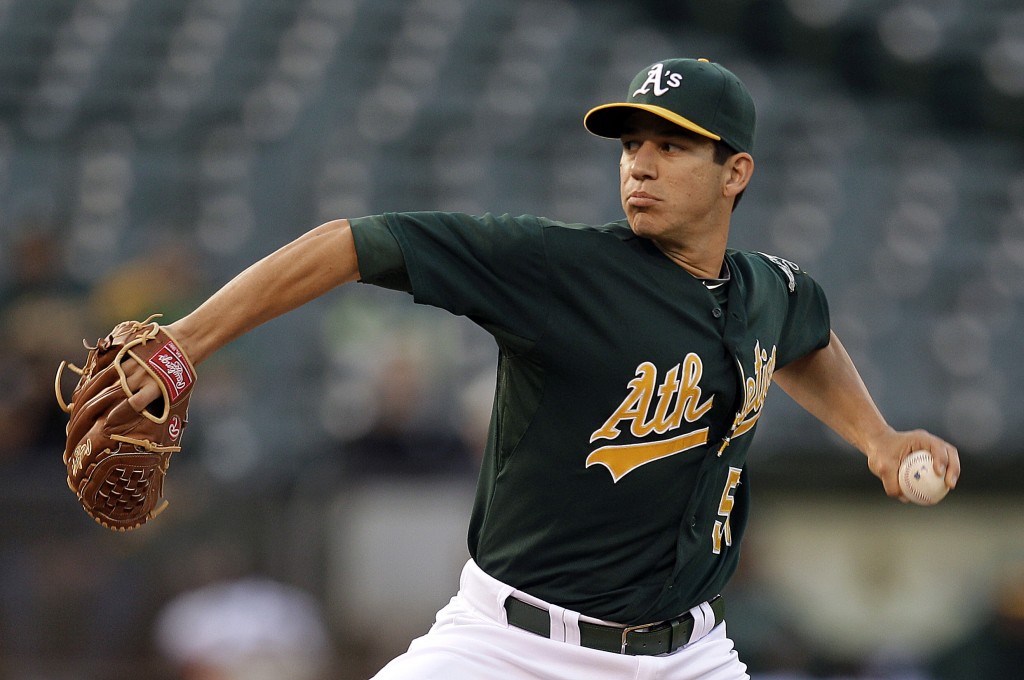
We miss you Tommy; Glad to see you're doing well. Photo AP/Ben Margot via dailyrepublic.com

Nationals farm system observers certainly knew we gave up a ton of talent to acquire Gio Gonzalez back in late 2011.  Most of the pundits I read at the time thought the Nats overpaid for a high-walk guy who overly benefited from playing in the “pitcher friendly” Oakland Coliseum (I say that in quotes since the multi-year park factors for that stadium can be nearly neutral depending on which statistic and which time period you choose).  We know what we’ve gotten in Gonzalez so far; a gregarious, pro-team guy who pitched lights out in 2012, increasing his K/9 and decreasing his BB/9 from both last season and from his career norms and who led the majors in wins.  He struggled in the playoffs of course, but his 21 wins were a big reason we were in the playoffs in the first place.

How about our 4 former Nats?  How are they doing so far?  In rough order of impact:

1. Tommy Milone: 13-10 with a 3.74 ERA and 1.279 whip in 31 starts after winning Oakland’s #5 starter job out of camp.   His debut was a sterling 8-inning 3 hit gem, and his season was a series of sterling outings interrupted by blow-out starts.  Scouts routinely pegged him as a 4-A starter, with not enough stuff to last in the majors, but he got results for us last year and continued to get results this year.  He helped lead Oakland to an improbable AL West crown and was the team’s #2 starter in the playoffs.  For a guy that I thought was a 4-A starter, Oakland has to be happy to have him on their squad.

2. Brad Peacock: Oakland is keeping him as a starter for now, and he toiled the entire season in AAA in Sacramento.  However, Peacock took a significant step backwards in 2012, posting a 12-9 record with an astounding 6.01 ERA.  Even accounting for the known hitters parks in the Pacific Coast League, to go from a 3.19 ERA in Syracuse to nearly double that in Sacramento spells issues.   I still think he’s bound for a middle-relief role on account of his only really having two pitches, and on account of the amazing starter depth Oakland possesses in their system.  But, starter or reliever, Peacock has to pitch better in 2013.

3. Derek Norris returned to the hitting form that we all knew and loved a couple years back once he reached Oakland’s AAA squad.  He hit .271/.329/.477 in about a half season in Sacramento and was then called up.   His MLB numbers weren’t great (.201/.276/.349) but he’s young and the team traded away its 6 year starter in Kurt Suzuki (to the Nats as we all know; sending Oakland yet another catcher prospect in the process) so Norris could be getting his chance sooner than later.

4. AJ Cole, the “gem” of the trade completely melted in the High-A California league, with a 0-7 record and a 7.82 ERA in 8 starts.   He returned to form upon his return to low-A, going 6-3 with a 2.07 ERA in 19 starts in the Midwest league.  All is not lost; he’s only 20, and there’s no shame in a 20-yr old failing at his first shot at high-A (where you see a lot of college draftees in their second pro year).


One year later, how does this trade look for both teams?  My trade reaction post from December 2011 talked about how this trade would come down to how closely the four traded guys came to matching their “ceilings.”  One year later, I think its safe to say that Milone has surpassed his ceiling, Peacock is in danger of never even fulfilling his “floor,” Norris is somewhere in the middle and its just way too early to judge Cole.

Meanwhile Gonzalez has surpassed what anyone could have hoped for in his first season; I thought he was a #2 starter but he put in an “Ace” year.  He may not win the Cy Young but he’ll be in the top 3 in voting.  He’s clearly a great clubhouse guy, a skill that you cannot put a dollar figure on.

I think both teams probably do this deal again.  There were no “winners” and “losers” thus far; both teams got exactly what they wanted out of the trade.

Written by Todd Boss

October 15th, 2012 at 3:20 pm

Game 5 Recap: Leaky bullpen and a Gutwrenching Ninth

13 comments

Not the best outing for Storen. Photo Andrew Harnik/washingtontimes.com

What a gut-wrenching game.

It started out as great as you could hope; scoring 3 runs in the first inning and igniting the largest crowd in Nats history.  The offense finally strung together a series of big hits from the top of our order against the same pitcher (Adam Wainwright) who shut us down so easily in the first game of the series.  The Nats offense woke up again in the 3rd and bounced Wainwright (the same guy that pundits expected to completely shut the team down again).  You can’t blow a 6-0 lead, can you?  Here’s a stat; on the Season the Nats were exactly 45-6 when scoring 6 or more runs.  But they’ve also coughed up larger leads; they blew a 9 run lead in Atlanta in July in a game that looked eerily similar to last night’s game; get a big lead, your starter gives up a few innocuous runs, then the bullpen slowly leaks runs until its all over.

Gio Gonzalez wasn’t really that effective, all told.  His final line: 5ip, 5 hits, 4 walks and 3 runs (all earned).  In the first inning he honestly looked startled on the mound, scared to be there.  He scuffled through the first inning looking tentative and got bailed out by some slightly over-aggressive hitting from the top of St. Louis’ order.  He did pitch with better confidence the next couple of innings (who wouldn’t with a 3-0 first inning and 6-0 third inning lead?).   He was definitely commanding his curve ball far better than in game 1 and was keeping St. Louis at bay.  However a lead-off walk burned him in the 4th for the first run, and then a complete meltdown in the 5th from Gio turned into two more runs.   His 5th inning line is as ugly as it gets for a starter; Double-Single-Walk-run scoring wild pitch-walk-walk to force in a run before finally getting the 3rd out.

Here’s where the bullpen just failed to get the job done.  Edwin Jackson walks the lead-off guy and he scores, making it 6-4.  The Jordan Zimmermann experiment from game 4 couldn’t be replicated, costing the team a run.  I can’t second-guess the move though; it had worked so well the night before.  Tyler Clippard gives up a home-run to Daniel Descalso to make it 6-5.  And of course we know what happened to Drew Storen, who picked a really bad time to match his career worst outing, giving up 4 runs on 3 hits and 2 walks in the 9th.  And the big hits didn’t come from the middle of St. Louis’ order; it was Descalco and Pete Kozma of all people getting the clutch hits.

My dad pointed out an interesting question; Storen was sharp last night but not tonight; could it be because he threw three straight games?  Storen had appeared in 3 straight games twice before this season but didn’t pitch full innings each time.  In this series he threw an inning each in games 1, 3,4 and 5.  His pitch count by game?  10,11, 26, and last night’s 33 pitch debacle.  Dad’s specific complaint was about the use of Storen in the blow-out game 3.  Why waste an inning there when you pretty much well know you’re going to need your 8th and 9th inning stars both subsequent nights?   Is it possible that Storen was just a bit gassed from the cumulative effects of a 26 pitch outing the previous night AND having pitched three consecutive days?

Another pet peeve of mine; how do you let Descalso steal second base un-challenged in the 9th?  Yes there’s two outs, but that put him in scoring position to tack on an extra run on the subsequent single.  If you hold that guy on, maybe you throw him out and get the 3rd out right there before the Cards get the lead.  He certainly doesn’t score on a single to RF.  This isn’t a problem just with Storen; the Nats pitching staff is notoriously bad at holding runners.  In the end, that extra run didn’t really matter … but it could have mattered if Suzuki threw the guy out before the go-ahead single, right?

There’s not much else to say in the way of analysis; the Nats should have been able to hold onto a 6 run lead, and Storen just had a bad night.  The fact that it came in such an important game is a shame.  If we want to look at a critical issue with the pitching staff on the night, it is probably this; the Nats pitchers put the Cards lead-off guy on in SIX of the nine innings, and that runner scored 5 of those times.  They got the lead-off hitter on base every inning after the 3rd.  That’s just a failure to execute by your pitching staff.  Of course it’s also a testament to the hitting ability of this St. Louis team up and down the lineup.

There goes the season; I had tickets for Game 1 of the NLCS.  I guess we have to wait til next year.

Game 4 Recap: Detwiler defines the word Irony with 6 strong innings

11 comments

Detwiler shuts down the Cards in Game 4. Photo Haraz Ghanbari/AP via federalbaseball.com

The movie The Matrix has been on the movie channel rerun cycle lately, so if I may quote the character Morpheus, “Life it seems is not without a sense of irony.”  The irony of Ross Detwiler being the guy who bails out the Nats with his stellar Game 4 outing is this; had Stephen Strasburg been active, it would most likely have been Detwiler who would have made way in the rotation.  Instead he (finally) gave the Nats an effective start, going 6 innings, allowing just 3 hits and an un-earned run in the Nats 2-1 walk-off win.

Using a sinking fastball with great effect, Detwiler controlled the powerhouse St. Louis offense and kept the ball on the ground; 11 of his 18 outs recorded were ground ball outs.  He was slightly wild on the night (3 walks and only 59 of his 104 pitches for strikes) but umpire Jim Joyce‘s wide and varying strike zone helped both pitchers put up excellent lines on the night.  Detwiler, the least experienced of any of our starters and a guy who most thought wouldn’t even be in the rotation this year (I certainly didn’t think so as spring training unfolded), was the one guy who has stepped up and pitched to his capabilities.

The game of course will be remembered for Jayson Werth‘s fantastic 13 pitch at-bat, culminating with a walk-off home-run off Lance Lynn for what had to be one of the more memorable games in the team’s brief history.  Good for Werth and great for this team.  I’ve already got the image saved as an iconic moment in this franchise.

Other odds-and-ends:

  • Thanks for pre-empting the game for an HOUR, TBS.  This was an unanticipated problem of trying to DVR the game and watch it later.  In addition to avoiding all social media, news sites and phone alerts so as not to have the game outcome spoiled, now I may have to start taping on multiple channels.  So I completely missed the first four innings.   Hence not so much analysis of Detwiler’s outing.
  • How about Jordan Zimmermann in the first relief appearance of his major league career?  He was throwing harder than I’ve ever seen him throw; touching 97 on more than a few occasions.  His mph was no stadium gun hype either: pitch f/x shows a max of 97.2 and an average of 96.73 for Zimmermann.   Meanwhile, here’s the pitch f/x data for his start on 10/8: average 94.08, max of 95.6.    That’s 1.6 mph more on his max effort fastball.  He absolutely mowed down the heart of the St. Louis order (aided again by a questionable strike 3 call on Matt Holliday that just left him laughing).  I figured Zimmermann was going for more than an inning, with Davey Johnson perhaps thinking the game might go long.  Instead, it seems he was playing the odds that Craig Stammen wasn’t up for the task.
  • Meanwhile, how about 9 straight punch outs to end the game?  It was refreshing to “remember” what the back-end of this bullpen is capable of.

This is the Nats pitching effort we’ve been accustomed to, and have waited for all series.  Now, suddenly, would you bet against this team in Game 5?  We have talked a lot about momentum and how the Nats had little heading into the post-season; they’ve certainly got it now.  Adam Wainwright should regress back towards the mean from his Game 1 start, and Gio Gonzalez should “egress” back towards his form of the bulk of the season.  Game 5 could be a pretty special experience.

Game 3 Recap: Jackson makes one mistake, offense misses in the clutch

5 comments

Jackson gets hit for 4 runs in 5 innings. Photo AP via wjla.com

The title says it all.  Edwin Jackson missed his target in the 2nd inning, it turned into a 3-run homer (from a #8 hitter no-less) and that was more than enough offense than the Cards needed en route to peppering the Nats pitching staff for 8 runs and 14 hits in a game 3 romp 8-0.  One mistake is all it took, but you can’t make a mistake middle-in with two guys on base to a professional hitter.  There was no need to watch the game after the 5th inning; it was clear this team wasn’t going to get to Chris Carpenter nor whoever else the Cardinals brought in after he hit his pitch limit.

Where is the Nats offense?  More to the point, where is all our clutch hitting?   We had the lead-off hitter on three times; a runner on first with none out has an Run Expectancy of about .84; meaning we’d expect that runner to score 84% of the time.  Instead we got 0 runs out of any of those situations.  The team has to get something out of that bases-loaded first inning, has to get something out of the third inning rally.  We went 0-8 with runners in scoring position, leaving 11 guys on base.  Where is Adam LaRoche this series?  Or Michael Morse?  We need these middle-of-the-order guys to produce if we’re going to win games.  The St. Louis #8 hitter was clutch yesterday; our guys havn’t been clutch (arguably) in 3 weeks.

It doesn’t matter if we still had Stephen Strasburg in the rotation if you don’t score runs.  We’ve scored 7 runs in 3 games, four of which were essentially meaningless as we were getting killed in game 2.  Meanwhile the Cards now stand at 22 runs and counting, an eerie repeat of the late September blasting we took in the 3-game series in St. Louis.

Ross Detwiler gets a shot in a do-or-die game tomorrow.  Lets hope he finally gets some run support.

Written by Todd Boss

October 11th, 2012 at 9:20 am

First “Wish we had Strasburg” story from National Media

6 comments

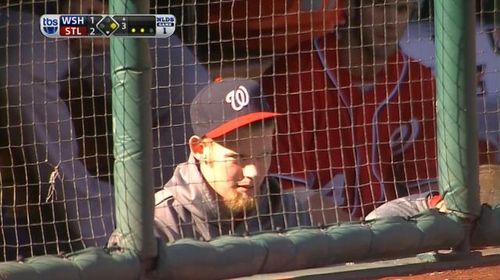
Strasburg sitting in the dugout during the NLDS, where he'll be for the rest of the playoffs. Photo Masn screen shot via nats enquirer blog

Rant on.  I couldn’t help myself today…

It was great to see that they couldn’t even wait until GAME THREE of the divisional series to post the first “Gee wish we had Stephen Strasburg” story.  Here’s the link, courtesy of Ken Rosenthal.  I’ll bet he had this article in the can weeks ago just waiting for a slow news day to post it.

Rosenthal quotes an anonymous player who doesn’t agree with the shutdown Situation, who said that “the team would be up 2-0″ if they had Strasburg.”   Such a gutless reporting technique; notice there was nothing other than a passing mention that there are clubhouse guys who agree with the shutdown.  Just cherry-picking opinions (of which there are dozens in a clubhouse) until he found one that enabled him to write the story he wanted to write.

He talks about how the Braves “handled” Kris Medlen so that he was still pitching in the post-season.  There’s no way Medlen-to-Strasburg comparisons are correct.  Medlen was absolutely not in the starting rotation discussion in Atlanta, and if he was he was 8th or 9th in line.  And there’s no way that Medlen was anything other than found gold to the Braves in terms of how good a starter he would turn out to be.  And there’s nobody who can tell me any differently.  Lastly, do you think perhaps the Braves would rather have used Medlen from the start of the season, had they known how dominant he’d be??  Do you think they would have finished in 2nd place in this division had they had Medlen all season?  Because last time I checked, the Braves lost their one-and-done WITH MEDLEN ANYWAY and are playing golf while the Nats are sitting pretty in the divisional series.

Nobody ever mentions this, but Strasburg was mediocre down the stretch.  He had a 4.14 ERA in his last 10 starts, a 4.50 ERA in his last handful of games, alternating between excellent and awful.   You could argue “arbitrary endpoints” but to me it sounds like a guy running out of gas, no?  Who is to say that the team wouldn’t have recognized that he was running on fumes anyway, and shut him down at the time they did regardless of an innings limit?  Why does nobody talk about this fact?  That’s because the National media narrative w/r/t Strasburg is LAZY.  Regurgitate the same stories, talk about the same platitudes of there being “no proof that shutting him down isn’t the best thing to do.”

Here’s my analogy; if  you had heart surgery and your cardiologist only told you to pitch 160 innings the next year, you’d do it and not complain about it right?  Well Strasburg’s ARM SURGEON advised the team on this limit after having ARM SURGERY, and the team followed it.  I don’t think we’d be hearing all these back seat pundits talking about how the Nats are idiots for resting a guy if it was his heart that was cut and not his elbow.  To say nothing of the fact that he’s young (24), under team control for at least four more years , and the team isn’t exactly looking like a one-year wonder right now, fielding the 3rd youngest pitching squad and the youngest hitting squad in the major leagues.   Every core player and pitcher is locked up or under team control for at least three-four years.  There’s NO reason to think that this team won’t be contending for years to come, irrespective of what any other team in the division does.

The Nats got a split in St. Louis.  That’s the best they could hope for against a dangerous opponent.  Wainwright isn’t going to strike out 2 batters an inning every time he goes out.  The Nats BLASTED Lohse this season.  Carpenter has what, three starts this year?  And the last time Jackson pitched against St. Louis at home, he went 8 shutout innings.  There’s more to this series than just Strasburg and St. Louis; the National media should try covering the Nationals for a change.

*sigh*.  So sick of hearing about Strasburg.  Can’t we talk about the Nats?!  They did have the best record in baseball after all.

/Rant off.  Stepping down from sandbox.

Written by Todd Boss

October 10th, 2012 at 10:49 am

NLDS Game 2 Recap: Zimmermann does not Execute

8 comments

Jordan Zimmermann did not have his best command Monday afternoon. PHoto JB Forbes/McClatchy-Tribune News Service via sfgate.com

There really isn’t much analysis needed of last night’s game 2 12-4 pounding; for me it was clear from the beginning that Jordan Zimmermann was missing his spots.  After a clean 1st inning (which included a relatively lucky strike-3 call on leadoff hitter Jon Jay) the potent St. Louis lineup teed off on mistake after mistake from Zimmermann.  A scorched line drive to third, then a well struck single up the middle, then a double off the wall, all seemingly within a blink of the eye.  Only Jay’s bloop hit to drive in the 2nd inning’s fourth run was not “well struck.”

Zimmermann was missing his spots, plain and simple.  Instead of getting a ball on the corner, it was drifting over the plate.  Instead of keeping the ball at the knees, it was floating upwards into the hitting zone.  St. Louis can hit the ball.  They’re in the top 3 in the NL in most standard offensive measures  (BA, wRC+, OPS, wOBA).  And, as we saw last night, they can power the ball pretty easily against mistakes.

When Craig Stammen relieved Zimmermann and couldn’t stop the bleeding, I stopped watching.  Yes our team has shown it can make up leads, but for me a 7-1 lead in the 4th against a playoff team is pretty much the definition of insurmountable.  I was rooting to just leave Stammen in the game to save the pen frankly.  We did get a chance though to get everyone in the bullpen an inning; kinda like the way you manage little league.  So there’s that.

So much for home/away, day/night and days rest split analysis.  When your starter can’t execute, you don’t have much chance on the night.  Its one of the reasons we play 162 games (these off-nights for good pitchers even themselves out over time), but also one of the reasons the playoffs are such a crap shoot (Aces get blown out and 5th starters pitch lights out in the playoffs all the time).

Lets just hope that scoring 12 runs made the Cardinals really tired (you know, from all the running around the bases they had to do) so they’re at a disadvantage in game 3.

Written by Todd Boss

October 9th, 2012 at 9:56 am

NLDS Game 1 Recap: Gonzalez the Escape Artist

10 comments

The team escaped Game 1 with a victory despite Gonzalez’s struggles. Photo Joy Absalon/US Presswire via usatoday.com

Nats take Game 1 of the NLDS 3-2.

You know your pitcher is having a rough day when the score line reads “2-0-0.”  As in, 2 runs, 0 hits and 0 errors.  That was the score at the end of the second, an inning in which Nats starter Gio Gonzalez had walked no less than four batters, thrown a wild pitch and given up a sac fly for the second run despite giving up zero hits.

TBS broadcast a stat showing Gonzalez’s ERA on various days of rest; the key stat was that he had a 5.80 ERA when he had more than 5 days rest.  His days rest entering Game one of the playoffs?  Nine days.  He last threw in Philadelphia on September 27th.

Being able to rest your starters and “set up” your post season pitching rotation can be a blessing and a curse.  Today it was a curse; clearly Gonzalez was overthrowing, missing his spots, and his pitching line showed it.  He didn’t trust his curve early, was relying solely on his fast ball and couldn’t locate it to his desire.  To his credit he settled down for a couple innings, got a couple of very timely plays in the field, and exited having given up a sole meaningless hit to go with seven walks in 5 innings.  To me it looked like he was over-throwing, that he was “too strong.”  Starters are creatures of habit; throw one day, rest the 2nd, toss the 3rd, bullpen work the 4th, rest the 5th and then repeat.  When too many extra days are thrown in, younger guys can get off schedule.

In the first inning I thought perhaps Gonzalez was trying to “save” his curve for later in the game; a great strategy for professional pitchers who can do it.  Instead of showing guys your whole arsenal the first time through the order, pound them with fastballs and make them hit your pitch.  Then, in their 2nd and 3rd at bats mix in curves and off-speed stuff as out pitches as needed.  If you play your cards right, you can work through each hitter’s 3 at-bats keeping them off-balance and suddenly you’re deep into the 6th or 7th inning as a starter.   As it turned out, he wasn’t trusting his curve at all, and suddenly he was pressing to hit his spots.

Craig Stammen escaped an incredible jam in the bottom of the 7th, having loaded the bases with none out.  Usually that situation has a run expectancy of somewhere greater than 2 runs but the Nats defense came through; an Ian Desmond force out at the plate for the first out then a clutch 5-4-3 double play to end the inning.  Despite Tyler Moore‘s late inning heroics, this was the key of the win.

Adam Wainwright showed exactly why he’s a Cy Young candidate when he’s healthy; his curve-ball was absolutely fantastic on the night.  The already-strike-out prone Nats fanned 10 times, many times on a fantastic curve that Wainwright was controlling and commanding to the outside corner.  I was surprised when he got the hook despite being on 100 pitches; as it turned out he probably wasn’t going to finish 7 complete regardless.  You can’t really fault the bullpen management by Cards manager Mike Matheny; he had his 8th inning guy on the mound (Mitchell Boggs) and the Nats beat him.

Other thoughts from watching the game:

  • I scoffed aloud when the TBS announcing crew spoke of Ryan Zimmerman‘s defensive prowness and said that “he rarely makes throwing errors.”  Really?  I know they don’t watch Nats games normally but the narrative behind Zimmerman’s throwing issues on non-pressure plays is well documented in DC.  He had 12 throwing errors on the year, and his 19 total errors tied him for 3rd in baseball.  Sure enough, a throwing error in the bottom of the 8th put the lead-off guy on board and caused the inning to be far more stressful than it needed to be for Tyler Clippard.  Guy on first with nobody out?  Roughly an 85% chance he scores.  For years I’ve defended Zimmerman and talked of the ridiculousness of “wasting” his defense by moving him to first, but the fact remains that every time he fields a routine ground ball I’m waiting for him to air-mail the throw.  When Anthony Rendon is ready to hit at the major league level, I think the talk is going to be about Zimmerman moving to first and not Rendon moving to another position.
  • For as clutch as Moore, Ian Desmond and Kurt Suzuki were on the day, Jayson Werth and Danny Espinosa were the opposite.  TWICE Werth squandered bases-loaded situations with two outs, leaving a total of 7 guys on base.  He may be our current lead-off hitter, but he’s normally a middle-of-the-order bat and he needs to capitalize on situations like that.  In Werth’s defense (no pun intended), the over-the-shoulder grab was a game-saver in its own right, so on a day when he disappointed at the plate he made up for it in the field.  Meanwhile it was not really shocking that Espinosa whiffed over and over; he led the NL in strikeouts on the season and was batting from his clearly weaker side.
  • How about Tyler Moore?  A fantastic job of hitting, hitting a pitcher’s pitch and not trying to do too much with it.  The old “game winning RBI” stat went the way of the Edsel, but tonight the clubhouse knows exactly who won that game.
  • Here’s to the return of “Clip-Store-and-Save.”  Clippard escaped Zimmerman’s throwing error in the 8th and Drew Storen dispatched two of the best St. Louis hitters in a 1-2-3 ninth.  The team has to feel great about its bullpen on the night.  No worries about using your 3 best guys; they’ll all be able to go tomorrow then get a travel day of rest.
  • The ridiculousness of the Hold stat: Boggs was credited with both a “Hold” and the Loss.  How is that possible?  Because he put on the go-ahead run that Mark Rzepcynski eventually allowed to score.  I think the Hold stat would carry more weight if it was withheld from relievers who don’t actually “hold” the game at bay and who contribute to the blown save and (if applicable) eventual loss.
  • The sideline reporter couldn’t help but compare the handling of Wainwright to Stephen Strasburg; both had Tommy John surgery last year.  He said the Cardinals “trusted” Wainwright more and let him pitch 200 innings.  But they didn’t really talk about the real difference: Wainwright is into the club option portion of his FA contract and is no sure thing to stay with the team beyond 2013.  He’s also 30.  Compare that to Strasburg; he’s 23 and is under team control for at least four more seasons, and is likely to be offered a multi-year contract that buys out those arbitration seasons and a couple of FA seasons beyond that (similar to the deal Gonzalez signed).  The point is; the Nats know they’ve got this guy for years to come and clearly played it conservative with his re-hab.  Why this point is glossed over by pundits and bloggers is beyond me.  Every time I hear some know-it-all say things like, “there’s no proof that letting him pitch more than 160 innings will harm him” my blood boils.  Well, there’s no proof to the other side either!  The fact is you can either be reckless with your major investment and overuse him, or you can play it safe and hope for the best.  There’s no guarantees in life and thus there’s no guarantee that Strasburg won’t blow out his elbow again in 2013.  But on this point I can guarantee; had the team continued to ride Strasburg down the stretch, push his innings to 190-200, and then he re-injures himself in the last week of September?  You can guarantee all those know-it-alls would immediately be clucking their tongues about how the Nats “mis-used” Strasburg and should have played it safer.  I don’t envy Mike Rizzo this post-season, because unless the Nats win the world series there’s going to be the inevitable stories about how the Nats would have won had they kept their Ace in the rotation.  To borrow a quote from Major League, “Well, I guess then there’s just one thing left to do … win the whole !?@& thing.”  (link NSFW)

Great comeback by the Nats, snatching a win in a game they probably should have lost.  They now have the split in St. Louis and are in a commanding position to win this short series.