Nationals Arm Race

"… the reason you win or lose is darn near always the same – pitching.” — Earl Weaver

Archive for the ‘Baseball in General’ Category

Debate: Was Jimmy Rollins’ steal against Baseball’s “Unwritten Rules?”

8 comments

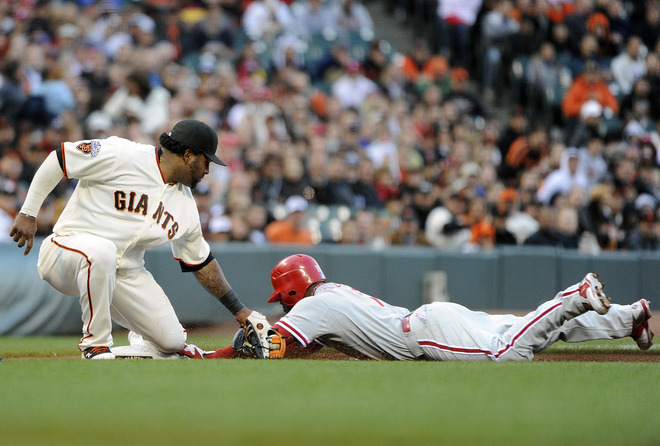
Jimmy Rollins steals lots of bases: did he steal one too many vs the Giants friday night? Photo: Thearon Henderson/Getty Images

(editor’s note: this post started with an email conversation amongst friends, where the Phillies fan amongst us didn’t think Rollin’s steal was “bad baseball.”)

The Giants and Phillies mixed it up in Friday 8/5’s game, a 9-2 victory (box/gamer) for Philadelphia that featured some “unwritten rule” discussion over the actions of Jimmy Rollins and subsequently Giant’s reliever Ramon Ramirez.

Here was the situation: the Phillies had just scored 2 runs to extend their lead to 8-2 in the top of the 6th inning.  The Giant’s starter Jonathan Sanchez had been knocked out of the game, and reliever Ramirez gave up a 2-run scoring single to Rollins.  Rollins promptly stole second base, and the next pitch plunked batter Shane Victorino.

Honestly, I believe it was a deserving retaliation by Ramirez and/or the Giants.  Stealing with a lead is a sliding scale; had Rollins done it in the 2nd inning with a 3-run lead it wouldn’t have gone punished, but the 6th is iffy with a 6 run lead.  Essentially, when the game appears to be out of reach, major leaguers have a tendency to just “play out the string” and expect this “conceding behavior” to be matched by the winning team.  Having been on both sides of many blowouts, there’s definitively a list of things you don’t do with a massive lead.  Steals and bunts are definitely out.  Curtailing aggressive play (taking extra bases, take-out slides, etc), swinging at 3-0 pitches and swinging out of your ass trying to hit homers are all examples of no-nos.  Certainly admiring homers and showing up a pitcher is a no-no, at nearly any point in the game (the Weaver incident earlier this week).

My Phillies friend apologist countered that the game was still close enough, that the Giants still had 4 at-bats, and the steal (though borderline) was justified.

Here’s some stats on the Giant’s offense and their capabilities of coming back, courtesy of baseball-reference.com:

  • The Giants are 0-8 when giving up 8 or more runs in a game.
  • They’re 12-26 when trailing after the 5th, no matter how many runs they’re down.  And,
  • The largest comeback they’ve had all season in being behind 4 runs.

I’d like to find some stats on how often baseball teams make up X-run leads, but my google skills are failing me.  I’m pretty certain though that the likelihood of making up 6 run deficits is pretty slim.  Tom Boswell has done research that shows that about half of all baseball victories feature more runs scored by the winning team in ONE inning than the loser scores the entire game (his “Big Bang” theory, based on his own research).  Sure enough, the Phillies scored more runs in the 5th inning (four) than the Giants did the entire game (two).

For me, the play was bush league, broke the unwritten rules of showing up your competitors and/or running up the score, and the retaliation was not only deserved but expected.

What do you think?

Written by Todd Boss

August 7th, 2011 at 9:56 am

Boswell, er I mean Sheinin’s 7/25/11 chat questions, answered

leave a comment

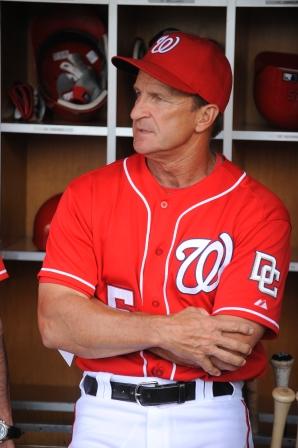
Is Davey Johnson up for the task at hand? Photo unknown origin.

I whiffed on the last couple of Boswell’s chats, finding time enough to read them but not to write a 2000 word missive in response.  Boswell’s on vacation this week, so here’s Dave Sheinin covering for him and doing a chat.

As always, I paraphrase the “questions” for levity and clarity, and I answer each question myself before reading Dave’s answer.

Q: Has the game passed by Davey Johnson?

A: Camera shots certainly seem to catch Johnson in an “old man” stupor from time to time.  I don’t think Baseball is like Football in that older generations of coaches can’t compete b/c the game has passed them by.  But I don’t sense that Johnson is really that in tune with the game right now.  The team has swooned since he took over, he has lost more than his share of 1-run games (fairly or unfairly set at the foot of the manager).  In reality this is a longer-term answer, meaning we’ll only be able to tell after he runs the team for a while.  Sheinin says that whoever replaced Riggleman was destined for a fall, and that he’s ok with everything Johnson has done thus far.

Q: Is Strasburg going to hit Potomac during his rehab trip, or are they gonna get screwed over again?

A: Good question; I’d say this time he appears for Potomac at some point, as the Nats had Wang travel up and down the system to get starts on his regular rotation.  There doesn’t seem to be a need to keep Strasburg out of Potomac’s awful outfield.  Sheinin agrees.

Q: How would you handicap the odds of the following trades happening by the deadline: 1. Nats trade Marquis 2. Nats trade Livan 3. Nats trade Clippard 4. Nats trade Desmond 5. Nats trade other(s) 6. Nats acquire Colby Rasmus 7. Nats acquire BJ Upton 8. Nats acquire Michael Bourn 9. Nats acquire other CF.

A: I’d put them in this order of most likely: 1, 5 (Coffey), large gap, 3, 2, 7, 9 (Span), 8, 4, 6.

I think Marquis and Coffey are definitely moving.  I don’t think anyone would want Livan.  I have a hard time thinking that the team is going to move Clippard or Desmond.  Rasmus probably goes elsewhere.  Bourn is a lesser version of Upton, so we’d probably want Upton over anyone else.

Sheinin thinks that the most likely players to get traded is Coffey, and doesn’t think Marquis is going anywhere.

Q: Do you think Riggleman intentionally left the team at its “high-water” mark?

A: Absolutely.  Riggleman was frustrated by the lack of communication from his boss (Rizzo), frustrated by his lame-duck status and probably was reading the tea-leaves that he’d be let to just play out his contract and let someone else enjoy the spoils of his work in 2012.  So he gave the team an ultimatum at the time that best suited his negotiaitons.  Rizzo called his bluff and Riggleman walked.  I know most believe Riggleman acted selfishly, but I put a ton of blame on Rizzo’s poor handling of the situation.  One conversation probably could have avoided all the negative press that followed Riggleman’s departure.  Sheinin thinks Riggleman knew exactly what he was doing.

Q: Would you trade both Clippard and Norris to get Denard Span?

A: No, I would not.  I think the Nats value the combined value of both those players, both under team control for at least 4 years (Clippard) to at least 6 in Norris’ case.  Span is decent, but for that price i’d shoot for Upton (who has more power and steals more bases).  Sheinin dodged the question, stating that Span wasn’t really in play.  Which he wasn’t at 11am monday, but since then rumors have floated about the Twins and Nats talking about him.

Q: What kind of pitch count will Wang be on?  What would be an expected first outing?

Probably nothing too conservative; he’s been rehabbing for literally a year and a half.  But if he reaches 100 pitches in an outing i’d be surprised.  I think a 5ip 2run outing would be a major success.  Sheinin doesn’t expect much.

Q: What will the team do with Gorzelanny, who seemingly is making way for Wang in the rotation?  DL?

A: The team can’t demote him (options), so they probably demote Detwiler and have Gorzelanny be the new long-man out of the pen.  At least until we trade a starter or someone goes down with an injury.  He may have an “invented injury” all of a sudden and go onto the 15-day DL.  Certainly the team has been shady in the past in the way it handles DL trips, and I wouldn’t be surprised to see this happen here.  Sheinin says that teams hide injuries all the time for competitive purposes.

Q: Why is Drew Storen’s name in trade rumors?

A: Good question.  I have a very hard time believing the Nats would consider trading Storen unless it was to obtain someone marquee.  It may be that other teams are asking about him and that news is leaking out. Sheinin does say that relievers are fungible, as I’ve said many times, and you never say never to a trade possibility.

Q: What makes more sense in 2012: Morse in LF or at 1B?

A: Makes more sense: keeping Morse at first and Nix in left and not messing with what has turned into a very healthy middle-of-the-order for this team.  Reality: LaRoche isn’t going to get traded and we don’t want to light $8M on fire, so he’s going back to 1B.  Which means Morse is back in left and Nix is left out.  Sheinin says a lot can happen between now and next spring, like us signing Prince Fielder and making this whole conversation moot.

Q: If you had to bet right now, is Desmond or Lombardozzi starting in the infield next year?

A: I’d bet Desmond starts there and is given one more year to figure it out.  Lombardozzi starts in AAA and if he earns his way up, he earns his way up.  Sheinin agrees, but says that Desmond needs to start producing or risk losing his job.

Q: Why did Riggleman call out Boswell during his departure?

A: Probably because Boswell wrote a ton of not-so-nice pieces essentially proving just how bad a manager Riggleman has been over his career.  You’d probably be pissed as well.  Sheinin thinks that Riggleman’s rant was misguided.

Q: Who starts in CF for this team in 2012?

A: Who knows.  It really seems like this team is in the market for a CF, so right now i’d say its a FA to be named.  I don’t think it will be Ankiel or Bernadina.  Ankiel parts ways with the team and Bernadina battles with Nix to be the 4th outfielder.  Sheinin agrees.

Q: Which team will regret their big contract more?  Werth/Nats, Howard/Phillies, Jeter/Yankees or A-Rod/Yankees?

A: Probably the Nats.  Howard is a big bat in the middle of a talented lineup and it more or less goes unnoticed that he’s not producing at his normal levels in 2011.  The Yankees have so many $40M mistakes that its comical, but the A-Rod contract in particular looks like it will be a massive albatross in a few years (A-Rod is guaranteed $20M in 2017, when he’ll turn 42 mid-season).  Sheinin agrees.

Re-alignment? The easiest solution will be to ADD 2 teams.

2 comments

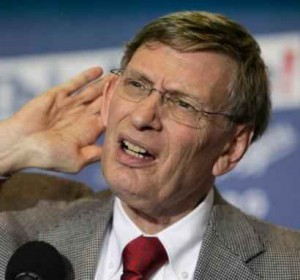
Bud Selig failing to hear calls for him to retire. Photo: ajc.com

(Note: if some of this looks familiar, it is because I started this post in a long-winded answer in a recent “My answers to Boswell’s chat” post).

Ever since Buster Olney posted a June 12th Article raising the topic of “Divisional Realignment,” every baseball columnist and blogger on the internet seemingly has posted their own 2 cents on which team should move leagues and why, opined about how year-long interleague play would be the death of baseball, and other interesting topics (my very fast 2 cents on the pressing questions: move Houston to AL West, who cares about interleague play, and make DH standard in both leagues).  The topic came up again at the all-Star game, with Selig talking about “minor” realignment in the future and other topics.

However, what if re-alignment isn’t the best solution to the problem at hand?  Yes, it is more difficult to make the playoffs from the NL in general (by virtue of having 16 teams to the AL’s 14) and in the NL central specifically (with 6 teams and a lot of money being spent by a couple of them).  Certainly as compared to the AL west with only 4 teams.

Instead of going two leagues of 15 teams each, why don’t we just ADD two more teams to the AL?

If we’re already talking about adding a 5th playoff team to each side via a 2nd wild-card, why not add 2 more teams and have an NFL-style league configuration and playoff structure.  8 divisions of 4 teams each, with 4 division winners and two wildcards in each league.  The two wild cards play the lesser two divisional winners, much like in the NFL, giving the two best divisional winners a weekend bye and some semblance of an advantage.  If the season ended on (say) a Wednesday, the two wild-card series occur Fri-Sat-Sun with the divisional playoffs to run starting the following Tuesday.  It isn’t adding that much time to the playoffs and should be doable.

(Note: other pundits have mentioned this same idea.  Keith Law and a blog run by The Common Man have both made mention of the possibility of expanding.  Baseball America just posted a missive that leads to the same concept (equal teams in both leagues) but suggests contracting two teams (can’t see that happening, sorry.  Too much value in each team to just get rid of them).

Lets talk about the logistics and questions of this:

Which two cities get new teams?

The two current largest metropolitan markets without major league baseball teams right now are Portland and San Antonio, and for a variety of reasons they make the most sense to select.  The San Antonio-Austin corridor is growing rapidly and has a large population base of immigrants that enjoys baseball.  Portland is a large sophisticated area that only has one major sports franchise, and has a natural wealthy owner in Paul Allen to buy and own the franchise.

Honestly, the two largest US or Canadian cities without baseball are Montreal and Vancouver, but after the complete debacle of the Expos leaving Montreal I’m guessing that Canadian baseball will never get an expansion team again.  Vancouver couldn’t keep an NBA team so I’m doubting baseball makes sense up there either.  Mexico has a well attended Mexican League, with attendance in the 350,000 for some teams, but the exchange rate issues and current safety issues in the country make it a no-go.

If we were being completely realistic in terms of  a population per baseball team, then both New York and Los Angeles really would be the two expansion targets.  You could put a team back in Brooklyn (or perhaps Long Island) and then put a team in the Riverside area (which by itself has a larger population than places like Phoenix, Seattle, Minneapolis, and San Diego).  However, none of the teams in either market is likely to give up any of their local revenues or TV networks to allow in a third team.  So we have to move elsewhere.

A slight potential issue: Portland doesn’t currently support even a AAA franchise.  San Antonio/Austin supports several baseball teams and would be a more “sure thing” (The San Antonio Missions is a AA team and the Round Rock Express, north of Austin, is AAA).   I don’t believe Portland has any semblance of any pro baseball team; the closest I could find is a Short-A team in Spokane.  If you’re using AAA attendance as a bench mark (here’s links to the International league attendance figures, and the Pacific Coast League), then your best bets are cities like Louisville, Indianapolis, Sacramento and Albuquerque.  Of these cities, only Indianapolis and Sacramento are really large enough MSAs to make sense.  Moving to any California city is problematic because of the current budget nightmare there.  Indianapolis is interesting but may struggle to find a fan base sitting in-between Cincinnati and Chicago.

Lots of people talk about somewhere in North Carolina as a potential spot.  An area of the country far away from its two closest MLB teams (Washington and Atlanta).  Durham hosts a AAA franchise ably enough.  The problem would be (as pointed out by Baseball America pundits, who are based in the Research Triangle) that the Triangle area supports a large number of minor league teams, a thriving set of collegiate baseball programs, and a big wood bat league, and a MLB team would probably harm attendance at all of these well supported clubs.

So lets assume for the sake of this argument we’re expanding to Portland and San Antonio.

How would we change the divisional structures to move to 8 divisions of 4 teams each?

The American League is much easier to re-configure than the NL.  Here’s how the AL might shake out with two new teams and 4 divisions:

AL East Boston NY Baltimore Toronto
AL South Tampa Bay Texas Kansas City San Antonio
AL Central Cleveland Detroit Chicago Minnesota
AL West Seattle Los Angeles Oakland Portland

This plan would preserve most of the major rivalries in the AL while creating some new ones.  The AL East and its two juggernaut teams continue to do battle 18 times a year, but the addition of two wild cards means that Toronto and Baltimore have no more excuses.  Tampa moves out of the AL east but goes against two like-minded franchises in terms of building on youth in Texas and Kansas City.  The AL South has a bit more travel, but Tampa’s strong TV ratings should be maintained with 8pm start times instead of 7pm during its many central time zone trips.  San Antonio builds an instant in-division rivalry with their Dallas neighbors.  The AL Central keeps its four core teams that have gotten used to competing against each other and are all very geographically close.  Finally, the AL west gets an instant Seattle-Portland rivalry while keeping all its games on Pacific time.

The National League has a couple more re-configuration challenges, as we’ll see.  Here’s one potential configuration:

NL East Philadelphia Atlanta NY Mets Washington
NL “South” Florida Houston St. Louis Colorado
NL Central Milwaukee Cincinnati Pittsburgh Chicago
NL West San Francisco Arizona Los Angeles San Diego

The NL East, Central and West all make plenty of sense.  The only fault of this plan is what to do with the collection of teams that end up in the NL “South.”  Clearly, Colorado is not a “southern” team and is two timezones away from its divisional rivals.  This means a lot of divisional games for Florida end up starting at 9pm.  This plan also moves your marquee NL franchise (St. Louis) away from its longtime rivals in Chicago. It may be better to try to maintain a bit more geographical sense and keep rivals together.

You could do something a bit more radical to NL teams and longer term divisions, like this:

NL East Philadelphia Pittsburgh NY Mets Washington
NL South Florida Houston St. Louis Atlanta
NL Central Milwaukee Cincinnati Colorado Chicago
NL West San Francisco Arizona Los Angeles San Diego

Here, the Pirates join the NL east, which joins the two Pennsylvania teams together for a nice little rivalry, plus keeps the four closest North east teams together.  Atlanta joins the south allow Florida and Atlanta to stay close together.   Houston and St. Louis are relatively close as well.  This plan eliminates Colorado from having the 2-time zone divisional rivals; there’s just no natural spot for Colorado to go unless you completely re-made the league and created a 4-team division with Colorado and the 3 Texas teams.  The only downside to this plan is that St. Louis loses its divisional history with long-time NL teams Milwaukee, Cincinnati and Chicago.

Here’s another attempt, trying to keep the four longest running NL central teams together somehow:

NL East Philadelphia Pittsburgh NY Mets Washington
NL Central Colorado Houston Atlanta Florida
NL Midwest Milwaukee Cincinnati St. Louis Chicago
NL West San Francisco Arizona Los Angeles San Diego

This may be your best solution.  Florida and Atlanta stick together but must travel to Colorado.  The NL Midwest now has four of the oldest teams in the league staying together.  Colorado, Houston and Florida stay together, as three of the newest teams in the league.

Would the various rooting interests all approve 2 more teams?

Probably.  Here’s several groups who have input:

  • Players Union: Two more MLB teams means 80 more full time jobs for union members, so the Players Union would approve.  Plus, hundreds more minor league players get jobs and keep their dream alive.
  • 2nd-tier American cities: Two more teams has the cascading effect of adding in somewhere between 10 and 12 minor league teams.  Two AA cities will get promoted to be AAA cities and there will be more cities out there that get teams that they may have always wanted.
  • MLB Owners: would love to pocket expansion fees from two new wealthy owners buying into the league (especially Frank McCourt right about now).  I’d guess expansion fees would be somewhere in the $400M-$600M range, split 30 ways.  Easy money.  The difficult part the Owners would have to accept would be the carving up of TV areas and loss of local revenue for the owners of the Houston and Seattle franchises.
  • MLB Hitters: would probably like expansion, which dilutes the pitching pool and aids hitting.
  • Fans: will get more wild cards, more playoff teams, a structure that makes sense and seems fairer (no more 16/14 team split leagues).

In fact, the only groups that i’d guess would NOT be in favor of expansion would be Baseball Purists, who gripe at every change in the game and probably still want to live in the 60s-era, no playoffs pennant winners go to the World Series.  To them I say this: Baseball used to be the National Pastime, but it has been passed by clearly by Pro Football, College Football, and arguably both professional and collegiate basketball in terms of casual interest.  You cannot sit by in situations like this; you must be proactive.  Casual fans love playoffs, love the drama, and by keeping more teams involved in pennant races you keep fans coming to the ballparks for more teams, later into the season.

So, why would expansion NOT work?

I can think of a couple major reasons.

1. Splitting up of existing TV markets.  We saw what happened when Washington moved into a city that Baltimore “owned” already: Angelos gets handed a regional network and a majority ownership stake.  This could give Angelos a massive future revenue stream while permanently hampering the Nationals franchise.  This point can’t be emphasized enough; the primary reason the Yankees and Red Sox can spend what they spend is exactly their ownership stakes in the YES Network and NESN respectively.

We’re subsequently seeing a battle now between the league, the owner of San Francisco and the Oakland franchise as the Athletics attempt to move.  The Giants “claim” the San Jose market (despite it being a comparable distance away from San Francisco in terms of geography and driving time in the busy Bay Area Peninsula region as Washington is from Baltimore), and do not want to give it up.  The Athletics could move further south down the Bay to a city like Fremont (a northern suburb of San Jose), but this would put the majority of the San Jose metropolitan area 20-30 miles from a stadium.  The A’s might as well move to Sacramento.

Any existing major city that could be considered for expansion is already “owned” by one of the existing MLB franchises.  See this Map of the US by regional network ownership as a reference point: Seattle has already “claimed” Portland and most of northern Oregon as its own, and San Antonio is claimed by BOTH Texas and Houston (who also claim the entirety of Louisiana).

I think asking existing owners to give up territory in their Regional Network map could be a complete roadblock for expansion into any area.

2. Viability of new Markets.  Continuing to use Portland and San Antonio as expansion markets would immediately make those two cities among the smallest MSAs in baseball.  They would both be larger than Milwaukee, but would be smaller than other notoriously struggling franchises (in terms of revenue) such as Kansas City, Pittsburgh, and Tampa Bay.

However, market size and revenues are not on a linear relationship.  A lot has to do with the quality of the stadium, the stadium location and the performance of the team.   The Florida Marlins had the lowest 2009 revenue (according to Forbes) yet play in Miami, the 6th largest metropolitan area.  Clearly the poor stadium is a major factor to their lack of attendance, but the fans also seem to be turned off by the perpetually shady owner Jeffrey Loria.  It will be a very interesting case study to see how the Marlins do once they move into their new stadium, which should give the fans a better experience and give the Marlins a better revenue stream from luxury boxes, concessions, parking and naming rights.

There is continual complaints from fans and players in Tampa Bay (here’s a recent article that summarizes the issues they face, but the same issues are repeated over and again in the two local papers down there) over the sorry state of attendance at their games.  Despite being a newer stadium, the constructors of the St. Petersburg stadium made several errors in terms of luxury box flexibility and stadium accessibility.  Fans down there attest to this fact; the stadium is impossible to get to, so they stay at home generally and watch.  Tampa has historically had great TV ratings but awful in-person attendance. This year (per the above article) despite still being competitive the Rays are drastically down in attendance and TV ratings, possibly a reaction to a perceived white-flag season after dumping so many free agents last year.  Florida’s economy is in the tank, and there will be no new stadium financing (especially after Loria’s fleecing of Miami).  So Tampa is facing the very real possibility of moving themselves.  They’ve even recently had talk of declaring bankruptcy in order to force a new stadium discussion.

If there are existing markets that clearly cannot support baseball, then how can we add two more teams?

In the end, Would I like to see expansion? I think expansion makes more sense than splitting up the leagues and doing interleague every day.  If the TV revenue issues can be resolved and somehow these smaller market new additions find stadium deals that make them financially acceptable, then expansion makes the most sense.
Written by Todd Boss

July 13th, 2011 at 1:32 pm

My Answers to Boswell’s Chat Questions 6/27/11

2 comments

As one may expect, Boswell's latest chat was filled with Riggleman questions. Photo unknown credit.

In the wake of the Jim Riggleman debacle, I’m guessing that Boswell fields and opines a lot on Riggleman.  Boswell and I differ in our opinions of Riggleman as a manager, and I found it telling that Riggleman noted on a radio show last week that Boswell had never interviewed him (a point refuted by Boswell below).  That would put a severe damper on Boswell’s opinions of Riggleman in my mind; if you don’t have the courtesy to interview the subject of multiple highly critical columns and op-ed pieces, then how can you claim 100% credibility?  Now i’m not sure who to believe, since Boswell reports near daily conversations with Riggleman.  Perhaps Riggleman meant that the two had never talked about one particular topic.

Regardless, here’s Boswell’s 6/27/11 chat.  As always, I read the question, write my own answer then interpret Boswell’s answer.  All questions are paraphrased from the chatroom for clarity here.

Q: Given the latest string of performances, should the Nats be buyers or sellers at the trade deadline?
A: Clearly their amazing run has reversed my answer to this question from a few weeks ago.  Now, if the team continues at a 111-win pace (as was noted today on twitter … the team’s form in the past 14 games would put them on a 111-win pace for a full season), then they will factor into the wild card race amazingly.  If you’re in the WC race, you are buyers at the deadline.  If you have a shot at the playoffs, then you take that shot.  (Boswell thinks they’ll be “non-sellers,” preferring to stand pat b/c they have no obvious holes.  A fair assessment of the team right now).

Q: Did the Nats upgrade at Manager?
A: Well, clearly yes.  Even if Davey Johnson turns out to be a Joe Gibbs-esque over the hill and out of touch (something I really don’t believe happens in this slower-moving strategic sport versus the fast advances of the pro football game), he will command more respect than Riggleman could ever expect.  But I think the team was exposed in a certain way throughout this whole Riggleman affair.  Riggleman may go down as the man who made the career-suicide move, but Rizzo is not blameless here.  You couldn’t find time to spend an hour with your most important subordinate to discuss contract status?  And the owners clearly are too-hands off here; I agree with the sentiment of Adam Kilgore who wrote a post that essentially said that this situation wouldn’t have happened if Stan Kasten was still here.  That’s not a great endorsement of the state of your front office right now.  (Boswell actually compliments Riggleman in his answer.).

Q: Why not just leave Bernadina in leadoff instead of all these lineup experiments?
A: Good question.  Its hard to guess what will happen tomorrow (with a new manager) based on what happened yesterday (with the old manager).  Personal opinion; batting a pitcher 8th is asinine, Bernadina should be batting leadoff until Desmond either figures out how to hit or we acquire a replacement, and you leave Werth in a power-hitting position where he should be.  Simple as that. Boswell says Bernadina should be leading off and cites his defense as a reason to include him.

Q: What does Boswell think about Riggleman’s pointed statements about him to the press?

A: Wow, can’t wait to read this answer.  I’m guessing Boswell will trash him, again.  (Boswell refutes Riggleman’s comments, that I alluded to above, about how he was never interviewed by Boswell.  Hmm.  Otherwise Boswell deflects some of Riggleman’s comments and actually excuses his statements as being heat of the moment.  Interesting.

Q: What changes will Davey Johnson institute on this team?
A: No idea.  Johnson certainly was a master strategist and depends on matchups and stats, so perhaps we’ll see more platooning.  He’s old-school, so perhaps we’ll see pitchers going longer into games and less bullpen churn.

Q: Is the Werth-Leadoff and Pitcher-8th experiment dead?

A: Probably.  Honestly it smacked of desperation from Riggleman, though I’d be desperate too if my $126M hitter was batting in the .220s.

Q: Is small-ball dead (Nats were 2nd in NL in sac bunts)?

A: I doubt it; its still the National league.  And I don’t completely blame sac bunting on Riggleman.  I’ve seen our struggling hitters gladly take a sac bunt instead of trying to get a hit when they’ve been down.  Johnson is still an old-school manager.

Q: Which player benefits the most from Johnson’s arrival?

A: I’d guess Jayson Werth, who clearly was fed up with Riggleman and should have more respect for Johnson.

Q: Does Johnson’s arrival raise expectations for this team for the season?

A: Yeah unfortunately.  Or fortunately, who knows.  For me, if you’re not going to make the playoffs I’d rather finish dead last and get higher draft picks.  There’s not a lot of value in winning 78 games year after year.  I still think .500 is a great goal for this squad.

(Boswell punted on these last 5 questions, saying they’d all be addressed in his 6/28 column).

Q: Did ownership somehow derail the team, or were they responsible for Riggleman’s departure by being cheap?

A: I’m not going to blame the owners for being cheap, despite Riggleman’s contract paying him 2nd to last in the league.  I will blame Rizzo for letting him hang on the option and failing to be a professional and just grant the guy a meeting.  (Boswell says that ownership gets some blame here… but then explains why they shouldn’t since Riggleman signed the contract and that’s that)

Q: How is the bullpen holding up?  When will Zimmermann be shutdown for the season on innings limits?

A: I think the bullpen is starting to fray.  Kimball, Slaten out, Clippard with a “tired arm” and Burnett continuing to blow leads.  Storen got hammered the other night too.  Mattheus has shown that he’s a nice mid-season callup, and we have other such arms in AAA that we can try out soon (Mandel, Wilkie).

Zimmermann may be done sooner than we think.  He’s at 94 innings now, is averaging 6 1/3 per start, and if you think 150 is his limit then he’s only got 8-9 more starts.  That’s only going to take us to the end of July.  (boswell doesn’t really answer, just notes that Storen is on pace to appear in 80 games, which is ridiculous for a high-end closer).

Conclusion: Boswell seems to really soften his opinion on Riggleman, gives him many compliments throughout.

Written by Todd Boss

June 29th, 2011 at 10:03 am

My answers to Boswell’s questions 6/20/11

3 comments

Werth is catching a lot of criticism for his performance lately. photo: Mitchell Layton/Getty Images NA

WP columnist Tom Boswell conducted his weekly chat today 6/20/11, via the Washington Post chat pages.  Boswell heavily covered the US Open and took a number of questions on Rory McIlroy and the tournament, but he did field some Nats questions.

As always, the questions below are paraphrased from their original asking for space and levity.

Q: Is Jayson Werth already a bust?
A: I think there’s some impatient Nats fans out there.  Yeah he’s hitting .232/.332/.409, but his OPS+ is still above 100, so its not like he’s having an Adam Dunn-esque season.  I think he’s struggled with the absence of his lineup protection Ryan Zimmerman and has tried too hard to carry the team and earn his contract.  Happens all the time in the first year of a massive deal, or the first year with a new team and a new stadium and a new city.

Lots of pundits flat out panned the Werth contract.  Too much money, he’s too old, he’s not a superstar.  Well, its not like the Phillies didn’t want him back; he was a coveted free agent and we overpaid because we had to.  I still maintain that if Werth had signed 7rs/$126M with New York or Boston, nobody would have said a thing (indeed, Carl Crawford signed for MORE money and is hitting worse, yet you don’t see many articles slamming Boston for such a horrible contract).  I think a lot of the flak was just the Nats perception as being cheap, and breaking that perception.

(Boswell mentions the same two players I just did, and says that he believes Werth is just “playing tight” right now.  Fair enough).

Q: Did Riggleman leave Gorzelanny in to bat in the 4th inning on 6/19, in an attempt to avoid another Marquis-blowup by taking him out prior to 5 complete innings (so that he wouldn’t qualify for the win)?

A: Maybe.  Maybe not.  Gorzelanny was giving up a LOT of hits, he had given up runs in 3 straight innings and was probably heading for an early shower.  But the Nats got 2 runs back in the bottom of the 4th and Gorzelanny wasn’t near 100 pitches on the day.  Unfortunately he went out and gave up more runs in the 5th and had to get hooked.  Managers aren’t omniscient, and Riggleman had no idea he was going to get pounded for 3 more runs.  Keep in mind as well, this was Gorzelanny’s first game back, he didn’t really have a ton of rehab time (one AAA start) and was more or less rushed back into service because of how bad Maya performed.  (Boswell didn’t really answer the question, just saying that Riggleman has to manage a group of 25 guys, each with different incentives).

Q: How would you re-align baseball, if you were commissioner for a day?  Would you keep divisions?

A: Short answer: Move Houston to AL West to create a fantastic Dallas-Houston rivalry and to create 6 divisions of 5 teams each.  Standardize the DH across the board.  Have rotating divisional focus but stick to it (not like what they do now, where its random what teams play who).  Who cares if there’s inter-league play at the end of the season; make the matchups compelling and people will come to see the games.

Another move could be to add 2 more teams and have an NFL-style playoff structure.  8 divisions of 4 teams each, with 4 division winners and two wildcards in each league.  The two wild cards play the lesser two divisional winners, giving the two best divisional winners a weekend bye and some semblance of an advantage.  Assuming you add two teams to to the AL (in Portland and San Antonio, the two current largest markets without major league baseball teams), you could have divisions like this:

AL East Boston NY Baltimore Toronto
AL South Tampa Bay Texas Kansas City San Antonio
AL Central Cleveland Detroit Chicago Minnesota
AL West Seattle Los Angeles Oakland Portland
NL East Philadelphia Atlanta NY Mets Washington
NL South Florida Houston St. Louis Colorado
NL Central Milwaukee Cincinnati Pittsburgh Chicago
NL West San Francisco Arizona Los Angeles San Diego

This plan would preserve most of the current rivalries in baseball while creating some new ones.  Tampa moves out of the AL east but goes against two like-minded franchises in terms of building on youth in Texas and Kansas City.  The AL South has a bit more travel, but Tampa’s strong TV ratings should be maintained with 8pm start times instead of 7pm during its many central time zone trips.  San Antonio builds an instant in-division rivalry with their Houston neighbors.  The AL Central keeps its four core teams while the AL west gets an instant Seattle-Portland rivalry while keeping all its games on Pacific time.

The NL East, Central and West all make plenty of sense.  The only fault of this plan is what to do with the collection of teams that end up in the NL “South.”  You could do something a bit more radical to the existing rivalries in this plan:

NL East Philadelphia Pittsburgh NY Mets Washington
NL South Florida Houston St. Louis Atlanta
NL Central Milwaukee Cincinnati Colorado Chicago
NL West San Francisco Arizona Los Angeles San Diego

Here, the Pirates join the NL east to allow Florida and Atlanta to stay close together.  The central teams now cut down on travel a little bit (though Cincinnati is closer to Pittsburgh than most any other NL team, so splitting them up doesn’t make a ton of sense).

Just some random thoughts.  (Boswell, coincidentally, completely punted on the question, saying he had no idea but that any plan done just to make life easier for the AL east doormats Toronto and Baltimore needs to be rethought.)

Q: Do the Nats move Rendon to 1st base if he hits like everyone is talking?

A: It all depends.  If he hits his way into the majors next June, then we may have to get creative where to put him (left field?)  If it takes a few years and we’re looking at FA first basemen then sure, 1st base makes perfect sense.  If its 3 years from now, Desmond is still hitting .205 and Espinosa looks like a franchise player, move Espinosa to short and install Rendon at 2nd.  Lots of options.  Way too early to decide.  Hell, we haven’t even signed the guy yet!    Boswell insinuates that perhaps its Zimmerman who makes way.  Wow, hadn’t considered that possibility.  I have a hard time believing that we’re going to move the best defensive third baseman in the majors on account of a few throwing errors.

Q: Is Bernadina part of the Nats future?

A: I have a hard time believing so.  He’s a fringe-below average major league hitter.  He can play a good center, but we’re grooming Bryce Harper to play center (I would hope).  So Bernadina is left to compete for a left field spot with guys who can adequately man the position but hit 25 homers.  (Boswell completely ignored the Bernadina question).

Q: How does Morse’s prowness defensively at 1st compare to LaRoche and Dunn?

A: He’s clearly in between, though closer to LaRoche than most would say.   So far this year in about 2/3s the innings Morse has a 4.1 UZR/150 rating, which is pretty darn good for a first time full time first baseman.  LaRoche’s was higher (at 9), not surprisingly since he’s one of the best defensive first basement in the league.  Dunn?  He was a -4 uzr/150 in 2010 for the Nats and hasn’t played 1st enough to get a rating so far in 2011.  I always thought Dunn was more agile than people gave him credit for, but that he really struggled on grounders and throws from his middle infielders.  (Boswell more or less agrees).

Q: With Morse playing 1st so well and hitting even better, is he the future first baseman?  What do we do with LaRoche?

A: A very good question.  If LaRoche is healthy, I think he’s your first baseman.  He’s signed for 2012 with a decent 2013 option.  Meanwhile, Morse clearly needs to be in the lineup.  I think the answer may be to flip Nix for a prospect and put Morse back in left when the time comes.  Its nice to have positional flexibility with your hitters.  I think you wait til next spring training and see just how LaRoche is hitting post surgery before making this determination.  (Boswell rambled about how Morse may be hitting what we can expect from Harper).

Q: What are the odds of a Beltway World Series?  Which franchise makes the playoffs first?

A: Slim to none on the first question; I can’t see Baltimore beating out its AL east rivals until they get a new ownership group and embrace the approach the Tampa Bay Rays have taken.  So therefore the immediate answer to the 2nd question is the Nats.  I personally feel that we may reasonably expect a playoff run in 2013.  Philadelphia will be aging and saddled with several major contracts (they have $86M committed to just FOUR guys for 2013 right now, and those four guys will be 36, 33, 34 and 34.  ouch) and could be caught at the top of the division.  Atlanta will still be strong, but the Nats seem to be built to peak starting in 2013.  (Boswell says the Nats have a higher ceiling and then goes on a tangent about the fan base and attendance).

Q: Would the Nats be doing themselves a disservice by trading Marquis, Livan and Gorzelanny and replacing them with lesser AAA pitchers?  Why trade veterans if they’re winning?

A: (before starting, lets discuss.  Livan is an absolute steal at $1M/year and Gorzelanny is under arbitration control for 2 more seasons.  I seriously doubt either is traded).  So lets talk about Marquis.  Yes you should absolutely trade Marquis.  Several reasons:

  • He’s in a contract year and is pitching better than he would be once he gets paid.
  • He’s on the wrong side of 30 and has value now.
  • Did everyone forget how bad he was in 2010?
  • Any contract he signs will be difficult to reap the value of as it plays out.
  • He’s not an Elias typeA or typeB pitcher, so if we lose him to free agency we’ll get zero compensation.
  • We’re not winning the world series this year, therefore….
  • All losing teams trade off veterans at the trade deadline for prospects.  And we should too.

(Boswell thinks the 7/31 trade market is softening and that the Nats won’t take any offers, and everyone stays.  I doubt that, based on what we were getting last year for the likes of Cristian Guzman).

Q: Are the Nats (especially Desmond and Werth) taking too many first pitch fastballs?

A: Hard to answer this without empirical evidence.  Boswell thinks the team should have altered its approach against a weak starting pitcher and not let him get into so many pitcher’s counts.  Fair enough.

Q: What’s the longest someone has employed this pitcher-batting-8th lineup?

A: It has to be the Cardinals, who ran it for nearly an entire season.  Who else uses it?  (Boswell went off on Werth’s splits since going to leadoff).

Written by Todd Boss

June 21st, 2011 at 9:45 am

Obligatory blog post about Realignment rumors

6 comments

Buster Olney wrote a piece (insider ESPN, sorry) on June 12th with some interesting comments on realignment and the future structure of the league.   Specifically Olney says that the players union is FOR a two-league 15-team structure, which means that it very well may happen along with the addition of a 2nd wild card (and possible draft slotting, and perhaps trading of draft picks) in each league when the next CBA ends.

How do you organize the league, if you were to move a new team into the AL?

Two proposals:

1. Two division-less 15-team leagues, with the top 5 from each league making the playoffs.  I call this the “Guarantee that Boston and the Yankees make the playoffs for the rest of time” plan.  It certainly would make for a fairer test of the long season, and would mean that a team like Toronto would actually make the playoffs every once in a while, since they’ve been winning 85-87 games and finishing fourth.  But it eliminates the whole concept of divisional play and resembles too closely the English Premier League.

2. Three 5-team divisions in each league, taking the 3 division winners and the two next best teams.  Still a plan that favors the monstrous budgets in Boston and New York, but also guarantees that the five teams that spend the most aren’t necessarily going to be the 5 teams that make the playoffs.

Who switches leagues?  It is obviously a NL team.  Perhaps its easier to start with the teams that will NOT move leagues based on history:

  • Philly, Atlanta, the Mets, St Louis, Cincinnati, Pittsburgh, the Cubs, San Francisco, the Dodgers.

Also, Geographically speaking the 4-team AL West is almost certainly the division that needs to be augmented, which more or less eliminates the Nats, the Marlins (despite what Olney’s sources say.  If the Marlins moved to the AL, what division would they join?), and the Brewers (despite their having already switched leagues in recent memory).

Candidates:

  • Houston: Houston Chronicle (and former WP columnist) Richard Justice wrote some compelling reasons here.
  • Arizona: Has a WS victory, probably not going to move, despite its WS victory seemingly accomplished on the backs of FA acquisitions.  They had the chance to move in the mid 90s and declined.  They have an AL style ball park, offensively heavy, and could fit in nicely with the existing AL west.
  • Colorado: one WS appearance since inception in 1992.
  • San Diego: in the NL West since inception in 1969.  Two world series appearances.  Budget constrained and would probably struggle to compete in the AL west.

Plus, if you  moved someone out of any division except the NL Central, then immediately Houston would become a member of the NL West to replace whoever left.  By moving Houston once, you end the divisional disruption.  In fact, the more you look at it, the more you realize that Houston is really the only logical candidate to move.

Downsides to this plan?  Interleague play all year.  But really, perhaps the real answer is to eliminate the whole interleague nonsense and go towards a more NFL-style schedule where the lines are blurred.  In every other pro league the two “leagues” all play each other all year.

(By the way, Rob Neyer and Jon Paul Morosi both agree; Houston must move to the AL).

DH or no DH?  Perhaps it is just time to admit the obvious and go with all DHs and eliminate pitchers from hitting altogether.  The union wants it (it keeps older sluggers employed for longer periods of time), Fans want it (nobody likes seeing a weak #8 hitter get intentionally walked to get an automatic out of a pitcher).  About the only people who do NOT want it are good-hitting hitters like Livan and NL starters who get somewhere in the range of 30-40 extra strikeouts per year facing their counter parts.

Written by Todd Boss

June 13th, 2011 at 4:12 pm

How are GO/FO ratios calculated?

2 comments

In reviewing the Potomac Nationals 4/25 game, I was going to make a comment about how Paul Demny was really keeping the ball down after glancing at his ground ball/fly out ratio (listed in the box score as 12/4).

However, after reading the game recap, I cannot figure out how they arrived at this 12/4 ratio.  Follow along with the recap and see if you agree or disagree with what I see (we’re analyzing the Myrtle Beach innings against our starter Demny):

Inning 1: A line out to center, and two grounders.  1 Flyball outs(FO), 2 groundball outs (GO)

Inning 2: Walk, Grounder, flyball to right, walk, and another grounder.  1 FO, 2 GOs.

Inning 3: ground-out, fly out, single and ground out.  1 FO, 2GOs

Inning 4: Ground out, strikeout, double (in the air) to left field, then fly out to right.  1 FO, 1 GO.

Inning 5: RBE, then ground-out, then a flyball-inducing double play.  1 GO, 1 FO

Inning 6: HBP, then a CS, walk, single, fly out to left then a ground out to short.  1GO, 1FO

Inning 7: Grounder to short, grounder to short, single, single then strike out.  2 GO.

Count them up:  I get 11 ground outs, 6 fly ball outs for 17 of his 21 outs.  The other 4 outs: 2 strike outs, a CS and a double-play.  Of the 5 hits he gave up, at least two of them were “fly ball” hits.   The other three (plus the reached-by-error) were grounders, giving Demny 15 balls on the ground, 8 balls in the air for those “in-play” balls during his tenure.  Still a pretty good ratio, but not 12/4 as reported in the box.

What am I missing?

Written by Todd Boss

April 26th, 2011 at 3:39 pm

Milwaukee’s defensive shifts make no sense to me

2 comments

I just finished watching the Nats beat the Brewers in extra innings tonight, as Jayson Werth easily beat out a throw on an infield-in situation on a grounder from Adam LaRoche to first.  Even if Prince Fielder‘s throw hadn’t been high Werth had easily beaten the throw.

Why was Werth, not exactly the fastest player in baseball, that far down the line on an infield-in situation?  Well, because Milwaukee’s new manager Ron Roenicke employs a pull-hitter type shift on nearly every hitter, which means that with a lefty up in LaRoche, Milwaukee’s 3rd baseman was playing halfway to second base.  So Werth could literally run halfway down the line on each pitch and had no difficulties beating a throw home on Laroche’s sharp grounder.

Oh, by the way, the only way Werth was on 3rd to put himself into this position was by virtue of stealing 3rd base without even a throw from the catcher.  Again, how was he able to do this?  Because Milwaukee’s defensive alignment meant that there was little chance one of the middle-infielders would hold him on 2nd, and the 3rd baseman had to run 20 feet to cover the bag.

I’m sure the constant shift has been beneficial (else why would they constantly be doing it?)   But tonight I cannot remember one play where the shift helped out.  Perhaps one sharp grounder to 2nd baseman Richie Weeks put him into position to make a play he wouldn’t have normally, but Weeks couldn’t handle it and it went for a hit anyway.  In the earlier innings, in a 2-on 1 out situation, a ball DEAD to the typical positioning of a 2nd baseman (and what should have been a basic inning-ending double play ball) went for a single.   The 2nd baseman wasn’t within 30 feet of a ball that every other 2nd baseman in the league doesn’t have to move to field.  Instead of getting a double-play, the bases were loaded and Narveson eventually walked in 2 runners instead of being out of the inning.

Perhaps Roenicke is a genius and this is the wave of the future; all I saw tonight was a manager over-thinking his defense.  The Nats have batters who excel going to the opposite field (Morse, Espinosa, Ramos) and, while the shifting makes sense for pull-tendency hitters (LaRoche and Werth) they should have been playing other batters straight up.

Written by Todd Boss

April 15th, 2011 at 10:34 pm

Manny Ramirez and his Legacy

5 comments

A sad end to a great hitter's career. Photo: pul.se website, unknown origin

It really is a shame to see Manny Ramirez go out in the fashion that he has, scurrying away into retirement instead of facing a second PED suspension.  Actually, it was more of a shame to see his first suspension last year, which immediately cast him into a shameful collection of baseball players (McGwire, Bonds, Clemens, Giambi, Sosa, and Palmeiro) who represented the best the game had to offer from the mid 90s to the mid 2000s, but who also defined an era of steroids, PEDs and rampant drug use throughout baseball and probably will never gain entry to the sports Hall of Fame (at least not while they’re alive in all likelihood).

What is amazing about both drug tests is the basic idiocy displayed in actually getting caught.  The baseball drug testing policy is already considered to be among the easiest and most basic to skirt, continually being criticized by the WADA for its lack of transparency and lack of accountability.  The CBA lays out exactly what drugs are being tested for, and the players pretty much know when and where they’re going to be tested.  The policy isn’t nearly as draconian as what (say) professional cyclists go through, yet players continue to use and get caught.  The fact that Ramirez got caught twice is really amazing.

Manny Ramirez retires with these amazing statistics:

  • A career slash line of .312/.411/.585
  • A career OPS of nearly 1.000 (final figure: .996 for his career)
  • A career OPS+ of 154, roughly meaning he batted 50% better than the average major leaguer for his career.
  • 555 career homers, averaging a homer every 14.8 plate appearances.
  • 12 All star appearances, 9 silver sluggers and 11 seasons receiving MVP votes (most being consecutively from the years 1998-2006, not coincidentally the height of the steroid era).

Leaving steroid and PED use out of the equation, one can easily say Ramirez is one of the 4-5 best right handed hitters of the last half century.  He can be mentioned in the same breath as the likes of Willie Mays, Albert Pujols, Hank Aaron, and Frank Robinson in terms of being a complete hitter.

Yet, in the end his 2nd drug suspension will define his legacy.  He’ll never be in the Hall of Fame, not while we have a voter base that refused to elect Jeff Bagwell in his first year of eligibility, seemingly on the question of whether or not he “could have been using” despite not one shred of proof otherwise.

I’m of two conflicting thoughts on the eligibility considerations for players who used PEDs.  On the one hand, the most hallowed records in the game (single season home run and career home run records) were shattered by hitters who artificially enabled themselves to surpass the previous records and forever change the game.  Many of the hall voter base are long time baseball writers who grew up idolizing those players whose records were “stolen” by these modern day cheaters, and they will forever penalize the likes of McGwire, Sosa and Bonds for destroying the memory of Ruth, Aaron or Maris.  The 2013 hall of fame ballot especially highlights this issue and may be our best test case for how these players are treated.

On the other hand, the culture of the game at the time encouraged and fostered drug use during the mid 90s, and various opinions from players at the time put the overall usage across the entire league in the 75% range.  We didn’t discount the pitching performances of players in the dead ball era, nor do we ignore the performance of pitchers in the late 60s who dominated their counterparts during a small era of dominance.   We used to have dozens of batters hitting .400 prior to the turn of the century, yet now the best hitters in the league hit in the mid .300s at best.  Players in the early parts of the century played in a non-integrated sport, and players in the 60’s and 70’s notoriously used stimulants on a regular basis to make it through the grind of the season.  At some point voters need to realize that omitting an entire generation of players based on innuendo or suspicion is doing the game a huge injustice and destroying an entire generation of legacy that merits inclusion in the hall of fame.

There is no good solution.  At some point though we need to at least acknowledge this generation’s greatest players.  Unfortunately, it probably will take a veteran’s committee 30 years from now to do it.

Si’s Tom Verducci wrote a great piece echoing much of what I’ve said above; it is worth a read.

How’s that Milledge trade looking now?

5 comments

This is the only time i’ve ever seen Burnett’s hat on straight. Photo: masnsports.com

6/30/2009: The Nationals and Pirates announce a trade:

  • Nyjer Morgan and Sean Burnett coming to Washington
  • Lastings Milledge and Joel Hanrahan going to Pittsburgh.

To Nationals faithful, the 6/30/2009 trade with the Pirates was a serious talking point.  It was the first major trade of the Mike Rizzo era after a contentious spring training that deposed Jim Bowden.  At the time of the trade, Milledge was sitting in AAA Syracuse after having hit .161 in April, and Hanrahan was busy compiling a 7.71 era while blowing as many saves (5) as he had successes as our closer.

We all know what happened next: Morgan came over, slotted into center field and had a career season.  And Burnett settled into the bullpen and gave us better-than-loogy performances that continue to today.  Milledge hit significantly better for Pittsburgh than had been hitting for us, and suddenly Hanrahan found the plate again and has morphed into a half-way decent late-inning option for the worst team in baseball.

At the time though, pundits far and wide talked about how the Pirates “fleeced” the Nats in the deal.  Here’s one take from a USA Today columnist, and here’s MLB Trade Rumor’s round up of the typical analysts and their comments like “easy win for the Pirates.”

I remember thinking at the time that baseball pundits seemed to constantly be in love with Lastings Milledge.  Nobody could see who he was as a player (immature, egotistical, uncoachable) or see his lack of accomplishments (he has a career 91 OPS+).  All they could see was his age and his “potential.”  (Hmm, reminds me of how Jim Bowden looked at *every* prospect)  Meanwhile, Hanrahan was somehow valued higher than Burnett despite the fact that he had a 1.9 whip for 2009 (as a closer!  That’s nearly two baserunners per inning for a guy you’re entrusting to finish wins) and he was a righty.  Burnett was an effective lefty and remains that way today.

Anyway.  When Milledge was non-tendered in December and then subsequently got into a massive brawl in the Venezuelan Winter League, I didn’t see any mea culpas from these pundits.  The Pirates, probably the worst-run team in baseball and with one of the smallest payrolls, didn’t want to gamble with a probably salary in the $1M range on Milledge turning it around for 2010.  He only lasted four at bats for the White Sox, who DFA’d him today.  He’s officially worn out his welcome for four teams now (New York, Washington and Pittsburgh and Chicago) inside of 5 seasons.

Of course, Milledge’s counterpart in the trade Nyjer Morgan was similarly jettissoned at the end of spring training when he lost out his starting center fielder job to Rick Ankiel.  Morgan was traded to Milwaukee for a low-A player (Cutter Dykstra) that Keith Law described as no better than an “organizational player.”  So now the trade looks more like Hanrahan for Burnett and Dykstra.  Who is winning now?  Burnett has been great for us, and while he’s not a 95-mph flame throwing back of the bullpen type he has been nothing but consistent, continuing to give better-than-loogy performances and now he seems slated as the closer-for-now.

There was so much vitriol in the blogosphere aimed towards the Nationals front office for this move that I feel like bringing it up.  I havn’t seen too many mea culpas out there from the same people who flamed the Nats at the time.

Written by Todd Boss

April 7th, 2011 at 3:51 pm