Nationals Arm Race

"… the reason you win or lose is darn near always the same – pitching.” — Earl Weaver

Archive for the ‘Baseball in General’ Category

Ladson’s Inbox 3/14/11; My answers to his questions.

5 comments

A running post, my answering the questions that Nats MLB beat writer Bill Ladson answers on a (mostly) weekly basis.  here’s Ladson’s 3/14/11 mailbox post with his answers.

Q: Is it too early to say Drew Storen lost his chance of being the team’s closer?
A: I think it was too early to say this even last year, when Storen was good but not fantastic in the closer role.  We wouldn’t have acquired a 103mph throwing Henry Rodriguez otherwise.  I think Storen *eventually* gets the role but until then its a mix between him, Tyler Clippard and Rodriguez depending on the night.  Riggleman likes to give relievers their assignments for the night ahead of time and seems certain to go closer-by-committee.

Q: Why do the Nationals keep taking chances on injured pitchers like Chien-Ming Wang and Cla Meredith, when a guy like Kevin Millwood is available?
A: Because Millwood was awful last year?  4-16, 5.10 era and an 83 ERA+.  Though he was effective in 2009, his 07 and 08 numbers were in line with his 2010 numbers.  2010 was the last year of a 5yr/$60M contract.  If the Yankees, who *desperately* need starters, aren’t biting on Millwood (or even Jeremy Bonderman) at this point then nobody will.  Besides, I’d much rather pay a 22-yr old prospect the major league minimum to put up a 5.00 era and a mid-80s ERA+rather than a veteran who would command 2-3 times more at a minimum.

Wang is a special case; I think the Nats spent the $1M guaranteed this year as a follow-on to their $2M investment last year.  $3M is a good gamble on a pitcher who won 19 games two years in a row in the AL East.  Meredith (i’m pretty sure) was NOT injured coming into the season, and his TJ diagnosis was a surprise.  He’s already released and should have only cost the team a few thousand in spring training stipends and meal monies.

By and large, it seems that you can gamble with one injury reclamation project per spring.  And they are good gambles; the league is filled with pitchers who have returned from major injuries on non-guaranteed contracts to contribute.

Q: With the Nationals signing first baseman Adam LaRoche to a two-year deal, have they lost faith in Chris Marrero, and should they consider trading him at this point?
A: It is a fair point.  I think the Nats got stuck between two situations; Marrero not being ready for a full time major league gig for 2011 and a quality first baseman not wanting to come here on a one-year deal.  So they bought 2 years of LaRoche and probably cost Marrero a year of development time.  They have not lost faith in him … but to rise to the majors as a first baseman you have to have 30+ homer power.  This isn’t the 80s when a skinny Don Mattingly-like first baseman can arise and prosper.  You need production out of that position.  Until Marrero displays that, he’s stuck in the minors.

Q: If Danny Espinosa starts off the season cold, who will come in as the second baseman?
A: Nobody, really.  The team is basically all in on both Desmond and Espinosa to start 150+ games at their respective positions this year.  Alberto Gonzalez is not a lock to make this team versus Alex Cora, and neither can really hit a lick.  Jerry Hairston can backfill but is no more than a role player at this point in his career.  There is a significant gap from the majors to our 2nd base prospects Kobernus (who has not played like a 2nd rounder at all) and Lombardozzi (who played well in the AFL but is still needing minor league time).  We all better cross our fingers these guys don’t get hurt or struggle badly.

Q: Do you see Jerry Hairston Jr. taking significant at-bats away from Espinosa and Ian Desmond — potentially retarding their progress?
A: Not at all; once-a-week starter and late inning defensive replacement to spell their legs during the grind.

Q: How can you be even remotely upbeat about Morgan? His base-running decisions last year were terrible and his foot speed is supposed to be his biggest offensive threat. I like the guy’s heart, but I doubt he’ll be anything but a disappointment this year.
A: I believe Morgan will break camp as the leadoff hitter/center fielder, but will probably only be given about 2-3 weeks to show he’s back on track at the plate before the team goes with Rick Ankiel or Roger Bernadina in center.  If this happens, Morgan’s time in the majors may be close to complete; he’s 30, has a history of behavioral issues from last year, and isn’t getting any faster or younger.

Q: Are you surprised that Laynce Nix is facing an uphill battle to make the Nationals’ 25-man roster?
A: Why would anyone be surprised that an outfielder on a non-guaranteed contract is having problems making a team with 5 outfielders on major league contracts?  Nix’s success was always insurance over the likes of Morse and Ankiel not working out.  If a team wants to trade for him, all the better.  He doesn’t exactly fit the Mike Rizzo defense-first profile of outfielders as it is.

Written by Todd Boss

March 14th, 2011 at 3:13 pm

Why is the (insert MLB player here) DUI story such big news?

leave a comment

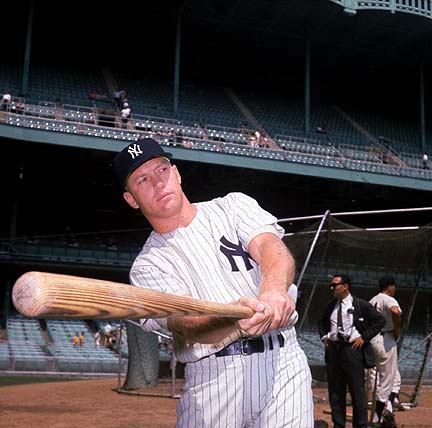
Would a DUI arrest by Mickey Mantle have been such a big story? Photo: AP file

Why is ANY story about an athlete getting arrested for DUI that big of a news story?  While I do understand the ink about Miguel Cabrera‘s off-season DUI arrest (since his Alcohol issues caused him to miss games in a critical series two years ago for his team), recently I saw this link critiquing the reactions of three MLBers who got busted for DUI this past off-season (Cabrera, Austin Kearns and Adam Kennedy: side note is it ironic or just coincidental that the latter two are Nationals washouts?).  Then late last week one Coco Crisp was arrested for DUI as well.  I began to wonder; why are these revelations such big news stories?

Think about your job.  You probably sit in an office and stare at a computer 8 hours a day.  Your boss has no idea what you do the other 7-8 hours of your day, nor any idea what you do all weekend.  You could have a massive drug problem, or get arrested on a friday night and spend the whole weekend in jail … but as long as you show back up at work Monday, don’t miss any work and don’t miss any deadlines/don’t let it affect your work product … then who cares?

I guess the real answer is something along the following.  MLB players are celebrities now.  They’re for the most part multi-millionaries and live lives that most Americans cannot comprehend.  In today’s TMZ-inspired celebrity news cycle what used to pass as a personal matter is now rabidly reported as breaking, important news.  Do I care that Coco Crisp tied a few drinks on last weekend and (like a moron) got into his car and drove?  No, not really.  It may show bad judgement on his part but it has nothing to do with his performance on the field.  It certainly didn’t affect Wade Boggs‘ career (he was notorious for his beer drinking abilities, reportedly drinking “50-60” beers on cross country trips).

Written by Todd Boss

March 9th, 2011 at 8:58 am

Edmonds or Sheffield for the Hall?

2 comments

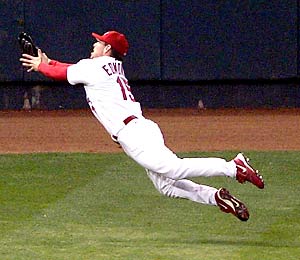
Will Jim Edmonds' defensive capabilities lift him to HoF status? Photo: www.vivaelbirdos.com

I know it is cliche, and that every baseball writer pens the same article whenever a big name retires.  But these opinion pieces are still fun to write and argue about.  So argue away.

Within the past week, two notable hitters hung up their spikes.  Gary Sheffield was forced to admit (much like Barry Bonds, Jermaine Dye and other aging DH-only players quickly being obsoleted in the fast, new, young MLB) that no team would hire him after sitting out all of 2010 and officially filed the paperwork with the league.  Meanwhile, Jim Edmonds retired from a lingering achilles heel injury that prevented him from suiting up in 2011.

For the sake of this article, we will exclude consideration of the fact that Sheffield has admitted to PED/Steroids use and thus probably faces little chance of making the hall.  Lets talk about their performances on the field.

Case 1: Gary Sheffield

Sheffield hails from the famous Hillsborough High School in Tampa, which also produced the likes of Dwight Gooden, Carl Everett and (infamously) Elijah Dukes.  Sheffield’s career numbers are strong.  He retires with a CAREER OPS+ of 140.  That’s essentially an entire career of production at the average level of what Ryan Zimmerman gave the Nats last season.  He hit more than 500 homers while also having more than 250 stolen bases.  He has a career slash line of .292/.393/.514, which is also great.  His hall of fame monitor and standard scores (Bill James’ creations that try to measure whether a player is HoF worth) both easily put him in. His closest comparison on baseball-reference is Mel Ott.  That’s heady company.

Awards: 9 times an all star, 7 times getting MVP votes (a 2nd, two 3rd and a 6th place finish).  5 silver sluggers.  Played 3B early, RF middle and LF/DH late in his career.  His best season was in 1997, finishing with a ridiculous 189 OPS+ for the Marlins but only finishing 6th in the MVP voting.

Beyond the Boxscore printed out an interesting Visual Hall of Fame graphic that essentially shows that Sheffield’s best seasons of his 22-yr career were in the latter part of his career, consistent with a steroids user who was able to beat back the hands of time and not diminish as he aged.  In the same way that Bonds did not tail off as he entered his late 30s.

Regardless of the steroids, I think he’s a hall of fame player.  He was a feared, ferocious hitter who clearly had 5-tools (though not quite at the 5-tool level of someone like Willie Mays or Ken Griffey).  He was a game changer who bounced around the league but produced wherever he was.  Unfortunately because of a prickly relationship with sports writers and implications in the BALCO scandal, his only chance of entrance will be 30 years from now by a veteran’s committee.  He’ll be on a very busy 2014 hall of fame ballot (other first timers on that ballot include near locks Greg Maddux, Frank Thomas, and Tom Glavine, along with borderline cases Jeff Kent and Mike Mussina).

Case 2: Jim Edmonds

Edmond’s case is less about pure offensive merit but weighing the benefits of a player who can produce at a high offensive level AND provide fantastic defense.  Edmond’s career offensive numbers are good but not amazing; in 17 major league seasons he hit 393 homers, had a respectable career slash line of .284/.376/ .527, and a career OPS of 132.

Those numbers compare pretty favorably to Sheffield’s career lines when you consider that Edmonds was considered among the best 2-3 outfielders in the game for the middle 10 years of his career.  He earned 8 gold gloves for his work in centerfield and has a litany of high-light reel catches to his credit. He was excellent defensively but this did not correlate to raw speed on the base-paths; he retired with only 67 stolen bases for his career, averaging just four a year.   His diving catches helped contribute to his demise; he was frequently injured, missed the entirety of 2009 and hung it up because he was not going to be medically cleared to play this year.

Career Achievements: 8th in his Rookie voting, 4 time all star, 6 times receiving MVP votes (a 4th and a 5th place vote his best achievements).

Bill James’ Hall of Fame metrics are not quite as kind to Edmonds; he falls short in both the Monitor and the Standard.  His most similar player comparison is to one Ellis Burks, not really a flattering comparison.

Is he a hall of famer?  I say “probably.”  When grading the defensively minded players (shortstops, catchers and athletic center fielders) you have to balance offensive and defensive.  With Edmonds, he’s nearly the hitter of Sheffield with fantastic defense. I’m concerned by the lack of MVP consideration, and lack of all-star selections.  If a player isn’t routinely considered among the best players in the game, how can he be a hall of famer?

He’ll be on the 2015 ballot along with first timers (and locks) Randy Johnson, Pedro Martinez and John Smoltz.  So he may have to wait to get in but he should merit it.

Vegas Over/Under wins for 2011

3 comments

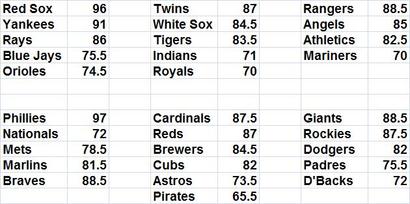
Courtesy of Beyond the Boxscore, here’s a quick look at Vegas Over/Unders for teams for 2011.


First thoughts looking at this:

– The AL East looks all jacked up.  The Yankees look high.  91 wins versus 86 for the Rays?  I don’t think the Rays are going to fall that far.  Meanwhile Toronto won 86 games last year … do we think the trades of Marcum and Wells are going to cost them 10 wins?  And the Red Sox might actually be low.  They come into 2011 healthy and stacked.

– NL East: 97 wins is tough to argue with for Philly … but why isn’t Atlanta in the 90+ game range?  They won 91 last year and should only improve as their young guys get better.

– Oakland; won 81 games last year, added hitting, has one of the deepest young rotations in the game … and only is predicted to improve a game and a half?  I think they’re winning closer to 90 than 80 games this year.

– An aside about Detroit; what exactly are they getting for their money?  $133M in payroll last year bought them a .500 season, and while they have some very bad contracts coming off the books they’re still in the 9-figure range.

– Milwaukee: this one shocks me.  Only 84.5?  They added Greinke and Marcum, two guys who will give them a shutdown 1-2-3 rotation.  And they have a battering ram middle of the order (Weeks, Fielder, Braun and Hart).

– Lastly the Nats at 72 wins.  Hmm.  3 game improvement over last year.  I’d bet the over… I’ll predict that we improve 5-6 games over last year’s team.  I think simply the opportunity of getting a few more “competent” starts out of guys like Marquis, Zimmermann, and Gorzelanny versus what we got out of Atilano, Martin and Olsen last year will make a huge difference.  Yes we’ve lost some offense, but we’ve also improved defensively across the board.

Written by Todd Boss

February 20th, 2011 at 8:41 am

The Rest of the 2011 HoF Ballot

one comment

Will Bagwell be a first ballot Hall of Famer? Photo bill37mccurdy.wordpress.com/

As noted in my previous Bert Blyleven rant post, from the looks of the baseball blogosphere lately, it is part of my duty as a baseball blog writer to put in my 2 cents on the 2011 Hall of Fame ballot.

On Jan 5, 2011, Hall of Fame BBWAA voting will be announced and we’ll have an entire week of blog postings doing post-vote analysis.  Its a great little way to fill the time in-between insignificant FA signings but before pitchers and catchers report.

I posted previously just about Blyleven, one of the most talked about candidates in some time.  I don’t think he’s a Hall of Famer but I think he’ll get voted in.  Here’s a quick rundown of the rest of the ballot.

————————————-

First, the returning candidates from previous years

Roberto Alomar: Received 73.7% of the vote in his first year in 2010.  Probably penalized for being a complete jerk to sports writers for most of his career, and for the infamy that has followed him since he retired (HIV infection lawsuits and restraining orders).  Unfair that he wasn’t a first ballot hall of famer.  10 gold gloves puts him in pretty restrictive company.  12 straight all star games, numerous MVP vote gathering seasons.  Retired rather early for a middle infielder at 36.

Verdict: Should be a lock for HoF.

Other’s on returning ballots:
Jack Morris: i’d vote for him before Blyleven.
Barry Larkin: unfair comparisons to current power-hitting short stops are leaving Larking behind.
Lee Smith: Saves are overrated to begin with, and Smith never seemed like he was as dominant as his contemporaries.
Edgar Martinez: great guy, great hitter, one dimensional.
Tim Raines: Why he has lost candidacy points i’ll never know.  Probably due to his later Yankee years souring the east coast sportswriter crew on his career in general.

Trammell, Mattingly, McGriff, Parker, Murphy: all these guys are probably destined to be eventually included by some veterans committee 30 years from now, when we have recovered from the steroids era and we realize that a guy like Murphy and his 398 career homers isn’t that bad.

————————————-
Requisite Steroid-Accused HoF Candiates.

Mark McGwire: Yeah he used.  But he was also quite a hitter prior to his using.  5 years run of 52-58-58-70-65 home run seasons.  A shame.  He’ll never get in.

————————————-
First time on 2011 Ballot.

Rafael Palmeiro: probably the dumbest steroids user on the accused list.  He’s the punchline of the era and I’ll be surprised if he garners 10% of the vote.

Jeff Bagwell: He should be a HoF lock, the first we’ve had in a while.  But i’m hearing rumbling that not a ton of guys are supporting him.  It may just be a matter of time before he gets in but he’s deserving.

Larry Walker: excellent career OPS+ numbers clearly inflated by playing in Colorado.  He really could hit though, leading the league in batting average 3 times and homers once.

Juan Gonzalez: one or two great seasons and then a mess of a career.  Hey at least he made a ton of money.

Kevin Brown: amazing to think he’s been retired for 5 years.  His career will be defined by his ridiculous 9-figure contract.
————————————-

No one else on the 2011 ballot in my opinion will be close.

In summary, If I had a vote here’s my ballot: Alomar, Bagwell, Morris, Larkin, Raines, McGwire, Trammell.

Here’s why more Wild Card teams is a bad idea.

leave a comment

Here's Bud Selig pretending he can't hear ongoing criticisms of his leadership. Photo courtesy of blogs.ajc.com

By now we’ve all heard about Bud Selig‘s expansion plans for the playoffs.  He would like to add 2 wild card teams to each post season, presumably having either a sudden-death or a best-of 3 series between them in order to determine who moves on into the conventional Divisional Series.

Here’s the main, singular problem I have with the plan.  It virtually guarantees that the griphold that AL East powerhouse teams New York and Boston have on the playoffs will continue.

Here’s a quick rundown on the AL East playoff representatives since the wild card was introduced after the players strike in 1994.

2010: Yankees (Rays)
2009: Yankees and Boston
2008: Boston (Rays)
2007: Yankees and Boston
2006: Yankees
2005: Yankees and Boston
2004: Yankees and Boston
2003: Yankees and Boston
2002: Yankees
2001: Yankees
2000: Yankees
1999: Yankees and Boston
1998: Yankees and Boston
1997: Yankees (Orioles)
1996: Yankees (Orioles)
1995: Yankees and Boston

In the last 15 years, to summarize:

  • The Yankees missed the playoffs just ONCE.
  • The Red Sox made the playoffs 9 of 15 years.
  • Both teams combined to make 23 of 30 possible appearances in the post season.
  • Other teams in the AL east made the playoffs a grand total of 4 times.
  • The Yankees and Red Sox BOTH made the playoffs in 8 of those 15 years.  HALF the time.

Lets take a quick peek at the standings for the past few years to see who would have benefited from a 2nd wild card:

2010: Boston and San Diego
2009: Texas and San Francisco
2008: Yankees and NY Mets
2007: Detroit/Seattle (tied) and San Diego
2006: White Sox and Philadelphia
2005: Cleveland and Philadelphia
2004: Oakland and San Francisco
2003: Seattle and Houston
2002: Boston/Seattle (tied) and LA Dodgers
2001: Minnesota and San Francisco
2000: Cleveland and LA Dodgers
1999: Oakland and Cincinnati
1998: Toronto and San Francisco
1997: Anaheim and NY Mets/LA Dodgers (tie)
1996: Boston/Chicago/Seattle (tie) and Montreal
1995: California and Houston

So, had a 2nd wildcard been in place it would have increased the Boston/Yankee playoff appearance ratio from 23 of 30 to at least 25 of 30 and possibly 27 of 30 places since 1994.

Why not just guarantee the two teams berths and have the rest of the league play for 3rd place??

Coincidentally, what was going on in the AL East just prior to the Wild Card era?  Take a look:

1993: (toronto)
1992: (toronto)
1991: (toronto)
1990: Boston
1989: (toronto)
1988: Boston
1987: (detroit)
1986: Boston
1985: (toronto)
1984: (detroit)
1983: (Baltimore)
1982: (milwaukee)
1981: Yankees
1980: Yankeees

The Players strike ended a nifty run of 4 divisional titles (and 2 World Series victories) in 5 years for the Toronto Blue Jays, who have not appeared in the post season since.  The strike clearly caused a shift in baseball viewing habits for both Canadian franchises, and resulted in the outright removal of the Montreal franchise (and subsequent firesale/gift for new Marlins owner Jeffrey Loria).

I realize that the MLB has drastically fewer playoff teams as a percentage of the league.  Here’s a quick table:

Ttl Teams # Playoff teams Pct
mlb 30 8 26.66667
nfl 32 12 37.5
nba 30 16 53.33333
nhl 30 16 53.33333
mls 16 8 50

Even adding 2 more wild cards would only increase MLB’s percentage to 30%, still lower than the parsimonious NFL.  But to what end?  Others have noted that this would mean longer seasons, world series drifting into mid-November, competing and losing to the NFL in ratings, bleeding into an already busy sports period, etc.

Just about the only benefit I can see would be having 2 wild card teams beating each other up and exhausting their rotations just before taking on the #1 regular season team.    The last thing I want to see as a baseball purist is a wild card team like the 1997 Florida Marlins sneak into the playoffs on a hot streak and luck their way to a world series title.  At least extra wild card teams would help prevent that from happening.

Written by Todd Boss

November 30th, 2010 at 5:27 pm

Posted in Baseball in General

Tagged with

Vazquez and Webb: Do we really want them?

2 comments

A younger, thinner, harder throwing version of Javier Vazquez. Photo courtesy of baseball.dailyskew.com

11/28/10 update: possibly obsoleting much of this, the Marlins have reportedly signed Vazquez to a one year deal.

As the FA hot stove gets hotter, more and more players have the “Nationals” name attached to them as intereted parties.  None more so than Javier Vazquez and Brandon Webb.  The question we as Nats fans should have is the following: Are Vazquez and Webb really worth going after?

Javier Vazquez, despite being the answer to one of my favorite trivia questions ever (what major league player has the highest scoring Scrabble last name?) seems to be more famous for the players he’s been traded for over the years (he was the primary chip in trades involving Nick Johnson, Randy Johnson, Chris Young, and Melky Cabrera) than he has been for his pitching.  At age 34 he’s 152-149 for his career for a barely-better than average 105 era+ value.

He has shown that he can be great (2009 for Atlanta) and he can be mediocre (his two seasons in NY and two other seasons in Chicago).  He’s never missed a start in the majors, though the Yankees took him out of their starting rotation towards the end of last season for a bit after a series of poor outings.

Question is: rumors abound that he’s lost his velocity.  Is this true?  Lets take a look at Pitch F/X.  Here’s samples from three games last year (the box score is linked to the date and the Pitch FX data is linked to a mentioning of speed):

1. June 6th: probably his best game of the year.  7 innings, 1 hit, 9ks (though 4 walks).  Again his avg fastball is around 89 but he maxed out at 91.7.

2. July 26: a decent performance middle of the season.  About the exact same figures as on 6/6; 89.22 average, 91.6 max.

3. Sept 29: his final appearance of the year, a loss against Toronto where he got shelled.  Here he was averaging
89, max of barely 90 on his fastball.  Hmm.  not good.

Now Lets look at 2009, when he finished 4th in Cy Young voting (which really means, he received one vote from one of the stat nerd voters who decided NOT to vote for Carpenter because he missed a few starts).  Here’s a random game from the middle of the season.

1. June 11: Vazquez goes 8 innings, gives up 2 hits and strikes out 12 hapless Pirates.  Interesting: he was
throwing an average of 91.43, max of 93.5.

So, his average fastball MPH has dropped nearly 3.5 mph between mid 2009 and the end of 2010.  Not good.  This did not go without notice in the NY press and blogsFederal Baseball pulled out some great links and wrote a similar article to this a few days ago.

Here’s one last visual aid; Fangraphs historical pitch velocity maps. In the mid-late 2007 he was averaging 93-94 with peaks of 97-98.  Now, he’s spent an entire year averaging 88-89 with peaks of no more than 92-93.  That’s a significant drop off and may be indicative of Vazquez’s utility as a power pitcher coming to an end.  The same thing happened to Livan Hernandez and he adjusted, but clearly Livan isn’t the ace starter that the Nats really kinda need.

—————————–

So, how about Brandon Webb?  We’re already reading how Rizzo likes Webb dating to his AZ days and we’re seeing pundit predictions and beat writer stories that Webb is coming to the Nats on a one-year reclamation project.

Webb’s history over the last 2 years:
– Made opening day start 2009, shoulder hurt, went on DL with Bursitis, surgery in august.
– Tried comeback 2010, never got off DL.  Pitched in the instructional league after the end of the season.  In those three instructional league games, here’s his performance summary:

  • 9/29/10: 1 inning, fastball at 81mph.
  • 10/2/10: 81-84mpg
  • 10/7/10: 2 innings, fastball low-80s, top mid-80s.

Webb got 2 innings in his last of three Instructional league start and was, per this report, was sitting “in the low-80s and topped in the mid-80s.”    Stated another way, “Webb has thrown in front of scouts multiple times, according to several reports, and in his most recent session his fastball reached four or five miles per hour below his typical velocity.”

Perhaps this is just a tentative guy, trying to work his way back.  In fact, if he was indeed pitching at just 90% of his effort after so long a time off, then mid 80s is just fine.

Webb was never a terribly hard thrower.  His fangraphs velocity chart from his healthier 2007 and 2008 show a consistent mid-to-upper 80s (88.5), with peaks into the low 90s.  His strength is in a serious sinker, that batters drive into the ground and cannot hit hard, consistently.

Conclusion:
– Take a flier on Webb.  I’d go 1yr $5M with $1M incentives at 15,20,25 and 30 games started to push total value to 1yr $9M.  And i’d get a club option at $10M for a second year.
– Stay away from Vazquez.  He’s trending downwards and is in Jose Contreras territory.

Coming soon: similar thoughts about Carl Pavano and Jorge de la Rosa.

GM for a day Part 3: the rest of the Roster and DFA candidates

leave a comment

The last time anyone was happy with Jason Marquis. AP Photo/Luis M. Alvarez

This is the 3rd of a quick series of reviews on the Nat’s 2010 season ending roster with analysis of what we should do.  Part I was a discussion of our Arbitration candidates while Part II was a discussion about Free Agents (ours and rumored acquisitions).  Part III is a quick rundown on the players either already under contract for 2011 or under club control (not yet reached arbitration status).  Bold means I am guessing that they’re on the 25 man roster on opening day.

Marquis, Jason #4 starter in 2011; lets hope he can regain some form.
Zimmerman, Ryan Franchise player
Strasburg, Stephen 60-day DL to start season; hopefully see some rehab starts in September
Rodriguez, Ivan Likely to cede playing time gradually to Ramos through 2011.
Hernandez, Livan Great 1-year re-signing.  Opening Day #1 Starter 2011.
Maya, Yunesky Hopefully shows his value with a full Spring Training.  Probable #5 starter barring FA signings or injury
Morgan, Nyjer Still under club control; but definitely a roster question mark
Mock, Garrett Destined for AAAA starter status.  Syracuse Rotation
Stammen, Craig Despite good advanced stats, probably behind in rotation race.  2011 long man in BP
Clippard, Tyler BP Anchor; splits time between setup and closer role.
Zimmermann, Jordan #3 starter 2011.  Hopefully stays healthy.
Atilano, Luis AAA rotation
Balester, Collin MLB bullpen/longman
Bernadina, Roger Possible starting 2011 RF
Desmond, Ian Starting SS
Detwiler, Ross Probably loses out on rotation battle and starts in AAA
English, Jesse Coming off injury, probably AAA bullpen.  Possible DFA.
Jaime, Juan Injured all of 2010: Possible DFA?
Martin, J.D. Coming off injury, probably AAA rotation or DFA.
Martis, Shairon AAA rotation
Mattheus, Ryan Injured most of 2010: Possible DFA
Maxwell, Justin 4th outfielder.
Severino, Atahualpa AAA bullpen
Thompson, Aaron AA Rotation.  Possible DFA after awful 2010.
Bisenus, Joe DFA Candidate after middling end of 2010.
Storen, Drew MLB bullpen; sharing closing duties w/ Clippard
Ramos, Wilson MLB backup catcher
Espinosa, Danny MLB starting 2nd baseman
Harper, Bryce Likely starting in Potomac and fast rising.

We had more than 40 guys that needed to be made active  (given that we ended the year with several on the 60-day DL) and some had to be designated for assignment (DFA) to make room when the date arrives to make the rosters right post 2010.   That date was 11/10/10, and between our 5 free agents we also cut loose four other players.  None was really a surprise.

  • Scott Olsen endured another injury and earned the ire of the manager when his move to the bullpen was met with some petulance.
  • Tyler Walker was injured all year and is the most common of commodities in baseball (the right handed middle reliever).
  • Jesse English suffered a similar fate to Walker, and is surplus to requirements after Slaten did such a good job as the LOOGY.
  • The mild surprise DFA so far has been Joe Bisenius.  He didn’t have the greatest numbers out of our bullpen at the end of last season (walking more than he K’d) but he’s a power arm in a league that is quickly becoming a power-arm league.  Perhaps he’ll be invited to spring training to try to earn another shot.

As of right now, we sit at exactly 37/40 on the 40 man.  This gives us some nice flexibility to acquire players via trade or sign free agents without having to make any more moves.  We also have a pending deadline to add Rule5 eligible players, and we have several guys we probably want to protect (a blog posting on this is upcoming…), so I do feel we could make a few more moves:

  • Juan Jaime: he’s buried in the minors and its unlikely someone would risk him after being injured all year
  • Ryan Mattheus (see Jaime)
  • Aaron Thompson: who had just a horrible 2010 and could probably pass through waivers.
  • We could also cut JD Martin loose: he’s 27 coming off a season-ending injury, is clearly not going to be in the future plans of the team, and a soft-tossing right handed starter isn’t likely to be in great demand on the waiver wire.

Let the offseason mania begin!

Nats GM for a day. Part 2: the Free Agents

one comment

Is this the National’s 2011 First Baseman? Photo: J. Meric/Getty Images

In our first of a 3-part post, we talked about the arbitration cases that the Nats face.  Some of those decisions are already being made and that post has been updated.  Now, lets talk about the free agents.

Player What Should Washington Do?/What WILL We do?
Dunn, Adam We should resign him, but Rizzo seems dead set against it.  Offer him arbitration and let him walk.
Batista, Miguel Valuable rubber arm in BP; I would resign him to a simliar 1 year deal in 2011.
Harris, Willie Let him go.  Declining value, Morse a better utility option.
Mench, Kevin Let him go; awful september numbers.  Perhaps ML FA in AAA
Kennedy, Adam Decline club option and let him go.  No need for 2nd baseman.

Clearly, the Adam Dunn decision will be critical to the direction of the team and our offense next year.  As noted above, personally I think he needs to be re-signed.  The team’s actions all year (plus Tom Boswell‘s repeated comments about how the front office has bungled the negotiations) seem to indicate though that we’re content with getting the compensatory picks and moving another direction.  If we decide to let him go, I’d prefer to sign someone like Adam LaRoche, a player who plays decent defense and shows a good bat.  I don’t think Carlos Pena (as is frequently rumored) is a good choice, and there’s sentiment in the Tampa Bay community that he may stay on in Tampa and try to improve on an awful 2010 season.  But, most pundits seem to think he’s coming here.

We also could become more creative and put someone like Josh Willingham, Michael Morse or even a supposedly healthy Jesus Flores at first as a stop gap until one of our prospects like Chris Marrero or even, say it isn’t so, Bryce Harper is ready to come up.  I mean come on, you “hide” defensive liabilities at first base.  If someone is 6’4″ and has any fielding ability they should be good enough to play the position.

Moving on to other FAs to be the decisions are relatively easy.  Harris, Mench, and Kennedy are gone.  None batted well enough to even consider and we have more able (and cheaper) minor leaguers ready to come up and serve as backups.  The last FA to be Miguel Batista proved to be a great asset to the bullpen at relatively little cost and would be worth bringing back.  We signed him last year on a non-guaranteed contract but guaranteeing him $1M wouldn’t be a huge risk.

Now, given the above, what is in store in the FA market?  I know i’ve heard lots of noise about how the Nats are going after Cliff Lee but I just don’t see that happening.  Here’s what I do see them doing:

1. Getting one or two pitchers.  Rizzo has a history with Brandon Webb, Arizona has blown enough cash on the guy, and he may be ready to come back.  We sign him to a one year deal and try to get lucky.  I’d also be happy with trading for one of Tampa’s spare starters (Garza, Shields), acquiring Vazquez (who I think is an NL, non-NY market pitcher and could return to his 2009 Atlanta form) or a De La Rosa type (hard thrower and can get Ks).  Most pundits have us signing Vazquez, some have us getting Webb.

2. Get a FA first baseman: I’ve previously said I like Adam LaRoche.  Rizzo likes Carlos Pena.  We’ll see what happens.  There’s lots of teams looking for first basemen, so the competition for these guys may force our hand into a guy we don’t want.

3. Find a utility player: we need a better version of Willie Harris.  May come from the minors as a prospect but probably not.  We need a guy who can play 2nd/ss or 3b in a pinch.

Less Likely:

4. Sign or acquire a marquee outfielder.  I’d love to see someone like Werth or Ross in right field, which could move Bernadina to center, allow us to rid ourselves of Morgan and then use Maxwell as the 4th outfielder.  We could also acquire someone like Rasmus or Ellsbury, put them in center, dump Morgan and go with Willingham-new CF-Bernadina.  Or we could use a Morse/Bernadina platoon in Right with Bernadina occasionally spelling Morgan in center (though they’re both lefty and both hit relatively the same, so that may not actually work).

I don’t really see us going after any bullpen help or a closer.  As Zuckerman once said, we’re remarkably set on 2011 positions despite being a 90-loss team.   We had a good bullpen last year and have a couple of decent looking reliever prospects in Carr and Kimball.  I could see a 2011 bullpen with Clippard, Burnett, Storen, Stammen, Balester, Slaten and Carr.  Or substitute some of our arbitration/fa guys for Stammen and Balester.

I’ve said for a while that the Nats need to spend like a mid market team.  $90M payroll at a minimum so as not to insult the fanbase.  Perhaps this off season we’ll see it.  They only have a paltry $24M committed for 2011 right now and, while that number will increase with potentially 13 arbitration cases, a huge chunk of last year’s payroll is now gone (just Guzman and Dunn consisted of nearly 1/3 of our 2010 payroll).  So, lets see some FA dollars get spent!

WS Pitcher Review and Lee’s horrendous Decision in Game 5

2 comments

Edgar Renteria buried the Rangers in Game 5. Photo: Stephen Dunn/Getty Images.

(this is a follow-up to a previous posting about the Giant’s World Series victory).

Despite the supposed massive superiority of the American League and its juggernaut payroll teams, a team from the National League (one that barely made the playoffs no less) was crowned WS champion after a rather tidy 4-1 series victory.  The Giants are certainly not a low-payroll team; they started the season with the league’s 9th highest payroll, finished the regular season with the 5th best record and advanced through the playoffs with relative ease (they were 11-4 in the playoffs altogether, losing 2 Sanchez starts, a Lincecum and a Cain start (despite Cain continuing a 22 inning post season no earned-run streak).

Not that it mattered in the end, but game 5 certainly turned on a questionable pitching strategy decision just before the decisive 3-run homer in the 7th.  Cody Ross led off with a single (continuing his amazing post season and certainly buying him FA dollars in the off season).  Cliff Lee made an 0-2 mistake to Uribe who smacked a single into center.  After a fantastic career-first sacrifice/drag bunt by Aubrey Huff, Cliff Lee had runners on 2nd and 3rd with one out.  Lee battled Burrell to 3-2 before striking him out on an outside cutter.  This seemed at the time to be the game-changing strikeout that Lee needed but he quickly fell behind the next batter Edgar Renteria 2-0, missing badly with two curveballs.  Announcer Tim McCarver, often villified as being the master of the obvious, stated very clearly that the right decision upon falling behind 2-0 would be to walk Renteria, load the bases with 2 outs and start afresh with the on-deck hitter Aaron Rowand (a sub in the series and not nearly the threat of Renteria).  Before McCarver could finish his thought, Lee grooved a 2-0 fastball, belt high, down the middle of the plate and the aging, soon-to-be-retired Renteria didn’t miss.  He crushed a 3-run homer and the game was essentially over.  Lincecum pitched 8 complete (giving up a meaningless homer to Nelson Cruz) before oddball closer Brian Wilson blew through the heart of the Rangers lineup (Hamilton, Guerrero and Cruz again) to get the save and finish out the series.

Why does Lee not walk Renteria there?  Why does the pitching coach see the obvious situation, run out to the mound and say, “hey, lets just throw two fastballs a foot outside and start over on Rowand?”  This is the reason MLB teams have bench coaches; to help the manager manage the game.  It was the latest in a series of curious pitching moves (or non-moves) from the Rangers coaching staff.  In reality Lee is a competitor and probably thinks he can get anyone out, at any time, let alone an over-the-hill bounce-around-the league veteran like Renteria.  But, no matter what the quality of the hitter mistakes in Major League Baseball quickly turn into gopher balls.

Overview of all 15 games the Giants played this offseason:

Series/Game # Giants SP Opponent SP Game Result WP LP
NLDS-1 Lincecum Lowe Giants W 1-0 Lincecum Lowe
NLDS-2 Cain Hansen Braves W 5-4 Farnsworth Ramirez
NLDS-3 Sanchez Hudson Giants W 3-2 Romo Kimbrel
NLDS-4 Bumgarner Lowe Giants W 3-2 Bumgarner Lowe
NLCS-1 Lincecum Halladay Giants W 4-3 Lincecum Halladay
NLCS-2 Sanchez Oswalt Phillies 6-1 Oswalt Sanchez
NLCS-3 Cain Hamels Giants W 3-0 Cain Hamels
NLCS-4 Bumgarner Blanton Giants W 6-5 Wilson Oswalt
NLCS-5 Lincecum Halladay Phillies 4-2 Halladay Lincecum
NLCS-6 Sanchez Oswalt Giants W 3-2 Lopez Madson
WS-1 Lincecum Lee Giants W 11-7 Lincecum Lee
WS-2 Cain Wilson Giants W 9-0 Cain Wilson
WS-3 Sanchez Lewis Rangers W 4-2 Lewis Sanchez
WS-4 Bumgarner Hunter Giants W 4-0 Bumgarner Hunter
WS-5 Lincecum Lee Giants W 3-1 Lincecum Lee

SF Starting Pitching Stats in the playoffs (all three series combined)

Pitcher Starts w/l Team w/L ip k/bb era whip
Lincecum 5 4-1 4-1 37 43/9 2.43 0.92
Cain 3 2-0 2-1 21.33 13/7 0 0.94
Sanchez 4 0-1 2-2 20 22/9 4.05 1.25
Bumgarner 3 2-0 3-0 20.66 18/5 2.12 1.11

The cliche for post season baseball has always been, “good pitching beats good hitting” and we certainly saw this in the 2010 post season.  The Giants featured 2 clear “Aces” in Lincecum and Cain, while witnessing a 21-yr old rookie Madison Bumgarner dominate on the sport’s biggest stage.  Only #3 starter Sanchez struggled in this post season (if you can call a 4.05 era against the best teams in baseball truly “struggling”).   The world series featured the league’s best hitting team in Texas, but they were shut down by the Giant’s pitching staff, hitting .190 for the series.

Ironically; what the Giants just finished doing to the Rangers is what most of the baseball world thought the Phillies and their vaunted rotation would be doing.  Yes; the AL has the Red Sox and Yankees and Rays (by most opinions 3 of the best 5 teams in baseball) but the NL has the rotational depth to shutdown $150M rosters.  If the Yankees want to compete next year, look no further than replacing Vazquez with Cliff Lee, turning the ineffective Burnett into a 5th starter (ala what SF did with Barry Zito) and finding themselves a solid #1a Ace behind Sabathia.

How does this tie back to the Nats?  The answer is clear; if you can put together a top notch starting rotation, you can go incredibly far.  Imagine in 2012 this rotation: a healthy Strasburg, a strong and improving Jordan Zimmerman, an impressive young starter in Sammy Solis, a top notch free agent acquisition along the likes of Greinke or a healthy Brandon Webb, and a take your pick from our stable of #5 starters like Lannan, Detwiler or Maya.  These guys can end losing streaks, keep your team in games, throw up quality starts 80% of the time, and turn a league average offense into a post season team.

That’s the “plan” anyway.