Nationals Arm Race

"… the reason you win or lose is darn near always the same – pitching.” — Earl Weaver

Repost: Are the Nats suddenly a 100-win team? With this offense, yes.

7 comments

The return of Michael Morse has energized the offense. Photo Jacqueline Martin via federalbaseball blog

(Editor note; I attempted to publish this last Friday, then the server immediately went down all weekend.  Wanted to re-post it to get commentary from typical readers.  All numbers below were as of last friday, before the wild 4-game series against Atlanta).

There’s been lots of press this week, and to an extent all season, about Stephen Strasburg‘s innings limit.  Mike Rizzo came out this week and said (paraphrasing) that there’s not a hard-and-fast 160ip limit, but that he will be shut down, and it will be Rizzo’s decision when Strasburg doesn’t pass the “eye test.”

Nats pundits are already discussing this impact on a playoff race, who the replacement may be (with John Lannan getting an early audition during this weekend’s double header), and whether we should flip someone out of our “thinned” farm system for a rental SP like Zack Greinke or Ryan Dempster (I put “thinned” in quotes out of deference to those that don’t share my glass-is-half empty opinion on the state of our farm system right now as posted here earlier this week).

Inarguably, this team will be a worse team without Strasburg.  We’d be weaker in September once he got shut-down and we’d be hampered in a short series without our staff Ace.  I’m not worried about September though; remember last year?  Some teams were fielding 40-man roster specials, with lineups that mostly started the year in AAA.  And I’m not entirely worried about how we’d look in a playoff series, since playoff rotations go 4 deep (meaning whatever question mark we’re throwing out there as a 5th starter in September is in the bullpen in October), and a rotation of Gonzalez, Zimmermann (who, amazingly, is tied for the NL lead in pitcher bWAR right now), Jackson and Detwiler getting the game 4 start is still pretty durn good.

But, here’s some interesting stats that should give you (and anyone in baseball frankly) some pause; this team is positioned to get significantly better from here on out, despite the looming loss of Strasburg and despite the fact that they’re already in first place.  Why?

Because the offense is really starting to heat up.

Here’s some stats to give context: based on the Team Scoring page at baseball-reference.com, here’s the Nats scoring-based records:

  • When the Nats score 0,1,2 or 3 runs, they are 14-28, for a .333 W/L percentage. This is pretty common; even last year’s 102-win Philadelphia team rarely won when scoring 3 or fewer runs.
  • When the Nats score 4 or more runs?  They are 39-9 this season, a .795 W/L percentage.
  • Taking this a step further, when the nats score 5 or more runs, they’re 29-6, a .828 W/L percentage.

(For context, a record of 100-62 equates to a .617 W/L percentage).

Perhaps the above states the obvious; most teams have pretty good records when they score a bunch of runs.   For comparison sake’s, here’s the same analysis for the team with the best record in baseball, the Yankees:

  • Scoring: 0,1,2,3 runs: 5-23 for a .178 W/L
  • 4+ runs: 52-12, .813 w/l
  • 5+ runs: 44-10, .815 w/l

The Yankees and their superior offense leads to a ton of wins once they get above 4-5 runs.  The difference between the Yankees and the Nats is our current ability to win a pretty sizeable number of games when scoring 3 or fewer runs.  This difficulty in winning close games and depending on bashing your way to victory has been a theme for the Yankees for a few years now, and is one of the reasons they have only won one World Series since 2000 despite being in the playoffs nearly every year (only one missed playoff appearance during that span).  They are susceptable to getting shut down by a good rotation in a short series.  But I digress…

Getting back to the theme of this post: Here’s a look at the monthly W/L records for the Nats, along with average Runs scored and Runs Allowed (through July 19th’s game):

Month W/L W/L pct RS RA
April 14-8 0.636 3.36 2.68
May 15-13 0.535 4.21 3.85
June 15-11 0.576 4.46 3.73
July 9-5 0.642 4.78 3.57
season 53-37 0.588 4.166 3.488

Look specifically at the average number of Runs Scored by this team.  It is distinctly trending up; from 3.36 RS/game in April to a massive 4.78 RS/game so far in the month of July.   That’s almost 1 and a half more runs they’re scoring a game right now as compared to April (when their 14-8 record was mostly on the backs of one of the best opening months of starting pitching seen in the Majors since the dead-ball era).

Some reasons for this outburst of runs?

  1. Ryan Zimmerman‘s cortisone shot on June 24th: he had a .589 OPS in June (which should have been even worse, but he finished the last week of June on a tear, going 11-32 with 5 extra base hits after getting his shot), but has a blistering 1.280 OPS so far in July.
  2. The top of the order stepping it up: Danny Espinosa is hitting .327 in July and Lombardozzi is hitting nearly as well.
  3. The resurgence of Roger Bernadina, hitting at a .375 clip so far in July and leading to the DFA of Rick Ankiel (my wife’s favorite player; I havn’t broken the news to her yet).

Meanwhile, the rest of the sluggers in the lineup (Harper, LaRoche, and Tyler Moore doing his best effort to prove scouting pundits wrong who thought he couldn’t hack it against MLB pitching) are for the most part churning along and providing pop in front of and behind the 3-4-5 hitters in the order.

And, this offense could only get better when Jayson Werth returns.  Remember; he was quietly having a solid year at the plate, with an .810 OPS and a 121 OPS+.  You insert Werth and suddenly this team is rock solid and full of power from position 2-7.  You’d have to sacrifice Bernadina and Moore to the bench primarily, but they’re great insurance in case Werth’s wrist betrays him.

They’re averaging 4.78 runs a game, and on the season they’re 39-9 when they score 4 or more runs.  That spells a pretty serious run I expect this team to make in the next month and a half, especially against a slate of opponents that are mostly .500 or below.  Right now, sitting at 53-37 they’re on pace for a 95 win season … but, amazing as it is to say it, this team easily has the capability of reaching 100 wins if their offense continues its upward trend.
Are you concerned about the state of the Nats farm system?

26 comments

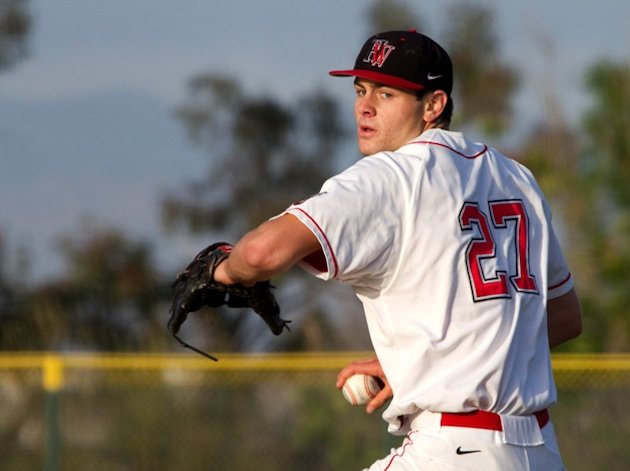
Will Giolito become the Nats #1 prospect? Photo Eric Dearborn via Win For Teddy blog

I know it seems silly to criticize the team with the best record in the NL, but I thought the question was worth asking, given a couple things I read this week prospects related.  Given the drain of prospects in the last 6 months (through the Gio Gonzalez trade and through graduation to the majors for several of the team’s better prospects), its safe to say that our cupboard is relatively thin right now.  This point was highlighted to me by two recent online articles;

1. ESPN’s Keith Law posted a mid-season review of farm systems on the Rise or Fall (sorry, insider only), and stated the obvious about our system.  His summary: Yes we got Lucas Giolito but it was essentially at the expense of any other high-end talent in the 2012 draft.  And, a lot of our high-end guys are taking significant tumbles on boards due to lack of performance or injury (see later on for a look at our top 10 prospect performances).

2. Baseball America’s Jim Callis posted an updated Midseason top 50 prospects post 2012 draft and included where he’d put the top-end talents drafted (including international signees) in his weekly Ask BA feature on July 16th.   Of note to me was the fact that Washington, even with the signing of the high-end Giolito, does not have a SINGLE player in his mid-season 50.   Luckily for us, our NL East competition didn’t fare too much better, with a grand total of 5 players between our divisional rivals.  This compared to teams like Seattle (5), Kansas City (4), and the rich-keep-getting-richer Rangers with 3 guys likely to become impact players within a year or two.

Why is this a concern if the team is in first place?  Two primary reasons:

1. If you’re not going to matriculate your prospects and depend on them for production, then you need to utilize them in trade to acquire needed talent.  There’s plenty of trade rumors right now mentioning the Nats desires for a starter to cover for Stephen Strasburg‘s innings limit.  But who are we going to trade to acquire said pitcher?   I’d go as far as saying that there’s not one guy on our 2012 top 10 prospect list (not including Harper and Lombardozzi of course) who, at this point in 2012, could be the centerpiece of a marquee acquisition.  Who is trading for our #1 prospect Anthony Rendon right now? 

2. This team has a LOT of money committed to players over the coming years, and won’t be able to depend on hefty production from salary controlled guys forever.  They will need a stream of up-and-coming players to offer cheap alternatives to free agents and players who have become too expensive.  For example; in the year 2016 the team has $47M committed to just THREE players right now, before considering at least that much in arbitration for just Strasburg, Bryce Harper and Jordan Zimmermann.  $47M is nearly the team’s payroll just a few years ago!  Yes we will naturally grow payroll and revenues with success and the renegotiation of the MASN contract, but constructing a 25 man roster is about making choices.  The last thing we want is to see this team become the 2012 Philadelphia Phillies; a bloated, old team with a ton of injuries and the 2nd highest payroll in the league at $175M, but mired in last place.

For context of this discussion, here’s a list of Baseball America’s top 10 prospects for this team for 2011 and 2012 (compiled after the Gonzalez trade), and a status of where they are as of now:

Year Nats Rank Name, pos Status
2011 1 Bryce Harper, of In majors
2011 2 Derek Norris, c Traded
2011 3 Danny Espinosa, ss/2b In majors
2011 4 A.J. Cole, rhp Traded
2011 5 Wilson Ramos, c Out for Season (two knee surgeries)
2011 6 Sammy Solis, lhp Out for Season (Tommy John)
2011 7 Cole Kimball, rhp 60-day DL (shoulder surgery)
2011 8 Eury Perez, of .299/.325/.342 in AA Harrisburg in his 6th pro season
2011 9 Chris Marrero, 1b 60-day DL (torn hamstring)
2011 10 Brad Peacock, rhp Traded

That’s 2 guys who are starters in the Majors, 3 traded for Gonzalez, 4 guys on long term DL stints and Eury Perez with his meager .667 OPS in AA, in his 6th pro season.  How about 2012’s list?

Year Nats Rank Name, pos Status
2012 1 Bryce Harper, OF In majors
2012 2 Anthony Rendon, 3B Out for Season (broken ankle, his 3rd major leg injury in 4 years)
2012 3 Brian Goodwin, OF .324/.438/.542 in low-A.  Stellar season so far
2012 4 Alex Meyer, RHP 7-4, 3.10 Era, 1.13 whip and 107/34 k/bb in 90IP in low-A Hagerstown.  Just promoted
2012 5 Matt Purke, LHP Long term DL (Shoulder concerns); hasn’t thrown in 5 weeks.
2012 6 Sammy Solis, LHP Out for Season (Tommy John)
2012 7 Steve Lombardozzi, INF In Majors
2012 8 Destin Hood, OF .223/.296/.313 in AA Harrisburg, in his 5th pro season
2012 9 Chris Marrero, 1B 60-day DL (torn hamstring)
2012 10 Michael Taylor, OF .225/.314/.333 in High-A Potomac in his 3rd pro season

2012’s list includes 4 major injury concerns, two guys under-performing (Hood and Taylor), and two guys matriculated to the majors.  The two players putting up good statistical seasons may come with astericks though; Alex Meyer was compiling his stats in low-A, going against guys 2-3 years younger than himself.  His promotion to High-A was overdue and should be telling, to determine if his future lays as a dominant 12-6 starter or a high-leverage reliever.  Brian Goodwin’s excellent season is a great sign of things to come … but again, in Low-A.  I know he was a Juco signee, but he’s 21 now, turning 22 in November and is the same age as college juniors getting drafted now.  If he continues to produce upon promotion to better competition, I’ll feel better.

Now, I know there’s guys in our system who are coming back from injuries (i.e. Nathan Karns), or who are putting up good numbers despite being lower draft picks (i.e. Matt Skole, Cameron Selik, Danny Rosenbaum), and we have some guys who we acquired through trades and who are having surprisingly good seasons in the minors (i.e., Zach Walters, Ryan Perry and Corey Brown) but are these kinds of players going to step up and either be a) next year’s top prospects or b) eventual productive major leaguers?  I know we all love Rosenbaum for example, but most scouts think he’s a marginal prospect at best (and his lack of inclusion on our top 10 lists reinforces that notion).

This sudden lack of depth was one of the reasons I wasn’t the biggest fan of drafting Giolito.  With the new draft rules and specific limits on bonuses, combined with the significant injury issues we’ve had with high end draftees Rendon and Purke in 2011’s draft, I thought the team should have gone the safer route.  Yes I’m sure Mike Rizzo did a ton of due diligence and was confident in Giolito’s long term health.  But missing on three first rounders (or in Purke’s case, a first round talent given a significant bonus and a 40-man deal) could lead to a significant hole in player development for this team right at a time a couple of years from now when they desperately need a MLB-minimum impact guy.

Wang to “DL” – See you in September

4 comments

Wang hits the DL. Photo via Washington Nationals.

The Nationals organization continued its loose interpretation of the “Disabled List” by placing ineffective starter-turned-mop-up guy Chien-Ming Wang on the 15-day DL, retroactive to July 1st, with what is being labeled a “hip strain.”

Has anyone else heard or read anything in the beat reporter’s works over the past week or so about Wang suffering from a hip strain?  I didn’t think so.  I’ve read lots about mechanics, ineffectiveness and an inability to work efficiently out of the bullpen, but nothing about a hip issue.

So be it; it works for the team and allows them to stash Wang in extended spring training for weeks instead of granting him his release (which would be the only other way to get him off the active roster, his having no further minor league options available).  I suppose it is fair to say that every professional baseball player has some sort of malady or another that could be diagnosed and serve as a reason to hit the DL.  I once heard an NBA player, when asked while he was rehabbing when the last time he was healthy was and he reportedly responded; “High School.”  Baseball is a grind; most players play through minor strains and bumps and bruises.  Luckily for the team, this procedural move allows Wang to be shipped out while he’s at his least effectiveness, awaiting his real reason for still being with the organization:

September 19th.

See, that’s just about the day that Stephen Strasburg is likely to hit his 160 inning limit for 2012.  He’s been averaging 5.8125 innings per start (93 IP in 16 starts).  That gives him about 12 starts left.  The team is thinking of making Strasburg the 5th starter in the rotation after the break.  That’d put his first start back on 7/17 at home vs the Mets, and counting 11 more starts after that roughly has Strasburg making his last start on 9/12, meaning the team would need Wang back and effective on 9/19.  Lots can happen between now and then of course; another starter could go down with injury and the team could have rain-outs that force their hands (they’re already looking at a call-up or a spot-start twice between now and mid September due to re-scheduled rainouts).  Or, the team could lose one of their long-men out of the pen and need a mop-up guy in the interim.

Either way, I think Wang’s career with the team may be at an end.  Ross Detwiler profiles more closely to the Mike Rizzo prototype pitcher; a power guy who gets lots of swings and misses.  Wang has admirably come back from shoulder surgery but he just hasn’t been able to put it together in 2012, and when his signature sinker isn’t working, he’s batting practice fodder.  Look for the team to make due with its current rotation as long as they can.

Written by Todd Boss

July 3rd, 2012 at 8:24 pm

Nats all-star review (2012 edition)

6 comments

Gonzalez gets a very deserving NL All-Star selection. Photo unknown via WP.com

(Note: i’m copying a large chunk of 2011’s version of this post to give a running history of the Nats all-stars later on below).

MLB announced the 2012 all-star rosters and the Nats, for the first time in their history in Washington, have 3 representatives.  Here’s a discussion:

2012

  • Nationals All-Star representatives: Stephen Strasburg, Gio Gonzalez, Ian Desmond
  • Possible Snubs: Adam LaRoche, Bryce Harper, Craig Stammen
  • Narrative: The two starters Strasburg and Gonzalez were the obvious candidates, and my personal prediction was that they’d be the only two candidates selected.  The inclusion of Desmond is a surprise, but also a testament to how far he’s come as a player in 2012.  I entered the season figuring that Desmond would be closer to a demotion than the all-star team, and his power from the short stop position has been a huge shot in the arm to our challenged offense.  LaRoche has had a fantastic come back season but fared little shot against better, more well-known NL first basemen so his non-inclusion is not too surprising.  Stammen has been our best bullpen arm, but like LaRoche fared little chance of getting selected during a year when the Nats had two deserving starters.  Lastly Mr. Harper; he wasn’t on the ballot so fared little shot of being included, but has been put on the “last man in” ballot, up against a series of established veterans and future hall of famers.  We’ll see if celebrity wins out.  Before his slump the last two weeks he was clearly among the best hitters in the league despite his age.

(Editors Note: Harper was subsequently added on 7/7/12 to replace the injured Giancarlo Stanton).

Coincidentally, I thought Matt Kemp‘s decision to go public with his snub of Harper for the home run derby was both short sighted and disappointing.  If I was Bud Selig, I’d take the opportunity to make this year’s derby the most watched mid-season baseball event ever by forcing the inclusion of both Harper and uber-rookie Mike Trout.  Ask yourself this: 1) do you bother to watch the home run derby now?  And 2) if Harper and Trout were in it, would you watch this year’s version?  For me, even as an avid baseball fan I don’t bother to watch the event and wasn’t planning on it this year … but with these two guys in, it’d be must-see TV.  I hate it when Baseball misses such an obvious chance to showcase players and take advantage of the prevailing storylines of the season; it seems to happen year after year.

For a trip down Memory lane, here’s the Nationals all stars by year and talk about their selection, whether they were deserving, and who got snubbed each year.

2005

  • Nationals All-Star representatives: Livan Hernandez, Chad Cordero
  • Possible Snubs: Nick Johnson, John Patterson.
  • Narrative: The Nats went into the All Star break surprisingly in first place, having run to a 50-31 record by the halfway point.  Should a first place team have gotten more than just two representatives?  Perhaps.  But the team was filled with non-stars and played far over its head to go 50-31 (as evidenced by the reverse 31-50 record the rest of the way).

2006

  • Nationals All-Star representatives: Alfonso Soriano
  • Possible Snubs: Nick Johnson, Ryan Zimmerman
  • Narrative: Soriano made the team as an elected starter, the only time the Nats have had such an honor.  Our pitching staff took massive steps backwards and no starter came even close to meriting a spot.  Cordero was good but not lights out as he had been in 2005.  Soriano’s 40-40 season is a poster child for “contract year” production and he has failed to come close to such production since.  The team was poor and getting worse.  Johnson had a career year but got overshadowed by bigger, better first basemen in the league (a recurring theme for our first basemen over the years).

2007

  • Nationals All-Star representatives: Dmitri Young
  • Possible Snubs: Ryan Zimmerman, Shawn Hill (though I wouldn’t argue for either)
  • Narrative: Young gets a deserved all-star appearance en route to comeback player of the year.  Zimmerman played a full season but didn’t dominate.  Our rotation featured 6 primary starters, none of whom are still in the league now, though Hill showed flashes of dominance throughout the year.

2008

  • Nationals All-Star representatives: Cristian Guzman
  • Possible Snubs: Jon Rauch
  • Narrative: The first of two “hitting rock-bottom” seasons for the team; no one really merited selection.  Zimmerman was coming off of hamate-bone surgery in November 2007 and the team was more or less awful across the board.  Rauch performed ably after Cordero went down with season-ending (and basically career-ending) shoulder surgery.   Guzman’s selection a great example of why one-per-team rules don’t make any sense.  Guzman ended up playing far longer than he deserved in the game itself by virtue of the 15-inning affair.

2009

  • Nationals All-Star representatives: Ryan Zimmerman
  • Possible Snubs: Adam Dunn
  • Narrative: The addition of Dunn and Willingham to the lineup gave Zimmerman the protection he never had, and he produced with his career-best season.  His first and deserved all-star appearance en-route to a 33 homer season.  Dunn continued his monster homer totals with little all-star recognition.

2010

  • Nationals All-Star representatives: Matt Capps
  • Possible Snubs: Adam Dunn, Josh Willingham, Ryan Zimmerman, Steven Strasburg
  • Narrative: Capps was clearly deserving, having a breakout season as a closer after his off-season non-tender from the Pirates.  The 3-4-5 hitters Zimmerman-Dunn-Willingham all had dominant offensive seasons as the team improved markedly from its 103-loss season.  But perhaps the surprise non-inclusion was Strasburg, who despite only having a few starts as of the all-star break was already the talk of baseball.  I think MLB missed a great PR opportunity to name him to the team to give him the exposure that the rest of the national media expected.  But in the end, Capps was a deserving candidate and I can’t argue that our hitters did anything special enough to merit inclusion.

2011

  • Nationals All-Star representatives: Tyler Clippard
  • Possible Snubs: Danny Espinosa, Michael Morse, Drew Storen, Jordan Zimmermann
  • Narrative: While Clippard was (arguably) the Nats best and most important reliever, I think Zimmermann was a more rightful choice.  He was 10th in the league in ERA at the time of the selections and has put in a series of dominant performances.  Meanwhile Espinosa is on pace for a 28homer season and almost a certain Rookie-of-the-Year award (though a precipitous fall-off in the 2nd half cost him any realistic shot at the ROY), and perhaps both players are just too young to be known around the league.  Lastly Morse is certainly known and he merited a spot in the “last man in” vote sponsored by MLB (though he fared little chance against popular players in this last-man-in voting).

Nationalsarmrace.com System Maintenance Notice

3 comments

We're moving! Clipart via movingvans.blogspot.com

Hello readers!

As an fyi, the site will be taken down over this 6/23-6/24 weekend at some point as we physically re-locate the computer that it runs upon.  Do not be alarmed if you surf to the site over the next few days and get a 404 error.  We’re not going away;we’re just moving.

Technical details for those interested: we host www.nationalsarmrace.com (and a slew of other domain names, including bossconsulting.com, my personal email domain) on a 1-U pizza box running Free BSD out of my home.  I have 13 static IPs flowing into the house, and we NAT them through the fios router to support multiple virtual servers on the box.  We run 2 domain name servers, web, mail, filestore, and a mysql database to go along with at least 6 domain names (and possibly more; the cluster technically belongs to a former colleague of mine who hosts projects for his neesd as I do).  After 10 years, I’m moving and needed a hosting solution.  I just couldn’t run servers out of my home anymore so we’re moving the servers temporarily to a rack-space that my colleague controls and maintains, with the eventual desire to move the services to a managed cloud somewhere.

My big challenge is less with this site (its basic wordpress, seemingly hostable at most any where) as it is with bossconsulting.com, which hosts a large historical searchable database of professional racquetball matches (my other passion).  I need an email solution and a webserver like most people, but I also need a mysql database AND the web CGI ability to run old-school perl code against it.  The site is www.bossconsulting.com/irt for those interested; I havn’t updated the static docs for the end of the 2011-12 season yet.  If anyone has any recommended hosting solutions for this cluster I’d be happy to hear them.

Thanks, see you again soon, Todd

Written by Todd Boss

June 23rd, 2012 at 9:24 am

Posted in Non-Baseball

Tagged with

Rays not exactly Fundamental

2 comments

After watching the Nats take 2 of 3 from the Rays this week, I’m left with one major thought: The Rays are one of the worst fundamental baseball teams I’ve seen play here.  For all the rumors of how Joe Maddon is a genius, his team certainly made mistake after mistake defensively.  Just in the 3rd inning of the game tonight they made three basic defensive mistakes:

BJ Upton failed to properly prepare himself to throw home after catching a sac fly and was (for some inexplicable reason) surprised to see Danny Espinosa tagging up and scoring easily.

Carlos Pena took a cut-off throw and failed to pay any attention to Ian Desmond, who alertly scampered to 2nd base without a throw.

Matt Moore didn’t pay frankly any attention to Espinosa while on second base, allowing a double steal to occur, both runners of which eventually scored and proved to be the lead-changing runs that turned the game.

The Rays are the 2nd worst team in terms of errors in the league.  There’s specific questions about the constant shifts put in play by Maddon against players not necessarily known as pull hitters.   Their current third basemen situation is atrocious; a throwing error in the first game, a simple catch missed in the 2nd game (when Bryce Harper ran from 2nd on a ball to the shortstop) and a fielding error in the 3rd game.  Yes I know they’re missing Evan Longoria … but the Nats are missing their highest paid player right now too in Jayson Werth.  And, they clearly are pushing the limits of the rulebook as evidenced by the Joel Peralta pine-tar incident.

The Rays were probably lucky to avoid the sweep frankly; they got a win with their ace David Price giving up 4 runs in 7 innings while our soon-to-be-demoted #5 starter Chien-Ming Wang conspired to give away a game possibly for the last time for this team as a starter.

Seems to me the Rays need to tighten up their professionalism.

Thoughts about the Peralta Pine Tar incident

6 comments

Joel Peralta tips his cap in mock respect after getting tossed for having "an excess of pine tar" in his glove. Photo Patrick McDermott/Getty Images via bleacherreport

While watching the Nats game tonight, the broadcast team of Bob Carpenter and JP Santangelo posted the following quote (as referenced in several of the beat reporters columns earlier today):

“Just looking down the road, if I’m a major league player that may happen to want to come to play for the Nationals in the future, I might think twice about it, under the circumstances,” Maddon said before Wednesday’s game. “Because this is a guy, this is one of their former children here that had really performed well and all of sudden he’s going to come back to this town and they’re going to rat on him based on some insider information.”

The MASN broadcast team also relayed a follow-up to this quote, mentioning that a beat reporter that they had not “seen before” asked Joe Maddon a very probing, intelligent question.  As transcribed from the MASN broadcast:

“Well, your guy was the one who was caught.  A lot of people are talking about the fact that you’re trying to deflect the blame to the to the other team across the diamond.”

Maddon apparently blew off the question, didn’t ask it and challenged the questioner whether or not he covered baseball on a regular basis.  These quotes somewhat disappointed me; I have a lot of respect for Maddon by virtue of stories about him in Jonah Keri‘s excellent book “The Extra 2%,” about the rise of Tampa Bay.  Perhaps he’s indeed trying to deflect blame and control the story.  But I think Maddon does the exact same thing, if he’s in the same situation.

Last night’s gamesmanship was probably unnecessary, but a move that you have to make in the right situation.  Yes the Nats probably were aware of the fact that Peralta had a tendency to overdo the pine tar, by virtue of his playing for our team a couple years ago.  Was last night an odd time to cash in that particular chip?  The team was losing, but the game was close, and Peralta is clearly a great asset out of the Rays bullpen.  In fact, it surprised me to see the team not pursue signing Peralta after his excellent 2010 season for us.

Perhaps the message was meant more for Peralta; who knows what type of departure he had from the team.  But you would have to think that if the team still respected him as a player, instead of trying to get him ejected perhaps Davey Johnson would have taken the same route that Tony LaRussa did in the 2006 world series, when hurler Kenny Rogers clearly had pine tar all over his throwing hand, a fact that became clear when the high definition cameras caught him throwing in the first inning.

The fact is, when its hot out and you’re sweating, getting a grip on the baseball can be very difficult.  I certainly use pine tar heavily when I play to get an extra grip on the bat.  I have certainly played with pitchers who had a secret stash of pine tar “hidden” within their glove in order to get an extra snap on the curve.  Is this a violation of baseball’s rules?  Of course it’s against the stated rules.  The question is whether it is as egregious a transgression as (say) stealing signs or sneaking a peak at the catcher’s signs.

Much like a football player moving teams and taking along insider information on formations and trade secrets, inside information either brought to or left with teams can put managers in a tough situation.  Billy Martin was well aware of George Brett‘s proclivity to over-tar his bat, and he waited until a key game situation (i.e., a go-ahead homer) to cash in that particular chip.  Clearly Johnson made the decision to use the information he had on hand, last night in a key late-inning situation.

What do you guys think?  Bush league move?  Good use of information?

Lidge DFA and a bullpen unravelling

4 comments

Lidge just couldn't regain his past glory with the Nats. Photo unknown via baseballasreligion blog

I was mildly surprised to see the news wire report today before the Nats-Yanks series finale; the Nats have designated Brad Lidge for assignment.  Not because Lidge didn’t “earn” this release; his numbers on the season are abysmal for a mid-to-late innings reliever (9 1/3 IP, 12 hits and ELEVEN walks for a ridiculous WHIP of 2.46.  And not because Lidge was singularly involved with both of the Yankess losses this weekend (he allowed Gio Gonzalez‘s inherited runner to score before allowing another three runs in on friday night, then wasting six shutout innings from his fellow bullpen members by giving up 3 hits and a walk in the 14th inning yesterday).

I say I’m mildly surprised because I honestly thought the next guy to get the axe out of our suddenly struggling bullpen would be the curiously called-up Mike Gonzalez, who may have decent ancillary numbers so far (no runs in 4 IP over 6 games) but he’s allowed a Doug Slaten-esque 4 of 9 inherited runners to score, including 2 in friday night’s bullpen implosion as well.  Gonzalez seemed to be a two week solution, signed off waivers only to provide cover until we got a couple of arms back off of the DL.  I certainly didn’t expect him to be seeing as much game action as he has lately.

The Nats are starting to see the real effects of losing two of their three best arms (Storen and Rodriguez); guys who should be the 5th or 6th guys out of the pen are now the 1st and 2nd guys out of the pen.  Clippard, who was doing just fine as the best 8th inning guy in baseball (he did lead the majors in Holds in 2011) now is, well not “wasted” as the closer but certainly not doing what he does best; being the guy who cleans up and fixes the highest leverage situations.

More to the point the team faces now; the loss of Storen and Rodriguez, as well as the trickle-down effects of stashing Ross Detwiler in the bullpen so the (so far) inferior Chien-Ming Wang can continue to put up sub-replacement player numbers out of the #5 starter role, combined with the presence of THREE swing-men/ex-starters (Gorzelanny and Stammen to go along with Detwiler) means that suddenly our bullpen has found itself ill-prepared to face the challenges that it was meant to face.  We really only had four true back-of-the-bullpen relievers who could close out games.

The team needs Ryan Mattheus back, now (Editor’s Note; about 2 minutes after I penned this the team announced that Mattheus was, indeed, back).  I know plantar fasciitis is painful but, hey, this is the majors.  Get a cortisone shot and get back out there.  We also need to think about giving some minor league arms a chance.  Or making a trade for some bullpen help.  Maybe we can flip one of our swing-men for a back of the bullpen arm from a team that needs starter help (Colorado anyone?)

The team’s still in first place, a third of the way through the season.  With no reason to think we can’t maintain the lead now that our big hitters are back and getting healthier.  We need to shore up this problem so it doesn’t derail the progress this team has made.

College World Series Preview/Regionals Recap

3 comments

(note: you must visit www.d1baseball.com, your absolute best resource for all things college baseball).

With the completion of the final Super Regional games yesterday, including the exciting last game of Super Regionals where Arkansas scored in the top of the 10th to beat #4 seed Baylor 1-0, the 2012 College World Series (CWS) field is set.  Four of your top eight national seeds made it to Omaha (Florida, UCLA, Florida State and South Carolina).  First, a recap of the Regional action

Regional Recap

Regional winners.

  • #1 Florida
  • #16 NC State (in a slight “upset” over SEC power house Vanderbilt)
  • Unseeded Oklahoma (over #9 seed UVA and ranked team Appalachian State)
  • #8 South Carolina
  • #5 Oregon
  • Kent State (over #12 Purdue and highly regarded Kentucky; see more below)
  • Arkansas (over #13 Rice, probably slightly overrated as they always seem to be)
  • #4 Baylor
  • #2 UCLA
  • TCU over #15 Texas A&M
  • Stony Brook over #10 Miami and 20th ranked UCF
  • #7 LSU
  • St. Johns over #6 seed UNC
  • #13 Arizona
  • #14 Stanford
  • #2 Florida State

10 of the 16 teams went chalk in the regionals.  The 16 Regional tournaments featured only one “major” upset, with #6 national seed Chapel Hill getting upset by the unheralded St. Johns.  Local favorites UVA (the #9 national seed) went up against a tough region and came out short, falling early to Appalachian State before Oklahoma took the regional.  Other “seeds” that lost in the Regional round were #12 Purdue (to Kent State), #13 Rice (to Arkansas), #10 Miami (to Stony Brook) and #15 Texas A&M (to TCU).

Of these lower seeds, clearly Miami was over-rated (BA ranked #23 but getting a 10th seed) and went up against what most people called “the best #4 seed in the history of the tournament” in Stony Brook, a team that boasted the best record in the nation and was at the bottom end of the BA top 25 rankings at season’s end.  Texas A&M was probably well seeded but had a pretty non-descript record against fellow top-25 teams and wasn’t a surprise to get upset.  Lastly the Purdue regional; lots and lots of press about how Kentucky was “screwed” out of a top seed (BA ranked #11, 12-6 against top 25 teams and clearly playing in a tougher conference than Purdue).  However, as with the infamous UVA/San Diego State/UC Irvine regional a couple years ago, all that complaining went for naught as a surprise team (Kent State) ended up winning the regional.  Both Stony Brook and Kent State eventually showed they were no fluke … as we saw in the Super Regionals.

Super Regional Results/Recap

  • #1 Florida d #16 NC State
  • #8 South Carolina d Oklahoma
  • Kent State d #5 Oregon
  • Arkansas d #4 Baylor
  • #2 UCLA d TCU
  • Stony Brook d #7 LSU
  • #13 Arizona d St. Johns
  • #2 Florida State pounded #15 Stanford

Baseball America had great previews of the super regionals in two parts here and here.

The three best teams in the land (Florida, Florida State and UCLA) each advanced with some ease.  Florida State in particular pounded two of the better college pitchers out there in Stanford’s Mark Appel (#8 overall drafted) and National’s 3rd rounder Brett Mooneyham en route to two blow-out wins.  They look tough.

#8 national seed and two-time defending champion South Carolina advanced to the CWS for the 3rd straight year but fall on the side of Florida, who cruised through their regional and played most of their season against ranked opponents (18-10 on the year against BA top 25 teams).  This looks like it will be a dog fight, as South Carolina ace Mike Roth continues to defy the odds and get wins despite not having top-of-the-draft stuff.

The greatest stories out of College Baseball though belong to Stony Brook and Kent State (Stony Brook was featured today in a story by SI’s Joe Lemire).  Both teams not only made their first super regional appearance but also make their first ever College World Series appearance.   To have two such teams in the CWS is great for the sport and is reminiscent of the great Fresno State run to the title a few years back as a similar #4 seed.  By way of comparison; a #4 regional seed winning it all is somewhat akin to a #13 or worse seed winning the entire NCAA basketball tournament.  We all go nuts when a mid-major makes the final four … as GMU did as “only” an #11 seed.  The highest ever seed to WIN the NCAA tournament was #8 Villanova in a cocaine-driven upset of Georgetown.  I think both cinderellas will meet their match in the CWS, but its still a great story.

CWS Predictions

Group 1: Florida, South Carolina, Arkansas, Kent State

Group 2: UCLA, Stony Brook, Arizona, Florida State

Top Half: I think Florida will outlast South Carolina in the upper half.   Arkansas isn’t to be counted out though; they beat Florida 2/3 AT Florida this season, but lost two of three against South Carolina.  I’m guessing South Carolina handles Arkansas before showing up depleted and getting run over by the #1 team in the country.  Kent State continues to just be happy to be there.

Lower Half:  Florida State has already shown it can bombard a Pac-10 team (UCLA lost 2 of 3 at home to Stanford in the regular season), whil Arizona and Stony Brook seem like also-rans.

Final: All things considered, an all-Florida, ACC/SEC challenge for the title is fitting, since those are easily the two best conferences.  Florida rides its extensive experience against top teams and wins the title.

Written by Todd Boss

June 13th, 2012 at 2:28 pm

Too many injury concerns in Nats recent drafts?

22 comments

As most Nats fans know by now, the team took a big risk and drafted prep RHP Lucas Giolito in the first round despite his having suffered a sprained Ulnar Collateral Ligament (that of Tommy John surgery fame) this spring.   Most pundits have stated the obvious; this is a high risk, high reward pick for sure.  Baseball America loves the pick, as did the notoriously prickly Keith Law.

The team left two rather big names on the board by making this pick, namely Chris Stratton and Devin Marrero.  Marrero’s stock has dropped considerably this season after mashing his first two years in college, while Stratton’s stock has risen mightily and seemed to fit Mike Rizzo‘s typical MO for drafting; big powerful college arms that are close to the majors.

Here’s the question; was this TOO much of a risk?  Anthony Rendon fell to us in 2011 after being the consensus 1-1 pick in his draft class for nearly two years after suffering multiple injuries in college.  And it didn’t take him but about a week of professional games before suffering yet another leg injury, one that (depending on who you ask) seems set to sideline him for the entirety of the 2012 pro season (with the off-chance of returning for the Arizona Fall League).  Meanwhile the team took an even bigger gamble on Matthew Purke, a lefty starter with shoulder concerns in college that have continued into the pros (he was kept in extended spring training for nearly 2 months, having only recently made his pro debut in low-A, where he promptly got hammered).  Small sample sizes, I know.  But stats are stats.

Giolito, if healthy, was in the mix for 1-1.  As was Purke.  As was Rendon.  All three fell because of injury concerns.  So clearly these are top-end talents, each individually worth the risk.  But all three within two draft classes?

There seem to be two common mantras in baseball drafting; You don’t draft for need, and Get the Best Player Available.  Right now the Nats need hitting, both at the MLB level and throughout its farm system.  Maybe the team didn’t like what it saw out of Marrero, or maybe the team is convinced that Giolito’s injury was nothing major and feels like they got a massive steal as the best player on the board at #16 overall.  Fair enough; i’m certainly not privy to Rizzo’s interviews or Giolito’s medical records.  But if none of these three guys pan out, the Nats are looking at a pretty gaping draft hole rising through its system within a few years.

Agree?  Disagree?

Written by Todd Boss

June 5th, 2012 at 1:31 pm