Now that the 2026 Opening Day is past us, and I’ve updated my internal spreadsheet that tracks Opening Day starters over the years, which lets me bring you the following useless Trivia realted to Opening Day starters.
Here’s a link to my Opening day starter xls, which is also updated along the right hand side in the Links section. It is also worth noting that Baseball Reference of course maintains similar information. Here for example is the canonical opening day list of lineups (pitchers and players) for the Washington Nationals franchise. And here’s the list of all 30 teams’ opening day lineups for the 2025 season, with similar data for all past seasons). I can’t quite find a similar resource to just the starters across all 30 teams, but I’m sure it’s there somewhere, so I continue to maintain this XLS and the streak/trivia information.
Ok, that being said, here’s some useless trivia related to Opening Day Starters:
- First time Opening Day Starters for 20262: 13 of the 30 teams used first-time starters this year. That’s in line with the past few years (12 in 2025, 14 in 2024) and continues the trend of overall churn in starting pitching in the sport.
- Current Active Leader of Opening Day Starts: this remains the ageless Richmond-native Justin Verlander, with 12. He did 9 in Detroit, then another 3 in Houston. Clayton Kershaw was #2 but has now retired. Tied for 2nd now is Chris Sale (who extended his streak this year with Atlanta) and our former Ace Max Scherzer (who will slot into the back-end of Toronto’s rotation as he chases one more ring).
- Current Active Consecutive streak: Logan Webb, who made his 5th straight for San Francisco and was quickly bombed by the powerful Yankees lineup on the Netflix day before the real opening day nonsense that broke a ton of traditions.
- Current Leader of Consecutive Opening Day Starts: Verlander made 7 straight with Detroit; Webb is creeping up on him, and we have a slew of guys who just made their 3rd or 4th straight opening day starts … including Detroit’s Tarik Skubal, who seems like a great candidate to push for this record if/when he joins a new team.
Historical records:
- Most Opening Day Starts in History: Tom Seaver (16). Tied for 2nd place with 14 is Jack Morris, Randy Johnson, Steve Carlton, Walter Johnson
- Most Consecutive Opening Day Starts in History: Jack Morris; all 14 of his starts were in a row, Mr. Durability, and Mr. Hall of Famer thanks to the Veteran’s committee.
Nats Records:
- Max Scherzer is the Nats franchise leader in Opening day starts with 6. Do you think he’ll go into the Hall of Fame wearing a Nats hat? I tend to think so; he elevated himself to HoFame levels during his time in Washington.
- Strasburg is 2nd with four: he took the ball opening day in the 3 seasons before the Scherzer acquisition, then got it in 2017 mid Scherzer contract. Reminder: $35M of the Nats $92M opening payroll is going to Strasburg, who will get another $35M next year too in what may be the worst free agency contract ever handed out.
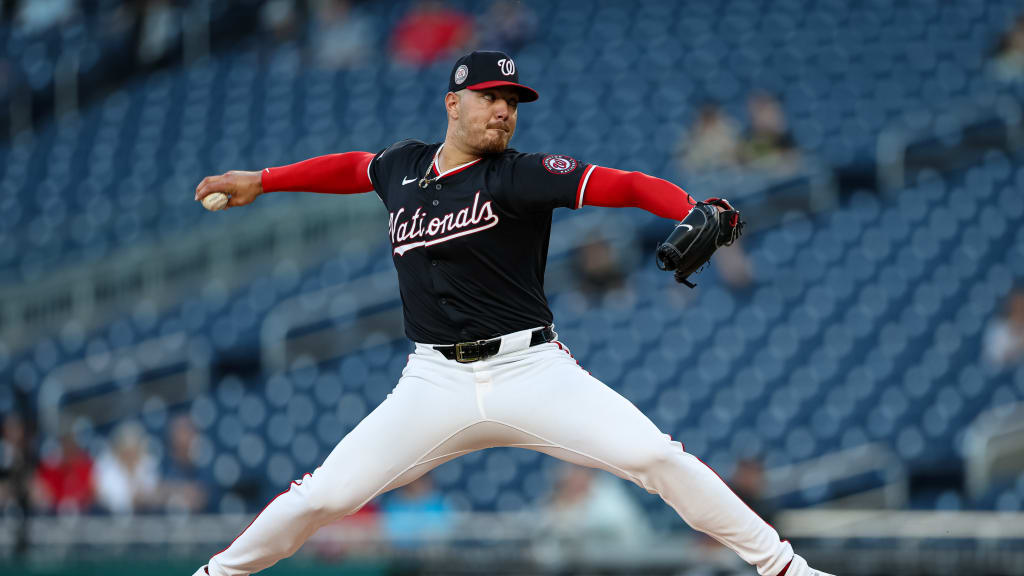
- Cade Cavalli becomes the 10th player in the Nats 22 year history to take the ball on opening day.
- Odalis Perez remains the most unlikely Opening Day starter, getting the ball in our bottoming-out year of 2008.
Lastly, here’s some interesting team observations for 2025’s Opening day Starters
- Cavalli is the 4th straight different Opening day starter we’ve had, not really a surprise to Nats fans who are watching the second straight reboot of the franchise. Cavalli seems likely to lead the line again though, since his competitors have either been traded (Gore) or are injured again (Grey) and our top starter prospects remain lower in the minors or hurt.
- Some teams have consistency, others are just all over the road. Cincinnati threw Virginia-born Andrew Abbot; he’s their 11th different opening day starter in 12 years.
- Other teams who can’t find a consistent ace: Tampa Bay (8 different guys in last 9 years),
- Texas had a crazy run where they used 15 different starters in the 16 years running from 2009 to 2024, but have now thrown Eovaldi 3 years’ running.
I thought this was the last year of the Stras deal. Are you sure it goes through 2027?
And somewhat relatedly, I’ve been kind of marveling at how aggressively this FO has refused to spend on players. Because that $92M doesn’t just include Stras’s $35M – there’s also TW’s $7M, Ogasawara’s $1.75M, Gray’s $1.35M and Adam’s 500k. (Also, all but the last of those was signed by Rizzo.)
Adding up the 26 active players, I get just under $51M. That’s the lowest in the majors by a fair bit. TBR and Miami are next at around $70M.
I wonder how many years we’d have to go back to find a lower number.
SMS
28 Mar 26 at 11:36 am
To be at least somewhat fair, while Gray and Adams were acquired by the former regime, the decisions to sign them rather than nontender them was made by the current one.
John C.
30 Mar 26 at 3:57 pm
@John C – That’s absolutely fair enough, and I also don’t know if I really believe that “total active roster salary” is a fair metric to measure deadbeat owners. Like, those guys on the IL are being paid real money too, and it’s definitely not the owner’s fault that they’re hurt.
But I do think there’s something there about the fan experience – about how well resourced is the actual team on the field – and the numbers were just so stark that I can’t stop thinking about it.
I think I am going to try to find time to run through past years just for fun. I bet the 2026 Nats are the lowest of this CBA, at least.
SMS
30 Mar 26 at 5:22 pm
At least they’ve started the season 3-1. If they had gotten swept in Chicago and gotten trounced for Philly’s opening night, there’d be some serious dark clouds right now.
Todd Boss
31 Mar 26 at 1:12 pm
FYI, the team just did all the assignments for AA, High-A, Low-A officially in the Milb transactions page:
https://www.milb.com/rochester/roster/transactions/washington-nationals/2026-03/p-2
I’ll be updating the big board presently.
Todd Boss
31 Mar 26 at 1:36 pm
If I’m reading these transactions right and Coy James and Ronny Cruz are starting in Fredericksburg, that only intensifies the position crunch that squeezed out A Cruz.
I’m counting 8 top 30 prospects that need time at A or A+ SS/2B/3B. I wonder how they’ll handle it.
SMS
31 Mar 26 at 2:47 pm
Once the teams do a full rotation, i’ve got a post reacting to the full season rosters, but yeah i see what you see for sure.
Todd Boss
1 Apr 26 at 4:14 pm