Nationals Arm Race

"… the reason you win or lose is darn near always the same – pitching.” — Earl Weaver

Injuries lead to call-ups lead to Difficult Roster Decisions.

5 comments

Got word this morning that the team is optioning the ineffective Ryan Perry back to AAA and bringing up veteran minor league FA signing Mike Gonzalez to take his place.  Luke Erickson notes the fact that 40-man member Atahualpa Severino was bypassed for this move, despite not requiring a subsequent 40-man roster move (the team transfered Drew Storen to the 60-day DL to make room).

This is the latest in a flurry of additions to the 40-man roster necessitated by a freak rash of injuries, and eventually will make for some rather difficult roster moves after the season is over.  As it stands right now, the team is now technically sitting at 45 guys on the 40-man roster (40 active or 15-day DL, 5 on the 60-day DL), meaning that at a minimum after the season 5 guys are going to have to make way.  Yes we have some free agents that will come off the books, but you generally need to operate your 40-man roster with some room to maneuver, especially considering some of the big prospect names that are going to be Rule-5 eligible this coming off-season (just to name a few; Danny Rosenbaum, Jeff Kobernus and Destin Hood).

Makes you wonder how the team feels about the two Major League contracts they handed out last draft?  Anthony Rendon is injured and likeout out for the season (again)  Matthew Purke only just got out of extended spring training to record his first start in Low-A.

Anyway; the real problem is the carnage that is likely to occur when the team has to designate a number of these mid-season additions.  Because as we designate them we run the risk of losing them to waiver claims.  I don’t think Carlos Maldonado is necessarily at risk, but certainly we didn’t need to expose someone like Sandy Leon or Corey Brown until absolutely necessary.

It makes you wonder if prior additions who are continually getting passed over for non 40-man candidates are either targets to get cut or were mistakes to begin with.  Why no Severino?  How about Carlos Rivera?  How long before the team summarily cuts Xavier Nady and his .500 OPS?

Would you have made this trade for Adam Jones?

8 comments

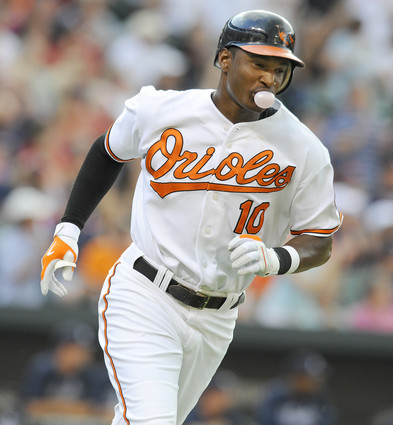
Adam Jones is on fire in 2012 and seems set to sign a long-term extension. Photo unknown via BaltimoreSportsReport.com

Interesting rumor that surfaced today: MASN’s Roch Kubatko tweeted that the Nats offered four players over the winter for centerfielder Adam Jones.  Those four players reportedly were John Lannan, Steve Lombardozzi, Drew Storen and an unnamed “center fielder.”  You’d have to guess the CF was lower-end, certainly not Eury Perez or Brian Goodwin (I’m not even sure we CAN trade Goodwin yet; there’s a set amount of time that has to pass before you can trade recently drafted guys).  The only other two starting CFs in the minors right now are Michael Taylor (our high-A center fielder) and AAA’s Corey Brown.   If I had to guess it would have been Brown, given his removal from the 40-man and his general struggles.

No time-frame was offered for this proposed trade; was it before or after the team swung the Gio Gonzalez deal?  If this was before, you wonder if we end up making the Gonzalez deal (probably; there’s no overlap in players and we’d have really needed another starter).  If this was after, perhaps it indicates how little the organization thought of Lannan even before the events of spring unfolded.

The articles make it seem that this would have been disastrous for the O’s: Lannan is stinking it up in AAA and Storen is hurt.  Its hard not to agree.  But I’d look at it another way; this would have been three 25-man roster guys plus a 4th OF (assuming it was Brown) who looks like he’s turning it around.  I think Lannan is a serviceable 5th starter in this league and just got caught in a numbers game out of spring, and that he’s better than he’s pitching in AAA.  At the time of this deal we wouldn’t have known that Lombardozzi would have this hot start; we only knew that he was young and seemed over-matched last September.

A concern in this story to me is the mention of Storen in the talks.  This is now the 2nd or 3rd time we’ve seen his name mentioned as being trade bait (one other that comes to mind was the proposed Zack Greinke trade.  At some point Storen is going to stop being the team player he clearly is now and become jaded, knowing that his front office is actively trying to get rid of him.

Nonetheless: Jones for that clutch of players seems like it is a steal for the Nats in hindsight.  If this deal had been swung, we’d certainly have a different look to the offense, but would be struggling with some serious depth holes right now (as if we aren’t already).

Thoughts?

Has anyone ever signed a “good” $100M+ contract?

leave a comment

Werth's wrist issue has not helped his cause with pundits who ridiculed his contract in the first place. Photo AP/Richard Lipinski via cbssports.com

One of the things that’s always irked me as a Nats fan is the continual presence of Jayson Werth‘s 7yr/$126M contract on the ever present lists of “Worst Contracts in Baseball.”  Or the fact that when Ryan Zimmerman signed his $100M extension, an anonymous front office member was quoted as saying that the Nats now had “two $100M contracts but no $100M players.”  (paraphrased from memory, can’t find the original quote).

Lets face it: professional baseball (and to an extent most Professional Sports) is a unique industry when it comes to paying for performance.  Most players perform in their peak professional years for pennies on the dollar (especially those in pre-arbitration years) as compared to their general “worth” on the Free Agent market.  Teams can lock up players for at least 6 years and sometimes 8-9 years (depending on the amount of time they spent in the minors) once they are signed.  In most cases players are first reaching free agency in their early 30s, whereas most would agree that a player’s peak performance age is probably in the 27-28 timeframe.  That means that by the time a star  is finally ready to cash in and sign that life-defining guaranteed contract …. they’re mostly on the downside of their career.  This means that teams are almost always paying for players’ decline years, and it almost always means that teams are generally regretting these huge contracts almost the moment they’re signed.

Teams that want to add through Free Agency thus are almost always paying ahead for past performance.  And usually this means that, especially by the end of a long FA contract, teams are vastly overpaying for the performance they’re getting on the field.

So I asked this question; has anyone ever signed a “good” $100M+ contract?  Good meaning, did the player perform up to the value of the contract the entire way through it?  A group of friends of mine argued about the same topic while drinking beer in the bleachers at Nationals Park last week; lets revisit the conversation.

According to Cot’s site (now at Baseball Prospectus), there have been 35 such contracts of $100,000,000 or more.  I’ve divided these contracts into three categories: those that are in the past or are sufficiently worked through in 2012 as to pass judgement, those that were signed starting with 2011 (so they only have a season and a quarter to judge), and those that started in 2012 or in the future.  Of these 35 contracts, they break down as follows:

  • Old enough to be Judge-able: 20
  • Started in 2011: 5
  • Started in 2012 or in the future: 10 (lots of big contracts handed out this past off season).

How would you judge these contracts?  Lets go by category: The rank is the rank of all time total value amongst all of these 35 contracts.

Category 1: Judgeable $100M contracts

Rank Player Amount (Years) Knee Jerk Opinion on value
1 Alex Rodriguez $275,000,000 (2008-17) Future Albatross: paying A-rod $28M at age 41
2 Alex Rodriguez $252,000,000 (2001-10) Great production for most of this contract
6 Derek Jeter $189,000,000 (2001-10) Hard to Argue Jeter wasn’t worth it…
8 Mark Teixeira $180,000,000 (2009-16) 2009 was great; a .242 hitter since.
9 CC Sabathia $161,000,000 (2009-15) Continues to be one of the best pitchers in baseball.
10t Manny Ramirez $160,000,000 (2001-08) One of the greatest per-dollar value large contracts ever
14 Miguel Cabrera $152,300,000 (2008-15) Great value so far; perennial MVP candidate
16 Todd Helton $141,500,000 (2003-11) Early part of contract good; last few years meager.  A push
17 Johan Santana $137,500,000 (2008-13) Major injuries plaguing contract
18 Alfonso Soriano $136,000,000 (2007-14) Considered one of the worst contracts in baseball
20t Vernon Wells $126,000,000 (2008-14) Severely underperforming; one of most immovable contracts
20t Barry Zito $126,000,000 (2007-13) 5th starter stuff, bumped from rotation by career minor leaguer
25 Mike Hampton $121,000,000 (2001-08) Major disappointment, traded twice
26t Jason Giambi $120,000,000 (2002-08) Great early value in NY; injuries and lack of production late.  A push
26t Matt Holliday $120,000,000 (2010-16) Quietly earning this contract.
29 Carlos Beltran $119,000,000 (2005-11) Injuries plagued middle of contract; good value otherwise
30 Ken Griffey Jr. $116,500,000 (2000-08) Missed most of 3 seasons mid-contract, constantly hurt
32 Kevin Brown $105,000,000 (1999-2005) 72 Wins for $105M, missed parts of 4 seasons.
33t Carlos Lee $100,000,000 (2007-12) Decent performance if not spectacular; Too much $/year though
33t Albert Pujols $100,000,000 (2004-10) If anything, underpaid during this stretch.

Category 2: Too Early to really tell (signed/started in 2011) Contracts:

Rank Player Amount (Years) Early Reports Are..
7 Joe Mauer $184,000,000 (2011-18) Injuries early in contract; struggling so far in 2012.
12 Troy Tulowitzki $157,750,000 (2011-20) Hard to argue with production; injury prone though
15 Carl Crawford $142,000,000 (2011-17) Played relatively poorly in 1st yr, hurt 2nd.
20t Jayson Werth $126,000,000 (2011-17) Wide-spread opinion of major over-pay; out most of 2012
26t Cliff Lee $120,000,000 (2011-15) One of the best pitchers in baseball

Category 3: 2012 and Future Extensions

Rank Player Amount (Years) Industry Opinion seems to be…
3 Albert Pujols $240,000,000 (2012-21) Future Albatross?  Slow 2012 start, tons of money in late 30s
4 Joey Votto $225,000,000 (2014-23) Too much for too long?
5 Prince Fielder $214,000,000 (2012-20) Bad body won’t age well
10t Matt Kemp $160,000,000 (2012-19) Best player in baseball rocketed out of the gate in 2012.
13 Adrian Gonzalez $154,000,000 (2012-18) Red Sox issues in general dragging him down but was good in 1st season
19 Matt Cain $127,500,000 (2012-17) Lot of money to a pitcher with a career W/L record below .500
23 Ryan Howard $125,000,000 (2012-16) Achilles heel injury to start; $25m/ year for decline
24 CC Sabathia $122,000,000 (2012-16) Continues to be one of the best pitchers in baseball.
31 Jose Reyes $106,000,000 (2012-17) Concerned about contract year boost in productivity?
33t Ryan Zimmerman $100,000,000 (2014-19) Great player if healthy … but seemingly never healthy

Conclusions

  • Of the 20 judge-able $100M contracts, 10 were unquestionably bad, 7 were good and the other 3 were arguable one way or the other (which, is still “bad” in that they weren’t huge successes).
  • 3 of the 5 2011 contracts are widely panned as of this moment.
  • Of the 10 nine figure contracts starting this year or later, at least 4 have been badly panned and really only Matt Kemp‘s contract looks like a winner from the onset.  Then again, judging a 6 year contract on 2 months of production is (goes without saying) the definition of a small sample size.

I’ve only identified 11 of these 35 contracts that were either “worth it” or which seem to be trending well.   So the answer to my blog question is definitely, “Yes, there have been a handful of 9-figure deals worth the money.”  However, 18 of these 35 contracts were either patently bad or are trending that way soon.  The other 7 that I’ve put somewhere in the middle may very well be considered losses; when you commit $100M as a franchise you expect near Hall of Fame productivity.

The lesson that I take away is this: a 6-9 year commitment for $18-$25M/year should be a guaranteed lock of productivity for your team, but as these contracts show it almost seems like a coin flip as to whether your franchise-defining contract will actually work out.  That’s scary stuff to consider as a GM and/or an owner.

Bonus Analysis: Team by Team: 18 of the 30 teams in baseball have rolled the dice on a 9 figure salary; how have they fared?

Team Ttl good bad indifferent
Boston 3 1 1 1
Chicago Cubs 1 1
Cincinnati 2 1 1
Colorado 3 1 1 1
Detroit 2 1 1
Houston 1 1
Los Angeles Angels 1 1
Los Angeles Dodgers 2 1 1
Miami 1 1
Minnesota 1 1
New York Mets 2 1 1
New York Yankees 6 3 2 1
Philadelphia 2 1 1
San Francisco 2 1 1
St. Louis 2 2
Texas 1 1
Toronto 1 1
Washington 2 2

Look how many teams have tried once or twice and failed every time.   And notice that sometimes even a “good” contract can still be crippling.  Alex Rodriguez earned every penny of his massive contract in Texas … but the owners capped payroll and couldn’t build a good team around him, so the contract was viewed as a massive anchor for the team.  He had to be traded so that the team could rebuild (and as it turned out, be sold to a more competent owner).

Back to our Nats: Washington has handed out two 9-figure deals and both (while still early) are being panned in the media.  Werth‘s wrist injury and Zimmerman‘s continual dings aren’t helping.  Lets just hope that the kids keep competing and driving us forward.

Opinions?
Written by Todd Boss

May 25th, 2012 at 8:43 am

30 for 30 is coming back

leave a comment

ESPN and Grantland announced today the 2nd installment of the fantastic 30-for-30 series.

I thought the network made a huge mistake by not keeping the 30-for-30 brand name when it released a slew of follow-on productions after the initial run of 30 ended.  Instead they branded them as “ESPN Films presents…” stories and made it nearly impossible for the DVR-age of TV viewers to find them.  Most of us depend on setting a “Record Series” job keyed on the name … but then they presented the follow-on films just using their titles.  To make matters worse ESPN kept changing the air times and the order, didn’t keep a regular weekly schedule of releases, and as a result the viewer numbers were down for the follow on shows.  I still havn’t seen half of the 2nd set, which is unfortunate because there’s some great stories presented.

I did a review of the first batch of 30-for-30s and tried to post thoughts on some of the follow-on shows when I happened to catch them (reviews for the Bartman episode, Dotted-Line, and The Real Rocky) but ran out of gas on the reviews when it became too difficult to get them recorded.

Either way, can’t wait to see the next installments.

Written by Todd Boss

May 16th, 2012 at 1:12 pm

Posted in 30 for 30,Non-Baseball

Tagged with

What are we going to do when Wang comes back?

8 comments

In a word: I have no idea.

While the rest of Nats nation talks about the fallout of Jayson Werth‘s broken wrist (most of this post was written before last night’s debacle), I had been thinking about this topic: when Chien-Ming Wang exhausts his 30 day rehab assignment, what in the world is this team going to do with him?

If I’m correct about rehab assignment rules while on the 15-day DL, players have 30 days once they appear in a minor league game.  Wang’s first ML appearance was in Potomac on Apr 29th, and then he pitched 6 innings on Friday night in Hagerstown.  As has been reported in both local media and national, Wang’s 6 inning stint represented a big step forward in the pitcher’s ability to return to the majors.  Now, perhaps this isn’t a problem for another month or so, but both these reports seemed to indicate that Wang was “nearly ready” to return to the majors.  Problem is, the Nationals really don’t have anywhere to put him.

As everyone knows, the Nats currently have the best pitching staff in baseball by most statistical measures.  We’ve rocketed out to an 18-10 start, winning 8 of our 9 series so far, on the strength of starting pitching.  And there’s no logical starter that we should replace right now.  Strasburg just won NL pitcher of the month, Gonzalez is making all the “Nats paid too much” pundits eat their words thus far with a stellar start, Zimmermann is allowing a miniscule .992 WHIP right now (even after counting for May 6th inflation), and Detwiler is pitching better than any of them now to little fan fare, with a 3-1, 1.59 era, .988 whip and a staff-best 241 ERA+.  Arguably the “worst” of our starters is also our most expensive: Edwin Jackson.  Of course, the word “worst” is only understood in context: if it weren’t for one first inning meltdown on April 19th, Jackson’s ERA would be 2.34 instead of its current 3.69.

If you’re Davey Johnson, you don’t possibly dare disrupt the existing rotation do you?  I wouldn’t.  But, Wang needs to go somewhere.  Can you put him in the bullpen?  Doubtful; he’s a starter coming off a shoulder injury and probably needs to be on a set schedule of throwing.  I doubt he’s able to jump up and be ready to enter a high-leverage reliever situation with 8 pitches to get ready.  Do you send Detwiler to the pen?  He’s the least experienced of the 5 starters we have; the other 4 have long since established their spots.  Do you move Jackson to the bullpen?  That’d make for an awful expensive middle reliever.  Wang has no options (nor does Detwiler or Gorzelanny for that matter, logical choices to move up or down to make way), so they all have to find room on the active roster.  I don’t think Wang is trade-bait; who would give up anything other than a marginal prospect for him based on his injury past?

Honestly, I’m expecting some 15-day DL hijinks to ensue if/when the situation comes to loggerheads.

How long before Espinosa is benched?

12 comments

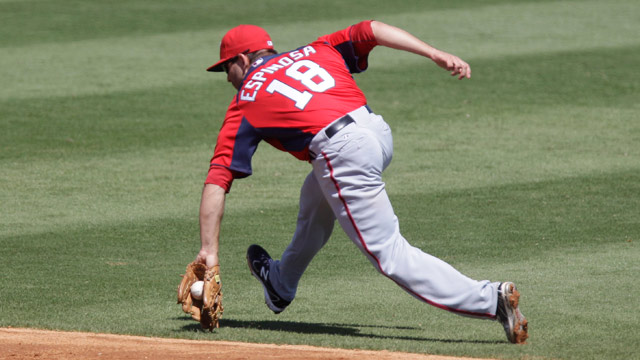
Espinosa is still great in the field ... but struggling at the plate. Photo AP via mlb.com

I’m not the only one tolling this bell right now.  Nats beat reporters Dave Nichols posted today on the same topic.  Despite being annointed the starting 2nd baseman, and for a while last year while Ian Desmond struggled serving as the shortstop in waiting, Danny Espinosa is really struggling to start off 2012.   He’s posting a 49 OPS+ right now, with a .188 batting average and (as Nichols points out), an alarming number of strikeouts.

Meanwhile, Steve Lombardozzi is more than ably filling in defensively at 3rd but is a natural 2nd baseman and is getting on base at a .383 clip.  He’s also batting nearly .300 (two 0-fers in Los Angeles dropped his BA below the .300 margin).  Sounds to me like a prototypical lead-off hitter, doesn’t it?

I’ve often used this mantra when complaining about Roger Bernadina‘s continued presence on the lineup: after more than 900 MLB plate appearances, isn’t it safe to say we know what his performance will be?  Well, Espinosa now has nearly as many PAs as Bernadina and seems regressing by the day.  His OPS+ is still decent for his career on account of his 21 homers last season.  But he’s only hit one so far this year and as a result the slugging component of his OPS and OPS+ has drug him down to below replacement level.

Most have noticed his severly bad switch-hitter splits from 2011; clear evidence that he may consider giving up switch hitting and just batting from the right-side.  Of course, its awful hard to do that after you’ve been switch hitting your entire life.

With our #3 and #4 hitters on the DL, and with the team ranked in the bottom 3 in MLB in most offensive categories right now … how long before the team makes a move and benches Espinosa in favor of Lombardozzi?  I like Espinosa; have always defended him.  And after watching Lombardozzi look absolutely lost at the plate last fall, I never thought i’d be saying this so quickly.  But he looks good, Espinosa does not, and the team needs to give itself the best chance to win and score runs.  They can’t win games 3-2 every night.

Written by Todd Boss

May 3rd, 2012 at 4:26 pm

Did the Nats call up the wrong OF?

10 comments

Harper knows he's ready; is the Media? Photo GQ magazine Mar 2012

As the rest of the free world now knows, Bryce Harper has gotten called up to give the incredibly weakened Nats lineup some potential offense.  Sometimes moves can be planned and orchestrated (such as keeping Stephen Strasburg in the minors in 2010 past the super-2 deadline), and sometimes your hand is called.  With Michael Morse out indefinitely, and with the most fragile $100m player this side of Carl Crawford (aka, F.O.T.F. Ryan Zimmerman) heading to the DL yet again, this team suddenly is without 55-60 homers and 200 RBIs in the middle of its order.

So, we’ll roll the dice with the 19-yr old Harper.

But, should the team really have called up a much more mature, much more MLB-ready member of the Syracuse Chiefs?  A guy who is currently putting up this line in AAA: .278/.354/.556 with 6 homers in 20 games?  A guy who has hit 30+ homers in two successive seasons, at two successive levels of the minors and is currently on a pace for more than 40 in AAA?  Yes I’m talking about Tyler Moore, a 16th round draft pick who has come out of nowhere to become (arguably) this team’s 3rd best hitting prospect in the minors today.

Yes, I know he’s a 1B primarily, and he’s just started taking reps in LF.  But after watching Xavier Nady lumber towards balls in LF and watching Mark DeRosa turn routine RF fly balls into adventures, how much worse could it be to stick him out there instead and juggle Harper with Werth and Ankiel in CF and RF (matchup dependent)?  Scouts and pundits have routinely discounted Moore’s abilities, and Mike Rizzo‘s scouting trip last week apparently made his mind up for him, so perhaps there’s a method to his madness.  Maybe Moore really isn’t an OF option despite his LF experiments.  We’re not watching him game in and game out, just typing out blog posts from our dining room table.

Either way, the Nats should get at least a more competent batter in the line-up.  If Harper comes up and starts blasting the ball all the better.

Johnny Damon: Hall of Famer? Not for me

5 comments

Johnny Damon during his Boston reign. Photo unknown via metsmerized.com

With recent news that Johnny Damon has convinced another team (for 2012 its the Cleveland Indians) to give him more at-bats so that he can continue his march towards the magic 3,000 hit plateau, and with today’s Rob Neyer column that already assumes Damon is a hall of famer and asks, “Which cap will be on his Cooperstown plaque,” I have this to say:

How is it possible that Johnny Damon is a hall of fame player?

Here’s a few metrics for you:

  • All Star Apperances: TWO!  Two times he’s been considered amongst the best 60 or so active players.
  • Top 5 MVP votes: Zero
  • Top 10 MVP votes: ZERO
  • Top 20 MVP votes (as in, one of the 32 writers involved threw him a 10th place vote here and there): 4 times.
  • Career OPS+: 105.  As in, compared to his fellow players he’s only about 5% better at the plate.
  • Career OPS: .789, below the .800 line of respectability for modern day hitters.
  • Defensive awards: Golden Gloves and Silver Sluggers: Zero.

I’m sorry, but in what world is this a hall of fame career?  Damon is the epitome of an accumulator, averaging nearly 700 plate appearances and 188 hits per year over his career and staying relatively healthy (never playing less than 140 games per year since his debut in 1996).  105 OPS+!  If he was a gold-glove calibre middle infielder maybe that’d be acceptable, but he’s a sub-par defensive outfielder who has never sniffed a defensive award.

I also go back to my tried-and-true argument related to All Star appearances and MVP voting; how can a player possibly be considered one of the greatest players of all time if he rarely, if ever, was considered one of the best players of his own time, on a year to year basis?  Great players earn all star appearances even in down years, while middling players never earn them.

For everyone who has vehemently argued against Jack Morris, essentially on the strength (weakness) of his career ERA (and by implication, ERA+) … I wonder who hypocritically is arguing FOR Damon.  Oh wait; Rob Neyer is.

Am I crazy?  Who out there thinks that Damon is worthy of a copper plaque in Cooperstown?

(caveat: after reading the comments in the Neyer article, it occurred to me it was possibly a spoof.  As in, an entire tongue-in-cheek article.  If so, my reading comprehension skills are at fault and I rescind this criticism.)

Written by Todd Boss

April 17th, 2012 at 6:58 pm

Questionable defense bailed out in the 10th

2 comments

Opening day is always so much fun.  Except when you are running late, try driving to the stadium, and literally drive around for an hour trying to find a place to park.  I’ve never seen the areas around the stadium THAT jammed, with no parking available in any lot for any price.  We ended up illegally parked off of Delaware ave and somehow didn’t get a parking ticket.  My guess is that the meter maids got carpel tunnel syndrome from writing so many tickets for out of towners that they had to go home before reaching the neighborhood where my car was parked.  We saw the jets from 395, we heard the fireworks while driving past the McDonalds on South Capitol, and arrived in time to see the Nats bat in the bottom of the 2nd.  Lesson learned; never never try to drive to opening day again.

Anyway.

Gio Gonzalez looked fabulous; 7ip, 2 hits, 7 punchouts and zero walks.  He works fast, his four seamer hopped and his curve (at least from the side) looks amazing.  He made Joey Votto, Cincinnati’s best hitter, look just foolish, punching him out twice.  Gonzalez continues a trend of Washington’s 3 best starters pitching 7 complete with room to spare (Gonzalez sat at 97 pitches through 7 complete but had 7-8-9 coming up, meaning that Clippard had a relatively easy hold, but more importantly meaning that, were it later in the season, Gonzalez easily could have extended himself to get through the 8th).

Too bad Gonzalez’s Win was spoiled by the 2nd and 3rd defensive gaffes from Ryan Zimmerman on the afternoon.  He had a fielding error earlier in the game (compounded by throwing the ball away) that didn’t end up factoring into the game, but his defense in the 9th was very questionable.

Baseball 101: if you’re nursing a close lead in the 9th inning, what do you tell your fielders?  NO DOUBLES.  That means your 1st and 3rd basemen guard the line and your outfielders play deep.  You can absorb a single but you don’t allow someone into scoring position.  So what happens in the top of the 9th?  Scott Rolen doubles down the line past Zimmerman to get into scoring position.  Zimmerman was so far off the line he didn’t even dive after the ball.   What he heck was he doing?

Then, after a walk to load the bases Zimmerman plays Ryan Ludwick at least even with the bag, perhaps even further in, apparently guarding against the bunt.  Ok: I guess I can understand that play to a certain extent … except that Ludwick is a power hitter and the Reds were 2 runs down at that point.  Dusty Baker isn’t playing for a suicide squeeze, he’s playing for a gapper to score two runs.  To make matters worse, Ludwick gets down 1-2, and Zimmerman STILL doesn’t return to double play depth.  Ludwick, who was a far shot to bunt in the first place, certainly isn’t bunting with 2 strikes down 2 runs in the 9th!  So what happens?  Ludwick hits a routine grounder to Zimmerman, who gets eaten up because he’s playing right on the grass and the ball takes a weird hop.  If Zimmerman plays at normal depth, that’s a game ending double play ball at best, a force out at 3rd for the 2nd out at worst.

Do you blame his positioning on Zimmerman or the dugout?  Probably the latter, but Zimmerman has been playing long enough and is a good enough fielder that he should have known what to do.  I hope he buys Gonzalez dinner for costing him a Win (not to mention Lidge for the blown-save).  In the end the Nats get the W … but as I was driving away from the stadium it wouldn’t have surprised me in the least to see the team demoralizingly drop that game after controlling it the entire day.

Written by Todd Boss

April 13th, 2012 at 9:54 am

Nats Rotation Cycle 2012 #1: good/bad/soso

9 comments

Surprise 5th starter Detwiler turned in your best outing of the first Rotation Cycle. Photo Cathy T via nationalsdailynews.com

It has been so long since I did one of these, that I nearly forgot that I used to do them 🙂

For the uninitiated, I try to do a quick recap of our starters each turn through the rotation, culminating in 33 “rotation cycle” posts that can be seen if you click on the “Nats Rotation Review” category tag to the right.  If I’ve seen the game, I’ll give more detailed analysis based on my observations.  Otherwise I’m recapping the box score and interpreting the stats to come to a conclusion.  The focus is on the starters, but there is a section for relievers and the offense.

The classifications are not very scientific; usually good, bad or mediocre/soso.  If someone is great or awful, we’ll note that as well.

Good

  • Stephen Strasburg looked healthy and in command on opening day 4/5 (box/gamer), getting a no decision after 7 complete innings.  His line: 7ip, 5 hits, 1 ER, 5K and 1BB.  More importantly he was only on 82 pitches through 7 innings, a very efficient work day.  A couple of these hits were relatively weak (one an infield pop fly that fell between 4 infielders, another a scoring issue that probably was a hit).  Its not difficult to look unhittable when its 41 degrees and the wind is blowing in, but Strasburg seems to be adopting the same strategy as his compatriot Jordan Zimmermann: pitch efficiently, pitch to contact, and keep your pitch counts down so you go deeper into games.  It may not be as flashy as a 14-K effort, but if it leads to wins everyone is happy.
  • Jordan Zimmermann‘s first start on 4/8 (box/gamer) was just as effective as Strasburg’s; unfortunately for Zimmermann he went up against a buzz-saw in Jeff Samardzija and his offense couldn’t help.  Zimmermann took the loss on a day when he went 7 complete innings on just 80 pitches, giving up 6 hits, 0 walks and one earned run.   This is the classic adage of why W/L records are misleading; if Zimmermann pitches this way all year as our #3 starter we’re going to go far.
  • Ross Detwiler‘s rotation spot won’t be going away any time soon if he continues outings like 4/10 (box/gamer).  5 innings, 2 hits and a walk with 6 Ks to earn the win.   Detwiler picks up where he left off last summer and gives immediate validation to the Lannan– demotion decision.

Bad

  • Yes, its bad when your marquee off-season acquisition Gio Gonzalez fails to get out of the 4th inning in  his debut start.  Gonzalez struggled with control and with effectiveness on 4/7 (box/gamer) and gave up 4 runs on 7 hits and 3 walks.  He did have 6 strikeouts in his 3 2/3 innings, so there’s that.  His fastball was hopping; 95mph in the first two innings, averaging about 93 on the day.  He threw mostly fastballs but wasn’t getting the swing-and-miss effect like he needed.  Of course, an outing like this isn’t helped in the analysts’ minds when Tommy Milone (the 4th best prospect sent the other way in the trade) pitched 8 shutout innings in his debut.  Lets hope this is first-start jitters.

Mediocre/Inconclusive

  • Edwin Jackson‘s 4/9 start (box/gamer) wasn’t bad, but it wasn’t as effective as we would have liked.  He was a victim of the long-ball, giving up 3 runs on 4 hits and a walk in 5 innings.  He did have 6 punchouts on a night where he threw a ton of off-speed stuff (only 42 of his 78 pitches were fast-balls; he threw a ton of sliders on the night).   The homer he gave up ended any chance of his getting a W on the night on a game that was more or less thrown away by replacement starter Henry Rodriguez.

Starter Trends

MLB Trends (through Detwiler 4/10 Cycle 1)

Strasburg    good
Gonzalez    bad
Zimmermann    good
Jackson    soso
Detwiler    good

Relievers of Note and other News

  • So far its looking like Brad Lidge may be the steal of the FA market.  He’s throwing well, his slider is back and he’s closing out save opportunities for just $1m.
  • So far, its looking like the “bad” Henry Rodriguez from 2011; a 0.00 ERA but a 2.25 whip and a loss by virtue of his own throwing error.
  • Ryan Mattheus isn’t doing himself any favors right now and may not be long for this bullpen.  Of course then again its looking like Drew Storen is closer to Tommy John surgery than returning to the field, having visited Dr. James Andrews this week.  Meanwhile, surprise 25-man roster includee Craig Stammen is performing decently in a swing-man role and looks to stick.

Thoughts on the offense

  • Adam LaRoche comes out on fire, a shock considering he’s usually a slow starter and the fact that he looked beyond awful in the first game, waving weakly at curveballs in the dirt.  Ian Desmond looks like the Desmond of September, which is great news.
  • Meanwhile, in a completely unsurprising development Roger Bernadina has started out the season 3-for-20.  Why aren’t we looking for a CF again?
  • Too bad Chad Tracy doesn’t have any OF flexibility; he’s looked great off the bench so far.

Overall Summary

Can’t argue with an away series win, despite the weakened nature of the opponent in Chicago.  We could get a second away-series win tonight if one stud young Ace (Strasburg) can beat one come-back Ace (Johan Santana).  That’s the way to go in baseball; play .500 on the road and play .600 ball at home and you’re a 90 win team in an era where 90 wins almost certainly guarantees post-season play.