Nationals Arm Race

"… the reason you win or lose is darn near always the same – pitching.” — Earl Weaver

Nats Starter Matchup Monthly Analysis

4 comments

Ross Detwiler has been helping to keep the team afloat all year. Photo: Photo by Marc Serota/Getty Images

In the same spirit of grading the Minor League starters from yesterday’s post, here’s letter grades for each of the starts in April for our MLB rotation:

MLB Rotation:

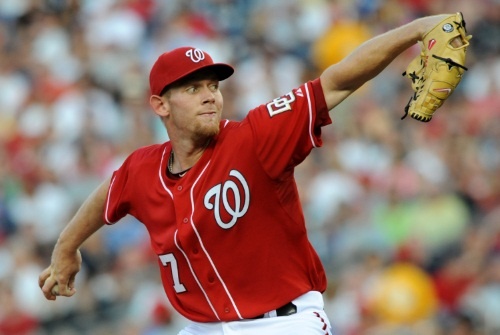
  • Strasburg: A,D-,A-,B-,C+,B-
  • Gonzalez: A,B+,F,D,A+,D-
  • Zimmermann: B,B+,A,B-,A+
  • Haren: F,D,D-,C-,B+
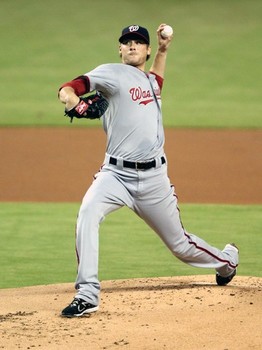
  • Detwiler: A,A-,A-,B-,C-

Discussion: Nats YTD Stats are here for reference

We’ve all been watching the games, so nothing surprising here.   Jordan Zimmermann has quietly been one of the best starters in the NL so far.  He’s working on a .861 WHIP and has 5 straight Quality Starts.  This is reflected in his grade scores above.   Meanwhile. Dan Haren‘s early struggles are slowly turning into workable outings.  Ross Detwiler‘s Sunday loss was “death by paper cuts” and his 11 hits allowed wasn’t as bad as it looked in the box score.  I’d like to see some more consistency out of Gio Gonzalez; is he an 8ip-1hit guy or is he 7 runs in 5 innings guy?  There really hasn’t been an in-between for him.  Lastly Stephen Strasburg hasn’t pitched that badly (one bad outing out of 6) but has gotten almost no run support, contributing to his ugly W/L record.


Now here’s some fun Starting Pitcher Matchup analysis.  I’ve been keeping track of the opposing starter we’ve faced each night and ranked them three different ways:

  • Their Rotation Order intra team: the opening day starter for a team is their “#1” and the other four guys are ranked 2-5 as they appear in the opposing rotation.
  • Their Ranked Performance intra-team: at the time of their series with the Nats, the 5 starters on a team are ranked 1-5 on pure in-season performance.  The guy with the best season stats at that time is ranked #1, the guy with the worst #5.
  • Their Subjective League-Wide “Rank” as a pitcher: a subjective look at whether the opposing starter is a league wide “Ace,” a near-Ace or #2, and the like.

I also kept track on a night-to-night basis a quick opinion on whether I felt the Nats had the Starting Pitching Advantage (or if it was an even-matchup, or if I felt the opposing team had the pitching advantage) and tracked how we did.

Here’s some analysis based on our opposing pitcher each night.  It provides some interesting insight into the team’s performance so far.


Rotation Order Stats

Starter # Record Opposing Starter in Wins Opposing Starter in Losses
1 2-4 Nolasco (2) Cueto, Hudson (2), Wainwright
2 2-3 Slowey, Peavy Maholm, Harvey, Garcia
3 5-0 Leblanc (2), Floyd, Hefner, Arroyo
4 1-3 Bailey Bailey, Sanabia, Gee
5 3-3 Leake (2), Axlerod Teheran (2), Miller
5+ 0-1 Cingrani

In other words, the Nats are 2-4 versus opposing team’s “Aces,” 2-3 against their #2’s, etc.

(Note: a “5+” pitcher means a starter who was not on the opening day roster for a team.  We’ll see a ton more 5+’s as more starters go down with injury and are replaced by minor league call-ups).

Not all #1 starters are made the same, nor are #5 starters.  The team has the expected losing record against other team’s #1s, but also has a relatively weak record against other team’s #4 and #5 starters.  Some of this is thanks to Haren‘s weak matchup as our #4 starter, and some of this is because guys like Homer Bailey, Shelby Miller and Tony Cingrani aren’t exactly bottom tier starters in this league (we’ll see this later on with the “League Wide Rank” table).


I initially started tracking this ranked-opposing starter analysis to prove to a friend that a team’s “Ace” doesn’t always go against another team’s “Ace.”  And you can see how quickly team’s rotations get mis-matched versus one another thanks to the unbalanced schedule and irregular off-days:

Strasburg Three vs #1, Two vs #2, One vs #5
Gonzalez Three vs #2, Two vs #3, One vs #1
Zimmermann Three vs #3, Two vs #4
Haren Two vs #4, Three vs #5
Detwiler Two vs #5, Two vs #1, One vs #5+

Detwiler’s #5 rotation spot is now matched up essentially with the #1 spot of a lot of his opponents (the one #5+ spot was Cingrani, who took Cincinnati’s #1 spot from Johnny Cueto when he hit the D/L), and has been since mid April.  Thankfully our #5 has been pitching like a #2 all year.

You can kind of tell what has happened to the Nats versus opponents in terms of schedule off-days just by looking at this list; clearly the Nats stayed on schedule with their opponents for at least the first three turns through the rotation, then jumped ahead a day for two turns,


Ranked Performance intra-team

1 2-3 Nolasco (2) Cueto, Maholm, Harvey
2 2-1 Peavy, Bailey Miller
3 2-4 Slowey, Floyd Hudson, Bailey, Wainwright, Cingrani
4 4-2 Leblanc (2), Hefner, Arroyo Hudson, Garcia
5 3-4 Leake (2), Axlerod Sanabia, Teheran (2), Gee

In other words, the Nats are 2-3 against opposing teams’ best pitcher at the time of the series, 2-1 against the opposing team’s 2nd best performing pitcher at the time of the series, etc.

As with the above, not all #1s are the same.  Ricky Nolasco is perhaps the 4th starter on a good rotation but he’s the best Miami has.  Believe it or not Adam Wainwright was only the 3rd best starter on St. Louis’ team at the time of our series (behind both Jake Westbrook and Shelby Miller), despite my believing him to be an “Ace” in this league (see the next table).


League-Wide “Rank”

Starter # Record Opposing Starter in Wins Opposing Starter in Losses
1 0-3 Cueto, Harvey, Wainwright
2 1-5 Bailey Bailey, Hudson (2), Miller, Cingrani
3 4-2 Nolasco (2), Peavy, Floyd Maholm, Garcia
4 1-0 Arroyo
5 7-4 Slowey, LeBlanc (2), Axelrod, Leake (2), Hefner Sanabia, Gee, Teheran (2)

In other words, the Nats are 0-3 against MLB “Aces,” 1-5 against MLB “near aces” or #2’s, etc.

This table really shows how the team has truly done against the elite pitchers in this league.  We can argue in the comments section about my subjective ranking of pitchers (is Matt Harvey truly an “Ace” in this league?  Probably not yet, but he sure is pitching like one.  Is Julio Teheran really a #5 pitcher in this league?  Not on talent, but certainly on performance thus far), but I’m happy with my rankings for pitchers overall.

For comparison purposes with our own team talent-wise, I have Strasburg as a league-wide #1, Gonzalez and Zimmermann as #2s, Detwiler as a #3 (but rising) and Haren as a #4 (but falling; he was a #2 just a couple years ago).

The Nats have managed just one victory over Aces or near-Aces in this league so far (and that was by virtue of Zimmermann‘s one-hitter victory over Homer Bailey: you don’t win 1-0 games in the Majors very often).  They’re 12-6 against everyone else.

The team’s bigger concern should be games dropped to the #5 pitchers.   For every loss to an Ace, you have to make up for it by beating up on the lesser starters in this league.  You just cannot lose to guys like Alex Sanabia or Dillon Gee.


Performace against Expectations by Advantage

By “Advantage” Record Matchups in Wins Matchups resulting in Losses
Wash 10-6 Stras-Hudson, Stras-Garcia, Haren-Sanabia, Zimm-Gee, Detwiler-Teheran, Stras-Teheran
Even 3-6 Zimm-Bailey, Detwiler-Nolasco, Haren-Leake Stras-Cueto, Stras-Harvey, Detwiler-Wainwright, Detwiler-Cingrani, Gonzalez-Hudson, Gonzalez-Maholm
Opp 0-2 Haren-Bailey, Haren-Miller

In games where I thought Washington had the clear starting pitching advantage head-to-head, we still managed to lose 6 times.  Those losses are listed above: three times we dropped games where Strasburg was pitching against lesser opponents.  You can quibble whether Strasburg-Tim Hudson is an even matchup or not, but certainly Strasburg vs Teheran or Jaime Garcia is a mis-match on paper.

In games where I thought the pitching matchup was even, the team still went just 3-6.  Again, Strasburg ended up with some tough matchups against other fellow “Aces,” while Detwiler ran into a couple of hot-hands.

The two games where I thought our opponent had the clear advantage heading into the game both involved Haren going up against near-aces from Cincinnati and St. Louis; we lost both games easily as expected.


April Conclusion: The Nats have faced some good teams with some good pitching thus far; they need to do a better job cleaning up against opposing teams’ #5 starters.

This analysis doesn’t even start to look at the offense; with better run support Strasburg may be 4-1 instead of 1-4.  And it doesn’t look at the bullpen or our defense of course; two areas that have turned Wins into Losses pretty quickly for the team.
Monthly Check-in with Minor League Pitching Staffs

10 comments

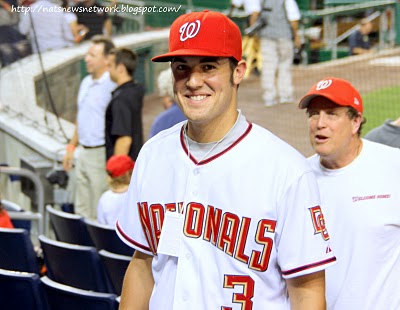
Robbie Ray is having a nice bounce-back 2013 so far. Photo: Natsnewsnetwork.blogspot.com

In 2011, I managed to do “Rotational Review” posts for both the MLB team and the minor league system for the whole summer.   That turned out to be a pretty hefty time commitment, and an endeavor that I couldn’t keep up with.  I managed to do all 33 MLB rotation reviews but gave up on the minor league systems around the all-star break. For the entirety of 2012 I never once published much of an in-season look at any of the minor league teams.  But I want to stay aware of the minor league pitchers; its basically the reason I started this blog.  I wanted to be up on the rising talent, always on the lookout for the next home grown pitching talent.

In 2013, I’ve modified my approach.  With the help of daily doses of Luke Erickson‘s NationalsProspects.com daily looks, I’m taking the time to give a quick “grade” to each Starter’s outing by looking at the stat-line and the peripherals, in order to gauge how guys are looking.  Instead of the previous “good-bad-soso” analysis, I’ve adopted somewhat of a letter grade system, from A+ to F.  It isn’t a hard and fast grading system, but generally speaking we start with a run-of-the-mill quality start being graded a C (lets face it, 3 earned runs in 6 innings for a 4.50 ERA is average) and then go from there.  6 shutout innings gets somewhere between an A+ and an A- depending on # of hits/walks/Ks, while a complete meltdown (e.g. 7 runs in 3 innings) earns an F.  You get the idea.

So, without further ado, here’s the April 2013 look at the starters by team, with grades for outings and some commentary.  We’ll do an expanded view of the MLB rotation in the next post.  The grades are through 4/30’s outings; the stats may be slightly off since I wrote the bulk of this prior to this morning.

AAA Rotation

  • Ohlendorf: A,B,D+,D,C-
  • Young: F,D
  • Maya: C,D,D,F,D-
  • Perry: D-,B+,C-,B
  • Rosenbaum: A-,A,C+,A
  • Roark: A,D,F->demoted to bullpen,A
  • Tatusko: D,A-

Discussion: Syracuse YTD Stats are here for reference

(A quick note explaining the notation; the top 5 pitchers are the current rotation, and guys who have been starters before promotions or demotions, or who have spot starts are noted below the current rotational members.  The rotation is listed in current appearance order).

So far, the AAA rotation (which i like to call the “desperately seeking to find an injury backup starter” group) has been mostly a mess this year.  Former Major league starters Ross Ohlendorf and Chris Young sport ERAs of 5.46 and 9.00 respectively.  Yunesky Maya has been even worse; a 7.45 ERA and a 1.62 whip.  Ryan Perry rebounded after a rough debut outing.  Tanner Roark was holding Young’s rotation spot and was either excellent or awful; even with two grade-A outings he’s sporting an 8.44 ERA in 21 1/3 innings.  Only Danny Rosenbaum has shown himself worthy of a potential call up; after trying out for the Colorado rotation all spring on a Rule-5 invitation, he was returned and has really thrown well in Syracuse.  (side note on Rosenbaum; is he now officially “Daniel?”  Sort of how we went from Tom Milone to Tommy?  I’ll have to update all my tags in the blog system).

In the Bullpen, Erik Davis, Fernando Abad and JC Romero each sport sub 1.00 ERAs in relief; the rest of the bullpen ranges from mediocre to awful.  As noted in a prior post comment, there’s not a lot of relief backup were one of our MLB arms to go down.  Davis is showing why the team protected him last November though.

AA Rotation

  • Broderick: C-,C+,B-,F,B-
  • Treinen: F,D,A,C,B+
  • Demny: A-,D,C,C-,F
  • Clay: D,A,A,C,B+
  • Karns: F,A,A,B+
  • Holder: C

DiscussionHarrisburg YTD Stats are here for reference

As with Syracuse, there’s a lot of up-and-down so far in Harrisburg.  Brian Broderick, who should be in AAA frankly, is barely holding on in AA.  He’s yet to have anywhere close to a dominant outing.  Blake Treinen (throw-in from the Michael Morse trade) started really slow and has clawed his way back to respectability.  Paul Demny has been up and down too.  Caleb Clay (a MLFA signing who spent 6 years in the Boston organization) has been surprisingly sucessful as an Eastern League starter; he was relatively UNsuccessful the last two years playing for Boston’s AA affiliate in the same league as a middle reliever.  We’ll see if he can keep this up.  Lastly Nathan Karns, who in my mind is the “next best Nats starter prospect” to keep an eye on (with apologies to Rosenbaum, AJ Cole and Lucas Giolito) himself rebounded from an awful 2013 debut to put in 3 dominant starts.  He now sits with a 3.80 ERA and 29 ks in 21 innings through 5 starts with nearly a 4/1 K/BB ratio.

Trevor Holder got a spot start and has been otherwise decent.  Ian Krol (the PTBNL in the Morse trade) has been lights out; one run allowed in 13+ innings so far.  Michael Broadway, who we picked up as a MLFA just a few days before the season started, has also been good in short sample sizes.   Aaron Barrett has 4 saves and 15 ks to just 3 walks in his 11 innings this month.  Most of the rest of the Harrisburg bullpen are showing great K/9 rates right now with good numbers thus far.

High-A Rotation

  • Ray: A-,B,B-,A,A
  • Jordan: A,B,B+,B-,B-
  • Cole: D,B,D,D,C+
  • Schwartz: A,A
  • Hill: C+,A-,A+,C,C-
  • Turnbull: D-,D,F->demoted

Discussion: Potomac YTD Stats are here for reference

Potomac is led by a series of guys who are all on good rolls.  Robbie Ray, Taylor Jordan and Taylor Hill each are sporting sub 2.00 ERAs at the end of the month.  Hill’s outings are a combination of excellent and mediocre; his stat line looks better than his Start grade line.  Kylin Turnbull turned out not to be ready for High-A, but his promoted replacement Blake Schwartz certainly looked like he was ready in his first start (6ip, 3hits, zero runs) and followed up that outing with another dominant outing on 4/30.   Only A.J. Cole has really struggled out of this group, a disappointing start so far for the re-captured prospect.   Is High-A going to turn out to be his tripping point?  The California league is tough on hitters, but the Carolina league isn’t; what is going on with Cole?

In the bullpen, Tyler Herron has an amazing 20 Ks in 10 1/3 innings, while Richie Mirowski has given up just 4 hits in his 10+ innings of work for the month.

Low-A Rotation

  • Anderson: B+,B+,A,B,A
  • Turnbull: A
  • Pineyro: D,D,Inc,C-,A+
  • RPena: B,F,D,A-,B+
  • Encarnation: B+,C-,C-
  • Schwartz: B+,A,B-,A+->promoted
  • Mooneyham: B-,A,A->dl
  • Dupra: B,A,B-,D->promoted
  • Rauh: C,C,B-,D-
  • Fischer: A+
  • Hudgins: A,A-

DiscussionHagerstown YTD Stats are here for reference

Hagerstown has a “rotation,” and then they have something akin to a “tandem” pitching plan in place, where the 2nd guy in goes nearly as long as the starter.  Hence the larger number of guys who are given grades on their “starts,” when in reality guys in the lower group don’t have any starts.  If a guy goes 3-4 innings in a game, they generally have a grade here.

Dixon Anderson is leading the way with 5 excellent outings and a 2.25 era/0.87 whip.  Brett Mooneyham had three good starts as well before hitting the D/L.  Schwartz proved too dominant in his 4 outings (21 Ks in 14 innnings) and was promoted; Dupra’s line earned him a promotion as well.  Pedro Encarnation is finally putting it together outside of short-season.  Turnbull looked very dominant in his low-A return as expected.   David Fischer and Wil Hudgins longer outings may have been good, but their other outings have drug down their stat lines.  DSL grad Pineyro is somewhat holding his own in full-season ball, with up and down nights that hopefully will even out.  Lastly Ronald Pena is living up to his “sleeper” potential; the 16th round 2012 draft pick has picked up right where he left off in full-season ball.

Ask Boswell 4/29/13 edition

10 comments

Loved Zimmermann’s 1-hitter last week. Photo AP/Manuel Balce Ceneta

We havn’t done an Ask Tom Boswell chat response in a while; I started one from last week’s chat but ended up deleting it.  Nothing really to add to what Boswell was responding.

Here’s the 4/29/13 edition, after an up and down week with the Nats; getting swept by St. Louis and then taking three of four from Cincinnati behind some of the best starting pitching we’ve seen in a while.

As always, I’ll write a response here before reading Boswell’s, and will edit questions for clarity.

Q: Did Strasburg learn anything from watching Gio’s and JZimm’s efficient starts against the Reds?

A: We talked a bit about Stephen Strasburg‘s issues last week in this space.  I’m not sure what he could have learned from Gio Gonzalez and Jordan Zimmermann‘s consecutive 1-hit outings that he didn’t already know; get ahead of hitters, throw first-pitch strikes, use your whole arsenal.  Cincinnati is a good hitting team, but Atlanta is better.  At least we have the distinct pitching matchup advantage in game one (when the struggling Julio Teheran goes for Atlanta).  Boswell repeats both my points here; first pitch strikes and a favorable Teheran matchup.

Q: Why is blocking the plate by the Catcher now suddenly such an issue?

A: I think it starts with the horrible injury suffered by Buster Posey; a needless debilitating injury that took out an MVP candidate and cost him a year off his career.  Locally, we all remember Chase  Utley‘s cheap shot on Jesus Flores, which essentially cost him two years and a job in the majors.  And I think it is the general climate in sports today to try to avoid concussive injuries at all costs in the wake of the very scary CTE studies that are out there and may change the very fabric of Football as we know it.  Every time there’s another injury, another collision the drumbeat gets louder.  Just because catcher collisions have always been a part of the game doesn’t mean they’re right.  I’m in favor of eliminating the play, and If I was a MLB manager i’d advise my catchers to give the runner half the plate and try to avoid injury.   Boswell agrees.

Q: Why isn’t Solano catching any games?

A: Two reasons: Kurt Suzuki by virtue of the off/on schedule with Wilson Ramos for the first couple of weeks is relatively rested and can catch 6 straight days.  The other?  Jhonatan Solano just isn’t as good of an offensive option, and with the whole team struggling at the plate why put a guy in who is clearly overmatched?  The guy only has about 100ABs above AA after all.  Boswell says the last thing you should do when struggling is bench a veteran for a rookie, especially at catcher.  Ramos returns from the DL tonight so its a moot point.

Q: If you were betting on a team to win the next World Championship in DC who would be that team?

A: You have to think its the Nats right?  Redskins are lookup up with RGIII but aren’t a complete team yet and may be a couple years off (and no more salary cap penalties) from putting together a SB team.  The Wizards may not be relevant for another decade.  The Caps are hot and may go for a decent run in the NHL playoffs, but those series are such coin flips that if they couldn’t win when they were the league’s best regular season team, its hard to see why they’d win now.  Lastly DC United is just getting back to some respectability after years of decline, but winning an MLS title over some of the powerhouses in the league is a tall order.  Boswell says Nats, Caps, Skins.  Doesn’t even mention the other two franchises 🙂

Q: Any chance Bud steps in ala with the Dodgers and Frank McCourt and forces Loria’s to sell the team?

A: I think there’s a chance, but something “illegal” would have to happen.  Selig was able to force McCourt to sell when the league was being embarassed and the team was clearly suffering financially because of mis-management.  Selig has allowed Loria to already do several unsavory things to fan bases in both Montreal and Miami, so its hard to see what else could happen.  However, if this supposed SEC investigation finds real evidence of fraud and the team is sued, I can see Selig stepping in and forcing Loria out.  Boswell doesn’t really answer the question.

Q: When he gets sent down next week, would you be surprised if he played second base exclusively given that Espinosa is now struggling with the bat and glove?

A: Anthony Rendon was ALREADY playing multiple positions in the minors this season, starting mostly at 3B but also getting a few games at 2B and at least one at SS.   But I don’t think Rendon would be Danny Espinosa‘s replacement; Steve Lombardozzi would be.  If Espinosa were to be sent to the DL, Lombardozzi starts and then Rendon probably gets called back up to provide some infield cover.  Boswell thinks Rendon could make the transition, but needs more minor league time.  He also talks a lot about Espinosa vs Lombardozzi and (in my opinion) overrates the defensive value of Espinosa a bit.  In the age of rising strikeouts, it isn’t as important to have Gold Glove calibre fielders everywhere.  This is just a partial answer that may need eventual expansion in a blog post of its own.

Q: Mr. Boswell, why did Davey insert Rendon instead of Lombardozzi (following Ryan’s injury) into the lineup and why did he not allow Tyler Moore to start Sunday with Cingrani on the bump?

A: Good questions, both.  I think the team likes Rendon’s defense at 3B more than Lombardozzi or Chad Tracy, so that makes sense at least against lefties.  Why didn’t Tyler Moore play against the tough lefty Tony Cingrani?  I do not know.  You could see Adam LaRoche‘s o-fer a mile away going against the second coming of Randy Johnson (Cingrani’s now has 37 Ks in 23 MLB innings).  Perhaps veteran preference/veteran blind spot on the part of Davey Johnson?  Boswell agrees at least with the LaRoche assessment.

Q: Have the Nats have over-managed Strasburg (in terms of pitch counts, innings limits and pitching to contact) since his injury and gotten into his head?

A: I don’t see Strasburg’s issues being a result of lack of confidence.  If that was the case we’d be seeing 3ip-8 run explosions, not “first inning bad then lights out for the next 6 innings” outings.  Have the Nats over-managed him?  Perhaps; we know Strasburg didn’t like the 2012 shutdown but I supported it (as did the surgeon who performed the damn operation, nobody ever remembers).  I think Strasburg also understands the value of getting hitters to hit your pitch instead of going for blow-em-away Ks every time.  Call it “pitch to contact” but I like to call it “making them hit your pitch.”  You want to try to get a great swing in after falling behind in the count?  Fine; hit my 97mph inside fastball for power, or try to drive my 94mph sinking 2-seamer on the outside corner.  I’ll tip my hat to you if you do.

But Strasburg misses his spots; his command has not been great.  97mph flat on the corner is good; in the middle of the plate is bad.  He’s been missing in the middle way too much.  Boswell defended his column, saying Strasburg needs to “keep it simple.”

Q: What does the team do with Henry Rodriguez?

A: So far this year we’re seeing nothing but “bad” Henry Rodriguez: more walks than hits, too many base-runners, and too many pitches that he just has no idea where they’re going.  He only threw FOUR of Seventeen pitches yesterday for strikes.  Luckily for him, its only a “wild pitch” if someone advances right?  Because some of those pitches were just ridiculous.  I’ll chalk it up to the wet conditions, as (likely) will management.

What can they do with him?  As often repeated in this space, he’s a human roster logjam.  The team has been forced to carry him and his Jeckyl and Hyde pitching for 3 years now because he was out of minor league options when we acquired him.  We’ve invented nebulous DL trips to stash him in extended spring training.  He’s now the lowest leverage guy on the bullpen, when he should be in the mix for 7th and 8th inning opportunities.  But the thing is, there’s not really a guy in Syracuse who is beating down the door to come up.  Maybe Erik Davis, who has pitched really well in AAA and has shown why the team put him on the 40-man.  Or perhaps the team could call up one of its veteran lefties (Fernando Abad or JC Romero) in a pinch.  But I think we’ll see at least another month of H-Rod trying to find his way before that happens.

Boswell raves about his career BAA (.211).  To that I say this: he has now for his career walked 91 batters out of 606 plate appearances.  That’s 15%.  6.1 bb/9.  I’m sorry, but how can you have a reliever with those kind of walk rates be put into any close game?  You can’t.  So in my opinion there’s better ways to use the 7th bullpen slot.

Q: What’s a good ratio for balls to strikes?

A: I’ve always used 60% strikes to pitches thrown as a benchmark for a good outing.  In Jordan Zimmermann‘s 1-hitter he threw 59 of 91 for strikes, or 64%.  In Yu Darvish‘s near perfect game in early April he threw 78 of 111 pitches for strikes for 70%.    Boswell says 65% is a good goal; honestly that’s a bit too high for me realistically.

Q: Do you think Soriano’s presence is helping or hurting Storen?

A: Good question.  Drew Storen‘s struggles so far are really baffling; how do you go from a career 1.099 whip in your first 3 seasons to a 1.7 whip in 2013?  And it isn’t on walks; he’s giving up a ton of hits.  Perhaps it is mental; when Rafael Soriano himself has been a non-closer, his numbers have never been as good than when he’s getting the Saves.  Perhaps Storen is struggling to adapt to this mindset so far.  It also could just be small sample size syndrome too; its only April 29th after all.  Boswell basically says that Storen isn’t a kid anymore and that he should “man up.”

Q: What are Harper’s MVP chances looking like right now?

A: Pretty good.  MVP voting usually starts with “the best players on the best teams” and then whittles down from there.  Bryce Harper is clearly the best hitter on what should be a playoff team, and has been making a game-wide name for himself so far with his performance.  If Washington wins the division and Bryce keeps playing like this, he’s a shoe-in.  However, some guy named Justin Upton has been just as strong; if Atlanta wins the division Upton may be the name people vote for.


Whats eating Stephen Strasburg?

3 comments

What's eating Gilbert Grape? Photo: howtowatchsports.com

Our Ace, and “Best in the League” by many pundits pitcher Stephen Strasburg is now 1-4 on the season with relatively pedestrian (for him) numbers so far (3.16 ERA, 3.32 FIP, 3.65 xFIP).

So what’s the problem?  Or, more importantly, what is NOT the problem?

First off; I think its safe to say we can ignore his inflated FIP and xFIP numbers for now.  As I pointed out in this April 4th post about my issues with fWAR, FIP focuses entirely on the “Three true outcomes” that a pitcher entirely controls and really does a poor job of measuring pitchers who induce a whole slew of weak ground balls (like Strasburg does).   This is easily seen by looking at the two example cases in the 4/4/13 post to see how FIP measures a guy who strikes out 9 but gives up 5 earned runs higher than a guy who strikes out just a few but gives up zero runs in an outing.

I also do not buy the opinions I’ve heard in various forums and podcasts that hitters are “squaring him up” a lot this year.  You heard this a lot after his 4/19/13 loss to the Mets, when he gave up back-to-back homers to Ike Davis and Lucas Duda in the 6th (two of the three homer’s he’s given up this year, the third being an out-of-this-world chest-high fastball just clubbed out by Evan Gattis).    I don’t buy this because observation has shown that he gives up a TON of bloops, dinks, infield nubbers, etc.  He also has a very low Line-Drive percentage right now; just 14.9% of the balls hit off of him so far this year have been classified as “line drives,” or hard-struck balls.

Dave Cameron of Fangraphs had a piece on ESPN talking about Strasburg and the Nats “pitch to contact” strategy that shows essentially that pitch-to-contact guys don’t really throw that fewer a number of pitches than guys who just try to strike you out.   Is Strasburg’s change in style leading to issues for him?  So far it doesn’t seem so: he’s averaging about 6 1/3 innings per start and has been right around 110 pitches each of his last four despite still going deeper into the game.  But his K/9 is absolutely down (from 11.1 last year to 8.0 this year).

No, I think Strasburg’s issues are these three items.

1. Bad first innings.  Tom Boswell had a great piece on this earlier this week, talking about how a lack of a first pitch strike has really cost Strasburg this year.  And he’s right; pretty much the absolute worst thing you can do as a pitcher is to show a hitter your fastball for a ball at 0-0.   Not only does the hitter get the timing down pretty well on your fastball, but he also gets ahead in the count.  Boswell is probably right in saying that hitters are now trying to jump on the first fastball they get, knowing that getting behind in the count against him is near-certain demise; but Strasburg has to make that adjustment too.  He can’t nibble on first pitch fastballs; he has to be smarter than that.

Strasburg has given up 15 total runs in 5 games this year; fully EIGHT of them have come in the first inning.  That just cannot continue.

2. Bad luck; we’ve watched his games, and he’s not exactly getting pounded when he gives up most of these runs.   Check out the game-logs for his losses:

  • April 7th; 6 runs given up to Cincinnati: in the first he gave up his runs after two infield singles and a walk turned into a 2-rbi double, the only well-hit ball of the inning.  He gave up 3 more in the 6th on some better hit balls and had one runner score after he departed.
  • April 13th: 6 innings pitched, zero earned runs and a loss; Ryan Zimmerman threw away a routine 3rd out and the next guy up clubbed a homer.  Yes, he gave up a homer (it wasn’t as if he made a bad pitch there; Gattis just crushed it) but he never should have been in the position in the first place.
  • April 19th: Two more unearned runs in the first when Desmond booted the first ball of the day; a weak dribbler up the middle.  He gave up two more hits in the 1st but only Buck‘s was really a line-drive.   By the 6th inning he gave up two bombed homers; no bad luck there.
  • April 24th: the lead-off double was earned, but the rest of the hits in the first were opposite field shorter line drives, with the required Nationals infield error thrown in to ensure unearned runs contributing to his day.

Only four of his 15 runs allowed were deemed to be unearned, but we’ve watched the games.  Zimmerman’s error against the Braves decided that game.  Desmond’s error against the Mets set the tone.  The team went down 3-0 in the first against both Cincy and St. Louis at a time when the offense was struggling.  Just can’t do that.  Speaking of the offense…

3. Lack of Run Support.  In his five starts, Strasburg’s offense has scored this many runs for him: 2,3,1,1, and 2.  That’s 1.8 runs per game!  Maybe Bob Gibson in 1968 could have gotten wins with that little run support, but certainly not Strasburg.  The Nats YESTERDAY gave Gio Gonzalez nearly the same total run support that Strasburg has gotten all year.

Written by Todd Boss

April 26th, 2013 at 11:12 am

Nats early schedule partly to blame for .500 Record

9 comments

A quick thought, stemming from the comments of the previous post.  I’m looking at the starters that the Nats have gone up against to contribute to their current .500 record and they’ve gotten beat by some pretty tough guys.  Johnny Cueto, Adam Wainwright, and Matt Harvey (despite his small sample size) are all “Aces” in this league, among the best in the game.  Meanwhile guys like Tim Hudson, Homer Bailey, Shelby Miller and Paul Maholm (not normally, but so far in 2013) are all “near aces” or what I like to call #2 starters in the game.

The Nats have gone up against all of these guys and come away with 7 of their 10 losses (as of 4/24/13).  There’s no shame in losing to a dominant starter like Harvey or Wainwright.

(Now, as for why the Nats other three losses are against such pedigree’d pitchers as Dillon Gee, Julio Teheran and Alex Sanabia, well, that’s probably another blog entry…).

Anyway, the opposing pitchers have highlighted this blog post’s point: The Nats have had a very tough April schedule.  I didn’t really notice it until last week when I saw who the next three opponents were: St. Louis, Cincinnati and Atlanta.  Nothing like 11 straight games against 2012 playoff teams while you’re struggling to make your fanbase nuts.

Here’s a quick monthly broken-out guide to the Nats schedule (and a link to the entire schedule in list form) when looking at 2012 playoff teams to get a sense of how tough April is for us:

Month Games #vs 2012 playoff teams Pct
April 27 15 55.56%
May 28 12 42.86%
June 27 2 7.41%
July 26 2 7.69%
Aug 27 9 33.33%
Sept 27 6 22.22%
ttl 162 46 28.40%

Look at how front-loaded this schedule is, and then look at what this team is up against in June and July.  15 of 27 games in April against 2012 playoff teams; Cincinnati twice, the Braves twice and a 3-game set vs St. Louis.  That’s a lot of games against very good teams.  It’s no wonder we’re exactly a .500 team right now.

But then look at June and July; just four total games against 2012 playoff teams (two against Atlanta a the beginning of June and then two in Detroit at the end of July).  The Nats are going to have nearly 8 straight weeks of games in the middle of the season against teams that not only missed the playoffs last year, but in many cases were downright awful and are on pace to be just as awful this year. Teams like Minnesota, Colorado, San Diego, Miami, and Pittsburgh.  Plus a bunch of games against teams from our own division that we know are going to be struggling to be .500 clubs all year (namely, New York and Philadelphia).  They also will go an entire month (from August 19th to September 16th) without playing a 2012 playoff team.

Now, the above table analysis doesn’t take into account that there are still dangerous teams out there on the schedule.  Kansas City is improved for 2013.  The Phillies are not going to be an easy out.  We’ve got an extra game thrown in against Milwaukee (a team with a winning record last year).  Los Angeles and Arizona aren’t going to be easy teams to beat either.   But we shouldn’t forget that this Washington team won 98 games themselves last year and should be the bully on the playground this year.

In a previous post I showed a scenario where the Nats can break-even on season series against the “good” teams in the league but be dominant against the lesser teams in the league and end up with a significant amount of victories (north of 100 wins) on the season.  Now, so far we’re not exactly breaking even against Atlanta, St. Louis or Cincinnati, but we have been somewhat holding serve against lesser teams like Miami and the White Sox.  We just need to get through this early stretch.

I’m not saying, by the way, that this team doesn’t have concerns.  The team isn’t hitting well, especially our #4 and #5 hitters (only the most important ones).  Dan Haren has been absolutely awful as compared to expectations so far.  Strasburg has looked hittable.  Gonzalez has been pitching scared.  The bullpen has been erratic.  The defense has been ghastly (they lead the league in Errors right now).  And I havn’t exactly been the biggest fan of Davey Johnson‘s managing thus far.   But right now these are small sample sized concerns that can (and should) iron themselves out.

The message is this, all is not lost.  Its early.  The Nats are going to struggle for the next week to keep up with Cincinnati and especially in Atlanta.  We will likely have a losing record on May 1st (I personally see us splitting the home Cincy series and losing 2 of 3 in Atlanta).  But we need to be patient and wait to see how this team performs as it enters its “easy stretch” in a couple months.  A win in June is just the same as a win in April, and a .500 month can be easily offset by a .700 month or two later in the year.

Ladson’s Inbox 4/18/13

15 comments

I’m sure there’s going to be some nervous questions with the Nats uneven start in MLB.com Nats beat reporter Bill Ladson‘s latest mailbox (dated 4/18/13).  Lets dive in.

Q: Will the Nationals stick with right-hander Dan Haren for long if he continues to struggle?

A: I would think so.  You can’t judge a pitcher after 3 starts.  But you can start to make changes after about 6-8 starts.  The big concern with Dan Haren right now is clearly his control; he’s missing out over the plate a lot, and he’s getting hammered.  He’s not going to overpower you; he relies on control and command and a sinking fastball.  Right now he’s struggling with all three.  He’s giving up a TON of hits (26 in 13 innings) for a very ugly WHIP.  But he’s not walking anybody (1 walk on the season).

Is he washed up?  That’s hard to imagine; he’s only 32.  His money is guaranteed; will his immense salary give the team pause to replace him?  They didn’t hesitate to send down John Lannan and his $4M salary last spring … but $13M is a different story.

Ladson second guesses the acquisition, which I think is pretty gutless if he’s not on record before with these concerns (which I cannot say that I recall seeing).  Otherwise he says its early and check back in a month.

Q: What is Plan B for Haren’s spot in the rotation?

A: Well now that’s a good question.

Your AAA candidates right now aren’t exactly enticing.  They’re in AAA for a reason.   Yunesky Maya has proven several times why he isn’t a MLB quality player and is playing out the string in Syracuse.  Danny Rosenbaum couldn’t make the Rockies rotation, one of the worst in the game (but to be fair, he’s still a prospect and could turn into a new version of Tommy Milone with some more seasoning).  Ryan Perry hasn’t looked convincing since his acquisition.  Ross Ohlendorf hasn’t looked bad so far this year in Syracuse, but he’s sort of like the 2013 version of Zach Duke, a guy who couldn’t catch on with a MLB team so he’s trying his luck on a ML contract.  Tanner Roark has been awful so far this year and likely gets replaced in the rotation by … Chris Young, who looks to be the #1 call-up option once he’s back throwing regularly, but again, if he was that good, he’d have picked up with another team.  We don’t really have any upper-end starting prospects anywhere in the system right now close enough to be a decent option either.  The best bet even in AA is Nathan Karns and he’s been awful so far  (wish you had Alex Meyer back yet?  3 starts and a 1.69 ERA so far for Minnesota’s AA team).  The Nats have very little starting pitching depth, we all knew it, and Haren’s troubles are somewhat of a nightmare situation for the team.

Ladson says simply that Chris Young is next in line.

Q: Even if Johnson is not worried about Ryan Zimmerman’s throwing errors, do you think we should be worried?

A: Davey Johnson is clearly protecting his player in the media right now.  Ryan Zimmerman‘s arm is a HUGE concern for this team.  He’s getting very close to a Steve Sax/Chuck Knoblock mental state where he literally cannot make any routine throw any longer.  And that’s really bad for this team, which has no place to put him.  The team just had to acquire Denard Span, which pushed the plus-defender Bryce Harper to left, which cost the team Michael Morse.

Lest you think I’m being a “hind sight is 20/20” hypocrite here, I’m on record pretty plainly that I didn’t think the Span deal was “necessary,” and pointed out a lot of the issues that we now face in terms of players being blocked and of the loss of Meyr.  One of my oft-repeated mantras is that you “can hide players in left and at first base.”  Meaning, you don’t need a gold glover at 1B or in LF if it means more offense.  But that’s not what Mike Rizzo has chosen to do in Washington.  Instead he ran out of town the lesser defender Morse (if you do want a dose of hindsight analysis, Morse is only leading the AL in Homers as we speak and has a 160 OPS+).

Well, now Zimmerman can’t move to first for at least two years, and LaRoche can’t play anything but first base (Morse could at least lumber around left field if he wasn’t on the sac).  Zimmermandoesn’t rate as a 2nd baseman … so Anthony Rendon is seemingly blocked right now.  Nobody’s going anywhere in the outfield … the Nats are locked into this lineup whether they like it or not.

So, yeah I’m worried.

Ladson says he trusts what Johnson says and also thinks that Zimmerman’s shoulder isn’t 100pct.  What!?  Since when has anyone said that?  In fact, all we’ve heard all spring training is that his shoulder is ready to go.

Q: Does Daniel Rosenbaum have a future in the Nationals’ organization, and if not, what do you see the Nats doing with him?

A: We alluded to Rosenbaum briefly above; lets talk about him in more depth.  I think Rosenbaum represents the kind of softer-tossing control lefty that Rizzo doesn’t entirely favor.  He wants a guy who can miss bats, power pitchers with higher K potentials.  Rosenbaum’s numbers in AAA so far look great at a macro level (2 starts, 6 hits allowed an a sterling 0.82 era) but there’s one rather troubling number: only 3 strikeouts in 11 innings.  In AA last year he had 99 Ks in 155 innings.  I just don’t think that’s enough swing-and-miss potential to be effective in the modern game.  Rizzo traded away Milone, who features as a similar pitcher to what Rosenbaum offers, for somewhat similar reasons.

What is his future?  Perhaps continuing to serve as a backup starter in the minor leagues, perhaps serving as trade fodder for the next off-season’s manouverings.  Ladson says the same essentially.

Q: Do you think Johnson should have had Zimmerman play more innings during Spring Training to get comfortable with his throwing motion?

A: The number of spring training innings for established veteran hitters is immaterial; Spring Training is almost entirely so that the pitching staff can build up the arm strength needed to go 6-7 innings from day one.  So, no, I don’t think any change in time played in Viera would have made a difference here.   Ladson agrees.

Q: Why is the bulk of our lineup sitting in the Marlins series (Danny Espinosa, Bryce Harper, Denard Span)?

A: Harper and Span because they had the flu, Espinosa because he got a huge bruise from a HBP.  Nothing nefarious here.  Ladson confirms/agrees.


Which NL playoff contenders are helped/hurt by Interleague Schedule?

leave a comment

Spurred into action by this Dave Cameron SI.com piece, where he postulates that Atlanta isn’t as well constructed as other NL playoff contendors (including Washington) for constant intraleague because they don’t have a natural power hitter on the bench (like we do in Tyler Moore and/or Chad Tracy), I asked myself this question:  Which probable NL playoff contenders are going to be helped or hurt by their intraleague schedules this year?

(Note: I’ll skip the obvious answer to Cameron’s above question: who cares how well constructed you are when you start the season 12-1?  And, had Cameron waited about a week to write this the answer may have very well been Atlanta’s out-of-nowhere find Evan Gattis, who clearly can serve as an interleage DH very ably).

Going down the line, looking just at intraleague opponents you get this list (3 game sets unless denoted):

  • Washington: Home to Chicago White Sox, Detroit (2), Baltimore (2), Minnesota.  Away to Cleveland, Baltimore (2), Detroit (2), Kansas City.
  • Atlanta: Home to Kansas City (2), Minnesota, Toronto (2), and Cleveland.  Away to Detroit, Toronto (2), Kansas City (2), Chicago White Sox.

Head to head, you have to say that Washington has a slight inter-league advantage over Atlanta; they have to play defending AL champs Detroit 6 times to our 4, they have to play Toronto four times instead of our Baltimore (a slightly tougher matchup).  The games involving Cleveland and Chicago are probably a wash.  Atlanta’s “natural rival” right now is Toronto to our Baltimore, which likely hurts them this season.

  • Cincinnati: Home to Los Angeles Angels, Cleveland (2),  Seattle, Oakland (2).   Away to Oakland (2), Texas, Houston, and Cleveland (2).
  • St. Louis: Home to Kansas City (2), Texas, Seattle, Houston (2).  Away to Kansas City (2), Houston (2), Oakland, Los Angeles Angels.

St. Louis doesn’t play a single AL team until May 27th, and plays 8 of their 10 away AL games IN A ROW in mid June.  This is a pretty massive scheduling advantage that lets them modify their roster for one big AL road trip and basically not have to worry about the away AL games the rest of the season.  Head to head as compared to Cincinnati, you’d have to give a slight edge to St. Louis again, for getting those two extra games versus Houston.  Otherwise these two slates look pretty even.

Either way they’re both considerably more difficult than what the NL East teams face, thanks to the games against the AL West playoff-calibre teams.   Half their games are against LA, Texas and Oakland while the Nats only have to worry about 4 Detroit games (unless you think that Baltimore is going to be a playoff team again, which I don’t).

  • San Francisco: Home to Oakland (2), Toronto (2), Baltimore, Boston.   Away to Toronto (2), Oakland (2), Tampa Bay, New York Yankees.
  • Los Angeles: Home to Los Angeles Angels (2), New York Yankees (2), Tampa Bay, Boston.   Away to Baltimore, Los Angeles Angels (2), New York Yankees (2), Toronto.

Ouch; the NL West guys have AL East heavy interleague schedules this year.  I’d say that the Giant’s slate is slightly harder; Tampa Bay and the Yankees and four games against Toronto versus three for the Dodgers.  Oakland vs Angels as a natural rival seems like it will be slightly harder on the Dodgers (but, Oakland is starting right where they left off and may be a playoff team at the Angels’ expense again).

But again, either way you have to think the NL West teams are worse off than the NL East teams this year for interleague looking at their slate.

All of this may be helpful to teams trying to get a wild card spot, which we all hope will be Atlanta and not us.  Because we all now know what can happen if you slip to the one-game wild card play-in.  Just ask Atlanta and Texas what happened last year, when two teams who I thought both had the capability of winning it all were knocked out in a coin-flip game.

By the way, today on April 12th, the NL standings after 9 games basically already mirror the above scenarios in terms of Division leaders and wild card contenders.  The only anomoly would be Arizona being in 2nd place by a game in the NL West.  The cream rise to the top quickly it seems.

Written by Todd Boss

April 17th, 2013 at 9:52 am

Nats Trivia: Home Opener and Record Attendance Figures

leave a comment

(posting this after updating for 2013’s home opener)

Here’s some fun trivia that I’ve collected over the years related to the Nats home opener Attendance and attendance records at the stadium in general.

Nats Trivia: capacity of Nats park?
– 41,888 at opening
– 41,546 in 2010
– 41,506 in 2011
– 41,487 in 2012
– 41,418 in 2013

(RFK capacity: 45,596 per wikipedia/ballparks.com)

Nats All-time Record attendance?

45,966 10/12/12 game 5 2012 nlds

Other/Previous Attendance Records
– 45,274 Opening Day 2013 (new Regular Season record for Nats park)
– 45,017 10/10/12 first home playoff game
– 44,685 8/20/11 vs Phillies (longer standing Nats park record)
– 41,985 6/24/09 vs Boston. (Nats reg-season record standard bearer for a while)
– 45,157 Fathers day 2006 vs Yankees (long standing Regular season Record)
– 45,596 RFK franchise opener (long standing franchise attendance record)

Opening Day Attendances through the years
2013: 45,274 (1:05 monday game, 60 and beautiful)
2012: 40,907 (1:05 thursday game 56, partly cloudy)
2011: 39,055 (1:05 thursday game, 41 degrees and overcast)
2010: 41,290 (1pm game monday, beautiful weather 80s and sunny): phillies invasion
2009: 40,386 (3pm game on a monday, chilly 53degr and overcast).
2008: 39,389 (season and stadium opener), 8pm sunday night, Braves, nat’l tv but cold.
2007: 40,389 (in rfk, 1pm game vs Florida, 72degrees
2006: 40,516 (in rfk, tuesday day game vs Mets, 72degr and sunny)
2005: 45,596 (in rfk, debut of entire franchise, 62degr and clear, evening game).

Opening Day Box Scores

2013:
http://washington.nationals.mlb.com/mlb/gameday/index.jsp?gid=2013_04_01_miamlb_wasmlb_1&mode=recap&c_id=was#gid=2013_04_01_miamlb_wasmlb_1&mode=box
http://www.baseball-reference.com/boxes/WAS/WAS201304010.shtml

2012: http://washington.nationals.mlb.com/mlb/gameday/index.jsp?gid=2012_04_12_cinmlb_wasmlb_1&mode=wrap&c_id=mlb#gid=2012_04_12_cinmlb_wasmlb_1&mode=box

2011: http://www.baseball-reference.com/boxes/WAS/WAS201103310.shtml

2010: http://mlb.mlb.com/mlb/gameday/index.jsp?gid=2010_04_05_phimlb_wasmlb_1&mode=wrap

2009: http://washington.nationals.mlb.com/news/wrap.jsp?ymd=20090413&content_id=4251894&vkey=wrapup2005&fext=.jsp&team=home&c_id=was

2008: http://washington.nationals.mlb.com/news/wrap.jsp?ymd=20080330&content_id=2467836&vkey=wrapup2005&fext=.jsp&team=home&c_id=was

2007: http://washington.nationals.mlb.com/news/wrap.jsp?ymd=20070402&content_id=1874785&vkey=wrapup2005&fext=.jsp&team=home&c_id=was

2006: http://washington.nationals.mlb.com/news/wrap.jsp?ymd=20060411&content_id=1394878&vkey=wrapup2005&fext=.jsp&team=home&c_id=was

2005: http://nationals.mlb.com/news/wrap.jsp?ymd=20050414&content_id=1015977&vkey=wrapup2004&fext=.jsp&c_id=was

Written by Todd Boss

April 16th, 2013 at 9:39 am

Posted in Nats in General

Tagged with

Braves sweep shows some areas of concern

13 comments

Its a long season.  The Nats swept the Braves in Atlanta last year in May and the Brave still won 94 games.  This isn’t the end of the world.

However.

Each of the 3 losses this weekend exposed some very specific issues with the team and its manager that aren’t necessarily new, but which are coming to the foreground.  In order:

Friday’s Loss: Over-managing the Pitching Staff:  Once again Davey Johnson pulled a highly effective starter on a miniscule pitch count only to watch his bullpen blow up.  Worse, this is the second straight time its happened to Ross Detwiler, who now has given up exactly one earned run in 13 innings (on a solo homer) and has two No Decisions for his efforts.  No wonder he was visibly frustrated when told he wasn’t going back out.  I defended the decision to pull Strasburg after 80 pitches on opening day in various forums, but I cannot defend the decisions now, knowing that our bullpen was DEAD LAST in the majors in ERA heading into the weekend (I believe they’ve “improved” to 29th by the time of this posting).

I think Johnson has to start relying on his starters to go deeper into games until the bullpen sorts itself out.  Or, to put it differently, I don’t want to see a starter yanked unless he’s sitting on 115 pitches or the lineup is getting ready to turn over a 4th time.   It just does not make sense to pull an effective starter after 90 pitches right now.

Saturday’s Loss: Zimmerman’s Worsening Throwing Arm.  We’re 12 games into the 2013 season and Ryan Zimmerman already has 3 throwing errors.   His throwing error on Friday contributed to the collapse but his air-mailing the throw saturday on a simple, routine play directly led to two unearned runs and a deflating feeling for the Nats.   Opposing scouts are starting to openly question why the Nats are keeping Zimmerman at the position, after watching his throws.  I don’t know if he’s still hurt, if he’s got a Chuck Knoblock mental thing going on, or if he’s just spent far too much time trying to mechanically fix the issue instead of just being a natural athlete, but it isn’t working.  Strasburg‘s line on Saturday: 6IP, 5 hits, 7 Ks, 0 earned runs … and a Loss.  I know this game isn’t entirely on Zimmerman; you have to score to win, but giving a bulldog veteran like Tim Hudson (and his amazing career record when given a lead) 2 free runs is never a good idea.

Unfortunately, there’s nothing the team can really do about this.  You can’t sit your #4 hitter (despite how crummy he’s hitting; see the next point).  There’s no place to stick him now or in the immediate future thanks to the Adam LaRoche re-signing blocking 1B for the next two years.  And he’s a $100M player who clearly isn’t playing like one.

Sunday’s Loss: Where’s the offense?  I know the team generally is doing pretty well; we’re middle of the league right now in terms of Homers, BA, and OPS.  But most of that is thanks to Bryce Harper‘s fast start.  We have two key middle-of-the-order guys who are just not getting it done.  Specifically, LaRoche and Zimmerman.  You just cannot win consistently with your middle of the order guys hitting .147 and .220 respectively.   To make matters worse, there seems to be no hope in sight for Danny Espinosa, and with a MLB-ready guy who had a great spring and is lighting up AA in Anthony Rendon seemingly an able replacement, you have to wonder how long the team is going to let their #7 hitter continue to hit .175 with a known tear in his shoulder.  Paul Maholm is a decent pitcher … but he’s not Cy Young.  He went 7+ and gave up just four measly hits on the afternoon in a game where the Nats looked like they gave up frankly.  One more throwing error tossed in by Zimmerman for good measure.


We didn’t really even talk about how the Nats had the distinct Starting Pitching matchup advantage in all three games but lost them all.  Sometimes your aces just get whacked (Strasburg in Cincinnati, Gonzalez on Sunday); you have to roll with it and try to outscore your opponent in those games.

Nor have we talked about concerns with the bullpen; what is going on with Clippard and Storen?  But the Bullpen is one of those areas that can look really bad with a couple of small sample sized bad outings, so we won’t over-react too much.

But, I think there’s some concerns here that are a bit above those of the “well its just mid April” variety.

A “Sweeping” Change for the Nats

6 comments

So, I know “small sample sizes” and all that, but he’re something I found interesting upon watching the Nats finish their second sweep of the series against the White Sox.

Last year early on, the Nats had a bad tendency to drop the final game of series that they were on the verge of sweeping.  Check out the 2012 Nats game-by-game results: time and time again they won the first two (or three) games in a series then dropped the finale.  In April and May of 2012 this happened against the Chicago Cubs, Cincinnati, Houston, San Diego, Philadelphia, Cincinnati again, and then Philadelphia again.  That was 7 straight attempts at sweeping a series where they dropped the 3rd game (I’m not counting the 2-game mini series sweeps they had along the way).  They also threw in a couple other series where they won 2 of 3 but lost the first game instead of the last.  Finally on May 25-27th they finished off a series sweep in Atlanta (and then promptly got swept in Miami the next series).

So far in 2013, they have had two inferior opponents (Miami and the White Sox) on the ropes and then promptly  swept them.  No let down in the final game; they powered through and got the 3rd win in the series.

Why is this important?  Because these extra wins against these crummy teams will make a difference down the road.   If you sweep every sub .500 team (or come close to it) and then break even against your playoff contenders, you’re a 110 win team.   Check out this possible result-grid for the Nats 2013 season (put in with approximate records with the team splitting with any playoff calibre team and then dominating or sweeping the lesser clubs):

Team W L
ARI 3 3
ATL 10 9
BAL 2 2
CHC 6 1
CHW 3 0
CIN 4 3
Cle 3 0
COL 6 1
Det 2 2
KC 2 1
LAD 3 3
MIA 15 4
MIL 5 2
Min 3 0
NYM 15 4
PHI 10 9
PIT 4 3
SDP 6 1
SFG 3 3
STL 3 3
Record 108 54

Looks pretty good doesn’t it?  And this assumes we break even with Philadelphia … who I think is really weakened this year and could be fodder for the Nats once the games come around.  Can this team take 15 of 19 games against Miami and the Mets?   Well, they beat the Mets 14-4 last year and they’re about the same team, and Miami is (of course) significantly weaker than the team that had a season split with the Nats last year.  So yeah I think those are decent predictions.

I also feel these 3rd game of 3 wins are important because perhaps last year they were, for lack of a better term, “embarassed” to be suddenly in the dominant position as a team, and I think mentally this prevented them from really putting their foot on the throat of an opponent and finishing them off.  Perhaps they were of the mind-set going into a 3-game series of thinking, “wow it’d be great if we won 2 of 3 here” and then they mentally let up in the finales after winning the first two games.

Now, the Nats are serious.  And they’re getting wins where they should be getting wins.  I can’t wait for this weekend’s series against what is looking like the 2nd best team in baseball (behind us of course 🙂 ).

Written by Todd Boss

April 12th, 2013 at 3:13 pm

Posted in Nats in General

Tagged with