Nationals Arm Race

"… the reason you win or lose is darn near always the same – pitching.” — Earl Weaver

My 2012 End-of-Season award Predictions

3 comments

Mike Trout is a shoe-in for Rookie of the Year. Will he add AL MVP as well? Photo Gary Vasquez/US Presswire via espn.com

I’ve had a good string of predicting MLB’s major Post season awards in this space.  In 2010 I went 8 for 8.  In 2011 I again went 8-8 in predicting MLB’s awards, though I missed on predicting the unofficial Sporting News Executive and Comeback Player of the year.   I don’t have much confidence in going 8-for-8 this year though; the AL MVP seems way too close to predict, and I have no idea how the Cy Young awards will go.

[Editor Note: I write this in phases over the course of the season, and finalized it in early October.  After I wrote this piece some of the awards have already been announced; Sporting News announced Comeback Players of the Year last week.  I’ll put up another post talking about my guesses and which awards I got right and wrong in another article once all awards are announced in November.]

Here’s a sampling of major baseball writers’ and their predictions that I could find ahead of my publishing this article: Tom Verducci, Ken Rosenthal, Bob Nightengale, Jonah Keri, and Jayson Stark.  Here’s the Fangraphs.com staff picks, heavily statistically weighted as you’d expect.  As you will see, even the national writers are all over the road with their predictions.  Here’s HardballTalk’s Matthew Pouliot‘s theoreticall ballot, with some contrarian picks.  Seamheads’ Andrew Martin has the typical sabre-slanted ballot.

Before reading on to my predictions on 2012’s winners, a statement to prevent arguments in the comments section.  These are my guesses as to who will WIN the awards, not necessarily who DESERVES them.  Invariably there’s a player who plays on a non-playoff or losing team but puts up fantastic numbers (Matt Kemp for the 2011 Dodgers, perhaps Mike Trout this year) who a number of loud pundits say “should” win the MVP.  Well, the fact of the matter is that the current voter base absolutely takes into account the circumstances behind a player’s production, and places more value on batters who are in a pennant race.  As do I.  The MVP isn’t the “Best Overall Batter Award,” which would end a lot of these arguments (since, the Cy Young essentially is exactly the “Best Overall Pitcher Award” and thus is easier to predict); its the “Most Valuable Player” award, and I agree with many who believe that a guy hitting .370 for a last place team isn’t nearly as “valuable” as the guy who hits .320 and leads a team deep into a playoff race.  It is what it is; if we want to change it perhaps the Baseball Writers Association of America (BBWAA, whose awards these are) needs to add a category or clarify their requirements.

Secondly, when considering the Cy Young, invariably there’s one pitcher who puts up comparable numbers to another, but one plays in a weaker division so the same Sabr-focused pundits make their holier-than-thou proclamations about how the voter base failed in their picks.  And their points are valid.  But this is a prediction piece, not an opinion piece, and the fact of the matter is that current voters are still mostly old-school and put value on things like “Wins” and “ERA,” stats that most Sabr-nerds think are useless in evaluating a pitcher.

So keeping those two points in mind, Here’s my predictions for 2012:

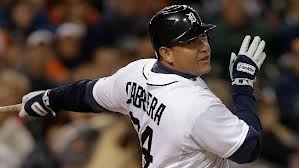
  • AL MVP: Miguel Cabrera.  Despite the massive amount of internet baseball material devoted to talking about how great a season Mike Trout has had (mostly looking at his WAR values historically), I still see the voter base placing emphasis on three major points:
    • Cabrera plays for a playoff team, Trout does not.   The fact that the Angels will finish with a better record than the Tigers, or that the Angels clearly played in a harder division?  Immaterial to the old-school voter base.
    • Cabrara won the Triple Crown.  And most Triple Crown winners throughout history also won the MVP.  The fact that the triple crown is based on 3 relatively flawed statistics?  Irrelevant to the narrative of the achievement itself.  It remains an incredibly difficult achievement to accomplish in modern baseball’s era of specialized hitters (Ichiro for batting, Adam Dunn for homers) to hit for both average and power in the way that Cabrera consistently does.  (Rob Neyer posted thoughts about this topic, quoting random people on the internet with various takes).
    • Cabrera had a monster finish, Trout did not.  Cabrera’s OPS in the run-in months was over 1.000 each of July, August and September.  Trout peaked in July but was merely above average in the closing months.   Your finish matters (as we’ll see in the NL Rookie of the Year race discussed later on).

    Opinions like USA Today’s Bob Nightengale‘s exemplify the bulk of the voter base right now.  A few years ago the writers were smart enough to award Felix Hernandez a Cy Young with nearly a .500 record by recognizing more of the advanced metrics in play, but the Cy Young’s definition is a lot more specific than that of the MVP.

    This is nothing against Trout; the Angels were 6-14 when he got called up and finished 89-73.  That’s an 83-59 record with him, a .584 winning percentage that equates to 95 wins, which would have won the AL West.  Trout was the undeniable MVP for me nearly all season.  You hate to say it, but when the Angels faltered so did Trout’s MVP candidacy.

    The rest of the ballot?  Adrian Beltre and Robinson Cano get some typical “best player on best teams” votes.  I’d give Josh Reddick some top-5 votes too.

  • AL Cy Young: David Price, by virtue of his 20 wins and league leading ERA, will squeak out the win over last year’s winner Justin Verlander. The statistical crowd will point out that Verlander was just as dominant in 2012 as he was in 2011 (when he unanimously won), and that his significantly higher innings total and lead in Pitcher WAR should get him the award.   However, as with the AL MVP you have to take into account the voter base.   Price won 20 games, that he pitches in a tougher division, that he beat out Verlander for the ERA title.  Plus, and I hate to say it, but Price is the “sexy pick,” the guy who hasn’t won before.  Verlander is the known guy and sometimes you see voters being excited to vote for the new guy.  Its kind of like the Oscars; sometimes an actor wins for a performance that wasn’t the best as a way to “give it to the new guy.”  Certainly this contributed to Clayton Kershaw‘s victory in 2011 and we may see similar behaviors again.  There might even be an east coast voter bias in play.  Jered Weaver, Chris Sale, Jake Peavy, and Felix Hernandez all get some top-5 votes, possibly finishing in that order behind Price and Verlander.
  • AL Rookie of the Year: Mike Trout, in what should be an unanimous vote. He could (if the MVP vote goes the way many thinks it should) become only the 3rd player ever to win both the MVP and the RoY in the same year (Fred Lynn and Ichiro Suzuki being the others).  In the conversation: Yu Darvish (who certainly did not have a BAD year, but drifted mid-season), Yoenis Cespedes (who would win it in most years), Matt Moore (my preseason guess; I’m still shocked he displayed virtually none of the dominance of the 2011 post-season during his 2012 season), Will Middlebrooks (who made Kevin Youklis expendible within just a couple of months of arrival), and amazingly Tommy Milone (who was nearly unhittable in his home stadium and continued his performance from the Nats in the end of 2011).  A couple other names in the conversation: Scott Diamond and Jarrod Parker.
  • AL Mgr: Buck Showalter should get this this award for taking a team that should be a .500 ballclub based on pythagorean record and put them in the playoffs for the first time in a decade.  I also think he wins because of east coast bias, since certainly what Bob Melvin and the Oakland A’s pulled off is nothing short of fantastic.  Robin Ventura may have gotten some votes had the White Sox held on, but may be the 3rd place finisher.
  • (Unofficial “award”): AL GM: I almost hate to say it, but Billy Beane. The A’s were supposed to be awful this year, having traded away most of their starting rotation (as explained further in this Aug 2012 post here) and let most of their hitters walk.  Instead they acquire a couple of good pieces from Washington, sign the exciting Cespedes to go with a few bottom-barrel FAs, and overcame a 13-game deficit to win the powerhouse AL West.  A great story.
  • (Unofficial “award”): AL Comeback Player of the Year: It has to be Adam Dunn, right?  How do you go from the lowest qualifying average in history to career highs in homers and not get votes.  Jake Peavy may get some votes after two injury plagued seasons, but he was pretty decent last year and isn’t exactly coming out of nowhere like Ryan Vogelsong did last year.

Now for the National League:

  • NL MVP: Buster Posey‘s strong finish, combined with his team’s playoff run and his playing catcher gives him the nod over his competition here.  For much of the season I thought this award was Andrew McCutchen‘s to lose, but his fade and Pittsburg’s relative collapse from their division-leading mid-season costs him the MVP.  The rest of the ballot? Ryan Braun may be putting up MVP-esque numbers but the fall out from his off-season testing snafu will cost him votes (both in this race and for the rest of his career unfortunately). Johnny Molina getting some press too, for many of the same reasons as Posey.  Joey Votto probably lost too much time to be really considered, but remains arguably the best hitter in the league.
  • NL Cy Young:  R.A. Dickey was the mid-season choice, was challenged late but his 20th win combined with his fantastic ERA for a knuckleballer makes him the winner.  Amazingly, Dickey has pitched most of the season with a torn abdominal muscle, making his season accomplishments even more impressive.   Johnny Cueto makes a great case, leading the playoff-contending Reds, but he slightly sputtered down the stretch.  Clayton Kershaw quietly had a fantastic year, leading the league in ERA, but as we saw with David Price above, I think the voters like to vote for the new guy.  Kershaw got his Cy Young last year; this year is Dickey’s time.  Other names in the top-5 mix: Matt Cain, Cole Hamels, Gio Gonzalez and perhaps even Jordan Zimmermann (who got some mid-season attention by virtue of his excellent July).  I have a hard time giving the award to a reliever, but the numbers Aroldis Chapman and Craig Kimbrel are putting in as the closers of Cincinnati and Atlanta respectively may be enough to at least appear in the top-5.  Lastly, the odd case of Kris Medlen; his WAR puts him in the top 10 despite only having 12 starts.  Is this enough to give him some votes?  Maybe some 5th place votes here and there.  But look out in 2013.
  • NL Rookie of the Year: Bryce Harper, who won his 2nd rookie of the month in September, finished incredibly strong and took advantage of late-season fades from his two biggest competitors to win this award.  The National media buzz on Harper/Trout was never greater than during the season’s last month, and while games in April count the same as in September, the lasting impression is made by he who finishes strongest.   Wade Miley has a great case but I think falls short.  Cincinnati’s Todd Frazier has had a great season and was beating Harper’s numbers across the board, but he sat once Scott Rolen came back and faded down the stretch.   Milwaukee’s Norichika Aoki has had a nice season at age 30, coming over from Japan.  I don’t think guys like this (or Darvish, or Ichiro Suzuki for that matter) should qualify as “rookies” but rules are rules.  Anthony Rizzo, Wilin Rosario, Matt Carpenter, and Mike Fiers also put up good rookie numbers and may get some 5th place votes.
  • NL Mgr: Davey Johnson.  Nobody had the Nats winning nearly 100 games.  Had the Pirates not collapsed perhaps we’d be talking about Clint Hurdle. Don Mattingly had somewhat of a transitionary team playing great early, but the mid-season influx of high-priced talent, and their subsequent collapse costs him any support.
  • (unofficial award) NL GM: Mike Rizzo, pulling off the Gio Gonzalez trade, signing Jackson in a deal immediately lauded as a great move and quickly putting together a team that looks to be 15-20 games improved over 2011.  We thought they’d be in the mid-80s in wins; who thought they could be pressing for 100??
  • (Unofficial “award”): NL Comeback Player of the Year: Buster Posey.  He went from a season-ending injury to an MVP season.  In other years Adam LaRoche may get some looks here, but not in the face of what Posey has been doing for San Francisco.  Lastly I had Johan Santana on a short list for this award until he was lost for the season in the aftermath of his 134 pitch no-hitter on June 1st.  At at point he was 3-2 but with a 2.38 ERA.  He finished the season 6-9 with a 4.85 ERA and was shut down on August 17th.  Are we sure that no-hitter was worth it?

30 for 30 Review: “9.79*”

2 comments

This should have been a seminal athletic moment of the 80s. It ended up being so, but for very different reasons. Photo unk via dailymail.co.uk

Editor’s note: there are spoilers in this review, and if you have not seen the film they are surprising enough that you may want to skip this post and see the film first.

The 2nd installment in the return of the “30 for 30” series aired on October 9th, 2012 and is titled “9.79*.”  Directed by Daniel Gordon (a decently acclaimed british documentarian), it tells the story of the 1988 100m Men’s final from the Seoul Olympic games.  As most sports fans would be able to tell from the title, the race was won by Ben Johnson in a then-world record time of 9.79, an astounding improvement upon the standing world record and a seminal event in the sports decade.

Soon after though, Johnson tested positive for the use of Steroids, was stripped of his medal and booted from the games, and the event was a shocking introduction to the world of doping and the use of performance enhancing drugs that has only exploded since.  Nowadays, we hear about Baseball players using steroids and the narrative is familiar.  The USADA just released its report by which it made the decision to charge and eventually ban Lance Armstrong and attempt to strip him of titles won 10+ years prior.  But in 1988, the only knowledge of doping that casual sports fans knew of was allegations of eastern bloc athletes (women mostly) who were astoundingly breaking records in Swimming, Track and Weight Lifting.

(Here’s an excellent review of the film, doing it much better than I: avclub.com)

As with before, I’ll break down talking about the Subject Matter and then the film-making.

Subject Matter: the film maker got all 8 participants in the 1988 100m final to appear on film and talk somewhat candidly about the state of the sport leading up to that race, the role of drugs, and the ethical dilemna they all faced.  Contrast this to prior 30 for 30 films about Allen Iverson and Michael Jordan which didn’t include any on-screen interviews from the subjects.  The fact that Johnson himself speaks at length and openly about the experience makes this a pretty compelling watch.  Even more-so based on points we’ll touch on later…

The film starts off with an anonymous quote, “If you don’t take it, you don’t make it.”  The implication is, if you’re a runner in the 1980s and you’re not taking drugs, then you’re not going to win.  At least one of the interviewees (Calvin Smith, he himself a banned doper who was awarded the Bronze medal upon Johnson’s disqualification) talked openly about this choice.  Runners train extremely hard to only have a shot at coming in 5th or 6th place in the face of other runners who were cheating, leading (much as we saw in the Cycling world) to an escalating arms race of doping to “re-level” the playing field.  It is an awful choice to make for an athlete; stay clean and never win, or cheat like everyone else and give yourself a shot at lucrative glory.  I don’t know what choice I’d make if forced to.

(Editor note; I mis-quoted Smith in this paragraph; it was someone else who spoke about doping, not Smith.  By all accounts, Smith never failed a doping test and many think he should have been retro-actively awarded the Seoul gold medal after the three men ahead of him all subsequently failed tests.  Thanks to a commenter for pointing this out).

The film doesn’t outright “accuse” Carl Lewis of doping himself, but the implication is pretty clear and pretty stark.  One person talks about how taking HGH forces adults to get braces (since the substance causes the jaw bone to grow far after it typically stops growing in adults), and then a few minutes later shows Lewis in 1987 … wearing braces.  Lewis himself doesn’t do himself any favors, nor does his coach and head cheerleader Joe Douglas, who seemed all too eager to brag about the sundry things that went on, or about the money that was greasing the skids in the mid 1980s in the sport.  I was left after watching thinking that Lewis was just as dirty as the rest of the competition, just that he got “out-roided” in the final.

A very frank interview with the head of the testing lab from the 1984 Olympic Games also raised some eyebrows; he accused the powers-that-be of outright ignoring the results they were seeing, and he seemed to imply that the 1984 Olympic organizers ordered him to sweep positive tests under the table so as not to sully those politically-charged games.  He kept previous samples and re-tested them years onward and found rampant drug use in the 1984 games, but he decided to destroy the evidence rather than re-open yet another investigation into past results.  I slightly disagreed though with the premise of the lab director that testing is a simple either/or principle; as Malcolm Gladwell pointed out on a recent “BS Report” podcast, to conclude that an athelete has tested positive for certain markers (especially testosterone) is incredibly difficult, since your natural testosterone levels ebb and wane on a day to day basis, are affected by your moods and naturally degrade as you age.  They’re even affected by what you eat!  And, as we learned in the Ryan Braun debacle, testosterone levels in samples can quickly change if not properly stored (If you don’t know what I’m talking about, read my post on the topic from February 2012 and read Will Carroll‘s amazon story about what *really* happened.  It is well worth the read.  Or just read this piece at the HardBallTimes to understand why I don’t believe Braun cheated at all).  So unfortunately drug testing is more of an art form than something that provides conclusive proof.  And that is troubling, since in order to justify its existence a drug testing lab needs to, you know, find people who cheated.

The most outrageous point of the documentary made came from Johnson, and was a shocker.  He accused a member of Lewis’ camp of spiking his post-race beer after the 1988 100M final with the same steroids he then tested positive for.  The accused person refused to be interviewed on film but provided an incredible quote when asked whether he spiked the drink; he said something along the lines of, “Maybe I did, and maybe I didn’t.”  What kind of answer is that??  Of course he’s not going to admit such a thing, but the lack of a powerful denial almost seems like proof in and among itself that this hanger-on of Lewis’ purposely spiked the drink.  The back-story of the bad blood between the runners and the massive competition for the fastest times in the season leading up to the Olympics, to go with the arrogance of Lewis and his coach makes the accusation of a spiked drink completely believable.

From a film-making perspective, I thought the documentary was very well filmed, with excellent b-roll shots of Toronto (where Johnson is from) and other on-location spots.  You can slightly quibble with the “faked” footage, but most of the b-roll is used as supporting shots being played during quotes from the participants.  It was a little difficult to understand all the interviews, mostly because of the heavy West Indian accent of Johnson and his country-mates.  But that also may be because I was watching the film late at night and trying not to wake my wife :-).  I’d place this film somewhere in the middle-range of the pantheon of 30-for-30 films.  It was an interesting watch but i’d probably not bother to watch it again.

Roster Construction Analysis of 10 Playoff Teams; 2012 edition

5 comments

Justin Verlander is one of the most important home-grown players in the 2012 playoffs. Photo unk via rumorsandrants.com

Every year I do a bit of “Team Construction” analysis to kind of gauge the trends in roster construction.  Last year’s post is here, and the links to the side have the underlying spreadsheet of player acquisition methods so you can see the pure details.  This topic was also covered in-depth by John Sickels on his minorleaguebaseball.com blog for another viewpoint.

Borrowing from last year’s post, there are four main ways teams can acquire players:

  1. Draft: The player is with the original team that drafted him.  In the case of international free agents, if they’re signed as 16-year olds they are considered in this category as well (i.e., Ichiro Suzuki is not a developed player, but an international Free Agent).  It could be better defined as “Club developed players.”  Simple examples for the Nats: Stephen Strasburg and Bryce Harper.
  2. Traded MLBers: The player was acquired by the team by virtue of trading an established MLB player.  Most of the time these days, this means the player was acquired as a prospect (since most trades seem to be of the prospect-for-established player kind).  Example for the Nats would be Michael Morse, who was acquired by our trading an established MLB player in Ryan Langerhans for Morse while he was still (essentially) a minor leaguer.
  3. Traded Prospects: The player was acquired by the team by virtue of trading prospects.  This is essentially the reverse of #2.  The Nats key example is Gio Gonzalez.
  4. Free Agent: The player was acquired in free agency.  This category also includes two other types of acquisitions: waiver claims and cash purchases.  These three categories are lumped together since all three indicate that a team has acquired a player with zero outlay in terms of development or prospects.  Examples for the Nats: Edwin Jackson, Adam LaRoche.

Here is the summary of roster construction and “Construction Strategy Category” that we’ll talk about next.  Note that I only count the “core players” on a team for this analysis.  The core players is defined as the 5-man starting rotation, the setup and closer, the 8 out-field players, and the DH for AL teams.  I didn’t extend this all the way to the 25-man roster, figuring that these core 15 players are the main reasons teams win and advance.  That and huge chunks of the bullpen and the bench are either fill-in FAs or draftees and it would skew the analysis of how teams really got to the playoffs.  Here’s the summary (the table is sorted by count of Draftees):

Season Team Drafted/Developed Traded Prospects Traded MLBs FA/Waivers Ttl Constr Method
2012 Atlanta 11 1 3 0 15 #1
2012 St. Louis 9 0 2 4 15 #1/#4
2012 Washington 8 3 1 3 15 #2
2012 San Francisco 8 2 2 3 15 #2
2012 Cincinnati 8 2 3 2 15 #1
2012 New York Yankees 5 2 1 8 16 #4
2012 Detroit 5 5 2 4 16 #2/#4
2012 Texas 4 2 7 3 16 #3/#4
2012 Baltimore 3 1 8 4 16 #3
2012 Oakland 2 1 7 6 16 #3

So, what are the four construction methods I’ve identified? Again borrowing from last year’s version of this post, they are (with this year’s examples).  The complication this year is that some of the 10 playoff teams don’t fall neatly into one specific category.

Method #1: Build from within 100%: (Cincinnati, Atlanta).   Atlanta, amazingly, didn’t use a single Free Agent among its core 15 this year.  They made a couple of key trades to acquire a few starters, but the rest of their lineup is home-grown draftees.  That may change next year as they try to replace Chipper Jones, Michael Bourn and possibly Brian McCann, who may leave via free agency.  Meanwhile Cincinnati has just a couple of free agents and mostly rely on guys they’ve grown as well.

Method #2: Ride your developed Core and use your prospects to acquire big names: (Washington, San Francisco and Detroit to an extent): The Nats have transformed themselves over just a couple of seasons, relying less on FAs to plug holes caused by an awful farm system to having most of their core team developed at home (See the table further below to follow the transformation of our team over the past few seasons).  Those spots they couldn’t depend on have been filled by trades (three guys acquired by flipping prospects for them; in addition to Gonzalez Kurt Suzuki and Tyler Clippard also count here).  San Francisco has seen their payroll skyrocket as they extend their home-grown talent, but for the most part they have stayed true to the team development concept.  Their one major Free Agent (Barry Zito) is notoriously one of the worst contracts in baseball and it is somewhat surprising to even see him on the post-season roster.  He wouldn’t be if Tim Lincecum was pitching in 2012 like he has regularly done in previous seasons.  Detroit was entirely in method #2 until they decided to spend money like the Yankees; we’ll revisit in #4.

Method #3: Go Young and grow up Strong (Baltimore, Oakland and Texas to an extent): Baltimore acquired a massive chunk of their rosters by flipping major leaguers for prospects and watching them blossom into a surprise playoff team.  Oakland has made a habit of getting rid of guys before they hit arbitration; fully 7 of their squad was acquired this way.  The difference is that Oakland has been forced to buy a big chunk of their core group on the FA market, depending on cast-offs like Brandon Inge and Jonny Gomes to plug leaks and get production on the cheap.  I’m guessing that Oakland will transform more into Category #1 as the vast amount of prospects they’ve landed lately continue to matriculate.  Lastly Texas was entirely in this category before they dropped major money on the likes of Adrian Beltre and Yu Darvish, transforming them into a spending power to go with their still-excellent farm system.

Method #4: Spend what it takes to win: (New York fully with St Louis, Texas and Detroit partially here): The Yankees are the class-A example of this method (along with Boston and the Dodgers frankly), but the spending that St. Louis, Texas and Detroit cannot be overlooked.  The Yankees more and more are depending on expensive FA purchases to replace what their farm system is not developing, and the problem is only being brought into more focus this off-season.  Their 3 primary starters are FA acquisitions, their biggest FA is looking like a contract catastrophe, and their developed guys are not stepping up and taking over major roles (especially on the pitching staff).  The other three teams mentioned here are mostly built on home-grown talent, but have spent so much money on the FA market lately that they are broaching into the upper echelons of MLB payroll.  St. Louis is almost entirely built from within (as noted by other columnists doing this same type of analysis) but still has depended on a couple of key FAs to advance as far as they have.

Conclusions:

  • There’s no real formula to building a playoff team, as we see from the spread of the 10 teams among the four methods defined.
  • I think its safe to say that the most difficult methods to depend on are #1 and #3.  You need to have a very good farm system to depend on the #1 method to work for you, and over the past few years only a couple of teams really have had success using this method (Atlanta and Tampa Bay).  Kansas City has tried #1 for years and has gone nowhere.  The #3 method is also frought with issues, since it requires a ton of patience from your fan base and may not be sustainable.  Would anyone be surprised if both Oakland and Baltimore collapsed next season?  Probably not; you really need to build on a base of players once you’ve established yourself as a good team and continue to augment, either through trade or through FAs.  But even that can be dangerous; just ask Philadelphia this year, owners of the 2nd biggest payroll in baseball and just a 3rd place team.
  • Is Category #1 and #3 the same?  No, not really. #1 teams rely much more heavily on personally developed prospects, while #3 teams purposely set out to acquire prospects in trade to combine with their own development mis-fortunes.  If Baltimore had a better farm system, they wouldn’t have needed to jettison so many established MLBers to acquire prospects, and they’d probably be closer to a #2 team (a wealthy team who supplements developed players with key FAs, much like what Washington is doing).
  • Oakland is really a unique case; they do develop players but get rid of them because of a self-imposed incredibly restrictive salary cap.  Imagine what Billy Beane could do with that team if he could have purchased just $30M of players on the open market (which would have still left Oakland in the bottom third of payroll).
  • Buying your way to a team (method #4) can work, but only if you have nearly unlimited money and everything goes right for you.  There’s almost no excuse for a $175M payroll to get beat to the playoffs by a $55M payroll team (Oakland).  That is unless you overpay for poor FA targets, install the wrong manager and saddle yourself with the worst clubhouse in baseball.  In case you were wondering, the 2012 Boston Red Sox were a classic case of why money cannot buy happiness, and why unlimited funds do not necessarily guarantee playoff baseball.  The Angels are another example; owing most of their season’s turnaround and success to Mike Trout and his MLB minimum salary providing nearly 10 WAR despite having the 3rd largest payroll in baseball and having just purchased the games pre-emminent hitter in Albert Pujols.
  • Frequent commenter Clark has a good point; classifying Mark Teixeira and Raul Ibanez as the same type of player (acquired via free agency) is a bit mis-leading.  Clearly a $150M player isn’t the same as a $1M player.  But, for the purposes of analyzing how much of your team is “bought” versus “developed” the point remains the same whether its a bargain basement guy or a $20M/year player.

So, if I had just purchased a new team, what construction method would I follow?  I guess it depends; if I thought I had a patient fan base, I’d probably do exactly what is going on in Houston.  I’d gut the MLB roster, trade every tradeable asset and start over payroll-wise.  I’d follow strategy #1 until I was at least competitive, and then i’d probably switch over to a #2 strategy or a #3 strategy, depending on just how good my developed players were.  You hope for #3; it implies you’ve got so much in-house talent that all you need to do is keep extending your key guys and you’ll keep winning.

I don’t think #4 is a sustainable way of building rosters.  The Yankees have gotten away with it for years, but only because they initially had a banner crop of developed players (the “core four”) to depend on up their spine.  Would anyone be surprised if the Yankees fail to make the playoffs next year?  Alex Rodriguez looks incredibly old, Derek Jeter just broke his ankle, they’re losing a number of hitters to FA and they only have a couple of starters locked up.  Where’s their starting pitching for 2013?  And what happens if they finally get hit with injuries to their rotation to the extent that Boston did this year?  I think this is why you see $80M payroll teams beating out $170M payroll teams all the time; teams get bloated, they over pay their own players and suddenly are old, inflexible and unable to adjust financially to buy what they need.

Lastly, here’s what the Nats roster has done over the past few seasons:

Season Team Drafted/Developed Traded Prospects Traded MLBs FA/Waivers Ttl Constr Method
2010 Washington (end of 2010) 7 1 2 5 15 #2
2011 Wash (2011 opening day) 6 2 1 6 15 #2
2011 Wash (primary Roster for season) 6 2 2 5 15 #2
2011 Wash (end of season) 9 1 2 3 15 #2
2012 Washington (playoff roster) 8 3 1 3 15 #2

The team has been slowly replacing Free Agents with home-grown or acquired talent, and as we all know is well on its way towards a strong, home grown team.  This year’s core team only uses 3 pure FAs: Adam LaRoche, Jayson Werth and Edwin Jackson.  We could very well see LaRoche replaced outright with the home grown Tyler Moore, and if the team replaced Jackson with someone like John Lannan (not that we’ll possibly see that happen), we could be down to just one FA in the core squad.

30 for 30 Review: “Broke”

leave a comment

I'll bet Mike Tyson wishes he still had some of this cash. Photo unknown via esquire.com

[Editor’s note: Non-baseball, non-Nationals post.  Originally written in early October right after this show aired but saved until baseball season was over.  If you have some time, I highly suggest either getting it on-demand or find a re-run].

The fantastic 30 for 30 series is back on ESPN.   The great news was first published in May 2012 and the first installment of the new series aired on 10/2/12.  I like doing reviews of the 30 for 30 series (if you search for “30 for 30” in quotes you can see some of the past reviews on this site), and I’ll try to do them for the new episodes.  If you’re interested in past looks at ESPN Films and my thoughts on the original series, you can click “30 for 30” in the Category Tab to the right and get all posts on the topic.

First up in the new series, “Broke,” a 1.5 hour documentary by director Billy Corben about the amazing propensity for professional athletes to go bankrupt soon after retiring despite having made millions in career earnings.  This is essentially a documentary version of the seminal 2009 Sports Illustrated article on the same topic.  The film had some decent  interviews and covered several of the typical pitfalls that cause athletes to squander money.  In no particular order; blatant overspending on cars, jewelry and houses, financing your family, neighborhood and your entourage, poor choices in advisors, poor financial advice from these “advisors,” squandered business investment, predatory women and marriages, child-support payments that are tied to a player’s salary, and of course the most basic one; absolutely zero retirement planning.

(If you want to read some  highlight quotes from the documentary, click on thisBusinessInsider.com link here.  If you want to read Jason Whitlock‘s op-ed piece inspired by the documentary, click here.  Lastly, a review from Hitfix.com on both Broke and the 2nd in the series is here; we’ll cover 9.79 in a separate post).

My quick review: liked the subject matter, didn’t like the presentation.

The subject matter continues to be topical, nearly every year we hear about guys who have gone broke.  The documentary listed dozens and dozens of them at the end of the film.  I’ve often wondered how these guys manage to go broke despite 10s of millions of dollars in guaranteed income, but in reality its relatively easy.  You can somewhat excuse it when a guy like Curt Schilling loses his baseball fortune attempting to start a software company, but its a bit more inexcusable when you hear about a guy who “makes it rain” in strip clubs with hundred dollar bills.  That being said, for every Magic Johnson (who has made a massive fortune owning/operating Movie Theatures and Starbucks franchises, of which he owns more than 100) there are dozens of tales of investments in Car Washes, Restaurants and Record Companies going bad.  The film prominently featured Jamal Mashburn, who has turned his lucrative NBA career into the next coming of Johnson; he’s followed Magic’s lead and purchased dozens of franchises in Kentucky; per wikipedia and the film he owns 34 Outback Steakhouses, 37 Papa John’s franchises and a number of car dealerships.  Just 40, he’s apparently amassed enough wealth to be in the discussion to purchase an NBA Franchise.

The most egregious examples of pro athletes going broke were not interviewed for the film; Allen Iverson (career earnings in excess of $200 million including salary and endorsements), Evander Holyfield (career earnings estimated at about $200M), Antoine Walker (career earnings of $110M before taxes), Vince Young (ALREADY broke despite a $26M guaranteed contract just 6 years ago!)  and the most ridiculous example being Mike Tyson (career earnings of $400M, all gone).   A bit of googling resulted in this interesting “Top 10 worst Financial Meltdowns by Athletes” and its a bit mind boggling.  The director noted that most of these guys who have been forced to declare bankrupcy for vast sums are far too embarassed to appear on the film, hence the rather random collection of on-screen athletes who did appear (among others, Bernie KosarAndre RisonKeith McCants, Sean Salisbury and Cliff Floyd).   I’d say that Rison was probably the closest we’ll see to the blatant modern-day squandering of money that we hear stories about, while Kosar and Salisbury befell some of the other classical bankrupcy issues mentioned above.

The section on predatory women was kind of sad really; the film interviewed a blogger whose site (Baller Alert.com, I kid you not) sends out alerts to female subscribers if/when they find out that basketball players are going to be at a certain location.  The blogger noted that one time she announced that an NBA player was at a club in DC and an hour later 1,000 women showed up.   This isn’t the first time I’ve read about this culture in the pro sports world; the book Andy Roddick Beat Me with a Frying Pan the author decided to find out how easy it was to bait a pro athlete into hooking up, so he recruited a former girlfriend, she got some “coaching” as to how to dress and act, and they inserted her into a bar situation where a known pro athlete was present.  Sure enough, the athlete sent over a handler and tried to press onwards with a relationship.

I was left with two overriding thoughts after watching the film:

1. It was really, really difficult to watch this film as a middle-aged white male and not pass judgement on the ridiculous spending exploits of predominantly young black males.  I alluded to salary just a couple weeks ago in this space, talking about how John Lannan was set for life on the basis of his $5M 2012 contract and how I didn’t necessarily feel sorry for the guy.  But the fact is that most athletes don’t see a singular payday this way.  The film certainly wasn’t apologetic for these guys getting into trouble; it merely analyzed what generally happens to these  young players.  They get paid, they spend money, they make mistakes, they have children out of wedlock and incur massive monthly payments, they buy 5 houses and 8 cars, they don’t plan for the future … and then suddenly they’re out of the game and they go from millions a year to Zero income.  It is a common tale.  This documentary certainly isn’t EXCUSING this behavior; it just explains how it happens.

2. I’m surprised that the pro sports don’t do more to heed this off.  The film showed Herm Edwards giving the incoming NFL rookies his speech at the Rookie Symposium … and then talked about how most rookies sleep through the sessions.  I’m surprised that the unions havn’t recognized this as a massive problem and forced some sort of IRA contribution out of their players upon entrance to the leagues.

From a “film critic” stand-point, while the subject matter was pretty interesting I wouldn’t rank this film with the upper echelon of 30-for-30 works (“The Two Escobars,” “Four days in October” being some of the best of the original run).  I thought it could have been done in an hour, I thought it should have done a better job focusing on the more egregious cases of players gone bankrupt, I thought they could have found better representatives to talk than guys like Homer Bush and Sean Salisbury (Homer Bush!?  I had to look him up on b-r.com: 409 career games?  And he’s talking about athletes squandering millions?  Well, he did manage to make $7.7M per his b-r page, so that’s not chump change.  Bush reportedly was not happy with the way he was portrayed in this film, as mentioned on Slate’s Hang Up and Listen podcast).  Lastly I thought having the SAME song playing for virtually the entire show got old, fast.  Critics didn’t like the “soundbyte after soundbyte” presentation, which lasted well into the film.

We miss you; How Oakland’s Gio Gonzalez haul did in 2012

3 comments

We miss you Tommy; Glad to see you're doing well. Photo AP/Ben Margot via dailyrepublic.com

Nationals farm system observers certainly knew we gave up a ton of talent to acquire Gio Gonzalez back in late 2011.  Most of the pundits I read at the time thought the Nats overpaid for a high-walk guy who overly benefited from playing in the “pitcher friendly” Oakland Coliseum (I say that in quotes since the multi-year park factors for that stadium can be nearly neutral depending on which statistic and which time period you choose).  We know what we’ve gotten in Gonzalez so far; a gregarious, pro-team guy who pitched lights out in 2012, increasing his K/9 and decreasing his BB/9 from both last season and from his career norms and who led the majors in wins.  He struggled in the playoffs of course, but his 21 wins were a big reason we were in the playoffs in the first place.

How about our 4 former Nats?  How are they doing so far?  In rough order of impact:

1. Tommy Milone: 13-10 with a 3.74 ERA and 1.279 whip in 31 starts after winning Oakland’s #5 starter job out of camp.   His debut was a sterling 8-inning 3 hit gem, and his season was a series of sterling outings interrupted by blow-out starts.  Scouts routinely pegged him as a 4-A starter, with not enough stuff to last in the majors, but he got results for us last year and continued to get results this year.  He helped lead Oakland to an improbable AL West crown and was the team’s #2 starter in the playoffs.  For a guy that I thought was a 4-A starter, Oakland has to be happy to have him on their squad.

2. Brad Peacock: Oakland is keeping him as a starter for now, and he toiled the entire season in AAA in Sacramento.  However, Peacock took a significant step backwards in 2012, posting a 12-9 record with an astounding 6.01 ERA.  Even accounting for the known hitters parks in the Pacific Coast League, to go from a 3.19 ERA in Syracuse to nearly double that in Sacramento spells issues.   I still think he’s bound for a middle-relief role on account of his only really having two pitches, and on account of the amazing starter depth Oakland possesses in their system.  But, starter or reliever, Peacock has to pitch better in 2013.

3. Derek Norris returned to the hitting form that we all knew and loved a couple years back once he reached Oakland’s AAA squad.  He hit .271/.329/.477 in about a half season in Sacramento and was then called up.   His MLB numbers weren’t great (.201/.276/.349) but he’s young and the team traded away its 6 year starter in Kurt Suzuki (to the Nats as we all know; sending Oakland yet another catcher prospect in the process) so Norris could be getting his chance sooner than later.

4. AJ Cole, the “gem” of the trade completely melted in the High-A California league, with a 0-7 record and a 7.82 ERA in 8 starts.   He returned to form upon his return to low-A, going 6-3 with a 2.07 ERA in 19 starts in the Midwest league.  All is not lost; he’s only 20, and there’s no shame in a 20-yr old failing at his first shot at high-A (where you see a lot of college draftees in their second pro year).


One year later, how does this trade look for both teams?  My trade reaction post from December 2011 talked about how this trade would come down to how closely the four traded guys came to matching their “ceilings.”  One year later, I think its safe to say that Milone has surpassed his ceiling, Peacock is in danger of never even fulfilling his “floor,” Norris is somewhere in the middle and its just way too early to judge Cole.

Meanwhile Gonzalez has surpassed what anyone could have hoped for in his first season; I thought he was a #2 starter but he put in an “Ace” year.  He may not win the Cy Young but he’ll be in the top 3 in voting.  He’s clearly a great clubhouse guy, a skill that you cannot put a dollar figure on.

I think both teams probably do this deal again.  There were no “winners” and “losers” thus far; both teams got exactly what they wanted out of the trade.

Written by Todd Boss

October 15th, 2012 at 3:20 pm

NLCS Preview – by the Starters

leave a comment

If Verlander continues to pitch as he has, Detroit looks unbeatable. Photo unknown via rumorsandrants.com

The post-season goes on, despite yesterday’s debacle.  Here’s a look at the probable starter matchups for the ALCS and NLCS:

Series GM# Date/time (EST) Home-Visitor Home Starter Visiting Starter Advantage
ALCS 1 10/13/2012 Det-NYY Pettitte Fister Tossup
ALCS 2 10/14/2012 Det-NYY Phelps? Sanchez Tossup
ALCS 3 10/16/2012 NYY-Det Verlander Sabathia Det
ALCS 4 10/17/2012 NYY-Det Scherzer Kuroda? Det
ALCS 5 10/18/2012 NYY-Det Fister Pettitte Det
ALCS 6 10/20/2012 Det-NYY Hughes? Sanchez Tossup
ALCS 7 10/21/2012 Det-NYY Sabathia Verlander Det

The Tigers have a huge advantage heading into this series by virtue of scheduling; they finished up their ALDS a day early, thus they get to schedule their ace Justin Verlander on normal rest to go in games 3 and 7.  Meanwhile the Yankees have a major conundrum; in order to get CC Sabathia two starts in the NLCS he has to go on 3-days rest for game 3.  And, in order to get Hiroki Kuroda 2 starts, he must similarly go on 3-days rest for game 2.  Kuroda is a japanese import, where he pitched just once a week (6 days rest as a norm) and has little experience going on short rest.  Sabathia actually has fantastic career numbers on 3-days rest (a 1.01 ERA for his career in the regular season, albeit in just 4 such starts).  However Sabathia’s effect is likely to be nullified by going against Verlander, in Detroit.  Meanwhile, who goes in game 2?  David PhelpsPhil Hughes?  I don’t think the Yankees have any good options there.  I honestly don’t see a single one of these 7 matchups that i’d immediately say favors New York; I think Detroit can get the split in the first two games and may wrap the series up before it even returns.  Detroit in 5.

Series GM# Date/time (EST) Home-Visitor Home Starter Visiting Starter Advantage
NLCS 1 10/14/2012 SF-Stl Bumgarner Lynn SF
NLCS 2 10/15/2012 SF-Stl Vogelsong Carpenter Stl
NLCS 3 10/17/2012 Stl-SF Wainwright Cain SF
NLCS 4 10/18/2012 Stl-SF Lohse Lincecum? Stl
NLCS 5 10/19/2012 Stl-SF Lynn Bumgarner Tossup
NLCS 6 10/21/2012 SF-Stl Carpenter Vogelsong Stl
NLCS 7 10/22/2012 SF-Stl Wainwright Cain Tossup

The NLCS pitching matchups are a lot more clear; Jaime Garcia is replaced by the 18 game barely-not-a-rookie Lance Lynn and may actually fare better.  Chris Carpenter was effective enough and I believe gives the Cardinals a distinct advantage in both his starts over the journeyman Ryan Vogelsong.  The two aces look to match up in games 3 and 7; I’ll give Cain the advantage at home but if the series makes it to game 7, I’m not so sure he’ll be a distinct favorite back in St. Louis.  Lastly, which Tim Lincecum shows up in this series?  Going against the 16-3 Kyle Lohse is no small feat; he controlled a better hitting team in the Nats and was an unlucky no-decision in game 4.   The Cardinals offense can get to the SF starters and very well make this a quicker series than people think.  Cardinals in 6 games.

Game 5 Recap: Leaky bullpen and a Gutwrenching Ninth

13 comments

Not the best outing for Storen. Photo Andrew Harnik/washingtontimes.com

What a gut-wrenching game.

It started out as great as you could hope; scoring 3 runs in the first inning and igniting the largest crowd in Nats history.  The offense finally strung together a series of big hits from the top of our order against the same pitcher (Adam Wainwright) who shut us down so easily in the first game of the series.  The Nats offense woke up again in the 3rd and bounced Wainwright (the same guy that pundits expected to completely shut the team down again).  You can’t blow a 6-0 lead, can you?  Here’s a stat; on the Season the Nats were exactly 45-6 when scoring 6 or more runs.  But they’ve also coughed up larger leads; they blew a 9 run lead in Atlanta in July in a game that looked eerily similar to last night’s game; get a big lead, your starter gives up a few innocuous runs, then the bullpen slowly leaks runs until its all over.

Gio Gonzalez wasn’t really that effective, all told.  His final line: 5ip, 5 hits, 4 walks and 3 runs (all earned).  In the first inning he honestly looked startled on the mound, scared to be there.  He scuffled through the first inning looking tentative and got bailed out by some slightly over-aggressive hitting from the top of St. Louis’ order.  He did pitch with better confidence the next couple of innings (who wouldn’t with a 3-0 first inning and 6-0 third inning lead?).   He was definitely commanding his curve ball far better than in game 1 and was keeping St. Louis at bay.  However a lead-off walk burned him in the 4th for the first run, and then a complete meltdown in the 5th from Gio turned into two more runs.   His 5th inning line is as ugly as it gets for a starter; Double-Single-Walk-run scoring wild pitch-walk-walk to force in a run before finally getting the 3rd out.

Here’s where the bullpen just failed to get the job done.  Edwin Jackson walks the lead-off guy and he scores, making it 6-4.  The Jordan Zimmermann experiment from game 4 couldn’t be replicated, costing the team a run.  I can’t second-guess the move though; it had worked so well the night before.  Tyler Clippard gives up a home-run to Daniel Descalso to make it 6-5.  And of course we know what happened to Drew Storen, who picked a really bad time to match his career worst outing, giving up 4 runs on 3 hits and 2 walks in the 9th.  And the big hits didn’t come from the middle of St. Louis’ order; it was Descalco and Pete Kozma of all people getting the clutch hits.

My dad pointed out an interesting question; Storen was sharp last night but not tonight; could it be because he threw three straight games?  Storen had appeared in 3 straight games twice before this season but didn’t pitch full innings each time.  In this series he threw an inning each in games 1, 3,4 and 5.  His pitch count by game?  10,11, 26, and last night’s 33 pitch debacle.  Dad’s specific complaint was about the use of Storen in the blow-out game 3.  Why waste an inning there when you pretty much well know you’re going to need your 8th and 9th inning stars both subsequent nights?   Is it possible that Storen was just a bit gassed from the cumulative effects of a 26 pitch outing the previous night AND having pitched three consecutive days?

Another pet peeve of mine; how do you let Descalso steal second base un-challenged in the 9th?  Yes there’s two outs, but that put him in scoring position to tack on an extra run on the subsequent single.  If you hold that guy on, maybe you throw him out and get the 3rd out right there before the Cards get the lead.  He certainly doesn’t score on a single to RF.  This isn’t a problem just with Storen; the Nats pitching staff is notoriously bad at holding runners.  In the end, that extra run didn’t really matter … but it could have mattered if Suzuki threw the guy out before the go-ahead single, right?

There’s not much else to say in the way of analysis; the Nats should have been able to hold onto a 6 run lead, and Storen just had a bad night.  The fact that it came in such an important game is a shame.  If we want to look at a critical issue with the pitching staff on the night, it is probably this; the Nats pitchers put the Cards lead-off guy on in SIX of the nine innings, and that runner scored 5 of those times.  They got the lead-off hitter on base every inning after the 3rd.  That’s just a failure to execute by your pitching staff.  Of course it’s also a testament to the hitting ability of this St. Louis team up and down the lineup.

There goes the season; I had tickets for Game 1 of the NLCS.  I guess we have to wait til next year.

Game 4 Recap: Detwiler defines the word Irony with 6 strong innings

11 comments

Detwiler shuts down the Cards in Game 4. Photo Haraz Ghanbari/AP via federalbaseball.com

The movie The Matrix has been on the movie channel rerun cycle lately, so if I may quote the character Morpheus, “Life it seems is not without a sense of irony.”  The irony of Ross Detwiler being the guy who bails out the Nats with his stellar Game 4 outing is this; had Stephen Strasburg been active, it would most likely have been Detwiler who would have made way in the rotation.  Instead he (finally) gave the Nats an effective start, going 6 innings, allowing just 3 hits and an un-earned run in the Nats 2-1 walk-off win.

Using a sinking fastball with great effect, Detwiler controlled the powerhouse St. Louis offense and kept the ball on the ground; 11 of his 18 outs recorded were ground ball outs.  He was slightly wild on the night (3 walks and only 59 of his 104 pitches for strikes) but umpire Jim Joyce‘s wide and varying strike zone helped both pitchers put up excellent lines on the night.  Detwiler, the least experienced of any of our starters and a guy who most thought wouldn’t even be in the rotation this year (I certainly didn’t think so as spring training unfolded), was the one guy who has stepped up and pitched to his capabilities.

The game of course will be remembered for Jayson Werth‘s fantastic 13 pitch at-bat, culminating with a walk-off home-run off Lance Lynn for what had to be one of the more memorable games in the team’s brief history.  Good for Werth and great for this team.  I’ve already got the image saved as an iconic moment in this franchise.

Other odds-and-ends:

  • Thanks for pre-empting the game for an HOUR, TBS.  This was an unanticipated problem of trying to DVR the game and watch it later.  In addition to avoiding all social media, news sites and phone alerts so as not to have the game outcome spoiled, now I may have to start taping on multiple channels.  So I completely missed the first four innings.   Hence not so much analysis of Detwiler’s outing.
  • How about Jordan Zimmermann in the first relief appearance of his major league career?  He was throwing harder than I’ve ever seen him throw; touching 97 on more than a few occasions.  His mph was no stadium gun hype either: pitch f/x shows a max of 97.2 and an average of 96.73 for Zimmermann.   Meanwhile, here’s the pitch f/x data for his start on 10/8: average 94.08, max of 95.6.    That’s 1.6 mph more on his max effort fastball.  He absolutely mowed down the heart of the St. Louis order (aided again by a questionable strike 3 call on Matt Holliday that just left him laughing).  I figured Zimmermann was going for more than an inning, with Davey Johnson perhaps thinking the game might go long.  Instead, it seems he was playing the odds that Craig Stammen wasn’t up for the task.
  • Meanwhile, how about 9 straight punch outs to end the game?  It was refreshing to “remember” what the back-end of this bullpen is capable of.

This is the Nats pitching effort we’ve been accustomed to, and have waited for all series.  Now, suddenly, would you bet against this team in Game 5?  We have talked a lot about momentum and how the Nats had little heading into the post-season; they’ve certainly got it now.  Adam Wainwright should regress back towards the mean from his Game 1 start, and Gio Gonzalez should “egress” back towards his form of the bulk of the season.  Game 5 could be a pretty special experience.

Game 3 Recap: Jackson makes one mistake, offense misses in the clutch

5 comments

Jackson gets hit for 4 runs in 5 innings. Photo AP via wjla.com

The title says it all.  Edwin Jackson missed his target in the 2nd inning, it turned into a 3-run homer (from a #8 hitter no-less) and that was more than enough offense than the Cards needed en route to peppering the Nats pitching staff for 8 runs and 14 hits in a game 3 romp 8-0.  One mistake is all it took, but you can’t make a mistake middle-in with two guys on base to a professional hitter.  There was no need to watch the game after the 5th inning; it was clear this team wasn’t going to get to Chris Carpenter nor whoever else the Cardinals brought in after he hit his pitch limit.

Where is the Nats offense?  More to the point, where is all our clutch hitting?   We had the lead-off hitter on three times; a runner on first with none out has an Run Expectancy of about .84; meaning we’d expect that runner to score 84% of the time.  Instead we got 0 runs out of any of those situations.  The team has to get something out of that bases-loaded first inning, has to get something out of the third inning rally.  We went 0-8 with runners in scoring position, leaving 11 guys on base.  Where is Adam LaRoche this series?  Or Michael Morse?  We need these middle-of-the-order guys to produce if we’re going to win games.  The St. Louis #8 hitter was clutch yesterday; our guys havn’t been clutch (arguably) in 3 weeks.

It doesn’t matter if we still had Stephen Strasburg in the rotation if you don’t score runs.  We’ve scored 7 runs in 3 games, four of which were essentially meaningless as we were getting killed in game 2.  Meanwhile the Cards now stand at 22 runs and counting, an eerie repeat of the late September blasting we took in the 3-game series in St. Louis.

Ross Detwiler gets a shot in a do-or-die game tomorrow.  Lets hope he finally gets some run support.

Written by Todd Boss

October 11th, 2012 at 9:20 am

First “Wish we had Strasburg” story from National Media

6 comments

Strasburg sitting in the dugout during the NLDS, where he'll be for the rest of the playoffs. Photo Masn screen shot via nats enquirer blog

Rant on.  I couldn’t help myself today…

It was great to see that they couldn’t even wait until GAME THREE of the divisional series to post the first “Gee wish we had Stephen Strasburg” story.  Here’s the link, courtesy of Ken Rosenthal.  I’ll bet he had this article in the can weeks ago just waiting for a slow news day to post it.

Rosenthal quotes an anonymous player who doesn’t agree with the shutdown Situation, who said that “the team would be up 2-0″ if they had Strasburg.”   Such a gutless reporting technique; notice there was nothing other than a passing mention that there are clubhouse guys who agree with the shutdown.  Just cherry-picking opinions (of which there are dozens in a clubhouse) until he found one that enabled him to write the story he wanted to write.

He talks about how the Braves “handled” Kris Medlen so that he was still pitching in the post-season.  There’s no way Medlen-to-Strasburg comparisons are correct.  Medlen was absolutely not in the starting rotation discussion in Atlanta, and if he was he was 8th or 9th in line.  And there’s no way that Medlen was anything other than found gold to the Braves in terms of how good a starter he would turn out to be.  And there’s nobody who can tell me any differently.  Lastly, do you think perhaps the Braves would rather have used Medlen from the start of the season, had they known how dominant he’d be??  Do you think they would have finished in 2nd place in this division had they had Medlen all season?  Because last time I checked, the Braves lost their one-and-done WITH MEDLEN ANYWAY and are playing golf while the Nats are sitting pretty in the divisional series.

Nobody ever mentions this, but Strasburg was mediocre down the stretch.  He had a 4.14 ERA in his last 10 starts, a 4.50 ERA in his last handful of games, alternating between excellent and awful.   You could argue “arbitrary endpoints” but to me it sounds like a guy running out of gas, no?  Who is to say that the team wouldn’t have recognized that he was running on fumes anyway, and shut him down at the time they did regardless of an innings limit?  Why does nobody talk about this fact?  That’s because the National media narrative w/r/t Strasburg is LAZY.  Regurgitate the same stories, talk about the same platitudes of there being “no proof that shutting him down isn’t the best thing to do.”

Here’s my analogy; if  you had heart surgery and your cardiologist only told you to pitch 160 innings the next year, you’d do it and not complain about it right?  Well Strasburg’s ARM SURGEON advised the team on this limit after having ARM SURGERY, and the team followed it.  I don’t think we’d be hearing all these back seat pundits talking about how the Nats are idiots for resting a guy if it was his heart that was cut and not his elbow.  To say nothing of the fact that he’s young (24), under team control for at least four more years , and the team isn’t exactly looking like a one-year wonder right now, fielding the 3rd youngest pitching squad and the youngest hitting squad in the major leagues.   Every core player and pitcher is locked up or under team control for at least three-four years.  There’s NO reason to think that this team won’t be contending for years to come, irrespective of what any other team in the division does.

The Nats got a split in St. Louis.  That’s the best they could hope for against a dangerous opponent.  Wainwright isn’t going to strike out 2 batters an inning every time he goes out.  The Nats BLASTED Lohse this season.  Carpenter has what, three starts this year?  And the last time Jackson pitched against St. Louis at home, he went 8 shutout innings.  There’s more to this series than just Strasburg and St. Louis; the National media should try covering the Nationals for a change.

*sigh*.  So sick of hearing about Strasburg.  Can’t we talk about the Nats?!  They did have the best record in baseball after all.

/Rant off.  Stepping down from sandbox.

Written by Todd Boss

October 10th, 2012 at 10:49 am