Nationals Arm Race

"… the reason you win or lose is darn near always the same – pitching.” — Earl Weaver

Archive for the ‘bryce harper’ tag

Is it time to fire Davey Johnson?

12 comments


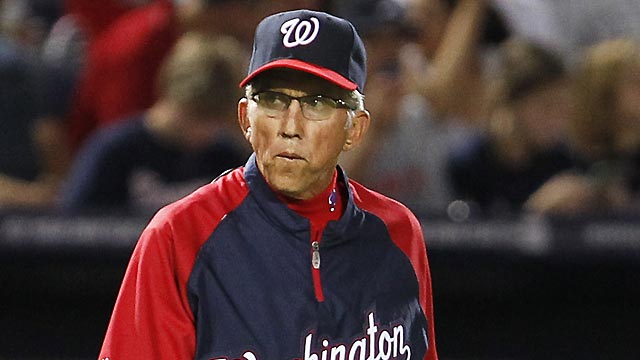
Davey Johnson can't get this team in gear.  Is it time to go?  Photo Getty via mlb.com

Davey Johnson can’t get this team in gear. Is it time to go? Photo Getty via mlb.com

I know this is blasphemous to say.

I know it’ll never happen, not under this GM and not under this ownership group, both of whom have far more respect for Davey Johnson than to give him such an ignominious end to his time here.

And I know that Johnson is as good of a manager as is out there.  I may have been critical of his decisions here and there (especially related to yanking starters on low pitch counts), but I recognize he’s a Hall of Famer and cannot argue against his career accomplishments.

But I’m beginning to believe that the only way to shake this team out of its current malaise is to change the message coming from the top.

They tried demoting players who weren’t hitting (Danny EspinosaTyler Moore).   They’ve tried calling up their best remaining prospects (Anthony Rendon, Nathan Karns and Taylor Jordan).  They’ve tried cleaning house of underperforming relievers (Henry RodriguezZach Duke, and Drew Storen).  They’ve tried changing key staff (firing Rick Eckstein).  They’ve tried ridiculous lineups (your best power hitter Bryce Harper leading off??)   Nothing has made a difference; the team has basically been playing .500 ball for weeks and weeks now.

For whatever reason, this team of players, picked by every baseball pundit out there to make the playoffs and by a good portion to make it to or win the World Series, is now 10 games out of of the divisional lead.  They’re 10 games back of Atlanta, which themselves has only played .500 ball since mid April after a 12-1 start.  The Nats just finished June and July playing 50 games in a row against teams that missed the 2012 playoffs (perhaps not the best bench mark, since Pittsburgh has the best record in baseball this year, but still), and finished the stretch 5 games south of .500.

The team looks like its sleepwaking through games.  They look like they have no voice, no spark, no sense of urgency.  No leadership.

The trade deadline won’t help at all; the Nats have practically no tradeable assets.  Their only FAs to be are Dan Haren and Chad Tracy.  Kurt Suzuki has a 2014 option that clearly won’t be exercised, so he counts too.  But who is out there lineing up for these 3 guys?  Meanwhile, despite their offensive woes, there’s really not a spot on the field that can be improved through trade.  Go around the field and you’ve got players on deals that at least extend through 2014 (LaRoche and Span), or  you’ve got guys on major contracts (Zimmerman and Werth) or you’ve got cornerstone younger players (HarperRamosDesmond and Rendon).  Who are you going to replace?  Maybe you think about trading Rafael Soriano (after all, the last thing a losing team needs is a high-priced closer) but a quick glance at the teams in playoff contention does not easily find a team in need of a closer (the best candidate may be Pittsburgh, who just lost their closer Jason Grilli to a forearm injury, but they’re not exactly rolling in dollars nor likely to take on an $11M/year guy).

Maybe its time to bring in a new voice, and see if he can scare this team into an August and September run.

Sorry Davey; you know how the old saying goes.  You can’t fire 25 players, but its pretty easy to fire the manager.

Taylor Jordan: Never too soon to think about the future…

4 comments

Jordan is making a case for his future with this organization.  Photo via wffn.net/hueytaxi on flikr.com

Taylor Jordan is making a case for his future with this organization. Photo via wffn.net/hueytaxi on flikr.com

I’ll file this as one of the “Patently Obvious” responses that have come out of Mike Rizzo‘s mouth in response to a reporter’s question, but Rizzo went “on record” as saying that Taylor Jordan will “get every opportunity to be in the mix for the rotation next year” per beat reports (this example from Byron Kerr) after Jordan got his first major league victory in Sunday 7/28/13’s 14-1 blow-out of the Mets.

Well, of course he’ll get a chance to compete for the rotation.   He’s pitching a hell of a lot better right now than $13M man Dan Haren, for approximately 1/30th of the cost.  What GM doesn’t want that??

One of the big reasons I started this blog was to talk about the development of Nats minor league pitchers.  Back in the dark days, when the team was spending $15M on the FA market to acquire 5th starters like Jason Marquis, I became convinced that the single most valuable commodity in Major League Baseball (in terms of talent development and acquisition) was the pre-arbitration starting pitcher.   Our farm system had the “Loria/Bowden” holes in terms of player development in the 2007-2009 time frame and for a few years the team couldn’t develop an effective starter, instead relying on guys like Marquis and on other minor league/low-end free agent signings (think Tim ReddingDaniel Cabrera, and the aging Livan Hernandez being examples).   Rizzo came in, put the emphasis on drafting and development, and now the opening day rotation features 3 home-grown guys and a fourth in Gio Gonzalez who was acquired by trading other home-grown guys.

One of my biggest data-collection projects was the information behind my regular “Pitcher Wins on the Free Agency Market” post.   After looking at pretty much every significant FA pitcher signing that baseball has ever had, and calculating salary versus wins, it became clear that teams are historically doing well if they get about one win per $1M spent on a FA pitcher.  Sign a guy for $13M a year?  You hope to get 13 wins out of him.

But this analysis also shows just how valuable the pre-arbitration, cost-controlled starter is.  Consider Clay Buchholz for Boston in 2010; he goes 17-7 in his 3rd active year, earning the MLB minimum of $443,000.  That 17-win capability eventually earned him a $12-$13M/year contract, but while he was getting the minimum he was winning games for Boston for pennies on the dollar versus what it would have cost Boston to purchase that capability on the open market.

Combine this point with the continually dwindling talent available on the FA market these as teams lock up their players earlier and more frequently, and the price for pitching just continues to go higher.  Zack Greinke signed a 6 year $147M contract paying him more than $24M annually last summer partly because he was the only significant pitcher out there.  Grienke is talented, don’t get me wrong, but outside of his unbelievable 2009 season he’s basically pitched like a #3 starter.   Even this year, he’s pitching to a rather pedestrian 103 ERA+, just barely above the league average of adjusted ERA for starters.  Not exactly what you expect for that kind of money.  The 2014 Free Agent Market in terms of pitching is looking equally as bare as 2013.   The best guy out there may be Matt Garza, who again is talented but is also injury prone and not exactly a league-wide Ace.   Get past Garza and you’re looking at inconsistent (Ricky Nolasco or Phil Hughes), injury plagued (Shawn Marcum or Colby Lewis), just old guys (Freddy Garcia, Hiroki Kuroda) and pure wild cards (Tim Lincecum or Scott Kazmir).

There’s a reason Tampa went nearly 8 full seasons without having a Free Agent acquisition start a game for them; they know exactly what it means to develop effective starters, and they have a stableful of them.  Trade away James Shields and Wade Davis?  No problem; just call up Chris Archer and Alex Colome (never mind the rest of their Durham rotation).

So, back to Jordan.  If the Nats can find an effective 4th or 5th starter from their farm system right now, it frees them from the one-year hired gun strategy of Haren and Edwin Jackson.  It gives them the flexibility to continue to allow their best prospects in the lower minors to develop (i’m thinking specifically of A.J. ColeRobbie RaySammy Solis, and Matthew Purke, though Cole and Ray aren’t exactly in the “low” minors anymore with their promotions to AA).  It gives them the depth they did not have this year to cover for a starting pitcher injury.   It gives them time to let Nathan Karns figure out if he’s going to be a starter or a reliever at the MLB level.  It gives them added payroll flexibility can go towards fixing holes in the short term.  Longer term it allows the team to spend money on extending the core guys, or allows them to consider whether the rising price tag on someone like Ross Detwiler is worth paying (much like they cut loose John Lannan last year).  If you’re going to pay market value for Strasburg and Harper, then you’re going to need some low-cost players who can contribute to counter balance the payroll.

Or, and it wouldn’t surprise me to see this either, it gives Rizzo interesting trade chips that he could package with other guys to acquire the Haren/Jackson hurler instead of buying him.

Two years ago we acquired Gonzalez for two near-to-the-majors starters, a surplus catcher prospect and a low-minors/high profile arm.  Right now it seems like we could put nearly the same package together (Jordan, Karns, Jhonatan Solano or Sandy Leon and then a decent arm from A-ball, or maybe even a Ray or Cole) and move them for such a resource.  I wouldn’t put it past Rizzo; Jordan may be looking good right now, but his peripherals don’t project as a “Rizzo Guy.”  Neither did Tommy Milone so he got shipped out; will Jordan be a 5th starter candidate in 2014 or trade bait?

Personally, I’d like to see Jordan succeed.  He’s a great success story; unhearalded 9th rounder coming off an injury that most of us thought was good, but who also thought that finishing the year successfully at high-A would have been a great achievement.  Instead he blows through high-A and AA ball and is now more than holding his own in the majors.

Nats all-star review: 2013 and years past

11 comments

harper and trout 2

Harper and Trout’s rookie appearance in the 2012 game was so special: I hope Yasiel Puig makes it this year. Photo unk.

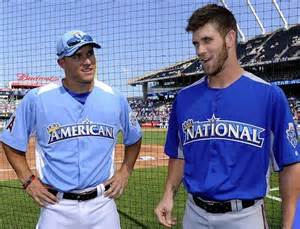
Here’s my annual Nationals All Star representative post.   As with 2012 and 2011‘s post, I’m including a retrospective on our “illustrious” All Star representative history from years past.  If you read on and it sounds familiar, that’s because a lot of it is cut-n-pasted from the annual version of this post.  Even so, reading backwards to see who our All-star representatives were in the lean years is an interesting exercise.

Here’s a link to the All Star Rosters for 2013.

2013

  • Nationals All-Star representatives: Bryce Harper, Jordan Zimmermann
  • Snubs: Stephen Strasburg, Ian Desmond
  • Narrative: Harper comes in 3rd in the NL outfielder voting, ahead of some big-time names, to become only the second Nationals position player elected as an All-Star starter.  He was 4th in the final pre-selection vote, so a big last minute push got him the starter spot.   Harper also becomes the first National to participate in the Home Run Derby.   Zimmermann is 12-3 heading into the game and is on mid-season Cy Young short lists right now and is a very deserving pick.  Strasburg’s advanced stats are all better than Zimmermann’s, but his W/L record (4-6 as of this writing) means he’s not an all-star.  It also probably doesn’t help that he missed a few weeks.  Desmond loses out to Troy Tulowitzki, Everth Cabrera and Jean Segura.  Tulowitzki is having a very solid year and is a deserving elected starter (though he’s currently on the DL and I wonder if Desmond may still make it as an injury replacement), while Cabrera and Segura are both having breakout seasons.  Desmond is on the “Final vote” roster, but my vote (and most others’ I’m guessing) would be for Yasiel Puig there ([Editor Update: Desmond and Puig lost out to Freddie Freeman: I still hope Puig finds a way onto the roster).   Gio GonzalezRyan Zimmerman,and Rafael Soriano are all having solid but unspectacular years and miss out behind those having great seasons.

Trivia: With his 2013 selection, Harper has been selected as an all-star in every season in which he has appeared in a game.  As far as I can tell in baseball history, there’s only TWO other players in Major League History who can say this.  Name them (discuss in comments).

2012

  • Nationals All-Star representatives: Stephen StrasburgGio GonzalezIan Desmond, Bryce Harper
  • Possible Snubs: Adam LaRocheCraig Stammen
  • Narrative: The two starters Strasburg and Gonzalez were the obvious candidates, and my personal prediction was that they’d be the only two candidates selected.  Gonzalez’ first half was a prelude to his 21-win, 3rd place Cy Young season.  The inclusion of Desmond is a surprise, but also a testament to how far he’s come as a player in 2012.  Harper was a last-minute injury replacement, but had earned his spot by virtue of his fast start as one of the youngest players in the league.  Of the “snubs,” LaRoche has had a fantastic come back season in 2012 but fared little shot against better, more well-known NL first basemen.  Stammen was our best bullpen arm, but like LaRoche fared little chance of getting selected during a year when the Nats had two deserving starters.

2011

  • Nationals All-Star representatives: Tyler Clippard
  • Possible Snubs: Danny EspinosaMichael MorseDrew StorenJordan Zimmermann
  • Narrative: While Clippard was (arguably) the Nats best and most important reliever, I think Zimmermann was a more rightful choice.  He was 10th in the league in ERA at the time of the selections and has put in a series of dominant performances.  Meanwhile Espinosa is on pace for a 28homer season and almost a certain Rookie-of-the-Year award (though a precipitous fall-off in the 2nd half cost him any realistic shot at the ROY), and perhaps both players are just too young to be known around the league.  Lastly Morse is certainly known and he merited a spot in the “last man in” vote sponsored by MLB (though he fared little chance against popular players in this last-man-in voting).

2010

  • Nationals All-Star representatives: Matt Capps
  • Possible Snubs: Adam DunnJosh WillinghamRyan Zimmerman, Steven Strasburg
  • Narrative: Capps was clearly deserving, having a breakout season as a closer after his off-season non-tender from the Pirates.  The 3-4-5 hitters Zimmerman-Dunn-Willingham all had dominant offensive seasons as the team improved markedly from its 103-loss season.  But perhaps the surprise non-inclusion was Strasburg, who despite only having a few starts as of the all-star break was already the talk of baseball.  I think MLB missed a great PR opportunity to name him to the team to give him the exposure that the rest of the national media expected.  But in the end, Capps was a deserving candidate and I can’t argue that our hitters did anything special enough to merit inclusion.

2009

  • Nationals All-Star representatives: Ryan Zimmerman
  • Possible Snubs: Adam Dunn
  • Narrative: The addition of Dunn and Willingham to the lineup gave Zimmerman the protection he never had, and he produced with his career-best season.  His first and deserved all-star appearance en-route to a 33 homer season.  Dunn continued his monster homer totals with little all-star recognition.

2008

  • Nationals All-Star representatives: Cristian Guzman
  • Possible Snubs: Jon Rauch
  • Narrative: The first of two “hitting rock-bottom” seasons for the team; no one really merited selection.  Zimmerman was coming off of hamate-bone surgery in November 2007 and the team was more or less awful across the board.  Rauch performed ably after Cordero went down with season-ending (and basically career-ending) shoulder surgery.   Guzman’s selection a great example of why one-per-team rules don’t make any sense.  Guzman ended up playing far longer than he deserved in the game itself by virtue of the 15-inning affair.

2007

  • Nationals All-Star representatives: Dmitri Young
  • Possible Snubs: Ryan Zimmerman, Shawn Hill (though I wouldn’t argue for either)
  • Narrative: Young gets a deserved all-star appearance en route to comeback player of the year.  Zimmerman played a full season but didn’t dominate.  Our rotation featured 6 primary starters, none of whom are still in the league now, though Hill showed flashes of dominance throughout the year.

2006

  • Nationals All-Star representatives: Alfonso Soriano
  • Possible Snubs: Nick JohnsonRyan Zimmerman
  • Narrative: Soriano made the team as an elected starter, the first time the Nats have had such an honor.  Our pitching staff took massive steps backwards and no starter came even close to meriting a spot.  Cordero was good but not lights out as he had been in 2005.  Soriano’s 40-40 season is a poster child for “contract year” production and he has failed to come close to such production since.  The team was poor and getting worse.  Johnson had a career year but got overshadowed by bigger, better first basemen in the league (a recurring theme for our first basemen over the years).

2005

  • Nationals All-Star representatives: Livan HernandezChad Cordero
  • Possible Snubs: Nick JohnsonJohn Patterson.
  • Narrative: The Nats went into the All Star break surprisingly in first place, having run to a 50-31 record by the halfway point.  Should a first place team have gotten more than just two representatives?  Perhaps.  But the team was filled with non-stars and played far over its head to go 50-31 (as evidenced by the reverse 31-50 record the rest of the way).


Ask Boswell 7/1/13 Edition

8 comments

Desmond; trouble-maker Photo Drew Kinback/Natsnq.com

Ian Desmond; trouble-maker. Photo Drew Kinback/Natsnq.com

Another month, another .500 record for the Nats.  At the halfway point they’re 41-40, on pace for a fantastic 82-80 record.  Well, the Cardinals won the World Series a few years back making the post-season 83-79, so maybe all is not lost (sarcasm).  Though, the last couple days have seen unprecedented offensive output (they’ve scored 10+ runs twice in a row after only having done it once prior).

Bryce Harper is back after missing nearly 5 weeks of games (and hitting badly through another 4 weeks in May of them before that), and promptly hits a homer in his first AB off the D/L.   With Harper’s inclusion, we’ll finally see the “ideal offensive lineup” that I touched on last week.  On paper, a 2-7 of Werth-Harper-Zimmerman-LaRoche-Desmond-Rendon looks really, really good.

In this light, lets see what kind of baseball questions Tom Boswell took in his pre-holiday chat on 7/1/13.  As always, I’ll write my answer here before reading his to avoid bias and edit questions for clarity (since a lot of the “questions” he takes are rambling complaints about this or that).

Q: Are the Nationals as a team missing the “spark” they need to rally for the playoffs?

A: I’ve talked about the outflow of “chemistry” this team lost when Michael Morse was dealt before.  I’ve also speculated in this space before about whether or not this team has too many “uber serious” players.   In many ways winning consistently creates “chemistry” but I also think the reverse is true if you don’t have the right guys with leadership voices in the clubhouse.  Is the return of one hitter (albeit their best) going to change the tune for this team?  Boswell notes that the team faces a significant hole: 6.5 games in the division, 5.5 games just for the wild-card coin flip game.

Q: Thoughts on Taylor Jordan?  Does he get a 2nd Start?

A: See here for my post over the weekend on Taylor Jordan, and Yes he gets a 2nd start.  He only gave up one earned run.   Lets see what Boswell said: Boswell has a good point: he liked Jordan, thought he had potential .. but then noted that this team needs to go 50-31 to make the playoffs and you’re not going to go 50-31 with a rookie as your 5th starter.  

Q: With Werth appearing to be injured, do you see Davey moving Harper to right and Werth to left field?

A: Well, this is one of those “veteran manager” moves from Davey Johnson that gets me sometimes.   I believe that Jayson Werth is inarguably a lesser fielder than Harper (who would be playing center for nearly every other team in the league by virtue of his range and arm).  Harper’s arm is one of the best in the league.  He’s younger, faster and covers more ground (excellent range per UZR/150 numbers in center last year).  So why is Werth in right?  Because he’s the vet.  Harper won’t take over RF until Werth advances in age or gets a new manager who isn’t afraid to move him and his 9 figure salary to the position he should be in.  I disagree with Boswell’s opinion on this one; he thinks Werth is the more polished OF and that Harper got hurt playing RF.  As if he wouldn’t have run into a wall eventually playing elsewhere.

Q: Do we need alterations to the Balk rule?

A: At some level yes.  I think there’s a huge difference between some slight bobble in your motion and a blatant attempt to deceive the runner by “flinching” or doing a purposeful stop-start head motion.   Its the difference between inadvertant and purposeful deception.  And the embarassing umpire “Balking” Bob Davidson needs to be reigned in.  Plus, nearly every left-handed pitcher uses a “balk move” to first on a regular basis, almost never stepping directly at the bag.  And when was the last time you saw a right-hander get a balk call for throwing over to first while bending his right leg?  But, in the grand scheme of things I’m not sure the Balk rule is the great scourge of our modern game (see ball-strike zone consistency, instant replay, ongoing PED issues, and salary discrepancies making the league a group of haves and have-nots).  Boswell doesn’t understand the Balk but loves it.

Q: At what point do Zimmerman’s errors accelerate the conversation to move him to 1B?

A: We can start talk about moving Ryan Zimmerman the moment that Adam LaRoche‘s contract runs out.    Anthony Rendon can play 2B in the interim and eventually move back over to his natural position.  Before then?  Somebody would have to get seriously hurt or traded in order to make any modifications to our infield.   Boswell points something out I didn’t think about: Zimmerman is playing very shallow because his arm strength is shot … hence why he made those two errors in the saturday Jordan start.

Q: Should we look to trade for Nolasco?

A: I had to laugh; the questioner also asked if the Marlins would pick up his salary.  Haha.  Have you not see the M.O. for Jeffrey Loria by now?  Hoard every nickle in every deal.   That being said, I think we’d have the biggest chance of trading intra-division with Miami versus anyone else; they seem to be amenable to take back less in return for taking salary off their hands (see the Willingham/Olsen deal a while back).

A better question; should we be forcing a trade for pitching at all?  Even with the Dan Haren issues all year the team is 5th in the majors in ERA (10th in adjusted ERA+).   Of course, the four teams above us are all either divisional rivals or challengers for the wild card.   But the point is this: you need to fix what’s wrong, and the pitching overall isn’t what’s wrong.  Its offense.  Its bench production.  Its hitting.  Trade for something that helps fix the problem.  Boswell just talks about how we have enough money and how we shouldn’t give up any decent prospects.

Q: Is there a stat that shows how many a player’s errors relate directly to runs scored?

A: Unearned runs?  Except I’ve never seen someone directly tie the two together.  Therefore probably not, because this type of research likely will have a Sabre-tinged analyst immediately say, “I’m not doing that because Errors are not the best way to measure fielders.”  Then they’ll point at (in this case speaking of Zimmerman) his UZR/150 (an awful -20.2 for 2013 thus far), his Defensive Runs Saved (strikingly he’s actually cost the team 2 runs so far, projecting for a -4 rDRS for the year) or his Fielding Runs Above Average (FRAA) which measures out at 3.0 so far in 2013, slightly above average.   My narrative on Zimmerman’s steep decline this year in range and defensive metrics goes as follows: nursing leg injuries and forced to play further up, Zimmerman’s not making the plays he normally would, which is being reflected in his UZR decline.  Meanwhile FRAA correctly measures that he’s still a slightly above average fielder.  Boswell doesn’t know.

Q: With Harper coming back, I’m assuming that Rendon slides down to seventh. Is that the best place for him? Also, is he too good of a hitter to bat seventh? With Ramos coming back soon, does this make the Nats a much more dangerous offensive team?

A: I’m not so sure I’d move Rendon down; he’s the absolute prototypical #2 hitter.  He hits to all fields, he’s especially good at hitting to right, he’s got a .360 OBP, and is a great tablesetter for the 3-4-5 guys.  No, I think you move everyone else down a spot.   Of course, that being said, if you had a manager with any cajones, he’d move Werth to the #7 spot since everyone else in this equation is a better hitter right now.  But it won’t happen, so either Ian Desmond or Rendon likely moves to #7.

With Wilson Ramos back as I’ve noted in this space, yes this should finally let the Nats put out their best, strongest lineup.   Boswell says Werth bats #2, pointout his OBP is .330.  I’ll now point out that that OBP is 10% less than Rendon’s right now.  But I can’t argue with Boswell’s point that Rendon could use the pressure taken off of him … until you remember that Harper didn’t seem to have any issues batting #2 all year last year.   Update: Boswell called it right: Werth is batting #2 upon Harper’s return.

Q: Why would Davey claim the Lerners want him out?

A: That’s a reasonable conclusion from reading Mike Wise‘s article over the weekend.  He seems to intimate that the ownership group is frustrated with the team’s performance this year and puts some of it at Johson’s feet.  At least that’s the way Johnson interprets it.  Boswell has an interesting point; he says this is a young team and the owners want a manager who can be here for 5-10 years … Johnson is 70 and they don’t see him as the solution.

Q: Should Yasiel Puig be an all-star?

A: If it were me, absolutely yes I’d make Yasiel Puig an all-star, give him an at-bat later in the game.  He’s been electric, he’s been the best hitter in the league for half this season.  He’s still hitting .436 through 100 at bats!.  Having him at the game just makes it more of a fan draw.  Boswell thinks he’ll be a late injury replacement.  I hope so.

Q: Which team has more wins at the end of 162, O’s or Nats?

A: Easy; the Orioles.  They’ve already got a 10 game head start.  I don’t think the Nats are going to be 10 games better than Baltimore in the 2nd half.  Boswell punts.

Q: Did Desi violate the unwritten code yesterday by slamming a home run into the restaurant when the Mets had a position player on the mound?

A: No way.  Of all the unwritten rules out there, the one that is unassailable is that a batter gets a legitimate chance to get a good swing in at the plate no matter what the score.  There’s limits (you can’t swing out of your shoes on a 3-0 pitch when winning by 10 runs) but I don’t see how Desmond’s bomb counts.   Boswell says Desmond’s HBP earlier negates all rules.  Not sure I agree with that reasoning unless the HBP was in any way possible deliberate.  Later on another questioner notes that he thought the Desmond HBP was definitely deliberate; I turned the game off when the Nats knocked out Wheeler, figuring they had it sewn up, and didn’t see the fracas.

Q: Why haven’t media such as yourself chastised the Nats for the foolish contracts given to Werth (injury prone, strikeout prone, shaky defensively), Soriano (too much to pay a closer who is not automatic), and Haren? In Philadelphia, all three contracts would have been regarded as somewhere between bad and stupid.

A: Wow.  Well, not to re-hash the same reasoning we’ve had over-and-over about these guys, but here goes:

  • The Werth deal was an over-pay but also re-established Washington as a player in the FA market, reestablishing credibility that had been destroyed by years of Loria and MLB ownership incompetence.  Remember, the same off-season Carl Crawford signed for MORE money and has produced a total of 1.8 war in the last three seasons combined, yet we don’t hear as much about how “stupid” the Boston organization was for that signing.  Why does Boston get a pass but Washington doesn’t?
  • Rafael Soriano was a luxury item, but I’m not sure its fair to say he’s “not automatic.”  He’s blown 3 saves in 24 chances.  Jim Johnson leads the league in saves and he’s blown 5.  Craig Kimbrel has a 1.48 ERA and he’s blown three himself.  I have no problems with Soriano and his contract (other than my general stance against paying top dollars for closers in general … but it wasn’t my money).
  • Haren looked like a good signing at the time, was a good risk, and frankly there’s no such thing as a bad one year contract.  It wasn’t like we were the only people bidding on him; he was in demand.

Giving power hitters on the wrong side of 30 5 guaranteed years at $25M each?  Now that’s a “stupid” contract.    Boswell chastises the Philly fan for his media’s overreaction to anything, defending the moves as I have.
If only we had a healthy lineup… Nationals runs Scored analysis and what-if

4 comments

Here’s a fun little statistical exercise.  What would the Nats record be right now if it actually had all its guys healthy at the same time?

Lets use a short hand stat (OPS+) to take a quick look, and then make some runs scored analysis adjustments to see some expected W/L records.  Assuming both Bryce Harper and Wilson Ramos were healthy and continued to hit at their current OPS+ rates once they return (which frankly is a rather conservative statement; Harper was hitting far above his seasonal OPS+ rate before he started running into walls at the end of April),  here’s what our lineup could look like:

Lineup # Naem Bats Pos OPS+ as of 6/28/13
1 Denard Span L CF 82
2 Anthony Rendon R 2B 134
3 Bryce Harper L LF 166
4 Ryan Zimmerman R 3B 125
5 Adam LaRoche L 1B 118
6 Ian Desmond R SS 117
7 Jayson Werth R RF 104
8 Wilson Ramos R C 105
9 Pitcher

That’s nearly an entire lineup of guys above 100 OPS+ (which indicates league average production) and from 2-6 are significantly above 100.  I dare say, this lineup of guys, with an average OPS+ of 118, should produce runs at about 18% above the league average.  Now, the pitcher spot and our crummy bench production will drag this team number down; lets say for sake of argument that this lineup will produce at an average of a 110 OPS+ when they’re all present and accounted for.

What does that mean?   Through 6/28/13’s games, the league team average of Runs Scored is 330.    The Nats have scored, to date, 275 runs, which ranks them 29th in the league and only above the AAA team the Miami Marlins are running out every night.  Lets look at two scenarios for our offense from a Pythagorean Record perspective to show where this team could have been with a league average offense and with the above described 10% above league average offense:

First, where are we right now:

6/28/13 actual
Actual Wins 39
Actual Losses 39
Actual W/L Record 39-39
Games played 78
Actual W/L percentage 0.500
Runs Scored 275
Runs Allowed 303
Pythagorean W/L percentage 0.456
Pythagorean wins 36
Pythagorean losses 42
Pythagorean W/L Record 36-42

We’ve scored 275, allowed 303 and are playing 3 games above our Pythagorean record.  Mostly because of a handful of specific blowouts (15-0 loss to Cincy the first week, a 9-0 loss in Atlanta, 10-1 loss in New York, back to back 13-4 and 8-0 beatings in San Diego and San Francisco), this team is playing a few games better than its expected record based purely on RS/RA.  We don’t have enough reverse-blowouts where the Nats have won by a large score to really counter balance it.

(Fun fact: did you know the Nats have only scored 8 or more runs in a game 3 times in their first 78 games?  The Red Sox have scored in double figures 9 times already including one 17 run outburst a few weeks back.  It seemingly takes the Nats a WEEK to score 17 runs.  I digress).

How about if the Nats just had a league average Offense right now, scoring 330 runs instead of 275?

thru 78 games with MLB avg runs scored
Actual Wins 39
Actual Losses 39
Actual W/L Record 39-39
Games played 78
Actual W/L percentage 0.500
Runs Scored 330
Runs Allowed 303
Pythagorean W/L percentage 0.539
Pythagorean wins 42
Pythagorean losses 36
Pythagorean W/L Record 42-36

We’d be at a Pythagorean record of 42-36 but (for reasons listed above) they’d likely have a record of 45-33.   45-33 would have us essentially tied for the divisional lead right now.

Last scenario; what if we were scoring at 10% above the league average, inline with the production of the 2012 offense and in line with the assumptions made on the OPS+ analysis above?

thru 78 games at 10% above league avg runs
Actual Wins 39
Actual Losses 39
Actual W/L Record 39-39
Games played 78
Actual W/L percentage 0.500
Runs Scored 363
Runs Allowed 303
Pythagorean W/L percentage 0.582
Pythagorean wins 45
Pythagorean losses 33
Pythagorean W/L Record 45-33

Pythagorean record of 45-33, likely actual record three games better at 48-30, which would have us tied with St. Louis and Pittsburgh for the best record in the game.  Right back where the team was last year in terms of league-wide record.

Interesting.

Conclusion: its all about the offense.  Maybe my own personal doom and gloom can get turned around if we get our guys back healthy, start hitting, continue pitching as well as we have, and get this turned around.


Written by Todd Boss

June 28th, 2013 at 2:26 pm

Ladson’s Inbox 6/24/13

2 comments

What a week!  Both Bill Ladson and Tom Boswell doing chats/email inboxes!  As I sit here as my flight has been delayed a second time, I find myself with the time to bang out Ladson’s latest inbox.

As always, I write my response here before reading Ladson’s and edit questions as needed for clarity.

Q: With right-hander Dan Haren going on the disabled list, is it possible the Nationals will try and trade for left-hander Cliff Lee or another top-of-the-rotation pitcher near the Trade Deadline?

A: Rumors on the street are that Mike Rizzo is working the phones, hard.  That sounds to me like he’s looking for serious reinforcements to try to salvage this “go for broke” season.  But somehow I seriously doubt it’ll be Cliff Lee.  Lee is owed too much money, he’s already 34, and the likelihood of Philadelphia dealing intra-division seems remote.  There’s plenty of other pundits out there reviewing the likely pitchers on the Trade market and there’s some intriguing names out there.  But it’ll be a sellers market and the Nats farm system has already been thinned recently.  Will they thin it even more in a desperate attempt to keep the 2013 dream alive?  I hope not; we’re already seeing how poorly thought out trades by other teams in similar positions have backfired and cost their teams significant prospect depth.  As others have noted, Ladson predicts the callup of Taylor Jordan for the time being.  Lets hope he comes out of no where and pitches 6 shutout innings.

Q: Does Wilson Ramos remind you a bit of Jesus Flores — a promising young catcher who can’t seem to stay off the disabled list?

A: Yeah, except that Ramos is twice the size of Flores and still can’t stay healthy.  That Kurt Suzuki move is looking better and better.  Derek Norris has yet to really pan out in the majors for Oakland (hitting below .200 this year and for his career), and Suzuki is holding down the fort for now.  That being said, we need Ramos back to spell Suzuki, who seems to be tiring as he catches the large majority of the innings.  Ladson doesn’t say much … but says the Nats miss Ramos.  Duh.

Q: Is there any chance we might see Ryan Zimmerman at second base?

A: Zero chance.  He’s a big dude; he’s not a 2nd baseman.  Now, Anthony Rendon looks like a 2-bagger to me.  Shorter guy, agile, quick arm, good glove.   Ladson agrees.

Q: What do you think of the Nats’ start this year, compared to last? Are they a stronger team?

A: Lots of injuries, lots of under-performing on the offense, and a couple of depressing pitching issues.  They’re better than a .500 team but they need to have at least a league-average offense (not one of the worst).  Ladson says they need Harper back.  Duh.


Ask Boswell 6/24/13

leave a comment

Lots of grief for Espinosa and Haren this week.  Photo Nats official.

Lots of grief for Espinosa and Haren this week. Photo Nats official.

We’re now almost 3 months in, the team is still stuck at .500 and the natives are getting restless (see Haren, Dan‘s forced D/L trip as penance for his performance lately and Danny Espinosa‘s forced demotion to work on his batting).  I wonder what the tone of Tom Boswell‘s weekly chat questions on 6/24/13 will be?

As always, I answer here before reading Boswell’s answers and edit questions for clarity.

Q: Should the Nats move Ian Desmond up in the order?

A: Ian Desmond has mostly been batting 5th or 6th (depending on injuries to the 3-4-5 guys).   Frankly there’s no place else to put him.  They bought Denard Span so he could bat lead-off, and now suddenly Anthony Rendon is the prototypical #2 hitter; hits to all fields, good bat control, high average and some pop.  3-4-5 are set in stone when they’re healthy.   The only question is whether Desmond merits batting before or after Jayson Werth.  I’d say he will stay in the #6 hole.  Boswell says #6 is the best spot for him and he’ll stay there until Adam LaRoche‘s contract is up.

Q: Why do fans boo home-town players who are struggling?

A: The genesis of this question is the cascade of Boos rained down on Dan Haren after his latest meltdown.   I think fans are fans: they pay good money and expect this team to be successful.  When a guy lets in 7 runs in 3 and a third innings … well that’s a game spoiled.  Are they booing the player or the team, really?  Should they boo?  Eh; you certainly hear “good baseball town” crowds booing players.  Boswell says he’d have booed Haren too, but also notes what a class act and competitor he is.

Q: Where do we go with Dan Haren now?/Will Ohlendorf get the spot start?/Is Haren getting DFA’d?

A: Just answered a lot of this myself in a post yesterday.  Short answer; spot start from someone, extended rehab assignment for Haren, and probably a long-man role in the bullpen if we find a competent starter replacement.   I don’t think he’s getting DFA’d because any one of a number of pitching poor teams would snap him up in a heartbeat despite his crummy numbers.  Boswell thinks the team is going out on the open market to replace Haren and notes he’s hearing Taylor Jordan is getting a shot this weekend, and thinks that summarily demanding that a struggling player be released is cruel.

Q: Is Ian Desmond a flawed player?

A: The question arises because of Desmond’s small delta between his BA and his OBP (.280 and .318) and his approach in clutch situations.  I think Desmond has taken a small step back from last year’s break out season but otherwise all three of his slash line numbers are right where they were last year and in the same relative ratio as last year. His 2012 OBP was about 40 points higher than his average (same as this year), and his slugging is about at the same slightly lower figure.  He’s on pace to hit the same number of homers and actually increase his total extra base hits.  I see no issues here.  I’ll take a 120 OPS+ shortstop who plays plus defense anyday.  Boswell agrees, saying Desmond is a complete player and an all-star.  Nuff said.

Q: Is Werth’s groin strain another example of a Nats player coming back too soon?

A: It doesn’t seem so.  Different injury, and one that does tend to bedevil older players like Werth.  Lets just hope it isn’t too long.  Boswell does kind of scoff at Werth’s excuse of “playing dehydrated.”  As if there wasn’t enough ways for a professional athlete to hydrate themselves during the day.

Q: Will either Haren or Espinosa get another start in 2013?

A: I think the answer is likely yes.  This team has shown itself to be incredibly brittle so far (Saw a stat that the opening day lineup hasn’t played together since the 2nd week of April).  The odds of another guy going down with injury and requiring the return of either guy seems high.  The better question is likely what happens after 2013.  Haren’s one year deal is clearly over, and the Nats can’t possibly offer him a Qualifying Offer.  Danny Espinosa will be sans position and will be traded (even more proof of this?  The fact that Espinosa is playing SS in Syracuse).  Boswell interpreted the question more of a “rest of their career question” and said that Espinosa clearly has more career but Haren, maybe not unless he adjusts his approach.

Q: Why is there a disagreement between Harper and Johnson on his rehab?

A: Much to-do about nothing?  Either way, it doesn’t sound good when you have media members scurrying from one guy to another to play “he said, she said” in the papers.  Those two need to get on the same page, whether Bryce Harper is going on a rehab assignment Tuesday, Wednesday or three Fridays from now.  turns out: he’s going out on rehab tonight.  Boswell thinks its just Davey Johnson being too positive on how long it takes guys to come back.

Q: Why hasn’t Espinosa gotten surgery, if it has so clearly impacted his performance?

A: Probably two words: “Anthony” and “Rendon.”  I think Espinosa’s been reading the tea leaves and knew that his spot was the most likely destination for Rendon, and that Rendon (once arriving) likely wouldn’t give it up.  So far, that scenario is playing pretty much exactly as in Espinosa’s worst fears.  Boswell talks about how the Nats evaluated Espinosa’s injuries now and at the time.

Q: If the Nats were to pursue someone like Lee or Gallardo in the trade market, what would it cost them?  And who is untouchable?

A: Cliff Lee is owed so much money that it may not take as much in prospects as one would think.  But, the Philles have to declare that they’re out of it first … and they’ve got basically the same record as the Nats right now.  Gallardo is signed through 2014 with a 2015 option for about the same money we’re paying Haren right now .. and he has limited no-trade.  The thing is; is he worth trading for?  He’s only so-so this year, better the last two years.  I think Yovani Gallardo probably rates a bit below Gio Gonzalez on the trade market b/c of his salary  and being slightly less on the field, so perhaps two good prospects plus a young guy.

Who is untouchable at this point?  Rendon, Karns (they like him too much), Jordan (gotta see what they have now).  Brian Goodwin (he’s Span’s replacement in two years).  A.J. Cole (they worked pretty hard to get him back).  I don’t think they want to part with Matt Skole either.  But that’s not leaving a lot to work with in terms of prospects.

Boswell doesn’t really talk much about these guys or who the Nats are keeping … but fantasizes about getting David Price.  Dream on; the Tampa Bay Rays don’t trade unless they know they’re winning the deal.


Ask Boswell 6/17/13 Edition

leave a comment

Anthony Rendon - What a draft day steal.  Photo: Brett Coomer/Houston Chronicle via chron.com

He’s continued to hit in the pros like he used to in college.  Photo: Brett Coomer/Houston Chronicle via chron.com

The Nats continue to struggle offensively.  They’re generally only above the Mets and the Marlins in key offensive categories, two teams that have basically given up for 2013.  They’re hitting worse than the Astros, a team that also had given up on 2013 before it started and whose payroll is 1/6th of ours.   Our best hitter Bryce Harper languishes on the D/L, but the team has (finally) made some adjustments and shed some of the underperforming players on its roster and rookie Anthony Rendon has been living up to his expectations.

So, what is Tom Boswell‘s weekly chat is going to be about?   Here’s his 6/17/13 version.  As it turned out many of the questions were about the US Open, and a few about Hockey and Football.  But lots about baseball.  As always I answer here before reading Boswell’s response and edit questions for clarity.

Q: Is Davey Johnson the problem with the Nats in 2013?

A: Despite some complaints about his Starting Pitcher and bullpen usage earlier this year, Davey Johnson isn’t the reason this team is losing.  Not with a team whose offense ranks 28th in the league in all the basic run-creating categories (Runs, Batting Average, OBP, and OPS+).   Changing the manager won’t help; all you can do is change the personnel.  And the Nats have done what they can; sending Tyler Moore and Danny Espinosa to the minors, calling up Rendon (slash line as of 6/16/13: .361/.426/.525; yeah that’s pretty darn good), giving Chris Marrero some at-bats.  The obvious: they need Harper back, they need the bench to start producing like it did in 2012, and they need Wilson Ramos to come back and spell the quietly falling-apart Kurt Suzuki (he’s now hitting just .215 with little power).  Boswell agrees; its the offense.

Q: Did Johnson screw up by not loading the bases in the Friday loss?

A: Situation: 2nd and 3rd with none out; do you load the bases?  I’d normally say that it depends on the matchups; a fly ball beats you anyway, so you’re looking for a pitching matchup that you can either get a punch out or a ground ball.  Well, they got their groundball; it just wasn’t enough to get the guy at the plate, who broke on contact and was fast.  A bases-loaded situation there means Suzuki doesn’t have to make the tag, just get the force out.  I guess Johnson could have loaded the bases.  Boswell points out the similarities to this and the NLCS Game 5 situation with Pete Kozma but doesn’t give an answer.

Q: Is Rick Eckstein culpable for the Nats Offensive woes?

A: Boswell answered an identical question on 5/28/13.   I’ll say the same thing again: I just don’t see how a hitting coach is responsible for players who suddenly hit 200 OPS points below their career averages as we’re seeing with a huge percentage of this team.  Rick Eckstein isn’t in the batter’s box; these guys are.  Boswell agrees, saying it isn’t Eckstein who is waving at balls a foot outside.

Q: Are the Nats just mentally fragile?

A: Possibly.  I think the weight of expectations is causing them to press.  But you have some veteran guys in that clubhouse (Jayson WerthAdam LaRoche especially) who should be leading the team and helping to manage this.  Maybe these guys just aren’t “Captain” material?  Notice too that the two most senior guys on the pitching staff (Dan Haren and Rafael Soriano) aren’t exactly the best role models either; Haren is struggling too much to command any respect, and Soriano doesn’t appear to be a big clubhouse influence (and I privately wonder if there isn’t lingering animosity towards Soriano’s signing from the rest of the bullpen, which seems relatively close in age and experience).  Boswell notes that the team leaders need to step up.

Q: Why is Dan Haren pitching again?

A: Asked and Answered here four days ago.  Boswell didn’t really answer.

Q: Should we eliminate pitcher Wins and Losses?

A: Well, if you’re a sabrematrician we should.  A pitcher can give up one hit in 5 innings (as Stephen Strasburg did on sunday) and take the loss, while a pitcher can give up 5 runs in 5 and get a win if his offense bails him out.  That in a nutshell is the issue most people have with the Win and Loss statistics.   I saw a stat on billy-ball.com today that Chad Billingsley took the loss in an 8-inning one-hit outing in 2011 (the run was un-earned to boot).  That’s pretty unlucky.  Bill James said recently that he continues to use W/L records simply because they’ve been the default way to express stats for pitchers for 100 years.  I now view them sort of as throw-away stats written ahead of the meaningful measurements for pitchers, things like Fip and xFip, perhaps Siera.  I like ERA+ and K/9 as good short-hand measurements too, but realize that every one of these stats has flaws.  The pitcher “Win” used to mean a lot more than it does now; when a guy went 9 innings every day instead of going 5 2/3 and having a bullpen close out more than a third of the game it becomes harder and harder to equate one with with another.  Boswell agrees.

Q: How much of Rendon’s hitting is a reflection of his talent, and how much of it is a product of teams not having a book on him yet? Certainly he’s not a .350 hitter, but is he a .300-.310 hitter?

A: Great question.  I think its part column A and part column B.  For one, he’s an exceptional hitter.  He wasn’t College Player of the Year as a sophomore at Rice by accident.  He should have been a 1-1 pick had it not been for lingering issues that dropped him into the Nats lap in 2011.  And in his short sample size so far in 2013 we’re seeing his great approach; fast hands, ability to use the whole field, opposite field power.  Now, a new hitter hasn’t had “the book” written on him (that’s what advance scouts do) so yes, we’ll expect to see teams identify weaknesses in Rendon’s swing and start pitching him accordingly.  The great players then adjust to the adjustments.  In the ESPN documentary Bryce Begins there was a very telling quote from Braves pitcher Kris Medlen, who commented that Harper had “already made the adjustment” to the way the Braves were pitching him from one series to the next.  The film then showed Harper fanning at a pitch to strike out .. and then clobbering the same pitch in a subsequent game.  That’s what pro hitters do to stay good, and that’s what Rendon is going to have to eventually do to keep his lofty average.  Boswell raves about his stat lines all the way up the minors.

Chasing Saves: a cautionary tale for GMs

6 comments

Mariano Rivera’s success has led to a generation of closer-chasing in MLB. Photo wikipedia

One of the mantras we hear from Fantasy Baseball experts is “Don’t chase Saves.”  Closers are so hit-or-miss in this league, that on draft day trying to chase mediocre closers usually turns into wasted draft picks as these guys frequently get hurt or under-perform and get replaced.  Well, its not that much better in “real” baseball, where teams best laid plans for closers often backfire mightily.

In fact, check out this link on RotoAuthority.com, which charts the Opening day and Closing Day 2012 closers for all 30 teams.  In summary:

  • Only 10 of the 30 MLB teams kept the same closer wire-to-wire.
  • 14 of the 30 teams had a different guy in the closer role by season’s end.  That’s half the league!
  • The other 6 teams had the same guy at season’s start and end, but went through personnel changes in between.  This includes our own Nats, who started with Drew Storen, he got hurt, Tyler Clippard took over and stayed in the role after Storen got back, then Clippard melted in September and Storen took back over the role.

By my observations, as of June 15th 2013 here’s the same stats for this year:

  • 22 of 30 teams have same guy as start of season
  • 8 teams have already made a switch (Boston, Detroit, Arizona, Oakland, Chicago Cubs, Cleveland, St Louis, Los Angeles Dodgers)

So what’s the point here?  Teams need to re-think they way they grow, acquire and pay for “Saves.”  Lets look at how far one particular organization has gone “Chasing Saves” and pursuing a Closer.  I present you the Boston Red Sox, normally considered a very forward-thinking, analytical organization but which seemingly has a very large blind spot for the mytical “shutdown closer” position.  As of the publishing of this article (June 14, 2013):

  • Current Closer: Andrew Bailey, for whom they traded 3 players to the Oakland A’s in 2011 to obtain.  Two minor league prospects and one Josh Reddick, who hit 32 homers last year.
  • Acquired last off-season to be their 2012 closer: Mark Melancon, for whom they traded two good prospects to the Houston Astros in 2011; Jed Lowrie and Kyle Weiland.   Lowrie is now posting a nifty 126 ops+ for the Athletics (to whom he was flipped by Houston for even more prospects).  Melancon had two bad outings at the beginning of 2012, was banished to the minors and eventually flipped for ….
  • Former 2013 closer: Joel Hanrahan, for whom they traded 4 players to the Pittsburgh Pirates last December.  Including Mark Melancon, who is repaying the Pirates for their patience in him by posting a .072 ERA in 25 innings thus far this year.  Hanrahan just had Tommy John surgery and is out for at least a  year.
  • [Post-post update]; By the end of June, Bailey allowed 4 homers in 5 games, hit the D/L and on July 22nd was announced as undergoing season-ending surgery. and is being replaced by … somebody.  By Mid July it seemed clear that it was Kenji Uehara, a free-agent signing last off-season.  So for all their trades, they end up using a minor FA signing as their closer.

So for the record that’s 9 guys traded away (including at least two effective hitters) in the past two off-seasons to chase one (in my opinion) relatively meaningless statistic.  And basically all they have to show for it is Andrew Bailey no longer pitching the 9th for them.

Of course, maybe the joke’s on me, since the Red Sox are in first place at the time of this writing.

But for an organization that used to be known for doing smart things (including the smart move of allowing long-time closer Jonathan Papelbon be overpaid by someone else on the FA market), these moves are just dumb.   Find a hard throwing guy in your system, make him the “closer,” repeat as necessary.  That should be the strategy.


And oh, by the way, I don’t exempt our own team from this.  Rafael Soriano was an unneeded purchase who (as we’ve seen by the unwarranted shot at Bryce Harper) could be more trouble than he’s worth.  But hey, its not my money right?  At least the Nats didn’t trade good prospects to acquire him (like Boston has done over and again).


This argument leads into an oft-repeated discussion in this space about the ridiculousness of the Save statistic and how frequently closers are preserved for “Save Situations” despite their leverage rating.   Lets look at a couple of very specific mathematical arguments against overpaying for closers:

1. Joe Posnanski and others have shown how useless closers are.  Teams are winning games at basically the same percentage now in the closer era that they were 50 years ago, without highly paid specialized closers.  Some quick percentages:  For the latest decade teams won 95.2% of games in which they led going into the 9th.  In the 60s, 70s and 80s that same percentage varied between 95.6-94.8%.   Can someone explain to me how the proliferation of highly paid closers in the last 20 years of the game has basically helped teams …. win the exact same number of games they used to before closers, matchup bullpen roles and Loogys existed??

2. Any old mediocre reliever is going to end up being a relatively effective closer.  Proof?

Lets say an average reliever has a 4.50 era or so (which in today’s game frankly is a stretch, given what we’ve talked about before and the advantages that relievers have over starters; they can go max effort for shorter time periods and they don’t have to face batters more than once).  That means he gives up one run every two innings.  Now lets say that you used this pitcher with his 4.50 era in every closing situation you face in a given year.  A save situation can be a lead held by 1, 2 or 3 runs.

So, out of these three scenarios your 4.50 ERA pitcher can give up his run every other start and still “save” 5 out of 6 games.

  • 1 run lead: gives up 0 runs; save
  • 1 run lead; gives up 1 run: blown-save
  • 2 run lead: gives up 0 runs; save
  • 2 run lead: gives up 1 run: save
  • 3 run lead: gives up 0 runs: save
  • 3 run lead: gives up 1 run: save.

And then even in those blown-save situations, extra inning affairs are basically coin flips anyway historically, which means that teams are going to win half those games anyway.  So you’re basically going to win 5.5 out of every 6 games.   5.5 out of 6 is 91%.  So historically even my normal case scenario undervalues the ability of teams to win these games.

And this scenario really undervalues what kind of reliever you’re actually going to put into the role.  Every team has a handful of relievers in their bullpen with ERAs in the 3-3.50 range; that’s 1-1.5 runs better than my “mediocre pitcher” example over the course of a couple weeks (assuming closers get about 9 innings of work every two weeks).  With even this marginal improvement you’re going from 91% to closer to the historical 94-95% of games won.


Want some more food for thought on closers?   Here’s your current top 5 closers in the league by number of saves, along with their acquisition method, salary and general statement about their careers thus far:

  1. Jason Grilli – 23 Saves.  36yrs old.  $2.25M.  He was flat out released in July 2011 by Philadelphia and signed as a Minor League FA by Pittsburgh.  He’s a 36 year old journeyman on his 7th pro organziation with a 106 career ERA+.
  2. Jim Johnson – 23 saves.  30yrs old.  $6.5M.  He’s a home-grown middle reliever thrust into the closer role last year when the O’s got fed up with FA closer Kevin Gregg.
  3. Mariano Rivera – 23 saves.  43yrs old.  $10m, taking a discount from his $15M/year deals since 2008 b/c of knee issue.  Home-grown player who converted to relief after bombing out as a failed starter at age 25.
  4. Joe Nathan – 20 saves.  38yrs old.  $7M, taking a discount from his last contract value of $11.25M/year after significant arm injury.   Failed starter with San Francisco, traded to Minnesota in the AJ Pierzynski deal and has flourished as a closer.
  5. Addison Reed – 19 saves.  24yrs old, $520k (20k above MLB minimum).  3rd round draft pick by the White Sox out of San Diego State, where he was a career relief pitcher after not having ever pitched until his Junior year of HS.

The next few guys are Kimbrel (655k), Mujica ($3.2M).   But you’ve also got guys out there closing like Wilhemlsen, who didn’t even make the majors until he was 27 and was out of the game working as a bartender for 6 years.

The point?  You shouldn’t pay for a high end closer; you find someone internally who looks like a good option on the cheap and go with them.  You can find someone in your farm system, or on waivers, or working in a bar who can be an effective closer.  Find someone who can throw 1mph for 20 pitches a few nights a week; they’re going to give you as good of a chance to win as throwing the last guy out of the bullpen out there with a 3 run lead in the 9th.


One last bit of observation:  Lets look at Dennis Eckersley‘s career.  As a starter: good, not amazing.  A couple years with a smattering of Cy Young votes.  One 20-game winning season but another season where he 9-13 with a 5.61 ERA.  He converts to a closer and immediately his ERA plummets, his K/9 jumps up, his ERA+ numbers rise to stupid levels.  One year (1990) as a 35-yr old he allowed just 5 earned runs and just 3 unintentional walks on the year through 73+ innings.

So, how is it that a 4th starter during his 20s can suddenly become a lights out Hall-of-Fame closer in his mid-30s while doubling his k/9 rates at a time when he should have been regressing as a player?  The answer is easy; relievers only have to face part of the lineup once a night, don’t need 4 pitches and can basically get by with a gimmick pitch.  And, since they’re only throwing 15-20 pitches a few nights a week instead of 100-110 pitches every 4 days, they don’t need to “save their arm for the whole night” and can go with max effort during their outings with no long term effects.

That’s a lot of loosely tied together points to my main theory: If I were the GM of a team, the absolute last thing I’d pursue on the FA market was a high-priced closer.  I don’t think the “closer” role is going away (players know that Saves translate to Dollars in arbitration and on the FA market), but I’m hoping we’ll see less Dusty Baker-esque management techniques and more Joe Maddon.

Two months in; Stuck in Neutral

13 comments

So my dad calls me the other day and immediately exclaims, “What’s wrong with this team?!?

Today, the season is 57 games old.  Two months old.  Almost exactly 1/3 old.  And the Nationals, the supposed power houses, next-coming-of the 1927 Yankees, the possible 110 win Nationals, are a .500 team.  Actually, a game under .500 with the weekend series loss to Atlanta.

We’ve talked about the Nats early schedule (as has Tom Boswell recently), chock full of 2012 playoff contenders.   But 2013 is a new season and in reality the Nats as of two months in have played the 14th ranked schedule of 30 teams (3 days ago it was 19th ranked … so these rankings move fast).   We’ve talked about the injuries, the offense in general, defense, the bench, Drew StorenDanny Espinosa, and Dan Haren all as contributing factors. A couple of prominent national baseball writers pipped in on 5/31/13 on this topic: Jay Jaffe on si.com and then Rob Neyer on BaseballNation.com, offering some suggestions, possible trades (Ian Kinsler?) and possible call-ups (the obvious Anthony Rendon).

But here’s my scary thought, as proposed to my dad.  What if .500 is exactly what this team is?

The 2011 Nationals finished .500.  The 2012 Nationals surprised us all and won 98 games.  Now the team is back to its 2011 levels.  Is it possible that this was always a .500 team for whom everything went perfectly right in 2012?  All the stars were in alignment in 2012 in terms of hitting, bench play and coming out parties for guys like Ian Desmond and Bryce Harper and Gio Gonzalez.   Now in 2013 are we just seeing all these guys revert to their normal production levels?

Were we just spoiled by the amazing bench production we got last year?  Here’s a quick table (stats as of 5/31/13):

player 2012 OPS+ 2013 OPS+ Career OPS+
Bernadina 113 34 85
Moore 125 27 90
Lombardozzi 83 55 74
Tracy 112 19 97

In other words, all four primary bench guys outperformed their career OPS+ values (mostly by a 25-30% factor) in 2012, and now all four guys are hitting so far below replacement level as to be drastically hurting the club.

I think the answer to the above questions goes along the following, topic by topic:

  • No, this is better than a .500 team.  The 2013 team is absolutely better than the 2011 team that rallied in September to finish 80-81.  The rotation now is leaps and bounds better than the 2011 rotation.  The offense (on potential anyway) is better.
  • This team is by-and-large the exact same team as the 2012 98 win team.  You can quibble about the loss of Michael Morse‘s charisma and power versus the fire-starting abilities of Denard Span at the top of the order, but then you also have to acknowledge the runs-saved so far this season by having an additional plus-plus defender in the outfield.  Haren versus Edwin Jackson?  At least a wash.  Bullpen additions and subtractions?  Perhaps replacing Burnett, Gorzelanny and Gonzalez with just Zach Duke and Rafael Soriano has weakened the bullpen.  Perhaps not, considering Soriano’s pedigree as a closer and its cascading effect on the rest of the bullpen.
  • The bench over produced in 2012 and is underproducing thus far in 2013, per career averages.  A bit of expected regression to the mean should indicate rising bench offensive production from here on out.  It almost has to; there’s just no way that these four guys are going to hit THIS badly the rest of the season.

But, the early season damage as been done.  At this point, just for the team to match its 2012 win total they’d have to finish the season 70-35.  That’s a .667 winning percentage.  That’s a 110-win pace for a season.  The NL Central right now has three teams with better records than either Atlanta or Washington, the two pre-season NL favorites, meaning there may not even be a NL Wild-Card to fall back on.  This team needs to focus on winning the division or there may not be an October.

This sounds like something Yogi Berra would say, but here goes: you have to score to win.  For me, if they start scoring runs and out-hitting teams, the issues we have with defense, the bullpen and injured starters will become secondary concerns.  As we speak, these Nationals are hitting .229 AS A TEAM.  That’s unbelievable.   Almost amazingly bad.  They’re 28th in batting average.  They’re dead last in team OBP (on a pace for a modern seasonal low OBP in fact), 27th in team slugging, 29th in wOBA and 28th in wRC+.

They need Werth back in the middle of the order.  They need a healthy Harper, who hasn’t been the same since the LA wall crash but really hasn’t been the same since hitting the wall in Atlanta in late April (from a tweet by Mark Zuckerman: Bryce Harper’s stats before April 29 collision in ATL: .356/.437/.744. His stats since: .183/.315/.350).  They’re finally getting LaRoche back on track, and Zimmerman is hitting well.  They need to stop giving at bats to Espinosa, and they need Ramos back to help spell Suzuki (he’s catching nearly every game and his offense has bottomed out in the last month).

I’m going under the assumption, by the way, that Strasburg misses at most one start and that Detwiler returns straight away.  I don’t think Nathan Karns is ready for the big time and the team needs to find another spot starter in the short term (Stammen?).

June is here; a weak schedule and an opportunity to get some wins.  If we’re still .500 on July 1st, then we’ll probably have run out of excuses and decided that we are who we are.