Nationals Arm Race

"… the reason you win or lose is darn near always the same – pitching.” — Earl Weaver

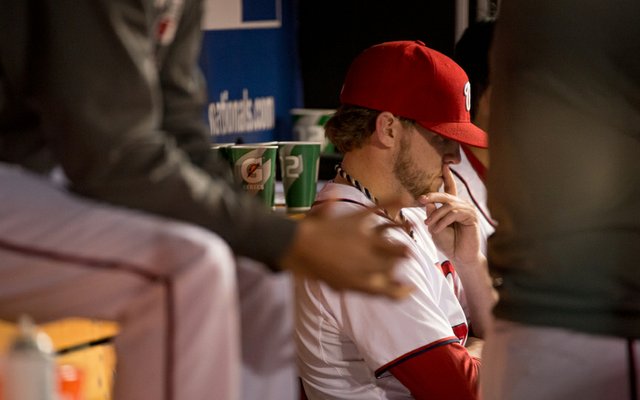
Drew Storen for Ben Revere; a trade that seems to work on both sides

47 comments

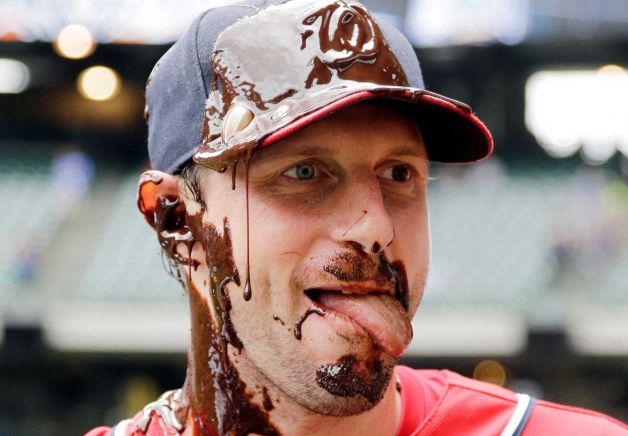
Lets Hope Storen doesn't have days like this in Toronto. Photo Andrew Harnik/washingtontimes.com

Lets Hope Storen doesn’t have days like this in Toronto. Photo Andrew Harnik/washingtontimes.com

(Editor’s note: sorry for the delay on this post: you might have noticed the site being unavailable for a bit of time yesterday.  That’s because the shared server hosting all my various business and personal websites crashed and was down for hours.  Hopefully we’re all back up and normal.  This post is written and posted as of 1/10/16).

Drew Storen got his wish today; a fresh start with another team.  And amazingly, Mike Rizzo was able to turn an asset that basically the entire industry knew he was shopping (and knew that the player wanted out) and was able to basically get the *exact* player he was seeking in Ben Revere; a capable hitter who fits precisely into the hole left by the departed Denard Span.  Lefty, center fielder, lead-off hitter, good stats.

Amazing trade, frankly, by Rizzo, given these circumstances.

The Nats hadn’t consummated a trade with Toronto since 2005 (and that was a two minor leaguers swapping deck chairs kind of a deal in Tyrell Goodwin for Aaron Wideman).  Clearly Rizzo has a better working relationship with the new brain trust in Toronto (former Cleveland GM Mark Shapiro) than he did before (Alex Anthopoulos).

For Storen; he gets out of town and gets a chance at a fresh start for a team that won its division last year and still sports the best offense in the game.  He’s gotta be happy.  I’m not sure he is the closer in Toronto (Robert Osuna was pretty good: 20 saves, 2.58 ERA, 153 ERA+, sub 1.00 whip but is also just 20); maybe there’s a ST competition, maybe Storen just accepted the deal and the 8th inning to get a fresh start.  Can’t blame him.

For the Nats, they get basically the #1 priority they’ve been seeking all off-season.  And they get it without committing to major dollars in the future, without giving up a draft pick, and without trading any of their prospects.  In this respect, A+ trade for Rizzo.  Revere had a good lead-off hitter slash line last year (.306/.342/.377), hits lefty to help with lineup balance, and plays a position of need (CF).  I’m not sure he’s the super duper awesome CF that the team sought (a good looking uzr/150 in 2015 but negative defensive figures the three previous years in Philly), but he’s always been awesome in RF so maybe we’re looking at Harper in CF and Revere in RF as a optimized defensive alignment.  (Oh who am I kidding?  Do you think Dusty Baker is looking at fangraphs and seeing massive negative DRS figures for Revere and going, ‘gee he should play RF?’)

The Nats also save some cash (Revere makes a bit less than Storen in terms of projected Arb salaries), AND the Nats get a PTBNL (probably a low-level prospect).  We sent some unreported amount of cash to Toronto; probably a few hundred thousand or so to balance out the salary delta.  I love it when billion dollar assets send piddling amounts of cash in deals; can you imagine the negotiations?  “Hey Mike, I need $100k to make this deal work.”  “Oh ok Mark, lemme dig into my car cushion and see what i’ve got here that fell out of my pocket during my last arbitration negotiation … oh!  here’s $200k.  Sold!”

New projected opening day 2016 lineup:

  • Revere*, Rendon, Harper*, Zimmerman, Murphy*, Werth, Espinosa*, Ramos, pitcher.

Perfect lefty/righty balance.  If you think Espinosa is super-sub and Drew is the starter at short, replace like for like since Drew is a lefty hitter.  If you think Turner is the starter … you’re crazy to think that given the moves this team has made in the past few weeks 🙂

Other downstream effects of this deal:

  • If we didn’t have confirmation before, i’ll say it again: i just can’t see how Trea Turner makes the 25-man roster.  This was more about the Drew acquisition than this, but I don’t see how he makes this team unless someone gets hurt in Viera.
  • The 5-man bench looks pretty much complete: backup C (Lobaton unless otherwise replaced), RH pinch hitter/corner player (Moore), LH pinch hitter/
    corner player (Robinson), speedy backup OF who can play CF as needed (Taylor), and utility infielder (Drew or Espinosa).
  • Matt den Dekker now gets pushed to AAA; i can’t see him beating Clint Robinson for “lefty PH bat” and Moore is now basically the only RH bat on the bench so gets to stick around another year.
  • Taylor now is back to being 4th OF, right where he was last year.  But don’t worry; Werth probably gets a hangnail on April 10th and Taylor will still get 300-400 ABs in 2016.
  • Not a ton of salary difference with the move; Storen and Rivera were projected by mlbtraderumores to make 8.8 and 6.7M respectively.  I had Storen’s projected salary a bit less.  In total, I’ve got the 2016 projected payroll at $143M now, still $18M less than last year.
  • Treinen now is back in the projected MLB bullpen; I think he was last guy out given the acquisitions and make up of the roles prior to Storen’s jettison.
  • Papelbon now probably stays; i’d be shocked if he gets moved now, given his NT clause and his toxicity around the league. And, well, the team still needs a frigging closer.  Ironic that they “had” to move their home grown 1st rounder (who happened to also be the union rep) so that they could keep the former star of their divisinoal rival who also just happened to choke the unanimous league MVP on national TV.  But that’s the bed they’ve made for themselves.

One last thing: The bullpen makeover now seems complete.  Check out how the 2016 projected opening day pen looks compared to years past:
o 2016: Papelbon, Treinen, Gatt, Kelley, Perez*, Rivero*, Petit (Barret on D/L)
o 2015: Storen, Treinen, Barrett, Stammen, Thornton*, Cedeno*, Roark (Janssen on d/l)
o 2014: Soriano, Storen, Clippard, Barrett, Stammen, Blevins*, Detwiler*
o 2013: Soriano, Storen, Clippard, Mattheus, Stammen, Rodriguez, Duke*
o 2012: Clippard, Lidge, Mattheus, Stammen, Rodriguez, Burnett*, Gorzelanny*
o 2011: Storen, Clippard, Coffey, Gaudin, Burnett*, Slaten*, Broderick
o 2010: Capps, Clippard, Bruney, English, Bergmann, Burnett*, Walker*, Batista (yes it was an 8-man pen)

100% turnover from 2015’s opening day rotation, man for man (if Janssen had been healthy, Treinen would have been in AAA).  I know it needed to be done, but i’m still apprehensive about it from a cohesion perspective.

In summary; good trade for both sides.  Sorry to see Storen go but it had to be done for both the player and the team.  I think the Nats are better today than they were yesterday; not because Revere > Storen necessarily (by bWAR they are but that’s probably not a fair comparison) but because Storen wasn’t going to be the best he could be here any longer.
Potomac/High-A Pitching Staff Year in Review; 2015

20 comments

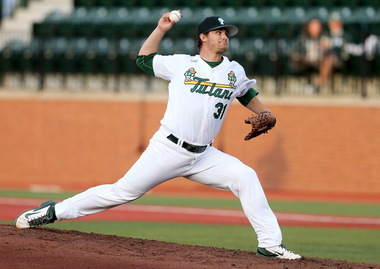
Tyler Mapes is a great draft story and my pitcher of the year out of Potomac. Photo via nola.com

Tyler Mapes is a great draft story and my pitcher of the year out of Potomac. Photo via nola.com

This is the 4th in the 2015 Pitching staff review series, here’s a review of Potomac/High-A’s pitching staff for 2015.  Other parts of the 2015 series:

For some historical perspective, here’s 2013’s version (featuring Taylor Jordan), here’s 2012’s version (Nathan Karns the feature pitcher) and 2011’s version (Danny Rosenbaum the feature pitcher) of this post specifically for Potomac/High-A.  Had we done this in 2014, we would likely have “featured” Gilberto Mendez for his good work closing.

Note; while its relatively easy to do reviews for the upper levels of the system, once we get lower we’re usually talking about a lot of short sample sizes.  And i’m sure there’s people reading this who saw every pitcher on this post throw in 2015; by all means feel free to comment if you believe i’ve mis-characterized someone here.  Of all the write-ups I expect readers here to have better opinions of Potomac players by virtue of actually seeing them week in/week out, so definitely pipe up.

All stats are courtesy of either milb.com’s Potomac 2015 Stats page or via Fangraph’s Potomac 2015 page.   Also useful here are the Big Board and the Nats Draft Tracker since so many of these lower-minors guys are recent draftees.  And here’s the Baseball America Minor League Free Agent (MLFA) tracker.  And here’s a list of the official MLB MLFA declarations for 2015, though these are more useful for the AAA and AA squads frankly.

Potomac Pitching Staff movement throughout the year (* == lefty)

  • Opening Day rotation: Pivetta, Rauh, Schwartz, Suero, Spann*
  • End of Season Rotation: Mapes, Dickson, AWilliams, Spann*, Howell
  • End of Season spot starts/swingman: Dupra, Thomas*,  Valdez
  • End of Season bullpen:  Self,   Walsh*, Johansen, Orlan*, MRodriguez
  • Mid-Season promotions: Dupra, Bacus, Suero, Pivetta, Mapes, Giolito, Purke*, Simms, Rauh, Roark
  • up-and-back: Mapes, Spann*, Dupra
  • down-and-back: Thomas*, Rauh
  • demotions: KPerez, Napoli*, Amlung, Orlan*
  • D/L: RPena, Turnbull*, Sylvestre*,  Lopez
  • cut/released/FAs: Mirowski, Henke, Encarnacion, Schwartz (retired), CDavis

Potomac starters.  The rotation started the season with Pivetta, Rauh, Schwartz, Suero, Spann*.  19 guys got starts in 2015.  Here’s an overview of the starters used, starting with the original five starters, going all the way to the rehab spot starts.

  • Nick Pivetta was your opening day starter, and by the end of the season he had gotten promoted and traded.  He earned his promotion, going 7-4 with a 2.29 ERA in 15 starts for Potomac.  He was not as successful upon his promotion to AA, but that was still enough to catch the eye of Philadelphia and be the bounty for them ridding themselves of Jonathan Papelbon‘s ego and contract.  If he was still with the team, he would have been the ‘featured” player above and not Mapes for his dominant season in High-A.  Outlook for Next Season: Philadelphia’s AA team in Reading, where he gets to go against Harrisburg and all his old teammates a few times a year.
  • Brian Rauh threw 7 excellent High-A starts before getting promoted to AA, where he spent most of the year.  See AA write-up for more.  Outlook for Next season: AA rotation or bust.
  • Blake Schwartz had three High-A starts, struggled, and retired.  After a fantastic 2013 season in Potomac, he just never could make the jump to AA and (not that I’ve ever talked to him or anything) perhaps got discouraged after not really progressing further up the chain.  Outlook for Next season: retired, out of baseball
  • Wander Suero pitched pretty effectively for Potomac in the first half in a swingman role, getting 16 appearances and 5 starts and posting a 2.41 ERA, 1.20 whip, and a 3.27 FIP.  Not much in the way of swing and miss though; 39/18 K/BB in 56 innings.  After moving up, he struggled in AA but inched up his K/9 rate while focusing more on middle relief.  No reason to think he can’t compete in AA in 2016, and is still relatively young (he turned 24 just after the season ended so he’ll still be 24 all next year).  Outlook for Next season: AA bullpen, perhaps High-A bullpen again if he gets squeezed in a numbers game.
  • Matthew Spann bounced between High-A and AA all year, posting mid 4 ERAs in both places.  See AA write-up for more.  Outlook for Next season: AA rotation.
  • Reynaldo Lopez led the team in IP and starts for 2015, going 6-7 with a 4.09 ERA in 99 IP across 19 starts.  His stats: 4.09 ERA, 1.22 whip, 2.95 FIP and 94/28 K/BB in those 99 innings, all as a 21-yr old.  It isn’t hard to see why Lopez is highly ranked on “top 10” lists for Nats prospects; he more than held his own in High-A as one of the younger hurlers in the league.  The team held him back in XST for a few weeks to keep innings off his arm.  While most scouting reports think he’ll eventually end up in the bullpen (no third pitch, iffy mechanics, big arm), he’s obviously worth giving more chances to stick as a high-velocity starter (in the same vein as Yordano Ventura for example).  Outlook for Next season: AA rotation.
  • John Simms threw an excellent half season for Potomac before getting bumped up mid-season; see AA writeup for more.  Outlook for Next season: AA rotation.
  • Lucas Giolito threw an dominant half season for Potomac (86 ks in 69 innings) after being kept in XST for the first 5 weeks of the season (so much for those pre-2015 interviews where he proclaimed that he had no innings limits, eh?) before also getting bumped up mid-season; see AA writeup for more.  Outlook for Next season: AA rotation.
  • Austen Williams blitzed the Sally league and forced a promotion to Potomac mid-season, where he continued pitching well.  In High-A he was 4-6 with a 2.59 ERA, 1.09 whip, 3.22 fip and 41/17 K/BB over 63 high-A innings.  The 2014 draftee is looking like a nice little find.  There does seem to be a bit of fortuitousness in his numbers (.253 BABIP and a delta between his ERA and FIP), so I could see the log-jam in the AA projected rotation keeping Williams back in Potomac for the first half of the 2016 season.  Outlook for Next season: High-A rotation to start with an eye on quick promotion.
  • Philips Valdez dominated the Sally league and earned a promotion after two months.  In Potomac he bounced in and out of the rotation, getting 10 starts across 22 appearances and posting a 3.77 ERA in High-A.  Other numbers: 1.44 whip, 3.26 fip, 48/25 K/BB in 59 High-A innings.  Valdez has been around for a while; this was his *seventh* season in the Nats organization.  He just turned 24.  But he has relatively few innings on his arm; just 260 IP across those seven seasons (he missed the entirety of 2012).  He’s looking like he could be a low-profile decent starter going forward, though he may run out of time in the system before the team is faced with a tougher decision on how to keep him.  For now, I think he repeats High-A to start, is tried out as a full time starter, and we’ll see if he can push forward to AA in 2016.  Outlook for Next season: High-A rotation
  • Tyler Mapes so far is a pretty good 2014 draft success story; he was a 30th round *senior sign* out of Tulane who was basically unhittable in Short-A last year, threw 6 clean innings in Low-A and was bumped up to High-A (the first 2014 draftee to get promoted that high) after just a couple of weeks.  Once in Potomac, he continued to pitch well in a swing-man role; 30 appearances, 8 starts, a 2.38 ERA across 90 innings, 1.22 whip, 2.78 FIP and 75/17 K/BB over 96 innings in High-A.  Not too shabby.  If it were me, I’d push him right to AA and stick him in the rotation, but as noted before I’m projecting an awful lot of starters to be in that Harrisburg rotation right now.  I’m curious to see how things shake out for someone like Mapes; he didn’t last to the 30th round as a favor to the Nats; is there something limiting in his capabilities that will cause him to suddenly top out like a lot of late-round senior signs?  We’ll see.  Outlook for Next season: AA rotation.
  • Ian Dickson was hurt the first half of the season and finished 2015 the exact same place he finished 2014: in the Potomac rotation with decent to effective numbers.  2015 totals for Dickson: 3-3, 3.60 ERA in 12 appearances/8 starts.  We see a problem though: 31 ks and 39 (?!) walks in 40 innings in Potomac this year.  Wow; that’s a walk an inning.  He never saw this kind of walk rate before, so hopefully its just a remnant of whatever injury kept him out the first half of the year.  Nonetheless, he seems like he’ll be back in Potomac a third year until he can solve his walk rate issues.  Outlook for Next season: High-A rotation.
  • Dakota Bacus began the season in Potomac, had 5 starts and 8 appearances and got bumped quickly to Harrisburg, where he played most of the season.  See AA write-up for more.
  • Jeff Howell is a pretty interesting player.  He’s a career minor league backup catcher, having toiled in the lower minor leagues since 2005.  He signed on with Washington in 2012 and hung around as a backup between the levels for a couple of years.  Then suddenly, at the age of 32, he decided to try his hand on the mound.  Perhaps he was inspired by other Catchers-turned-Hurlers like Jason Motte.  He (presumably) hung out in XST for most of the season learning how to pitch, then threw a couple of games in the Rookie league, then for Hagerstown, then finally for Potomac at season’s end.  He struggled once he got to Potomac, giving up 9 runs in 13 innings but more importantly walking 17 guys while he was there.  He’s now a MLFA and one may think that he’d re-up with Washington since we’re the ones who gave him a shot.  We’ll see how the off-season goes.  He may choose to pitch elsewhere where he can be guaranteed a rotation spot (a tough one in our system, since we’re completely overloaded with arms from pitching-heavy drafts over the past few years).   Outlook for Next season: continuing his conversion to pitcher in another organization.
  • Others who got starts in Potomac for 2015:
    • Matt Purke got three brief starts in Potomac before settling in Harrisburg for the year; see AA write-up for more.
    • Rehab starts for Potomac in 2015: Barrett, Roark, Janssen and Carpenter (though technically Roark’s were not rehab but “stretching out” starts).

Potomac Relievers: taking a look at the relief corps.  We’ll organize relievers by going by IP from most to least.  Anyone with less than 10 IP will get cursory analysis at the end.

  • Justin Thomas was the bullpen leader in IP for Potomac in 2015, throwing 57 innings across 28 games, posting a 3.43 ERA, 1.21 whip, a 2.84 FIP and getting 50/18 K/BB in those 57 innings.  He’s a lefty but was used more as a long-man, not being limited to just short stints.  He’s looking great considering his limited draft pedigree (senior sign out of a small college in the 21st round) and I see no reason not to keep bumping him up the chain.  Outlook for Next season: AA rotation.
  • Jake Johanssen was 1-7 with a 5.44 ERA, 1.81 whip, 4.69 fip with 48/27 K/BB in 48 relief innings for Potomac.  Johanssen was our top draft pick in 2013, has already been “demoted” from a starter to the pen, and now seemingly can’t perform in a relief role either.  Where do you go from here with him?  You and I know that his large bonus is a “sunk cost” and shouldn’t dictate his usage, but teams don’t seem to see it that way.  Just look at how long the Nats kept Brett Mooneyham around after it became clear he wasn’t capable of performing, even at lower levels of the minors?  I see Johanssen repeating High-A and trying to get his career back on track.  Outlook for Next season: High-A bullpen.
  • Derek Self seems to be taking a step back in his career; after posting a 1.69 ERA through half a season in Potomac last year, he more than earned a promotion up to AA where he more than held his own.  However after just 14 innings in AA this year, he got dumped back to Potomac, thus repeating High-A for the third straight year.  He was solid again; a 4/1 K/BB ratio in middle relief, but where is his Nats career going at this point?  Obviously he needs to be in the AA bullpen next year, but you could have also said that last year and it didn’t work out.  There’s going to be a lot of AA bullpen competition; if he gets squeezed out does he get cut in 2016?  we’ll see.  Outlook for Next season: AA bullpen competition/Release Candidate.
  • Brian Dupra is in a similar boat as Derek Self; he’s now 27 and spent most of his third successive year in Potomac.  He was promoted mid-season to AA but didn’t last long after getting hit hard.  Final Potomac stats for 2015: 2.79 ERA in 42 mostly later bullpen innings.  I think he’s going to be in a similar situation as Self this coming spring; if he cannot cut it at AA (and there’s plenty of competition for that bullpen), he may get cut loose entirely.  Not that it should matter, but it should be noted that Dupra was a senior sign for limited bonus money out of Notre Dame in 2011, so it could be a “make the team or get cut” situation.  Outlook for Next season: AA bullpen competition/Release candidate.
  • Cody Davis was struggling early in the season, with a decent ERA but ugly peripherals (4.55 fip, 10/15 K/BB in 21 ip) and was released towards the end of June as upwards player movement started to need bullpen spots.  The undrafted MLFA signing from 2011 played parts of 5 seasons for the system but seemed to fall apart this year as he repeated High-A.   It does not look like he picked up anywhere and may be done.  Outlook for Next season: out of baseball.
  • Manny Rodriguez only threw 21 innings between two different D/L stints this year, and then was released soon after the end of the season.  It seems that the team believed he never recovered from the injury that cost him two full seasons early in his minor league career.  Outlook for Next season: out of baseball.
  • Jake Walsh threw 17 scoreless innings as a late-inning/closer in Low-A before getting bumped up to High-A in July.  From there out he posted a 3.66 ERA in 19.2 innings across 9 appearances with a 19/10 K/BB ratio.   There’s something odd going on with Walsh; why was he even in Low-A to start 2015?  He posted a sub-2.00 ERA across low- and high-A LAST YEAR, yet didn’t start in Potomac nor get considered for the AA rotation despite being a senior sign in 2013.  He now holds a CAREER 1.65 ERA and seems to me to more than have earned a shot at a look at a higher level.  Outlook for Next season: AA bullpen.
  • Kevin Perez spent the 2nd half of the year in  Hagerstown after struggling early on in Potomac: see Low-A write-up for more.
  • Robert Orlan spent most of the season in Hagerstown but posted a 2.20 ERA in Potomac in 16.1 August innings:  see Low-A write-up for more.
  • Justin Amlung, similarly to Orlan above, spent most of the season in Hagerstown but posted an excellent 1.84 ERA in Potomac in 14.2 July and August innings:  see Low-A write-up for more.
  • Other Relievers of note who had less than 10 IP for Potomac this year:
    • David Napoli had 8 IP for Potomac before getting demoted to Hagerstown:  see Low-A write-up for more.
    • Matt Purke threw 7 IP for Potomac during his tour of the Nats farm system in 2015: see AA write-up for more.
    • Erik Davis threw 3 re-hab IP in 2015; see AA write-up for more.
    • Tanner Roark threw one 4Ip start during his “stretch out” minor league stint; see MLB write-up for more.
    • Brenden Webb, normally an Outfielder, threw a 3Ip mop-up game (really?  they couldn’t find ONE reliever out of the 32 guys who threw innings for Potomac this year?)
    • MLBers Aaron Barrett, Casey Janssen and David Carpenter each had some re-hab innings; see MLB write-up for more.
    • A few guys spent the entire year on the D/L: Ronald Pena, Kylin Turnbull, Hector Sylvestre: all are looking at repeating Potomac next year if/when healthy.

Summary

Potomac certainly saw a lot of churn in its pitching staff; 32 total pitchers used (19 different starters including rehab starts by relievers).  Their leading IP was Lopez, who didn’t even hit 100 IP on the year.  There were at least 6-7 arms who earned their promotions to AA mid-season, a great sign for the rising tide of pitching talent in the system.  Lots of guys with ERAs that start with a “2” in the season-ending stats.  It didn’t help Potomac in the standings; they finished both halves several games under .500 and out of the playoffs.  This will create quite a competition for the AA staff next year: my projections at this point show at least 6-7 rotation candidates, 8-9 bullpen candidates and another 3-4 guys who are right at that age where they may be summarily cut if they don’t make the AA team in 2016.  Harsh, but good for the Nats, who could use all the bullpen help they can get.

Hall of Fame candidates with Nationals ties (2016 version)

7 comments

Griffey was nearly unanimous. Photo via freeteam.com

Griffey was nearly unanimous. Photo via freeteam.com

Congrats to Ken Griffey Jr. and Mike Piazza for their election this year.  Hopefully the high vote totals for Bagwell and Raines will lead to their election next year, where the ballot doesn’t really have any obvious candidates.  (And let me qualify: I absolutely think there’s players on next year’s ballot who deserve to be in … its just that PED stain will probably prevent them from being slam-dunk candidates.  More on that in next year’s episode of “how the Hall of Fame Ballot turns”).

This is the Class of 2016 Version of this post: first one was done after the 2014 Hall of Fame class was announced and the voting results made public, and then the next was done after the Class of 2015 was announced.

Here’s a review of every player who has Nationals ties who has appeared on a Hall of Fame ballot, along with their voting results.  This post will let you answer the trivia question, “What former Nats player has come the closest to Hall of Fame enshrinement?”  (Answer at the bottom)

We’ll work from most recent to oldest.

2016 Ballot:

Not a single Nats-connected is on the official Class of 2016 ballot.  So, really the rest of this post is just cut and pasted from last  year’s post.  But we’ve published it for a trip down memory lane.

Post-publishing update: as I suspected but didn’t have a good way to research, there’s actually quite a few guys who were *candidates* for the 2016 ballot by requirements, but who didn’t make the cut who also had connections to the Nationals.  In fact, there’s quite a few of them.  Here’s a good list, thanks to the excellent research by Bill from platoonadvantage.com.

  • Ronnie Belliard: Played pretty well for the god-awful stretch of Nationals teams from 2007-2009, posting a nifty 123 OPS+ during the middle season before getting traded away at the 2009 trade deadline for two minor leaguers who never went anywhere (Luis Garcia, Victor Garate).  Stuck with Los Angeles one more season before hanging them up at 35.  Played parts of 13 seasons in the majors but didn’t rate a spot on the ballot.
  • Jesus Colome was an important part of the Nats bullpen during the same 2007-2009 span that Belliard was involved with, getting more than 120 appearances his first two seasons before posting an 8 ERA in 2009 and getting DFA’d in July.  He got picked up the next year by Seattle and got a few appearances (hence why he’s not on the “Nats to Oblivion” lists) and, if you can believe it, is still pitching at age 37 in the independent Atlantic league as we speak.  He did manage 10 distinct years w/ MLB appearances though, so he qualified.
  • Jose Guillen came to Washington with the Expos, played one solid year in 2005, had a season-ending elbow injury in 2006, then bounced around the league for a few more years.  He was active for 14 total seasons but never made an all star game.  He hit 24 homers for the surprising 2005 Nats … and led the league in HBPs.
  • Cristian Guzman signed a somewhat controversial 4yr/$16M contract (it cost the team its 2nd round pick) that started when the team moved to Washington, was god-awful his first year, then had to have shoulder surgery to miss the entirety of 2006.  He recovered his stroke in 2007 and actually made the all-star team in 2008 (our only representative during the dark years) … which was enough to convince our idiot GM Jim Bowden to give him a 2yr/$16M extension to an aging shortstop w/ no power on the wrong side of 30.  Not surprisingly, his OPS dropped 100 points in 2009 and the team dumped him on Texas in a trade-deadline deal after he had lost his starting job to Ian Desmond, netting the Nats two RHPs (one of which Tanner Roark makes this one of the better trades ever consummated by the Nats executive staff).  Guzman played in 15 more games for Texas, batted .152 and never played again.

2015 Ballot:

  • Aaron Boone, who signed a 1yr/$1M FA contract to be a backup corner infielder with the abhorrent 2008 Nationals team.  Boone’s crowning baseball achievement was his extra innings walk-off homer that ended one of the best games in MLB history (Game 7 of the 2003 ALCS between Boston and the Yankees, ranked #6 by MLB’s panel a few years back when ranking the best 20 games of the last half century).  Ironically one of his lowest moments was just a couple months later, blowing out his ACL that subsequent winter while playing pickup basketball, costing him the entirety of the 2004 season and the trust of the  Yankees organization.  He missed 2/3rds of the 2007 season after another left knee injury and the Nats were probably his last gasp shot at extending his career at the age of 35.  He got a decent amount of playing time thanks to the fragility of Ryan Zimmerman and Nick Johnson, somehow got another guaranteed MLB deal the following year, went 0-14 for Houston and was released.  He’s now an analyst with ESPN.  Received 2 votes on the 2015 ballot.
  • Ron Villone signed a minor league deal in 2009 and was quickly added to the Nats active roster, where he appeared in 63 games as our primary one-out lefty.   He pitched the entirety of 2010 on another minor league contract with Syracuse, posting a 6.59 ERA as a 40-year old and never earning a call-up.   In 2011 he was invited to spring training again (perhaps with the hope that he’d join the organization as a coach) but he got cut, then pitched a handful of indy league games for his home-town New Jersey indy league team, got hammered, and hung them up.   He retired having played in 15 seasons for no less than 12 different teams.  In 2012 he took a pitching coach job with the Cubs organization (one of the teams he managed NOT to play for during his career) and has been moving up their organization in that capacity since.  Received Zero Hall-of-Fame votes by virtue of not appearing on the BBWAA ballot.
  • Julian Tavarez signed a one-year deal in the beginning of 2009, started out decently but had an awful stretch that resulted in his DFA in mid July 2009.  He never threw another pitch in organized ball, abruptly retiring considering his mid-season release.  He ended a 17-year career spanning 11 different franchises.  Received Zero Hall-of-Fame votes by virtue of not appearing on the BBWAA ballot.  According to his wiki page, he now resides in a suburb of Cleveland (his original professional team) but does not list any post-career activities, baseball-related or otherwise.  Received Zero Hall-of-Fame votes by virtue of not appearing on the BBWAA ballot.

Both Tavarez and Villone belong to the infamous “From Nationals to Oblivion” club, a topic we revisit on an annual basis.

Note: it is not entirely clear to me why Villone and Tavarez were not actually ON the 2015 ballot; both seem to have the qualifications (10 years of experience and 5 years retired) and both were on previous versions of the “anticipated ballot” at baseball-reference.com, but neither showed up on BBWAA’s official ballot for this year.  Pete Kerzel did a post reviewing “Nats connected” 2015 ballot members when the ballot came out in Nov 2014 and only mentioned Boone.  I include them here since it seems to me they *should* be on the ballot and I’m not sure why they were not (unless someone is passing judgement on the “quality” of HoFame ballot members).  Are they pushed to subsequent ballots for some reason?  If anyone has insight i’d love to know.

2014 Ballot:

  • Paul Lo Duca: one of Bowden’s more infamous signings; he went from our opening day catcher in the 2008 season to being released by August 1st.  The highlight of his tenure here was having his name being revealed in the Mitchell Report just a couple days after signing with us.  After his release, he signed on to finish out the season with Florida, took a year off and attempted a come back in 2010 (signing a ML contract with Colorado but never appearing above AAA).   Hard to believe this guy was a 4-time all-star.  Received Zero hall-of-fame votes.

2013 Ballot:

  • Royce Clayton; signed a contract to be the Nats shortstop during the lean Jim Bowden years, and then was included in the Mega swap of players that headed to Cincinnati in the 2006 season.  He hung around for one more season in 2007 as a backup short stop and retired afterwards.  Received Zero hall-of-fame votes.
  • Mike Stanton was picked up in mid 2005 after being released by the Yankees, and he pitched well enough for the Nats that he was able to fetch a couple of low-level prospects in a late September move to Boston (who was looking for some late season bullpen cover).  The team then re-signed Stanton for 2006, and flipped him again mid-season, this time to the Giants for Shairon Martis.  Stanton toiled a one more season before hanging them up after 2007.   Received Zero hall-of-fame votes.

2012 Ballot:

  • Vinny Castilla: signed a two year deal to join the Nats, timed with their inaugural season in Washington, but was traded to Colorado for SP Brian Lawrence when it became apparent that Ryan Zimmerman was set to man the hot corner in DC for the next decade or so.  Played one more season and retired after 2006.  Received Six (6) Hall-of-fame votes.

2011 Ballot:

  • Carlos Baerga: signed a one year deal as a 36-yr old to join the Nats in their inaugural season and serve as a backup infielder.   Hit .253 in part-time duty and hung ’em up after a 14-year career that can be well described as “journey-man.”   He was an integral part of the early 90s Cleveland Indians as their starting 2nd baseman and a 3-time all-star, and ended up playing on 6 major league teams and spent parts one season in Korea.  Received Zero hall-of-fame votes.

So, thus far the Nats greatest Hall of Fame achievement is Vinny Castilla receiving 6 sympathy votes.  I’m sure this will change when Pudge hits the ballot next year (2017 class ballot).  Stay tuned!

Harrisburg/AA Pitching Staff Year in Review; 2015

43 comments

Voth was your unquestioned AA star pitcher in 2015. Photo via mlbdirt

Voth was your unquestioned AA star pitcher in 2015. Photo via mlbdirt

After skipping the minor league pitching staff reviews in 2014 (that silly thing called work interfered), I’m back for 2015.  I’ll be reviewing the six minor league levels and the major league levels going from high to low.

In this series, we have already published the 2015 MLB review and the 2015 AAA review.

For some AA review historical perspective, here’s 2013’s version (featuring Nathan Karns), here’s 2012’s version (featuring Danny Rosenbaum) and 2011’s version (featuring Brad Peacock) of this post specifically for Harrisburg/AA.  In the missing 2014 post I likely would have “featured” either A.J. Cole or Matt Grace.

All stats are courtesy of either milb.com’s Harrisburg 2015 Stats page or via Fangraph’s Harrisburg 2015 Stats page.   Also useful here are the Big Board and the Nats Draft Tracker.  And here’s the Baseball America Minor League Free Agent (MLFA) tracker.  And here’s a list of the official MLB MLFA declarations for 2015, though these are more useful for the AAA squad frankly.

Harrisburg Pitching Staff movement throughout the year (* == lefty)

  • Opening Day Rotation: Voth, Ross, Espino, Alderson, Swynenberg
  • End-of-Season Rotation:  Bates, Voth, Rauh, Simms, Giolito
  • End of Season spot starts/swingman:  Purke*
  • End of Season bullpen: Mendez, EDavis, Suero, Lee*, de los Santos, Demny
  • 9/1 promotions: Bacus, Roark
  • Mid-Season promotions: Swynenberg, Espino, Ross, Demny, Simmons, Solis*, Bleier*, Runion, Harper*
  • up-and-back: de los Santos
  • down-and-back: Spann*
  • demotions: Self, Dupra, Mapes, Amlung
  • dl/TIL: Benincasa, Alderson
  • cut/released/FAs/traded: Sisk, Ambriz, Pivetta (traded)

Harrisburg starters.  The rotation started the season with Voth, Ross, Espino, Alderson, Swynenberg.  Here’s an overview of the starters used, starting with the original five starters.

  • Austin Voth not only was the opening day starter, he led the team in IP and in starts.  He posted a 6-7 record with a 2.92 ERA, 1.11 whip, 3.07 fip and had a 148/40 K/BB ratio in 157.1 innings.  Nobody else had more than 15 starts on the year for the Senators, meaning Voth was the unquestioned leader of this pitching staff all year.  He proved that his precipitous rise in 2014 was no fluke by posting solid numbers.  Thanks to a glut of starters above him, I can’t quite see him breaking into the MLB rotation (ala Jordan Zimmermann, who jumped straight from a solid AA season to the majors), but I can see him jumping ahead of some of the AAA starter-in-waiting guys (Cole, Jordan, Hill) if/when the opportunity arises to provide injury cover in the majors.  Outlook for Next season: AAA rotation and a MLB debut at some point in 20116.
  • Joe Ross threw 9 solid starts in AA before getting called up and solidifying his place in the 2016 MLB rotation; see the MLB write-up for more.  Outlook for Next season: Nats #4 starter.
  • Paolo Espino threw seven decent starts in AA before getting plucked to move up, spending the rest of the season in AAA.   See AAA write-up for more.  Outlook for Next season: AAA rotation.
  • Tim Alderson had just 5 starts as a Feb 2015 MLFA signing before getting hurt and spending essentially the rest of the season on the D/L.  He has already elected free agency.  Outlook for Next season: in another organization.
  • Matt Swynenberg made just two AA starts, got bumped to AAA to provide cover and then apparently elected to retire, spending the rest of the season on Syracuse’s restricted list.  See AAA write-up for more (though there’s not much more to tell).  Outlook for Next season: retired
  • Colin Bates returned to Harrisburg for his second stint, converting more to a long-man/spot starter in 2015 than the pure reliever he was in 2014.  Results are mixed: he was 6-6 with a 4.28 ERA in 111.1 innings across 28 games/15 starts.  1.37 whip, 4.25 fip.  62/29 K/BB in those 111 innings.  A pretty low K/9 ratio for today’s power-heavy pitching game lends me to believe that Bates has reached his peak; I could see him pushed to the AAA bullpen or staying in AA bullpen again as a swingman based on the numbers, but either way he stands to play out 2016 as an org guy before hitting MLFA.  Outlook for Next season: AA bullpen.
  • Richard Bleier gave AA 15 effective starts before getting pushed to the AAA rotation;  See the AAA write-up for more.   Outlook for next season: in AAA for another organization
  • Dakota Bacus started in Potomac but got bumped quickly to Harrisburg, where he played most of the season (he was a 9/1 call-up to AAA to provide a few days of bullpen cover).  For Harrisburg he was 6-3 with a 3.51 ERA in 22 appearances and 11 starts.  1.29 whip in AA, 4.11 fip and a 53/29 K/BB in 89.2 AA innings.  Not bad, not great.  Bacus was the return for Kurt Suzuki trade in late 2013 and has steadily climbed the ladder; I can see him in the AAA bullpen next year.  He’s still just 24 and we have a couple more years of control, so he could still have an impact.  He’s survived one Rule-5 draft already; his goal in 2016 should be to put himself in a position to earn a 40-man spot.  Outlook for Next season: AAA bullpen.
  • Matthew Spann bounced freely between High-A and AA this year, throwing slightly more innings in High-A but getting 10 starts in AA.  In those 10 AA starts, he was 2-2 with a 4.66 ERA, 1.61 whip, 3.70 fip and had a 35/25 K/BB ratio in 56 innings.  He ended the year where he began it; the High-A rotation.  Spann was the return for David DeJesus and already has 6 minor league seasons in him, so he may have found his peak level.  I could see him back in the mix for the AA rotation for one more season before hitting MLFA/getting released.  The fact that he’s a lefty though gives him a bit more of a stay of execution; his lefty vs lefty numbers are a bit better than against righies, so perhaps he could convert to relief if need be.  But he’s stuck as a starter for an awful long time; most guys wouldn’t last 6 seasons as a starter in the low-minors unless there was something there.  Outlook for Next season: AA rotation.
  • Lucas Giolito had 8 starts for Harrisburg after a mid-season promotion from High-A.  He was 4-2 with a 3.80 ERA in those 8 starts, with 1.37 whip, 3.18 fip and 45/17 K/BB in 47.1 AA innings.  Gioloto took a bit of time to adjust to AA; 10 of the 20 earned runs he gave up (and 6 of his 11 walsk) in his 8 AA starts were in his first two appearances.  It took him weeks to get a home start, and he only made two home starts during his AA season.  Eventually he adjusted; throwing 7 innings of one-hit ball with 11 strikeouts in his home debut for Harrisburg.  Giolito got hit; he certainly wasn’t as dominant in AA as he was in High-A, but he’s also just turned 21 and there’s no mistaking the potential in his arm.  I think the team starts him in AA again, hoping for a 5-6 week earned promotion to AAA and perhaps a mid-to-late season call-up potential for 2016.  Outlook for Next season: AA rotation to start.
  • John Simms earned his promotion from High-A to AA the same day as Giolito and also got 8 AA starts.  His results were mixed: 2-3 with a 4.40 ERA, 1.42 whip, 3.82 fip and 34/15 K/BB in 45 AA innings.  Simms showed more K/9 in AA than he did in High-A oddly, but wasn’t appreciably more hittable.  This was his second stint in AA and improved slightly from his 2014 numbers (where he had 11 starts with a 5.03 ERA).  Nonetheless, good progress for the 2013 11th rounder.  Outlook for Next season: AA rotation.
  • Brian Rauh had an interesting tour of the Nats minor league affiliates in 2015, starting the season in Potomac, getting quickly promoted to Harrisburg, struggling, getting hurt, going to the D/L, doing a rehab assignment in Viera, then working his way back up the chain from Low- to High-A and ending the year back in the Harrisburg rotation.  He proved twice he was too good for High-A, and proved twice why he may  not be ready for AA.  Total AA stats on the year: 8 starts, 4.83 ERA, 1.41 whip, 4.95 fip and 29/10 K/BB in 41 AA innings.   2016 is sink or swim time for Rauh in AA; he can’t go back to Potomac for the fourth straight year.  Outlook for Next season: AA rotation or bust.
  • Matthew Purke had a whirlwind off-season, getting DFA’d off the 40-man roster but then quickly re-signed to a MLFA contract for the 2015. season to give it one last go for the former big-money bonus 2011 3rd rounder.  He rose to AA where he pitched as a swing-man, getting 10 games and 5 starts, and did not impress.  6.29 ERA, 1.64 whip, 3.76 fip.  19/7 K/BB in 24 AA innings.  His lower minors numbers were much better … but at this point in his age 25 season, he needs to be competing well at the higher levels.  I think its clear that he’s not going to recover from his shoulder issues and it seems unlikely he’ll rise much above where he already has.  He has already declared as a MLFA and has signed with the White Sox as a MLFA for 2016.  Thus ends a long, drawn-out saga for a guy who I thought was a huge draft day coup for us.  Outlook for Next season: AA in the White Sox organization.
  • Others who had a few starts for AA Harrisburg:
    • Nick Pivetta had 3 AA starts after getting promoted from Potomac before getting flipped for Jonathan Papelbon: see High-A write-up for more.
    • James Simmons threw a couple of spot starts in Harrisonburg, inbetween his regular reliever duties.  See reliever section for more.
    • Solis, Fister, Strasburg, Janssen and Roark each had one “start” during rehab assignments in Harrisburg; see MLB write-up for each.

Harrisburg Relievers: taking a look at the relief corps.  We’ll organize relievers by going by IP from most to least.  Anyone with less than 10 IP will get cursory analysis at the end.

  • Gilberto Mendez keeps moving on up the system, posting a 3.84 ERA in a full season (61 innings) as a middle reliever in AA.  1.38 whip, 3.51 fip and 52/17 K/BB in those 61 innings.  Mendez’ numbers inflated somewhat dramatically from his last two years, his whip jumping from 0.94 to 1.38 with the jump to AA.  His K/9 stayed impressive though.  His BAA and BABIP look inflated so perhaps he had some bad luck going.  He’s still young (turned 23 after the season), and he could be a middle relief option in the majors relatively soon.  One thing I like about him is the way he keeps the ball on the ground: just one homer allowed in those 61 innings.  I think the team starts him in AA bullpen again looking for a 5 week promotion to AAA where he can hone his craft against more advanced/mature hitters.  It wouldn’t surprise me to see him in AAA, but right now the team has so many MLB-experienced arms that won’t make the 25-man roster that there might not be enough room in Syracuse for Mendez.  Outlook for Next season: AA bullpen to start.
  • Abel de los Santos was a surprise callup in mid July, getting a premature add to the 40-man and a call-up so that he could throw to a handful of batters, then return back to AA.  Perhaps not the best use of an option.  Nonetheless, he was a 22yr old in AA holding his own (much like Mendez; in fact their birthday is just days apart in November).  For the year in AA; 3.43 ERA in 57.2 innings, 1.13 ERA, 3.39 fip and 55/12 K/BB in those 57 innings as an 8th/9th inning guy (he had 8 saves in 11 opportunities).  His numbers look similar to Mendez’s at first, but I think the team starts him in AAA since he’s on the 40-man, in order to get him some more experience against veteran hitters.  Side note: that trade of Ross Detwiler looking pretty good now eh?  de los Santos and new top10 prospect Chris Bostick for the OBE’d Detwiler, who didn’t last half the year before getting flat out released by Texas.  Outlook for Next season: AAA bullpen.
  • Paul Demny started the year in AAA, got demoted after 10 innings and spent the rest of the season in Harrisonburg.  He had fantastic numbers in AA this year; 1.88 ERA, 60 Ks in 48 innings splitting time as the closer with de los Santos.  But its also his EIGHTH minor league season in the system.  He’s already declared as a MLFA and you have to think he’s looking elsewhere at this point, given the fact that half the RH relievers between AA and AAA got callups last year and he didn’t.  Outlook for Next season: with another organization.
  • Bryan Harper, forever to be known as Bryce’s older brother, had a pretty darn good season, posting a 3.02 ERA in 45 innings with decent peripherals (33/15 K/BB, 1.18 whip, held lefties to a .185 BAA).  He earned a late-season call-up to AAA as well.   He survived the Rule-5 draft but sits behind several other lefty relievers at this point, two of which are already slated for AAA (Grace and Solis).  I could see him losing out on a numbers game and repeating AA in 2016, waiting for injuries to open up the log jam of lefty relievers in the organization.  Outlook for Next season: AA bullpen.
  • James Simmons signed out of Indy ball and stuck with the Nats farm system for parts of two seasons, serving as a rubber-armed utility guy between AA and AAA both this year and last.  Oddly, he was hurling for AA, got called up to AAA to make one spot start in July … and then was released soon after.  His numbers weren’t great in 2014 but were improved in 2015, but as a 29-yr old now out of affiliated ball, it may be the end of the road for him.  Outlook for Next season: out of baseball.
  • Erik Davis: returned from Tommy John surgery in 2014, got shelled in AAA and then was demoted to Harrisburg for the duration of the season.  He was effective in AA (2.65 ERA in 34 ip) but you have to ask yourself; where does the team go with him?  He’s now 29, still on the 40-man roster and doesn’t look like he made a full recovery in his first year back.  Given that he was a marginal right-handed middle reliever to begin with, I wonder if he’s ever going to have an impact with this team.  He still has a MLB option left (which he’ll use in 2016), but I have him as either option #1 or #2 to DFA if the team suddenly needs 40-man roster space.  If he survives on the roster to 4/1/16, I can see him tried in AAA bullpen again.  Outlook for Next season: AAA bullpen/release candidate.  1/6/16 update: Davis was DFA’d on the 40-man to make room for Daniel Murphy: we’ll update in this space when his roster status is finalized.
  • Nick Lee earned a mid-season promotion after closing effectively for Potomac and showed some organizational intrigue while in AA.  While at Harrisburg he posted a 3.75 ERA with 29/19 K/BB in 24 innings.   Lots of walks, but also lots of Ks especially for a lefty.  On a whole, the team liked enough of what they saw to not only send him to the AFL but to also protect him on their 40-man roster.   He seemingly slots in as a lefty specialist in 2016 but sits behind Solis and Grace.  I think he starts in AA with an idea of moving up to AAA.  Outlook for Next season: AA bullpen to start.
  • Hector Ambriz was signed in May, then released in June after getting hammered in 10 outings across four weeks.  He remains unsigned.  Outlook for Next season: out of baseball.
  • Other Relievers who got innings for AA/Harrisburg in 2015:
    • Wander Suero: Pitched the first half of the season in High-A: see High-A writeup for more.
    • Sam Runion: split time between AA and AAA; see AAA write-up for more.
    • Derek Self started in AA but was demoted to High-A, where he spent most of the year.  See High-A writeup for more.
    • Sammy Solis: 13.1 IP in AA in-between assignments to AAA and MLB.  See MLB write-up for more.
    • Brian Dupra was up and down between Potomac and Harrisburg; See High-A writeup for more.
    • Robert Benincasa threw four innings in April and spent the rest of the season on the D/L.  A lost season.  Outlook for Next season: AA bullpen again.
    • David Carpenter appeared briefly for Harrisburg on a rehab stint; see MLB write-up for more.

Summary

20 guys got starts for Harrisburg in 2015, though the rotation as it were really was dominated by one crew for the first half, one crew in the second half.   A lot of the guys who featured for Harrisburg in 2015 seem like good bets to return for at least the start of 2016 thanks to the log-jam above them.   At some point though we’ll start to see movement through the system; a good number of these guys in AA need to move up or move on.


Nationals Arm Race Best Stories for 2015; Happy New Year!

22 comments

Here’s a quick recap of the year in stories on this blog, to tie a bow on 2015.  From each month, I’ve grabbed a couple of the more interesting or unique posts I did, with thoughts and follow-on.

(Here’s 2014’s review and  2013’s review as well, to see how far we have or have not evolved…)

Jan 2015:

  • Holy Cow Scherzer! Nats make a statement by signing Scherzer for $210M; he does not disappoint with 2 no-hitters in his first season.  We’ll conveniently forget his 6+ ERA during crunch time when the team was caught and surpassed in the standings by the eventual NL champion Mets.
  • Like the Janssen signing: Yeah; this one didn’t work out as well.

Feb 2015

Mar 2015

  • Brady Aiken has TJ surgery, shakes up draft boards: Aiken eventually goes 17th overall and loses millions versus where he was drafted the year prior.  Hope he can come back from such an early TJ surgery.
  • Nats Outfield … what happens next?  Big discussion once it became clear that both Span and Werth were not making the 2015 opening day lineup healthy.

Apr 2015

May 2015

  • 2015 CWS Field of 64 announced; teams and analysis: one of many CWS posts, culminating in UVA winning in Omaha in late June.
  • DC/MD/VA District High School Tournament Report: 2015 post-season: May is Prep HS tournament time.  June has a ton of College and College World Series posts.  I know I don’t get a lot of comments on my HS and College coverage, but I enjoy following both and try to keep interest in local baseball alive.  FWIW, the area may very well have a first round pick in 2016 in Oakton HS’ Joe Rizzo.  More to come in February when I start up Prep baseball 2016 posts.

June 2015

July 2015

Aug 2015

Sept 2015

Oct 2015

Nov 2015

Dec 2015


Total posts for 2015 (including this one): 115.  That’s down from 130 posts in 2014 and down significantly from 2013 (237 posts).  Wow, how in the heck did I do 237 posts in 2013.  That’s nearly a post for every weekday, all year.  Including this post, i’ve published 923 total since the inception of the blog.  When I hit 1000 i’ll do some cool retrospective or something.  Should happen midway through 2016.

923 posts; that’s a lot of writing.  I once calculated that a typical novel is between 90,000 and 100,000 words.  Well, most of my posts are between 1000 and 2500 words … so that means I’m writing about a book every 50 posts.  I’m in the wrong profession.  Of course, i’m not sure who would ever read a book about some random IT guy’s musings about his local baseball team.  🙂

I feel like we have a solid group always commenting, no trolls.  Very grateful for everyone who stops by and everyone who comments.  I wonder how we can get more readers; should I do more publishing on twitter when I post?  Probably.  Now that natsinsider.com is gone, we may struggle to get the word out since Mark was my primary feeder site.

We generally have 20-30 comments on each post, which is cool.  High comments on posts were 70 on a “Ladson Inbox”post in January 2015 and an astonishing 115 comments on the August “call me when we sweep Atlanta” post.

Happy New Year and thanks for reading in 2015.

Ryan Zimmerman, HGH and Al Jazeera

26 comments

Well, if he's been juicing you could have fooled me looking at his stats lately. Photo team official

Well, if he’s been juicing you could have fooled me looking at his stats lately. Photo team official

Over the Xmas holiday weekend, a bombshell broke in the sports media world.  The Qatarian TV network Al Jazeera was to air a documentary titled “The Dark Side: Secrets of the Sports Dopers” on sunday 12/27/15 and had shared the entirety of the broadcast with the Huffington Post ahead of time.  The whole video is available from youtube (via this link thanks to Deadspin.com).

While the “big scalps” claimed in the documentary were more on the NFL side (namely, Peyton Manning and a number of pretty well known NFL players, mostly related to the Green Bay team), there were two baseball players mentioned: Ryan Howard and our own face of the franchise Ryan Zimmerman.  There was a third player actually captured on film (journeyman catcher Taylor Teagarden) who should probably get his resume updated, as I doubt he continues to have a job playing after this airs (he’s in the Chicago Cubs organization right now on a MLFA deal), probably faces a lengthy suspension already and would seem to be completely un-signable once its completed.

I dutifully watched the documentary on TV when it aired on 12/27/15.  The premise of the show was to have the filmmakers take some (well known?) British sprinter and run him through the under-world of morally questionable doctors here and far in order to see just how easy it was to get PEDs these days.  He traveled to the Bahamas, to Vancouver, to Austin and then took a long road trip with the primary name dropper, one Charlie Sly, all with the use of a hidden camera.  Sly is the “source” who fingered Manning, Zimmerman, Howard and a slew of other pro athletes and was portrayed in the documentary as a “Pharmacy doctor” but per the Guyer Institute where he worked was actually an “unpaid pharmacy intern.”  In the film, he frankly looks more like a sloppy college student than some mastermind of PED use.

Sly, of course, has already recanted everything he said in the film (as was announced during the showing of the program).  So, between the clear “name dropping” going on and his lack of actual medical credentials, he’s not exactly a source who inspired confidence. But the problem I have is this: how does he decide to pick these specific athletes? I mean, Ryan Zimmerman and Ryan Howard are pretty random baseball players to pick. No basketball players named; just two aging veteran baseball players who certainly have not exactly shown the kind of career resurgences you’d expect for someone using illegal substances.  Where there’s smoke, there’s fire.  Maybe he got the two Ryans’ names from some other procedure they underwent at the Guyer institute that was completely legitimate.  Who knows.

The Nats (and Phillies) have issued statements of support for their players.  All those mentioned have (of course) issued denials.  The Guyer Institute has announced that Manning wasn’t seen at the clinic during the time period in question.  Some reporters have noted that it is common to prescribe HGH to women going through fertility treatments (guess what: the Mannings went through IVF and just had twins).  And the Al Jazeera film-maker defiantly defending her work and saying that Manning hasn’t answered the charges.

I think in someways I agree with Will Leitch‘s take on it, as published today in Sports on Earth, that once they got a-hold of a big name that became the focus.  There’s no “proof” to be had of any of these players other that the discredited and recanted word of one guy with a tenuous connection to the institute where this all supposedly occurred.  How reliable is that?

Life in sports with PEDs is tough.  Everyone’s a target in some ways.  This documentary could be nothing or it could be completely legitimate, but the damage to all of these players is now done.  Whatever the heck Delta-2 is, or any of the other mind-boggling slew of medications mentioned by Sly and the other slime-ball doctors caught on film, is immaterial.  The players can say “there’s no proof” until they’re blue in the face.  Mike Piazza is the best hitting catcher of all time and has been kept out of the Hall of Fame thanks to one reporter noting that he had “back acne” and jumping to the obvious conclusion (that he was ‘roided up).  Is that fair?  Nope.  Is it reality in today’s baseball climate?  You bet.  Not that anyone was mistaking  Howard or Zimmerman for hall-of-famers, but still its a shame that both guys’ reputations will take the inevitable hits.

Post Publishing Update 1/7/16: Zimmermann (and Howard) have filed suit.  Here’s some links post-publishing.

https://sports.vice.com/en_us/article/baseball-players-attorneys-spare-no-insult-in-lawsuit-against-al-jazeera

http://sports.yahoo.com/news/2-baseball-players-sue-al-jazeera-over-documentary-012353550–mlb.html

http://espn.go.com/mlb/story/_/id/14511191/ryan-zimmerman-ryan-howard-file-defamation-suits-vs-al-jazeera

http://espn.go.com/espn/otl/story/_/id/14515727/charles-ely-recanting-ryan-zimmerman-ryan-howard-ped-usage-allegations-problematic-al-jazeera-media

http://www.si.com/mlb/2016/01/06/ryan-zimmerman-ryan-howard-lawsuit-al-jazeera-peds-dark-side

Written by Todd Boss

December 28th, 2015 at 2:44 pm

Murphy Signing: I guess I’m ok with it

21 comments

Murphy makes the drive down I-95 to Washington. Photo via bleacherreport.com

Murphy makes the drive down I-95 to Washington. Photo via bleacherreport.com

I may have buried the lead of the post in the title, but I figured we’d want a place to react to the big Xmas gift the Nats gave themselves; pending a physical the Nats have signed Daniel Murphy to a 3yr, $37.5M contract.  We’ll assume that the contract doesn’t get cancelled for physical reasons (ala Hisashi Iwakuma) or some criminal issue (ala Aroldis Chapman) in the next 72 hours or so and the team makes it official at some point over the weekend.

Nats acquire the left-handed bat they needed to play a position they suddenly found themselves needing coverage in thanks to the Yunel Escobar trade.  They also acquire a guy who makes a ton of contact (just 38 Ks last year in 538 PAs … by way of comparison Michael Taylor struck out 158 times in 2015, in *fewer* plate appearances (511 to Murphy’s 538).  Murphy also can contribute with some power; 14 homers last season (and another 7 in last year’s post-season), and some speed (not a ton of SBs last year but he stole 23 in 2013).  He makes a ton of sense batting in the #2 hole (assuming of course the team finds someone who can actually get on base for him), but he could also slot in at #5 (assuming Bryce Harper bats 3rd, in order to split up the lefties).

More importantly, the Nats take a veteran solid bat off their closest rivals, who don’t really seem in any hurry this off-season to back-fill their holes in the lineup by the departing Murphy or Yoenis Cespedes.

Some thoughts on the the deal and its ramifications on the Nats:

  • Assuming he gets an even $12.5m in 2016 per his contract’s AAV, the Nats 2016 payroll just jumped up into the $141M range.  I think that comes down a bit (assuming the Nats can shed themselves of one or both of their highly paid closers).
  • The signing costs the Nats the 17th overall pick in the draft.  A tough pill to swallow; on his own i’m not entirely sure Murphy is worth that pick.  perhaps you can see the value in the significantly lower contract value than what Murphy was probably worth on the open market.  I guess you don’t really covet the 17th overall pick when you have just one year left with Scherzer, Strasburg and Harper all together.  You have to try to win now with these guys, since more and more it seems clear the team won’t retain either of its young starlets (not with talk of Harper getting a $400M contract).
  • Ben Zobrist: 4yrs/$52M from the Cubs.  Zobrist is four years older, had only a slightly better 2015 split than Murphy (.276/.359/.450 versus .281/.322/.449), play a similar set of positions (4 5 7 and 9 last year for Zobrist, 4 5 and 3 last year for Murphy), and had similar bWARs (1.9 for Zobrist, 1.4 for Murphy).  Yet Zobrist gets $14.5M more and one additional year despite being 4 years older and almost guaranteed of being a fossil at the end of his contract.  Do you think Qualifying Offers are working?  Do you think this is going to be topic #1 to address in the next CBA?
  • Murphy will require a roster move; the team is at 40/40 on its 40-man.  My uneducated guess: Erik Davis.
  • I’m guessing there’s an open competition between Espinosa and Turner to be the opening day SS.  And my guess is that Espinosa wins it for now.  Something in my gut tells me that the improvements he’s made plus his superb defensive ability will win out over Turner’s potential.  But, no more 2B for Espinosa; he’s either the starter at Short or the utility guy.  I could be wrong; maybe Espinosa is destined to be Mr. backup infielder again in 2016, riding the pine while Turner learns how to be a major leaguer.  I hope not; I think at this point in his career he’d be so gutted if he got beat out that he’d be close to useless as a super-sub.
  • Murphy is not especially gifted at 2nd defensively.  Negative UZR/150s across the board.  But, its not nearly as important having a plus defender there as it is on the right hand side of the infield, and the return of the gifted Rendon plus the near gold-glove quality of Espinosa at short could really help the Nats and their pitching staff convert more ground alls to outs.
  • All the 2B on the Nats depth chart just became serious trade bait.  40-man roster guys Wilmer Difo and Chris Bostick?  100% blocked for 3 years.   Murphy may be able to play other positions … but the positions he can fill are also filled by guys who are better than Murphy and also here for more than 3 years.  So I wouldn’t be surprised by some dealing coming soon.  Maybe Billy Beane can give us something we need in return for some closer-to-the-majors middle infielders and 5th starters (of which we have plenty in AAA).
  • $12.5M AAV for a 1.4 bWAR player.  Yeah; there’s some serious money in the game right now.

Does this move make the Nats a better team?  Yeah I think it does.  By himself Murphy doesn’t move the needle a ton, but he gives this team some things they didn’t have yesterday.  I like his contact hitting, his lefty bat, the addition of some needed power.  The team missed out on so many other guys this off-season, they probably felt they had to make this deal.  So they did.

How will HoFame balloting be affected by the voter purge?

7 comments

Griffey is a shoe-in for 2016 class; who else might be affected? Photo via freeteam.com

Griffey is a shoe-in for 2016 class; who else might be affected? Photo via freeteam.com

(Editor note: we’ll take a quick break from the minor league reviews and arguing about why the Nats are trying to fill a 5th starter spot instead of one of their several obvious needs for that classic Late December task: arguing about the Hall of Fame.  I wrote most of this post much earlier this summer/fall, waiting for the “hall of fame” blogger season to post it.  Now’s as good of a time as any).

In the middle of the 2015 post-season, an interesting tidbit got reported by NBCSports’ Craig Calcaterra: The Hall of Fame BBWAA electorate has been reduced by a whopping 20% thanks to the new voter eligibility rules announced back in July 2015.

20% of voters!  That’s a huge number.  I thought the rules, when they were first announced, would have a negligible effect on things and would be a paper tiger.  But losing 20% of the voters will have a profound effect on the ballots going forward.  I agree with Calcaterra in characterizing these types of voters as generally being out of touch, industry-has-passed-them-by, believe everything they read from Murray Chass types who have directly led to the ballot congestion and the ridiculous voting patterns we’ve seen lately.  No word yet on whether the category of writers purged also includes those who no longer cover the sport actively (the most egregious example being the 3 voters who write for www.golferswest.com) who not only kept their votes but felt the need to pontificate about the state of the sport!).

Early returns are promising, by the way.  The BBHOF tracker website has taken the lead in collecting all published ballots and they’re tracked directly in this Google xls.  As of the time of this writing, they have about 20% of the ballots in the tracker spreadsheet and borderline candidates like Piazza, Raines and Bagwell are all trending above the 75% needed.  Griffey is at a perfect 100% and still looks like a good bet to beat Tom Seaver‘s all time record.  That is until some curmudgeons decide they like Seaver more than Griffey and send in blank ballots or some dumb-ass thing.

Key Dates in 2016 HoF class voting:

  • 11/9/15: ballot officially released, though we’ve known for years who’s actually on it thanks to baseball-reference.com.
  • 12/21/15: BBWAA ballots due back to Cooperstown for counting
  • 1/6/16: Class of 2016 announced, as well as 10,000 internet blogger posts on the topic.
  • 7/24/16: Official induction ceremony for the Class of 2016 in Cooperstown, NY

Anyway.  Lets look at the 2016 Ballot (hey, its never too early to do Hall of Fame vote analysis) and guess how things may go for the candidates, now that 20% of dead-weight is gone.

  • Ken Griffey Jr: if anything, his chances of breaking Tom Seaver‘s vote % record may rise thanks to the elimination of a bunch of curmudgeons who have been witholding votes inexplicably to prevent there ever being a unanimous inductee.  Easily gets elected in 2016.
  • Trevor Hoffman: might be hurt by more new-age voters who realize how minimal the impact of a closer is, no matter how good (Hoffman had just a 28.4 career bWAR, less than Mike Trout had accumulated by the end of his third full season, by way of comparison).

There’s not really anyone else new to the 2016 class worth mentioning; I could see Jim Edmonds getting 5% of the vote to stay on the ballot but nobody else getting much more than home-town beat writer sympathy votes.  This isn’t an indictment of Edmonds at all; there’s just too many good players on the ballot (our lament every year) and I think he’s a worthy candidate (some of the Jay Jaffe JAWS analysis on Edmonds is pretty telling; for a period of 10 years during his peak he trailed only Griffey and Bonds in terms of WAR).

How about the hold overs?  I think there’s good news for some guys:

  • Mike Piazza/Jeff Bagwell: two “PED-suspicion” guys who have never had any actual concrete proof against them probably now get in thanks to the elimination of a class of voters who probably believed everything they read in the anonymous-sourced NYTimes articles from 10 years ago.  Bagwell has further to go and may not get to 75%, but Piazza should.
  • Tim Raines: the more older/non sabremetric appreciating voters that go mean the higher percentage of votes Raines will get from more modern voters who realize just how valuable he was.  Like Bagwell, he has further to go and may not get to 75% this time, but between 2016 and 2017 he should get in.
  • Roger Clemens/Barry Bonds: I can see their vote totals rise from the 35% they’ve  been getting into the 50% range, still not enough to get enshrinement.  Still too many wounds and not enough voters who can overcome their disdain for what happened.
  • Mark McGwire/Sammy Sosa: same story as Clemens/Bonds, except whack off another 20% of votes.
  • Curt Schilling/Mike Mussina: Hard to see their vote totals changing much; older voters were probably giving Schilling too much credit for the bloody sock game but new voters havn’t supported him as much as expected (and he’s doing himself no favors with his continued idiotic political twitter posts).  Mussina just doens’t seem like the kind of pitcher that gets elected to the Hall thanks to a long career without specific accolades and being a known pr*ck to the media.

Everyone else held over from the 2015 ballot not already mentioned (Smith, Martinez, Trammell, Kent, McGriff, Walker, Sheffield, Garciaparra) each have specific issues that likely prevent any of them from getting much above the vote totals they’ve already gotten and probably won’t be helped much by the purge of the electorate.  I would vote for some of these guys (namely Martinez and Trammell) but understand why others don’t.

This is as close to a prediction piece as we’ll do for the Hall of Fame 2016 ballot (there’s way too many of them already), but my guess is that we’ll be seeing just Griffey and Piazza in Cooperstown in July 2016, with Bagwell, Raines and perhaps Hoffman right on the cusp to join them in 2017 (where the incoming class has some pretty serious PED-related issues that should be fascinating to watch play out; more on that in a year’s time).

Here’s some similar articles for your Hall of Fame perusal:

Syracuse/AAA Pitching Staff Year in Review; 2015

21 comments

Espino probably had your best overall season out of the AAA staff. Photo via milb.com

Espino probably had your best overall season out of the AAA staff. Photo via milb.com

After skipping the minor league pitching staff reviews in 2014 (that silly thing called work interfered), I’m back for 2015.  I’ll be reviewing the six minor league levels and the major league levels going from high to low.  In this series, we have already published the MLB version for 2015.

For some historical perspective, here’s 2013’s version (featuring Tanner Roark), here’s 2012’s version (featuring John Lannan) and 2011’s version (featuring Tommy Milone) of this post for AAA Syracuse.  In the missing 2014 post I likely would have “featured” either Taylor Hill or Rafael Martin.

All stats are courtesy of either milb.com’s Syracuse Stats page or via Fangraph’s Syracuse Stats page.   Also useful here are the Big Board and the Nats Draft Tracker.  And here’s the Baseball America Minor League Free Agent (MLFA) tracker.  And here’s a list of the official MLB MLFA declarations for 2015.

Syracuse Pitching Staff movement throughout the year (* == lefty)

  • Opening Day Rotation: Cole, Jordan, THill, McGregor, Billings
  • Closing Day Rotation:  Espino, Bleier*, McGregor , THill, Jordan (Cole 9/1 callup)
  • End of Season Swingmen: Walters, Billings
  • End of Season bullpen:   Runion,  Gutierrez, Harper*
  • 9/1 promotions: Solis*, Martin, Grace*, Cole
  • Mid-Season Promotions: Rivero*,  Ross, Treinen
  • Up-and-back: Martin, Grace*, Cole, Jordan, THill, Solis* (not counting 9/1 call-ups)
  • Down-and-back: Bleier*, Runion
  • Demotions: Spann* (was up for spot start), AWilliams (up for spot start),  EDavis, Demny,
  • DL/restricted: Swynenberg
  • Cut/released: Delcarmen, Lively (Japan), RHill*, Simmons, Meek (Korea), Valverde (opt-out), Fornataro

Syracuse starters.  The rotation started the season with Cole, Jordan, Hill, McGregor, and Billings.  It finished the year with Espino, Bleier, McGregor , THill, Jordan and Cole.  Here’s an overview of the starters Syracuse used, starting with the original five starters.

  • A.J. Cole was Syracuse’s opening day starter in 2015.  On the year, he was 5-6, 3.15 ERA, 1.18 whip, 3.90 FIP and 76/34 K/BB in 105.2 innings.  Cole got yanked up and down a couple times on the year, with one ill-fated spot-start for the major league team where he looked completely out of his depth against Atlanta (not exactly the ’27 Yankees).  His K/9 is down, BB/9 is up from his stint in AAA in 2014, though his BAA improved significantly.  I’m struggling not to write him off; after all he’s only 23, he’s still listed in or near the top 100 prospects in all of the minors, and he still could have value.  I just don’t think its going to happen with the Nats.  He’s been pushed down on the starter depth chart and (save an injury) has no chance of making the 25-man roster in 2016.  So is there value in having him pitch another year in upstate New York?  I could see Cole getting flipped to a team that could use a cheap 5th starter candidate.  Outlook for next season: Syracuse’s opening day starter again, unless moved.
  • Taylor Jordan was 5-6, 2.95 ERA, 1.15 whip, 3.41 FIP and 61/27 K/BB in 103 IP.   He’s slipping further and further away from a rotation job that seemed rather likely after his 2013 sterling debut.  His AAA numbers were pretty good this year but he got lit up in his one 2015 spot start (to be fair, it was against Toronto and the best offense in the majors).  His margin for error is just so much lower because he doesn’t get the K/9 that other guys do.  Unlike Cole though, Jordan doesn’t necessarily wow the scouts and may be tougher to move.  I think he plays out his options string as a AAA starter with occasional big league cover and then gives it a go in another organization.  Outlook for next season: Syracuse rotation again.
  • Taylor Hill was 3-10 with a 5.23 ERA, 1.62 whip, 3.85 fip and 70/29 K/BB in 118 IP.  Not a good year for Hill, who got a handful of mop-up bullpen gigs in late May/early June and wasn’t entirely impressive while doing it.  See all that we’ve said for Cole and Jordan, but lower expectations a bit more.  I have Hill near the top of my “guys to get DFA’d to make room on the 40-man roster” at this point and he needs to figure out what changed between 2014 (2.81 ERA) and this year (5.23 ERA, both at Syracuse).  We won’t really know if he’s getting pushed out of the rotation until deeper dives into the AA rotation.  Outlook for next season: Syracuse rotation/release candidate.  1/6/16 update: Hill was DFA’d on the 40-man to make room for Stephen Drew: we’ll update in this space when his roster status is finalized.
  • Scott McGregor (boy I have a hard time typing that w/o remembering the old Baltimore Orioles hurler from the mid 1970s) was 6-6 with a 4.04 ERA, 1.43 whip, 4.67 fip and 63/35 K/BB in 107 IP split between starting and relieving.  He started in the rotation, having signed as a MLFA in June of 2014 originally then re-upped with the Nats over last off-season to continue his role as AAA 5th starter/long-man.  But his performance slipped considerably this year.  I don’t see him listed on the MLFA tracker so its possible he’s signed through 2016 with the team, so we’ll assume he’s reprising his role again in 2016.  Outlook for next season: Syracuse long-man/spot starter
  • Bruce Billings was 8-5 with a  3.63 ERA, 1.26 whip, 3.23 fip and 90/28 K/BB in 121 IP.  The MLFA produced well in a season spent in a similar role to McGregor; 4th/5th starter who made way for prospects as they got moved up but who eventually spent most of the year in the rotation.   His numbers are about what you’d expect for a veteran minor leaguer/classic AAA org guy; he’s declared again and will look to build on his decent 2015 with an organization where he has a better shot at getting called up.  Outlook for next season: in AAA for another organization.
  • Paolo Espino had a nice season, getting promoted up from AA and giving Syracuse 20 starts of 3.21 ERA, 1.15 whip, 3.68 fip pitching (88/19 K/BB in 117 AAA innings).  The 2014 MLFA signing (as with McGregor) stuck with the team for 2015 and could be an interesting piece going forward.  Question is; is he a MLFA for this upcoming season?  My records and research disagree with each other: he’s *not* listed in the BA MLFA tracker nor is he on the official MLB declared MLFA list (links at the top), but the drat tracker says he’s a MLFA.  I’ll assume our private files are not better than MLBs and assume he’s still under team control.  Outlook for next season: Syracuse Rotation.
  • Richard Bleier was 14-5 with a 2.57 ERA between AA and AAA this year.  65/16 K/BB in 171 IP.  Bleier had a nice season, working his way out of AA and finishing the year in the AAA rotation.  His K/9 is shockingly low given his stat line, perhaps why he’s not likely to draw much attention from the team’s executives on 1/2 street.  He’s a declared MLFA already for 2015 and likely plies his trade elsewhere next year.  Outlook for next season: in AAA for another organization.
  • P.J. Walters was acquired mid-season from the Dodgers for cash: for the Chiefs he threw 60 innings of 5.35 ERA and got 5 spot starts towards the end of the year.  52/23 K/BB in his 60 innings for Syracuse on the year.  Walters has significant MLB experience, with 152 IP across several organizations dating to 2008.  He’s yet to really have a decent MLB stretch thought, and his AAA numbers are starting to look just as bad.  Given the team’s dearth of RH bullpen depth options though, I think its safe to say they’ll keep him around to see if he’s an option to consider.  Outlook for next season: Syracuse bullpen.
  • Other guys who got spot starts here and there:
    • Joe Ross had 5 starts before getting called up to the majors.  See MLB write-up for more.  Outlook for next season: Nats #4 starter.
    • Matt Swynenberg had exactly one AAA start of 3 innings this year before spending the rest of the year on the restricted list, which usually indicates retirement.  We’ll see if he gets an official release this coming off-season.  Outlook for next season: retired/out of the organization.
    • Mitch Lively had 2 spot starts but was mostly a reliever; see the reliever section.
    • Sam Runion and Eric Fornataro each had a spot start but were primarily relievers; see the reliever section.
    • Matthew Spann, James Simmons and Austen Williams each got called up to AAA from lower levels to provide exactly one spot start.  See High-A for for Spann and Williams, AA for Simmons writeups.
    • Strasburg and Fister had one-two rehab starts for Syracuse in 2015.

Syracuse Relievers: taking a look at the relief corps.  We’ll organize relievers by going by IP from most to least.  Anyone with less than 10 IP will get cursory analysis at the end.

  • Rafael Martin was Syracuse’s closer for a good portion of the season, getting 12 saves in 50 IP across 46 games.  We discussed Martin at length in the MLB writeup but will repeat our prediction here.  Outlook for next season: Syracuse bullpen/MLB reliever depth.
  • Eric Fornataro was a waiver claim last off-season, then DFA’d off the 40-man roster before the season started.  He then failed to impress, posting a 5.54 ERA in 50 innings before getting released in July.  Outlook for next season: in another organization/out of baseball.
  • Matt Grace had a 2.40 ERA in 48 IP and spent a decent amount of time on the MLB roster (17 ip across 26 appearances).  See MLB writeup for more.  Outlook for next season: Syracuse bullpen/lefty reliever coverage.
  • Evan Meek posted a 2.15 ERA across 37.2 innings in the early part of the year, effective if a bit wild (33/19 K/BB in those 37 ip) and, after not getting consideration for a call-up, asked for his release to sign with a Korean team.  Outlook for next season: still in Korea or with another Organization.
  • Sam Runion posted a 2.91 ERA in 65 IP across AA and AAA after getting picked up in June of 2014 as a MLFA.  1.43 whip, decent K/9 rates, just not enough to get a sniff at a MLB call-up.  Just a classic org guy who is a MLFA this year and likely plies his trade elsewhere next year.  Outlook for next season: MLFA, re-signed per BA ML transactions so AAA bullpen again (updated 12/29/15)
  • Mitch Lively was in basically the same boat as Meek; put up good numbers (2.31 ERA, 0.97 whip, but wasn’t called up and decided to go overseas.  He was released on 6/17/15 so as to sign with a Japanese team.  He posted a 6.75 ERA in 16 games in Japan; not sure what the future holds for him.  Outlook for next season: still in Japan or with another Organization.
  • Juan Gutierrez was signed off the AAA waiver wire in August 2015 and threw 34 mediocre innings (3.47 ERA)for Syracuse down the stretch in a classic “we need someone to pitch innings for us to finish the season” move.  He’s a MLFA and likely keeps on moving for 2016.  Outlook for next season: in another organization.
  • Jose Valverde signed a month into the 2015 season with a typical veteran MLFA contract that guaranteed an opt out after a couple of months if the big club didn’t use him.  Valverde closed effectively for Syracuse until July, when he opted out.  He did not sign elsewhere for 2015.  He’s playing in the DWL but I wonder if he’s done; his last two MLB stints were both ugly.  Outlook for next season: in another organization/out of baseball.
  • Manny Delcarmen had an 8.14 ERA in 21 IP across 18 appearances before getting released in early June.  He played out the rest of the season in Mexico.  Outlook for next season: in another organization/out of baseball.
  • Rich Hill signed as a MLFA late in the 2015 spring from the  Yankees, pitched decently as a middle reliever in Syracuse and likely had an “out clause” forcing the team’s hand, who released him in late June.  He picked up with Boston, pitched well for their AAA squad, got promoted back to the majors, pitched lights out in 4 starts in the end of the season … and signed a $6M contract to pitch for Oakland in 2016. Go figure.  Did the Nats miss the boat here?  This isn’t the first time they’ve had a guy in their AAA rosters who went on to have significant success for another club (Colby Lewis, Marco Estrada, Chris Young).  Maybe they should have given Hill a 40-man job while they were trying out everyone else in late May/early June.  Maybe you could say the same thing about a whole bunch of the MLFA MLB-experienced veterans who passed through Syracuse’s roster in 2015.  Outlook for next season: Pitching for Billy Beane out in Oakland on a $6M deal.
  • Other Relievers who appeared in AAA of note (not including Rehabbing MLBers): Outlook for next season for all of these guys seems the same: either continued “org guy” middle reliever or minor league free agent in another organization.
    • Solis, Treinen and Rivero each had a nominal amount of AAA innings: see MLB writeup for them.
    • Demny and Davis spent more time in AA than AAA: see Harrisburg write-up.
    • Everyone else not mentioned had 5 or less IP in AAA and were mostly in other levels.

Summary

34 different hurlers passed through the Syracuse locker room this year.  Phew.  And it seems like a huge percentage of them have already churned out of the organization, looking for their next stop.  I guess this is the way AAA teams go these days.  We may see more MLFA veteran arms coming into the system for 2016 given the number of guys they’re losing.

Its hard to say whether we really learned much from the AAA staff this year; the team kind of already knew what it had with its highest-end prospects in AAA (the likes of Cole, Jordan and Hill).  Almost the entire bullpen was veteran MLFAs who likely won’t be back, most of whom never got a chance to contribute to the major league team in its time of need in 2015.

Nationals/MLB Pitching Staff Year in Review; 2015

60 comments

Scherzer will always have his no-hitters from 2015. Photo via thesportsquotient.com

Scherzer will always have his no-hitters from 2015. Photo via thesportsquotient.com

Here’s the first in a 7-part series where we delve into the pitching staffs from start to end, from the majors all the way to the GCL.  We start with the rotations, review all the starters and then hit up the relievers.  We try to predict as we go, which I’ll summarize at the end with a big “2016 predictions” piece.

Here’s 2013’s post and then 2012’s post.  We never got to 2014 as I was switching jobs and this series takes a ton of time and I couldn’t do it.

All stats are courtesy of either Baseball-Reference page or via Fangraphs page.  Also useful here are the Big Board and the Nats Draft Tracker as always.

Washington starters.  The rotation at the beginning of the season was Scherzer, Zimmermann, Strasburg, Gonzalez, Fister.  By the end of the season it was basically the same, with Roark replacing Ross who had replaced Fister.

  • Max Scherzer: 14-12 with a 2.79 ERA, 0.918 whip with 276/34 K/BB ratio in 228.2 IP (33 starts).  Look at that K/BB ratio again: that’s more than 8 strikeouts for every walk for a power pitcher.  His season also included two no-hitters (both of which easily could have been perfect games) and a one-hitter, and by one measure (Game Score) his season-ending 17-K no-hitter was nearly the best pitching 9-inning performance ever.  If you needed another excuse to ignore W/L records, just look at Scherzer’s record on the year given his peripherals.  But even given his season on a macro level, some were rather disappointed in Scherzer because in August, when the chips were down and this team collapsed, he was 0-3 with a 6.43 ERA in 5 starts.  Nonetheless, Scherzer more than earned his salary in 2015 and I see no reason not to expect similar results in 2016.  Outlook for next season: 2nd straight opening day start.
  • Jordan Zimmermann: 13-10, 3.66 ERA, 1.205 whip with 164/39 K/BB over 201.2 IP (33 starts).  His ERA was a point higher than in 2014, his WHIP was 10% higher and his FIP was inflated to a very un-Zimmermann 3.75 level.  Not exactly the walk year season he was hoping for.  Nonetheless, Zimmermann should make out like a bandit on the FA market, where he occupies the lead spot in the 2nd tier of FA pitchers and should do just fine.  Unfortunately, it seems like his time in DC is up; we don’t know the size or length of the contract extension he turned down, but it seems obvious that the team didn’t give him what he and his advisers thought he deserved.  He’ll be oft-mentioned in the coming weeks as he finds a new home and it’ll be a shame to see him go.  Outlook for next season: pitching for another team: Signed with Detroit for 5yrs/$110M.
  • Stephen Strasburg: 11-7, 3.46 ERA, 1.107 whip with 155/26 K/BB in 127 IP (23 starts).   His end-of-the-year numbers don’t look nearly as bad as the debacle that his season really was.   He had a 6.55 ERA through his first 10 starts, then missed most of June and July with two separate D/L trips.  Upon his return, he was awesome, dropping his season ERA from 5.16 to 3.46 thanks to 9 quality starts (out of 10) and 5 double-digit strikeout games.  But, the damage was done; he was awesome down the stretch in a series of games that ended up being meaningless.  On the bright side, the Nats likely save a few million dollars in their arbitration case.  Lets just hope that whatever he finally figured out in Aug and Sept continues into next season.  Outlook for next season: Nats #2 starter.
  • Gio Gonzalez: 11-8, 3.79 ERA, 1.423 whip with 169/69 K/BB in 175.2 IP (31 starts).  Another year, another inconsistent season from our #4 starter.  The team was 16-15 in his 31 starts, which makes sense since he had exactly 16 quality starts.  I think at this point Gio is what he is: a decently valued 4th starter who earns his salary and puts up enough value to keep his spot.  The Nats will ride his arm until his contract expires.  Outlook for next season: Nats #4 starter.
  • Doug Fister: 5-7, 4.19 ERA, 1.398 whip with 63/24 K/BB in 103 IP (25 appearances, 15 starts).  MLB’s most underrated starter over the past few  years finally had father time catch up to him, going 4-7 with a 4.60 ERA in 15 starts before the team mercifully pulled the plug.  His average fastball velocity has been dropping, but dropped precipitously this year (down to 86.1) and just was too hittable.  To Fister’s credit, he accepted the move to the bullpen instead of taking the “easy” way out and claiming a D/L trip, and was effective in 17 relief innings to make his season ERA look a little more palatable.  Nonetheless, it was not exactly the way the Nats drew things up.  Fister faces an uncertain future; he went from being guaranteed a Qualifying Offer to maybe struggling to get a guaranteed offer.  In the end, I can see perhaps a west coast team taking a flier on him as a 5th starter with a pillow contract for him to try to regain some value.  Outlook for next season: Pitching elsewhere, hopefully as a 5th starter somewhere.
  • Joe Ross: 5-5, 3.64 ERA, 1.109 whip with 69/21 K/BB in 76.2 IP (16 appearances, 13 starts).  Ross initially got called up to cover for Strasburg’s first injury, and was impressive enough to be the first man in line to replace the suddenly ineffective Fister.  He got another 10 mostly effective starts, getting shut down in early September after two ineffective starts where he was uncharacteristically wild (9 of his 21 MLB walks were in his last 2 starts) as he reached a soft innings limit for the year.  No complaints here; Ross quickly guaranteed his rotation spot for 2016 with his work during the summer and is making the trade where he was acquired looking even more lopsided.  Outlook for next season: Nats #3 starter.
  • Tanner Roark: 4-7, 4.38 ERA with 70/26 K/BB in 111 IP (40 appearances, 12 starts).  The Nats thanked Roark for his “found gold” 5-win 2014 season by acquiring Scherzer and pushing Roark to the all-important long-man/slop innings guy.  Not exactly what Roark probably expected.  He did get 5 starts covering for Strasburg in late May-early June but otherwise was yanked all over the place; sometimes being a one-inning middle reliever, then getting 3+ in a blowout loss, even getting higher leverage innings in the 8th and 9th (he even had a save in May).  When Fister proved ineffective, the Nats didn’t give the slot to Roark like they should have, instead calling up Ross and leaving Roark pitching in relief (their reason was that he wasn’t stretched out).  When it became clear Ross was going to run out of innings, they sent him back to Potomac briefly to “stretch out” and Roark finished the year in the rotation with 6 relatively ineffective starts.  Not the year Roark wanted.  There was an incredibly long-winded article in beyondtheboxscore.com that seemed to point at Roark’s position on the rubber as the cause of all his ills, but i put Roark’s struggles more simply: pitchers are creatures of habit and when you take a starter and suddenly tell him he’s a one inning reliever, you shouldn’t be surprised when he doesn’t immediately perform in that role.  The question the Nats have to face is this: was 2014 a fluke?  Do you pencil in Roark for the #5 starter in 2016 or do you try to acquire his replacement?  Do you have an open competition between Roark and the slew of AAA arms for the spot?  Personally, I’m a Roark believer and think he’ll be just fine if you install him in the rotation and let him work.  Outlook for next season: Nats #5 starter.
  • Others who got 1-2 Spot Starts:
    • Taylor Jordan: got one spot-start in early June, getting pounded by Toronto.  He provided long-relief cover a few times here and there throughout the season but wasn’t used even after being called up 9/1 (perhaps an innings limit?).  See AAA write-up for more.
    • A.J. Cole got one spot start in late April, getting destroyed by Atlanta in the epic 13-12 game.  I was highly critical of this particular call-up at the time, questioning why the start didn’t go to Roark at the time.  Cole got two other mop-up games to make his ERA slightly less awful for the year, but raised serious questions as to his future.  See AAA write-up for more.

Rotation summary: Scherzer was good but struggled when the chips were down.  Zimmermann regressed, as did Gonzalez.  Strasburg was either awful or  hurt most of the season.  Fister was abhorrent.  Roark was wasted.  Yet despite all that negativity surrounding our rotation, the Nats starters as a group were still ranked pretty highly : 3rd in fWAR, 7th in ERA, 4th in FIP.   So, it was still a pretty good rotation but not nearly as good as we thought they’d be upon the Scherzer acquisition.


Washington relievers.  On opening day the MLB bullpen was Storen, Treinen, Stammen, Thornton, Cedeno, Barrett, Roark.  By the time it was over, the team had used no less than *20* relievers.  Not exactly how they sketched it out in the off-season.  Lets talk about all 20 guys; here they are ordered with closers first, then descending by IP.  Anyone with less than 10 innings is relegated to the end with generally a shorter write-up.

  • Drew Storen was having a near-all Star calibre season closing, holding a 1.69 ERA with 46/9 K/BB over 37.1 IP and 29 saves.  Then suddenly he was demoted thanks to the Papelbon acquisition.  His numbers post 7/29/15: 7.13 ERA in 17 innings, which culminated with his 3-walk performance in the season-ending Mets loss in early September (his 5th blown save of the year).  Two days later he slammed a locker on his thumb, broke it and was done for the season along with his team.  We’ve argued this one to death; there are people who like to argue that players are machines and they are highly paid to do whatever the team asks of them.  I maintain that this team has tried over and over to replace Storen thanks to a couple of poorly-timed games of ineffectiveness that just happened to occur in the two NLDS series this team has managed to reach, and the “layering” of Papelbon over top of him was the icing on the cake of his Nats career.  I’m sure Storen wants out of town, and I’m sure he’ll be a classic “change of scenery” guy.  Mike Rizzo needs to make it happen.  Outlook for next season: Closing for another team.
  • Jonathan Papelbon was acquired in late July straight up for a relatively low-level prospect (Nick Pivetta), an indication of how desperate Philadelphia was to rid themselves of him.  He pitched a grand total of 23.1 innings in two months, through little fault of his own clearly disrupted the karma of the bullpen, and entirely at fault on his own took offense to Bryce Harper‘s non-defense in the press of Papelbon’s over-reaction and subsequent plunking of Manny Machado in a game earlier in that week and decided that calling out one of the game’s premier hustlers for “not hustling” down the line on a routine pop-up was a good idea.  Fast forward to the umpteenth unnecessary embarrassing moment for the franchise and perhaps the final nail in the coffin of the inexplicably unaware and dense manager Matt Williams.  Fun fact: Papelbon bought a $2.9M house in Alexandria exactly one week before choking his teammate on national TV and getting suspended for the rest of the season.  Good timing.  I know that Harper has “reached out” to Papelbon and they’re all saying this is just ‘brothers fighting” and all that BS, but Rizzo has to be shopping him for whatever he can get for him, upto and including eating the entirety of his $11M 2016 salary.  Many think he’s completely untradeable, but i’m guessing someone will take a flier on him.  Outlook for next season: Closing for another team.
  • Blake Treinen was the busiest guy in the pen this year (outside of sometimes starter Roark that is), throwing 67.2 innings in 60 innings as mostly an 7th/8th inning guy.    He had a 3.86 ERA, a 3.49 FIP, and a 1.389 whip, all incrementally worst in 2015 than the year before.  65/32 K/BB in those 67IP.  Treinen features a mid to upper 90s sinking fastball that has so much movement that TV announcers sometimes think its a changeup, yet still has some really odd splits.  Righties had just a .493 OPS against him on the year … while lefties teed off to the tune of a .934 OPS.  Odd because you’d think that a guy who could throw a fastball that tails away from lefties like Treinen would be more successful.  Another oddity; he had a 5.90 ERA at home and just a 2.33 ERA away.  So basically, if he was facing a righty on the road, he’s your guy.  He has limited his repertoire to just two pitches these days (2-seam sinker and a wipeout slider), and seems so far removed from having anything resembling a third pitch that any thoughts of returning to the bullpen seem long gone.  Is Treinen just a ROOGY (right handed one out guy?)  Do teams even have that?  Maybe his goal for the off-season is to figure out some pitch that is effective against lefties.  He also needs to work on his control; his walk rate of 4.3 per nine just won’t cut it for a higher leverage reliever.  Outlook for next season: back in his 7th/8th inning role.
  • Felipe Rivero, 2.79 ERA, 2.64 FIP, 0.952 whip and 43/11 K/BB in 48.1 relief innings.  Rivero was a revelation for the team this year, converting to relief for the first time in his career and really shining.  He has some serious heat; max fastball of 99.8 and an average of 95.5 from the left side, but really was a two pitch pitcher this season; fastball and slider (fangraphs distinguishes his 4-seamer from his 2-seamer but the velocities are exactly the same; does he throw two different, distinct fastballs?)   Unlike Treinen, Rivero got righties and lefties out at equal clips (.200 BAA for righties, .198 for lefties) and really came into his own in the bullpen.  He’s much more than a matchup-lefty and could be a valuable bullpen member for a while.  Can he return to starting?  Hard to say; does he have a third pitch?  Years of starting in the minors seems to indicate that his future remains in the pen.  Outlook for next season: reprising his 7th inning reliever role.
  • Matt Thornton had an excellent age 38 year; 2.18 ERA, 3.52 FIP, 1.065 ERA in 41.1 relief innings across 60 appearances.  His FIP is much higher than his ERA because he doesn’t rely as much on the strikeout; he had just a 23/11 K/BB ratio in those 41.1 innings.  His splits showed some interesting tidbits: 10 of his 11 walks on the year came against right handed hitters, while he had an 11/1 K/BB ratio when facing lefties.  Thornton is best judged by his performance against lefties and he was excellent; .198/.205/.279, and this is why I’m an advocate of resigning him for 2016.  I’m still kind of baffled by his being waived by the Yankees frankly.  The FA market for left handed relievers is a little busy; I count 20 lefties out there.  But not all of them were as effective as Thornton was in 2015.  Can the Nats re-sign him?  Do they want to?  They do have several in-house loogy replacements to be discussed, if they wanted to save a couple million dollars off of payroll.  Outlook for next season: another season as a loogy, for the Nats or elsewhere.
  • Casey Janssen: when the Nats acquired Janssen, a three year closer for the Toronto Blue Jays, I figured the team’s late-inning bullpen issues were solved.  The loss of Rafael Soriano was inevitable (and, frankly, not really that important given how badly he finished 2014), but the loss of Tyler Clippard was going to be hard to fix.  But plugging in a former AL east closer into the 8th inning role?  No worries.  Well, that’s not quite how it went.  Janssen got hurt in spring training, missed the first 7 weeks of the season … and then underwhelmed once he arrived.  His numbers on the season: 4.95 ERA, 4.05 FIP, 1.150 whip, with 27/8 K/BB in 40 IP.   Perhaps the 4.95 ERA is skewed by a few bad outings: scanning through his game log he gave up 4 runs on 5/30, another 4 runs on 8/31, 3 more the following day (in that infamous St. Louis series) and 2 on 9/27.  So of the 22 runs he allowed all year, 13 of them were in four outings.  Perhaps so, but his job as an 8th inning guy is not to allow these massive rallies, ever.  His fastball velocity has been declining and his 4-seamer sat at just 88.3 MPH on average this year; is that fast enough even if you have pinpoint control and can throw 5 pitches?  Apparently not; Janssen’s struggles were a big part of the bullpen’s struggles this year, a big reason they felt the need to acquire Papelbon, and in crunch time towards the end of the season Williams didn’t trust him to give him important assignments.  The Nats bought out his option year and cut ties with him; the end of a disappointing season together.  Outlook for next season: middle reliever for another organization.
  • Aaron Barrett: started out the year looking good as a key 6th/7th inning righty, struggled starting in May, hit the D/L in June, got lit up on Aug 5th to the point of getting demoted to AAA, at which point he (finally) told team doctors that his arm had been bugging him for weeks (months even).  A quick scan showed a blown UCL and he underwent Tommy John surgery on September 5th, 2015.  Final season stats: 4.60 ERA but a 2.21 FIP, 1.193 whip and 35/7 K/BB in 29.1 innings.  Look; you don’t want to wish ill will on a guy for trying to gut it out, but at what point was his arm issues impacting his performance on the field and costing the team games?  Outlook for next season: on the 60-day D/L for most if not all the season. 
  • Sammy Solis was closer to a DFA than a call-up at the end of 2014, a season mostly lost to injury and lost promise of the former 2nd round pick.  But a slew of injuries forced him into action in the Nats bullpen and he held up, throwing 21.1 innings of 3.38 ERA, 3.46 fip, 1.359 whip with a 17/4 K/BB ratio.  That’s not too bad of a debut, even if it was his age 26 season.  He showed a reverse split interestingly, with lefties hitting him at a .355 clip (righties: .255).  I have a feeling that the team is likely going to look elsewhere for a second lefty out of the pen.  Option number one is probably resigning Matt Thornton, which will relegate Solis to AAA/spare part duty in Syracuse.  Outlook for next season: Syracuse bullpen/lefty reliever coverage.
  • Matt Grace; 4.24 ERA, 3.08 fip, 2.00 whip with 14/8 K/BB in 17 IP across 26 outings.  Grace is a nice story, a guy who really came on strong in 2014 and earned his 40-man slot.  But his numbers in his first go-around in the majors were less than ideal.  See Solis’ write up and then add on a little pessimism and you have Grace right now; too many baserunners and not enough ability to get right handers out (.429 BAA) to be trusted as an effective major league reliever right now.  Outlook for next season: As with Solis Syracuse bullpen/lefty reliever coverage.  Except he’s “behind” Solis.
  • Rafael Martin: everyone’s favorite story.  Signed out of the Mexican leagues, shot up the system posting just ridiculous numbers in AA and AAA in 2013 and 2014.  Finally got his shot and had some really odd stat lines: 5.11 ERA, 4.76 FIP, 1.378 whip with 25/5 K/BB in 12.1 major league innings.  That’s right; he had an 18.2 K/9 ratio.  He struck out 8 of the first 12 batters he faced, including a pretty memorable debut where he struck out 5 guys in two innings in Boston in mid April.  He was looking like a made-for-TV-movie story until he took a rough outing in Miami and got sent down … not to be recalled until 9/1.  He threw a bunch of garbage time innings in September and got his ERA back down but kept striking guys out with his upper 80s arsenal.  Why didn’t he get more of a shot when the chips were down and other right handed relievers were struggling in August?  I don’t know.  Honestly, I think he’d make an excellent long-man/middle reliever, the classic “7th guy out of the pen” with his ability to go long and spin the ball in there as a change of pace versus harder throwing guys.  Something tells me though that he’s going to be back in Syracuse as bullpen insurance.  Outlook for next season: Syracuse bullpen/righty reliever coverage.
  • David Carpenter: acquired in trade from the Yankees for Tony Renda, threw 6 innings in the majors for the team, got hurt, went to the 60-day D/L with a shoulder issue, outrighted on 11/15/15, refused the assignment and has already signed with Atlanta for 2016.  Not exactly the best return for a former 2nd round pick and slightly surprising he was outrighted while there was still room on the 40-man roster (and still is room as we speak).  Outlook for next season: in Atlanta organization.
  • Craig Stammen: threw just 4 innings before requiring elbow surgery.  A huge blow for a guy who had been a team leader in IP and an effective middle reliever for  years.  He’s arbitration eligible, and the team could not arrive at an equitable deal ahead of the 12/2/15 non-tender deadline, so Stammen was non-tendered.  I have a feeling that if the team still wants him for 2016 and will work out some sort of heavy incentive-laden deal to keep him in the fold (he’s been with the organization since 2005 after all, tying him for the longest tenured player still with the team now that Ian Desmond has declared FA.   Outlook for next season: hopefully back in his 7th inning middle relief role, perhaps pitching elsewhere.
  • Xavier Cedeno: threw 3 innings, gave up 3 hits, 2 walks and two runs, then was inexplicably DFA’d and traded to the Dodgers for “cash.”  The Dodgers then turned around and traded him to Tampa, where he put up a 2.09 ERA in 43 IP in 2015.  What the heck happened here?   We talked about it in this space when it happened, and the quick hook DFA was as inexplicable then as it seems now.  Was this perhaps the first precursor into the questionable bullpen management that plagued Matt Williams all year?  Outlook for next season: a valuable loogy for Tampa.
  • Other Relievers who pitched too few innings for analysis:
    • Taylor Hill: provided 12 innings of bullpen coverage in Late May-Early June: see AAA write-up.
    • Abel de los Santos: added to the 40-man, called up and started his service clock (oh, and burned an option too while they were at it) so that he could throw to exactly eight (8) batters in mid-july before being returned to Harrisburg.  Ridiculous use of resources frankly.  See AA write-up.
    • Position players Clint Robinson and Tyler Moore became the 1st and 2nd position players to ever hurl for the Washington franchise, each throwing the final inning in a blow-out loss.

Bullpen summary: Ugh, what a mess from start to finish.  Under performance, injuries, and a rotating door of guys trying to perform.  By the end of August there wasn’t anyone even worth trusting in that pen, as evidenced in the critical Mets home series where the season was lost.  Even given that, the bullpen as a whole ranked 12th in fWAR, 10th in ERA, 9th in FIP, so it wasn’t really that bad league-wide.  Which surprised me too when I went to fangraphs to pull the data.  Some more telling stats: 7th in the league in Blown saves with 27.  17th in total saves.  17th in Holds.

Pitching summary overall: we expected more, and in the end the performance of the staff and bullpen probably wasn’t the sole reason this team failed to win the NL East.  But it didn’t help.