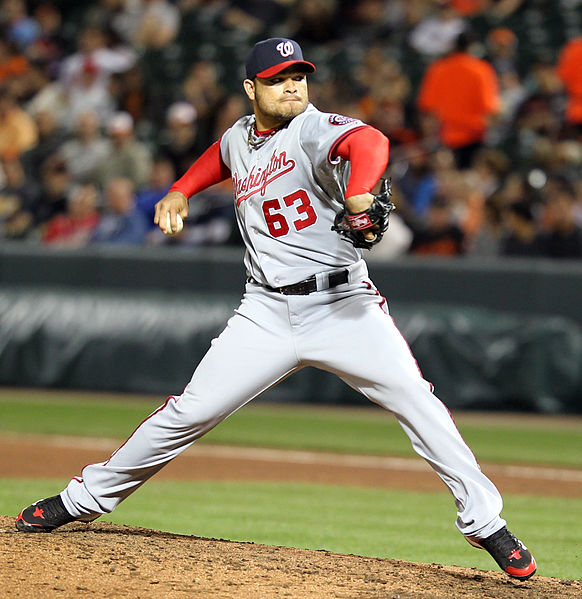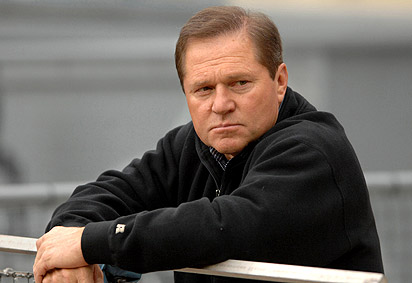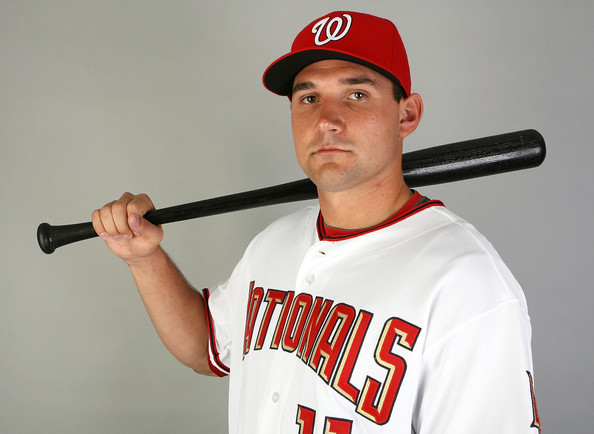
Does Boras run the Nats? The national narrative certainly seems to think so. Photo Ezra Shaw/Getty images via espn.com
I love a diversion. Bill Ladson’s inbox is always a diversion. Here’s 1/22/13’s edition.
Q: Why do the Nationals need another closer in Rafael Soriano?
A: My posted opinion about the deal from 1/15/13. Did they “need” another closer? Probably not. But, innings sent to Rafael Soriano cascades downwards and means that innings that would be given to lesser relievers will now be pitched by Clippard and Storen (assuming one of them isn’t moved of course), and overall the bullpen is improved. I wonder if Ted Lerner didn’t pull a George Steinbrenner/Dan Snyder-esque move and force a player signing as a reaction to a singular event (aka Storen’s NLDS game 5 meltdown). Its possible I suppose. If so, you hate to see moves like this, because it undermines the GM and leads to poorly constructed rosters. Ladson belives this is a reactionary move to the NLDS bullpen meltdown in total, not just Storen’s misfortunes.
Q: It seems like Washington takes all of Scott Boras’ clients and puts them on its roster.
A: I hate this Urban Myth that now pervades anyone’s analysis every time the Nats sign a Scott Boras client. Check the proof: MLBtraderumors keeps a player agent database and guess what? The Nats don’t even have the most clients of Boras. The Nats have 7 Boras clients but Boston has 8. Plus, three of the 7 Boras clients the Nats have were no-brainer 1st round draft picks (Harper, Strasburg and Rendon, and you could even argue a 4th such Boras pick in Goodwin that the team would have taken at that point in the draft irrespective of his representation) that the team was likely going to draft and sign no matter who represented them. The fact is this: the Nats have become a premier FA destination, Boras represents a lot of good players on the FA, and the Nats have hired some of his players. When Boston or Texas hires a Boras client, you don’t suddenly hear people sarcastically asking, “Does Boras run the Red Sox?” now do you? I think its great that Rizzo and Boras have a good working relationship, because other teams/GMs do not, and it affects the quality of their teams as a result. Ladson defends my point as well, saying similar things to what I’ve pointed out.
Q: Does the Nationals’ front office regret not making Edwin Jackson a qualifying offer? It seems he would have signed elsewhere and the Nats would have received a compensation pick that would help the farm system.
A: Great Question! One I asked in this space myself on 11/5/12. I honestly think the team believed that Edwin Jackson, who had a history of signing one year deals, would have taken the contract. Either that or there was a hand-shake deal in place stating that the team wouldn’t extend the offer. I don’t truly believe the latter part of this, because (as others have pointed out) it’d be illegal as per the latest CBA. Either way, I thought it was a mistake at the time and the Nats indeed missed the opportunity to gain an extra pick. Ladson believes point #1; he thinks the team was afraid that Jackson would take the deal.
Q: If there was one thing that could hold the Nationals back from winning the World Series this year, what would it be?
A: I’ll give you two things that could prevent the team from winning. 1) Injuries in our Rotation and 2) bad luck. We’re very thin in terms of starters and a season-ending injury to one of our big names would be a bad impediment. And, the playoffs are crap-shoots; 83 win teams (St. Louis in 2006) can get hot and win it all while 116 win teams (Seattle in 2001) get beat easily before ever getting to the World Series. That being said, even a starter injury probably wouldn’t be fatal to this team’s chances of making the playoffs; the Mets and Marlins are moving backwards, the Braves seem to be treading water, and the Phillies are getting older by the day. The division is there for the taking even without winning 98 games again. Ladson says injuries.
Q: Is it true that the Nationals are interested in Kyle Lohse and plan to put Ross Detwiler in the bullpen?
A: Man, I hope not. I like Kyle Lohse but there’s a reason he’s still on the FA market despite a TON of teams needing pitching help (and it isn’t just because of the lost draft pick). He’s really not THAT good. He had (easily) his best season last year, the definition of a contract year if there ever was one. Career 98 ERA+. I think he’s a good fit for a team that needs a 3rd starter, but the Nats aren’t that team. I made my arguments for keeping Ross Detwiler in the rotation on 1/16/13, when rumors swirled about the team looking at Javier Vazquez. Who would you rather roll the dice with? A young, up and coming power lefty or a soft-tossing righty who’ll be 34 next year? I think buying another $12M/year starter and pushing Detwiler to the bullpen just for the reason of “needing another lefty” in the bullpen is arbitrary and would be a waste of Detwiler’s promising 2012. Ladson agrees, saying that Davey Johnson likes Detwiler in the rotation.
Q: Would Mark DeRosa be a viable managerial candidate for the Nationals in 2014?
A: Random question. What makes you think Mark DeRosa won’t still be playing in 2014? Plus, what ties does he have to this organization that would make you think that the Nats think he’s the heir apparent? I mean, if we’re talking about former players who have put in the time with this organization, look no further than Matt LeCroy, who played for the team and has been managing in our minor league system for years. Personally, I think the team will go with a “celebrity manager” when the time comes. Ladson expresses some surprise at the question as well.
Q: After he was acquired from the Athletics for Michael Morse, where does A.J. Cole fall on the Nationals’ list of prospects?
A: I’d say he’s probably 3rd in line, after Rendon and Goodwin. That’s about where he was when he was still in the system, and despite his rough 2012 in the California league he’s still very promising. Ladson says 3rd, as does mlb.com’s rankings for the team.
Q: What did you think of what the Nationals received for Morse? Could they have gotten more — a Major League lefty reliever in addition to a starting prospect? Is the problem that Morse only had a total of two good seasons?
A: I think the Nats got what they could for Morse, frankly. I would have liked to have seen a MLB lefty and a starting pitcher prospect in the lower-to mid minors. Lots of people were using the Josh Willingham trade as a comp; both players are similar (both are good offense, no defense type guys in the last year of an affordable contract). Willingham netted us a mlb reliever and a high-minors OF prospect. However Morse’s defensive inabilities preceed him reputationally, and many scouts perceive his 2011 as a one-off instead of a ceiling of potential. Ladson says they made a great deal.