Nationals Arm Race

"… the reason you win or lose is darn near always the same – pitching.” — Earl Weaver

Archive for the ‘Baseball in General’ Category

Ladson’s Inbox: 11/5/12 edition

one comment

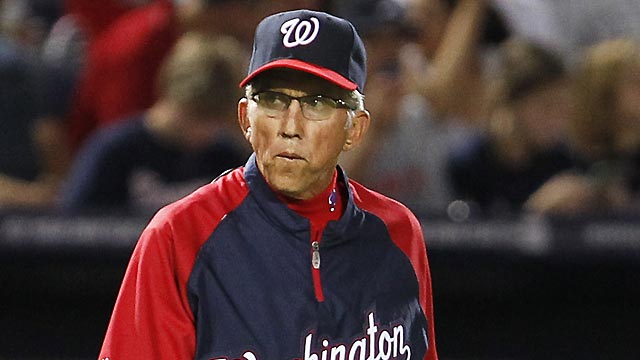
Would you bring back Johnson after his mis-steps managing the bullpen in the NLDS? Photo Getty via mlb.com

Welcome to another edition of MLB.com Nationals Beat reporter Bill Ladson‘s inbox, posted 11/5/12.  As always, I answer in this blog before reading his answer and sometimes edit the questions for clarity.

Q: Could the Nationals put a package of players together to pry away left-hander David Price from the Rays?

A: Unlike last off-season, when the Nats sent a bevy of top-end prospects to Oakland for Gio Gonzalez, I don’t perceive that the Nats have the depth of prospects nor the will to trade their biggest prospect names (Rendon, Meyer, Goodwin) in order to acquire David Price.  Tampa would likely want a combination of both prospects and MLB players, and you have to wonder if the Nats would be willing to ship so many pieces for Price (no matter how good a pitcher he is).  Now having said that about this theoretical trade, why do people think Tampa is actually LOOKING to move Price?  Yes they’ve been said to be looking to trade arms for bats this off-season, but they are far more likely to move James Shields if they’re looking to save money.  Shields has two more options at somewhat reasonable money ($9M for 2013, $12M for 2014) while Price is more than likely to only rise a few million above his 2012 salary of $4.35M.  Ladson says the Nats would have to deal a lot to Tampa to get Price and are more likely to go after Grienke.

Q: Do you expect Nationals to go after outfielder Josh Hamilton, who is a free agent?

A: I do not.  Josh Hamilton is injury prone (in his 5 seasons in Texas he’s only played more than 150 games once), is on the wrong side of 30, is prone to disappear at the plate for weeks on end, is going to command far more money than the team should be spending, and of course has the well-documented past daemon issues to constantly contend with.  I think Hamilton needs to stay with an AL team so that he can DH and continue to bat while he saves his body from the field.

Just see Philadelphia and New York Yankees rosters for prime examples of what happens when you guarantee $20M/year to guys in their 30s.  You end up with an expensive, aging and inflexible roster.  The Nats should do their best to avoid these kinds of contracts.  And I think Hamilton is going to age badly and be the kind of slugger who suddenly “loses it” once they hit their mid 30s.  Ladson essentially agrees.

Q: If the Nationals stay healthy, do you think they could win the World Series for the next several years?

A: “For the next several years?”  That’s a heady prediction; teams that win 3 World Series in short-orders are considered dynasties in the history of the sport.  Now, had this question been phrased, “do you think they could win the World Series within the next several years?”  I’d unequivocably say Yes.   They have a young talented core of starters all locked up for several years, they have a solid backbone of guys up the middle, they don’t really have any major trouble spots on the roster, and they have the payroll flexibility to adjust.

The real issue with guaranteeing World Series victories is the following (borrowing from Billy Beane); baseball playoffs are really such a crapshoot.   Anything can happen in a short series; how do the Tigers go from sweeping the Yankees to being swept them selves by the Giants?   I think Nats fans should hope for a continued streak of playoff appearances with the hopes that one of these years they put it together consistently through several short series and win a title.  Ladson also thinks they’re destined to win a title.

Q: Why are so many fans intent on trading Michael Morse? I don’t get it. He is one year removed from being team’s MVP in 2011.

A: I don’t know if fans WANT to trade Michael Morse as much as they’re resigned to the understanding that Morse represents a deviation from the way that Mike Rizzo wants to put teams together.  He’s clearly a defensive liability in left field, but the only other spot he can play (1B) is presumably being offered right now to Adam LaRoche for the next few years.  Therefore, I think the team looks to move Morse while he still has some value so they can put a better defender in left.

Now, is this what I’d do?  No not really; I’d probably let LaRoche walk, install Tyler Moore at first full time and leave Morse in left.  That takes away a huge middle-of-the-order lefty bat and leaves the team very right-handed (Zimmerman, Werth, Moore, and Morse are all RH), meaning Bryce Harper probably moves from #2 to #5 in the order to balance.  I’ve said it a million times; you can “hide” poorer defensive players in left field in this league, and in fact you have to in order to get enough bats in the lineup.

There’s no reason to think there’s any antipathy towards Morse; he’s clearly a clubhouse positive, he’s bright and cheery and seems to be a great teammate, and of course he’s got the best walk-on music (and subsequent crowd sing-along) on the team.  How can we want to get rid of that?

Ladson seems to think that fans were angry with Morse because of some extra bases taken by the Cards on hits down the line.  I don’t see that at all; yes he was slow to getting to those balls, but if you look at replays of all the doubles down the LF line you’d be hard pressed to find a ball that you’d immediately say, “See a better fielder throws the guy out at 2nd.”

Q: Has the organization soured on Danny Espinosa? And do you see Anthony Rendon on a fast track?

A: Two parter.  I don’t think the organization has “soured” on Danny Espinosa, no.  Why else would he get 160 games last year?  He’s a fantastic defensive player, covered more than ably at Short for Desmond and has 20-20 capabilities.  Now, that being said he’s a massive strike-out liability and really disappointed in the post season.  I think the organization, much as they did with Desmond, is showing some patience with their young middle infielder.  Desmond broke-out in his 3rd full pro season and perhaps so will Espinosa.  But, he needs to make some adjustments.  Perhaps its time to abandon switch hitting?  And his K rate must drop.

There are possible moves to be made though involving Espinosa, if it came to it.  He’s a natural short-stop, and his batting would be far more acceptable were he playing short.  We could move Espinosa to a team looking for a SS, install Lombardozzi at 2nd base and hope that he improves on his .317 OBP enough to be a decent lead-off options in the years to come.

Anthony Rendon should be on the fast track, absolutely.   The interesting question will be “where will he play” if he does push through to the majors?   Can’t play 3rd, could play 2nd but that leads to issues with Espinosa.  Could play LF, but see the previous Morse question.  Honestly, we should probably just wait to deal with this particular issue for that time at which Rendon is actually pushing for a MLB job.  This, by the way, is also another reason why I think re-signing LaRoche is foolish; I think the team needs to plan for the inevitable move of Ryan Zimmerman off of 3rd and to 1st Base, where his scatter-arm is no longer the major liability it is becoming.  Rendon makes for a natural 3rd replacement for Zimmerman, who can move to 1st and probably own the gold glove there for the next 5 years.

Ladson says the team hasn’t yet soured on Espinosa, and implies that something is afoot with either Espinosa or Lombardozzi this coming off-season.

Q: Why are you for keeping Davey Johnson around? Do you think that it’s smart to have your closer pitch the ninth inning of a game your team is losing by eight runs?

A: Wow, a shot across the bow of Davey Johnson for the little-mentioned usage questions surrounding Drew Storen in the NLDS.  Storen threw a meaningless inning in the game 3 blowout, meaning that he ended up pitching in three straight games.  My dad in particular believes this is the primary reason Storen was so wild in the game 5 meltdown, and puts the usage question directly on Johnson.  And I tend to agree.

That being said, Johnson is still a manager worth keeping around.  I just think he needs to learn from his mistakes in terms of bullpen usage in the coming seasons.

Ladson says he does not question Storen’s usage in game 3, but does question two critical non-moves in game 5 that many have mentioned; not using Mattheus and not walking Kozma.  Both are very fair points.


The AL MVP and the Triple Crown; do we need a modern version?

leave a comment

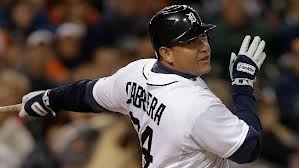
Does the Triple Crown guarantee Cabrera the MVP?

A large part of this year’s AL MVP narrative revolves around Miguel Cabrera‘s “winning” the Triple Crown this year, an incredibly rare feat that hadn’t been done since Carl Yastrzemski in 1967 and has only been done 16 times in the history of the game.  Make no mistake; leading the lead in average and home-runs is very difficult, as it has been for most of the game’s long history.  Babe Ruth never won a Triple Crown despite a career .342 batting average; he only led the league in hitting one year.  Most high-average players are power-starved and would never have a shot at winning the home-run title.

However, as any sabermatrician would tell you, the triple crown is a collection of three relatively flawed hitting statistics that basically should have no meaning in the evaluation and analysis of a player.  Home Runs are the “cleanest” of the statistics but aren’t necessarily the best indicator of power in a hitter.  Runs Batted In are greater measures of the efficiency of the batters ahead of the hitter getting on base than of his own hitting prowness, and Batting Average treats a bunt single and a towering home-run as the same “hit” while calculating the statistic.

So, is there a better Triple Crown out there, using modern baseball statistics?  And, if we found three replacements how would Cabrera’s MVP case look?

If you took the three stats in the current Triple Crown and tried to “improve” them, I think you’d end up replacing Batting Average with Weighted On Base Average (wOBA), you’d replace home-runs with either Slugging Percentage or perhaps more directly with the Isolated Power (ISO), and you’d replace RBIs with the Weighted Runs Created (wRC) statistic.  Hitting prowness is replaced with the wOBA statistic, which acknowledges that getting on base via a hit or a walk is more important than just the hitting portion.  Power measurements are more accurately displayed via the ISO than by the simplistic Home Run category (which is heavily dependent on the home-park of the player).  And the “run creation” aspect that RBIs attempts to measure is more accurately displayed by the wRC statistic.

How would the AL’s top 5 in each of these three “Modern Triple Crown” categories look (data pulled from Fangraphs.com leader board splits for advanced hitting stats for 2012):

Rank Name wOBA
1 Miguel Cabrera 0.417
2 Mike Trout 0.409
3 Prince Fielder 0.398
4 Edwin Encarnacion 0.396
5 Robinson Cano 0.394
Rank ISO
1 Josh Hamilton 0.292
2 Miguel Cabrera 0.277
3 Edwin Encarnacion 0.277
4 Josh Willingham 0.264
5 Adam Dunn 0.263
Rank Name wRC
1 Miguel Cabrera 137
2 Prince Fielder 125
3 Robinson Cano 124
4 Mike Trout 121
5 Edwin Encarnacion 115

Interesting.  Cabrera would nearly win the “Sabr-Triple Crown” as well, and if you replaced ISO with Slugging he would have (Cabrera easily led the AL in slugging).   His MVP competitor Mike Trout fares pretty well here: he was 2nd in wOBA,  10th in ISO and 4th in wRC (where his lack of a full season hurts him the most, since wRC is a counting statistic over an entire season).  But make no mistake; Cabrera’s year at the plate still looks incredible.  Keep this in mind when you make “Trout for MVP” arguments; yes Trout’s base-running and fielding prowness gives him a ton of adavantage in the all-encompassing WAR statistics, but voters don’t really care about your fielding when it comes to measuring MVP-calibre seasons at the plate.  And the above stats show that Cabrera’s triple crown is no fluke.  And, as I pointed out in my awards prediction piece on 10/22/12, Cabrera has a few more things going for him that will sway voters (especially the “old school” types who still view the MVP as a “valuable player” and not a “best player” award).

Also of note in these lists: Edwin Encarnacion continues to have monster production years in relative obscurity of the bottom of the AL east.  And notice the #4 and #5 ISO guys in the AL?  Why yes its former Nationals Adam Dunn and Josh Willingham.  People forget just how good the Nats 3-4-5 hitters where when these two guys and a healthy Ryan Zimmerman were in the lineup.  Too bad they never had any pitching to go with them.

Lets pull the same information for 2012 in the National League:

Rank Name wOBA
1 Ryan Braun 0.413
2 Buster Posey 0.406
3 Andrew McCutchen 0.403
4 Aramis Ramirez 0.384
5 Matt Holliday 0.378
Rank Name ISO
1 Ryan Braun 0.276
2 Jay Bruce 0.263
3 Jason Kubel 0.253
4 Garrett Jones 0.242
5 Aramis Ramirez 0.240
Rank Name wRC
1 Ryan Braun 131
2 Andrew McCutchen 124
3 Chase Headley 115
4 Buster Posey 114
5 Matt Holliday 114

Ryan Braun clearly had a monster season at the plate, winning the modern Triple crown (again, had we replaced ISO with slugging Braun wins again, leading the league in slugging by more than 40 points).  In the “normal” Triple Crown Braun finished 3rd in batting, first in homers and 2nd in RBIs, not really even close to Buster Posey‘s league leading BA of .336 to ever have a triple crown in his sights.

But we all know Braun has zero shot at an MVP (now or forever in the future most likely) by virtue of the off-season drug testing snafu.  Which is a shame; not that Posey won’t completely deserve the award, but Braun’s season at the plate should be noted.

What do you think of the “Modern Triple Crown?”  Should I be looking at different stats?

How does Nats-Cards NLDS Game 5 rate historically?

7 comments

How “good” of a game historically speaking was Game 5 of the Nats-Cards NLDS?  How will this game be remembered historically?

I realize of course how difficult it is to objectively view the Nats meltdown in Game 5 from a baseball stand-point for Washington fans.  It was too much of a gut-punch game, too sudden, too unbelievable of a collapse by our closer Drew Storen.  And we’re all immediately on the defensive because the inevitable back-seat driver columns from hither and yon about how Stephen Strasburg would have won the series for us in the face of more than enough evidence to the contrary (as in, how exactly would Strasburg have factored into a 2-run lead given up by our closer in Game 5?)  But I wonder if this game goes down into the pantheon of great games, or if it will remain known as just an amazing collapse by Nats bullpen.

I touched on the topic of “Greatest Games” last fall, when I wrote in this space that I thought game 6 of the 2011 World Series was instantly among the best games of our lifetime.  The trap that we all fall into as sports fans is to immediately assume that the player or game we are watching today is immediately “better” than historical figures in each sport.  I see far too many articles in the sportswriting world that immediately declare that Such-and-Such a sports news item is the “worst trade” or “best game” ever played.   Strasburg is “the best pitching prospect the game has ever seen,” that is until the next “best there ever was” guy shows up.  We’re prone to hyperbole to get hits and sell papers, unfortunately.  But Game 6 last year was different; as I was watching it I was saying to myself that it was the best game I’d ever witnessed.

In that same post I also reviewed MLB Networks’ fantastic “Best 20 games of the last 50 years” series for context.  Going back to that list, the breakdown of games is as follows:

  • Regular Season: one game
  • Regular Season One-Game playoffs: Two games; from 1978 and 2009, both classic games.
  • Divisional Series: One game: the 1995 Seattle-New  York series with a walk-off win.
  • League Championship Series: Seven Games
  • World Series: Nine of the twenty games.

So, only one game of the 20 best from the last half century occurred in a Divisional Series, and it featured an upset over the historical Yankees and an amazing walk-off win at home with the crowd going wild.  I think baseball historians don’t give as much credence to divisional series games, no matter what the context of the game.  The Cardinals in Game 5 of this year’s NLDS may have just overcome the largest deficit in any elimination game in the history of the sport … but there was no walk-off win, no home crowd going berserk at the end.  In the Seattle/New York ALDS game on the top 20 list, two moments of individual brilliance by Hall of Fame quality players led to the win.  In the Nats-Cards game, two no-name middle infielders from St. Louis poked run-scoring singles to spoil a 2 run ninth inning lead against a young team with no post season experience and no baseball history.

So, perhaps thankfully, Drew Storen isn’t going to be unfairly remembered in the same vein as Bill Buckner and Steve Bartman; singular people unfairly blamed by an entire fan-base for failures by their team unfairly (If you think Buckner was solely responsible for the Red Sox collapse in that game, you need to watch the ninth inning again and pay attention to how badly Calvin Schiraldi pitched in the 10th.  And if you think Bartman is responsible for the Cubs pitchers giving up EIGHT runs in an inning, or blowing a 2-run lead in the 6th inning of game 7, then I’d suggest you check the game footage to prove that Bartman was in the stands and not on the field).  This game will stick in Nats fans memories for quite a while of course, but at least we won’t be seeing our failures on highlight shows for decades to come.

Written by Todd Boss

October 31st, 2012 at 10:54 am

My 2012 End-of-Season award Predictions

3 comments

Mike Trout is a shoe-in for Rookie of the Year. Will he add AL MVP as well? Photo Gary Vasquez/US Presswire via espn.com

I’ve had a good string of predicting MLB’s major Post season awards in this space.  In 2010 I went 8 for 8.  In 2011 I again went 8-8 in predicting MLB’s awards, though I missed on predicting the unofficial Sporting News Executive and Comeback Player of the year.   I don’t have much confidence in going 8-for-8 this year though; the AL MVP seems way too close to predict, and I have no idea how the Cy Young awards will go.

[Editor Note: I write this in phases over the course of the season, and finalized it in early October.  After I wrote this piece some of the awards have already been announced; Sporting News announced Comeback Players of the Year last week.  I’ll put up another post talking about my guesses and which awards I got right and wrong in another article once all awards are announced in November.]

Here’s a sampling of major baseball writers’ and their predictions that I could find ahead of my publishing this article: Tom Verducci, Ken Rosenthal, Bob Nightengale, Jonah Keri, and Jayson Stark.  Here’s the Fangraphs.com staff picks, heavily statistically weighted as you’d expect.  As you will see, even the national writers are all over the road with their predictions.  Here’s HardballTalk’s Matthew Pouliot‘s theoreticall ballot, with some contrarian picks.  Seamheads’ Andrew Martin has the typical sabre-slanted ballot.

Before reading on to my predictions on 2012’s winners, a statement to prevent arguments in the comments section.  These are my guesses as to who will WIN the awards, not necessarily who DESERVES them.  Invariably there’s a player who plays on a non-playoff or losing team but puts up fantastic numbers (Matt Kemp for the 2011 Dodgers, perhaps Mike Trout this year) who a number of loud pundits say “should” win the MVP.  Well, the fact of the matter is that the current voter base absolutely takes into account the circumstances behind a player’s production, and places more value on batters who are in a pennant race.  As do I.  The MVP isn’t the “Best Overall Batter Award,” which would end a lot of these arguments (since, the Cy Young essentially is exactly the “Best Overall Pitcher Award” and thus is easier to predict); its the “Most Valuable Player” award, and I agree with many who believe that a guy hitting .370 for a last place team isn’t nearly as “valuable” as the guy who hits .320 and leads a team deep into a playoff race.  It is what it is; if we want to change it perhaps the Baseball Writers Association of America (BBWAA, whose awards these are) needs to add a category or clarify their requirements.

Secondly, when considering the Cy Young, invariably there’s one pitcher who puts up comparable numbers to another, but one plays in a weaker division so the same Sabr-focused pundits make their holier-than-thou proclamations about how the voter base failed in their picks.  And their points are valid.  But this is a prediction piece, not an opinion piece, and the fact of the matter is that current voters are still mostly old-school and put value on things like “Wins” and “ERA,” stats that most Sabr-nerds think are useless in evaluating a pitcher.

So keeping those two points in mind, Here’s my predictions for 2012:

  • AL MVP: Miguel Cabrera.  Despite the massive amount of internet baseball material devoted to talking about how great a season Mike Trout has had (mostly looking at his WAR values historically), I still see the voter base placing emphasis on three major points:
    • Cabrera plays for a playoff team, Trout does not.   The fact that the Angels will finish with a better record than the Tigers, or that the Angels clearly played in a harder division?  Immaterial to the old-school voter base.
    • Cabrara won the Triple Crown.  And most Triple Crown winners throughout history also won the MVP.  The fact that the triple crown is based on 3 relatively flawed statistics?  Irrelevant to the narrative of the achievement itself.  It remains an incredibly difficult achievement to accomplish in modern baseball’s era of specialized hitters (Ichiro for batting, Adam Dunn for homers) to hit for both average and power in the way that Cabrera consistently does.  (Rob Neyer posted thoughts about this topic, quoting random people on the internet with various takes).
    • Cabrera had a monster finish, Trout did not.  Cabrera’s OPS in the run-in months was over 1.000 each of July, August and September.  Trout peaked in July but was merely above average in the closing months.   Your finish matters (as we’ll see in the NL Rookie of the Year race discussed later on).

    Opinions like USA Today’s Bob Nightengale‘s exemplify the bulk of the voter base right now.  A few years ago the writers were smart enough to award Felix Hernandez a Cy Young with nearly a .500 record by recognizing more of the advanced metrics in play, but the Cy Young’s definition is a lot more specific than that of the MVP.

    This is nothing against Trout; the Angels were 6-14 when he got called up and finished 89-73.  That’s an 83-59 record with him, a .584 winning percentage that equates to 95 wins, which would have won the AL West.  Trout was the undeniable MVP for me nearly all season.  You hate to say it, but when the Angels faltered so did Trout’s MVP candidacy.

    The rest of the ballot?  Adrian Beltre and Robinson Cano get some typical “best player on best teams” votes.  I’d give Josh Reddick some top-5 votes too.

  • AL Cy Young: David Price, by virtue of his 20 wins and league leading ERA, will squeak out the win over last year’s winner Justin Verlander. The statistical crowd will point out that Verlander was just as dominant in 2012 as he was in 2011 (when he unanimously won), and that his significantly higher innings total and lead in Pitcher WAR should get him the award.   However, as with the AL MVP you have to take into account the voter base.   Price won 20 games, that he pitches in a tougher division, that he beat out Verlander for the ERA title.  Plus, and I hate to say it, but Price is the “sexy pick,” the guy who hasn’t won before.  Verlander is the known guy and sometimes you see voters being excited to vote for the new guy.  Its kind of like the Oscars; sometimes an actor wins for a performance that wasn’t the best as a way to “give it to the new guy.”  Certainly this contributed to Clayton Kershaw‘s victory in 2011 and we may see similar behaviors again.  There might even be an east coast voter bias in play.  Jered Weaver, Chris Sale, Jake Peavy, and Felix Hernandez all get some top-5 votes, possibly finishing in that order behind Price and Verlander.
  • AL Rookie of the Year: Mike Trout, in what should be an unanimous vote. He could (if the MVP vote goes the way many thinks it should) become only the 3rd player ever to win both the MVP and the RoY in the same year (Fred Lynn and Ichiro Suzuki being the others).  In the conversation: Yu Darvish (who certainly did not have a BAD year, but drifted mid-season), Yoenis Cespedes (who would win it in most years), Matt Moore (my preseason guess; I’m still shocked he displayed virtually none of the dominance of the 2011 post-season during his 2012 season), Will Middlebrooks (who made Kevin Youklis expendible within just a couple of months of arrival), and amazingly Tommy Milone (who was nearly unhittable in his home stadium and continued his performance from the Nats in the end of 2011).  A couple other names in the conversation: Scott Diamond and Jarrod Parker.
  • AL Mgr: Buck Showalter should get this this award for taking a team that should be a .500 ballclub based on pythagorean record and put them in the playoffs for the first time in a decade.  I also think he wins because of east coast bias, since certainly what Bob Melvin and the Oakland A’s pulled off is nothing short of fantastic.  Robin Ventura may have gotten some votes had the White Sox held on, but may be the 3rd place finisher.
  • (Unofficial “award”): AL GM: I almost hate to say it, but Billy Beane. The A’s were supposed to be awful this year, having traded away most of their starting rotation (as explained further in this Aug 2012 post here) and let most of their hitters walk.  Instead they acquire a couple of good pieces from Washington, sign the exciting Cespedes to go with a few bottom-barrel FAs, and overcame a 13-game deficit to win the powerhouse AL West.  A great story.
  • (Unofficial “award”): AL Comeback Player of the Year: It has to be Adam Dunn, right?  How do you go from the lowest qualifying average in history to career highs in homers and not get votes.  Jake Peavy may get some votes after two injury plagued seasons, but he was pretty decent last year and isn’t exactly coming out of nowhere like Ryan Vogelsong did last year.

Now for the National League:

  • NL MVP: Buster Posey‘s strong finish, combined with his team’s playoff run and his playing catcher gives him the nod over his competition here.  For much of the season I thought this award was Andrew McCutchen‘s to lose, but his fade and Pittsburg’s relative collapse from their division-leading mid-season costs him the MVP.  The rest of the ballot? Ryan Braun may be putting up MVP-esque numbers but the fall out from his off-season testing snafu will cost him votes (both in this race and for the rest of his career unfortunately). Johnny Molina getting some press too, for many of the same reasons as Posey.  Joey Votto probably lost too much time to be really considered, but remains arguably the best hitter in the league.
  • NL Cy Young:  R.A. Dickey was the mid-season choice, was challenged late but his 20th win combined with his fantastic ERA for a knuckleballer makes him the winner.  Amazingly, Dickey has pitched most of the season with a torn abdominal muscle, making his season accomplishments even more impressive.   Johnny Cueto makes a great case, leading the playoff-contending Reds, but he slightly sputtered down the stretch.  Clayton Kershaw quietly had a fantastic year, leading the league in ERA, but as we saw with David Price above, I think the voters like to vote for the new guy.  Kershaw got his Cy Young last year; this year is Dickey’s time.  Other names in the top-5 mix: Matt Cain, Cole Hamels, Gio Gonzalez and perhaps even Jordan Zimmermann (who got some mid-season attention by virtue of his excellent July).  I have a hard time giving the award to a reliever, but the numbers Aroldis Chapman and Craig Kimbrel are putting in as the closers of Cincinnati and Atlanta respectively may be enough to at least appear in the top-5.  Lastly, the odd case of Kris Medlen; his WAR puts him in the top 10 despite only having 12 starts.  Is this enough to give him some votes?  Maybe some 5th place votes here and there.  But look out in 2013.
  • NL Rookie of the Year: Bryce Harper, who won his 2nd rookie of the month in September, finished incredibly strong and took advantage of late-season fades from his two biggest competitors to win this award.  The National media buzz on Harper/Trout was never greater than during the season’s last month, and while games in April count the same as in September, the lasting impression is made by he who finishes strongest.   Wade Miley has a great case but I think falls short.  Cincinnati’s Todd Frazier has had a great season and was beating Harper’s numbers across the board, but he sat once Scott Rolen came back and faded down the stretch.   Milwaukee’s Norichika Aoki has had a nice season at age 30, coming over from Japan.  I don’t think guys like this (or Darvish, or Ichiro Suzuki for that matter) should qualify as “rookies” but rules are rules.  Anthony Rizzo, Wilin Rosario, Matt Carpenter, and Mike Fiers also put up good rookie numbers and may get some 5th place votes.
  • NL Mgr: Davey Johnson.  Nobody had the Nats winning nearly 100 games.  Had the Pirates not collapsed perhaps we’d be talking about Clint Hurdle. Don Mattingly had somewhat of a transitionary team playing great early, but the mid-season influx of high-priced talent, and their subsequent collapse costs him any support.
  • (unofficial award) NL GM: Mike Rizzo, pulling off the Gio Gonzalez trade, signing Jackson in a deal immediately lauded as a great move and quickly putting together a team that looks to be 15-20 games improved over 2011.  We thought they’d be in the mid-80s in wins; who thought they could be pressing for 100??
  • (Unofficial “award”): NL Comeback Player of the Year: Buster Posey.  He went from a season-ending injury to an MVP season.  In other years Adam LaRoche may get some looks here, but not in the face of what Posey has been doing for San Francisco.  Lastly I had Johan Santana on a short list for this award until he was lost for the season in the aftermath of his 134 pitch no-hitter on June 1st.  At at point he was 3-2 but with a 2.38 ERA.  He finished the season 6-9 with a 4.85 ERA and was shut down on August 17th.  Are we sure that no-hitter was worth it?

Roster Construction Analysis of 10 Playoff Teams; 2012 edition

5 comments

Justin Verlander is one of the most important home-grown players in the 2012 playoffs. Photo unk via rumorsandrants.com

Every year I do a bit of “Team Construction” analysis to kind of gauge the trends in roster construction.  Last year’s post is here, and the links to the side have the underlying spreadsheet of player acquisition methods so you can see the pure details.  This topic was also covered in-depth by John Sickels on his minorleaguebaseball.com blog for another viewpoint.

Borrowing from last year’s post, there are four main ways teams can acquire players:

  1. Draft: The player is with the original team that drafted him.  In the case of international free agents, if they’re signed as 16-year olds they are considered in this category as well (i.e., Ichiro Suzuki is not a developed player, but an international Free Agent).  It could be better defined as “Club developed players.”  Simple examples for the Nats: Stephen Strasburg and Bryce Harper.
  2. Traded MLBers: The player was acquired by the team by virtue of trading an established MLB player.  Most of the time these days, this means the player was acquired as a prospect (since most trades seem to be of the prospect-for-established player kind).  Example for the Nats would be Michael Morse, who was acquired by our trading an established MLB player in Ryan Langerhans for Morse while he was still (essentially) a minor leaguer.
  3. Traded Prospects: The player was acquired by the team by virtue of trading prospects.  This is essentially the reverse of #2.  The Nats key example is Gio Gonzalez.
  4. Free Agent: The player was acquired in free agency.  This category also includes two other types of acquisitions: waiver claims and cash purchases.  These three categories are lumped together since all three indicate that a team has acquired a player with zero outlay in terms of development or prospects.  Examples for the Nats: Edwin Jackson, Adam LaRoche.

Here is the summary of roster construction and “Construction Strategy Category” that we’ll talk about next.  Note that I only count the “core players” on a team for this analysis.  The core players is defined as the 5-man starting rotation, the setup and closer, the 8 out-field players, and the DH for AL teams.  I didn’t extend this all the way to the 25-man roster, figuring that these core 15 players are the main reasons teams win and advance.  That and huge chunks of the bullpen and the bench are either fill-in FAs or draftees and it would skew the analysis of how teams really got to the playoffs.  Here’s the summary (the table is sorted by count of Draftees):

Season Team Drafted/Developed Traded Prospects Traded MLBs FA/Waivers Ttl Constr Method
2012 Atlanta 11 1 3 0 15 #1
2012 St. Louis 9 0 2 4 15 #1/#4
2012 Washington 8 3 1 3 15 #2
2012 San Francisco 8 2 2 3 15 #2
2012 Cincinnati 8 2 3 2 15 #1
2012 New York Yankees 5 2 1 8 16 #4
2012 Detroit 5 5 2 4 16 #2/#4
2012 Texas 4 2 7 3 16 #3/#4
2012 Baltimore 3 1 8 4 16 #3
2012 Oakland 2 1 7 6 16 #3

So, what are the four construction methods I’ve identified? Again borrowing from last year’s version of this post, they are (with this year’s examples).  The complication this year is that some of the 10 playoff teams don’t fall neatly into one specific category.

Method #1: Build from within 100%: (Cincinnati, Atlanta).   Atlanta, amazingly, didn’t use a single Free Agent among its core 15 this year.  They made a couple of key trades to acquire a few starters, but the rest of their lineup is home-grown draftees.  That may change next year as they try to replace Chipper Jones, Michael Bourn and possibly Brian McCann, who may leave via free agency.  Meanwhile Cincinnati has just a couple of free agents and mostly rely on guys they’ve grown as well.

Method #2: Ride your developed Core and use your prospects to acquire big names: (Washington, San Francisco and Detroit to an extent): The Nats have transformed themselves over just a couple of seasons, relying less on FAs to plug holes caused by an awful farm system to having most of their core team developed at home (See the table further below to follow the transformation of our team over the past few seasons).  Those spots they couldn’t depend on have been filled by trades (three guys acquired by flipping prospects for them; in addition to Gonzalez Kurt Suzuki and Tyler Clippard also count here).  San Francisco has seen their payroll skyrocket as they extend their home-grown talent, but for the most part they have stayed true to the team development concept.  Their one major Free Agent (Barry Zito) is notoriously one of the worst contracts in baseball and it is somewhat surprising to even see him on the post-season roster.  He wouldn’t be if Tim Lincecum was pitching in 2012 like he has regularly done in previous seasons.  Detroit was entirely in method #2 until they decided to spend money like the Yankees; we’ll revisit in #4.

Method #3: Go Young and grow up Strong (Baltimore, Oakland and Texas to an extent): Baltimore acquired a massive chunk of their rosters by flipping major leaguers for prospects and watching them blossom into a surprise playoff team.  Oakland has made a habit of getting rid of guys before they hit arbitration; fully 7 of their squad was acquired this way.  The difference is that Oakland has been forced to buy a big chunk of their core group on the FA market, depending on cast-offs like Brandon Inge and Jonny Gomes to plug leaks and get production on the cheap.  I’m guessing that Oakland will transform more into Category #1 as the vast amount of prospects they’ve landed lately continue to matriculate.  Lastly Texas was entirely in this category before they dropped major money on the likes of Adrian Beltre and Yu Darvish, transforming them into a spending power to go with their still-excellent farm system.

Method #4: Spend what it takes to win: (New York fully with St Louis, Texas and Detroit partially here): The Yankees are the class-A example of this method (along with Boston and the Dodgers frankly), but the spending that St. Louis, Texas and Detroit cannot be overlooked.  The Yankees more and more are depending on expensive FA purchases to replace what their farm system is not developing, and the problem is only being brought into more focus this off-season.  Their 3 primary starters are FA acquisitions, their biggest FA is looking like a contract catastrophe, and their developed guys are not stepping up and taking over major roles (especially on the pitching staff).  The other three teams mentioned here are mostly built on home-grown talent, but have spent so much money on the FA market lately that they are broaching into the upper echelons of MLB payroll.  St. Louis is almost entirely built from within (as noted by other columnists doing this same type of analysis) but still has depended on a couple of key FAs to advance as far as they have.

Conclusions:

  • There’s no real formula to building a playoff team, as we see from the spread of the 10 teams among the four methods defined.
  • I think its safe to say that the most difficult methods to depend on are #1 and #3.  You need to have a very good farm system to depend on the #1 method to work for you, and over the past few years only a couple of teams really have had success using this method (Atlanta and Tampa Bay).  Kansas City has tried #1 for years and has gone nowhere.  The #3 method is also frought with issues, since it requires a ton of patience from your fan base and may not be sustainable.  Would anyone be surprised if both Oakland and Baltimore collapsed next season?  Probably not; you really need to build on a base of players once you’ve established yourself as a good team and continue to augment, either through trade or through FAs.  But even that can be dangerous; just ask Philadelphia this year, owners of the 2nd biggest payroll in baseball and just a 3rd place team.
  • Is Category #1 and #3 the same?  No, not really. #1 teams rely much more heavily on personally developed prospects, while #3 teams purposely set out to acquire prospects in trade to combine with their own development mis-fortunes.  If Baltimore had a better farm system, they wouldn’t have needed to jettison so many established MLBers to acquire prospects, and they’d probably be closer to a #2 team (a wealthy team who supplements developed players with key FAs, much like what Washington is doing).
  • Oakland is really a unique case; they do develop players but get rid of them because of a self-imposed incredibly restrictive salary cap.  Imagine what Billy Beane could do with that team if he could have purchased just $30M of players on the open market (which would have still left Oakland in the bottom third of payroll).
  • Buying your way to a team (method #4) can work, but only if you have nearly unlimited money and everything goes right for you.  There’s almost no excuse for a $175M payroll to get beat to the playoffs by a $55M payroll team (Oakland).  That is unless you overpay for poor FA targets, install the wrong manager and saddle yourself with the worst clubhouse in baseball.  In case you were wondering, the 2012 Boston Red Sox were a classic case of why money cannot buy happiness, and why unlimited funds do not necessarily guarantee playoff baseball.  The Angels are another example; owing most of their season’s turnaround and success to Mike Trout and his MLB minimum salary providing nearly 10 WAR despite having the 3rd largest payroll in baseball and having just purchased the games pre-emminent hitter in Albert Pujols.
  • Frequent commenter Clark has a good point; classifying Mark Teixeira and Raul Ibanez as the same type of player (acquired via free agency) is a bit mis-leading.  Clearly a $150M player isn’t the same as a $1M player.  But, for the purposes of analyzing how much of your team is “bought” versus “developed” the point remains the same whether its a bargain basement guy or a $20M/year player.

So, if I had just purchased a new team, what construction method would I follow?  I guess it depends; if I thought I had a patient fan base, I’d probably do exactly what is going on in Houston.  I’d gut the MLB roster, trade every tradeable asset and start over payroll-wise.  I’d follow strategy #1 until I was at least competitive, and then i’d probably switch over to a #2 strategy or a #3 strategy, depending on just how good my developed players were.  You hope for #3; it implies you’ve got so much in-house talent that all you need to do is keep extending your key guys and you’ll keep winning.

I don’t think #4 is a sustainable way of building rosters.  The Yankees have gotten away with it for years, but only because they initially had a banner crop of developed players (the “core four”) to depend on up their spine.  Would anyone be surprised if the Yankees fail to make the playoffs next year?  Alex Rodriguez looks incredibly old, Derek Jeter just broke his ankle, they’re losing a number of hitters to FA and they only have a couple of starters locked up.  Where’s their starting pitching for 2013?  And what happens if they finally get hit with injuries to their rotation to the extent that Boston did this year?  I think this is why you see $80M payroll teams beating out $170M payroll teams all the time; teams get bloated, they over pay their own players and suddenly are old, inflexible and unable to adjust financially to buy what they need.

Lastly, here’s what the Nats roster has done over the past few seasons:

Season Team Drafted/Developed Traded Prospects Traded MLBs FA/Waivers Ttl Constr Method
2010 Washington (end of 2010) 7 1 2 5 15 #2
2011 Wash (2011 opening day) 6 2 1 6 15 #2
2011 Wash (primary Roster for season) 6 2 2 5 15 #2
2011 Wash (end of season) 9 1 2 3 15 #2
2012 Washington (playoff roster) 8 3 1 3 15 #2

The team has been slowly replacing Free Agents with home-grown or acquired talent, and as we all know is well on its way towards a strong, home grown team.  This year’s core team only uses 3 pure FAs: Adam LaRoche, Jayson Werth and Edwin Jackson.  We could very well see LaRoche replaced outright with the home grown Tyler Moore, and if the team replaced Jackson with someone like John Lannan (not that we’ll possibly see that happen), we could be down to just one FA in the core squad.

WC Pitching Matchup Analysis

one comment

Kris Medlen looks to get the WC win for his team. Photo unk via totalprosports.com

Here we go.  Baseball’s first wild card play-in games are set for tonight (at 5pm and 8:30pm eastern time), and its safe to say there was a surprise or two with the announced pitching matchups.  Lets look at the guys getting the starts and make some predictions on which team has the better chance based on the starter going.  I tried to do similar posts for the 2011 post season and, while they’re not always accurate, they’re fun to do and to read.

MLB Probable Pitchers are here, for tonight and the first few games of the playoffs.

1. St. Louis at Atlanta.  This is the game DC will be watching.  Match up: Kris Medlen (10-1, 1.57 ERA) versus Kyle Lohse (16-3, 2.86 ERA)

What more can we say about Medlen that we havn’t already said?  9 earned runs allowed in his 12 starts on the season, a 10-1 record with a 1.57 ERA.  He’s the modern day equivalent of Greg Maddux, a slight framed guy with beyond pinpoint control.   He achieved a bWAR of 4.4 despite getting just 12 starts on the year and pitching in middle relief until August.

Meanwhile, Kyle Lohse quietly had a great year.  Nobody’s mentioning his name in consideration of Cy Young despite a sterling record and great ancillary numbers (a 134 ERA+ is pretty good).  I think his selection is slightly surprising to go in this game; he’s probably the #3 starter on the team (behind Chris Carpenter and Adam Wainwright) but he’s clearly the best performer on the year.  As with Atlanta choosing Medlen over Tim Hudson, Cardinals Manager Mike Matheny is going with his hottest hand.

However, while Medlen is likely to pitch 6-7 innings of one-run ball, I think the Braves get to Lohse.  They’ve faced him once already this year and put 9 hits and 5 runs on him in May.  The Braves hit right-handers far better than lefties, but St. Louis really doesn’t have a great lefty starter choice.  Jaime Garcia may not even make the post-season roster (would you take Garcia ahead of Lance Lynn?).

The Pick: Atlanta in what could be a romp.


1. Baltimore at Texas.   Match up: Joe Saunders (3-3, 3.63 ERA after his trade to Baltimore) versus Yu Darvish (16-9, 3.90 ERA)

Saunders is another surprising pick for Baltimore, who has gotten by on smoke & mirrors all season when it comes to starting pitching.  The Northern Virginia Native Saunders (West Springfield HS and then Virginia Tech) is essentially a MLB-average starter for his career (a 103 ERA+) but pitched above his career stats in Baltimore.

Not to denigrate Saunders, but he’s essentially a less stable version of John Lannan.  He’s a softer tossing lefty who is about MLB average over his career, but with higher and lower extremes from season to season.  Would you trust a do-or-die situation in the hands of Lannan?  Problem is, who else would you go with if you were the Orioles?  I thought they’d go with the hot-hand Steve Johnson or their ace Wei-Yin Chen.  We’ll see if this gamble pays off; the Rangers hit left-handed pitching pretty well (108 wRC+, .285 BA).

Meanwhile, this is a national stage for high priced Japanese import Darvish.  He had a relatively effective season (16-9, a 116 ERA+) and got a ton of strike outs (221 in just 191 1/3 innings pitched).  The Orioles definitely have some higher-strike out guys in the middle of their order (Chris Davis, Mary Reynolds).    Darvish never faced Baltimore this season, but had a strong September and seems hitting his stride entering the playoffs.

The Pick: Texas in a struggle.

MLB Post Season Predictions

17 comments

How far will Atlanta get in Chipper Jones' swan song? Photo Thearon Henderson/Getty Images via nytimes.com

Everyone has to do a prediction piece, right?

First, a re-cap.  Here’s my predictions at the beginning of the season for how the divisions would shape up;

  • AL East: New York Yankees
  • AL Central: Detroit
  • AL West: Los Angeles Angels
  • AL Wild Cards: Tampa, Texas

AL Narrative: 2/3 for divisional winners and 3/5 for playoff teams.  Not bad.  Oakland and Baltimore shocked everyone, as did the Angels’ failure to really play to their talent/salary.

  • NL East: Philadelphia
  • NL Central: Milwaukee
  • NL West: San Francisco
  • NL Wild Cards: Atlanta, Cincinnati

NL Narrative: 1/3 on divisional winners, 3/5 on playoff winners.  It was hard to see Philadelphia falling to third place, just as it was hard to see Washington improve 17 games from 2011.


Now for the playoffs:

  • AL Wildcard: Texas over Baltimore
  • ALDS: Texas over New York Yankees
  • ALDS: Detroit over Oakland
  • ALCS: Texas over Detroit

AL Narrative: Texas loses the AL title on the last day of the season, but I still think they’re the best AL team.  This is the wake-up call they need to power through the playoffs.  The Yankees are given a huge disservice to have to face Texas on the road right out of the gate; a matchup I don’t think they can win.  Detroit could get the ALCS win but I don’t doubt it; Texas owned them this season (winning 3 of 4 in Detroit and 7 of 10 overall).   Oakland are red-hot but can’t match up with Detroit’s pitching.

  • NL Wildcard: Atlanta over St. Louis
  • NLDS: Atlanta over Washington
  • NLDS: Cincinnati over San Francisco
  • NLCS: Atlanta over Cincinnati

NL Narrative: Atlanta throws unbeatable ace Kris Medlen to win the play-in game, then promptly takes the first two games of the NLDS on the heels of their sweep of the Nats in mid September.  The Nats can’t overcome Medlen’s only NLDS start and lose the series when they can’t sweep a 3-game set here in Washington next week.  Meanwhile San Francisco’s bats go quiet against Cincinnati and the Reds club their way into the NLCS.  Medlen gets two starts in the NLCS, shortening the series to the point where Atlanta cannot be beaten.

World Series: Atlanta beats Texas.  Story book ending for Chipper Jones, and another heartbreak for Texas as they lose their third consecutive World Series.  Texas just isn’t as strong pitching-wise as they were last year, don’t have enough lefties to shut Atlanta down, and I don’t think Yu Darvish will be up to the challenge.  Meanwhile Medlen continues his other-worldly streak of starts; Atlanta has now won 23 consecutive games which Medlen has started (12 this year and another 11 to close out 2010).  There’s no reason not to think that streak won’t continue into the post season; he’s given up a grand total of NINE earned run in his 12 starts this season.

This isn’t the most positive prediction for the post-season for the home team, but the Nats sputtering end to the season does not inspire confidence.  Swept in Atlanta, splits with Milwaukee and then pounded in St. Louis means they’re walking a tightrope in the post-season.  If they get a win in Atlanta, they may win the NLDS.  But the 2-away/3-home structure really works to the detriment of the higher seed; its relatively easy for a team to win 2 straight at home … while its relatively difficult to win 3 straight at home.  But that’s the predicament the Nats may face when they return to Washington.  And get ready for the inevitable “You shouldn’t have shut down Strasburg” pieces, because they’re a-coming unless Washington wins the World Series.  In fact I’ll bet writers already have them penned and in the can, ready to publish (kind of like obituaries for old movie stars that are in hospice).

However, if somehow Atlanta blows the wild-card game I reserve the right to completely re-do these predictions 🙂

Written by Todd Boss

October 4th, 2012 at 5:18 pm

Jimmy Rollins; time for Philadelphia to sleep in the bed they’ve made.

4 comments

Courtesy of Nat Enquirer; this video of Jimmy Rollins classlessly giving the Nats zero credit for having the best record in the majors in 2012.

Specifically, “With us healthy, they’re a second-place team. But we weren’t.”

But that’s the problem that Rollins needs to understand; when you build your team on the backs of aging players … you’re NEVER going to be as healthy as you expect to be.  There’s a reason the Nats didn’t lose ONE start to injury all year; our pitchers are younger and healthier.  Philadelphia has built a rotation of aging stars and free agents.  Cliff Lee missed 3 starts this year, Cole Hamels missed a couple, and Roy Halladay missed 7 or 8.  Those guys are 33, 28 and 35 this year.  They’re not getting any younger and likely will miss starts again in 2013.

How about Philadelphia’s positional players?  Ryan Howard only played 71 games.  Chase Utley only 83.  Placido Polanco just 90.   Carlos Ruiz missed all of August.  Maybe you can argue that the two big names from this list should start 2013 healthy and that may make a difference.  Fair enough, except that Howard is 32, Utley is 33, and both now have a slew of injuries on their resume.  Nobody should assuming those guys are playing 150+ next year.

Meanwhile, Washington had a TON of time lost to injuries in its offense.   Desmond missed a month.  Morse missed two.  Werth missed half the season.  Zimmerman lost a few weeks.  And we went through no less than SIX catchers on the season.  And the team persevered, struggled offensively most of the early part of the year, and maintained its lead.

Philadelphia made its choices, signing major dollar contracts to extend its own guys and to buy its rotation and its key bullpen members.  And now you have to live with those decisions, which leave you with an aging roster overpaying for the decline years of your players.  Meanwhile Washington rode the wave of 100-loss seasons, committed to building its farm system, didn’t overpay for Free Agents, and now sits with one of the youngest teams in baseball (3rd youngest pitching staff and youngest on-field staff), with a below-average payroll and the best record in the majors.

Sour Grapes Jimmy Rollins.  You should get used to 3rd place because its probably where the Phillies reside for the next several years, until you can jettison your ill-signed contracts and start over.

Jeffrey Loria; Worst owner in sports?

6 comments

Jeffrey Loria, a wanted man in Miami. Photo unknown via si.com

I think in my next life my job title will be “really good buddy of Bud Selig.”  That way I can be assured of running one baseball franchise into the ground (Expos), then having a baseball franchise gift-wrapped for me (Marlins), get to do all sorts of unethical and a-moral things like blatantly deceive politicians to rob taxpayers of hundreds of millions of dollars (to build their new stadium) while continuing to massively profit from my venture (as we discovered when the books of the Marlins were leaked).

This is the life of Jeffrey Loria.

But the news doesn’t get much better for the Marlins fans.  An off-season of spending to prepare for the opening of the new stadium included three major free agents,  none of which really made any sense:

  • Jose Reyes, except you already had an all-star short stop in Hanley Ramirez
  • Mark Buehrle, a career workhorse with a near .500 record but now being paid like an ace
  • Heath Bell, millions of dollars for the most over-rated position on the team (closer).

The team also acquired $19M/year Carlos Zambrano.  The Reyes and Buehrle deals were heavily back-loaded, essentially grenades awaiting the team in a few  year’s time.

Halfway through the season, Ramirez was traded, Bell ineffective and demoted, replaced by a MLB-minimum salary guy in Steve Cishek, Zambrano buried in the bullpen and Buehrle sitting with a .500 record.   The Marlins moved a few other guys (the FA to be Anibel Sanchez, the disappointing Gaby Sanchez, and Edward Mujica namely) at the July deadline in a clear “white flag waving” move just a few months into their supposed “new phase of Marlins baseball.”  The team sits in last place, 22 games under .500 in a season they were supposed to compete.

The news doesn’t get any better for the team or the fans this past week:

Wow: great time to be a Marlins fan!  And there’s really not much hope rising up from the minors; in the past the Marlins could get by with penny pinching and still field a competitive team on the backs of its excellent player development staff (you know, the same player development staff that fueled the Montreal Expos for years and which he ripped out and brought with him to Florida in 2004).   Now the Marlins farm system is considered to be one of the worst in the majors and is relatively devoid of rising talent.

Fun times ahead for Miami.  I hope you enjoy that brand new stadium that nobody will be coming to, Mr Loria.  Hey, at least the Nats can stop getting killed by Miami year after year head to head (Here’s our record against Florida/Miami over the past few years: 9-9 this year, 7-11 last year, 5-13, 6-12 and an amazing 3-14 in 2008).  With the Mets in a long-term rebuilding program and the Marlins cratering, we really only have to worry about two divisional rivals for the foreseeable future.


Who still thinks the Nats will pursue a CF in the off-season?

24 comments

Harper has turned into a very good defensive CF. Photo Gary Vasquez/US Presswire via Natsinsider.com

Jim Bowden was the latest pundit to repeat the often-mentioned mantra “The Nats need a Center Fielder,” but this isn’t entirely a “pick on Jim Bowden” post.  Most pundits think the Nats are still in love with BJ Upton or newly in love with Michael Bourn and will aggressively pursue one or the other this coming off-season.  Now, that tired statement may have been true in the 2011 off-season, but anyone who still prints this now hasn’t been watching what has been going on in the Nats outfield this season.

To put it simply; Bryce Harper has turned into a very good defensive center fielder.  And there’s no reason to move him off the position for a number of years.

It only took about a week for rumors of Harper’s arm to circulate around the league; within a week or so 3rd base coaches were already playing it conservatively and refused to challenge his arm.  It only took a couple of Sportscenter highlight throws from the outfield to earn that praise.  Harper has 3 outfield assists on the year and probably won’t get too many more given the reputation he’s already earned.

But his arm is just one part of the equation.  Click here for the advanced fielding measure “UZR/150” for all 2012 center-fielders with at least 500 innings played.  Harper currently possesses a 28.6 UZR/150, good for 2nd in the league and far above vaunted defensive outfield wizard (and fellow Rookie phenom) Mike Trout.  In fact, he’s just ahead of Bourn and only behind reserve outfielder Craig Gentry.  To put this into english; right now Harper is just about the best defensive center field in the league.  He’s very fast, shows great range on the ball, and his errors have generally been on over-aggressive throws instead of dropped balls.

By way of UZR/150 comparison, Bourne is clearly a top defender, but the other rumored target Upton actually boasts a -1.3 UZR/150 right now, indicating that he’s actually costing his team runs.

The common narrative is that the Nats want a lead-off/center fielder type so they can move Harper to one corner and Jayson Werth the other and have a plus outfield all the way around.  But lets face it; that’d be a monumental waste of Harper’s defensive talents right now.  An .850 OPS hitting center fielder with 30 homer capabilities is one of the rarest commodities in baseball, and usually good ones only come around once in a generation.  We already knew Harper was such a generational talent, but even I was surprised to see just how well statistically he has played CF thus far.  Do the Nats need a prototypical lead-off hitter?  Yes …. but not as long as Werth is willing to be in that role.  Here’s a fact; Werth has an OBP of .426 hitting lead-off this year, which would be the 2nd best OBP in the league (behind the amazing Joey Votto) if he qualified.  When you have almost an entire lineup of guys who have 20-hr power, someone has to bat lead-off.

The other problem with the “Nats get a free agent CF” scenario is that it leaves no room in the outfield for Michael Morse.  Buying another outfielder pushes Morse to 1B, which pushes Adam LaRoche out the door.  Now, this scenario may happen regardless (LaRoche absolutely should parlay his 2012 season into a multi-year FA deal, or at least explore the possibility), but I’d rather have the positional flexibility to give someone like Tyler Moore more starts, or to give the resurgent Roger Bernadina starts against right-handed starters, or even keep LF the rotating door between Moore, Bernadina and Lombardozzi so that all three valuable players can get playing time.  And if you don’t think the team really wants to give Moore playing time, then you havn’t been paying attention to his season.

Lastly there’s this: spending money on an unneeded CF means less money to spend on pieces that we WILL need; money towards either Edwin Jackson or his rotational replacement, money towards some bullpen reinforcements, or perhaps money to extend a trade target that we leverage to free up some positional log-jams (middle infield for example, between our current starters and the upper-end reinforcements on the way in the high minors).

There’s been comparisions of Harper to the vaunted Mickey Mantle in the past; if Harper sticks in CF for the next decade, those comparisons will just be all the more viable.