Nationals Arm Race

"… the reason you win or lose is darn near always the same – pitching.” — Earl Weaver

Hagerstown/Low-A Pitching Staff year in Review; 2011

3 comments

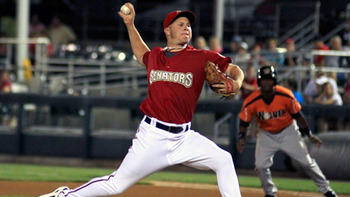
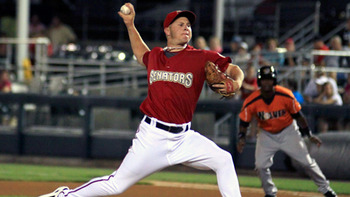
Despite injury issues, Taylor Jordan was your best low-A starter this year. Photo via wffn.net/hueytaxi on flikr.com

(4th in a series looking at all the minor league levels of pitching.  AAA, AA and High-A links).

The Hagerstown rotation was one of real interest all season, with teenage prospects AJ Cole and Robbie Ray both holding down spots, with 2010 2nd rounder Sammy Solis putting in his Nats debut, and with unexpected performances from unexpected players.

Here’s the status of the Hagerstown pitching staff at the end of the season (ages are as of 9/30/11)

  • Starters:  Cole 19, Ray (L) 19, Grace (L) 22, Demmin (L) 23, Swynenberg 22
  • Bullpen: SBrown 24, Eusebio 23, McCatty 24, Holt, Graham 23, Weaver 23, McKenzie 22
  • spot starts:  Applebee(L) 23
  • promotions: Bronson (sort of), Selik, Solis, Holland
  • up-and-back: Weaver
  • demotions:  Jenkins(L) 23, Bates 21
  • dl: McGeary 22, Jordan 22, Hansen (L) 21
  • cut/released/traded: Hicks (traded), Ott, Vasquez, Erb, Garcia, Gibson, Manno (traded), Arnold

Hagerstown starters.  The rotation started the season with Selik, Grace, McKenzie, Hansen and Jordan.  Here’s how these guys and the rest of the pitchers fared in 2011.

  • Cameron Selik was a revelation, giving up just one run in his first 29 innings pitched before earning his promotion to high-A.  This after not even being on the radar after his quiet debut in short-A in 2010.  Outlook for next season (from high-A post): starting in the High-A rotation with an eye towards moving upwards.
  • Matt Grace was the sole starter in the Hagerstown corps who lasted the entire year in the rotation.  Unfortunately, he was merely average most of the year before tailing off badly with some really bad starts in August which really spoiled his lines. Final season stats: 12-7, 5.17 era.  He gave up a LOT of hits (169 in 132 innings).   Outlook for next season: I’d guess he competes for the high-A rotation, but may be converted to a bullpen arm.
  • Christopher McKenzie had a very rough 2011, posting nearly a 7.00 ERA in 13 appearances (10 starts).  He struggled early, lost his rotation spot when the teenage duo of Ray/Cole were placed on the squad, had a couple of DL trips and ended the season by putting in a couple of starts in late August.  This is the 2nd year in a row that McKenzie had a very ugly ERA number; somehow I doubt there will be a 3rd year lasting through the season with numbers that high.   He does have youth on his side though; he doesn’t turn 22 until December.  Outlook for next season: his age and experience put him in the high-A bullpen, but if he can’t get his ERA into respectable figures he will be released.
  • Bobby Hansen was an enigma this year; he went 5-1 in 10 early season starts with a 4.10 era (most of that sullied by a 6 run first inning in a one-off mid-April start), then suddenly he was pulled from the rotation.  After a number of weeks he was placed on the DL and resided there the rest of the season.  Commenters here pointed out that he was “hurt” and was going to be “out for a while” but I’m not sure official word ever came down.  Outlook for next season: get healthy, then get back into the low-A rotation.  He’s young and he has time to move up with good performance.
  • Taylor Jordan put together the start of a great season in the Hagerstown rotation, going 9-4 with a 2.48 era in 18 appearances (17 starts).  However, he went on the DL in early July and never made it off.  Like Hansen, we struggled with information on the injury.   Outlook for next season: same as Hansen: get healthy and get back into the Low-A rotation.
  • AJ Cole surprisingly joined up the full season low-A team (as opposed to my guess of pitching in the GCL as a 19-yr old) in May and at times showed the upper-end ceiling he has, and the reason he earned such over-slot money as a 4th rounder in 2010.   He exceeded expectations through May and June, then fatigued in July and August, dragging down his season stats.  On the year: 4-7, 4.04 era but most importantly a 108/24 k/bb ratio in just 89 innings as one of the youngest arms in low-A.   Not a bad first pro season.  Outlook for next season: I’d guess he starts again in Low-A, looking for more consistency before moving up.
  • Robbie Ray joined the team the same time as Cole, but frankly out-impressed his more heralded 2010 draftee.  For weeks Ray was pitching as if he were wise beyond his years, and though he also tired in August (especially in his last two starts, which raised his season era from 2.31 to 3.13) his season can only be considered a great success.  Final numbers: 2-3, 3.13 era and 95/38 k/bb in 89 IP.  Outlook for next season: Same as Cole; I think he starts in low-A again with an eye towards a quick move upwards.
  • Ryan Demmin was an undrafted 2010 FA who pitched lights out in short-A but who couldn’t handle the jump to High-A.  Upon his eventual arrival in Hagerstown he entered the rotation and pitched pretty effectively; 3-1 with a 1.69 ERA in 5 starts.   For some reason he was dumped back out of the rotation in late August and ended the year with a few relief appearances.  Across 3 levels he was 8-2 with a 4.25 era with pretty good k/9 numbers.  Outlook for next season: I’m guessing he’s destined for the bullpen; his k/9 as a lefty bodes well for his future.  Potomac middle reliever.
  • Matt Swyndenberg improved in his 3rd pro season, still relatively young for the level but putting up good numbers.  He toiled out of the bullpen in long relief for most of the summer, posting a 2.66 ERA in 50 innings across 20 appearances.  When he got a chance to start, he was up and down, with some good and some bad starts and a 4.67 ERA split.  He’s not a big time K/9 guy and seems destined to try to make it as a reliever moving forward.  Outlook for next season: Potomac middle-relief.
  • Paul Applebee served as the long-man/spot starter all season, picking up 72 relief innings and another 24 2/3 in 5 spot starts.   He repeated low-A in 2011 and improved marginally.  He was a 10th rounder out of college in 2009 and needs to move up.   Outlook for next season: Potomac middle-relief, perhaps a similar long-man/spot starter role.
  • Shane McCatty got one spot start in the middle of the season, a high point for his otherwise unimpressive year.   A 6.63 era in 57 (mostly) relief innings is a distinct decline from his numbers at the same level last year.   Unfortunately Nepotism is at play here; if it weren’t for his last name, he may have already been released.  Outlook for next season: As with McKenzie, the low-A bullpen looks to filled with rising arms from Auburn and the GCL. I’m guessing he moves to the Potomac bullpen with a short leash.

Hagerstown Relievers: taking a look at the relief corps at the end of the season, and talk about other hurlers on the team.

  • Most of Hagerstown’s relievers were, well, bad.  Eusubio, Brown, Weaver, and Holt all sported ERAs at the 5.00 level or above in various amounts of innings.   Bates, Jenkins and Hanks were each demoted mid-season (though Bates made it back to low-A at the end of the season).  Outlook for next season: all of them need to show they can product in low-A before moving on.
  • Neil Holland earned a promotion to Potomac where he was even better than in low-A.  Outlook for next season: (from high-A post): moving on up again, starting in the AA bullpen.
  • Fan Favorite Christopher Manno put up consistently ridiculously good numbers in a late-innings/closer role for Hagerstown before being packaged in the Jonny Gomes deal.  We wish him well.
  • After Manno was traded, Ben Graham took over in the shared-closer role and pitched well enough.  He was 4-4 with a 3.30 era in 46 relief innings.  He’s another non-drafted FA after the 2010 draft that may add value to the organization.   Outlook for next season: middle-relief in Potomac.


Nats Rotation Cycle #31: good/bad/soso

4 comments

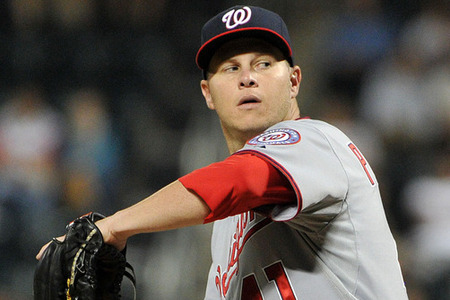
Detwiler is really making a statement for his inclusion in the 2012 rotation. Photo Haraz Ghanbari/AP via federalbaseball.com

We’re getting down to the wire; There’s only three more of these posts coming, because the rotation only makes 3 more passes before the season is over.  Because of the off-day on 9/19 and the double-header 9/20, Milone pitched BEFORE Detwiler’s start in this “cycle” so the end of cycle #31 bleeds over into the beginning of cycle #32.

Good

  • Tommy Milone looked great on 9/15 (box/gamer), shutting down a weak NY Mets offense and getting his first MLB victory.  The Mets started 5 guys who were on their AAA roster a month ago, so its somewhat difficult to get a read on Milone’s capabilities on the day.  But he did go 5 2/3, gave up 1 run on 3 hits with 3 walks (one intentional).  The walks are surprising; Milone’s calling card and the way he’ll survive is by NOT allowing walks.
  • Day 3 of the return of Stephen Strasburg on 9/17 (box/gamer) went much better for the kid; his velocity was back, he was efficient (6ip on 61 pitches), he was accurate (0 walks and 45 of 61 pitches for strikes) and he was dominant (1 run on 4 hits and 3 Ks).  Can’t ask for much more than that.  Too bad he got a no-decision as his offense couldn’t get him more than one run against the Marlin’s #5 starter Volstad.
  • Ross Detwiler put in perhaps his best start in a Nats uniform in the back side of 9/20’s double header (box/gamer), holding an (admittedly weaker) Phillies lineup to just 3 hits over 7 1/3.  Ross was sitting on just 81 pitches when departing in the 8th, efficiently working through the lineup.

Mediocre/Inconclusive

  • John Lannan bounced back from a poor start last week with an improved on on 9/16 (box/gamer).  6ip, 3runs on 8 hits and a walk.  I think we know what we have in Lannan by now, and I’m sure he feels lonely as the sole remaining rotation guy from opening day.
  • A 7th inning homer turned Chien-Ming Wang‘s 9/18 start (box/gamer) from a good one to just merely a run of the mill quality start, but there’s definite promise in Wang’s performances as of late.  He went 6 2/3, gave up 3 runs on 6 hits with zero walks and 5 Ks.  Two homers hurt the sinkerballer.

Starter Trends

Milone    bad,soso,good
Lannan    good,good,bad,soso,good,bad,bad,good,soso,good,bad,soso
Strasburg    great,soso,good
Detwiler    soso,soso,good,good,bad,bad,soso,great
Wang        bad,bad,great,soso,soso,good,bad,soso,soso,soso
Peacock    good

Relievers of Note and other News

  • (not much in the way of links and notes here; I was gone all weekend and just did very rudimentary reviews.  A future post is in the works for my weekend trip, which will be of significant interest to baseball fans).
  • Drew Storen gets two saves in one day on 9/20: that’s pretty rare in this modern age of innings limits and coddling relievers.
  • Quick report that the team is scouting FA-to-be CJ Wilson.   The 2011 off season FA market is so thin on quality starting pitching that Wilson, who has had two pretty good seasons after pitching in relief the early part of his career, may be the leading starter out there on the market (i’m not counting CC Sabathia, who almost certainly opts out and re-signs for more money).  One complication: Wilson will be a Type-A free agent, costing the Nats a pick.  And guess what?  This little end-of-the-season run now has the team perilously close to having a non-protected first round draft pick.  Is CJ Wilson worth giving up the 16th overall pick in the draft?

Potomac/High-A Pitching Staff year in Review; 2011

5 comments

Danny Rosenbaum was your opening day starter, and best hurler of 2011. Photo Jeff Mankie/News & Messenger via insidenova.com

(3rd in a series; scroll back to earlier posts for AAA, AA reviews).

The defending Carolina League champs Potomac had some big shoes to fill, with a number of their impact players from last year departing and moving onwards and upwards.  2011 saw an interesting rotation full of question marks, and by the end of the season the rotation featured one of the franchise’s most important pitching prospects.

Here’s the status of the Potomac pitching staff at the end of the season (ages are as of 9/30/11)

  • Rotation: Demny 22, Selik 24, Olbrychowski 25, Bronson (L) 24, Solis 23
  • Bullpen: Smoker (L) 22, Nelo 25, Testa (L) 26, Wort 22, Holland 23, Frias 22, Holder 24
  • Spot starts: Clegg (L) 24
  • Promotions: CMartinez, RMartin, Lehman, Rosenbaum
  • up-and-back: Bronson
  • Demotions: Demmin, Weaver
  • DL: EDavis 24
  • Cut/released (spring training and/or mid-season): Fabian, Phillibaum, Dill, Beno, Caldera 25, Morrison 24

Potomac starters.  The rotation started the season with Rosenbaum, Holder, Frias, Demny and Clegg.

  • Danny Rosenbaum was your opening day starter, and easily your best starter in High-A this year.  He put in 20 appearances (19 starts) and pitched to a 6-5 record, 2.59 era, 1.17 whip with 108/41 k/bb in 132 IP.  The lefty looks like another in a long line of lefties this system is developing; not necessarily overpowering fastballs but pitches with guile and control.  Much like Lannan, Milone or even teammate Solis, Rosenbaum will probably be a difficult pitcher to evaluate going forward, with scouts not knowing how to rate his ceiling as a starter.  Outlook for next season: Rosenbaum was promoted at the very end of the season and had six very productive AA starts.  He should start in Harrisburg in 2012.
  • Trevor Holder has been fighting the “overdraft” label since his 2009 drafting as a 3rd rounder despite a less-than-stellar college career.  After the Strasburg money outlay, many pundits thought that his drafting represented an “affordability” pick, and sure enough he signed as a college senior for far less than slot.  Holder was given no less than 14 Potomac starts before mercifully being demoted to the bullpen, where he put in a few more relief appearances the rest of the season.  Final season numbers: 3-8, 5.77 era.  Outlook for next season: Holder should start 2012 in Potomac’s bullpen, and it would be the fourth year he’ll be in high-A.  He’s officially in “organization guy” territory now, and unless he markedly improves soon he’ll be closer to a release than a future with this team.
  • Marcos Frias is an interesting case; in 2010 he was awful as a starter for Potomac, yet he was given another shot in 2011.   He got four early-season starts and wasn’t half bad (he had two good starts and one really bad one in April) and was demoted to the bullpen when Selik got promoted.  Once he got to the bullpen?  He was fantastic, posting a 1.67 era in 54 relief innings.  The DSL graduate is still very young, and the Nats may have found a valuable bullpen arm.  Outlook for next season: Frias should be in the AA bullpen, perhaps in the mix to be the closer.
  • Paul Demny was the only hurler in the rotation who started and stuck in the rotation for the entire season, finishing the year with 26 starts, a 10-10 record and a 4.32 era.  He’s still young (he’s in his fourth pro season and has just turned 22), but he’s also at the point in his pro career that he needs to start showing progress above the A level.  As a JuCo signee he’s rule 5 eligible this off-season but there’s very little chance he gets selected (at least in the MLB phase), so the team has a bit more time to evaluate him.  But 2012 is a make or break year for him.  Outlook for next season: Perhaps he starts in high-A again, but he could be pushed up to the AA rotation depending on how the rosters shake out.  I’m not sure he did enough to earn a promotion on performance in 2011, but a numbers game of recent rising college draftees may put him on the AA roster.
  • Mitchell Clegg had nine mostly poor-to-incredibly bad starts before being demoted to the bullpen, at which point he had a couple of spot starts but worked mostly in the bullpen the rest of the year.  On the year: 4-7, 5.50 era and he was equally bad out of the bullpen (starting split: 5.11 era, relieving split: 6.00 era).  Outlook for next season: he’ll be lucky to make the 2012 Potomac bullpen, and I wouldn’t be surprised if he’s released after spring training.
  • Cameron Selik earned a promotion to Potomac after five stellar outings in Hagerstown (where he gave up exactly one earned run in 29 innings) but wasn’t able to replicate that success in high-A.  He gave the team 16 starts before being moved to the bullpen in August.  As a starter in high-A he was 4-9 with a 4.57 era.  Outlook for next season: he’ll be in the Potomac rotation, looking to improve his 2nd year at the level.
  • Adam Olbrychowski was struggling during the first half as a middle-reliever in the Potomac pen, then was surprisingly inserted into the rotation, where he performed markedly better.  He posted a 5.63ERA in 16 relief innings, then posted a 3.71 era in 15 starts during the second half.   I may be wrong, but I believe he’s rule-5 eligible this coming off season, though his status as a mediocre-to-halfway decent right hander in high-A probably keeps him safe for the time being.  Outlook for next season: good question.  He’ll be 26 and in his 6th minor league season next year, but he clearly improved once he hit the rotation.  I’d say he starts in the AA rotation with a short leash.
  • Evan Bronson logged a lot of frequent flier miles this season; he was left in extended spring training, then joined up with Potomac a few cycles into the season.  He lasted a few starts, got dropped from the rotation when Solis joined the team, made a quick appearance in AAA and a spot start in AA, then finished the season back in the Potomac rotation.  Phew.  All in all he posted a 5-5 record in high-A in 23 appearances and 12 starts.  He was clearly better in relief than he was as a starter, often putting in long relief stints and holding down the fort.  Outlook for next season: He’s put in good numbers in high-A two years running; time for him to move to AA.  I’d guess he gets a look as a starter but serves as the long man/spot starter in AA.
  • Sammy Solis had a slight injury in the spring, then started in low-A (a bit low for an accomplished college draftee of his stature).  Once he made it to high-A though, he did not disappoint.  In 10 starts he posted a 6-2 record with a 2.72 era, a 1.28 whip and had 53/11 k/bb in 56 1/3 innings.  Whats really interesting about Solis is his splits; despite being a lefty he dominated right handed hitters, posting a 1.97 era split against them (albeit with a .260 BA against).  Outlook for next season: Solis remains one of our better starter prospects though, and should advance quickly up the system in 2012.  He will start in the AA rotation and may end the season in AAA.
  • Erik Davis struggled in AA, earning a demotion to high-A, where he was even worse.  0-5 with a 6.75 era in six starts, ending the season on the DL (unclear if it was for a legitimate injury or a roster manipulation preparing the team for the playoffs).   Outlook for next season: (from the AA post): he starts in the AA bullpen on a short leash.
  • Other Starters of note (non-rehab): Alex Caldera had two awful starts and was summarily released in April.   He was acquired for cash from Kansas City in late March and after his release picked up with the low-A affiliate of Florida.

Potomac Relievers:

  • Pat Lehman was fantastic early on as the closer and earned a mid-season promotion.  Outlook for next season: (from the AA post): he sticks in the AA bullpen, competing for the closer role.
  • Hector Nelo took over as the primary closer after Lehman’s promotion and was similarly productive.  He had a 2.40 era in 41+ innings and earned 18 saves. He really has turned around his career; getting released in April by Texas, signing with Washington two days later and looking like a new pitcher.  He was a 25-yr old in high-A though; he’ll need to produce at the next level in 2012.  Outlook for next season: AA bullpen in perhaps a setup role.
  • Josh Smoker has remade his own career post arm injury, putting up great numbers in a later-inning relief mode.  On the season he was 5-2 with a 2.31 era but more importantly 56 Ks in 50 innings.  He’s rule-5 eligible but is in little danger of getting plucked away.  Outlook for next season: AA bullpen.
  • Joe Testa and Neil Holland were both excellent in middle-relief.  Unfortunately Testa is way too old for high-A and may be considered the “extra guy” we got in the Ramos-Capps deal.  Holland is much younger and pitched his way out of Hagerstown early.  Outlook for next season: AA bullpen for both, though Testa may not be long for the organization, losing out in a numbers game.
  • Rob Wort couldn’t follow up on his excellent 2010 numbers in Potomac and took a step back in 2011.  He’s young though.  Outlook for next season: he repeats high-A, again in the bullpen.
  • Dean Weaver and Ryan Demmin both were demoted down to Hagerstown; we’ll cover them in the Low-A review.
  • Other relievers with appearances: Rafael Martin was dominant and earned his promotion to AA.  Kyle Morrison was released after just a few appearances early on.  Carlos Martinez bounced around the organization and pitched a few ineffective innings for Potomac.


Harrisburg/AA Pitching Staff year in Review; 2011

3 comments

Brad Peacock was your AA pitcher of the year, and earned two subsequent promotions in 2011. Photo via bleacherreport.com

(2nd in a series.  See yesterday’s post for Syracuse).

The Harrisburg rotation started the year with two starlets, a couple question marks and a few guys who had MLB experience (either in the rotation or on the DL, waiting to get their shot).  It was interesting to see a rotation in AA that was (on average) younger and had more MLB time than the team’s AAA roster, but that’s how this season played out.  No less than twenty guys got “starts” for the AA team this year, including a number of rehab starts and even more “passing through” starts for guys on their way out of the organization.

Here’s the status of the Harrisburg pitching staff at the end of the season (ages are as of 9/30/11)

  • Starters: Roark 24, Arneson 27, Martis 24, OPerez(L) 30, Rosenbaum (L) 23
  • Bullpen: Lehman 24, VanAllen (L) 27,  Barthmaier 27, McCoy (L) 23, RMartin 27, HPena 26
  • Spot starts: CMartinez 27
  • Promotions: Mandel, Meyers, Mattheus, Tatusko, Zinicola,  Peacock, Mock (post rehab)
  • up-and-back: Arneson, Pena, CMartinez
  • demotions: RMartin (from last year), EDavis
  • DL: Atilano 26
  • Cut/released post Spring or mid-season: Leatherman, Novoa, Spradlin, Dials, CJames, Alaniz, Chico
  • Missing: JJones 29

Harrisburg starters.  The rotation started the season with Meyers, Tatusko, Atilano, Peacock and Erik Davis.  Here’s how these guys and the rest of the starters fared in 2011.

  • Brad Meyers got the season opening start and it was clear after 6 starts he was ready to be promoted, going 3-2 with a 2.48 era and a sub 1.00 whip.  Outlook for next season: (from AAA post): Begins 2012 in AAA, competes for MLB #5 starter in spring.
  • Ryan Tatusko was mediocre at best in a AA starting role, putting up a 5.94 era in 12 appearances (9 starts) before being dumped to the bullpen when Oliver Perez was ready to go.  His last couple of appearances were decent though, and he got promoted to fill an opening in AAA’s bullpen, where he played most of the season.  Outlook for next season: (from AAA post): Org guy, in AAA’s bullpen or in another organization.
  • Luis Atilano only got 2 starts in and was hammered before hitting the DL, where he remained the rest of the season.  He’s 26 this year and was DFA’d, cleared waivers and accepted his assignment, indicating that he’s probably not in the future plans of the team.  Outlook for next season: I’m guessing he’s given his release and will be a minor league free agent.
  • Brad Peacock tore up AA, putting up a 10-2 record with 129 Ks in just 98 IP.  Most questioned why he was left to languish in AA for so long, clearly having earned a promotion.  But he’s young (only 23 this year) and there was not really a hole in the AAA rotation for him until Detwiler’s promotion opened one up.  Outlook for next season: (from AAA post): Loses out on #5 starter competition, starts in AAA, possibly in MLB bullpen b/c of his arm.
  • Erik Davis was obtained in trade for disgruntled utility infielder Alberto Gonzalez, had a bunch of starts, a DL stint, and then a string of awful starts that got him demoted to Potomac (where he didn’t fare much better).  Final AA line: 5-7, 4.79 era, 1.61 whip and 93/41 k/bb in 94 ip.  He’s got great K/9 but not much else.   Outlook for next season: there’s not much use for a 25yr old right-hander who can’t cut it in High-A, though his precipitous drop in stats from 2010 to 2011 is cause for hope that this was an aberration year.  I’ll guess he features in the AA bullpen in 2012.
  • Erik Arneson started the year with 3 pretty decent AAA starts, then suddenly was in the AA bullpen.  This was his third year repeating the AA level with this franchise, clearly indicating that the team views him as an organizational guy.  Despite his all-star game appearance and stellar 2011 numbers in AA (8-4, 2.43 era, 1.10 whip in 16 starts and 26 appearances), he’s 27 this year and clearly isn’t going anywhere.  Outlook for next season: Org Guy; either a minor league FA or perhaps floating between our AAA and AA levels as he did this year.
  • Shairon Martis is an interesting case; he was in the Nats starting rotation in 2009, and by the spring of 2011 he had successfully passed through waivers and was on our AA squad despite only being 24.  Not surprisingly, he did well, posting a 8-6 record, a 3.05 era, a 1.22 whip, had 146/39 k/bb in 133 ip and threw a 7-inning no-hitter.  And this all proved, what exactly?  As I said over and again during the season’s rotation reviews, Martis getting out AA hitters with ease shows us nothing that we didn’t already know.  We need to see him at least at the AAA level to see if he’s ever going to be the pitcher that showed so much promise when he was promoted to the majors in 2008 as a 21-yr old.  There was word/rumors during spring training that the team wasn’t pleased with his conditioning or his work efforts, perhaps contributing to his being essentially in the franchise “doghouse.” Outlook for next season: He should be in the AAA rotation, but I wouldn’t be surprised if he was stuck in extended spring training by virtue of a numbers issue.
  • Tanner Roark got nearly a full season of starts in the AA rotation and didn’t have the greatest season,  In 21 starts he posted a 9-9 record, 4.69 era, 1.40 whip and pedestrian K/9 rates.  He’s younger than his trade mate (Tatusko, both received for Cristian Guzman in mid-2010) so the team will have a bit more patience.  Outlook for next season: I think his starting days are done; i’d think he’ll be converted to a reliever and start in the AA bullpen.
  • Oliver Perez was picked up in a relatively high-profile signing after he was unceremoniously released (with $12M still owed on his 2011 contract) by the Mets, who had tired of his poor performances on the mound.  The Nats, surprisingly in my opinion, installed him as a starter in AA and left him there the entire season.   Outside of a quick DL stint he mostly pitched decently, posting a 3-5 record in 15 starts, with a 3.09 Era and a 1.39 whip.  But, as with Martis above, what exactly did we learn from this?  An experienced MLB veteran *should* be getting AA guys out with regularity.  With the troubles the team had with their loogy (see Slaten, Doug‘s inherited runners and WHIP rate on the season), I’m surprised they didn’t try to feature Perez as a lefty out of the bullpen.  Now, with the season over I suppose the team has learned that Perez is now just a mediocre AA starter.  Outlook for next season: Perez will be a FA and probably goes elsewhere to continue his career on a minor league deal, looking to regain a starting job somewhere in the MLB.
  • Denny Rosenbaum got a late season call-up after pitching well in high-A all season and continued his excellent season in AA.  His stats for Harrisburg: 3-1, 2.29 era and a sub 1.00 whip in 6 starts.  These numbers were slightly better than what he posted in 20 Potomac games, and he seems to be featuring as a Tom Milone-esque crafty left-hander who is riding under the radar.  Outlook for next season: at 23 he’s still pretty young and will be in the AA rotation with a mind to get promoted after a few starts in the same way Meyers or Peacock earned their way up this year.
  • Other guys who got spot starts here and there (non-rehab): Jimmy Barthmaier got a couple spot starts but worked mostly out of the bullpen, sporting a high ERA but good k/9 rates.  Same for journeyman Carlos Martinez, albeit without the good K/9 rates.  Evan Bronson put in a spot start during a brief call up to provide cover for the team during one of their many rain-out induced double headers.  Outlook for next season: Barthmaier and Martinez are org guys and may or may not return.  We’ll cover Bronson in the high-A post, where he spent most of the season.

Harrisburg Relievers: taking a look at the relief corps at the end of the season.

  • Rafael Martin and Hassan Pena split the closing duties and both put up great numbers.  Pena was a AAA demotion while Martin seems to be a bit old for the level.  Despite this, Martin is representing the franchise in the Arizona Fall League, so perhaps he’ll feature prominently next year.  Outlook for next season: both guys seem set to be part of the AAA bullpen.
  • Pat Lehman and Corey VanAllen both pitched pretty well; Lehman earned a mid-season promotion and put up a 3.71 era in AA, earning a trip to the AFL as well.  VanAllen is older, lefty and had a great K/9 ratio.  Outlook for next season: Lehman stays in the AA pen to start, while VanAllen moves up to AAA as a possible loogy.
  • Pat McCoy struggled in AA, putting up a 4.78 era in 52 innings of work, but he’s also very young and had a 9.0 K/9 rate.  Outlook for next season: he’ll start again in AA bullpen, looking to gain on his experiences in 2011.
  • The Rest not already mentioned; Barthmaier, Martinez already covered above. 

Other pitchers who appeared in AA of note (not including Rehabbing MLBers): Ryan Mattheus started the season in AA and earned two promotions, ending up with good MLB numbers.  He’ll make the 2012 bullpen as long as he stays healthy. Matt Chico was awful in 10 appearances before being demoted/DL’d and eventually released.  Zech Zinicola and Jeff Mandel started in AA before both being promoted to AAA, where they worked the bulk of the season.  Garrett Mock put in two awful rehab starts en route to his own release.

http://www.minorleaguebaseball.com/milb/stats/stats.jsp?pos=P&sid=milb&t=p_pbp&pid=572095

Syracuse/AAA Pitching Staff Year in Review; 2011

4 comments

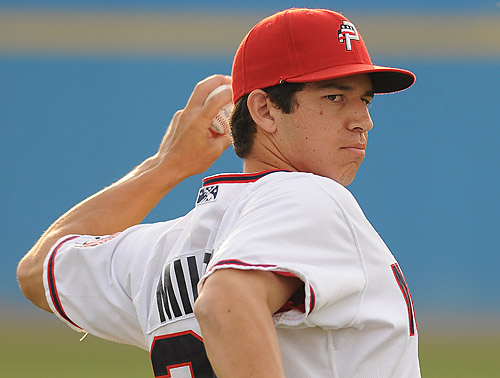
Tom Milone was your AAA pitching star of 2011. Photo Tom Priddy/Four Seam Images via Milb.com

(editors note before we begin; I’m sure my faithful readers noted that I abandoned the Minor League Rotation Review posts right after the 4th of July.  That was right around the same date I put in notice and began the process of switching consulting engagements.  Free time and post-work free time suddenly evaporated and something had to give.  Paying gigs before volunteer ones unfortunately.)

That being said, I did maintain the good/soso/bad all the way through the season, and did my best to keep up with the various reliever movements (my interest is mostly with the starters in the system).  Now that the regular seasons are over, I’ll do a team-by-team review of the pitchers, the moves and where guys may/should start in 2012.  Ideally this set of reviews should start with the MLB roster, but since the minor leagues are done, I’ll hit them up first.

Syracuse’s rotation started the year with two guys who some thought could have made the MLB roster, two guys who were closer to the “organizational guy” title than a spot on the 25-man, and a relatively young up and comer who had been cruising up the organization under the radar.  By the end of the year it held three of our better starting pitcher prospects to go with two guys who are not long for the organization.

Here’s the status of the Syracuse pitching staff at the end of the season (ages are as of 9/30/11)

  • Rotation: Maya 30, Stammen 27, Meyers 26, Peacock 23, JD Martin 28
  • Bullpen: Mandel 26, Wilkie 27, Severino(L) 26, Zinicola 26, CGarcia 26, Hyde (L) 26
  • Spot starter: Tatusko 26
  • Promotions: Kimball 26, Mattheus 27, Detwiler 25,  Milone(L) 24, Balester 25
  • 9/1 promotions: Maya, Stammen, Peacock, Severino
  • up-and-back: Stammen, Maya, Severino
  • demotions: Martis (from last year), Chico, Mock, Arneson, Bronson (spot start), CMartinez
  • cut/released from 2010 or this year: Meredith, Kown, Bergmann, Bisenius, Romero (L) (opted out), Carr 27, Mock 28
  • missing: Villone 41

Syracuse starters.  The rotation started the season with Maya, Detwiler, Mock, Milone and Stammen, with JD Martin as the season-long spot starter.

  • Yuniesky Maya: failed to make the team out of spring training, was the opening day starter in Syracuse, but struggled for long parts of the season.  Got a call-up and did not impress in Washington and sulked up on his return.  Finished the year 4-9, 5.00 era, 1.24 whip and 98/28 k/bb ratio in 129 2/3 innings.  Outlook for next season: He probably can’t make the MLB rotation again, and probably returns to AAA for 2012.  His fastball was never as good as advertised and he isn’t as good as countryman Livan Hernandez at getting guys out with control and guile.  At this point, this signing looks like a failure.
  • Ross Detwiler: Promoted mid-season just before the-all star break and has pitched considerably better in the majors than he did in AAA.  In fact, there was some debate at the time of his promotion whether he was the deserving pitcher to come up.  Final AAA numbers: 6-6, 4.53 era 1.49 whip, 63/32 k/bb in 87 1/3 innings.  Outlook for next season: He’s officially out of options and can’t be assigned to AAA without passing through waivers.  He WILL make the 2012 MLB team, likely as a #5 starter with an eye towards moving to the bullpen if he falters.
  • Garrett Mock: started strong, then had two incredibly bad outings and went on the DL.  His rehab travels around the low minors became some what of a joke, but when he returned he failed to impress, and was DFA’d in early September to make way for 9/1 callups to the majors.  Final AAA line: 0-3, 6.28 era, 1.67 whip, 32/24 k/bb in 28 innings.  His stats at all levels are worse.  Outlook for next season: there are plenty of people who openly questioned why Mock occupied a 40-man spot for so long.  I’m guessing he picks up with another team and tries to start fresh with a new organization for 2012.
  • Tom Milone: posted his third straight 12-win season in successive levels and earned a pre-9/1 call up.  He’s young, he’s lefty, and he’s got impeccable control.  Final AAA numbers: 12-6, 3.22 era, 1.03 whip and 155/16 k/bb in 148 1/3 innings.  Another great season for the Nats 2010 minor league pitcher of the year, an award he is in the running for again in 2011.  Outlook for next season: He has 3-4 more September starts to audition for next year’s rotation.  The big question with Milone is whether his 89-90mph fastball and control will be enough in the majors.  I’m predicting he falls victim to a numbers/options status game and starts next year in AAA.
  • Craig Stammen: all around nice guy never once featured in the team’s plans this year, officially crossing over from starter potential to organizational guy in 2011.  He put together a decent season, tailing off in the end to sully his overall numbers, but was never threatening to get a call-up or another shot in the Nats rotation.  AAA stats: 10-7, 4.75 era, 1.43 whip, and 127/40 k/bb in 142 innings.  Outlook for next season: He becomes 2012’s version of JD Martin, the AAA-bound starter and innings eater.  I think he’ll stay on the 40-man because he does have value, and has one option left, but after 2012 he’s a DFA candidate.  Too bad, because he’s a good-guy and deserves better.
  • Brad Meyers: earned one of the first promotions of the season after recovering from injury and dominating in his first few AA starts.   He struggled upon first arriving at AAA, hit the DL briefly, but finished strong.  Final AAA numbers: 6-5, 3.48 era, 1.31 whip and 74/15 k/bb in 95 ip.  Outlook for next season: I think Meyers gets added to the 40-man roster ahead of the Rule-5 draft for protection, but he is at least 7th in the starter pecking order (Strasburg, Zimmermann, Lannan, Detwiler, Peacock, and Milone) right now, so he starts in AAA.
  • Brad Peacock: Peacock absolutely dominated AA, to the point where it was long past the time to promote him when he finally was moved to AAA.  He had two rough starts but more than a few great ones, and finished AAA with a 5-1, 3.19 era, 1.25 whip and 48/24 k/bb in 48 innings.  On the season his minor league numbers were fantastic and earned him the organization’s Minor League Pitcher of the Year; 15-3, 2.39 era, 177/47 k/bb in 146 2/3 total innings.  Outlook for next season: He’s very young (only 23) and certainly could use another year of seasoning in AAA.  He may end up competing for the #5 rotation spot with Milone, unless a new starters comes in via trade or FA.  On the other hand, if he doesn’t master his secondary pitches he’ll be destined for the bullpen, and Rizzo loves hard-throwers in the pen, so I could see him featuring as a righty out of the bullpen next season.  We’ll see.
  • JD Martin: Outrighted before the season and then signed a minor-league deal, Martin was AAA’s long man/spot starter.  He ended up with 14 starts and pedestrian numbers on the season: 3-7, 3.93 era in 30 appearances.  His fate was sealed in January when he was outrighted and nobody else sniffed; he’s a soft-throwing righty who is a good AAA pitcher until his spot is needed.   Outlook for next season: he could be back in the same role he was in this year, unless a numbers game forces his release.
  • Other guys who got spot starts here and there (non-rehab): Erik Arneson (started in AAA then was dumped to AA despite 3 decent starts.  See the AA post) and Ryan Tatusko (pitched mostly in relief with 2 AAA spot starts after a mid-season promotion).  See the AA post for thoughts on Arneson and below for Tatusko.

Syracuse Relievers: taking a look at the relief corps at the end of the season.

  • Relievers Cole Kimball, Ryan Mattheus and Collin Balester were each promoted up at various points during the season and each performed pretty well at the MLB level.  Outlook for next season: Kimball may start 2012 on the DL post surgery.  Mattheus should earn a bullpen spot after pitching well.  Balester’s spot is more tenuous; he’ll be out of options and has not really impressed at either level in 2011.  I’m guessing he’ll lose out in a long man competition to someone like Tom Gorzelanny and get a DFA at the end of spring training 2012.
  • Local Favorite Josh Wilkie served as the AAA closer and put up good numbers; 3.13 era, 1.36 whip, 57/21 k/bb in 60 1/3 innings pitched.  Outlook for next season: He’ll get a spring training invite but seems destined to return to AAA to wait for injuries or an opportunity.
  • Athualpa Severino got a 9/1 call up and finally featured in a MLB game, showcasing a big fastball for a little guy.  Outlook for next season: He’s a little old for a prospect (27) but could feature as a LOOGY in 2012, especially since the team is so thin on that particular speciality.
  • Everyone else (Mandel 26, Zinicola 26, CGarcia 26, Hyde (L) 26, Tatusko 26) in the AAA bullpen seems destined to be organizational guys, unfortunately.  Jeff Mandel passed through waivers and toiled decently this year.  Zech Zinicola was a rule-5 draftee who got returned and put up great numbers, but seems to be a AAA ceiling guy.  Christian Garcia didn’t have great numbers in the Yankees organization but the team took a flyer on him.  Lee Hyde has already passed through waivers successfully and was more or less awful in 2011.  Lastly Ryan Tatusko regressed badly in 2011 after a stellar 2010.  He was demoted to the bullpen and pitched mostly in relief for AAA this year, getting a couple of spot starts that he was just “soso” in.  Outlook for next season: All these guys will be back in AAA or with another organization, trying to keep the dream alive.

Other pitchers who appeared in AAA of note (not including Rehabbing MLBers): Hassan Pena pitched 7 horrible innings and was demoted.  Matt Chico was similarly bad and was DL’d/demoted before getting released.  Philly castoff JC Romero had 16 appearances and pitched well before opting out of his contract because the team hadn’t promoted him (a surprise, given our loogy struggles this year).  A year after Adam Carr was put on the 40-man to protect him, he was flat-out released after an injury riddled season (lets hope the team re-signs him and he gets another shot).  Both Evan Bronson and Carlos Martinez put in brief AAA outings before returning to their normal teams.  Lastly I put in Ron Villone as “missing” because he was in our Spring Training camp but never made it onto any roster.  We didn’t necessarily hear any announcement, but I suspect he retired after not making the team out of camp.

After reviewing all the staffs at each level, I’ll cull the above predictions into a summarized 2012 projected staff throughout the system.

Nats Rotation Cycle #30: good/bad/soso

5 comments

Brad Peacock gets his first turn in the rotation. Photo via bleacherreport.com

A reminder; the rotation is now Milone-Lannan-Strasburg-Detwiler-Wang after Detwiler got skipped when the last Dodger game was cancelled.   Plus we’ve found out that Brad Peacock will get a start at the end of this cycle, so this is a 6-man review.  We may be in a 6-man rotation the rest of the way as well.

Good

  • Brad Peacock‘s debut mlb start resulted in 5 scoreless innings and a win on 9/14.  Here’s much more analysis on the performance.

Bad

  • An ugly loss on 9/10 (box/gamer) from John Lannan, the one remaining rotational hold over from the beginning of the season.  2 1/3 innings, 8 hits, 6 runs (4 earned) to raise his season Era from 3.48 to 3.65.  Luckily the team has about a dozen relievers to pick up the slack now, and 5 guys combined to finish the game.  Of those 5, only Collin Balester impressed, pitching two clean innings.

Mediocre/Inconclusive

  • Tom Milone (or, as found out on Saturday, “Tommy Milone“) didn’t “appear” to be pitching badly in his 9/9 start (box/gamer), but by the time he got yanked in the 6th it seemed to be “death by paper cuts.”  He gave up 3 runs on 8 hits, had 3 Ks and (of course) zero walks in his tenure.  89 pitches, 64 of them strikes.  Pitch F/X is still struggling to properly classify his pitches, as were the Masn announcers, who routinely were claiming his cutter is the same speed as his fastball.  In reality he throws his four-seamer between 88-90 with good movement, and his cutter comes in at about 86.  He mostly as a 2-pitch pitcher last night, fastball and change-up, with five big curves thrown in and just a handful of cutters.  He really struggled to get his cutter on-target, but did get a great bat-snapping cutter for a weak grounder early on.  He worked the corners really well, but got punished when he missed over the plate.  A couple of guys flailed on curves and outside pitches for weak hits (hence my “paper cut” comment), and he was victimized each time a lead-off hitter got on base (3 innings with first batter retired?  0 runs.  3 innings with the lead-off hitter getting on base?  Scored each time).  Milone definitely works the corners well though, and throws a ton of strikes.  I continue to wonder if he will be a Greg Maddox-type pitcher (i.e., someone who doesn’t throw amazingly hard but has such great control and movement) or if he’ll flame out into a 4-A type starter, great in the minors but without good enough stuff to be successful in the majors.  We need more starts, more evidence.
  • Wunderkid Stephen Strasburg‘s 2nd start back was troubling against the Astros on 9/11 (box/gamer).  From the first pitch (a 94-mph fast ball) he clearly didn’t have the velocity that he featured in his first start (to say nothing of his 2010 velocity).  The Astros worked him for 30+ pitches in the first inning, and he was sitting at 57 pitches through 3 complete innings before getting the safety hook from the dugout.  He seemed to be struggling with the control of his 2-seamer and wasn’t throwing his curve nearly as much as he needed to.  On the plus side, his change-up was fantastic, and was directly responsible for 3 of his 4 Ks on the day.  And, he really only gave up one hard-hit ball (a liner to right field for an out).  Final line: 3ip, 3 hits and one run.  The next day, he talked about his lack of velocity, noting that his mechanics were “on and off.”  Lets hope its that and not something more serious.
  • Ross Detwiler looked great early on 9/12 (box/gamer), giving up just a hit and a walk through five complete, then getting the first two outs in the 6th before unraveling in the 6th.  Two quick walks and then two hits ended his night and spoiled an otherwise good looking night.  Final line: 5 2/3, 3 hits, 2 runs and 3 walks.  His ERA on the season now sits at 3.76, but his FIP stands nearly a point higher (though to be fair his xFIP is nearly in line with his ERA, a good sign for the longer term).  In any case, each decent start we see in September makes me feel better about the likely fact that Detwiler’s going to make the 2012 rotation.
  • Another start, another piece of the Chien-Ming Wang puzzle.  He went 5 innings on 9/13 (box/gamer), scattering 5 hits through 4 before giving up a 2-run single in the 5th.  On the night: 5ip, 9 hits, 2 runs.  The improvement this time around was the clean first inning (he had a 12.75 ERA in the first innings of his games this year).   He was only on 72 pitches when he was pinch hit for in the top of the 6th and could have easily gone 8 complete if the team had any sort of lead.
  • Sometimes its the little things that make a difference; apparently Sean Burnett‘s turn-around this season was due to changing his rubber location.  According to an excellent piece by Adam Kilgore, Burnett moved towards the first base side of the rubber about 18 inches.  Results?  As of July 19th he had a 5.67 era.  Since the move he has a 1.37 era.  Yeah, that’s a great adjustment.

Starter Trends

2nd half only:
Milone    bad,soso
Lannan    good,good,bad,soso,good,bad,bad,good,soso,good,bad
Strasburg    great,soso
Detwiler    soso,soso,good,good,bad,bad,soso
Wang        bad,bad,great,soso,soso,good,bad,soso,soso
Peacock    good

Relievers of Note and other News

  • The cancellation of the 9/8 Dodgers game means the team will flip-flop Wang and Detwiler’s next starts so that everyone continues on normal rest.
  • Wang, like every other FA that’s not necessarily entirely going to be in demand this off-season, has said he wants to come back to his current team.   See my thoughts on the team’s lack of a club option on him here.
  • Brad Peacock will get a start this week in NY, possibly putting the whole staff into a 6-man rotation.  Perhaps he’ll replace Lannan in the rotation to give the Nats a completely new rotation versus opening day.  More likely is that he’ll fit in between regular starters to give the team a 6-man rotation.  Can’t wait to see him stretched out to see his full arsenal of pitches.
  • Garrett Mock was outrighted to AAA after passing through waivers, meaning that he passed through waivers without another claim (similarly to what happened earlier in the year with Chico in December of last year).  On the positive; he stays in the system on the off chance that 2011 was a complete outlier and he can turn around the ship.  On the negative; a guy with a plus fastball but who has proven time and again that he can’t produce consistent results stays in the system to provide continual tempting of the club management (the leader of whom Rizzo has a soft spot for him, having drafted him while working in Arizona).  Lets hope he doesn’t take the job of someone more deserving.
  • Here’s Doug Slaten‘s 9/13 appearance: two batters, one walk and one HBP.  Is anyone surprised by this?  Why is this guy still getting the ball?  Hasn’t he shown enough failures as a loogy and in middle relief to show the team everything they need to know going forward?
  • Reverse draft standings update: As of 9/13 the team is projected to draft 12th overall in the 2012 rule-4 draft.  With a bad run of form we could easily rise to #8.  The 2012 draft is considered to be much weaker than 2011, but there’s still talent to be found.
  • 2012 preliminary schedules have been released and the Nats get the AL east next year!  Away to Boston and Toronto, home dates against the Yankees and the Tampa Bay Rays.  I’ll predict now that the Saturday Yankees game will break the attendance record at the stadium.  Or come darn close to it.
  • About 5 questions into Keith Law’s chat on thursday 9/15/11 (insider only), someone asked him about Peacock and Milone’s debuts.  His opinions thus far mirror mine: Milone may be a 4-A starter and Peacock may end up a reliever.

Thoughts on Brad Peacock’s debut start

2 comments

Brad Peacock fires in another fastball during his debut start last night. (Photo by Christopher Pasatieri/Getty Images via sbnation.com)

As a fan of the team, its always neat to see shots of the parents of an up and coming rookie and to listen to the in-game interviews done by Masn’s Debbie TaylorCollin Balester‘s dad was wearing a big hawaiian shirt and was clearly telling his entire section “that’s my son” while pointing at the field.  Craig Stammen‘s parents were a bit more reserved and mentioned their faith while praising their son’s performance.  Last night, Brad Peacock‘s dad (a retired cop) was jubilant (if ill-dressed for the occasion) but gave a great mid-inning interview while holding Brad’s son on his lap.  That kind of stuff reminds you about something you often forget about when following a team of highly-paid athletes; these guys are people too.  They have families, they have priorities, hopes and dreams, and their parents root for them just like your own parents rooted for you when you were a kid.  Anyway…

Last night 9/14, Brad Peacock got his first major league start against the Mets, in New York (box/gamer).  Though I posted some thoughts on his MLB debut a week ago, it was clearly not the most optimal debut for a rookie starter (brought in with runners on base and pitching from the stretch against an MVP candidate).  Last night is a much better indication of what kind of pitcher Peacock may be and what his capabilities are setting up hitters multiple times and working deeper into games.

Game Summary: On the night Peacock’s line was great: 5ip, 0 runs on 2 hits and 3 walks.  He had a wild pitch that *maybe* should have been caught by Jesus Flores but which didn’t hurt him.

Early on in the game, Peacock was clearly not getting calls when he missed his spots.  He had more than a few calls that were clearly in the “K zone” graphic that MASN uses, but he had missed the target that Flores set up for him.  One of the two hits he gave up was to  Reyes, who he clearly had struck out but didn’t get the call at the knees.  When he did give up harder-hit balls it was usually on pitches that he missed his location.  On more than a few occasions he missed out over the plate badly, but the velocity and/or movement on the pitch usually bailed him out, getting popups for foul balls.

After cruising through 3 no-hit innings (only blemish was a 2-out walk to the opposing pitcher), he gave up a decently struck single and then suddenly struggled to find the plate.  He had two walks and a wild pitch in the 4th to load the bases before getting a harmless popout.  He was more in control in the 5th, getting a nifty play out of Desmond and a one-pitch out from the opposing pitcher before having Reyes struck out (as mentioned before) but giving up the single before retiring Tejada on a liner to Werth.

Velocity: His fastball peaked at 95.1mph early, then he seemed to settle into a pattern of low-90s heat.  On the night he averaged 92.77mph on the 4-seamer.   This average MPH was a bit lower than during his MLB debut last week (pitch f/x for his debut here, where he averaged 94.15 and peaked at 95.8) and the commentators noted that Peacock’s velocity will average lower in starts than in relief efforts.  I’m not sure I believe that necessarily.  This team’s approach with its harder throwing starters has clearly been pitching to contact and working deeper into games at the expense of a couple MPH and a few strikeouts.  Was that what we saw last night?  Or was Peacock just tired from the adrenaline rush of his first start?  Or was an average of 94 versus 92 what we should expect during starts?  Everything we’ve heard from his stellar minor league season mentions a 95mph fastball, and you would have to think that implies a 95 average, not one 95mph heater every now and again while sitting consistently 92.  Yes, relievers can generally throw harder, since they go max-effort for an inning as opposed to having to protect their arm for 100 pitches over 6 innings, but it would be nice to know what to expect out of a starter.

Whatever the speed is on his fastball, the delta between it and his change-up is fantastic.  He threw a ton of change-ups (21 out of 94 pitches) and relied on it heavily.  His curve more often than not either bounced or started outside and kept on moving outside.  I’m not sure I ever saw an inside curve-ball attempt.

Pitch Counts: Through 5 complete innings  he was sitting at 94 pitches, needing 31 just to get through the fourth, and clearly his night was over.  94 pitches on the night, 61 for strikes for a pretty good strike/ball ratio.   However, 94 pitches to complete 5 innings is rather inefficient, especially for someone who only got two Ks on the night.  Lots of these strikes were foul balls, raising his pitch count and driving him from the game early.  He will need to find a way to avoid 30-pitch innings and 10-pitch at bats, and will need to work on getting through 6 or 7 innings on that same number of pitches.

GO/AO Ratios: More concerning was the very high ratio of air-outs versus ground-ball outs.  Of the 15 outs he recorded:

  • 9 were fly balls or line drives to the outfield
  • 2 were pop-ups caught in foul territory
  • 2 were groundballs
  • 2 were strikeouts.

(side note/complaint: the official box score lists ground-outs/fly-outs ratio as 2/6.  How do they possibly arrive at this ratio?  11 of his 15 outs were recorded via balls caught before they hit the ground, whether they were fly balls or pop ups.   I assume they don’t count foul-ball pop ups as “fly ball outs,” but do they not count the 3 fly-ball outs recorded that were more “line drive” than fly out?  At least they got the 2 ground-ball outs correctly tabulated).

That’s an air-out to ground-out ratio of 11/2.  That’s downright scary.  Conventional wisdom will tell you that a standard number of fly-ball outs turn into home-runs for normal pitchers, and “fly ball” pitchers therefore get tagged with a number of additional runs over their ground-ball pitcher compatriots.  This is one of the tenants of the xFIP stat (trying to adjust for “expected” FIP versus actual FIP by standardizing for typical fly-ball to home-run ratios) and sure enough Peacock’s Xfip sits at a monstrous 6.25 right now despite an ERA of 1.42.   Of course, we are talking about small sample sizes, and we’d need more information to really draw any conclusions going forward.

Repertoire: Peacock again showed that right now he’s a 2 and a half pitch hurler (here’s pitch f/x data on the night).  He featured a four-seam fastball that he relied on heavily, throwing it nearly 2/3s of the time, moving it inside and outside against hitters.  He has a pretty good change up that features a 10-mph difference from the fastball and that he commands pretty well and isn’t afraid to throw at any count.  And he has a big overhand “knuckle-curve” that features pretty true 12-6 movement but which he doesn’t command nearly as well (he threw 13 last night, only 5 for strikes, but one was an absolute beauty to Satin to get one of his two K’s on the night).

As has been noted by other scouting reports I’ve read, Peacock really needs to work on his curve and develop a 4th pitch if he wants to be a successful MLB pitcher.  I don’t perceive his 4-seamer to have enough movement to rely upon (think of Roy Halladay or Greg Maddux, both of whom had such great natural movement on their fastballs that they didn’t really “need” to develop their secondary pitches), and he clearly needs to work on his curve-ball command.  The over-hand throwing motion kind of precludes him from considering a cutter (perhaps) or from adding a slider to his arsenal.  He probably doesn’t use a 2-seamer because he’s not getting much movement on his 4-seamer now.  The overhand motion does lend it self to a couple of pitches he could try: a split-fingered fastball could come in a few mph slower than his current fastball but should exhibit sinking behavior similar to a 2-seam fastball.  Or a forkball could be a good pitch that tumbles and drops but which could be thrown a bit harder than a straight change.

Summary: I think he had a nice outing but had some clear areas of concern.  I am not sure he can stick as a MLB starter based on what i’m seeing, but could easily be a later innings relief guy (think Joel Hanrahan, and his conversion from 5-inning high ERA starter to effective closer).

Written by Todd Boss

September 15th, 2011 at 11:16 am

My Answers to Boswell’s Chat questions 9/12/11 edition

5 comments

This week’s chat being the day after an epic Redskins victory, i’d expect it to be football heavy.  I’ll parse out the Nats questions.

As always, I edit the “question” for levity and clarity, and write my response before reading Boswell’s.

Q: Did Nyjer Morgan really refer to Albert Pujols as “Alberta?”

A: Not in so many words; i think he just referred to him as “she” in a tweet.  I posted my response here, and lots of other pundits have a similar message; par for the course for Morgan.  He’s working his way off yet another franchise.  Pretty soon he’s gonna run out of chances.  Boswell says that Morgan was very quick to be defensive to reporter questions, and notes that an attack on Pujols won’t be forgotten for a while.

Q: What is the future of Chris Marrero?

A: He’s held his own upon being called up, with a .306/.352/.367 line as of monday 9/12/11.  Good average yes; where’s the power?  I don’t think you can play 1B in this league without being either a .350 hitter or putting up 30homers.  He’s relatively weak at 1B, which is the least-challenging defensive position out there.  I don’t know what the future holds; but I’m having doubts that he’s a long term major leaguer.  Boswell agrees, saying Marrero won’t start over LaRoche and seems to be a weak  hitter w/o a positions.

Q: How is it that Clippard is the 8th inning guy and Storen is the 9th inning guy?

A: I’d like to think that the team recognized that Clippard is the more valuable pitcher and therefore needs to pitch in the higher leverage situations as compared to Storen.  More likely, the two guys are used to their roles, enjoy them, and don’t want to rock the boat.  Boswell agrees with all my points.

Q: Any chance Rizzo leaves for Chicago?  If so, who replaces him?

A: I think there’s little chance Rizzo leaves.  Why would he leave mid-stream here to go take over a Chicago Cubs team that gutted its farm system to acquire Matt Garza, has $56M still owed to Alfonso Soriano, has a $19M 2012 guaranteed for Carlos Zambrano and (outside of Starlin Castro) seems to have little to no talent on the roster?   Maybe this is a challenge, but there’s so much deadweight there you’d have to think the turnaround is going to take a while.  That being said, Chicago would give him a payroll at least twice what he has here, and presumably the same draft resources.  So perhaps he’s sick of the cheapskate Lerners and will jump ship.  Who replaces him?  I would think there are plenty of internal candidates; bit name GMs probably don’t want any part of this team based on past history.  Boswell says Rizzo’s performance outside of DC is pretty high, and fans should be a bit worried.

Q: If you were planning a trip to Viera for Spring Training, when would you go?

A: I’d want to go early on; perhaps the first or 2nd week, so that you can see more than just the major leaguers.  I’d want to see the full experience; the non-roster invitees, the non-40 man guys, the vets on minor league deals just trying to hang on, etc.  Boswell agrees; first week.

Q: Are the new wave of kids enough for 2012, or is 2013 the year?

A: I’ve always said 2013 is the year.  2012 will be Strasburg’s come back year, Zimmermann’s “taking the next step” year, an important additional year for Desmond and Espinosa, a calming down year for Werth, and a “was I a flash in the pan year” for Morse.   We’ll have more time to try out different arms in the bullpen.  We can look to augment in the FA market (but its thin).  The post 2012 FA market is massive, and the team will have all of 2012 to evaluate the likes of Milone, Peacock, Lannan, Gorzelanny, and Detwiler to determine who gets replaced with a hired gun.  Boswell offered opinions of rookies, but nothing for 2012.

Q: Is there a culture of losing with this team?

A: Perhaps some.  But the more rookies rise up who are accustomed to success, replacing veterans who are just happy to have jobs and don’t care about the W/L record, the better the team’s attitude will be.  Boswell talks about problems that still exist in the operational staff.

Q: Should we have gone with a managerial “prospect” instead of Davey Johnson?

A: I don’t think so; this season was always a transitional one.  It was going to be just as instructive to learn if Johnson can still manage after a 12 year hiatus as it would be to give the job to Bo Porter or someone.   Boswell blows more sunshine up Johnson’s ass.

Q: What will Strasburg’s innings limit be next year?

A: Almost identical to Jordan Zimmermann’s this year.  160, give or take.  Boswell forgot to answer.

Q: Are we being alarmist with Strasburg’s lack of velocity in start #2?

A: No, I don’t think so.  How do you go from 98-99 and then 5 days later be 5mph slower?  I just hope its a tired arm and not something more serious.  Boswell admits to being a bit alarmist.

My Answers to Boswell’s Chat questions 9/6/11 edition

4 comments

(This is a week old … i had it queued up but forgot to post it.  I’m assuming that he will talk mostly football in today’s chat but i’ll write up a response for later this week…)

I didn’t think Boswell would do a chat, given that his normal day (Monday) was a holiday this week.  How overjoyed was I to see that he did one Tuesday morning 9/6.   As always, “questions” are edited for clarity and space, I ignore anything not Nats/Baseball related and I write my response before reading his.

Q: What was the rationale behind having Strasburg’s first MLB pitch count limit be LOWER than his last rehab starts?

A: Simple; MLB hitters are a heck of a lot tougher to get out, so more effort per-pitch is required.  Boswell just says they’re being ultra-conservative.

Q: Does Davey Johnson get a mulligan for his W/L record?

A: Not in this opinion.  I think the team should have some concerns over how a .500 team has slumped so badly since Riggleman left town.  I don’t think the game has passed him by, ala Joe Gibbs with the Redskins, but a 12 year gap between managing jobs may have left its toll.  Boswell, predictably, intones his whole “Johnson is the best manager in the last 50 years” response.  Yeah, but his team is significantly worse than with his predecessor and he’s making pretty questionable moves on the field.

Q: Is Mike Rizzo already considering the Nats a feather in his GM cap (by virtue of being considered for the Cubs GM job)?

A: Yes, and it should be.  Its hard to understate just how badly constructed the final Bowden version of this team was, especially considering the bullpen.   Here was your pitching corps for opening day 2009:

  • Starters : Lannan (L), Olsen (L), Cabrera, Martis
  • Middle relief: Beimel, Hinckley (loogy), Ledezma, Shell, Tavarez
  • Setup/Closer : Rivera, Hanrahan

Of this group: Ledezma and Shell were DFA’d within 3 weeks of opening day, Hinckley was cut a month after that.  Olsen got hurt, Cabrera was cut after 7 weeks, Tavarez was released in July after being awful for about a month straight, and Hanrahan sported a 6+ era in the closer role before being traded.  Now THAT is a debacle of a pitching staff.

Rizzo has remade the entire 40-man roster, quickly.  He has drafted well and has our farm system from being considered one of the worst to quickly being considered among the best.  And he’s done all of this while improving the team and keeping payroll relatively constant.  I think he’s been mostly a success since being named (Werth signing and Willingham trades excepted).

Boswell says overall he’s doing a good job.

Q: Phillies or the field in October?

A: Given the coin-flip nature of playoff series, I’ll take the field.  I still think the Phillies are good enough to win and *should* make the WS (along with Boston).  But you just don’t know what can happen once the playoff series start.  Boswell takes the field, barely.

Q: Do the Nats need to look elsewhere for a hitting coach?

A: I just have a hard time believing that any hitting coach can really make that much of a difference.  Boswell notes that the entire lineup strikes out with incredibly high rates, and how can that possibly be the hitting coach’s fault?

Q: Is there too much hype surrounding Strasburg, as compared to the other key players on this team?

A: Yeah, but what can you do?  Strasburg attracts national media attention because he’s, well, potentially the best pitching prospect ever.  When he struck out 14 guys in his MLB debut it set the tone for his starts being must-watch.  I think its great, because the better the team does the more the rest of the players will get noticed and get their due (especially Zimmerman vis-a-vis MVP voting).  Boswell says Zimmerman needs and deserves more attention, then throws a nugget about Morse ducking the press after his big 2-homer day.

Q: What are your expectations for Strasburg’s first start?

A: (answering this AFTER the start): I expected  him to get hit frankly.  I thought he’d go 5 innings and give up a couple runs, a few hits.  I didn’t expect a near no-hitter through 5.  Boswell predicted 4ip, 3 hits, 1 run, 1 walk and 5 k’s.  pretty close!

Q: Thoughts on the Moneyball concept, now that its been around for 10 years?

A: I think the primary concept; focusing on statistical analysis of players, ignoring conventional scouting cliches, looking at OBP to find hidden gems and building winning clubs on a budget via player development, prospect acquisition and drafting has become the standard and not the exception across baseball.  In fact, Beane is now clearly behind the curve when you compare what GMs like Andrew Friedman and Theo Epstein are pulling off on a regular basis.  I will also say that while Beane’s approach was novel, the book failed to really give credit where credit was due; the 2000-2 A’s were that good because they had 4 a-one starters.  Boswell mostly agrees.

Q: Does Werth strike out too much?

A: Yeah, he does.  He takes a lot of pitches and takes a lot of called third strikes.  Boswell defends him.

Q: What is Morse’s contract status?  When will the team “unload him?”

A: Per Cot’s, amazingly we have him for 2 more years under arbitration control.  His arb hearing this coming off season should be interesting; he should go from $1.05M to probably $4-5M.  I hope the team just buys out his years and keeps him around for 2014 as well, so that the whole nucleus of hitters is guaranteed to be together for a while.

The pre-arbitration or even arbitration-controlled player is the best value in baseball.  Morse isn’t going anywhere, unless its in his walk year and the team is struggling and he features as a type-A FA.  Boswell says Morse isn’t going anywhere.

Q: Why did Adam Dunn fall off a cliff?

A: To me, a combination of factors.  New town, big contract and big expectations, and a new league all contribute.  But I think the whole DH concept has made it difficult for Dunn to focus and stay concentrated on the game.  Boswell says all of the above and maybe more.

Q: Will Livan pass Rizzo another “salary note” and will Rizzo accept?

A: Probably.  Hopefully Livan will price himself a bit higher than this year.  And even if Livan accepts the long-man role at (say) $1.5M a year, that’s a steal.  And I hope Rizzo takes it.  Boswell didn’t really answer this part of the question til later, then says that a $1M insurance policy for your starting rotation is the best deal in baseball.  He just hopes the Florida Marlins don’t come in and swipe him with a better offer.

Q: Is Tyler Clippard ok?

A: He definitely seems to be struggling lately.  His game-logs show the upwards progression of his ERA from 1.58 on 8/1 to the 2.04 it sits at today.  He could just be wearing down after so many  high-leverage innings.  Boswell says he talked w/ Clippard, who spotted a mechanical problem (he was flying open) and fixed it.

Did the Nats screw up by not getting a 2012 Club option on Wang?

7 comments

Did Rizzo mis-step by not structuring Wang's contract w/ a club option? Photo via Washington Nationals official photo day.

We’ve all been watching Chien-Ming Wang labor through his first few starts in nearly two seasons, having worked his way back through shoulder surgery.  August and September are clearly a “regular season tryout” for Wang, with the team having carried him for the last two seasons to the tune of $3m guaranteed.  Recently, details of his incentives were posted by foreign journalists that seem to indicate that Wang is likely to earn at least $1M more in roster bonuses, pushing the Nats outlay to $4M for the estimated 12 starts we’ll get out of him this year.  This isn’t exactly the worst $/start FA contract ever signed, and the amount of money spent isn’t exorbitant, but it is a lot of money for very few impactful starts.

Now, a quick caveat before getting into the meat of this post: I’m not convinced he’s really back, or that he’s going to be worth retaining just quite yet.  He’s not pitching that badly; through his first seven starts he has a 4.19 era, a 1.397 whip.  His advanced stats were a bit more troubling: he is sporting a 5.32 fip, a 4.99 xfip and a 5.11 SIERA as of the date of this writing, meaning his ERA is likely a mirage and likely will rise.  Even more concerning; he’s not getting any strikeouts; he was never a big K/9 guy (4.1/9 on his career), but he had THREE strikeouts in his first 21 innings back and 9 in 38 IP to this date: This the NL; you usually get 3-4 strikeouts per game by falling out of bed by virtue of the opposing pitcher and generally weaker lineups.  So perhaps this whole post is for naught.

Now, all that being said.  Lets say Wang throws 1.50 era baseball the rest of the season and the team wants him back.  Here’s the big problem: the Nats don’t have a club option on him!!  There’s nothing to prevent Wang from going back to the Yankees (his “home” club) after this season, having had our team pay for his rehab for the past two years and $3M dollars.  Yeah he’d probably accept a 2 or $2.5M offer … but the Yankees may double that because they don’t really care about payroll and need starting pitching and may be willing to roll the dice.

I know sportswriters and bloggers have been saying things like, “well maybe he’ll recognize the situation and give the Nats a fair deal.”  Maybe.  But certainly it isn’t in his best interest to do something like this.  Yeah the team just gave him $3M for a few 2011 starts … but baseball is a business and if a team comes in with a larger offer to take a flier on him, he’s not going to just give money away.  Especially on a team that has a slew of rising SP prospects and who just got done telling another veteran with a mid 4 ERA (Livan Hernandez) to shut it down for the rest of the season.

I think this was a team mistake: they had to know this situation would happen and the whole point of a club option is to protect the club’s interest.  A club option could have been done with $0 buy out, especially for a guy who had just gotten $2M in 2010 to basically have a year-long paid rehab assignment.

Written by Todd Boss

September 10th, 2011 at 10:18 am