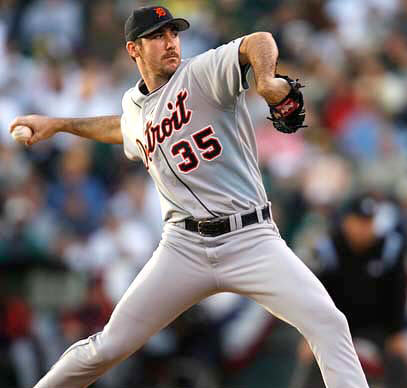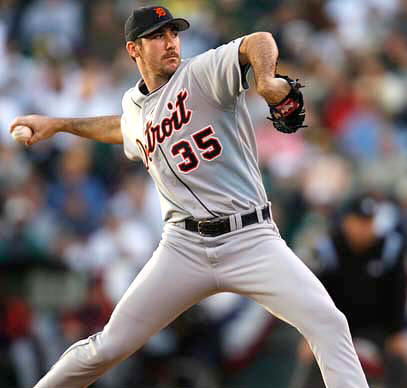
Virginia native Justin Verlander is your unanimous AL Cy Young Winner for 2011; is he also an MVP candidate? Photo unknown via rumorsandrants.com
In honor of the AL MVP vote, set to be announced today 11/21/11 ….
Justin Verlander had one of the better starting pitcher seasons in the past few years. He compiled a 24-5 record with a 2.40 era, a sub 1.00 whip and a 9.0 k/9 rate. Pitchers getting to 25 wins in the modern 5-man rotations is exceedingly rare and, no matter what you think of the “win” category is still indicative of a stellar season.
Verlander was your unanimous 2011 AL Cy Young Award winner. He led the AL in a slew of traditional and non-traditional statistical pitching categories, including your “pitching triple crown” categories of Wins, ERA and Strikeouts. He also lead the AL in bWar and Whip, and is in the top 5 in a number of other categories (k/9, k/bb, fWar, FIP, xFIP, and SIERA). He wasn’t nearly as “far ahead” of some of his AL competition (in most other seasons any one of Sabathia, Weaver, Shields, and maybe even Beckett before he got hurt would be serious Cy Young candidates), but it’s no surprise that he was the unanimous Cy Young winner.
So, is he also your AL MVP?
In a year where most of the candidates for the AL MVP seem to have “warts” of some sort, is Verlander in line to be the first pitcher since Dennis Eckersley in 1992 to win both the Cy Young and the MVP?
Lets talk about reasons having a starting pitcher win your league’s MVP does not make any sense:
- A SP only plays in 34-35 games a year, about 20% of a team’s total starts. How can the “most valuable player” only play in 20% of a team’s games?
- Even if your SP wins 25 games (as Verlander nearly did), or the team goes 27-8 in your pitcher’s starts (as Detroit did for Verlander this year) … that’s still only at best representing 25-30% of your team’s victories.
On the other hand:
- If you have an ace starter and switch places with a replacement-level player, how much of an effect would that have on your team’s success? If you assume the Tigers replaced Verlander’s 27-8 record in games he started with a .500 pitcher, suddenly the Tigers are looking at potentially 10 fewer victories and missing the playoffs. But then again, this probably overstates the capabilities of any one pitcher winning games all by himself.
- Tom Boswell once argued that pitchers may only pitch every 5th day, but they face nearly 1000 batters in a season (Verlander faced 969 batters this year). That’s nearly 300 more batters faced than positional players get plate appearances. The converse is that if you’re looking at impact strictly on a plate appearance basis, you have to then factor in every single play in the field that a positional player takes part in. Using an MVP competitor as comparison: Jacoby Ellsbury (an outfielder) had 388 putouts in center field while playing 1358 innings. He also had 729 plate appearances. So those two figures add up to eclipse direct involvement on a per-at bat level. Depending on where you play in the infield, your involvement on a per-at bat level is about equivalent to an outfielders (for 3rd basement), significantly higher (for middle infielders) to exceptionally high (for 1st basemen and catchers). The difficulty of a center fielder catching a fly ball for a putout isn’t nearly as much as a pitcher recording a strikeout with the bases loaded … but then again, when you’re already expecting roughly 75% of hitters to make outs without you (as a pitcher) even really being considered anything much above replacement … the law of averages, averages out a bit.
To me, pitchers are not a large enough part of a team’s success on a day in/day out basis to be the “most valuable player,” in the accepted working definition of the title. I believe pitchers have an award for accomplishment (the Cy Young) and the MVP, while perhaps poorly named or poorly defined, really should be for positional players. Perhaps this argument comes back to the pure definition of an MVP, and on this point I’ll have disagreements as well, since I basically consider the MVP to be realistically defined as “the most important positional player on a playoff team.” I generally don’t believe that the best player on a 4th place team really can be the MVP.
Of course, all this being said, I did predict that Verlander would win the AL MVP. Why? Because every one of his primary competitors seems to have some narrative that will prevent them from winning. Ellsbury‘s team folded in September. Bautista‘s team didn’t play a meaningful game for months. Cabrera was only the 2nd best player on his own team. Granderson had a 40-homer season but he hit .260 and wasn’t even in the league top-10 in bWAR.
What do you guys think?