Nationals Arm Race

"… the reason you win or lose is darn near always the same – pitching.” — Earl Weaver

Archive for the ‘matt kemp’ tag

My 2013 Fantasy Baseball Team

2 comments

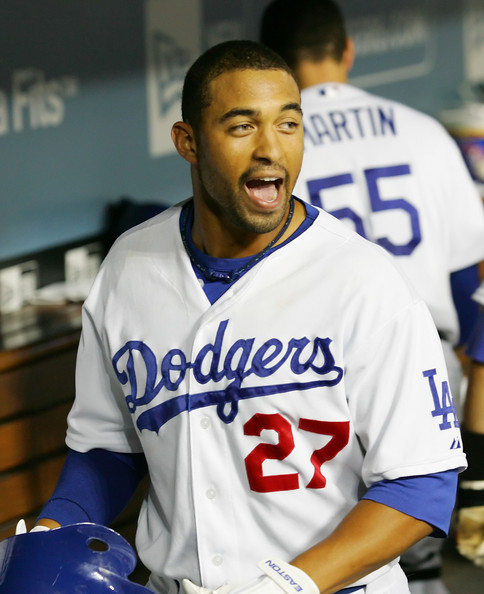
Kemp reacts to being Boss' first round pick in my fantasy league for the 2nd year running. Photo unknown via ladodgertalk.com

Editor’s note: feel free to stop reading now if you don’t want to read 4,400+ words on my fantasy baseball team.  I won’t blame you for it.  For those of you who do play fantasy, as I made picks I wrote down who I was considering and who was available per each pick to try to give some context for the pick.  I’ll insert a “jump” line here so that RSS readers don’t have to see this whole massive post :-)

Read the rest of this entry »

Possible 2013 WBC Nationals participants?

leave a comment

Harper makes perfect sense to represent the US in 2013 WBC. Photo GQ magazine Mar 2012

I read a quickie piece with some Mike Rizzo quotes from the Washington Time’s beat reporter Amanda Comak on November 11th, 2012 and there was an interesting tidbit at the bottom: per Comak,  Rizzo has not been approached yet about any Washington Nationals participation in the WBC, but would approach each request on a “case-by-case basis” to determine what is in the best interests of the team.  This got me thinking about possible Nats representatives on 2013 WBC teams.

Lets take a quick look at the Nationals representatives on WBC teams from the past, talk about whether its really in the best interests of the team to even let these guys play, and then talk about who may be candidates for the 2013 WBC regardless.

(Note: I’ve added updates highlighted in red since the original 11/21/12 publication date on players mentioned here).

Washington has sent a decent number of players to play in the WBC over the years, with very mixed results for the team’s interests.  In 2006 the team sent seven different players to the inaugural WBC:

  • Luis Ayala for Mexico
  • Chad Cordero, Gary Majewski and Brian Schneider for team USA
  • Ronnie Belliard, Alberto Castillo, and Wily Mo Pena for the Dominican Republic.

The tournament was marred for the team by a blown UCL ligament to Ayala, who had undergone elbow surgery earlier in the off-season but pitched for his home country anyway.  The team did not want Ayala to participate in the inaugural event, did not want him used by the Mexican team, and team officials were “livid” by the injury, which cost Ayala the season and cost the team its 8th inning setup guy.  Ayala recovered to pitch again in 2008 but was never as effective, and was shipped out in 2009 for a PTBNL.  Coincidentally, I suspect the team still harbors some ill-will towards Ayala to this day.  Meanwhile the other two relievers who participated both experienced regressions in form; Cordero’s ERA nearly doubled (from 1.82 to 3.19) from his breakout 2005 season while Majewski’s numbers dipped slightly before he was traded in the big Cincinnati deal of 2006.

In 2009, the team had 5 participants:

  • Pete Orr playing for Canada
  • Joel Hanrahan and Adam Dunn playing for the USA
  • Saul Rivera and Ivan Rodriguez playing for Puerto Rico.

The WBC seemed to energize particularly Dunn, who enjoyed playing in a post-season atmosphere for the first (and only) time in his career.  Nobody suffered any injuries, but Hanrahan in particular may have been affected by his lack of a proper spring training; he posted a 7.71 ERA for the team while losing the closer spot and was shipped to Pittsburgh.  Ironically, Rivera also experienced a huge regression of form, going from a 3.96 ERA in 2008 to a 6.10 ERA in 2009 and was eventually released.

This begs the question; do we even WANT our pitchers playing on this team?  The first two WBCs have shown pretty distinctly that our pitchers have regressed greatly after playing.  This only makes sense: the spring training routines are greatly impacted to play in this event.  We may see a ton of front-office resistance to specific guys (especially those coming off injury) playing in the 2013 event.  Which could affect the eligibility of some specific players for 2013.

Now, which Nats may play for the 2013 teams?  First off, looking at the Nationals 40-man roster, we have become an amazingly heavy USA-born team (we’ll get to non-40man roster players in a moment). Thanks to the Nats big board resource (originated by Brian Oliver and now maintained by “SpringfieldFan”), which has the country of origin for players, here’s a breakdown of the home-country of our current 36 active (as of November 15th, 2012) roster players:

  • USA: 27 (would be 29 if adding in our rule-5 avoidance players)
  • Venezuela: 5 (Jesus Flores, Sandy Leon, Wilson Ramos, Henry Rodriguez, and Carlos Rivero)
  • Cuba: 1 (Yunesky Maya)
  • Columbia: 1 (Jhonatan Solano)
  • Dominican Republic: 1 (Eury Perez)
  • Netherlands (via Curacao): 1 (Roger Bernadina)

As you can see, the massive bulk of our team is USA born, and essentially our entire post-season starting roster was USA born as well.  That doesn’t necessarily mean that these USA-born players will actually play for team USA (Alex Rodriguez played for Puerto Rico despite being born and raised in Miami, and our own Danny Espinosa is eligible to play for Mexico by virtue of his first-generation born in the US status), but almost all of these guys will be up for consideration for the USA team.  And this only accounts for our 40-man players; as we’ll see below there’s plenty of lower-minors players from smaller countries that will participate.

Who from the Nationals franchise may make a 2013 WBC roster?  First off, thanks to James Wagner’s 11/15/12 NatsJournal post we already know of three WBC participants; Solano is on the Columbian team, minor leaguer Jimmy Van Ostrand is on the Canadian team, and A-ball catcher Adrian Nieto is on the Spanish team.  Curacao qualifies to play with the Netherlands, and I’d guess that Bernadina would make a great choice considering the lack of Dutch players in baseball (Baseball Continuum’s projections agree.  And as of 12/4/12 he’s officially been listed as a Netherlands participant).. Venezuela is already qualified for the main draw and has a relatively strong possible team.  The Baseball Continuum blog posted an early projection of the Venezuelan team and listed Flores as a likely participant (specifically mentioning that Ramos wasn’t considered due to injury recovery; I’d suspect these two players to switch based on Ramos’ recovery and Flores’ awful 2012).   If Henry Rodriguez was healthy i’d guess he would be on that list too, but his season-ending surgery probably precludes his participation.  The Dominican Republic has perhaps the strongest depth and has no need for the recently called up Perez among its outfield depth.  Maya’s defection eliminates him from discussion for the Cuban team.  (12/4/12 update): Chien-Ming Wang has been announced as a member of Chinese Taipei’s team (for the purposes of this article I investigated all 2012 Nats).

Which leaves our large contingent of American players.  A couple of writers have started postulating on these rosters (David Schoenfield’s very early guess as to a potential USA roster is here, Baseball Continuum’s latest projection is here).  So using these two posts as a starting point, lets go position-by-position and give some thoughts as to who may get some consideration.  Keep in mind the WBC rosters are generally very reliever heavy, since no starter is going to be “allowed” to pitch a complete game in March.

(Note: I’m still considering our Free Agents as “Nats players” for the purposes of this analysis, since this really goes position by position from our 2012 team to find candidates).

  • Catcher: Kurt Suzuki isn’t nearly in the class of the likes of Buster Posey, Brian McCann, Joe Mauer, or Matt Weiters.  There are a ton of quality american backstops right now.
  • First Base: Free Agent Adam LaRoche probably faces far too much competition from the likes of Prince Fielder, Paul Konerko, Adam Dunn, Allen Craig, Eric Hosmer, and Mark Teixeira to make this team.  If it were me, I’d go with Fielder and Teixeira.  But, LaRoche’s great 2012 season and his Gold Glove recognition may get him a spot.  He is a FA though, so i’d guess he won’t commit until he signs and gets the go-ahead from his new team.  Or, perhaps he uses the WBC to showcase himself?  Not likely needed; he should sign long before the WBC kicks off in March.
  • Second Base: Danny Espinosa is a decent player, but not in the same league as  Shoenfield’s projection of Dustin Pedroia and Ben Zobrist.  Brandon Phillips is also in the mix for the team.
  • Shortstop: Ian Desmond’s breakout 2013 season may get him some consideration.  There’s not a lot of American quality short stops out there.  Troy Tulowitzki is the obvious leading choice (as was Derek Jeter in the first two WBCs), but is he ready to come back from injury?  Looking around the majors there are a couple other possibilities (JJ Hardy, Brendan Ryan, Jimmy Rollins and Brandon Crawford all could be alternatives as well).   I think Desmond’s combination of offense and defense, combined with Tulowitzki’s injury recovery could get him on the team.
  • Third Base: Ryan Zimmerman cannot break the hegomony of David Wright and Evan Longoria right now, even given Longoria’s injury struggles this season.  Chase Headley and David Freese are also in the 3b mix.  12/4/12 update: Apparently Wright is committed, Longoria is out due to injury recovery and Headley “was not asked,” so perhaps Zimmerman is back in the mix.
  • Outfielders: I think Bryce Harper is a natural to make this team, not only on talent but also because of the brand-name recognition (and TV ratings and fan interest) it would generate.  Same goes for Mike Trout.  Otherwise there’s a slew of top-end american players who can man the outfield and they read like the top of the MVP boards: Braun, Kemp, McCutchen, Stanton, Hamilton, and Granderson are all candidates to make this team.  12/6/12 update: Scott Boras has stated that Harper will skip the WBC to focus on his sophomore season.
  • Starters: The two logical Nats candidates to be considered would be Gio Gonzalez and Stephen Strasburg.  But lets be honest; there is no way in hell Strasburg would be allowed to play.  Could Gonzalez make this team?  Given the depth of American starter talent right now (just off the top of my head: Verlander, LincecumCain, Hamels, Halladay, Kershaw, Lee, Weaver, Sabathia, Medlen, and so on) perhaps this will be a selection of attrition moreso than a selection of availability.  So if a number of the older guys on this list beg out, perhaps Gio gets his shot.  The WBC’s location in San Francisco has already lead to Ryan Vogelsong committing to play in his home town, and could lead to other Bay Area players signing up.  I’m not sure any of the rest of our starters are really candidates, given the reputations of the above list plus the reliever-heavy nature of the roster.
  • Relievers: our two most well known relievers (Tyler Clippard and Drew Storen) are possibilities; would the Nats block Storen based on his 2012 injury?  Craig Stammen’s breakout 2012 season could get him looks, based on the reliever-heavy needs of the team.  Normally Sean Burnett may be in the loogy mix, but there’s better lefty relievers out there AND Burnett’s FA status may lead him to bow out to curry favor to his new team (Schoenfeld lists Burnett as a possible member back in July, before knowing he’s declared free agency).  The question is, would you take Clippard/Storen against the likes of this list of quality american back-of-the-bullpen arms: Kimbrel, Ventors, Marshall, League, Janssen, Papelbon, Hanrahan, Motte, Boggs, Bailey, Reed, and Nathan?  Possibly, considering that a lot of these guys probably bow out.  We’ve sent multiple relievers to each of the past two WBCs and its likely going to be the same thing this year.

Summary: here’s my guesses as to which Nats (and recent ex-Nats) will play in the WBC:

  • Venezuela: Ramos
  • Spain: Nieto
  • Canada: Van Ostrand
  • Columbia: Solano
  • Netherlands: Bernadina
  • Chinese Taipei: Wang
  • USA: Harper, Desmond, Gonzalez, Clippard.  Perhaps Zimmerman and Stammen.

March 2013 update: here’s the post-WBC actual list of participants when all was said and done, helped by  the list of rosters via Wikipedia.  MLB reports that nine (9) Nationals are participating in the classic, though the below list (excluding Wang) totals more.  They’re not counting Solano/Columbia, having lost in the preliminaries.

  • Columbia: Jhonatan Solano (AAA/Mlb in 2012)
  • Spain: Adrian Nieto (low-A in 2012)
  • Canada: Jimmy Van Ostrand (AA in 2012)
  • Italy: Matt Torra, Mike Costanzo (both AAA in 2012, Washington MLFA signings for 2013)
  • Netherlands: Roger Bernadina, Randolph Oduber (high-A in 2012)
  • Chinese Taipei: Chien-Ming Wang (former Nat, non-signed FA for 2013 start of season)
  • USA: Gio Gonzalez, Ross Detwiler
  • Dominican Republic: Eury Perez (3/4/13 addition to DR team)

My 2012 End-of-Season award Predictions

3 comments

Mike Trout is a shoe-in for Rookie of the Year. Will he add AL MVP as well? Photo Gary Vasquez/US Presswire via espn.com

I’ve had a good string of predicting MLB’s major Post season awards in this space.  In 2010 I went 8 for 8.  In 2011 I again went 8-8 in predicting MLB’s awards, though I missed on predicting the unofficial Sporting News Executive and Comeback Player of the year.   I don’t have much confidence in going 8-for-8 this year though; the AL MVP seems way too close to predict, and I have no idea how the Cy Young awards will go.

[Editor Note: I write this in phases over the course of the season, and finalized it in early October.  After I wrote this piece some of the awards have already been announced; Sporting News announced Comeback Players of the Year last week.  I'll put up another post talking about my guesses and which awards I got right and wrong in another article once all awards are announced in November.]

Here’s a sampling of major baseball writers’ and their predictions that I could find ahead of my publishing this article: Tom Verducci, Ken Rosenthal, Bob Nightengale, Jonah Keri, and Jayson Stark.  Here’s the Fangraphs.com staff picks, heavily statistically weighted as you’d expect.  As you will see, even the national writers are all over the road with their predictions.  Here’s HardballTalk’s Matthew Pouliot’s theoreticall ballot, with some contrarian picks.  Seamheads’ Andrew Martin has the typical sabre-slanted ballot.

Before reading on to my predictions on 2012’s winners, a statement to prevent arguments in the comments section.  These are my guesses as to who will WIN the awards, not necessarily who DESERVES them.  Invariably there’s a player who plays on a non-playoff or losing team but puts up fantastic numbers (Matt Kemp for the 2011 Dodgers, perhaps Mike Trout this year) who a number of loud pundits say “should” win the MVP.  Well, the fact of the matter is that the current voter base absolutely takes into account the circumstances behind a player’s production, and places more value on batters who are in a pennant race.  As do I.  The MVP isn’t the “Best Overall Batter Award,” which would end a lot of these arguments (since, the Cy Young essentially is exactly the “Best Overall Pitcher Award” and thus is easier to predict); its the “Most Valuable Player” award, and I agree with many who believe that a guy hitting .370 for a last place team isn’t nearly as “valuable” as the guy who hits .320 and leads a team deep into a playoff race.  It is what it is; if we want to change it perhaps the Baseball Writers Association of America (BBWAA, whose awards these are) needs to add a category or clarify their requirements.

Secondly, when considering the Cy Young, invariably there’s one pitcher who puts up comparable numbers to another, but one plays in a weaker division so the same Sabr-focused pundits make their holier-than-thou proclamations about how the voter base failed in their picks.  And their points are valid.  But this is a prediction piece, not an opinion piece, and the fact of the matter is that current voters are still mostly old-school and put value on things like “Wins” and “ERA,” stats that most Sabr-nerds think are useless in evaluating a pitcher.

So keeping those two points in mind, Here’s my predictions for 2012:

  • AL MVP: Miguel Cabrera.  Despite the massive amount of internet baseball material devoted to talking about how great a season Mike Trout has had (mostly looking at his WAR values historically), I still see the voter base placing emphasis on three major points:
    • Cabrera plays for a playoff team, Trout does not.   The fact that the Angels will finish with a better record than the Tigers, or that the Angels clearly played in a harder division?  Immaterial to the old-school voter base.
    • Cabrara won the Triple Crown.  And most Triple Crown winners throughout history also won the MVP.  The fact that the triple crown is based on 3 relatively flawed statistics?  Irrelevant to the narrative of the achievement itself.  It remains an incredibly difficult achievement to accomplish in modern baseball’s era of specialized hitters (Ichiro for batting, Adam Dunn for homers) to hit for both average and power in the way that Cabrera consistently does.  (Rob Neyer posted thoughts about this topic, quoting random people on the internet with various takes).
    • Cabrera had a monster finish, Trout did not.  Cabrera’s OPS in the run-in months was over 1.000 each of July, August and September.  Trout peaked in July but was merely above average in the closing months.   Your finish matters (as we’ll see in the NL Rookie of the Year race discussed later on).

    Opinions like USA Today’s Bob Nightengale’s exemplify the bulk of the voter base right now.  A few years ago the writers were smart enough to award Felix Hernandez a Cy Young with nearly a .500 record by recognizing more of the advanced metrics in play, but the Cy Young’s definition is a lot more specific than that of the MVP.

    This is nothing against Trout; the Angels were 6-14 when he got called up and finished 89-73.  That’s an 83-59 record with him, a .584 winning percentage that equates to 95 wins, which would have won the AL West.  Trout was the undeniable MVP for me nearly all season.  You hate to say it, but when the Angels faltered so did Trout’s MVP candidacy.

    The rest of the ballot?  Adrian Beltre and Robinson Cano get some typical “best player on best teams” votes.  I’d give Josh Reddick some top-5 votes too.

  • AL Cy Young: David Price, by virtue of his 20 wins and league leading ERA, will squeak out the win over last year’s winner Justin Verlander. The statistical crowd will point out that Verlander was just as dominant in 2012 as he was in 2011 (when he unanimously won), and that his significantly higher innings total and lead in Pitcher WAR should get him the award.   However, as with the AL MVP you have to take into account the voter base.   Price won 20 games, that he pitches in a tougher division, that he beat out Verlander for the ERA title.  Plus, and I hate to say it, but Price is the “sexy pick,” the guy who hasn’t won before.  Verlander is the known guy and sometimes you see voters being excited to vote for the new guy.  Its kind of like the Oscars; sometimes an actor wins for a performance that wasn’t the best as a way to “give it to the new guy.”  Certainly this contributed to Clayton Kershaw’s victory in 2011 and we may see similar behaviors again.  There might even be an east coast voter bias in play.  Jered Weaver, Chris Sale, Jake Peavy, and Felix Hernandez all get some top-5 votes, possibly finishing in that order behind Price and Verlander.
  • AL Rookie of the Year: Mike Trout, in what should be an unanimous vote. He could (if the MVP vote goes the way many thinks it should) become only the 3rd player ever to win both the MVP and the RoY in the same year (Fred Lynn and Ichiro Suzuki being the others).  In the conversation: Yu Darvish (who certainly did not have a BAD year, but drifted mid-season), Yoenis Cespedes (who would win it in most years), Matt Moore (my preseason guess; I’m still shocked he displayed virtually none of the dominance of the 2011 post-season during his 2012 season), Will Middlebrooks (who made Kevin Youklis expendible within just a couple of months of arrival), and amazingly Tommy Milone (who was nearly unhittable in his home stadium and continued his performance from the Nats in the end of 2011).  A couple other names in the conversation: Scott Diamond and Jarrod Parker.
  • AL Mgr: Buck Showalter should get this this award for taking a team that should be a .500 ballclub based on pythagorean record and put them in the playoffs for the first time in a decade.  I also think he wins because of east coast bias, since certainly what Bob Melvin and the Oakland A’s pulled off is nothing short of fantastic.  Robin Ventura may have gotten some votes had the White Sox held on, but may be the 3rd place finisher.
  • (Unofficial “award”): AL GM: I almost hate to say it, but Billy Beane. The A’s were supposed to be awful this year, having traded away most of their starting rotation (as explained further in this Aug 2012 post here) and let most of their hitters walk.  Instead they acquire a couple of good pieces from Washington, sign the exciting Cespedes to go with a few bottom-barrel FAs, and overcame a 13-game deficit to win the powerhouse AL West.  A great story.
  • (Unofficial “award”): AL Comeback Player of the Year: It has to be Adam Dunn, right?  How do you go from the lowest qualifying average in history to career highs in homers and not get votes.  Jake Peavy may get some votes after two injury plagued seasons, but he was pretty decent last year and isn’t exactly coming out of nowhere like Ryan Vogelsong did last year.

Now for the National League:

  • NL MVP: Buster Posey’s strong finish, combined with his team’s playoff run and his playing catcher gives him the nod over his competition here.  For much of the season I thought this award was Andrew McCutchen’s to lose, but his fade and Pittsburg’s relative collapse from their division-leading mid-season costs him the MVP.  The rest of the ballot? Ryan Braun may be putting up MVP-esque numbers but the fall out from his off-season testing snafu will cost him votes (both in this race and for the rest of his career unfortunately). Johnny Molina getting some press too, for many of the same reasons as Posey.  Joey Votto probably lost too much time to be really considered, but remains arguably the best hitter in the league.
  • NL Cy Young:  R.A. Dickey was the mid-season choice, was challenged late but his 20th win combined with his fantastic ERA for a knuckleballer makes him the winner.  Amazingly, Dickey has pitched most of the season with a torn abdominal muscle, making his season accomplishments even more impressive.   Johnny Cueto makes a great case, leading the playoff-contending Reds, but he slightly sputtered down the stretch.  Clayton Kershaw quietly had a fantastic year, leading the league in ERA, but as we saw with David Price above, I think the voters like to vote for the new guy.  Kershaw got his Cy Young last year; this year is Dickey’s time.  Other names in the top-5 mix: Matt Cain, Cole Hamels, Gio Gonzalez and perhaps even Jordan Zimmermann (who got some mid-season attention by virtue of his excellent July).  I have a hard time giving the award to a reliever, but the numbers Aroldis Chapman and Craig Kimbrel are putting in as the closers of Cincinnati and Atlanta respectively may be enough to at least appear in the top-5.  Lastly, the odd case of Kris Medlen; his WAR puts him in the top 10 despite only having 12 starts.  Is this enough to give him some votes?  Maybe some 5th place votes here and there.  But look out in 2013.
  • NL Rookie of the Year: Bryce Harper, who won his 2nd rookie of the month in September, finished incredibly strong and took advantage of late-season fades from his two biggest competitors to win this award.  The National media buzz on Harper/Trout was never greater than during the season’s last month, and while games in April count the same as in September, the lasting impression is made by he who finishes strongest.   Wade Miley has a great case but I think falls short.  Cincinnati’s Todd Frazier has had a great season and was beating Harper’s numbers across the board, but he sat once Scott Rolen came back and faded down the stretch.   Milwaukee’s Norichika Aoki has had a nice season at age 30, coming over from Japan.  I don’t think guys like this (or Darvish, or Ichiro Suzuki for that matter) should qualify as “rookies” but rules are rules.  Anthony Rizzo, Wilin Rosario, Matt Carpenter, and Mike Fiers also put up good rookie numbers and may get some 5th place votes.
  • NL Mgr: Davey Johnson.  Nobody had the Nats winning nearly 100 games.  Had the Pirates not collapsed perhaps we’d be talking about Clint Hurdle. Don Mattingly had somewhat of a transitionary team playing great early, but the mid-season influx of high-priced talent, and their subsequent collapse costs him any support.
  • (unofficial award) NL GM: Mike Rizzo, pulling off the Gio Gonzalez trade, signing Jackson in a deal immediately lauded as a great move and quickly putting together a team that looks to be 15-20 games improved over 2011.  We thought they’d be in the mid-80s in wins; who thought they could be pressing for 100??
  • (Unofficial “award”): NL Comeback Player of the Year: Buster Posey.  He went from a season-ending injury to an MVP season.  In other years Adam LaRoche may get some looks here, but not in the face of what Posey has been doing for San Francisco.  Lastly I had Johan Santana on a short list for this award until he was lost for the season in the aftermath of his 134 pitch no-hitter on June 1st.  At at point he was 3-2 but with a 2.38 ERA.  He finished the season 6-9 with a 4.85 ERA and was shut down on August 17th.  Are we sure that no-hitter was worth it?

Nats all-star review (2012 edition)

6 comments

Gonzalez gets a very deserving NL All-Star selection. Photo unknown via WP.com

(Note: i’m copying a large chunk of 2011’s version of this post to give a running history of the Nats all-stars later on below).

MLB announced the 2012 all-star rosters and the Nats, for the first time in their history in Washington, have 3 representatives.  Here’s a discussion:

2012

  • Nationals All-Star representatives: Stephen Strasburg, Gio Gonzalez, Ian Desmond
  • Possible Snubs: Adam LaRoche, Bryce Harper, Craig Stammen
  • Narrative: The two starters Strasburg and Gonzalez were the obvious candidates, and my personal prediction was that they’d be the only two candidates selected.  The inclusion of Desmond is a surprise, but also a testament to how far he’s come as a player in 2012.  I entered the season figuring that Desmond would be closer to a demotion than the all-star team, and his power from the short stop position has been a huge shot in the arm to our challenged offense.  LaRoche has had a fantastic come back season but fared little shot against better, more well-known NL first basemen so his non-inclusion is not too surprising.  Stammen has been our best bullpen arm, but like LaRoche fared little chance of getting selected during a year when the Nats had two deserving starters.  Lastly Mr. Harper; he wasn’t on the ballot so fared little shot of being included, but has been put on the “last man in” ballot, up against a series of established veterans and future hall of famers.  We’ll see if celebrity wins out.  Before his slump the last two weeks he was clearly among the best hitters in the league despite his age.

(Editors Note: Harper was subsequently added on 7/7/12 to replace the injured Giancarlo Stanton).

Coincidentally, I thought Matt Kemp’s decision to go public with his snub of Harper for the home run derby was both short sighted and disappointing.  If I was Bud Selig, I’d take the opportunity to make this year’s derby the most watched mid-season baseball event ever by forcing the inclusion of both Harper and uber-rookie Mike Trout.  Ask yourself this: 1) do you bother to watch the home run derby now?  And 2) if Harper and Trout were in it, would you watch this year’s version?  For me, even as an avid baseball fan I don’t bother to watch the event and wasn’t planning on it this year … but with these two guys in, it’d be must-see TV.  I hate it when Baseball misses such an obvious chance to showcase players and take advantage of the prevailing storylines of the season; it seems to happen year after year.

For a trip down Memory lane, here’s the Nationals all stars by year and talk about their selection, whether they were deserving, and who got snubbed each year.

2005

  • Nationals All-Star representatives: Livan Hernandez, Chad Cordero
  • Possible Snubs: Nick Johnson, John Patterson.
  • Narrative: The Nats went into the All Star break surprisingly in first place, having run to a 50-31 record by the halfway point.  Should a first place team have gotten more than just two representatives?  Perhaps.  But the team was filled with non-stars and played far over its head to go 50-31 (as evidenced by the reverse 31-50 record the rest of the way).

2006

  • Nationals All-Star representatives: Alfonso Soriano
  • Possible Snubs: Nick Johnson, Ryan Zimmerman
  • Narrative: Soriano made the team as an elected starter, the only time the Nats have had such an honor.  Our pitching staff took massive steps backwards and no starter came even close to meriting a spot.  Cordero was good but not lights out as he had been in 2005.  Soriano’s 40-40 season is a poster child for “contract year” production and he has failed to come close to such production since.  The team was poor and getting worse.  Johnson had a career year but got overshadowed by bigger, better first basemen in the league (a recurring theme for our first basemen over the years).

2007

  • Nationals All-Star representatives: Dmitri Young
  • Possible Snubs: Ryan Zimmerman, Shawn Hill (though I wouldn’t argue for either)
  • Narrative: Young gets a deserved all-star appearance en route to comeback player of the year.  Zimmerman played a full season but didn’t dominate.  Our rotation featured 6 primary starters, none of whom are still in the league now, though Hill showed flashes of dominance throughout the year.

2008

  • Nationals All-Star representatives: Cristian Guzman
  • Possible Snubs: Jon Rauch
  • Narrative: The first of two “hitting rock-bottom” seasons for the team; no one really merited selection.  Zimmerman was coming off of hamate-bone surgery in November 2007 and the team was more or less awful across the board.  Rauch performed ably after Cordero went down with season-ending (and basically career-ending) shoulder surgery.   Guzman’s selection a great example of why one-per-team rules don’t make any sense.  Guzman ended up playing far longer than he deserved in the game itself by virtue of the 15-inning affair.

2009

  • Nationals All-Star representatives: Ryan Zimmerman
  • Possible Snubs: Adam Dunn
  • Narrative: The addition of Dunn and Willingham to the lineup gave Zimmerman the protection he never had, and he produced with his career-best season.  His first and deserved all-star appearance en-route to a 33 homer season.  Dunn continued his monster homer totals with little all-star recognition.

2010

  • Nationals All-Star representatives: Matt Capps
  • Possible Snubs: Adam Dunn, Josh Willingham, Ryan Zimmerman, Steven Strasburg
  • Narrative: Capps was clearly deserving, having a breakout season as a closer after his off-season non-tender from the Pirates.  The 3-4-5 hitters Zimmerman-Dunn-Willingham all had dominant offensive seasons as the team improved markedly from its 103-loss season.  But perhaps the surprise non-inclusion was Strasburg, who despite only having a few starts as of the all-star break was already the talk of baseball.  I think MLB missed a great PR opportunity to name him to the team to give him the exposure that the rest of the national media expected.  But in the end, Capps was a deserving candidate and I can’t argue that our hitters did anything special enough to merit inclusion.

2011

  • Nationals All-Star representatives: Tyler Clippard
  • Possible Snubs: Danny Espinosa, Michael Morse, Drew Storen, Jordan Zimmermann
  • Narrative: While Clippard was (arguably) the Nats best and most important reliever, I think Zimmermann was a more rightful choice.  He was 10th in the league in ERA at the time of the selections and has put in a series of dominant performances.  Meanwhile Espinosa is on pace for a 28homer season and almost a certain Rookie-of-the-Year award (though a precipitous fall-off in the 2nd half cost him any realistic shot at the ROY), and perhaps both players are just too young to be known around the league.  Lastly Morse is certainly known and he merited a spot in the “last man in” vote sponsored by MLB (though he fared little chance against popular players in this last-man-in voting).

Has anyone ever signed a “good” $100M+ contract?

leave a comment

Werth's wrist issue has not helped his cause with pundits who ridiculed his contract in the first place. Photo AP/Richard Lipinski via cbssports.com

One of the things that’s always irked me as a Nats fan is the continual presence of Jayson Werth’s 7yr/$126M contract on the ever present lists of “Worst Contracts in Baseball.”  Or the fact that when Ryan Zimmerman signed his $100M extension, an anonymous front office member was quoted as saying that the Nats now had “two $100M contracts but no $100M players.”  (paraphrased from memory, can’t find the original quote).

Lets face it: professional baseball (and to an extent most Professional Sports) is a unique industry when it comes to paying for performance.  Most players perform in their peak professional years for pennies on the dollar (especially those in pre-arbitration years) as compared to their general “worth” on the Free Agent market.  Teams can lock up players for at least 6 years and sometimes 8-9 years (depending on the amount of time they spent in the minors) once they are signed.  In most cases players are first reaching free agency in their early 30s, whereas most would agree that a player’s peak performance age is probably in the 27-28 timeframe.  That means that by the time a star  is finally ready to cash in and sign that life-defining guaranteed contract …. they’re mostly on the downside of their career.  This means that teams are almost always paying for players’ decline years, and it almost always means that teams are generally regretting these huge contracts almost the moment they’re signed.

Teams that want to add through Free Agency thus are almost always paying ahead for past performance.  And usually this means that, especially by the end of a long FA contract, teams are vastly overpaying for the performance they’re getting on the field.

So I asked this question; has anyone ever signed a “good” $100M+ contract?  Good meaning, did the player perform up to the value of the contract the entire way through it?  A group of friends of mine argued about the same topic while drinking beer in the bleachers at Nationals Park last week; lets revisit the conversation.

According to Cot’s site (now at Baseball Prospectus), there have been 35 such contracts of $100,000,000 or more.  I’ve divided these contracts into three categories: those that are in the past or are sufficiently worked through in 2012 as to pass judgement, those that were signed starting with 2011 (so they only have a season and a quarter to judge), and those that started in 2012 or in the future.  Of these 35 contracts, they break down as follows:

  • Old enough to be Judge-able: 20
  • Started in 2011: 5
  • Started in 2012 or in the future: 10 (lots of big contracts handed out this past off season).

How would you judge these contracts?  Lets go by category: The rank is the rank of all time total value amongst all of these 35 contracts.

Category 1: Judgeable $100M contracts

Rank Player Amount (Years) Knee Jerk Opinion on value
1 Alex Rodriguez $275,000,000 (2008-17) Future Albatross: paying A-rod $28M at age 41
2 Alex Rodriguez $252,000,000 (2001-10) Great production for most of this contract
6 Derek Jeter $189,000,000 (2001-10) Hard to Argue Jeter wasn’t worth it…
8 Mark Teixeira $180,000,000 (2009-16) 2009 was great; a .242 hitter since.
9 CC Sabathia $161,000,000 (2009-15) Continues to be one of the best pitchers in baseball.
10t Manny Ramirez $160,000,000 (2001-08) One of the greatest per-dollar value large contracts ever
14 Miguel Cabrera $152,300,000 (2008-15) Great value so far; perennial MVP candidate
16 Todd Helton $141,500,000 (2003-11) Early part of contract good; last few years meager.  A push
17 Johan Santana $137,500,000 (2008-13) Major injuries plaguing contract
18 Alfonso Soriano $136,000,000 (2007-14) Considered one of the worst contracts in baseball
20t Vernon Wells $126,000,000 (2008-14) Severely underperforming; one of most immovable contracts
20t Barry Zito $126,000,000 (2007-13) 5th starter stuff, bumped from rotation by career minor leaguer
25 Mike Hampton $121,000,000 (2001-08) Major disappointment, traded twice
26t Jason Giambi $120,000,000 (2002-08) Great early value in NY; injuries and lack of production late.  A push
26t Matt Holliday $120,000,000 (2010-16) Quietly earning this contract.
29 Carlos Beltran $119,000,000 (2005-11) Injuries plagued middle of contract; good value otherwise
30 Ken Griffey Jr. $116,500,000 (2000-08) Missed most of 3 seasons mid-contract, constantly hurt
32 Kevin Brown $105,000,000 (1999-2005) 72 Wins for $105M, missed parts of 4 seasons.
33t Carlos Lee $100,000,000 (2007-12) Decent performance if not spectacular; Too much $/year though
33t Albert Pujols $100,000,000 (2004-10) If anything, underpaid during this stretch.

Category 2: Too Early to really tell (signed/started in 2011) Contracts:

Rank Player Amount (Years) Early Reports Are..
7 Joe Mauer $184,000,000 (2011-18) Injuries early in contract; struggling so far in 2012.
12 Troy Tulowitzki $157,750,000 (2011-20) Hard to argue with production; injury prone though
15 Carl Crawford $142,000,000 (2011-17) Played relatively poorly in 1st yr, hurt 2nd.
20t Jayson Werth $126,000,000 (2011-17) Wide-spread opinion of major over-pay; out most of 2012
26t Cliff Lee $120,000,000 (2011-15) One of the best pitchers in baseball

Category 3: 2012 and Future Extensions

Rank Player Amount (Years) Industry Opinion seems to be…
3 Albert Pujols $240,000,000 (2012-21) Future Albatross?  Slow 2012 start, tons of money in late 30s
4 Joey Votto $225,000,000 (2014-23) Too much for too long?
5 Prince Fielder $214,000,000 (2012-20) Bad body won’t age well
10t Matt Kemp $160,000,000 (2012-19) Best player in baseball rocketed out of the gate in 2012.
13 Adrian Gonzalez $154,000,000 (2012-18) Red Sox issues in general dragging him down but was good in 1st season
19 Matt Cain $127,500,000 (2012-17) Lot of money to a pitcher with a career W/L record below .500
23 Ryan Howard $125,000,000 (2012-16) Achilles heel injury to start; $25m/ year for decline
24 CC Sabathia $122,000,000 (2012-16) Continues to be one of the best pitchers in baseball.
31 Jose Reyes $106,000,000 (2012-17) Concerned about contract year boost in productivity?
33t Ryan Zimmerman $100,000,000 (2014-19) Great player if healthy … but seemingly never healthy

Conclusions

  • Of the 20 judge-able $100M contracts, 10 were unquestionably bad, 7 were good and the other 3 were arguable one way or the other (which, is still “bad” in that they weren’t huge successes).
  • 3 of the 5 2011 contracts are widely panned as of this moment.
  • Of the 10 nine figure contracts starting this year or later, at least 4 have been badly panned and really only Matt Kemp’s contract looks like a winner from the onset.  Then again, judging a 6 year contract on 2 months of production is (goes without saying) the definition of a small sample size.

I’ve only identified 11 of these 35 contracts that were either “worth it” or which seem to be trending well.   So the answer to my blog question is definitely, “Yes, there have been a handful of 9-figure deals worth the money.”  However, 18 of these 35 contracts were either patently bad or are trending that way soon.  The other 7 that I’ve put somewhere in the middle may very well be considered losses; when you commit $100M as a franchise you expect near Hall of Fame productivity.

The lesson that I take away is this: a 6-9 year commitment for $18-$25M/year should be a guaranteed lock of productivity for your team, but as these contracts show it almost seems like a coin flip as to whether your franchise-defining contract will actually work out.  That’s scary stuff to consider as a GM and/or an owner.

Bonus Analysis: Team by Team: 18 of the 30 teams in baseball have rolled the dice on a 9 figure salary; how have they fared?

Team Ttl good bad indifferent
Boston 3 1 1 1
Chicago Cubs 1 1
Cincinnati 2 1 1
Colorado 3 1 1 1
Detroit 2 1 1
Houston 1 1
Los Angeles Angels 1 1
Los Angeles Dodgers 2 1 1
Miami 1 1
Minnesota 1 1
New York Mets 2 1 1
New York Yankees 6 3 2 1
Philadelphia 2 1 1
San Francisco 2 1 1
St. Louis 2 2
Texas 1 1
Toronto 1 1
Washington 2 2

Look how many teams have tried once or twice and failed every time.   And notice that sometimes even a “good” contract can still be crippling.  Alex Rodriguez earned every penny of his massive contract in Texas … but the owners capped payroll and couldn’t build a good team around him, so the contract was viewed as a massive anchor for the team.  He had to be traded so that the team could rebuild (and as it turned out, be sold to a more competent owner).

Back to our Nats: Washington has handed out two 9-figure deals and both (while still early) are being panned in the media.  Werth’s wrist injury and Zimmerman’s continual dings aren’t helping.  Lets just hope that the kids keep competing and driving us forward.

Opinions?

Written by Todd Boss

May 25th, 2012 at 8:43 am

Lannan option shocker

4 comments

Hope to see you back soon Mr Lannan. Photo Luis Alvarez/AP via www.timesunion.com

I was sort of curious why there was so much volume on my Nationals RSS feeds this morning; little did I know there was a relatively shocking piece of news to report and comment on; John Lannan has been optioned to AAA to start the 2012 season.

I’ll admit it: I had Lannan penciled in as the 5th starter as soon as Chien-Ming Wang went down with injury.  I didn’t give it a second thought.  When the Nats bought Edwin Jackson, they had 6 starters for 5 spots and my presumption was that Lannan was the default choice for the 5th starter once Wang proved not to be ready for the start of the season.  In the back of my mind I knew Lannan had an option … but never thought that he and his $5M salary would be dropped to Syracuse.

This action definitely sends some statements.  In no particular order:

1. Unlike past iterations of the team (notably the 2009 team and the bullpen construction decisions made at the end of spring training), this sends the message that roster spots are not entirely guaranteed by virtue of salary or options status.  We all knew Ross Detwiler had no options and was set to make the 25-man roster, but nobody thought he’d be beating out Lannan for the 5th starter spot.  Its hard to argue he didn’t earn it; his Spring Training ERA was half that of Lannan’s.

2. The team isn’t concerned about “wasting” salary: Lannan joins fellow multi-millionare Yuniesky Maya in Syracuse, meaning that the Syracuse rotation is set to earn a sizeable percentage per annum of the major league rotation (roughly $20M for the Nats starting 5 versus $7M and change in AAA).  In fact if it weren’t for Jackson’s $11M salary the two rotations would be roughly equal.  Amazing.

3. Was there a stated rotation competition still ongoing this late into Spring Training?  If so it certainly didn’t come out in the dozens of stories filed by the beat reporters from Viera.  Perhaps the real shock here is that nobody knew that Lannan’s job was in jeopardy.  Did Lannan?

4. Sending Lannan down isn’t the same thing as sending Bryce Harper down: I’ve seen some bloggers kvetching about the statement “we’re starting with our best 25″ when explaining the demotion while the team breaks camp with 3 non-roster invitees (Tracy, Carroll, Nady), at least one of which is set to get major reps in the outfield, and none of which are as good as Harper right now.  The simple matter is this; there’s “money” considerations and then there’s “MONEY” considerations.  Just keeping Harper in the minors a couple of weeks guarantees us one more year of his service prior to FA eligibility, and that’s hugely important.  No-one will argue the WAR-value add of 2 weeks of a 19yr old rookie versus 162 games of a 25-yr old emerging slugger.

I can buy some of the argument, by the way, that the Super-2 status concerns may be moot with Harper, considering that the team is in its best interests to buy out Harper’s arbitration years before he hits them.  Other forward-thinking teams (Tampa, Colorado, Los Angeles, Milwaukee) have certainly been doing this with their younger stars (Evan Longoria, Matt Moore, Troy Tulowitzki, Matt Kemp, and Ryan Braun respectively for the above teams).  But, as far as I can tell none of the above players are advised by Scott Boras, who knows maximum value is obtained by waiting til the last minute, by playing all the angles, and by not giving “home town  discounts.”  So for me, there is still significant future value in keeping Harper in the minors until mid-to-late June.  The difference can be googled by the reader, as WP writers have done this analysis several times in the past and discovered that a superstar avoiding super-2 can mean $14-$18M in future salary.

5. Davey Johnson needs to get on the same page as his boss (aka, Mike Rizzo).  Johnson telling the press “John’s my guy,” as he reportedly did just last week, or Johnson prematurely announcing that Lannan had won the 5th starter spot and then revoking it is a serious breach of boss-employee trust.   No wonder Lannan “took the news hard;” how would you feel if you were blindsided by your employer a week after them telling you that you were doing a great job and that everything seemed fine?  In this respect, the team seemed to have done Lannan wrong.  I’ll caveat this by saying that none of us armchair pundits are in the clubhouse on a day to day basis, so none of us had any idea what conversations Johnson and Lannan may have had leading up to his demotion.

6. I will have to agree with others who think this sends a bad message to the rest of the team.  Lannan by all respects is the kind of player teams want.  He doesn’t make waves, he doesn’t get bad press.  He was our opening day starter twice in recent years, he was a great example of a middle-round player overcoming his draft position and potential to make the majors, and he frankly isn’t that bad a pitcher.  Does the team’s “treatment” of Lannan send the wrong message to its veterans?  If so, that’s a bad cloud to have hanging over a team with some serious money tied up with its veterans (namely Werth, Zimmerman and Gonzalez).  If these guys didn’t like the way the team handled this situation, the clubhouse could be lost fairly easily.

7. You would think this action kills what remaining trade value Lannan had; Rizzo had already spoken of how the trade market for him was “thin” to begin with.  Lannan is a tough asset to get equal value for; he doesn’t over power you, he has unimposing stats (career 101 ERA+, or exactly MLB average), and he doesn’t get a ton of Ks.  He is a durable lefty who can fit at the back of your rotation.  Is that worth $5M a year (and more next year when he hits arbitration again)?  Or, more importantly to the Nats, is that worth a starting position player?  Certainly the Angels aren’t giving up their promising CF Peter Bourjos (as an example) for Lannan straight up.  We’d have to sweeten the pot.  Except that at some point, the value of keeping a disgruntled Lannan in AAA as starter insurance will eventually be more important than whatever role player we could get in return.

The one precedent that gives me hope on the trade front is when the team somehow turned demoted and malcontented Lastings Milledge into Nyjer Morgan (yes I know there was two others involved, but in terms of like for like, Milledge essentially turned into Morgan).  Perhaps Detwiler will continue his late 2011 performance into April of 2012 and will remain our starter-in-waiting to cover for eventual injuries and what not.  This would give the team more confidence to shop the now-insurance policy Lannan and wait for the right deal.

All in all, just your ordinary Wednesday in Nats town.

My 2012 Fantasy Baseball Team

7 comments

Kemp reacts to being the first overall pick in my fantasy league. Photo unknown via ladodgertalk.com

As with last year’s edition of this post, feel free to stop reading now if you don’t want to read fantasy team analysis of a league that you’re not necessarily in.  I know that really grates some people, and I understand.  For those of you who do play fantasy, I’ll try to talk about who was available and who I had to choose from for each pick so you can get a context of the decisions I made.

League overview: 12 team 6×6 head to head.  Your categories are:

  • Hitting: Runs, HRs, RBIs, SBs, Batting Average and OPS.
  • Pitching: Wins, Saves, K’s, ERA, WHIP and Holds.

Last year we had Losses as a category instead of Holds but too many of the league hated the Losses category, but wanted to keep OPS as a 6th category.  So we’ve introduced Holds as a category for the 2012 season.  I proposed this but rather inadvertantly; my strategy going into this 2012 season was going to be to go after the exact type of pitcher who normally gets holds; the setup-guy, the excellent specialized reliever who pitchers 60-70 innings but gets 70-80 K’s with excellent ERAs and WHIPs.  With no Losses to worry about, the value of holding any type of pitcher increased over last year’s edition of the league. The only downside was that we are also introducing a transaction limit for the season (65 over the 21 week season).  So picking good arms early will be crucial.

We added an 11th and 12th team to the league at the last minute, two newer guys to fantasy baseball who made some “interesting” picks throughout the night.  I was picking 1st out of the 12 in a typical snake draft order.

My draft strategy for 2012 is as follows:

  • Get the minimum number of hitters, and get them early to get the best players available.
  • Focus on Homers.  Homers lead to Runs and RBIs, 3 of your 6 offensive categories.
  • Get a couple of top end starters early, then spend the entire 2nd half of the draft on pitching.
  • Focus on NL, high K/9 starters only.
  • Get a high end closer if they’re available, but don’t over spend.
  • Focus on the high-end Holds leaders and setup guys, getting guys who can close in a pinch.

What became  apparent about 5 rounds into the draft is the disservice of drafting 1st (or last) in such a huge league; if a run starts on a position, you have almost no chance of getting any of the top guys.  Catchers, top-end Holds guys and top-end Closers all had major runs without my even getting a consideration to get a pick in.  Once all the top closers were gone, I decided not to scrounge for saves, at all.  If a guy like Rodriguez or Holland becomes a closer and I get free saves, all the better.  But what I really want are low ERA, low WHIP innings all week that help lower the overall team ERA/WHIP.

Below are my round-by-round picks.  Yahoo O-Ranks are given; this is Yahoo’s rank for the player for the 2012 season.  Average Draft Rank (ADR) is listed as per MockDraftCentral’s ratings, though honestly after the Holds guys start going off the board the ADR is mostly useless.  Plus ADR reports are based on the classic 5×5 league, not the 6×6 league that we’re doing.   But it does illustrate some of the over-drafts and/or value picks I got.

  1. Matt Kemp: (Yahoo #2, ADR #2) With the first overall pick I really was choosing between Kemp and Miguel Cabrera.  I liked Cabrera because he’ll be gaining positional flexibility at 3B, a relatively thin position.  I also like Cabrera because he’s gaining Prince Fielder to provide lineup protection.  However; Kemp was the #1 producer last season, had 39 Hrs to Cabrera’s 30 and threw in 40 steals for good measure.  I think Kemp is the best player in baseball and I see no reason that he won’t at least repeat his (near) 40/40 performance.  With the understanding that I’ll be missing most of the high end infielders by virtue of not picking again until the 23rd overall pick, I take Kemp.  Cabrera’s grounder to the face just a few hours before the draft didn’t really factor into the decision.  Ironically Ryan Braun was ADR #1 but he didn’t go until 4th or 5th in our league.
  2. Ian Kinsler: (Yahoo #20, ADR #23).  With the 24th pick, I really wanted Curtis Granderson, who was a bit undervalued (Yahoo ranked #22 but 6th best player in 2011), but he got snagged just before I picked.  Kinsler was highest guy on the board and was the natural pick.  I’ve had Kinsler before and he’s always a solid, mid 20s producer with some consistency.  He was hurt in 2010 but in 2009 was a top 10 player.  Lets hope for a similar season.  2B is thin (even more so with Chase Utley’s injury), so I didn’t mind getting a halfway decent one this high.
  3. Giancarlo Stanton: (Yahoo #25, ADR #26): With the 25th pick, I reached a little bit for Stanton.   I didn’t want to go with slighly higher ranked guys like Mark Teixeira and certainly not Hanley Ramirez (who Itook #2 overall last year and absolutely killed my team).  Cliff Lee (Yahoo #24) should have been there but was drafted incredibly early by one of the new guys in the league.  So, faced with a slew of positional guys after Stanton on the Yahoo chart who all under performed last year (Beltre, McCutchen, Wright) and therefore were not worth the draft position, I took a gamble on Stanton.  Personally I think this guy is going to be one of the biggest names in the game; a 45 homer guy who helps bring his team back to relevance.  Unfortunately I wasn’t aware that he’s been dinged up in Spring Training and now may miss opening day.  That’s not good drafting.  But i’d rather have him and miss a couple weeks than be frustrated with an injury prone guy.
  4. Tim Lincecum: (Yahoo #28, ADR #24)
  5. Cole Hamels: (Yahoo #32, ADR #29): After 22 more picks, drafting with the 48th and 49th overall pick I was stunned to see two NL heavyweight starters sitting there available for the taking.   According to ADR both these guys should have been long gone.  Lincecum struggled last year clearly, but Hamels overperformed based on his Yahoo ranking (#21 performer in 2011) and fit my profile of an NL starter with good stats.  No argument here; I took the two leading starters available.  Its like a repeat of 2011: I had both these starters last year and I’m looking forward to having them both again this year.
  6. Brett Lawrie (Yahoo #45, ADR #53): With the 72nd overall pick I again got great value in Lawrie.  At this point I had not drafted either a 3B or a 1B, having missed out on the first couple of tiers of both.  I had a 1B targeted (see pick #8) so I went for an upside pick.  Lawrie had 9 homers in just 150 ABs in 2011 and based on his minor league production he seems set to be a monster hitter in this league.  Based on who was left on the board at that position at this time (Mark Reynolds, David Frese, Martin Prado) I went with the best available guy.  That being said, Lawrie is a risk.  I’m slightly worried that 2 of my top 4 hitters are relatively young guys who could go south; this strategy failed me last year (when Jason Heyward and Pedro Alvarez both underperformed so badly that I had to drop them).
  7. Alex Gordon; (Yahoo #66, ADR #61): Right after Lawrie with the 73rd overall pick, I was scanning down the available hitters, with an eye on 2011 performance, I was amazed again to find a near top 20 guy from last  year.   Gordon was ranked #23 in 2011 performance but was still on the board.  I grabbed him.  23 Homers, 87 rbi along with 17 steals and I think this is a halfway decent pick.  He takes my last OF spot.
  8. Lance Berkman: (Yahoo #86, ADR #95); With the 96th pick I nabbed Berkman.  Waiting until the 8th round to find a first baseman is not usually a good strategy … but it has served me well in the past.  Instead of overpaying for one of the top 1Bs, I like to wait and get nearly as good a player but many rounds below.  Last year it was Paul Konerko (who I would have loved to get again but Jamos snapped him up a few rounds earlier) so this year I targeted Berkman.  Another undervalued pick (his 2011 yahoo ranking: 32) who qualifies at both OF and 1B but who will be playing the far less taxing 1B position fulltime in 2012.  Because of this shift to the infield, i’m hoping for a healther season and more ABs.  Berkman proved last year he can still hit, and with a relatively decent lineup still around him he should still see pitches to hit despite the Cardinals losing Pujols.  31 homers last year in just 488 ABs; he could broach 40 if he gets 600 Abs like he should.
  9. Jimmy Rollins: (Yahoo #73, ADR #88).  97th overall, still continuing to get value.  Rollins isn’t the best SS out there, but by the 9th round he’s as good as you’re going to get.  He was a decent producer in 2011 but is a far cry from his 2007-2009 numbers (when in consecutive seasons he was the 5th, 9th and 12th ranked fantasy player).  He has some power, 30 SB capability and a decent bat.  With the Phillies injury concerns, perhaps more RBI opportunities will fall to Rollins.
  10. Joe Mauer (Yahoo #95, ADR #82).  At the 120th pick, I was missing two positional players: a catcher and a utility guy.  I’ve been burned in the past drafting catchers too high, and frankly am happy to roll the dice with the recovering Mauer.  Mauer has positional flexibility of qualifying for 1B if needed but what I really need is for him to be in the lineup and hitting.  If Mauer returns anywhere close to his 2009 form (#12 fantasy producer) this will be the steal of the draft.
  11. Josh Johnson (Yahoo #101, ADR #99).  More value, but also more risk, with the #121 pick.  Johnson fits my profile of high K NL starters … but of course is coming off of a major arm injury.  Is he ready to go?  If he’s healthy, this is a 4th or 5th round talent way down in the 11th.  If not … well there’s always the waiver wire.
  12. Drew Stubbs: (Yahoo #92, ADR #79).  With the 144th pick I needed one last hitter to supplement my bench and noticed the huge number of SBs that Stubbs had last year (40).  He was decently ranked for value and I think this is a pretty decent pick.  The ADR of 79 probably is skewed higher because in a 5×5 league steals are more important.  But Steals are important here as well, and looking at this team i’ve got a ton of them.  Big fan of this pick here.
  13. Mike Adams.  Pick #145 and the beginning of my main 2012 strategy; focus on setup guys who get holds and have good peripherals.  By the 13th round the top Holds guys from 2011 (Clippard, Venters, Robinson, and Marshall) were all gone; I was most disappointed to have missed on Robinson in particular, who went just a few picks before I went.  I grabbed Adams as the best holds guy available.  (note from here on out I won’t bother with Yahoo ranks or ADRs for Holds guys since they doesn’t make any sense).
  14. Ricky Romero: (Yahoo #109, ADR #86): At this point in the draft I was targeting a few more starters and a few more setup guys and went for best players available.  but getting a guy of Romero’s caliber with the 168th pick is great.  Romero isn’t entirely my kind of starter; he’s AL, and more importantly he’s AL East.  But his K/9 is improved and he’s a good pitcher on a team that will get wins.  He had 15 wins last year with a sub 3.00 ERA; imagine if he pitched in the NL.  Regardless, he’s a good pickup at this point in the draft.
  15. Francisco Rodriguez: I like K-Rod because, well, if Milwaukee’s closer (John Axford) falters or gets hurt, suddenly I’ve got a pretty good closer getting saves.  As it stands, Rodriguez will get a ton of Hold opportunities and has all the incidentals I want in a back-end reliever (good K/9, good holds from 2011).  The only downside on him is his ERA; its a bit high for an 8th inning guy.
  16. Fernando Salas: Salas was St. Louis’ closer for most of 2011 but got demoted after a couple of blown saves in August.  He didn’t get demoted because his numbers were bad; in fact his 2011 numbers were great.  Unfortunately for Salas, Jason Motte lit it up in the post season and enters 2012 with the job clearly in hand.  Which means, like Rodriguez, he’ll get save opportunities as the former closer and would be the presumptive replacement in case of injury or ineffectiveness.
  17. Jeremy Hellickson (Yahoo #183, ADR #127); Going against my better judgement, I picked up yet another AL East pitcher, but once again went for value.  Hellickson was my 193rd pick and despite being Yahoo ranked 183, he was 86th in performance in 2011.  Lots of people think Hellickson will regress in 2012 because of his amazingly low BABIP (.223 in 2011).  However not all of Hellickson’s BABIP variation is attributed to “luck;” He’s a flyball pitcher.  And flyball pitchers will have more of their balls in play caught, keeping BABIP low.  Hellickson had only 35% of balls in play be grounders in 2011.  Roy Halladay, by way of comparison, has been 50% or more groundballs every year of his career.  Where this should be catching up to Hellickson is in homers given up (more fly balls should lead to more homers), but his home ballpark helps.  Either way. I’ll take him with the 193rd pick.
  18. Mark Melancon: Another deposed closer in Melancon, who got 20 saves for Houston last year but joins Boston as the presumptive 8th inning guy behind Andrew Bailey.  Remember; Bailey missed 2 months in 2011 with a forearm strain; Melancon ably fits into the closer spot.  This pick may be affected by recent news that Daniel Bard will be returning to the bullpen, but holds guys don’t have to be 8th inning guys.
  19. Greg Holland: What a find here; Holland has fantastic numbers and could be another steal since KC closer Soria has blown out his elbow.  I don’t think Holland gets the call as the closer immediately, but if new acquisition Broxton doesn’t step up Holland will.
  20. Alexei Ogando (Yahoo #227, ADP #208); Looking for two more starters I went for best names on the board.  Ogando may not be the best but he’ll get Ks and he has a big arm.  And at the 240th pick of the night I’m happy to get a 13 game winner on a playoff team.
  21. Josh Collmenter (Yahoo #312, ADP #305):  I don’t understand why Collmenter is so low; he plays in the weaker NL West, is in the NL, and won 10 games with good numbers last year (#140 ranked yahoo fantasy in 2011).    Oh; just found out why; he’s got a 14.00 ERA in Spring Training thus far.  Ouch.  We’ll keep an eye on his first couple starts (perhaps sitting him if he’s going against a touch lineup) and see how he goes.

Team analysis

Hitters: I’ve got a ton of power, but also a ton of SB capability.  Kemp is 40/40 guy, Kinsler and Lawrie project to be 30/30 and Gordon a 20/20 guy.  Rollins and Stubbs both get a ton of steals.  I’ve got 5 guys with 30+ homer capability.  Homers lead to runs and RBIs.  What may hurt me is AVG and OPS: Kinsler, Stanton and Stubbs all seem to be .250 hitters.  Rollins and Stubbs both are < .800 OPS guys.  So we’ll take the good with the bad.  But I do like my hitters.

Name Team Pos O-rank 2011 Actual Owned H/AB R HR RBI SB AVG OPS
Lance Berkman StL 1B,OF 86 32 97% 147/488 90 31 94 2 0.301 0.959
Ian Kinsler Tex 2B 20 22 99% 158/620 121 32 77 30 0.255 0.832
Brett Lawrie Tor 3B 45 771 97% 44/150 26 9 25 7 0.293 0.953
Joe Mauer Min C,1B 95 820 97% 85/296 38 3 30 0 0.287 0.728
Matt Kemp LAD OF 2 1 99% 195/602 115 39 126 40 0.324 0.985
Giancarlo Stanton Mia OF 25 66 99% 135/516 79 34 87 5 0.262 0.893
Alex Gordon KC OF 66 23 98% 185/611 101 23 87 17 0.303 0.878
Jimmy Rollins Phi SS 73 67 97% 152/567 87 16 63 30 0.268 0.737
Drew Stubbs Cin OF 92 103 93% 147/604 92 15 44 40 0.243 0.685

Pitchers: I’m less liking my starters versus what I had last year.  I have three good NL guns but then have three #2/#3 AL starters.  And I have a big injury risk in Johnson to go with spring dismal performances out of Collmenter.  I may be playing some waiver wire games.

Name Team Pos O-rank 2011 Actual Owned IP W SV K HLD ERA WHIP
Tim Lincecum SF SP 28 49 99% 217 13 0 220 0 2.74 1.21
Cole Hamels Phi SP 32 21 99% 216 14 0 194 0 2.79 0.99
Josh Johnson Mia SP 101 183 97% 60.1 3 0 56 0 1.64 0.98
Ricky Romero Tor SP 109 46 95% 225 15 0 178 0 2.92 1.14
Jeremy Hellickson TB SP 183 86 86% 189 13 0 117 0 2.95 1.15
Alexi Ogando Tex SP 227 131 68% 169 13 0 126 0 3.51 1.14
Josh Collmenter Ari SP,RP 312 140 21% 154.1 10 0 100 0 3.38 1.07

The middle relief/holds strategy should be interesting; with a transaction limit in place we’re going to have to monitor the 5 RPs closely.  I’m not after saves (clearly; having not drafted a single closer) but I wouldn’t mind getting a few here and there.  I have tried the no-closer route in the past; it didn’t work exactly as I wanted.  I had too many mediocre starters and got killed in ERA and WHIP.  This time around is slightly different; by focusing on middle relievers who generally have great stats, I’m hoping to keep ERA and WHIP down and continually add Ks and holds.

Name Team Pos O-rank 2011 Actual Owned IP W SV K HLD ERA WHIP
Mike Adams Tex RP 305 83 32% 73.2 5 2 74 32 1.47 0.79
Francisco Rodriguez Mil RP 374 149 33% 71.2 6 23 79 17 2.64 1.3
Fernando Salas StL RP 371 73 31% 75 5 24 75 6 2.28 0.95
Mark Melancon Bos RP 379 138 14% 74.1 8 20 66 3 2.78 1.22
Greg Holland KC RP 383 135 11% 60 5 4 74 18 1.8 0.93

That’s your fantasy team.  What do you think?

Nats Off-season News Items Wrap-up 1/31/12 edition

6 comments

Will the team extend Zimmerman, now that Fielder is off the table? Photo AP via tbd.com

This is your semi-weekly/periodic wrap-up of Nats and other baseball news that caught my eye.  I try to publish this about weekly or if it gets up to about 1500 words, so that it’s not to voluminous.

Nationals In General

  • Nats continue to talk about a contract extension with Ryan Zimmerman, according to this and other sources.  I’m not arguing against re-signing him; in fact he’ll be at a discount by virtue of missing so much time last season and being relatively injury-ridden as of late.  The question is whether Zimmerman’s camp would accept anything less than what Troy Tulowitzki got (10/$157M) or Ryan Braun (13/$150M between current and extension contracts) signed.  Here’s a case against re-signing him (though to be fair, the same blog posted a “case-for” earlier).  Lastly on the topic; this fangraphs.com article looking for a good comparable for Zimmerman based on his production and value (the answer?  Matt Kemp’s 8yr/$160M deal).
  • Nats miss out on Prince Fielder, as he signs a 9yr, $214M deal with Detroit.  Quick hit thoughts: Thank god there’s no more rumors about Fielder to the Nats.  I wanted him and his bat, but not at that price and for that length.  The team dodges an albatross of a contract in a few years time.  Lastly; how in the world is Detroit going to manage that payroll?  Its not as if that city is an up-and-coming, wealthy place.  Makes you wonder just how well-off these baseball owners really are.
  • I guess FA rumors are just meant to be with this team; suddenly we’re in the Roy Oswalt mix.  Now, I’ve said in the past that I like this guy and think he’d be a great fit for the team … but that was before we traded the farm for Gio Gonzalez and offered arbitration to John Lannan.  I’ll ask a simple question; if we sign Oswalt, who makes way?  Last time i checked this team has 5 starters, each signed for 2012 and each with a multi-million dollar commitment.  So this rumor doesn’t make any sense any longer.  Oswalt makes a ton more sense for a team like Texas or Boston, as is noted in the many columns on the subject posted recently.
  • LOVE the Brad Lidge acquisition.  The team needed a middle relief replacement for Todd Coffey and just got one, and for almost no money ($1M base with incentives).  He’s struggled with his health, but when he has been healthy he’s been lights out for the last two seasons (not to mention the rest of his career).  He can close in a pinch, he can help offload high-leverage innings off of Tyler Clippard.  And he can mentor the bullpen guys.  Fantastic signing by Mike Rizzo.
  • Nats will play Georgetown U in an exhibition for the 2nd year running.  Knowing how weak Georgetown’s program is, I wonder just how badly the scoreline will look (last year’s score was 15-0).
  • MLB daily dish is attempting to replicate the Big Board and throw in contract details at this site here.  We’ll see how uptodate this site is kept during the turbulent season of player movement in the minors.

Free Agents/Player Transaction News

  • Jamie Moyer signs a minor league deal with Colorado.   He sits at 267 wins for his career, so the chances of him getting to 300 are relatively slim, but his chances of making Colorado’s rotation aren’t too bad.  Roto World lists their depth chart right now at Chacin, Hammel, Pomeranz, White and Moscoso.  Lots of youth there; White and Pomeranz are both 22-23 and were both relatively awful last  year.  De La Rosa is coming off injury but may not be ready for opening day.  He very well could feature for this team in 2012.

General Baseball News

  • Yes I know these “top 5 lists” are mostly national columnists fulfilling writing requirements during the slow January baseball news period, but if the Nats are listed, i’ll post it.  David Schoenfield lists his “Top 5 rotations” in the game and he goes Philly, Angels, Texas, New York and Arizona.  I gotta say; i think he’s vastly overrating the Yankees rotation and I think he’s overrating the Arizona crew as well.  Arizona’s pitchers were more or less awful in last year’s NLDS; not sure I’d count on them in a pinch.  I’d easily put Tampa Bay and San Francisco’s rotations above these two teams, not to mention the possibility of Atlanta’s group gelling and helping that team win 95 games.
  • Marlins apparently ready to sign up for Showtime’s the Franchise, which featured San Francisco last year and was Showtime’s answer to HBO’s Hard Knocks football weekly documentary.  The show was great in 2011, showing the human side of many of the Giants players and was a must-watch in my house.  Of course, showing Miami could be an interesting endeavor; most of the baseball industry speaks badly about Miami’s ownership and senior management group and these documentary shows usually go to great lengths to humanize and gain empathy for all the participants.
  • Jose Bautista claims to have been “random drug tested” 16 times in the past two years, despite any single player’s chances of being randomly tested only being about 3 times in two years (according to the number of tests MLB is authorized to run versus the number of pro players).  As is noted in the link, it looks to me like MLB is taking no more chances with its big home-run hitters.

Collegiate/Prospect News

  • First College top 25 posted by Baseball America (more discussion on each team here), and there’s no surprise who’s #1: Florida by virtue of its absolutely stacked lineup (two first team and two 2nd team pre-season all americans by this publication).  No surprise Stanford is #2 behind their presumptive 2012 #1 overall pick Mark Appel, but surprised that Texas and Texas A&M are so low.  I think by the time the CWS rolls around we’ll be seeing these teams, plus South Carolina back in the mix behind their returning friday and saturday starters.
  • The great Kevin Goldstein unveils his top 20 Nationals prospects on Baseball Prospectus.  We all know who went the other way in the Gio Gonzalez trade; what’s more interesting is who now resides in places 16-20.  Clearly he has to struggle to find “prospects” worthy of ranking there, based on his inclusion of Jason Martinson, Matt Skole, Sandy Leon, and David Freitas.  Otherwise the top 12 or so reads as expected.
  • MLB’s Jonathan Mayo announces their top 100 for the whole game.  Bryce Harper #2 behind Matt Moore; no argument there.  Surprised Mike Trout didn’t get more credit.  Most scouting pundits consider the big 4 (to include Atlanta’s Julio Tehran) as almost interchangeable.   The rest of the top 10 are well known; I’d never heard of #7 Jurickson Profar, a shortstop in Texas’ organization who is really young but really promising.  Other thoughts: surprised to see Danny Hultzen so high; I know he was dominant in college but is he slated to be that dominant in the pros?  Other Nats/ex-Nats on the list: Anthony Rendon at #27, Brad Peacock at #75, Alex Meyer at #83, Sammy Solis at #86, AJ Cole at #88.  No mention of Matthew Purke, but no surprise; he needs to have a healthy, strong season to regain his former 1-1 status.
  • My alma-mater JMU is #1 pre-season CAA baseball.

General News; other

  • Those of you who know me may know that i’m also a pretty passionate Soccer fan.  So here’s a fantastic look at the history of soccer through an “All-time fantasy soccer player draft.”   The first round was rather surprising; I know Lionel Messi is a great player now, but he’s got a bit of work before he supplants Pele, Maradona, Ronaldo or even Zidane in my book.  Of course, he’s already a 3-time world player of the year at the tender age of 24, so by the time he retires he may very well have 3 more awards.  Still, the selections (especially from the non-US based journalists who have a better sense of soccer’s history) are a great read.
  • Speaking of soccer, here’s a Grantland article on the conventional wisdom among most American fans that Soccer is boring.  I’ve tired of trying to argue this point with people who have never actually SEEN a live soccer game.  I have a good friend, born and bred in Pittsburgh and who is a die hard Steeler’s fan (in other words, the complete anti-thesis of a typical soccer fan) who I drug to a US Men’s national team game at RFK about 15 years ago.  He fell in love and now follows the european game with similar gusto as I.  I think American sports fans are too impatient, and have been even before the rise of cell-phones, the red-zone channel and highlight shows, to appreciate the beauty of Soccer.  They devolve the game, without really having any personal experience watching a big match or seeing one in person, into the common phrase, “how exciting can a 1-0 game be?”  I’d say to that; imagine a professional football game where there was no field goals allowed, the end zone was only 24 feet wide and there was a player positioned at that end zone at all times whose sole job it was to stop break away runs and passes.  Its simply that much tougher to score.  So most soccer fans know that the excitement of the game is the tactics, the breakdown of individual skill of the attacker versus the individual skill of the goalkeeper, and the near miss.


Nats Off-season News Items Wrap-up 12/21/11 edition

2 comments

Can't wait for the first Darvish-Pujols matchup when Texas visits Los Angeles. Photo unknown via beatofthebronx.com

This is your semi-weekly/periodic wrap-up of Nats and other baseball news that caught my eye.

Nationals In General

  • John Sickels does in-depth system reviews, but allows his readers to pipe in about the prospects down on the farm.  Here’s the discussion on the Nats, which (as is apt to happen) devolved into arguments about Bryce Harper.  Still, lots of the usual suspects piped up and offered opinions.  Here’s a link to his preliminary list of Nats prospects.
  • In case you havn’t seen enough scouting reports on our precocious star, here’s another from the blog prospectjunkies.com.  I will say it was refreshing to see this author go out of his way to dispell the whole “Harper is a brat” storyline that most lazy sportswriters pen, without having ever interviewed or even *seen* the guy.
  • I hope this isn’t our starting CF for 2012; Nats sign Mike Cameron to a minor league contract.  I actually don’t mind this deal; yes he’s old and yes his production slipped badly in 2011, but he’s still a high-end defensive player.  Maybe he’s just a cheaper version of Rick Ankiel.  Odds are, as posted elsewhere, that Cameron is a half-season option just holding court until Harper is promoted sometime in June.  Works for me.
  • Hmm.  Reports from Ken Rosenthal that the team is “pushing hard” for Gio Gonzalez, offering Billy Beane a “4 for 1″ deal.  Not sure I like hearing that; while he’s got decent stats two years running, there’s some chinks in that armor.  He lead the league in walks last year and gives them up at nearly a walk every other inning.  His ERA jumps nearly a point when he pitches away from the friendly confines of Oakland’s pitcher-friendly stadium.  He’s not an “Ace.”  What four players are we talking about giving up?  If this is anything like the Mat Latos deal, it probably would be something like Detwiler, Norris, a major league arm and a lower minor league arm.


Free Agents/Player Transaction News

  • First Reports on the winning Yu Darvish bid?  $48M.  No, wait, then it was even higher than Dice-K’s bid.  I privately thought he’d eclipse Daisuke Matsuzaka’s record of $51M (and change) from 2005.   Another nugget from this article; Darvish wants a 5yr/$75M contract.  That’s $120M+ for this guy.  Does anyone still want to argue that he’s worth $120M, when the absolute best FA pitcher purchase in recent years (Cliff Lee) himself got 5yrs/$120M guaranteed from Philadelphia?
  • Who won the Darvish sweepstakes?  First thought to be Toronto, then Texas.  On 12/20 we were confirmed: Texas won with a $51.7M bid.  The AL West is turning into a shootout.
  • Breaking news over the weekend: Cincinnati gets Mat Latos for a package of prospects that includes their uber rising star Yonder Alonso, another 1st rounder in Yasmani Grandal and former ace-pretender Edinson Volquez.  That’s an awful lot for a guy who, while certainly is “good,” isn’t among the elite pitchers of this league.  That seems like more than what Zack Greinke fetched, and he as a Cy Young award to his credit.  It also begs the question; why does San Diego need Alonso?  They already traded for a top-end 1B prospect, Anthony Rizzo.  Alonso was blocked in Cincinnati by Joey Votto and was clearly on the trading block, but San Diego is a curious spot.   Oh I see now: he’s officially listed as a left fielder now.  Except that scouts openly scoff at his abilities to play anywhere but 1b or DH.  The Padres can always put together a competent pitching rotation by virtue of their park; if some of these hitters pan out they could be a very good team, quickly.  Meanwhile Cincinnati gets a good pitcher who hopefully wasn’t under-exposed by pitching in the cavern in San Diego but who most say is a legit front-of-the-rotation ace.  Update: now we’re hearing that Rizzo is in play possibly for Matt Garza.  That’s probably Theo Epstein trying to get his boy back.

General Baseball News

  • An excellent take at Grantland from Jonah Keri, another favored writer, on Steroid use in baseball, inspired in the post Ryan Braun mania.  As it has turned out, Braun’s case isn’t about Steroids, but he does dispute the notion frequently posted on the internet that “no positive test has ever been appealed successfully.”  In reality, according to both players and well-connected writers, no “leaked” positive test has ever been appealed, and that initial positives have been overturned on more than a few occasions.  Here’s a player who says he successfully appealed a positive test himself.  He also links to very interesting articles on testosterone and false positives, one of which (If i’m reading it correctly) notes that about 1 in 4 positive tests is actually a false positive.  I can’t believe any official test is that inaccurate, so perhaps its either old technology or i’m mis-interpreting the story.  Subsequent reports show that Braun’s test was from medication taken for a “personal issue.”  Sounds like Viagra, doesn’t it?
  • Another takeaway from Keri’s article is another pet peeve of mine; the notion that Matt Kemp was a “more worthy” MVP candidate than Braun but that Braun won the award because “his teammates were better.”  That’s one take on the award, IF you interpret the “MVP” to be given to the “best player” in a particular year.  But that’s not the definition of “Most Valuable Player” that most writers adhere to.  Simply put, how can you be the “Most Valuable player” to your team if your team stinks?  If your team already has a losing record, and the star player wasn’t there, wouldn’t that team just have a WORSE losing record?  To me, that’s the essence of the MVP argument; you simply cannot be the most valuable player on a bad team, unless your season is so historically amazing that it stands out on its own merit.  If we want to “invent” a new award, say the “Cy Young” of hitters (almost an uber “Silver Slugger”) so that we can properly award a guy like Kemp, I’d be for it absolutely.  In fact, it would pretty much end these ridiculous arguments that will only continue to get louder as more and more stat-heads who never actually watch games but just interpret advanced statistical tables on websites as if baseball players were robots playing in a nil-gravity vacuum gain admittance to the BBWAA and start voting on these awards themselves.
  • Yet another excellent Grantland.com article, this time analyzing whether or not the Economics of Moneyball still exist.  After this article published, I saw some criticisms of the statistics used on more stat-heavy blogs like Fangraphs.  Not sure why; the article makes sense to me.
  • I sometimes take issue with Craig Calcaterra’s stuff on Hardballtalk, but his opinion on ESPN Legal Analyst Lester Munson’s love affair with the abject failure of the Barry Bonds case is spot on for me.  Bonds was convicted of one really shaky obstruction of justice count after years and MILLIONS of dollars of expenses, and was sentenced to 30 days of home confinement.  The prosecutors who led this monstrosity need to be fired, frankly.
  • Ugh.  Bill Conlan of the Philadelphia Daily News, a hall of fame baseball writer, resigns ahead of child molestation charges being filed.  Interestingly, it is the rival Philly newspaper, the Philadelphia Inquirer, filing the charges.

General News; other

  • I like Grantland, and I like stuff that Chuck Klosterman writes.  Here, he writes about the “Triangle Offense” that we’ve heard so much about from Phil Jackson during his time with the Bulls and Lakers.  My takeaway; the Triangle is dying out because (according to Jackson) the league is dominated by me-first scorers (whether they be slash and burn or 3-point specialists) and because the Triangle is considered really complex.
  • Kobe Bryant’s wife is leaving him, reportedly because she caught him cheating.  Really??  What, that whole incident in Colorado wasn’t evidence enough?
  • In case you somehow missed the front page of cnnsi.com this week, yet another example of the absolute hypocritical nature of the NCAA is on display once again: a former St. Joseph’s basketball player is being held hostage by an (apparently) petulant basketball coach who refuses to grant his waiver to play for another school.  Coaches can change schools like they’re changing suits, but if a player changes they have to get approvals from their releasing school (a conflict of interest if there ever was one) and approval from the NCAA, AND then have to give up a year of eligibility.  How is this possibly fair?  Coaches can coach for 50 years and don’t lose any eligibility; players can only play for four (five if they red-shirt) but have to give up 25% of that time if a situation isn’t right for them.  Every time I read something about college athletics like this (or the UKentucky/Oliver case, or the Colorado WR/snowboarder case, or the entire player images case) I’m more and more infuriated and hope that the organization has to face congressional review.  More links on the topic: lawsuit threatened.  Possibly “the other side” to the story here.  There’s other interesting links to twitter comments and blog op-ed pieces throughout.  Another opinion here.

Nats pursuit of a CFer; a complete analysis of options

11 comments

Conventional wisdom says the team will pursue BJ Upton. But what if there's a decent short-term alternative? Photo unknown via ajc.com

The Nats have not had a consistent, quality, and reliable center fielder since 2005 (and even then it was arguable).  When the team moved here, Brad Wilkerson played most of the season in center field, put up a 103 ops+ and hit a bunch of homers while running around pre-game with packages of Skittles in his pocket.  Jim Bowden traded Wilkerson with a couple other guys for one year of Alfonso Soriano.  Since, then, here’s some of the guys who have played CF for us on a regular basis:

Preston Wilson
Endy Chavez
Ryan Church
Nook Logan
Marlon Byrd
Alex Escobar
Brandon Watson
Ryan Langerhans
Justin Maxwell
Brandon Watson
Lastings Milledge
Roger Bernadina
Elijah Dukes
Nyjer Morgan
Willie Harris
Corey Patterson

Half these guys are out of the league now, most of the rest are marginal players or backup outfielders.  In 2011, we had innings from Rick Ankiel, Jayson Werth and even Laynce Nix (who managed to put in 8 innings in center field but somehow not have a single play, resulting in a neutral zero for UZR/150).  But none of these guys is a long term CF solution, each for different reasons.

Is this the off season we end the madness and finally get a long term solution in center field?

I put together a spreadsheet of every Center Fielder option in the major leagues, threw in their age, salary, contract details, and three measures of their 2011 performance (OPS+, UZR/150 and bWAR).  That spreadsheet is here, for reference.  I’ll pull out the relevant details for each section below.

I’ve divided the CF options to consider into several categories below.

1. Current Washington CF options in-house

Player Age Team Current Contract 2011 Salary 2011 OPS+ 2011 UZR/150 CF only 2011 bWAR
Bernadina, Roger 27 Washington Pre-Arb $414,000 82 -16.6 0.8
Werth, Jayson 32 Washington 7yr/$126M->2017 $10,571,000 97 3 2.1

Bernadina, despite his defensive reputation, was actually rather awful in CF this year while putting up an 82 OPS+.  He’s now had more than a 1000 major league at-bats to show his worth.  The team should DFA him and move on.  Werth actually had a decent UZR/150 in center, albeit in a small sample size, hence why the team seems to be considering using him there on a more regular basis.  We also have a couple of other internal options in the minors:

  • Corey Brown: though his successful designation to AAA says more about his future than I could say.  He’s gone from trade chip prospect to organizational guy in 2 seasons.
  • Eury Perez: just ADDED to the 40-man, but more for protection purposes than because he’s ready.  He’s an option perhaps in mid-season 2013.
  • Bryce Harper: I’d love to see Harper groomed to play CF and don’t understand why the team hasn’t taken more of an effort to do so.  His value as a power-hitting CF would far eclipse his value in a corner OF spot.  As it stands now though, he’s not a full time CF and he probably won’t be on the MLB roster until late June, IF he earns it.

So, we could stand pat, use Werth primarily in CF and pursue a corner outfielder in free agency.  But that still leaves a lead-off hole in our lineup and then probably also leaves a RF hole…

2. Franchise Players/Entrenched Starters/Longer Term Contract

Player Age Team Current Contract 2011 Salary 2011 OPS+ 2011 UZR/150 CF only 2011 bWAR
Ellsbury, Jacoby 27 Boston Arb 2nd yr $2,400,000 146 15.7 7.2
Granderson, Curtis 30 NY Yankees 5yr/$30M->2012 $8,250,000 138 -5 5.2
Hamilton, Josh 30 Texas 2yr/$24M->2012 $8,750,000 128 -3.3 3.6
Jones, Adam 25 Baltimore Arb 2nd yr $3,250,000 114 -8.5 1.7
Kemp, Matt 26 LA Dodgers 8yr/$160M->2019 $7,100,000 171 -4.7 10
McCutchen, Andrew 24 Pittsburgh Arb 1st yr $452,500 127 3.3 5.5
Pagan, Angel 29 NY Mets Arb 4th yr $3,500,000 93 -16 0.2
Victorino, Shane 30 Philadelphia 3yr/$22M->2012 $7,500,000 129 5.7 5.1
Young, Chris 27 Arizona 5yr/$28M->2013 $5,200,000 103 12.9 4.8

For the most part this is a list of the best CFs in baseball.  There’s almost no chance any of these teams are giving up these players in trade; they’re cornerstones, MVP candidates, or key players.

Angel Pagan isn’t a great CF, but he’s clearly the entrenched starter for the Mets, a team clearly in financial chaos.  Likewise, perhaps someone like Adam Jones could be put into the “franchise player” category (he’s not nearly the player as the rest of these guys), but he’s also entrenched in Baltimore.

Coincidentally, look at Ellsbury’s stats.  Young, cheap, a 146 ops+, a 7.2war and a 15.7 UZR/150.  Is there a more complete player in baseball right now?  Matt Kemp certainly out hit him, but Ellsbury had the best UZR rating for any full time CFer in the majors while putting up his 30/30 season.

3. Recent Acquisitions

Player Age Team Current Contract 2011 Salary 2011 OPS+ 2011 UZR/150 CF only 2011 bWAR
Bourn, Michael 28 Atlanta Arb 3rd Yr $4,400,000 104 -6.2 5
Cabrera, Melky 26 San Francisco Arb 4th yr $1,250,000 121 -9.7 2.9
Jackson, Austin 24 Detroit Pre-Arb $440,000 89 8 2.4
Rasmus, Colby 24 Toronto Arb 1st year $443,000 89 -10.7 0.2
Schafer, Jordan 24 Houston Pre-Arb $414,000 74 -4.3 0.2

These guys aren’t necessarily the best CFs out there, but each of them was more or less just acquired, so presumably they’re not going anywhere ELSE this off-season.  Schaefer just got busted for drug possession, and seems to be in competition with Jason Bourgeois (listed later on), but both really underperformed this year and are not really good options for the Nats.

4. Younger Starters and Up and coming prospects

Player Age Team Current Contract 2011 Salary 2011 OPS+ 2011 UZR/150 CF only 2011 bWAR
Bourjos, Peter 24 LA Angels Pre-Arb $414,000 115 8 5
Cain, Lorenzo 25 Kansas City Pre-Arb $414,000 73 -38.8 0.1
Fowler, Dexter 25 Colorado Arb 1st yr $424,000 105 -6.8 1.2
Gomez, Carlos 25 Milwaukee Arb 3rd Yr $1,500,000 82 27.5 1.7
Jay, Jon 26 St. Louis Pre-Arb $416,000 114 3.2 1.3
Jennings, Desmond 24 Tampa Bay Pre-Arb $414,000 128 -7.1 2.3
Maybin, Cameron 24 San Diego Pre-Arb $429,100 103 11.6 2.9
Peterson, Brian 25 Miami Pre-Arb $414,000 105 13 0.5
Revere, Ben 23 Minnesota Pre-Arb $414,000 73 15.1 0.8
Stubbs, Drew 26 Cincinnati Pre-Arb $450,000 86 -2.2 2.9
Sweeney, Ryan 26 Oakland Arb 2nd yr $1,400,000 91 -5.9 0.8
Trout, Mike 19 LA Angels Pre-Arb $414,000 88 0 0.9

This is a list of mostly 2nd tier CFers in this league, but for the most part they’re pre-arbitration or still relatively affordable, and teams aren’t about to give up on them.  Peter Bourjos represents the Angel’s biggest problem in trying to find playing time next year for Mike Trout: he hits the ball well, he has great defense and he’s only 24.  However the Angels are dying for a catcher, which just so happens to be a strength for this team. Bourjos mostly batted at the bottom of their order, but seems like a natural leadoff hitter.

I put Sweeney in this list only because the entire starting Oakland OF hit free agency, and they’ll need to start SOMEONE in the outfield in 2012.   Lorenzo Cain looks set to be KC’s starter with the Cabrera trade, so I list him here despite his poor numbers in 2011 (besides that Kansas City isn’t exactly in a position to be trading away prospects right now).  Peterson looks like he could take over for Miami in center (see further down for a discussion on this effect on Chris Coughlan).

Best possibilities: The Nats sacrifice a catcher and a decent prospect haul for Bourjos.

5. Awful Contracts/Poor players/Veterans not interested in

Player Age Team Current Contract 2011 Salary 2011 OPS+ 2011 UZR/150 CF only 2011 bWAR
Davis, Rajai 30 Toronto 2yr/$5.75M->2012 $2,500,000 67 -17.5 -0.9
Gutierrez, Franklin 28 Seattle 4yr/$20M->2013 $4,312,500 53 27.1 -0.4
Hunter, Torii 35 LA Angels 5yr/$90M->2012 $18,000,000 115 -39.3 2.2
Milledge, Lastings 26 Chicago WS Arb 2nd yr $500,000 97 -82.2 -0.3
Morgan, Nyjer 30 Milwaukee Arb 1st year $450,000 111 13 2
Rios, Alex 30 Chicago WS 6yr/$64M->2014 $12,500,000 65 -7.4 -1.5

The list above includes two Washington castoffs (Milledge and Morgan), one of the worst contacts in baseball (Rios), two severe under performers (Davis and Gutierrez), and a guy who really doesn’t play CF anymore (Hunter).  There’s no appealing trade options here.


Ok. now that we’ve seen who is likely NOT going to be options for us in 2012, lets look at those that could be options.

1. Cleveland’s CF log jam

Player Age Team Current Contract 2011 Salary 2011 OPS+ 2011 UZR/150 CF only 2011 bWAR
Brantley, Michael 24 Cleveland Pre-Arb $421,800 96 -12.8 2.2
Carrera, Ezequiel 24 Cleveland Pre-arb $414,000 72 -1.5 -0.5
Crowe, Trevor 27 Cleveland Pre-arb $435,700 61 66.6 * -0.1

(Crowe’s 66.6 uzr/150 was a very small sample size and isn’t indicative one way or the other of his defensive prowness).

With Cleveland’s re-signing of Grady Sizemore to a one year incentive laden deal (guaranteed $5M, with $4M more in incentives), suddenly Cleveland has too many center fielders.  Sizemore, Carrera and Bradley all played about equal numbers of innings in center for the team last year, with Crowe throwing in a few more.  Brantley was essentially the starting left fielder but got 400-some innings in Center, and seems set to do the same this year with him and Sizemore switching back and forth.  That leaves Carrera and Crowe as “extra” outfielders for the team.  Crowe is a former 1st rounder who seems to have peaked as a 4-A guy, while Carrera just earned a callup for the first time in 2011.  For now both look like nothing better than 4th outfielders, so we’re looking elsewhere.

Best possibilities here: none

2. Veteran Trade Possibilities

Player Age Team Current Contract 2011 Salary 2011 OPS+ 2011 UZR/150 CF only 2011 bWAR
Borbon, Julio 25 Texas Pre-Arb $490,000 72 -9.6 -0.3
Bourgeois, Jason 29 Houston Pre-Arb $423,000 89 -6.2 2.3
Byrd, Marlon 33 Chicago Cubs 3yr/$15M->2012 $5,500,000 96 3.3 1.7
Coghlan, Chris 26 Miami Arb 1st yr $490,000 81 -12 -0.1
Gardner, Brett 27 NY Yankees Arb 1st yr $529,500 89 6.6 4.4
Gentry, Craig 27 Texas Pre-Arb $416,000 84 35 1.4
Quenton, Carlos 28 Chicago WS Arb 3rd Yr 5,050,000 124 1.7 * 3.2
Span, Denard 27 Minnesota 5yr/$16.5M->2014 $1,000,000 91 17.6 2.6
Torres, Andres 33 San Francisco Arb 2nd yr $2,200,000 82 17.3 1.3
Upton, BJ 26 Tampa Bay Arb 3rd Yr $4,825,000 115 1.4 3.8

It is from this list that most of the current Nats trade rumors come.  Here’s some thoughts, roughly in alphabetical order:

  • Julio Bourbon seems like a potential non-tender for now: Endy Chavez got most of the CF innings for the team but Hamilton can cover it well enough (as he did in the playoffs).  But they also have Craig Gentry.  Neither is that great an offensive player, but Gentry is a pretty good defensive player.  None of them solve our issues.
  • Jason Bourgeois was mediocre both at the plate and in the field, and now Houston has acquired Schafer in trade, so he might be available in trade.  But what does he bring that Bernadina doesn’t?  We don’t need a replacement guy.
  • Former Nat Marlon Byrd could be an interesting candidate; he wasn’t that bad in 2011, but is scheduled to get a salary bump in his last year.  He’s good in center, good at the plate, and plays in Chicago, which is going to be rebuilding and probably would take prospects in trade.  But, he’s 33, slowing down, and is a one-year solution.  Is that worth it?  Upton will be younger, better offensively, better defensively, and is reaching his peak, not going past it.
  • Coughlan may be spare parts to Miami, that they have discovered the decent Brian Peterson.  But, as with others on this list, he’s not exactly in high demand.  He’s similar to Bernadina as well; 80-ish OPS+ and sub-average defense in CF.
  • Brett Gardner is listed here since he’s a center fielder stuck in LF in New York, and since we think that the Yankees could be talked into a trade since they’re hurting in a couple of areas where we have prospect depth.  However, he’s also one of the few pre-arbitration starters on that team and even a team with $200M payroll sees the value in a cost contained player.  I think trading for him is an impossibility.  Someone suggested Peacock and Desmond for Gardner as a trade in a Keith Law chat and he openly laughed at it.  So the Nats have to ask themselves what it would take to get someone like Gardner before entertaining this question.
  • There’s only two guys on this list with an OPS+ over 100; BJ Upton and Carlos Quenton.  I included Quenton here because his name persistently pops up in various blogs as a trade possibility. However, a quick check of his Fangraphs page shows that he isn’t a center fielder.  He doesn’t have a single Major League inning in center, ever.  So he’s not a center fielder, and doesn’t solve our issues.  (His 1.7 uzr/150 is in Right Field, not center).  The only way he’d make sense is if we went with Werth full time in Center and put him in RF.  But even given that, he’s only under club control for one more year before hitting FA, so he’s essentially a rental.
  • Denard Span is signed to a very club-friendly contract, is a fantastic defender, and wasn’t half bad at the plate this year.  Why is he available?  Because he went down in June with what appeared to be a mild concussion, and was out 2 months.  And in his absence, the Twins promoted 23-yr old Ben Revere, who seemed to ably hold down the job.  The Twins might be in rebuilding mode after a 90 loss season and could entertain some longer-term moves.  We’ve traded with them in the past and they definitely have some needs (a closer for one)  Drew Storen for Denard Span?  Jon Heyman tweeted on 11/19 though that the Nats already asked about both players and were rebuffed.  We’ll see if that’s just a negotiating ploy.
  • Andres Torres just lost his job in San Francisco with their acquisition of Cabrera, and could be on the trading block.  He’s great in the field but can’t hit, as is our own FA Rick Ankiel, and if the team was going to settle you would think we’d re-sign one of our own.
  • BJ Upton, of course, is listed as our trade candidate #1, for the obvious reasons.  He’s easily the best centerfielder available.  Decent OPS+, better than average Uzr/150, and a pretty good 3.8 war.  He’s not going to be cheap, hence the reason that cost-conscious Tampa is considering a non-tender.  We could trade for him, to guarantee that we get him before the free-for-all that would occur if he hit the open market, but (rightly so) how much would we want to give up for a guy who probably wants to hit the open market in a year’s time?  Would we demand a negotiating window to try to extend him?

Best alternatives here: Upton, Span, Byrd, Gardner.

3. Free Agents; actual Cfers

Player Age Team Current Contract 2011 Salary 2011 OPS+ 2011 UZR/150 CF only 2011 bWAR
Ankiel, Rick 31 FA (Wash) FA $1,500,000 81 11.6 2.1
Cameron, Mike 38 FA (Mia) FA $7,250,000 74 17.7 -0.8
Cespedes, Yoenis 25 FA (Cuba) FA n/a n/a n/a n/a
Chavez, Endy 33 FA (Texas) FA $1,250,000 95 9.3 0.8
Crisp, Coco 31 FA (Oak) FA $5,250,000 91 -6.7 2.1
Hairston, Scott 31 FA (NYM) FA $1,100,000 112 6.1 1.6
McLouth, Nate 29 FA (Atl) FA $7,000,000 89 -28.9 0.7
Patterson, Corey 31 FA (STL) FA $900,000 70 5.5 0.9
Wise, Dewayne 33 FA (Tor) FA $414,000 44 22.2 -0.4

Here it is; the list of FA center fielders.

  • Ankiel is the known quantity; he hit .239 but was very good in center.
  • Mike Cameron may be 38 but he’s still an excellent CFer; unfortunately his offense was awful.
  • Cespedes is a complete unknown quantity; scouts compare him to a younger Sammy Sosa with power and speed.  But the Cuban leagues equate roughly to a High-A level of talent, so you’d be paying $30-$40M for a guy who’s still 2 years away.  This doesn’t help us in 2012.
  • Former Nat Endy Chavez put together an excellent season in Texas; I wouldn’t be surprised at all to see him re-sign with the team and make another playoff run.  In fact, if I was Chavez I’d take less money to do so.
  • Coco Crisp: barely a center fielder anymore and a 91 ops+.  Stay away.
  • Scott Hairston had a 112 OPS+ as a 4th outfielder for the Mets, but in limited time.  Pagan was clearly the starter and Hairston bounced around the field.  He’s more of a utility player than a starter,but that didn’t hamper his brother this season.
  • McClouth has had such a bad couple of seasons I’d be surprised if anyone gives him a major league contract.  Maybe he really should be in the next category (for “cf’s that aren’t really center-field capable anymore).
  • Patterson was 8 for 56 after a mid-season trade to St. Louis.  He’s in the same boat as McLouth; he’s looking at a minor league contract for a team ready to take a flier on him.
  • Wise’s bat is so bad, he’s got a career 62 ops+.

Where’s the long-term solution here?  Answer: there doesn’t seem to be one.

Best possibilities: pursue Chavez and get him to leave Texas, or to sign Hairston and hope that he can put together those kind of numbers for a full season starting in CF.

4. Free Agents: not really CFs any more

Player Age Team Current Contract 2011 Salary 2011 OPS+ 2011 UZR/150 CF only 2011 bWAR
Dejesus, David 31 FA (Oak) FA $6,000,000 93 -76.2 0.6
Johnson, Reed 34 FA (Chi Cubs) FA $900,000 122 -35.1 1.3
Jones, Andruw 34 FA (NYY) FA $3,200,000 122 -24.6 0.9
Pierre, Juan 33 FA (CWS) FA $8,500,000 80 -10.7 0
Ross, Cody 30 FA (SF) FA $6,300,000 105 -2.6 1.6
Sizemore, Grady 28 FA (Cle) 1yr $5M 2012 $7,666,667 95 -17.2 0.5

(Sizemore already re-signed for Cleveland to join their log jam of CF-eligible outfielders).

All these guys are listed as CF-capable by MLBtraderumors, but really none are CFs anymore.  A cursory glance at their UZR/150s should indicate as much.  Only Cody Ross really could still hold his own in Center.  I like Cody Ross; he’s used to the NL East, he’s a great clubhouse guy, and he’d improve his offensive numbers by getting out of San Francisco.   I’m not sure if Ross solves our problem; the rest of these guys are corner-outfielders mostly in the same category as our own corner-OF free agents Laynce Nix and Jonny Gomes.

Best Possibilities: Ross.


Conclusion

All signs indicate that the team is either going to work a trade.  But I wouldn’t mind a one-year stop gap signing either in order to not deviate from “the plan” in order to overpay for someone.

If we’re willing to burn some prospects, I’d say our priorities are (in order): Upton, Gardner, Bourjos and Span.

If we’re going for a one-year stop gap, I’d say our best options are Byrd, Ross, and Hairston.

If we’re willing to sacrifice offense to find a plus-defender in CF, then I say we just re-sign Ankiel and wait another year.  Or perhaps consider Chavez or Torres.