Nationals Arm Race

"… the reason you win or lose is darn near always the same – pitching.” — Earl Weaver

Archive for the ‘john lannan’ tag

Ladson’s Inbox 4/18/13

15 comments

I’m sure there’s going to be some nervous questions with the Nats uneven start in MLB.com Nats beat reporter Bill Ladson’s latest mailbox (dated 4/18/13).  Lets dive in.

Q: Will the Nationals stick with right-hander Dan Haren for long if he continues to struggle?

A: I would think so.  You can’t judge a pitcher after 3 starts.  But you can start to make changes after about 6-8 starts.  The big concern with Dan Haren right now is clearly his control; he’s missing out over the plate a lot, and he’s getting hammered.  He’s not going to overpower you; he relies on control and command and a sinking fastball.  Right now he’s struggling with all three.  He’s giving up a TON of hits (26 in 13 innings) for a very ugly WHIP.  But he’s not walking anybody (1 walk on the season).

Is he washed up?  That’s hard to imagine; he’s only 32.  His money is guaranteed; will his immense salary give the team pause to replace him?  They didn’t hesitate to send down John Lannan and his $4M salary last spring … but $13M is a different story.

Ladson second guesses the acquisition, which I think is pretty gutless if he’s not on record before with these concerns (which I cannot say that I recall seeing).  Otherwise he says its early and check back in a month.

Q: What is Plan B for Haren’s spot in the rotation?

A: Well now that’s a good question.

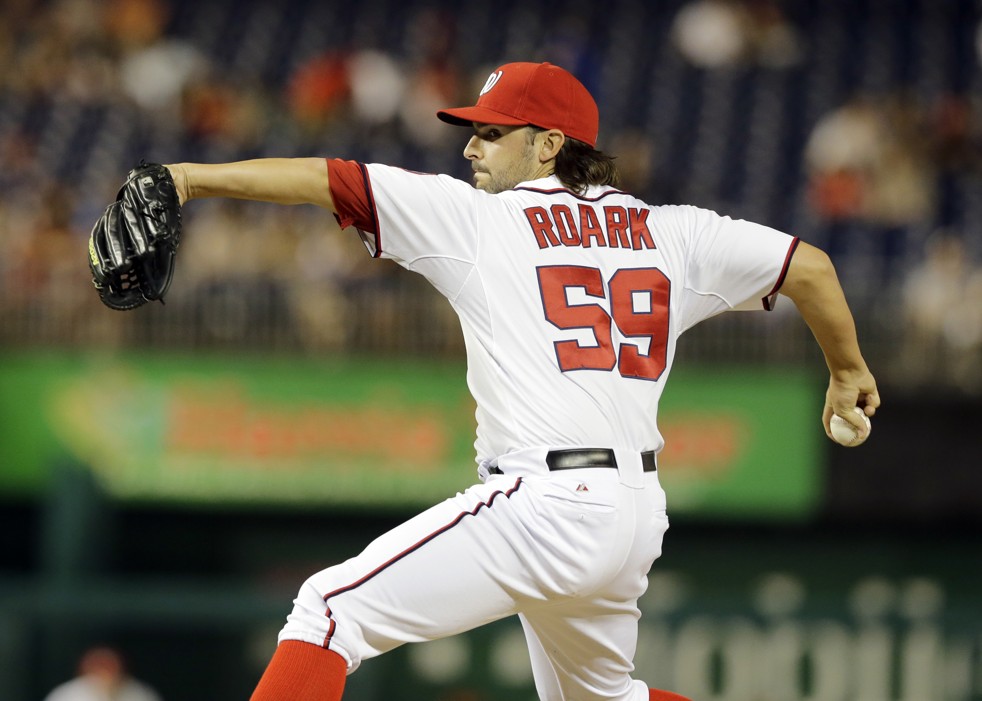
Your AAA candidates right now aren’t exactly enticing.  They’re in AAA for a reason.   Yunesky Maya has proven several times why he isn’t a MLB quality player and is playing out the string in Syracuse.  Danny Rosenbaum couldn’t make the Rockies rotation, one of the worst in the game (but to be fair, he’s still a prospect and could turn into a new version of Tommy Milone with some more seasoning).  Ryan Perry hasn’t looked convincing since his acquisition.  Ross Ohlendorf hasn’t looked bad so far this year in Syracuse, but he’s sort of like the 2013 version of Zach Duke, a guy who couldn’t catch on with a MLB team so he’s trying his luck on a ML contract.  Tanner Roark has been awful so far this year and likely gets replaced in the rotation by … Chris Young, who looks to be the #1 call-up option once he’s back throwing regularly, but again, if he was that good, he’d have picked up with another team.  We don’t really have any upper-end starting prospects anywhere in the system right now close enough to be a decent option either.  The best bet even in AA is Nathan Karns and he’s been awful so far  (wish you had Alex Meyer back yet?  3 starts and a 1.69 ERA so far for Minnesota’s AA team).  The Nats have very little starting pitching depth, we all knew it, and Haren’s troubles are somewhat of a nightmare situation for the team.

Ladson says simply that Chris Young is next in line.

Q: Even if Johnson is not worried about Ryan Zimmerman’s throwing errors, do you think we should be worried?

A: Davey Johnson is clearly protecting his player in the media right now.  Ryan Zimmerman’s arm is a HUGE concern for this team.  He’s getting very close to a Steve Sax/Chuck Knoblock mental state where he literally cannot make any routine throw any longer.  And that’s really bad for this team, which has no place to put him.  The team just had to acquire Denard Span, which pushed the plus-defender Bryce Harper to left, which cost the team Michael Morse.

Lest you think I’m being a “hind sight is 20/20″ hypocrite here, I’m on record pretty plainly that I didn’t think the Span deal was “necessary,” and pointed out a lot of the issues that we now face in terms of players being blocked and of the loss of Meyr.  One of my oft-repeated mantras is that you “can hide players in left and at first base.”  Meaning, you don’t need a gold glover at 1B or in LF if it means more offense.  But that’s not what Mike Rizzo has chosen to do in Washington.  Instead he ran out of town the lesser defender Morse (if you do want a dose of hindsight analysis, Morse is only leading the AL in Homers as we speak and has a 160 OPS+).

Well, now Zimmerman can’t move to first for at least two years, and LaRoche can’t play anything but first base (Morse could at least lumber around left field if he wasn’t on the sac).  Zimmermandoesn’t rate as a 2nd baseman … so Anthony Rendon is seemingly blocked right now.  Nobody’s going anywhere in the outfield … the Nats are locked into this lineup whether they like it or not.

So, yeah I’m worried.

Ladson says he trusts what Johnson says and also thinks that Zimmerman’s shoulder isn’t 100pct.  What!?  Since when has anyone said that?  In fact, all we’ve heard all spring training is that his shoulder is ready to go.

Q: Does Daniel Rosenbaum have a future in the Nationals’ organization, and if not, what do you see the Nats doing with him?

A: We alluded to Rosenbaum briefly above; lets talk about him in more depth.  I think Rosenbaum represents the kind of softer-tossing control lefty that Rizzo doesn’t entirely favor.  He wants a guy who can miss bats, power pitchers with higher K potentials.  Rosenbaum’s numbers in AAA so far look great at a macro level (2 starts, 6 hits allowed an a sterling 0.82 era) but there’s one rather troubling number: only 3 strikeouts in 11 innings.  In AA last year he had 99 Ks in 155 innings.  I just don’t think that’s enough swing-and-miss potential to be effective in the modern game.  Rizzo traded away Milone, who features as a similar pitcher to what Rosenbaum offers, for somewhat similar reasons.

What is his future?  Perhaps continuing to serve as a backup starter in the minor leagues, perhaps serving as trade fodder for the next off-season’s manouverings.  Ladson says the same essentially.

Q: Do you think Johnson should have had Zimmerman play more innings during Spring Training to get comfortable with his throwing motion?

A: The number of spring training innings for established veteran hitters is immaterial; Spring Training is almost entirely so that the pitching staff can build up the arm strength needed to go 6-7 innings from day one.  So, no, I don’t think any change in time played in Viera would have made a difference here.   Ladson agrees.

Q: Why is the bulk of our lineup sitting in the Marlins series (Danny Espinosa, Bryce Harper, Denard Span)?

A: Harper and Span because they had the flu, Espinosa because he got a huge bruise from a HBP.  Nothing nefarious here.  Ladson confirms/agrees.


Nats Major & Minor League Pitching Staffs vs Predictions

leave a comment

First off, this is partly a post of self-flaggelation, to show how far off my various predictions of what the 2013 minor league staffs would look like by doing 2012 season-ending analysis.  Such is the nature of minor league pitching staffs in the modern day; they’re a combination of spare parts, rising stars and hangers-on and they can change rapidly with trades and spring training performances.  Every trade and every MLFA signing trickles down and fouls up predicitons.

Here’s my End of Season 2012 post with predictions for each of the 2013 minor league pitching staffs.   We’ll use that as a basis for the Opening Day 2013 rosters of the four full-season minor league teams.  Just for fun we’ll throw in (and start with) the MLB prediction.  Note that this early in the season we don’t really know who’s shaking out as starters and relievers necessarily for these minor league teams; i’m just going on first week usage right now.  As always, Luke Erickson and nationalsprospects.com, the Nats Big Board and the tireless work by “SpringfieldFan” is much appreciated here.


MLB Nov 2012 Prediction

  • MLB Rotation: Strasburg, Gonzalez, Zimmermann, Detwiler, FA or other acquisition
  • MLB Bullpen: Clippard, Storen, Mattheus, Stammen, Garcia, a FA left-hander (possibly Burnett), a FA long-man (possibly Gorzelanny).
  • MLB notables Out of Organization: Jackson, Burnett, Gonzalez, Lannan, Wang

MLB April 2013 Actual

  • MLB Rotation: Strasburg, Gonzalez, Zimmermann, Detwiler, Haren
  • MLB Bullpen: Clippard, Storen, Mattheus, Stammen, Duke, Rodriguez, Soriano
  • MLB notables Out of Organization: Jackson, Burnett, Gonzalez, Lannan, Wang, Gorzelanny

MLB Discussion: It wasn’t going to be that difficult to predict the 2013 Nats pitching staff make-up by looking at our staff and their FA status heading into the off-season.  The rotation filled its one spot with Dan Haren.  The bullpen was 5/7ths predicted correctly (if you count Zach Duke as a FA left-hander acquisition).  Christian Garcia’s injury opened the door for one more season of Henry Rodriguez, and of course nobody could have predicted the Rafael Soriano purchase.  Lastly all 5 of the predicted departures occured, in addition to Tom Gorzelanny being let go.


AAA Nov 2012 Prediction

  • AAA Rotation: Roark, Maya, Broderick, Meyers, Perry
  • AAA Bullpen: Tatusko (swingman), Arneson (swingman), Severino (loogy), Davis, Lehman, Nelo (closer), Martin,  Mandel

AAA Apr 2013 Actual

  • AAA Rotation: Ohlendorf, Roark, Maya,Perry, Rosenbaum ( eventually Young)
  • AAA Bullpen: Tatusko, Mandel,  Davis, McCoy, Crotta, Abad, Romero, Bramhall
  • AAA D/L: Kimball, Bray, Meyers, Torra, West, Garcia (technically XLS), Accardo
  • AAA cut/released/FA: HPena, Mann, Zinicola, Arneson, Atkins, Ballard
  • AAA Missing: none

AAA Discussion

We were 3/5s correct on the rotation, and probably would have been 4/5ths right if Brad Meyers was healthy.  Ross Ohlendorf and (eventually) Chris Young are new faces here, both being former MLB starters who are taking the Zach Duke route of signing on for full seasons as AAA starter insurance for the big club in the hopes of rebuilding value and finding a MLB job for next year.  Brian Broderick is indeed back; its just that he’s starting for AA instead of AAA.  Lastly Danny Rosenbaum was returned to the team after his spring Rule-5 adventure and was put in AAA instead of AA, where (as we’ll see in a second) I would have predicted he would start.  Once Young is ready to go, I see Tanner Roark turning into the swingman/long-man.

On the bright side (pun intended), when was the last time a professional baseball team had TWO Ivy League alumni pitching in its rotation??  Both Young and Ohlendorf went to Princeton.  I wonder if they have NYTimes crossword puzzle competitions instead of (assumedly) video game competitions on off-days in the clubhouse.

As far as bullpen predictions go, next year I’m paying more close attention to who are 6-year free agents.  Arneson, Severino and Nelo were all MLFAs and have either signed on elsewhere or are facing forced retirement.  Tatusko, Davis and Mandel are onboard.  Lehman is (surprisingly?) in AA, perhaps a victim of the numbers game of the Nats signing (and keeping) a number of minor league lefty relievers this off-season.  I would guess, looking at the names in the bullpen, that Erik Davis is the closer but who knows what the usage will be like.  Lastly Bramhall was a MLFA signing over the off-season who just got placed on the AAA roster to replace the injured Accardo.


AA Nov 2012 Prediction

  • AA Rotation: Rosenbaum, Holder, Gilliam, Karns, Grace, Demny (swingman?) or MLFA?  Solis if he’s healthy?
  • AA Bullpen: Frias, McCoy, Selik (maybe high-A again), Holland (setup),  Wort (closer), VanAllen (loogy), Demmin (maybe high-A again), an org arm or two to fill in.

AA Apr 2013 Actual

  • AA Rotation: Broderick, Treinen, Demny, Clay, Karns
  • AA Bullpen: Holder, Frias, Holland, Wort, Barrett,  Krol,  Lehman, Swynenberg
  • AA D/L: Solis, RMartin, Olbrychowski, Selik
  • AA Cut/released/FA: VanAllen
  • AA Missing: none

AA Discussion

We got, well, not much of this right.  Of my starter predictions: Rosenbaum is in AAA, Holder is here but seems to be the long-man right now, Gilliam is hurt, Solis is still on the DL, and Grace is back in High-A.  We do seem to have at least gotten Karns and Demny right.  Broderick was a surprise FA signing, his being a favorite of the Nats organziation per our Rule-5 experiment with him a couple years back.  I’m surprised he’s not in the AAA rotation though.  Treinen was a trade-throw in from the Morse deal and takes a spot in this rotation, while Clay was a 2013 MLFA signing who (surprisingly?) made the rotation over the likes of other candidates.

The bullen prediction is all over the place: We got Frias, Holland and Wort right.  McCoy is in AAA, Selik is on the AA D/L and VanAllen and Demmin were MLFAs who were left unsigned (and per the big board are still unsigned).   I thought Barrett and Swynenberg would be in high-A instead of AA, I (and most others) thought Lehman would be in AAA, and Krol arrived as the PTBNL in the Morse trade.


High-A Nov 2012 Prediction

  • High-A Rotation: Swynenberg, Ray, Meyer (maybe AA?), Schwartz (maybe low-A), Rauh(maybe low-A)
  • High-A Bullpen Competition: Barrett (maybe AA) , Testa, Smoker (loogy), Hill, Meza(perhaps a starter?), Holt, Hawkins, Bates, Mirowski
  • High-A bullpen Release candidates: Olbrychowski, McCatty, Applebee

High-A Apr 2013 Actual

  • High-A Rotation: Ray, Jordan, Cole, Turnbull, Hill
  • High-A Bullpen Competition: Herron, Mirowski, Holt, Hawkins, Meza, Bates, Self, Grace
  • High-A D/L: Smoker, Applebee, Gilliam
  • High-A Cut/FA/Released: Demmin, Consuegra, Samuel, Testa
  • High-A Missing: McCatty, Olbrychowski

High-A Discussion

The Potomac rotation guess was already light; a couple of the guys I was guessing might be in low-A are indeed there (Schwartz and Rauh).  Swynenberg is in the AA bullpen.  Meyer was traded.  Only Robbie Ray returns.  I thought Jordan was going to repeat Hagerstown.   We got Cole back in the Morse trade and bumped up Turnbull from short season (over Mooneyham, interestingly) Lastly Hill seems to have beaten out Grace for the 5th starter spot.

The Bullpen prediction looks pretty good: 7 of the predicted guys are here (Smoker on the DL, Meza, Holt, Hawkins, Mirowski and Bates).  Barrett indeed is in AA.  Testa was released.  Of my release candidates McCatty is in XST, Applebee and Olbrychowski are on the DL.  Lastly both Samuel and Consuegra were off-season MLFA signings who didn’t pan out and have already been released.


Low-A Nov 2012 Prediction

  • Low-A Rotation: Turnbull, Jordan, Purke (if healthy), Monar, Mooneyham
  • Low-A Rotation Competitors: Hansen, Lee (loogy if not), Encarnation, McGeary (if finally healthy)
  • Low-A Bullpen Competition: Anderson, Estevez, Dupra, McKenzie, Henke, Davis, Boyden, Benincasa, Hudgins, Dicherry, Mudron

Low-A Apr 2013 Actual

  • Low-A Rotation: Anderson, Mooneyham, Pineyro, RPena, Encarnation
  • Low-A Swingmen: Rauh, Schwarz, Dupra
  • Low-A Bullpen: Fischer, Harper, Henke, Hudgins, Benincasa
  • Low-A D/L: Estevez, Purke, Simko, Mesa, Weaver
  • Low-A Cut/FA/Released: Kreis, Lucas, Upperman, Hansen, Monar
  • Low-A Missing: Hollins, Hicks

Low-A Discussion

Historically the hardest to predict, the Low-A team.  Of the guesses for the rotation last fall, we only got Mooneyham right.  Turnbull and Jordan were bumped up a level.  Purke is still hurt.  Of the “competitors” the team flat out released Monar and Hansen to my surprise.  Monar was really good in Auburn last year, and while Bobby Hansen wasn’t nearly as dominant as a starter, I thought he’d at least get a shot at being a loogy after so many years in the organization.  Jack McGeary was selected out of the org during the minor league phase of the rule-5 draft.  Lee is in XST limbo right now.

So who are these surprising Low-A rotation guys?  I thought Anderson would be relegated to the bullpen in Low-A; instead he’s the opening day starter.  I thought Pineyro would repeat short-season ball but he made the full-season team.  And lastly I thought Pena was destined for another season in short-A.

Rauh and Schwartz, after I thought they had shots in the rotation in high-A, seem to be taking the roles of “2nd starters” for now, each having gone multiple innings in relief of the starter.  I wouldn’t be surprised to see them becoming full time starters if one of the 5 guys ahead of them falter.

Most of the rest of the predicted bullpen are 2012 signees who are currently amongst a large group of extended spring training guys who will be battling it out for short-season jobs with 2013 signees.   And we seem to have a very large group of them; the big board lists in excess of 30 hurlers who are currently still in the organization, who are not on the D/L officially, but who are not assigned to one of the four full season teams.   That’s a lot of arms for just a handful of spots in short-A and the rookie league after the 2013 draft occurs.

Written by Todd Boss

April 11th, 2013 at 8:41 am

Posted in Majors Pitching, Minor League Pitching

Tagged with , , , , , , , , , , , , , , , , , , , , , , , , , , , , , , , , , , , , , , , , , , , , , , , , , , , , , , , , , , , , , , , , , , , , , , , , , , , , , , , , , , , , , , , , , , , , , , , , , , , , , , , , , , , , , , , , , , , ,

Pitcher Wins on the Free Agency Market; an analysis

3 comments

Is Greinke's big new deal going to pay off for the Dodgers? We'll see. Photo Jeff Golden/Getty Images

One of my pet projects of recent years has been to track “major” Starting Pitcher free agent contracts and then to do analysis of how they turned out, on a Dollar per win basis.  This post is an analysis of this work along with some interesting conclusions to determine some of the “best” and “worst” free agent contracts ever awarded.

This is mostly an analysis of past performance; there’s plenty of pitchers right now on major contracts that are just too soon into the deal to really draw any conclusions.  I’ve included in the spreadsheet all the major contracts signed this past off-season and will continue to do so if these guys get significant deals.  But we’ll have to wait a year to see how the first year of the contracts play out.  For all contracts that are in the middle of being played out, I’ve calculated how that contract is faring thus far.

Some caveats to the data:  For ease of analysis, I depend on the Average Annual Value (AAV) of the contracts as opposed to trying to figure out exactly how many wins were earned in which year of a varying contract amount.  Therefore (for example), Gio Gonzalez’s contract may have only paid him $3.25M in 2012 but I’m using the full AAV of $8.4M for the purposes of the analysis (it would just be far too difficult to calculate each pitcher’s dollar per win on an annualized basis otherwise).  Also, I focus on dollars per Win, despite the known limitations of the “Win” statistic.  I have gone through and added in Quality Starts to the analysis, but that stat is also flawed in some respects (though it does do a pretty good job of indicating whether or not the starter has done his job).  Unfortunately the $/QS doesn’t work out as nicely as $/Win, since Pitcher Wins are still so prevalent in our player analysis.  I mean, after all, the goal of the game is to WIN the game, right?

Here’s a quick cut-n-paste from the spreadsheet (which is also available in the Links section to the right and on Google Docs) of some selected fields.  See the Google xls for everything.  Apologies if this doesn’t present well online.  The table is listed in descending order of $/year AAV.  Blanks in the Wins and $AAV per win indicate that the contract has yet to begin.  I also threw in a couple of non-FA contracts at the end to show what a MLB-minimum successful starting pitcher looks like in comparison.

Last Name First Name Total Value (includes club options) $/year AAV Contract Term Wins $ AAV per win
Clemens Roger $28,000,022 $28,000,022 2007 6 $4,666,670
Greinke Zack $147,000,000 $24,500,000 2013-2018
Sabathia C.C. $122,000,000 $24,400,000 2012-16 15 $1,626,667
Lee Cliff $120,000,000 $24,000,000 2011-15 23 $2,086,957
Hamels Cole $144,000,000 $24,000,000 2013-18
Sabathia C.C. $69,000,000 $23,000,000 2009-11 59 $1,169,492
Santana Johan $137,500,000 $22,916,667 2008-13 46 $2,989,130
Cain Matt $127,500,000 $21,250,000 2012-17 16 $1,328,125
Lincecum Tim $40,500,000 $20,250,000 2012-13 10 $2,025,000
Halladay Roy $60,000,000 $20,000,000 2011-13 30 $1,333,333
Darvish Yu $111,700,000 $18,616,667 2012-18 16 $1,163,542
Zambrano Carlos $91,500,000 $18,300,000 2008-12 50 $1,830,000
Zito Barry $126,000,000 $18,000,000 2007-13 58 $1,862,069
Clemens Roger $18,000,000 $18,000,000 2005 13 $1,384,615
Peavy Jake $52,000,000 $17,333,333 2010-12 25 $2,080,000
Matsuzaka Daisuke $103,000,000 $17,166,667 2007-12 50 $2,060,000
Beckett Josh $68,000,000 $17,000,000 2011-14 20 $1,700,000
Weaver Jered $85,000,000 $17,000,000 2012-16 20 $850,000
Lackey John $82,500,000 $16,500,000 2010-14 26 $1,903,846
Burnett A.J. $82,500,000 $16,500,000 2009-13 50 $1,320,000
Verlander Justin $80,000,000 $16,000,000 2010-14 59 $813,559
Sanchez Anibal $80,000,000 $16,000,000 2013-17
Schmidt Jason $47,000,000 $15,666,667 2007-09 3 $15,666,667
Hernandez Felix $78,000,000 $15,600,000 2010-14 40 $1,170,000
Wilson C.J. $77,500,000 $15,500,000 2012-16 13 $1,192,308
Hampton Mike $121,000,000 $15,125,000 2001-08 56 $2,160,714
Brown Kevin $105,000,000 $15,000,000 1999-05 72 $1,458,333
Lowe Derek $60,000,000 $15,000,000 2009-12 49 $1,224,490
Hamels Cole $15,000,000 $15,000,000 2012 17 $882,353
Kuroda Hiroki $15,000,000 $15,000,000 2013
Mussina Mike $88,500,000 $14,750,000 2001-06 92 $961,957
Oswalt Roy $73,000,000 $14,600,000 2007-11 61 $1,196,721
Buehrle Mark $58,000,000 $14,500,000 2012-15 13 $1,115,385
Peavy Jake $29,000,000 $14,500,000 2013-14
Buehrle Mark $56,000,000 $14,000,000 2008-11 54 $1,037,037
Martinez Pedro $54,000,000 $13,500,000 2005-08 32 $1,687,500
Halladay Roy $40,000,000 $13,333,333 2008-10 58 $689,655
Martinez Pedro $92,000,000 $13,142,857 1998-04 117 $786,325
Danks Jon 65,000,000 $13,000,000 2012-15 3 $4,333,333
Park Chan Ho $65,000,000 $13,000,000 2002-06 33 $1,969,697
Dempster Ryan $52,000,000 $13,000,000 2009-12 48 $1,083,333
Haren Dan $13,000,000 $13,000,000 2013
Jackson Edwin $52,000,000 $13,000,000 2013-16
Colon Bartolo $51,000,000 $12,750,000 2004-07 46 $1,108,696
Carpenter Chris $50,800,000 $12,700,000 2008-11 44 $1,154,545
Arroyo Bronson $25,000,000 $12,500,000 2009-10 32 $781,250
Dickey R.A. $25,000,000 $12,500,000 2013-14
Perez Oliver 36,000,000 $12,000,000 2009-11 3 $12,000,000
Silva Carlos $48,000,000 $12,000,000 2008-12 15 $4,000,000
Millwood Kevin $60,000,000 $12,000,000 2006-10 52 $1,153,846
Kuroda Hiroki $12,000,000 $12,000,000 2011 13 $923,077
Pettitte Andy $12,000,000 $12,000,000 2013
Haren Dan $47,750,000 $11,937,500 2009-12 54 $884,259
Kuroda Hiroki $35,300,000 $11,766,667 2008-10 28 $1,260,714
Arroyo Bronson $35,000,000 $11,666,667 2011-13 21 $1,666,667
Lincecum Tim $23,000,000 $11,500,000 2010-11 29 $793,103
Mussina Mike $22,141,452 $11,070,726 2007-08 31 $714,240
Dreifort Darren $55,000,000 $11,000,000 2001-05 9 $6,111,111
Meche Gil $55,000,000 $11,000,000 2007-11 29 $1,896,552
Lilly Ted $33,000,000 $11,000,000 2011-13 17 $1,294,118
Jackson Edwin $11,000,000 $11,000,000 2012 10 $1,100,000
Harrison Matt $55,000,000 $11,000,000 2013-17
Carpenter Chris $21,000,000 $10,500,000 2012-13 0 (0 wins)
Ryu Hyun-Jin $61,700,000 $10,283,333 2013-18
Neagle Denny $51,000,000 $10,200,000 2001-05 19 $2,684,211
Lilly Ted $40,000,000 $10,000,000 2007-10 54 $740,741
Darvish Yu $60,000,000 $10,000,000 2012-18 16 $625,000
Kuroda Hiroki $10,000,000 $10,000,000 2012 16 $625,000
Pavano Carl $39,950,000 $9,987,500 2005-08 9 $4,438,889
Wolf Randy $29,750,000 $9,916,667 2010-12 31 $959,677
Johnson Josh $39,000,000 $9,750,000 2010-13 22 $1,329,545
Greinke Zack $38,000,000 $9,500,000 2009-12 67 $567,164
Washburn Jarrod $37,000,000 $9,250,000 2006-09 32 $1,156,250
Igawa Kei $46,000,000 $9,200,000 2007-11 2 $23,000,000
Cain Matt $27,250,000 $9,083,333 2010-12 41 $664,634
Lowe Derek $36,000,000 $9,000,000 2005-08 54 $666,667
Matsuzaka Daisuke $52,000,000 $8,666,667 2007-12 50 $1,040,000
Beckett Josh $42,000,000 $8,400,000 2007-10 55 $610,909
Gonzalez Gio $42,000,000 $8,400,000 2012-16 21 $400,000
Guthrie Jeremy $25,000,000 $8,333,333 2013-16
Ortiz Russ $33,000,000 $8,250,000 2005-08 7 $4,714,286
Schmidt Jason $40,000,000 $8,000,000 2002-06 71 $563,380
Buchholz Clay $30,000,000 $7,500,000 2012-15 11 $681,818
Lester Jon $43,000,000 $7,166,667 2009-14 58 $494,253
Hamels Cole $20,500,000 $6,833,333 2009-11 36 $569,444
Wainwright Adam $36,000,000 $6,000,000 2008-13 64 $468,750
Ryu Hyun-Jin $36,000,000 $6,000,000 2013-18
Webb Brandon $28,000,000 $5,600,000 2006-10 56 $500,000
Lee Cliff $23,000,000 $4,600,000 2006-10 67 $343,284
Igawa Kei $20,000,000 $4,000,000 2007-11 2 $10,000,000
Jimenez Ubaldo $23,750,000 $3,958,333 2009-14 53 $298,742
Jimenez Ubaldo $10,000,000 $2,500,000 2009-12 53 $188,679
Price David $9,750,000 $1,950,000 2007-11 41 $237,805
Buchholz Clay $555,000 $555,000 2011 6 $92,500
Buchholz Clay $443,000 $443,000 2010 17 $26,059

Here’s some interesting facts, that come out of this analysis (some of these points can also be seen at the amazing Cots Salary database, now at Baseball Prospectus, and are confirmed in my spreadsheet tracking the same):

  • Largest total Starting Pitcher Contract ever signed: Felix Hernandez’s brand new 7 year, $175M extension, beating out the previous record-holder CC Sabathia (7yrs/$161M in 2009).   Zack Greinke’s just signed 6yr/$147M would be the 2nd biggest ever signed, and Cole Hamel’s 6yr/$144M contract the third.  Will our own Stephen Strasburg come close to broaching these limits when he hits the FA market?  We’ll see.
  • Largest Single-Season AAV: Roger Clemen’s 1yr/$28M deal in 2007.  The next closest are Hernandez’s $25M/year, Greinke $24.5M/year and Sabathia’s $24.4M figures.

(A couple of quick caveats to the above lists: CC Sabathia subseqently opted out of his 7/161 deal, so it basically got turned into a 3yr/$69M deal.  And, techncially Hernandez’s deal ripped up the last two years of his previous deal to replace it with the 7/175 deal; lots of people are looking at the new deal as a 5  year extension with an even higher AAV.  I don’t see it the same way; I see it as a replacement of the existing contract years).

What are some of the worst deals ever made?

  • Worst Ever Starting Pitcher Contract: Kei Igawa’s 2007 deal with the Yankees, which was 5yrs/$20M but included a $26M posting fee, is the worst $AAV per Win contract ever signed.  Igawa went 2-4 in 13 starts over the life of this 5 year deal, equating to $23M per win for his team.  He spent the last two seasons of this contract buried in AAA.
  • Worst non-Posting fee Starting Pitcher Contract: Jason Schmidt’s 3yr/$47M contract with the Dodgers.  Schmidt made 10 total starts and went 3-6, equating to $15.6M per win.

Other names on the “Worst Starting Pitcher Contract” category include Oliver Perez ($12M/win), Darren Dreifort (6.1M/win), Russ Ortiz (4.7M/win), Carl Pavano ($4.4M/win) and Carlos Silva ($4M/win).   Most of these contracts are well known to baseball fans and are commonly thrown around when talking about the worst historical FA contracts.

How about some of the “Best” Contracts ever signed?  Lots of players have signed small one year deals and won double-digit games, so those really cannot count.   Starting with an arbitrary floor of a $50M free agent contract, here’s the best value FA contracts ever signed:

  1. Pedro Martinez: 7yr/$92M, during which he went 117-37 for the Red Sox for a $786k/win total.
  2. Justin Verlander: He’s in the middle of a 5yr/$80M contract and for the first 3 years he’s 59-22 for $813k/win.
  3. Mike Mussina went 92-53 in his 6yr/$88.5M contract for $961k/win.

Jered Weaver and Yu Darvish deserve some mention here; they’re both in the first year of $50M+ contracts and are easily earning their pay in terms of $/win.


So what does this data mean?  Here’s some conclusions.

  1. It used to indicate that if you got about one (1) pitcher Win per million dollars spent on a player in the Free Agent market that you were doing great.  Look at our own Edwin Jackson in 2012: we signed him for $11M, he went 10-11 for us, equating to $1.1M/win.  Good value frankly.
  2. If you’re getting anything between $1.25M and $1.5M/win, there may be some complaints about the value of the contract.  Not always, but most of the time it indicates that either the pitcher is underperforming or is overpaid.
  3. Anything over $2M/win is usually considered a bust.  Nearly every contract in the $2M/win in AAV and above has been mentioned and criticized as being a bad contract; the list of “worst ever” above starts at $4M/win and goes higher.
  4. If you pay a starter anything more than about $18M/season,  you’re really going to have a hard time getting value back.  There’s only been a handful of 20-game winners over the past 5 years or so, but paying a starter $24M like Greinke is getting is almost certainly going to be regretted at some point.  An injury or a lost season completely blows the $AAV/win.
  5. It illustrates more clearly than anywhere else the value of a top-notch, pre-Arbitration starter.  Take Clay Buchholz for example; in 2010 he was 17-7 while earning the league minimum of $443k.  That equates to $26,059/win on the same staff that was busy paying Daisuke Matsuzaka $2.06M per win (when adding in the $52M posting fee).  Buchholz has struggled since then, but teams that depend on these pre-arb starters (Tampa, Oakland, Washington to a certain extent) save untold amounts of FA dollars as a result.
  6. Lastly, and this is the hard part, this analysis is getting nearly impossible to do across baseball eras because of the general inflation of contracts and especially because of the bonanza of FA dollars being thrown out there right now.  Pedro Martinez at the top of his game signed a 7yr/$92M deal.  Imagine what he’d get today?  It could be twice that.  He was coming off a 1997 season in which he struck out 305 batters, had a 1.90 ERA, a 219 ERA+ and won the Cy Young award.  So perhaps going forward a general $1.25M/win is a more accurate barometer for whether or not a pitcher has “earned” his contract.  But there’s no easy way to draw a line in the free agency sand and say that before yearX $1M/win was a good barometer while after yearY $1.25M/win is a good barometer.
  7. A caveat to the $1M/win benchmark; there are different standards for obtaining wins.   If you sign a $3M 1 year deal and then subsequently go 3-12 with a 6.00 ERA … while it looks like you reached the $1m/win threshold in reality you were, well, awful.  This analysis only really holds up for major FA contracts paying in excess of $10M/year.

Lastly, for comparison purposes, here’s the above analysis looks for the 2012 Nationals pitching staff.  Keep in mind that the $/win figures for pre-arbitration pitchers vastly skew the analysis.

Last Name First Name Total Value (includes club options) $/year AAV Starts QS Wins $ per QS $ AAV per win
Strasburg Steven $15,100,000 $3,775,000 45 28 21 $539,286 $719,048
Gonzalez Gio $42,000,000 $8,400,000 32 22 21 $381,818 $400,000
Zimmermann Jordan $2,300,000 $2,300,000 32 24 12 $95,833 $191,667
Jackson Edwin $11,000,000 $11,000,000 31 17 10 $647,059 $1,100,000
Wang Chien-Ming $4,000,000 $4,000,000 5 0 2 #DIV/0! $2,000,000
Detwiler Ross $485,000 $485,000 27 12 10 $40,417 $48,500
Lannan John $5,000,000 $5,000,000 6 2 4 $2,500,000 $1,250,000
Maya Yunesky $8,000,000 $2,000,000 10 1 1 $6,000,000 $6,000,000

The counting figures for Starts/QS/Wins/Losses are cumulative for the life of whatever contract the player is on.  So for Strasburg, he was basically in the 4th year of his original 4 year deal, hence the 45 total starts in those 4 years.  For guys like Zimmermann and Detwiler, the analysis is just for 2012 since they were playing on one-year deals.

The 2012 Nats have $AAV per win values all over the road:

  • Detwiler’s $48k per win in 2012 is an amazing bargain; he got 10 wins while pitching for basically the MLB minimum.  And, Zimmermann’s 12-win season while on a first-year Arbitration salary also represented about 20% of what those wins would have cost on the FA market.
  • Jackson produced almost exactly at the expectations for a FA starter; $11M contract, 10 wins, and $1.1M per win.  In 2013 if we get 12-13 wins from Dan Haren, we’ll be doing alright.
  • Lannan provided just on the borderline of bust production, as you’d expect for someone who got paid $5M to give the team 6 starts.
  • Wang: $4M salary, 5 starts, zero quality starts, 2 wins and a $2M/win price tag.  Yes; he was a bust.
  • Lastly Mr. Yunesky Maya.  The team has now paid him $6M over three years.  In that time he’s gotten 10 MLB starts and has produced exactly one Quality start and one win.  That’s $6M the team has paid for each win, in the range for one of the worst dollar-per-win contracts ever signed.  Of course, the Nats only signed him for $8M (not the $46M contract Igawa got), so the downside is limited.  But it does illustrated just how badly this deal has gone for the team.

Ladson’s Inbox 2/5/13

16 comments

Lots of questions about Gonzalez and Garcia this week. Photo unknown credit.

Hey, what great timing for another Bill Ladson inbox (posted 2/5/13).  Baseball news is light, pitchers and catchers report in a week or so, and I’m not quite ready to continue my Stats series.

As always, I write my answer before reading his, and sometimes edit questions for clarity:

Q: Do you think general manager Mike Rizzo will add starting pitching depth before Opening Day? Does the lingering possibility of a Gio Gonzalez suspension change whom the Nationals would consider acquiring?

A: In Ladson’s 1/22/13 mailbag, some one asked what could prevent the Nats as constructed from winning the World Series in 2013.  I answered Rotation Injuries and Luck.  Well, in the wake of the Miami PED scandal, I guess the third answer may be “PED scandal.”

This is a tough question to answer; Gio Gonzalez has denied the rumors, but the newspaper in question (the Miami New Times) clearly only named Gonzalez because they felt like the evidence they had in hand was irrefutable.  Many other players have not been named.  So as a GM; how do you go about preparing for 2013 at this point?   If Mike Rizzo knows that Gonzalez is getting suspended, you have to think he’s on the horn to his buddy Scott Boras about possibly buying Kyle Lohse, which is clearly the best remaining FA starter.  But Lohse isn’t coming cheap, and likely isn’t coming on a one year deal, and would cost another draft pick (I believe).  The Nats are already topping $120M in payroll; would they go to $135M?

If we think Gio at least gets a pass and the suspension is put off, maybe Rizzo’s recent activities of signing random starters to minor league contracts is going to be sufficient.

Ladson mentions Javier Vazquez and the ever-present rumors of Christian Garcia going to the rotation as possible Gonzalez replacements if he gets suspended quickly.  Probably fair; Vazquez may be a great, cheap alternative.

Q: Everyone is saying that it’s going to be a two-team race in the National League East between the Nationals and Braves. Do you think the Phillies have a shot to contend with both these teams, or is their time done?

A: Boy, its hard to look at the aging, expensive Phillies lineup they had in place in 2012, which suffered injuries and setbacks and creaked their way to a .500 record, and then look at the highly questionable slew of acquisitions and signings this off season (Ben Revere, John Lannan, Michael YoungDelmon Young and everyone’s favorite anti-gay advocate Yuniesky Betancourt) and not, well, giggle at where this team is going.  My favorite baseball joke from the off-season goes like this: “The Phillies wanted to get Younger this off-season, so they signed Michael Young and Delmon Young.”

The two Youngs were both negative WAR players last year, Lannan is a 5th starter, Revere was a backup centerfielder who the Phillies traded some decent assets for, and Betancourt is who he is (though admittedly he’s on a minor league deal and seems at best set to be a utility infielder behind starters Jimmy Rollins and Chase Utley).  I see the Phillies being a very bad defensive team with the two Youngs in the starting lineup, I see some serious questions in the back side of the rotation, and I see continued regression and louder complaints about Ryan Howard’s contract.  Fun times a-coming in Philadelphia.  Ladson actually says that the Phillies will “be improved with Michael Young.”  Bill!  Have you seen Young’s WAR figures from 2012??  He was a NEGATIVE WAR player at both major War sites.  That means he makes your team worse!    Now, he was completely servicable in 2011 … so if you want to make the argument to me that 2012 was an aberration for an aging hitter playing in a hitter’s park, well I guess that’s a stance you can take.  But pretty much every other pundit in the blogosphere has loudly criticized the Philadelphia moves this off-season.

Q: What is the status of Lucas Giolito? When do you see him pitching in D.C.?

A: Tommy John surgery in Late August (I can’t remember the exact date; it was 8/24/12 when I posted this highly-critical article about Lucas Giolito and the situation), so figuring a typical 12-month rehab session before he’s actively throwing again in pro-games basically puts him at the end of the 2013 minor league season.  Which means he’ll be 20 before he really is ready to start his pro career in the spring of 2014.  Figure 4-5 years average case for typical high schoolers to work their way up the systems (perhaps fewer years given his talents and pedigree, as we’ve seen with someone like Dylan Bundy in 2012, who made his way from low-A to AA in his first pro season out of HS and got a late Sept callup to the majors) and we’re probably looking at 2016-2017 before seeing him in the majors.  If, of course, he recovers from surgery, hasn’t destroyed his mechanics, is effective, matures, doesn’t get re-injured, or any of the million other pitfalls that typically befall high school arms drafted in the upper rounds.  Ladson thinks he’s pitching pro games “after the all-star break” and is in the majors in 3 years.  Wow.  That is optimistic.

Q: How do you think Henry Rodriguez will do? And what do you think his role in the bullpen will be?

A: I am, and always have been, pessimistic on Henry Rodriguez.  I hated the Willingham trade that got him here.  He’s forced the team to invent injuries to stash him on the DL coming out of spring training b/c he has no options.  He led the league in wild pitches in 2011 in just 65 innings.  He had a 69 ERA+ in 2012.  At some point when does the team say, “OK, its nice that he throws 100mph.  But enough is enough; we need a reliable pitcher who can deliver when called upon.”  Perhaps Spring Training 2013 is that time.

What do I think his role will be?  I’m sure he’ll look great in Spring Training again, will break camp with the team, and very well may look halfway decent for a while.  But just like every other season, he’s going to have those 3-walk outings where he pitches a 1/3 of an inning and gives up 4 runs, and then the manager will be afraid to use him unless the team has a 5-run lead.  And eventually we’ll call up Garcia to replace him and move on.  That’s my prediction for Rodriguez.  Ladson says the team should “attempt to trade him if he is not impressive this spring.”  Wow, that’s sage advice; if only every team could trade its under-performing players and actually get value back whenever it wanted.

Q: Can you predict Washington’s Opening Day lineup if all available players are healthy?

A: Easy.  I’ll even predict the batting order.  Span-Werth-Harper-Zimmerman-LaRoche-Desmond-Espinosa-Suzuki-Strasburg.  Ladson predicts the same names but in a lineup order that makes no sense from a lefty-righty balance perspective.

Q: After announcing his retirement, do you think Brian Schneider is a possible candidate to replace Johnson as manager of the Nationals?

A: Wow, yet another speculative question about the future Nationals Manager.   He took a question about the manager on 1/28/13, and on 1/22/13.  And on 1/14/13.   I guess people like speculating on the Nats next manager.  Not repeating what i’ve said on the topic before, is Brian Schneider a candidate?  Why would he possibly be a candidate to manage the major league team of a system he left 5 years ago?  Why would the Nats pick a manager who’s never managed a day in his life?   Ladson breathes some common sense on this one.

Q: I think Garcia has to be on the Opening Day roster, so is he in the bullpen or someplace else? Can the 25-man roster accommodate him and all the other pitchers?

A: “Someplace else?”  Like where?  In the outfield?   I like Garcia too, but the team has a numbers problem in the bullpen.  Storen, Clippard, Mattheus, and Stammen have all more than earned their spots.  Soriano is being paid a ton of money.  Duke is guaranteed a spot (he’s the only lefty and he’s got enough service time to refuse a demotion).  Oh, and Rodriguez has no options.  So there’s your 7-man bullpen.  Notice there’s only one left-hander out there; if you believe that you need left-handers to get left-handed batters out, then the bullpen needs to sacrifice one of the righties in order to have a second lefty (Bill Bray?) in there.

The only way I see Garcia making this bullpen is if the team runs out of patience with Rodriguez and DFAs/DLs him, or if the team trades away one of their closer-quality surplus guys, or if maybe someone like Mattheus/Stammen (both of whom do have options) struggles or gets hurt.  Otherwise look for Garcia to get stretched out and get looks as a starter in AAA.  Ladson says he’s confident Garcia is on the 25-man roster …. ok explain it to me then based on the above paragraph.  Who is he replacing?

Updated Nats Resource Links and their impact

11 comments

With the slew of off-season activity nearly complete, I’ve updated some of the tracking worksheets that I maintain related to the Nats roster.  From non-tenders, FA signings and re-signings, trades and Arbitration settlements a lot has changed in terms of the Nats payroll, expected WAR estimates and 40-man options statuses.  All these resources are now updated in Google Docs.  Links (which should also be along the right-hand side of the page):

Here’s the implications that the last few months have had in each case:

Nats WAR Estimate Impact: We last visited this topic on 1/3/13 and I had a 2013 fWAR best case estimate of 57.6, equating to a 103 win season.  Now we’ve replaced Michael Morse’s 3-win estimate with Adam LaRoche’s 3.5 win estimate and added in Rafael Soriano’s 1.2 fWAR estimate and are looking at a fWAR estimate of 59.1 and a 105 win capable team.  As with before, this doesn’t mean i’m predicting 105 wins; i’m saying that if everyone plays to their potential and nobody gets hurt, its hard not to see this being a 105 win team as constructed.

Nats 2013 Payroll Impact: When we last visited this topic on 12/3/12, we were sitting on a 2013 estimated payroll of just $88M.  Since then, we re-signed LaRoche, signed Dan Haren, stunningly signed Soriano and settled a slew of pre-arbitration settlements (most of which seemed to trend higher than MLB’s estimates for the players).  I’m now estimating the Nats 2013 payroll to be $121,823,500 (but see the caveat in the next paragraph).  There are still two payroll figures to be announced/decided: Zach Duke’s 2013 pay has yet to be disclosed (I’m using an estimate of $1.5M) and Jordan Zimmermann was not able to settle with the team ahead of the filing deadline (i’m using an estimate of $4.9M for him).  The team filed at $4.6M while Zimmermann filed at $5.8M, meaning they’re $1.2M apart at current.  The midpoint would be $5.2M, meaning that the overall payroll could creep even higher and hit $122M.

Coincidentally, I’m not sure how to treat Soriano’s deal from a payroll perspective.  2 years, $28M but as we’ve learned half that money is deferred.  The spreadsheet shows it as a $14M aav contract but he’s only being paid $7M this year.  With the deferred money, the calculated AAV of the contract is only in the $11M/year range.  Cots shows $14M/year right now on its main page, but it hasn’t fixed its internal google XLS’s yet.  I think the right way to go would be to show $7M being paid this year and next, and then when the deferred payments kick in show them as the annual $2M payments that they’ll be.  So maybe the current payroll isn’t $121M but closer to $114M.  I’ll be curious to see how the sites like Cots and Usatoday (the two main sites that publish team payroll figures) treat this contract going forward.

Option Status: We last visited this topic on 11/14/12, before the non-tenders of Flores, Lannan and Gorzelanny, before the Rule-5 additions and before all the signings.   New signings Haren and Soriano are both 5+ year vets so Options don’t matter.  Interestingly, Duke has 6+ years of service time and signed a MLB deal, meaning he cannot be assigned to AAA withouth is consent and/or passing through waivers; the team is clearly counting on him to be in the MLB bullpen the whole year.  The most interesting options cases now belong to Ryan Mattheus and Craig Stammen, both of whom have options and both of whom (despite Stammen’s new 2 year deal) could be affected by the crowded bullpen.  I think we’re all under the assumption that Christian Garcia is starting the year in AAA; he has 3 options to use and may be on the train back and forth often in 2013.  I remain curious as to what the team will do with Carlos Rivero, who hit well in AAA and even better in winter ball, but has no options remaining and doesn’t have a single day of MLB service time.

Lastly (unrelated to the Nats), I’ve updated somewhat my “Best versus Winner” xls with the results from the NFL playoffs over the weekend.  For the 9th straight year in the NFL, the Superbowl winner will NOT be the team that also had the best regular season record.  This year, Denver and Atlanta shared the best regular season record and both were eliminated before reaching the Superbowl.  I keep track of this particular finding for all four major sports and generally have found that very infrequently does the team with the best record in any sport actually take the year end title any more.  Baseball has only seen it a few times in the last 20 years.

I’ve got a draft post that has an overview of all the random documents and spreadsheets that I’ve uploaded to Google Docs over the years (including the 4 discussed in this post).  I”ll publish it during a slow period this winter.

Ladson’s Inbox 1/14/13

16 comments

Free Michael Morse! Photo Jacqueline Martin/AP via federalbaseball.com

Another edition of Bill Ladson’s Nats inbox, dated 1/14/13.

Q: Who will replace Davey Johnson once he retires after the 2013 season?

A: Who knows and who cares?  Can we wait until the end of the 2013 season to see if Davey Johnson actually retires?  I’m not convinced that he actually will retire if the Nats don’t win the World Series.  Even if he does retire, I think its pointless to speculate who in the baseball universe the team could possibly look to as a successor.  It could be a current TV pundit, a bench coach, someone elses manager, someone who just got fired, a minor league manager in our system, one of our current coaches, Mike Rizzo’s uncle.  About the only person I think it will NOT be is Jim Riggleman.  Ladson says internal candidates Randy Knorr and Trent Jewett are good candidates, and throws out Joe Girardi’s name based on his contract status coinciding with the end of next season.

Q: Is there any validity to the Nationals having interest in Javier Vazquez? If the Nats were to sign him, would they move Ross Detwiler to the bullpen so he could be their second lefty?

A: This topic as so irked me that I’m penning an entire post dedicated to it.  Check back later.

Q: If Michael Morse is only making $6.7 million, why not keep him around as insurance and a right-handed bat off the bench?

A: An excellent question.  Much like the team paid John Lannan to sit around in Syracuse for a year, they could do the same with Michael Morse.  Except that Morse is FAR more valuable in trade than in sitting around and wondering what he’s done to earn his fate.  He’s by all accounts a great clubhouse guy, but keeping him here would be detrimental to everyone involved.  I think the team needs to move him for lefty bullpen help and some farm system starting pitching depth.  Ladson says the team needs to do Morse a favor and trade him.

Q: Who do you see as the Opening Day closer — Tyler Clippard or Drew Storen?

A: Drew Storen.  Tyler Clippard had his shot at the title and lost it down the 2012 stretch.  I think the team goes back to its winning formula with Clip-Store-and Save in 2013.  Ladson thinks Johnson will go with “the hot hand” and split the role.  I don’t.  I think he’ll go right back to what he was doing before.

Q: With Adam LaRoche now signed, what are the Nats’ long-term plans for Tyler Moore?

A: Once Morse is traded, Moore becomes the big bat off the bench and does some fill-in work at 1st base and (maybe) LF.   I see his opportunities limited though unless we see some injuries.  Longer term, I think he’ll have to hit his way into full time playing time; if he does perhaps he’s the first baseman of the future.  I don’t see it though; I think he’s likely to find his way off the team through trade at some point.  The OF is full and 1B is blocked.  Ladson agrees, mentioning an interesting wrinkle; with Bo Porter now in Houston, perhaps a trade would be in order.

Q: Which Minor League player do you think will have a breakout season this year?

A: A good question.  Borrowing from Luke Erickson’s NationalsProspects watchlist for 2013 (a very handy one-page summary of all the top/interesting prospects throughout the Nats farm system), I’ll pick three names that could press for quick promotion and big impact in 2013: Rendon, Skole and Goodwin.  Ok that’s a cop out.  I will say this: I *hope* that Rendon breaks out and finally hits like his draft pedigree.  Lets keep an eye this year on Nathan Karns and Erik Davis, two rising arms that could both feature in the bullpen in 2013.  I’d like to see Robbie Ray rebound.  For a deep-cut, i’m really interested to see what Kevin DiCharry does in 2013.   Ladson goes with the two obvious candidates Rendon and Goodwin.  I don’t think he follows the farm system that closely, so we’ll give him a pass.

Q: Is Ryan Zimmerman expected to be healthy for Spring Training?

A: I saw nothing in his surgery detail that indicated that the 2013 season was in jeopardy in any way.  Ladson confirms.

Q: If Jayson Werth bats in the middle of the order, what right-handed hitter is the best choice for No. 2 after Denard Span?

A: I’d probably say Jayson Werth is still the best option at #2.  The lineup that seems to make the most sense goes Span-Werth-Harper-Zimmerman-LaRoche-Desmond-Espinosa-Suzuki.  That allows the team to go L-R-L-R-L-R-S-R, a perfect balance.  Perhaps you switch Desmond and Werth.  Ladson thinks Harper is batting second most of the time.  Can’t see that; can’t see Johnson purposely going lefty with 3 of the first four guys in his rotation.  That seems to scream out easy Loogy matchups every night.

Q: Will Christian Garcia do any starting for the Nats next season? I know Johnson would love to see that.

A: A man can wish; I’d love to see Christian Garcia starting and bringing his stuff for 7 innings a night.  Unfortunately I don’t think he’s got the stamina in that arm (surgically repaired more than once) to start, no matter how much Johnson may want him as starter depth.  I think Garcia starts the year in AAA starting but soon finds himself back in the MLB bullpen.   Ladson says he’s getting stretched out and will provide cover for any injuries.


2013 Rotation Rankings; Ranked 1-30

8 comments

Greinke bolstered the Dodger's already strong rotation. How much? Photo Jeff Golden/Getty Images

(Editor Note: I’ve had the bulk of this post written for weeks and have been waiting for the last couple of impact FA starters to sign.  I’m tired of waiting.  If/when guys like Kyle Lohse, Shawn Marcum or Joe Saunders signs, or if there’s another big trade that happens, perhaps I’ll re-post this).

On December 5th, awash in the after-glow of the Dan Haren acquisition, I postulated that the Washington Nationals’ 2013 rotation was the Best in the Majors.

That was before the next shoe dropped in the Los Angeles Dodger’s unbelievable spending spree in 2012: signing Zack Greinke to a 6yr/$147M contract.  This is the 2nd largest starting pitcher contract ever signed (just behind CC Sabathia’s 7yr/$161M deal that he opted out of to sign a slightly larger deal in terms of AAV after the 2012 season).  These rankings also are updated for the highly-criticized James Shields (and parts) for Wil Myers (and parts) deal, the Ryan Dempster signing.

The larger story behind the Greinke signing remains the unbelievable payroll Los Angeles will be sporting in 2013; they’ll spend roughly $225M in 2013, breaking the  Yankees record by a 10% margin, and all boldly in the face of a dollar-for-dollar luxury tax.  And they’re likely not done yet on the FA market.  But the focus of this article is a revisiting of baseball’s best rotations, now that Greinke is in the Dodger’s fold.

Instead of trying to figure out which handful of teams are the best, why not rank all 30 rotations?  With the help of some Depth Chart websites (ESPN, rotoworld, mlbdepthcharts, and some good old-fashioned baseball-reference.com), here’s my rankings of the 30 rotations as they stand for 2013, right now.   For the sake of this ranking, I am trying to take a reasonable expectations case for each of the pitchers on each team, as opposed to a “best case” for each team (this is most important when considering San Francisco’s rotation).  I’m also not considering “depth,” just the Ace through 5th starter (this is important when judging Washington especially).

Note: a couple of other National writers have done similar analysis, with David Schoenfield’s NL-only rankings on his Sweetspot blog back in November and Buster Olney’s top-10 in the MLB rankings here.  By and large the rankings match up, with a couple of different .

Discussion on each rotation is below the rankings.

  1. Washington: Strasburg, Gonzalez, Zimmermann, Haren, Detwiler
  2. Detroit: Verlander, Fister, Sanchez, Scherzer, Porcello (with rookies Smyly, Crosby, Wilk awaiting)
  3. Los Angeles DodgersKershaw, GreinkeBeckett, Harang, Capuano (with Ryu, Lilly, Billingsley in the wings)
  4. Toronto: DickeyMorrow, Johnson, Buehrle, Romero with Happ/Laffey/Drabeck/Huchinson in the wings.
  5. San Francisco: Cain, Lincecum, Bumgarner, Vogelsong, Zito.
  6. Tampa Bay: Price, Hellickson, Moore, Niemann and one from Cobb/Archer.  Possibly Odorizzi and Montgomery now in the mix too.
  7. PhiladelphiaHalladay, Hamels, Lee, Kendrick, Lannan (with Cloyd/Pettibone/Hyatt as backups)
  8. St. Louis: Carpenter, Wainwright, Westbrook, and probably Lynn and Garcia (Kelly/Miller if Garcia is not ready)
  9. CincinnatiCueto, Latos, Bailey, Arroyo, Leake (possibly Chapman?)
  10. Arizona: Kennedy, McCarthy, Cahill, Miley, and one from Skaggs/Collmenter
  11. Atlanta: Medlen, Hudson, Minor, Maholm, and one from Beachy/Delgado/Tehran
  12. Texas: Darvish, Harrison, Holland, Ogando and likely a FA pick up. (Perez for now)
  13. Los Angeles Angels: Weaver, Wilson, Vargas, Hanson, Blanton (wth Richards/Cassevah for depth).
  14. Oakland: Anderson, Griffen, Parker, Colon, Milone, with Straily/Blackley/Ross/Godfrey in the wings.
  15. Chicago White Sox: Sale, Peavy, Danks, Floyd, Quintana
  16. New York Yankees: Sabathia, Kuroda, Pettitte, Nova, Hughes/Phelps.  What about Pineda?
  17. Boston: Lester, Buchholz, Dempster, Lackey, and 1 from Doubront/Morales/ De La Rosa.
  18. Baltimore: Hammel, Chen, Tillman, Gonzalez, Britton (perhaps Bundy)
  19. Chicago Cubs: Garza, Samardzija, Jackson, Wood, and one from Baker/Feldman/Villanueva (likely two if Garza is still injured or is traded).  They also just signed Dontrelle Willis to a minor league deal.
  20. Kansas CityShields, Guthrie, Santana, Davis, Chen (Hochevar, Moscoso?)
  21. Seattle: Hernandez, Iwakuma, Ramirez, Beavan (Hultzen?).  Bonderman on a reclamation project.
  22. Pittsburgh: Burnett, Liriano, Rodriguez, McDonald, Locke, McPherson
  23. Milwaukee: Gallardo, Estrada, Fiers, Narveson, Rogers (with the likes of Peralta and Thornberg waiting if Narveson cannot go).
  24. Minnesota: Diamond, Worley, Correia, Pelfrey (if he’s healthy), Hendricks, Duensing, De Vries (maybe Gibson or May? ).  Harden on a reclamation project.
  25. New York Mets: Santana, Niese, Gee, Harvey, and who knows.
  26. Cleveland: Jimenez, Masterson, McAllister, Kluber, Carrasco, Bauer (Kazmir and Myers on reclamation projects)
  27. Colorado: De La Rosa, Chacin, Pomeranz, Nicaso, Francis (and newly acquired Rosenbaum perhaps?)
  28. San Diego: Volquez, Richard, Marquis, Stults, Ross
  29. Miami: Nolasco, Alvarez, LeBlanc, Eovaldi, Turner, Maine?
  30. Houston: Norris, Humber, Ely, White, Harrell, Lyles (who, who and who?)

Free Agents as of 1/2/13 that could impact the above list: Lohse, Marcum, Saunders, Lowe.  Also guys like Webb, Vazquez and Pavano could be coming out of retirement but likely won’t make much of an impact.

Rumored trades as of 12/31/12 that could impact this list:  Harang, Capuano, Masterson, Smyly/Porcello.

Hmm.  I seem to favor NL teams.  The majority of my top Ten rotations are in the NL.  Is this bias?  Discussion, 1-30

  1. Washington: If Dan Haren returns to 2011 form, which I’m assuming he will, this is the best rotation in the majors.  Not the deepest though; if we lose someone to injury we could struggle to repeat 2012’s win total.  But this is an exercise to determine the best 1 through 5, not to determine depth (where teams like the Dodgers and Tampa clearly have more depth).  I will say, this is a close race at the top; I can see arguments for any of the top 4-5 to be the best rotation.  I don’t want to be accused of homerism by ranking the Nats #1, but can make a man-for-man argument that shows we should be #1 above the next several competitors.
  2. Detroit’s rotation in the post season was fantastic against New York, then god-awful against San Francisco.  Why?  What can they change in 2013?  They better figure it out, because upon re-signing Anibel Sanchez they’re rolling the dice on the same big 4 in 2013.  Fister and Scherzer are slightly underrated but showed how dominant they can be in the playoffs.  The #5 starter is likely where Detroit falls to Washington; Detwiler’s 12th ranked ERA+ in 2012 will trump nearly every other #5 starter in the league.
  3. The Los Angeles Dodgers has an Ace in Clayton Kershaw, a near-Ace (in my opinion) in Zack Greinke, a potential near-ace career reclamation project in Josh Beckett, and then a bunch of question marks.  Two rotation stalwarts Ted Lilly and Chad Billingsley remain injury question marks for 2013, and the rest of their rotation right now are league average hurlers.   I believe their pitchers get a bump in adjusted ERA by virtue of their home park, thus I don’t believe their current #4/#5s match up as well with Washington’s or Detroit’s, putting them in 3rd place.  Plus Beckett is a question mark; is he throwing like he did at the end of 2012, or is he the Fried-Chicken eating malcontent he has been in Boston the last couple of years?
  4. Toronto: Its not every day you can trade for 4 starting players, including two rotation members.  But thanks to Miami’s salary dump, Toronto finds itself with a significantly improved rotation.  If Josh Johnson returns to Ace form, coupled with Brandon Morrow’s fantastic 2012 performance and Mark Buehrle’s solid #3 stuff, they have something to build on.   The subsequent acqusition of 2012 Cy Young award winner R.A. Dickey changes things though, valulting Toronto into the discussion for best AL rotation.
  5. San Francisco has won two World Series’ in three years with the same core of hurlers, and there’s no reason to think they won’t continue to be amongst the elite in the league.  The question remains though; what are they getting from Tim Lincecum in 2013?  Is the other shoe going to drop on Ryan Vogelsong’s fairy tale career resurgence?  And, can Barry Zito continue his career rebound?   If the best-case falls for Lincecum and Zito (Lincecum returns to Cy Young form and Zito pitches even marginally ok) then I think they’re the best rotation in the game.  As it stands though, i’m assuming that both guys fall somewhere short of the best case, meaning that they’re “only” the 5th best rotation in the game.
  6. Tampa Bay has well-known pitching depth, and even with the move/heist of the James Shields trade they have a ton of guys who other teams would love to have.  Expect a bounce-back sophomore campaign from Matt Moore and more excellent innings from rising hurlers Alex Cobb and Chris Archer.  They may not be the best rotation in the game, but they’re certainly the most value for the dollar.
  7. Philadelphia’s big 3 are all fantastic, but are showing signs of age.  Roy Halladay only had an 89 ERA+ last year; has age caught up to him?  The drop-off after the big 3 is significant too.  But the potential of the big 3 keeps this rotation among the league’s elite.  The acquisition of John Lannan didn’t affect their ranking much; he merely replaces the Phillies heading into 2013 with a rookie in the #5 spot.  I had Philadelphia lower in the earlier drafts of these rankings, and have them this high on the assumption that their big three are all entering 2013 healthy.
  8. St Louis’s 2012 rotation was rich enough this year to drop 18-game winner Lance Lynn to the bullpen.   With Chris Carpenter healthy in 2013, with Adam Wainwright recovered from Tommy John, and with the likes of hard-throwing Joe Kelly or Shelby Miller as your #5 starter, this could be a scary rotation.  And that’s if Jaime Garcia isn’t ready for the start of the season after injuring his shoulder in the playoffs.  Kelly/Rosenthal are serious arms though and give far more depth than what a team like Washington has.  Some pundits are not as high on the ability of Carpenter to return to his career form, pushing this ranking slightly lower than I initially had them.   It all comes down to the health of their 1-2 punch; if Carpenter and Wainwright pitch like Cy Young candidates, this rotation gets pushed up much higher.
  9. Cincinnati’s 5 starters took every 2012 start except ONE (the back half of an August double header).  In today’s baseball landscape, that’s nothing short of amazing.  Mike Leake may not be the strongest #5, but Cincy’s 1-2-3 put up great numbers pitching in a bandbox in Cincinnati.  I’m not the biggest Mat Latos fan, but his 2012 performance spoke for itself.   Lastly, there’s rumors that Aroldis Chapman may be moving to the rotation, pushing Leake presumably to a swing-man role.  If Chapman can repeat his K/9 performance in a starter role, this rotation is even more formidable.  Should it be higher?  Perhaps; in previous drafts I had them in the top 5, but I just can’t seem to give their top guys the same “Ace” billing as other leading arms above them on this list.
  10. Arizona’s acquisition of Brandon McCarthy is a great one for me; if the Nats hadn’t bought Haren, I thought this guy would fit in perfectly.  Arizona has a solid 1-4 and (like Atlanta) has a slew of options for #5.  And, they have help in the immediate future, with Daniel Hudson coming back from July 2012 TJ surgery and a top prospect in AA.  I see them as a solid rotation 1 through 5 but without the blow-away ace that other top rotations have.
  11. Atlanta’s found gold in Kris Medlen gives Atlanta enough depth to trade away starters (the Tommy Hanson for Jordan Walden deal).  They have 4 good starters and then can pick from 3 top-end prospects for the 5th starter until Brandon Beachy is back from surgery.  What pushes this rotation down in the rankings is the unknown; is Tim Hudson getting too old?  And what kind of performance can we expect from Medlen realistically?  Can he really continue to pitch like Bob Gibson in 1968?  Their 3/4/5 guys don’t scare me right now, but the potential of 1 and 2 keep them ranked decently high.
  12. Texas bought an ace last off-season in Yu Darvish, has a couple of good arms developed in house in Holland and Harrison, but has been depending on one-off FAs to fill the void.   They need a full healthy year out of their two upper-end arms Alexi Ogando and/or Neftali Feliz to make the leap.  Felix is out for most of 2013 though after getting Tommy John surgery in August.  Colby Lewis is in the fold but seems like he’s out most of 2013 after elbow surgery late last season.  If they buy another decent FA this off-season (Lohse?), this rotation works its way further up.  I have a hard time seeing them at #12, but who above them on this list right now do you push them ahead of?
  13. The Los Angeles Angels have a great 1-2 punch in Weaver and Wilson, but they’ve spent the off-season watching their former envious rotation erode.  Hanson is an arm injury waiting to happen, Blanton has been pitching below replacement level for 3 years, and they don’t have an established #5 right now.  Perhaps this rotation should be lower.  The shrewd trade for Jason Vargas helps keep them in the upper-half of the league, based on who their planned #4/#5 guys are.
  14. Oakland’s slew of young, cost contained and quality starters is the envy of the league.  The only thing that keeps this list from greater acclaim is Oakland’s relative lack of recent success (2012 not withstanding).  Throw in a couple more playoff appearances and Billy Beane can get a sequel to Moneyball published.  Like the LA and SF rotation, they benefit from their home park, but that doesn’t take away the fact that they won the division last year.  The off-season isn’t over either; I can still see Beane flipping one or more of his rotation for more depth/more hitting and turning to his stable of youngsters again.  I’m not necessarily happy with this ranking spot and feel like it should be higher, but their collection of unknowns doesn’t inspire the confidence of the known Aces above them on this list.
  15. The Chicago White Sox have a big up and coming potenial Ace in the making in Chris Sale and the engimatic Jake Peavy.  After that are some league average options.  Jose Quintana had a great 2012; can he repeat his success?  I feel like the 3/4/5 guys in this rotation are all quality, innings eater types, but nothing that really knocks your socks off.  Middle of the pack feels right.
  16. The New York Yankees continue to get 95+ win teams with a smoke-and-mirror job in the rotation.  Now they set to go into 2013 with one possibly injured Ace and two guys nearly 40 as their 1-2-3.  Is 2013 the year the wheels come off the bus for New York?  A healthy Michael Pineda contributing as the #2 starter he can be would vastly improve the outlook here.
  17. Boston’s ranking may be changing significantly, depending on which arms they buy up off the FA market.  I think a new manager helps Lester and Buchholz regain their near-Ace form of yesteryear, and Dempster should give them competent innings in the middle of the rotation.  But I can’t assume anything when it comes to their 1/2; they’ve both been so good and so bad in the recent past.
  18. Baltimore amazingly comes in ranked this low despite making the playoffs last year with this collection of no-name starters.  Maybe i’m underselling their 1-2-3 capabilities.  Maybe i’m just treating them like a team that had a pythagorean record of 82-80.
  19. The Chicago Cubs still seem set to be in “sell mode,” so listing Garza as their Ace seems fleeting.  Behind Garza though are a collection of hard throwing, promising guys.  I like Samardzija, the Edwin Jackson acquisition gives them a solid #4.  Perhaps this rotation should be slightly higher on potential.
  20. Kansas City made their big trade to acquire an “Ace” … and only got James Shields.  I mean, Shields is good .. but not that good.  He’s only got a career 107 ERA+, but he is a healthy workhorse.  Behind Sheilds is a collection of guys who mostly are #4 and #5 starters elsewhere, which means this rotation is … below average.
  21. Seattle should have been higher than the teams directly ahead of them on this list just by virtue of the quality of Felix Hernandez … but then they went and traded away Vargas, and seem to have no good ideas on the back end of their rotation right now.  This team could be in trouble.
  22. Pittsburgh is getting by on veteran starters who have the ability to look good, and may not deserve this high of a ranking.  AJ Burnett had a great first half but settled back down to average in 2012.  Here’s a great stat: Burnett is getting paid $16.5M a year … and has *never* made an all star team in his career.
  23. Milwaukee seems like they should be higher with a guy like Gallardo leading the ranks.  But their #2 is Marco Estrada, a guy who couldn’t make Washington’s rotation in the years when we didn’t HAVE a rotation.   I know Fiers is good; perhaps this rotation should be higher.
  24. Minnesota’s rotation looks pretty poor right now; their ace is a guy whose a #3 on most teams (Scott Diamond) and they’re hoping for one of their injury reclamation projects to pan out.  It could be a long season in Minneapolis.
  25. The New York Mets rotation could be better than 25th, if Santana isn’t allowed to throw 150 pitches pursuing a no-hitter and if Niese pitches up to his capability.  However, Santana hasn’t had an injury-free season since 2008, and I’m not betting on it in 2013.  They are planning on giving both the 4/5 slots to rookies, meaning there could be some long series for this team in 2013.  Their fate was sealed when they traded away their Cy Young winning Ace, and the statement was made about the direction of the franchise.

From 26-30, I honestly don’t see much of a difference between these rotations.   Really the only argument was to figure out which rotation of no-names between Miami and Houston was dead-last.  I selected Houston for the time being; if/when Miami trades Ricky Nolasco for 40 cents on the dollar, we’ll feel free to rank them 30th.


At the end of this massive posting, I can honestly say that the difference between the 5th ranked rotation and the 6th is often near nothing. Looking back, I can see anyone from the 5-8 range being listed in any order and I’d agree with it. I ranked and re-ranked these rotations over and over again from the time I started writing this post in early December to the time i’ve posted it. Perhaps it would have been easier to just have groupings of rotations instead of a pure ranking 1-30. But, that would have been a copout.

I look forward to your opinions and arguments for some rotations to be higher/lower than others.

Nats Franchise Draft history; biggest, best, worst Draft Picks

10 comments

Face of the Franchise Zimmerman easily represents the best player drafted in the Washington era (by WAR). Photo team official

This is the Third in a long-delayed series of “Best of” posts, breaking down the transactions of both the club’s General Managers.  Previously:

1. Biggest/Best/Worst Trades in Nats History (March 2012)

2. Biggest/Best/Worst Free Agent signings in Nats History (November 2012).

Here’s Part 3: looking at the Biggest, Best and Worst Draft picks the team has made since arriving here in Washington.

Ground rules for this article:

1. Unlike the trades and free agent posts, assiging “credit” or “blame” for draft picks on the General Manager is not entirely straightforward.  Baseball teams rely heavily on Scouting Directors and their staffs when it comes to the draft, especially once you get past the first few rounds.  So, perhaps for the purposes of this article it is better to talk about the “Reign of Jim Bowden” and the “Reign of Mike Rizzo” instead of insinuating that every draft decision was made by the GM during these times.  Much like the President of the US gets credit/blame when  the US economy as a whole rises or falls (whether or not you’d like to argue that a president’s decisions can influence a multi-trillion dollar economy), so does the GM get the credit/blame for his staff’s draft picks.  Most baseball pundits that I’ve read generally say that the GM/Team Ownership is always directly involved in making any 1st round and supplemental first round picks (because of the money), and will be involved if over-slot bonuses come up in later rounds, but that by the 5th round or so the entire draft is being conducted without the GM’s involvement.  Which leads us to point #2…

2. Related to #1; Mike Rizzo, whom Bowden hired in July of 2006, may not have been the Scouting Director but he certainly had a say in the drafts (coming from a scouting background in Arizona).   I’ll list scouting directors tenure here as well, related to #1 and #2.  But, it probably isn’t going to be entirely fair to the GM to say that such-and-such a pick was “good” or “bad” if it was actually being done by his staff.

3.  It is entirely “hindsight is 20/20″ in nature.  But, it is what it is.  If you draft a 1st rounder who flames out in low-A, he’s a failure.  If you draft a major leaguer in the 21st round, he’s a fantastic success.  Mostly here in judging the “best draft picks” I’m looking for value in later rounds.  As it turns out judging “worst” draft picks mostly will be around first round busts.

Just for review, here’s the tenure period of both GMs:

  • Nov 2004 – Mar 2009: Jim Bowden
  • Mar 2009 – present: Mike Rizzo

And here’s the tenure period of Scouting Directors during our time here in Washington:

  • Mid 2002 – Mar 2009: Dana Brown
  • Mar 2009 – Present: Kris Kline

The quintessential Nats Draft resource is the Draft Tracker Spreadsheet, initially created by NatsFarm.com’s Brian Oliver and now maintained by “SpringfieldFan. ” It has all our draft picks, where they came from and signing bonuses.  A file I’ve kept recently (The Draft Prospects Worksheet) is a file I started to create when the Nats started getting some upper-end draft picks as a way to track who we may take.  Lastly, you can query the entire amateur draft results per team at baseball-reference.com (the link will go to the 2009 draft by way of example).

Jim Bowden Tenure: Nov 2004 – Mar 2009

Bowden’s Biggest Draft Picks (in terms of dollars committed).

  • 2005 1st rnd: Ryan Zimmerman, $2.975M
  • 2007 1st rnd: Ross Detwiler, $2.1M
  • 2007 6th rnd: Jack McGeary: $1.8M
  • 2006 1st rnd: Chris Marrero: $1.6M
  • 2006 1st rnd: Colten Willems: $1.4M

Bowden’s Best Draft Picks

  • 2005 11th rnd: John Lannan out of Siena College.  A durable and servicable lefty starter with MLB average numbers out of a small college in the 11th round is a great find.
  • 2005 12th rnd: Craig Stammen out of Dayton.  He didn’t look as if he’d be successful until his transition to the bullpen, where his arm action and movement have baffled hitters during his shorter reliever stints.
  • 2006 41st rnd: Brad Peacock out of a Florida HS as a “draft and follow” guy (which enabled teams to take late round fliers on good talent, so this isn’t exactly the same as finding a true 41st round player who made the majors, since Peacock likely wouldn’t have been taken without the DDE rules in place and would have been an upper round draft pick the next season he was eligible).
  • 2007 2nd rnd: Jordan Zimmermann out of U Wisconsin Stevens Point (not because of his draft position, but because of the scouting out of such a small school).  Zimmermann survived TJ surgery and now looks like a hidden Ace in the making.
  • 2007 4th rnd: Derek Norris out of a Kansas HS: possibly the best HS player the team has drafted since arriving in DC.
  • 2008 10th rnd: Tommy Milone out of USC.  Rizzo may not have rated him, but he looks to be in Oakland’s rotation for many years to come.
  • 2008 16th rnd: Tyler Moore out of Mississippi State.  Scouts continually have downplayed Moore’s power; I have never read a scouting report on Moore that didn’t focus on “holes in his swing” or “defensive liabilities.”  All he’s done is mash the ball at every level he’s been challenged with in his career.
  • 2008 19th rnd: Steve Lombardozzi out of St. Petersburg JuCo.  Despite his pedigree (his father played in the Majors in parts of 6 seasons), Lombardozzi was lightly pursued and surprisingly signed as a late round JuCo draftee.  He’s scraped his way to the top though and could find himself starting if the team decides to move Espinosa.

Despite the issues at the top of the 2008 draft, it may have been Bowden’s best.  He took no less than 6 guys who now are on 25-man rosters in this league (Milone, Moore, Lombardozzi, Espinosa, and Crow).  2005 wasn’t bad either, with 7 guys that have MLB appearances (though only 3 remain with the team).

Bowden’s Worst Draft Picks

  • 2006: almost the entire draft.  Bowden blew the first 6 picks on high schoolers, the best of whom was Chris Marrero, who has contributed -0.7 WAR in his career thus far.  First round pick Colten Willems flamed out and just gave up playing in the middle of the 2010 season, Stephen Englund was released (but not before earning a 50-game suspension for Amphetemine usage), Sean Black didn’t sign and Stephen King has yet to succeed above A-ball despite being in his his 6th pro season (and, just for good measure, had his own 50-game drug suspension in 2009).  Only one player in the top 12 rounds of picks even played a day in the majors.  Just a complete debacle of a draft.
  • 2007’s high schoolers: Smoker, Souza, Burgess, and Smolinkski: all top 3 round picks, all busts.
  • 2007’s Jack McGeary, who insisted (admirably) on also going to college, but probably at the detriment of his baseball career.  I’m sorry; if someone pays you $1.8M dollars in cash, you probably should work for that money.   McGeary never was able to master anything above rookie ball and was so under-valued by the team that they failed to protect him in the minor league phase of the 2012 Rule 5 draft (where he was subsequently taken by Boston).
  • The 2008 Aaron Crow debacle.  Yes I know that this pick turned into 2009’s Drew Storen.  And yes I know that Crow has now been turned into a middle reliever while Storen has turned into an effective closer.  At the time, this move helped continue the “incompetent” labels that the organization was earning, as Bowden reportedly refused to negotiate with Crow’s agents and failed to do his due diligence before drafting the player.  Who is to say whether Crow’s electric arm wouldn’t have turned into a regular rotation member in our organization (Kansas City doesn’t exactly have a stellar record of developing pitchers).  In the end, getting Storen and also not losing the opportunity cost of missing a year’s development time of a first round pick (by virtue of the rest of the team being so awful) ended up not hurting the team.  But it still goes down as a draft failure for Bowden.

Mike Rizzo Tenure: Mar 2009 – present

Rizzo’s Biggest Draft Picks (in terms of dollars committed).

  • 2009 1st rnd: Stephen Strasburg: $7.5M bonus, 15.1M guaranteed
  • 2010 1st rnd: Bryce Harper: $6.25M bonus, $9.9M guaranteed
  • 2011 1st rnd: Anthony Rendon: $6M, $7.2M guaranteed
  • 2011 3rd rnd: Matthew Purke: $2.75M bonus, $4.15M guaranteed
  • 2011 1st rnd (supplemental): Brian Goodwin: $3M
  • 2012 1st rnd: Lucas Giolito: $2.9M
  • 2011 1st rnd: Alex Meyer: $2M
  • 2010 4th rnd: A.J. Cole: $2M
  • 2009 1st rnd: Drew Storen: $1.6M

As we saw with the Free Agent post, Rizzo clearly had more money to work with from Ownership than Bowden did.  Spending $2M on a 4th round pick (AJ Cole) would have been unheard of in the Bowden reign.

Rizzo’s Best Draft Picks

  • 2009 12th rnd: Nathan Karns out of Texas Tech: Karns got 4th/5th round money in the 12th round but has been bedeviled by injuries until this year.  By now we know what he’s capable of; our organization’s Minor League pitcher of the Year earned a spot on the 40-man roster and could be in line for a 2013 late season call-up.  It could be too-early to tell, but right now this is looking like one of Rizzo’s best.
  • 2009 22nd rnd: Danny Rosenbaum out of Xavier; despite the team not protecting him and losing him in Rule-5, he had come out of no-where to be one of our best pitching prospects.
  • 2010 12th rnd: Robbie Ray out of a Tennessee HS; he had a great debut and has been steadily rising up the ranks.  The team was able to buy him out of a committment to the University of Arkansas by offering 2nd round money.
  • 2010 22nd rnd: Cameron Selik as a U Kansas senior has made it to AA and looks like a great later-round steal, especially for a college senior this low in the draft.
  • 2011 5th rnd: Matt Skole out of  Georgia Tech looks like he could be an excellent hitting prospect and is making it into the top 5 lists of Nationals prospects.
  • 2011 1st rnd supp: Brian Goodwin out of a Miami JuCo looks more advanced than anyone would have thought at this point, and could be pressing for playing time in 2013.  I don’t normally give plaudits for 1st round talents, but the team aggressively pursued and captured Goodwin at a time when it looked like he was heading to UNC.

Rizzo’s Worst Draft Picks

  • 2009 2nd rnd: Jeff Kobernus out of Cal Berkeley.  Perhaps less because of his production (which was mostly poor for his career), but moreso because the decision not to protect him and value your investment in the player, leading to his departure in the 2012 rule-5 draft.  No worries for Nats fans: Rizzo drafted almost the doppelganger of Kobernus in 2012: again taking a 2nd baseman from California in the second round (Tony Renda).  Lets hope it works out better this time.
  • 2009 3rd rnd: Trevor Holder out of Georgia.  A blatant punt on the draft pick to save money, Holder was a college senior with zero leverage and should have been offered closer to $1,000 instead of the $200,000 he got.  Holder has struggled for years in our system.  He did have a decent 2nd half in Harrisburg, so there is hope yet.  But 3rd round picks should have more promise than Holder has shown.
  • 2010 3rd rnd: Rick Hague out of Rice.  He hasn’t lived up to his 3rd round billing yet, though (to be fair) he has struggled with some injuries.

Rizzo’s Too Soon to Tell Draft Picks

  • 2010 2nd rnd: Sammy Solis was looking promising out of U San Diego, but has been side lined by Tommy John Surgery.
  • The 2011 college-arm gamble: Rizzo drafted dozens of college players this draft, stocking the system with experienced amateurs.
  • 2012 1st: the Lucas Giolito gamble won’t play itself out for a couple of years, but it is safe to say Rizzo went “all in” on this player.  A 1-1 talent but damaged goods upon drafting, the team is putting a lot of faith into its experience in dealing with hurlers going through Tommy John.
  • 2011 3rd: Matt Purke got a MLB deal and a whole lot of money, and has done relatively nothing to earn it because of lingering shoulder injuries.  I’m listing him as too early to tell, but the signs are not good.


Ask Boswell; 12/17/12 Edition

2 comments

Is he staying or going? Photo: Rob Carr/Getty Images

Another Ask Boswell edition, dated 12/17/12.

As always, I type my response here before reading his answer (which sometimes leads to non-answers, since Tom Boswell sometimes doesn’t directly answer the same question i’m answering), and I sometimes edit questions for clarity.

Q: What is it going to take to settle this MASN Mess?

A: Probably a huge check to Peter Angelos to buy out his 90% stake in MASN.  But I like the approach baseball is taking; clearly Angelos has himself an incredibly one-sided deal, and clearly the whole “we’ll renegotiate in 5 years” turned out to be a gigantic mess.  Because its now drug on for more than a year with Angelos predicably low-balling the team while other teams out there get multiples of millions of dollars more per year than the Nationals are getting.  Wendy Thurm at fangraphs.com posted a great review of all 30 team’s RSN contracts.  For comparison purposes the next closest Market sizes to Washington (based on 2008 MSA) are Miami and Houston.  Miami gets $18M/year in a very bad deal, Washington is getting $29M/year, and Houston just negotiated a $80m/year deal.  Detroit, which is smaller still than Washington, is getting $40M/year in an old deal that expires in 2017, though they’re likely not to rise too much because of the economic conditions of their market.  What does all that mean?  Clearly Washington is no New York/Boston/Los Angeles, but clearly the team needs more than $29M.

I hope Fox Sports comes along, buys out Angelos and negotiates individual terms with the two franchises.  Will it happen?  Probably no, probably never.  Perhaps the solution will be a change of ownership in Baltimore, and Bud Selig (or whoever the commissioner is at the time) tacks on a clause of the switch to split off the RSN.  I could see that happening.

Boswell says it will take time, anger, and maybe even Selig imposing his whole “best interests of the game” clause.

Q: Who has the most frightening lineup in baseball ( Angels, Dodgers, or Blue Jays)?

A: Hmm.  The Angels now feature no less than SIX guys who have hit 30 homers in a season; Trout, Pujols, Trumbo, Hamilton, Morales and Wells.   That’s some incredible offense (even if Vernon Wells‘ time is past).   The Yankees and the Rangers were 1-2 in Runs Scored, Slugging and OPS in 2012 but both will be weakened by injuries and FA defections in 2013.  The Dodgers lineup “seems” potent, but includes a significant number of question marks.  If everyone plays to their potential, then yes the Dodgers could be fearsome.  But its more likely that  Crawford struggles and that Adrian Gonzalez continues to appear as if his best days are past.  Lastly Toronto may have a great middle of the order but they can’t match the Angels for up-and-down the lineup power.   The additions of Jose Reyes and Melky Cabrera aren’t going to help them catch the Angels.  Boswell says Toronto is best.

Q: With Hamilton->Los Angeles, are the odds of LaRoche leaving higher?

A: I think the ongoing stalemate over contract length plus Texas suddenly being majorly in the market for a middle-of-the-order lefty bat to replace Hamilton should have Nats fans worried (or rejoicing, depending on your viewpoint) that Adam LaRoche may be plying his trade in Dallas the next few years.   I would not be surprised to see LaRoche sign a 3 year deal in Texas right now.  Is that the end of the world for the Nats?  No … I think the team will do just fine with Michael Morse playing first and Tyler Moore getting backup reps in LF and at First.  Others have pointed out that Morse’s lefty/right splits are nearly identical and it doesn’t matter that we wouldn’t have another lefty in the lineup.  And (not that the average fan cares about this point) it would save a bit on payroll, perhaps allowing the team to augment/buy something they may need at the trade deadline.

Q: With all the FA stars seemingly ending up in the AL, are the Nats better just by attrition?

A: A fair point.  But the NL Dodgers have certainly bought their fair share of talent too.  As a Nats fan, you have to be happy about the decline of our divisional rivals in the past few months: Marlins fire-sale, Mets basically turning into a mid-market team (and traded away their Ace in RA Dickey this week), and the Phillies making one curious acquisition (Michael Young) after another (Ben Revere).  Washington has improved this off-season, and if they can stave off the injury bug that hit the offense last season they could improve on 98 wins in 2013.   But I also think St. Louis will be just as good, I think Cincinnati has improved, and of course the Dodgers could be scary if all their talent comes together.  Boswell thinks so, but also has stated before that the WS now goes through Los Angeles.

Q: Is there something amiss in the MASN contract legally, since Angelos has not accepted what should have been stipulated in the contract?

A: It sure seems so.  Ever since Angelos got the team, his legal background seems to have Selig spooked.  I wonder if this is why Selig has not pressed more for a solution to this situation.  Boswell thinks that the search for a MASN buyer could be indicative of a permanent stalemate in the contract talks.

Q: Will Philadelphia fans forgive Lannan for breaking Utley’s hand?  Should the Nats batters be worried when he returns?

A: Yes the Philadelphia fans will forgive and forget; remember, most fans just root for the laundry.  Whoever is wearing the jersey is a friend, everyone else is foe.  I don’t think our batters should be too worried; I’m sure they look forward to facing John Lannan.  He’s not exactly the second coming of Cy Young after all.  Boswell says that Chase Utley brings the HBP on himself by virtue of his hitting too close to the plate.

Q: You’re Mike Rizzo: Do you have another big move up your sleeve, either a trade of a FA signing? Or are you satisfied with what you’ve got, and standing pat?

A: I don’t think the team has any more major moves; Mike Rizzo left the winter meetings early because his work was done.  I can see a couple of players getting moved for prospect depth, and perhaps an under-the-radar signing for a right handed reliever to compete for a spot in spring training (ala Brad Lidge last year), but that’s it.  This team is who it is right now.  Well, once the LaRoche situation is resolved anyway.  Boswell agrees.

Q: Who you got for more wins this year, Angels or Dodgers?

A: Dodgers.  Easier division, more talent added.  The Angels have to deal with both Oakland and Texas, and look to have a significantly worse rotation so far in 2013.  The Angels can’t improve much from 89 wins, but the Dodgers can definitely improve on 86 wins.  Boswell didn’t really answer; he says both make the playoffs but neither makes the WS.

Q: Was it the # of Years that convinced Hamilton to go to Los Angeles?

A: I think it was partly a sense that Josh Hamilton felt he wasn’t wanted in Texas, and then mostly from there the right destination in terms of team and guaranteed dollars.  Some cynics out there in the baseball world say that the team doesn’t matter; that players only follow the money.  I don’t believe that necessarily.  Money issues equal, If you had to choose between a franchise on the brink of the playoffs, in a warm-weather city like Los Angeles versus a team that hasn’t contended in years in a crummy weather city (thinking Seattle, another rumored destination), where would you choose?  Boswell says Hamilton isn’t worth 5 years but didn’t answer this part of the question otherwise.

Rule 5 Losses: odds of them coming back?

7 comments

Danny Rosenbaum gets drafted by Colorado in the Rule 5 draft. Photo Jeff Mankie via insidenova.com

The Rule 5 draft was conducted on 12/5/12, the last day of the Winter meetings, and the Nats farm system took a hit.

In the Major League Phase (full results from mlbtraderumors.com), we lost:

  • Danny Rosenbaum, who was drafted 3rd overall by the Colorado Rockies.
  • Jeff Kobernus, who was taken 7th overall by the Boston Red Sox, and immediately flipped to Detroit for a utility player.

Rosenbaum’s drafting isn’t a huge surprise, given his stature as the leading lefty starter prospect in our system and consistently being mentioned in top 10 lists and all-star teams.  Rosenbaum’s problem is that he projects as a classic back-of-the-rotation lefty; decent but not eye-popping velocity, good control, keeping the ball in the park and giving you consistent innings, and the Nationals current management has little use for such a player.  He projects almost exactly like John Lannan and Tommy Milone, two lefties that Rizzo didn’t covet and who were either flipped or non-tendered.  Now, before bemoaning Rosenbaum’s loss too much, the odds of him being returned seem nearly 100%: Colorado is absolute hell on pitchers.  He joins a team which lost 98 games and whose BEST starter last year posted a 4.43 ERA.  Colorado is stock piling young starter prospects, running them through an unconventional pitch count limit system, and (I guess) seeing who stands out.  Is Rosenbaum any better than the large handful of starters there already?  I don’t think so; I suspect he’ll be back.  Lets just hope he doesn’t return as damaged goods, as Brad Meyer was late last season.

Kobernus has to be excited; he goes from presumably being stuck in the minors for another year to getting a chance to make the 25-man roster team of the defending AL champs as a utility infielder.  Our 2009 2nd round pick signed an under-slot deal (as did nearly everyone else in that draft thanks to the monies paid to Strasburg and Storen) and has posted decent if not flashy numbers in a steady progression through the system.  In 2012 his slash line in AA was .282/.325/.333 and he was a mid-season all-star.  I guess the team decided it just didn’t need a middle infielder who had little to no power (his best OPS season was in 2011 where he just reached .700).  Can he stick in Detroit?  I suspect he could, given the role he’s asked to perform.  However, I worry that (much like Erik Komatsu in 2011, who it should be noted was NOT picked this year despite still being rule-5 eligible) he won’t be able to hit consistently enough to stay with the big team and may eventually be returned.

In the AAA phase, the team also lost:

  • Jack McGeary, taken by Boston.
  • Hector Nelo, taken by the Los Angeles Dodgers.

The departure of McGeary represents the end of a relatively tumultuous relationship between the one time upper-end prospect and team, and serves as a continuing cautionary tale of the risks behind drafting and paying high-end high school arms.  McGeary wanted to attend Stanford and worked out a part-time playing deal to allow him to attend school.  Admirable, but not exactly what a team expects for a $1.8M investment.  After a couple of years he decided to finally focus on baseball first, but blew out his elbow in June 2010.   His late 2011 return looked promising, but injuries cost him most of 2012 as well, pitching a grand total of 9 1/3 innings this year.   After 6 full pro seasons he had yet to advance further than Low-A.   Nats prospect fans have waited years and years for the likes of McGeary, Josh Smoker, Colton Willems and other top-5 talent High school arms to pan out, and have been left wanting.  Arguably the best HS arm the team has drafted since relocating to Washington is Patrick McCoy, a lefty with halfway decent numbers in AA this past year and who has been passed over in two successive rule 5 drafts.  At least the current regime seems to understand this; they’ve signed exactly three HS arms in the last three drafts combined and they’re all familiar names (Giolito, Cole, Ray).

Nelo ended the year as the AA closer, with pretty decent numbers, but himself was a 2011 minor league free agent and seemingly was considered nothing more than an organizational arm for the team.  He was a right handed reliever in a system filled with such players , and his departure shouldn’t be missed too much.


In the end, the Rule 5 draft was as we expected it; it was rather anti-climactic for Nats fans who thought we may get a new player or two to try out.  But as has been stated elsewhere, when the 25-man roster is nearly finalized for the 2013 season, there exists little need to experiment with a rule 5 draftee.