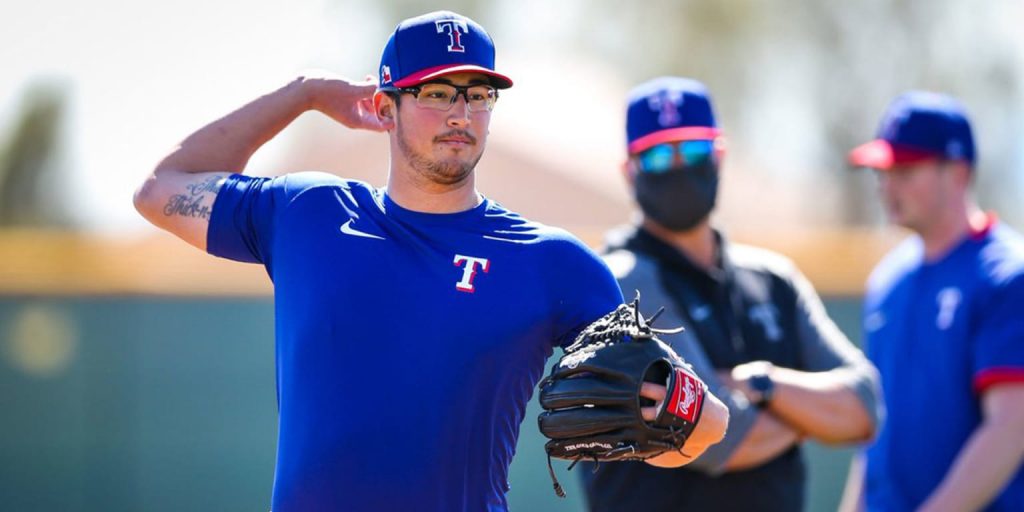
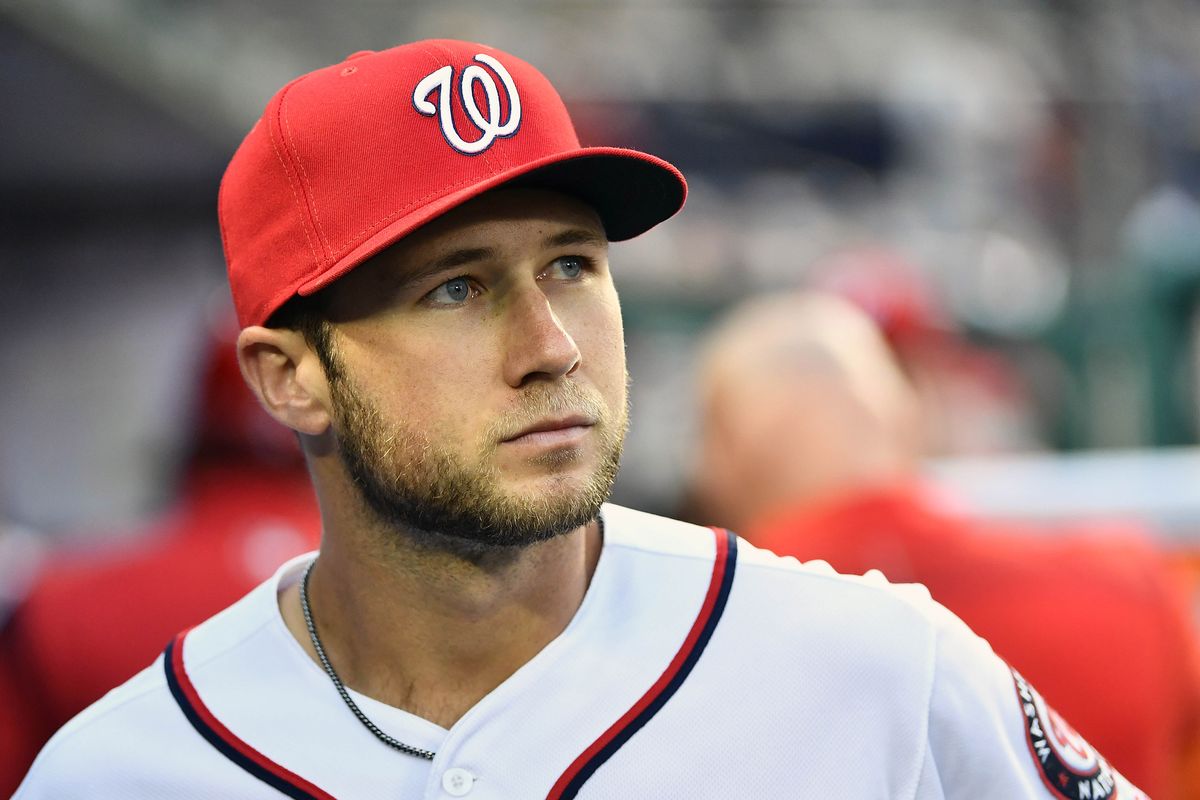
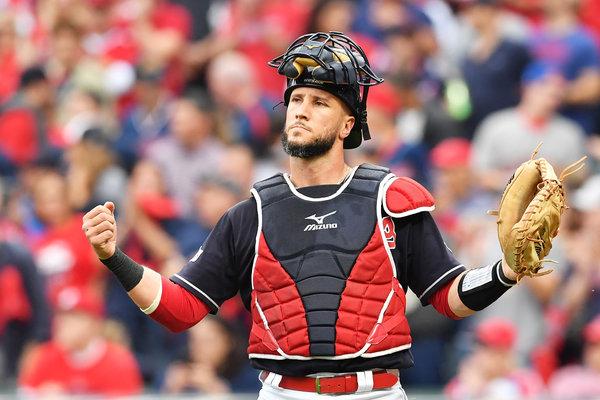
Dunning now in the Texas rotation. Photo via mlb.com
The Nats are well-known for their heavy emphasis on pitching in drafts, and then for using said pitching depth as “currency” to acquire talent to build their roster. The team has traded away more than 20 prospect pitchers in the last 5 years, ranging from recent MLB debutants to rookie-league wild-cards.
I thought I’d be interesting to check in with some of the arms we’ve moved over the past few years.
Part of me does this as a “wouldn’t it be nice if we had kept them…” motive, since not all of these trades were really ones I would have made. But nearly all of these trades contributed in one way or another to the 2019 title … so I have to temper my criticism. In the end, you’d rather have a title than a prospect. But, choices have been made over the years and some of those choices look better or worse in retrospect.
These are listed in order of MLB impact of the traded away talent, not chronologically (this list does not include all the MLB arms we traded away in the 2018 missing the playoff purge; this is mostly about trading away prospects).
Lucas Giolito; Traded to Chicago White Sox (along with Lopez and Dunning) for Adam Eaton in 2016. Eaton gave the team 4 injury-filled years and a combined 2.7 bWAR. Giolito is now the #1 starter for the White Sox and was an all-star in 2019, but it took him several years and multiple mechanical changes to get there.
Jesus Luzardo: traded to Oakland in 2017 (along with Treinen and Neuse) to acquire Ryan Madson and Sean Doolittle. Luzardo rose to be one of the best prospects in the game ahead of the 2020 season, now Oakland’s #2 starter as a 23yr old. Madson and Doolittle served as valuable back-end bullpen pieces, though Madson did not make it to our title-winning season and Doolittle lost his closer job by 2019 and is pitching elsewhere. This is the kind of trade i wish we made less of; you should be able to grow relievers from your farm system, not trade away future #2 projected starters for a combined 3 seasons of varying production.
Dane Dunning was the 3rd of 3 ranked prospects in the 2016 Chicago/Eaton trade. He hovered in the top prospects list for several years, had TJ surgery, debuted with some success in late 2020 for the White Sox, then was flipped to Texas in 2020 for Lance Lynn, and is now featuring in the 2021 Texas rotation as their 5th starter.
Taylor Hearn: was the 2nd of 2 prospects in the 2016 Pittsburgh/Melancon trade. He was subsequently flipped by Pittsburgh in 2018 for Keone Kela, and debuted for Texas in late 2019. Since, he has been an 7th/8th inning reliever for Texas with some effectiveness.
Austin Adams, traded to Seattle in 2019 for Nick Wells after we DFA’d him. Pitched effectively for Seattle’s bullpen in 2019, then traded to San Diego in Aug 2020 for a package of players. Pitching in middle relief for San Diego in 2021. Wells has done basically nothing for this team, while Adams has at least continued to pitch in the majors and does beg the question … why couldn’t he do for us what he has managed to do for Seattle and San Diego?
Summary: well, you’d have a pretty nice start to a rotation right now with Giolito/Luzardo/Dunning. But it took years to get there for these guys: these were players who were traded 4-5 years ago. And the guys we got in return (Eaton, Doolittle) were key parts of the 2019 title team.
Minor league arms traded in last 5 years still in minors:
Reynaldo Lopez was the 2nd ranked of 3 prospects in the 2016 Chicago/Eaton trade; he was a full time rotation starter in 2018 and 2019 for Chicago, but got beaten out for the rotation in 2021 and is in AAA. Interesting how many thought Lopez was the “prize” of that trade … now he’s like 7th on their rotation depth chart.
Wil Crowe: traded to Pittsburgh (along with Eddy Yean) for Josh Bell. Crowe made the opening day 2021 roster for Pittsburgh, but was optioned after one poor outing. Likely projecting as a 4-A type starter, and future analysis of this trade will have to remember that Pittsburgh was in a salary dump mode when evaluating whatever Crowe and Yean become.
Jefry Rodriguez, traded (along with Johnson and Monasterio) to Cleveland for Yan Gomes in 2018. Pitched for a couple months in the Cleveland rotation in 2019, hit free agency in 2021, signed MLFA with Washington in 2021, likely in AAA. Probably safe to say the Nats are coming out on top of this move.
Taylor Guilbeau: traded to Seattle for Roenis Elias in 2019. Pitched for Seattle MLB middle relief in 2019 and 2020, DFA’d and outrighted in Feb 2021. Elias got lit up, got hurt and was essentially useless for us.
Trevor Gott; traded to San Francisco in 2019 for cash after we DFA’d him; he pitched for SF’s bullpen for two years, was DFA’d and outrighted in Feb 2021. Once again, like with Adams … how is it that Gott couldn’t break our crummy 2019 bullpen but then pitched effectively for another organization immediately upon his exit from Washington? its like Blake Treinen all over again.
Pedro Avila was traded to San Diego for Derek Norris in 2016; he rose in the ranks and debuted briefly for San Diego in 2019, then was subsequently DFA’d and outrighted; he remains in their minor league system and projects for AAA in 2021. Norris was originally drafted by DC, and they wanted to get him back. But he only lasted another 3 months with the team, getting released in spring training 2017 before catching on with Tampa for one more season.
Aaron Fletcher: traded to Seattle for Hunter Strickland in 2019. Likely in AAA in 2021. Strickland … wasn’t good for Seattle in 2019 and he wasn’t good for us either.
Mario Sanchez: traded to Philadelphia for Jimmy Cordero in 2016. Hit MLFA in 2018, came back to Washington, projected AA in 2021. Cordero was crummy for us, then got DFA’d, selected and was gone.
Yohanse Morel, traded (along with Gutierrez and Perkins) to Kansas City for Kelvin Herrera in 2018. Likely in High-A in 2021.
Kyle Johnston: traded to Toronto for Daniel Hudson in 2019. Likely in High-A in 2021. Hudson closed out game 7 of the 2019 World Series; enough said.
Tyler Watson, traded to Minnesota for Brandon Kintzler in 2017. Likley in High-A in 2021. Knitzler was (possibly) scapegoated in the infamous clubhouse blowup mid 2018 and was dumped for pennies on the dollar in 2018.
Ryan McMahon; traded to Minnesota for Ryne Harper in 2020; Likely in Low-A in 2021. Harper has really yet to do much, so this is a show-me trade.
Eddy Yean; traded to Pittsburgh (along with Crowe) in 2020; projected to pitch in GCL or Low-A in 2021.
Summary: I see several really good moves here, a couple that didn’t work out as well for the Nats, and some that are preliminary. About what you expect when you’re trading prospect arms.
Minor League Arms traded in the last 5 years who are now apparently out of baseball.
McKenzie Mills: traded to Philadelphia for Howie Kendrick in 2017. Struggled in AA in 2019 for Philadelphia, released in big Minor league purge in June 2020 and out of baseball. This was a prime example of the Nats selling high on a guy; Mills blew that summer, going 12-3 for the 2017 season, then never replicated that success and was out of baseball two years later. Odd that the team didn’t try to pick him back up after his 2019 release.
Jeffrey Rosa; traded to Tampa Bay for Enny Romero in 2017. Struggled for Tampa’s GCL team in 2018 and was released.
Mick VanVossen, traded to Chicago WS for Ryan Raburn. struggled in high-A in 2017, likely released that off-season (he has no stats since 2017).
Felipe Rivero, traded to Pittsburgh (along with Hearn) in 2016 for Mark Melancon. Changed his name to Felipe Vazquez, replaced Melancon as Pittsburgh’s closer and was dominant, a 2-time all-star in 2018 and 2019. However, he was arrested on child sex abuse charges at the end of the 2019 season and faces multiple felonies in multiple states. As much as I hated this trade at the time (we gave up two solid players for yet another veteran closer since our team for reasons inexplicable cannot home grow closers ourselves), I think we’re all happy to have dodged a bullet w/r/t what Rivero/Vazquez became.
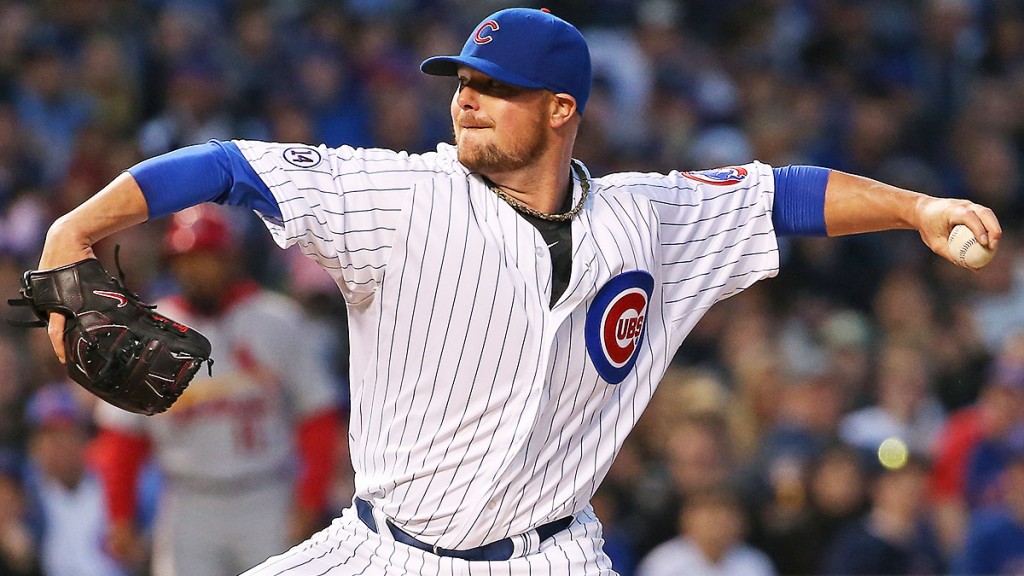
Lester to feature the curly W in 2021. photo via Grantland
One of our most obvious roster gaps heading into the off-season was a veteran 4th starter, and today Mike Rizzo got his man.
Jon Lester. 3-time World Series winner, cancer survivor, noted wine aficionado, signs a one-year $5M deal with the ubiquitous mutual option that is never mutually agreed to, to be our 4th starter for 2021.
Lester joins an esteemed list of “veteran 4th starters signed to pillow contracts” under the Rizzo regime. To wit:
2010: Jason Marquis (though to be fair he signed a 2 year deal to probably be more than our 4th starter).
2011: Chien-Ming Wang
2012: Edwin Jackson, the first of the “real” 4th starter FA assassins
2013: Dan Haren
2014: Doug Fister
2018: Jeremy Hellickson
2019: Anibel Sanchez
To be fair here, Fister was of course a trade acquisition, and was much more than a 4th starter, but his acquisition, plus Scherzer signing and the eventual rise of home grown products like Roark and Ross led to several years without a need to pursue the veteran 4th starter. Not surprisingly, they made the playoffs 3 of 4 years in this timeframe … inexplicably missing the playoffs in 2015 in a season I hand squarely on the incompetence of Matt Williams. But I digress.
Clearly Rizzo’s strategy in building a rotation goes like this: splurge for the top of your rotation, sign a veteran for your 4th starter, let the kids compete for the 5th starter. What I’d LIKE it to be is, grow a couple of stud starters, pair them with your $30M/year guys, and dominate. He’s had had a slew of misses in the 1st round in the last decade, gave up too early on others (ahem Giolito), and now seems to have put their eggs into the Cavalli/Rutledge basket. Lets hope.
Anyway, back to this post. What do I think of the Lester signing? Well…. i think he’ll be a great clubhouse guy. But i’m tempered on what I think he can provide on the field, unfortunately. Lester went from being an #1/#2 kinda guy to being a #4 starter right starting with the 2017 season. He saw a sustained bump in his WHIP starting in 2017, which he somehow danced around in 2018 to put together a smoke-and-mirrors 18win season where his FIP was a full point higher than his ERA. This run of luck came back to bite him in 2019, in the form of a .347 BABIP that ballooned his ERA to ugly territory. 2020 was a wash; he was bad across the board, which could be a pretty bad sign for 2021.
Now he’ll be in his age 37 season with a whole lotta mileage on his known torn UCL elbow. He’s also famous for his inability to keep runners on first base … which will put pressure on his catchers. Gomes is pretty decent at caught stealing percentage (.305 pct in 2019, which was 6th or 7th or so of “regular” catchers in the league), but who knows about whatever backup we pick.
Do we think Lester is a bounce back candidate? Can he flourish when he’s not “the man” in the rotation? How much does he have left in the tank? All interesting questions. At the worst case its a very small price tag to take that gamble.
Payroll implication; not a heck of a lot. $5M doesn’t really change anything else the team might be doing, which makes this a positive. I now have their projected 2021 payroll at $181M, leaving them a shade under $29M left to work with. Notably, they have about $11.5M in deferred dollars this year, plus their “real” 2021 payroll (i.e. actual dollars heading out the door versus cap space dollar figure) is another $9.5M … so that’s $20M of money that the Lerners may be removing from consideration … which means they only want to spend about another $9m. Maybe. Just throwing that out there; there’s a real versus cap space payroll consideration here as the team starts to see a lot of its deferred dollar contracts catching up to them.
My conclusion; proceed with caution. I would have liked to roll the dice with another candidate on the FA market.
Would you believe that A.J. Cole is the best prep draft prospect ever for the Nats in the Rizzo era? Read on. Photo AP
A comment about Mason Denaburg in the last thread, with MarkL wondering/speculating on whether our 2018 1st overall pick may possibly pitch in 2021, made me think, yet again, about the folly of drafting high school arms (or HS players in general) and then made me wonder..
Who is the best HS player we’ve ever drafted?
By “best” I mean possible one of two things: 1. Most successful for our team or for someone else, since (as we’ll see) we’ve had a tendency to trade prospects before they matriculate. 2. Most successful for the Nationals themselves.
So, we’ll answer both.
I’ll also divide this into the “Rizzo” era and the pre-Rizzo era, since you can almost count on one hand the total number of HS players Mike Rizzo has drafted since taking over in mid 2009, whereas the Jim Bowden regime was quite heavily skewed towards HS players.
Using the Draft Tracker as a reference, here are your nominees for best ever HS draftee by the Washington Nationals, moving backwards in time (note; i’m omitting some HS draftees like 20th round signees who happened to sign and subsequently flame out; this mostly is a value play of top-5 round picks plus other notables we over-paid).
2020: Samuel Infante, SS/3B from Florida: too early to tell obviously, but the reaction in the Natmosphere was mixed to begin with. We’ll see.
2018: Mason Denaburg, RHP from Florida. $3M signing bonus for getting selected 27th overall in the 1st round. Has been plagued by injury since his arrival, and his limited stats have not been promising. What is even more indicting about this selection is the fact that the next three arms drafted who signed ( Shane McClanahan, Jackson Kowar and UVA’s Daniel Lynch) were all college arms (like what the Nats normally draft this high), are all now considered top-100 prospects, and had all reached AA by the end of 2019. Opportunities lost.
2016: Carter Kieboom, SS from Georgia. Held the #1 Nats prospect label for years, but has struggled in two call-ups now that have the team looking at 3B candidates in free agency, a pretty severe indictment of what they think they have in Kieboom right now.
2016: Jesus Luzardo, LHP from Florida. Traded as the centerpiece prospect of the Sean Doolittle/Ryan Madsen acquisition in 2017, then became a top-10 prospect in all of baseball prior to the 2019 season. Pitched in Oakland’s rotation as a 22yr old in 2020 with league average results, projecting to be a #2 lefty starter. It was a lot to give up for relievers (at the time I was “ok” with the trade, but did note that it would look pretty lopsided if Luzardo turned into precisely what he’s projecting to become), but flags fly forever and Doolittle was an integral part of this team for a while.
2015: Blake Perkins, OF from Arizona. Traded to Kansas City as part of a prospect group to acquire Kelvin Herrera, has a career .236 minor league BA as a glove-first CF.
2015: Tyler Watson LHP from Arizona. 34th rounder paid like a 4th rounder that year. Traded to Minnesota to acquire Brandon Knitzler as part of the great mid-season bullpen construction job in 2017. Pitched all of 2019 in High-A’s rotation with decent results, likely in AA in 2021. Knitzler of course ran himself out of town in mid 2018, so the team didn’t get a ton to show for this trade.
2014: Jakson Reetz, C from Nebraska. Has passed through three Rule-5 drafts now and was part of the 60-man extended roster in 2020. He stepped up his power and his offense in 2019 in High-A; is he turning a corner? Re-signed as a MLFA this off-season to do his 8th pro season in our farm system.
2014: McKenzie Mills LHP from Georgia. This 18th rounder blew up in the spring of 2017, dominating Low-A and getting flipped to Philadelphia to acquire Howie Kendrick. His 2018 was solid in High-A, but he struggled with the jump to AA and got released in the minor league purge of June 2020. I wonder if he’s worth a MLFA flier in 2021 for someone.
2013: Drew Ward, 3B from Oklahoma. 3rd rounder who was good enough to get promoted year after year, but not to escape “org player” role. Released in the 2020 player purge.
2013: Travis Ott, LHP from Pennsylvania. showed some promise in his 2nd pro season in Short-A as a 19yr old, enough so to be the secondary piece in the huge 3-team trade that netted the team Trea Turner and Joe Ross. (more on that later when we talk about Souza). He continued to pitch well in Tampa’s org, but then curiously was moved to the bullpen in 2018 and then was stuck on the restricted list in apr 2019, where he presumably remains today. No idea what happened here.
2012: Lucas Giolito RHP from California. Perhaps the most controversial candidate on this list. He had TJ surgery the year he was drafted, recovered, raced through the minors and debuted for the team as a 21yr old in June of 2016. His Minor league career looked too good to be true. But, in MLB 21 innings that year he pitched to an ugly 6.75 ERA, an even worse 8.21 FIP … and then got flipped in the off-season as the centerpiece to acquire Adam Eaton from the White Sox. I hated the move when it happened. There were rumors about how the Nats talent evaluators thought that Giolito had “plateaued” or that somehow he wasn’t someone they could work with. And, to be fair, it took a full year of awfulness in the majors for the White Sox before Giolito modified his mechanics and turned into a pretty good starter. His last two seasons have been ERA+ of 134 and 128 respectively, and he’s gotten down-ballot Cy Young voting. Did the Nats give up on him too early? Yes. Did we get equivalent value in return from Eaton? No …. but it wasn’t entirely Eaton’s fault. Who could have known that Eaton would blow out his knee, which would blow out his defensive value, which was a huge reason he was such a WAR darling prior to his trade? Does the 2019 WS title make every move between 2015 and Nov 2019 worth it regardless of the transaction? Most would argue yes. Flags fly forever.
2012: Hayden Jennings, OF from Louisiana; a 6th rounder that year, he lasted just two years in the system and never got out of the GCL. Seemed like a quick release frankly; I wonder if there was some off-the-field issues.
2010: A.J. Cole RHP from Florida. Just could never cut it as a starter for this team, with spot start appearances across 4 MLB seasons for the Nats. Finally flipped for cash after his DFA ahead of the 2018 season when he ran out of options and the team ran out of patience. He’s bounced around since, pitching for the Yankees bullpen in 2018, getting claimed off waivers by Cleveland for 2019, then signing on as a FA for Toronto in 2020, each time putting up decent numbers as an 8th/9th inning non-closer type. Why he could never do this for us is … a mystery. Certainly we could use a competent reliever right now.
2010: Robbie Ray, LHP from Arizona. A 12th rounder given 2nd round money, Ray was the centerpiece prospect in the Doug Fister 2013 trade (which shocked the baseball world and made the Nats look like a genius), then was flipped again to Arizona ahead of the 2014 season. From there he turned into a solid starter, putting up huge K/9 numbers but featuring as a guy who struggled to get through 6 innings thanks to elevated pitch counts. He’s a FA this off-season and could be a decent 4th starter for someone.
2010: Bryce Harper: you could technically count Harper here since he was a HS-aged player in Juco, but it isn’t like selecting him 1-1 was any great piece of decision making on the Nats part. He was destined to be a 1st overall pick from the moment he appeared on the cover of SI as a 16-yr old.
So, in the Rizzo Era, I’d say that the most successful HS drafted player for us or any other team is clearly Lucas Giolito (even though Ray has more career bWAR), with Luzardo projecting right now perhaps as having the capabilities of supplanting him in the future.
The most successful HS drafted player for the Nats? Only three have even played a game for the Nats: Cole, Giolito and Kieboom. Read that sentence again; in a decade of drafting, just three prep-players have ever suited up for this team. I guess you’d have to say Cole has the most impact for the Nationals themselves at this point, with high hopes for Kieboom going forward.
Rizzo was named the GM in August of 2009, so technically the 2009 and prior drafts were not on his resume (yes he was involved in the 2009 draft, but it was still Jim Bowden‘s show) You can see the effect that Rizzo had on draft strategy, because prior to 2010, the team was much more apt to draft prep players. We’ll run through them below.
2009: Michael Taylor, SS from Florida. Quickly converted to OF, where he was a fantastic defender who hung around for years as 4th OF for the team. Finally non-tendered this past off-season, and he’s heading to Kansas City for the 2021 season. Some were sorry to see him go; if his arb salary hadn’t inflated so much, maybe he’d still be here.
2009: Roberto Perez SS from Puerto Rico. Played three minor league seasons and (in my opinion) got a quick release after a stint in 2011 at Short-A.
2008: Destin Hood, OF from Alabama. The 2nd round pick played out the string in our org, then bounced around for four more years as a MLFA. In his “make or break” year as a 23yr old in AA he slashed .224/.278/.327 and his fate was sealed. Eventually got some MLB time with Miami.
2008: Graham Hicks, LHP from Florida; never got out of low-A, flipped in the Gorzelanny deal, out of baseball by age 22.
2008: Adrien Neito, C from Florida. Had a great-looking season in High-A as a 23rd old, then the team left him unprotected in Rule-5 and he got plucked by the White Sox. I went back and looked at my analysis of the 2013 rule-5 draft and discovered that the team was sitting at 39/40 and really didn’t have the room to protect someone like Nieto, who was considered a long-shot to get taken despite going to the AFL that year. Nonetheless, after spending all of 2014 on the 25-man roster, he was went back down and never re-appeared. He has bounced around as a MLFA ever since and is still active today.
2008: J.P. Ramirez, OF from Texas. Ramirez played out his 6-years with the Nats, then jumped to indy and eventually Mexican league ball.
In 2007 alone, Bowden drafted no less than 8 prep players in the top 10 rounds. Did any of them pan out?
2007 Michael Burgess OF from Florida. He was beginning to blossom in 2010 as a 21 yr old, making it to AA and playing in the AFL, so he was used as the centerpiece prospect to get Gorzelanny. He didn’t do much afterwards, bouncing around orgs and eventually going to indy ball.
2007: Jake Smolinkski 3B from Illinois. Very quickly became a solid prospect, succeeding in Low-A as a 19yr old and became the centerpiece prospect sent that off-season to acquire Josh Willingham and Scott Olsen. Interestingly, he washed out of the Miami org as a MLFA, caught on with Texas and had several years as a MLB utility player with Texas and Oakland after that.
2007: Steven Souza, OF from Washington State: a middling prospect for years, he started to show some serious pop as a 23yr old in High-A, culminating with a blow-up season in AAA as a 25 year old that allowed the Nats to pull off perhaps their greatest ever trade heist; packing Souza with Travis Ott and interjecting themselves into a trade between Tampa and San Diego to fleece San Diego out of two first round picks in Trea Turner and Joe Ross. Souza had his best season in 2017 for Tampa, a 3.5 win team, but has struggled with injuries
2007: Derek Norris, C from Kansas. 5 seasons, 5 promotions for Norris in our system, before he was included as perhaps the 3rd piece of 4 in the Gio Gonzalez trade. Once he got to Oakland though, he blew up and had several solid seasons, even making the 2014 all star team. But he declined quickly, got moved to San Diego, then the nats re-acquired him back for Luis Avila … only to DFA him a few weeks later.
2007: Josh Smoker, LHP from Georgia. Played out his string with the team without ever getting out of A-ball, then made it into the Mets’ bullpen in 2016 and 2017, where he put up below replacement level numbers.
2007: Jack McGeary, LHP from Massachusetts. Paid like a mid-1st rounder in the days before bonus slots, McGeary seemed like a potential steal. Unfortunately, he just could not compete, suffering injuries multiple times. Mercifully taken in the minor league rule-5 draft by his hometown team Boston in 2013, he didn’t do much better there, eventually washing out of indy ball in 2014 as a 25-yr old.
2007; PJ Dean, RHP from Texas. Looked awesome in Short-A as a 19yr old, throwing 10 starts with a 1.97 ERA. Was the lead prospect in the Willingham/Olsen trade that off-season… then, nothing. I have no idea what happened to the guy; he never played another game of baseball for the Marlins or anyone. Does anyone have any idea what happened to him?
2007: Patrick McCoy LHP from Arizona; struggled as a starter early, moved to the pen, played out his string with the Nats as an org guy, signed on as a MLFA with Detroit and got a call-up where he put nearly 2.5 runners on base and was waived. Bounced around after that, never made the majors again.
It is notable that Jim Bowden nearly signed more HS players between these last two years than Rizzo has done in a decade in charge. Just a completely different mind-set of drafting.
In 2006 it was more of the same: the first 6 players he picked were all HS players.
2006: Chris Marrero, OF from Florida. Made his way up to the big club in 2011 as a 22yr old, never really made it back. Was the quintessential 4-A guy for years, profiling as a corner guy w/o great defensive skills but missing the big bat.
2006: Stephen Englund, OF from Washington State. Seems like a huge scouting miss; he just could not hit pro pitching. Career minor league slash line of .188/.308/.252. Cut from Low-A in 2009 after starting the season 11-101 with 48 Ks.
2006: Stephen King, 3B from Florida. Played for years in the low-minors as a light-hitting infielder, eventually leaving as a 6-yr FA. Got to AA twice, was never able to even hit .200 there.
2006: Colten Willems, RHP from Florida. The 1st rounder was ok his first couple of years in pro ball, never could really compete above low-A, then abruptly retired at age 21 when he struggled upon getting demoted back to Hagerstown. A huge draft bust.
2006: Sean Black, RHP from New Jersey. Drafted in the 2nd round, refused to sign. Went to Seton Hall, 7th round pick by the Yankees three years later. Was a solid starter up to AA, got flipped to Cincinnati and his career fizzled.
2006: Glenn Gibson LHP from New York. Had a great pro debut in Short-A as a 19yrold, then was traded to the Rays to obtain Elijah Dukes. Tampa dumped him two seasons later, and the Nats picked him back up because they liked him enough to draft him in the first place. He didn’t go much further and was released from affiliated ball in 2011 as a 23yr old.
2006: Sam Brown, RHP from North Carolina. Did not sign, went to NC State, signed with Texas, then signed as a MLFA with the Nats in 2011 after his release. Pitched one year in the Hagerstown bullpen and was done.
2006: Brad Peacock, RHP from Florida. A 41st round pick selected under the previous rules of “Draft and Follow.” He was drafted in June of 2006, but not signed until May 30th of 2007. It took him a while to get going professionally, but he blew up in 2011, rising from High-A to the majors with a sterling debut. This led to him being included in the player package to acquire Gonzalez from Oakland. After a year there, he was moved again to Houston in the Jed Lowrie move, and from there he flourished in a swingman role, winning a World Series there in 2017.
In 2005, just one top-10 round HS player drafted, but a few more signed on in the later rounds.
2005: Ryan DeLaughter; OF from Texas. he never really succeeeded outside of complex ball, giving Short-A a try multiple times. Hooked on briefly with Milwaukee and indy league baseball as a 22yr old.
2005: Deryck Johnson, CF from Florida; this 14th rounder played just one season in rookie ball, hit .185 and was cut.
2005: Michael Watkins, RHP from Rhode Island. Pitched parts of two rookie league seasons and got cut.
2005: Eduardo Pichardo, RHP from Florida. This 17th rounder threw 13.2 innings across two rookie league seasons and posted a stellar 20.41 ERA and was released.
2005: Brad Clark, RHP from Florida. This 19th rounder got hurt, didn’t pitch until 2007, threw 5 1/3 total innings and got cut.
2005: Ryan Butchter RHP from New Jersey: signed as a 33rd rounder, somehow survived two seasons with ERAs north of 7.00, then got traded after his third pro year for Matt Avery. Avery pitched one year of relief for our AA team and got cut. Meanwhile, Butchter hung on for years, finally debuting as a 27 yr old, and then as a 29yr old rookie excelled in the San Diego bullpen.
So, in the pre-Rizzo era, who’s the most accomplished HS drafted player for any team? Best candidates are Peacock, Norris, Souza, and Taylor. I’ll go out on a limb and say its Peacock.
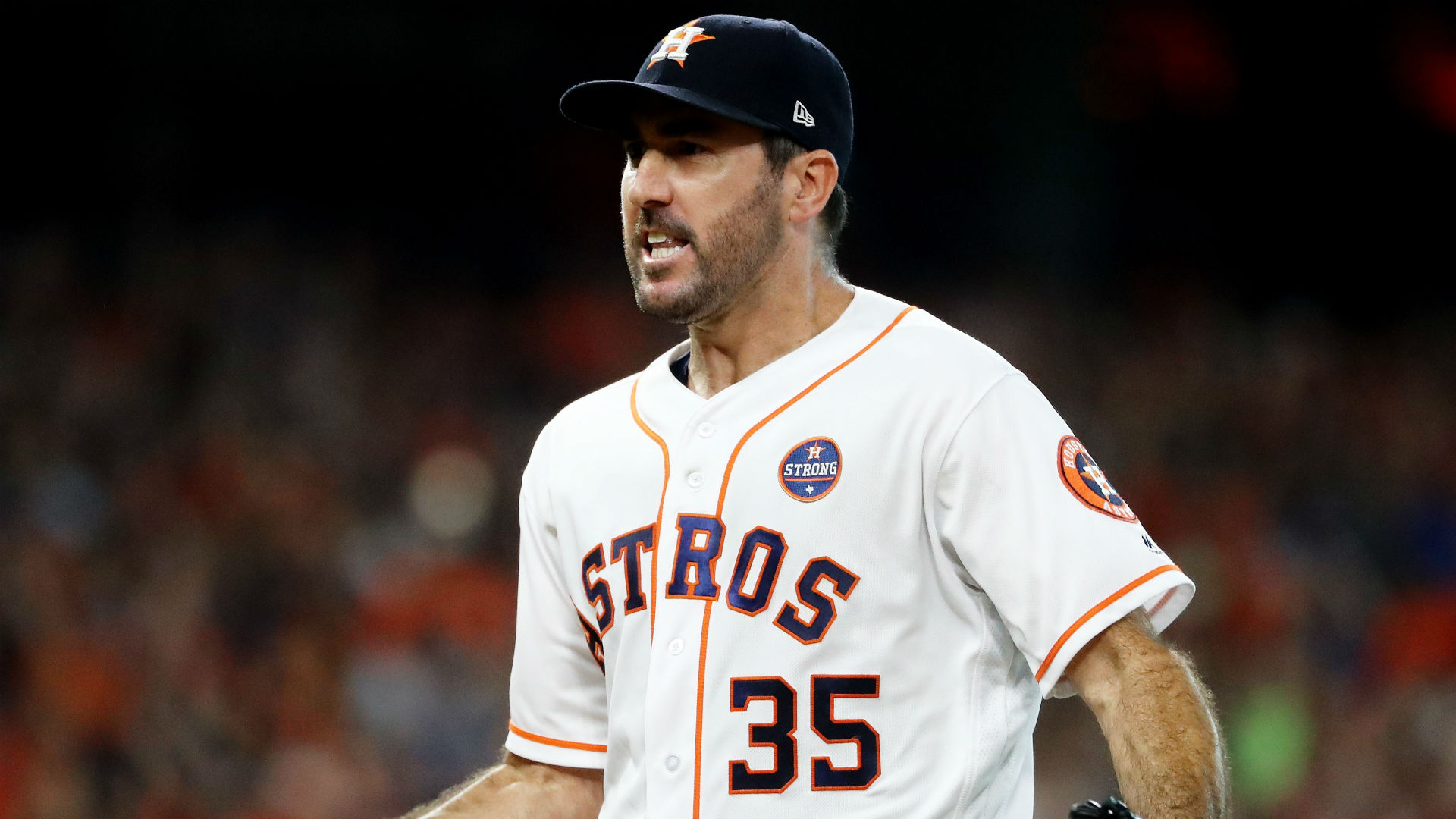
Verlander makes his 12th career opening day start, putting him in the clear lead. Photo via sporting News.
Every year I update this long-running XLS for this increasingly anachronistic relic of tracking Opening Day Starter honors for teams. But it does make for some good trivia questions.
After this year’s opening day, which involved few fans and
Most Opening Day Starts, Active Leaders:
Justin Verlander makes his 12th career Opening day start, double the next closest competitor now.
Next closest are two veterans, each of which who has 8 career opening day starts, neither of which made 2020 opening day starts (Clayton Kershaw and Jon Lester).
Special mention of Felix Hernandez, who is technically active with the Braves but is not on their 40-man roster. He has 11 but seems like a longshot to make another.
Current Leading Consecutive streak:
3; shared by Verlander, Max Scherzer and Aaron Nola
Julio Teheran had a streak of 6 broken this year; he signed with the Angels in the off-season
Number of first-time Opening Day Starters in 2020: 18 of 30
This is easily the highest number of 1st time opening day starters since I started tracking this.
Most surprising opening-day starters in 2020:
Tommy Milone getting the opening day start for Baltimore. Just crazy.
Sonny Gray getting his 3rd career opening day start, 5 years after last getting one for Oakland.
Johnny Cueto getting his 5th career opening day start, also 5 years after his last.
Trevor May, who gets a last minute spot start filling in for the injured Kershaw. The rich keep getting richer out in LA; he was more than adequate, quite a showing for a guy who would normally be in AAA yet could clearly make nearly every other rotation in the league.
Historically, here’s the all-time record holders:
Most Ever Opening day Starts: Tom Seaver with 16. Tied for 2nd place with 14 is Jack Morris, Randy Johnson and Steve Carlton
Most Consecutive Opening Day Starts: Jack Morris, all of whom’s 14 opening day starts were in a row.
Kieboom is Law’s number one … like everyone else. Photo via federalbaseball.com
Keith Law, long-time ESPN baseball writer and prospect lead, moved to the Athletic this past off-season and he’s put out most of his 2020 pre-season prospect content. Yesterday he put out his Nats top-20 list.
We already know that Law is bearish on the Nats system in general, ranking it 29th out of 30 teams. A lot of that has to do with his being “lower” on Carter Kieboom and especially Luis Garcia than any others. But its also a pretty specific indictment of the Nats top-end drafting (and to be fair, trading of prospects to acquire MLB players) over the past years. Consider the top 3 rounds of draftees lately (see the Draft Tracker for more: https://docs.google.com/spreadsheets/d/1Qd5DS9GlmkQOEh_zGhOvlhHK0EegqY1uJB4mLGmRBaY/)
So, take a look at this list of top end picks. You have to go all the way back to 2011 to find a first rounder who has starred for this organization (Anthony Rendon). The team gave up on Giolito and he’s now starting for the White Sox. Fedde is heading to the minors again in 2020 and seems topped out as a 4-A starter, and so far the team has gotten nothing from its 2017 and 2018 $3M arms Romero and Denaburg. You can credibly say that the team lost or outright blew its first round picks in 5 of the last 8 seasons, and the guys who have succeeded not named Kieboom are playing for other teams.
The 2nd rounders are even a worse indictment; Renda and Johansen were failures. Suarez refused to sign (a huge gaffe in the modern bonus-structure driven draft). Stevenson is a 5th outfielder. Dunning and Neuse are solid … for other teams. We gave up last year’s 2nd rounder to sign Patrick Corbin.
Lastly the 3rd rounders have also basically done nothing: the team was obsessed with Mooneyham for years and he never got above A-ball. Ward and Wiseman are org players. Reetz is finally showing some promise … in his 6th pro season. Luzardo? Awesome … for another team. Raquet was serviceable as a starter in high-A last year repeating the level, but may be heading to relief as a lefty specialist. Schaller didn’t even make Law’s top 20 list despite being a Vanderbilt product, and Mendoza is already a 1B limited guy more famous for his HS pedigree than his abilities.
Yeah. Its no wonder our system is so poorly ranked.
(No, i’m not taking into context who we traded these assets for. Yes i’m aware that the trades of Giolito, Dunning, Neuse, and Luzardo netted the team several crucial pieces at the MLB level in Adam Eaton, Sean Doolittle and Ryan Madsen. That’s not the point here; we’re isolating reasons why the farm system has collapsed; part of is is poor drafting and part of it is trading away 1st and 2nd rounders. I’m less concerned with the traded assets as I am with the 1st and 2nd round pick failures that are starting to mount up; Denaburg and Romero in particular.).
———–
Anyway. Lets take a look at who Law likes and doesn’t like as compared to the rest of the prospect ranking world. Law’s methodology generally favors ceiling over floor (so he likes younger prep guys with potential versus boring guys in AAA with demonstrated but un-flashy talent). He favors those in the skill positions (SS, CF) versus corners. He really discounts relievers. He likes IFAs. So with that in mind, here’s some names worth mentioning:
He has the same top 3 as most every one else for our system: Kieboom, Garcia, Rutledge. BA, Fangraphs, MLBpipeline and Law all have these three in a row.
He’s generally down on Kieboom though versus other shops: I’ve seen Kieboom in the 11-15 range on a lot of minors-wide lists; Law has him all the way down at #74.
We know he’s down on Garcia versus others. I’ve seen Garcia mostly in the 60s to 90s range on these minor’s wide lists; Law doesn’t have him anywhere close and has made mention of it whenever asked, saying that Garcia’s sole “tool” seems to be that he was 19 in AA last season. This is definitely at odds with the way Garcia is portrayed within the organization (he did get an NRI this year and has already hit a flashy homer), nor with other evaluations.
He remains higher on Denaburg than others: see “ceiling” versus “floor” reasoning above.
he’s a little higher on Jeremy De La Rosa and Eddy Yean than other shops, noting that Yean’s name frequently comes up in trade talks but the Nats are holding firm.
He’s lower on Matt Cronin than other shops despite his eye-popping numbers: see “reliever all the way” reasoning above.
He’s suddenly much higher on Reetz than basically anyone else, citing 2nd half splits that really look rosy. Hey, i’ve been down on Reetz for a while, using him as my classic “Baseball doesn’t know what a sunk cost is” economics argument for hanging onto failed prospects just because they ahve a big bonus. But maybe we’re finally going to see something out of him.
He’s way higher on Jhonatan German than anyone else; despite his being a pure reliever, perhaps a reliever-only starts getting his attention once he starts getting AA hitters out.
He’s bullish on Telmito Agustin, but i’m not sure why. Agustin cratered while repeating high-A, though he’s still just 23.
He does not like Mendoza nearly as much as others. Mendoza has a big bat, no doubt, but he can barely play 1B and may end up being a DH-only guy. That’s a ding on the prospect ranking set unless you’ve got Vladimir Guerrero Jr. batting lines in the minors.
he’s down on some of our mid-minors college arms, guys like Jake Irvin, Reid Schaller, Jackson Tetreault and Ben Braymer. Braymer in particular probably is a “floor versus ceiling” discussion; yeah he’s on the 40-man but what does he project to? A 5th starter? A reliever?
Lastly, he’s completly at odds with one shop in particular that has Tres Barrera as the 11th ranked prospect. And I get it; what exactly is Barrera going to give this organization going forward?
Anyway. If you’re not an Athetic subscriber I would encourage you to sign up. They’ve got some of the best talent in the game writing for them now and they just keep adding more good stuff.
Rendon; to trade or not to trade? Photo Nats Official via espn.com
Yeah, the team just won 3 of 4 from Miami. They’re still almost guaranteed at this point not to make the playoffs. As suggested in the comments from the previous post … Here’s a sweep through the 40-man roster as of today, to talk about possible trade chips and who may or may not be in the future of this team.
Anthony Rendon: who would also be the most likely to fetch prospects in trade mid-season, but who also is someone the Nats may very much want to sign to an extension. Will the ownership group learn their lesson after dragging their feet last year with Bryce Harper, costing them the Houston trade that almost certainly would have brought back better stuff than a post 4th round pick (#139 overall, which is what we got instead thanks to criminal cap mismanagement over the past two years). Is this leadership group going to keep him instead of trading him because they think trading him for half a season will damage their negotiations with him? Trust me, Rendon WANTS to be traded; it removes the Qualifying Offer from burdening his off-season negotiations. Frankly, getting moved to a contender shouldn’t preclude his returning to the Nats on a long term contract, but a bigger question is what is he worth? Unlike other major 3B players who signed mega deals lately (Nolan Arenado, Manny Machado), Rendon will be 30 upon signing, has injury history, and thus his value is limited. This is a tangent conversation to the subject at hand, but factors in.
Brian Dozier; so far, he’s not only not earning his 2019 $9M salary, he’s putting his career in serious jeopardy. If he is still hitting .210 at the end of the year, its hard to see him getting a guaranteed contract next year at age 33.
Howie Kendrick, who it should be noted was expected to be basically a 4th OF/utility guy and has been batting frigging cleanup for the team lately. He continues to be a professional hitter even at advancing age (he’s in his age 35 season), and should be worthy of some halfway decent return in prospects in trade.
Jeremy Hellickson: for as good as he was in 2018, he’s been as bad in 2019. He’s not going to fetch anything in trade, and is closer to a release than a trade.
Javy Guerrero: we’ll see if he even makes it to July 1. Fungible asset, trade if you can get anything.
Gerardo Parra: we’re paying him a pro-rated MLB min … as with Guerrero, trade if you can get anything for him.
If you waive the white flag on 2019, every one of these players should get moved for whatever you can get, if anything. Rendon and Kendrick bring the most back at this point.
Players with 2020 Options
Ryan Zimmerman: boy, is he putting the team into a tough position. Instead of producing in his possible walk year, he’s been awful at the plate and has gotten hurt with a typical “old guy” injury (Planter Fasciitis). Yes he’s the Face of the Franchise, yes he’s the longest tenured player, yes he was the first player the team ever drafted, yes he’s the clubhouse leader, yes he means a ton to the community, yes he holds a massive fundraiser each year, yes he’s set down DC roots, yes he’s got a 5 year personal-services contract with the team (since deemed illegal in the CBA), and yes he wants to be with the team post playing career. Yes to all of that. However, there’s no way he’s worth his 2020 option of $18M. that’s 10% of the payroll for a guy who is easily replaced with readily available mid-30s sluggers for a quarter of the price. This is going to be ugly. I don’t think you trade him (who would want him and who would give up prospects?), but I also don’t think you sign him at his option. I privately suspect the team will renegotiate his $18M option to something like a 4-yr/$20M deal that pays him right around what Matt Adams is making, takes him to his late 30s, establishes him as a utility/bench bat for the duration, and keeps him in the fold til that point in his career where inarguably he is done playing.
Adam Eaton: his 2020 and 2021 options are ridiculously affordable ($9.5M and $10.5M). The team gutted its top-end starting pitcher depth to acquire him (a decision that looks worse and worse as Lucas Giolito throws 4-hit shutouts and Reynaldo Lopez maintains 12 K/9 rates and Dane Dunning remains a viable future MLB starter even despite his TJ surgery). But Eaton is now 30, and his 5-6 bWAR seasons seem past him. If he’s a 1-2 win player, he’s worth the salary and picking up the options. If he ends 2019 hitting a punchless .273 …. do you dare cut him or trade him? Maybe not after 2019, but another season of this after 2020 and they may be cutting bait.
Yan Gomes: $9M 2020 option. While the team didn’t trade as much for Gomes, catchers are difficult to come by in this sport. So even despite his current BA, I can’t see the team cutting him loose after this year and declining his option.
Sean Doolittle has a ridiculously cheap $6.5M 2020 option and is the first stable closer we’ve had under longer term team control since Drew Storen. He’s not going anywhere.
Trevor Rosenthal: $10M option on the table which increases to $15M player option if he pitches in 50 games (he’s appeared in 7 so far). You may laugh right now at even considering this option; what if he comes back and pitches lights out in June and July? I think you trade him for whatever you can get and let his options be someone else’s issue. More likely, he’s going to come back from his “rehab” appearances, continue to struggle and the team will summarily cut him, and he’s exhibit 1A for the 2019 team’s issues.
Matt Adams: $4M 2020 mutual option; he’s not earning it right now. Trade him for what you can get, and find some other middle 30s lefty slugger on the open market next year.
Tony Sipp: $2.5M 2020 option, that’s a steal. But he’s got a 5.40 ERA in limited action; would you pick up this option?
Of this group, i’d move Rosenthal, Adams and Sipp if you can get anything.
Signed for 2020/longer term:
Max Scherzer; signed through 2021, and honestly if he wins another Cy Young he’ll be wearing a Nats cap in Cooperstown. can’t move him.
Stephen Strasburg: signed through 2023, can’t move him.
Patrick Corbin; just signed new deal through 2024, why would we want to move him.
Anibal Sanchez: $9M for 2020 guaranteed … but he’s not really putting himself into position to get anything back in trade based on performance and injury so far.
Kurt Suzuki: $6M for 2020, and he’s playing great. If you move him you just have to replace him and what has changed in terms of our ML catcher depth from last off-season to now? We still don’t trust Spencer Kieboom with major league ABs, i’m not sure why Raudy Read continues to take up space on the 40-man, and our best prospect Israel Pineda is in Low-A. So we need Suzuki for 2020.
I’d keep the big 3 starters and Suzuki; move Sanchez if you can (doubtful). I just don’t see how you can justify moving any of our big 3 starters unless you’re planning a complete, 59 win season overhaul.
Arbitration eligible next year:
Trea Turner
Michael Taylor
Kyle Barraclough
Justin Miller
Wilmer Difo
Matt Grace
Koda Glover
Joe Ross
An interesting set of players. I’d say the team faces some interesting tender choices next off-season. Right now looking at this list i’d clearly tender Turner, Barraclough and Ross, I’d probably take a hard look at Miller, Difo, Grace but eventually tender, and I’d probably cut loose Taylor and Glover. Who of these guys are trade bait? Honestly, everyone but Turner, Ross and Barraclough.
In terms of Trade deadline … i’m not sure i’d trade any of these guys … they’re all either untouchable or un-tradeable.
Pre-Arbitration players:
Juan Soto, Wander Suero, Andrew Stevenson, Victor Robles, Jake Noll, James Bourque, Erick Fedde, Spencer Kieboom, Kyle McGowin, Tanner Rainey, Raudy Read, Adrian Sanchez, Austin Voth, Austen Williams, Carter Kieboom.
No reason to part ways with anyone here; if they’re starters (Soto, Robles, Fedde, etc) they’re too valuable on their current $575k (or so) contracts, and if they’re role players they’re fungible assets who are probably not really trade-able.
—————–
Summary: there’s not really a ton of return value here. Rendon, Kendrick, Adams seem to be the best trade chips.
—————–
added bonus: CBS sports did some similar analysis of Nats potential trade chips: https://www.cbssports.com/mlb/news/mlb-trade-deadline-anthony-rendon-and-other-nationals-trade-chips-ranked-if-they-become-sellers-by-july-31/ . They came up with similar names here.
I just perused some team splits for 2019. Your Washington Nationals offense is, as of this writing, (per Fangraphs):
20th in fWAR; a *combined* 3.7.
20th in wRC+, a paltry 91
22nd in Batting Average, hitting .243 as a team
9th in K% .. sitting at exactly 25% , but…
sitting 21st in ISO, meaning they’re striking out a ton but not getting the added benefit of the power.
How about the defense? The team is
27th in Fangraphs’ total Defense stat
29th in UZR/150
28th in DRS, a combined -27 of runs “saved” (interestingly …their run differential sits at 32 right now, almost entirely on the defense)
And then there’s the bullpen:
30th in bullpen ERA
30th in LOB%
25th in bullpen FIP
21st in K/9
24th in bullpen fWAR .. somehow grading out as a group to exactly neutral 0.0 fWAR. In other words … completely replaceable across the board as a whole.
At least we have the starters:
#1 in fWAR
13th in ERA, but
4th in FIP (Fangraph’s fWAR for pitchers is heavy on the FIP … and the Nats starters are doing this with a .306 BABIP.
#2 in K/9.
Anyway … point is; the hitters are bad, the bullpen is awful, and the defense is atrocious.
How exactly did we get here? Well, Mike Rizzo was incredibly active over the winter. But, amazingly, practically all of his moves have turned out bad. Here’s a list of all his major transactions in the off-season:
Kyle Barraclough: 4.67 ERA
Trevor Rosenthal: complete train wreck
Yan Gomes; hitting .228
Tanner Rainey: walked 12 in 18 innings in AAA.
Meanwhile Tanner Roark has a 3.51 ERA and a 127 ERA+ in 10 starts for Cincy this year.
Matt Adams: 89 OPS+ as our big “bench bat”
Anibal Sanchez: 5.10 ERA in 9 starts
Brian Dozier: hitting .205
Jeremy Hellickson: 6.23 ERA in 8 starts.
Tony Sipp: 5.79 ERA.
He cut loose Trevor Gott in February but kept a slew of other minor league arms: here’s Gott’s SF line so far this year: 21 innings, 2.11 ERA, 193 ERA+
He cut loose Austin Adams, who had a ridiculous 24/3 K/BB ratio in 12.1 Fresno innings, who then got picked up by Seattle and has punched out 7 of the first 11 batter’s hes faced. But was he good enough for our bullpen? Nope.
He brought in Dan Jennings: 13.50 ERA in 8 appearances. Why exactly did he get the last 3-4 outings?
Even his AAA MLFA moves to provide veteran pitcher backup have been suspect:
Henderson Alvarez: 8.01 ERA in Fresno
Scott Copeland: 6.33 ERA in Fresno
Vidal Nuno; also a 6.33 ERA in Fresno
J.J. Hoover: 5.70 ERA in Fresno
Brady Dragmire: 11.48 ERA in Fresno, now mercifully on the DL.
Logan Ondrusek: had an ERA north of 5.00 in AA (as a 34-yr old).
In fact, really only a couple of his moves have actually worked out:
Kurt Suzuki: 108 OPS+ in a backup catcher role.
Patrick Corbin: 3.25 ERA in 10 starts … well heck for $140M i sure hope he’s working out.
Look back at the performance of his roster moves. Its absolutely astounding how badly he’s judged the talent he’s traded away versus the performance of what he acquired.
Look, this is not hindsight is 20/20 analysis. I was totally on-board with a ton of these moves. I really thought that Dozier and Rosenthal were good bounce back candidates and that Sanchez was a sneaky good signing. And i’m genuinely dumbfounded that basically every off-season veteran gamble has failed to pay off. Some of the moves I questioned at the time and continue to question (Gott, Roark, Adams). You have to wonder how much of an indictment of the pitching staff it is when guys like Gott (to say nothing of someone like Blake Treinen) depart here and succeed elsewhere. Even Lucas Giolito is starting to round into form with another organization, after clearly being dumped as being “unfixable” by this org.
The question is, now what? What can this team really do? If suddenly every guy with a sub 100 OPS+/ERA+ turned it around and succeeded, can this team run off a 20-8 month and get back into this race? With this manager?
Kieboom is probably the surest NRI thing in 2019. Photo via PerfectGame
The Nationals, on the eve of spring training, announced their list of Non-Roster Invitees (NRIs) for 2019.
Here’s the list:
RHP — Henderson Alvarez, Aaron Barrett, Scott Copeland, Wil Crowe, J.J. Hoover, Ronald Peña
LHP — Vidal Nuño
C —Tres Barrera, Taylor Gushue
INF —Luis Garcia , Carter Kieboom, Jose Marmolejos, Jake Noll, Matt Reynolds, Brandon Snyder, Jacob Wilson
OF — Hunter Jones, Chuck Taylor
Now, before you say “who cares” here’s some stats. In the last four seasons (through 2018):
5 NRIs made the 25-man roster straight out of Spring Training (and Guthrie technically made it 6 since he got called up a few days later and was always intended to be the 5th starter in 2017)
18 NRIs eventually played for the MLB team at some point that same season.
So its likely that we’re going to see these NRIs at some point in the future. Like, on average at least 4-5 of these NRIs are going to play for this team in 2019.
So lets squint and make some predictions.
Do any of these guys stand a chance at making the Opening day roster? Yeah maybe. I think a couple of the relievers (especially Nuno) have a real shot at the bullpen if they perform in Florida. Three of the seven guys I’m projecting to the MLB bullpen have options remaining (Barraclough, Suero and Glover), the team only really has one legit lefty in the pen (Grace) and may end up carrying 8 relievers through some roster chicanery early on.
Do any of these guys project to feature at all in 2019? Absolutely: I think Alvarez, Hoover, Nuno, Reynolds, and Snyder in particular seem likely to get call-ups to cover for injury, unless they exercise opt-outs. Reynolds is one of the few SS capable guys in the high minors, Snyder could be Zimmerman or Adams injury coverage, and Alvarez could get the call to provide spot starts if in-house options like Fedde continue to struggle at the MLB level.
Who among these guys project to eventually get on the 40-man? The top-end prospects on this list for sure: Crowe, Garcia, Kieboom, Barrera and perhaps Gushue all seem likely to eventually make the 40-man.
One (1) made the 25-man roster out of spring: Miguel Montero
Four (4) eventually got added and called up: Tim Collins, Moises Sierra, Jimmy Cordero, Spencer Kieboom. Special Mention to Edwin Jackson, who opted out of Washington then excelled for Oakland later in 2018).
Zero (0) made the 25-man roster out of spring (though technically one kinda was; see next).
Five (5) eventually got added and called up (Jeremy Guthrie, Matt Albers, Grant Green,Jacob Turner and Andrew Stevenson): Guthrie was the 5th starter, stashed in XST for a few days before his ill-fated debut.
Five (5) have since been added to 40-man (Erick Fedde, Taylor Hill, Kyle McGowin, Wander Suero, Tim Collins)
Two (2) made the 25-man roster out of spring (Dan Uggla and Clint Robinson)
Two (2) others eventually got added and called up (Rafael Martin and Emmanuel Burriss)
Two (2) others were young catchers since added to the 40-man (Spencer Kieboom, Pedro Severino)
(I believe the above analysis is correct; feel free to comment if i’ve missed someone. this is a bit tougher to keep track of b/c the team often signs MLFAs mid-spring then technically gives them NRIs … especially for Vets, and I may miss some from the original announcements).
The Nats seemingly solved their catching issues for the next few years with the shrewd acquisition of Cleveland 2018 all-star catcher Yan Gomes. And they didn’t have to break the bank to do it.
They part ways with Jefry Rodriguez, who was probably sat #6 on the current Nats roster of starting pitchers, soon to be pushed further downwards with whatever acquisitions may yet to come, and who had proven over the course of the last two seasons he couldn’t be trusted with the ball for a playoff team. They also part ways with 2017 minor league POTY Daniel Johnson, cashing in on a guy who is still low minors but could flourish for a team like Cleveland. There’s also a PTBNL thrown in, usually indicative of a lower level prospect that Cleveland gets to pick from later on after scouting the Nats low-A team or something.
Johnson becomes the 4th player flipped from the 2016 draft, which is more and more looking like the best Nats draft in a decade. He joins Jesus Luzardo, Dane Dunning, and Sheldon Neuse heading out the door from that draft, and all three of these previously traded players have more or less flourished with their new organizations. Luzardo is now considered one of the best left-handed prospects in the game, Dunning regularly is called an “under the radar” type pitching prospect who the White Sox seem to be depending on as a solid mid-rotation piece in the future, and Neuse played all of 2018 in AAA as a 23-yr old after a 3-level rise in 2017.
(Yes, I’d like to have all of them back, especially Luzardo, who the team spent so much to acquire, nursed back to health and really could help with the current rotation crunch).
Nonetheless, for me this acquisition kicks off a series of new consequences for the 2019 team:
No more pursuit of additional catchers, which should be a sigh of relief for Victor Robles fans, who had repeatedly been dangled to the Marlins for J.T. Realmuto. No longer.
I like this Gomes acquistion, and I like the semi-platoon they now have setup with Kurt Suzuki. If one goes down with injury, the other can cover while they bring back up Kieboom for protection. This is such a better situation than we had the past two seasons, where had a crummy hitting, poor defending catcher in Matt Wieters with the likes of Kieboom or Severino as the guy getting regular day-after-night game starts.
Pedro Severino‘s days are numbered; no options, no roster spot for 2019. He’ll hang around all spring to guard against injury, but faces a looming DFA next April 1st. Will he get picked up by another team? Perhaps. He was just so bad at the plate in 2018 that its hard to project any team giving him even a backup role, no matter how good his defense is.
If Severino stays in the system though, he’ll likely push downwards in a cascading manner our current catching “depth,” since he’ll join Spencer Kieboom in AAA, That pushes Taylor Gushue back to AA, likely with Raudy Read who seems lost in the shuffle here. That then leaves Jakson Reetz and Tres Barrera basically repeating High-A for the time being. I don’t think any of these guys are really pushing for promotion necessarily based on offensive performance: Gushue hit .212 in AA in 2018, Read hit much better in AA but showed almost no power in a half-season in AAA, Reetz has never hit even .240 in any stop since the rookie league, and Barrera hit good but not amazing in Potomac. Probably the best case would be to just part ways with Severino, and have this be your C depth in 2019:
AAA: Read and Kieboom splitting time evenly
AA: Gushue and Barrera, who probably needs a promotion
High-A: Reetz and perhaps one of the low-A 2018 catches like Alejandro Flores or Alex Dunlop
Suffice it to say … we have very little reliable catching depth in our minors right now. Thankfully Gomes has options through 2021 for reasonable money.
We already knew we had no SP depth, and now we just traded our primary backup hurler. Not that i’m enamored of Jefry Rodriguez and think he’s our savior … but I do slightly question the choice of player to ship out. I understand “trading from strength” and I also understand that you have to give up something to get something … but this team has traded away SO MUCH starting pitching over the past few years that I wonder if they need to, you know, save some of it? As has been noted elsewhere, the last time the Nats developed and kept a for-real MLB starter was Stephen Strasburg, which, lets be honest, even the most incompetent organization could have done. Here’s a list of the starters we’ve traded away in the last 2 years: Jefry Rodriguez, McKenzie Mills, Tyler Watson, Jesus Luzardo, Taylor Hearn, Pedro Avila, Lucas Giolito, Reynaldo Lopez, Dane Dunning. That’s a ton of starters. And now we’re looking at acquiring even more via trade or FA. At some point we have to stop spending money on FA starters and grow them from within.
This was actually a fantastic Salary Cap move: Gomes counts just $3.8M towards the 2019 luxury tax cap. With all the tenders and salary estimates, I still have the team $43M under the cap, so that’s plenty of room to buy the upgrades they need.
In the end…. one major position of need down (C), two more to go (SP and 2B).
Its that time of year; for all the non-playoff contenders, the last few weeks of September are for “showing some fight” and “making a run to build on for the next season.”
In reality, wins in September for a lost team are really only good for one thing: “costing your team spots in the 2019 draft.”
Luckily for one team though this year … the #1 draft pick in 2019 is already sewn up. The Baltimore Orioles, the pride and joy of Peter Angelos and the major’s best (and most expensive) team back in the mid 1990s … has officially bottomed out in a way that not even the Houston Astros could accomplish.
As of this writing (9/20/18) they sit at 44-108, a .289 W/L percentage. They sti an astounding 59 games out of first place. They project to around 46-47 wins, which means the 2003 Detroit Tigers’ ignominious record is safe. But they’re still projecting to be one of the worst teams in the history of the 162-game era.
Baltimore currently has an 8 game “lead” for the #1 overall draft pick. Amazingly, Kansas City sits at #2 … and they have nearly as large of a lead for that pick over the next worst teams.
So, how about our Nats? After selling off and waving the white flag (a few weeks too late, and without getting under the damn luxury tax threshold so why did they bother but thats a different story for a different post), the Nats as of this writing sit at 77-75, projecting to 82-83 wins. They sit precisely in the middle of the 1st round: 15th overall pick (technically they are the 14th worst team, but Atlanta will get the 9th overall pick thanks to blowing their negotiations earlier this summer with Carter Stewart). Thanks to the machinations of the standings, its likely that irrespective of how they play out the string, they’ll pick no better than 14th overall in the 1st (and 13th of 30 there on) and no worse than 18th overall in the 1st (and 17th of 30 there after).
So, that’s not bad. They’ve picked in that general area a few times just in the past few years actually.
In 2012 they picked 16th overall and got Lucas Giolito.
In 2014 they picked 18th overall and got Erick Fedde
I guess the consolation prize for this year is a slightly better shot at a good arm in that 14-18 overall pick range.