Nationals Arm Race

"… the reason you win or lose is darn near always the same – pitching.” — Earl Weaver

Archive for the ‘bud selig’ tag

Ask Boswell 4/29/13 edition

10 comments

Loved Zimmermann's 1-hitter last week. Photo AP/Manuel Balce Ceneta

We havn’t done an Ask Tom Boswell chat response in a while; I started one from last week’s chat but ended up deleting it.  Nothing really to add to what Boswell was responding.

Here’s the 4/29/13 edition, after an up and down week with the Nats; getting swept by St. Louis and then taking three of four from Cincinnati behind some of the best starting pitching we’ve seen in a while.

As always, I’ll write a response here before reading Boswell’s, and will edit questions for clarity.

Q: Did Strasburg learn anything from watching Gio’s and JZimm’s efficient starts against the Reds?

A: We talked a bit about Stephen Strasburg’s issues last week in this space.  I’m not sure what he could have learned from Gio Gonzalez and Jordan Zimmermann’s consecutive 1-hit outings that he didn’t already know; get ahead of hitters, throw first-pitch strikes, use your whole arsenal.  Cincinnati is a good hitting team, but Atlanta is better.  At least we have the distinct pitching matchup advantage in game one (when the struggling Julio Tehran goes for Atlanta).  Boswell repeats both my points here; first pitch strikes and a favorable Tehran matchup.

Q: Why is blocking the plate by the Catcher now suddenly such an issue?

A: I think it starts with the horrible injury suffered by Buster Posey; a needless debilitating injury that took out an MVP candidate and cost him a year off his career.  Locally, we all remember Chase  Utley’s cheap shot on Jesus Flores, which essentially cost him two years and a job in the majors.  And I think it is the general climate in sports today to try to avoid concussive injuries at all costs in the wake of the very scary CTE studies that are out there and may change the very fabric of Football as we know it.  Every time there’s another injury, another collision the drumbeat gets louder.  Just because catcher collisions have always been a part of the game doesn’t mean they’re right.  I’m in favor of eliminating the play, and If I was a MLB manager i’d advise my catchers to give the runner half the plate and try to avoid injury.   Boswell agrees.

Q: Why isn’t Solano catching any games?

A: Two reasons: Kurt Suzuki by virtue of the off/on schedule with Wilson Ramos for the first couple of weeks is relatively rested and can catch 6 straight days.  The other?  Jhonatan Solano just isn’t as good of an offensive option, and with the whole team struggling at the plate why put a guy in who is clearly overmatched?  The guy only has about 100ABs above AA after all.  Boswell says the last thing you should do when struggling is bench a veteran for a rookie, especially at catcher.  Ramos returns from the DL tonight so its a moot point.

Q: If you were betting on a team to win the next World Championship in DC who would be that team?

A: You have to think its the Nats right?  Redskins are lookup up with RGIII but aren’t a complete team yet and may be a couple years off (and no more salary cap penalties) from putting together a SB team.  The Wizards may not be relevant for another decade.  The Caps are hot and may go for a decent run in the NHL playoffs, but those series are such coin flips that if they couldn’t win when they were the league’s best regular season team, its hard to see why they’d win now.  Lastly DC United is just getting back to some respectability after years of decline, but winning an MLS title over some of the powerhouses in the league is a tall order.  Boswell says Nats, Caps, Skins.  Doesn’t even mention the other two franchises :-)

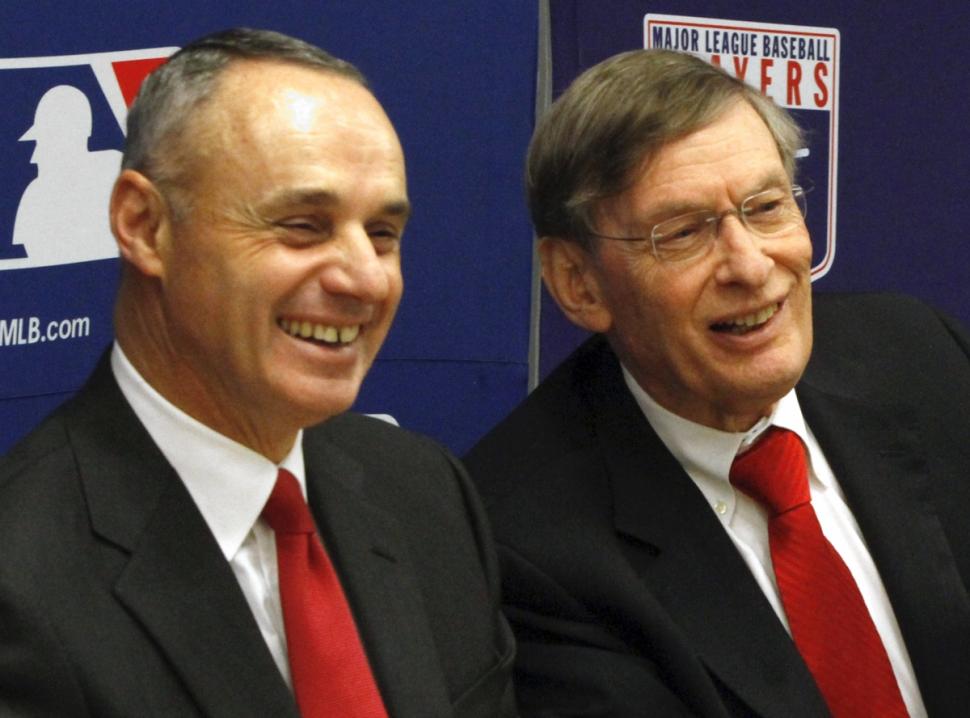
Q: Any chance Bud steps in ala with the Dodgers and Frank McCourt and forces Loria’s to sell the team?

A: I think there’s a chance, but something “illegal” would have to happen.  Selig was able to force McCourt to sell when the league was being embarassed and the team was clearly suffering financially because of mis-management.  Selig has allowed Loria to already do several unsavory things to fan bases in both Montreal and Miami, so its hard to see what else could happen.  However, if this supposed SEC investigation finds real evidence of fraud and the team is sued, I can see Selig stepping in and forcing Loria out.  Boswell doesn’t really answer the question.

Q: When he gets sent down next week, would you be surprised if he played second base exclusively given that Espinosa is now struggling with the bat and glove?

A: Anthony Rendon was ALREADY playing multiple positions in the minors this season, starting mostly at 3B but also getting a few games at 2B and at least one at SS.   But I don’t think Rendon would be Danny Espinosa’s replacement; Steve Lombardozzi would be.  If Espinosa were to be sent to the DL, Lombardozzi starts and then Rendon probably gets called back up to provide some infield cover.  Boswell thinks Rendon could make the transition, but needs more minor league time.  He also talks a lot about Espinosa vs Lombardozzi and (in my opinion) overrates the defensive value of Espinosa a bit.  In the age of rising strikeouts, it isn’t as important to have Gold Glove calibre fielders everywhere.  This is just a partial answer that may need eventual expansion in a blog post of its own.

Q: Mr. Boswell, why did Davey insert Rendon instead of Lombardozzi (following Ryan’s injury) into the lineup and why did he not allow Tyler Moore to start Sunday with Cingrani on the bump?

A: Good questions, both.  I think the team likes Rendon’s defense at 3B more than Lombardozzi or Chad Tracy, so that makes sense at least against lefties.  Why didn’t Tyler Moore play against the tough lefty Tony Cingrani?  I do not know.  You could see Adam LaRoche’s o-fer a mile away going against the second coming of Randy Johnson (Cingrani’s now has 37 Ks in 23 MLB innings).  Perhaps veteran preference/veteran blind spot on the part of Davey Johnson?  Boswell agrees at least with the LaRoche assessment.

Q: Have the Nats have over-managed Strasburg (in terms of pitch counts, innings limits and pitching to contact) since his injury and gotten into his head?

A: I don’t see Strasburg’s issues being a result of lack of confidence.  If that was the case we’d be seeing 3ip-8 run explosions, not “first inning bad then lights out for the next 6 innings” outings.  Have the Nats over-managed him?  Perhaps; we know Strasburg didn’t like the 2012 shutdown but I supported it (as did the surgeon who performed the damn operation, nobody ever remembers).  I think Strasburg also understands the value of getting hitters to hit your pitch instead of going for blow-em-away Ks every time.  Call it “pitch to contact” but I like to call it “making them hit your pitch.”  You want to try to get a great swing in after falling behind in the count?  Fine; hit my 97mph inside fastball for power, or try to drive my 94mph sinking 2-seamer on the outside corner.  I’ll tip my hat to you if you do.

But Strasburg misses his spots; his command has not been great.  97mph flat on the corner is good; in the middle of the plate is bad.  He’s been missing in the middle way too much.  Boswell defended his column, saying Strasburg needs to “keep it simple.”

Q: What does the team do with Henry Rodriguez?

A: So far this year we’re seeing nothing but “bad” Henry Rodriguez: more walks than hits, too many base-runners, and too many pitches that he just has no idea where they’re going.  He only threw FOUR of Seventeen pitches yesterday for strikes.  Luckily for him, its only a “wild pitch” if someone advances right?  Because some of those pitches were just ridiculous.  I’ll chalk it up to the wet conditions, as (likely) will management.

What can they do with him?  As often repeated in this space, he’s a human roster logjam.  The team has been forced to carry him and his Jeckyl and Hyde pitching for 3 years now because he was out of minor league options when we acquired him.  We’ve invented nebulous DL trips to stash him in extended spring training.  He’s now the lowest leverage guy on the bullpen, when he should be in the mix for 7th and 8th inning opportunities.  But the thing is, there’s not really a guy in Syracuse who is beating down the door to come up.  Maybe Erik Davis, who has pitched really well in AAA and has shown why the team put him on the 40-man.  Or perhaps the team could call up one of its veteran lefties (Fernando Abad or JC Romero) in a pinch.  But I think we’ll see at least another month of H-Rod trying to find his way before that happens.

Boswell raves about his career BAA (.211).  To that I say this: he has now for his career walked 91 batters out of 606 plate appearances.  That’s 15%.  6.1 bb/9.  I’m sorry, but how can you have a reliever with those kind of walk rates be put into any close game?  You can’t.  So in my opinion there’s better ways to use the 7th bullpen slot.

Q: What’s a good ratio for balls to strikes?

A: I’ve always used 60% strikes to pitches thrown as a benchmark for a good outing.  In Jordan Zimmermann’s 1-hitter he threw 59 of 91 for strikes, or 64%.  In Yu Darvish’s near perfect game in early April he threw 78 of 111 pitches for strikes for 70%.    Boswell says 65% is a good goal; honestly that’s a bit too high for me realistically.

Q: Do you think Soriano’s presence is helping or hurting Storen?

A: Good question.  Drew Storen’s struggles so far are really baffling; how do you go from a career 1.099 whip in your first 3 seasons to a 1.7 whip in 2013?  And it isn’t on walks; he’s giving up a ton of hits.  Perhaps it is mental; when Rafael Soriano himself has been a non-closer, his numbers have never been as good than when he’s getting the Saves.  Perhaps Storen is struggling to adapt to this mindset so far.  It also could just be small sample size syndrome too; its only April 29th after all.  Boswell basically says that Storen isn’t a kid anymore and that he should “man up.”

Q: What are Harper’s MVP chances looking like right now?

A: Pretty good.  MVP voting usually starts with “the best players on the best teams” and then whittles down from there.  Bryce Harper is clearly the best hitter on what should be a playoff team, and has been making a game-wide name for himself so far with his performance.  If Washington wins the division and Bryce keeps playing like this, he’s a shoe-in.  However, some guy named Justin Upton has been just as strong; if Atlanta wins the division Upton may be the name people vote for.


Why does MLB want to damage its sport with an International Draft??

14 comments

First we saw what happened to Puerto Rico as a Baseball talent source once it was included as a US territory and made part of the Rule 4 Amateur Draft.  In a nutshell; all the US teams closed whatever academies they may have had on the island and cut back on scouts because there was no longer any competitive advantage to being there and developing talent, and thus the number of players from Puerto Rico has drastically fallen as compared to 20 years ago.  The best article on this topic i’ve seens is by Jorge Castillo of the New York Times in Jan 2012.

Next we saw the gutting of the Amateur draft compensation limits, along with limits on International free agency spending as ramroaded into the latest CBA.  These guidlines were seemingly put in by cheap owners with poor executive staffs who were tired of having the lower payroll teams eat their lunch by spending a few more million dollars on scouting and player development to gain competitive advantages.  You know, instead of just having tens of millions of extra dollars handed to them by Regional Sports Networks in large markets (Jerry Reinsdorf, i’m looking at you here, complicit with the notoriosly cheap Bud Selig).

Now this; now we’re hearing that MLB is actually considering putting in place an International draft.  A June 1st deadline exists to take action and apparently both sides (the owners and the Players association) seem to be in favor of this draft in some form.  MLB is so interested in getting an international draft that they’re willing to give (per Buster Olney) “significant concessions” to the players union (up to and including higher minimum salaries and lowering the time to arbitration) in order to make it happen.  The Union’s argument (as it always has been) goes along the following; amateurs and foreigners aren’t union members, so to hell with them.  If we can guarantee ourselves more money, lets do it.

Why is this bad?

Simply put, I do not trust MLB executives and the collective penny pinching, revenue hounding ownership-driven management of the sport to put in place the appropriate resources to off-set what is sure to be a massive pull-out of Latin American countries by all 30 teams if an International Draft is put in place.  What possible incentives would a team have to develop talent in a place like the Dominican Republic via a privately funded academy, if their rivals could just swoop in and draft them after they’ve been developed for years on end?   I feel that an international draft would destroy the pipeline of Latin American talent into the sport, and it would significantly harm the future of Baseball.  It would be like Puerto Rico, only on a grand scale for every country south of the Rio Grande.

All so that the owners can save a few million dollars.  The average MLB salary last year was $3.2M, or less than most teams now have as budgets for the entire annual Rule 4 draft.  Pennies all-told when compared to the typical 9-figure payrolls they maintain and the hundreds of millions of dollars they earn from gate, concessions, parking, merchandise and TV revenues.

I’m not saying the current situation where 16 year olds are signed and then discarded as washed out 19 year olds in America (and left with no English skills, little education and no future) is good.  I’m not saying that a system controlled by underworld Buscones is good either.  But I have no faith that MLB will take the proper steps and will invest enough money in these countries to offset the impact of a draft.  Zero faith; this is after all the same instution that is currently trying to kill pensions for non-uniformed employees!

I don’t entirely understand why the Players Association is for this either; don’t they understand the long term ramifications of these policies?  I mean, amateurs aren’t part of the union … but EVERY major league player once was an amateur and faced all these same issues (whether they were subject to the Rule 4 draft or they had to deal with international free agency or had to deal with the Posting system).   Are the players so myopic in pursuit of short-term financial gains that they can’t see what the long term effects will be?

Now, the above alarmism being said, there are pretty significant barriers to an international draft.  Take for example the situation going on in Mexico.  Mexican clubs demand large transfer fees for their players, and nearly every player of any consequence over the age of 13 “belongs” to a club (much like the old Reserve Clause in the majors, only its even MORE restrictive); how would you draft someone who has a price tag associated with them?  The issues with the Mexican league are detailed and highlighted in this excellent SportsonEarth.com story by Jorge Arangure Jr about a lawsuit being filed on behalf of a Mexican prospect who is alleging that he’s being tied to a Mexican club via forged documents.  Meanwhile a “handshake” deal exists between MLB and the Japanese league preventing MLB teams from signing Japanese players as youths so as to allow them to go through the “posting system,” which enriches clubs in the country.  How do you handle Japanese players in the draft?  Does the posting fee count against the international FA limit?  It clearly doesn’t now, allowing teams to spend tens of millions of dollars just to acquire the rights to negotiate with Japanese FAs (who come from the industrialized and wealthy Japan) but meanwhile FA teenagers from impoverished Latin American countries now face cap limits on bonuses that often times were little more than a few thousand dollars.  How is this situation in any way justifiable?

This isn’t Professional Basketball, where professional leagues are now established and are popular the world over and an international draft in the NBA makes sense because player development occurs naturally without the required investment of the US professional league.  There’s no summer-long pro baseball in the Dominican Republic or Venezuela where so many of these players come from; there’s barely organized amateur baseball there outside of the academies run by teams.  Sure there’s Winter leagues … but are these winter leagues more for returning players from stateside or showcases for local talent?

If you take these Latin American academies away … you will destroy baseball in the country.  And you’ll shut down the pipeline of talented players coming to play in America, which will lessen the sport.  Is that really what these owners want?

(Here’s some additional reading material on the topic: Maury Brown’s BizofBaseball take, MLBTradeRumors’ running blog of updates on the topic, and Jay Jaffe’s op-ed piece).

Written by Todd Boss

March 21st, 2013 at 9:24 am

Miami New Times piles on Loria, Selig

7 comments

These links are a bit dated, but I thought they were interesting reads.

  • The Miami New Times has refused to divulge their sources to MLB, mostly because (as far as I can tell) they’re still pissed at Bud Selig for allowing his buddy Jeffrey Loria to screw Miami.  This “Press Release” reads more like a disgruntled blogger than it does an official communique.

In either case, any worries that people may have had about Gio Gonzalez or anyone else getting suspended for their roles in the Biogenesis case seem unfounded.  How can MLB suspend anyone if they don’t have any evidence in their hands?

Written by Todd Boss

March 19th, 2013 at 10:18 am

Ask Boswell; 12/17/12 Edition

2 comments

Is he staying or going? Photo: Rob Carr/Getty Images

Another Ask Boswell edition, dated 12/17/12.

As always, I type my response here before reading his answer (which sometimes leads to non-answers, since Tom Boswell sometimes doesn’t directly answer the same question i’m answering), and I sometimes edit questions for clarity.

Q: What is it going to take to settle this MASN Mess?

A: Probably a huge check to Peter Angelos to buy out his 90% stake in MASN.  But I like the approach baseball is taking; clearly Angelos has himself an incredibly one-sided deal, and clearly the whole “we’ll renegotiate in 5 years” turned out to be a gigantic mess.  Because its now drug on for more than a year with Angelos predicably low-balling the team while other teams out there get multiples of millions of dollars more per year than the Nationals are getting.  Wendy Thurm at fangraphs.com posted a great review of all 30 team’s RSN contracts.  For comparison purposes the next closest Market sizes to Washington (based on 2008 MSA) are Miami and Houston.  Miami gets $18M/year in a very bad deal, Washington is getting $29M/year, and Houston just negotiated a $80m/year deal.  Detroit, which is smaller still than Washington, is getting $40M/year in an old deal that expires in 2017, though they’re likely not to rise too much because of the economic conditions of their market.  What does all that mean?  Clearly Washington is no New York/Boston/Los Angeles, but clearly the team needs more than $29M.

I hope Fox Sports comes along, buys out Angelos and negotiates individual terms with the two franchises.  Will it happen?  Probably no, probably never.  Perhaps the solution will be a change of ownership in Baltimore, and Bud Selig (or whoever the commissioner is at the time) tacks on a clause of the switch to split off the RSN.  I could see that happening.

Boswell says it will take time, anger, and maybe even Selig imposing his whole “best interests of the game” clause.

Q: Who has the most frightening lineup in baseball ( Angels, Dodgers, or Blue Jays)?

A: Hmm.  The Angels now feature no less than SIX guys who have hit 30 homers in a season; Trout, Pujols, Trumbo, Hamilton, Morales and Wells.   That’s some incredible offense (even if Vernon Wells‘ time is past).   The Yankees and the Rangers were 1-2 in Runs Scored, Slugging and OPS in 2012 but both will be weakened by injuries and FA defections in 2013.  The Dodgers lineup “seems” potent, but includes a significant number of question marks.  If everyone plays to their potential, then yes the Dodgers could be fearsome.  But its more likely that  Crawford struggles and that Adrian Gonzalez continues to appear as if his best days are past.  Lastly Toronto may have a great middle of the order but they can’t match the Angels for up-and-down the lineup power.   The additions of Jose Reyes and Melky Cabrera aren’t going to help them catch the Angels.  Boswell says Toronto is best.

Q: With Hamilton->Los Angeles, are the odds of LaRoche leaving higher?

A: I think the ongoing stalemate over contract length plus Texas suddenly being majorly in the market for a middle-of-the-order lefty bat to replace Hamilton should have Nats fans worried (or rejoicing, depending on your viewpoint) that Adam LaRoche may be plying his trade in Dallas the next few years.   I would not be surprised to see LaRoche sign a 3 year deal in Texas right now.  Is that the end of the world for the Nats?  No … I think the team will do just fine with Michael Morse playing first and Tyler Moore getting backup reps in LF and at First.  Others have pointed out that Morse’s lefty/right splits are nearly identical and it doesn’t matter that we wouldn’t have another lefty in the lineup.  And (not that the average fan cares about this point) it would save a bit on payroll, perhaps allowing the team to augment/buy something they may need at the trade deadline.

Q: With all the FA stars seemingly ending up in the AL, are the Nats better just by attrition?

A: A fair point.  But the NL Dodgers have certainly bought their fair share of talent too.  As a Nats fan, you have to be happy about the decline of our divisional rivals in the past few months: Marlins fire-sale, Mets basically turning into a mid-market team (and traded away their Ace in RA Dickey this week), and the Phillies making one curious acquisition (Michael Young) after another (Ben Revere).  Washington has improved this off-season, and if they can stave off the injury bug that hit the offense last season they could improve on 98 wins in 2013.   But I also think St. Louis will be just as good, I think Cincinnati has improved, and of course the Dodgers could be scary if all their talent comes together.  Boswell thinks so, but also has stated before that the WS now goes through Los Angeles.

Q: Is there something amiss in the MASN contract legally, since Angelos has not accepted what should have been stipulated in the contract?

A: It sure seems so.  Ever since Angelos got the team, his legal background seems to have Selig spooked.  I wonder if this is why Selig has not pressed more for a solution to this situation.  Boswell thinks that the search for a MASN buyer could be indicative of a permanent stalemate in the contract talks.

Q: Will Philadelphia fans forgive Lannan for breaking Utley’s hand?  Should the Nats batters be worried when he returns?

A: Yes the Philadelphia fans will forgive and forget; remember, most fans just root for the laundry.  Whoever is wearing the jersey is a friend, everyone else is foe.  I don’t think our batters should be too worried; I’m sure they look forward to facing John Lannan.  He’s not exactly the second coming of Cy Young after all.  Boswell says that Chase Utley brings the HBP on himself by virtue of his hitting too close to the plate.

Q: You’re Mike Rizzo: Do you have another big move up your sleeve, either a trade of a FA signing? Or are you satisfied with what you’ve got, and standing pat?

A: I don’t think the team has any more major moves; Mike Rizzo left the winter meetings early because his work was done.  I can see a couple of players getting moved for prospect depth, and perhaps an under-the-radar signing for a right handed reliever to compete for a spot in spring training (ala Brad Lidge last year), but that’s it.  This team is who it is right now.  Well, once the LaRoche situation is resolved anyway.  Boswell agrees.

Q: Who you got for more wins this year, Angels or Dodgers?

A: Dodgers.  Easier division, more talent added.  The Angels have to deal with both Oakland and Texas, and look to have a significantly worse rotation so far in 2013.  The Angels can’t improve much from 89 wins, but the Dodgers can definitely improve on 86 wins.  Boswell didn’t really answer; he says both make the playoffs but neither makes the WS.

Q: Was it the # of Years that convinced Hamilton to go to Los Angeles?

A: I think it was partly a sense that Josh Hamilton felt he wasn’t wanted in Texas, and then mostly from there the right destination in terms of team and guaranteed dollars.  Some cynics out there in the baseball world say that the team doesn’t matter; that players only follow the money.  I don’t believe that necessarily.  Money issues equal, If you had to choose between a franchise on the brink of the playoffs, in a warm-weather city like Los Angeles versus a team that hasn’t contended in years in a crummy weather city (thinking Seattle, another rumored destination), where would you choose?  Boswell says Hamilton isn’t worth 5 years but didn’t answer this part of the question otherwise.

Ask Boswell 11/26/12 Edition

22 comments

The Nats entire off-season plan revolves around what Adam LaRoche does. Photo Alex Brandon/AP via wp.com

I havn’t done a “how would I answer this chat question” from The Washington Post’s Tom Boswell in a while, but on the back of his 11/26/12 “Stay the Course” opinion piece in the Washington Post (where he basically advises that the team should stay out of the major FA market this off-season), I thought I’d chime in and read/respond to his 11/26/12 chat.

My opinion on Boswell’s piece; I don’t think you can stand pat in today’s baseball world.  Yes this team won 98 games last year.  But does anyone think we’ll win 98 games again by doing little to nothing to address the team’s needs?  Trying to replace Adam LaRoche and Edwin Jackson’s departures internally has a large chance of weakening the team, and I believe we need to explore a significant FA purchase (or a trade) this off-season.  Now, inarguably TV deals and the rising revenue streams are fueling the FA market, and we’re already seeing contracts that heretofore would have been immediately labeled as “over pays.”  Therefore, even if the Nats go after a 2nd or 3rd tier player in free agency, they’re going to be compensated far more than we ever thought their value represented.  But this is just the way the baseball world is going; we can no longer say that someone is “overpriced” … we need to remember that everyone is going to be “overpriced.”  Perhaps Jayson Werth’s $126M/7yr deal will look like a bargain in a few  years.

And this is before even addressing the impact that the amazing new Los Angeles Dodger’s TV deal, reportedly worth between $6 and $7 billion dollars over 25 years, will have on the baseball world.  Even at the low-end estimate, that’s $240M a year in RSN revenue.  $240M a year!  They could field a $200M team, pay luxury taxes and still have money to spare under this deal, and that’s before a single dollar in gate, game-day revenues, suites, parking or merchandising comes in.  To call this a “game-changer” is an understatement; I think this could be a serious issue facing Baseball in the coming years.  We’re already seeing what the new ownership group is capable of doing in terms of acquiring talent without much regard to payroll.  What happens if they also acquire the likes of Josh Hamilton and Zack Greinke this coming winter?  A quick check of Cot’s page shows that Los Angeles has $169.5M committed to its top 14 players right now, with three guys making > 20M and nine total with pay > $11M/year.  And they’re reportedly in the mix for the top FAs this off-season, potentially adding 20-30M more to that base number.  That’s amazing.  Just more revenue sharing for Jeffrey Loria to pocket I guess (Thanks Bud!).

Anyway, back to the chat responses.  As always, I write my response before reading his, and sometimes edit questions here for clarity/conciseness.  I’m only answering baseball-related questions, ignoring the slew of Redskins issues.

Q: Are the Nats positioning themselves to make a strong push in the next two drafts?

A: This is what I whittled down a long-winded, rambling “question” to.  The gist is that a comp pick from Adam LaRoche leaving, plus another potential comp pick if Michael Morse leaves next year could help re-stock the farm system.  I’d tend to say, “maybe.”  The Nats are no longer where they were in 2009 and 2010, getting franchise players by virtue of back to back awful seasons.  So the likelihood of finding an impact player is far less.  That being said, having multiple first and supplemental first round picks is a great way to find players and to get guys who “slipped” due to signability/injury issues (as Lucas Giolito did this year).

The Nats farm system has taken some hits in the last two seasons; one from trade (losing 4 top-10 players in the Gio Gonzalez trade) and then another from injury concerns for its top guys (Sammy Solis, Matthew Purke, Lucas Giolito, and Anthony Rendon all representing 1st and 2nd round talents who suffered either season-ending injuries or significant injuries curtailing their progression in the last calendar year, to say nothing of injuries to lower-level guys like Taylor Jordan who will provide depth rising up).  This thinned farm system may prevent Rizzo from making the kind of deal he made last summer, and he may want to focus on getting some more depth in the 2013 draft, as much as is possible from drafting so low.

Here’s the issue writing my own response before reading Boswell’s: he didn’t even talk about the draft portion of the “question,” instead talking about the FA pitcher angle.

Q: What do you think the team is planning on doing to replace Edwin Jackson?

A: I’d guess the team is working on two fronts: one looking at possible trade angles with teams that have surplus starting pitching (Arizona, Tampa Bay, Oakland, Los Angeles Dodgers and perhaps even Atlanta) and seeing if he can swing a deal.  Then I’d guess he’s looking at a 2nd tier of starters, looking to avoid the Greinke sweepstakes (despite his affinity for the hurler).  I do NOT think the team is going to tender John Lannan, instead looking to get a better pitcher for slightly more money than the $5M he’d likely earn at a minimum in 2013.  Of course, with the prices we’ve seen for lefties already perhaps we will tender Lannan and consider another $5M insurance policy a bargain.  Boswell scrolls through the same 2nd tier of starters, noting that there’s definitely someone out there who could work.  He also mentioned the team may look at re-signing Zach Duke, though I’d be surprised by that.  Why would we re-sign Duke but non-tender Lannan, if Lannan clearly is a better pitcher?

Q: Is the lack of a MASN deal hindering the Nats FA plans?

A: You have to think it is.  If the Nats knew what they were getting next year, they’d certainly have a better idea of how much they could spend.  The fact that Bud Selig has allowed Peter Angelos to hijack this MASN revenue negotiation for this long is deplorable.  Of course, by waiting this long with the negotiations Angelos has only cost himself money, as the price we can command as a franchise certainly skyrocketed between the end of 2011 and now.  So there’s that.  But its clear the team is getting a pittance as compared to other comparably sized markets (Houston, Philadelphia) and needs a larger share.  Boswell doesn’t think the lack of a deal is affecting the team’s plans, mostly because there’s not a $250M player on the market this year as there was last year.

Q: Were you invited to any of the seven off-season Nationals player weddings?

A: I wasn’t.  Boswell wasn’t either.  :-)

Q: Why did the MLB allow the Marlins trade to go through? It poisons Miami against baseball probably for a decade and will surely be seen as a cautionary tale for city governments for at least as long.

A: Simple reason: Selig is buddies with Jeffrey Loria and has enabled his crummy behaviors for nearly 2 decades.  More complex reason: on the face of it, from a purely baseball sense this trade was little different than the Boston-Los Angeles trade, and I’d guess you would have a hard time accepting one and denying the other.  Loria’s position with Miami is not Selig’s concern; he got the new stadium that Selig claims is necessary in every market and Loria clearly will continue to profit from the team.  To an owner, that’s the primary concern.  And Selig works for the owners.  All of us bloggers and columnists to deplored the trade and Loria in general (including me, in this space in September and again in November) and talk about the sanctity of the game are just blowing hot-air.  Selig doesn’t care.  Boswell didn’t really answer the question, just saying that baseball is dead in Miami for a long, long time.  Hey, it only helps the Nats to have a 110 loss team in the division, right?

Q: Is Adam LaRoche destined for the AL as an aging 1st baseman?

A: I don’t think so; the questioner compared LaRoche to Adam Dunn, who can DH and is more valuable in the AL.  Inarguably aging sluggers fare better in the AL … but LaRoche just won a gold glove for his defense at first base.  He isn’t exactly a plodding first baseman slowed by age.  He should be able to capably play the position for several more  years, through whatever contract he’s about to sign.  Boswell agrees that this is the trend, and says that Baltimore is a possible destination … but mentions nothing about LaRoche’s plus defense.

Q: Why aren’t the Nats making a bigger play for Edwin Jackson?

A: A good question.  I questioned the Nats lack of a Qualifying Offer being extended to Jackson and surmised it was because the team was afraid he’d take it (having a history of working on one-year deals).  So clearly the lack of the Q.O. indicates a new direction for the team.  I don’t think its related to his meltdown in the post-season; that can happen to anyone (see most of our pitching staff not named Ross Detwiler).  I’d guess that it relates somehow to Jackson’s maddening capabilities; shutdown power pitcher one night, gopher-ball machine the next.  I think they’re just going in a different direction.  Boswell says Jackson wants a 5-year deal … which if true even more reinforces my questioning of the lack of the Q.O.  I disagree with his sentiment that the team is “saving room” for the rising farm system arms; to me a prospect starter is not a solution until the day he arrives in the majors and gives you 30 starts.

Q: Why did Tampa extend Evan Longoria?

A: The team had him under baseball’s most team-friendly contract (6yrs, $17.5M with three team options, locking him to Tampa from 2008 til 2016).  One of baseball’s best players, he made just $2M and $4.5M in the last two seasons.  Which is just ridiculous.  I feel Tampa did the extension to show good faith to the player who was just so woefully underpaid.  Boswell didn’t really answer the question, just saying its a good move because hitters come back from injury better than pitchers.

Q: Should the team be worried about losing LaRoche and his lefty power?

A: Yes absolutely.  Which is why the team should either try to get him to sign a reasonable deal (3 years max) OR the team should let him walk and try to replace the lefty power on the FA market (perhaps in the form of someone like Nick Swisher, who won’t be cheap but also can stick in LF for a while and should fit in nicely to the clubhouse).  Or maybe the team swings a deal for a lefty outfielder in trade and sticks Morse at first.  Boswell agrees, thinking that LaRoche’s hot FA market will get him a 4 year deal for more money than the Nats are willing to pay.

Q: Is there any chance that MASN just cuts ties with the Nats and frees us from the awful deal?

A: No. Chance. In. Hell.  Angelos stands to get such massive, major profit from this deal that he’ll die before giving in.  There is just no way.  And more and more its looking like this pact with the devil, which enabled the team to move here, will be a limiting factor in the years to come.  People talk about how Atlanta has the worst TV deal in the MLB?  Well what about the Nats?  Boswell asked Selig about this and was told that “everything is on the table.”  I highly doubt that, but I’m not going to call Boswell a liar.  I’ll just say, “Don’t hold your breath” that the Nats will be allowed to extract themselves from MASN and create their own RSN.  This would be the absolute dream scenario, but I just cannot see Selig backpeddaling on this deal less than a decade after it was signed.

Q: Will the Nats learn the lessons heeded by other big-money teams who got saddled with old, expensive players?

A: Hopefully so.  Not giving LaRoche 4 years would be a signal to that end.  But it can be difficult; what happens when the whole core of our young team hits free agency?  That’s a lot of big checks to write, and the fan base will bemoan every star that is allowed to walk.  Boswell thinks LaRoche is consistent enough to warrant the contract, but also notes that he’s several years past the typical hitter prime.

Q: Is Morse really the better choice at 1B if it’s between him and Moore? Is he really just that bad in the OF?

A: I’m convinced this narrative is overplayed.  Morse was a shortstop coming up through the minors, so he’s not exactly immobile, and suddenly nobody remembers that Tyler Moore was a plodding minor league first-baseman who only tried LF for the first time in spring training of last year.  Now suddenly Morse isn’t the better LF option?  I don’t buy it.  Neither are great LF choices; Morse had a -23.3 UZR/150 in 493 innings while Moore had a -22.7 in 229 innings this past season (small sample sizes both).  So it seems they’re both awful out there.  But then again (as I’ve said many times) you can “hide” guys in LF if they’re big bats.  You take the lesser defense in order to get a middle-of-the-order hitter.  The last thing you want is a #8 hitter (think Xavier Nady) bumbling around in LF and hitting .190.  If we lose LaRoche, I think the team should put Moore back in his natural position at 1B and let Morse get one more season out there.  Boswell didn’t answer the question, instead rambling about something else.


Loria a disgrace to the Game

13 comments

Jeffrey Loria, the biggest con-man in Miami. Photo unknown via si.com

A couple of months ago, I posted an entry titled “Is Jeffrey Loria the worst owner in sports?” after a series of off-season gaffes came to light.  Perhaps that title was prone to hyperbole, as the comment section talked about other awful owners in professional sports.  However, I’m bringing up the topic again.

The previous post was written before Heath Bell was shipped off to Arizona, before Ozzie Guillen was officially fired, and (the reason for this re-hashing of the topic) before the absolutely ridiculous fire-sale trade announced yesterday evening, where the Marlins shipped off the rest of 2011’s off-season acquisitions (Jose Reyes and Mark Buehrle), along with their best starting pitcher (Josh Johnson), their starting catcher (John Buck) and a valuable utility player in former Nat Emilio Bonifacio to the Toronto Blue Jays for a quartet of malcontents and decent-at-best prospects.  Oh, just for good measure the Marlins kicked in $4M dollars of (likely) revenue sharing money to boot.

I completely agree with the initial reactions from national baseball writers Bob Nightengale (who called the team a “Ponzi Scheme“), Ken Rosenthal (who says Loria should “just sell the team“), Buster Olney (who calls the Marlins the “Ultimate con“), from Scott Miller (saying that Loria “must be stopped“), from Keith Law (who called the deal a “boondoggle“) and from Jeff Passan (who calls this “a Baseball Tragedy“).  Passan’s article in-particular is worth a read, as it details all the shameful behaviors of Loria and his son-in-law, napoleonistic team president David Samson, in gory details.  You’ll feel the heat of anger just reading each new incident that these two con artists have perpetrated over the years.

Most infuriating to me is that this represents just the latest profiteering injustice that Bud Selig has empowered Loria to commit.  Going back to his days with the Expos (who he left in shambles and which directly led to our first years of franchise incompetence), continuing through to the criminal negotiations resulting in a mostly-publicly funded stadium, now resulting in this dismantling (which leaves the team with roughly $20M in committed 2013 payroll).  The shame is that Loria will pocket MILLIONS and millions more dollars by shedding all these ill-thought contracts.  How is that fair to the baseball fans in Miami, or the taxpayers in Florida, or the players that remain on that team (see Giancarlo Stanton’s tweet for his opinion of the move), or to the other owners, or to the players union in general?

Selig should absolutely veto this trade in the “Best interests of Baseball” clause, and should force Loria to sell.  The reaction and upheaval from the national media is unlike anything I’ve ever witnessed reading and folling the sport.  Enough is enough.  I realize that these moves only benefit us as Nationals fans (since the Miami team is now likely to lose nearly 110 games, ala the 2012 Houston Astros), but my sense of fair play and businessmen obtaining ill-gotten profits spurs me to write this post today.

Jeffrey Loria; Worst owner in sports?

6 comments

Jeffrey Loria, a wanted man in Miami. Photo unknown via si.com

I think in my next life my job title will be “really good buddy of Bud Selig.”  That way I can be assured of running one baseball franchise into the ground (Expos), then having a baseball franchise gift-wrapped for me (Marlins), get to do all sorts of unethical and a-moral things like blatantly deceive politicians to rob taxpayers of hundreds of millions of dollars (to build their new stadium) while continuing to massively profit from my venture (as we discovered when the books of the Marlins were leaked).

This is the life of Jeffrey Loria.

But the news doesn’t get much better for the Marlins fans.  An off-season of spending to prepare for the opening of the new stadium included three major free agents,  none of which really made any sense:

  • Jose Reyes, except you already had an all-star short stop in Hanley Ramirez
  • Mark Buehrle, a career workhorse with a near .500 record but now being paid like an ace
  • Heath Bell, millions of dollars for the most over-rated position on the team (closer).

The team also acquired $19M/year Carlos Zambrano.  The Reyes and Buehrle deals were heavily back-loaded, essentially grenades awaiting the team in a few  year’s time.

Halfway through the season, Ramirez was traded, Bell ineffective and demoted, replaced by a MLB-minimum salary guy in Steve Cishek, Zambrano buried in the bullpen and Buehrle sitting with a .500 record.   The Marlins moved a few other guys (the FA to be Anibel Sanchez, the disappointing Gaby Sanchez, and Edward Mujica namely) at the July deadline in a clear “white flag waving” move just a few months into their supposed “new phase of Marlins baseball.”  The team sits in last place, 22 games under .500 in a season they were supposed to compete.

The news doesn’t get any better for the team or the fans this past week:

Wow: great time to be a Marlins fan!  And there’s really not much hope rising up from the minors; in the past the Marlins could get by with penny pinching and still field a competitive team on the backs of its excellent player development staff (you know, the same player development staff that fueled the Montreal Expos for years and which he ripped out and brought with him to Florida in 2004).   Now the Marlins farm system is considered to be one of the worst in the majors and is relatively devoid of rising talent.

Fun times ahead for Miami.  I hope you enjoy that brand new stadium that nobody will be coming to, Mr Loria.  Hey, at least the Nats can stop getting killed by Miami year after year head to head (Here’s our record against Florida/Miami over the past few years: 9-9 this year, 7-11 last year, 5-13, 6-12 and an amazing 3-14 in 2008).  With the Mets in a long-term rebuilding program and the Marlins cratering, we really only have to worry about two divisional rivals for the foreseeable future.


More and more I’m liking the 2nd Wild Card

8 comments

Will the Greinke acquisition get the Angels out of the WC game? Photo Jeff Golden/Getty Images

Baseball Purist Alert: this opinion piece may not entirely please you.

I have to admit; as a life-long baseball fan I find myself constantly being at odds with myself over the “purity” of the game dating to its roots versus the natural progression of modern baseball as it adjusts to the current  sports climate.  Every change we’ve seen, from divisional play to wild cards to instant replay seems like an attack on the sanctity of the National Pasttime, and the sport which routinely traces its roots to stars from 70 years ago.

The latest Collective Bargaining Agreement added a second Wild Card in each league, and a one-game playoff between the two wild-card teams to advance into the divisional series.  Some purists were aghast with the addition of yet another non-divisional champ to the post season party.  However, as we’ve seen this season play out the second wild-card inarguably has some side-effects that I think are good for the game.  Lets talk about these intended (or unintended) impacts:

1. The additional Wild Card has kept more teams in the Playoff Race.  Here’s the standings as of 7/31/12 (a fantastic new feature I found at baseball-reference.com; you can pull standings as of any date in the history of the game).  8 of the 16 teams in the NL and arguably 9 or 10 of the teams in the AL were technically still “in” the race for a playoff spot.  More teams in the playoff race means longer sustained fan interest and less tanking or selling off of assets.

2. By virtue of #1, more teams were trying to improve at the Trade Deadline.  You can argue that more teams in the playoff hunt meant that fewer teams were sellers, and that lead to gridlock at the trade deadline.  But, some surprise selling teams (namely Miami and Philadelphia) injected new life to the trade deadline and had some teams making significant and crucial pickups.

3. An additional Wild Card still leaves Baseball with the lowest percentage of its teams in Post Season Play.  Hey; at least we’re not the NBA, where more than half the teams make the playoffs.  It still means something to make the playoffs, which is important.

4. The play-in game will be fantastic.  Nothing is as amazing as a one-game playoff to advance, and some of baseball’s most historic moments have come during these games.  Who would know who Bucky Dent was if not for his amazing home-run in the 1978 playoffs?  Both teams will be sending their Aces, both teams will be playing like its Game 7, and the neutral fan will be in heaven.

5. The additional Wild Card will mean that teams will play harder, longer into the season.  Why do you think we’re seeing the massive trade-deadline arms race between Western divisional rivals in both leagues?  The Angels/Rangers and the Dodgers/Giants were by far the most active teams at the deadline because they all know that the difference this year between winning the division and the wild-card is significant.  In years past we’ve seen teams almost not care if they won the division or dropped to the wild card; you were guaranteed not to meet your divisional rival until the LCS and the home field advantage in baseball is so slight that sometimes you could argue that playing away in a short series is more advantageous.

Why?  In a short series, its pretty easy to “steal” a game on the road and then hold serve and win 2 straight at home, knowing that the pressure is on the favorite and knowing that the under-dog can drop a game at home but still get a 5th/deciding game on the road.  In a 7-game series the same rule of thumb applies; its really difficult to get a 3-game sweep, but its really easy to get a 2-game split.  Especially considering that the home-field advantage in baseball is only about 56% but has been as low as 52% in the past decade (see this link at Baseball-Reference.com, which has the home-team winning percentage over the years).

Now we see the immedicate impact; the Angels and Rangers absolutely do not want any part of a coin-flip game with the 2nd wild card for this reason.  Primarily because…

6. The one-game play-in will significantly impact the advancing Wild Card Team.  You have to think that teams will send their Ace/#1 starter to the hill in the play-in game.  Why possibly save him for a series that you may not get to?  As a result, the wild card winner advances to play either the #1 seed or the #2 seed (if the #1 team is in their same division) having already spent their big arm.

Why do I see this as a good thing?  Because one major beef I’ve always had with Wild Cards is their relatively easy path to advance to the World Series.  Up until the last day of last season, the Cardinals were not even set to be a playoff team, and then they run to the World Series title.  We’ve already talked about the relatively small home field advantage baseball teams have.  Wild Card teams, more often than not, come into the playoffs “hotter” than the divisional champ that they then face.  This results in a significant number of Wild Card “upsets” in our history of divisional play and having Wild Cards advance far further than I’d normally like to see them, at the expense of divisional winners losing short series.  In the 17 years of divisional play/wild cards we’ve had:

  • 5 Wild Card WS champions (including most recent St. Louis Cardinals plus 3-straight from 2002-4)
  • Another 5 Wild Card WS runner-ups (including 3 straight from 2005-7)
  • Overall, 10 of 34 World Series participants being Wild Cards, a rate of nearly 30%.
  • 18 Wild Cards overall who won their Divisional Series out of 68 such series being played, a success rate of more than 25%.

Perhaps this is one last vestige of “baseball purism” in me, but I think the game needs to have more World Series winners who not only won the 8-team (now 10-team) playoff derby, but who also succeeded all year long and won their divisions.  Only three times in the divisional era has the team with the best record also won the World Series, 3 times out of 17 (the spreadsheet linked here is also available in the links section to the right-hand side of the blog, called “Best versus Winner.”  It needs updating for 2011 and 2012 champions in all sports, but shows just how infrequently the best regular season team wins in any sport.  A side effect of expanded playoffs in all sports, true, but a concerning trend for any sport purist).

In any rate, I’m hoping that the diminishing of the Wild Card one-game winner means that fewer Wild Cards run through the playoffs, which will lead to more “deserving” World Series participants.


Do I wish that Baseball would revert to the old, old days where there was one division and two pennant winners?  No, of course not.  In fact, I think Baseball would be best served by adopting the NFL’s 8 division alignment with 2 wild cards for a very neat post-season tournament where the two best teams got byes (in the link above, I posted some possible alignment possibilities when the whole re-alignment discussions really took hold in July 2011; my two expansion target cities were San Antonio and Portland).  But expansion in Baseball seems like such a difficult proposition that it may never happen (for the reasons explained in this post).  But the 2nd wild card seems to be setting up baseball fans for an exiting and “fairer” post season in 2012 and beyond.

Written by Todd Boss

August 7th, 2012 at 1:47 pm

Nats all-star review (2012 edition)

6 comments

Gonzalez gets a very deserving NL All-Star selection. Photo unknown via WP.com

(Note: i’m copying a large chunk of 2011’s version of this post to give a running history of the Nats all-stars later on below).

MLB announced the 2012 all-star rosters and the Nats, for the first time in their history in Washington, have 3 representatives.  Here’s a discussion:

2012

  • Nationals All-Star representatives: Stephen Strasburg, Gio Gonzalez, Ian Desmond
  • Possible Snubs: Adam LaRoche, Bryce Harper, Craig Stammen
  • Narrative: The two starters Strasburg and Gonzalez were the obvious candidates, and my personal prediction was that they’d be the only two candidates selected.  The inclusion of Desmond is a surprise, but also a testament to how far he’s come as a player in 2012.  I entered the season figuring that Desmond would be closer to a demotion than the all-star team, and his power from the short stop position has been a huge shot in the arm to our challenged offense.  LaRoche has had a fantastic come back season but fared little shot against better, more well-known NL first basemen so his non-inclusion is not too surprising.  Stammen has been our best bullpen arm, but like LaRoche fared little chance of getting selected during a year when the Nats had two deserving starters.  Lastly Mr. Harper; he wasn’t on the ballot so fared little shot of being included, but has been put on the “last man in” ballot, up against a series of established veterans and future hall of famers.  We’ll see if celebrity wins out.  Before his slump the last two weeks he was clearly among the best hitters in the league despite his age.

(Editors Note: Harper was subsequently added on 7/7/12 to replace the injured Giancarlo Stanton).

Coincidentally, I thought Matt Kemp’s decision to go public with his snub of Harper for the home run derby was both short sighted and disappointing.  If I was Bud Selig, I’d take the opportunity to make this year’s derby the most watched mid-season baseball event ever by forcing the inclusion of both Harper and uber-rookie Mike Trout.  Ask yourself this: 1) do you bother to watch the home run derby now?  And 2) if Harper and Trout were in it, would you watch this year’s version?  For me, even as an avid baseball fan I don’t bother to watch the event and wasn’t planning on it this year … but with these two guys in, it’d be must-see TV.  I hate it when Baseball misses such an obvious chance to showcase players and take advantage of the prevailing storylines of the season; it seems to happen year after year.

For a trip down Memory lane, here’s the Nationals all stars by year and talk about their selection, whether they were deserving, and who got snubbed each year.

2005

  • Nationals All-Star representatives: Livan Hernandez, Chad Cordero
  • Possible Snubs: Nick Johnson, John Patterson.
  • Narrative: The Nats went into the All Star break surprisingly in first place, having run to a 50-31 record by the halfway point.  Should a first place team have gotten more than just two representatives?  Perhaps.  But the team was filled with non-stars and played far over its head to go 50-31 (as evidenced by the reverse 31-50 record the rest of the way).

2006

  • Nationals All-Star representatives: Alfonso Soriano
  • Possible Snubs: Nick Johnson, Ryan Zimmerman
  • Narrative: Soriano made the team as an elected starter, the only time the Nats have had such an honor.  Our pitching staff took massive steps backwards and no starter came even close to meriting a spot.  Cordero was good but not lights out as he had been in 2005.  Soriano’s 40-40 season is a poster child for “contract year” production and he has failed to come close to such production since.  The team was poor and getting worse.  Johnson had a career year but got overshadowed by bigger, better first basemen in the league (a recurring theme for our first basemen over the years).

2007

  • Nationals All-Star representatives: Dmitri Young
  • Possible Snubs: Ryan Zimmerman, Shawn Hill (though I wouldn’t argue for either)
  • Narrative: Young gets a deserved all-star appearance en route to comeback player of the year.  Zimmerman played a full season but didn’t dominate.  Our rotation featured 6 primary starters, none of whom are still in the league now, though Hill showed flashes of dominance throughout the year.

2008

  • Nationals All-Star representatives: Cristian Guzman
  • Possible Snubs: Jon Rauch
  • Narrative: The first of two “hitting rock-bottom” seasons for the team; no one really merited selection.  Zimmerman was coming off of hamate-bone surgery in November 2007 and the team was more or less awful across the board.  Rauch performed ably after Cordero went down with season-ending (and basically career-ending) shoulder surgery.   Guzman’s selection a great example of why one-per-team rules don’t make any sense.  Guzman ended up playing far longer than he deserved in the game itself by virtue of the 15-inning affair.

2009

  • Nationals All-Star representatives: Ryan Zimmerman
  • Possible Snubs: Adam Dunn
  • Narrative: The addition of Dunn and Willingham to the lineup gave Zimmerman the protection he never had, and he produced with his career-best season.  His first and deserved all-star appearance en-route to a 33 homer season.  Dunn continued his monster homer totals with little all-star recognition.

2010

  • Nationals All-Star representatives: Matt Capps
  • Possible Snubs: Adam Dunn, Josh Willingham, Ryan Zimmerman, Steven Strasburg
  • Narrative: Capps was clearly deserving, having a breakout season as a closer after his off-season non-tender from the Pirates.  The 3-4-5 hitters Zimmerman-Dunn-Willingham all had dominant offensive seasons as the team improved markedly from its 103-loss season.  But perhaps the surprise non-inclusion was Strasburg, who despite only having a few starts as of the all-star break was already the talk of baseball.  I think MLB missed a great PR opportunity to name him to the team to give him the exposure that the rest of the national media expected.  But in the end, Capps was a deserving candidate and I can’t argue that our hitters did anything special enough to merit inclusion.

2011

  • Nationals All-Star representatives: Tyler Clippard
  • Possible Snubs: Danny Espinosa, Michael Morse, Drew Storen, Jordan Zimmermann
  • Narrative: While Clippard was (arguably) the Nats best and most important reliever, I think Zimmermann was a more rightful choice.  He was 10th in the league in ERA at the time of the selections and has put in a series of dominant performances.  Meanwhile Espinosa is on pace for a 28homer season and almost a certain Rookie-of-the-Year award (though a precipitous fall-off in the 2nd half cost him any realistic shot at the ROY), and perhaps both players are just too young to be known around the league.  Lastly Morse is certainly known and he merited a spot in the “last man in” vote sponsored by MLB (though he fared little chance against popular players in this last-man-in voting).

Why is baseball so intent on killing their international talent pools?

7 comments

Bud Selig continuing to ignore the facts to save a buck. Photo via ajc.com

Bud Selig continues to push for an international draft.

Why can’t he see what irrevocable damage this would do to the game of baseball??  The cause and effect of including Puerto Rico into the domestic rule-4 (aka amateur) draft is pretty clear; when the province (a former hotbed of baseball prospects) was added to the US draft, MLB teams no longer had any incentive to host baseball academies on the island, which then led to almost no money being sent to develop amateur players, which has led to a startling drop-off of talent being drafted out of the territory.

If the same is done for the ENTIRETY of the world, what do you think will happen in developing baseball countries like Venezuela, Dominican Republic and the like?  Every MLB team will close up shop, stop spending money to develop and scout players, and we’ll stop seeing the massive inflow of foreign talent.  Its that simple.  An international draft works in Basketball because it is far more of an international sport than Baseball; there’s significant pro leagues world wide and a massive interest in developing players.  So there’s no need for NBA teams to setup basketball academies in places like Germany or Spain; they already exist and are funded by international amateur/olympic organizations.

The same situation doesn’t exist in baseball, and our sport has already suffered for Selig’s blatant pandering to tight fisted owners.  Clearly Jerry Reinsdorf was behind the limits of amateur bonus money negotiated into the last CBA and clearly is behind this international draft effort as well; for reasons unknown Reinsdorf and Selig are so myopic they cannot see the long term damage this will do to the sport: in order to save just a few million dollars here and there in signing bonuses they want to do billions of dollars in long term damage to the sport.

The most recent CBA already took the first steps towards hurting small-market teams and shutting the door on two-sport stars by putting in artificial and (in my opinion) unneeded limitations on bonus monies.  In a sport that clearly has massive revenue discrepancies between big city teams in New York, Los Angeles, Chicago and the like versus places like Kansas City, Pittsburgh, Tampa Bay and Oakland, why would the league purposely eliminate the primary way that these small market teams can improve themselves?  Its as if Selig called up the owners of large market teams with incompetent GMs and said, “Hey guys, how can we screw these teams to overcome our own incompetencies that we’re paving over by spending $150M/year in payroll?”

It really is infuriating…

How could we fix this issue, if an international draft was forced upon the sport?  I’d be ok with an international draft if, somehow, the draft rules were modified so that teams that developed talent in their own private academies were somehow given the ability to keep their own talent.  Perhaps a modified draft where international prospects were graded by independent talent evaluators and teams could burn one of their own amateur draft picks by taking one of their own?  How about an expansion-type draft situation where teams could protect a number of players ahead of each amateur draft, and then at the end of each round they could protect one additional player?

Written by Todd Boss

March 3rd, 2012 at 9:38 am