Nationals Arm Race

"… the reason you win or lose is darn near always the same – pitching.” — Earl Weaver

Archive for the ‘mark buehrle’ tag

Opening Day Starter Trivia

leave a comment

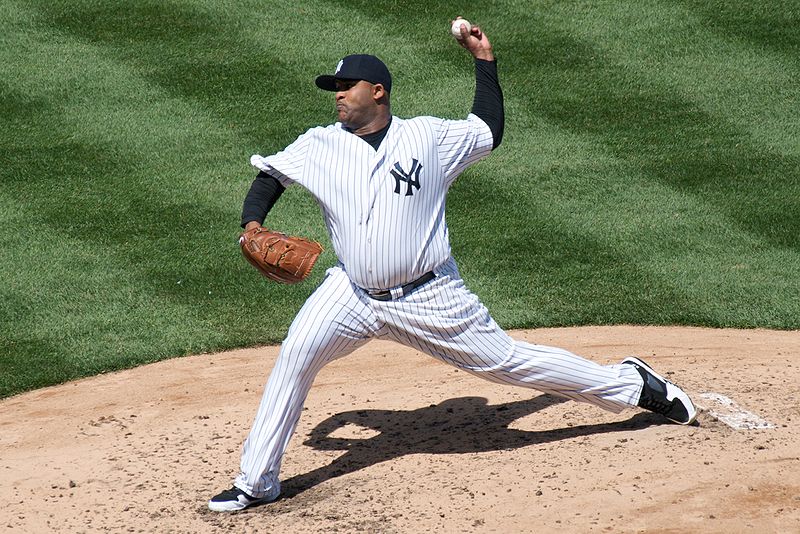
Sabathia is your current Active leader in Opening Day starts. Photo wiki/flickr chris.ptacek

One of my favorite annual trivia questions amongst my baseball buddies revolves around Opening Day Starters.  With another Opening Day in the books, here’s some useless trivia related to Opening Day starters for my readers.  I’ve uploaded my little Opening Day Starters spreadsheet to Google Docs and created a link in the “Nationals Arm Race creation” section along the right.

Current Active Leaders in Opening Day Starts

10 Roy Halladay
10 CC Sabathia
9 Mark Buehrle
6 Bartolo Colon
6 Derek Lowe
6 Tim Hudson
6 Felix Hernandez
6 Justin Verlander
5 Aaron Harang
5 Josh Beckett
5 Jered Weaver
5 James Shields
4 Jake Peavy
4 Barry Zito
4 Tim Lincecum
4 Yovanni Gallardo

Those players bolded in the list above had 2013 opening day starts and added to their totals.  Roy Halladay’s difficult spring training cost him his shot at Opening Day and thus CC Sabathia moves into a tie for first.  Mark Buehrle has given over the reigns of opening day starter possibly for good, based on his standing in the Toronto rotation (4th starter?).

Felix Hernandez and Justin Verlander have chances to broach the all-time records (see below) based on their ages, their current counts and their new long-term contracts.

Current Active Leader in consecutive Opening Day Starts: Verlander with 6 straight.

Most ever Opening Day Starts all-time: Tom Seaver with 16 in his career.

Most ever Consecutive Opening Day Starts: Hall of Fame lightning rod Jack Morris, who made 14 straight such starts.

Number of first-time opening day starters in 2013: no less than 13 first timers this year, nearly half the league.   Some guys got deserved first-time opening day starts (Jeff Samardzija, Matt Cain, and R.A. Dickey), some guys got Opening Day starts mostly out of attrition of other worthy pitchers (Jon Niese, Bud Norris, A.J. Burnett, Vance Worley and Jhoulys Chacin) and some guys are taking over as the new big-dog of their rotations (Brett Anderson, Chris Sale).

Who seems most likely to break Seaver’s Record at this point? Sabathia, who already has 10 opening day starts, is clearly the #1 in New York, is only 32 and still has five years on his current deal.  Question is, if he renews past 2017, can he still earn the #1 spot?   Meanwhile Hernandez already has 6, just signed a deal that takes him through 2019 with a relatively easy option for 2020.   That’s 8 more seasons on his existing 6 opening day starts and he’d only be 34 years of age.   He could be the standard holder if he stays healthy and continues to pitch like an ace.

Ask Boswell 2/25/13 Edition

8 comments

When is Anthony Rendon going to be ready for the Majors? Photo Nats Official via espn.com

With the first couple of Spring Training games in the books, its fitting that Tom Boswell did a Monday morning chat on 2/25/13.

Here’s how I’d have responded to the Baseball-specific questions he took.  As always, questions are edited for clarity and I write here before reading his response so as not to “color” my answer.

Q: Given that the Nats know almost every player making the roster out of Spring Training, do the players/coaches approach the 6 weeks differently?

A: Good question; I was taking with someone about this exact topic this weekend.  The 25-man roster is essentially already solidifed; perhaps the only question remaining is whether or not Henry Rodriguez makes it onto the team or does the team carry a second lefty reliever (Bill Bray?).  So I think the answer has to do with looking more at the AAA talent, looking at minor league FA signings like Micah Owings and Chris Snyder to see if they’re going to be better options than the guys we already had slated at AAA.  And the coaching staff gets to look at up-and-coming guys like Anthony Rendon, Zach Walters, and the like.  Boswell reiterates what I said here, naming other ML signings of interest like Chris Young, but also says that this ST has a lot of “wasted time.”

Q: I’ve spent the offseason reading Ball Four to help get my baseball fix. Do you have a sense about how different things are now?

A: It has been a while since I read Jim Bouton’s seminal baseball book Ball Four.   But the season he chronicles (1969) happened before a number of rather important moments in Baseball history.  Expansion, divisional play, the Designated Hitter, the aftermath of the Curtis Flood and Andy Messersmith decisions (aka, Free Agency) and of course the massive increase of money in the game (both from a revenue stand point and from a player salary stand point).  One thing that seems certain to have changed; players can now earn enough in a season to be set financially for life.  And, the players union’s power is now such that players have the upper hand in a lot of negotiations with the league and the owners when it comes to labor unions.  Boswell notes that managers, coaches and GMs are far “smarter” now than they were in the Bouton era.

Q: How the Nats will do at the gate this year?

A: The season ticket base is back to where it was in 2005 apparently, broaching 20,000 season tickets.  The team averaged 29,269 fans last year.  Clearly the attendance seems set to rise significantly.   I think they’ll average 35,000 a night if they continue to be a first-place club.  Boswell agrees, noting that the team also has a couple of very marketable stars to help with attendance.

Q: Other than obvious injuries, are there any things that can happen in the first quarter of the year that you would find to be troubling?

A: I’d be troubled if Danny Espinosa started off slow.  I’d also be concerned if we saw significant regression out of our WBC participants Gio Gonzalez and Ross Detwiler, confirming my fears.  But the most important factor may be the performance of Dan Haren: is he the 2012 Haren or the 2009 Haren?  If he approaches 2009 version, this team may be set for the season.  Boswell notes they have a tough early schedule, that winning 98 games is tough, and that we should be patient.

Q: Gio Gonzalez; did he or didn’t he?

A: I think the prevailing opinion in the sport now seems to be that he did NOT take or receive PEDs from the Miami clinic, and that he was an unfortunate bystander.  His passing a surprise PED test given two days after the scandal seems to have also bolstered his case.   Boswell agrees.

Q: Are the Nats a 98 win team again, or was last year a fluke?

A: Barring a significant injury in the rotation, I think the Nats are easily a 98-win team and perhaps better in 2013.  Statistical WAR “proof” offered in this space back in January, and that was before the LaRoche re-signing and the Soriano pickup, both of which marginally should improve the team a few wins.  Most national pundits that I’ve read think the same thing, that this team could win 103 games.  The various estimator stats out there (Zips, Pecota, etc)  the team much closer to 90 wins, but those predictors are by and large incredibly conservative.  Boswell also says it comes down to health of the rotation.

Q: How would you rate the Nats starting rotation, spot by spot, compared to the rest of the Major Leagues?

A: Spot by Spot, its hard not to think that each of our guys are each at least in the top 5 by position in the league.  Drawing from my Rotational Rankings post from January 7th, 2013, I’d say that:

  • Strasburg is clearly among the best arms in the game (in the discussion along with Verlander, Kershaw, and Hernandez).  He’s not as accomplished as this group of course, but his talent is unquestionable.
  • Gonzalez matches up as a top 5 number two starter (other candidates: Greinke, Hamels, Lincecum or Cain, depending on who you think SF’s “ace” is).
  • Zimmermann is traditionally underrated but is at least a top 5 number three starter (along with Scherzer, Johnson/Morrow, Bumgarner, Lee and Moore).
  • Haren on potential could be the best number four starter in the game, though Buehrle, Miley, and Lynn could also fit in here.
  • Detwiler is often mentioned as being the best number five starter out there, and its hard to find competitors (best options: Zito, Romero, Garcia, and whoever Oakland and St. Louis settle upon for their #5 starters).

Boswell seems worried that these five guys can handle the workload all year, only really trusting Gonzalez in terms of repeatability.

Q: What future do you see for Anthony Rendon, and when will he debut in the majors?

A: I have been of the belief that Zimmerman should move to 1B for Rendon at some point.  But with LaRoche signed for two years, that won’t happen for a while (2 years, perhaps 3 if we pick up his 2015 option).  So now i’m starting to come around to the the possibility of Rendon pushing someone else off their position.  The most likely candidate seems to be Espinosa at 2B.  Despite having Lombardozzi on the 25-man, Rendon is a higher-potential player.  If Espinosa starts slow, and Rendon starts fast, I could see Rendon getting called up in June and starting to get reps at 2nd while Espinosa goes on the DL for his shoulder.  Otherwise, a Sept 1 call-up seems in order.  Boswell predicts a post-all star game call-up.

Q: Is there any way the Nats can stop Detwiler and Gio from pitching in that baseball ‘classic’? I see a disaster waiting to happen. Luis Ayala was never the same after getting hurt pitching in that thing.

A: There’s no way legally the team can prevent either guy from pitching, since neither suffered any injuries in 2012.  And yes I agree (as discussed in this space on 2/11/13) this is bad news for the Nats.  Washington has never had a pitcher play in the WBC who didn’t regress badly, and the stats seem to show that most every pitcher who does participate in the WBC pitches poorly the next two seasons (links in my post).   Boswell says cross your fingers.

Q: Do you think Bryce has it in him to be National League mvp?

A: Yes I do.  MVP voting generally starts with the “Best Player” on the “Best Teams” and creates a short list from there.  It is why it is relatively easy to predict the MVPs.  If Washington is the best team in the league and makes the playoffs again, and Bryce Harper has a break out season, it won’t be hard to see him getting serious MVP consideration.  Now, let me also say that a “Harper for MVP” prediction is NOT the same as predicting that Harper is set to become the best player in the game.  That’s not what the MVP measures.  If the question was, “Is Harper set to become the best player in the National League” i’d then say, “No, he’s a few years away from that distinction.”  Boswell thinks it may be a bit early.

Q: How many wins per year would you estimate a a stellar defense adds to a teams win total over the course of a season?

A: I’m sure there’s a good statistical answer for this, based on the percentage of WAR added by defense.  But it seems like a very difficult answer to come by.  Boswell says “a few.”

Q: Any reason to think he’s NOT going to be the GM for a long time?  Because I can’t think of many others who have done as good a job in all of baseball.

A: I can see no reason for Rizzo not to be the GM for at least the next 4 years.  His next big challenge will be dealing with the inevitable payroll demands of Harper and Strasburg (both of whom project to be $25M players) while also keeping a competitive team on the field.   2017 could be an interesting year for this team; Strasburg projects to hit Free Agency that year, and Harper should be in his 4th arbitration year.  They already have Zimmerman and Werth at $14M and $21M respectively in the 2017 year, with possibly another $40-$45M out the door to keep Harper and Strasburg.  They better start working on the farm system again.  Boswell didn’t really answer the question, just mentioned how Rizzo’s options have yet to be picked up.

Q: How is Ramos looking thus far? 100%? Suzuki is a professional and seems to be a good guy, do you get a feel for how well he and Ramos interact? How great would it be to generate some power/runs from the catcher spot this year.

A: I’ve been assuming that the catcher job is Suzuki’s to lose for now; its still early but no word has come out negatively on Ramos‘ recovery.  Either way, yes it would be nice to get some production out of the #8 hole.  Suzuki was pretty good after he came over here, but Ramos healthy was a middle-of-the-order bat.  Boswell suggests that Ramos stop blocking the plate.

Q: If Rendon tears it up after September call-up, what does the Nats 2014 infield look like?

A: Wow; hard not to say Rendon replaces Espinosa like-for-like right now.  But, just as Desmond broke out in his 3rd full time season, so could Espinosa.  It could make for a log jam.  Lets hope for the best, hope for a rebound Espinosa season and a good-problem-to-have situation of having to trade a strength to make way for another strength.  Boswell has no idea where Rendon will play if he merits a call-up.

Q: I think the Nats, and Danny Espinosa are whistling past the graveyard if they think a completely torn left rotator cuff will not seriously affect Danny’s play. Your take?

A: A fair assessment.  I too believe a torn rotator cuff absolutely has to be affecting his swing, especially from the right side.  I think Espinosa should have gotten the thing surgically repaired in the off-season.  I wonder how much the team knew of the injury, because when it was reported in the off-season it sure seemed like a surprise.  Boswell says its a concern and that Espinosa should take more days off.

Q: Is McCatty working with Strasburg on correcting his inverted W delivery? Strasburg also has footstrike issues, as he tends to plant his foot and then whip his arm, which puts a ton of strain on his shoulder. I’m concerned if he doesn’t correct this, his shoulder will give out this season or next. Are the Nats worried about this? Are they working on cleaning up his delivery at all?

A: I’m beginning to think that this whole “Inverted W” thing is a bunch of BS.  Keith Law stated as much when prompted in a chat recently; he says that the problem with the Inverted W theory is that its difficult to “state” with authority that certain pitchers do or don’t have the phenomena.  And its true; if you see some shots of Strasburg he has it, in others his arms are more bent behind his back.  Its the same with Gio Gonzalez (I can show you stills of him landing with his arms clearly in an “inverted W” position and you don’t hear anyone talking about Gonzalez’s mechanics.   The leading inverted-W site on the internet (Chris O’Leary’s page linked here) uses an opportunisitic example set of pitchers with that motion, but I can find plenty of examples of guys who have similar mechanics but zero soft-tissue injury history (on the Nats two quick examples are Drew Storen and Craig Stammen).  Meanwhile one of his examples was John Smoltz … who only threw 3400 MLB innings in his career and basically didn’t miss a start until he was 32.  Not the best example of proof that his mechanics were somehow “awful.”  I think the entire phenomenon is an observation of coincidence, that pitchers get injuries all the time no matter what their mechanics, and that we need to move onwards.  Wow; Boswell thinks exactly what i think; these proofs are nonesense.

2013 Rotation Rankings; Ranked 1-30

8 comments

Greinke bolstered the Dodger's already strong rotation. How much? Photo Jeff Golden/Getty Images

(Editor Note: I’ve had the bulk of this post written for weeks and have been waiting for the last couple of impact FA starters to sign.  I’m tired of waiting.  If/when guys like Kyle Lohse, Shawn Marcum or Joe Saunders signs, or if there’s another big trade that happens, perhaps I’ll re-post this).

On December 5th, awash in the after-glow of the Dan Haren acquisition, I postulated that the Washington Nationals’ 2013 rotation was the Best in the Majors.

That was before the next shoe dropped in the Los Angeles Dodger’s unbelievable spending spree in 2012: signing Zack Greinke to a 6yr/$147M contract.  This is the 2nd largest starting pitcher contract ever signed (just behind CC Sabathia’s 7yr/$161M deal that he opted out of to sign a slightly larger deal in terms of AAV after the 2012 season).  These rankings also are updated for the highly-criticized James Shields (and parts) for Wil Myers (and parts) deal, the Ryan Dempster signing.

The larger story behind the Greinke signing remains the unbelievable payroll Los Angeles will be sporting in 2013; they’ll spend roughly $225M in 2013, breaking the  Yankees record by a 10% margin, and all boldly in the face of a dollar-for-dollar luxury tax.  And they’re likely not done yet on the FA market.  But the focus of this article is a revisiting of baseball’s best rotations, now that Greinke is in the Dodger’s fold.

Instead of trying to figure out which handful of teams are the best, why not rank all 30 rotations?  With the help of some Depth Chart websites (ESPN, rotoworld, mlbdepthcharts, and some good old-fashioned baseball-reference.com), here’s my rankings of the 30 rotations as they stand for 2013, right now.   For the sake of this ranking, I am trying to take a reasonable expectations case for each of the pitchers on each team, as opposed to a “best case” for each team (this is most important when considering San Francisco’s rotation).  I’m also not considering “depth,” just the Ace through 5th starter (this is important when judging Washington especially).

Note: a couple of other National writers have done similar analysis, with David Schoenfield’s NL-only rankings on his Sweetspot blog back in November and Buster Olney’s top-10 in the MLB rankings here.  By and large the rankings match up, with a couple of different .

Discussion on each rotation is below the rankings.

  1. Washington: Strasburg, Gonzalez, Zimmermann, Haren, Detwiler
  2. Detroit: Verlander, Fister, Sanchez, Scherzer, Porcello (with rookies Smyly, Crosby, Wilk awaiting)
  3. Los Angeles DodgersKershaw, GreinkeBeckett, Harang, Capuano (with Ryu, Lilly, Billingsley in the wings)
  4. Toronto: DickeyMorrow, Johnson, Buehrle, Romero with Happ/Laffey/Drabeck/Huchinson in the wings.
  5. San Francisco: Cain, Lincecum, Bumgarner, Vogelsong, Zito.
  6. Tampa Bay: Price, Hellickson, Moore, Niemann and one from Cobb/Archer.  Possibly Odorizzi and Montgomery now in the mix too.
  7. PhiladelphiaHalladay, Hamels, Lee, Kendrick, Lannan (with Cloyd/Pettibone/Hyatt as backups)
  8. St. Louis: Carpenter, Wainwright, Westbrook, and probably Lynn and Garcia (Kelly/Miller if Garcia is not ready)
  9. CincinnatiCueto, Latos, Bailey, Arroyo, Leake (possibly Chapman?)
  10. Arizona: Kennedy, McCarthy, Cahill, Miley, and one from Skaggs/Collmenter
  11. Atlanta: Medlen, Hudson, Minor, Maholm, and one from Beachy/Delgado/Tehran
  12. Texas: Darvish, Harrison, Holland, Ogando and likely a FA pick up. (Perez for now)
  13. Los Angeles Angels: Weaver, Wilson, Vargas, Hanson, Blanton (wth Richards/Cassevah for depth).
  14. Oakland: Anderson, Griffen, Parker, Colon, Milone, with Straily/Blackley/Ross/Godfrey in the wings.
  15. Chicago White Sox: Sale, Peavy, Danks, Floyd, Quintana
  16. New York Yankees: Sabathia, Kuroda, Pettitte, Nova, Hughes/Phelps.  What about Pineda?
  17. Boston: Lester, Buchholz, Dempster, Lackey, and 1 from Doubront/Morales/ De La Rosa.
  18. Baltimore: Hammel, Chen, Tillman, Gonzalez, Britton (perhaps Bundy)
  19. Chicago Cubs: Garza, Samardzija, Jackson, Wood, and one from Baker/Feldman/Villanueva (likely two if Garza is still injured or is traded).  They also just signed Dontrelle Willis to a minor league deal.
  20. Kansas CityShields, Guthrie, Santana, Davis, Chen (Hochevar, Moscoso?)
  21. Seattle: Hernandez, Iwakuma, Ramirez, Beavan (Hultzen?).  Bonderman on a reclamation project.
  22. Pittsburgh: Burnett, Liriano, Rodriguez, McDonald, Locke, McPherson
  23. Milwaukee: Gallardo, Estrada, Fiers, Narveson, Rogers (with the likes of Peralta and Thornberg waiting if Narveson cannot go).
  24. Minnesota: Diamond, Worley, Correia, Pelfrey (if he’s healthy), Hendricks, Duensing, De Vries (maybe Gibson or May? ).  Harden on a reclamation project.
  25. New York Mets: Santana, Niese, Gee, Harvey, and who knows.
  26. Cleveland: Jimenez, Masterson, McAllister, Kluber, Carrasco, Bauer (Kazmir and Myers on reclamation projects)
  27. Colorado: De La Rosa, Chacin, Pomeranz, Nicaso, Francis (and newly acquired Rosenbaum perhaps?)
  28. San Diego: Volquez, Richard, Marquis, Stults, Ross
  29. Miami: Nolasco, Alvarez, LeBlanc, Eovaldi, Turner, Maine?
  30. Houston: Norris, Humber, Ely, White, Harrell, Lyles (who, who and who?)

Free Agents as of 1/2/13 that could impact the above list: Lohse, Marcum, Saunders, Lowe.  Also guys like Webb, Vazquez and Pavano could be coming out of retirement but likely won’t make much of an impact.

Rumored trades as of 12/31/12 that could impact this list:  Harang, Capuano, Masterson, Smyly/Porcello.

Hmm.  I seem to favor NL teams.  The majority of my top Ten rotations are in the NL.  Is this bias?  Discussion, 1-30

  1. Washington: If Dan Haren returns to 2011 form, which I’m assuming he will, this is the best rotation in the majors.  Not the deepest though; if we lose someone to injury we could struggle to repeat 2012’s win total.  But this is an exercise to determine the best 1 through 5, not to determine depth (where teams like the Dodgers and Tampa clearly have more depth).  I will say, this is a close race at the top; I can see arguments for any of the top 4-5 to be the best rotation.  I don’t want to be accused of homerism by ranking the Nats #1, but can make a man-for-man argument that shows we should be #1 above the next several competitors.
  2. Detroit’s rotation in the post season was fantastic against New York, then god-awful against San Francisco.  Why?  What can they change in 2013?  They better figure it out, because upon re-signing Anibel Sanchez they’re rolling the dice on the same big 4 in 2013.  Fister and Scherzer are slightly underrated but showed how dominant they can be in the playoffs.  The #5 starter is likely where Detroit falls to Washington; Detwiler’s 12th ranked ERA+ in 2012 will trump nearly every other #5 starter in the league.
  3. The Los Angeles Dodgers has an Ace in Clayton Kershaw, a near-Ace (in my opinion) in Zack Greinke, a potential near-ace career reclamation project in Josh Beckett, and then a bunch of question marks.  Two rotation stalwarts Ted Lilly and Chad Billingsley remain injury question marks for 2013, and the rest of their rotation right now are league average hurlers.   I believe their pitchers get a bump in adjusted ERA by virtue of their home park, thus I don’t believe their current #4/#5s match up as well with Washington’s or Detroit’s, putting them in 3rd place.  Plus Beckett is a question mark; is he throwing like he did at the end of 2012, or is he the Fried-Chicken eating malcontent he has been in Boston the last couple of years?
  4. Toronto: Its not every day you can trade for 4 starting players, including two rotation members.  But thanks to Miami’s salary dump, Toronto finds itself with a significantly improved rotation.  If Josh Johnson returns to Ace form, coupled with Brandon Morrow’s fantastic 2012 performance and Mark Buehrle’s solid #3 stuff, they have something to build on.   The subsequent acqusition of 2012 Cy Young award winner R.A. Dickey changes things though, valulting Toronto into the discussion for best AL rotation.
  5. San Francisco has won two World Series’ in three years with the same core of hurlers, and there’s no reason to think they won’t continue to be amongst the elite in the league.  The question remains though; what are they getting from Tim Lincecum in 2013?  Is the other shoe going to drop on Ryan Vogelsong’s fairy tale career resurgence?  And, can Barry Zito continue his career rebound?   If the best-case falls for Lincecum and Zito (Lincecum returns to Cy Young form and Zito pitches even marginally ok) then I think they’re the best rotation in the game.  As it stands though, i’m assuming that both guys fall somewhere short of the best case, meaning that they’re “only” the 5th best rotation in the game.
  6. Tampa Bay has well-known pitching depth, and even with the move/heist of the James Shields trade they have a ton of guys who other teams would love to have.  Expect a bounce-back sophomore campaign from Matt Moore and more excellent innings from rising hurlers Alex Cobb and Chris Archer.  They may not be the best rotation in the game, but they’re certainly the most value for the dollar.
  7. Philadelphia’s big 3 are all fantastic, but are showing signs of age.  Roy Halladay only had an 89 ERA+ last year; has age caught up to him?  The drop-off after the big 3 is significant too.  But the potential of the big 3 keeps this rotation among the league’s elite.  The acquisition of John Lannan didn’t affect their ranking much; he merely replaces the Phillies heading into 2013 with a rookie in the #5 spot.  I had Philadelphia lower in the earlier drafts of these rankings, and have them this high on the assumption that their big three are all entering 2013 healthy.
  8. St Louis’s 2012 rotation was rich enough this year to drop 18-game winner Lance Lynn to the bullpen.   With Chris Carpenter healthy in 2013, with Adam Wainwright recovered from Tommy John, and with the likes of hard-throwing Joe Kelly or Shelby Miller as your #5 starter, this could be a scary rotation.  And that’s if Jaime Garcia isn’t ready for the start of the season after injuring his shoulder in the playoffs.  Kelly/Rosenthal are serious arms though and give far more depth than what a team like Washington has.  Some pundits are not as high on the ability of Carpenter to return to his career form, pushing this ranking slightly lower than I initially had them.   It all comes down to the health of their 1-2 punch; if Carpenter and Wainwright pitch like Cy Young candidates, this rotation gets pushed up much higher.
  9. Cincinnati’s 5 starters took every 2012 start except ONE (the back half of an August double header).  In today’s baseball landscape, that’s nothing short of amazing.  Mike Leake may not be the strongest #5, but Cincy’s 1-2-3 put up great numbers pitching in a bandbox in Cincinnati.  I’m not the biggest Mat Latos fan, but his 2012 performance spoke for itself.   Lastly, there’s rumors that Aroldis Chapman may be moving to the rotation, pushing Leake presumably to a swing-man role.  If Chapman can repeat his K/9 performance in a starter role, this rotation is even more formidable.  Should it be higher?  Perhaps; in previous drafts I had them in the top 5, but I just can’t seem to give their top guys the same “Ace” billing as other leading arms above them on this list.
  10. Arizona’s acquisition of Brandon McCarthy is a great one for me; if the Nats hadn’t bought Haren, I thought this guy would fit in perfectly.  Arizona has a solid 1-4 and (like Atlanta) has a slew of options for #5.  And, they have help in the immediate future, with Daniel Hudson coming back from July 2012 TJ surgery and a top prospect in AA.  I see them as a solid rotation 1 through 5 but without the blow-away ace that other top rotations have.
  11. Atlanta’s found gold in Kris Medlen gives Atlanta enough depth to trade away starters (the Tommy Hanson for Jordan Walden deal).  They have 4 good starters and then can pick from 3 top-end prospects for the 5th starter until Brandon Beachy is back from surgery.  What pushes this rotation down in the rankings is the unknown; is Tim Hudson getting too old?  And what kind of performance can we expect from Medlen realistically?  Can he really continue to pitch like Bob Gibson in 1968?  Their 3/4/5 guys don’t scare me right now, but the potential of 1 and 2 keep them ranked decently high.
  12. Texas bought an ace last off-season in Yu Darvish, has a couple of good arms developed in house in Holland and Harrison, but has been depending on one-off FAs to fill the void.   They need a full healthy year out of their two upper-end arms Alexi Ogando and/or Neftali Feliz to make the leap.  Felix is out for most of 2013 though after getting Tommy John surgery in August.  Colby Lewis is in the fold but seems like he’s out most of 2013 after elbow surgery late last season.  If they buy another decent FA this off-season (Lohse?), this rotation works its way further up.  I have a hard time seeing them at #12, but who above them on this list right now do you push them ahead of?
  13. The Los Angeles Angels have a great 1-2 punch in Weaver and Wilson, but they’ve spent the off-season watching their former envious rotation erode.  Hanson is an arm injury waiting to happen, Blanton has been pitching below replacement level for 3 years, and they don’t have an established #5 right now.  Perhaps this rotation should be lower.  The shrewd trade for Jason Vargas helps keep them in the upper-half of the league, based on who their planned #4/#5 guys are.
  14. Oakland’s slew of young, cost contained and quality starters is the envy of the league.  The only thing that keeps this list from greater acclaim is Oakland’s relative lack of recent success (2012 not withstanding).  Throw in a couple more playoff appearances and Billy Beane can get a sequel to Moneyball published.  Like the LA and SF rotation, they benefit from their home park, but that doesn’t take away the fact that they won the division last year.  The off-season isn’t over either; I can still see Beane flipping one or more of his rotation for more depth/more hitting and turning to his stable of youngsters again.  I’m not necessarily happy with this ranking spot and feel like it should be higher, but their collection of unknowns doesn’t inspire the confidence of the known Aces above them on this list.
  15. The Chicago White Sox have a big up and coming potenial Ace in the making in Chris Sale and the engimatic Jake Peavy.  After that are some league average options.  Jose Quintana had a great 2012; can he repeat his success?  I feel like the 3/4/5 guys in this rotation are all quality, innings eater types, but nothing that really knocks your socks off.  Middle of the pack feels right.
  16. The New York Yankees continue to get 95+ win teams with a smoke-and-mirror job in the rotation.  Now they set to go into 2013 with one possibly injured Ace and two guys nearly 40 as their 1-2-3.  Is 2013 the year the wheels come off the bus for New York?  A healthy Michael Pineda contributing as the #2 starter he can be would vastly improve the outlook here.
  17. Boston’s ranking may be changing significantly, depending on which arms they buy up off the FA market.  I think a new manager helps Lester and Buchholz regain their near-Ace form of yesteryear, and Dempster should give them competent innings in the middle of the rotation.  But I can’t assume anything when it comes to their 1/2; they’ve both been so good and so bad in the recent past.
  18. Baltimore amazingly comes in ranked this low despite making the playoffs last year with this collection of no-name starters.  Maybe i’m underselling their 1-2-3 capabilities.  Maybe i’m just treating them like a team that had a pythagorean record of 82-80.
  19. The Chicago Cubs still seem set to be in “sell mode,” so listing Garza as their Ace seems fleeting.  Behind Garza though are a collection of hard throwing, promising guys.  I like Samardzija, the Edwin Jackson acquisition gives them a solid #4.  Perhaps this rotation should be slightly higher on potential.
  20. Kansas City made their big trade to acquire an “Ace” … and only got James Shields.  I mean, Shields is good .. but not that good.  He’s only got a career 107 ERA+, but he is a healthy workhorse.  Behind Sheilds is a collection of guys who mostly are #4 and #5 starters elsewhere, which means this rotation is … below average.
  21. Seattle should have been higher than the teams directly ahead of them on this list just by virtue of the quality of Felix Hernandez … but then they went and traded away Vargas, and seem to have no good ideas on the back end of their rotation right now.  This team could be in trouble.
  22. Pittsburgh is getting by on veteran starters who have the ability to look good, and may not deserve this high of a ranking.  AJ Burnett had a great first half but settled back down to average in 2012.  Here’s a great stat: Burnett is getting paid $16.5M a year … and has *never* made an all star team in his career.
  23. Milwaukee seems like they should be higher with a guy like Gallardo leading the ranks.  But their #2 is Marco Estrada, a guy who couldn’t make Washington’s rotation in the years when we didn’t HAVE a rotation.   I know Fiers is good; perhaps this rotation should be higher.
  24. Minnesota’s rotation looks pretty poor right now; their ace is a guy whose a #3 on most teams (Scott Diamond) and they’re hoping for one of their injury reclamation projects to pan out.  It could be a long season in Minneapolis.
  25. The New York Mets rotation could be better than 25th, if Santana isn’t allowed to throw 150 pitches pursuing a no-hitter and if Niese pitches up to his capability.  However, Santana hasn’t had an injury-free season since 2008, and I’m not betting on it in 2013.  They are planning on giving both the 4/5 slots to rookies, meaning there could be some long series for this team in 2013.  Their fate was sealed when they traded away their Cy Young winning Ace, and the statement was made about the direction of the franchise.

From 26-30, I honestly don’t see much of a difference between these rotations.   Really the only argument was to figure out which rotation of no-names between Miami and Houston was dead-last.  I selected Houston for the time being; if/when Miami trades Ricky Nolasco for 40 cents on the dollar, we’ll feel free to rank them 30th.


At the end of this massive posting, I can honestly say that the difference between the 5th ranked rotation and the 6th is often near nothing. Looking back, I can see anyone from the 5-8 range being listed in any order and I’d agree with it. I ranked and re-ranked these rotations over and over again from the time I started writing this post in early December to the time i’ve posted it. Perhaps it would have been easier to just have groupings of rotations instead of a pure ranking 1-30. But, that would have been a copout.

I look forward to your opinions and arguments for some rotations to be higher/lower than others.

Nats 2013 Rotation; Best in the Majors?

5 comments

Nats 2013 rotation:  Strasburg, Gonzalez, Zimmermann, Haren, Detwiler.

Question: Is this the best rotation in the majors?   David Schoenfield already thinks so.  If not, which team’s would you put up against it?

Last year, this same rotation (with Haren being replaced by Edwin Jackson) was considered a very good rotation, but not amongst the MLB’s elite.  That’s mostly because most baseball people thought Gonzalez would regress leaving the comfy confines of Oakland.  Instead, Gonzales put up a 21 win season, finished 3rd in the Cy Young voting and stunned most pundits with his lowered walk rates.  Meanwhile Zimmermann was getting some minor Cy Young consideration mid-way through the 2012 season before tiring in September; in any case the league-wide recognition for our quiet #3 hurler has been welcome.  Strasburg is who he is; inarguably near the top of anyone’s list of the best pitchers in the league.

Now in 2013, with these established guys continuing to improve, with Strasburg unleashed, and with an established #2 Haren in the fold, is this the best rotation in the majors?  Here’s your competition for “Best rotation” teams (I’ve got these ranked in my rough order of strength):

  • St. Louis: Carpenter, Wainwright, Westbrook, and two from Garcia/Lynn/Kelly/Rosenthal
  • Cincinnati: Cueto, Latos, Bailey, Arroyo and Leake
  • Atlanta: Hudson, Medlen, Minor, Maholm, and one from Beachy/Delgado/Tehran
  • Tampa Bay: Price, Hellickson, Moore, Niemann and one from Cobb/Archer
  • San Francisco: Cain, Bumgarner, Lincecum, Vogelsong, Zito
  • Philadelphia: Halladay, Hamels, Lee, Kendrick, Worley
  • Texas: Darvish, Harrison, Holland, Lewis and probably Ogando barring a FA pickup
  • Detroit: Verlander, Fister, Scherzer, Porcello, Smyly
  • Oakland: Anderson, Griffen, Parker, Milone and one from Straily/Blackley/Ross/Godfrey
  • Los Angeles Dodgers: Kershaw, Beckett, Capuano, Harang and a slew of injuries and question marks.
  • Toronto: Johnson, Buehrle, Morrow, Romero and one from Happ/Laffey/Drabeck/Huchinson/someone

Am I missing anyone?  Here’s some thoughts on these rotations as they stand right now:

  • St Louis’s rotation was rich enough this year to drop 18-game winner Lance Lynn to the bullpen.   With Chris Carpenter healthy in 2013, with Adam Wainwright recovered from Tommy John, and with the likes of hard-throwing Joe Kelly or Trevor Rosenthal as your #5 starter, this is a scary rotation.
  • Cincinnati’s 5 starters took every 2012 start except ONE (the back half of an August double header).  In today’s baseball landscape, that’s nothing short of amazing.  Mike Leake may not be the strongest #5, but Cincy’s 1-2-3 put up great numbers pitching in a bandbox in Cincinnati.
  • Atlanta’s found gold in Kris Medlen gives Atlanta enough depth to trade away starters (the Tommy Hanson for Jordan Walden deal).  They have 4 excellent starters and then can pick from 3 top-end prospects for the 5th starter until Brandon Beachy is back from surgery.
  • Tampa Bay has well-known pitching depth, and even with the anticipated move of James Shields they have depth up and down the rotation.  Expect a bounce-back sophomore campaign from Matt Moore and more excellent innings from rising hurlers Alex Cobb and Chris Archer.  They may not be the best, but they’re certainly the most value for the dollar.
  • San Francisco has won two World Series’ in three years with the same core of hurlers, and there’s no reason to think they won’t continue to be amongst the elite in the league.  The question remains though; what are thet getting from Tim Lincecum in 2013?  And, can Barry Zito continue his career rebound?  If the answers are yes and yes, then this rotation is much closer to the top of the list.
  • Philadelphia’s big 3 are all fantastic, but are showing signs of age.  Roy Halladay only had an 89 ERA+ last year; has age caught up to him?  The drop-off after the big 3 is significant too.
  • Texas bought an ace last off-season in Yu Darvish, has a couple of good arms developed in house in Holland and Harrison, but has been depending on one-off FAs to fill the void.   They need a full healthy year out of their two upper-end arms Alexi Ogando and/or Neftali Feliz to make the leap.  Felix is out for most of 2013 though after getting Tommy John surgery in August.  If they buy a FA this off-season, this rotation works its way further up.  Especially if that FA is Zack Greinke.
  • Detroit’s rotation in the post season was fantastic against New York, then god-awful against San Francisco.  Why?  What can they change in 2013?  They lose Anibel Sanchez to free agency, but their top three arms in Verlander, Fister and Scherzer are just as good as anyone elses 1-2-3 in terms of cumulative depth.  If they retain Sanchez, this rotation rises in the rankings as well.
  • Oakland’s slew of young, cost contained and quality starters is the envy of the league.  The only thing that keeps this list from greater acclaim is Oakland’s relative lack of recent success.  Throw in a couple more playoff appearances and Billy Beane can get a sequel to Moneyball published.
  • Los Angeles has an Ace in Clayton Kershaw, a possible near-ace career reclamation project in Josh Beckett, and then a bunch of question marks.  Two rotation stalwarts Ted Lilly and Chad Billingsley remain injury question marks for 2013, and the rest of their rotation right now are league average hurlers.  If they make a splash in the FA market (Greinke?) this rotation could rise in the ranks as well.
  • Toronto: Its not every day you can trade for 4 starting players, including two rotation members.  But thanks to Miami’s salary dump, Toronto finds itself with a significantly improved rotation.  Is it close to league best?  No, probably not.  But if Josh Johnson returns to Ace form, coupled with Brandon Morrow’s fantastic 2012 performance and Mark Buehrle’s solid #3 stuff, they have something to build on.

Where would I put Washington’s rotation in this list?  At the top, or very close to it.  Each of our guys matches up well in a head-to-head competition going down the line, with Haren as a #4 starter that you’d likely take 100% of the time over anyone else’s #4 starter.

Have we seen the last 300-game winner? (updated post 2012 season)

leave a comment

San Francisco Giants starter Randy Johnson acknowledges the crowd after the Giants beat the Washington Nationals 5-1 for his 300th win, in the first game of a baseball doubleheader Thursday, June 4, 2009, in Washington. (AP Photo/Nick Wass)

Despite being much maligned as a method of judging a starting pitcher’s worth, the “Win” is still the essential goal of every starter in the majors and the accumulation of them over a season or career still inspires much thought and discussion.  The magical “300 win” threshold remains one of the more challenging career objectives for any starter, and remains an interesting benchmark to discuss.    Only 23 pitchers in the history of the game have reached 300 wins.

So, after Randy Johnson’s reaching the benchmark, and after a number of recent start pitchers also hitting the plateau (Greg Maddux, Roger Clemens and Tom Glavine), are we ever going to see another 300-win pitcher?

Here’s some other reading on this same topic by the likes of John Dewan (referencing Bill James‘ annual predictions on who may reach 300 wins with his percentile chances), David Schoenfield (in a dated piece predicting Roy Halladay’s chances for getting to 300 wins), and an early 2012 piece from Jon Paul Morosi talking about Clayton Kershaw’s chances.

Achieving 300 wins in a career is getting more and more difficult.  Here’s some interesting stats  about reaching 300 wins for a starter in the modern baseball age:

  • If a pitcher were to enter the major leagues at age 23, he would need to AVERAGE 20 wins for the next 15 years to reach 300 and pitch until age 38.
  • Put another way, that same pitcher entering at age 23 would have to average 18 wins for 17 seasons to reach 300 by about age 40.
  • The majors have had ONLY Eleven 20-game winners in total over the past 5 seasons.  (Seven of which have come in the last two years, echoing the “rise of the pitcher” and the collapse of the PED slugger era, so perhaps its getting easier to accumulate wins).
  • 5-man rotations mean that starters are averaging 33-34 starts a year, down from the 38-40 starts that Pitchers would get just 20 years ago.
  • Because of mania over inning counts, specialized relievers, and an obsession with using “closers” in save situations, starters now only earn decisions in around 69% of starts, down from 78.5% of starts in 1972 (source Jay Jaffe’s article, referenced further down).  This means the average pitcher only gets about 24 decisions from their 33-34 starts, making the 20-game winner even that more rare.  One can argue that better pitchers get more decisions because they’re more likely to pitch into the 7th and 8th innings, by which time their team should have scored enough runs to win for them.  But the fact remains that a lot of wins and losses are in the modern bullpen.

In 2009, just as Randy Johnson won his 300th, I had two long winded discussions (one in April 2009, another in June 2009) an older version of this blog that I maintained with friends about the demise of the 300-game winner.  Blog author Jason Amos did a great summary in this posting along with some great links.  Now, with another 3 seasons in the books, I thought it might be interesting to see who we were considering as candidates just a few years ago and who might be the next “best” candidates to get to 300 wins.  I’ll address candidates and their chances as we present pitchers a number of different ways.

(coincidentally, the 300-game winner spreadsheet I’m using for this post can be found at this link, and in the Links section along the right hand side of this page).

Here’s the current list of active wins leaders post 2012.  For brevity’s sake here’s the top 10 (and I’ve included Jamie Moyer as being “active” for the sake of this argument):

Rank pitcher age wins
1 Jamie Moyer 49 269
2 Andy Pettitte 40 245
3 Roy Halladay 35 199
4 CC Sabathia 31 197
5 Tim Hudson 36 197
6 Livan Hernandez 37 178
7 Derek Lowe 39 175
8 Mark Buehrle 33 174
9 Bartolo Colon 39 171
10 Kevin Millwood 37 169

Of this list of top 10 active win leaders, clearly most of them are never going to reach 300 wins.  Jamie Moyer has not yet retired at age 49, but the odds of him even making another MLB roster seem thin. Likewise Livan Hernandez and Derek Lowe may struggle to get guaranteed contracts in 2013.  Andy Pettitte has returned and pitched effectively for the Yankees this year, but he’s 50+ wins away from the plateau and only seems likely to maybe pitch one more year.   Bartolo Colon does have a contract for 2013 but it may be his last season, and Kevin Millwood is just too far away.  Tim Hudson, despite his strong performances the last few years, is just too far away at this point as well.  The chances of any of these guys to reach 300 wins is 0%.

How about the rest of this top 10 list?  Specifically CC Sabathia, Roy Halladay and Mark Buehrle?  There’s some intriguing candidates there. Lets look at their chances a slightly different way.

When Randy Johnson hit 300 wins, two Baseball Prospectus authors posted similar posts to this with some interesting analysis.  First, Jay Jaffe used a fun little stat he called the Jaffe Blind Optimism method (JABO), which takes a pitcher and assumes he will win 15 games a year until age 42.  Well, this incredibly optimistic formula leads us to a new set of more reasonable candidates.  I changed the formula slightly and only ran out the 15 wins/year til age 40 and got this list:

Rank pitcher age wins Jaffe 15wins/yr avg->40
1 CC Sabathia 31 197 332
2 Felix Hernandez 26 98 308
3 Clayton Kershaw 24 61 301
4 Trevor Cahill 24 53 293
5 Justin Verlander 29 124 289
6 Matt Cain 27 85 280
7 Mark Buehrle 33 174 279
8 Yovani Gallardo 26 69 279
9 Chad Billingsley 27 80 275
10 Roy Halladay 35 199 274

By this analysis we see that CC Sabathia looks like a pretty sure bet to hit 300 wins, and for good reason.  He’s been healthy, he plays for a team that is constantly winning, and he doesn’t have to pitch like a Cy Young award winner to get wins in New  York (21, 19 and 15 wins his last three seasons).  He has always been healthy and just needs 5 more solid seasons to be very close to the 300 win plateau.  He’s signed through 2016 (with an option for 2017), and there’s no reason to think he’s not going to see that contract through.  His elbow-injury scare in the post-season turned out to be innocuous, but we’ll keep an eye on his health status in 2013.  If he loses a season or more to injury the chances of his making 300 wins declines precipitously.  Felix Hernandez has nearly a 100 career wins at age 26, and also seems like a decent bet to hit 300 wins at this point.  But, he’ll need to move to a winning team to make this task easier on himself; he’s only won 13,14 and 13 games the last three seasons because of dreadful run support.  He’s signed through 2014 and I’d be surprised if he stays in Seattle (unless they turn that franchise around in the next 3 years).

Clayton Kershaw and (surprisingly) Trevor Cahill appear here by virtue of a lot of early career success (Cahill was an 18 game winner for a bad Oakland team at age 22 in the majors, no small feat).  While both have been injury free thus far, it is really difficult to project 24yr olds as staying healthy deep into their 30s.  So, we’ll say they’re promising for now but need to get to about 150 wins before we can really start projecting their odds.  Yovani Gallardo has quietly been racking up wins as Milwaukee’s “ace,” but is sort of in the same boat as Kershaw and Cahill; he’s only 26, so its hard to see how he’ll sit at age 30.  If he’s got another 60-70 wins in four year’s time, we’ll talk.

Justin Verlander’s 24-win season in 2011, as well as his established status as the “Best Pitcher in Baseball” right now, has launched him into the discussion.  The problem is that he “only” has 124 wins entering his age-30 year.  He needs to average 18 wins a  year for the next decade to have a shot.  That’s a tall task, especially considering how well he pitched to just get to 17-8 this year.  It isn’t out of the realm of possible, but it is a longshot.

Mark Buehrle and Roy Halladay are both aging workhorses whose chances of reaching the plateau are dimming.  Buehrle has just moved to the hyper-competitive AL East and wasn’t exactly dominating to begin with.  Meanwhile Halladay’s injury struggles have limited his wins the last couple seasons, likely knocking any chance he had of hitting the plateau.  I’ll give them each non-zero chances, but barely non-zero.  I’ll give them both the benefit of the doubt because they both seem like the kind of pitchers who could pitch well into their 40s and get the extra wins they’d need to move over the top.

Matt Cain and Chad Billingsley are both mentioned because they had a ton of wins before the age of 25; both in reality are not accumulating wins at the pace they’ll need to stay even close to hitting the 300-win plateau.  Plus Billingsley struggled with an injury this year and may be affected next season.  Chances right now; slim.

Just for the sake of argument, here’s the next 10 players ranked by the modified Jaffe system:

Rank pitcher age wins Jaffe 15wins/yr avg->40
11 Zack Greinke 28 91 271
12 David Price 26 61 271
13 Johnny Cueto 26 60 270
14 Gio Gonzalez 26 59 269
15 Carlos Zambrano 31 132 267
16 Jered Weaver 29 102 267
17 Jon Lester 28 85 265
18 Jair Jurrjens 26 53 263
19 Ervin Santana 29 96 261
20 Tim Lincecum 28 79 259

I posted this list because a number of these players were formerly listed as good candidates to hit 300 wins.  Specifically, Carlos Zambrano, Jered Weaver, and Tim Lincecum.  Zambrano may be out of baseball in 2013, Lincecum may not even be a starter any more, and Weaver, while clearly getting a ton of wins lately needs a slew of 19-20 game winning seasons to catch back up.  The collection of 26-yr olds in David Price, Johnny Cueto, and our own Gio Gonzalez are all well behind the paces being set by fellow-aged pitchers Hernandez, Cain and Gallardo, though it isn’t hard to see any of these three post multiple 18-20 win seasons in the coming years.

So, here’s my predictions of the chances by player discussed above (anyone not listed here specifically also sits at 0% chance of making 300 wins):

Name age wins % Chance
CC Sabathia 31 197 90%
Felix Hernandez 26 98 75%
Justin Verlander 29 124 33%
Clayton Kershaw 24 61 25%
Trevor Cahill 24 53 20%
Roy Halladay 35 199 10%
Yovani Gallardo 26 69 10%
Mark Buehrle 33 174 5%
Matt Cain 27 85 5%
Chad Billingsley 27 80 5%
Jamie Moyer 49 269 0%
Andy Pettitte 40 245 0%
Tim Hudson 36 197 0%
Livan Hernandez 37 178 0%
Derek Lowe 39 175 0%
Bartolo Colon 39 171 0%
Kevin Millwood 37 169 0%

Conclusion: I believe we will see another 300-game winner.  I think Sabathia has a very good chance of making it, as does Felix Hernandez at this point in his career.  But injuries can quickly turn a 300-game career into an “out of baseball by 36″ career, so nothing is set in stone.

Loria a disgrace to the Game

13 comments

Jeffrey Loria, the biggest con-man in Miami. Photo unknown via si.com

A couple of months ago, I posted an entry titled “Is Jeffrey Loria the worst owner in sports?” after a series of off-season gaffes came to light.  Perhaps that title was prone to hyperbole, as the comment section talked about other awful owners in professional sports.  However, I’m bringing up the topic again.

The previous post was written before Heath Bell was shipped off to Arizona, before Ozzie Guillen was officially fired, and (the reason for this re-hashing of the topic) before the absolutely ridiculous fire-sale trade announced yesterday evening, where the Marlins shipped off the rest of 2011’s off-season acquisitions (Jose Reyes and Mark Buehrle), along with their best starting pitcher (Josh Johnson), their starting catcher (John Buck) and a valuable utility player in former Nat Emilio Bonifacio to the Toronto Blue Jays for a quartet of malcontents and decent-at-best prospects.  Oh, just for good measure the Marlins kicked in $4M dollars of (likely) revenue sharing money to boot.

I completely agree with the initial reactions from national baseball writers Bob Nightengale (who called the team a “Ponzi Scheme“), Ken Rosenthal (who says Loria should “just sell the team“), Buster Olney (who calls the Marlins the “Ultimate con“), from Scott Miller (saying that Loria “must be stopped“), from Keith Law (who called the deal a “boondoggle“) and from Jeff Passan (who calls this “a Baseball Tragedy“).  Passan’s article in-particular is worth a read, as it details all the shameful behaviors of Loria and his son-in-law, napoleonistic team president David Samson, in gory details.  You’ll feel the heat of anger just reading each new incident that these two con artists have perpetrated over the years.

Most infuriating to me is that this represents just the latest profiteering injustice that Bud Selig has empowered Loria to commit.  Going back to his days with the Expos (who he left in shambles and which directly led to our first years of franchise incompetence), continuing through to the criminal negotiations resulting in a mostly-publicly funded stadium, now resulting in this dismantling (which leaves the team with roughly $20M in committed 2013 payroll).  The shame is that Loria will pocket MILLIONS and millions more dollars by shedding all these ill-thought contracts.  How is that fair to the baseball fans in Miami, or the taxpayers in Florida, or the players that remain on that team (see Giancarlo Stanton’s tweet for his opinion of the move), or to the other owners, or to the players union in general?

Selig should absolutely veto this trade in the “Best interests of Baseball” clause, and should force Loria to sell.  The reaction and upheaval from the national media is unlike anything I’ve ever witnessed reading and folling the sport.  Enough is enough.  I realize that these moves only benefit us as Nationals fans (since the Miami team is now likely to lose nearly 110 games, ala the 2012 Houston Astros), but my sense of fair play and businessmen obtaining ill-gotten profits spurs me to write this post today.

Jeffrey Loria; Worst owner in sports?

6 comments

Jeffrey Loria, a wanted man in Miami. Photo unknown via si.com

I think in my next life my job title will be “really good buddy of Bud Selig.”  That way I can be assured of running one baseball franchise into the ground (Expos), then having a baseball franchise gift-wrapped for me (Marlins), get to do all sorts of unethical and a-moral things like blatantly deceive politicians to rob taxpayers of hundreds of millions of dollars (to build their new stadium) while continuing to massively profit from my venture (as we discovered when the books of the Marlins were leaked).

This is the life of Jeffrey Loria.

But the news doesn’t get much better for the Marlins fans.  An off-season of spending to prepare for the opening of the new stadium included three major free agents,  none of which really made any sense:

  • Jose Reyes, except you already had an all-star short stop in Hanley Ramirez
  • Mark Buehrle, a career workhorse with a near .500 record but now being paid like an ace
  • Heath Bell, millions of dollars for the most over-rated position on the team (closer).

The team also acquired $19M/year Carlos Zambrano.  The Reyes and Buehrle deals were heavily back-loaded, essentially grenades awaiting the team in a few  year’s time.

Halfway through the season, Ramirez was traded, Bell ineffective and demoted, replaced by a MLB-minimum salary guy in Steve Cishek, Zambrano buried in the bullpen and Buehrle sitting with a .500 record.   The Marlins moved a few other guys (the FA to be Anibel Sanchez, the disappointing Gaby Sanchez, and Edward Mujica namely) at the July deadline in a clear “white flag waving” move just a few months into their supposed “new phase of Marlins baseball.”  The team sits in last place, 22 games under .500 in a season they were supposed to compete.

The news doesn’t get any better for the team or the fans this past week:

Wow: great time to be a Marlins fan!  And there’s really not much hope rising up from the minors; in the past the Marlins could get by with penny pinching and still field a competitive team on the backs of its excellent player development staff (you know, the same player development staff that fueled the Montreal Expos for years and which he ripped out and brought with him to Florida in 2004).   Now the Marlins farm system is considered to be one of the worst in the majors and is relatively devoid of rising talent.

Fun times ahead for Miami.  I hope you enjoy that brand new stadium that nobody will be coming to, Mr Loria.  Hey, at least the Nats can stop getting killed by Miami year after year head to head (Here’s our record against Florida/Miami over the past few years: 9-9 this year, 7-11 last year, 5-13, 6-12 and an amazing 3-14 in 2008).  With the Mets in a long-term rebuilding program and the Marlins cratering, we really only have to worry about two divisional rivals for the foreseeable future.


NL East Rotation Preview

3 comments

Remember this guy? He'll be 100% for next spring and may spell a changing of the guard in the division. Photo via AllansGraphics.com

With major moves being made this off-season for the rotations of the NL East teams, we seem set to be in store for some serious pitching duels intradivision in 2012.  How do the rotations stack up, right now?  If the season started tomorrow, here’s what we’d be looking at for rotations:

Philadelphia Atlanta Miami Washington New York
#1 Halladay Hudson Johnson Strasburg Santana?
#2 Lee Jurrjens Buehrle Gonzalez Dickey
#3 Hamels Hanson Sanchez Zimmermann Pelfrey
#4 Worley Beachy Nolasco Jackson Niese
#5 Pineiro Delgado Zambrano Wang Gee
In the mix Blanton, Kendrick, Willis? Minor, Tehran Vazquez?Volstad, LeBlanc Lannan, Detwiler, Gorzelanny Young? Schwinden?

By team, some observations:

  • Philadelphia plans on replacing Roy Oswalt’s 2011 starts with a call-up who looked pretty good last year in Worley. Joe Blanton looks like the odd-man out and his $8.5M salary may be wasted by virtue of an underrated but saavy acquisition of Joel Pineiro.  The Oswalt trade didn’t give the team what it seeked (a World Series title) but it didn’t cost them a ton in prospects either (JA Happ didn’t exactly light it up for Houston).  They’ve signed Dontrelle Willis for rotation depth.  Still, you can’t argue with three Cy Young candidates at the top of your rotation, and this team remains the team to beat in the division despite injuries (Ryan Howard) and aging (every single projected starter not named Hunter Pence is 30 or older, and Pence will be 29).   The pitching staff was #1 in ERA in the NL and I can’t imagine them dropping far from that.    If Worley performs like he did in 2011, and if Pineiro returns to his St. Louis form, then this is just as tough a 1-5 as last year.
  • Atlanta should have won the wild card last year and seems set to roll out a rather similar rotation this year.  They’ll replace their worst starter Derek Lowe with starts from one of three up-and-coming rookies (I’ve got Delgado slated there now but likely Mike Minor wins the #5 spot in spring training) and should be improved.  Hudson is a year older and hasn’t missed a start in 2 years, but is slow coming back from off-season back surgery and may or may not be ready for opeing day.  The staff was #4 in the NL in team ERA and should do nothing but improve … but there’s some serious injury question marks.  Their incredible SP minor league depth should get them through.
  • Miami has a some major question marks, despite acquiring Mark Buehrle to slot into their #2 spot.  They will cross their fingers on Josh Johnson; if he’s not healthy this team will be really hurt.  Nolasco can be brilliant or awful from start to start.   We still don’t know if Vazquez is retiring or returning; my initial guess would have been that he was too good in 2011 (3.69 era, 106 era+) and too young (reportedly 34 but i’ve never heard of any age-questioning here) to retire.  To provide cover though, the team traded for the volatile but possibly still talented Carlos Zambrano to slot in at #5.  Which Zambrano will they get?  And will his notorious clubhouse antics gibe with new hot-head manager Ozzie Guillen? On paper, a 1-5 of Johnson, Buehrle, Nolasco, Sanchez and Zambrano spells an awful lot of power and a lot of Ks.  They could be tough.  They should improve on last year’s #10 team ERA ranking.
  • Washington just got a lot better, replacing 29 mostly awful Livan Hernandez starts with a healthy Stephen Strasburg and likewise replacing 35 combined mediocre starts out of Jason Marquis and Tom Gorzelanny with newly acquired power lefty Gio Gonzalez and power righty Edwin Jackson. They were 6th in the NL in team ERA, have mostly the same bullpen in place (5th best in the league in ERA in 2011) and seem set to improve.   Chien-Ming Wang seems set for the #5 spot, leaving John Lannan potentially being the most expensive pitcher in Syracuse.   The jeopardy the team now has is an utter lack of starting pitching depth; Peacock and Milone WERE our 2012 rotational safety nets; now we have just Detwiler, Gorzelanny and a couple guys who clearly seem to be AAA starters.  For this reason the team probably keeps Lannan around with the eventual goal of having him provide cover until our next wave of high-end pitching prospects develop.  Either way, this rotation and bullpen look to be improved from 2011.
  • New York faces a grim 2012, not only in the rotation but also in the front office.  We’re hearing reports that Johan Santana is still too hurt to make opening day (though he’s since spelled some of these concerns with his first spring training outing).  Converted knuckleballer R.A. Dickey spent his off-season in a nasty fight with management over his charity climb of Mt. Kilimanjaro.  All their other starters posted ERAs in the mid to upper 4’s (or worse) with ERA+ figures in the 78-82 range.  And there doesn’t seem to be help coming on the Free Agency front (since the team can’t afford to keep operations running without bank loans) or on the prospect front (a quick glance at their AAA and AA starting talent resulted in ONE starter who had a minor league era in the respectable range, an 18th rounder in AA).  I think this team is finishing dead last in 2012 and may lose 100 games despite their payroll.  And to add insult to injury, the owners were just forced to cough up $83 million in a pre-trial settlement over their Madhoff scandal involvement.  Tough times are ahead for the Mets.

What do you guys think?  In terms of Washington, more than a few pundits have stated that the addition of Gonzalez makes the Nats a wild card contender, right now, and that was before the Jackson move finally brought some plaudits from typically cynical national baseball writers when considering signings by this franchise.

Do you think the Nats have now supplanted the Braves as having the 2nd best rotation in the division (as ESPN’s Buster Olney is opining?)  I think they have; I think Atlanta’s starters may be taking a slight step back while our quintet looks to be a solid, young but relatively experienced core.

Ask Boswell 1/3/12 edition

4 comments

The Fielder-to-the-Nats rumors just won't die. Photo unknown via baltimoresportsreport.com

Happy New Year!  Here’s Tom Boswell’s weekly Monday chat done today Tuesday 1/3/12. With the Redskins season mercifully over, I’d expect a bunch of questions related to post mortem-ing the team, but there’s also been a flurry of baseball moves.

Of the baseball questions he took, here’s how I’d have answered them.  As always, questions are edited for clarity and I write my own answer prior to reading his.

Q: Hey Bos, I don’t think the Nationals should sign him for top dollar. I don’t even think they should sign him for the right price and years. BUT, I think the Nats would be foolish not to CONSIDER signing him for the right price and years.

A: That’s crazy; for the right price and years, Prince Fielder is one of the best 10 hitters in the game.  This team needs offense, not more pitching.  It needs a big bopper in the middle of the order (ala Adam Dunn) and lineup protection for Zimmerman and Werth.  Its no coincidence that Zimmerman’s two best offensive seasons were with Dunn protecting him in the 4-hole, nor that our best offensive season in years came in 2009 with our 3-4-5 hitters all successful.  Now; do I want Fielder for 8-10 years?  No; nor does anyone else apparently.  Boswell intimates that the (cheap) Lerners are choosing between Fielder and Zimmerman.  He just can’t get off his ridiculous column of last week.

Q: What are your thoughts on the Gio Gonzalez trade? It seems like it was a pretty high cost to give up both Cole and Peacock.

A: I’ve posted my thoughts in this same space.  Short version: I like the trade for who we got based on our prospects not entirely fulfilling their promise.  Boswell says the trade should work for both sides but also talks about how difficult it was to get approval for the trade and the symbolism involved.

Q: So, are the Nats in on Fielder or not? Did Boras and Fielder meet with Rizzo and the Lerners in DC? What about a long term, Matt Moore type deal for Zimmermann (Jordan)? Who penciled in at CF?

A: So many questions.  My guesses: Nats are in on Fielder since the years may be dropping.  Boras definitely met with Rizzo/Lerners.  Its pre-mature to sign Zimmermann to a Moore deal (that deal may still backfire for Tampa; he’s only thrown a few MLB innings), and Mike Cameron is your opening day CFer.   Boswell doesn’t answer any of these questions, but gives out a great link at jdland.com pertaining to the removal of the eye-sore gravel factory!

Q: Why go for Gonzalez and not go for Fielder? You’re either all-in or not.

A: A fair question; I think the team looked at its 2012 rotation and saw weakness at the back end, as well as some innings limitations throughout, and thought it needed a guy who they could count on for innings.  Initially it was Buerhle but they got out bid, and lucky for them they ended up with a better player.  The prospects we gave up were significant … but then again, there’s a lot of people who say “there’s no such thing as a pitching prospect.”  Meaning, they’re high risk, high reward.  We traded 3 guys who may never amount to anything for a guy in Gonzalez who we KNOW what he is, right now. Boswell does some “big body” slugger analysis and seems to be talking himself into Fielder.

Q: Are the Nats really crazy (my opinion) enough to bring Bryce Harper up before May and risk losing him a year early to free agency? Granted a center field of Roger Bernadina and Mike Cameron or a similar right-handed batter is less than compelling, but what’s six weeks or so in the grand scheme of things? Basing so much of their strategy on Werth being the centerfielder for the season or more (not that he isn’t capable, a gamer, and all that) also seems high risk. What are the smart moves here?

A: Well put question.  I agree; 6 weeks over the course of 7 years is nothing, especially since it saves the team millions and millions by keeping Harper in the minors.  I’m ok starting the season with Cameron in center, Werth in right and Harper in AA.  Likewise, I’m also ok starting with Werth in center, a FA to be named in right, with an eye towards Harper in July.  Boswell agrees, but can’t help himself and does a ton of WAR analysis on young players.

Q: For those of us who read your stuff regularly and respect what you have to say, you owe us an explanation. What happened between your chat on December 19 and your column published less than 48 hours later that caused you to so radically change your view from “Rizzo has the authority to make to make deals” to “the cheapo Lerners just don’t get it.” And please don’t insult the intelligence of your readers by trying to say the two positions were totally consistent.

A: Wow.  Demanding a complete mea culpa from this ridiculous column (see my reaction to it).  Lets see what he says: Boswell says the facts changed between his chat and his column and then the deal.

Q: With the issues of the other NL east teams (some of which are pretty arguable in the question), does Fielder make the Nats a contender for the next 3 years?

A: Undoubtedly yes.  Mark Zuckerman did a nice little WAR analysis, showing how, without any more moves, the team could very well be a 90-91 win team in 2012.   With Fielder, we’d be closer to a 96 win team most likely.  Boswell agrees w/ the question, saying though that he thought the team wouldn’t contend til 2013.

Q:Who is the Nats CF in 2013?

A: Who possibly knows.  Upton will be a FA.  So will Michael Bourn.  Harper could (should?) be playing CF; he’s athletic enough and it would greatly enhance his value.  Werth can man RF for the time being and then we can find a bopper to play LF if Morse moves to 1b.  Or we buy Fielder, Morse stays in LF for a while and you’re set.  Boswell says Werth only goes to CF if Harper comes up… but I think it should be the reverse frankly.


Final word: there was a fantastic piece of analysis phrased in the form of a question, where a chatter did a good piece of investigative work and discovered that Oakland’s foul grounds perhaps costs Gonzalez 6-13 runs over the course of his career, or a run every 15th start or so.  Further proof in my mind that Oakland’s park effects are overstated.  Its a must read.  About 60% down in the chat.

Reaction to Tom Boswell’s accusatory column

32 comments

Here’s Tom Boswell’s latest column about the Nats.  The more I read it, the more irritated I get with his stance.  Maybe it was a column designed to get a reaction of of people.  If so maybe I’m just a sucker for reacting (and writing this blog post).  So be it; in a town with so little Nats press coverage, those stories that do get printed have that much more import to the general public.  And I don’t want the general public feeding off of a crap story like this to get their impression about the team, where it stands, and where its going.

As far as I can tell, Boswell is taking the tired stance that “The Lerner’s are cheap” since they havn’t accomplished what they’ve laid out to accomplish this off-season (namely, obtain a Center Fielder and a Starting Pitcher).

Here’s the gist of one quote that I can’t get over:

If you want to know why it’s almost Christmas and the Nats haven’t signed Mark Buehrle, Roy Oswalt or Edwin Jackson, why they haven’t bid on Yu Darvish or Yoenis Cespedes, why they haven’t been within a zillion miles of C.J. Wilson, Jose Reyes or Prince Fielder, and especially why they haven’t made a prospects-for-a-star trade such as the Reds for ace Mat Latos, it’s probably because ownership is tensing up, tightening the leash again.

Wow.  Well there’s an awful lot of assumptions in here.  Player by player:

  1. Mark Buehrle: the team DID make an offer to him, and came in 2nd.  The Marlins, who suddenly are spending money without abandon, guaranteed a 4th year and a TON of money to sign him.  Was Buehrle the answer?  Was he worth 4 years at $14.5M in average annual value (AAV) per year?  To say nothing of the fact that Miami heavily back loaded the contract so that Buehrle will be getting an asounding $19M in 2016, when he’s scheduled to be a soft-tossing lefty turning 36 years old.  I’m sorry; its a bad contract and you cannot fault the Nats for not wanting to extend that much money on a guy who is no better than a #3 starter in this league.
  2. Roy Oswalt: last time I checked, Oswalt hasn’t signed.  You can’t MAKE a player sign a contract!  Why is it the Nats fault that Oswalt likely is on vacation with his family and hasn’t signed a 2012 contract yet?   In fact he specifically said that he was waiting for the markets for both Wilson and Buehrle to clear before he even considered what he was going to do.
  3. Edwin Jackson: Boras client.  Boras clients wait til the last minute to “create the market.”  Nobody’s heard a peep out of Boras’ camp yet.  Again, how is it the Nat’s fault that Jackson hasn’t signed yet??
  4. Yu Darvish: $51M in posting fee and then reportedly wants a $75M contract.  Darvish isn’t Cliff Lee or CC Sabathia, and those are the only two pitchers with contracts in the 5yr/$120M range.  Is Darvish the same as Lee or Sabathia?  Not even close.  He’s a good prospect who has yet to throw a MLB pitch and who may or may not ever live up to his billing.  No other Japanese pitcher has lived up to his billing, so the track record isn’t rosy.  There’s taking risks, and then there’s taking ridiculous, franchise altering risks that set you back for 5 years.  I will not fault the team for staying out of the Darvish negotiations.
  5. Yoenis Cespedes hasn’t even established DR residency, so he’s not even an official free agent yet!!  How can you fault the team for not pursuing him if he’s not even eligible to sign??    Not to mention the fact that he’s a complete raw talent that needs probably a year and a half of minor league time and couldn’t help us in 2012?
  6. CJ Wilson was a #2 pitcher who laid a massive egg in the playoffs and signed a lucrative deal to play for his home town team.  What makes you think he was even considering coming to Washington?
  7. Jose Reyes was another bad signing by Miami, giving a ton of money to a clubhouse malcontent, injury risk short stop who only produced when it was his contract year.  Why even mention Reyes if he’s not a pitcher or a center fielder, in the context of this article?
  8. Prince Fielder; again, hasn’t signed yet.  Boras client.  Not the Nats fault.  Maybe Rizzo has spent hours and hours on the phone with Boras and we don’t know.  I don’t have a phone tap into the Nats front office, does Boswell?  Lets not criticize moves (or lack of them) until they ACTUALLY OCCUR.
  9. Mat Latos-like deal: well, i’m kinda glad we havn’t made a Latos deal since I thought that deal was incredibly bad for Cincinnati.  They gave up one starter, two close-to-the-majors first rounders AND a 4th decent prospect for a guy who I wouldn’t even say is in the best 50 pitchers in the game.  If Rizzo mades this trade and gave away the kind of talent that Cincinnati did, there’d be a massive uproar.

Lets face it.  The Nats stated needs were always going to be really difficult to fill.  Why?  Because:

  1. there was such a lack of starting pitcher FA depth that those candidates out there were ALWAYS going to get bid up ridiculously.  Its simple economics; lack of supply means a lot of demand.  And, if you’re building a team FOR THE LONG TERM you don’t hamstring yourself trying to chase in the short term.
  2. There’s even fewer legitimate CF targets out there, either in trade or in the FA market.  There’s perhaps 10-12 legitimate CFs in the league who provide plus offense AND plus defense.  You’re not going to just “trade for” one of these guys.

So, any deal to fill either spot isn’t going to happen overnight.

Here’s another quote I take issue with:

When are they going to stop trying to build a suspension bridge with the minimum amount of steel and then, as happened in 2008 and ’09, act shocked if it collapses? After one 80-81 third-place year, have they forgotten the pain?

Who says that they are?  Last time I checked this team hired Rizzo in 2009, then formulated a plan, and the team has in the last two years improved 10 games each year in the win column while building a top-10 farm system.   How can you accuse the team of going off the rails of its own plan just by virtue of the fact that a couple of potential FA targets signed elsewhere in a seller’s market??

Boswell uses phrases in this article such as “All the signs are there,” and “Its probably because…” and “the Nats could end up” and “Its what I suspect is happening.”  EVERY one of those phrases is Boswell conjecture.  He has no idea what’s really going to happen.

Another quote:

Instead, they’ve done nothing except sign washed-up center fielder Mike Cameron, 39, to a minor league deal.

Really?  They’ve done “nothing” except that signing?  So all that work scouting players, negotiating with Buehrle, and talking trades was “nothing.”  To say nothing of the fact that Cameron, while a minor deal, was a necessary one.  This team has NO backup outfielders right now.  Just as they have almost no utility infielders.  So while CF and a SP were the #1 and #1a off-season priorities, there are other holes to fill.

One more hypocritical quote:

In baseball, no pitfall is more common than becoming infatuated with your own young, unproven, inexpensive players. For example, you look at Ross Detwiler, Brad Peacock and Tommy Milone and figure one of them most likely will become a 100-game winner. Sorry, tilt! Not how it works. They’re nice prospects. But odds are that none ever has a 15-win season. Buehrle and Oswalt already have won 161 and 159 games, respectively — and each may win 50 more.

Oh, so we can’t count on Detwiler, Peacock or Milone (total combined 2012 salary: around $1.2M) but WE SHOULD be throwing upwards of $120M on Yu Darvish!?  Because he’s so proven at the major league level?   Why isn’t Darvish “just another nice prospect” as well?  Wouldn’t you rather see if Brad Peacock is just as good a right handed starter as Darvish at 1/100th of the cost?  I would.  Especially considering that for that money saved you could end up with somone as good as Darvish AND the next big FA slugger.  That’s why you develop prospects, and that’s why you let them play.  If instead this is an argument about why we should be getting Oswalt, well see above; Oswalt hasn’t signed yet!

Boswell’s over-riding point seems to be that the Nats need to be spending the anticipated $30M revenue bump they anticipate getting from the new MASN TV contract, now.  That’s fair, certainly. But lets not print such a wildly accusatory article when its DECEMBER and half our possible targets are actually still out there.  The team may actually still be spending that money!  Not to mention the dozens of trade possibilities that nobody’s even considering since, you know, we’re not Mike Rizzo and don’t know what he’s actually considering or talking about with other GMs.  We have no idea what’s going to happen tomorrow.  Tomorrow this team may sign Fielder, Oswalt AND Cespedes and suddenly Rizzo and Lerner are the heros.

Until tomorrow happens though, printing this kind of reactionary crap is just that.  Crap.

Thomas Boswell
Thomas Boswell
Columnist

Nationals have more cash coming in, but refuse to spend it

Toni L. Sandys/The Washington Post – After making the Nationals respectable in two seasons, General Manager Mike Rizzo said the team was a player or two away from contention. But it seems ownership has not opened the purse strings to sign any significant players.

The Washington Nationals never really seem to learn. Or, rather, the Lerners don’t. As soon as you think they start to get it, they backslide again.

When are the Nats going to be allowed to be good? When will they get to build a winner with a roster that has a sensible margin of safety, rather than constructing a team that can succeed only in a best-case world?

When are they going to stop trying to build a suspension bridge with the minimum amount of steel and then, as happened in 2008 and ’09, act shocked if it collapses? After one 80-81 third-place year, have they forgotten the pain?

It’s happening again. All the signs are there. The Nats’ baseball people lay out clearly what they want to achieve in the offseason. None of it is terribly difficult. But there is risk and expense. Then, as the offseason unfolds, nothing happens.

Was Jayson Werth just the exception that proves the rule? Even his signing only nudged the Nats’ 2011 payroll over its ’05 level, when the team was an MLB chattel. Is what we’re seeing, again, really the distressing norm?

“We’re busy. We’re trying to be aggressive but broad-minded, we’re working behind the scenes,” General Manager Mike Rizzo said on Wednesday, adding that the Nats were working on “bench options.” Bench options? Pine or oak?

If you want to know why it’s almost Christmas and the Nats haven’t signed Mark Buehrle, Roy Oswalt or Edwin Jackson, why they haven’t bid on Yu Darvish or Yoenis Cespedes, why they haven’t been within a zillion miles of C.J. Wilson, Jose Reyes or Prince Fielder, and especially why they haven’t made a prospects-for-a-star trade such as the Reds for ace Mat Latos, it’s probably because ownership is tensing up, tightening the leash again.