Nationals Arm Race

"… the reason you win or lose is darn near always the same – pitching.” — Earl Weaver

Archive for the ‘bartolo colon’ tag

Opening Day Starter Trivia

leave a comment

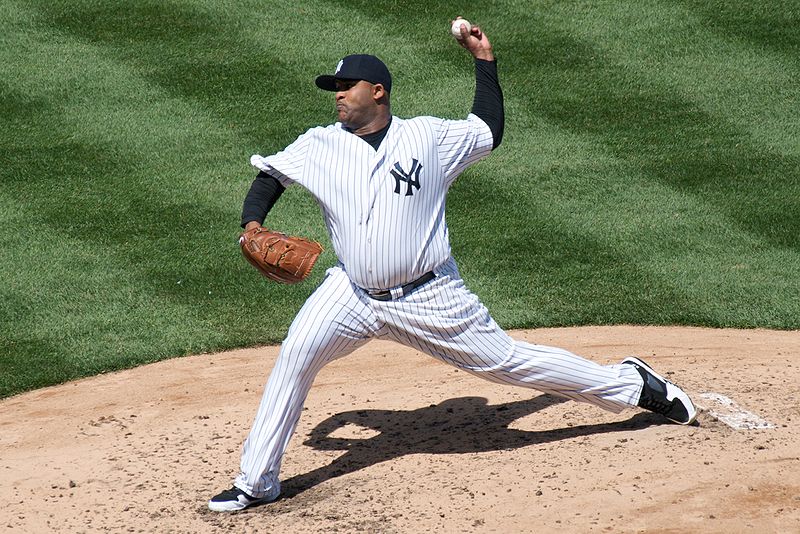
Sabathia is your current Active leader in Opening Day starts. Photo wiki/flickr chris.ptacek

One of my favorite annual trivia questions amongst my baseball buddies revolves around Opening Day Starters.  With another Opening Day in the books, here’s some useless trivia related to Opening Day starters for my readers.  I’ve uploaded my little Opening Day Starters spreadsheet to Google Docs and created a link in the “Nationals Arm Race creation” section along the right.

Current Active Leaders in Opening Day Starts

10 Roy Halladay
10 CC Sabathia
9 Mark Buehrle
6 Bartolo Colon
6 Derek Lowe
6 Tim Hudson
6 Felix Hernandez
6 Justin Verlander
5 Aaron Harang
5 Josh Beckett
5 Jered Weaver
5 James Shields
4 Jake Peavy
4 Barry Zito
4 Tim Lincecum
4 Yovanni Gallardo

Those players bolded in the list above had 2013 opening day starts and added to their totals.  Roy Halladay’s difficult spring training cost him his shot at Opening Day and thus CC Sabathia moves into a tie for first.  Mark Buehrle has given over the reigns of opening day starter possibly for good, based on his standing in the Toronto rotation (4th starter?).

Felix Hernandez and Justin Verlander have chances to broach the all-time records (see below) based on their ages, their current counts and their new long-term contracts.

Current Active Leader in consecutive Opening Day Starts: Verlander with 6 straight.

Most ever Opening Day Starts all-time: Tom Seaver with 16 in his career.

Most ever Consecutive Opening Day Starts: Hall of Fame lightning rod Jack Morris, who made 14 straight such starts.

Number of first-time opening day starters in 2013: no less than 13 first timers this year, nearly half the league.   Some guys got deserved first-time opening day starts (Jeff Samardzija, Matt Cain, and R.A. Dickey), some guys got Opening Day starts mostly out of attrition of other worthy pitchers (Jon Niese, Bud Norris, A.J. Burnett, Vance Worley and Jhoulys Chacin) and some guys are taking over as the new big-dog of their rotations (Brett Anderson, Chris Sale).

Who seems most likely to break Seaver’s Record at this point? Sabathia, who already has 10 opening day starts, is clearly the #1 in New York, is only 32 and still has five years on his current deal.  Question is, if he renews past 2017, can he still earn the #1 spot?   Meanwhile Hernandez already has 6, just signed a deal that takes him through 2019 with a relatively easy option for 2020.   That’s 8 more seasons on his existing 6 opening day starts and he’d only be 34 years of age.   He could be the standard holder if he stays healthy and continues to pitch like an ace.

Why is Toradol “ok” but Steroids and HGH “bad?”

9 comments

Did Papelbon inadvertantly open up a whole new PED angle? Photo Keith Allison via wikipedia/flickr

The latest salvo in the “Questionable Performance Enhancing Drug” storyline in today’s professional baseball landscape was this interesting statement from Jonathan Papelbon last week;  he and other Boston teammates frequently were injected with the drug Toradol by team doctors when they were feeling “run-down” or overly fatigued in order to get a quick pick-me-up for a game.  Apparently Toradol had the effect of giving players a four hour window of feeling “pretty damn good” and it was used by a portion of the Boston clubhouse.  Its also in use in many other clubhouses (though apparently not in Philadelphia, who told Papelbon his Toradol days were over).

Ok, how is Toradol not a Performance Enhancing Drug?  It certainly seems to qualify based on WADA’s “Three Criteria” for PEDs:

  1. The capacity to enhance performance (clearly, as discussed by Papelbon)
  2. Use can result in negative health consequences (absolutely; Jon Lester suffered some of them and had a serious internal bleeding issue, and now Boston is reportedly reviewing its use of the drug)
  3. Violate the spirit of sports. (opinion based .. but after reading what Toradol can do, how can you NOT argue that its use violates the “spirit of sports?”)

(2/15/13 update: The Red Sox trainer who administered all this Toradol apparently “flouted” state laws by doing so, as reported by Passan, who is all over this case.)

By the way, WADA adds a drug to its banned list if it qualifies for TWO of the above three categories (hence the addition of things like “Deer Antler Spray” despite it having no known side effects, since it clearly seems to violate the spirit clause).

This leads me to my larger question: Why is Toradol, and as a side effect Steriods and HGH “bad” but the use of Cortisone, Toradol considered “ok” in terms of usage?   What do Cortisone shots do?  They enable a player to play through pain that otherwise may keep him out.  Uh … isn’t that the definition of a “performance enhancing” substance??   Our own Ryan Zimmerman clearly benefitted from cortisone shots in 2012; his before/after splits are pretty distinct and obvious.   Cortisone itself also fits the 3 WADA principles; it enhances performance, it has side-effects that many doctors are quite worried about, and I’m sure some would agree it changes the “spirit of the game” in some ways.

If your answer involves something along the lines of “PEDs are banned because they’re illegal” then I’ll counter with this: Steroid’s aren’t illegal; they’re just controlled.  But so is Cortisone; you can’t just inject yourself with the stuff without a doctor’s order.  And so is Toradol; you can’t go into your local supermarket and buy injectable Toradol.   And so is HGH: ask yourself why most elderly persons keep bottles of the stuff on their bed-side table?  Even something like a B-12 shot raises some issues; lots of players get B-12 shots and swear by the natural effect it has, but as with Toradol I’m pretty sure you can’t just get injectable B-12 and administer it yourself.  Even though B-12 is naturally occuring, in order to naturally consume the amounts of B-12 being injected you’d likely have to eat a bushel of clams (or some other high B-12 food) every day.

Honestly I may have the biggest issue with the classification of HGH as a PED, when you think about what HGH is (a naturally occuring growth hormone that is generates solely to help the body heal itself after an injury or illness) and then think about what Cortisone accomplishes for athletes.  So its “ok” to take a Cortisone shot that treats inflammation from an injury/strain so that you can go out and play better … but its NOT ok to take a naturally occuring suppliment to help with the same issue??  The only reason adults don’t heal as fast as kids is precisely because our natural HGH generation slows as we age … and doctors prescribe HGH to help the elderly heal from illnesses and injuries all the time.  Isn’t this inconsistent?

And all the above just talks about various medications.  Lets talk about the in-vogue plasma-replacement treatments that Kobe Bryant popularized and which have now been done by others, including Alex Rodriguez and Bartolo Colon. In this op-ed piece from Jeff Passan from Dec 2011, he discusses the blurry line between PEDs and legitimate surgical procedures.  The article has a very in-depth description of the A-Rod procedure and raises the question as to what defines a Performance Enhancing Drug?   If blood doping is illegal, how is a procedure that filters out platelets and re-injects them to targeted spots legal?  Colon was out of the game in 2010, got the procedure and suddenly is a 116 ERA+ pitcher in 2013; isn’t this concerning?

Passan takes things one step further, comparing the healing effects of HGH with these new treatments that A-Rod and Colon got and makes a very good point; these new-fangled surgical procedures absolutely qualify for WADA’s 3 criteria.  Passan has also asked the same questions I’m asking in a June 2006 article that started about HGH but ended with this same general question.  And he makes very good points about cortisone, HGH, Testosterone and even Tylenol usage.  Its worth a read.

Here’s another question: why is it “ok” to have performance-enhancing surgical procedures (Lasik surgery, Tommy John surgery, or any manner of surgery involving transplanted ligaments or tendons) but it is NOT ok to use drugs that have the same general effect?   If I can take a pill that gives me 20-10 vision, which enables me to see the baseball better and become a better hitter, would that be considered a PED?  I’m pretty sure … but yet people go get laser surgery and can get their eyes fixed to this level of quality any day of the week.  Perhaps this is a ridiculous example but my point stands; whether or not your performance is enhanced by virtue of a bottle or by the knife, aren’t these valid questions?  We’re starting to hear of psychotic parents of teen-aged pitchers actually getting “preventative” Tommy John surgery done, knowing that most pitchers who have the surgery see improvement in certain aspects of their game (since the Ulnar Ligament connector is actually strengthened in this surgery over how it grows naturally).  Is this … ethical?

And then there’s this interesting point, which was proposed on a BS Report podcast done between Bill Simmons and Chuck Klosterman last week.  If HGH is considered a PED, and HGH’s sole purpose in life is to help people get better after being sick … then why aren’t classes of anti-biotics such as Amoxicillin also considered PEDs?  What is the difference?   Klosterman then made the additional (scary) point that PED usage and testing may all be for naught eventually; Genetic testing and DNA manipulation may get to the point where there can BE no test to find out whether someone’s been genetically manipulated in order to be a superior athlete.  Testing has been trailing the science for years in professional sports … it may eventually be rendered completely moot.  Of course, taken the the ridiculous extreme, do we really want a slew of genetically engineered super-athletes competing for our enjoyment?  Why not just invent a bunch of robots to play these games?

Food for thought.  I know we’ve discussed some of these topics here before but do you worry about the inconsistencies in professional sports PED policies?  I’m not sure I have an easy solution, but I will say that the classifications of drugs seems arbitrary in some cases.

Have we seen the last 300-game winner? (updated post 2012 season)

leave a comment

San Francisco Giants starter Randy Johnson acknowledges the crowd after the Giants beat the Washington Nationals 5-1 for his 300th win, in the first game of a baseball doubleheader Thursday, June 4, 2009, in Washington. (AP Photo/Nick Wass)

Despite being much maligned as a method of judging a starting pitcher’s worth, the “Win” is still the essential goal of every starter in the majors and the accumulation of them over a season or career still inspires much thought and discussion.  The magical “300 win” threshold remains one of the more challenging career objectives for any starter, and remains an interesting benchmark to discuss.    Only 23 pitchers in the history of the game have reached 300 wins.

So, after Randy Johnson’s reaching the benchmark, and after a number of recent start pitchers also hitting the plateau (Greg Maddux, Roger Clemens and Tom Glavine), are we ever going to see another 300-win pitcher?

Here’s some other reading on this same topic by the likes of John Dewan (referencing Bill James‘ annual predictions on who may reach 300 wins with his percentile chances), David Schoenfield (in a dated piece predicting Roy Halladay’s chances for getting to 300 wins), and an early 2012 piece from Jon Paul Morosi talking about Clayton Kershaw’s chances.

Achieving 300 wins in a career is getting more and more difficult.  Here’s some interesting stats  about reaching 300 wins for a starter in the modern baseball age:

  • If a pitcher were to enter the major leagues at age 23, he would need to AVERAGE 20 wins for the next 15 years to reach 300 and pitch until age 38.
  • Put another way, that same pitcher entering at age 23 would have to average 18 wins for 17 seasons to reach 300 by about age 40.
  • The majors have had ONLY Eleven 20-game winners in total over the past 5 seasons.  (Seven of which have come in the last two years, echoing the “rise of the pitcher” and the collapse of the PED slugger era, so perhaps its getting easier to accumulate wins).
  • 5-man rotations mean that starters are averaging 33-34 starts a year, down from the 38-40 starts that Pitchers would get just 20 years ago.
  • Because of mania over inning counts, specialized relievers, and an obsession with using “closers” in save situations, starters now only earn decisions in around 69% of starts, down from 78.5% of starts in 1972 (source Jay Jaffe’s article, referenced further down).  This means the average pitcher only gets about 24 decisions from their 33-34 starts, making the 20-game winner even that more rare.  One can argue that better pitchers get more decisions because they’re more likely to pitch into the 7th and 8th innings, by which time their team should have scored enough runs to win for them.  But the fact remains that a lot of wins and losses are in the modern bullpen.

In 2009, just as Randy Johnson won his 300th, I had two long winded discussions (one in April 2009, another in June 2009) an older version of this blog that I maintained with friends about the demise of the 300-game winner.  Blog author Jason Amos did a great summary in this posting along with some great links.  Now, with another 3 seasons in the books, I thought it might be interesting to see who we were considering as candidates just a few years ago and who might be the next “best” candidates to get to 300 wins.  I’ll address candidates and their chances as we present pitchers a number of different ways.

(coincidentally, the 300-game winner spreadsheet I’m using for this post can be found at this link, and in the Links section along the right hand side of this page).

Here’s the current list of active wins leaders post 2012.  For brevity’s sake here’s the top 10 (and I’ve included Jamie Moyer as being “active” for the sake of this argument):

Rank pitcher age wins
1 Jamie Moyer 49 269
2 Andy Pettitte 40 245
3 Roy Halladay 35 199
4 CC Sabathia 31 197
5 Tim Hudson 36 197
6 Livan Hernandez 37 178
7 Derek Lowe 39 175
8 Mark Buehrle 33 174
9 Bartolo Colon 39 171
10 Kevin Millwood 37 169

Of this list of top 10 active win leaders, clearly most of them are never going to reach 300 wins.  Jamie Moyer has not yet retired at age 49, but the odds of him even making another MLB roster seem thin. Likewise Livan Hernandez and Derek Lowe may struggle to get guaranteed contracts in 2013.  Andy Pettitte has returned and pitched effectively for the Yankees this year, but he’s 50+ wins away from the plateau and only seems likely to maybe pitch one more year.   Bartolo Colon does have a contract for 2013 but it may be his last season, and Kevin Millwood is just too far away.  Tim Hudson, despite his strong performances the last few years, is just too far away at this point as well.  The chances of any of these guys to reach 300 wins is 0%.

How about the rest of this top 10 list?  Specifically CC Sabathia, Roy Halladay and Mark Buehrle?  There’s some intriguing candidates there. Lets look at their chances a slightly different way.

When Randy Johnson hit 300 wins, two Baseball Prospectus authors posted similar posts to this with some interesting analysis.  First, Jay Jaffe used a fun little stat he called the Jaffe Blind Optimism method (JABO), which takes a pitcher and assumes he will win 15 games a year until age 42.  Well, this incredibly optimistic formula leads us to a new set of more reasonable candidates.  I changed the formula slightly and only ran out the 15 wins/year til age 40 and got this list:

Rank pitcher age wins Jaffe 15wins/yr avg->40
1 CC Sabathia 31 197 332
2 Felix Hernandez 26 98 308
3 Clayton Kershaw 24 61 301
4 Trevor Cahill 24 53 293
5 Justin Verlander 29 124 289
6 Matt Cain 27 85 280
7 Mark Buehrle 33 174 279
8 Yovani Gallardo 26 69 279
9 Chad Billingsley 27 80 275
10 Roy Halladay 35 199 274

By this analysis we see that CC Sabathia looks like a pretty sure bet to hit 300 wins, and for good reason.  He’s been healthy, he plays for a team that is constantly winning, and he doesn’t have to pitch like a Cy Young award winner to get wins in New  York (21, 19 and 15 wins his last three seasons).  He has always been healthy and just needs 5 more solid seasons to be very close to the 300 win plateau.  He’s signed through 2016 (with an option for 2017), and there’s no reason to think he’s not going to see that contract through.  His elbow-injury scare in the post-season turned out to be innocuous, but we’ll keep an eye on his health status in 2013.  If he loses a season or more to injury the chances of his making 300 wins declines precipitously.  Felix Hernandez has nearly a 100 career wins at age 26, and also seems like a decent bet to hit 300 wins at this point.  But, he’ll need to move to a winning team to make this task easier on himself; he’s only won 13,14 and 13 games the last three seasons because of dreadful run support.  He’s signed through 2014 and I’d be surprised if he stays in Seattle (unless they turn that franchise around in the next 3 years).

Clayton Kershaw and (surprisingly) Trevor Cahill appear here by virtue of a lot of early career success (Cahill was an 18 game winner for a bad Oakland team at age 22 in the majors, no small feat).  While both have been injury free thus far, it is really difficult to project 24yr olds as staying healthy deep into their 30s.  So, we’ll say they’re promising for now but need to get to about 150 wins before we can really start projecting their odds.  Yovani Gallardo has quietly been racking up wins as Milwaukee’s “ace,” but is sort of in the same boat as Kershaw and Cahill; he’s only 26, so its hard to see how he’ll sit at age 30.  If he’s got another 60-70 wins in four year’s time, we’ll talk.

Justin Verlander’s 24-win season in 2011, as well as his established status as the “Best Pitcher in Baseball” right now, has launched him into the discussion.  The problem is that he “only” has 124 wins entering his age-30 year.  He needs to average 18 wins a  year for the next decade to have a shot.  That’s a tall task, especially considering how well he pitched to just get to 17-8 this year.  It isn’t out of the realm of possible, but it is a longshot.

Mark Buehrle and Roy Halladay are both aging workhorses whose chances of reaching the plateau are dimming.  Buehrle has just moved to the hyper-competitive AL East and wasn’t exactly dominating to begin with.  Meanwhile Halladay’s injury struggles have limited his wins the last couple seasons, likely knocking any chance he had of hitting the plateau.  I’ll give them each non-zero chances, but barely non-zero.  I’ll give them both the benefit of the doubt because they both seem like the kind of pitchers who could pitch well into their 40s and get the extra wins they’d need to move over the top.

Matt Cain and Chad Billingsley are both mentioned because they had a ton of wins before the age of 25; both in reality are not accumulating wins at the pace they’ll need to stay even close to hitting the 300-win plateau.  Plus Billingsley struggled with an injury this year and may be affected next season.  Chances right now; slim.

Just for the sake of argument, here’s the next 10 players ranked by the modified Jaffe system:

Rank pitcher age wins Jaffe 15wins/yr avg->40
11 Zack Greinke 28 91 271
12 David Price 26 61 271
13 Johnny Cueto 26 60 270
14 Gio Gonzalez 26 59 269
15 Carlos Zambrano 31 132 267
16 Jered Weaver 29 102 267
17 Jon Lester 28 85 265
18 Jair Jurrjens 26 53 263
19 Ervin Santana 29 96 261
20 Tim Lincecum 28 79 259

I posted this list because a number of these players were formerly listed as good candidates to hit 300 wins.  Specifically, Carlos Zambrano, Jered Weaver, and Tim Lincecum.  Zambrano may be out of baseball in 2013, Lincecum may not even be a starter any more, and Weaver, while clearly getting a ton of wins lately needs a slew of 19-20 game winning seasons to catch back up.  The collection of 26-yr olds in David Price, Johnny Cueto, and our own Gio Gonzalez are all well behind the paces being set by fellow-aged pitchers Hernandez, Cain and Gallardo, though it isn’t hard to see any of these three post multiple 18-20 win seasons in the coming years.

So, here’s my predictions of the chances by player discussed above (anyone not listed here specifically also sits at 0% chance of making 300 wins):

Name age wins % Chance
CC Sabathia 31 197 90%
Felix Hernandez 26 98 75%
Justin Verlander 29 124 33%
Clayton Kershaw 24 61 25%
Trevor Cahill 24 53 20%
Roy Halladay 35 199 10%
Yovani Gallardo 26 69 10%
Mark Buehrle 33 174 5%
Matt Cain 27 85 5%
Chad Billingsley 27 80 5%
Jamie Moyer 49 269 0%
Andy Pettitte 40 245 0%
Tim Hudson 36 197 0%
Livan Hernandez 37 178 0%
Derek Lowe 39 175 0%
Bartolo Colon 39 171 0%
Kevin Millwood 37 169 0%

Conclusion: I believe we will see another 300-game winner.  I think Sabathia has a very good chance of making it, as does Felix Hernandez at this point in his career.  But injuries can quickly turn a 300-game career into an “out of baseball by 36″ career, so nothing is set in stone.

A look at Oakland’s amazing 2012 season so far

9 comments

Tommy Milone has made Oakland's 2012 rotation surprisingly good. Photo AP/Ben Margot via dailyrepublic.com

I’ll admit it; after watching Billy Beane wheel and deal this past off-season, trading away most of his starting rotation and letting most of his FA hitters walk, I was predicting a 55 win season for this team.  They were banking on a proposed move to San Jose and I saw these moves as a purposeful bottoming out while playing out the string in Oakland, ahead of a lucrative move to the South Bay.  Well, that move seems interminably stalled, and many pundits predicted a near record loss season for this team, especially considering the massive moves that the Angels had made, coupled with the 2-time defending AL champs Texas being in the same division.

Instead, they sit at 56-48 and if the season ended today, right now on August 2nd, the Oakland A’s and their $55M payroll (2nd lowest in the league by a couple hundred thousand dollars) would be the 2nd wild-card and would play the Los Angeles Angels, they of the $154M payroll (and counting, considering this was their opening day payroll and they’ve taken on with the Zack Greinke deal at the trade deadline).

How did this happen?  Lets look at the evolution of the Starting Rotation, because what this group is doing is nothing short of amazing.

In 2011, the Oakland had 10 different guys start games for them.  Here’s a quick summary (* indicates a left hander on baseball-reference.com pages):

Name Age W L W-L% ERA G GS
Trevor Cahill 23 12 14 0.462 4.16 34 34
Gio Gonzalez* 25 16 12 0.571 3.12 32 32
Brandon McCarthy 27 9 9 0.5 3.32 25 25
Guillermo Moscoso 27 8 10 0.444 3.38 23 21
Rich Harden 29 4 4 0.5 5.12 15 15
Brett Anderson* 23 3 6 0.333 4 13 13
Josh Outman* 26 3 5 0.375 3.7 13 9
Tyson Ross 24 3 3 0.5 2.75 9 6
Graham Godfrey 26 1 2 0.333 3.96 5 4
Dallas Braden* 27 1 1 0.5 3 3 3

Here’s what happened to each of these guys (good link for trade details from baseball-reference.com here; this link shows the latest trade between Oakland and all other teams but quickly shows all these 2011 deals listed here):

  • Cahill traded to Arizona
  • Gonzalez traded to Washington
  • Moscoso traded to Colorado
  • Harden left via free agency, and as far as I can tell he remains unsigned.
  • Outman traded (with Moscoso) to Colorado.
  • Anderson had Tommy John surgery in June of 2011 and is in the minors rehabbing now.
  • Braden had shoulder surgery in April of 2011 and has not pitched since.

They traded or released the starters who made nearly 80% of their starts in 2011.  That leaves 3 guys who had any MLB starts last year: Brandon McCarthy, Tyson Ross and Graham Godfrey, a total of 35 starts.  To add insult to injury, Oakland traded their 2011 closer Andrew Bailey to Boston last December.

So, what does the Oakland rotation look like this year?  Here’s the same data through August 1st:

Name Age W L W-L% ERA G GS
Tommy Milone* 25 9 8 0.529 3.68 21 21
Bartolo Colon 39 7 8 0.467 3.78 20 20
Jarrod Parker 23 7 5 0.583 3.44 18 18
Brandon McCarthy 28 6 3 0.667 2.54 12 12
Travis Blackley* 29 3 3 0.5 3.15 14 10
Tyson Ross 25 2 8 0.2 6.35 12 12
A.J. Griffin 24 3 0 1 2.51 7 7
Graham Godfrey 27 0 4 0 6.43 5 4

So, where’d all these guys come from?

  • Milone: acquired from Washington in the Gonzalez Deal
  • Colon: bottom-of-the-barrel FA signing (1yr/$2M).
  • Parker: acquired from Arizona in the Cahill deal.
  • McCarthy; signed a 1yr/$4.275M FA deal after accepting arbitration from the team after last year
  • Blackley: selected OFF WAIVERS from San Francisco earlier this year
  • Ross: homegrown: a 2nd round pick in 2008
  • Griffen: also homegrown; he was a 13th round draft pick by Oakland in 2010.
  • Godfrey: acquired from Toronto in the 2007 Scutaro deal

Ross and Godfrey got demoted after poor performance, and McCarthy currently sits on the DL, giving Oakland this current rotation: Colon, Blackley, Griffen, Milone, Parker.  All 5 guys with ERAs under 3.78 and all with ERA+ of at least 104 and mostly greater than that.  And, when McCarthy comes back he’s essentially the best pitcher of any of them.  AND, this is all being done with out Dalles Braden and Brett Anderson, two guys who were core components of the 2010 rotation and who would clearly be in the 2012 rotation if not for injury.  AND, Oakland just announced today they’re promoting one of their best starter prospects in Dan Straily for a spot start this coming friday.

Wow.

And, when Braden, Anderson and McCarthy come back, that gives Oakland a major surplus of pitching that can be flipped in the coming off-season for even more prospects and hitting (much as they did this past off-season).

Combine this pitching revolution with the schrewd Yoenis Cespedes signing (who immediately became the highest paid player on the team), the explosion of Josh Reddick (acquired in the Andrew Bailey deal from Boston), unexpected output from DH/FA signee (and ex-Nat) Jonny Gomes and a solid season from Seth Smith (acquired in the Moscoso deal) and you’ve got a team that is producing enough to win.  They’re not an offensive juggernaut (mostly ranked 12th-13th in the 14-team AL in the major offensive categories) but you don’t need to score 8 runs a game when you have a staff ERA of 3.47.

As much as Moneyball critics will hate to hear it, I think Billy Beane is your easy choice for AL Executive of the year right now.

Nats Off-season News Items Wrap-up 12/31/11 edition

5 comments

Its Hall of Fame ballot time. Let the Jack Morris arguments start-up again. Photo John Iacono via si.com

This is your semi-weekly/periodic wrap-up of Nats and other baseball news that caught my eye.  With the approaching Hall of Fame nonsense, er I mean news cycle approaching, I’ll throw in a HoFame section.

Nationals In General

  • Transcribed from a radio interview by Tim Dierkes, here’s Mike Rizzo on CF and 1B.  This is the first time I’ve seen Rizzo mention NEXT year’s FA class in terms of looking for talent and it makes you wonder if we don’t already have our entire primary starting 15 set (8 out-field players, 5 starters and setup/closer) for 2012.   I can live with Jayson Werth in CF, since it opens up lots of FA possibilities in RF.  In fact, I smell a separate post coming…
  • Former Nat Lastings Milledge is going to Japan to try to resurrect his baseball career.
  • Scouting-specific SeedlingsToStars.com site looks at Anthony Rendon.
  • The USA Today does an in-depth, position-by-position overview of the team and where it stands.
  • Another Tom Boswell article that I disagree with; he thinks Prince Fielder isn’t “right” for the Nats.   I’m sorry; but Fielder is a run creating machine (he created 35 more runs last year than Michael Morse, by way of comparison, which roughly equates with his 5.2 Wins Above replacement value).  Yes we have LaRoche who is plus defense, but is he going to come back to 2010’s form or is he going to be a lost cause again?  Meanwhile, Fielder looks set to take a shorter term deal and re-try his hand at the FA market when he hits 30.  Wouldn’t you sign him for 3yrs $70M?  You put Fielder at 1B, keep Morse in Left, groom Bryce Harper to play center and keep Werth in right.   For the next 3 years.  How difficult is that?  Boswell talks about where to put Rendon; well; you put him wherever you have a need.  Put him at 2nd and move Espinosa to short.  Or you trade someone to free up room.  This team’s problem isn’t the need for a lead-off slap hitter; we need a big run producer in the middle of the order.  Someone to replace what Adam Dunn gave us for two years.
  • Ryan Tatusko posts his 2011 recap of his minor league season plus his time in the Venezuelan Winter League.  I wish more players were as blogger-friendly as Tatusko.

Hall of Fame Specific

  • A pro Edgar Martinez take with the important quote, “There is a position called DH…”  I have changed my own stance on this issue in recent years, especially when considering relief pitchers as hall of fame worthy.  If you argue that a closer and his 60-70 innings is somehow more valuable to a team than a designated hitter’s 650 at bats, then I’d have to disagree.  On my hypothetical ballot, Martinez is in.
  • Excellent review of active MLB players under HoFame consideration by Fangraph’s Dave Cameron.   Also, the comments discussion brings up a number of other players.  He uses primarily career WAR to determine the player’s value, which I’m somewhat hesitant about (in most cases WAR is an accumulator stat, as a mediocre player who stayed very healthy will have a higher WAR than an excellent but shorter-lived career).
  • This article really got to me, to the point where I commented on both the original post by Jay Jaffe at Baseball Prospectus and the discussion at TangoTiger’s InsideTheBook.com blog.  Jaffe’s hall of fame measuring system (called JAWS) somehow has determined that Brad Radke, the middling pitcher for the Twins who had basically one standout season in his career, was a BETTER player career-wise than Jack Morris.  How would any sane baseball observer possibly come to this conclusion?  This is where the modern blogger’s over-reliance on statistics really gets to me.  I have not read into why this system ranks Radke so high while ranking Morris so low but suspect it is due to a reliance on the same calculations that go into the ERA+ statistic (of which Radke’s career ERA+ of113  is better than Nolan Ryan’s career era of 112).

Free Agents/Player Transaction News

  • Oakland continues to dismantle itself: Boston trades OF prospect Josh Reddick and two other players to Oakland for closer Andrew Bailey and outfielder Ryan Sweeney.  This is after Boston acquired Mark Melancon earlier in the off-season; they now have completely remade the back side of their rotation.  Clearly the team is moving Daniel Bard to the rotation, having just traded for his replacement.   Reddick was clearly seen as surplus to requirements, despite putting together a decent 2011 season, but you have to wonder if the team is going to be satisfied with Sweeney starting in RF.
  • Keith Law makes a good point during his analysis of the Bailey move, saying that adding Bailey is a far better move than paying Jonathan Papelbon $50M.  I agree completely and think that anyone who pays $10M+ per year for a guy who throws 70 innings and who only really has about 50% “high leverage” plate appearances (see last year’s splits for Mariano Rivera and Papelbon to see that 57% of Rivera’s plate appearances were in “high” leverage situations as a high, while Papelbon was at 47%) is just wasting money.  Find a hard thrower in your organization (say, like Drew Storen for the Nats), install him as the closer as a rookie, then ride him til free agency and then cut him loose and start over.  Relievers are fungible talents, they come and go, mostly are failed starters since they don’t need the full repertoire of pitches to be successful, and are cheaper to come by.
  • (hat tip to ck of the Nats Enquirer): The Baltimore Sun reports that Scott Boras and Prince Fielder were in the Baltimore/DC area to meet with an owner not named Peter Angelos.  More links on the topic from Federal Baseball.  Gee, I wonder who it could be?  Why would those two fly HERE and not directly to the city of the owner in question, unless the owner of the team in question was either a) the Nationals, or b) an owner of a MLB team who lives in this area but owns a team based elsewhere, or c) an owner of another team just happened to be in DC for some odd reason (odd because Congress is out of session, which would seem to eliminate most any possibly lobbying reason).  Don’t get me wrong; I think Adam LaRoche can contribute in 2012 and it seems ludicrous to think he can’t at least get close to his 2010 numbers, but Fielder is a 5+ WAR player who probably makes us the favorite for the NL wild card if we sign him, right now.

General Baseball News

  • Wow, two LOOGY articles in the same day.  Bill James answered a question about the evolution of the LOOGY and posted this link describing its birth (apparently by Tony LaRussa in the 1991 season).  I also never knew that the term “LOOGY” was coined by none other than Rob Neyer.  And TangoTiger points to some of the same research.  Mid 30s lefties everywhere have LaRussa to thank for their extended careers.
  • Could you imagine this happening in today’s game?  The first intentional pitch would have resulted in ejections.  Certainly modern umpires would not let a pitcher throw pitch after pitch at an opposing batter.  Clearly these umpires let this game get out of hand.
  • Will MLB step in?  USAToday’s Seth Livingston thinks that the Oakland payroll dumping trades this off-season may get the attention of the front office.  Hard to see why; according to Cot’s the Athletics are only signed up for around $17M of guaranteed contracts in 2012 right now, before a slew of arbitration cases.  They non-tendered 3 of their 10 arbitration cases but kept a couple of their more expensive guys (Cot’s thinks they had 14 arbitration-eligible players; I havn’t cross-referenced outrights and DFAs but know they had 10 arb tender decisions).  Of those they did tender, they have since traded away Sweeney, Gonzalez, Bailey, Breslow and Cahill.  Geeze.  Baseball-Reference thinks they’ll get to $50M in payroll; I wonder if they’ll get to $35m frankly.  And, its looking more and more like this could be something like a 50-win team.  Things could get ugly in the Bay area in 2012.
  • This would be a loss for us prospect hounds: Keith Law is reportedly interviewing for a front-office position with the Houston Astros.  Law takes a very specific, opinionated viewpoint towards player development, drawing from his experiences in the Toronto organization (which itself during his time took a rather college-heavy approach to the draft which ultimately wasn’t as successful as the team wanted, ultimately contributing to the end of JP Ricciardi’s reign.
  • An interesting exercise; USA Today builds an unbeatable MLB team for the median MLB payroll.  Honestly though, I’m not sure just how challenging this exercise is.  If you gave me $86M (the median payroll they used) you should be able to put together TWO such teams.  There’s enough pre-arbitration and arbitration-controlled talent in the league to be able to do the same task for something approaching a $20M payroll.  A future blog post?  :-)
  • Follow-up on Alex Rodriguez’s experimental Germany treatment; this op-ed piece from Jeff Passan on the blurry line between PEDs and legitimate surgical procedures.  The article has a very in-depth description of the A-Rod procedure and raises the question as to what defines a Performance Enhancing Drug?  I have had similar discussions; why are Steroids “bad” but Cortisone “good” in terms of usage?  What do Cortisone shots do?  They enable a player to play through pain that otherwise may keep him out.  Uh … isn’t that the definition of a “performance enhancing” substance??  Steroid’s aren’t illegal; they’re just controlled.  But so is cortisone; you can’t just inject yourself with the stuff without a doctor’s order.  Passan takes things one step further, comparing the healing effects of HGH with these new treatments that A-Rod and Bartolo Colon got and makes a very good point; the WADA uses 3 categories to define a doping drug and everything we’ve described here can be argued to fit those criteria (except that only HGH and Steroids have been determined to be “bad” by the powers that be).  There’s something inconsistent here.

Collegiate/Prospect News

  • Seedling to the Star’s scouting report on Brave’s phenom prospect Julio Tehran.  Tehran’s stock has slipped somewhat in the past two years, especially given the inevitable comparisons to fellow pitching prospect phenom Matt Moore.  While Moore’s 2011 MLB debut was nothing short of amazing (including his 7 innings of shutout ball in the playoffs), Tehran posted a 5.03 ERA in about 20 MLB innings throughout 2011.  It was bad enough to probably rule Tehran out of the 2012 rotation plans and send him back to repeat AAA.  But if he can put things together, he’ll join an arsenal of young arms in Atlanta that seems set to be their next wave of starters in the ilk of John Smoltz and Tom Glavine.


General News; other

  • Baseball meets modern America: Joe Maddon and the rising Latino population in his home town of Hazelton, PA, as written by Joe Posnanski.
  • 67-56?  I’ve never seen a football game with such a ridiculous scoring line.


End of Season Award Review

leave a comment

Here’s a wrap up of the end of season awards.  I posted my predictions here (albeit without MLB comeback player of the year predictions, since those came out very early in the off-season).

Final results: For the 2nd year running, I went 8-for-8 in predicting the BBWAA awards.   But I will say this; predicting these awards going forward will be more difficult, as more modern baseball writers will depend more and more on advanced stats to decided these awards.  Meanwhile, I was only 1-for-4 in predicting the Sporting News “unofficial” award add-ons for GM and Comeback player (and I pretty much disagree with all I was wrong about :-) .

  • AL MVP:  Prediction: Justin Verlander.  Winner: Verlander.  Ellsbury 2nd, Bautista 3rd.
  • AL Cy Young: Prediction: Justin Verlander. Winner: Verlander, unanimously.  Weaver 2nd, Shields 3rd.
  • AL Rookie of the Year: Prediction: Jeremy Hellickson. Winner: Hellickson rather easily.  Trumbo 2nd, Hosmer 3rd.
  • AL Mgr: Prediction: Joe MaddonWinner: Maddon.  Leyland 2nd, Washington 3rd.
  • Sporting News AL GM: Prediction: Andrew FriedmanWinner: Dave Dombrowski.
  • Sporting News AL Comeback player of the Year.  Prediction: Bartolo Colon.  Winner: Jacoby Ellsbury.
  • NL MVP: Prediction: Ryan Braun. Winner: Braun.  Kemp 2nd, Fielder 3rd.
  • NL Cy Young: Prediction: Clayton Kershaw.  Winner: Kershaw handily.  Halladay 2nd, Lee 3rd.
  • NL Rookie: Prediction: Craig Kimbrel.  Winner: Kimbrel unanimously.  Freeman 2nd, Worley 3rd.
  • NL Mgr: Prediction: Kirk GibsonWinner: Gibson. Roenicke 2nd, LaRussa 3rd.
  • Sporting News NL GM:Prediction: Doug MelvinWinner: Melvin.
  • Sporting News NL Comeback player of the year.  Prediction: Ryan Vogelsong.  Winner: Lance Berkman

Discussion (here’s a link to all the 2011 post-season voting with totals from Baseball-Reference.com).

  • AL MVP: Verlander as predicted.  Not because I think he’s the MVP (see my rant about Pitchers winning the MVP here), but because he won the voting.  I think this kind of winner will gradually fade as more modern, stats-aware voters pour into the BBWAA and start “improving” the vote.  The same goes for Cy Youngs as well; see commentary for the NL Cy Young award.  That being said, this voter’s explanation perfectly sums up what I would have guessed would have happened.  And this guy, who voted Michael Young first, Verlander 2nd, Ellsbury 5th and Bautista 7th should really have his voting credentials questioned.
  • AL Cy Young: no surprise on the winner, or 2nd or 3rd place really.  I was surprised that Josh Beckett didn’t fare better.  Perhaps it was because of his injury later in the season.  His WAR should have put him in the top 5.
  • AL Rookie: Again, no surprise winner here.  Hellickson proved his value with a sparkling 2010 late season call-up, just as Matt Moore did this year for Tampa.  This award looked to be Michael Pineda’s at the all-star break.  He finishes 5th.
  • AL Manager: Maddon won pretty handily; no surprise here.
  • AL Comeback Player of the Year: when you put Ellsbury’s season into context, he certainly out-performed any reasonable expectation of his abilities.  He wasn’t exactly a slouch in 2009, but he certainly wasn’t a 30-home run talent either.  I guessed Colon just based on the fact that he was basically out of baseball before the Yankees signed him.
  • AL Executive: Perhaps the voters have tired of the tight-rope act going on in Tampa.  Dombrowski’s FA signings were sublime, but his mid-season trade for Doug Fister probably won over the voters, who watched the Tigers improve 14 games and win the AL Central.  I question the award though; Detroit already had a massive payroll and established players in most positions.  Tampa made the playoffs in a year they slashed payroll by 40% in the AL east.
  • NL MVP: another award that will be roundly criticized by Sabre-nerds, since Kemp had a slightly better statistical season.  However I agree 100% with Mark Zuckerman’s reasoning.  The MVP is the best player on a playoff team, unless a player on a non-playoff team has an other-worldly season.
  • NL Cy Young: Even I was surprised at the overwhelming win; 27 of 32 first place votes.  Halladay the easy 2nd place winner, though we’re bound to hear stat-heads whining that Halladay had the more impactful season.  Interesting that Ian Kennedy garnered one first place vote; thankfully it didn’t factor into any of the eventual results, because anyone who thought Kennedy’s season was better than the first three pitchers was crazy.  I think the Kershaw vote was predictable if only because Halladay already has a Cy Young to his credit, and voters wanted to give the award to someone new.  Predictably, Keith Law voted against the majority in a major award category, as he’s done the past few years.  I say predictably because Law represents the stat-heavy minded voter that, while probably correct in their voting way, does not represent the majority of current voters and thus made the predictability of this award relatively straight forward.  Here’s Amanda Comak’s vote and explanation.
  • NL Rookie: Again, no surprise that Kimbrel won unanimously, as most older voters notoriously over-rate closers.  But there wasn’t a better choice than Kimbrel after his dominant season.  Atlanta shows how good a franchise they have been in developing talent lately with 1st and 2nd place in this competition, to go with the excellent Brandon Beachy.  Watch out next year for Julio Tehran and Arodys Vizcaino to be early ROY candidates.
  • NL Comeback Player:  No offense to Berkman’s incredible offensive season, but its not as if he was exactly chopped liver prior to 2011. Vogelsong hadn’t appeared in the majors since 2006!  Vogelsong was one of this year’s great feel-good stories, stuck in the minors for years and then putting up a fantastic season covering for the injured Barry Zito at the age of 33.  The players showed why they can’t be trusted to vote properly; Vogelsong is the definition of a comeback player.
  • NL Executive: Melvin’s all-in approach for 2011 worked, and he was rewarded for it.
http://www.freep.com/article/20111116/SPORTS02/111116004/Dave-Dombrowski-co-winner-Sporting-News-Executive-Year-award?odyssey=mod%7Cnewswell%7Ctext%7CSports%7Cs:

Nats Off-season News Items Wrap-up 11/4/11 edition

5 comments

Wang re-ups for his 3rd year in a Nats uniform. Photo from Washington Nationals photo day.

Here’s a weekly wrap up of Nats-related news items, with my thoughts as appropriate.

  • MLBtraderumor’s Tim Dierkes announced that the cutoff for this year’s “Super-2″ status is 2 years, 146 days.  This cutoff means that two (and possibly three) Nats players made the cut and will be in line for a 4th arbitration season.  Jordan Zimmermann made it by 8 days, Tyler Clippard by 2 days (!), and Roger Bernadina (at least according to Amanda Comak’s calculations; he’s missing from Dierkes’ list).  In Bernadina’s case, it may not matter, as he’s out of options for 2012, isn’t likely to make the roster anyway and seems a certainty for a non-tender.  We’ll save salary speculation for a future post as we get closer to the arbitration dates.  11/1 update: Dierkes responded to my comment in this blog posting and said that his personal calculations determined that Bernadina missed the cutoff.
  • Tim Dierkes is a busy man; he has a series of FA analysis by position and posted his Center Field analysis over the weekend.  Considering that the Nats have been looking for a quality center fielder essentially since moving to Washington, the analysis is a good read.  The news isn’t good; Dierkes only projects ONE viable CF FA candidate: Coco Crisp (quotes later in the week though confirm that Crisp wants to stay on the west coast, making him a less likely candidate).  He mentions Grady Sizemore as being worth a flier but no guarantee to be healthy.  There’s some “thinking outside the box” candidates, guys who are older and who could hold on to CF for another year, but if the Nats were to do that we might as well either go with Jayson Werth in center or re-sign Ankiel.  Trade potential BJ Upton is still there, and I’m sure he’s still available for the right price.  Perhaps the Nats could package a bunch of prospects for both Upton and Shields.  One other interesting name to consider: Melky Cabrera.  Nice season, nearly a 20/20 guy.  Getting a bit expensive for KC… maybe we could flip them some pitching surplus.
  • Sammy Solis has marginally improved as the AFL has gone forward, putting in a 4ip, 1run performance on Oct 29th.  Meanwhile, what is going on with Matthew Purke?  In three appearances through 10/29 he’s given up 11 runs on 10 hits in 3 1/3 innings.  Not good.  We may have to just shield our eyes until spring training.
  • Bill Ladson reported on a conversation he had with Mike Rizzo about the Nats off-season plans, and the takeaway seems to be that the team “has made no promises” to Adam LaRoche about playing time in 2012.  I just have a hard time believing that the team plans on just ignoring 1/8th of their payroll (LaRoche’s $8M salary on last year’s $68M payroll) by signing a replacement.  Rizzo pursued and signed LaRoche for a reason; good defense and adequate bat.  At least, that’s the idea.  Personally I have a hard time believing that Albert Pujols is leaving St. Louis, and I’ll bet that Fielder stays in the NL central as well (perhaps replacing Carlos Pena in Chicago as Theo Epstein’s first big signing).
  • ESPN’s Buster Olney believes the Nats will look at Grady Sizemore, recently having his 2012 option declined by the Indians, as a center field option.  I suppose Sizemore is no more of a risk than it would be to resign Rick Ankiel, or to experiment with Werth in center and a player to be named (Laynce Nix?) in right.  It would be ironic to see Sizemore come back to the team that drafted and developed him, only to trade him in an incredibly damaging deal for a few months rental of Bartolo Colon.
  • Taken from a link in the previous Olney posting, the “Field of Dreams” property in Iowa used to make the movie of the same name is being sold.  Visitors come by the thousands even to this day to see the makeshift field built into a century-old farmland.  What I find neat is the apparent unassuming nature of the owners and the fact they’ve never really attempted to commercialize the property.  In that respect, it reminds me of Cooperstown, which I visited for the first time this past summer (blog post in the works with pictures) and found to be amazingly quant and un-tarnished by the type of tourist-driven revenue generators you find at other places in this country.
  • A post courtesy of Rob Neyer’s blog about the seemingly imminent move of the Astros to the AL West points out a salient points the Houston fan base would have to put up with; more 9:05pm local starts as the team travels to play new rivals on the West coast.  This likely will badly affect their TV ratings.  Will the Astros take to having new divisional rivals in the Angels, A’s and Mariners well?  It doesn’t seem to have really hurt the Rangers, who have the same issue.  One has to think an intra-state, intra-divisional rivalry with the Rangers would be fantastic for both teams though.  Imagine 18 games and state bragging rights at stake for a state that takes its bragging rights (in all matters, both sports and non) very seriously.
  • All 8 of our free agents filed as soon as the FA filing period opened, as reported by Adam Kilgore.  I’ve got a post coming up on thoughts on the 8 free agents and which I think we should look at resigning.
  • Jon Heyman’s first off-season column addresses some of the main “questions” facing baseball this off-season and he includes answering some of the major FA rumors.  He lists the Nats as favorites for both Prince Fielder and CJ Wilson.  Signing both would instantly add $30M of payroll to a team that already projects at somewhere in the $65M already basically allocated (we owe $45M in guaranteed contracts on the books now, probably somewhere in the range of $13M to clear our arbitration cases, and the rest being minimum salaries to 40-man guys).  Are the Lerners ready to step up and pay this kind of money?
  • Heyman’s article also notes that the last remaining issue in the MLB contract negotiations relates to Draft Slotting.  Bud Selig has been pushing hard for this, as he feels smaller market teams get screwed by agents who know bigger market teams will pay the money for their guys.  Meanwhile the league is apparently read to ditch free agent compensation picks as a bargaining chip.  Certainly the union has to like this (especially for relievers, who get labeled type-A and suddenly can’t find work).
  • Dodger Fan’s long nightmare may be over: Frank McCourt is apparently willing to sell the team for $1B in a deal that seems to completely remove him from gaining any additional benefit from the team (meaning, he has to divest the parking lots he was threatening to keep control over).  Now if only Bud Selig would consider a decent replacement owner instead of one of Selig’s friends or whoever greased his palm most recently … ah modern baseball.  11/2/update: maybe there won’t be a Selig-appointee; apparently the team will be sold at auction.  Great!  That means an owner not necessarily hand-picked by Selig and his cronies.  I’d love to see Mark Cuban get involved but apparently he was approached a few months ago and backed out.
  • Baseballamerica.com had a front-page feature on the Nats on 11/1.
  • FanGraphs’ top 15 Nats prospects wasn’t too surprising (also posted 11/1).  I’m amazed how high AJ Cole is (called the top pitcher in the system, barely eclipsing the promise of both Alex Meyer and Matthew Purke).  And I’m amazed how far Derek Norris has fallen.  The article also points out something rather interesting: the Potomac rotation could be Meyer, Purke, Cole, Ray and then someone like Selik.  Wow.
  • SI.com’s Ben Reiter put out his list of the top 50 FAs available and has the Nats on Jose Reyes and Coco Crisp, but not Prince Fielder or Edwin Jackson.  I guess I wouldn’t complain if we got both or either guy; either would ably fit into the lead-off spot that we’ve struggled with for years (and if we got both put them 1-2 … and move both Espinosa and Desmond’s .220 batting averages to the bottom of the order).
  • And here’s Tim Dierkes’s top 50 FA list with guesses on destinations: He has the Nats mentioned as an interested party with most of the top names and signing only CJ Wilson of his top 50 list.
  • And here USA Today’s Paul White’s top 50 FA list, with the Nats projected to land Coco Crisp, Freddie Garcia (?!?) and Chein-Ming Wang.   His comment as to why we’d sign Garcia?  “Short term fix while the kids develop.”  It makes one wonder if he’s seen the state of our starting pitching frankly.  There’s little reason to doubt Milone or Peacock (or some combination of both) being able to fit into the 5th starter.
  • Ron Dibblewow.
  • Gold Glove winners announced; there doesn’t seem to be any egregiously bad winners like there was last year (Derek Jeter).  There were some complaints from the likes of Rob Neyers about the AL shortstop selection, using the Fielding Bible awards as his source.  But lets face it; the voters for the golden gloves probably spend about 20 seconds on it, when handed the form while dealing with a gazillion other items in September after a long season.  They’re voting reputations, not Uzr/150 results.  In fact i’d wager that fully 75% or more of the voters couldn’t tell you what Ultimate Zone Rating is or how it measures defensive capabilities.
  • SI’s Joe Sheehan puts out a nice overview of each division’s “state of franchise” post, and his thoughts on the Nats are interesting.  He has no idea if the team is going to be spooked byWerth’s contract and poor production, and suggests trading Tyler Clippard for a CF.
  • Chien-Ming Wang has officially re-signed with the team, per this SI article late Wednesday night.  We got details thursday: 1yr, $4M with some incentives.   That’s a bit more than I predicted (I was thinking something in the range of $2.5M as a guess).  But it still seems like a good deal, all things considered.  I’ll take a $4M #4 pitcher versus the $7.5M Marquis cost, and he seems like he could very well improve on his 2011 performance.
  • Byron Kerr has a rather effusive article on Sammy Solis (calling his fastball “lethal” and “high-velocity?”  Sorry Byron; he’s got #3 starter stuff, not Randy Johnson-esque power) and his efforts to learn a new pitch; a regular curve-ball.  Solis has used a knuckle-curve that spins/breaks more violently, but is harder to control.  He’s reached the point in his career where he needs alternatives to fastballs and change-ups that he can count on, and hopefully this helps him to the next level.  This is a common theme; high schoolers with merely upper 80s stuff can routinely get away with blowing the ball by most of the opposing lineups of weakling 16-18yr olds and sometimes experience a reality check when going up against hitters who can make the adjustment.
  • The Nats exposed Brian Bixler to waivers (i.e., designated him for assignment to remove him from the 40-man) and he got claimed by the Astros.  Not a major loss (he had a 47 ops+ last season), but still someone who could have helped out next year had he passed through to our AAA roster and been able to be “stashed” in Syracuse.  Best of luck to him.  His position is easily replaced from within from someone like Lombardozzi, or on the FA market similar to our 2011 signings of Hairston and Cora.
http://www.mlb.com/milb/stats/stats.jsp?pos=P&sid=l119&t=p_pbp&pid=545357

2011 FA Market Analysis and Predictions for Starting Pitching

11 comments

Is CJ Wilson worth a 9 figure contract this off season? We'll see. Photo Chris O'Meara/AP via livesportsdb.com

As the World Series ends, and as clubs start exercising (or more importantly, declining) player options, the FA market for starting pitching is starting to really take shape this off season.

The Nats don’t “need” Starting Pitching as they have in the past, but a quality veteran starting pitcher would certainly be preferred to the question marks that we might have if we used the likes of Ross Detwiler, Tommy Milone or Brad Peacock as a 5th starter in 2012.

Lets take a look at the starters on the market, put in some predictions as to what kind of money they’re going to get, and discuss whether or not the Nats should (or might) pursue them.  For reference, here’s a list of 2012 FAs from mlbtraderumors, as well as the Elias rankings as of the end of the 2011 season.  Remember, thanks to their end of the season run, the Nats 1st round pick is NOT protected and would be forfeited if they signed a type-A free agent.  So the FA types will be of importance when talking about each of the pitchers below.

Category: Aces (or nearly Aces) and Type-A starters.

  • CC Sabathia seems certain to opt-out of his remaining Yankee contract and will almost certainly re-up with the team.  11/1/11: he has done just that.  5yrs, $122M, fewer years honestly than I thought he’d demand.  He raises his AAV from $23M in the last deal to $24.4M and gets one additional guaranteed year.  The structure of the deal pays him $23M/year for the first four years, then $25M the last.  There’s an option for 2017 at $25M that he most likely makes if he stays healthy.
  • CJ Wilson is also a type-A FA and seems set on testing the market.  I would too if I were Wilson; I don’t think he’s an ace but he’s certainly going to be paid like one.  He seems set to get an AJ Burnett type deal (5yrs $85M) or perhaps more.  I hope the Nats don’t over-spend and get him.  I’d guess he heads to Boston; his free-spirit personal seems to fit with that franchise and the team just got a shock bit of news that John Lackey, despite how bad he was in 2011, is out for the entirety of 2012 with Tommy John surgery.
  • Roy Oswalt had his team option for $16M bought out on 10/25/11, but I’m guessing this is just a procedural move to re-sign him and keep the “big 4″ together for a few more years.  Oswalt’s on the wrong side of 30 and had a rough season of declining stats and missed starts, but still slots in as the best #4 starter in baseball and certainly didn’t come to Philadelphia for anything less than a World Series shot.  I’d guess he re-ups for 3 years, $36M with the Phillies.  Other pundits disagree and see him moving back to Texas to take over Wilson’s #1 spot on the Rangers rotation.
  • Edwin Jackson: another guy whose post season performances seem certain to hurt his FA prospects.  Big arm, good numbers, right age (only 28 hitting free agency), but a propensity to get hit hard and often.  Mike Rizzo loves him, tried to trade Adam Dunn for him in 2010, and it wouldn’t be a stretch to see the Nats go after him again.  Look for him signing with the Nats for 3 years and $28M.  Unless a pitching-starved big-money team like Boston or New York offers him a ton more than that.  I’m not really in favor of this deal for the Nats, but wouldn’t be surprised to see it happen.
  • Yu Darvish: as I opined here, I really do hope that the Nats do not spend fools money after Darvish.  A posting fee in the $40-$50M range, then at least that amount to sign the guy.  I know he’s got great numbers in Japan.  So did Dice-K.  There’s a halfway decent chance he doesn’t even get posted this year, so all ink spilled over Darvish could be moot.  Baseball Prospectus put out a great article about Darvish, including lots of analysis and links to others who share the same concerns that I do.  If you’re in the “pro-Yu” camp there’s a couple good articles on places like fangraphs that support your case.

Category: Mid-rotation/decent starting options.

  • Mark Buehrle is hitting the FA market, but i’d be shocked if he leaves Chicago at this point in his career.  I’m sure he’ll take a team friendly deal that extends his career out 3-4 more years, at which point he may very well retire a one-franchise guy with a surprisingly high number of career wins.
  • Hiroki Kuroda just finished off a sneaky-good season, going 13-16 with a 3.07 era.  The problem is that he’s 36 and had a ton of innings on his arm in the Nippon league prior to getting here.  He’d be a risk.  The Dodgers franchise is a mess but its the only team he’s known, and I’d guess he wants to stay on the west coast.  I’d guess he gets a decent 2-year deal from Seattle if the Dodgers can’t find the money.
  • Javier Vazquez looked washed up during last year’s FA market analysis, having lost 3-4 mph on his fastball and getting shelled in NY.  However, he had a great bounce-back season in Miami and i’d guess he re-ups there for the new season and new stadium.  However, there’s word out there that he may retire.  Hard to see a guy who just put in a decent, comeback season retire though, especially if guaranteed money is thrown around.

Category: Aging/Back of the Rotation starters

  • Bruce Chen has very quietly put together two pretty good seasons for the Royals all things considered, but will be 35 and may see a precipitous drop in production.  He’s not any better than the options the Nats face now, when you consider price and productivity.
  • Freddie Garcia had a revelation of a season for the Yankees; I’d think he stays there as insurance for 2012.   Still hard to believe the Yankees won 97 games giving no less than 51 starts to Garcia and Colon.
  • Bartolo Colon is in the same boat as Garcia, but is 38 to his 34 and may be cut loose to find another team willing to give him a shot with his stem-cell enhanced shoulder.
  • Joel Pineiro has never stayed healthy long enough to reach his potential, and he just laid an egg in his contract year in LA.  I’d be surprised if he got anything more than a 1yr $5M deal.
  • Aaron Harang: beware the veteran pitcher who goes to San Diego and suddenly looks like a #2 starter.  2011 numbers: 14-7, 3.64 era.  Home/Away splits?  3.05 era at home, 4.70 on the road.  I’m sure he’ll get some money, somewhere for a back-of-the-rotation job.
  • Livan Hernandez reportedly offered to move to the bullpen for the Nats, in order to stay here.  Unfortunately he pitched so poorly, and takes so long to warm up, that using him in extended relief really isn’t much of an option.  My guess is that Livan returns to his roots in Miami as the Marlins’ 5th starter on the cheap and enjoys one more spin around the league.
  • Jason Marquis, in a remarkable sense of timing by the Nats, was traded for Zack Walters and then promptly broke his leg.  Its too bad for Marquis, who clearly was using 2011 to regain some market value for his free agency this off-season.  At this point he certainly won’t be getting any 2year deals for 8 figures.  I’d guess he gets a 1yr $4M deal with some incentives, if that.
  • Chien-Ming Wang, by virtue of being in THIS section and not the next, has already had a successful 2011.  He is what he is right now; a guy trying to reclaim former glory and his former sinking fastball, and a guy who looks like a #4 starter who has capabilities of improving as he gets more and more innings into his repaired shoulder.  My guess is that he repays the Nats for nursing him back to health while providing him millions in salary and signs for a 2-year deal worth roughly $6-7M overall.
  • Tim Wakefield; I would have predicted him to possibly hang up the spikes until news of Lackey’s injury and Dice-K’s question mark.  Wakefield’s stats have really declined the past two years, but Boston seems in need of a back of the rotation guarantee that Wakefield’s $4M standing salary can fill, cheaply.
  • Brad Penny, Jeff FrancisPaul Maholm, Chris Capuano, Vicente Padilla, Rodrigo Lopez, Zack Duke, Aaron Cook, Kevin Milwood, Dontrelle Willis and anyone else not already mentioned: all of these guys were either so mediocre in 2011, went unsigned in 2011, or are so old, that i’d be surprised if more than just a few of them got major league deals for 2012.

Category: Reclamation Projects/Injury recovery guys.  The Nats have a history of pursuing former glory with recovering stars.  Would they try it again?

  • Adam Wainwright: his injury in spring training 2011 amazingly didn’t really cost the Cardinals, who marched right into the World Series without their #2 starter.  Wainwright’s injury couldn’t have been worsely timed in terms of his contract options; St Louis dodges a major payroll bullet by being able to opt out of millions of dollars of guaranteed money.  But Wainwright is free to look elsewhere.  Will he?  Doubtful: i’d guess he signs a one-year incentive-laden contract with St. Louis aimed towards regaining his career.  10/26/11 update: the team exercised its options on Wainwright, meaning he’s off the market.
  • Justin Duchscherer: had some lights out seasons, but missed all of 2009 and 2011 with injury.  Will anyone take a flier on him?
  • Chris Young and his 6′ 10″ faster-than-it-seems fastball only got 4 starts (2 against the Nats) before getting shoulder surgery.  Seems to run in the NY Mets family (see Santana, Johan).  It wasn’t as bad a surgery as it could have been, and he should return for 2012.  He’s now missed games in 4 straight seasons and its buyer-beware.
  • Jon Garland had season-ending surgery in July after just 9 starts, but when healthy is a 105 ERA+ guy, a 4th starter who can eat innings and be solid.  He had great durability up until this injury, having not missed a start since 2002.  But now its not clear if he’ll even be ready for 2012.
  • Ben Sheets is in almost the identical spot as Duchscherer; ironically both have a history of pitching in Oakland.
  • Rich Harden; mr Day Game split (or Mr. Unreliable Injury guy, if you play fantasy baseball) just finished yet another unproductive season with a 5+ ERA pitching in one of the best pitchers parks in baseball.  He seems set for a minor league contract for one last flier at a comeback.
  • Eric Bedard wasn’t half bad for Boston down the stretch, with a 9.0 k/9 rate on the season.  But at the end of the season he was yanked early in two critical games and i’d bet the team won’t be willing to roll the dice with him again.  We’ll see who overpays for his injury-plagued services in 2012.  With Boston’s sudden shortage of starters, look for Bedard to resign in Boston and start the year as Boston’s #4.
  • Brandon Webb: got some looks in spring training 2011, including from the Nats, but then went under the knife yet again.  You can usually come back from TJ surgery.  Shoulders are tougher.  He may be done.

Predictions:  I’d guess the Nats throw their name in the mix for Wilson but get scared off by his price tag.  Maybe we’ll post a respectable figure for Darvish.  But Rizzo goes hard after Jackson and we get him.  Meanwhile Rizzo also signs one of these injury reclamation projects to a nominal guaranteed contract to see what pans out.

Pettitte’s retirement spells doom for the Yankees season

one comment

Pettitte is done ... leaving a massive hole in the Yanks rotation. Photo: noahhunt.org

One of the last major off-season issues to resolve prior to the beginning of spring training (the status of lefty Andy Pettitte) was resolved with the pitcher announcing his retirement earlier this week.

The retirement leaves the Yankees rotation in serious trouble.  Pettitte may have only given the 2010 team 21 starts but he went 11-3 in those starts and was the Yank’s 2nd best pitcher.  They failed to acquire any of the marquee free agents or trade targets in the off-season and are going into 2011 with this as a rotation: Sabathia, Burnett, Hughes, Nova, and Mitre.  The problem is that after Sabathia, every one of these guys has serious question marks;

  • Hughes may have gone 18-8 but his accompanying numbers (4.19 era, 1.28 whip) only rated a 102 era+ for the season.  That’s essentially league average.  He benefited from some pretty amazing run support that probably cannot be sustained in the long term.  It was also his first year starting full time.  He has a great pedigree (1st round pick in 2004) and has pitched well.  But he may be a candidate for the Verducci effect of quickly increasing workload.  The Yanks have been burned in the past by young starters blowing out their arms (Wang).
  • Burnett may be the latest in a long line of quality pitchers who just cannot perform in the spotlight.  He was relatively awful in 2010; 10-15, 5.26 era, 1.511 whip.  Most teams would put up with this in a 5th starter if the guy was a promising rookie … but Burnett is a highly paid supposed ace starter.  He’s never been a complete lights out starter, sports a career 110-100 record and should never have been given a $84M contract to begin with.
  • Mitre is a 29-yr old journeyman pitcher with a career 13-29 record.  And he’s slated to be the Yankees #4 starter.
  • Nova looks like he could be a ok back of the end starter prospect … but he owns a grand total of 3 career major league starts.  And he’s slated to be the #5 starter.

New York has signed a couple of MLB veterans in Freddie Garcia and Bartolo Colon to minor league deals, and they may provide insurance/competition for Mitre and Nova in the spring.  But there is a reason these guys couldn’t catch on with even the worst teams out there; they’re more likely to put up a 6.00 era than a 3.00 era.  Perhaps Garcia’s decent 2010 season may land him a rotation spot, but Colon hasn’t pitched in the majors in over a year and was awful then.

Now, the Yankees are still one of the best offensive teams in the league and can slug their way to a number of 8-6 wins … but in a division where Boston has restocked and looks dominant and Tampa has a rotation that New York only wishes it had, 3rd place looks like it is in the Yankees future.  Writer Jon Paul Morosi thinks that the Yankees won’t miss Pettitte, but i think he’s crazy.  His article seems to just assume that a Fausto Carmona trade is a done deal (despite the fact that the Yankees have swung and missed on every pitcher acquisition this off-season).  He also assumes that 3 prospects that nobody has heard of (Dellin Betances, Manny Banuelos or Andrew Brackman) will magically come to the rescue.  Banuelos and Betances each are grizzled minor league veterans with 3 AA starts to their credit, and Brackman isn’t that far ahead of them (he was 5-7 with a 3.01 era in 15 AA starts in 2010).  Yeah; not exactly Jeremy Hellickson-esque prospects waiting in the wings.

2/7/11 update: Seth Livingstone at USA Today wrote about this same topic and reviewed some other possible prospects in the Yankees system that may be better options than the three mentioned above.

There are definitely some arms to be had in the trade market.  Joe Blanton is probably available, the Braves may have an extra starter in Kenshin Kawakami if their up and coming prospect Mike Minor blows it out in the spring, the Dodgers have 6 starters for 5 slots and may give up Vicente Padilla once the season starts, and even the Washington Nationals may have an extra arm or two worth gambling on (Maya, Wang and Detwiler are all slated to start in the minors right now).

Without a move though, I say “Welcome to 3rd place” and only the 2nd time you’ve missed the playoffs since the wild card era.