Nationals Arm Race

"… the reason you win or lose is darn near always the same – pitching.” — Earl Weaver

Archive for the ‘eury perez’ tag

Injuries and Idiocy lead to interesting Call-ups

23 comments

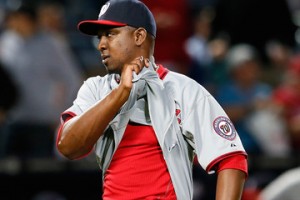
Unbelievably, Maya gets another MLB shot. Photo Al Bello/Getty Images

Hey, we’ve all been there Ryan Mattheus.

But clearly Mattheus never watched Bull Durham; Crash Davis‘ last lesson to Ebby Calvin ‘Nuke’ LaLoosh involved exactly what Mattheus just did to himself.  If you’re going to punch something … NEVER punch with your pitching hand.

And then in an even worse move, Mattheus hid the injury from his manager until it was too late to call up someone, meaning the team was short a reliever for last night’s SF game (a predictable 8-0 loss as Zach Duke even more predictably got hammered for 7 hits and 4 earned runs in just 3 1/3 innings).

We may even have an issue with Henry Rodriguez, who apparently “grimaced” as he was throwing one of his FOURTY SEVEN pitches last night, a ridiculous amount of pitches for a max-effort guy who should normally be throwing half that in an outing.  Don’t be surprised to see news of him hitting the D/L either.

So, with the bullpen shredded and now devoid of basically anyone who can throw significant long innings for the next couple of days, the team called up Yunesky Maya to provide some cover.  Maya has been awful in AAA so far this year (1-4 with a 5.07 era) but he’s the best option on the 40-man roster for what they need right now.   They’re also planning on calling up lefty Fernando Abad, one of their slew of lefty minor league free agents who has been excellent in AAA this year.   Abad will likely be a one-for-one replacement for Mattheus when he hits the D/L and has earned his way back to the majors.  Abad will require a 40-man move; he will be the 40th guy on the roster.  Maya likely switches places again with Eury Perez once the bullpen can catch its breath.

A better more interesting question may involve the fate of Duke.  He’s been awful this year, barely appears because of it, and when he is called upon to provide the one thing the team needs from him (an effective spot start) he fell on his face.  He’s not given this team anything close to what Tom Gorzelanny gave us for the past few years, and I’m beginning to wonder if the team really made the right decision keeping Duke over Gorzelanny.  Duke only makes $700k a year (versus the 2yr/$5.7M deal that Gorzelanny got from Milwaukee) but with the marginal value of a “Win” on the open market being in excess of $5M these days, have the Nats ended up being penny wise but a pound foolish?

Regardless of the “hindsight is 20/20″ analysis with Duke versus Gorzelanny, I have a feeling we may be seeing another move in the near future; the DFA of Duke and the call up of either J.C. Romero or newly acquired Xavier Cedeno. Both are lefties, both are veterans, both are pitching really well in Syracuse, and both seemingly can do no worse than Duke has done.  This isn’t as exciting as seeing a prospect get called up (for example; Danny Rosenbaum or Erik Davis), but with any more injuries we may get there.

Ladson’s inbox 3/22/13

one comment

Micah Owings has had an impressive spring, putting himself in line for a 2013 callup. Photo Jonathan Newton/TWP

We’re getting closer to Opening Day!  Bill Ladson publishes what may be his last spring training mailbag late friday 3/22/13.

As always, I sometimes edit questions for clarity and answer here before reading Ladson’s response.

Q: Micah Owings is showing pretty impressive numbers in Spring Training. What are his chances of making the Opening Day roster, considering Roger Bernadina and Tyler Moore are also backup outfielders?

A: Zero, barring an injury this week.  The Nats outfield has been set since mid last year.  Micah Owings knows this but took the offer with the Nats presumably for two reasons: the team is expected to be good (and what veteran player doesn’t want to catch on with a first place team?) and the team is a bit thin on corner outfielder OF prospects in the higher minors.  Looking at the current state of the minor league depth chart, it isn’t hard to see how a solid start in AAA would catapult Owings above Corey Brown into the #1 OF reserve spot (of course, Brown can play center, so it would likely depend on which OF was injured, but still).  I like reclamation projects, and I like what we’ve seen out of Owings so far this spring.  I’d like to see him make it back to the majors as a big bopper.  Ladson agrees, though he says the team may promote him in May or June??  Who exactly is he to replace?

Q: Most of the Nationals’ starters are not showing good numbers in Spring Training. Should we be worried?

A: Nope.  Rule number one with Spring Training; pay zero attention to the stats of any established Major Leaguer.  They’re not pitching these games to try to get a win; they’re pitching to get ready for the season, to work on specific pitches, to work on location, etc.  I once heard a story about Tom Glavine giving up something ridiculous like 8 runs in his final spring training outing and the press corps going nuts; turns out he was working on locating his change-up, and ONLY working on locating his change-up, so once the opposing team figured out what he was doing they started sitting on an outside change-up and tattooed him.  This is exactly why you can’t trust stats from Florida.  Ladson agrees.

Q: Do you think the bars that Bryce Harper and Stephen Strasburg have set for themselves this year will be too much for them to handle?

A: I’m not really aware of any “bars” either player has set; the only things I can think of are Strasburg saying he wants to be a “workhorse” and perhaps Harper saying he wants to hit 30 homers?  It isn’t like they’ve thrown down the gauntlet and said they want to win MVPs, Cy Youngs, etc.  Now the Press on the other hand; yes they’ve probably set the bar too high.  But (especially with Harper) it isn’t hard to see this scenario; usually MVPs are the best players from the best teams.  If the Nats end up being a playoff team, and Harper is our best player …. he’s going to be a leading MVP candidate.  This doesn’t imply Harper is the best player in the league (that’s NOT the definition of the MVP and not how its generally voted), but it does mean he may be in the running.  Ladson dismissed the question as well.

Q: What do you feel are the plans with Eury Perez this season and beyond?

A: First off, I’d say that Eury Perez really cost himself development time this year as a side-effect of playing for the Dominican Republic in the World Baseball Classic.  The Nats demoted him while he was sitting on the bench for the D.R., and mentioned publically they were worried about his lack of work.  I’d say that Perez needs another season proving himself at AAA before he really starts putting himself in the mix for a full time MLB spot.  He put up great numbers last year; .314/.344/.361 between AA and AAA with 51 steals in 127 games.  That’s classic leadoff/centerfielder stuff, or exactly what the team acquired in the off-season in Denard Span.  In games so far this spring, Perez has just glided to 2nd base on steal attempts; he’s faster than nearly any player I can remember in a Nats uniform.

But the question is this; how does Perez fit in given that the Nats are committed to Span for at least 2013 and 2014 (it seems more and more likely we’ll be declining his 2015 option based on this paragraph), and considering that the team has rising stud Brian Goodwin who seems to be a similar player in a similar position (albeit with slightly less speed but significantly more power)?  I’m beginning to think that the log-jam in the Nats outfield is going to eventually mean that Perez ends up being traded for an opportunity elsewhere.  Ladson agrees with all of these points, also mentioning prospect Michael Taylor, who I always forget about.

Wow; short mailbag, only 4 questions.


Ladson’s Inbox 3/14/13

5 comments

Mar 12, 2013; Miami, FL, USA; United States pitcher Gio Gonzalez (47) delivers a pitch against Puerto Rico at Marlins Park. Mandatory Credit: Scott Rovak-USA TODAY Sports

It’s been a while since Bill Ladson did an inbox; strange because you’d think with Spring Training in full swing he’d be getting a ton of emails.  Here’s his 3/14/13 edition.  Lets see if he takes a question on who will be the 2014 manager for the 5th consecutive time.

As always, I write my own answers before reading his, and edit questions for clarity as needed.

Q: Should the Nats be worried about sending their pitchers to the World Baseball Classic? Will there be pressure on them to pitch too many innings too soon?

A: Yes, this organization may be worried, as discussed in depth in Feburary in this space.  We’ve never had a pitcher throw in the WBC who hasn’t come back either injured or less effective, and league-wide studies show the same trend.  However I will say this: all 5 pitchers we’ve sent in years past were relievers.  This year we sent two starters in Gio Gonzalez and Ross Detwiler.  So maybe things will be different.  Yes the concern basically is that these guys are more interested in getting outs than getting ready for the regular season, causing them to overthrow, to not prepare as they normally would in the spring, to not focus on specific things that they would normally do in spring training games.  It is less about innings or pitch counts (which are strictly monitored).   Ladson says the team isn’t worried about their arms, but is worried about the lack of playing time Eury Perez is getting.  And they have a great point; Perez is sitting on the DR bench instead of getting ABs in spring training games.  His chances of making the team dropped to zilch and he’s already been re-assigned to AAA.

Q: Who are going to be the lefties for the Nationals by Opening Day?

A: I’m assuming he means the “Lefty relievers.”  At this point its looking like we’re going to break camp with just one lefty reliever in Zach Duke. Bill Bray needs more minor league time, Bobby Bramhall and Sean West are in minor league camp slated for AAA jobs, Brandon Mann got one inning and was awful, Pat McCoy got some innings but isn’t ready.  Only Fernando Abad has stuck with the big-league team and looks good.  But, if Henry Rodriguez is ready to go there’s no room for Abad.  I’m guessing Abad goes to AAA and bides his time.  Ladson agrees, and points out that our righties can get lefties out.

Q: With Tyler Moore on the big league roster, what do you think will happen to Chris Marrero?

A: I’m going to answer this my way, then i’ll predict what Ladson says.  Chris Marrero goes back to AAA, burns his last option in the process, and bides his time waiting for injuries to take out the likes of Adam LaRoche and/or Tyler Moore. That seems to be the only way he gets opportunities this year.  The team will hope for a strong AAA season to build up trade value and then will move him if they can.  Otherwise he’s looking at a waiver wire trip this coming off-season.  Now, before I read Ladson’s answer i’m going to guess that he says something along the lines of “The Nats will look to trade him for valuable assets” but he’ll neglect to mention that Marrero has zero trade value right now, having missed all of last year.  Lets see if i’m right: I stand corrected; Ladson has finally come around on his stance on Marrero and says he’ll be in AAA all year.

Q: Would the Nats ever consider adding Kyle Lohse to the roster?

A: Consider?  Perhaps.  Actually do it?  I don’t see it.   Kyle Lohse is becoming the poster child for the problem with the Qualifying Offer in the new CBA.  He foolishly declined it (on the advice of Scott Boras, who probably told him he could get 3-4 years guaranteed on the open market), and now sits unsigned 3 weeks from opening day.  Its amazing; this guy was 16-3 last year!  Lohse is seen as a product of his environment, a great coaching staff in St. Louis who do wonders with mediocre pitchers.  And make no mistake; 2012 aside Lohse is a career 97 ERA+ pitcher with a .500 record and a 4.45 ERA.  He doesn’t fit into the mold of what Mike Rizzo generally wants in a starter; power arm, high K/9 capabilities.  Now, if the team bus crashed and we lost our starting rotation to injury tomorrow … yeah i’m guessing we’d give him a call.  But there’s no way the Nats (or likely any other team) is going to give 3 guaranteed years to a 34-year old soft-tossing guy.  Boras really, really miscalculated here and it looks like its going to cost his client millions.  Ladson agrees.

Q: Please find out where Cole Kimball is in his rehab. I would like to know if he’s anywhere close to pre-surgery velocity.

A: I only saw Cole Kimball in one game, but his velocity was down.  Perhaps its ramped back up later into spring training.  In either case he’s bound for AAA to burn his last Option and await bullpen issues for his shot.  Ladson says he’s “close to throwing 95-mph.”  I wish more of these games were televised.

Q: Having heard earlier in the offseason that general manager Mike Rizzo feels Steve Lombardozzi and Danny Espinosa are both starters and not bench players, do you feel one of them will be traded prior to Opening Day? Lombardozzi was an extremely clutch pinch-hitter last year in my opinion.

A: Traded prior to Opening Day?  Almost impossible; nobody makes trades at this point in the season.  You make trades prior to spring training and then after a couple months are past in the season to address off-season or intra-season needs.  We’ll save the Espinosa vs Lombardozzi vs Rendon discussion; we all know it by heart by now.   Ladson says a trade is not coming.

Q: Considering he had a very good year with Triple-A Syracuse in 2012, what are the chances of outfielder Corey Brown making the team?

A: Zilch.  He may have hit in AAA, but he didn’t hit squat with Washington last September.  He’s at least 6th on the Washington OF depth chart (Werth, Harper, Span, Moore, Bernadina and then Eury Perez.  Perhaps even lower; I think the team would give Carlos Rivero and Erik Komatsu chances before Brown at this point.  And its just a matter of time before uber-prospect Brian Goodwin passes him by as well.  Brown’s looking at another year of AAA time, burning his last option, and then getting the MLFA treatment.  Ladson says no chance.

Hey!  No question on the 2014 Nats manager this time! I stand corrected.

Observations of Nats from early televised ST games

2 comments

Carlos Rivero looks like a valuable utility guy so far this spring. Photo Brad Barr/US Presswire via bleacherreport.com

I have to admit, I’ve thoroughly enjoyed the two Nats spring training games that managed to find their way to MLB Network TV thus far (NatsJournal live blogs for the 2/23 game here and 2/25 game here).  Not so much because we got to see Harper, Strasburg and Gonzalez … we all know what these guys can do.  No; I’m interested in seeing the young guys, the guys who we rarely get to see play.  This year’s spring training is a week longer, meaning that there’s going to be an awful lot of playing time devoted to these AA and AAA guys who got spring training invites, and that’s many more looks at the likes of Matt Skole, Chris Marrero, and Carlos Rivero.

It is also good to see some of these arm prospects that we’ve been hearing so much about, and it has been instructive to see some of the minor league veterans invited to spring training.  Some observations on our guys (arms then bats):

  • Stephen Strasburg’s first 7 pitches on 2/23/13; all fastballs, all 96-97.  Clearly he was working on his spots.  I’m not sure he threw a change-up the entire outing.  As is always the case in spring training, guys work on pitches, work on location, and stats are meaningless.  He gave up a wind-aided homer to a guy who’s hit like 1 his entire career; no cause for concern.
  • Gio Gonzalez was amped up; he over threw his fastball in the first and (if you believe the broadcast) reached 97 in the second.  He struggled with his release point clearly.  However, his curve looked in mid-season form, breaking sharply and serving as a nice out pitch against the few regulars that the Mets did bat on 2/25/13.
  • Bill Bray looked, well, awful.  His mechanics were always odd-looking, but he got hit hard by the Mets lineup of rag-tag regulars.  Not a good start for Bray’s spring.
  • Cole Kimball back on the hill …. where was his fastball?  It generally was coming in 90-91.  That’s clearly a step back from 2011, when he was averaging 93 and peaking at 95.8.  Lets hope this is Kimball working himself in slowly and not a permament velocity loss from his shoulder surgery.  Either way, he’s not going to displace his RHP competitors for the bullpen spots unless he can hump it up a bit more.
  • Pat McCoy was scheduled to throw 2/23, and I would really have liked to see him, but the Mets were ahead in the 9th and didn’t need to bat.  I’m convinced that McCoy could be a sleeper candidate for a left-handed specialist in this organization, if the cattle-call of guys we’ve signed to ML deals falls through.
  • Ross Ohlendorf put in two clean innings, but I don’t like what I see from him necessarily.   Not a lot of velocity (90-91) but a big guy (6′4″) who gets downward plane on his fastball.  But he just seems very “hittable.”  His numbers from the last two years in the majors show it; ERAs of 8.15 and 7.77 in 18 starts.  Not good.
  • Nathan Karns: the beat reporters raved about his performance overall; 2 innings, 3 Ks against a MLB-heavy part of the Mets order.  It was great to finally see Karns throw; he has easy arm action, runs the ball in 94-95, and spotted the ball on the corners well.  What I didn’t see was anything resembling a quality second pitch.  He attempted a number of sliders (I’m guessing sliders; they were generally 84-86, which would be a very hard curve) and he couldn’t get over-top of them at all.  He did throw one particular breaking pitch that was sharp and nasty.  I didn’t see anything resembling a 3rd or 4th pitch though.  Is he destined for the bullpen?  That’s not the worst thing in the world; to be the next Ryan Mattheus, a hard-throwing 7th inning right hander.

Now for thoughts on our minor league hitters:

  • Eury Perez is, well, really fast.  If he turns out to be anything close to a servicable hitter, he’s got leadoff/center fielder written all over him.  The question could become; which speedy CF prospect do we hope for more; Perez or Brian Goodwin?  Denard Span’s contract has a convenient option for 2015, just about the time that Goodwin is likely ready for the majors on a full-time basis.  Of course, that being said Perez is further along than Goodwin (who likely starts 2013 at AA).  Goodwin has power to go with his speed, while Perez seems to have very little power.  Which would you prefer to be the longer-term CF solution?
  • I like Matt Skole; sweet swing, not overpowered by facing MLB pitching.  It makes you wonder about scouting sometimes; how come guys like Skole and Tyler Moore get no love from scouts?  Its like a 30-home run minor league guy is somehow a liability.  Of course, Skole’s problem is the same as Anthony Rendon’s; positional blockage at 3B.  Yes Skole was playing low-A as a college junior when he hit 27 homers … but if you’ve seen Hagertown’s stadium, you know its a monster park to hit balls out of.  27 homers is no mean feat down there.   I’ll be curious to see if Skole can hit with that kind of power at High-A or AA (wherever he starts 2013).
  • Chris Marrero has looked pretty good, making good solid contact a number of times.  I don’t like his haircut though :-) .
  • Carlos Rivero is impressing me; he’s playing the outfield (after having played first SS and then 3B in the minors).  He has good hands, is a big guy, and seems like he can be a servicable backup utility guy who can fill in at any corner.  He’d be more flexible Moore or Chad Tracy in this respect (when judging our projected utility guys) but of course needs to show he can hit at the same levels.  Still, he is likely to be a numbers game victim unless someone like Bernadina gets hurt this spring.

How does the Nats WAR add up for 2013?

9 comments

How much WAR is Haren bringing to the 2013 Nats? Photo unknown via wikipedia

Mark Zuckerman posted a nice little Wins Above Replacement (WAR) analysis article in the wake of the Gio Gonzalez signing back in December 2011, showing that without any further moves and with the expected projections of WAR improvement the 2012 Nats should improve by nearly 12 wins if our injured stars return to the norm and produce as expected.  As it turned out, he was right … and wasn’t “right” enough.  He actually under-valued the WAR contributions of a newly healthy Adam LaRoche and of what Gonzalez would give the team (and of course nobody could have predicted what Ian Desmond would do nor how big an impact Bryce Harper would have) and the Nats ended up improving 17 games instead of a predicted 12 from 2011’s 81-81 team.

Here’s a similar analysis for your 2013 Nats, with some thoughts on players who may improve or regress from their 2012 WAR totals, and then using that analysis to predict how the team may fare in 2013.  I have uploaded my working 2013 fWAR spreadsheet to docs.google.com (also a link on the right-hand side of the page), which is the basis of the cut-n-paste tables below.  For the purpose of this article, we’re assuming that LaRoche is leaving and Michael Morse is playing 1B full-time, that Bill Bray is making the bullpen, and that Christian Garcia is starting in AAA.

A quick note before starting: the two leading baseball stats sites both have their own versions of the Wins Above Replacement stat.  Baseball-Reference’s WAR (usually abbreviated bWAR or rWAR) was developed by Sean Smith at BaseballProjection.com.  Meanwhile, fangraphs.com has developed their own version of WAR (usually abbreviated fWAR to distinguish from the Baseball-Reference version).  A good analysis of the differences between the two WARs is here: the main differences relate to the use of FIP versus ERA and TotalZone versus UZR for defensive additions.  In this article i’m using solely fWAR.  I think fWAR is slightly better and uses better component parts, though honestly the difference between the two is often negligible.

How many wins would an entire team of replacement level players win?  In other words, where do you start adding WAR figures to, in order to estimate how many wins you should expect out of your team?  Jim Breem of the Milwaukee-Wisconsin Journal Sentinel did just this study in Jan 2011 and discovered that the average of replacement level wins across MLB in 2010 was 45.5 wins.  In other words, you could expect a team of nothing but AAA-level veterans or 0.0 WAR players to win about 45-46 games in a season.  This is about on par with the figure’s I’ve heard in various chats, and is somewhat supported by last year’s awful Houston Astros (who finished 55-107 and had just a handful of players posting a 1.0 WAR or greater).   The 2012 Nats fWAR totaled exactly 50.0, the team finished 98-64 and they had a Pythagorean record of 96-66,  implying that a team of replacement Nats players would win between 46 and 48 games, right in line with Breem’s studies.  For the purposes of predicting the # of 2013 Nats wins we’ll use 46 as a floor.

How did our returning players fare in 2012, and what might they contribute in 2013?  Here’s my estimates for all returning players.  This table is sorted by 2012 fWAR from highest to lowest.  (b) after a pitcher’s name indicates the fWAR contributions (or lack thereof) of that pitcher at the plate.

2012 fWAR 2013 fWAR Est Trend from 2012
Ian Desmond 5.4 5 Down
Gio Gonzalez 5.4 4.8 Down
Bryce Harper 4.9 6 Up
Ryan Zimmerman 4.5 5 Up
Stephen Strasburg 4.3 5 Up
Danny Espinosa 3.8 3.8 Even
Jordan Zimmermann 3.5 4 Up
Roger Bernadina 1.9 2 Even
Ross Detwiler 1.8 2 Even
Jayson Werth 1 1.5 Up
Tyler Clippard 1 1 Even
Steve Lombardozzi 0.8 0.8 Even
Craig Stammen 0.8 0.8 Even
Stephen Strasburg (b) 0.7 0.8 Even
Drew Storen 0.7 1 Up
Tyler Moore 0.6 0.6 Even
Wilson Ramos 0.6 0.2 Down
Kurt Suzuki 0.6 1.5 Up
Chad Tracy 0.5 0.5 Even
Jhonatan Solano 0.4 0 Down
Jordan Zimmermann (b) 0.4 0.4 Even
Michael Morse 0.3 3 Up
Zach Duke 0.2 0.8 up
Corey Brown 0.1 0 Even
Eury Perez 0.1 0 Even
Christian Garcia 0.1 0 Even
Sandy Leon 0 0 Even
Ryan Mattheus (b) 0 0 Even
Zach Duke (b) 0 0 Even
Craig Stammen (b) -0.1 0 Even
Carlos Maldonado -0.1 0 Even
Ryan Perry -0.2 0 Even
Ryan Mattheus -0.2 -0.2 Even
Gio Gonzalez (b) -0.3 -0.3 Even
Henry Rodriguez -0.4 -0.4 Even
Ross Detwiler (b) -0.5 -0.6 Even

Here’s some discussion on my estimates:

Players who I’m trending Up: Harper, Zimmerman, Strasburg, Werth, Suzuki, Storen, Zimmermann, Morse and Duke.  I have Harper going from a 4.9->6.0 fWAR player, which frankly may be selling the kid short.  Lots of pundits think he’s going to explode in 2013 for a Mike Trout-like season.  I think both Zimmerman and Strasburg can achieve 5.0 fWAR seasons.  I think Werth can go from a 1.0->1.5 with a full healthy season, especially if he continues to hit as he did upon returning last year (we’ll ignore for a moment that he’s not “earning” his salary with fWAR seasons in the 5.0 fWAR range like he’s being paid to do).  Suzuki has a couple of 3.4 fWAR seasons under his belt; estimating him at 1.5 may be selling him short.  Storen returns to the closer role healthy, though an improvement to just 1.0 fWAR would be a career best for him.  I’m predicting an improved season out of Zimmermann, who seemed to tire at the end of last season in his first full season back from Tommy John surgery.  Morse has a huge increase predicted (from 0.3->3.0) but he posted a higher fWAR than that in his breakout 2011 season; if he’s here and playing full time, there’s no reason to not expect another season like 2011’s.  Lastly Duke’s 0.8 fWAR estimate may be exceedingly high, but he managed to add 0.2 fWAR in just a few weeks of work in September.

Players who I’m Trending Down: Desmond, Gonzalez, Ramos and Solano: I think Ramos and Solano’s contributions are now limited and/or blocked by Suzuki, so their fWAR contributions drop accordingly.  I’m building in some regression for both Desmond and Gio from last year’s fantastic performances.  Most every player with an estimate of 0.0 for 2013 is assumed to be spending the majority of the season in the minors (notably Ryan Perry and Garcia, but also the likes of Corey Brown,  Eury Perez and all the backup catchers we had to use last year).

Notable Players who I’m trending about Even: Espinosa, Bernadina, Detwiler, Clippard, Stammen, Henry Rodriguez: Even, meaning they’ll contribute about the same in 2013 that they did in 2012.  Is Clippard going to contribute 1.0 fWAR in 2013?  Maybe not.  Can Stammen repeat his stellar performance?  Will Rodriguez continue to drag down the bullpen with a -0.4 fWAR?  If anything, Espinosa should improve on his 3.8 fWAR; he’s trending up year over year.  I’ve listed almost all our backups (Bernadina, Lombardozzi, Moore, Tracy, etc) as being even year over year; there’s no reason right now not to expect the same performance we got out of them in the coming season.  For the moment I’m leaving Garcia in AAA, and have his fWAR at zero; if he were to join the bullpen on a full time basis he could contribute half a WAR or more.

Here’s a quick look at our new players acquired this off-season:

New Players for 2013 2012 fWAR 2013 fWAR Est Trend from 2012
Dan Haren 1.8 4.5 Up
Dan Haren (b) -0.1 -0.3 Down
Denard Span 3.9 3.9 Even
Bill Bray -0.6 0.3 Up
Bill Bray (b) 0 0 Even

Perhaps the most controversial estimate in this article is Haren’s 2013 fWAR number.  I’m estimating that he’s going to return to his previous form and at least post a 4.5 fWAR.  If you look at his history before 2012, you’ll see he’s easily capable of posting a 6.0 fWAR or higher.   I think the team gave him the contract they did because they’re assuming he’s healthy and assuming he can return at least to his 2011 form.  A 4.5 estimate may end up being low.  Meanwhile, I’m assuming Span is going to just repeat his 2012 performance, and I’m assuming that Bray improves upon his own poor 2012 and returns to something closer to his 2011 form (where he posted a 0.7 fWAR).

Given the above breakdown, here’s how the summaries look:

2012 fWAR 2013 fWAR Est
sum of 2012 fWAR of returning players –> 42.6 49 <– Sum 2013 fWAR estimates existing players
sum of 2012 fWAR for departed players –> 7.4
8.4 <– Sum 2013 fWAR estimates new Additions
sum of 2012 fWAR –> 50.0 57.4 <– Sum 2013 Nats fWAR Estimates

Ok, what does the above table mean?

  • Sum of WAR Returning of 42.6: this is the sum of the fWARs of all pitchers and batters in 2012 who are returning to the team in 2013 (as broken down in the upper table).
  • Sum of WAR Gone of 7.4: this is the sum of the fWARs of all pitchers and batters in 2012 who are no longer with the team.  Adam LaRoche leads this list with a 3.8 fWAR in 2012, though also included in this list are a number of negative fWAR players who drug the team down last year (DeRosa, Wang and Nady especially).
  • Sum of 2012 Nats fWAR of 50.0: This is the sum of returning and departing 2012 players, and is the same number referenced above.
  • Sum fWAR estimates of existing players: 49: This is the sum of the fWAR for all our returning players for 2013; notice this is higher; I’m predicting that through attrition of poor players and some improvement over 2012, we can expect our team to be nearly 7 wins improved.
  • Sum fWAR new additions: 8.4: Span, Haren and Bray should add 8.4 fWAR (as shown in the second table).
  • Sum 2013 Nats fWAR estimates: 57.6

That’s right; I believe the team has an fWAR capability of 57.6, or 7.6 wins more than last year.  Adding that to the previously discussed fWAR floor of 46 games and you have a 103-104 win team.

What happens if LaRoche comes back?  If anything the team could be improved even more.  LaRoche posted a 3.8 fWAR in 2012, while Morse’s BEST fWAR season was his 2011 breakout of 3.3.  If we assume LaRoche can repeat his 2012 performance at least for one year into a 2-3 year contract, then the team’s fWAR estimates rise again.

Does this mean I’m predicting that the 2013 Nationals are going to win 104 games?  Well, no.  Every single one of these estimates implies a 100% best case scenario; no injuries and for the most part all our players playing at their capability levels of 2012.  In reality, we’re going to see some time lost due to injury from key players, and we’re going to see some regression from some players.  The hope is that those regression periods are matched by improvements from other players, or from breakout performances from players who were in the 1.0 fWAR range in the past (think Desmond in 2012).

One last note on WAR (which I’d love to see others’ opinions about): I admittedly have an uneasy and not always consistent opinion on the statistic.  On the one hand, I absolutely believe that career WAR values reward accumulator type players and skew career WAR figures (my favorite example to use is Bert Blyleven, who currently sits with the 39th largest career bWAR in the history of the game.  But no one in their right mind would claim that Blyleven was the 39th best player to ever play the game… so there’s a disconnect that I have a difficult time dealing with).  But, on the other hand, WAR usually does a nice job of quantifying individual seasons, and lending itself to the kind of analysis I’ve just done here.  Do I need to overcome my reservations of using the statistic?  How can I reconcile my concerns with the overall prevalence of the stat?

Span for Meyer; Understand it but don’t entirely like it

38 comments

The team gets the lead-off hitter it has needed for years in Denard Span. Photo Bruce Kluckhohn/Minnesota Twins via twitter

At least Nats fans can start understanding the team’s off-season plans a little more clearly now.  The first domino has fallen.  The Nats acquired Denard Span from Minnesota for Alex Meyer yesterday.

I’ve argued against a center field acquisition for a while now.  Here’s three primary reasons why:

1. I don’t feel the Nats needed a center fielder.  Bryce Harper put up a 17.6 UZR/150 in 715+ innings while showing a plus-plus arm (both statistically and for any casual observers).   He’s just turning 20.  There is no reason to think he cannot ably patrol center for at least the next few years.  I’ve used this analogy before, but I feel like its the Yankees approaching Mickey Mantle after his first season in center and saying, “Hey Mick, we like you in center but we have this barely above league average guy At least until point #2 possibly comes to play:

2. Brian Goodwin, along with Destin Hood, Eury Perez, Michael Taylor and any other marginal OF prospect the team has is now effectively blocked for at least the next 3 years and possibly longer.  Span is signed through 2014 (with a very affordable 2015 option), Jayson Werth signed through 2017, and Harper is under team control through at least 2017.   There’s your outfield for the next 3 years guaranteed, 2/3rds of which is locked up for the next 5.  I just feel that the better path would have been to let Harper play CF until Goodwin or Perez seems ready (clearly Godwin is an upper-end prospect who has impressed ever since he was drafted, and the team didn’t add Perez to their 40-man roster just to give him the extra salary) and just make do with a slugger in left field.

3. The loss of Alex Meyer represents the best healthy starter arm in the entire system, a system which is becoming thinner and thinner (with this trade on the backs of the Gio trade I’d guess the Nats are now going to be in the bottom 5 farm systems when rankings start coming out).  You can argue whether or not Meyer was going to stick as a starter (see the “bright side” points below), but inarguably this weakens the farm system in general and further weakens a specific problem that may pop up sooner than later; starting pitcher depth.  If one of our big 4 suffers a spring training injury, it is difficult to see who may step up and be counted on for starts.

This move clearly forces the Nationals hand on Michael Morse, and now the team may end up negotiating from a point of weakness if they need to move him.  The decision path for the team now is clearly “Morse or LaRoche” at first base.  If the team does bring back Adam LaRoche suddenly Morse is without a lineup spot and his trade value diminishes quickly.  If the rumors are true that LaRoche is “only” seeking a 3 year deal, the Nats should stumble over themselves to offer him a 3 year deal (3yrs $40M seems more than fair based on what LaRoche did for us last year) and lock up the plus-defender/middle of the order bat.

This move also cannot be a happy day for Tyler Moore; he’s clearly set on being a backup now in 2013 no matter what happens with Morse/LaRoche, despite promising numbers in 2012.   Well, unless the team fails to re-sign LaRoche AND moves Morse (which I suppose is still possible but would make little sense), which would then install Moore as the every day first baseman.  Between Moore, Morse possibly being out of a position and Goodwin being blocked for years to come, you have to think we’re going to see some more moves involving these players (hopefully to acquire a starter, or some starter depth in the minors).


Now, on the bright side (since I’ve been accused of being too negative in my analysis), I will say the following:

1. We did not give up a ton for Span.  I like Meyer, but I’m afraid he may not stick as a starter.  The scouting knock on him has always related to his tall frame and repeatability of his delivery.  He has a funky leg kick and slightly weird mechanics, further muddying the waters.  Lastly he’s a huge guy and he (at first glance in videos) seems to really throw standing up and doesn’t use a ton of his lower body.  All of this spells “reliever” in his future.  If Meyer tops out as a fireballing reliever, this trade looks even better.

2. Span inarguably fills a need; a high OBP leadoff hitter.  He’s a .357 career OBP guy with speed and who hits lefty, a nearly perfect fit for what this lineup needs at the top.  Leadoff hitters generally come from one of three positions: CF, SS and 2B.  If the team decided it NEEDED a leadoff guy, and with Desmond and Espinosa locked into the SS and 2B slots for the time being, clearly the only place the team could go was a center-fielder.  The USAToday article linked at the top said it best (paraphrasing): this move is as if you bought a new chair for your living room, which forced you to have to move around your furniture.  You didn’t necessarily need the new chair, but it certainly makes your living room look better.  This move enables Werth to move further down in the lineup and return to his power stroke.

3. We didn’t spend good money after bad on BJ Upton or Michael Bourn, who’s 5yr/$75M demands would have been a real waste of money.  Span’s contract is great: 5yrs for $16.5M guaranteed plus a $9M option in 2015.   The Nats acquired a desired resource without appreciably increasing payroll, allowing them to focus (perhaps) on a FA starter.

Initial reaction to the trade in the Baseball World seems mixed, which is great since it probably indicates that this is a pretty fair trade all in all.  Keith Law doesn’t like it of  course, but that’s because Law believes every low-minors big arm is turning into Justin Verlander (Law also thought the Gio Gonzalez trade was a “huge win” for Oakland because they got AJ Cole, the same AJ Cole who put up a 7.82 ERA in high-A this year and was forced to repeat Low-A).  Meanwhile Dave Cameron calls this a “huge win” for Washington, focusing on Span’s numbers and mentioning the same concerns about Meyer that I do.  Rob Neyer pays a complement to Mike Rizzo and the Nats and says the team is well-positioned for several years.  Ken Rosenthal talks about the about-face the franchise has done in the last 3 years in the eyes of potential Free Agents, specifically Zack Greinke, who declined the Nats trade offer 2 years ago but now could be the final piece in building a juggernaut.


Coincidentally, those who think this moves Harper to LEFT field may be mistaken.  Werth’s defense in right has inarguably slipped (he posted a -14.2 UZR/150 in right this year, a significant drop from his previous decent-to-good seasons there).  I think Harper should play right field, with his gun for an arm protecting against 1st-to-3rd runners while Werth should immediately put up great UZR numbers in left.  Possible lineup in 2013 (assuming for now that LaRoche is leaving):

  1. Span (L) – CF
  2. Werth (R) -LF
  3. Zimmerman (R) – 3B
  4. Harper (L) – RF
  5. Morse (R) – 1B
  6. Desmond (R) – SS
  7. Espinosa (S) – 2B
  8. Suzuki (R) – C
  9. Pitcher.

L-R-R-L-R-R-S-R for good balance.  I could also see Desmond and Werth switching spots in the lineup.  Harper to cleanup may be a bit early, but without adding another lefty bat the lineup could have too many right-handed hitters in a row.

Now, what if LaRoche re-signs?  Then suddenly this lineup has pretty good balance.  With LaRoche in the fold i’d probably go like this:

  1. Span (L) – CF
  2. Werth (R) -LF
  3. Harper (L) – RF
  4. Zimmerman (R) – 3B
  5. LaRoche (L) – 1B
  6. Desmond (R) – SS
  7. Espinosa (S) – 2B
  8. Suzuki (R) – C
  9. Pitcher.

That’d be a slight modification over where these guys hit last year, but would give nearly perfect lefty-righty balance.


In the end, you have to give up something you value to get something you value.  The Nats made a good trade, despite my thinking they didn’t need to make the trade in the first place.  They’re an improved team on the field for 2013.

Possible 2013 WBC Nationals participants?

leave a comment

Harper makes perfect sense to represent the US in 2013 WBC. Photo GQ magazine Mar 2012

I read a quickie piece with some Mike Rizzo quotes from the Washington Time’s beat reporter Amanda Comak on November 11th, 2012 and there was an interesting tidbit at the bottom: per Comak,  Rizzo has not been approached yet about any Washington Nationals participation in the WBC, but would approach each request on a “case-by-case basis” to determine what is in the best interests of the team.  This got me thinking about possible Nats representatives on 2013 WBC teams.

Lets take a quick look at the Nationals representatives on WBC teams from the past, talk about whether its really in the best interests of the team to even let these guys play, and then talk about who may be candidates for the 2013 WBC regardless.

(Note: I’ve added updates highlighted in red since the original 11/21/12 publication date on players mentioned here).

Washington has sent a decent number of players to play in the WBC over the years, with very mixed results for the team’s interests.  In 2006 the team sent seven different players to the inaugural WBC:

  • Luis Ayala for Mexico
  • Chad Cordero, Gary Majewski and Brian Schneider for team USA
  • Ronnie Belliard, Alberto Castillo, and Wily Mo Pena for the Dominican Republic.

The tournament was marred for the team by a blown UCL ligament to Ayala, who had undergone elbow surgery earlier in the off-season but pitched for his home country anyway.  The team did not want Ayala to participate in the inaugural event, did not want him used by the Mexican team, and team officials were “livid” by the injury, which cost Ayala the season and cost the team its 8th inning setup guy.  Ayala recovered to pitch again in 2008 but was never as effective, and was shipped out in 2009 for a PTBNL.  Coincidentally, I suspect the team still harbors some ill-will towards Ayala to this day.  Meanwhile the other two relievers who participated both experienced regressions in form; Cordero’s ERA nearly doubled (from 1.82 to 3.19) from his breakout 2005 season while Majewski’s numbers dipped slightly before he was traded in the big Cincinnati deal of 2006.

In 2009, the team had 5 participants:

  • Pete Orr playing for Canada
  • Joel Hanrahan and Adam Dunn playing for the USA
  • Saul Rivera and Ivan Rodriguez playing for Puerto Rico.

The WBC seemed to energize particularly Dunn, who enjoyed playing in a post-season atmosphere for the first (and only) time in his career.  Nobody suffered any injuries, but Hanrahan in particular may have been affected by his lack of a proper spring training; he posted a 7.71 ERA for the team while losing the closer spot and was shipped to Pittsburgh.  Ironically, Rivera also experienced a huge regression of form, going from a 3.96 ERA in 2008 to a 6.10 ERA in 2009 and was eventually released.

This begs the question; do we even WANT our pitchers playing on this team?  The first two WBCs have shown pretty distinctly that our pitchers have regressed greatly after playing.  This only makes sense: the spring training routines are greatly impacted to play in this event.  We may see a ton of front-office resistance to specific guys (especially those coming off injury) playing in the 2013 event.  Which could affect the eligibility of some specific players for 2013.

Now, which Nats may play for the 2013 teams?  First off, looking at the Nationals 40-man roster, we have become an amazingly heavy USA-born team (we’ll get to non-40man roster players in a moment). Thanks to the Nats big board resource (originated by Brian Oliver and now maintained by “SpringfieldFan”), which has the country of origin for players, here’s a breakdown of the home-country of our current 36 active (as of November 15th, 2012) roster players:

  • USA: 27 (would be 29 if adding in our rule-5 avoidance players)
  • Venezuela: 5 (Jesus Flores, Sandy Leon, Wilson Ramos, Henry Rodriguez, and Carlos Rivero)
  • Cuba: 1 (Yunesky Maya)
  • Columbia: 1 (Jhonatan Solano)
  • Dominican Republic: 1 (Eury Perez)
  • Netherlands (via Curacao): 1 (Roger Bernadina)

As you can see, the massive bulk of our team is USA born, and essentially our entire post-season starting roster was USA born as well.  That doesn’t necessarily mean that these USA-born players will actually play for team USA (Alex Rodriguez played for Puerto Rico despite being born and raised in Miami, and our own Danny Espinosa is eligible to play for Mexico by virtue of his first-generation born in the US status), but almost all of these guys will be up for consideration for the USA team.  And this only accounts for our 40-man players; as we’ll see below there’s plenty of lower-minors players from smaller countries that will participate.

Who from the Nationals franchise may make a 2013 WBC roster?  First off, thanks to James Wagner’s 11/15/12 NatsJournal post we already know of three WBC participants; Solano is on the Columbian team, minor leaguer Jimmy Van Ostrand is on the Canadian team, and A-ball catcher Adrian Nieto is on the Spanish team.  Curacao qualifies to play with the Netherlands, and I’d guess that Bernadina would make a great choice considering the lack of Dutch players in baseball (Baseball Continuum’s projections agree.  And as of 12/4/12 he’s officially been listed as a Netherlands participant).. Venezuela is already qualified for the main draw and has a relatively strong possible team.  The Baseball Continuum blog posted an early projection of the Venezuelan team and listed Flores as a likely participant (specifically mentioning that Ramos wasn’t considered due to injury recovery; I’d suspect these two players to switch based on Ramos’ recovery and Flores’ awful 2012).   If Henry Rodriguez was healthy i’d guess he would be on that list too, but his season-ending surgery probably precludes his participation.  The Dominican Republic has perhaps the strongest depth and has no need for the recently called up Perez among its outfield depth.  Maya’s defection eliminates him from discussion for the Cuban team.  (12/4/12 update): Chien-Ming Wang has been announced as a member of Chinese Taipei’s team (for the purposes of this article I investigated all 2012 Nats).

Which leaves our large contingent of American players.  A couple of writers have started postulating on these rosters (David Schoenfield’s very early guess as to a potential USA roster is here, Baseball Continuum’s latest projection is here).  So using these two posts as a starting point, lets go position-by-position and give some thoughts as to who may get some consideration.  Keep in mind the WBC rosters are generally very reliever heavy, since no starter is going to be “allowed” to pitch a complete game in March.

(Note: I’m still considering our Free Agents as “Nats players” for the purposes of this analysis, since this really goes position by position from our 2012 team to find candidates).

  • Catcher: Kurt Suzuki isn’t nearly in the class of the likes of Buster Posey, Brian McCann, Joe Mauer, or Matt Weiters.  There are a ton of quality american backstops right now.
  • First Base: Free Agent Adam LaRoche probably faces far too much competition from the likes of Prince Fielder, Paul Konerko, Adam Dunn, Allen Craig, Eric Hosmer, and Mark Teixeira to make this team.  If it were me, I’d go with Fielder and Teixeira.  But, LaRoche’s great 2012 season and his Gold Glove recognition may get him a spot.  He is a FA though, so i’d guess he won’t commit until he signs and gets the go-ahead from his new team.  Or, perhaps he uses the WBC to showcase himself?  Not likely needed; he should sign long before the WBC kicks off in March.
  • Second Base: Danny Espinosa is a decent player, but not in the same league as  Shoenfield’s projection of Dustin Pedroia and Ben Zobrist.  Brandon Phillips is also in the mix for the team.
  • Shortstop: Ian Desmond’s breakout 2013 season may get him some consideration.  There’s not a lot of American quality short stops out there.  Troy Tulowitzki is the obvious leading choice (as was Derek Jeter in the first two WBCs), but is he ready to come back from injury?  Looking around the majors there are a couple other possibilities (JJ Hardy, Brendan Ryan, Jimmy Rollins and Brandon Crawford all could be alternatives as well).   I think Desmond’s combination of offense and defense, combined with Tulowitzki’s injury recovery could get him on the team.
  • Third Base: Ryan Zimmerman cannot break the hegomony of David Wright and Evan Longoria right now, even given Longoria’s injury struggles this season.  Chase Headley and David Freese are also in the 3b mix.  12/4/12 update: Apparently Wright is committed, Longoria is out due to injury recovery and Headley “was not asked,” so perhaps Zimmerman is back in the mix.
  • Outfielders: I think Bryce Harper is a natural to make this team, not only on talent but also because of the brand-name recognition (and TV ratings and fan interest) it would generate.  Same goes for Mike Trout.  Otherwise there’s a slew of top-end american players who can man the outfield and they read like the top of the MVP boards: Braun, Kemp, McCutchen, Stanton, Hamilton, and Granderson are all candidates to make this team.  12/6/12 update: Scott Boras has stated that Harper will skip the WBC to focus on his sophomore season.
  • Starters: The two logical Nats candidates to be considered would be Gio Gonzalez and Stephen Strasburg.  But lets be honest; there is no way in hell Strasburg would be allowed to play.  Could Gonzalez make this team?  Given the depth of American starter talent right now (just off the top of my head: Verlander, LincecumCain, Hamels, Halladay, Kershaw, Lee, Weaver, Sabathia, Medlen, and so on) perhaps this will be a selection of attrition moreso than a selection of availability.  So if a number of the older guys on this list beg out, perhaps Gio gets his shot.  The WBC’s location in San Francisco has already lead to Ryan Vogelsong committing to play in his home town, and could lead to other Bay Area players signing up.  I’m not sure any of the rest of our starters are really candidates, given the reputations of the above list plus the reliever-heavy nature of the roster.
  • Relievers: our two most well known relievers (Tyler Clippard and Drew Storen) are possibilities; would the Nats block Storen based on his 2012 injury?  Craig Stammen’s breakout 2012 season could get him looks, based on the reliever-heavy needs of the team.  Normally Sean Burnett may be in the loogy mix, but there’s better lefty relievers out there AND Burnett’s FA status may lead him to bow out to curry favor to his new team (Schoenfeld lists Burnett as a possible member back in July, before knowing he’s declared free agency).  The question is, would you take Clippard/Storen against the likes of this list of quality american back-of-the-bullpen arms: Kimbrel, Ventors, Marshall, League, Janssen, Papelbon, Hanrahan, Motte, Boggs, Bailey, Reed, and Nathan?  Possibly, considering that a lot of these guys probably bow out.  We’ve sent multiple relievers to each of the past two WBCs and its likely going to be the same thing this year.

Summary: here’s my guesses as to which Nats (and recent ex-Nats) will play in the WBC:

  • Venezuela: Ramos
  • Spain: Nieto
  • Canada: Van Ostrand
  • Columbia: Solano
  • Netherlands: Bernadina
  • Chinese Taipei: Wang
  • USA: Harper, Desmond, Gonzalez, Clippard.  Perhaps Zimmerman and Stammen.

March 2013 update: here’s the post-WBC actual list of participants when all was said and done, helped by  the list of rosters via Wikipedia.  MLB reports that nine (9) Nationals are participating in the classic, though the below list (excluding Wang) totals more.  They’re not counting Solano/Columbia, having lost in the preliminaries.

  • Columbia: Jhonatan Solano (AAA/Mlb in 2012)
  • Spain: Adrian Nieto (low-A in 2012)
  • Canada: Jimmy Van Ostrand (AA in 2012)
  • Italy: Matt Torra, Mike Costanzo (both AAA in 2012, Washington MLFA signings for 2013)
  • Netherlands: Roger Bernadina, Randolph Oduber (high-A in 2012)
  • Chinese Taipei: Chien-Ming Wang (former Nat, non-signed FA for 2013 start of season)
  • USA: Gio Gonzalez, Ross Detwiler
  • Dominican Republic: Eury Perez (3/4/13 addition to DR team)

September callups and the pending Nats Roster crunch

6 comments

Cole Kimball (remember him?) could be a victim of a roster crunch this off-season. Photo Rob Carr/Getty Images via zimbio.com

I took this discussion out of the comments section of the Giolito post in August and made it a separate discussion item, since the situation only got more “dire” with the 9/3/12 call-ups of both Christian Garcia and Zach Duke.

Before getting into the below analysis, let me say this: I’m absolutely supported all of the 40-man additions or the 9/1 call-ups; they were all required, important moves and, especially with the early-season catcher crunch, were vital to ensuring the continued success of the team through the September push.  Adding these two latest arms to a well-used bullpen, plus the 9/1/12 call-ups of of eventual 5th starter John Lannan, catcher depth in Sandy Leon and defensive replacement/pinch runner Eury Perez signal that this team used every avenue in its arsenal to win down the stretch and secure not only a playoff entry, but the #1 seed.

Garcia and Duke were new 40-man additions; to make room at the time the club put Henry Rodriguez on the 60-day dl (apropos since he just had season-ending elbow surgery).  The 40-man roster was filled to a full 40 active players, with an additional three on 60-day DL (Kimball and Ramos joining H-Rod on the 60-day list).

So, why am I worried about a future 40-man roster crunch?  Because with all these additions, we’re going to have to make some tough choices once it comes time to protect guys from the rule-5 draft.  Some have said that the expected Free Agents and Non-Tenders will immediately ease the roster crunch, but I’d counter that these players will have to immediately be filled through free-agency and aren’t going to offer the relief one may expect.

Lets do some analysis for the 43 guys (40 on 40-man plus 3 60-day DL) we’re talking about.   Here’s how these 43 guys are categorized in terms of contract status for next year:

  • Seven (7) guys under contract for next year.  Werth, Zimmerman, Morse, Gio Gonzalez, Maya, Tracy, Suzuki.
  • Eighteen (18)  guys who are pre-arbitration; Strasburg, Rendon, Purke, Harper, Espinosa, Ramos, Henry Rodriguez, Lombardozzi, Marrero, Mattheus, Kimball, Moore, Perez, Rivero, Solano, Garcia, Leon, Brown.  Some of these are non-tender candidates; we’ll get to them below.
  • Nine (9) guys who are arbitration-eligible but who are (in my opinion) not in Non-Tender jeopardy: Zimmermann, Clippard, Flores, Desmond, Storen, Bernadina, Detwiler, Stammen, Perry.  Both Perry and Storen may or may not actually hit Arbitration status per Cots, but the logic still stands that they’d be tied to the team regardless.  Are any of these guys non-tender candidates?  See below.  [Editor's Note] we now know that Storen DID hit super-2 status, while Perry missed out on arbitration for the year.  Most of this post was written prior to this knowledge.
  • Four (4) pure FAs that immediately come off books: Mike Gonzalez, Jackson, Wang, DeRosa.
  • Two (2) more guys with mutual options that, as it turned out, declined their side and became free agents anway (LaRoche and Burnett).
  • Three (3) easy Non-tender guesses: I think the team non-tenders Gorzelanny, Lannan and Duke (but looks to bring Gorzelanny back as a long-man).  There are other possible non-tenders on this roster; we’ll talk about them later on.

So, on the day the FA’s clear and the 60-day guys get put back on the 40-man we’ll be at 43-6 FAs = 37 players.  So, assuming both 43-6 FAs=37 to start, perhaps down to 34 at the non-tender deadline. That leaves 6 spots opened up … but if my scenario plays out as described above with 6 FAs and 3 non tenders, that includes no less than FIVE of our primary 25-man roster all season. Which means most likely we’ll be active in the FA market looking for replacements for those five guys. First example: Who replaces Edwin Jackson? The next guys in line are Lannan and Wang; both likely gone. After that is perhaps Perry or Maya, both on 40-man but so far both proven not to be able to get out MLB hitters. So we’re going to be looking for another starter. Same goes with replacing Burnett and Gonzalez as lefties out of the pen, and replacing DeRosa as mlb-veteran utility infielder.

My point is that, yeah we have a lot of guys getting cut but we can’t just leave those spots open on the 40-man; we’ll need to immediately fill them with MLB deals in free agency. So we go from 34 open spots probably almost immediately to 38 or 39 with these eventual FA  replacement signings…. and boom, you have your roster crunch when it comes to rule5.

I have a draft version of the 2012 rule 5 pre-draft recommendations and it could get ugly, but to do some quick analysis here’s the Draft Tracker google xls: https://docs.google.com/spreadsheet/ccc?key=0AmkEIm1TLiXQdGhVRjRfNW81SG8xRlROQ1ZxZzNfbUE&hl=en#gid=0.  Yellow shaded cells are 2012 R5 eligible but don’t forget 2011 R5 guys who have stepped up and may need protecting. At first glance in the conversation to be protected has to include: Kobernus, Rosenbaum, Karns, Hood, and Demny. I’m not saying they all need to be protected, but some of them may.

My point is this; if the team wants to protect more than 1-2 guys, they’re looking at a one-for-one replacement on the 40-man roster.  Maybe they do DFA Marrero and Kimball, but they probably don’t want to.  Marrero is only 24.  Kimball was relatively successful before going down with shoulder surgery and is the kind of reliever that Rizzo loves.

This is the essence of the “roster crunch” that this team faces this off-season.

Ladson’s Inbox: 10/22/12 edition

15 comments

LaRoche's status with the team will dictate a number of cascading roster moves. Photo Rob Carr/Getty Images via bleacherreport.com

I havn’t seen mlb.com beat reporter Bill Ladson do an inbox response since February.  So I was excited to see one pop in this past Monday, 10/22/12.  As a reminder, I write my response before reading his, and sometimes edit questions for clarity.

Q: What are the Nationals’ plans for Tyler Moore? He is a power hitter who deserves to play every day. If Adam LaRoche returns next year, where does Moore fit in?

A: Tyler Moore indeed had excellent numbers in limited action, getting called up at the end of April to cover for a dearth of outfielders on the Nats roster.  His slash line was .263/.327/.513 for an OPS+ of 124 with 10 homers in 156 Abs.   Thats a homer ever 15.6 ABs and correlates to nearly a 40 homer pace for a full season of roughly 600 at-bats.  That is of course if you believe in what we saw in 2012 versus the continued lack of respect for Moore from the scouting pundits (who think his minor league power numbers were more a function of age than talent, and who continued to think that Moore had too many holes in his swing to be an impact MLB player).

Unfortunately though for Moore, if Adam LaRoche is re-signed there may not be an immediate place for Moore in the lineup.  LaRoche can only play 1B, Michael Morse is signed through 2013 and has become a club and fan favorite in LF.   Those are basically the only two positions Moore can play.

I think the better question here is, “Will the Nats extend Adam LaRoche?”  Because that’s the question that drives several other roster moves for 2013.  If LaRoche comes back and the team favors giving Moore more playing time, maybe they package Morse in trade.  Perhaps Moore sits and waits for another injury to give him playing time; LaRoche was incredibly healthy in 2012 and could regress for 2013.  Or, perhaps LaRoche (as basically the leading 1B power hitter on the FA market) will get a 3-4 year deal (likely) and the Nats won’t over-pay for his decline years, will install Moore at first and keep Morse in left.   Honestly, I think this last scenario is what plays out, and we’ll see Moore as your starting first baseman in 2013.

Ladson basically echos exactly what I say above.  Glad we’re on the same page.

Q: Do you think the Nationals will go after Michael Bourn this offseason?

A: No no no!  As I opined on September 13th, after seeing yet another Jim Bowden article intoning last off-season’s mantra of “the Nats need a center fielder,” the Nats HAVE a center fielder, and a darn good one, in Bryce Harper.  Harper finished the season with the 4th best UZR/150 for any CF with 500+ innings, even better than the vaunted defensive wizard Mike Trout.  It took about 5 games for his arm to be respected league wide, and he’s only 19 and will only get better.  Why would we possible move Harper off CF in the next 4-5 years?  Yes, eventually we expect a bulked up power hitting Harper to move to a corner spot, but not at age 20.  Besides, if Harper moves off CF … who makes way in left or right?  Do you move Jayson Werth to left field?  If so, then what happens to Michael Morse?  Do you move him?  Harper’s defensive value is wasted in right field.  Werth’s defensive value (while inarguably slipping) is also wasted in left field, where you can “hide” a poor defensive player who is plus-plus power.

*sigh* I wish this rumor would go away.  I’m pretty sure the Yankees never said to Mickey Mantle at age 19, “Hey Mick!  We like you in center but we to move you to a corner outfielder so we can sign a sub-average hitter to lead-off and play in your position.”  Of course not, so why would the Nats do so?

Unfortunately Ladson perpetuates the ridiculous myth himself and says he thinks the team goes after Bourn and puts Harper in LF.  Just ridiculous.

Q: Any news on Cole Kimball’s recovery?  Will we see him in a Nats uniform in 2013?

A: Shoulder injuries in power pitchers are never an easy recovery.  That’s why we never really saw Kimball in the summer and why he’s currently in the AFL getting some extra time on the hill.  As of this writing he only has 3 2/3 innings, so not much to go by.  We are seeing some reports that he looks decent.  2013 prognosis?   He faces an uphill battle to make the bullpen; there’s several right handers that are now clearly ahead of him on the depth chart.  Storen, Clippard, and Stammen are locks (if not traded).  Rodriguez has no options.  Mattheus has pitched his way onto this team.  That’s your 5 righties out of the pen (Davey Johnson likes 2 lefties).   And we havn’t even talked about Christain Garcia, who pitched well enough to make the post season roster.   So the answer may be that Kimball starts in AAA and waits for an opportunity.  Ladson says he thinks Kimball can make the 2013 bullpen.  How exactly?  Who is he going to be ahead of?  Not much provided in the way of deep analysis, Bill.

Q: Do you think there is any chance the Nationals bring up Corey Brown to play center and bat second?

A: No.  Brown looks to me like the definition of a 4-A guy, and will be stashed in AAA as outfield depth until further notice.  Batting second?  Really?  We’re currently batting Werth at leadoff despite his having middle-of-the-order power.  What makes anyone think Brown deserves to bat anywhere in this lineup, let alone ahead of the power guys?  And, if Brown makes the 25-man roster which outfielder does he replace?  Certainly not the starters in Morse, Harper and Werth.  Certainly not Roger Bernadina, who more than earned his stay.  And certainly not above Moore.   Ladson agrees.

Q: What do you think about the addition of Kurt Suzuki to the roster?

A: Somewhat of a panic/reactionary move at the time, but it has worked out great for both sides.  Jesus Flores wasn’t stopping the one-way street for opposing base-runners, and we needed more of a plus-defensive guy behind the plate.  Flores did himself  no favors batting .213 either.  Suzuki immediately upped his batting stroke too,  batting .267 here after hitting just .218 in Oakland in 2012.  Clearly Suzuki and Wilson Ramos are your two catchers heading into 2013.  What do we do with Flores?  Do we dare non-tender him and give him away?  Do we tender him and try to trade him?  I’d hope for the latter, thinking that even a .213 hitting catcher has value in this league.  I hate to say it, but Ramos can’t stay on the field and we needed the insurance.  Ladson agrees, but doesn’t mention Flores’ fate.

Q: The Shark, aka Roger Bernadina, had a career year and will probably get a raise this offseason. Do you think the Nats are going to try to move him, or can we expect to see The Shark with the team next year?

A: Great question.  Do we sell-high on Bernadina and make-do with a 4th outfielder like Corey Brown or Eury Perez in 2013?  We could, if it brought us back something worth having.  We do have some rising quality OF depth that would replace Bernadina (Brian Goodwin comes to mind, perhaps even Anthony Rendon if he hits his way to the majors in 2013).    Ladson thinks Bernadina will be back.  I have no problem with that; he hit great this year, knew his role and is fantastic defensively.

Q: Do you think Davey Johnson is the best manager in Nationals/Expos history? Felipe Alou is tough to beat, but Davey has my vote on this one.

A: Why not Jim Fanning?  He led the franchise to its only prior post-season appearance.  I dunno; what exactly makes a “good” manager?  I think Johnson has absolutely done better with this team than anyone thought, so yeah that makes him a great manager (and my favorite for winning NL Manager of the Year).  Best ever for the franchise?  Why do people think Felipe Alou was so great?  His last three Expos teams each lost 90 or more games.  Who can really talk intelligently about how well Buck Rodgers mangaged the team in the mid 1980s?  The team improved 19 wins from 1978 to 1979 under Dick Williams.  Those are good managers too.  Ladson thinks Johnson is the best ever but says Alou was great.  I don’t get it.

Nats Playoff Rotation & Bullpen Decisions

4 comments

20-game Winner Gonzalez is our likely #1 starter in the playoffs. Photo Joy Absalon/US Presswire via usatoday.com

The Nats rotation has been incredibly stable this year; only a mid-season experiment with Chien-Ming Wang interrupted a near season-long quintet of starters unmarred by injury or poor performance.  The shutdown and playoff unavailability of Stephen Strasburg is well, well documented, so we won’t talk about him here.  But two important decisions await Davey Johnson in terms of his playoff roster construction: playoff rotation and bullpen construction.  Lets take these questions one-by-one:

1. What is your playoff rotation?  Here’s the evolution of our rotation this year:

  • The year started off with your starters in this order: Strasburg, Gonzalez, Zimmermann, Jackson and then Detwiler. The starters went R-L-R-R-L.
  • After the All Star Break, Johnson shuffled the starters and re-ordered them to go Zimmermann, Gonzalez, Strasburg, Jackson, Detwiler (still R-L-R-R-L), ostensibly to give Strasburg a bit more rest and extend his season a few days.
  • On August 3rd (around a double-header) Zimmermann and Gonzalez switched places.  Now you’ve got Gonzalez, Zimmermann, Strasburg, Jackson and Detwiler (L-R-R-R-L).  All three RHSPs are in order, as are the two LHSPs.
  • On August 15th around an off day, Detwiler and Jackson switched places, probably to keep Detwiler on regular rest and probably to fix the aforementioned issue of 3 RHSPs in a row (starters now Gonzalez, Zimmermann, Strasburg, Detwiler, Jackson for L-R-R-L-R).
  • On September 12th, John Lannan replaces the shut-down Strasburg in the rotation.  Now we’re Gonzalez, Zimmermann, Lannan, Detwiler and Jackson for L-R-L-L-R.

If we play out the rotation the rest of the season, barring any more rain-outs or injuries, the starters will be (Starting 9/21):

9/21: Jackson
9/22: Gonzalez
9/23: spot starter Wang, to give the rotation its regular rest.
9/24: Zimmermann
9/25: Lannan
9/26: Detwiler
9/27: Jackson
9/28: Gonzalez
9/29: Zimmermann
9/30: Lannan
10/1: Detwiler
10/2: Jackson
10/3: Gonzalez

At this point I’m going to assume that the Nats will win the division and go straight to the divisional series, which (per MLB’s playoff schedule) starts either Saturday 10/6 or Sunday 10/7.  Which day the Nats start will be critical; if the Nats are the #1 seed they’ll start Sunday; if they’re the #2 seed they’ll start Saturday.

But in either case I think we’re going to see some manipulation of the above schedule, because I think the team wants Gonzalez to start the opener.   And he cannot start an opener on 10/6 or 10/3 if he throws 10/3.   We may see him skipped on 9/28 and then throwing a start 10/1 (which I’d be happy for; that’s the last game I have tix for this year), which would put him on regular rest for either a 10/6 or 10/7 start.

After that though, there’s some decisions to be made.  The NLDS ridiculously gives the lower-seed the first two home games, so I think Johnson may want to have some options available to him for his 2nd, 3rd, and 4th starter (I think its a pretty basic assumption that Lannan is being left completely off the playoff roster; more on this later down when talking about the bullpen options).  Here’s the home/away splits of our 4 likely playoff starters (numbers as of 9/21/12).

Interesting; Zimmermann is far more effective away, Detwiler is far more effective at home, and Jackson is just about the same either way.  This seems to imply that Zimmermann is your best bet to take the 2nd start, away from home, then line up Detwiler-Jackson-Gonzalez (or some combination thereof) at home.

Here’s another take; Johnson likes to play match-ups with certain teams.  Will the Nats opponent factor into the equation?  Assuming the Nats are the #1 seed, your likely wild-card winners right now are Atlanta and St. Louis (its hard to see a scenario where St. Louis loses its current 3 game WC lead in the next 12 days, but it could happen, but for the purposes of this article we’ll assume these two teams hold on).  How do these teams fare against lefty versus righty starters?

  • Atlanta is hitting .247 as a team versus Lefties with an 86 wRC+.  That’s bad.
  • Atlanta is hitting .251 as a team versus Righties with a 97 wRC+.  That’s certainly better than they do versus lefties.
  • St. Louis is hitting .275 as a team versus Lefties with an 113 wRC+.  That’s basically 2nd in the majors behind the uber-hitting Rangers.
  • St. Louis is hitting .270 as a team versus Righties with a 104 wRC+.  That’s roughly a 10% difference in Run Creation.

So, it seems like if we play Atlanta, we want to load up on Lefties while if we play St. Louis we want to load up on Righties.  This would seem to indicate that, if Atlanta is our opponent we’ll want to go Gonzalez-Zimmermann-Detwiler-Jackson-Gonzalez again, meaning Atlanta has to face 2 lefties in the first 3 games plus 3 out of 5.  If we play St. Louis, you’d think that we’ll want to switch up Detwiler and Jackson so that St. Louis gets L-R-R-L-L.  The idea being that once we get home, even though we’re lefty-heavy we’ll have the advantage.

However, with the #1, #2 and #3 seeds far from settled with a week and a half to go, lets also look at the same logic for both Cincinnati and San Francisco, since its conceivable at this point we could be playing either of these teams (use the same links in the Atlanta links above to see these statistics):

  • Cincinnati is hitting .268 as a team versus Lefties with an 107 wRC+.   Both Tied for 6th in the majors.
  • Cincinnati is hitting .248 as a team versus Righties with a 89 wRC+.
  • San Francisco is hitting .268 as a team versus Lefties with an 96 wRC+.
  • San Francisco is hitting .270 as a team versus Righties with a 98 wRC+.

Conclusions?  Cincinnati matches up very well against lefties and struggles against righties, while San Francisco is a pretty well balanced team with no real weakness against either side.

One last factor is post-season experience, of which this group has very little.  Jackson is the sole guy with any post season experience, it being last year with potential opponent St. Louis.  I cannot see Johnson bumping any of the guys who are pitching better than him though, at least in a short series, based on this veteran experience (we’ll revisit this though in a 7-game series, where the identity of the 4th starter is incredibly important, as he only goes once in that series).

In any scenario, I think your first two starters away are going to be Gonzalez and Zimmermann.  After that will depend on the opponent.

2. What is your playoff bullpen?  By virtue of the fact that we don’t need a 5th starter, the team can carry an extra player.  Here’s the bullpen as it sits now, divided into “regulars” and 9/1 call-ups:

  • Regulars: Burnett, Clippard, MGonzalez, Gorzelanny, Mattheus, Stammen, Storen
  • Sept 1 callups: Duke, Garcia, Wang (and technically Lannan).

I think this decision is pretty simple; you keep the 7 “regulars” and add in power arm Christian Garcia, who has been lights out since arriving, as an extra middle-relief guy.  There’s no reason to have minor league starters Duke, Wang or Lannan on the post-season roster; the only function they’d have is as long-men, but the regulars include two such arms already in Stammen and Gorzelanny.

The possibility exists that Johnson will opt for an extra bench guy instead of an 8th bullpen arm, but I doubt he’d choose that route.  Your “extra” bench guys right now are Leon (3rd catcher), Brown and Perez (ofs), and one of either DeRosa or Tracy (technically it was DeRosa who got added off the DL after roster expansion; he likely would have been delayed in the minors had this happened earlier in the season).  I can’t see any reason to keep any of these guys on a post-season roster at the expense of an 8th reliever.  Tracy gets a few ABs a week and can only play 1B, while DeRosa can provide cover at multiple positions and seems to have more value.  I could be wrong though; Tracy continues to deliver timely pinch hits in the clutch (as he did this past weekend).

Man, it feels good to talk about playoff baseball!