Nationals Arm Race

"… the reason you win or lose is darn near always the same – pitching.” — Earl Weaver

Predicting 9/1 callup and 40-man Roster moves

8 comments

Will Brad Peacock continue his meteoric rise up the organization with a 9/1 callup? Photo bleacherreport.com

Davey Johnson has already called for them.  Jordan Zimmermann‘s innings limit necessitates one of them.  Livan‘s woes beg for one of them.  Who are they?  Starting Pitching prospects.  And when the calendar hits September 1st, the day MLB rosters can expand, we should be seeing a few of them make their way to the Nats roster.  We’re probably going to see guys already on the 40-man make appearances (Chris MarreroCorey Brown?), but who else?

But, the signings of Anthony Rendon and Matt Purke filled the two empty slots on the 40-man roster created by the trades of Jerry Hairston and Jason Marquis.  So if you believe reports that the Nats are calling up the likes of Steve Lombardozzi, Brad Peacock and Tom Milone (in addition to adding Stephen Strasburg back to the active roster for a September 6th or 7th re-debut), then we’ve got some 40-man moves to make.

Here’s my predictions on how the team will make room for 4 new 40-man players (remember, Strasburg is currently on the 60-day DL and does not count towards the 40 active players on the “40-man” roster).

  • Move Adam LaRoche and Cole Kimball to the 60-day DL.  These are procedural moves that could have been done weeks ago, but the team hasn’t had the need.  Both are clearly done for the season and can easily be moved off.
  • Move Doug Slaten to the 60-day dl.  We’ve heard very little news on Slaten since he was put on the DL, which means he’s probably not featuring in the team’s plans for 2011 and can be moved off the 40-man.  We may end up flat out releasing the guy too; he performed so badly this year in terms of WHIP and allowing inherited runners to score that the team certainly would go looking elsewhere for a loogy.  Update: he’s just starting to do rehab stints now; I’m guessing he’ll just be released upon finishing his rehab, as we did with Chad Gaudin.
  • Re-call Adam Carr to the majors, then 60-day DL him.  He’s been out since June and this procedural move would mean that nobody needs to be released.  We can add all these 60-day DL guys back to the 40-man once all our free agents and non-tenders go through.

If there are other non 40-man guys to consider adding, I don’ t know who they may be at this point.  Brad Meyers may be reaching an innings limit (based on analysis of his usage in AAA).  There don’t seem to be any relievers in AAA (Mandel, Wilkie?) worth calling up.  We have 2 catchers active and a third (Pudge) getting ready presumably to come off the DL, so we’re set there.

Who would get dumped off the 40-man if we needed to make space?  The leading candidate would have to be the enigmatic Garrett Mock, who has put up startling bad numbers at various levels this year.  Atahualpa Severino is another candidate; having spent 2 full years on the 40-man with exactly one day in the majors.

Nats Rotation Cycle #25: good/bad/soso

3 comments

Good

  • This time around it was Dr. Jekyll’s turn (aka, the “good” side) for Livan Hernandez, who stifled the best team in baseball for a 4-2 victory in Philadelphia on 8/12 (box/gamer).  Effort on the night: 6 2/3 innings, 4 hits and 1 unearned run allowed.  If you want to see something amazing, go look at Livan’s splits in wins, losses and no-decisions.  In 7 victories: 1.08 era.  In 11 losses: 5.84 era.  In 7 no-decisions: 5.63 era.  Maybe we can just skip every other start for him and just get his good ones.
  • Ross Detwiler gave up one run in 6 innings to take the “unlucky loss” on wednesday 8/17 (box/gamer).  He had a career-high strikeouts of 7 (6 through 3 innings) and worked out of a bases-loaded, one out jam in the 3rd that contributed to his good evening.  I’m still not that impressed with him on the mound though; he gave up 9 baserunners in 6 innings and was over 100 pitches to that point.
  • Jordan Zimmermann‘s presumed 3rd to last start was strong; 5 2/3 shutout innings in the series finale against the Reds on 8/18 (box/gamer).  Only a couple more starts to go before he hits his 160ip limit.  Here’s a couple of interesting stats on Zimmermann: he’s now 10th in the NL in WHIP, 2nd in the league (behind Halladay) in BB/9 and 4th in the league in K/BB ratio (behind the first 3 in the Philly rotation, in case anyone was doubting just how good their staff is).

Bad

  • John Lannan completely forgot how to find the plate on 8/13 (box/gamer). leading to a complete stomping from Philadelphia and an ugly 11-3 score line.  Luckily for Lannan, only one of the 7 runs he allowed was earned (a homer to Ryan Howard).

Mediocre/Inconclusive

  • Chien Ming Wang‘s fourth start wasn’t nearly as exciting as his no-hitter bid last week; he gave up 4 runs on 7 hits in a bit over 6 innings on 8/16 but cruised to the victory while the offense pounded opposing starter Mike Leake.  I was at this game and the ump seemed to be squeezing Wang on the low strike, which meant he had to work up in the zone a bit more.  Add to that a comment that the pitching coach made in post-game interviews; by virtue of the skipped game on sunday Wang got an extra days rest and was “too strong.”  He gave up more than a few hard-hit balls last night that were liners right at outfielders. He’s not getting any strikeouts either; he was never a big K/9 guy (4.1/9 on his career), but he’s had THREE strikeouts in 21 innings back. This the NL; you usually get 3 strikeouts by falling out of bed by virtue of the opposing pitcher and generally weaker lineups.  On the bright side, he was only at 78 pitches when getting yanked and probably could have finished 8 innings in 100 pitches.

Relievers of Note and other News

  • If you havn’t seen Bryce Harper‘s walk off homer from friday 8/12’s game … its worth a watch.  Estimated at 480feet to dead center, it was absolutely crushed.  Thankfully this bit of Harper news was a significant step up from earlier in the week, when he made all sorts of headlines for his ejection.  Keith Law, in a rare moment of levity among the typical over-reacting baseball pundit reporting w/r/t Harper, noted in his chat on thursday 8/11, put it best while responding to multiple baited questions about Harper’s makeup and his “issues” as follows: “Any other minor league player reacts badly to a called third strike, we hear nothing about it.I couldn’t agree more; I’m really tired of hearing about how Harper is immature and this and that, while every single emotion and action he has on the field is youtube’d for the world to see and overanalyze.  I’ve said this in this past; he’s not a robot, and he wouldn’t be as good as he is if he were emotionless on the field.
  • Stephen Strasburg’s 2nd rehab start went pretty durn well: 3 scoreless innings.  He threw 33 pitches (26 for strikes), was steady at 98, touched 99 and worked at least 3 of his 4 pitches (there was no mention of his 2-seamer, but its great to see him throwing his 90-mph changeup, the pitch that blew out his elbow in the first place).  Its also very interesting to see him talk about pitch counts and getting batters out with fewer pitches; he consciously wants to go deeper into games, knowing he’s on a 100-pitch limit.  He seems to be reading the party line, as Zimmermann has clearly adopted this approach so as to last longer.
  • Unfortunately, Strasburg’s 3rd start was not as promising: he gave up 5 runs on 4 hits and 2 walks in just an inning and a third in Hagerstown on 8/17.   He was clearly wild on the night; he threw 49 pitches but just 29 for strikes.  Mark Zuckerman tries to figure out when he’ll debut in the majors here, guessing its either tuesday or wednesday in the first week of September.  Next rehab start: Monday 8/22/11 back in Hagerstown.
  • Wow; talk about timing (good or bad, depending on your viewpoint).  Jason Marquis, lost for the season after breaking his fibula on a come-backer.

My answers to Boswell’s chat questions 8/15/11 edition

2 comments

Tom Boswell must have been on vacation; he hasn’t done a chat in weeks.  Well, he caught up and more on August 15th’s version.  Here’s how i’d have answered the questions he took.  As always, the “questions” posed are edited here for levity and clarity, and I write my “answer” before reading his.

Q: Why is Espinosa struggling at the plate?

A: Probably because the league’s pitchers are adjusting to him the 2nd time around.  Plus, there’s a lot of at-bats for advance scouts to learn from and formulate plans of attack.  This is a constant adjustment cycle that hitters and pitchers do throughout the year and throughout their careers.  There could also be a normal rookie fatigue factor; you play 30 games in a HS season, 60-or so games in a college season, around 70 games in a short-season minor league, and around 140 games in a full-season minor league.  To say nothing of the incredible jump in talent from even AAA to the majors.  So, some regression is to be expected as the season winds down.  Boswell agrees with the adjustments angle and gives some tips for Espinosa to follow.  I hope he was reading the chat 🙂

Q: Will the Nats get to 77 victories?

A: With a .479 winning percentage as of 8/15/11, that puts them on a pace for 77 wins (rounding down since they’re one game ahead of their pythagorean won-loss record).  I would say that the team will likely fail to reach that threshold though; September is going to see debut starts given to guys who have never seen the majors, and the transition is usually pretty tough.  I see a few extra losses thrown in there to bring down our win totals to the 73-74 range.   Boswell sticks by his pre-season prediction of 75.  Its looking like a good prediction.

Q: How has Davey Johnson performed so far?

A: I’d say he’s been awful.  Even given that Riggleman’s record was improved by a winning streak, the numbers are clear.  Riggleman was .500 with this team, Johnson is 17-24 (as of 8/15/11).  I think he’s poorly managed the bullpen and is poorly handling his starters.  On more than one occasion he’s let a starting pitcher make the 3rd out in the 6th, only to yank him one walk or one hit into the 7th.  This makes no sense to me!  Why give away that at-bat and that out (remember; you only get 27 outs in a game) especially if there’s runners on base and you still have hitters off the bench.  What was the point of “strengthening the bench” if you never use those hitters?  Grr.   Boswell agrees with me somewhat, and notes that Johnson quickly ended the lineup manipulations under Riggleman.  I’m not going to kill Riggleman for trying those lineup mods; they did lead to a very hot streak for this team.  Another interesting fact; the team has given up 10+ runs 6 times so far under Johnson but only twice before that under Riggleman; why is that?  The implication seemed to be that Riggleman was over-using Storen and Clippard.

Q: Will Purke sign by the deadline?

A: I didn’t think so: I was wrongBoswell had no answer, just said he’d be watching at midnight on 8/15/11.

Q: Should MLB allow close/controversial plays to be replayed on the scoreboard?

A: Good question: right now presumably these plays are NOT shown on scoreboards to prevent further fan-distress and histronics from the argumentative players and managers.  So, clearly when a play is not shown on the board the tacit message sent to all who are watching is, “oh they’re not showing the play so the umps must have blown it.”  It doesn’t seem to really cause that much grief in the NFL, which plays replays instantly (since they have 35 seconds to kill after every play).  So I think MLB should just show replays of all plays and not editorialize.  Boswell seems to agree.

Q: In 2013, what are the chances that this is the lineup we see every day: Ramos, Morse, Rendon, Espinosa, Zimmerman, Harper, CF, Werth?

A: Pretty close in my estimation.  We don’t have positions listed but the implication is that Harper is playing LF, Morse 1B and Rendon 2nd.  2013 may be a tad too early for Rendon; it may be a safer bet to put Lombardozzi at leadoff/2nd.  I think Harper should be trained as a center fielder.  Rendon should be able to transition to LF if need be, but it may be a waste of his abilities.  Otherwise this looks pretty close.  Boswell says there’s a pretty good chance, talks about Rendon a bit then gets more digs into Desmond despite his not being named here.

Q: Is there any significant relationship between payroll outlay (Nats 9th from bottom) and w/l record (14th from bottom)?

A: (links to use here: list of payroll by team, and the current MLB standings 1-30.   Nats are, as of 8/16/11 18th in W/L and22nd in total payroll.

There is definitely a relationship in general between payroll and won/loss records; I don’t think its a coincidence that the 3 highest payrolls (NYY, Boston, Philadelphia) are also the 3 best teams.  However that middle ground is where the direct correlation breaks down.  The Chicago Cubs have the 6th highest payroll and are 27th in won/losses.  Meanwhile the Tampa Bay Rays are 29th in payroll but have the 9th best record playing in the AL East.  This middle ground is where teams can use superior General Managers, superior scouting and overall organizational improvements to be better than they appear.  With respect to the Nationals current positions, I’ll say two things.

  1. Yes we’re clearly doing “better” than our payroll would indicate, a sign that Rizzo is getting good value for his contract dollars.
  2. Its despicable that a team with owners as wealthy as the Lerners, playing in a $600M stadium that was given to the team, and playing in the wealthiest per-capita area with a top 8 population center in the country isn’t spending more on this team.

Q: Is Batting Average not that good of a stat to use to judge hitters?  (in the context of Jayson Werth’s .226 value)

A: Batting Average needs context, yes.  A well-hit line drive directly at a 3rd baseman is really a better hit ball than a weak tweener ground ball that gets through for a hit.   If looking at the BA, you really should look at the BABIP (which for Werth is now .281 on the season, decent and closer to league norms than earlier, but still below his career .314) and his breakdowns of line drives, grounders and flyballs.  Here we see that Werth’s LD% is about on a par with his season last year, but his fly balls are way down.  Makes sense; more of his flyballs were turning into homers at the cozy Philadelphia park.  The stat I really use the most is OPS+, which normalizes the OPS (on base percentage plus slugging) to the league averages and is read more or less as a percentage value as compared to MLB average.  Werth’s number there is currently 98, meaning his OPS is about 2% worse than the league norm.  Now, this isn’t great (he’s being paid like on of the top 10 players in the league and was 5th in the NL in OPS+ last year), but it isn’t Adam Dunn.  Boswell points out that Werth’s slugging % is down and that he’ll be here til the next president is in office.

Q: Was Strasburg an injury waiting to happen?

A: Unknown; the injury he suffered (to his elbow) was NOT the injury that all these inverted-W and/or shoulder loading freaks drone on and on about.  So, until Strasburg’s shoulder blows out (as Prior’s did), we won’t know.   Boswell agrees

Q: What is going on with Zimmerman’s throwing motion?

A: Looks to me like the team has tried to address his biggest problem; making the un-pressured throw accurately.  It happens; you get a ball, have all the time in the world, and fire a ball over your first baseman’s head.  Then it gets into your head and you’re in trouble.  If this weird motion works (and it certainly seems to) then more power to him.  You’ll notice, by the way, that he never makes a throwing error when pressured or on the run.  At least not that I can remember.  Boswell Agrees.

Q: Should/Will the Nats go after Jose Reyes this off season?

A: Should they?  I don’t think so; depends on if they think Desmond has any future or if they can move over Espinosa and call up Lombardozzi.  It’d be foolish to spend $12M/year on a leadoff hitter who is only slightly better than your $440k/year in-house options.  Will they?  We’ll see.   Boswell thinks they shouldn’t and lists a few more good reasons.

Q: Would you trade all the National’s young pitchers for the Orioles’?

A: No.  Way.  Baltimore has a habit of destroying young arms lately.  And I like the upside of our slew of prospects versus theirs.  Boswell says no way.

Q: Zimm/Morse/Werth in 2012 vs Zimm/Dunn/Willingham in 2010?

A: Offense only?  You take the latter.  That was three guys with OPS’s in the 140s back to back to back.  Werth did it in his contract year but not before or since really.  Morse is a breakout guy this year; can he continue?  Can Zimmerman stay healthy?
Nationals future considerably brighter w/ 2011 draft signing successes.

14 comments

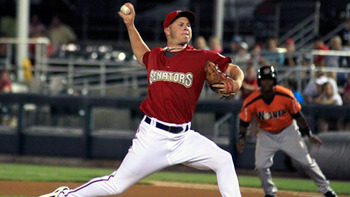
Frankly, I did not think we could get Purke signed. Photo AP/Nati Harnik

Upon starting to read Nationals press releases post 8/15/11 signing deadline, I was ecstatic and surprised by what transpired last night.  We got the first five draft picks signed for a total of about $16.5M spent.

Anthony Rendon and Alex Meyer were never in doubt in my opinion; neither was going back to school to try to marginally improve on their draft standing.  (Nor was Kylin Turnbull, our 4th rounder, who got a $325k deal out of Juco).  Rendon got a major league deal (i.e., an immediate spot on the 40-man roster), which probably was to be expected given his stature and his agent Scott Boras.  My guess is that Boras is starting to press for 40-man spots for his marquee players more and more and fighting less and less for these massive bonuses knowing that the 40-man spot accelerates the time it takes for these prospects to reach free agency by 2-3 years or more.

Brian Godwin got a $3M deal, or $1M more than it took for Meyer to sign.  Clearly the Nats had to buy him out of another year in college, where he and his counsel thought he could become a top-10 talent.

Most surprising: the signing of Matt Purke.  When Purke announced he wasn’t going to pitch in the Cape Cod league, I figured right then he wasn’t going to sign.  Why would he take a 3rd round money or slightly higher (somewhere between $425k and $800k) as a bonus when he got offered $6M out of high school and knows that a dominant junior season would put him in the discussion for #1 overall in 2012’s draft (and the probable $7-8M deal it would guarantee, as Gerrit Cole just got from Pittsburgh).  What the public didn’t know came out in the press releases: Purke let the Nats do not only an in-depth physical but an MRI with the injected dye to highlight injuries within his shoulder.  Purke also did private throwing sessions for the team.   They guaranteed him a 40-man roster spot as well (also incredibly surprising), but as mentioned above probably traded bonus money for that spot.

The usage of 40-man spots as a negotiating tool leaves the Nats slightly roster hampered; we now have 7 spots (and one rule5 draftee) on the roster who have never appeared in a major league game and seem set to start 2012 in the minors (Purke, Severino, Carr, Marrero, Rendon, Harper and Corey Brown).

However, Nats fans can now salivate at the selection of upper-ceiling arms that the team will be able to select from in a few years.  We can add Purke and Meyer immediately to this list: Strasburg and Zimmermann (1st and 2nd rounders) seem set to be the 1-2 for this rotation for the next several years.  Sammy Solis (2nd rounder) has looked ok in Potomac in his first year.  Youngsters AJ Cole (4th) and Robbie Ray (12th) have both looked fantastic in low-A.   “Found money” starters Brad Meyers (5th), Tom Milone (10th) and Brad Peacock (a draft-and-follow 41st rounder) are all pitching at AAA with varying degrees of success but all well younger than their AAA counterparts.   Even 2007’s high-end arms not already mentioned (Ross Detwiler 1st, Josh Smoker 2nd and Jack McGeary in the 6th) are not out of the running and all may feature at least as bullpen arms in the future.

How about a 2014 rotation of Strasburg, Zimmermann, Purke, Peacock and some high-priced ace FA?  That sounds pretty good.

Nats Rotation Cycle #24: good/bad/soso

2 comments

Wang looked as good in Chicago as he used to look in this uniform. Photo unknown via graphicshunt.com

The team went 3-2 in its last time through the rotation, taking a series from Atlanta at home before scuffling with Colorado in Denver.  This time through they finish off the Colorado series and move on to Chicago.

Good

  • John Lannan deserved more than he got after throwing 6 shutout innings on 8/7 (box/gamer).  He walked the leadoff hitter in the 7th and his bullpen conspired to blow the lead and cost him the Win.  Another clear example of how “wins” as a measuring stat for starters is clearly overrated.  Lannan’s line: 6ip+1 batter, 6 hits, 4 walks, 1 run.  Lannan has clearly turned around his season and is putting himself squarely in the Nat’s future rotational plans.  He’s a perfect #4 pitcher and probably sparkles on a good offensive team.  (See notes below for comments on the managing and bullpen performance in Lannan’s start).
  • Chien-Ming Wang looked about as good as you could ask for his 3rd start back after 2 years out of the game, throwing 6 innings of one-hit ball (no-hitting the Cubs through 5) in Chicago on 8/9 (box/gamer).  His sinker was moving well, he kept his fastballs right at the knees, and he humped it up to 93 on occasion (if you believe the stadium gun).  He had 11 ground ball outs to 4 flyball outs and needed just 81 pitches to complete 6 innings.  Apparently Steve McCatty asked some prior teammates about Wang and discovered that he wasn’t throwing his sinker nearly as much now as he was back in the day, and convinced him to do so going forward (aside: how is it possible that a pitcher “forgets” what made him successful??)   Coincidentally, despite pitching so well I agreed with Wang’s removal; in the 6th inning he was starting to lose control of his fastball and it was rising up, exactly what a sinker-baller doesn’t want.  A great start though, and a great sign for the future.

Bad

  • Unfortuantely Livan Hernandez was scheduled for his “bad” outing in his continuing Jekyll & Hyde season, and his bad was pretty bad.  He gave up 9 runs (7 earned) on 9 hits in 3 and 2/3 innings to take the loss on 8/6 (box/gamer).  The Nats bullpen didn’t help much either with each of the relievers struggling in one way or another (see notes).  Perhaps we can just skip Livan’s “bad” outings?  Or, I’ve got a better idea; we can remove him from the rotation since he’s giving the team less than a 50/50 chance of even being competitive in games right now.  Ben Goessling reported on the same topic, surmising that Livan’s rotation spot is in serious jeopardy with the team wanting to see youth in September.  One of the Nats blogs  highlighted a fantastic stat; look at Livan’s splits in his Wins versus Losses: in 6 wins he has a 1.25 era and a sub 1.00 whip.  In 11 losses? A 5.84 era and a 1.6ish whip.  His performance in 7 No-Decisions looks almost identical to his performance in losses.

Mediocre/Inconclusive

  • Jordan Zimmermann should have done better against the Cubs on 8/11 (box/gamer), giving up 4 runs on 9 hits, 2 walks in 6 2/3 innings.  He looked fantastic through 6, but gave up a single and back to back homers in the 7th to blemish his line and tag him with the loss on the night.
  • Ross Detwiler continues to look like he’s destined for the bullpen, giving up 3 runs on 7 hits and 2 homers in 5 innings on 8/10 (box/gamer).   The homers were cheap (Wrigley is a major hitter’s park) but 7 hits to go with 2 walks is just too many runners for a medicore-to-bad offense to overcome.

Relievers of Note and other News

  • Here’s your Washington Bullpen in the 8/6 game: Gorzelanny (4 hits in 2+ innings), Coffey (3 runs and 3 hits while retiring just one guy), Burnett (2 inherited runners, both scored), and Rodriguez (2 hits and 2 walks in one IP).  What are the odds that any of these four guys feature in 2012?  All four of them now feature ERA+ in the mid 80s (indicating their pitching about 15% worse than the MLB average) and they seem to be getting worse as the season rolls on.  The question fans have to be thinking about is Mike Rizzo‘s ego in these deals: Coffey was a 1-yr FA and won’t be missed, but the other three guys represent the bounty we have remaining from Rizzo’s 3 major trades since arriving here.  Will Rizzo admit that these moves didn’t work out and not force bad players to continue playing?  We’ll see.
  • Is it just me, or was Davey Johnson‘s pitcher management in the 8/7 game just ridiculous?  Lannan sits on 6 shutout innings and is allowed to bat in the top of the 7th.  He makes a feeble ground-ball out as expected.  Lannan goes back out to the mound for the bottom of the 7th, walks a guy and is yanked.  Why was he allowed to bat then!??  Clearly Johnson already had Lannan’s replacement warming up; why not actually, you know, try to score a run instead of giving a sub .100 hitter another at-bat?  Why do you have power bats on your bench?  Then, in a textbook example of a bullpen actively *trying* to blow a game; Mattheus promptly gives up a hit (yet earn’s a “hold” for his work !?), Clippard comes in and fails to cover 1st base on a grounder to Morse (yet somehow Morse is given the error on the play !?), then gives up another hit to tie the game.  Clippard’s reward for this performance?  The victory in the game.   A frustrating game to watch as a fan, and I can’t imagine what Lannan was thinking after throwing 6 dominant innings.
  • Stephen Strasburg‘s first rehab start review: 31 pitches, 26 for strikes, throwing mostly 4-seam fastballs with the occasional curve but apparently no 2-seamers and few changeups.  The opposing hitters caught on and tagged him for a few hits (including a solo-homer), but the hits aren’t that concerning (once it became clear in the opposing dugout that they could sit fastball, it becomes considerably easier to hit a guy).  He topped out at 98, sat in 96-97 range on the fastball.  He was quoted as saying his fastball “wasn’t there yet” but that he has to “start somewhere.”  Sounds like a good start to me.  His next start has been announced: Friday August 12th in Potomac.  Potomac has to be happy about (finally) getting a major Nats prospect to play there… Here’s the story from his 2nd rehab start: all good.
  • Wang’s no-hitter effort was eventually broken up by pinch hitter Tony Campana‘s sharply hit grounder to Morse.  But before that, he attempted a bunt and missed.  Breaking the unwritten rules of baseball, you say?  Bunting to break up a no-hitter is almost always a no-no … except that Campana is clearly a guy who bunts probably every third at bat.  If its part of your game, then its fair game.
http://washington.nationals.mlb.com/mlb/gameday/index.jsp?gid=2011_08_09_wasmlb_chnmlb_1&mode=recap&c_id=was

Nats Rotation Cycle #23: good/bad/soso

4 comments

Is Wang's comeback going to have a happy ending? Photo: Nats320 blog/Jeff Saffelle

I’m back, at least with Nats Rotation Cycles, after missing #21 and #22.  Basically, while we were gone:

  • Livan Hernandez continued his up and down ways, but managed to avoid getting traded.  Meanwhile…
  • John Lannan had a hiccup in his great run of form lately.
  • Jordan Zimmermann had one bad outing and one great one.
  • Tom Gorzelanny got demoted to the bullpen, paving the way for…
  • Chien-Ming Wang came of the DL after 2+ years and joined the rotation.
  • Jason Marquis got traded to Arizona the day he was set to pitch, meaning…
  • Yunesky Maya was recalled for one spot start, in which he did fantastically but strained an oblique, meaning that..
  • Ross Detwiler gets another shot at the rotation in Marquis’ spot.

Lets get back into the swing of things, starting with Rotation cycle #23.  After all these moves, we’re now set on this rotational order: Hernandez, Lannan, Wang, Detwiler and Zimmermann.

Good

  • Livan Hernandez put a “good” after a bad outing for about the 10th time in a row this season, a maddeningly frustrating run of form that has this pundit calling for his rotation spot.  He went for 1run over 6 innings against the Braves on 8/1 (box/gamer) for the victory.
  • Jordan Zimmermann pitched effectively enough in Colorado on 8/5 to get the victory (box/gamer).  He went 5 2/3 innings, giving up 4 hits, 2 runs and 2 walks while striking out 8.  Both those runs were inherited and allowed to score by the cardiac-kid Henry Rodriguez, who nearly blew the 4 run lead that the offense staked its pitching staff to before getting bailed out by Tyler Clippard. See Notes section for more thoughts on Rodriguez.

Bad

  • Chien-Ming Wang: two starts, two blowouts.  He turned 3 singles and a walk into two runs in the first, then seemed to settle down, getting lots of ground-outs (as expected).  In the 5th he leaked in a run by virtue of his own throwing error before giving up an absolute bomb of a 3-run homer to Dan Uggla.  The runs in the 5th may not have been earned in the scorebook, but they were Wang’s fault in my book.  Final line: 5ip, 7hits, 6 runs (2 earned) and a 6-4 loss on 8/3 (box/gamer).  As Ben Goessling reported, Wang went longer threw more pitches, but we’re essentially seeing spring training outings in August.  The team really has no choice but to keep throwing him out there, having already invested $3M in the guy.

Mediocre/Inconclusive

  • John Lannan got bailed out of his up-and-down start on 8/2 (box/gamer) by virtue of a power-show by his batters.  Ankiel’s grand slam and Morse’s towering upper-deck opposite field number contributed to an easy win.  Lannan ended up with 8ks over 6 1/3, giving up 3 runs early and then cruising along to the win.
  • Ross Detwiler got the loss on 8/4 in Colorado, giving up 2 runs in 5 innings.  I discussed this start at length here, including links to the gamer/box, pitch f/x and analysis.

Starter Trends (2nd half only): Livan is Dr. Jekyll this week, while Wang’s struggles are somewhat expected.  Zimmermann has turned it around after a couple of sub-par outings.

  • Lhernandez    bad,good,bad,good
  • Lannan    good,good,bad,soso
  • Wang        bad,bad
  • Detwiler    soso
  • Zimmermann     bad,bad,great,good
  • (Gorzelanny    incomplete,bad->demoted to bullpen)
  • (Maya        good->demoted)
  • (Marquis    good,soso->traded)

Relievers of Note and other News

  • After many rumors towards the end of the Trade Deadline cycle, both Tyler Clippard and Drew Storen are still safely in the Nationals bullpen.  And honestly, I hope they stay there.  Yes I know that relievers are over-rated but these two guys are integral parts to the vast improvement of our pitching staff’s performance over the past few years.  Here’s the number of runs allowed over the past few seasons: 2007: 783,  2008: 825 , 2009: 874, 2010: 742, 2011 on pace for 652.  That’s almost 100 runs better than last season, and a whopping 220 runs better than just two years ago.
  • The savior, Stephen Strasburg, is scheduled to make his first rehab start in Hagerstown on Sunday August 7th.  I wonder if his rehab starts will get National media exposure and live coverage like his minor league starts did.  Either way, it will be interesting to see how many mph he’s hitting his first time back.
  • After Yunesky Maya‘s excellent 7/31 start (in place of the traded Jason Marquis), we thought perhaps he’d stick in that role.  But the slight injury he suffered on the basepaths not only removed him from that game, but got him sent back to AAA where he subsequently got rocked.  It would have been nice to see him try to build on that start.
  • Davey Johnson has said he wants to see some of AAA’s stellar pitching feature in the majors, alluding to the performances of both Tommy Milone and perhaps Brad Peacock.  Milone has been solid all year in AAA, and Peacock’s first four AAA starts have been up and down, with his amazing k/bb rates skyrocketing to the bad.  It may be premature to consider Peacock, but Milone seems to be option #1-A to replace Zimmermann when he runs out of innings in a few weeks.
  • Henry Rodriguez‘s 8/5 line: 3 hits, 1 walk, two inherited runners allowed to score and zero outs recorded.  Hey, at least he didn’t throw a ball to the backstop with the bases juiced.  He’s now sporting a 1.61 whip on the season and his Jekyll and Hyde appearances have to be wearing out the patience of his manager.   He’s blown all three save opportunities he’s had and has let 33% of his inherited runners score.  That’s not as bad as Slaten’s 50% IR-IS rate but its not a good rate for a reliever that needs to pitch in high leverage situations.

Debate: Was Jimmy Rollins’ steal against Baseball’s “Unwritten Rules?”

8 comments

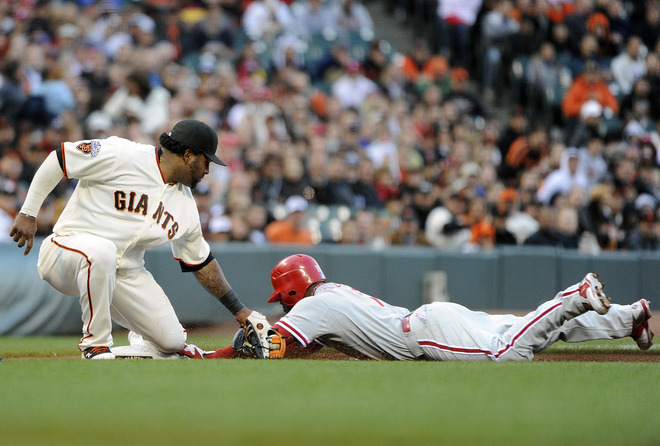
Jimmy Rollins steals lots of bases: did he steal one too many vs the Giants friday night? Photo: Thearon Henderson/Getty Images

(editor’s note: this post started with an email conversation amongst friends, where the Phillies fan amongst us didn’t think Rollin’s steal was “bad baseball.”)

The Giants and Phillies mixed it up in Friday 8/5’s game, a 9-2 victory (box/gamer) for Philadelphia that featured some “unwritten rule” discussion over the actions of Jimmy Rollins and subsequently Giant’s reliever Ramon Ramirez.

Here was the situation: the Phillies had just scored 2 runs to extend their lead to 8-2 in the top of the 6th inning.  The Giant’s starter Jonathan Sanchez had been knocked out of the game, and reliever Ramirez gave up a 2-run scoring single to Rollins.  Rollins promptly stole second base, and the next pitch plunked batter Shane Victorino.

Honestly, I believe it was a deserving retaliation by Ramirez and/or the Giants.  Stealing with a lead is a sliding scale; had Rollins done it in the 2nd inning with a 3-run lead it wouldn’t have gone punished, but the 6th is iffy with a 6 run lead.  Essentially, when the game appears to be out of reach, major leaguers have a tendency to just “play out the string” and expect this “conceding behavior” to be matched by the winning team.  Having been on both sides of many blowouts, there’s definitively a list of things you don’t do with a massive lead.  Steals and bunts are definitely out.  Curtailing aggressive play (taking extra bases, take-out slides, etc), swinging at 3-0 pitches and swinging out of your ass trying to hit homers are all examples of no-nos.  Certainly admiring homers and showing up a pitcher is a no-no, at nearly any point in the game (the Weaver incident earlier this week).

My Phillies friend apologist countered that the game was still close enough, that the Giants still had 4 at-bats, and the steal (though borderline) was justified.

Here’s some stats on the Giant’s offense and their capabilities of coming back, courtesy of baseball-reference.com:

  • The Giants are 0-8 when giving up 8 or more runs in a game.
  • They’re 12-26 when trailing after the 5th, no matter how many runs they’re down.  And,
  • The largest comeback they’ve had all season in being behind 4 runs.

I’d like to find some stats on how often baseball teams make up X-run leads, but my google skills are failing me.  I’m pretty certain though that the likelihood of making up 6 run deficits is pretty slim.  Tom Boswell has done research that shows that about half of all baseball victories feature more runs scored by the winning team in ONE inning than the loser scores the entire game (his “Big Bang” theory, based on his own research).  Sure enough, the Phillies scored more runs in the 5th inning (four) than the Giants did the entire game (two).

For me, the play was bush league, broke the unwritten rules of showing up your competitors and/or running up the score, and the retaliation was not only deserved but expected.

What do you think?

Written by Todd Boss

August 7th, 2011 at 9:56 am

Looking to the future: Ross Detwiler’s latest start

3 comments

Detwiler looked rather effective in his thursday start. Photo Haraz Ghanbari/AP via federalbaseball.com

For fans, the decline of the team over the past month has opened up opportunities to see glimpses of the future.  The trade of Jason Marquis opened up an immediate roster spot and it filled for the night rather ably by Yunesky Maya.  Unfortunately for Maya, his excellent start was shortened by a slight injury, which led to his demotion and subsequently he got rocked in his next AAA start.  Despite having former starter Tom Gorzelanny in the bullpen, manager Davey Johnson seems to have inserted 2007 first rounder and relative disappointment-thus-far-in-his-career Ross Detwiler into Marquis’ spot.  His first start upon his return was on Thursday August 4th against the Rockies in Denver (box/gamer).  How’d he look?

Detwiler took the loss, pitching 5 complete innings.  He gave up 5 hits, 3 walks, threw 68 pitches (only 38 of which were for strikes) with one strikeout.  Interestingly, he got 9 ground-ball outs versus just two fly-ball outs (both of which happened in the 5th, his last inning) and it took the Rockies until the fourth inning to even get a hit.   Detwiler didn’t necessarily seem to be keeping the ball down, but the Rockies were continually driving the ball into the ground.  This is definitely a good sign.  Has the team convinced him to pitch to contact more, and try to strike out fewer batters?  Because that seems to be his strategy.

So, after starting so well, what happened?  The Rockies hitters started squaring up his fastballs, most of which he was missing and hitting too much of the plate, and hit a series of solid line drives towards the end of the 4th and throughout the 5th.  Troy Tulowitzki had an excellent piece of hitting, driving an outside fastball to right field to give the Rockies two baserunners, and Ty Wiggington nailed a liner up the middle to score the first run.  Jayson Werth threw out a runner at the plate on the next single, saving Detwiler another run.  Desmond caught a screamer for the 3rd out of the inning, but the Rockies had hit the last 4 balls on the nose.  This trend continued into the 5th with Iannetta‘s leadoff double, a gapper to left center, followed (after a sac bunt) by another line-drive up the middle to eventually score him.  Detwiler got the last two outs on his only two fly balls (including a 410-foot drive to center from Todd Helton chased down by Ankiel), but Johnson had clearly seen enough.  The third time through the lineup is always tough to get through, even for good pitchers, but clearly the Rockies leading hitters were getting to Detwiler.  Johnson pinch hit for him in the top of the 6th and his night was done, despite only sitting on 68 pitches.

Relievers Balester and Mattheus each leaked in runs to allow Colorado to maintain its lead, the Nats were never really able to get to opposing starter Rogers (despite making him throw 30 pitches in the first), and Detwiler got tagged with the loss.

His arm-action has always seemed easy, and this night was no different.  He seems to be throwing effortlessly, and his release point seems to be a bit higher than the last time he featured in the majors.  This is a good thing; too much side-arm action means his curves move too horizontally to be effective.  On the night he wasn’t quite throwing as hard as we’ve come to expect: he averaged 91.9 on his fastball and humped it up to the 94.4 range on three different occasions (he can hit 95, as evidenced in his 7/5 start), more evidence that he’s working on command instead of power.  He only seems to have 3 pitches; slightly concerning for a “prospect” with his experience.  Fastballs that don’t seem to move much (pitch f/x calls them sinkers, but I don’t see a lot of sink), plus a change-up that he commands pretty well, and a curve that he clearly doesn’t trust (only throwing it twice all night).  In my opinion, major league starters need 4 pitches to survive, unless one of your pitches is such a lights out pitch with movement that you don’t need to develop secondary pitches).  Why doesn’t Detwiler have a cutter or a slider at this stage of his career?  In his only other start this season (July 5th against the Cubs), pitch f/x reveals similar pitch classifications.

Caveat: Colorado is a tough place to throw, so we need more starts to see what he really has.  Curves don’t move as much in the thin air and pitchers have a hard time keeping their hands moist enough to maintain their grips.  Plus conditioning really comes into play.

Conclusions: given the caveat, there is reason to be concerned about Detwiler’s future as a starter.  Is he really a two-pitch starter without a fastball with good movement?  If so, he’s destined for a reliever role.  The Nats clearly have a lot invested in the guy (first rounder, lots of bonus money) and he’s gotten a lot of chances and a lot of looks.  But I wonder where his long-term place is for this team.  Facing an options issue in the spring of 2012 (he’s out of them, thanks in part to Bowden’s ill-advised 2007 call-up), I’m guessing he may be eventually converted to relief.

Nats Trade Moves & Thoughts

3 comments

Previously I posted that I thought the Nats should trade pretty much everyone they could, given their current spot in the standings.  How’d they do?

Here’s the moves.

  • Acquiring Jonny Gomes: reviewed here.   We picked up Gomes for two minor leaguers that were either blocked (Rhinehart) or long shots (Manno).
  • Trading Jerry Hairston for a decent AA outfielder in Erik Komatsu.  Honestly I was a bit surprised Hairston was moved, given his valuable multi-position coverage for this team this year.  Komatsu wasn’t a BA top10 prospect for Milwaukee, but they did rate him as being the Brewer’s best hitting-for-average prospect in the pre-season.  He has a good pedigree (Cal State Fullerton product) and is doing well in AA this year.  He seems to be another attempt to build the outfielder pipeline that has been pretty poor, and has left the team continually struggling for a quality center fielder.
  • Trading Jason Marquis for a low-minors shortstop in Zach Walters.  Walters was spoken well of by his former U  San Diego teammate Sammy Solis, and has been hitting well this season (albeit he’s playing in low-A as a college draftee).  Some advocated against trading Marquis; not I though, figuring that Marquis was going to draw a decent prospect from somewhere.

In my “what I’d like to see the Nats do” post a few days ago, I basically advocated trading everybody we could.  Clearly having Laynce Nix and Ivan Rodriguez on the DL (either current or recently) prevented them from being trade candidates, and moving Livan Hernandez probably would have left a massive veteran leadership hole in the pitching corps.  We DFA’d Matt Stairs (not that he was ever going to be a trade candidate), and I’d guess that both Rick Ankiel and Alex Cora could still be waiver-wire trades made closer to the post season.  The one move that remains a surprise is not trading Todd Coffey, a decent right hander out of the pen that surely could have shorn up someone’s bullpen for a low-level prospect.

In the “non-move” category, I’m glad we didn’t move Drew Storen for Denard Span as was frequently mentioned in trade rumors leading up to the 7/31 deadline.  Honestly i’d rather pursue BJ Upton in the off season for a higher-ceiling guy.  Clippard is valuable but is a reliever, and despite the tendency of fans to overvalue their own relievers, the return didn’t seem to be worth the disruption to the bullpen.

I’m guessing a few of these expiring contract guys may be post waiver-wire trade possibilities, but all in all I’m happy with the moves and non-moves.  I certainly don’t agree with the pundits who are labeling the team “losers” in the trade market.

Wang is back; how’d he look?

5 comments

Wang got hit in his first game back. Cause for concern? Photo: The Washington Nationals

Chien-Ming Wang made his triumphant return to the Majors on July 29th, and promptly gave up 4 runs in the first inning back.   He was clearly nervous against the leadoff hitter Reyes, then gave up four consecutive singles (mostly hit well) en route to an ugly first inning.  A couple of loose plays behind him didn’t help (hence why 2 of the four first inning runs were unearned), but for a bit of time I was worried he would be relieved without getting an out.

Through the 2nd and 3rd innings he settled down, getting his sinker to move back across the plate instead of off of it, and looked pretty good.  Manager Davey Johnson more or less agreed, saying he was encouraged by the outing despite the results.

Wang’s fastball was a bit off of his 2007 peak, touching 93.3 and sitting mostly in the 91-92 range.  His breaking balls were mostly atrocious, floating over the plate and contributing to his woes.  He also attempted several split-fingered changeups with very limited success (only 2 of 7 for strikes).  However, his sink and movement seemed fantastic, and with more mound work I feel he can go back to being an effective starter.  If i’m Steve McCatty, I know exactly what i’m working on for his next start.

All told, the game was an 8-5 loss and you never want to give up 6 runs in 4 innings, but this team needs to stick with Wang for the rest of the season to see what they have.  Yes he is likely to get beat up, but if they have a reliable veteran starter who has a history of success in this league on the cheap, they need to find out.  I look forward to his next outing.

Written by Todd Boss

July 30th, 2011 at 5:14 pm