Nationals Arm Race

"… the reason you win or lose is darn near always the same – pitching.” — Earl Weaver

Syracuse 2010 Pitching season in Review

5 comments

This is the first in a series of articles reviewing the 2010 Nationals minor league affiliate pitching staffs.  I’ll post one a day for each of our levels starting with AAA and moving downwards.

AAA baseball rosters are unique among the affiliate teams.  By and large AAA rosters are not filled with a team’s burgeoning drafted talents; instead, AAA rosters are often storage lockers for “spare parts” for the major league roster (backup catchers, utility infielders).  Even more so, the AAA roster (in terms of pitchers) usually contains the last few guys cut from the MLB roster and/or relievers who couldn’t make the grade in the majors.  Certainly Syracuse’s pitching staff fits this bill, and had a ton of player movement (up and down) during the season.  Lets talk about where we landed at the end of the season:

(age is as of 12/31/10)

  • AAA Starters by Performance: Chico 27, Arneson 26, Kown 28, Martis 23, Mock 27
  • (rotation order: Chico, Martis, Arneson, Mock, Kown)
  • bullpen: Bergmann, Wilkie, Severino, Balester, Carr, Bisenius
  • spot starts: Mandel (demoted from starter)
  • promotions: Olsen, Slaten, Storen, JDMartin, Peralta
  • 9/1 callups: Balester, Maya, Bisenius
  • up-and-back: Bergmann, Chico (from AA), Stammen (and back), Atilano (and back), Severino, Balester
  • demotions: Spradlin, Zinicola, CJames, Kown (and back), MacDougal (and back), JJones, Garate
  • dl: English
  • cut/released: MacDougal, Villone, ABrown

Starter Review

Shairon Martis was the only rotational guy to spend the entire season in AAA, having lost out on the 5-man battle for the big club in spring training.  Chico came up after a few AA starts and got one spot start in the majors but was never seriously considered for either the rotation out of 2010 spring.  Arneson came up after some impressive AA performances and slotted into the AAA rotation nicely.  Kown spent the season going up and down from AA to AAA and looked halfway decent in 11 starts for AAA.  Lastly Mock just returned from the DL and made a couple of starts for Syracuse late in the season, replacing the spot that was occupied by Zimmermann on rehab and Maya on “extended spring training.”

Among those who didn’t end the season in the rotation but who gave Syracuse a number of starts: Mandel was put into the bullpen to aid in his conversion to a reliever, as has been done this year already with the likes of Stammen, Balester and other organizational arms.  Syracuse had no less than 23 guys make starts, a fantastically high number.

2011 Outlook for the 5 starters at the end (in order of 2010 performance).  All #s listed are for this level only.

  1. Matt Chico: 6-7, 3.73 era, 1.33 whip, 69/34 k/bb in 115 innings.  (he also made 5 similarly run of the mill starts in AA before getting moved up).  He’s still coming back from surgery technically, but a full season with mediocre minor league numbers combined with his advancing age (he’s 27 now) makes his prospects of ever contributing at the major league level slim.  He did feature nicely in his spot start this year and he did have a halfway decent 2007 season before getting hurt, but Baseball is a results oriented business and his aren’t cutting it.  2011 destination: Still in the AAA rotation but only because he’s a lefty.  He has already been removed from the 40-man roster.  He may lose out a rotation spot to one of the up and coming guys and languish as a middle reliever until cut loose as a minor league free agent.  His time as a prospect is probably over.
  2. Erik Arneson: 6-8, 3.95 era, 1.29 whip, 70/31 k/bb in 107 innings.  Arneson also had 13 appearances in AA before getting moved up.  Arneson’s numbers in AAA were just about identical to Chico’s.  Arneson’s problem is that he’s not a overpowering guy; 70ks in 107 innings against weak AAA competition is not what the team is looking for.  He’s 26 this year and will turn 27 during spring training next year, putting him as already being “old” for the level.  He’s already survived one rule5 draft, which officially makes him an organizational player.  2011 destination: AAA rotation or moved to the bullpen.  Unfortunately for Arneson, he’s not really a prospect anymore, he’s not a candidate to compete for the 2011 MLB bullpen (right handed harder throwers with more MLB-ready stuff like Balester and Mock make more sense) and there’s starters in AA that need to move up.  His status may depend on the 2011 major league rotational battle, and whether or not guys like Stammen and Mock continue to be starters.
  3. Andrew Kown: 2-4, 3.48 era, 1.34 whip, 41/16 k/bb in 62 innings thrown mostly in AAA starts (11 starts in 15 appearances).  Kown also had 15 starts in AA Harrisburg putting up similar ERA and k/9 numbers.  2011 destination: cut or released from the Nats organization.  Kown is right handed, turned 28 already and spent half the year in AA.  There’s just not going to be enough room on the AAA roster next year to keep a non-overpowering right hander around.  Plus he’s a minor league free agent and unlikely to be re-signed with a bunch of AA arms coming up.
  4. Shairon Martis: 8-7, 4.09 era, 1.42 whip, 99/60 k/bb in 152 innings.  After making the 2009 rotation out of spring training, Martis apparently showed up at 2010’s spring training out of shape and he never really got considered for the rotation.  He labored in AAA all year and never really was in the mix for a call up.  2011 destination: he’s already been DFA’d from the roster, the team apparently deciding that they had seen enough of Shairon in his 5 years here.  It is possible he stays with the team and tries to earn his way back into the mix.
  5. Garrett Mock: 1-1, 4.09 era, 1.27 whip in abbreviated AAA stint.  Mock was quickly demoted after a horrific MLB start (he pitched 3 1/3 innings, walked 5 guys and let another 4 get on base).  Soon after he was diagnosed with an odd neck injury (odd for baseball players), which cost him the season.  Luckily for the team it also saved them on Mock’s last option, so he will live on in the organization.  He has always had a live arm, and guys who throw mid 90s get chance after chance.  2011 outlook: Mock’s LAST chance to make the team as a reliever is probably 2011.  If he doesn’t stick this year, he’s out of options and will have to pass through waivers in 2012.

Written by Todd Boss

February 14th, 2011 at 10:42 am

Option Status of the Nats 40-man roster

12 comments

The closest Wang has ever come to pitching for our franchise. Photo Nats320/Jeff Saffelle

After asking myself the question, “Does player XYZ have any more options?” several times this year I decided to update Brian Oliver’s 2010 version of this post (available on his cherished yet idle website) for this year’s version of the Nats 40-man roster.

Here’s the key rules when it comes to Options (read here for a longer narrative form missive).

  • If a player is on the 40-man but not on the 25-man (active) roster, then they have to be placed on “optional assignment” to the minors for the year and they “burn” an option year.
  • If a player spends 20 days or less in the minors in a given year, then an option is not “burned.”
  • A player only gets three such “option years” while under contract to a given team; if they have been on optional assignment 3 years and are attempted to be optioned to the minors a 4th time, they are subject to waivers.
  • If a players has less than 5 years of professional service (at any level), the club can petition and usually obtain a forth optional year.  See this link at Baseball America for clarity on this (Thanks Sue Dienem).  The only way this really happens is if a guy gets added to the 40-man immediately after the draft and doesn’t languish in the minors, or if a player has a ton of injuries that eat up his minor league seasons.
  • If a player spends the entire year on the DL, or if the only minor league time is on a rehab assignment, then an option year is NOT burned.
  • If a player has MORE than 5 years of service, then according to the Basic Agreement that player can only be optionally assigned with his written approval.  In other words, the player can refuse such an assignment and immediately become a free agent.

And, before we go any further, here’s a great link defining how service time is calculated on mlbtraderumors.com.  This is important, because the credited years of service directly impacts whether or not a team can request a fourth option year.  The policy for both service time and Optional assignments are defined in the Collective Bargaining Agreement, Section XXI, though further details about Optional assignments are located in attachments, letters from attorneys and other sections of the CBA.

We’ll divide the 40-man roster candidates into several sections.  In all cases the service times listed are at the beginning of 2010, since Cot’s site has not  yet updated them for the 2010 season.  I didn’t bother to try to do the calculations, since they’re incredibly complex.  Years of service are listed in years.days, and a “year” of service is exactly 172 days.  So for example Pudge’s 18.109 means he has 18 full seasons plus an additional 109 days.

Section 1: Veterans who can refuse demotion based on Service Time.

Once a player has 5 or more years of Major League Service, the can refuse assignments to the minor leagues.  Therefore options are irrelevant on our older players; if they perform badly enough to be removed from the 25-man roster, odds are they’d demand to be released and would not accept an assignment to AAA.

Rodriguez, Ivan 18.109
Hernandez, Livan 11.097
Hairston, Jerry 9.127
Marquis, Jason 9.012
Werth, Jayson 6.102
Ankiel, Rick 6.033
LaRoche, Adam 6
Coffey, Todd 4.024

The only real 25-man question mark for me is Todd Coffey.  I’m listing him here assuming that the full season in Milwaukee put him over the 5 year threshold for service.  This is notable though; it virtually guarantees him one of the 7 bullpen spots and means the likelihood of someone like Cole Kimball, Adam Carr, Colin Balester, or Craig Stammen making the roster is significantly lowered.

Section 2: Players who have Options available but are MLB entrenched

Player Service Time per Cots as of beginning of 2010 First Added to 40-man Option Years Used Options left?
Zimmerman, Ryan 4.032 Sep 2005 none 3
Espinosa, Danny 0 Sep 2010 none 3
Storen, Drew 0 May 2010 none 3
Zimmermann, Jordan 0.168 Apr 2009 2010 2
Desmond, Ian 0.027 Nov 2008 2009 2
Strasburg, Stephen 0 Aug 2009 2010 2
Lannan, John 2.04 July 2007 2007, 2010 1
Morgan, Nyjer 1.12 Nov 2006 2007, 2008 1
Player Service Time per Cots as of beginning of 2010 First Added to 40-man Option Years Used Options left? Notes
Zimmerman, Ryan 4.032 Sep 2005 none 3 never used an option.
Espinosa, Danny 0 Sep 2010 none 3
Storen, Drew 0 May 2010 none 3
Zimmermann, Jordan 0.168 Apr 2009 2010 2 Arguable; 2009 may not have counted b/c he only had 2 starts.
Desmond, Ian 0.027 Nov 2008 2009 2
Strasburg, Stephen 0 Aug 2009 2010 2 Probably eligible for a 4th based on lack of svc time. Did 2009 count?
Lannan, John 2.04 July 2007 2007, 2010 1 Believe the 9 days in 2009 spent in minors did NOT burn an option year.
Morgan, Nyjer 1.12 Nov 2006 2007, 2008 1

Strasburg is a special case; he’ll move immediately to the 60-day DL and probably stay there til september, at which point he’ll make some rehab starts and likely not ever get to use an optional assignment.  As for the rest,  theoretically any of these guys could be sent down mid-2011 without any say, much as we did with John Lannan mid last year.  However, they are all slated to be starters and to be important members of the 2011 team.  I could see Espinosa or Morgan hitting a rough patch at the plate and getting sent down to work on their swings, but the rest should be fixtures at the MLB level going forward.  Zimmerman may have graduated to the first section but his option status is pretty much irrelevant; he’s our marquee player and won’t be optioned to the minors.  He’s halfway to being a 10 and 5 guy (meaning he gets automatic no-trade status).

Section 3: Players who have Options Available and thus will Jeopardize their ability to make the 25-man roster out of spring.

Player Service Time per Cots as of beginning of 2010 First Added to 40-man Option Years Used Options left?
Flores, Jesus 2.158 Dec 2006 2008 2
Maya, Yuneski 0 July 2010 2010 2
Stammen, Craig 0.137 May 2009 2009, 2010 1
Balester, Collin 0.125 Jun 2008 2009, 2010 1
Atilano, Luis 0 Nov 2008 2009, 2010 1
Ramos, Wilson 0 Nov 2008 2009, 2010 1
Detwiler, Ross 0 Sept 2007 2008, 2009 1
Mock, Garrett 1.007 Oct 2007 2008, 2009 1

First off, I believe Luis Atilano is going to be the next 40-man victim, but even if he was retained in favor of another he has little shot of making the team out of the spring, and will eventually be cut loose from the 40-man roster.  Maya‘s status will depend on his spring training but in all likelihood he’s starting the year in AAA (see the next section for some reasoning as to why).   Whoever loses the backup catcher role will burn the last of their remaining options, making a trade even more likely in the near future for one of Ramos or FloresDetwiler‘s well timed injury last year allowed him to pitch in the minors on an extended rehab assignment, then get called back up to the Majors without burning an option; that last option probably gets burned in 2010 as he seems 7th or 8th in line for 5 rotation spots.  Similarly to Detwiler, Garrett Mock‘s injury diagnosis so soon after being optioned (after blowing his first start) allowed the Nats to cancel the option, put him on the 60-day DL and save his services for one more year.

Lastly both Balester and Stammen have options left and both may end up using them this year; I see these two players competing for the long man/spot starter position with Coffey and Henry Rodriguez, which is bad news since Rodriguez is out of options (see next section).  2/11/11 update: Stammen may not have burned an option in 2010 by virtue of spending fewer than 20 days in the minors, per Sue Dinem.

Section 4: Players who have No Options available

A caveat before moving on; while some of these players have no options left, some of them have so little service time that the team may petition the league for a fourth option year.  Such petitions (if i’m reading the rules correctly) do not occur until the end of spring training and thus we do not know who may be subject to this rule.

Player Service Time per Cots as of beginning of 2010 First Added to 40-man Option Years Used Options left?
Wang, Chien-Ming 4.159 Mid 2003 2003, 2004, 2005 0
Burnett, Sean 3.085 Nov 2003 2004, 2006, 2007, 2008 0
Gorzelanny, Tom 2.16 Sept 2005 2006, 2008, 2009 0
Morse, Michael 2.114 Nov 2004 2005, 2006, 2007 0
Slaten, Doug 2.067 Nov 2005 2006, 2008, 2009 0
Gonzalez, Alberto 1.135 Nov 2006 2007, 2008, 2009 0
Bernadina, Roger 1.041 Oct 2007 2008, 2009, 2010 0
Clippard, Tyler 0.148 May 2007 2007, 2008, 2009 0
Rodriguez, Henry 0.016 Nov 2007 2008, 2009, 2010 0

Now, here’s where the roster decisions become rather interesting.  Lots of these players listed here are in open competitions for spots this spring and their lack of options may be telling.  Lets go section by section:

  • Chein-Ming Wang:  He’s seemingly just a few days short of the 5 year requirement to refuse assignment, but the Nats wouldn’t possibly have given him a major league deal if they were out of options and essentially had to guarantee him a major league spot.  My guess is either the Nats are going to look to start him on the DL, claiming some post-rehab injury if he doesn’t make the starting rotation or peitition the league for a fourth option year.
  • Tom Gorzelanny: he has no options left, is signed to a $2M contract and will be either the 5th starter or a long man out of the bullpen.  This fact pretty much guarantees that he makes the opening day roster and almost certainly guarantees that Maya, Wang and Detwiler (barring spring training injury or huge shock) are starting the year in the minors.
  • Burnett, Morse, Bernadina, Clippard: All four of these guys are expected to make the roster rather easily, so no option issues should exist.  The one question mark could be Morse, who despite hitting the cover off the ball last year watched the Nats systematically bring in player after player to compete with him for his bench role in 2011.  We signed Ankiel, we traded for Corey Brown, and then invited four other outfielders to spring training.  My guess is that the Nats will keep 5 outfielders though and he’ll be safe.
  • Slaten signed a relatively modest deal for $695K for the year, and really only faces competition from one guy for the loogy spot (Severino, who has never pitched in the majors before).  So the odds are high that he makes the team in that role.  He’s out of options, has been DFA’d in the past and passed through waivers with our team once before, but his performance last year would probably result in his being claimed this year.
  • Alberto Gonzalez: He also settled pre-arbitration for $700k but hit badly last year, made noise about wanting to be a starter, and watched the Nats bring in Hairston, Cora, and Cintron to compete with him for the utility infielder.  If he doesn’t have a good spring, there is little value in keeping him on the 40-man roster.
  • Henry Rodriguez: out of options, and someone we gave up Willingham to get, so he’s basically guaranteed a 25-man spot.  This (as noted above) essentially eliminates the possibility of someone like Kimball, Carr, or Stammen to make the team.

2/11/11 update: Sue Dinem points out that Bernadina did NOT burn an option in 2010, having only spent a few days in the minors.  This is important as it may lead to him to be sent down if we decide to keep one extra outfielder.

Section 5:rule 5 pickups that have no chance of making the team

The two remaining players on the 40-man right now not previously mentioned are our two rule5 pickups Elvin Ramirez and Brian Broderick.  I feel neither guy has any chance of making our 25-man roster, and both will be either returned or a trade negotiated.  Because both were never on a 40-man, they both have zero service time and all 3 options remaining at this point.

Coincidentally, here’s my prediction on the opening day 25-man roster, based on the above analysis:

  • SP: LHernandez, Zimmermann, Lannan, Marquis, Gorzelanny
    RP: Burnett, Slaten, Clippard, Storen, Balester, HRodriguez, Coffey
    C: IRodriguez, Flores
    INF: Desmond, RZimmerman, AGonzalez, Espinosa, LaRoche, Hairston
    OF: Bernadina, Morgan, Morse, Werth, Ankiel

5 outfielders, Flores over Ramos and Gorzelanny over Maya and Detwiler.

Written by Todd Boss

February 10th, 2011 at 3:42 pm

Posted in Nats in General

Should we leverage our Catching depth in a trade?

4 comments

Jesus Flores' general reaction to his injury troubles for the past two seasons. Photo Toni Sandys/Washington Post

MASN Nats beat writer Ben Goessling touched on this same issue back in December and came to the same conclusion that I have: The Washington Nationals may have some catching depth to spare when April 1st rolls around.  We have Ivan Rodriguez and Wilson Ramos as the incumbents (having DFA’d last year’s backup Wil Nieves, since signed by Milwaukee).  But we also have former starter Jesus Flores coming back from injury and seemingly healthy.   Plus our #1 hitting prospect not named Bryce Harper is Derek Norris, also a catcher.

At the end of the spring, I think we’re going to see Flores winning out the 2nd catcher position (by virtue of his age, his experience with the team, and the memory of his 130 OPS+ numbers he put up in 2009 before getting hurt).  But there’s little value in having one of the better Catching prospects in all of baseball languishing in Syracuse while we wait to see if Pudge or Flores suffers an injury.

I can see the Nats moving Ramos or Flores if the right deal comes about.  But, the Nats probably need an entire spring training of production out of both guys to prove to other teams that they are healthy and viable candidates.  Flores might be a tough sell to teams since he missed most of the last two seasons and seems brittle … but his numbers when he’s healthy are middle-of-the-order.  Meanwhile the entire league knows what Ramos is capable of and he may be a better trade candidate.

Also factoring in is the development of Derek Norris; at this point we’re all assuming he’s going to start in AA and be ready to take over one of the two MLB catcher spots when Pudge’s contract expires after this season.  If Norris takes a huge step back or suffers a season-ending injury, then nobody is going anywhere and the Nats will plan for Ramos/Flores platoon in 2012.

The Nats still have needs at the MLB level for 2011 though; you can argue that we really could improve at LF, CF and in the starting rotation.  Meanwhile, there are several teams out there going into 2011 with question marks at catcher.  Looking at these depth charts league wide, here’s some possible trade partners (barring injury to existing guys of course):

  • LA Angels: Jeff Mathis and Hank Conger are their current catcher starters.  Who?  Conger is very young but neither hit the Mendoza line for 2010.  But the Angels so badly bungled this off season they may be reticent to make any more trades.
  • LA Dodgers: Gave up on Russell Martin, so going into 2011 with journeyman Rod Barajas (career .239 hitter) and AJ Ellis (turns 30 in april and has a grand total of 141 major league plate appearances to his credit).  They have starter depth (Padilla looks to be odd man out and would improve our rotation).
  • Boston: Jarrod Saltalamacchia is listed as the starter over the ancient Jason Varitek; neither guy can actually hit and both are defensive liabilities.  Boston is clearly making a playoff push and may want a top-end defensive guy behind the plate for the playoffs.
  • Colorado: Chris Iannetta only hit .197 last year but has shown glimpses of power in the past.  Colorado let their 2010 starter (Soto) walk but they may have a hole at the Catcher position.
  • Milwaukee: we could convince the Brewers to upgrade from up and comer Jonathan Lucroy for their 2011 playoff push.  But they’ve emptied their farm system and probably have little we would want in return.
  • NY Yankees: are they really expecting Russell Martin to be the savior?  Or is there going to be a C/DH platoon with him and Posada (more likely the answer).
  • NY Mets: catcher has been a thorn in this team ever since the Nats “stole” Flores from them in the rule5 draft in 2006.  Now they’re going into 2011 with the very young Josh Thole as the starter.  But the Mets are a total mess right now and probably don’t make any more moves until the Madoff lawsuits are settled.
  • Kansas City, Pittsburgh, San Diego and Houston teams that *could* use catcher depth but which would never purchase it given their current rebuilding status (or cheapness as a franchise).

It should be interested to see if a trade surfaces early on into the season.  We’ll see.

Written by Todd Boss

February 9th, 2011 at 10:12 am

Posted in Nats in General

Pettitte was a very good pitcher… but no Hall of Famer

one comment

Pettitte stares down another hitter. Photo noahhunt.org

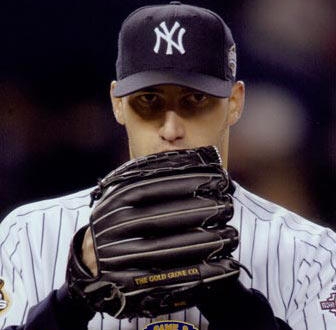
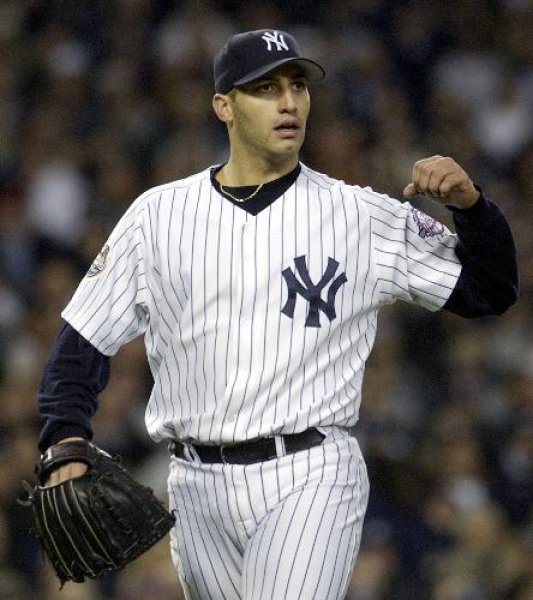
Andy Pettitte‘s retirement (see my previous post for thoughts on its effect on the Yankees season) has lead to a series of inevitable posts about his Hall of Fame worthiness.  Si.com’s Joe Sheehan wrote this opinion piece after Pettitte’s retirement, saying that “Modern era of baseball demands Cooperstown find place for Pettitte.”  I won’t really go into his arguments except to say that he believed that Bert Blyleven was “wildly overqualified” for the hall, a position that I “wildly” disagree with and posted as much here about a month ago.  So its doubtful that I’d agree with his sentiments.

(Note; for the purposes of this article we will ignore the fact that Pettitte’s chances of getting voted into the hall in light of his PED usage admissions are somewhere between zero and nil anyway, and just think of his career in its merits).

So far, from what I’ve seen from the baseball columnists who have opined on the subject, there seems to be about a 50-50 split pro and con for the Hall.  Joe Lemire seems to agree with Pettitte’s own assertion that he is not Hall-worthy, Buster Olney thinks he’s a borderline candidate but th inks that he may be a Veteran’s committee inductee some day, and Jayson Stark thinks he’s not quite Hall worthy.

For me, Pettitte is NOT a Hall of Famer.  His career numbers show him to be a consistent hurler who was essentially a very good #3 pitcher on a number of very good Yankees teams.  He finishes his career with a 240-138 record, a career 3.88 era, 1.357 career whip and a 117 career ERA+.  His season-ending accomplishments include:

  • 3rd place in his Rookie of the Year voting (losing out to Marty Cordova and Garrett Anderson)
  • 5 years (out of 16) receiving Cy Young votes, though only one of those 5 years was actually meaningful in terms of the voting.  He finished 2nd to Pat Hentgen in the 1996 voting.
  • 3 all star appearances.

His enduring legacy is his post season career, where he has more appearances and more wins than any other pitcher.  He pitched in the post season in 13 of his 16 professional seasons, had 42 starts altogether, and compiled a 19-10 record with a 3.83 era and 1.304 whip.  These numbers are more or less in line with his career numbers, indicating that he was a good pitcher but not great.

I would be a stingy hall voter.  For me the qualifications of a Hall of Fame pitcher include all the analysis of career achievements, but also some semantical arguments:

  • Was the pitcher ever the best player on his team for a consistent period of time?  (no)
  • Was the pitcher a guaranteed shut-down hurler who was worth the price of admission? (no)
  • Was the pitcher regularly an all star and frequently STARTED the all star game? (no)
  • Were you, as a fan of the opposing team, ever “scared” to hear that Pettitte was going against your team? (not really).

At the bottom of Pettitte’s B-R page, his Hall of Fame Monitor score puts him at 42 .. which is better than Jack Morris but below the 50 range that generally qualifies a player as a HoFamer (this is Bill James‘ concoction and the one overall HoF score that I agree with).  But also more telling is the list of pitchers that Pettitte is most like.  Top two: David Wells, Kevin Brown. .  Ironic that these guys were also middle-of-the-rotation Yankees hurlers who gained many wins by virtue of being along for the ride on one of the best teams ever constructed (the late 1990s Yankees teams).

Bottom line; Pettitte was a good teammate and by all accounts a nice guy who made an awful lot of money in his career and goes down as one of the most decorated Yankees ever.  But he’s not one of the BEST ever.

Ladson’s inbox; my answers to his questions

one comment

I cannot recall which National’s blogger used to do this (providing his/her own answers to the questions in Bill Ladson’s mailbag) but I thought i’d give it a shot.

Here’s the latest installment of his mailbag.  And here’s how i’d answer the questions he took.

Q: When does Ryan Zimmerman get a contract extension similar to the one Troy Tulowitzki received from the Rockies?

A: Probably never; odds are that he leaves our franchise for greener pastures (read, a competing team) where he immediately becomes a perennial MVP candidate and solidifies his Hall of Fame candidacy.  Because as it stands now, he’s winning only the title of “most under-rated player in the game.”  Go look at Mark Teixeira‘s stats and season-ending accomplishments just before and just after his New York signing.  Or ask Bert Blyleven why it took so long to get into the hall after playing for crummy teams his whole career.

Q: I think center fielder Nyjer Morgan played OK last year and deserves to be the leadoff hitter. I believe no one else on the current roster can hit at the top of the lineup. What do you think?

A: Morgan regressed both professionally and statistically last year, and Rizzo should have tried harder to find a replacement.  What’s probably going to happen is Morgan starting the season as a starter, he’ll hit .220 for a month and a half, and we’ll banish him to AAA before non-tendering him next off season.  I feel we should have tried harder to replace him in the off-season.

Q: If Bryce Harper has a great Spring Training, do you think the Nationals will keep him on the 25-man roster or send him to the Minors?

A: No way for one simple reason: “Super 2 status.”  Best case scenario has Harper blowing through the low-A and high-A leagues, then starting 2012 in AA before getting called up June 1st to delay his arbitration clock and play left field for the team (or perhaps moving Werth to left and starting in RF).

Q: Do you think Chien-Ming Wang could return to the form that made him one of the top pitchers with the Yankees? What is the latest on his physical condition?

A: Signs point to no after a lost 2010 season.  At least he’s less of a payroll burden this year when he misses the entire season.  By all accounts he’s supposedly at 100% but nobody knows what we’ll get until he starts throwing in Viera.  I could see him flashing promise in Viera then spending 3 months on the DL.

Q: In 2007, the Nationals came to camp with so many starting pitchers that they were drawing attention from the local media. This year, the Nationals have a similar situation as far as the number of starting pitchers. Can you tell the difference between the two years? Why should Nats fans be encouraged by this year’s class?

A: Definitely disagree here; unlike in 2007 there is almost no starter competition planned.  We have a presumptuous opening day roster of starters and only an injury or a huge spring upset will change that.  Lots of the Spring Training invite guys are going to be buried in AAA or were invited as professional courtesy for past years of service.  As far as encouragement for this year’s rotation; it is marginally better than the 5 guys who started 2010 and has some potential for improving with prospects that we value well.  It isn’t a league-leading rotation but it has some basis for growth towards 2012/2013.

Q: Do you think the Nationals need one more big-time bat or proven hitter to get them to .500 in 2011?

A: No, they need 3 more proven starters.  See Giants, San Francisco for building a winning team with a poor offense.

Q: What are the chances of the Nats making a run at Prince Fielder next offseason? It seems that one more big bat would make them a very good team.

A: Like the movie, the answer here is “Less than Zero.”  Rizzo wants UZR/150 plus-plus fielders across the board, and Fielder is absolutely NOT that.  Ladsen say’s we’re committed to LaRoche; I’d disagree with that sentiment too.  He is a 2 year stop-gap until either Chris Marrero matriculates and earns his spot or another option becomes available.

Written by Todd Boss

February 8th, 2011 at 3:40 pm

Pettitte’s retirement spells doom for the Yankees season

one comment

Pettitte is done ... leaving a massive hole in the Yanks rotation. Photo: noahhunt.org

One of the last major off-season issues to resolve prior to the beginning of spring training (the status of lefty Andy Pettitte) was resolved with the pitcher announcing his retirement earlier this week.

The retirement leaves the Yankees rotation in serious trouble.  Pettitte may have only given the 2010 team 21 starts but he went 11-3 in those starts and was the Yank’s 2nd best pitcher.  They failed to acquire any of the marquee free agents or trade targets in the off-season and are going into 2011 with this as a rotation: Sabathia, Burnett, Hughes, Nova, and Mitre.  The problem is that after Sabathia, every one of these guys has serious question marks;

  • Hughes may have gone 18-8 but his accompanying numbers (4.19 era, 1.28 whip) only rated a 102 era+ for the season.  That’s essentially league average.  He benefited from some pretty amazing run support that probably cannot be sustained in the long term.  It was also his first year starting full time.  He has a great pedigree (1st round pick in 2004) and has pitched well.  But he may be a candidate for the Verducci effect of quickly increasing workload.  The Yanks have been burned in the past by young starters blowing out their arms (Wang).
  • Burnett may be the latest in a long line of quality pitchers who just cannot perform in the spotlight.  He was relatively awful in 2010; 10-15, 5.26 era, 1.511 whip.  Most teams would put up with this in a 5th starter if the guy was a promising rookie … but Burnett is a highly paid supposed ace starter.  He’s never been a complete lights out starter, sports a career 110-100 record and should never have been given a $84M contract to begin with.
  • Mitre is a 29-yr old journeyman pitcher with a career 13-29 record.  And he’s slated to be the Yankees #4 starter.
  • Nova looks like he could be a ok back of the end starter prospect … but he owns a grand total of 3 career major league starts.  And he’s slated to be the #5 starter.

New York has signed a couple of MLB veterans in Freddie Garcia and Bartolo Colon to minor league deals, and they may provide insurance/competition for Mitre and Nova in the spring.  But there is a reason these guys couldn’t catch on with even the worst teams out there; they’re more likely to put up a 6.00 era than a 3.00 era.  Perhaps Garcia’s decent 2010 season may land him a rotation spot, but Colon hasn’t pitched in the majors in over a year and was awful then.

Now, the Yankees are still one of the best offensive teams in the league and can slug their way to a number of 8-6 wins … but in a division where Boston has restocked and looks dominant and Tampa has a rotation that New York only wishes it had, 3rd place looks like it is in the Yankees future.  Writer Jon Paul Morosi thinks that the Yankees won’t miss Pettitte, but i think he’s crazy.  His article seems to just assume that a Fausto Carmona trade is a done deal (despite the fact that the Yankees have swung and missed on every pitcher acquisition this off-season).  He also assumes that 3 prospects that nobody has heard of (Dellin Betances, Manny Banuelos or Andrew Brackman) will magically come to the rescue.  Banuelos and Betances each are grizzled minor league veterans with 3 AA starts to their credit, and Brackman isn’t that far ahead of them (he was 5-7 with a 3.01 era in 15 AA starts in 2010).  Yeah; not exactly Jeremy Hellickson-esque prospects waiting in the wings.

2/7/11 update: Seth Livingstone at USA Today wrote about this same topic and reviewed some other possible prospects in the Yankees system that may be better options than the three mentioned above.

There are definitely some arms to be had in the trade market.  Joe Blanton is probably available, the Braves may have an extra starter in Kenshin Kawakami if their up and coming prospect Mike Minor blows it out in the spring, the Dodgers have 6 starters for 5 slots and may give up Vicente Padilla once the season starts, and even the Washington Nationals may have an extra arm or two worth gambling on (Maya, Wang and Detwiler are all slated to start in the minors right now).

Without a move though, I say “Welcome to 3rd place” and only the 2nd time you’ve missed the playoffs since the wild card era.

Rotation Predictions for the National’s System 2011

7 comments

Your 2011 Opening Day starter. Photo: AP/Washington Times.

I started this blog to talk about the Nationals pitching staffs on the various levels, since that’s always been my obsession with this franchise.  However time constraints and the off season have limited my posts and analysis.  Today, for the first time in quite a while, I’m going to write about that which this blog supposedly focuses on: Nationals pitching.

Initially I was going to do an in-depth review of all 5 minor league pitching staffs for 2010 with detailed predictions for 2011.  Now that we’re 3 weeks away from pitchers and catchers reporting … I’m giving up on finding the time 🙂

However, here’s my thoughts on who I would be putting into the rotations of each level to start 2011.  These rotations cascade downwards from the top obviously, and assume no injuries.


Washington Nationals/MLB

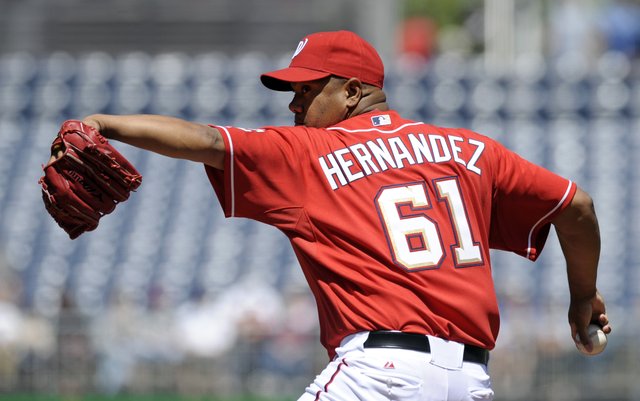
Prediction Livan, Zimmermann, Lannan, Marquis and Gorzelanny in that order.

Despite some people (Ladson, Bill) thinking that we acquired Gorzelanny to be a middle reliever, in my mind Rizzo made the acquisition because he doesn’t trust either Maya or Detwiler in the #5 slot.  And I wouldn’t either; In 5 starts last year at the MLB level Maya looked outmatched and unable to keep MLB hitters at bay.  I like Yunesky Maya and think he can be a competitor in this league.  He was probably rushed through the minor leagues last summer and wasn’t ready for what he saw in September.  However, he fared very well in the Dominican Winter league (named best pitcher) and could change some opinions by beating out Gorzelanny for the #5 spot.

Meanwhile Ross Detwiler looks like a busted #1 pick, not able to stay healthy long enough to make an impression and (thanks to an incredibly questionable decision to call him up in Sept 2007) he’s quickly running out of options.  He’s in a similar boat as Madison Bumgarner; a lanky lefty who throws across his body with some pace, making consistency difficult and making his breaking pitches too horizontal.  Personally, i’d suggest packaging him in a trade and making the argument that he’s still a #1 overall pick who hasn’t gotten opportunity here.  Unfortunately competing GMs know what we know and probably are not giving up decent talent to get him.

This isn’t the greatest rotation in the league (most pundits easily put it in the bottom 5 right now), but it is an improvement over 2010’s opening day rotation (Lannan, Marquis, Stammen, Livan and Mock in case you forgot or blocked it from your memory).  If Wang can somehow show he’s healthy and productive, then our 2012 potential rotation of Strasburg, Zimmermann, Lannan, Wang and decent FA could be halfway decent.


Syracuse/AAA

Prediction: Maya, Detwiler, Arneson/Stammen, Tatusko, Roark.

Syracuse ended 2010 with this rotation (ages next to names): Chico 27, Arneson 26, Kown 28, Martis 23, Mock 27.

What a difference a couple weeks makes in terms of predicting a rotation.  We have DFA’d Martis, released Martin and outrighted ChicoKown is pushing 30 and was already a minor league free agent signing to begin with.  Mock continues to have a future in this organization by virtue of his live arm, but he’s never put it together at the MLB level and nobody seems to know if it is as a reliever or a starter.  For now I’m predicting that he ends up either being converted to a reliever or outrighted off the 40-man.

The AAA rotation probably ends up being a mix of promotions from AA and spring training losers from MLB.  I’m going under the assumption that Atilano gets DFA’d in the next week or so to make room for signings as they become official, and i’m assuming that Stammen is being converted to a middle reliever and is out of the starter mix.  Additionally, Mandel clearly has been converted to a reliever and looks set to stay there.

Arneson may be an odd-man out here as well; he’s not on the 40-man and has survived a rule 5 draft or two.  If the Nats want to keep Stammen as a starter, I could see Stammen taking Arneson’s place here.

Lastly, the two promotions from last year’s AA rotation are the two hurlers Tatusko and Roark we got from Texas in the Guzman trade.  Both came over from Texas’ incredibly strong AA affilliate and both continued dominating in the Eastern League.  In 6 starts , Tatusko had a 1.72 era, a 9k/9 ratio and a 1.17 whip.  Roark’s numbers were slighly worse but still better than anyone else on our AA squad.  The only problem is that both guys are “old” for AA and may be quickly moving from “prospect” to “organizational arm.”  I’d like to see what both guys can do in AAA.

We have a couple of additional names that may show up in this mix.  Brian Broderick was a rule-5 pickup from St. Louis that seems to be a long shot to crack either the MLB rotation or the bullpen.  However in this day and age, it seems that most rule5 guys are eventually acquired instead of returned, so I can see a lower-end prospect trade for the guy if he sufficiently impresses during spring training.  Also, Ryan Mattheus seems to be a favorite of the organization as well, and has signed a more-than-minimum deal for 2011.  Chuck James signed on as a minor league free agent and bounced around multiple levels of our system, always pitching fantastically, but never sniffed a call up or even a second contract.  I’d be curious to see where he ends up in 2011.

2/4/11 update: We have re-signed both JD Martin and Matt Chico and invited them to spring training, which may indicate that they could factor into the AAA rotation discussion.  The question may be; is it better to give Roark and Tatusko starts at the AAA level to see what they can do, or should we have open competition to see who shakes out?  I think we know what we have with both Martin and Chico (as does the rest of the league, since no one claimed them upon release and nobody gave them a major league deal).  We’ll see what happens.


Harrisburg/AA

prediction: Meyers, Peacock, Milone, Lehman and Holder

Harrisburg ended 2010 with this rotation: Peacock 22, Milone 23, Thompson 23, Roark 24, Tatusko 25.

Other notable names in the rotational mix for Harrisburg in 2010 include Mandel (promoted to AAA and converting to a reliever), Brad Meyers (injured after starting the season incredibly hot), Andrew Kown (moved up to AAA but probably not being retained), and Chuck James (who signed a minor league deal and pitched great, but does not seem likely to be retained).

Aaron Thompson (bounty for the Nick Johnson Trade) never lived up to his expectations as a Florida #1 draft pick and was DFA’d earlier this off season.  He got picked up by Pittsburgh (as did Scott Olsen) and that may be a better place for him to attempt to advance his career.

I believe we’ll see 3/5th of the starting 2010 rotation starting in Harrisburg in 2011, based on age and the log jam of hopefuls in AAA.  I like Meyers and hope to see him continue to dominate AA and have a healthy season.  We’ll see the two best starters from last year’s Potomac team (Lehman and Holder) moving up to start in AA.  I’d like to see Holder (who was considered a reach of a draft pick in 2009 by most pundits) to succeed and show his worth in 2011. This seems like a pretty strong group and will join some serious batting firepower coming up from high-A for the Harrisburg team in 2011.


Potomac/High-A

prediction: Frias, Rosenbaum, Bronson, Fabian, Applebee

Potomac ended the 2010 season with this rotation: Lehman 24, Holder 23, Frias 22, Alaniz 26, JJones 28

Potomac’s rotation was all over the map in 2010 due to injuries and promotions.  Jaime started the year
on the DL, Morris, Rosenbaum and Fabian ended the  year on the DL, which forced the continued use of
minor league retread Jones and effective but old Alaniz in starting roles.  We’ve moved AJ Morris (who
would have been Potomac’s ace last year) in this offseason for Gorzelanny, leaving open some opportunities.
And we gambled taking Jaime off the 40-man roster and lost, with Arizona quickly claiming him.  That move was necessary but probably a mistake, as Jaime was a live armed guy who at one point was a top 10 Baseball America system prospect for us.  Ah well; we had to keep a spot open for JD Martin you realize!

I’m predicting that Lehman and Holder move up to AA to start based on their age and time in the minors.
Neither guy really dominated the Carolina league last year but Lehman features a very good K/9 ratio and
Holder is a very high draft pick that the team isn’t about to give up on.  That leaves high-A holdovers from
2010 Frias, Fabian and Rosenbaum to lead the line.  Frias’ numbers were not great, but he was only 22.
Rosenbaum was effective before going down with injury.  The others (Bronson, Fabian and Applebee)
earn the spots more through a slight gap in the prospect line between the low-end leagues and high-A.

I’m not as confident with these predictions, and we very well may end up seeing Lehman and Holder starting
out the season in High-A again, with the plan to quickly move them up to AA.


Hagerstown/Low-A

Low-A prediction: Solis, Clegg, Demny, Ott/Jenkins, Grace

Hagerstown ended the 2010 season with this rotation: Low-A: Demny 21, Hicks 20, Bronson 23, Applebee 22, Ott 22.

Other notable names in the 2010 mix included McGeary (tommy john surgery; what a mess for this guy.  First round talent, bought him out of his Stanford commitment only to watch him struggle at every level.  You have to wonder if he’ll ever return), Clegg (who was 9-3 and pitching very well for a 21st rounder before DL), Smoker (another Bowden toolsy draft pick whose career seems to be in the toilet), and Sammy Solis (two spot starts after signing in mid august as a high-profile 2nd rounder).

We have traded Hicks, who didn’t have the greatest numbers last year but was only 20 pitching in a full season.  I’ve got Bronson and Applebee in the high-A rotation for now.

I think Solis’ success in the AFL may earn him a spot in high-A to start; if so switch Solis and Applebee.
Clegg has a chance to quickly move up the ranks as well and may be in line for a quick promotion.  Demny was young for low-A last year and had a decent first full season; i’ll bet he starts in low-A again and moves up mid-season.  Lastly, Ott came up late last year and had two unremarkable starts but there isn’t much else to compete with him, unless one of the college-guys from short A has an amazing spring and beats him out.   Jenkins possibly could  be in the mix here, being a lefty with good K/9 rates and being a bit too old to stay in short-A.  Finally, i’m predicting that 2010 draft pick Grace gets a look.  He was an 8th round pick out of UCLA and didn’t have the best numbers in the GCL … but he is a lefty, he doesn’t walk a ton of people and he could be a sleeper.

I have seen a couple of sites that believe we’ll be starting both A.J. Cole and Robbie Ray in full season Hagerstown.  I have a very hard time seeing that; both basically lost the entirety of 2010 in terms of professional development by waiting until August 15th sign, meaning that they both got minimal innings.  I think they stay in Florda as camp breaks and start in the GCL.  See below…


Short-A (Vermont last year, Auburn this year) and GCL/extended spring

Prediction: Cole, Ray, Hanks, Meza, KLopez, King, Encarnation and 3-4 starters that we draft in 2011.

Vermont ended 2010 with this rotation: Jenkins 22, Hansen 21, Swynenberg 21, Jordan 21, McKenzie 21/Bates 22
The GCL ended 2010 with this rotation: Hanks 20, Meza 20, KLopez 20, King 20, Encarnacion 21

There was not a whole lot to like about Vermont’s 2010 rotation.  The four guys who got the most starts
all had almost identical numbers in terms of ERA, Whip and K/9 (for me the three numbers most worth
looking at for minor leaguers).  They were all in the mid 4s in ERA with decent K/9 rates.  It is hard to see
any of them really having an impact; i’ll guess that most of them get converted to middle relief and move up
to comprise Hagerstown’s bullpen or repeat the Short-A season to determine if they have a future in professional baseball in general.

Meanwhile the GCL saw a very high number of starts go to rehabbing starters in 2010.  By my count, 14 of the 56 starts in GCL last year were either rehab starts or “extended spring training” starts for guys that
were headed for upper levels.  This may have been due to the lack of young starting pitcher prospects available to us, since the starts we did get from prospects in the GCL (Hanks, Meza, KLopez, King) were as unimpressive as the starts we got out of Vermont.

In many ways both rotations really depend on who we draft in June, since both leagues essentially start just after the draft.  The higher-end/older draft picks fill up the short-A roster, while the younger/lower-end draft picks form the GCL roster.  I’m guessing that both the starlet high school arms out of 2010’s draft (Cole and Ray) start in extended spring and then move up to short-A when they’re ready.  I do not believe they’ll start in Hagerstown based on the lack of professional innings in 2010.  They’ll be initially supplimented by the four 20-yr olds in GCL last year until solutions make themselves apparent.  If guys like Meza, King, Lopez and Encarnation do not improve, they’ll soon be converted to relievers or outright released to make room for the next set of draft picks.


Thats it.  From an organizational perspective, it seems that outside of Ray and Cole we have very few starter prospects anywhere below low-A, and that our pipeline seems thin right now.  Perhaps something to think about during the 2011 draft, which is very college-arm heavy and we have 3 early draft picks. Hopefully we identify some fast-moving arms and continue the improvement of the system in general.
Written by Todd Boss

February 4th, 2011 at 3:14 pm

Who comes off the 40-man?

5 comments

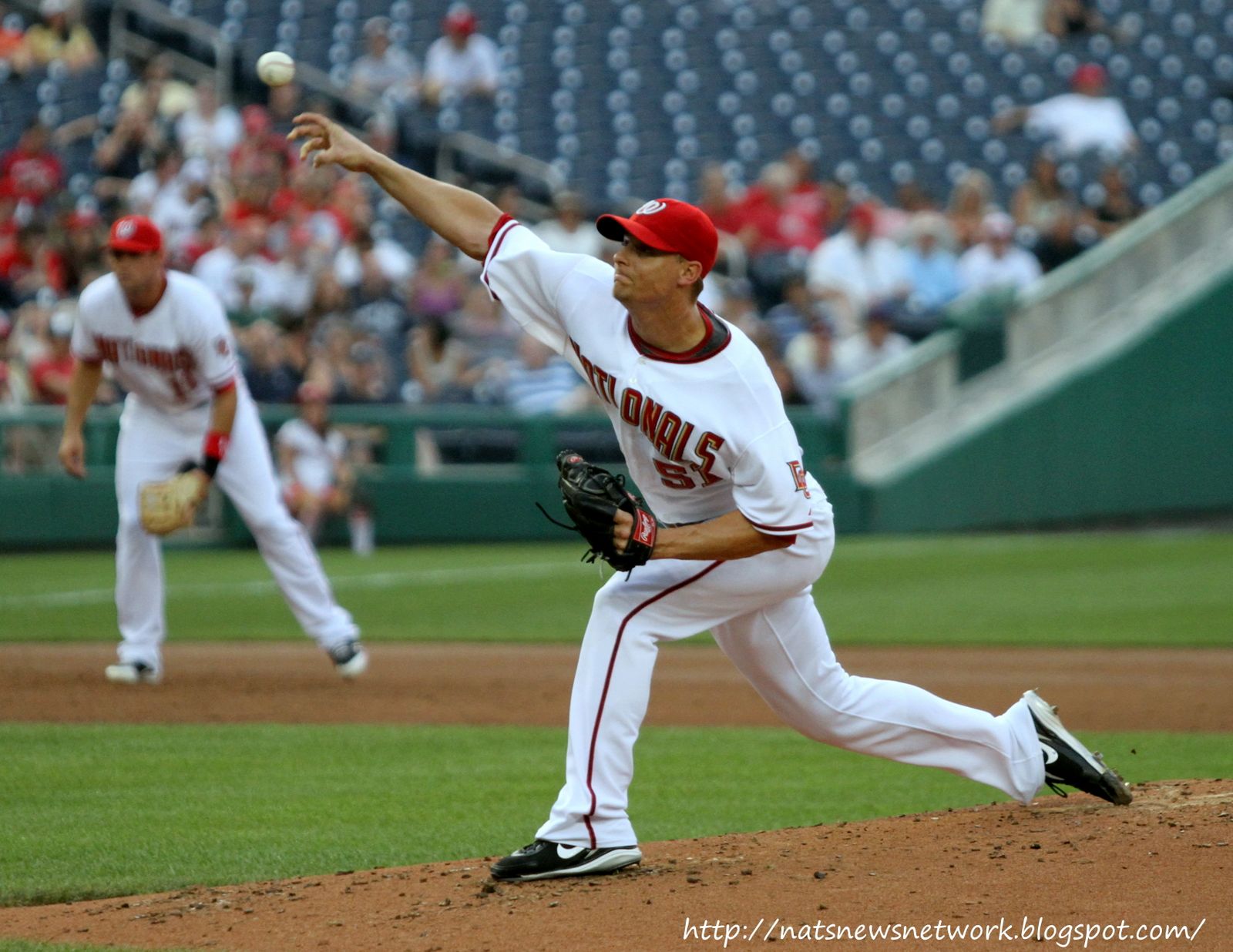
JD Martin's days could be numbered with the team. Photo courtesy of natsnewsnetwork.blogspot.com

1/19/11 Update: with the signing of reliever Todd Coffey, the team now appears to be three men over the limit.  Oh, and about 2 hours later the signing of infielder Jerry Hairston now requiring four guys to be dropped or traded.  One player has been cleared off the 40-man; the predicted JD Martin given his outright release unfortunately later in the afternoon.

Unless I’ve forgotten how to count, and unless I really do not understand the 40-man roster rules, the Nationals have been over the limit for nearly two weeks now.  They signed Adam LaRoche on 1/4/11, then made the announcement official on 1/7/11Answer: per Zuckerman’s posting today, “corresponding [40-man roster] moves don’t have to be made until the contract for the new player is formally processed at MLB headquarters in New York.”  LaRoche’s contract didn’t hit NY til today, so the Martin release is the corresponding move.  Still 3 to go.

Yet, here we are on 1/19/11 and no corresponding move has occurred yet.  The Nationals’ 40-man roster has been above 40 ever since.  I believe teams have to make immediate moves but do not have to make them public; a player could have been designated for assignment on 1/7/11, at which point the team has 10 days to actually decide what to do with him.  So perhaps tomorrow 1/19/11 (since we had a holiday mixed in there?) we’ll have an answer.

Likewise, Tom Gorzelanny will also require a corresponding move, since none of the 3 players traded for him were on the 40-man to start with.  With his addition (yes the trade has been announced but it will not be official until all physicals are passed) we’ll be at 42 (43 with the Coffey signing).

So, who on the current 40-man roster is next to go?  If we need to clear four spots without a major trade, then my initial guesses are:

1. Justin Maxwell: I know that Maxwell is a local and is a fan favorite, but the fact remains that we now have at least 5 outfielders with major league time last year (Werth, Ankiel, Morgan, Bernadina, and Morse) that seem to be ahead of Maxwell on the depth chart, plus a 6th outfielder prospect who will get a look prior to Maxwell at this point (CBrown).  He’s never produced at the MLB level and is now far too old to be considered a prospect.

2. J.D. Martin: Martin is probably the right-handed starter version of Maxwell.  He’s fallen down the depth chart, his name isn’t being mentioned as even competing for a rotation spot out of spring, and the argument can be made that he’s not in the top 5 players to make the AAA rotation.  He’s always had ok numbers when he’s pitched in the majors but in a power-arm league, spots for soft-tossing slight-of-frame right handers are limited.

3. The third and fourth spots are tougher.  I think #3 may end up being someone like Luis Atilano.  Mediocre MLB numbers in 2010, coming off of injury, he probably can sneak through waivers as Chico did and get assigned to AAA to try to get back.  He’ll be 26, slightly older than you want in a prospect, and he’s clearly not in the MLB rotation battle for 2011.

4. Atahualpa Severino: he has no mlb experience and is behind Slaten in the loogy battle right now.  However, other teams may see that we just added him to the 40-man last year and might take a look.  He’s a bit old for a prospect with no MLB time and he could slip through waivers.

This 4th spot is a stretch though, and I think honestly a better way to clear space may be a set of prospects trade for a veteran.  I don’t see at this point how Morse or Detwiler makes the 25-man roster, so perhaps we should look instead to package these guys for a player.

Other candidates (and their reasons for keeping them over Atilano and Martin right now) could be Mock (lively fastball, good stuff and a favorite of the organization), Martis (still young and still could prosper),  and Marrero (still too early to give up on him; needs one more season to prove he belongs but he’s clearly blocked for 2 years by LaRoche; could be a trade candidate).

Gorzelanny trade thoughts…

5 comments

The Nats' newest #5 starter, Tom Gorzelanny. AP Photo/Mark J. Terrill

Love the Trade to get Tom Gorzelanny.  The three guys we gave up were all marginal prospects in the grand scheme of things.  Burgess was a Bowden toolsy draft pick who has moved slowly through the farm system and now is completely blocked for the next 7 years or so by Werth and Harper.  I really liked AJ Morris when we drafted him (he was a 4th rounder but was fantastic in college, giving Mike Leake his only loss of the 2009 season) but he’s already lost his starter status and seems like a middle relief guy at best.  Lastly Graham Hicks was probably the 2nd or 3rd best pitcher in Hagerstown this year and has some promise.

Gorzelanny’s numbers are not fantastic, but you wouldn’t expect them to be for a 5th starter from a team that lost 90 games last  year.  He had a 106 era+ for the season pitching out of a hitters park in Chicago.  He probably has the inside track on the 5th starter spot here in DC by virtue of his acquisition.  If the season started tomorrow you have to think the rotation would be going Livan, Lannan, Zimmermann, Marquis and GorzelannyMaya and Detwiler are starting in AAA save an injury, and Wang has a bit more time to rehab.

Meanwhile, AAA is looking jammed.  We already had Atilano, Martin, Mock and Martis as returning rotation starters in AAA.  Chico is down there as well, having passed through waivers to be reassigned.  Maya and Detwiler are going to need places to pitch.  Plus we have some older prospects from last year’s AA team (Roark and Tatusko) who really need to be pitching in AAA to see if they’re MLB candidates.

All in all, a competent pitcher to compete for a spot in the rotation and who may help out the rotation in the short term.  And not for a lot of money (probably something close to Lannan’s $2.75M deal for 2011).

Off Topic: ranking the ESPN 30 for 30 series

3 comments

Photo courtesy of ESPN Films, the producers of the series.

For me, the ESPN “30 for 30” series was one of the best creations of TV over the past few years.  The documentary approach to sports journalism has been refreshing and (in most cases) great TV.  When sports programming can keep even a passing sports fan (my finacee) interested and asking for more, you know its been done well.

I listen to almost exclusively podcasts in the car these days, and one of my favorites is the “Firewall and Iceberg” podcast recorded by the lead TV reviewers Alan Sepinwall and Dan Fienberg from www.hitfix.com.  I first learned of reviewer Alan Sepinwall by his appearances on Bill Simmons‘ podcasts (which are first in line to listen to when they get released) and really enjoy his reviews online and their podcasts.

I happened to be perusing the hitfix.com site lately (I was looking for the name of a show they were extolling on the latest podcast) when I came across this link: Dan Fienberg’s rankings of the 30 “30-for-30” shows.  While I did appreciate most of his comments, I didn’t necessarily agree with the rankings he came up with for the programs.  Since i’ve seen every one of the series, I thought i’d go ahead and do my own rankings.

Disappointing or Unwatchable

  • “Marion Jones: Press Pause”   As most critics have noted, this essentially turned into a glorification of Marion Jones and never once delved into her steroids usage, why she did it, or touch on any of the real issues involved with her.
  • “Without Bias” – It essentially was a step-by-step review of the story of the player without adding much analysis to the story.
  • “Straight Outta LA” – Unwatchable, I turned it off halfway through.  Ice-T‘s not much of a filmmaker.
  • “One Night in Vegas” – Another really weird documentary, especially with the gangsta-poem readings at the beginning and end of the show.  I find it really difficult to glorify the death of a rap star who essentially talked his way into being a target.
  • “Silly Little Game” – Re-enactment of the first group of people to play fantasy baseball; it sounds as interesting as watching the first accountants come up with regulatory principles in a room together.
  • “The House of Steinbrenner” – This wasn’t so much a documentary as it was a glorification of a franchise that has used its superior financial might for the entire century.  Poor Yankees fans; your stadium has been replaced with a Billion dollar monstrosity that has $4,000/game seats and is guaranteed to skew the revenue system in baseball for another 50 years.  Awesome.

Watchable but could have been done better

  • “The Birth of Big Air” – Matt Hoffman certainly is an interesting character but I don’t really consider extreme sports of any kind to be “real” sports.  Yes they’re difficult feats of athletic prowness … but so is ballet dancing.  Yes, i’m difficult to watch most olympic sports with 🙂
  • “The U” – Too long, and gets bogged down in the year-to-year machinations of the program.
  • “Unmatched” – Such an uncomfortable documentary; I came away from watching it with the interesting storyline that Evert and Navratilova were such friends … but the tone of the story and music choices had me essentially waiting for the lesbian coupling that seemed to be so pushed by the filmmakers.  Ugh.
  • “Little Big Men” – Good story, but there’s been so many American little league winners, as well as the dilution of the field, that this story loses its impact.
  • “Guru of Go” – Perhaps combining both the story of Hank Gathers’ death AND the basketball system of Paul Westphal confused the story.
  • “The Legend of Jimmy the Greek” – one of the very first ones shown and certainly an interesting story, but the re-enactment voice over ruins the story.
  • “June 17, 1994” – Brings bad some strange memories.  I loved the never-before-seen footage of sportscasters but I thought the story could have done with actual images and story telling.
  • “Run Ricky Run” – Another weird documentary.  Hard to feel remorse for a drug using athlete though.
  • “Muhammad and Larry” – This was perhaps the most depressing of the series.  Ali was so brain damaged by the time he took this fight, it seems almost criminal now that he was allowed to fight.  The story drags though, using weird fillers for most of the time and not really showing the fight itself.

Interesting watches

  • “The 16th Man” – Good, but so was Invictus.
  • “Jordan Rides the Bus” – I love Ron Shelton‘s work but you cannot help but wonder how good this would have been with actual participation from Michael Jordan.  You come away from the story with the thought that Jordan actually had talent and that he worked at his baseball craft.
  • “The Pony Excess” – Lots of interviews, great detail.  Probably a bit too long though.
  • “Tim Richmond: To the Limit” – I thought it was really interesting that NASCAR turned out to be so introspective about the clear mis-treatment of one of its own … all in the name of fear over his illness.  Read his wikipedia page for some really interesting notes about his essentially be framed for his positive drug test.  I cannot imagine this news breaking in Nascar or any other major sport today.

Good to Very Good

  • “Fernando Nation” – If you don’t remember just how amazingly dominant Fernando Valenzuela was when he came to MLB, check out his baseball-reference page.  In his rookie season he threw EIGHT shutouts, and started the season 8-0 with 8 complete games, and only gave up FOUR earned runs in his first 8 starts.  That’s a heck of a start to the season.  The story telling related to the treatment of the Mexican-American community in Los Angeles was also interesting to learn about.
  • “No Crossover: The Trial of Allen Iverson” – Another that really could have used involvement of the principal character of the story.  Nonetheless, the substories related to the high school rivalries and politics of the Tidewater area were fascinating, if not necessarily substantiated.  Having lived in Virginia at the time, the amazing part of the Iverson story was that he was named both the Football and the Basketball player of the year in the state … as a Junior.  He undoubtedly would have done the same as a senior.
  • “King’s Ransom” – Interesting story telling from a great director in Peter Berg.  The involvement and discussions with Gretzky on the golf range really gave this story its life.  Unlike the story of LeBron James moving cities and destroying a franchise, Gretzky’s departure clearly altered the direction of the Edmonton Oilers for the long run.
  • “Small Potatoes: Who Killed the USFL?” – Some criticized this documentary, but just for the interview with the incredibly egotistical Donald Trump make this for me.
  • “Into the Wind” – Such a moving story. Steve Nash‘s involvement was really special in telling this inspirational Canadian pride story.

The Best of the Series

  • “Four Days in October” – A great documentary if only for the fantastic interviews with Pedro Martinez.  I found the footage of the Red Sox players facing a 3-0 deficit fascinating, and the drama of the games in retrospect makes the Boston comeback even more amazing.  Update: After several re-watches, I moved this up in my rankings.
  • “The Band that Wouldn’t Die” – Most say this is the best of the series.  I feel they’re getting starry-eyed by the director (Barry Levinson) versus the actual story.  But this obscure story is a highlight of the series and is a great example of the richness of American sport as a subject matter.
  • “Winning Time: Reggie Miller vs. The New York Knicks” – One of the absolute best stories.  The interviews with Reggie Miller and Spike Lee make this one of the best of the series.
  • “The Best That Never Was” – My father immediately recalled who Marcus Dupree was, and this story was an interesting tale.  My biggest takeaway was the 100% positiveness of Dupree, even today.  He’s not angry or sad about what his life has become (he’s a truck driver in rural Mississippi).  On the contrary, he’s grateful for everything he had and all the opportunities he got.
  • “The Two Escobars” – the footage, interviews and story told here was fantastic.  I only wish it was not 100% subtitled.
  • “Once Brothers” – Another great story, told through the eyes of the very human Vlade Divac.  It could have used a bit more subtext into the politics behind the split of Yugoslavia for those of us who get lost in the mid 80s politics.

If I had to give a best and worst, I’d probably go with “The Two Escobars” for best and “Marion Jones” as the worst.  I can’t wait to see the stories they have in the pipeline.  Steve Bartman should make for a great story to tell.  The great news is that the series will continue and some of the original ideas proposed will be explored.  Again referring to a Bill Simmons podcast, here’s some of the original series ideas kicked around that may still be turned into documentaries:

  • 86 masters
  • 89 ws earthquake
  • Tysons-robin givens Relationship
  • doc and darrell
  • title 9
  • dream Team
  • fab five
  • wwf/ andre the giant (couldn’t be done b/c Vince McMahon owns all the film)
  • 94 rangers
  • kerri suggs
  • scott norwood/scapegoats (delayed b/c of the Bartman film)
  • racism in sports
  • franchise relocation (pushed off b/c of the Levinson Baltimore Colts band story)
  • pete rose

Here’s to a great series and many more great documentaries.

5/11/11 Update: ESPN’s 30-for-30 site now allows you to rank the series yourself, which I did and ranked them as such:

1.Two Escobars
2.Band/Wouldn’t Die
3.Reggie Miller
4.Marcus Dupree
5.Four Days Oct.
6.Once Brothers
7.No Crossover
8.Who Killed USFL?
9.Fernando Nation
10.King’s Ransom
11.Into The Wind
12.Jordan Rides/Bus
13.Pony Excess
14.Tim Richmond
15.The 16th Man
16.Muhammad / Larry
17.Unmatched
18.Birth of Big Air
19.Little Big Men
20.Jimmy The Greek
21.The U
22.Guru of Go
23.June 17, 1994
24.Run Ricky Run
25.Without Bias
26.Steinbrenner
27.Silly Little Game
28.Straight Outta L.A.
29.One Night/Vegas
30.Marion Jones

After submitting my rankings, I could see how the rest of ESPN nation had these ranked and was rather surprised.  As of 5/11/11, here’s the rankings overall:

1 The U
2 Pony Excess
3 Marcus Dupree
4 Reggie Miller
5 Run Ricky Run
6 Two Escobars
7 Without Bias
8 June 17, 1994
9 Once Brothers
10 No Crossover
11 Muhammad / Larry
12 Jordan Rides/Bus
13 One Night/Vegas
14 Four Days Oct.
15 Who Killed USFL?
16 Straight Outta L.A.
17 King’s Ransom
18 Guru of Go
19 Jimmy The Greek
20 Steinbrenner
21 Band/Wouldn’t Die
22 Into The Wind
23 Silly Little Game
24 The 16th Man
25 Fernando Nation
26 Little Big Men
27 Birth of Big Air
28 Unmatched
29 Tim Richmond
30 Marion Jones

“The U,” which I thought was only mediocre, led by a fairly large margin over #2.  My #1 film “The Two escobars” was in the top 10, but was 3rd in overall #1 votes.

Post publishing edit: on 8/13/17, SI.com’s Media writer Richard Deitsch published his list of hte best 30 for 30’s.   Many of his best list are those done well after this list was created.

“Marion Jones: Press Pause”
“Without Bias”
“Straight Outta LA”
“One Night in Vegas”
“Silly Little Game”Watchable but could have been done better
“The Birth of Big Air”
“The U”
“Unmatched”
“Little Big Men”
“Tim Richmond: To the Limit”
“Guru of Go”
“The Legend of Jimmy the Greek”
“The House of Steinbrenner”
“June 17, 1994”
“Run Ricky Run”

Run of the Mill
“The 16th Man”
“Muhammad and Larry”
“Jordan Rides the Bus”
“Four Days in October”
“Fernando Nation”
“The Pony Excess”

Good
“No Crossover: The Trial of Allen Iverson”
“Once Brothers”
“King’s Ransom”
“Small Potatoes: Who Killed the USFL?”

Great
“The Band that Wouldn’t Die”
“Winning Time: Reggie Miller vs. The New York Knicks”
“Into the Wind”
“The Best That Never Was”
“The Two Escobars”