Nationals Arm Race

"… the reason you win or lose is darn near always the same – pitching.” — Earl Weaver

Spring Training 2015 NRI discussion

45 comments

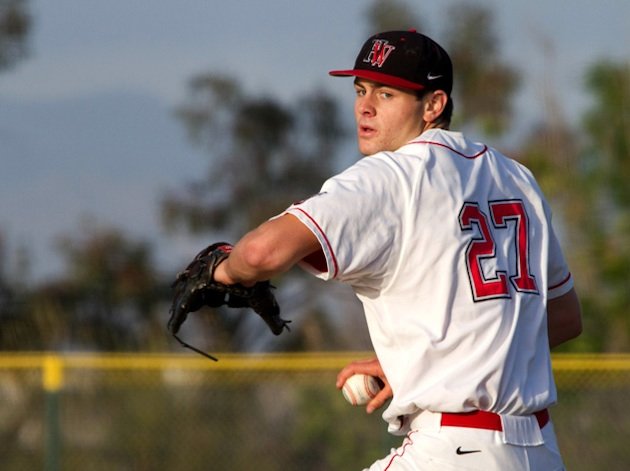
Matt Skole joins a motley crue of NRIs for Spring Training. Photo via dynastysportsempire.com

Matt Skole joins a motley crue of NRIs for Spring Training. Photo via dynastysportsempire.com

As suggested by Dr. Forensicane in a previous thread, lets talk about the Non-Roster Invitees (NRIs) for the Nats this coming spring, and for each lets talk about their chances for making the team, staying with the franchise, and depending on their roster status, their future plans with the team in general.

(post-posting update: if you havn’t seen it, check out this overview of the NRIs published on curlyw.natsblog.com.  It is very comprehensive and organized its list similarly to mine).

Most Nats beat-writers published the same list of 20 NRIs on Friday 2/13/15.   Here’s the list by category.  I’ll talk about the least-likely to make the team to the most-likely by positional category:

    • Catchers: Spencer Kieboom, Steven Lerud, Pedro Severino

Discussion: Lerud was a MLFA signing from Atlanta and seems likely to join recently acquired Dan Butler as the primary minor league catching depth for this team.  Thanks to an options crunch, Jhonatan Solano has already been released (and signed naturally with Miami to join his brother) and Sandy Leon likely gets DFA’d at the end of spring training, meaning that the Nats AAA depth needs to be rebuilt.  Meanwhile Keiboom and Severino represent some of the rising catcher talent in the system that may be in a position to really contribute once our two presumed MLB catchers (Ramos and Lobaton) have reached free agency.  The fact is that teams need tons of catchers in spring training camp and it is not surprising to see non 40-man guys get the call to help out with bullpen sessions and then get cut loose once the active camp has been thinned.

Odds of any of these NRIs making the 25-man roster: none for any of these players, even with an injury.  Lerud likely sticks around as AAA depth, and Keiboom/Severino have yet to reach rule-5 eligibility.

Future plans: Lerud to AAA and probably out of the org after this season, and the two prospects moving on up the chain (Severino likely in AA and Kieboom in high-A).

    • Left Handed Relievers: Matthew Purke

Discussion:I am no longer considering Purke a starter; I think his best shot at making it is if he converts to relief. I’d be ecstatic if he regained his mojo as a starter but i’ve lost confidence as such. That being said; we’re all well enough familiar with Mr. Purke by now: for a couple of days in November I thought we had cut him loose completely, ending a rather expensive Nationals experience.  But he re-signed as a MLFA with the team (likely in a pre-arranged deal) and then took the invite to spring training.  I’m guessing the senior team officials want to get a look at him, see how he fares as a match up reliever, see if his stuff holds up in short stints, etc.  By having Purke in spring training, the senior decision makers can watch multiple bullpen sessions, get a sense of his makeup and drive, and make a decision on his future (see next).

(tangent: fun fact here; did you know that Purke was born in the same town (Nacogdoches, TX) as USMNT striker Clint Dempsey?)

Odds of making the 25-man roster: none.  The team didn’t go to all this trouble to get Purke *off* the 40-man roster just to put him back on; there’s other lefty alternatives that will get the first crack at the majors if our standing lefties (Thornton and Blevins) falter.  Namely Xavier Cedeno and Matt Grace.  Even after the season begins, I could see the team experimenting with Sammy Solis or Felipe Rivero as a reliever in the majors before looking at Purke.  Which leads us to Purke’s future plans…

Future plans: Getting Purke back on a non-40-man deal gives Purke a stay of execution.  I think the team sees how he does this year and then considers whether to add him back to the 40-man as a protectionary move prior to next off-season.  But he can’t be putting up 8+ ERAs in AA.  He needs to get guys out or he’s done.

    • Right Handed Starters: Bruce Billings, Mitch Lively, Scott McGregor

Discussion: Both Lively and McGregor were signed midway through 2014 after getting dropped by their respective AAA clubs (affiliates of San Francisco and St. Louis respectively), and then each served as essentially an innings eating starter for Syracuse or Harrisburg the rest of the way through.  Thanks to a slew of last minute moves, both guys got AAA playoff starts in 2014 as well, neither pitching especially effectively as Syracuse was swept out of the playoffs.  Both chose to re-sign in Washington and both will get spring training invites.  Billings was signed from Los Angeles in November and was a starter for their AAA affiliate in 2014.

Odds of making the 25-man roster: none.  Assuming there are no trades or injuries, the 6th-10th guys in line to get MLB starts likely goes Tanner Roark, Blake Treinen, Taylor Jordan, Taylor Hill and newly-added 40-man member (and long time Nats prospect) A.J. Cole.   The Nats used just 8 starters in 2014, so the chances of all 10 of these guys even getting looks seems rather slim right now.

Future plans: You also have to think that the last 4 of these 5 guys will form the bulk of the Syracuse rotation to start 2015, leaving just one slot available.  And if it were up to me, I’d have Felipe Rivero in that 5th slot.  So its kind of hard to even see where these three guys fit in for 2015, unless they’re heading for long-man duty or are dropping down to AA.   I havn’t done enough analysis to even guess what AA’s rotation may look like to see if that’s an option.  So perhaps all three guys are playing for other teams’ scouts and for AAA rotations that give them more MLB opportunity.


Now to where some of these NRIs may actually have some chances to make this team…

    • Right Handed Relievers: Heath Bell, Manny Delcarmen, Eric Fornataro, Rafael Martin, Evan Meek

Discussion: The team shed an awful lot of innings from last year’s core bullpen, none as important as the combined 132 1/3 innings from late-innings relievers Rafael Soriano and Tyler Clippard.  The team made a pretty shrewd signing of former Toronto closer Casey Janssen (and not for a ton of money either …), who will slide into one of those departed slots.  But the truth is that this team has a potential opening for a veteran 7th inning guy.  Right now Aaron Barrett is set to step into that later-innings role; is he ready?  Is he good enough?

The team has three former MLB relievers who signed on with the team with an eye towards reclamation; Bell, Meek and (to a lesser extent perhaps) Delcarmen.  All three guys have had good success in MLB bullpens … and all three have fallen on hard times.  Fornataro just got outrighted to AAA; he’s not immediately coming back on even if he fares well in spring; I’m guessing he’s on a season-long audition.

Which brings us to Mr. Martin.  Forensicane’s best friend.   His 2014 numbers speak for themselves.   He has such an odd and unique career trajectory that perhaps the ST invite is solely so the MLB staff can see what the heck he’s got.  I hope we can get a glimpse of him during televised ST games to see what he’s got.

Odds of making the 25-man roster: Long.  Despite the weakened bullpen, the Nats still have a strong group making cases to head north come March 31st.  And we know that Blake Treinen can be effective out of the pen, meaning that if we get an injury to any of the presumed 7 leaders in the clubhouse for our bullpen (for my money: Storen, Janssen, Barrett, Stammen, Blevins, Thornton and Roark), Treinen probably is the first to get called into duty.

Where these guys have a shot is this: there’s almost no reliever depth on this team.  Outside of the 7 guys likely making the bullpen right now you have just three other relievers on the 40-man: Xavier Cedeno (out of options and likely DFA’d on 3/31/15 unless an injury befells Blevins and/or Thornton), Erik Davis (coming off a lost year to surgery … is he even ready to start throwing again?) and newly-added Matt Grace.  I suppose if Davis proves he’s past his TJ surgery he’d be in line for a call-up if needed, but i’d put my money on either Bell or Martin getting a shot in case of injury.

Future plans: I’d guess that the likes of Bell and Meek have opt-outs if they don’t make the team.  Delcarmen stayed put after his opt-out expired last year and signed on again for 2015; he’s likely AAA depth all year.  Fornataro (as discussed above) is in the AAA pen looking to re-gain value, and Martin is certainly guaranteed a chance to repeat his AAA 2014 performance (not that he has much left to prove…).

    • Middle Infielders: Emmanuel Burriss, Cutter Dykstra, Dan Uggla

Discussion: The team traded away a significant asset to bolster its middle infield presence, but an injury to one of the Nats three presumed 25-man roster middle infielders (Desmond, Escobar or Espinosa) could mean an opening for one of these guys.  Burriss holds an interesting local tie; he went to Wilson HS in the district, not exactly known for generating significant baseball talent.  He has never really hit at the major league level and toiled all last season for Syracuse.  Dykstra is seemingly more well known for who his father is (Lenny) and/or who his fiancee is (Meadow), but he has quietly hit his way up our system.  You can argue that he’s been too old for every level he’s played at for us, but he’s hit .275 or better three successive years. 

Which brings us to Mr. Uggla.  He hit 30+ homers for 5 successive seasons, then got hit in the head by a pitch and suffered what we now know to be “oculomoter dysfunction.”  I certainly remember his presence in the Marlin’s lineup for years; can he regain his stroke and have an impact?  Problem is that he’s 35 and hasn’t hit at a productive level for nearly 5 years.  And his skill set doesn’t exactly age well.  I’m guessing this might be just one last shot in the sun for him.

Odds of making the 25-man roster: very little.  Every team needs a backup short stop, and the team clearly already has one.  Uggla isn’t going to supplant Escobar.

Future plans: I’m guessing Uggla has an opt-out.  Burriss likely is AAA depth and is fine with it.  Dykstra should be matriculating to Syracuse himself, where he can prove he’s worth a look later on.

    • Corner Infielders/Outfielders: Kila Ka’aihue (L),  Clint Robinson (L), Matt Skole (L), Ian Stewart (L), Mike Carp (L)

Discussion: We know what we have in Skole; our 2012 minor league hitter of the year who earns his third straight NRI.  He’s got a sweet swing but a lost season to injury and a less-than-impressive bounce back have him off the prospect radar.  But he’s not really the interesting player out of this group.

I’ve put the player’s bat in parenthesis above for good reason; this team has a need for a bench bat.  And there’s not much tying the team to the presumed 25th guy on the roster right now.  And we *really* have a need for lefty power off the bench, especially now that Espinosa is only batting right handed.  So a lefty with power has a pretty good chance at making this team.  And I don’t think its a coincidence that *every* one of these guys is a lefty hitter.  Ka’aihue just came back from Japan and has a ton of power in the minors that hasn’t translated to the majors.  He’s limited to 1B.  Robinson seems like almost the exact same player as Ka’aihue except with less MLB time.  Stewart at least has some positional flexibility and has a 25 homer season in the majors (albeit in Colorado), but has struggled with injury the past few seasons, derailing his career.  Lastly there’s Carp, another guy like Ka’aihue with a ton of minor league power demonstration that for the most part hasn’t shown up in the majors.  Carp can play 1B or a corner outfield position, giving him a slight leg up on some of his competition here.

Odds of one of these guys making the 25-man roster: decent.  You have to think our bench right now is Lobaton, Espinosa, Nate McLouth, Kevin Frandsen and … somebody.  McLouth can play center … barely.  And he used to have power, but showed the team almost nothing for its $10M investment last year.  But the chances of the team cutting him before June 1st is zero, even if he goes o-for-the spring.   Perhaps the first name to consider for the 25th man is Tyler Moore, but he’s a right handed hitter.  And he’s out of options, and he’s had plenty of chances to earn his spot and has left the team wanting.  I think we’d all rather have Michael Taylor playing every day instead of getting three ABs a week for the big league club.  So I think there’s an opportunity here for one of these lefty power-hitting veterans to grab a spot previously held by the likes of Chad Tracy or Matt Stairs.  In order I think the chances are best for Stewart, Carp, Ka’aihue and then Robinson..

Future plans: Like with the other vets, it wouldn’t surprise me to see all these veterans with opt-outs.  As for Skole, I’d like to see him regain his batting eye; his BA and his OBP both took 40+ point nose dives in 2014.  Of course, it is also worth noting that Skole is 110% blocked on this team right now; he can basically only play 1st or 3rd.  Skole’s value to this team may be in his trade value, which means a good season in Syracuse could mean his ticket out of town for opportunity.


Conclusion: I think we could see one or two of these NRIs make the team, even without an injury.  Remains to be seen.
Qualifying Offers: Are they working? (2015 edition)

29 comments

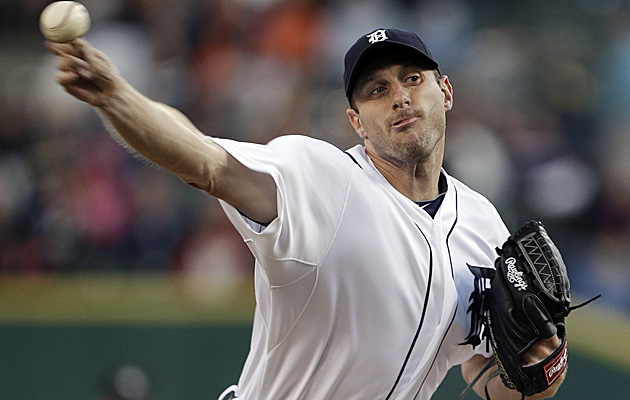
The QO didn't affect Scherzer's next contrct very much.  Photo AP Photo/Paul Sancya

The QO didn’t affect Scherzer’s next contrct very much. Photo AP Photo/Paul Sancya

Last year we did a quick analysis of all the Qualifying Offer-receiving free agents to see if the system was “working.”  (note; from here out I’ll use the abbreviation of QO for Qualifying Offer).

Now that James Shields has signed, there remain no more free agents on the market who received a QO from their former team.  Lets take a look at how the qualifying offers affected the markets for those players who got them this off-season.

Here’s a table of the 12 players who received QOs ahead of free-agency (I hope this table is readable once it publishes…)

Year Player Old Team New Team Draft Pick Forfeited Signing Date Subsequent contract (w/o options) Money up/down per AAV Q.O. Screw the player?
2014 Melky Cabrera TOR CWS 3-81 12/15/2014 3yr/$42M -1.3 Not Really
2014 Nelson Cruz BAL SEA 1-21 12/1/2014 4yr/$58M -0.8 No
2014 Michael Cuddyer COL NYM 1-15 11/11/2014 2yr/$21M -4.8 Sort of
2014 Francisco Liriano PIT PIT none 12/9/2014 3yr/$39M -2.3 Sort of
2014 Russell Martin PIT TOR 1-18 11/18/2014 5yr/$82M 1.1 No
2014 Victor Martinez DET DET none 11/14/2014 4yr/$68M 1.7 No
2014 Hanley Ramirez LAD BOS 2sup-69 11/25/2014 4yr/$88M 6.7 No
2014 David Robertson NYY CWS 2-45 12/9/2014 4yr/$46M -3.8 Sort of
2014 Pablo Sandoval SFG BOS 2-44 11/25/2014 5yr/$95M 3.7 No
2014 Ervin Santana ATL MIN 2-43 12/11/2014 4yr/$55M -1.55 Not Really
2014 Max Scherzer DET WAS 1-29 1/21/2015 7yr/$210M 14.7 no
2014 James Shields KC SD 1-13 2/9/2015 4yr/$75M 3.45 no

It should be noted that for the third consecutive year, not one player who received a QO accepted it despite its ever increasing value ($15.3M for 2015).  Is this “reverse collusion” on the part of the players, not to play the QO game?  For the third year, there were players about whom pundits scratched their heads as to why they chose not to take the offer.  While not as obvious as in 2013 (when both Stephen Drew and Kendrys Morales vastly over-stated the market for their services and were severely penalized as a result), the fact that especially Michael Cuddyer and David Robertson didn’t take the QO remained puzzling.

So, among the 12 players, who was hurt?  In the end, nobody really.

  • Half the players got new contracts with AAVs above the QO figure, in some cases significantly above.  So they’re not being “hurt” by the system.  This list includes Russell Martin, Victor Martinez, Hanley Ramirez, Pablo Sandoval, James Shields and of course our own Max Scherzer.
  • Another 3 players (Melky Cabrera, Nelson Cruz and Ervin Santana) signed longer term deals for slightly less than the AAV of $15.3M.  I say these guys were “not really” hurt since they guaranteed themselves 3-4 years and in each case nearly or more than $50M of earnings.   Each player rightly gambled and guaranteed themselves $50M instead of $15M.

The remaining three players each kind of have extenuating circumstances.

  • Michael Cuddyer (inexplicably) signed a 2yr/$21M deal with New York instead of taking a 1yr/$15.3M deal to stay in Colorado.  There has to be more to this story; why wouldn’t his agent have advised him of taking the QO and then hoping to get a 1yr/$6M deal the following off-season??  Wouldn’t that have been the better play?  Did he want to leave a losing team in Colorado?  (If so, why the heck did he go to the Mets??)  The Mets even more inexplicably gave up the 15th overall pick to get an 35-yr old corner outfielder who played just 49 games last year due to injuries and who has a combined 3 bWAR in the last two seasons.   One can see the nature of the kind of player you can generally get in the mid-first round here.  So while Cuddyer’s AAV is way below $15.3M, because he voluntarily signed the Mets contract he only screwed himself 🙂
  • Francisco Liriano declined the QO and then re-signed with the same team (Pittsburgh).  He got a 3yr deal for $39M.  Most pundits would agree that nobody would have given Liriano a $15M/yr longer term deal thanks to his age and injury history, so his taking lesser money AAV but for longer is a smart move for him.  Perhaps the QO limited his market, forcing him to go back to Pittsburgh … or perhaps not.
  • David Robertson declined the QO but got a 4yr guaranteed deal for $46M … as a reliever.  Which is fantastic, considering the volatility of the reliever position in general.  So even though his AAV is far less than $15.3M, he made out big time with the amount of guaranteed money.

San Diego gives up the best draft pick (13th overall) to get Shields’ services for four years, but five teams altogether give up first round picks to sign players.  Boston gives up its two second round picks to play Ramirez and Sandoval on the right side of their infield for the next four years.  A number of very wealthy teams pick up supplemental first round picks (Dodgers, Yankees and Detroit), which (like all FA compensation) kind of seems to defeat the purpose of helping “poorer” teams off-set the loss of marquee players.

Lastly, the order (and pools) for the 2015 draft is now set.   A better look is here, showing all the picks gained and lost.  Houston has the 2nd, 5th and 37th overall picks, 12 picks in the top 10 rounds and has an astounding $17M of bonus money to acquire players.  Washington has just $4.1M to sign its first 10 picks, meaning we’re likely looking at another set of college seniors drafted in rounds 6-10.  More on the draft later on.

So, to answer the question of the day; are QOs working?  This year they seemed to have worked; you can’t really argue that any player was negatively affected and teams that lost players got compensation picks.  You can argue whether the right teams got these picks.

Fyi; the spreadsheet with all this analysis is here: https://docs.google.com/spreadsheets/d/1UEiZzwWarVP3PfCtZeYTVBqC49dmBut21O7UhB17htQ/edit?usp=sharing

Nationals Prospect Ranks historically

27 comments

Giolito is currently ranked #1 Nats prospect.  Photo Eric Dearborn via win for teddy blog

Giolito is currently ranked #1 Nats prospect. Photo Eric Dearborn via win for teddy blog

For years I’ve collected links and lists of Nationals top 10 prospect lists into a text file, just growing it chronologically year after year.  I noticed somewhat recently that in the Nats Big Board there are a few tabs with titles like “2013 Prospect Rankings”  that had some but not all the rankings data that I’ve collected.  Plus there’s no 2014 or 2015 tabs of this information.

So, I kind of became obsessed with translating all the information I had in text format to a spreadsheet.  Today I’ve uploaded this spreadsheet for your viewing pleasure.  I’ve created a “Link” along the right-hand side of this blog and also offer the below Google XLS:

https://docs.google.com/spreadsheets/d/1ufpQabmX1XLTN9ShcgBDOLeOnfoIQLfXlk01qelJZbA/edit?usp=sharing

Some quick notes on the spreadsheet:

  • I’ve only included what I deem to be “professional pundits” rankings.  That is to say, I have not included my own, or the rankings of other Nats bloggers.    I’ve also excluded auto-generated rankings (like at Scouting Book), rankings driven by projection systems (Zips, Pecota, etc), and rankings driven by or for Fantasy purposes.
  • The default XLS in Google is sorted by the Fangraphs recent ranking, then alphabetically by last name after that.
  • The color schemes on the spreadsheet: Orange means that the player hadn’t been acquired and/or drafted yet. Red means that player has either left the organization (by release, trade, etc) or has “graduated” and is no longer a candidate for these lists.  Therefore a “white” or non-colored tab for recent lists should mean the player is still in our system, ranked or not.  Corrections welcome.
  • In the 2nd “pundits” tab you can see pundit by pundit whose lists i’ve used and (in yellow highlighting) see some of the lists I wouldn’t mind finding and including.  In particular, if anyone has the BA handbooks from previous years, I’d love a scan of the Nats top 30 pages.
  • One of the really interesting things I see in this data is the discrepant rankings from pundit to pundit by player; having all this data side by side lets you see (for example) that Keith Law really likes Joe Ross and John Sickels doesn’t rate Reynaldo Lopez nearly as highly as some of his counterparts.
  • The data is pretty solid to 2010; if anyone has older links i’ll take them and include them.  I also can carve off future time to do the google research but for now I’ve devoted enough time to this little project 🙂

There are some weird discrepancies in the data as far as I can tell:

  • I have not done the “not yet signed” logic for all the IFA candidates, mostly because there’s some discrepancies in some of the IFA signing dates.  To wit; Anderson Franco is listed on the big board as a 2014 IFA signing, but he appeared in BA Handbook’s 2014 rankings for the team.  That BA Handbook is written mostly in December; how could Franco be ranked if he wasn’t even signed yet?   Do all IFAs sign on the same July time-frame?  Can a D.R. prospect sign the moment he turns 16, even if its outside the signing window?
  • Players like Aaron Barrett and Taylor Jordan ended up on pundit ranking lists after exhausting their eligibility; that’s what numbers in red blocks means.
  • mlb.com lists in particular are not published and set in stone; their system constantly adjusts the lists to account for player movement, so some of the older MLB list links may not match what’s in the xls.

The canonical history of Nats prospects ranked #1 on any list:  Lucas Giolito, Brian Goodwin, Anthony Rendon, Bryce Harper (who never was NOT ranked #1 by any pundit), Stephen Strasburg (also never not ranked #1 in his brief stay on these lists in 2010), Jordan Zimmermann and lastly Chris Marrero, ranked #1 in the BA Nov 2007 ranking I somehow found.

Enjoy!

Ladson’s inbox 2/2/15

49 comments

Scherzer is on everyone's mind.  Photo via Scherzer's twitter account.

Scherzer is on everyone’s mind. Photo via Scherzer’s twitter account.

Love it; another inbox to analyze.  In the wake of the Scherzer signing, lets see what kind of questions MLB.com beat reporter Bill Ladson fielded this week.

As always, I answer as I write before reading Ladson’s answer, and edit questions for clarity as needed.

Q: How much better will the Nationals be now that right-hander Max Scherzer is on the roster?

A: Well, if you play the “WAR analysis” game, then Max Scherzer replaces Tanner Roark in the rotation for 2015.   Scherzer posted a bWAR of 5.5 in 2014 while Roark posted a bWAR of 4.8.  So on the face of it, assuming that both players provide identical value in 2015 as they did in 2014, perhaps Scherzer won’t immediately impact the team.  This is the essence of those immediate-post signing blogs and columns that questioned why the Nats needed to make this acquisition.

However.  I offer some counters.

  1. Roark immediately becomes your spot-starter to cover for injury.  Lets say that Gio Gonzalez (bWAR in 2014 of just 2.1) gets hurt and Roark covers for him; well that’s nearly a 3-WAR improvement.  Certainly Roark is going to be better than whatever AAA cover we could promote to provide injury relief.  The Nats only gave 12 13 starts to non-core rotation guys in 2014 but more than twice that number in 2013; the odds are that an injury is going to hit the rotation at some point.
  2. Scherzer will be better in 2015 than he was in 2014.  Why?  He moves to the NL, gets to face pitchers instead of DHs, faces generally weaker lineups, plays in a weaker division and pitches in more parks that are pitcher friendly.  You can make the argument that his K/9 is going to increase significantly (if he faces the pitcher 60-70 times in a season, he likely strikes them out at least half of that), and his ERA likely falls at least a half a point.  That will boost his WAR for 2015.
  3. Scherzer going twice in a seven game playoff series is going to be better than having any one else getting that second start.  In fact, a 1-2-3 punch of Strasburg, Zimmermann and Scherzer is one heck of a daunting task for any opponent.
  4. And there’s this: not to completely re-hash my post on the Scherzer signing, but i’ll note that this signing (to me) seems like a way to bridge the gap and guarantee an “Ace” in the rotation through the next two off-seasons of rotation transition (where the team likely loses Zimmermann, Fister and Strasburg).  The Nats rotation looks an awful lot better after these three guys are gone if Scherzer is leading the line.  So to me this isn’t a move about 2015 as much as it is about getting this team to 2017 and maintaining competitiveness.

Ladson said very little about answer the question, using his answer to immediately talk about the offense and the bench.  Yeah we know there’s issues there.  And we all remember how the middle of the order went like 1-for-the NLDS.  Wasn’t the question.

Q: Why didn’t Espinosa work on hitting right-handed exclusively after the season ended? If Espinosa made that transition successfully, he would be the answer at second base.

A: A good question.  Not the first time this topic has come up.  We’ve discussed it to death here but the reasons seem to fall along the following:

  1. Espinosa may be getting “advice” from his agent (Scott Boras) to put his own interests first.
  2. Espinosa may be “stubborn” about maintaining his switch hitting, given that it is a differentiator in the marketplace for him.
  3. Espinsoa may just be uneasy about suddenly facing right-handed curve balls from the right-hand side, probably having not faced such a situation in more than a decade (a fair point).

We all know about his splits lefty versus righty.  We all know he has not chosen to try RH-only.  I think its also safe to say that the organization has gone out of its way (Asdrubal Cabrera last season and now Yunel Escobar) to replace him in the starting lineup despite his defensive skills.  It is what it is; we now have a backup infielder on the roster to cover both 2B and SS and who has some pop from the plate in a backup capacity (and the associated K-rate of course).  Not the worst thing in the world to have.  Ladson says … well he stated the obvious (Escobar is the starter) and then says that the “Nats hope Espinosa cuts down on his strike-outs.”  Non-answer.

Q: How come Jeff Kobernus is not being considered for the starting second-base job? Why not have a young, cost-controlled guy play every day?

A: Because Kobernus hasn’t played 2B basically since college full-time since a half-season stint in Harrisburg in 2012.  The team moved him to the OF and he’s mostly stayed there.  Even if you thought he could play second effectively, he’s got a career minor league slash line of .285/.331/.363.   He is what he is: a utility guy who can cover in case of a slew of injuries and makes for a good 9/1 pinch running/6th outfielder call-up, but that’s about it.  I don’t think you can count on him to produce at the major league level day-in and day-out.  Ladson says Kobernus has a chance of making the bench out of spring training this year, which I disagree with.

Q: Asdrubal Cabrera signed with the Rays for one-year, $7.5 million. Why couldn’t the Nats make that deal? Or something close to it?

A: Probably because Cabrera wanted to play short-stop, and the Nats have a short-stop.  Besides, Escobar at $5M is a good deal.  I mentioned at some point in the off-season that Cabrera’s offensive output with Washington wasn’t too much better than Espinosa’s frankly (Cabrera’s split line with Washington in 2014 was .229/.312/.389; Escobar brings more to the table.  Ladson agrees, and says that the Nats weren’t willing to bring Cabrera back at his asking price based on what he showed last year.

Q: Why didn’t the Nats consider Tyler Clippard as their closer?

A: Hmm.  Good question.  Perhaps because when Clippard was given the closer job in 2012, he really struggled with it as compared to his typical 8th inning performance.   ERA in 2012 as closer: 3.72.  Career ERA: 2.88.  Besides, there was more in play for Clippard’s trade than just who was going to be the 2015 closer.  Clippard’s got a ton of miles on his arm, Clippard was set to make nearly 8 figures as a reliever, and the Nats felt like they could afford to part ways with him to acquire a player who filled a need.  Ladson notes what I noted, and said that Clippard’s pending free agency played into the decision.  That’s a great point that I didn’t mention; Clippard wasn’t going to be offered a qualifying offer (likely worth $16M next off-season), so he’d depart to no compensation.  With this trade, the Nats got some compensation for him.

Q: I know he’s had plenty of success as a general manager, but I’m surprised Mike Rizzo doesn’t feel any sense of urgency to try to sign Desmond or Jordan Zimmermann to an extension. What are your thoughts on this?

A: I think Mike Rizzo has been trying to extend these guys for more than two years.  “Sense of urgency?”  What else do you want to ask of the guy?  He by all accounts has offered both guys 9-figure deals, and has been rebuffed.  Do you think Ian Desmond is worth a 7yr/$100M deal?  Do you think Zimmermann is worth a 6yr/$150M deal?  Clearly to me the two players are valuing themselves higher than what the GM is valuing them, the GM has made what he thinks to be fair market value deals, and both guys have opted to test the market.  Baseball is a business, both on the player side and the team side.  Ladson thinks Rizzo will step up discussions once spring training happens.  I don’t; I think that the ship has more or less sailed on extending these guys at this point.  Now, will the team move Zimmermann?  I think we may see offers once James Shields signs…. if there’s teams out there that want to improve but miss out on Shields, they may come calling to the Nats with deals we cannot turn down.  We’ll see.  Overall thougth I’m doubtful any trades occur at this point.  My prediction: the juggernaut rotation goes into 2015 in-tact.


College Baseball 2015 Previews and pre-season Rankings

2 comments

Kirby Jones leads the highly  regarded UVA baseball team in 2015.   Photo via unk

Kirby Jones leads the highly regarded UVA baseball team in 2015. Photo via unk

Believe it or not, its time to start thinking about College Baseball again.  Most teams’ schedules start on the 2/13/15 weekend and all the major outlets covering the sport have released pre-season rankings lists.

College pre-season top-25 lists with local interests noted:

This BA link has capsules to all the top 25 teams.  And BA has released their pre-season All-American list, with local players of note Nathan Kirby and Mike Matuella (Duke’s #1 starter hailing from Great Falls) earning first team honors.  This pre-season All-American list comes from the National Collegiate Baseball Writers Association and is littered with UVA players.

Vanderbilt returns its entire weekend rotation, including two lock 1st round picks in Walker Buehler and Carson Fuller as well as another presumed 1st round pick in shortstop Dansby Swanson and is inarguably the best returning team in the land.  UVA’s Joe McCarthy earned pre-season 2nd team honors but just went down with injury (back injury, out 12 weeks ugh), which seems like its going to really hurt that team.

Interesting development for 2015: d1baseball.com has apparently been acquired, or has undergone a mass change in direction.  Gone is the 1990-esque interface; now they have graphics and professional writers associated with it (namely, Aaron Fitt, formerly of Baseball America, who left BA in Nov 2014 and is now focused entirely on the d1 site.  Most importantly, the site is now a pay-for site.   I visit this site constantly during the college and CWS seasons; we’ll see how much you can see w/o paying for this season.

2/10/15 post publish update: Great preview of College season from Chris Slade at minorleagueball.com

Written by Todd Boss

February 2nd, 2015 at 1:57 pm

Keith Law liking what the Nats Farm system is doing.

18 comments

Giolito is Keith Law's (and others) highest ranked RHP prospect right now. Photo unk via federalbaseball.com

Giolito is Keith Law’s (and others) highest ranked RHP prospect right now. Photo unk via federalbaseball.com

Some quick Keith Law links for you this week.  I know he comes across as abrasive, and his evaluations are sometimes at odds with other prospect hounds in the industry, but I’ve always liked  his methodology and his unapologetic analysis.

The first two links are behind ESPN insider’s pay-wall.  I’ve already gone on record saying that ESPN’s insider access is more than worth it, so consider buying it.  Its $3.33 a month on a year’s subscription and comes with the magazine (which is actually really good).

Anyway.  Law has increased his ranking of the Nats system significantly from last year, ranking them 9th in the league (last year they were ranked 18th).  The Steven Souza deal (a guy who Law did NOT rank in his own top 100 prospects despite being eligible) netted two prospects out of San Diego who did rank in Law’s top 100 (Joe Ross and Trea Turner), who joined no less than four other guys in Law’s top 100 prospect list.

  • 2015: Giolito, Ross, Taylor, Lopez, Turner and Cole are in Law’s top 100
  • 2014: Giolito, Cole and Goodwin were in Law’s top 100

Look at the growth of prospects by virtue of trade acquisition (Ross & Turner) and player development (Taylor and Lopez).  Goodwin isn’t even mentioned here, nor is last year’s 1st rounder Erick Fedde (yet to throw a pro pitch), both of whom have the capability of adding depth to this system (along with the Ross Detwiler bounty, minor leaguer of the year Wilmer Difo, and other under-the-radar guys).

From a system ranking perspective, here’s how Law’s rankings for Washington’s system have gone year over  year:

  • 2015: 9th
  • 2014: 18th
  • 2013: 21st
  • 2012: 21st
  • 2011: 19th (this was the year BA ranked the system #1 … just prior to the Gio Gonzalez trade.  Law got to do his rankings well after the trade)
  • 2010: 23rd
  • 2009: 29th

So, this is the highest we’ve ever seen Washington in Law’s opinion.  Great to see, given the performance of the on-field team and given the FA losses that we face in the coming two off-seasons.

I’ve uploaded and updated the historical Minor League Organizational System Ranking xls in google with Law’s 1-30 rankings (I was going to hold off on this until I saw that you could just get his numbers 1-30 by reading the team top 10 RSS feed).

Like the Janssen signing

14 comments

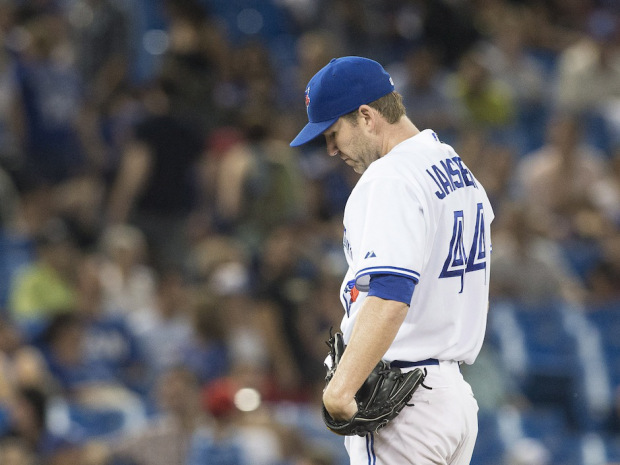
Janssen becomes the latest Nats signing. Photo via THE CANADIAN PRESS/Chris Young

Janssen becomes the latest Nats signing. Photo via THE CANADIAN PRESS/Chris Young

I hadn’t necessarily verbalized it in this space, but after the Tyler Clippard trade it made sense to me for the Nats to go shopping on the FA market for a middle reliever to help bridge the gap.  Its tough to lose two of your three late-inning options in one season (the other of course being the over-paid Rafael Soriano, who remains unemployed at this juncture), and a veteran one-year signing made sense.

And that’s exactly what the team got today with the signing of former Toronto closer Casey Janssen to a one-year $5M guaranteed deal with a mutual option for 2016.  I like this deal a lot; not a ton of money, a closer-quality guy who immediately takes over the 8th inning role and can cover for Drew Storen if he stumbles in the closer role.  Janssen’s numbers took a dive in 2014, which can be easily attributable to a violent bout of food poisoning he suffered mid-season last  year.

This move makes the 2015 bullpen likely look like the following (in relative order from Closer to Long-Man): Storen, Janssen, Barrett, Stammen, Blevins, Thornton and Roark.

Which means that, save for a theoretical trade of a starter, Roark is the long-man and Blake Treinen is likely in AAA as a starter.  If we move Zimmermann, Roark slides into the 5th starter and Treinen likely becomes a 7th inning option.  The rest of the 40-man reliever options don’t seem like they’re really threatening this core group: Cedeno is out of options and is looking at a DFA unless Blevins/Thornton gets hurt, Fornataro needs to re-establish himself in AAA, Erik Davis is coming off surgery and Matt Grace is freshly on the 40-man and (like Cedeno) won’t be an option unless there’s an injury.  Yes forensicane; I love Rafael Martin too … but he’s not on the 40-man yet so he’s not an option yet either.

I don’t mind keeping Treinen as a starter frankly; the Nats used 8 starters last year and likely will use that many this year.  Past the core 5, you have Roark, Treinen and then your pick of 40-man candidates Jordan/Cole/Hill if we get bit with an injury bug.  That’s plenty of decent starter depth for now; we can call up Treinen and Cole for middle-relief appearances in September ahead of a potential October series.

How do you feel about our bullpen?  Is the Barrett/Stammen/Thornton combination good enough to handle the 6th and 7th innings on a regular basis?  Would you rather have Treinen as a sinkerballing hard-thrower in that mix?  If so, who makes way?


One day on the job … three dumb things already said or done

5 comments

ManfredSelig

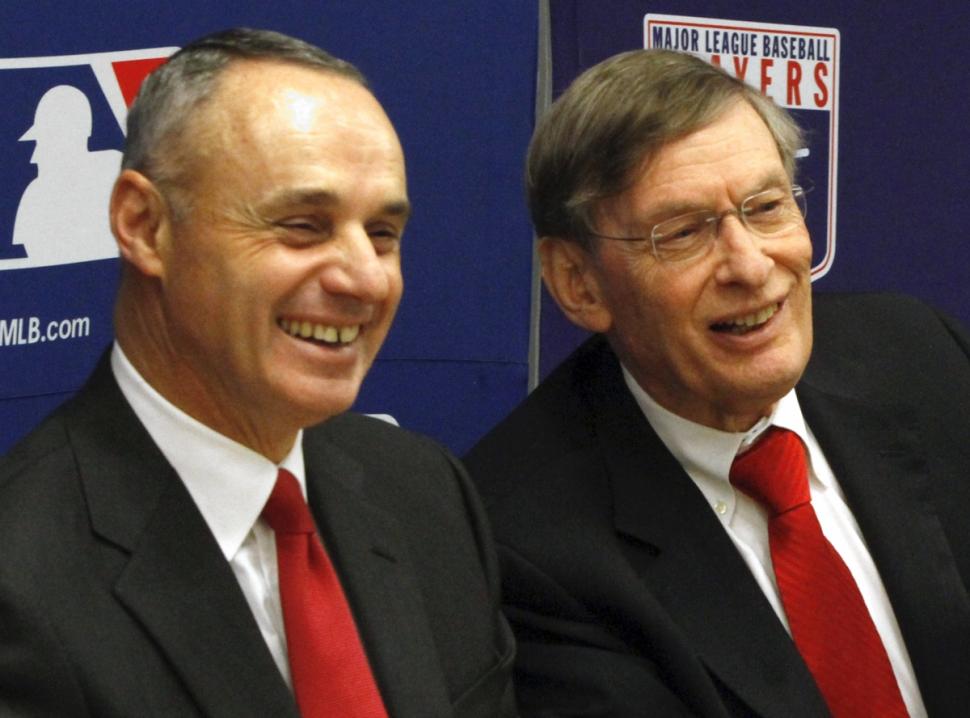
Out with the old, in with the … same? Photo via nydailynews.com

So, I see that new MLB commissioner Rob Manfred is picking up right where the oft-clueless Bud Selig left off.   On his first week on the job, he was quoted as saying two rather ridiculous things and doing something even dumber:

1. He’s open to “banning defensive shifts

2. He thinks baseball will eventually return to Montreal.

3. He appointed Fred Wilpon to be the head of the sport’s Finance committee.

I don’t think I need to go deeply into why #1 is a ridiculous statement; plenty of others in the blogosphere have done that already.  I’ll just say this: there’s a reason defensive shifts work, and its because batters have become far, far too one-dimensional at the plate.  There’s a very simple, easy method for defeating defensive shifts; bunting.  Watch Robinson Cano bunt for a casual double against a shift in Boston: he barely tried to get the bunt down, just essentially punching the ball towards a vast gap left open by the too-clever Boston infield.  There’s not even a fielder in the camera’s field of sight by the time the ball runs by the bag.  I didn’t see this game live, but i’ll bet Boston didn’t try this shift on him again.  If they didn’t, and I’m the starting pitcher … I’m probably not throwing another pitch until I see a conventional infield again.  As far as Cano goes … its a line-drive in the books right?

And that’s all it will take.  If every pull hitting lefty would just punch a couple of bunts towards the vacated third base position, the defensive shifting probably would drastically reduce.

If you’re *for* the banning of defensive shifts … how exactly would you do it?  Put dotted lines on the field and make players stay in their positions until the ball is pitched?  We’re talking about a game that’s existed for decades without such a need.  How would you police it?  How would you account for players running out of position to cover bunts?  When the pitcher is up, is the 3rd baseman allowed to creep in?  How much?  What if someone fake-bunts and suddenly players are out of their “zones?”  If someone cheats out of position, do you just give the player a ball or a base?  How does that change the decades-old score keeping?  That’s just a few of the implementation questions that would make this a non-starter to realistically force-feed into the game.

Look; if you want to tilt the power back to batters (and that’s what this is really about, right?  Offense is down, strikeouts are up), then do what they did back in the late 60s.  Lower the mound.  Shrink the strike zone (actually … don’t shrink it, just frigging call it like it should be called and stop giving guys who throw 100 a ball off the outside corner).  Or work the ball a little bit so that it plays better (wind it tighter, make the seams lower, etc).  I don’t think you’re going to be able to turn back the clock on match-up relievers, power arms out of the bullpen, etc, but there are things you can do to keep the game on a level playing field.


As far as baseball returning to Montreal … I just can’t see how it would work given the current state of finances in Baseball.   Yes Montreal is a huge city (Just to mention a couple of non-insignificant barriers:

  • RSN TV markets: currently the entirety of Canada’s TV market is “owned” by Toronto, though the area where Montreal sits is “shared” with Boston.  So that means that, much as the Nats had to make concessions with Baltimore to move to Washington, that a franchise would have to buy out these teams’ interest in the Montreal market.
  • Canadian dollar values; this was one of the main reasons the Montreal franchise began to struggle in the mid 1990s; Toronto hasn’t been relevant in nearly the same amount of time.  Why does anyone think this situation will ever change?
  • Montreal as a franchise had some of the best talent in the game in the early 90s but couldn’t escape the generations old Olympic stadium.  Modern baseball franchises depend on modern stadiums; who is going to commit to building a billion dollar stadium in the near-socialistic political climate in Quebec?
  • Oh, and there’s this: the Montreal Expos were dead last in attendance every year between 1998 and 2004, when they finally departed for Washington.  Even in 1994, the year they were 74-40 and were dominating the NL … they were just 11th out of 14 teams in the NL in terms of attendance.   In fact, you have to go all the way back to 1983 before even finding a season where the Expos were not in the bottom THIRD of attendance in the NL.  They don’t draw in Montreal; they never have.  Why would anyone think it’d be any different now?
  • Perhaps there’s relocation possibility to Montreal (in today’s climate, likely from Oakland or Tampa).  But if you’re the Oakland or Tampa owners; are you going to be any better off in Montreal than you are today?  You’d be going to a WORSE stadium situation and would struggle with RSN issues.
  • If you’re going to expand the game to go to 32 teams so you can put a team in Montreal (and its tempting; Montreal is a big city, it would rank just between Phoenix and Seattle in terms of MSA sizes of US cities), then where would you put the 2nd team?   The two biggest cities w/o a major league team right now are Portland and San Antonio … creating a team in Portland would revisit en masse the same Baltimore-Washington RSN issues we’ve already talked about, San Antonio isn’t exactly a metropolis itself, and both team areas would immediately be in smaller markets than places like Kansas City and Cincinnati, teams that struggle to compete because of their own small markets.  Or you could argue that NY or LA should support a third team … yeah good luck with that RSN fight.
  • Not to mention that a 32-team league drastically changes the playoff situation, likely forcing an NFL-like structure where four divisional winners and two wild-cards make the playoffs … thus also implying that two divisional winners have to play coin-flip play-in games against wild-card winners, eliminating the advantage of winning your division and essentially the whole point of the second wild-card as we know it now.

Just don’t see a return to Montreal.


The last point (appointing Wilpon to head the finances committee) is a joke that writes itself.  Multi-millionare owner of a franchise born to mint money in the NY media market has to run his own team like a small-market franchise thanks to hundred-million dollar civil suits against him and is dependent on tens of millions of dollars of bridge loans to keep his team afloat.  Yeah; that’s the guy I want involved with *anything* related to finances.

*sigh*  The more things change, the more they stay the same.  Oh one more thing I forgot: Baseball also felt the need to disband the “Oakland Stadium committee,” just 6 short years after it started and with seemingly nothing accomplished.

Well, at least Selig is out of the picture.  Oh wait, no he isn’t.  He’s going to serve as “Commissioner Emeritus” and draw a $6M annual pension.  Man!  What a game.  How do I get that job?!

Written by Todd Boss

January 27th, 2015 at 10:29 am

Holy Cow Scherzer!

31 comments

Wow.  Photo via Scherzer's twitter account.

Wow. Photo via Scherzer’s twitter account.

Nats sign Max Scherzer to a 7yr/$210M deal.  Which, as noted in the rich comment thread on the previous post, occurred while I was away and could not properly analyze.

Well, so much for “payroll is topped out.”

Now it seems like the ownership narrative is going to be, “Mr. Lerner just turned 90 and didn’t buy this d*mn team so they could only just win the division a couple of times.”

Which, as a fan who is still scarred by the Jim Bowden years, when a $68M payroll was astronomical and our GM was shopping in the bargain basement/rejects line in the free agency trough, is pretty liberating.  I guess this is sort of what it feels like to be a Yankees, Red Sox or Dodgers fan in some ways.

I have various thoughts, not having a chance to have read all the comments and all the analysis pieces out there.

  • Apparently the contract is actually structured as $15M a year for 14 years, as opposed to $30M a year for seven.  Man; that’s one heck of a pension plan Scherzer just got for himself.
  • I agree with those that believe this is an insurance move that makes the inevitable departure of Jordan Zimmermann a bit less of a loss.
  • Bummer for Tanner Roark if no subsequent moves are made; all he did was post a frigging 5 WAR season in 2014.
  • I like Scherzer now … but man i’m worried about what he’ll look like in 5 years.  There’s little to zero track record of long-term FA pitchers working out when signed to 9-figure deals.  Trust me; I’ve got a huge spreadsheet as proof that these things almost never work out.  So I think its fair to say that I am happy to have him (of course), but that i’m worried that this will bite the Nats going forward.
  • Yet another example of Mike Rizzo a) picking up a player he originally drafted, and b) doing a deal with the devil, er I mean Scott Boras.  At least the Nats aren’t on the hook for $30M/year clogging up their new “payroll ceiling,” whatever it is.
  • Given the track record for starters going from the AL to the NL … i wonder if we’re about to see a season that looks something like this: 18-5, 2.20 ERA and 280 Ks in 220 innings.  Scherzer’s already at 10.3 K/9 and now he gets to face the Pitcher, a weaker division in the NL East and no DHs.  Can he get to 300 Ks?

How would you lineup our rotation?  Probably Strasburg, Scherzer, Zimmermann, Gonzalez and Fister.  You have to put the lefty in the middle of the rotation, right?

Is Roark wasted in middle relief?  Yeah he is.  But … now the team has its best 6th starter option in its bullpen ready to go, instead of calling up somebody from AAA.  Is this a good thing or a bad thing?

Are we still going to see another move?  Maybe.  Not so much driven by payroll, but by function.  If the team is really fed up with negotiating with Zimmermann, then you move him for what  you can now.  And you’ve just replaced him like-for-like, for actually *less* money in 2015 than he was set to make (conveniently ignoring the $105M in “pension” payments Scherzer will be making for nearly a decade after he’s finished this contract).

Lets say the team does move Zimmermann; the 2015 rotation would be just as good as the 2014 rotation, but the team would presumably would have a couple more nearer-to-the-majors prospects received in return for Zimmermann.  Not the worst situation to find our selves in, given the FA losses the team faces after 2015 and 2016 (3/5ths of its 2014 rotation).  Scherzer bridges the gap and gives the team a solid guy for years to come as the next wave of starters makes its way to the majors (Cole, Giolito, Fedde, Lopez in perhaps that order).

Farewell Mr. Clippard

53 comments

Good luck in the Bay Area.  Photo unk.

T Good luck in the Bay Area. Photo unk.

Quick thoughts on the Tyler Clippard for Yunel Escobar deal that went down Wednesday night.

  • Bummed to see Clippard go.  I got a chance to play golf with him a few years back and he’s a real nice guy.  Nothing but a gentleman on the course, just a guy who liked playing golf in his spare time.  The thing that made me laugh the most from the game was his telling us that he rides his bike to the ball park every night … and then back home at midnight, through some rather sketchy streets around the stadium, all the way back to the townhouse he shared with Drew Storen on capitol hill.  If you’ve never been to Oakland’s stadium … well lets say I hope Clippard doesn’t try to ride his bike home at night from there.
  • Does Clippard get a shot at the closer role in Oakland?  Probably not; Sean Doolittle took over for the deposed Jim Johnson last year and did pretty well.  Very well actually: a 0.7 whip and a 1.71 FIP.  Not bad.
  • I tend to agree with the Mike Axisa CBSsports.com analysis posted here; Nats have some interesting flexibility now with Escobar.  He could be the 2B starter (making the transition from SS to 2B is an easy one for a quality infielder).  He could enable the team to move Ian Desmond and have Escobar be the starting shortstop until Trea Turner is ready (or proves himself not to be up to the task … Escobar is signed through 2016 with an easy 2017 option).

Is this a good trade for the Nationals?  Clippard was a vital and valuable part of the bullpen; is he replaceable?  Not easily.  The Nats have shed two of their three best relievers from last year with no real replacements (no, i’m not counting Heath Bell) other than internal promotions.  Perhaps this means we’ll see a couple of middle relief veteran signings now.  I think this also could mean Blake Treinen‘s being called into reliever duty instead of being in the Syracuse rotation.  Who pitches the 8th inning now?  Aaron Barrett?

Even given Clippard’s value, his escalating salary did mean he made more sense as a closer for another team.   Maybe that happens in Oakland regardless.  Or maybe Billy Beane keeps on dealing and moves Clippard again.  But the Nats plugged a hole for now and potentially for the next two years as well; a price that had to be paid for what they acquired.  And lets be honest; it is probably easier to find a good right handed reliever than it is to find a MLB-average offensive shortstop.

Escobar’s offensive numbers were a tick below MLB average last  year; an improvement over the presumed person he’s deposing in Danny Espinosa.  What’s more of an unknown is his defense; he was excellent in 2013, awful in 2014 in terms of range factors.  Since you don’t need nearly the range at 2nd, i’m guessing he’s going to be an excellent defender there by default.  So to this effect, he fits the Rizzo mold.  Good defender, decent offensive player.

The knock on Escobar, of course, is character.  It stems from an incident in 2009 while with Toronto when he put the words “Tu ere maricon” on his eyeblack.  As I noted in the comments section, I tend to give him the benefit of the doubt here, believing that the media took one of many possible interpretations of this common latin insult (and hopefully not the one he meant) and ran with it … suddenly the message and the story that remains to this day is that he used an “anti-gay slur” and that Escobar is “homophobic.”  Or perhaps not: according to a wikipedia guide of Spanish profanity, the term maricon as used by Cubans in particular most likely means exactly what he’s accused of saying.  I dunno; what’s the statue of limitations for making a poor decision?