Nationals Arm Race

"… the reason you win or lose is darn near always the same – pitching.” — Earl Weaver

Keep Asdrubal Cabrera?

14 comments

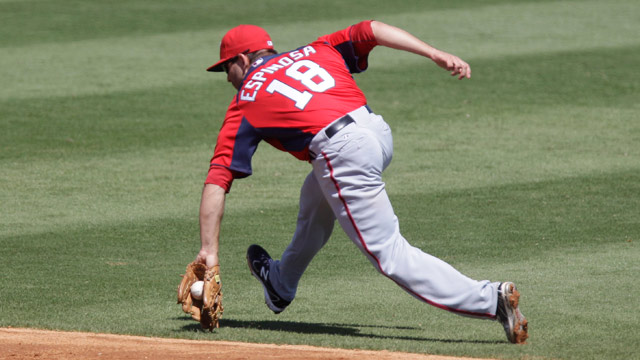
Who would you rather have? Photo AP via mlb.com

Who would you rather have? Photo AP via mlb.com

One thing that continually pops up in baseball analysis conversations is “the narrative.”  Today’s narrative to address: Asdrubal Cabrera is the solution for the Nat’s 2015 second base “problem.”

Here’s the 2014 stat lines for both Cabrera and Danny Espinosa:

Player Year Age Tm Lg G PA AB R H 2B 3B HR SB BB SO BA OBP SLG OPS OPS+
Cabrera 2014 28 WSN NL 49 200 175 20 40 9 2 5 3 22 29 0.229 0.312 0.389 0.7 92
Espinosa 2014 27 WSN NL 114 364 333 31 73 14 3 8 8 18 122 0.219 0.283 0.351 0.634 74

Espinosa’s prolific strike-out rate drives down his OPS+ figure.  Otherwise, he’s basically a small step down from Cabrera’s performance on the season.  But we’re not exactly talking about world-changing offense from Cabrera at the plate: a .229 BA with a bit of power.

Here’s some more quickie stats that will illuminate things.  Lets talk about their defense.  If we’re saying that Cabrera was a superior defender, here’s the 2B-only defensive stats for both players (UZR/150 and total Zone via fangraphs, DRS via either site, FRAA via baseballprospectus.com):

Player UZR/150 at 2B DRS at 2B FRAA at 2B
Cabrera -5.3 -10 -2.2
Espinosa 4 -1 0.1

So, across the board Espinosa statistically was a better defender than Cabrera.  You can make the argument that Cabrera was playing out of position; I can make the argument that Espinosa’s full-season stats have been even better than this (he is an elite defender year over year).

Lastly; contract status:

Player 2014 Salary 2015 contract status
Cabrera $10M Free Agent, 10-12M/yr projected
Espinosa $540k 1st year of Arb, $1.5M projected

I dunno. If someone said that the team should go out of its way to ensure they have a switch-hitting, slick fielding second baseman who can hit .220 … I’d say to you, “we already have him.”  And he’s pretty cheap.   And under team control for 3 more years, for a combined salary that’ll be less than one year Cabrera will fetch on the open market.

In reality, with a weak SS free agent market, Cabrera is going to get over-paid by someone to go back to short, despite his saying publicly that he likes Washington and wants to stay, so maybe this is all moot.  I’m not necessarily saying that Espinosa is the solution at 2B either: I think the team has found its Jamie Carroll for the next 3 years; a guy who can play either middle-infield position off the bench who switch hits.  I’ve seen rumors that the Nats will go shopping on the FA market: of course, the available player list isn’t exactly inspiring.  I’ve seen other rumors that the Nats will work the trade market; that’s impossible to project or guess, but Texas’ glut of middle infielders does present an opportunity (they have Elvis Andrus ensconsed at short, Rougned Odor at second, but have uber-prospect Jurickson Profar ready to play as soon as he’s healthy).  Oh, they also have a huge corner infield problem coming too, with Adrian Beltre and Prince Fielder under contract for years to come but minor-league homer leading 3B Joey Gallo not really needing to prove much at AA any longer.  I like the trade matchup (NL East to AL West) but can the GMs come to an agreement on something?

Or maybe just maybe Espinosa gets talked into giving up hitting lefty (career slash line: .271/.343/.460 for a career .804 OPS figure, which by way of comparison is slightly better than the OPS figure that MVP candidate Josh Donaldson put up in 2014.

Yeah, I’d take that out of my #8 hitter, while putting up good defense at 2nd and proving injury-coverage at short.
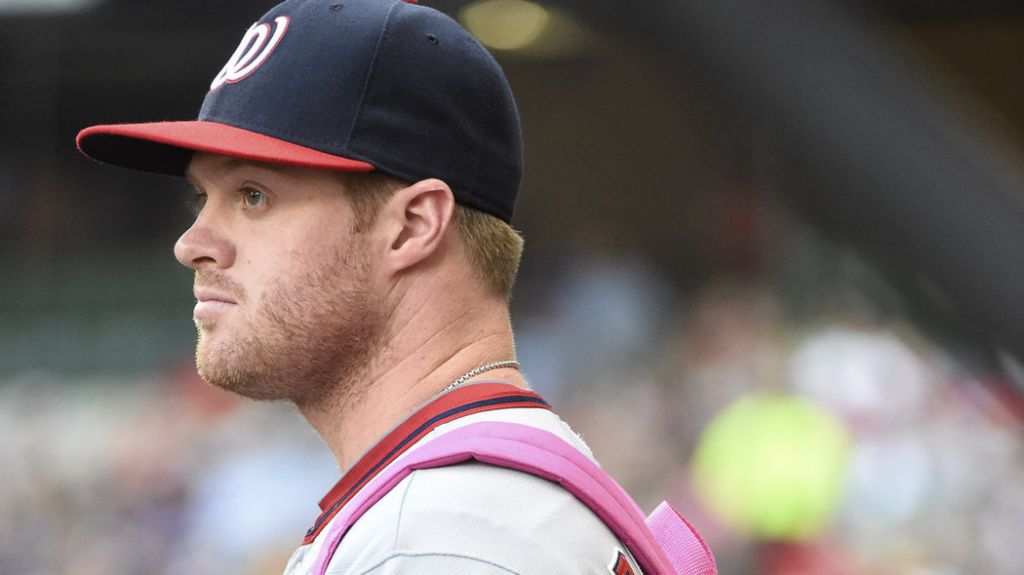
And the winner of the #1 overall pick in the 2015 draft is…

2 comments

http://www.mlbtraderumors.com/reversestandings

Your Arizona Diamondbacks!   Here’s next year’s top 10 (click on the above link for the full first round; the Nats will pick 30th out of 31 picks next year if we keep the pick).

(Another more complete post on this topic from MinorLeagueBall, including all the comp picks, bonus allocations and whatnot.)

2015 pick #
Team 2014 W 2014 L 2014 W/L Pct
1 Arizona Diamondbacks  64 98 0.395
2 Houston Astros
3 Colorado Rockies  66 96 0.407
4 Texas Rangers  67 95 0.414
5 Houston Astros  70 92 0.432
6 Minnesota Twins  70 92 0.432
7 Boston Red Sox  71 91 0.438
8 Chicago White Sox  73 89 0.451
9 Chicago Cubs  73 89 0.451
10 Philadelphia Phillies  73 89 0.451

Houston retains the #2 overall pick after failing to sign last year’s #1 Brady Aiken.  Teams that tied in records are given priority based on last year’s W/L record, meaning that Houston picks before Minnesota, the White Sox before the Cubs and Phillies, etc.   Houston, for their prolonged incompetence, gets the 2nd and 5th pick next year, and I’m sure they’ll figure out a way to out-smart themselves and screw it up again.  And that’s if they even keep the picks: 5th rounder Jacob Nix had his deal axed when Aiken’s deal went south, thanks to the ridiculous new signing bonus rules.  Nix has filed a grievance and if the Astros are forced to honor his deal, they’ll lose one or both of these picks (and maybe more).

The Diamondbacks with their fresh and completely inexperienced General Manager Dave Stewart now have the honor of selecting one from quite a few interesting candidates for #1 overall right now.  Aiken presumably will pitch a year at JuCo and be a completely legitimate shot to go 1-1 again (assuming he doesn’t get hurt).  But he’ll also be looking for significant money.  Duke’s Michael Matuella (who is a local kid, hailing from Great Falls and who attended Georgetown Prep) has been shooting up boards.  A couple of other prep players are considered upper first round talent (Brendan Rodgers in Florida, Mike Nikorak in Pennsylvania, Kolby Allard in California).  And, with a rising class of college juniors we have more than a few big-time college guys who may push Aiken down off the top spot.  Namely, Walker Buehler from Vanderbilt, Phil Bickford (late of Cal State Fullerton) or maybe even the likes of Kyle Funkhouser (Louisville) or Carson Fuller (Vanderbilt).  In fact, Vanderbilt may be like UCLA was a few years back, with two starters selected in the top of the first round.  And like always, some one may come out of nowhere to claim the 1-1 spot with an under-slot deal, much like the Astros did in 2012.

The top 10 for next year is rounded out by four of the wealthiest clubs in the game (Boston, both Chicago teams and Philadelphia).  Which also means that along with Texas, half the teams who finished in the bottom 10 this year were among the highest spenders in terms of payroll in 2014.  You can’t fault Texas necessarily, but you can certainly continue to mock Philadelphia.  How does Frank Wren get fired but Ruben Amaro keeps his job?

Shields-Myers trade revisited; not such a bad deal now, eh?

5 comments

While reading David Schoenfield‘s 10/1/14 chat, someone asked the following question:

How does the Myers/Shields trade look a year later?

A great question.  For those who don’t remember the entirety of the deal, on 12/9/12 this trade occurred:

  • The Rays got Wil Myers, Jake Odorizzi, Mike Montgomery and Patrick Leonard
  • The Royals got James Shields and Wade Davis

Prospect-followers (like me) howled about the trade at the time.  Wil Myers was the consensus “best prospect in the game” at the time while Shields wasn’t exactly considered to be an “Ace” in the league.  Royal’s GM Dayton Moore was accused of playing short-term gains versus the long term health of his franchise because of perceived pressure to return to the playoffs for the first time in nearly 3 decades.  Myers subsequently turned around and won the AL Rookie of the Year in 2013 while the Royals improved but still fell short of the playoffs.  I freely admit it: I hated the deal and thought it was another example of the Rays fleecing another team in a trade.  I wonder now if it is because I undervalued what Shields brings to the table.  I wonder if we all do: compare what Tampa got for Shields versus what they got for David Price; if the Myers deal had been for Price instead of Shields, I wonder if anyone would have howled a bit, since Price was a “name” player with awards while Shields was and is a relatively “anonymous” player in what he accomplishes on a day to day basis.

Two seasons onward, with the Royals having broken through to the playoffs, lets take a look at the players involved.

  • Shields: Just finished his second 225+ inning season leading the Royals staff, putting up bWAR figures of 4.1 and 3.3.  Shields also made the start (thought he didn’t really factor in the decision) that put the Royals into the ALDS for the first time since 1985.  He went 6ip/2ER to earn the win in the ALDS series clincher over the Angels, and is scheduled to start the ALCS opener tonight.
  • Davis: failed as a starter in 2013, but became one of the best setup men in the game in 2014.  Numbers: 71 innings, a 1.00 ERA, a sub 1.00 whip and a 3.7 bWAR.  That’s a pretty big WAR figure for a reliever.

2014 bWAR for the Royals’ side of the trade: 7.0 between them.

How about on the Rays’ side?

  • Myers had a 2014 slash line of just .222/.294/.320 in 87 games and missed half the year with a broken wrist.  bWAR of -0.9.
  • Odorizzi made 31 starts as a back-end rotation member; 11-13 with a 4.13 ERA and a 90 ERA+.  bWAR=1.2
  • Montgomery just finished his second full year in the AAA rotation, going 10-5 with a 4.29 ERA in Durham.  He has yet to appear in the majors.  He’s also just finished his 7th minor league season, which means he’ll be a MLFA if he’s DFA’d by the club (he’s on the 40-man roster; I’m not sure how many options he has left).
  • Leonard had a .808 OPS+ as a 21 year old in high A.  He’s likely 2 more years away from a MLB debut.

2014 bWAR for Rays side of the trade: 0.3.

Devil’s advocate statement: It is just one season.  Shields is a FA once the playoffs are over while the Rays control all four guys for years to come.   But “flags fly forever” and the Royals did finally achieve their goal of making the playoffs.  And they continue in the playoffs while Tampa continues to play golf.

Two years onward, would you still make this trade?  Would you sacrifice the long term promise of Myers and Odorizzi for the short term glory of a playoff run?

Editor’s Update: this article was originally published in Oct 2014.  In mid December, 2014, Tampa, San Diego and Washington were involved in a huge 11-player 3-team trade where Myers was moved to San Diego.  The return Tampa got for Myers was, to be honest, kind of thin frankly.  The Padres sent 5 players to Tampa (a backup catcher and four prospects) to acquire Myers and others, and then Tampa turned around the two best prospects in the deal to the Nats for Steven Souza and Travis Ott.  Did the Rays trade away a problem child?  Was Myers over-hyped?  Did he win his Rookie of the Year award thanks to an inflated BABIP and in actuality he’s a lot closer to replacement level than many thought?  Per the article, the answer to all of those questions may be “yeah, maybe.”   But inarguably this recent Myers trade if anything makes the Sheilds trade that much closer of a “win” on the KC side of this original deal.


Champion Series Pitching Matchups & Predictions (that you should ignore)

one comment

So, in the Divisional series prediction post, I predicted the following:

  • Washington-San Francisco: predict a Washington 3-1 series win.  Actual: SF wins 3-1.
  • St. Louis-Los Angeles Dodgers: predicted a LA sweep or 3-1 series win.  Actual: StL wins 3-1.
  • Detroit-Baltimore: predicted a Detroit sweep or a 3-1 win.  Actual: Baltimore sweeps 3-0.
  • Kansas City-Los Angeles Angels: predicted a LA victory in 5.  Actual: Kansas City sweeps 3-0.

Had I published in time, I likely would have gotten at least one of the WC games wrong too (I liked Bumgarner but thought Francisco Liriano could revert to his dominant 2013 post season form).

Four predictions, four incorrect, mostly wildly so.  Damn.  So much for the “pitching wins in the postseason” narrative.

Now what?   Of course!  Post another prediction piece 🙂

In the NL; the two top teams lost in the divisional series, leaving the weakest divisional champ going against the wild card, both with two off-days to re-set their rotations.  In the AL; two surprising sweeps and a huge gap between games lets both teams re-set their rotations too.  I’m guessing at the rotation order, but it should go as follows:

NL:

  • Game 1: SF@Stl: Jake Peavy vs Adam Wainwright
  • Game 2: SF@Stl: Madison Bumgarner vs Lance Lynn
  • Game 3: Stl@SF: John Lackey vs Tim Hudson
  • Game 4: Stl@SF: Shelby Miller vs Ryan Vogelsong
  • Game 5: Stl@SF: Wainwright-Peavy (if necessary)
  • Game 6: SF@Stl: Bumgarner-Lynn (if necessary)
  • Game 7: SF@Stl: Lackey-Hudson (if necessary)

SF barely hit against Washington’s starters but still squeaked out 3 games from 4.  St. Louis on the other hand hits the ball a ton and should pound SF’s lesser starters.  I like a split in Stl thanks to Bumgarner, then Stl taking two of three in ATT, and SF liking their chances throwing their ace in game 6.  But who the heck knows what is going to happen; Wainwright gave up 11 hits in his last outing.   St. Louis in 7.

AL:

  • Game 1: KC@Balt: James Shields vs Chris Tillman
  • Game 2: KC@Balt: Yordano Ventura vs Wei-Yi Chen
  • Game 3: Balt@KC: Bud Norris vs Jason Vargas
  • Game 4: Balt@KC: Miguel Gonzalez vs Jeremy Guthrie (or perhaps Danny Duffy)
  • Game 5: Balt@KC: Shields-Tillman (if necessary)
  • Game 6: KC@Balt: Ventura-Chen (if necessary)
  • Game 7: KC@Balt: Vargas-Norris (if necessary)

I, and every other national pundit, continue to be underwhelmed by Baltimore’s pitching staff.  But they get the job done: Norris was un-hittable against Detroit, and Tillman pitched good enough to win.  Is KC on a mission to save Dayton Moore’s job?  It sure seems so.  They couldn’t surpass Detroit in the regular season but swept the best team in baseball in the ALDS.  But meanwhile, Baltimore *hits* the ball.  I think Baltimore could win both games at home to start and then two of three in KC.

Prediction: Baltimore in 6.


NLDS Post Mortem

31 comments

Not Aaron Barrett's finest moment. Photo via lockerdome.com

Not Aaron Barrett’s finest moment. Photo via lockerdome.com

So, if you told me that the Nats would lose the deciding NLDS game because Matt Williams chose to work the 7th inning with Matt Thornton, Aaron Barrett and then Rafael Soriano as the savior, I would have asked you, “was everyone else in the bullpen dead?”

Instead of going to war in a tie game with any of his three longest serving and most effective relievers (i.e., Craig Stammen, Tyler Clippard or Drew Storen) he went with a waiver claim, a rookie, and a deposed starter with an ERA after the all-star break north of 6.00.

I get bringing in Thornton to go against the first two lefties in the 7th; why the hell do you leave him in to face the Giant’s best hitter in Buster Posey?

When Posey inevitably singles to put guys on first and second with one out … clearly the key point in the game and the post-season … why do you bring in a frigging rookie instead of your #1 shut-down, high leverage reliever (Clippard)?

Was anyone really shocked when Barrett walked the next guy to load the bases?  Was anyone then subsequently surprised when he overgripped, overcome by the moment and bounced a mid 90s fastball to the fence?   Wilson Ramos looked like an amateur trying to “block” that pitch, stabbing at it backhanded like someone who’s never caught before, but whatever.  The damage had already been done.  If it wasn’t a wild pitch, it would have been a deep ground out, or a sac fly; the run expectancy of bases loaded with one out is more than 1.5.  I won’t even go into the little league IBB wild pitch; the poor guy was clearly still thinking about the run he just gave up and the weight of the team’s season was on his shoulders.

For the record, you’re not going to win a ton of games where you get just four hits.  Gio Gonzalez once again proved he wasn’t up to the task, and the Nats were lucky to get out of the 5th without giving up a run (also a bases-loaded, one-out jam that Tanner Roark mostly created on his own but also mostly got out of thanks to a ballsy 2-0 changeup to Pablo Sandoval).

No, the story of this game and this series can be summarized with the following list of lines for the 4-game series:

  • Leadoff hitter Denard Span: 2 for 19 with one walk.
  • #3 hitter Jayson Werth: 1 for 17
  • #4 hitter Adam LaRoche: 1 for 18
  • #5 hitter Ian Desmond: 3 for 18.

All of those hits?  Singles.  No power, no driving the ball from the heart of the order.  Basically, the top half of the Nats lineup played four games of automatic outs.  Hard to win like that.  The bottom half of the lineup wasn’t much better: Cabrera was just 3 for 15 though with two clutch hits and Ramos was just 2 for 17 in the series and was a guaranteed weak ground-ball to shortstop every time.

You’re not going to win games when your 3-4-5  hitters get 5 combined hits in four games, none for extra bases and none driving in any runs.  Did you know that Anthony Rendon was 9-17 with a walk and scored ZERO runs in the series?  He was on base TEN times in four games and never scored.  That’s a huge indictment of the middle of the Nats order.

The only hitters who showed up in this series were the two youngest regulars on the field; Rendon and Harper.  With three homers and a double in four games (driving in four of the 9 total runs the team scored), Harper showed once again why it was folly that he was batting 6th.  He drove in exactly four runs; had he been batting with Rendon on all the time, he may have batted in double that and we’re talking about a different series.

Its a bummer; the Nats offense picked a really crummy time to shut down, to make Ryan Vogelsong look like a staff ace.  And they’re out in the divisional round for the 2nd time in three years despite being the #1 seed.  Tim Hudson: you have your answer.

Would you have pulled Fister?

15 comments

Fister shows Tim Hudson what *he* has between his legs.  Photo via wp.com

Fister shows Tim Hudson what *he* has between his legs. Photo via wp.com

It’s only fair to discuss, since we just saw Matt Williams pull another starter in the midst of a shutout and sitting right at 100 pitches.  That’s where Doug Fister stood after completing 7 innings last night before giving way to the conventional 1-2 punch of Clippard-Storen to finish off the Giants in Game 3.

With a 3 run lead and the top of the order due up in the 8th inning, the move to Clippard was a bit less arguable.  Fister was on a shutout, but wasn’t half as dominant as Jordan Zimmermann was the previous night.  Fister had given up 7 base runners in 7 innings: Zimmermann only 4 in 8 2/3rds.  It may smell like hindsight-is-20/20, but I thought this was a good managerial move.

Meanwhile, even if the hits off of Storen were mostly weak (going back to last night too; Posey’s single was on a good outside pitch that he nubbed into center and Sandoval sliced a ball the other way, landing it three feet fair, usually a sign of luck and not malice), are you concerned about going back to him with the game on the line?

Tonight, the Giants get our sole lefty Gio Gonzalez, who didn’t face the Giants this year.  In his sole start against SF last year, he gave up 2 in 7 and took the loss.  The Giants as a team possess a .258/.318/.390 slash line good for a wRC+ of 104 against lefties on the year, slightly better than how they fare against righties.  So we may brace ourselves for a bit more offense than we’ve see so far.  Meanwhile, the Nats get Ryan Vogelsong, who had just a 87 ERA+ for the season and who got absolutely blitzed in the two games he faced the Nats this year (2 starts, 11 1/3 innings, 13 hits and 9 runs).

Smells like a high-scoring, get into the bullpen early kind of game.  Do you like the Nats’ chances?

If we make it to game 5, do you dare to skip Strasburg and go with Zimmermann (who, by the way, would have his normal 4 full days of rest by the time the deciding game rolled around on thurs 10/9/14).


Written by Todd Boss

October 7th, 2014 at 9:17 am

Would you have pulled Zimmermann?

25 comments

This picture is 2 years old; replace it with a red jersey and you would have thought it was last night.  Photo Andrew Harnik/washingtontimes.com

This picture is 2 years old; replace it with a red jersey and you would have thought it was last night. Photo Andrew Harnik/washingtontimes.com

On his 100th pitch of what I certainly thought was going to be a 3-hit shutout masterpiece to resurrect this playoff series for the Nats, Jordan Zimmermann missed on a fastball up to Giants #2 hitter Joe Panik, issuing his first walk and just the fourth base-runner of the night.

I was not entirely shocked to see Matt Williams trot to the mound, but I also wasn’t happy.  As my wife can attest, I uttered the following phrase: “I think he’s going to regret taking him out.”

Sure enough.  Another Drew Storen meltdown, another blown 9th inning lead that led to the team snatching defeat from the jaws of victory.

To be fair; this isn’t entirely about second guessing.  You can quite easily make the argument to put in Storen as thus: Storen has been lights out for the entire year.  The Giant’s most dangerous hitter (Buster Posey) was coming to the plate.  You would rather have Posey going at a fresh Storen than getting his 4th look at Zimmermann (most starters’ third time through the lineup averages inflate wildly, to say nothing of their 4th).  It was righty-versus-righty.

Well, sometimes you can over-think things.  Certainly Tom Boswell feels that way, based on his column this morning.

On the other hand, if the following scenarios had played out, I’m not sure anyone would have argued against the strategy.

  1. After giving up the walk, Williams walks out to talk to Zimmermann, he stays in and gives up the Posey single, *then* Storen comes in and gives up the run-scoring double to Pablo Sandoval.  You’ve yanked the starter after putting two guys on, and you’ve gone to your closer in the highest-leverage situation of his career and he got unlucky.  That’s still harsh on Storen, but more understandable.
  2. After giving up the walk, Williams leaves Zimmermann in like a total old-school manager and watches him subsequently give up the single and then the double, all while his closer warms up in the bullpen.  That would have led to the reverse second-guessing; why leave him in when you’ve got your closer ready to go?

Major league manager; sometimes you just can’t win.  Williams had a quick hook last night.  Don Mattingly had an excruciatingly slow hook two nights ago, letting his ace Clayton Kershaw give up *SIX* hits in the 7th inning of the Dodgers-Cardinals series before relieving him, and then watched his reliever give up a 3-run homer to turn a 6-2 lead into a 7-6 deficit.  That’s “lose your job” kind of decision making (if the Dodger’s don’t get out of the NLDS).

You guys know what I follow and am most interested in; starting pitching.  So you probably know what I would have done; stick with my starter.  But sometimes it isn’t that simple.  So I’m not going to kill Williams for last night.  I do think Storen’s future with this team is in serious doubt; would you throw him again this post-season?  Would you trust him going forward?  Fool me once, shame on you, fool me twice …. and I see Storen in a new uniform next year.

I spent 6+ hours watching that baseball game (practically the first time all summer I have watched a game from start to end).  The longer I watched, that more and more looked like it was going to be the inevitable disappointment, as Yusmiero Petit looked like the second coming of Roger Clemens and the Nats hitters looked like a AAA team at the plate for much of the night.  A deflating end to a long night.  Tanner Roark gave up the game-winning homer on a mistake (he missed over the plate while trying to hit the outside corner and Brandon Belt destroyed it), but the offense had more than their share of walk-off opportunities.

The Nats have a long road ahead; they match up with the Giant’s Ace next, have to win 2 straight on the road just to get it back to a 5th game.  Lets see if they have what Tim Hudson implied they may not have: I can’t say it here in a PG blog but it rhymes with “Walls.”  🙂

Divisional Series Pitching Matchups & Predictions

5 comments

Strasburg's first post-season start is upon us. Photo unk via thewifehatessports.com

Strasburg’s first post-season start is upon us. Photo unk via thewifehatessports.com

Last year I went nearly game-by-game, night-by-night with predictions and analysis of the playoffs.  Can’t do that this year, but I am doing some quickie starter match-up analysis to do some Divisional Series match-up predictions.  The current list of probables is mostly guess work, with the help of MLB.com’s probable pitcher page.  Also using depth charts to make guesses on the probables.

Lets start with the home team.

Washington-San Francisco

Potential Pitching Match-ups:

  1. Game 1: SF@Wash: Jake Peavy vs Stephen Strasburg
  2. Game 2: SF@Wash: Tim Hudson vs Jordan Zimmermann
  3. Game 3: Wash@SF: Doug Fister vs Madison Bumgarner
  4. Game 4: Wash@SF: Gio Gonzalez vs Ryan Vogelsong (if necessary)
  5. Game 5: SF@Wash: Peavy vs Strasburg (if necessary)

The WP’s James Wagner has a nice “how do the Nats fare against Peavy and Hudson” story on 10/2/14 with per-National stats against Peavy and Hudson for the first two games.  And Wagner also just announced the rotation order for the Nats.

Yes, it seems like we’re going to see Strasburg & Zimmermann at home instead of Stras-Gio.

Looking at the match-ups, its easy to say “advantage Washington.”  Strasburg has been hot.  Zimmermann has been even more hot.  We then throw the underrated Fister against Giant’s best starter, then come back with Gio in game 4 on the road, where he’s  going against the erratic Vogelsong.  Hudson has had the Nat’s number for years, but he’s been a train wreck in the 2nd half of 2014.  Peavy has been a bulldog for San Francisco since the trade, but was nearly a 5.00 ERA in the AL.

I’m predicting Washington sweeps the first two at home, loses Bumgarner’s start, then beats SF in game 4 to wrap up the series 3-1.


St. Louis-Los Angeles Dodgers

  1. Game 1: Stl@LAD: Adam Wainwright vs Clayton Kershaw
  2. Game 2: Stl@LAD: Lance Lynn vs Zack Greinke
  3. Game 3: LAD@Stl: Hyun-Jin Ryu vs John Lackey
  4. Game 4: LAD@Stl: Dan Haren vs Shelby Miller (if necessary)
  5. Game 5: Stl@LAD: Wainwright v Kershaw again (if necessary)

St. Louis has already announced that Michael Wacha is *not* in the post-season rotation, which is a huge blow for their chances to out-last the Dodgers.  The game 1 match-up might be the pitching matchup of the post-season, with perennial Cy Young candidate Wainwright going against the likely MVP in Kershaw.  Lynn has gone from being barely a 5th starter to being the #2 guy on St. Louis’ staff, but I don’t know if he’s got enough to get St. Louis the split against Greinke.  Missing Wacha means that St. Louis will have to depend on both Lackey and Miller.  Long odds there.

This series might end up being a sweep frankly; I think LA has the distinct pitching advantage here.  And not having Wacha’s dominance from previous post seasons makes it tough.  Dodgers in a sweep or 3-1 if the Cards can get to either Greinke or Ryu.


Detroit-Baltimore

  1. Game 1: Det@Balt: Max Scherzer vs Chris Tillman
  2. Game 2: Det@Balt: Justin Verlander vs Wei-Yin Chen
  3. Game 3: Balt@Det: Bud Norris vs David Price
  4. Game 4: Balt@Det: Miguel Gonzalez vs Rick Porcello (if necessary)
  5. Game 5: Det@Balt: Tillman-Scherzer (if necessary)

The 96-win Orioles get rewarded with having to face three Cy Young winners in the first three games.  Their rotation mates are underrated (3rd best ERA in the 2nd half) but certainly not in the same class as what Detroit puts up there.  Baltimore’s best case is to get a split at home, then a split away and get to the 5th game.  I don’t see it: I think this series hinges on whether Verlander is Cy Young-Verlander or inexplicably-bad-lately Verlander.  I’m guessing the former; Detroit wins this series in a sweep or perhaps 3-1.


Kansas City-Los Angeles Angels

  1. Game 1: KC@LAA: Jason Vargas vs Jered Weaver
  2. Game 2: KC@LAA: Yordano Ventura vs Matt Shoemaker
  3. Game 3: LAA@KC: C.J. Wilson vs James Shields
  4. Game 4: LAA@KC: Weaver vs Jeremy Guthrie (if necessary)
  5. Game 5: KC@LAA: Shoemaker v Vargas (if necessary)

The Angels are struggling into the playoffs and have announced they’re going with a 3-man rotation.  Weaver’s history of going on 3 days rest is spotty; one decent start and one blow-out.  Meanwhile the Royals burned their #1 guy in the WC game AND threw Ventura enough to have people question Ned Yost‘s sanity (even moreso than they already were with his multiple bunting).  But the Angels hit, and the Royals’ guys won’t be able to completely put them at odds.

I think the 3-man rotation will backfire, and whether the Royals throw Guthrie or Danny Duffy in game 4 won’t make a difference; they’ll hit Weaver at home and push this to a 5th game, where everybody will be on deck.  Angels in 5.


Lets see if these probable pitchers hold up to guesses made on 10/1/14.

DC-IBWAA 2014 Poll results and my vote

24 comments

Each year, David Nichols of the District Sports Page blog does a great job getting all the Nats bloggers to participate in pre-season and post-season polls, voting on awards for the team for the year.

For 2014, here’s his post-season awards as voted on by us nerd bloggers.  2013’s post-season poll results and my post here.

Here’s how I voted and why.

2014 DC-Internet Baseball Writers Association

POST-SEASON ACHIEVEMENT AWARDS BALLOT


 AWARD FIRST (5 POINTS) SECOND (3 points) THIRD (1 point)
Goose Goslin Most Valuable Player
Player most valuable to the success of the Washington Nationals
Rendon Werth LaRoche
Walter Johnson Starting Pitcher of the Year
Excellent performance as a starting pitcher
Zimmermann Fister Roark
Frederick “Firpo” Marberry Relief Pitcher of the Year
Excellent performance as a relief pitcher
Storen Clippard Soriano
Sam Rice Hitter of the Year
Excellence in all-around hitting, situational hitting and baserunning
Rendon Span Werth
Frank Howard Slugger of the Year
Excellence in power hitting
LaRoche Desmond Rendon
Joe Judge Defensive Player of the Year
Excellence in fielding
Rendon Harper Span
Mickey Vernon Comeback Player of the Year
Player who overcame biggest obstacle in the preceding season to contribute on the field
Storen Roark Barrett
Josh Gibson Humanitarian Player of the YearPlayer who meritoriously gave of himself to the community Zimmerman Desmond Ramos
Minor League Player of the Year Minor league player most destined for big league success Souza Taylor Giolito

Award by Award:

  • Team MVP: Have to go with Rendon; easily leads the team in WAR (by a nearly 3-win margin in bWAR over Werth/Span in second place).   Werth continues to steadily hold on to his skills and contribute well into his mid 30s, while LaRoche put up a great contract year performance.
  • Starter of the Year: No argument here: Zimmermann was the best starter on the year.  Fister‘s advanced stats don’t like him (his FIP is above 4.00) but he gets results.  And Roark remains the best “found gold” the Nats have had in terms of prospect matriculation since the likes of Brad Peacock.
  • Reliever of the Year: Storen‘s great bounce back  year has to put him in the lead, followed closely behind by Clippard.  Still think the Soriano acquisition was worth it?  I have him 3rd here just by virtue of his first half … and because the rest of the relievers were either long guys (Stammen, Detwiler), matchup loogies (Blevins, Thornton) or guys who spent more time in AAA than the majors (Barrett, Treinen).
  • Hitter of the Year: Rendon, Werth obvious top 3 guys, but I like what Span‘s done this year in terms of jacking his average up.  Another classic contract year performance.
  • Slugger of the year: I just went with the team leaders in homers 1-2-3.  You would have thought that Harper would be here by now.
  • Defender of the year: looking at the various advanced stats, I ended up with Rendon for his excellent work at 2B and 3B, then Harper (an excellent UZR/150 in left on the year).  Span has a negative UZR/150 in center on the year, but passes the eye test.  I’ll be curious to see how he ends up looking in the other defensive metrics.  So he gets 3rd place essentially because there’s not another regular who has a positive UZR/150 on the team.
  • Comeback player: Storen makes the most sense … his comeback has been two years in the making.  Roark isn’t really a comeback guy as much as he’s a “making the most of his chances guy.”  Neither is Barrett honestly; but there’s not a good example of someone who was hurt or really came out of nowhere to make this team better.
  • Humanitarian: Honestly I only know of two guys on the Nats who actively do humanitarian/charity stuff and that’s Zimmerman and Desmond.
  • Minor League Player of the Year.  As discussed in the comments of another post recently, for me “Minor League Player of the Year” is a completely different list than the subtitle offered of “Minor league player most destined for big league success.”  POTY for me this year went Souza, Taylor and Giolito, while the top 3 prospects in our system probably are Giolito, Cole and Taylor.

Additional Questions

1) Of the players on the current active roster (or DL), which players do you think will not be part of the organization next season?

Pitchers: Blevins, Mattheus, Ohlendorf, Soriano, Detwiler

Out-field players: Solano, Cabrera, LaRoche, Frandsen, Span, Hairston, Schierholz

I’m guessing the team declines Soriano’s option, non-tenders Ohlendorf, Mattheus and Detwiler, and DFAs Blevins after his poor season.

Of the positional players, the team won’t exercise its options on LaRoche or Span, will have to end up DFA-ing Solano (and perhaps others; I havn’t done my options analysis yet) due to having no more options, and will let veteran FAs Frandsen, Hairston and Schierholz hit free agency.  I think Cabrera is going to command too much money for the team to realistically consider him.

2) Will Ian Desmond or Jordan Zimmermann sign a contract extension before they hit the free agent market?

No.  Both will go to FA.  Desmond to the Yankees to be the next Derek Jeter, Zimmermann to highest bidder.

3) Who was the biggest pleasant surprise on this year’s team?

Rendon’s advancement and central role on the team.

4) Who was the biggest disappointment?

Zimmerman’s continued inability to stay healthy.  A close second is Harper’s injury riddled season and struggles.

5) Who is your favorite professional Nats writer?

Mark Zuckerman #1.  After him, i’ll go with Adam Kilgore 2nd and Byron Kerr third.

6) Which is your favorite non-professional Nats blog or writer?

Luke Erickson; sorry to see him take a step back.  My #2 probably is NatsGM Ryan Sullivan, #3 Luigi de Guzman of Natsradamus (when he infrequently posts).

Rotation Reviews of your 2014 Playoff Teams

leave a comment

Will the Nats be staring down Kershaw in the playoffs? Photo via wiki.

Will the Nats be staring down Kershaw in the playoffs? Photo via wiki.

Here we are.  After a crazy trade deadline in July, and an August and September that featured the division leaders (in most cases) solidifying their positions and extending their leads, the playoffs are upon us.

Lets take a look at the rotations of the playoff teams (despite the fact that the four Wild Card teams are just one-man pitching staffs until they win the play-in game).  Who lines up best?  For each team i’ve tried to line the pitchers up one through five, with the 5th guy being the one headed to the bullpen.

(Quick useful links: AL full standings on b-r.com, NL full standings, and post season schedule at MLB.com).

Trade deadline 2014 acquisitions highlighted in blue.  Pre-season acquisitions highlighted in Green for context.

NL Division Champs:

  • Washington: Strasburg, Gonzalez, Zimmerman, Fister, Roark (yes this is how I think it will shake out despite Roark’s great season-long performance; we posted on this separately)
  • St. Louis: Wainwright, Lynn, Wacha, Miller, Lackey (Masterson to the bullpen when Wacha came back)
  • Los Angeles: Kershaw, Greinke, Ryu, Haren, Hernandez, Wright (Beckett hurt, done for year, Ryu coming back, should be ok for playoffs so I’ve inserted him as the #3.  Maholm, Billingsley, Fife hurt all year).

Just look at what the Dodgers have tried to do to keep their rotation afloat in terms of player acquisition over the past couple of years.  I’d like to have their budget.  They will have no less than eleven capable, MLB-experienced starters once they’re all healthy.  Yes Kershaw is unbeatable, but as pointed out earlier this year, they are basically a .500 team otherwise.  Their 4th and 5th starters have been below replacement for much of the past month but they’re getting back Ryu right in time for the playoffs.   St. Louis’ rotation looks just as strong as it has been for the past few years; Wainwright quietly has 20 wins and a 2.38 ERA on the season.  Lynn has been great.  Only Miller has struggled but still has a league-average ERA+.

It is hard not to look at the Nationals’ rotation and claim they’re the deepest one-through-four, despite Gonzalez’s struggles.   I’d take our #4 (Fister) over anyone else’s #4, I think our #3 matches up just as favorably to anyone els’es #3, and Strasburg has a 1.34 ERA in September as the #1.

NL Wild Card:

  • Pittsburgh: Liriano, Cole, Locke, Volquez, Worley (Morton dinged up late Sept, made way for Cole).
  • San Francisco: Bumgarner, Hudson, Petit, Vogelsong, Peavy (Lincecum to bullpen for Petit, Cain out all year)

The NL WC pitching match-up will be Bumgarner-Liriano.  Both teams manipulated their rotations at season’s end to preserve their aces for the coin-flip game.  We’ll do a separate prediction piece.

NL Also-Rans;

  • Atlanta:  Teheran, Minor, Santana, Harang, Wood (Beachy, Floyd, Medlen out all year)
  • Milwaukee: Lohse, Garza, Gallardo, Peralta, Fiers (Nelson and Estrada to bullpen)

The Braves fell so far, so badly in September that they were nearly surpassed by the lowly NY Mets for 2nd place in the NL East.  That’s crazy.  But they still remain here as an also-ran because they were in the wild card race until mid-September.  I still think it is crazy what they were able to accomplish given the starting pitcher injuries they suffered in spring training and don’t quite understand why Frank Wren was fired.  If you want to fire him for his crummy FA contracts so be it; but the man engineered a team that made the playoffs three of the past five years.  Harsh treatment if you ask me.  Insider comments seem to think that Wren lost an internal power-struggle involving Fredi Gonzalez.


And here’s what we’re looking at in the AL:

AL Division Champs:

  • Baltimore: Tillman, Norris, Chen, Gonzalez, Gausman (Jimenez demoted to BP)
  • Detroit: Scherzer, Verlander, Sanchez, Price, Porcello
  • Los Angeles: Weaver, Wilson, Shoemaker, Santiago, Rasmus, LeBlanc (Richards injured, Skaggs hurt)

It is hard to look at these rotations and comprehend where these teams currently stand:

  • How is Baltimore leading the AL East by 12 games?  None of these guys are a league-wide “Ace.”
  • How is Detroit not pulling away from the AL Central with this collection of arms?  Of course, you could ask this question of Detroit over and again the past few years; with a stacked lineup and stacked rotation they have just barely won their (usually) weak division year after year.
  • How does Los Angeles have the best record in the majors with a non-drafted FA and a waiver claim in their Sept rotation?  Would you favor this rotation over Detroit’s?

I guess it doesn’t matter; these teams have bashed their way to their titles and should continue to hit in the post-season.  Apparently the O’s aren’t going to go with Gausman in their playoff rotation despite his good seasonal numbers.  It may be a case of veteran manager going with the veterans, as Gausman’s numbers are pretty much in line with most of the rest of the Baltimore rotation.  The injury to Richards really hurts the Angels: Weaver may be close to an Ace but Wilson showed he is hittable in the post-season and lord knows what will happen when LA has to throw their #3 and #4 choices.

AL Wild Cards:

  • Kansas City: Shields, Duffy, Ventura, Guthrie, Vargas
  • Oakland: Grey, Samardzija, Lester, Hammel, Kazmir

AL Wild Card looks like a knock-out match-up of Shields and Lester; the A’s burned Grey yesterday to get the win that put them in the playoffs.  Oakland has to be kicking themselves; how did they go from (easily) the best team in the majors for the first half to struggling to hang onto the WC spot?   On paper replacing 3/5ths of the rotation (out with Chavez, Milone, Pomeranz and Straily, in with Samardzija, Lester and Hammel) sounded like a great idea … but to me the team’s chemistry was clearly un-balanced.  At least they held on to the spot and avoiding a one-game play-in against Felix Hernandez.

AL Also-Rans:

  • Seattle: Hernandez, Walker, Iwakuma, Paxton, Young (Elias out for year)
  • New York: McCarthy, Greene, Kuroda, Capuano, Pineda (with Tanaka finally coming back at season’s end.  Nova and Sabathia gone all year with injuries).

All Seattle needed to do was *get* to the wild card game … and they’d have great odds of advancing behind ace Hernandez.  But struggled to the finish line.  Meanwhile Cleveland and New York would have been mentioned here a week ago, but both squads just ran out of time to make comebacks.  I’ll give NY credit: they played 7 games better than their pythagorean record with huge chunks of their rotation gone for the season and depending on guys who’s names I had to look up.

Coming soon; a review of the WC matchups with predictions.


Written by Todd Boss

September 29th, 2014 at 8:58 am