Nationals Arm Race

"… the reason you win or lose is darn near always the same – pitching.” — Earl Weaver

Archive for the ‘Majors Pitching’ Category

Observations of Nats from early televised ST games

2 comments

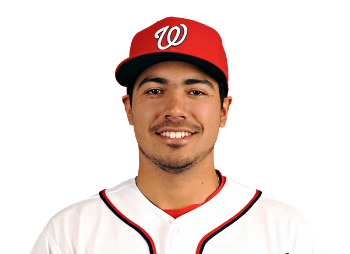
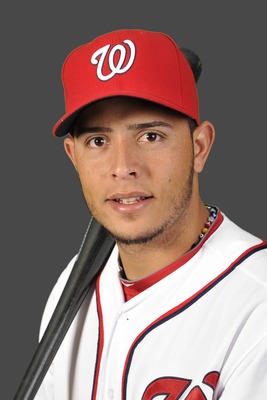
Carlos Rivero looks like a valuable utility guy so far this spring. Photo Brad Barr/US Presswire via bleacherreport.com

I have to admit, I’ve thoroughly enjoyed the two Nats spring training games that managed to find their way to MLB Network TV thus far (NatsJournal live blogs for the 2/23 game here and 2/25 game here).  Not so much because we got to see Harper, Strasburg and Gonzalez … we all know what these guys can do.  No; I’m interested in seeing the young guys, the guys who we rarely get to see play.  This year’s spring training is a week longer, meaning that there’s going to be an awful lot of playing time devoted to these AA and AAA guys who got spring training invites, and that’s many more looks at the likes of Matt Skole, Chris Marrero, and Carlos Rivero.

It is also good to see some of these arm prospects that we’ve been hearing so much about, and it has been instructive to see some of the minor league veterans invited to spring training.  Some observations on our guys (arms then bats):

  • Stephen Strasburg‘s first 7 pitches on 2/23/13; all fastballs, all 96-97.  Clearly he was working on his spots.  I’m not sure he threw a change-up the entire outing.  As is always the case in spring training, guys work on pitches, work on location, and stats are meaningless.  He gave up a wind-aided homer to a guy who’s hit like 1 his entire career; no cause for concern.
  • Gio Gonzalez was amped up; he over threw his fastball in the first and (if you believe the broadcast) reached 97 in the second.  He struggled with his release point clearly.  However, his curve looked in mid-season form, breaking sharply and serving as a nice out pitch against the few regulars that the Mets did bat on 2/25/13.
  • Bill Bray looked, well, awful.  His mechanics were always odd-looking, but he got hit hard by the Mets lineup of rag-tag regulars.  Not a good start for Bray’s spring.
  • Cole Kimball back on the hill …. where was his fastball?  It generally was coming in 90-91.  That’s clearly a step back from 2011, when he was averaging 93 and peaking at 95.8.  Lets hope this is Kimball working himself in slowly and not a permament velocity loss from his shoulder surgery.  Either way, he’s not going to displace his RHP competitors for the bullpen spots unless he can hump it up a bit more.
  • Pat McCoy was scheduled to throw 2/23, and I would really have liked to see him, but the Mets were ahead in the 9th and didn’t need to bat.  I’m convinced that McCoy could be a sleeper candidate for a left-handed specialist in this organization, if the cattle-call of guys we’ve signed to ML deals falls through.
  • Ross Ohlendorf put in two clean innings, but I don’t like what I see from him necessarily.   Not a lot of velocity (90-91) but a big guy (6’4″) who gets downward plane on his fastball.  But he just seems very “hittable.”  His numbers from the last two years in the majors show it; ERAs of 8.15 and 7.77 in 18 starts.  Not good.
  • Nathan Karns: the beat reporters raved about his performance overall; 2 innings, 3 Ks against a MLB-heavy part of the Mets order.  It was great to finally see Karns throw; he has easy arm action, runs the ball in 94-95, and spotted the ball on the corners well.  What I didn’t see was anything resembling a quality second pitch.  He attempted a number of sliders (I’m guessing sliders; they were generally 84-86, which would be a very hard curve) and he couldn’t get over-top of them at all.  He did throw one particular breaking pitch that was sharp and nasty.  I didn’t see anything resembling a 3rd or 4th pitch though.  Is he destined for the bullpen?  That’s not the worst thing in the world; to be the next Ryan Mattheus, a hard-throwing 7th inning right hander.

Now for thoughts on our minor league hitters:

  • Eury Perez is, well, really fast.  If he turns out to be anything close to a servicable hitter, he’s got leadoff/center fielder written all over him.  The question could become; which speedy CF prospect do we hope for more; Perez or Brian Goodwin?  Denard Span‘s contract has a convenient option for 2015, just about the time that Goodwin is likely ready for the majors on a full-time basis.  Of course, that being said Perez is further along than Goodwin (who likely starts 2013 at AA).  Goodwin has power to go with his speed, while Perez seems to have very little power.  Which would you prefer to be the longer-term CF solution?
  • I like Matt Skole; sweet swing, not overpowered by facing MLB pitching.  It makes you wonder about scouting sometimes; how come guys like Skole and Tyler Moore get no love from scouts?  Its like a 30-home run minor league guy is somehow a liability.  Of course, Skole’s problem is the same as Anthony Rendon‘s; positional blockage at 3B.  Yes Skole was playing low-A as a college junior when he hit 27 homers … but if you’ve seen Hagertown’s stadium, you know its a monster park to hit balls out of.  27 homers is no mean feat down there.   I’ll be curious to see if Skole can hit with that kind of power at High-A or AA (wherever he starts 2013).
  • Chris Marrero has looked pretty good, making good solid contact a number of times.  I don’t like his haircut though :-).
  • Carlos Rivero is impressing me; he’s playing the outfield (after having played first SS and then 3B in the minors).  He has good hands, is a big guy, and seems like he can be a servicable backup utility guy who can fill in at any corner.  He’d be more flexible Moore or Chad Tracy in this respect (when judging our projected utility guys) but of course needs to show he can hit at the same levels.  Still, he is likely to be a numbers game victim unless someone like Bernadina gets hurt this spring.

Ask Boswell 2/25/13 Edition

8 comments

When is Anthony Rendon going to be ready for the Majors? Photo Nats Official via espn.com

With the first couple of Spring Training games in the books, its fitting that Tom Boswell did a Monday morning chat on 2/25/13.

Here’s how I’d have responded to the Baseball-specific questions he took.  As always, questions are edited for clarity and I write here before reading his response so as not to “color” my answer.

Q: Given that the Nats know almost every player making the roster out of Spring Training, do the players/coaches approach the 6 weeks differently?

A: Good question; I was taking with someone about this exact topic this weekend.  The 25-man roster is essentially already solidifed; perhaps the only question remaining is whether or not Henry Rodriguez makes it onto the team or does the team carry a second lefty reliever (Bill Bray?).  So I think the answer has to do with looking more at the AAA talent, looking at minor league FA signings like Micah Owings and Chris Snyder to see if they’re going to be better options than the guys we already had slated at AAA.  And the coaching staff gets to look at up-and-coming guys like Anthony Rendon, Zach Walters, and the like.  Boswell reiterates what I said here, naming other ML signings of interest like Chris Young, but also says that this ST has a lot of “wasted time.”

Q: I’ve spent the offseason reading Ball Four to help get my baseball fix. Do you have a sense about how different things are now?

A: It has been a while since I read Jim Bouton‘s seminal baseball book Ball Four.   But the season he chronicles (1969) happened before a number of rather important moments in Baseball history.  Expansion, divisional play, the Designated Hitter, the aftermath of the Curtis Flood and Andy Messersmith decisions (aka, Free Agency) and of course the massive increase of money in the game (both from a revenue stand point and from a player salary stand point).  One thing that seems certain to have changed; players can now earn enough in a season to be set financially for life.  And, the players union’s power is now such that players have the upper hand in a lot of negotiations with the league and the owners when it comes to labor unions.  Boswell notes that managers, coaches and GMs are far “smarter” now than they were in the Bouton era.

Q: How the Nats will do at the gate this year?

A: The season ticket base is back to where it was in 2005 apparently, broaching 20,000 season tickets.  The team averaged 29,269 fans last year.  Clearly the attendance seems set to rise significantly.   I think they’ll average 35,000 a night if they continue to be a first-place club.  Boswell agrees, noting that the team also has a couple of very marketable stars to help with attendance.

Q: Other than obvious injuries, are there any things that can happen in the first quarter of the year that you would find to be troubling?

A: I’d be troubled if Danny Espinosa started off slow.  I’d also be concerned if we saw significant regression out of our WBC participants Gio Gonzalez and Ross Detwiler, confirming my fears.  But the most important factor may be the performance of Dan Haren: is he the 2012 Haren or the 2009 Haren?  If he approaches 2009 version, this team may be set for the season.  Boswell notes they have a tough early schedule, that winning 98 games is tough, and that we should be patient.

Q: Gio Gonzalez; did he or didn’t he?

A: I think the prevailing opinion in the sport now seems to be that he did NOT take or receive PEDs from the Miami clinic, and that he was an unfortunate bystander.  His passing a surprise PED test given two days after the scandal seems to have also bolstered his case.   Boswell agrees.

Q: Are the Nats a 98 win team again, or was last year a fluke?

A: Barring a significant injury in the rotation, I think the Nats are easily a 98-win team and perhaps better in 2013.  Statistical WAR “proof” offered in this space back in January, and that was before the LaRoche re-signing and the Soriano pickup, both of which marginally should improve the team a few wins.  Most national pundits that I’ve read think the same thing, that this team could win 103 games.  The various estimator stats out there (Zips, Pecota, etc)  the team much closer to 90 wins, but those predictors are by and large incredibly conservative.  Boswell also says it comes down to health of the rotation.

Q: How would you rate the Nats starting rotation, spot by spot, compared to the rest of the Major Leagues?

A: Spot by Spot, its hard not to think that each of our guys are each at least in the top 5 by position in the league.  Drawing from my Rotational Rankings post from January 7th, 2013, I’d say that:

  • Strasburg is clearly among the best arms in the game (in the discussion along with Verlander, Kershaw, and Hernandez).  He’s not as accomplished as this group of course, but his talent is unquestionable.
  • Gonzalez matches up as a top 5 number two starter (other candidates: Greinke, Hamels, Lincecum or Cain, depending on who you think SF’s “ace” is).
  • Zimmermann is traditionally underrated but is at least a top 5 number three starter (along with Scherzer, Johnson/Morrow, Bumgarner, Lee and Moore).
  • Haren on potential could be the best number four starter in the game, though Buehrle, Miley, and Lynn could also fit in here.
  • Detwiler is often mentioned as being the best number five starter out there, and its hard to find competitors (best options: Zito, Romero, Garcia, and whoever Oakland and St. Louis settle upon for their #5 starters).

Boswell seems worried that these five guys can handle the workload all year, only really trusting Gonzalez in terms of repeatability.

Q: What future do you see for Anthony Rendon, and when will he debut in the majors?

A: I have been of the belief that Zimmerman should move to 1B for Rendon at some point.  But with LaRoche signed for two years, that won’t happen for a while (2 years, perhaps 3 if we pick up his 2015 option).  So now i’m starting to come around to the the possibility of Rendon pushing someone else off their position.  The most likely candidate seems to be Espinosa at 2B.  Despite having Lombardozzi on the 25-man, Rendon is a higher-potential player.  If Espinosa starts slow, and Rendon starts fast, I could see Rendon getting called up in June and starting to get reps at 2nd while Espinosa goes on the DL for his shoulder.  Otherwise, a Sept 1 call-up seems in order.  Boswell predicts a post-all star game call-up.

Q: Is there any way the Nats can stop Detwiler and Gio from pitching in that baseball ‘classic’? I see a disaster waiting to happen. Luis Ayala was never the same after getting hurt pitching in that thing.

A: There’s no way legally the team can prevent either guy from pitching, since neither suffered any injuries in 2012.  And yes I agree (as discussed in this space on 2/11/13) this is bad news for the Nats.  Washington has never had a pitcher play in the WBC who didn’t regress badly, and the stats seem to show that most every pitcher who does participate in the WBC pitches poorly the next two seasons (links in my post).   Boswell says cross your fingers.

Q: Do you think Bryce has it in him to be National League mvp?

A: Yes I do.  MVP voting generally starts with the “Best Player” on the “Best Teams” and creates a short list from there.  It is why it is relatively easy to predict the MVPs.  If Washington is the best team in the league and makes the playoffs again, and Bryce Harper has a break out season, it won’t be hard to see him getting serious MVP consideration.  Now, let me also say that a “Harper for MVP” prediction is NOT the same as predicting that Harper is set to become the best player in the game.  That’s not what the MVP measures.  If the question was, “Is Harper set to become the best player in the National League” i’d then say, “No, he’s a few years away from that distinction.”  Boswell thinks it may be a bit early.

Q: How many wins per year would you estimate a a stellar defense adds to a teams win total over the course of a season?

A: I’m sure there’s a good statistical answer for this, based on the percentage of WAR added by defense.  But it seems like a very difficult answer to come by.  Boswell says “a few.”

Q: Any reason to think he’s NOT going to be the GM for a long time?  Because I can’t think of many others who have done as good a job in all of baseball.

A: I can see no reason for Rizzo not to be the GM for at least the next 4 years.  His next big challenge will be dealing with the inevitable payroll demands of Harper and Strasburg (both of whom project to be $25M players) while also keeping a competitive team on the field.   2017 could be an interesting year for this team; Strasburg projects to hit Free Agency that year, and Harper should be in his 4th arbitration year.  They already have Zimmerman and Werth at $14M and $21M respectively in the 2017 year, with possibly another $40-$45M out the door to keep Harper and Strasburg.  They better start working on the farm system again.  Boswell didn’t really answer the question, just mentioned how Rizzo’s options have yet to be picked up.

Q: How is Ramos looking thus far? 100%? Suzuki is a professional and seems to be a good guy, do you get a feel for how well he and Ramos interact? How great would it be to generate some power/runs from the catcher spot this year.

A: I’ve been assuming that the catcher job is Suzuki‘s to lose for now; its still early but no word has come out negatively on Ramos‘ recovery.  Either way, yes it would be nice to get some production out of the #8 hole.  Suzuki was pretty good after he came over here, but Ramos healthy was a middle-of-the-order bat.  Boswell suggests that Ramos stop blocking the plate.

Q: If Rendon tears it up after September call-up, what does the Nats 2014 infield look like?

A: Wow; hard not to say Rendon replaces Espinosa like-for-like right now.  But, just as Desmond broke out in his 3rd full time season, so could Espinosa.  It could make for a log jam.  Lets hope for the best, hope for a rebound Espinosa season and a good-problem-to-have situation of having to trade a strength to make way for another strength.  Boswell has no idea where Rendon will play if he merits a call-up.

Q: I think the Nats, and Danny Espinosa are whistling past the graveyard if they think a completely torn left rotator cuff will not seriously affect Danny’s play. Your take?

A: A fair assessment.  I too believe a torn rotator cuff absolutely has to be affecting his swing, especially from the right side.  I think Espinosa should have gotten the thing surgically repaired in the off-season.  I wonder how much the team knew of the injury, because when it was reported in the off-season it sure seemed like a surprise.  Boswell says its a concern and that Espinosa should take more days off.

Q: Is McCatty working with Strasburg on correcting his inverted W delivery? Strasburg also has footstrike issues, as he tends to plant his foot and then whip his arm, which puts a ton of strain on his shoulder. I’m concerned if he doesn’t correct this, his shoulder will give out this season or next. Are the Nats worried about this? Are they working on cleaning up his delivery at all?

A: I’m beginning to think that this whole “Inverted W” thing is a bunch of BS.  Keith Law stated as much when prompted in a chat recently; he says that the problem with the Inverted W theory is that its difficult to “state” with authority that certain pitchers do or don’t have the phenomena.  And its true; if you see some shots of Strasburg he has it, in others his arms are more bent behind his back.  Its the same with Gio Gonzalez (I can show you stills of him landing with his arms clearly in an “inverted W” position and you don’t hear anyone talking about Gonzalez’s mechanics.   The leading inverted-W site on the internet (Chris O’Leary‘s page linked here) uses an opportunisitic example set of pitchers with that motion, but I can find plenty of examples of guys who have similar mechanics but zero soft-tissue injury history (on the Nats two quick examples are Drew Storen and Craig Stammen).  Meanwhile one of his examples was John Smoltz … who only threw 3400 MLB innings in his career and basically didn’t miss a start until he was 32.  Not the best example of proof that his mechanics were somehow “awful.”  I think the entire phenomenon is an observation of coincidence, that pitchers get injuries all the time no matter what their mechanics, and that we need to move onwards.  Wow; Boswell thinks exactly what i think; these proofs are nonesense.
Henry Rodriguez still isn’t healthy?

11 comments

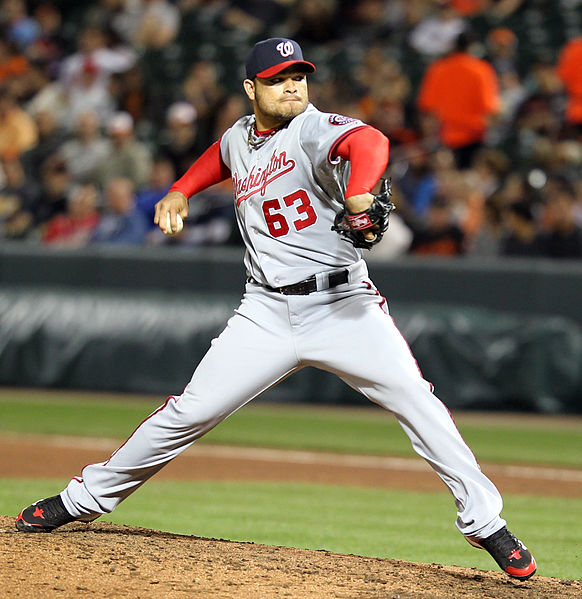
Be prepared for another dubious DL trip for Rodriguez. Photo Keith Allison via wiki/flickr

Sometimes its the smallest of items that catch your eye.   In Washington Times’ beat reporter Amanda Comak‘s 2/12/13 spring training report, she posted this little snippet:

Right-hander Henry Rodriguez, who had a bone spur and a chip removed from his throwing elbow last August, arrived in camp on Tuesday. Rodriguez has been rehabbing all winter and he said that while he feels good to this point, his rehab is not finished. It will be interesting to see just how much he’s able to do during spring training.

Rodriguez’s rehab isn’t finished?  We’re 6 weeks away from Opening Day.  He had this surgery in August, nearly 7 months ago.  It was characterized as a “clean-up” surgery, not a “repair” surgery.  What is going on?

The team already has too many right handed relievers for spots.  Rodriguez has zero options, so he’s either on the 25-man roster, on the DL or out the door via waivers (and you know someone would pick him up; there’s a lot of really bad teams with thin bullpens out there right now).

Be prepared for another 2011-esque situation where the team stashes him on the DL out of spring training so as to give him yet another lifeline on this team.  This topic came up recently in the comments, so for reference purposes he was put on the 15-day DL trip on 3/28/11, and I posted about this topic twice in March of 2011, on 3/23/11 when he got “shelved” to work on his mechanics and then again on 3/28/11 when his official DL-trip reason was “neck spasms,” despite not one single report of any neck issues the entirety of the spring.

I’ve made no secret of my frustrations with Rodriguez, both in his up-and-down performance and in the method of his acquisition.  This little snippet of news gave me yet another reason to potentially be frustrated with him.

However, this future DL trip may open up an opportunity for one of the handful of left handed relievers the team has signed on minor league deals with spring training invites.  It seems almost reminiscent of Jim Bowden‘s 2008 pitching staff cattle calls, the lengths to which the team has pursued possibly LOOGY’s this off-season.  I see no other reason for all these signings (just off the top of my head, Bill Bray, Fernando Abad, Bobby Bramhall, Brandon Mann, Sean West and Will Ohman) unless the team really wants to break camp with a second left-handed reliever.  A second left-handed reliever means only 5 right-handed relievers, and those spots seem to be taken at the moment by Soriano, Storen, Clippard, Stammen and Mattheus barring injury.

Gonzalez to play in WBC: why this is really Bad News for the Nats

10 comments

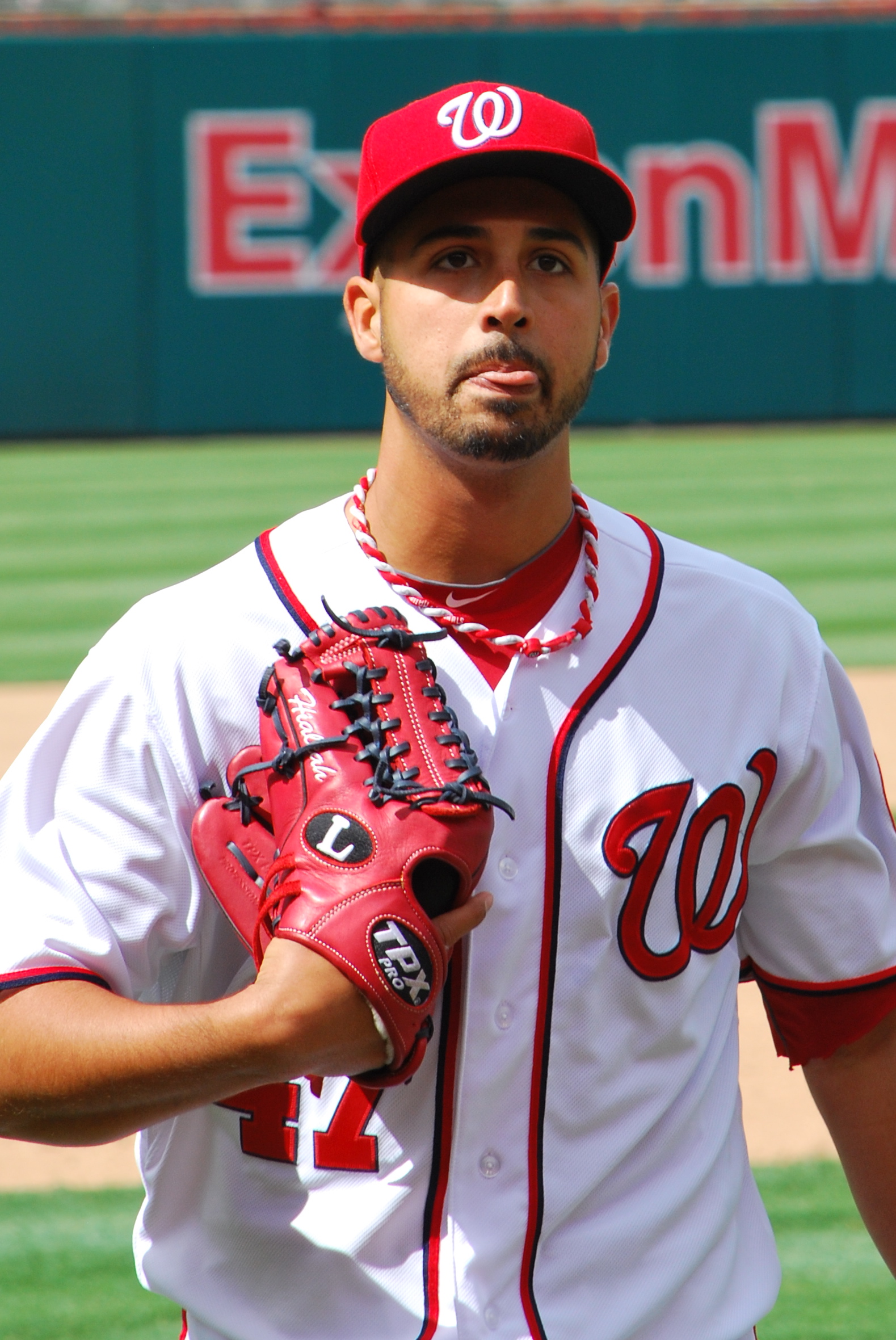
Gonzalez decides rolls the dice with his 2013 performance. Photo via Wikipedia/Flickr from user muohace_dc

Word came out over the weekend that suddenly embattled Nats pitcher Gio Gonzalez has accepted an invitation to play for Team USA in the World Baseball Classic, replacing Kris Medlen (who is anticipating having a child right around the same time).

Why is this bad news for the team?

Simply put: there’s a really bad track record for Pitchers who throw in the WBC the subsequent season, both league-wide and especially with the Nats.

Speaking just about the Nats first: Here’s a quick table showing the before and after ERA and ERA+ figures for the five Nationals pitchers who played in the first two iterations of the WBC (the “before” year is the season leading up to the WBC, while the “after” year shows performance in the season following the WBC):

WBC Yr Pitcher Name ERA before ERA After ERA+ before ERA+ after
2006 Luis Ayala 2.66 inj 153 inj
2006 Chad Cordero 1.82 3.19 225 134
2006 Gary Majewski 2.93 4.61 139 96
2009 Joel Hanrahan 3.95 4.78 109 89
2009 Saul Rivera 3.96 6.1 109 70

As you can see; every single one of our pitchers was either injured or regressed (mostly significantly) after playing in the WBC.  Ayala’s injury cost him the entire 2006 season.  I talked about this discovered phenomenon back in November, 2012 when trying to predict who may participate in the WBC (and where I actually predicted that Gonzalez would play, though the rest of my team USA predictions were wrong).

But this is just our team’s experiences.  How about Baseball wide?  MLB has endeavored itself to argue that participation in the WBC does not lead to an increase in injuries amongst its players and especially pitchers.  But we’re not talking about injuries here; we’re talking about performance.   Here are two very well done studies that show the negative impact of pitching in the WBC:

  1. This July 2010 study on Fangraphs
  2. This Feb 2013 study from BaseballPress.com

The BaseballPress one shows some of the same numbers I’ve shown above, but conducts the analysis across every pitcher who participated in both WBCs.  And the results are pretty evident; across the board on average pitchers regressed both in the year of the WBC and in the year after.  Plain and simple.

It isn’t hard to figure out why these guys regress; playing in the WBC interupts the decades-old Spring Training plans for getting a starting pitcher ready for a season by slowly bringing him along in terms of innings and pitch counts.  And, suddenly exposing both starters and relievers to high-leverage situations in February/March that they aren’t ready for either physically or mentally puts undue stress on these guys that (as we have seen) manifests itself later on down the road.

In the comments section of another post, someone asked what would stop the Nats from steamrolling to the World Series this year.  I answered “rotation injuries” and “bad luck in the playoffs.”  Well, now thanks to Gonzalez we can add two more items: PED suspensions and WBC regression.

Written by Todd Boss

February 11th, 2013 at 9:45 am

Trevor Bauer video of pitch grips

2 comments

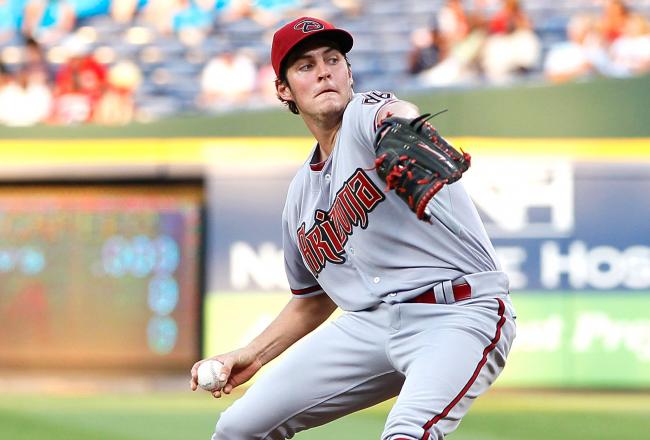
Pitching phenom Trevor Bauer demonstrates his pitching grips. Photo Kevin C. Cox/Getty Images via bleacherreport.com

Fascinating stuff here (link on youtube but referenced via the HardBallTalk blog).

I know I criticized Trevor Bauer in the wake of Arizona trading him away for what seemed to be personality issues.  But in hindsight, with the knowledge now that the team also traded Chris Young and now Justin Upton for apparently all the same reasons (manager Kirk Gibson didn’t like them, or didn’t like the way they played), at some point you have to start looking at the manager who can’t get along with star players versus the reverse.

But stuff like this video really makes me like the kid.  He posted this video showing how he grips and throws all his pitches in response to questions he got from regular fans.  He also freely gives out his facebook and twitter contact information and promises to try to get back to fans who ask questions.  I love social media sometimes.

Bauer’s pitch grips and thoughts:

  • Four Seam Fastball: conventional grip, nothing special.  He doesn’t mention throwing a 2-seam fastball other than mentioning the pitch in passing later on, but with his velocity and his throwing motion (straight over the top) you’d have to think a 2-seamer would be effective.
  • Regular Changeup: not a palm-ball, but a de-acceleration technique by throwing the ball off his middle fingers.
  • “Cut” Changeup; moves his index finger up and provides a bit of pressure; this apparently causes the ball to “cut” 2-3 inches.
  • Cutter; he calls it his “regular slider,” but its an odd grip for a slider; it looks more like a 2-seam fastball grip.  He admits it moves more like a cutter, so that’s what I’ve called it.  He seems to fix his wrist slightly askew, then go through a fastball motion and the ball cuts.
  • Slider: This is a much more conventional slider grip and throwing motion.  He calls it a “dot” slider (likely because the seams form a dot on the spinning baseball) and says that its rather “slurvy,” probably because (unlike his curve) it moves across his body.
  • Reverse Slider: He uses the same cutter grip but fixes his wrist in and then comes through the ball with a screw-ball motion.  He says he gets 4-6 inches of reverse movement.  Man that’s a lot of movement if its true.  Mariano Rivera only gets about 7-8″ of movement on what is generally the best cutter in the game.
  • Curve: he throws 2 variations depending on whether he’s looking to control it for strikes or to really break it off as an out pitch.  He varies the pressure of his middle finger; less on the tip for lesser movement/more control and then more on the tip for more movement/sharper break.  He doesn’t seem to snap his wrist in the same way that a 3/4 pitcher would (basically where the wrist snaps towards the opposite side of the body); he snaps his wrist straight down towards the ground.   This should result in close to a 12-to-6 curve that is relatively rare in the majors.  I would have thought this meant less spin, but I’d also guess that with enough wrist strength and repeitition,  you’d get the spin you need.
  • Split Fingered fastball: he definitely throws this like Roger Clemens or Mike Scott, where the ball isn’t jammed back into the hand like a forkball, but instead is more like a fastball brip with spread fingers.   He doesn’t throw this much, but it makes sense for an over-the-top guy to throw this.  (I often said that Brad Peacock needed to learn this same pitch).

He also talks a lot about the way he fixes his wrist on pitches (changeups and sliders) and brings his arm through.  I wonder; is that conventional?  I’ve never given thought to the position of my own wrist when I have pitched in the past.

So, that’s 8 specific pitches, perhaps 9 if you count a 2 seam fastball in there.  And there’s no circle change or knuckle curve.   How do you call a game with this guy?

His pitch f/x data is limited from 2012; they only have 169 pitches classified.  They have him throwing 4 differerent pitches (FB, CU, CH, SL) at speeds that generally are lower than his scouting reports have him throwing (FB average velocity 92.2 with a 95.1 max).  I’m hoping he gets a shot in 2013 to really show his repetoire.  I’d like to see what he can do in the majors.

Written by Todd Boss

January 31st, 2013 at 9:50 am

Verducci effect for 2013 announced

8 comments

Verducci predicts Nats fans may be reliving this ugly moment. Photo credit unknown.

SI sportswriter Tom Verducci published his 2013 iteration of the “Verducci Effect” article this week, and our own Stephen Strasburg is on his watch list.

The questions we’ll address in this article are these: Should we be worried as Nats fans about Strasburg?  And, do you even believe in the Verducci effect?

Cutting and pasting from his article, here’s the Verducci Effect defined (or the “Year-After Effect” as he calls it, so as humbly not to refer to the theory by his own name as the rest of us do):

The Year-After Effect, as I called the risk after a big innings jumps, is not a scientific, predictive system. It’s a rule of thumb to identify pitchers who may be at risk because of a sharp increase in workload. The older the pitcher, the bigger the body type and the closer to the 30-inning threshold is their increase, the less they seem to be at risk.

Of importance here is his own admission; this is a “rule of thumb,” not a scientific analysis, he limits his candidates to pitchers age 25 or younger, and he picks players instead of doing an across-the-board analysis of all eligible players (this is important as we talk about whether the effect is statistically supported).  He identified 14 such players in his 2012 iteration of this analysis and 9 of them suffered injuries or “significant regression.”  He has a similar track record in his previous years; of the 69 pitchers he’s identified in the last 7 years as being at risk, 55 of them have now suffered injury/posted significantly worse ERAs.  That’s about an 80% succeessful prediction clip.

Strasburg pitched 68 MLB innings and another 55 1/3 in the minors for a total of 123 1/3 2010 innings.  He threw 159 1/3 in 2012, for a total increase of 36 innings from his previous professional high, or a 22.6% increase.  Generally speaking Verducci’s threshold is in the 15-20% range.  Strasburg isn’t the most “at-risk” pitcher on the list; that would be Chicago’s Chris Sale, who amazingly threw 121 more innings in 2012 than he ever had before, being converted from the bullpen to a starter last year.   But Strasburg definitely increased his workload in 2012, and he’s likely to be increasing it again in 2013, with no stated limit on innings for the coming season.  If he averages the same number of innings per start this year as he did last year (5.69) he’ll end up with roughly 187 2/3 innings in 2013, which would be another 15% increase over his previous career high.  Most likely we’ll see him averaging closer to 6ip per outing, which would put him at about 200 innings and representing another 20% increase in innings.

Do we think this is dangerous territory?  Should we be worried?  All signs point to “No;” there’s not a person in the baseball world who would claim that the Nats have been anything but ultra-conservative with Strasburg since the moment he was signed.  His surgery, his recovery, and especially the heavily criticized “shut-down” in September of last year.  The team chose to be less competitive in the short term in order to attempt to be a better, stronger team in the long term.  Given his gradual ramping up of innings and his carefully managed recovery, I expect to see a similar season that Jordan Zimmermann just gave, two years removed from the same surgery.  No injuries, a strong season but with some evident fatigue at season’s end.


A better question may be this: does the Verducci effect actually exist?

This January 2012 Deadspin.com article pretty nicely summarizes all the criticisms associated with the effect.  A few more links are in this article at AmazingAvenue.  This study done by The Hardball Times that looked at ALL pitchers age 25 or younger, divided the pitchers into two groups (those who did and did not throw 30 more innings and thus usually qualify for Verducci analysis) and studied the results.    They found that the overall performance didn’t seem to be different between the two groups.

So, if the effect doesn’t exist, why does Verducci have an 80% prediction success rate?  If the statistical differences between the two groups are identical, then why isn’t Verducci’s prediction rate closer to 50%?

The answer lies in the following statement: Verducci’s articles don’t present themselves to be a macro statistical analysis, and they doesn’t approach the problem in the same way that statisticians do.  Instead, he finds candidates that qualify and then passes judgement based on his professional opinion about whether they’re a “watch candidate.”  Which I think is a perfectly fine way to do an analysis piece like this.  Of the 11 pitchers he selected this year, 4 are from 2012 playoff teams, another 2 are from teams in the ultra-competitive AL East, and 2 more experienced such extremely high jumps in innings that even a non-statistical observation would conclude they’re injury risks for 2013.  I don’t think this kind of analysis is unreasonable frankly.  He clearly “cherry picked” these candidates but for good reason; they were for the most part either severely driven or were pitching a lot of higher-than-average leverage innings for the bulk of the year, all the while throwing deeper into seasons than ever before.

Its a combination of statistics and opinion; most critics of the theory use 100% statistics to claim that the effect doesn’t exist.  But that’s the rub that I keep coming back to when talking about the use of statistics in baseball; human behavior (aka, baseball players) doesn’t operate on a spreadsheet, and statistics cannot and will not entirely predict all situations in the future.  You can’t just say that the effect doesn’t exist because you can’t prove it exists statistically.  In this case, there’s clearly an analysis/opinion portion of the effect that takes into consideration immeasurable factors that (in Verducci’s opinion) lead to more stress and a higher probability of injury.  Plus, Verducci admits that “body type” and age do factor into his opinion; meaning that a guy with a big body (and by inference he likely means that a bigger body that takes stress off the shoulder) is more likely to be able to weather a larger workload.  Roger Clemens versus Tim Lincecum.  I’d also assume he’s looking at mechanics along the way (and Verducci is on record for being critical of Strasburg’s mechanics, as I discussed in this March 2011 post).  Statistics can’t measure mechanics, or body type, clearly portions of Verducci’s analysis.

Let me put it a different way: would anyone be the slightest bit surprised to see Sale come down with a shoulder injury in 2013?  I certainly would not.  And that’s the essence of the article, to provide a baseball opinion, and one of the reasons I still put stock into it while others waste time trying to disprove it.

Lets just hope Strasburg is one of the 20% he’s wrong about…

Written by Todd Boss

January 25th, 2013 at 10:56 am

Ladson’s inbox 1/22/13

7 comments

Does Boras run the Nats? The national narrative certainly seems to think so. Photo Ezra Shaw/Getty images via espn.com

I love a diversion.  Bill Ladson’s inbox is always a diversion.  Here’s 1/22/13’s edition.

Q: Why do the Nationals need another closer in Rafael Soriano?

A: My posted opinion about the deal from 1/15/13.  Did they “need” another closer?  Probably not.  But, innings sent to Rafael Soriano cascades downwards and means that innings that would be given to lesser relievers will now be pitched by Clippard and Storen (assuming one of them isn’t moved of course), and overall the bullpen is improved.  I wonder if Ted Lerner didn’t pull a George Steinbrenner/Dan Snyder-esque move and force a player signing as a reaction to a singular event (aka Storen’s NLDS game 5 meltdown).  Its possible I suppose.  If so, you hate to see moves like this, because it undermines the GM and leads to poorly constructed rosters.  Ladson belives this is a reactionary move to the NLDS bullpen meltdown in total, not just Storen’s misfortunes.

Q: It seems like Washington takes all of Scott Boras’ clients and puts them on its roster.

A: I hate this Urban Myth that now pervades anyone’s analysis every time the Nats sign a Scott Boras client.  Check the proof: MLBtraderumors keeps a player agent database and guess what?  The Nats don’t even have the most clients of Boras.   The Nats have 7 Boras clients but Boston has 8.  Plus, three of the 7 Boras clients the Nats have were no-brainer 1st round draft picks (Harper, Strasburg and Rendon, and you could even argue a 4th such Boras pick in Goodwin that the team would have taken at that point in the draft irrespective of his representation) that the team was likely going to draft and sign no matter who represented them.  The fact is this: the Nats have become a premier FA destination, Boras represents a lot of good players on the FA, and the Nats have hired some of his players.  When Boston or Texas hires a Boras client, you don’t suddenly hear people sarcastically asking, “Does Boras run the Red Sox?” now do you?  I think its great that Rizzo and Boras have a good working relationship, because other teams/GMs do not, and it affects the quality of their teams as a result.  Ladson defends my point as well, saying similar things to what I’ve pointed out.

Q: Does the Nationals’ front office regret not making Edwin Jackson a qualifying offer? It seems he would have signed elsewhere and the Nats would have received a compensation pick that would help the farm system.

A: Great Question!  One I asked in this space myself on 11/5/12.  I honestly think the team believed that Edwin Jackson, who had a history of signing one year deals, would have taken the contract.  Either that or there was a hand-shake deal in place stating that the team wouldn’t extend the offer.  I don’t truly believe the latter part of this, because (as others have pointed out) it’d be illegal as per the latest CBA.  Either way, I thought it was a mistake at the time and the Nats indeed missed the opportunity to gain an extra pick.  Ladson believes point #1; he thinks the team was afraid that Jackson would take the deal.

Q: If there was one thing that could hold the Nationals back from winning the World Series this year, what would it be?

A: I’ll give you two things that could prevent the team from winning.  1) Injuries in our Rotation and 2) bad luck.  We’re very thin in terms of starters and a season-ending injury to one of our big names would be a bad impediment.  And, the playoffs are crap-shoots; 83 win teams (St. Louis in 2006) can get hot and win it all while 116 win teams (Seattle in 2001) get beat easily before ever getting to the World Series.   That being said, even a starter injury probably wouldn’t be fatal to this team’s chances of making the playoffs; the Mets and Marlins are moving backwards, the Braves seem to be treading water, and the Phillies are getting older by the day.  The division is there for the taking even without winning 98 games again.  Ladson says injuries.

Q: Is it true that the Nationals are interested in Kyle Lohse and plan to put Ross Detwiler in the bullpen?

A: Man, I hope not.  I like Kyle Lohse but there’s a reason he’s still on the FA market despite a TON of teams needing pitching help (and it isn’t just because of the lost draft pick).  He’s really not THAT good.  He had (easily) his best season last year, the definition of a contract year if there ever was one.  Career 98 ERA+.  I think he’s a good fit for a team that needs a 3rd starter, but the Nats aren’t that team.  I made my arguments for keeping Ross Detwiler in the rotation on 1/16/13, when rumors swirled about the team looking at Javier Vazquez.  Who would you rather roll the dice with?  A young, up and coming power lefty or a soft-tossing righty who’ll be 34 next year?  I think buying another $12M/year starter and pushing Detwiler to the bullpen just for the reason of “needing another lefty” in the bullpen is arbitrary and would be a waste of Detwiler’s promising 2012.  Ladson agrees, saying that Davey Johnson likes Detwiler in the rotation.

Q: Would Mark DeRosa be a viable managerial candidate for the Nationals in 2014?

A: Random question.  What makes you think Mark DeRosa won’t still be playing in 2014?  Plus, what ties does he have to this organization that would make you think that the Nats think he’s the heir apparent?  I mean, if we’re talking about former players who have put in the time with this organization, look no further than Matt LeCroy, who played for the team and has been managing in our minor league system for years.  Personally, I think the team will go with a “celebrity manager” when the time comes.  Ladson expresses some surprise at the question as well.

Q: After he was acquired from the Athletics for Michael Morse, where does A.J. Cole fall on the Nationals’ list of prospects?

A: I’d say he’s probably 3rd in line, after Rendon and Goodwin.  That’s about where he was when he was still in the system, and despite his rough 2012 in the California league he’s still very promising.  Ladson says 3rd, as does mlb.com’s rankings for the team.

Q: What did you think of what the Nationals received for Morse? Could they have gotten more — a Major League lefty reliever in addition to a starting prospect? Is the problem that Morse only had a total of two good seasons?

A: I think the Nats got what they could for Morse, frankly.  I would have liked to have seen a MLB lefty and a starting pitcher prospect in the lower-to mid minors.  Lots of people were using the Josh Willingham trade as a comp; both players are similar (both are good offense, no defense type guys in the last year of an affordable contract).  Willingham netted us a mlb reliever and a high-minors OF prospect.  However Morse’s defensive inabilities preceed him reputationally, and many scouts perceive his 2011 as a one-off instead of a ceiling of potential.  Ladson says they made a great deal.

Earl Weaver Passes

leave a comment

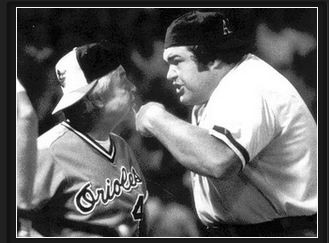
Weaver during one of his 96 career ejections. photo unknown via examiner.com

A quick post to note the passing Earl Weaver, long-time Orioles manager and one of the great characters in the game.  Weaver passed away over the weekend at the age of 82.

The tagline of this blog (located at the top left of the page) has always been an Earl Weaver quote related to pitching:

“… the reason you win or lose is darn near always the same – pitching.”

Weaver may have been remembered for his antics on the field and legendary rages against umpires, but he was also a pitching strategy pioneer.  As is noted in the link above, Weaver was one of the first managers to track pitcher-hitter matchups as a method of managing his bullpen.  He may have advocated the 3-run homer as the best offensive strategy, but he definitely advanced pitching strategy during his career.

Former Oriole Ken Dixon is a player in the local DCMSBL league and pitched for Weaver in the mid 80s.  We asked him once at a golf event what his favorite memory of Weaver was and he told the following story (paraphrased from memory): Dixon said he was pitching in a game one day and was really struggling.  Weaver was fuming at him in between innings, and when he got into another jam Weaver came out to the mound to (as Dixon thought) remove him from the game.  Instead, Weaver arrived at the mound and was so furious with the situation he just cursed and carried on like a crazy uncle, never really talking directly to Dixon.  Eventually, he left the mound without really saying anything of substance to Dixon (or taking him out).

Written by Todd Boss

January 20th, 2013 at 5:38 pm

Nats & Vazquez; Do people really think Detwiler is going to the bullpen?

19 comments

Do people really think Detwiler is heading to the bullpen? Photo: Haraz Ghanbari/AP via federalbaseball.com

By now we’ve all seen the reports; the Nats have been to Puerto Rico to scout Javier Vazquez, the veteran starter who inexplicably “retired” after an effective 2011 at the age of 34.  According to Adam Kilgore‘s initial reports and as stated in other places on line Vazquez is apparently hitting the mid 90s in winter ball and is looking to possibly re-start his pro career.  Kilgore reports that the Nats are looking to offer Vazquez a minor league contract with an “out clause” if he’s not assigned to the Majors by a certain date.

This out clause arrangement seems to make perfect sense for the Nats.  We have a full rotation, we need starter depth in AAA, and Vazquez is a risk having been out of the league for a year, despite how good he looks in a winter ball league that rates at best at being a “weak AAA” level of talent.

What I don’t understand in some of these reports is the claim that the team would love to sign Vazquez and then drop Ross Detwiler to the bullpen.  Mike Axisa from MLBtraderumors stated as much in his report and I got into it with a NY-based blogger who keeps stating that Detwiler “belongs” in the bullpen without really giving much in the way of proof.

Here’s what Detwiler did in 2012: 10-8, 3.40 ERA and a 1.22 whip in 164 1/3 innings and 27 starts.  He posted a 117 ERA+, good for 12th in the league among qualified starters.  He’s a lefty who averages 92-93 and can reach 96 in a division with a number of teams with lefty power (especially Philadelphia).  And he saved the Nats bacon by giving the team its best post-season start in the NLCS.  He is still cheap (he’s first year arbitration eligible this year), meaning he provides great value for the dollar as a starter.

Why exactly would the Nats be looking to replace Detwiler in the rotation??  And why would the team be looking at a reclamation project like Vazquez to be his replacement?  Vazquez’s 2011 numbers were good (13-11, 3.69 era, 1.183 whip) but not earth shattering (106 ERA+ in 2011 after getting hammered in New York the year prior).   Detwiler was a significantly better pitcher by this measure in 2012 than Vazquez was in 2011.   If you had the 12th best pitcher (by ERA+) in the league installed as your 5th starter, why exactly would you be looking to replace him?

Then there’s the “personnel issues” involved with Vazquez at this point.  Why did he walk away from the game?  Wouldn’t you be concerned about his committment levels and his drive at this point?  Why would a team want to give him anything other than a non-guaranteed deal?

Yes, I realize the team’s bullpen, as it is currently constructed, is light on left-handed relievers.  We’ll ignore for the time being the fact that our existing RHPs out there mostly have good lefty splits.  If you go on the assumption that the team “needs” another left handed reliever, there are certainly better ways to fill that spot than by wasting an excellent starter by putting him in the pen.  Any statistical measure of player value will show you that even a medicore starter is usually “worth” more than even an excellent closer; sometimes FAR more.  A quick proof: Craig Kimbrel‘s 2012 season as the Braves closer was epic and historical, and was worth a 3.6 fWAR.  That would only have qualified him for 25th in the league, tied with Kyle Lohse and just ahead of our own Jordan Zimmermann.   And that was for one of the best reliever seasons ever seen.  Rafael Soriano was an excellent closer last  year and only had an fWar of 1.2, a more typical closer number, which would have been about 77th in the league in fWAR, around what Bruce Chen and Edinson Volquez provided in 2012.

In the end, it may not matter; if Vazquez is coming back there’s plenty of teams that make much more sense for him to join that would give him a guaranteed MLB deal and a guaranteed rotation spot.  Any of the bottom 4-5 teams in my Rotation Rankings would make sense.  Returning to Miami would make too much sense, based on where he pitched last and proximity to his home in Puerto Rico.  But it bugs me just the same that people don’t use some common sense when looking at what Detwiler gave the team last year and assuming that he is better served in the bullpen to make way for a lesser pitcher.  I’ll fully admit; I have not always been a Detwiler fan.  But after what he showed the team in 2012, I think you stick with him in 2013 no matter what.

Soriano? Well at least its Rafael and not Alfonso

19 comments

The Nats get some icing on the cake in Soriano. Photo Elsa/Getty Images via nydailynews.com

Jeff Passan broke the news, which I found out about only by chance late Tuesday afternoon (silly me, trying to do “work” or something).  Rafael Soriano to the Nats on a 2yr/$28M deal with a third option year that only vests with a relatively unattainable 120 “games finished” plateau reached.

Wow.  Did not see this coming.

Was this a reaction move to Drew Storen‘s meltdown in the 9th inning of NLCS game 5?  Adam Kilgore is reporting that the Nats owner Ted Lerner was “heavily involved” in the transaction, likely because of the amount of money involved and perhaps as a sign of the 2013 mandate to win it all.

Two quick reactions from a roster management perspective:

  1. First off, we can call off the need for lefty relievers.  Soriano’s so good against both righties and lefties that he can be the Loogy. 🙂
  2. Secondly, I’m guessing that either Tyler Clippard or Drew Storen is officially on the block.  The team certainly could have made the argument that they had too many right handed, back of the rotation candidates BEFORE today.  Now they’ve got three closer-quality arms but only one closer job.  And clearly Soriano is going to be the closer.  If you look at his career stats, when he’s closing he’s lights out.  185 ERA+ last year for New York, a 237 ERA+ as Tampa’s closer in 2010.  Clippard and Storen are good, but they’re not that good.  One or the other is likely traded now, so as to clear a log-jam of RH arms in the pen.   They *could* send down guys like Stammen or Storen (they have options available) but they’re too good to make way.  More likely is a trade.

New Look 2013 bullpen: Soriano closing, Clippard or Storen setting up, Henry Rodriguez and Mattheus in 7th inning roles, Duke as loogy/long-man, Stammen as 6th-7th inning/long man and Bray as the loogy.   Or perhaps Garcia makes the team while Bray pitches in AAA waiting for an injury.  Or perhaps Clippard and Storen both stay, and both Bray and Garcia start in AAA.  Or perhaps Clippard or Storen get packaged with Morse to bring back (as we’ve been saying for a while) both a lefty reliever AND some prospect depth.

I can see the blogosphere criticizing this deal for three reasons.

  1. That’s a lot of money for a closer (I think it makes him the highest paid closer in the game), and the deal is surprising in that Soriano now will easily earn more than the rest of the bullpen combined, a stark departure from Mike Rizzo‘s parsimonious methods of building bullpens lately.
  2. Yet another Scott Boras client for the Nats.  By my count that’s now seven Boras clients in the Nats system and five on the MLB roster (others: Espinosa, Werth, Goodwin, Harper, Rendon, Strasburg).  I hate the lazy narrative that Rizzo is somehow Boras’ b*tch, but we’re about to hear it again.  Check the agent database: yes we have a lot of his clients but so does Texas (7), Boston (8), Kansas City (6) and Detroit (6).  Boras just has a lot of good players, and the Nats are a good team where players want to come to play.
  3. This costs the Nats their 2013 first round pick.  It wasn’t nearly as high a leverage pick as before (#33 overall with a couple of compensation picks pushing it down from the #30 spot as last year’s best record would have indicated).  I’m sure the argument will be that Soriano > back-of-the first round pick.

$14M for a closer is a lot of money.  But hey, its not my money.  If we weren’t sure of it before, the Nats are now *really* officially saying that they’re going for it in 2013.  I’ll have to re-do both the salary and the WAR worksheets when I get some time to see how this factors in.