Nationals Arm Race

"… the reason you win or lose is darn near always the same – pitching.” — Earl Weaver

Archive for the ‘Majors Pitching’ Category

Olsen (possibly) closes his Nats Career last night…

leave a comment

Well, Adam Kilgore beat me to the punch on this post earlier today, but I’ll still post my sentiments.

Scott Olsen put in yet another forgettable performance last night (gamer/box), lasting only 5 outs while giving up NINE earned runs in an ugly outing.  His era rose from 4.91 to 5.88, his whip rose from 1.43 to 1.53 and his ERA+ dropped from an already mediocre 84 to 70.  He drops to 3-8 on the season and the team is 5-10 in his starts.

The problem with Olsen is that his “highs” are not balancing out the lows.   In 15 starts he’s pitched into the 7th inning twice (including one gem against Atlanta where he gave up 2 hits in 7 1/3 inning) but he’s had “meltdown” games no less than five times.  (“meltdown” being defined as a game where the pitcher gives up at least as many runs as innings pitched).

Olsen arrived to the team with a history and a less-than-stellar fitness routine (he was a half-a-pack a day smoker).  We havn’t heard a single peep about any attitude or smoking issues this year and I was impressed that he accepted last year’s non-tender and subsequently signed on for less than what he would have earned in arbitration to start the  season.  I’m less impressed with the results for this team.

Thankfully for Olsen, he won’t earn an outright release in the next few weeks, probably just getting sent to the bullpen or just shelved as Yunesky Maya gets called up to naturally make the 9/7 start on a normal 4 days rest.  But, with an expected crowded race for next year’s rotation, he’s quickly earning himself a non-tender after the season is over.

Written by Todd Boss

September 2nd, 2010 at 1:33 pm

Did Chapman really throw a ball 105mph?

one comment

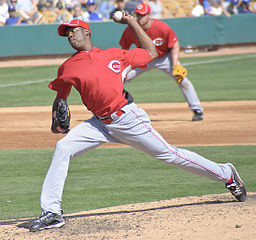
Chapman is amazing. Photo via wiki/flickr SD Dirk

Chapman is amazing. Photo via wiki/flickr SD Dirk

(Editor’s Note: This post was originally published on 9/2/2010, edited several times since, including links to the 105.1 pitch later in 2010 and him hitting 105.1 again in 2016, plus 2020 and 2022 readings and addition of additional links).

If you believe twitter and these published reports, Cincinnati’s Cuban prospect Aroldis Chapman “sat” at 103 and hit 105mph in his final AAA appearance before getting called up for the 9/1/2010 roster expansion.  I had a hard time believing it; the picture in the Yahoo looks doctored frankly, and stadium guns are notoriously “jacked up” to get the crowds excited and to spark interest in hard throwers.

There are two kinds of radar guns used by stadiums and scouts today.  A “fast” gun measures the speed of the pitch as it leaves the hand of the hurler while a “slow” gun measures its speed by the time the pitch crosses the plate.  For obvious reasons you’ll take the “fast” reading if you’re trying to hype the player, and you take the “slow” reading if you’re trying to evaluate the pitcher.  Oh, and you take readings over and again, compare first inning to last inning, etc.  My thoughts were that Chapman was on a fast gun that was over-exaggerated to add a couple MPHs (case in point; Jordan Zimmermann‘s radar readings on the telecast two nights ago put him at 96mph when his pitch f/x maximum was 94).  Click here for an excellent overview of the way we’ve measured velocity has changed over the years.

Now, that being said, check out the Pitch F/X data from Chapman’s first appearance in the majors on 8/31/2010, and his second appearance on 9/1/10. In his major league debut he threw 6 fastballs with an average of 100.65 and a max of 102.7mph.  This in and among itself would have been amazing and would have tied the fastest ever recorded pitch f/x data (that of Joel Zumaya hitting 102.7 in a game in June 2009)

However, look at the data from 9/1/10. He threw 7 fastballs that AVERAGED 102.11 mph with a peak of 103.9mph.  103.9!!


Before talking about new records, lets talk about history.

Now, I know there’s a ton of links out there talking about what the fastest ever reported pitch is on record (see links here or here at HardBalltimes or this google cache’d document as well as wikipedia or Guinness Book of World records links).

  • Walter Johnson was known for his power in the early part of the century; his fastball was estimated to be in the upper 90s by lore, and 91mph by testing.  Its a shame that modern technology didn’t exist back then.
  • Bob Feller being “recorded” using primitive measures in the 107mph range.
  • Steve Dalkowski’s legendary velocity being claimed at 110mph.
  • Nolan Ryan‘s “record” of 100.9mph has stood as some sort of altar to the speed ratings for years and years.

Lets discuss some of these points.

Bob Feller: So, what is the “proof” that Feller threw 107.6 in 1946?  Well, its complicated.  This ESPN article covers it: basically Feller threw a ball through a Lumiline Chronograph device, which hyper-accurately measured speed at the time.  His best measure was 98.6mph … but modern pitches are measured at the point of release, not where it crosses the plate.  So, you have to estimate how much velocity was lost from the point Feller tossed the ball to the device.  If you look at the photo (in the ESPN article), Feller was not throwing from the mound, but somewhere well forward of it.  So, to standardize speeds to some point closer to the release point of the pitch, we have to estimate the percentage loss of Feller’s pitch from an estimated delivery point based on a photo, then back into a number.  Some estimate this to be in the 103 range, others claim 107.6, which would imply he was throwing off the mound and experiencing the full expected velocity loss (which is clearly not true from the photo).  So I’d believe Feller was throwing roughly 103-104 based on where he released the ball … but its an estimate.  Add back 1mph for every 7 feet, and Feller seems to be standing at about 35 feet, so add perhaps 5mph to his 98.6 and you get the 103-104 rough estimate.

Coincidentally; the new standard is speed of the pitch measured at 50 feet from home plate.  This standardizes to allow for different release points by pitchers of different heights.

Steve Dalkowski: rumors of 110mph were mostly lore, but attempts were made to measure Dalkowski’s velocity.  Famously, he was measured at 98.6 at a military base in the 1960s, but there were some interesting caveats to that test.  According to this NYtimes article, the day Dalkowski attempted this test, he had thrown a 150-pitch start the DAY BEFORE, then had such a hard time throwing a baseball through the measuring device (he was notoriously wild) that it took him “dozens” of attempts before finally registering one pitch at the 98.6mph level.  It was the only known measurement of his arm ever done, and one has to think that (similarly to Ryan’s 100.9 speed below) he’d gain several mph just to standardize the speed to today’s 50-foot guidelines, and, frankly,  his arm was probably toast during the test.

(Side Note: if you’ve never heard of Dalkowski … his wikipedia page is a pretty good read).

Nolan Ryan: How about proof that Ryan threw 108.1, as is throw around the internet?  Well, It comes from the famous 100.9 reading he put up in a start in 1974.  However, that was reading was made using technology that, again, measured the speed closer to the plate than we currently do.  Per this article (which summarizes findings from a documentary called Fastball), the radar technology measured 100.9 ten feet from home plate, meaning we have to back up to the 50 feet estimate.  So, if the speed was measured at 10 feet, and we normally measure at 50 feet, we should add back “40 feet” of velocity loss, at around 1mph per every 7 feet, so call it somewhere between 5-6 mph … and we’re somewhere in the range of 106-107mph.  Not 108.1 as everyone claims; that’s adding back too much velocity and/or giving Ryan 10 feet more of credit (the measurement at the plate versus 10 feet in front).  These are still estimates of course; these speeds are also affected by the weather at the time (it was in Sept of 1974 in Anaheim … was that a humid day, an arid day?  Anaheim’s typical September weather is humid, hot; was it really humid that night?  Was it relatively dry?  That makes a huge difference in aerodynamics of a baseball and potential velocity loss.  So … we’ll never know.

Coincidentally, these velocity loss estimates are best documented by a physicist at the University of Illinois named Dr. Alan Nathan.  He estimates that baseball pitches lose 9-10% of their velocity from the point of release to the plate.  Example; if you release a ball at 100mph, it will generally measure at 90-91 by the time it crosses home plate.  Or, to put it easier … a pitch loses about 1MPH every 7 feet.

Other rumors and records for fast pitches suffer from perhaps hype and estimates, not science.  Zumaya reportedly hit 104.8 in the first game of the 2006 ALCS, but it was on the stadium gun, not Pitch F/X.  Ryan and Goose Gossage both reportedly hit 103mph in the 1978 All-Star game.  Stephen Strasburg reportedly could hit 102 as an amateur but rarely goes about 97 post-arm injury.  Justin Verlander may not have the triple-digit records but amazingly maintains his upper-90s throughout games, often hitting 100mph in his last inning of work.

I think Chapman’s speed last night is the new standard.  And a pretty amazing accomplishment.

Post publishing Editors notes: Chapman set a new MLB record on 9/24/10, after this article’s initial posting, throwing a documented 105.1mph.  He also threw a ball at 104.6 on 7/28/14.  Not quite as fast as his best ever … which I’m guessing even Chapman doesn’t think he’ll ever beat, since he got the reading tattooed on his wrist.  Then on 7/19/16,  years after his first record, he tied it again, throwing another ball 105.1.  Here’s the StatCast link for this pitch.  Coincidentally, this 105.1 pitch is now officially registered at 105.8 by MLB, because the technology we use now standardizes the pitch speeds at a specific distance, and Chapman’s 105.1 was measured further down from where we now standardize.

As of this writing, the Guinness Book of World records recognizes Chapman and 105.8 as the world records.

Post-posting related link: BA’s J.J. Cooper posted this Q&A session on 4/28/15 talking about Chapman and 101+ MPH pitches.

Jan 2017: Boston pitching prospect Michael Kopech, who is renowned his velocity, hit 110 MPH during a “max velocity” workout early in spring training by crow hopping.  Impressive, but not the same as throwing off a mound.  Holy mackerel!  How long before this kid gets to the majors and has a gun on him??

May 2018: we may have a new gold standard; Jordan Hicks threw a reported 105.1 MPH fastball, but Pitch FX shows it at 106.1.  (Unfortunately the PitchFX data at BrooksBaseball site now does not work, so my “evidence” is gone).  However, subsequent reporting on this pitch have lowered it to the mid 104s, so it remains unclear what its real velocity was to this day.

May 2022: University of Tennessee’s Ben  Joyce threw a pitch recorded at 105.5 in a college game.  Does Tennessee have Pitchfx?  Was this a juiced gun?  We’ll have to see.

Written by Todd Boss

September 2nd, 2010 at 12:21 pm

Zimmermann’s 2nd start back…

leave a comment

At the risk of sounding TOO optimistic (like perhaps the ever rosy Thomas Boswell in today’s WP column), Jordan Zimmermann looked awfully good last night in his 2nd start back (gamer and box score from nationals.com).  He went 6 complete innings, gave up 1 hit (a double by Sanchez that was erased on a great outfield assist from Bernadina), struck out 9 and finished on 86 pitches before being lifted.  He could have gone more, but why would you at this point in the season with a guy coming back from injury?

Zimmermann’s effort is probably the 2nd best/2nd most dominant pitching performance of the year (behind Strasburg‘s 14k debut 6/8/10) from any Nats starter.  Per the pitch f/x data he hit 94 once, touched 93 a few times and averaged 91.79 on his 65 fastballs on the night.

(side note; just goes to show you can NOT trust the stadium Guns, ever, as they had Zimmermann on 96 in the first inning several times, which means that the stadium gun was at least 3mph faster than reality).

It is hard to gauge the breakdown of pitches though; per the f/x data he only threw one changeup, yet was quoted in the gamer as saying that his changeup felt great.  I’m guessing that some of the pitches classified as “sliders” were in reality changeups, and that the variation of speeds between his slider and curve screwed up the pitch classification.  Either way, his curve was definitely faster and less loopy than his previous start.  By pounding so many fastballs he showed that he has dominant enough stuff to challenge a pretty decent hitting Marlins team.  Zero walks and 86 pitches to finish 6 innings means he had pretty good control.

Unless the Nats are specifically NOT calling changeups after what happened to Strasburg?  That’d be a bad precedent.

On the season, Zimmermann now has 13ks and 1 walk in 10 innings.  That’s something to build on.  I’ve always thought that best-case Zimmermann had the capabilities to be a great #2 starter on a good team, and performances like last night are indicitave of that and much more.

Written by Todd Boss

September 1st, 2010 at 9:31 am

Livan re-signed; great move to shore up 2011

leave a comment

Over the weekend, the Nationals took the first post-Strasburg step towards shoring up the 2011 rotation by extending FA-to-be Livan Hernandez through 2011.  No published financial figures but various tweets and rumors put it at $1M base plus a ton of incentives.  If this is indeed the case then his deal is an absolute steal considering his performances this year.  He’s pitching at a 2.7 WAR, which is valued at $10.8M per season per fangraphs.

(Small tangent; click on the fangraphs.com link to see who our 3rd most valuable starter by WAR is; yes indeed its Craig Stammen, demoted to the bullpen despite having the 3rd best advanced stats of any of our starters.  Unfair to the poor guy.  Perhaps he’ll get his chance again in 2011).

Livan has been an integral reason why the Nats are not clamoring towards another 59-loss season, having come out of nowhere (i.e., a minor league contract in spring training) to lead the staff.  He’s given us 18 quality starts in 27 outings, pitched into the 7th inning 12 times, and is averaging6.5 innings a start.  the team is 14-13 in his starts (42-62 in everyone else’s starts).

Here’s how 2011 is now shaping up, with no FA pickups (and not considering any of our AA prospects)

  • Locks: Zimmermann, Marquis, LHernandez
  • Considered (in order): Maya, Lannan, Olsen, Detwiler, Wang
  • DL for 2011: Strasburg
  • Minors/relievers/Left out: Atilano, Martin, Chico, Mock, Martis, Thompson, Stammen

What really “caused” the Strasburg Injury?

3 comments

By now, we’ve all heard the news: Steven Strasburg is headed towards Tommy John surgery and won’t be back for 12-18 months, which probably puts him out for the entirety of the 2011 season.  Analysis and observation seem to show that the acute injury was the result of a singular injury, namely his 5th inning change up thrown to Domonic Brown which left him visibly shaking his right arm.

So, what really caused the issue?  Here’s some possibilities:

1. Over-protection by the team.  I have an awful hard time believing this.  Strasburg never went more than 100 pitches or 7 innings in any major or minor league start this season.  Does that mean he was more susceptible to a major arm injury?  I seriously doubt it.  There are those pundits who blame the Nats for NOT gaining an MRI of his shoulder during his 15-day DL stint, which is similarly ridiculous.  He had a shoulder injury not an elbow injury.  If he had blown out a groin would those same pundits be saying the team should have MRI’d his legs too?

2. A mechanical change: Some analysis that i’ve read (this post by Foxsport’s Jon Paul Morosi) has quotes from unnamed scouts that say his mechanics had changed slightly, which (Morosi intimated) may have resulted in stress on the elbow that had not been there before.  To test this, compare his Pitch F/X report from his MLB debut on June 8th to that fateful day in Philadelphia  last week. Comparing the release points in these two plots shows something interesting; his release point is indeed several inches higher on average in his last game versus his first.  Comparing The 6/8 video versus the 8/21 video isn’t really helpful; the former just shows every strikeout while the latter replays the fateful pitch where the injury occurred.  One would have to see the isolated feeds side by side to really see a difference.  However, a slight mechanical change could certainly be factor.

3. The “Inverted W” Effect: There some pundits out there on the net who believe that the “Inverted W” effect (where a pitcher’s pre-release arm positions resembles an upside-down W) indicates a proclivity of arm injuries.  The name most often associated with this (the poster boy, so to speak), is Mark Prior, who had supposedly clean mechanics, threw hard and was basically out of baseball by the time he was 25.  Writer Chris O’Leary has several examples plus an entire section on Strasburg, who does exhibit the behavior.

The problem I have with the inverted W theory is that you can cherry pick from the thousands of major league pitchers out there to prove or disprove this theory.  O’Leary himself uses John Smoltz as an example of someone who had the Inverted W, saying that Smoltz “… retired due to shoulder problems.”  Uh, Smoltz made over 700 HUNDRED starts, plus had 4 years as a closer, and made 32 starts the year he turned 40.  Thats about as BAD of an example as you can find to prove your theory.

Yes Strasburg exhibits the inverted W behavior, but not nearly as definitively as poster boys such as Prior or Reyes.  But he’s never had shoulder problems, and damage to the elbow seems to be indicative of something besides the W effect.

4. Scapular Loading: some googling about his injury turned up this interesing article at Drivelinebaseball.com.  In essence, Strasburg puts undue stress on his elbow based on “scapular loading” during his windup.  The article concludes that this behavior possibly contributed but isn’t necessarily the cause.  It is worth a read though.  I don’t know nearly enough about the subject to agree or disagree to heavily.

5. Strasburg was throwing FAR more change-ups than he’s used to.  In college, he was so dominant that he could be a 2-pitch pitcher (4-seamer and curve) and pitch his way to the player of the year award.  However, in the pros 3 pitches are required and 4 good pitches are desired.  Luckily, Strasburg possessed a 91-mph circle change that moved 10-12 inches on the horizontal plane, an absolutely ridiculous pitch.  Well, his catchers noticed this too, knowing that a screw-ball like 91 mph pitch had a better chance of getting hit by lightening than being hit hard, and started calling for it more and more.  For the season he threw that pitch 16.7% of the time (according to Fangraphs.com) but by the time the fateful Philadelphia game rolled around he was throwing it more like 20-21% of the time.

The circle change is a rather difficult pitch to master.  You essentially make a “circle” with your thumb and forefinger around the ball, then throw the ball with a fastball arm-action but letting it “tumble” off your remaining three fingers.  This causes the screw-ball like reverse movement on the ball when thrown with enough velocity.  It is a great pitch; not only does it come out of the hand slower (hence the changeup) but it moves unlike any of your other pitches.  The bad part of the pitch; it causes a ton of stress on the arm.  Your wrist and fingers are very strong and contribute to the natural fastball motion; by taking them out of play with the circle-change you use a lot more of your forearm and elbow to “throw” the pitch.

Conclusions: in the end, it is difficult to  know exactly what happened.  I personally believe the over-reliance on the circle change was his downfall, but the other points (mechanical changes, inverted-W tendencies and scapular loading) are difficult to discount.

In any case, Tommy John surgery is so common now amongst power pitchers that you start to hear rumblings about pitchers getting it done as a preventative measure (!!).  Jonah Keri had a great q&a session with the originator of the procedure and it makes for a great read.  So we’ll cross our fingers, hope that around this time next august Strasburg is pitching rehab sessions in the minors and is ready to go full strength in 2012.

Written by Todd Boss

August 29th, 2010 at 11:35 am

2011 Rotation impact

leave a comment

Strasburg‘s injury will change the way the Nats approach the offseason and the 2011 rotation.  Instead of having Strasburg leading the rotation, I believe this injury will result in the exploration of the FA market, the resigning of Livan Hernandez sooner than later, and the end of the “injury test cases” for Rizzo and Lerner.

Here’s what I’ve got for 2011 right now:

  • Locks: Zimmermann, Marquis
  • Considered: Maya, Lannan, Olsen, Detwiler, Wang
  • FAs to be: Livan Hernandez
  • DL for 2011: Strasburg
  • Minors/relievers/Left out: Atilano, Martin, Chico, Mock, Martis, Thompson, Stammen

I think the rotation might be filled out exactly in the “considered” order, unless we resign Livan.  Right now I give Lannan the slight edge over Olsen and Detwiler based on past performances and pay.  I think Olsen is pitching his way off the team, and until Detwiler puts together 3 healthy starts he can’t be counted on.  I’m curious to see what Maya does during his call up and I think he’s a lock for the rotation next year.  Wang?  If he doesn’t show some progress why would we pay his freight next year?  IF we can get him in arbitration for a veteran minimum then he may be worth it.  $2M?  no way.

Atilano, Martin, Chico, Mock and Martis seem to be as close to your AAA rotation next year as can be.  Martin and Chico might be done; too old, too little production at the major league level, and in the way of AA promotion candidates like Peacock, Milone and the guys we got in the Guzman trade (Roark and Tatusko).

So, what does a rotation of Zimmermann, Marquis, Livan, Maya and Lannan get you in 2011?  70 wins?  more?  less?  Do we need to look into free agency?

Worst news for Strasburg

leave a comment

Unbelievable.

I’m listening (well, I was until I heard the words “significant tear” and “ulnar ligament” in the same sentence) to csnwashington.com live stream of the Strasburg news conference.

How ironic is it that Strasburg needs this surgery the exact day that our previous high-end power pitching prospect Jordan Zimmermann returns from the same surgery?  He made it back in 13 months; Strasburg probably won’t feature for us until 2012 based on the timing of the injury (why bring him back to make one september start next year?)

Huge blow.  You have to think this pushes back the realistic “season that we’ll really be competitive” a whole year.  Do you think this event changes the Lerner’s minds about giving out huge bonuses to unproven talent?

Written by Todd Boss

August 27th, 2010 at 10:52 am

Zimmermann’s return to the rotation…

leave a comment

An interesting day in the Nationals short franchise lifetime.  Lots of stuff went down yesterday: wunderkid Bryce Harper‘s introduction and BP show, Strasburg‘s career affecting arthrogram, the results of which (as we just have found out) probably means Tommy John surgery, and Jordan Zimmermann‘s first major league start since Tommy John surgery 13 months ago.

Lets talk about Zimmermann’s start.  A tough opposing team in the Cardinals didn’t help matters.  His final line wasn’t great.  4ip, 7 hits, 1 walk (the first batter he faced), one towering homer given up to this generation’s greatest hitter in Albert Pujols, and 5 earned runs.  70 pitches, 42 for strikes.  A bonanza of 9th inning scoring and 13th inning heroics earned the win for the team.

Zimmermann’s fastball was there for sure.  92-93 on the gun consistently, peaking at 94 a couple times per the Pitch f/x data.  Despite not giving up walks, he didn’t really have control of the fastball though.  His curve seemed waaaay too slow, floating in at 76mph for a delta from the fastball that I think is so distinct that hitters can adjust and swing strongly.  His strike zone map was all over the place.  Perhaps its rust, perhaps its more indicative that the AAA league (where he was absolutely dominant) is just not a good indicator of major league success.

Summary; its good to have him back, especially considering that he’s now just taken the reigns as next year’s rotational power pitcher for our team, and we hope that this is something he can build on.

Written by Todd Boss

August 27th, 2010 at 10:42 am

Marquis looks pretty good…

leave a comment

Jason Marquis was an unlucky loser last night, getting tagged with the loss despite going 7 1/3 and only giving up one earned run (a run that was inherited and allowed to score by Tyler Clippard, who had one of his worse outings of the year).  In this one outing Marquis managed to lower his era from 11.39->8.79, lower his WHIP from 2.25 to 1.919, and increase his ERA+ from 36 to 47 on the year (see Nats baseball-reference team stats).

So, how did he look?  Actually, his pitching line rather flattered his performance early on.  He walked the leadoff hitter and went 3-2 on the 2nd hitter and was sitting at 15 pitches without recording an out.  His sinker was high, he was missing his spots by several feet, and was getting bailed out by the very generous strike zone from the home plate umpire Bob Davidson.  Marquis even added in a balk call (an obvious balk, i’m not sure why either he or Riggleman bothered to argue it).   Then to add insult to injury Zimmerman threw away a relatively easy grounder to put Marquis into a 1st and 2nd, no outs 1st inning jam. Marquis weaseled his way out of the jam more through luck and a very weak Cubs lineup.  But no damage was done.

Through the next couple innings he still struggled with his control, getting helped out by very high strikes on balls that better hitters would have clubbed.  On one such pitch he was even seen on camera to audibly curse despite getting a called strike (because it was a sinking fastball left belt-high over the plate).  However, by the 4th inning he was back in the groove.  Suddenly he had his sinking movement back, he was starting balls over the plate and having them end on the hitter’s hands, he was throwing his changeup for strikes, and he looked pretty dominant.

In the 8th, Marquis was sitting on about 90 pitches and faced a pinch hitter for opposing starter Ryan Dempster (in a rather shocking decision by the Cubs new manager Mike Quade, taking out Dempster at that point.  Game is 0-0, he’s at 79 pitches through 7 complete innings and had given up 2 hits.  why not let him go further?  Can’t disagree with the results though; Dempster’s PH gets on, scores and earns the win for the team)  In any case, Marquis walked the pinch hitter and within a few minutes immediately showed why leadoff walks hurt.  Clippard allows the guy to steal first pitch, then a mistake to the Cubs star rookie Castro results in a run scoring double.

7 1/3 innings with 4 hits and 3 walks (though honestly a couple of those walks were really “situational” in nature as Marquis pitched around Fukodome to get a double play situation).

As Kilgore‘s WP article suggests though, you can’t win if you don’t score.  Dunn in particular cannot strikeout looking three straight times in a game like this.  Yes the strike zone is wide, and yes a couple of those calls were borderline.  But after your first couple innings, when the zone is established and you know you’re getting a ball off the outside corner and an above-the-belt strike call over the heart of the plate, professional hitters have to adjust.  Dempster did, and Dunn did not.

Verdict on Marquis: pretty promising in terms of him returning to the form that earned him the 2yr $15M contract.  At this point in the season, frankly I’m rooting for two things:

  1. Starting pitcher progress building towards 2011.
  2. Losses to improve their draft position next year.

It seems odd but it is the truth.  A workable Marquis fits into any decent team as a #3/#4 starter, and performances like last night’s will make him look that much better in a rotation headed by Strasburg and Zimmermann.  We’re now 53-73 on the season, on pace for a 68-94 win season and last night’s loss has officially moved us into the 6th draft pick next year.

Never leave town when Strasburg pitches

leave a comment

“Never leave town when Strasburg pitches” is the general lesson learned this past weekend.  If you do, be ready to return to 100s of blog postings, rants, old-school comments from Ron Dibble, and other opinions.  Its official today, Strasburg heads to the DL with a strained flexor tendon.  The umpire of the game says he heard an audible pop and Strasburg really looked like he was in some serious discomfort. One MRI inconclusive, so now they’re going with a reactive-fluid injection to more clearly see the damage.

All I can say is, the two words “Tommy John” seem to be in play here.

If there is a silver lining, it may be one of the following observations:

– If the nats shut him down for the rest of the year (and honestly, they really should at this point), he’s still gotten in enough innings to show some progress for the year (55 in the minors, 68 in the majors).  Certainly he did not hit the team goal of 150 combined innings … but then again 150 would put him into “Verducci Effect” territory.

– This move easily allows us to bring up Jordan Zimmermann, who has been just killing minor league hitters during his extended rehab, without having to sit one of our established starters (though, I still maintain that Stammen was unfairly demoted from the rotation; look at his advanced stats on fangraphs and you’ll see he’s basically our 2nd best starter behind Strasburg).

We’re moving forward with a rotation of LHernandez, Olsen, Lannan, Marquis, and Zimmermann for now.  Detwiler seems done for the  year.  I can see Olsen possibly getting dumped (and saving a few $100k starts) to make room for Maya in a couple weeks.  Wang continues to be MIA.