Nationals Arm Race

"… the reason you win or lose is darn near always the same – pitching.” — Earl Weaver

Archive for the ‘Majors Pitching’ Category

July 2013 Monthly Review of Nats Rotation by Opponent

one comment

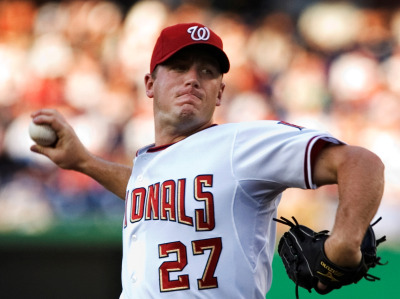
Zimmermann really struggled in July. Photo Manuel Balce-Ceneta/AP

Zimmermann really struggled in July. Photo Manuel Balce-Ceneta/AP

[Editor’s note: duh, I published this with the wrong title; just fixed 8/2/13]

Continuing a monthly series of look-backs at our starters (here’s Apr 2013May 2013June 2013, July2013 posts), here’s a monthly glance at how our rotation is doing from a Starting Pitching standpoint. As with previous posts, we’ll have “Grades” per outing, the team’s performance per opposing starter sliced and diced a few ways, and other per-starter stuff that I like to track.

MLB Rotation Per-Start Grades (click here for Nats overall season stats)

  • Strasburg: A,C,F,B,A+,D
  • Gonzalez: C+,A,A+,B,F-
  • Zimmermann: C-,C,B,F-,D
  • Haren: C-,A+,D,A
  • Jordan: B-,C-,B,C+,A
  • Ohlendorf: B long relief,A spot start
  • Detwiler: B- -> D/L

Quick Summary:  A month where we had a handful of really shocking blow-up starts.  Gonzalez‘s 11 run debacle  yesterday, Strasburg‘s 2 inning/7 run meltdown being the most shocking examples.  Only rookie Taylor Jordan kept an even keel, never pitching that badly and only really pitching excellently in his last start (also, not coincidentally his first win).  I will say it is good to see Dan Haren putting in some good-to-great starts; that may really help.  Ross Ohlendorf‘s injury yesterday better not be serious; Jordan’s innings limit is fast, fast approaching.

Performance By Opponent Starting Pitcher Rotation Order Number

A look at the opposing team’s rotation ranked 1-5 in the order they’re appearing from opening day.  This table changes at the all-star break and honestly must be taken with a grain of salt, since guys like Clayton Kershaw are now the “#3 starter” because their turns were skipped coming out of the all-star game.

Starter # Record Opposing Starter in Wins Opposing Starter in Losses
1 2-3 Gallardo, Burnett Hamels, Nolaso, Sanchez
2 2-3 Lee, Slowey Peralta, Greinke, Verlander
3 1-4 Harvey Lohse, Kendrick, Kershaw, Liriano
4 2-1 Marquis, Gee Cole
5 2-3 Hand, Torres Lannan, Fernandez, Morton
5+ 2-2 Cashner, Erlin Eovaldi, Mejia

Quick thoughts: given the aforementioned caveat of having Justin Verlander listed as a #2 and Kershaw listed as a #3, the team more or less performed as you’d expect.  A 1-4 record against opposing teams’ #3 starters is really skewed by the likes of Harvey, Lohse, Kershaw and Liriano in that grouping, all four guys being their team’s current aces.  This table is becoming less and less meaningful as rotations get scattered as the season goes along.

Performance By Opponent Starting Pitcher Actual Performance Rank Intra-Rotation

A ranking of opposing teams’ rotations by pure performance at the time of the series, using ERA+ heavily.

Starter # Record Opposing Starter in Wins Opposing Starter in Losses
1 3-4 Lee, Harvey, Cashner Sanchez, Lohse, Kershaw, Fernandez
2 1-2 Hand Kendrik, Liriano
3 4-2 Gallardo, Burnett, Marquis, Gee Greinke, Eovaldi
4 1-4 Erlin Nolasco, Peralta, Verlander, Morton
5 2-2 Slowey, Torrez Hamels, Cole
5+ 0-2 Lannan, Mejia

Quick Thoughts: the Nats actually held their own very well against other teams’ best performing guys.  They hung losses on Matt Harvey somehow, and hung a loss on Cliff Lee.  Less impressive was the collapse against AAA-callup Jenrry Mejia or the no-show against former teammmate John Lannan.

Performance By Opponent Starting Pitcher League-wide “Rank”
A team-independent assignment of a league-wide “rank” of what the starter is. Is he an “Ace?” Is he a #2?

Starter # Record Opposing Starter in Wins Opposing Starter in Losses
1 2-4 Harvey, Lee Kershaw, Grienke, Verlander, Hamels
2 0-3 Sanchez, Liriano, Fernandez
3 2-3 Gallardo, Burnett Lohse, Nolasco, Cole
4 0-1 Kendrick
5 6-4 Cashner, Hand, Marquis, Gee, Erlin, Slowey Eovaldi, Peralta, Morton, Lannan
5+ 1-1 Torres Mejia

Quick thoughts: despite a supposedly “weak” schedule the team faced a lot of big-time names in July.  Six of the 27 games went against league-wide Aces, a tall order for any team.  They also got whitewashed by the near-Aces/#2 starters, losing all three games against these types.  More disappointing?  Only a 6-4 record against league-wide #5 pitchers, the kind of guys that are nearly interchangeable with AAA players.  Maybe John Lannan isn’t really a #5 starter (probably not; he’s probably more of a #4), but the rest of these guys?

Records by Pitching Advantage

Start-by-start advantages in my own opinion and then looking at the results.

Wash 4-6 Zim-Gallardo, Gio-Cashner, Zim-Marquis, Stras-Erlin Det-Lohse, Stras-Nolasco, Zim-Kendrick, Stras-Eovaldi, Stras-Peralta, Zim-Mejia
Even 3-3 Gio-Burnett, Jordan-Hand, Jordan-Torres Gio-Verlander, Stras-Sanchez, Stras-Liriano
Opp 4-8 Jordan-Slowey, Ohlendorf-Harvey, Haren-Gee, Gio-Lee Zimm-Kershaw, Gio-Greinke, Haren-Fernandez, Jordan-Hamels, Haren-Lannan, Jordan-Cole, Haren-Morton

A sign of how our season has gone:  I gave opponents the clear advantage in 12 of our 27 games this month.    Compare this to April, when I only gave our opponents the advantage in TWO of our first 27 games.  We’re to the point where Haren and Jordan are automatically underdogs nearly every time they take the mound, and we face enough power arms where our big three may not always be favored to win either.

Matchup analysis

Looking at the opposing starter rank that our guys are going up against to see how their competition fares.

Nats Starters Opponents matchup analysis Nats Record under starter
Strasburg Two #2s, a #3 and three #5s 1-5
Gonzalez Three Aces, a #3 and a #5 3-2
Zimmermann An Ace, a #3, a #4 and two #5s 2-3
Haren one #2, three #5s 1-3
Detwiler one #3 0-1
Jordan An Ace, a #3 and three #5s 3-2
Ohlendorf An Ace in Harvey 1-0

Instead of classifying by rotation order in this table, this is by “league wide rank.”  And we see some very interesting information.

  • The team was only 1-5 in Strasburg’s 6 starts this month, and he wasn’t exactly going against an all-star collection of opposing starters.  That’s a big-time area of concern.  It all comes down to run support.
  • Gio meanwhile had to face up with three of the best 20 pitchers in the league and still managed to have a winning record during his starts.
  • Zimmermann, as we see in his grades, tailed off badly this month.
  • Haren, despite facing off mostly against other #5 quality guys, still conspired to lose 3 of his four starts.
  • Jordan, as we all know, has really surprised everyone and has been helping the team win.
  • Ohlendorf faced off against one of (if not the) major’s best hurlers and the team got a win in his spot start.
 

Taylor Jordan: Never too soon to think about the future…

4 comments

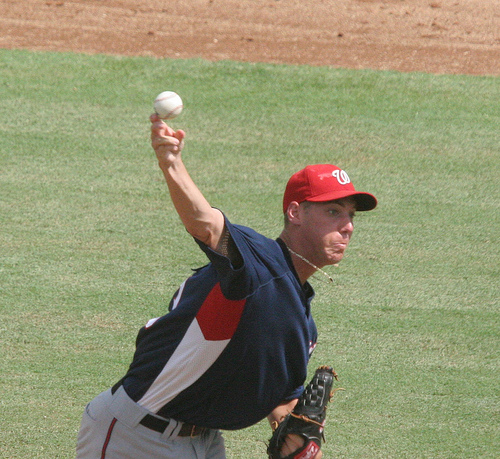
Jordan is making a case for his future with this organization.  Photo via wffn.net/hueytaxi on flikr.com

Taylor Jordan is making a case for his future with this organization. Photo via wffn.net/hueytaxi on flikr.com

I’ll file this as one of the “Patently Obvious” responses that have come out of Mike Rizzo‘s mouth in response to a reporter’s question, but Rizzo went “on record” as saying that Taylor Jordan will “get every opportunity to be in the mix for the rotation next year” per beat reports (this example from Byron Kerr) after Jordan got his first major league victory in Sunday 7/28/13’s 14-1 blow-out of the Mets.

Well, of course he’ll get a chance to compete for the rotation.   He’s pitching a hell of a lot better right now than $13M man Dan Haren, for approximately 1/30th of the cost.  What GM doesn’t want that??

One of the big reasons I started this blog was to talk about the development of Nats minor league pitchers.  Back in the dark days, when the team was spending $15M on the FA market to acquire 5th starters like Jason Marquis, I became convinced that the single most valuable commodity in Major League Baseball (in terms of talent development and acquisition) was the pre-arbitration starting pitcher.   Our farm system had the “Loria/Bowden” holes in terms of player development in the 2007-2009 time frame and for a few years the team couldn’t develop an effective starter, instead relying on guys like Marquis and on other minor league/low-end free agent signings (think Tim ReddingDaniel Cabrera, and the aging Livan Hernandez being examples).   Rizzo came in, put the emphasis on drafting and development, and now the opening day rotation features 3 home-grown guys and a fourth in Gio Gonzalez who was acquired by trading other home-grown guys.

One of my biggest data-collection projects was the information behind my regular “Pitcher Wins on the Free Agency Market” post.   After looking at pretty much every significant FA pitcher signing that baseball has ever had, and calculating salary versus wins, it became clear that teams are historically doing well if they get about one win per $1M spent on a FA pitcher.  Sign a guy for $13M a year?  You hope to get 13 wins out of him.

But this analysis also shows just how valuable the pre-arbitration, cost-controlled starter is.  Consider Clay Buchholz for Boston in 2010; he goes 17-7 in his 3rd active year, earning the MLB minimum of $443,000.  That 17-win capability eventually earned him a $12-$13M/year contract, but while he was getting the minimum he was winning games for Boston for pennies on the dollar versus what it would have cost Boston to purchase that capability on the open market.

Combine this point with the continually dwindling talent available on the FA market these as teams lock up their players earlier and more frequently, and the price for pitching just continues to go higher.  Zack Greinke signed a 6 year $147M contract paying him more than $24M annually last summer partly because he was the only significant pitcher out there.  Grienke is talented, don’t get me wrong, but outside of his unbelievable 2009 season he’s basically pitched like a #3 starter.   Even this year, he’s pitching to a rather pedestrian 103 ERA+, just barely above the league average of adjusted ERA for starters.  Not exactly what you expect for that kind of money.  The 2014 Free Agent Market in terms of pitching is looking equally as bare as 2013.   The best guy out there may be Matt Garza, who again is talented but is also injury prone and not exactly a league-wide Ace.   Get past Garza and you’re looking at inconsistent (Ricky Nolasco or Phil Hughes), injury plagued (Shawn Marcum or Colby Lewis), just old guys (Freddy Garcia, Hiroki Kuroda) and pure wild cards (Tim Lincecum or Scott Kazmir).

There’s a reason Tampa went nearly 8 full seasons without having a Free Agent acquisition start a game for them; they know exactly what it means to develop effective starters, and they have a stableful of them.  Trade away James Shields and Wade Davis?  No problem; just call up Chris Archer and Alex Colome (never mind the rest of their Durham rotation).

So, back to Jordan.  If the Nats can find an effective 4th or 5th starter from their farm system right now, it frees them from the one-year hired gun strategy of Haren and Edwin Jackson.  It gives them the flexibility to continue to allow their best prospects in the lower minors to develop (i’m thinking specifically of A.J. ColeRobbie RaySammy Solis, and Matthew Purke, though Cole and Ray aren’t exactly in the “low” minors anymore with their promotions to AA).  It gives them the depth they did not have this year to cover for a starting pitcher injury.   It gives them time to let Nathan Karns figure out if he’s going to be a starter or a reliever at the MLB level.  It gives them added payroll flexibility can go towards fixing holes in the short term.  Longer term it allows the team to spend money on extending the core guys, or allows them to consider whether the rising price tag on someone like Ross Detwiler is worth paying (much like they cut loose John Lannan last year).  If you’re going to pay market value for Strasburg and Harper, then you’re going to need some low-cost players who can contribute to counter balance the payroll.

Or, and it wouldn’t surprise me to see this either, it gives Rizzo interesting trade chips that he could package with other guys to acquire the Haren/Jackson hurler instead of buying him.

Two years ago we acquired Gonzalez for two near-to-the-majors starters, a surplus catcher prospect and a low-minors/high profile arm.  Right now it seems like we could put nearly the same package together (Jordan, Karns, Jhonatan Solano or Sandy Leon and then a decent arm from A-ball, or maybe even a Ray or Cole) and move them for such a resource.  I wouldn’t put it past Rizzo; Jordan may be looking good right now, but his peripherals don’t project as a “Rizzo Guy.”  Neither did Tommy Milone so he got shipped out; will Jordan be a 5th starter candidate in 2014 or trade bait?

Personally, I’d like to see Jordan succeed.  He’s a great success story; unhearalded 9th rounder coming off an injury that most of us thought was good, but who also thought that finishing the year successfully at high-A would have been a great achievement.  Instead he blows through high-A and AA ball and is now more than holding his own in the majors.

Storen to the minors… did he deserve it?

6 comments

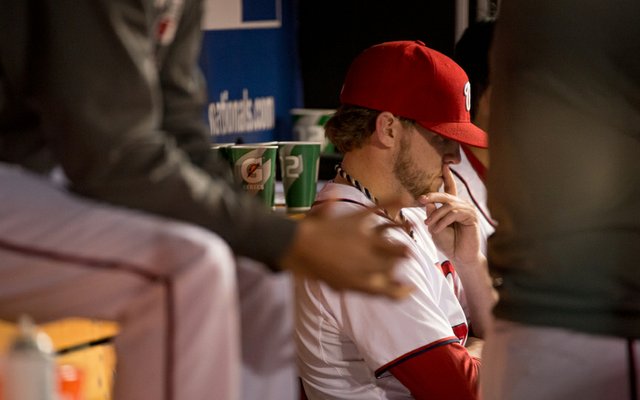
Storen will look to re-group in AAA..  Photo Andrew Harnik/washingtontimes.com

Storen will look to re-group in AAA.. Photo Andrew Harnik/washingtontimes.com

Talk about a fall from grace.  Drew Storen went from being the closer for a 98 win team in Oct, 2012 to being optioned to the minors after Friday 7/26/13’s doubleheader.

On the face of it, it makes sense.  This team is struggling, Ryan Mattheus is off the D/L, and there were 8 relievers for 7 spots.  Storen’s numbers in 2013 have been abhorrent: a 5.95 ERA and a 1.512 whip in 42 1/3 innings.  The team isn’t scoring any runs, so the last thing they need is a reliever who can’t hold a close lead right now.

A look deeper into Storen’s numbers though reveals a very tough-luck case.  Looking at his advanced stats from Fangraphs, he’s got a .346 BABIP right now, 45-50 points above the league average and a good 60 points above his career average.  He’s been very unlucky on balls in play.  This contributes to the huge gap between his ERA (5.95) and his FIP (4.16), and especially his xFIP (3.59).  This expected FIP by they way is significantly better than Rafael Soriano‘s current xFIP (4.26).  The point?  Storen has been unlucky so far this season and, were he given the chance to allow his appearances to regress to the expected mean, he likely would have pitched a ton better going forward.

Side Note:  Luigi De Guzman (aka “Ouij”) from Natstradamus did a fantastic bit of data mining, looking at Storen’s detailed pitch f/x data to delve into the reasons for Storen’s downfall.  Definitely go over there and read that piece.

Steve McCatty was quoted during Saturday’s broadcast as saying that he wanted Storen to work on his mechanics.  Specifically, Storen used to vary his left leg motion between the straight legged approach and a conventional knee bend.  This is confirmed by beat reporter James Wagner‘s story to the same.  Makes sense to me: the straight leg kick causes him to be slower to the plate, making it harder for him to hold runners.  The Nats as a team are already struggling to hold runners in general.  Plus, I’ve privately wondered if the varying leg kick causes him to struggle to hold his mechanics.  McCatty alluded to this, wondering if Storen’s control is affected.

On a different note; I’ve said this before, but I cannot help but think that Storen’s mental state has been in question ever since the acquisition of Soriano.  Buying Soriano on the FA market was essentially management telling Storen either a) we don’t trust you anymore after your game 5 meltdown, or b) we don’t think you’re good enough to be our closer any more.  It was an public and embarrassing demotion, and not every guy will take it in stride.  Tyler Clippard may have had an easier time with it since he was already an established 8th inning guy, and he was never really in line this season to be the closer.  These are the kind of man-management issues I think us casual fans forget about; just like you have problems in your office, so do players have problems in the clubhouse.

So, tough break for Storen.  Two straight awful appearances plus the blown save in 7/20’s Los Angeles game conspired to get him sent to the minors.  Lets hope he regroups, clears his head and is ready to come backup when the next spot in the bullpen opens up.


Written by Todd Boss

July 29th, 2013 at 7:02 am

Innings limits and media hypocrisy

2 comments

Matt Harvey is lucky he isn't pitching for a contender .. Photo: Brad Penner-USA TODAY Sports

Matt Harvey is lucky he isn’t pitching for a contender .. Photo: Brad Penner-USA TODAY Sports

I just noticed this little report float across the wire: the Miami Marlins plan to shut down their rising star 20-yr old Jose Fernandez when he reaches 170 innings.  We’ve already seen the Mets manipulate Matt Harvey‘s pre-all-star start in an attempt to limit his innings and stretch him out as long as possible, and they too have talked about an innings limit for their new-found Ace (Editor Note: this was before his unfortunate UCL injury).  Cub’s rising Ace Jeff Samardzija was shut down on September 8th of 2012 after reaching a prescribed limit that the team had set.  And our own Jordan Zimmermann worked on a 160 inning limit and was shut down in late August of 2011 after recovering from Tommy John surgery.  And there’s more: see the following for a quick summary of Operation Shutdown 2013:

So what’s the common theme here?  When the Nats shutdown Zimmermann in 2011 they were not a playoff team.  Nor were the Cubs with Samardzija in 2012.  And this year clearly the Mets and Marlins are not playoff teams.  BUT, when the Nationals in 2012 were clearly a playoff team and did a similar innings-limit shutdown with Stephen Strasburg, there was (and continues to be) national media uproar over the decision.  The Nats (and by proxy Mike Rizzo) were described as “arrogant” by more than one “anonymous GM” (aka gutless chicken-sh*t executive who wouldn’t go on the record criticizing a colleague who had to make a pretty significant, difficult decision), as dutifully and gleefully reported by bloggers and writers who go to great lengths to state their own opinions on the matter.   And it didn’t take but a few hours after the Game 5 meltdown (and in some cases even before then) for said writers to pipe up yet again with their opinions that the NLDS absolutely would have turned out differently if Strasburg was pitching.

And keep in mind, Strasburg was coming back from an injury!  Nearly every one of these 2013 Operation Shutdown guys weren’t ever hurt; they were just limited by executives who may prescribe to the Tom Verducci effect of increased workloads (whether or not you agree with the principle, which has been disproven on the macro level yet Verducci maintains an 80% successful prediction rate.  Discussion on both sides from a January 2013 post here).

Why the hypocrisy?  Because there’s a huge double standard here.  Its “OK” to shutdown your ace for health-related or longevity-related issues …. but only if your team sucks and you’re not making the playoffs.  However, if you are making the playoffs and you follow-through on your season-long stated intention to shutdown your star pitcher coming off a major arm injury … then you’re an idiot.  At least, that’s my interpretation of the media reaction in September of 2012 of Strasburg-shutdown versus Samardzija-shutdown.

Its ok to ignore doctor’s recommendations and attempt to blow out your 24-yr old’s arm again so that he can make one or two post-season starts … because, hey, Flags fly forever, and you may never get back to the playoffs.   I think this statement encapsulates the argument very simply; some people value making the playoffs for one year far above the long-term health of one particular baseball pitcher’s arm.  People with these opinions are gleefully watching our team struggle in 2013, and I’ve seen more than one opinion posted that say this is “karma” on the Nats for shutting down Strasburg last year.  Really?  Karma?  Not the 29th ranked offense in the league as being the root of all our troubles right now?

The point is this: if you were against an innings limit for Strasburg … then you should stand up and say you’re against innings limits for any pitcher.  All the “well we don’t know if shutting down a pitcher helps or hurts” arguments (which are all entirely true; we don’t have any idea if Strasburg’s career will be 3 more years or 15, and we have no idea if the 2012 shutdown will help, hurt or have no impact), shouldn’t be affected by the team’s place in the standings.  If you’re against the Strasburg shutdown on principle, then you should be equally outraged that the Mets, Cubs, and Marlins plan to “tank” games in August that their aces would have been scheduled to pitch as well.

I’m sure that we’ll continue to hear more “shutdown dates” being announced for the slew of young power arms that are making 2013 increasingly the “Year of the Rookie pitcher.”  None of these names have been mentioned yet, but rookies with decent MLB workloads such as Shelby MillerGerrit ColeZach WheelerJacob TurnerTony CingraniAlex Cobb, and maybe even guys like Jarred CosartChris Archer and Martin Perez could all be names that teams look to protect going forward.  And some of these guys (especially Miller and Cole) are pitching significant innings for playoff contenders, and are going to blow by 2012 innings numbers by mid-August.  Will we see another Strasburg-esque shutdown media blitz in 2013?


Post Script added 7/26/13: we have announced that our own Taylor Jordan will be facing an innings limit in 2013, and it is coming up very fast.  “20-30” more innings, or roughly 5-6 more starts.  That hopefully will coincide with Ross Detwiler‘s return from the D/L but it may not, forcing the team to scramble to fill that rotation spot.  Update: this on 8/18/13 after Jordan suffered a sprain that would have made it impossible to come back anyway.  Shut down at 142 total innings for 2013.

[After the fact post addition: ESPN’s Jerry Crasnik posted about the same topic on 8/7/13, with great updated innings counts for pitchers on contending teams.  He says the same things I’m saying here.  Sept2013 I updated this post whenever a new team announced they were shutting down a player].

9/15/13 post about innings limits

http://hardballtalk.nbcsports.com/2013/09/14/are-pitch-counts-and-early-shutdowns-actually-helping-pitchers/

June 2013 Monthly review of Nats rotation by Opponent

2 comments


Jordan Zimmermann is quietly putting together a Cy Young season.  Photo Unk.

Jordan Zimmermann is quietly putting together a Cy Young season. Photo Unk.

Continuing a monthly series of look-backs at our starters (here’s Apr 2013 and May 2013), here’s a monthly glance at how our rotation is doing from a Starting Pitching standpoint. As with previous posts, we’ll have “Grades” per outing, the team’s performance per opposing starter sliced and diced a few ways, and other per-starter stuff that I like to track.

MLB Rotation Per-Start Grades

  • Gonzalez: A,C+,A-,A,B,A
  • Zimmermann: A,A+,D-,A+,A
  • Strasburg: A-,A+,B+
  • Detwiler: C-,D,F,C
  • Jordan: C-
  • Ohlendorf: A
  • Karns: D+,F->sent back to AA
  • Haren: F,D-,D,F -> d/l

Discussion: The team had to cover for injuries to both Stephen Strasburg and Ross Detwiler, and those spot starts were hit-or-miss.  Ross Ohlendorf and his 1920’s wind-up covered excellently, and he earned a longer look serving as Zach Duke‘s replacement.   Taylor Jordan‘s debut was mediocre, but he fared much better than Dan Haren did on the month, putting in poor-to-awful outings all month before mercifully being sent to the D/L. Only Jordan Zimmermann and (quietly) Gio Gonzalez maintained some form of consistency for the team, each putting in 4-5 excellent outings in June.

Performance By Opponent Starting Pitcher Rotation Order Number
A look at the opposing team’s rotation ranked 1-5 in the order they’re appearing from opening day.

Starter # Record Opposing Starter in Wins Opposing Starter in Losses
1 0-3 Hudson, Chacin (2)
2 4-3 Diamond, De La Rosa, Cahill, Harvey Maholm, Masterson, De La Rosa
3 2-3 Hefner, Kazmir Correia, Lee, Gee
4 4-2 Francis, Kendrck, Miley, Wheeler Gee, Kluber
5 0-2 Lannan, Corbin
5+ 3-0 Denudo, Oswalt, Chatood

There’s no shame in going 0-3 against other team’s “Aces,” even if they’re not exactly league-wide Aces.  But you HAVE to do better than 0-2 against the #5 starters on other teams.

Performance By Opponent Starting Pitcher Actual Performance Rank Intra-Rotation
A ranking of opposing teams’ rotations by pure performance at the time of the series, using ERA+ heavily.

Starter # Record Opposing Starter in Wins Opposing Starter in Losses
1 2-3 Harvey, Chatwood Correia, Lee, Corbin
2 5-3 Diamond, De La Rosa, Cahill, Kendrick, Wheeler Maholm, Masterson, De La Rosa
3 2-3 Hefner, Miley Chacin (2), Kluber
4 0-1 Gee
5 0-2 Hudson, Gee
5+ 4-1 Kazmir, Francis, Denudo, Oswalt Lannan

The Nats show pretty good success against the 2nd-best starters on other teams, but once again seem to have let-up against pitchers who are scuffling this year.  Note that Dillon Gee is listed as being the 4th best Mets pitcher at one point and then the 5th best at another; that’s because I do the starter analysis of each team at the time of the series and Gee’s standing changed over the course of the month.

Performance By Opponent Starting Pitcher League-wide “Rank”
A team-independent assignment of a league-wide “rank” of what the starter is. Is he an “Ace?” Is he a #2?

Starter # Record Opposing Starter in Wins Opposing Starter in Losses
1 1-1 Harvey Lee
2 0-2 Corbin, Hudson
3 3-2 Chatwood, Cahill, Wheeler Maholm, De La Rosa
4 4-3 Diamond, De La Rosa, Miley, Oswalt Masterson, Chacin (2)
5 5-5 Kendrick, Hefner, Kazmir, Francis, Denudo Correia, Kluber, Gee (2), Lannan

This table, as my frequent readers know, is the Meat of this analysis.  Here we see that the team somehow got a win when Cy Young candidate Matt Harvey was on the mound but other wise lost when league wide Aces and #2s were the opponent.  What is more concerning here is just how many times our Nats lost to league wide #5 starters.  These are near replacement-leve pitchers who a supposed playoff contender should be feasting on.  Maybe Gee isn’t a #5 starter, since he beat us twice.  But a career 90 ERA+ says otherwise.  You have to win the games you’re supposed to win.

Records by Pitching Advantage
Start-by-start advantages in my own opinion and then looking at the results.

Advantage Desc Record Matchups in Wins Matchups resulting in Losses
Wash 10-4 Stras-Corbin, Gio-Masterson, Gia-Correia, Stras-Kluber
Even 1-3 Karns-Denudo Gio-Hudson, Haren-Gee, Haren-Lannan
Opp 2-6 Detwiler-Harvey, Ohlendorf-De La Rosa

Perhaps the most damning evidence of the evolution of our .500 team is this fact: in April of this month I only thought our opponents had the clear starting pitching matchup advantage two times out of 27 games.  In June?  I gave our opponents this advantage 8 times out of 26 games.  The Nats managed to pull out a couple of these clear pitching dis-advantages when New York’s bullpen blew Harvey’s gem against us, and when Ohlendorf outpitched Jorge De La Rosa in his one spot start.

Matchup analysis
Looking at the opposing starter rank that our guys are going up against to see how their competition fares.

Nats Starters Opponents matchup analysis Nats Record under starter
Strasburg A #4, a #5 and a #5+ 1-2
Gonzalez One Ace, Two #2s, One #3, Two #4s 3-3
Zimmermann A #2, two #3s, a #4 and a 5+ 5-0
Haren Two Aces, a #4 and a #5 0-4
Detwiler Two #2s, One #3, One #4 2-2
Karns A #2 and a 5+ 1-1
Jordan A #3 0-1
Ohlendorf A #2 1-0
team ttl for month: 13-13

By June, our rotation is so jumbled that rotational order is almost meaningless.  Strasburg is clearly our “Ace” but is pitching out of the #3 rotational order by virtue of his D/L stint.  And you can see that other teams face the same issue.  The 0-4 record for Haren’s starts is pretty damning; this has to change when he comes back or we need to look elsewhere and eat his $13M in salary.


How do Pitchers “tip” their pitches to opposing hitters?

10 comments

Zack Wheeler's mechanics are apparently a mess right now.  Photo cnnsi.com

Zack Wheeler’s mechanics are apparently a mess right now. Photo cnnsi.com

I’ve taken an interest in Mets rookie right hander Zack Wheeler since his call-up.  I nabbed him for my fantasy team and have watched his starts when I could.   His name has been in the news for quite a while, ever since he was traded by the Giants for a 2-month rental of Carlos Beltran (a trade that had Giants prospect-watching fans howling).  Moreso because of Wheeler’s pedigree; 100mph heat, #1 starter ceiling.  There’s nothing more exciting than seeing a prospect for the first time, even if he could be the bane of your team’s existance for the next 10 years.

His first few starts have been up and down; now we may know why: reports are coming out of the Mets camp that say that Wheeler’s been tipping his pitches.  Of course, it apparently wasn’t an issue when he threw 6 shutout innings in his debut, but its still something worth looking into.  The team plans on working with Wheeler in the bullpen to make some adjustments (he apparently is doing several things wrong right now; see below for all the different ways he’s tipping).  However, apparently not enough was fixed prior to his last start against the Nationals, who teed off on him as if they knew what was coming.  And you know what?  They probably did.

But this got me wondering: how exactly to pitchers “tip” their pitches?  I’ve played an awful long time and have always been a “feel” hitter at the plate; I look fastball, adjust to the curve, never really give much thought to trying to think along with the pitcher, and generally “feel” my way through at-bats.  I’ve never in my life specifically looked for or noticed a pitcher tipping his pitches or tried to take advantage of it; frankly when a guy’s fastball is only in the upper 70s or low 80s as it generally is in amateur leagues, you don’t really need to get that kind of advantage.

After doing a bit of research, here’s what I’ve found.  Pitchers can “tip” their pitches a number of different ways.

  1. Differing Arm Angles for different pitches.  This (according to the above link) is one current Wheeler issue.  I have seen this personally; usually a curveball comes in at a slightly lower arm angle if the pitcher wants to get more side-to-side action.  Pitch F/X data tracks release points and this type of tip can be worked on.
  2. Differing Arm Action: A common tip is when a pitcher specificically slows their arm when an off-speed pitch comes, especially a change-up.  This is an amateur tip though; professionals throwing change-ups hone their craft to be as deceptive as possible.
  3. Glove Positioning: another apparent Wheeler issue; he was holding his glove in different spots (as pointed out by this fangraphs.com link and as noticed in the video in this article here) depending on the pitch.  This has to be something done unconsciously; there’s no reason to hold your glove in different spots or to hold your body in different positions based on the pitch you’re going to throw.   Others have noted that pitchers will have different “glove widths” depending on the grip; a “12-6” grip (like on a fastball) allows the glove to be slightly more closed than a “3-9” grip, like you’d have on a curve ball.  Another glove tip-off may be the way the glove is held in the set position; some pitchers have a tendency to hold the glove more straight up and down when throwing fastballs.
  4. Differing Motion Mechanics: I’ve often wondered if our own Drew Storen, who uses two different leg kicks, has any sort of telegraphing of his pitch selection by virtue of this mechanical difference.  Andy Pettitte unconsiously was once found to bring his arms together in slightly different ways from the stretch depending on the pitch he was to throw.  Dennis Eckersley admitted (after he retired of course) that he went through a tipping period where batters could tell he was throwing off-speed stuff because he unconsiously was “tapping” his leg with his hand.
  5. Differing Motion Speeds: do you speed up  your motion for one pitch but not another?  Apparently Wheeler may be doing it now.  Conventional wisdom states that a pitcher will take a nice leisurly motion for a fastball to gain natural physical momentum but may forget that momentum when he’s throwing a curve.
  6. Pitch Gripping in the Glove: If a pitcher throws an unconventional pitch that takes a moment to get a grip on, a batter can pickup on different timings or different mannerisms and get a read on the pitch.  I’ve noticed this with pitchers who throw specifically the split-fingered fastball, one of the more difficult pitches to properly grip.  I once watched a guy on the hill who would pre-jam the ball in-between his fingers as he took the sign; it became pretty easy to know what was coming because if he did NOT fiddle with his glove you knew it was a splitter.  Some pitchers have to look down at their grip to get it right after accepting the call; can you glean anything from this fiddling in the glove?
  7. Pitch Grip VisibilityMike Mussina found out from a teammate (Jorge Posada) during spring training one year that his unique change-up grip telegraphed the pitch to opposing hitters.  Posada watched him pitch and called out every pitch in what must have been a rather disheartening bullpen session.  He made a slight adjustment with his finger positioning and eliminated the tell.  This problem is somewhat related to a pitcher’s overall ability to “hide the ball” during his wind-up; if you’re an over-the-top thrower and you throw a pitch that shows a lot of the ball … batters can see it.  Knuckleballers especially are plagued by this, but they don’t much care since everyone knows what pitch is coming anyway.
  8. Poker-face tells: sometimes pitchers just flat out have a Poker table-esque tell that they unconsiously perform on certain pitchers.  They’ll grimace, or puff up cheeks, or stick out their tongue on some pitches but not others.

The best way to find out about any of these tells is to have a former rival hitter get traded to your team.  But even then sometimes players can be secretive.  So video tape work is key, as is 3rd party eyes looking for predictive tells in your body language and motion.


Written by Todd Boss

July 2nd, 2013 at 1:31 pm

First Look: Taylor Jordan

15 comments

Taylor Jordan trades in his minor league gear for a Nats kit for the first time.  Photo via wffn.net/hueytaxi on flikr.com

Taylor Jordan trades in his minor league gear for a Nats kit for the first time. Photo via wffn.net/hueytaxi on flikr.com

As Luke Erickson noted over on NationalsProspects.com, one of the Nats worst-kept secrets was finally let out of the bag when word broke that Nats 2013 minor-league sensation Taylor Jordan was in New York and was going to make his Major League debut on Saturday June 29th.  Starting in place of “injured” and ineffective starter Dan Haren, Jordan went up against one of the worst offensive teams in Baseball (the Mets are dead last in team batting average, hitting just .229 as a team as of 6/29’s game).  Lets review how Jordan did.

At the end of the day, (a 5-1 Loss for the Nats and a “Loss” for Jordan in his debut), Jordan’s line probably betrays how well he pitched on the day.  Jordan was pulled after 4 1/3 innings and was relatively unlucky to have given up the 3 runs (1 earned) that he did.  After a nervous first inning that included a walk and a HBP, Jordan induced one of many ground ball outs on the night to get out of the jam.  He cruised through the 2nd and 3rd innings relatively unscathed before some bad luck and a couple of bad pitches cost him a run in the third.  He got what looked to be a double-play ball to erase one runner who reached by error but the turn was slow (in fairness, a ball deep to the hole in 2nd and a fast runner conspired against the turn).  He then hung a slider against John Buck who hit it sharply to left to drive in the first of his charged runs in the 4th.

Ryan Zimmerman‘s questionable positioning against the Mets’ cleanup hitter Marlon Byrd led to two fielding errors on sharply hit balls that, despite their pace, should have been outs (why is he playing even with the bag there??  Does he really think Byrd is bunting batting out of the clean-up spot?)   Then a little-league sequence in the 5th led to the 2nd run being scored when Ian Desmond‘s attempt to get Daniel Murphy advancing to third led to a second run.  Jordan’s last charged run was on a sac fly/inherited runner allowed to score by his relief pitcher Craig Stammen.

Jordan featured a fastball that was regularly 91-92 but which peaked at 95.81.  He seemed to tire as the game went on; his peak fastballs were all in the first two innings (perhaps he was “amped up”).  His mechanics reminded you of Jered Weaver, with a sweeping cross-body motion that results in plenty of movement on his pitches.  He featured a very plus change-up, which he commanded well and was able to get key strikes on (he had no issues throwing it to lead-off a hitter, or at 2-0).  His slider didn’t move much, but it also featured as a plus pitch when he kept it down.  He was able to locate his fastball well, as best evidenced in David Wright‘s third at-bat against him, where Jordan fooled him badly with a slider, jammed him inside repeatedly and eventually forced a weak ground-ball to the shortstop to retire him in the 5th.  He gave up some sharply hit balls, but he also was very unlucky as a couple of flairs and bloops fell in just behind the infield.

On the day, he gave up 5 hits, two walks, and a HBP against just one strike-out (against his opposing number Dillon Gee, who he retired with another fantastic change-up).  He wasn’t very efficient on the mound, only throwing 48 of 84 pitches for strikes.  He wasn’t “nibbling” per se, but definitely works the corners and missed his spots.  In the 4th and 5th he was constantly falling behind hitters and (as Masn announcer J.P. Santangelo noted) it eventually caught up with him.  He got 9 ground outs to just 3 fly outs to go along with a handful of bloop singles, and to me its clear what his approach is.  Despite pretty decent K/9 numbers so far in the 2013 minor league season (72 Ks in 90 1/3 innings) he’s definitely a guy who is going to rely on location and a sinking fastball to induce grounders for outs.

All in all, in an oft-repeated mantra for 2013 you can’t win if you don’t score.  He probably was pulled when he should have been and isn’t really at fault for the loss (not when your offense only scores one run against a middling pitcher like Gee).  I think Jordan clearly has earned another start and probably sticks around for a while.

One last note: I can’t help but comment on a cynical but possibly true comment I read in one of the other Nats blogs (my apologies, I cannot remember who said it).  Is Jordan’s call-up a precursor to his being included in a possible trade, much as Mike Rizzo featured both Tommy Milone and Brad Peacock at the end of 2011 prior to shipping them off?  I ask this because Jordan doesn’t seem to be the typical Rizzo guy; he’s not going to overpower you, he doesn’t throw mid 90s.  Then again, neither does Haren and that didn’t stop Rizzo from signing him for $13M.

Either way, I look forward to his next outing.  I’m always excited to watch new guys on the mound.

Haren’s 6 week Demotion, er I mean D/L Trip

5 comments

Haren's struggles earn a well-deserved D/L trip.  Photo via Zimbio.com

Haren’s struggles earn a well-deserved D/L trip. Photo via Zimbio.com

Little surprise that the Major’s worst starting pitcher Dan Haren was sent to the D/L.  As of 6/24/13, out of 99 qualified Starting Pitchers he currently ranks 99th in ERA, 95th in FIP, 72nd in xFIP (so there’s that) and (interestingly, since it purportedly is the best of the analytical evaluator advanced pitching stats) 48th in SIERA.  As has been noted elsewhere, he’s tied for the league lead in HRs conceded.  The team has lost his last nine starts, and his latest meltdown clearly has forced the team’s hand.  Haren may not be the reason this team is mired at .500 (offense, offense, offense), but he’s clearly not helping either.

So the Nats have found a “soft tissue” issue with Haren (this time?  a “Shoulder Strain”) and have sent him to the D/L.  This isn’t the first time the Nats have used a dubious soft-tissue injury to “stash” an inflexible contract (see Rodriguez, Henry and Wang, Chien-Ming repeated D/L trips over the past two years), and while I kind of laugh at the blatant manipulation of the rules, it benefits the team to be able to remove him from the active roster but not lose him to the open market, so we’ll let it slide.  (btw, how do I know that the team is playing shenanigans with the D/L trip?  Read CSN Chase Hughes‘ tweet about what Haren said when informed he was going on the D/L.   Haren didn’t even know what injury he was supposed to have!).

So what happens next?  Adam Kilgore‘s WP article on the topic seemed to indicate that the Nats and Davey Johnson are not considering either Ross Ohlendorf or Craig Stammen for spot starts.  Which I have a hard time believing frankly; both guys demonstrated their ability to pitch longer outings in the last two days in relief of failed starters.  Ohlendorf has been starting all year and is exactly the kind of 4-A/6th starter that the Nats envisioned him to be when they signed him in the off-season.  Why would the team do something rash like call up Taylor Jordan (as Kilgore suggested and as others are reporting) when we’ve already seen what a more polished and experienced AA-pitcher (Nathan Karns) can do when jumped far above his head too soon?  Yeah, I’m excited about Jordan and what he’s done this year; but I think Ohlendorf or Stammen are better options.  I’d start Ohlendorf on Saturday and see what happens.

Of course, perhaps the Nats talent evaluators are convinced that a guy (Jordan) with exactly 49 innings above A-ball is ready to replace a $13M veteran.   If so, I can’t wait to see him pitch live.  Even if it starts his service time clock too soon, he was a guaranteed 40-man addition ahead of the coming Rule-5 draft anyway based on his domination so far in 2013.  What’s a few extra months at this point?  He’s already past Super-2 status so the team has guaranteed all the control they could get over him.

As for Haren, here’s what we’re likely going to see:  he’ll pay lip service to his “injury,” get an MRI, see a couple of specialists, get a shot.  That’ll take a week or so.  By that time we’ll know whether or not whoever gets his Saturday 6/29/13 start is worth giving another start to.  If Ohlendorf or somebody pitches 6 shutout innings in Haren’s place … then Haren’s going on a long “rehab” assignment in Syracuse.  And frankly, even though he’s making $13M and was supposed to be our former ace acting as a 4th starter FA acquisition, he may struggle to get his starting gig back.

Is it time to pull the plug?  Well, baseball is a performance-based industry.  Haren has just not performed.  Is it truly because he’s pitching through injuries?  Somehow I don’t think so; he was ineffective last year, he’s yet to really have a truly dominant outing this year, and the question is out there as to whether Haren is officially washed up.  For as much as I looked forward to Haren’s time here when we signed him, I now feel like we can’t give him more starts unless he starts throwing shut-down outings in AAA.

PS: read this interesting nugget tooDanny Espinosa is playing short-stop in Syracuse.  You know what this tells me?  The same thing that Kilgore concludes: Espinosa is being showcased so that he can be shopped as a Shortstop on the trade market.  Read the link; I can’t disagree with any of his analysis.  Well, either that or the team is looking to move Ian Desmond and replace him w/ Espinosa.  Ha.

PPS: Also reading reports on NBCSports that Mike Rizzo is burning up the pre-trade market phone lines.  That’s a clear indication that this team is not ready to wave the middling .500 team flag.

More R.A. Dickey Animated Gifs

one comment


R.A. Dickey throwing another knockler. Photo via wiki/flickr user dbking

R.A. Dickey throwing another knockler. Photo via wiki/flickr user dbking

A few months ago I posted a Youtube video showing a Catcher’s point-of-view look at R.A. Dickey‘s knuckle ball coming in.

Here’s a couple more cool graphics that have popped up on various blogs that I read.

  •  From imgur/r/baseball, an animated Gif of Dickey’s knuckler as it travels to the plate.  Done by the same fellow @DShep25 who did similar Gifs of Yu Darvish‘s repertoire and of Miguel Cabrera‘s ability to hit homers from any point in terms of plate coverage.  (h/t to BusinessInsider blog).
  • And here’s a story to go with the above images from the author himself, Drew Shephard on fangraphs.com.

Still amazing that his 2013 numbers are so bad right now (6-8, 4.90 ERA, 1.388 whip, all significantly worse than his Cy Young numbers from last year).  The Blue Jays are only 6-9 in his starts, a big reason why they’re in last place in the AL East right now.

And then, since its related to these cool graphics, here’s a study (again from BusinessInsider’s Sports blog) about the Physics of a Curve Ball.  Its no wonder Dickey reportedly didn’t even travel with the team when they went to Colorado; he knew his pitches wouldn’t have any movement.

Written by Todd Boss

June 20th, 2013 at 12:26 pm

Chasing Saves: a cautionary tale for GMs

6 comments

Mariano Rivera’s success has led to a generation of closer-chasing in MLB. Photo wikipedia

One of the mantras we hear from Fantasy Baseball experts is “Don’t chase Saves.”  Closers are so hit-or-miss in this league, that on draft day trying to chase mediocre closers usually turns into wasted draft picks as these guys frequently get hurt or under-perform and get replaced.  Well, its not that much better in “real” baseball, where teams best laid plans for closers often backfire mightily.

In fact, check out this link on RotoAuthority.com, which charts the Opening day and Closing Day 2012 closers for all 30 teams.  In summary:

  • Only 10 of the 30 MLB teams kept the same closer wire-to-wire.
  • 14 of the 30 teams had a different guy in the closer role by season’s end.  That’s half the league!
  • The other 6 teams had the same guy at season’s start and end, but went through personnel changes in between.  This includes our own Nats, who started with Drew Storen, he got hurt, Tyler Clippard took over and stayed in the role after Storen got back, then Clippard melted in September and Storen took back over the role.

By my observations, as of June 15th 2013 here’s the same stats for this year:

  • 22 of 30 teams have same guy as start of season
  • 8 teams have already made a switch (Boston, Detroit, Arizona, Oakland, Chicago Cubs, Cleveland, St Louis, Los Angeles Dodgers)

So what’s the point here?  Teams need to re-think they way they grow, acquire and pay for “Saves.”  Lets look at how far one particular organization has gone “Chasing Saves” and pursuing a Closer.  I present you the Boston Red Sox, normally considered a very forward-thinking, analytical organization but which seemingly has a very large blind spot for the mytical “shutdown closer” position.  As of the publishing of this article (June 14, 2013):

  • Current Closer: Andrew Bailey, for whom they traded 3 players to the Oakland A’s in 2011 to obtain.  Two minor league prospects and one Josh Reddick, who hit 32 homers last year.
  • Acquired last off-season to be their 2012 closer: Mark Melancon, for whom they traded two good prospects to the Houston Astros in 2011; Jed Lowrie and Kyle Weiland.   Lowrie is now posting a nifty 126 ops+ for the Athletics (to whom he was flipped by Houston for even more prospects).  Melancon had two bad outings at the beginning of 2012, was banished to the minors and eventually flipped for ….
  • Former 2013 closer: Joel Hanrahan, for whom they traded 4 players to the Pittsburgh Pirates last December.  Including Mark Melancon, who is repaying the Pirates for their patience in him by posting a .072 ERA in 25 innings thus far this year.  Hanrahan just had Tommy John surgery and is out for at least a  year.
  • [Post-post update]; By the end of June, Bailey allowed 4 homers in 5 games, hit the D/L and on July 22nd was announced as undergoing season-ending surgery. and is being replaced by … somebody.  By Mid July it seemed clear that it was Kenji Uehara, a free-agent signing last off-season.  So for all their trades, they end up using a minor FA signing as their closer.

So for the record that’s 9 guys traded away (including at least two effective hitters) in the past two off-seasons to chase one (in my opinion) relatively meaningless statistic.  And basically all they have to show for it is Andrew Bailey no longer pitching the 9th for them.

Of course, maybe the joke’s on me, since the Red Sox are in first place at the time of this writing.

But for an organization that used to be known for doing smart things (including the smart move of allowing long-time closer Jonathan Papelbon be overpaid by someone else on the FA market), these moves are just dumb.   Find a hard throwing guy in your system, make him the “closer,” repeat as necessary.  That should be the strategy.


And oh, by the way, I don’t exempt our own team from this.  Rafael Soriano was an unneeded purchase who (as we’ve seen by the unwarranted shot at Bryce Harper) could be more trouble than he’s worth.  But hey, its not my money right?  At least the Nats didn’t trade good prospects to acquire him (like Boston has done over and again).


This argument leads into an oft-repeated discussion in this space about the ridiculousness of the Save statistic and how frequently closers are preserved for “Save Situations” despite their leverage rating.   Lets look at a couple of very specific mathematical arguments against overpaying for closers:

1. Joe Posnanski and others have shown how useless closers are.  Teams are winning games at basically the same percentage now in the closer era that they were 50 years ago, without highly paid specialized closers.  Some quick percentages:  For the latest decade teams won 95.2% of games in which they led going into the 9th.  In the 60s, 70s and 80s that same percentage varied between 95.6-94.8%.   Can someone explain to me how the proliferation of highly paid closers in the last 20 years of the game has basically helped teams …. win the exact same number of games they used to before closers, matchup bullpen roles and Loogys existed??

2. Any old mediocre reliever is going to end up being a relatively effective closer.  Proof?

Lets say an average reliever has a 4.50 era or so (which in today’s game frankly is a stretch, given what we’ve talked about before and the advantages that relievers have over starters; they can go max effort for shorter time periods and they don’t have to face batters more than once).  That means he gives up one run every two innings.  Now lets say that you used this pitcher with his 4.50 era in every closing situation you face in a given year.  A save situation can be a lead held by 1, 2 or 3 runs.

So, out of these three scenarios your 4.50 ERA pitcher can give up his run every other start and still “save” 5 out of 6 games.

  • 1 run lead: gives up 0 runs; save
  • 1 run lead; gives up 1 run: blown-save
  • 2 run lead: gives up 0 runs; save
  • 2 run lead: gives up 1 run: save
  • 3 run lead: gives up 0 runs: save
  • 3 run lead: gives up 1 run: save.

And then even in those blown-save situations, extra inning affairs are basically coin flips anyway historically, which means that teams are going to win half those games anyway.  So you’re basically going to win 5.5 out of every 6 games.   5.5 out of 6 is 91%.  So historically even my normal case scenario undervalues the ability of teams to win these games.

And this scenario really undervalues what kind of reliever you’re actually going to put into the role.  Every team has a handful of relievers in their bullpen with ERAs in the 3-3.50 range; that’s 1-1.5 runs better than my “mediocre pitcher” example over the course of a couple weeks (assuming closers get about 9 innings of work every two weeks).  With even this marginal improvement you’re going from 91% to closer to the historical 94-95% of games won.


Want some more food for thought on closers?   Here’s your current top 5 closers in the league by number of saves, along with their acquisition method, salary and general statement about their careers thus far:

  1. Jason Grilli – 23 Saves.  36yrs old.  $2.25M.  He was flat out released in July 2011 by Philadelphia and signed as a Minor League FA by Pittsburgh.  He’s a 36 year old journeyman on his 7th pro organziation with a 106 career ERA+.
  2. Jim Johnson – 23 saves.  30yrs old.  $6.5M.  He’s a home-grown middle reliever thrust into the closer role last year when the O’s got fed up with FA closer Kevin Gregg.
  3. Mariano Rivera – 23 saves.  43yrs old.  $10m, taking a discount from his $15M/year deals since 2008 b/c of knee issue.  Home-grown player who converted to relief after bombing out as a failed starter at age 25.
  4. Joe Nathan – 20 saves.  38yrs old.  $7M, taking a discount from his last contract value of $11.25M/year after significant arm injury.   Failed starter with San Francisco, traded to Minnesota in the AJ Pierzynski deal and has flourished as a closer.
  5. Addison Reed – 19 saves.  24yrs old, $520k (20k above MLB minimum).  3rd round draft pick by the White Sox out of San Diego State, where he was a career relief pitcher after not having ever pitched until his Junior year of HS.

The next few guys are Kimbrel (655k), Mujica ($3.2M).   But you’ve also got guys out there closing like Wilhemlsen, who didn’t even make the majors until he was 27 and was out of the game working as a bartender for 6 years.

The point?  You shouldn’t pay for a high end closer; you find someone internally who looks like a good option on the cheap and go with them.  You can find someone in your farm system, or on waivers, or working in a bar who can be an effective closer.  Find someone who can throw 1mph for 20 pitches a few nights a week; they’re going to give you as good of a chance to win as throwing the last guy out of the bullpen out there with a 3 run lead in the 9th.


One last bit of observation:  Lets look at Dennis Eckersley‘s career.  As a starter: good, not amazing.  A couple years with a smattering of Cy Young votes.  One 20-game winning season but another season where he 9-13 with a 5.61 ERA.  He converts to a closer and immediately his ERA plummets, his K/9 jumps up, his ERA+ numbers rise to stupid levels.  One year (1990) as a 35-yr old he allowed just 5 earned runs and just 3 unintentional walks on the year through 73+ innings.

So, how is it that a 4th starter during his 20s can suddenly become a lights out Hall-of-Fame closer in his mid-30s while doubling his k/9 rates at a time when he should have been regressing as a player?  The answer is easy; relievers only have to face part of the lineup once a night, don’t need 4 pitches and can basically get by with a gimmick pitch.  And, since they’re only throwing 15-20 pitches a few nights a week instead of 100-110 pitches every 4 days, they don’t need to “save their arm for the whole night” and can go with max effort during their outings with no long term effects.

That’s a lot of loosely tied together points to my main theory: If I were the GM of a team, the absolute last thing I’d pursue on the FA market was a high-priced closer.  I don’t think the “closer” role is going away (players know that Saves translate to Dollars in arbitration and on the FA market), but I’m hoping we’ll see less Dusty Baker-esque management techniques and more Joe Maddon.