Nationals Arm Race

"… the reason you win or lose is darn near always the same – pitching.” — Earl Weaver

Archive for the ‘Majors Pitching’ Category

The importance of Home grown Starting Pitching

5 comments

Clay Buchholz provided the best Wins/salary in the majors last year. Photo baseballrumormill.com

A few weeks back si’s Tom Verducci posted an article discussing the value of starters over closers.  One of the points that he made in the article related to the general fact that Ace Starters are more likely to be with the same team that developed them than being free agent acquisitions in the modern game.  In Verducci’s article, he analyzed the 20 best pitchers by ERA from last season and found that 13 of them are still with their original organization.  Furthermore, 10 of them were first round draft picks.

Modern baseball teams are being built more and more through the draft.  Last year’s World Series champions San Francisco featured 4 home grown starters, each of whom would slot in as the best or 2nd best pitcher on most every other rotation in the league.  Tampa Bay rode a slew of home-grown (and cheap!) starters to the 2nd best record in Baseball over the past 3 years.  And now we clearly see Mike Rizzo trying to build up his starting pitcher cache in the minors through mid-season trades and a focus on pitching in the past couple drafts.

I thought I’d take this point a bit further, as it relates to a topic that I have found more and more fascinating.  The New York Yankees and their $200M payroll struggled to find starting pitching in the off season and are now essentially conducting tryouts in spring training for the #4 and #5 starter spots in their rotation.  How did they find themselves in this predicament?  The answer is thus; it has been years since they developed a home-grown Ace starter.  Their best pitcher (CC Sabathia) was a (very) expensive Free Agent, their 2nd best a home grown rookie (Phil Hughes) and their third best (AJ Burnett) another pricey free agent.  Arguably it has been since either Chien-Ming Wang or possibly Andy Pettitte that the Yankees have developed a starter worthy of mention.  Now, the Yankees have certainly bought themselves a whole lot of offense that will mask their weaknesses in the rotation, but the fact remains that they could easily miss the playoffs in 2011 despite their payroll if the first three members of their rotation do not pitch well.

Lets look at the “Aces” in baseball, and take a look at their acquisition methods and their contract status.  Here, “Home Grown” means the team that developed the pitcher, not necessarily the team that drafted him.  When prospects get traded, I credit the acquiring team for developing and delivering the player to the majors.

  • Home Grown: Johnson, Hamels, Wainwright, Jimenez, Lincecum, Cain, Lester, Buchholz, Price, Verlander, Liriano, Felix Hernandez, Jered Weaver.
  • Free Agent Acquisition: Halladay, Lee, Carpenter, Sabathia.
  • Trade Acquisition: Oswalt, Santana, Greinke.

Of these 20 “Aces,” 13 are still with their developing organization.  Four Free Agent acquisitions for big money, and three traded Aces that cost their teams plenty (though in retrospect the Johan Santana trade isn’t looking that bad for the Mets).

Another side-point was Verducci’s findings that 10 of the top 20 pitchers by ERA last year were first rounders.  I find that piece of information really amazing, given the notorious “crapshoot” mentality of baseball Drafts.  Here’s a quick followup analysis of the Initial Acquisition method of my 20 “Aces” and determining draft or international free agent. Here, we’ll put “supplemental first rounders) into the “1st round” category.

  • Draft: 1st Rounder: Hamels, Halladay, Carpenter, Wainwright, Greinke, Lincecum, Cain, Buchholz, Price, Sabathia, Verlander, Jered Weaver.
  • Draft: top 5 rounds: Johnson (4th), Lee (4th), Lester (2nd).
  • Draft: 6th round or later: Oswalt (23rd).
  • International Free Agents: Santana, Jimenez, Liriano, Felix Hernandez.

So by my analysis, 12 of the best 20 pitchers in the game were first round picks.  Only Oswalt looks like a complete diamond in the rough find.  For all the talk about how the draft is a crap shoot (hey, Albert Pujols was a 13th round pick), it really seems apparent that these first rounders paid off handsomely.

Here’s one more look; of the 13 “home grown” aces, lets look at their current contract status.  All data per Cot’s fantastic salary database site.

  • Johnson: 4 years/$39M (2010-13)
  • Hamels: 3 years/$20.5M (2009-11), but he has a 4th arbitration year in 2012.
  • Wainwright: 4 years/$15M (2008-11), plus 2012, 2013 club options (this contract is in complete peril though, since the club can terminate at the end of 2011 when Wainwright is on the DL.  That essentially kills $21M guaranteed to Wainwright in 2012 and 2013.  Tough, tough break for the player).
  • Jimenez: 4 years/$10M (2009-12), plus 2013-14 club options (the club options are very reasonable for an Ace)
  • Lincecum: 2 years/$23M (2010-11), but these are just his first two arbitration years.  Two more to go to take him through 2013.
  • Cain: 3 years/$27.25M (2010-12)
  • Lester: 5 years/$30M (2009-13), plus 2014 club option
  • Buchholz: 1yr/$480K (est): Still on a pre-arbitration contract, possibly the best value in baseball right now.  Controlled through 2014 by the Red Sox.
  • Price: 6 years/$8.5M (2007-12).  Wait, actually THIS may be the best deal in baseball, since Buchholz will probably garner a massive first-year arbitration award in 2012 just as Price’s 6 year deal ends.  However, Price can void the contract and file for arbitration as soon as he becomes eligible, presumably for the 2012 season.
  • Verlander: 5 years/$80M (2010-14)
  • Liriano: 1 year/$4.3M (2011).  Still in his arbitration years, under club control through 2012.
  • Felix Hernandez: 5 years/$78M (2010-14)
  • Jered Weaver: 1 year/$7.37M (2011).  He lost his arbitration hearing this year after going “only” 13-12 but leading the league in strikeouts and coming in 5th in Cy Young voting.  Under club control through 2012.

And, adding in the non-home grown players for a complete picture of the future Ace starter FA market:

  • Halladay: 3 years/$60M (2011-13), plus 2014 option
  • Lee: 5 years/$120M (2011-15), plus 2016 option
  • Carpenter: 5 years/$63.5M (2007-11), plus 2012 club option
  • Sabathia: 7 years/$161M (2009-15) but he can opt out after the 2011 season
  • Oswalt: 5 years/$73M (2007-11), plus 2012 club option
  • Santana: 6 years/$137.5M (2008-13), plus 2014 club option
  • Greinke: 4 years/$38M (2009-12)

So, here’s a quick summary of when these Aces may hit the FA market:

  • After 2011: Wainwright (but he’ll be post-TJ surgery), Sabathia (probably)
  • After 2012: Cain, Liriano, Weaver, Oswalt, Carpenter, Greinke, Hamels
  • After 2013: Johnson, Lincecum, Santana (probably)
  • 2014 or Beyond : Jimenez, Lester, Buchholz, Price, Verlander, Hernandez, Halladay, Lee

Notice how teams are locking up these Ace pitchers for the long haul.  We’re likely to have perhaps just an injury reclamation project in Adam Wainwright and opt-out 100% certain to return to the Yankees Sabathia as the sole major  free agent candidates this coming off season.  I’ve read differing opinions on whether or not Sabathia opts out of his contract (he’d be abandoning $92M of guaranteed pay over 4 years) but I’d be surprised (shocked actually) if he did NOT opt out, especially if he has a third consecutive year of similar production to his first two for the Yankees.  You would have to think he could easily merit a contract north of Cliff Lee’s $24M/year for 7 additional years.  7yrs/$170M or so.

Lastly, lets look at the 8 playoff teams from last  year and investigate how many of their starters were home grown:

  • Giants: 4 of 5 homegrown (Lincecum, Cain, Sanchez, Bumgarner).  1 FA in Zito
  • Rangers: 3 of 5 home grown (Wilson, Hunter, Feldman), 1 trade acquisition (Lee), and one FA (Lewis)
  • Yankees: 1 home grown (Hughes) and 4 Free Agents (Sabathia, Burnett, Pettitte, Vazquez)
  • Phillies: 1 home grown (Hamels), 3 traded acquisitions (Halladay, Oswalt, Blanton) one FA (Moyer).
  • Rays: 4 home grown (Sheilds, Neiman, Price, Davis) one trade acquisition (Garza)
  • Twins: 3 home grown (Baker, Blackburn, Slowey) one FA (Pavano) and one trade acquisition (Liriano).
  • Braves: 3 home grown (Hanson, Jurrgens, Medlen/Minor), one FA (Lowe), one trade acquisition (Hudson)
  • Reds: 3 home grown (Leake, Bailey/Wood, Cueto), two trade acquisitions (Arroyo and Harang).

Six of the Eight playoff team used rotations that were mostly home grown.  Most of the trade acquisitions here were trading of prospects (either the acquiring team using prospects to acquire a proven Vet, as with Hudson, or the acquiring team acquiring and developing the player, as with Garza).

What is the lesson, after all this analysis?  Draft well, develop well, and then lock down your Aces for the long haul.  That is the pathway to success.  There are some exceptions of course (the Phillies have acquired 2 Aces by leveraging their very good farm system depth, and still have enough lower-level depth to rank among the best farm systems in baseball.  And the Yankees of course have bought themselves a good portion of their team).  But looking at the playoff teams last year, most of them were draft-heavy on starters.

Coincidentally; the Nats 2011 rotation by way of comparison?  2 drafted (Lannan, Zimmermann), 2 FAs (Livan and Marquis) and one trade acquisition candidate (Gorzelanny).  This would look far better of course if we were using two key drafted/developed players (Strasburg, Detwiler or even Maya).

Here’s hoping that the Nats’ higher-end starting pitcher draft picks (Strasburg, Zimmermann Solis, Cole, and Detwiler) become the core of our rotation for years to come.
Does Verducci’s article about Strasburg’s Mechanics worry you?

4 comments

This is an image I hope we don’t see again.

In an article that seemingly came out of nowhere, Si.com columnist Tom Verducci posted this missive on 3/8/11 with ominous warnings to Nationals fans everywhere.  He believes that Stephen Strasburg has a fatal flaw in his mechanics related to the timing of his stride forward off the rubber versus his release point that may continue to plague the pitcher even after his post Tommy John surgery recovery.

I say this article comes out of nowhere since I would have expected to see this posted back in August 2010, when every other pundit posted their own theories as to why “the best pitching prospect ever” suddenly blew out his elbow.  I reviewed some of those explanations at the time but thought (and still do think) that his injury was less about his release point and more about pitch selection.  I think that Strasburg (and more importantly his catchers) fell in love with his change-up after discovering what a devastating pitch it was (imagine facing a 91-mph screw ball that moves a foot into the right handed hitter).  Suddenly he was throwing a ton of circle changes and placing unexpected, here-to-fore unseen stress directly on his elbow ligament.  When a hurler goes from pitching one day a week in a protected environment where he can get by throwing mostly fastballs to overpower college hitters to suddenly throwing only about 58% fastballs (per Verducci’s research) at the Major league level every 5 days, sudden injury onset can occur.

Verducci touches on the preponderance of off-speed pitches Strasburg was throwing in the article but focuses on the “late cocking” of the arm as the primary culprit of the injury.  He then lists a number of pitchers who exhibit this same late arm cocking with (conveniently) a ghastly list of arm and shoulder injuries that followed.

Here’s my problem with this type of cherry picking of arm injuries; as Mike Rizzo pointed out in the article, you can probably find a similar subset of pitchers who exhibit the same late-cocking of the arm who have NEVER had an arm injury.  Rob Neyer posted a similar opinion in a Verducci-followup piece.  Similarly, those who subscribe to the “Inverted W” pitching mechanical flaw fail to point out that, while there are plenty of examples of pitchers who show the inverted W behavior (most notably in most examples is Mark Prior but Strasburg exhibits the same mechanics as well), there are also plenty of pitchers who do the same motion but who never have had a serious injury.  People always forget to mention this fact and their articles always come off with the message that “if you exhibit this, you are doomed.”

John Smoltz was listed as a pitcher who had this fatal mechanical flaw (he also has inverted W syndrome) and listed as an “example” of what can happen.  Yes Smoltz blew out his elbow in his early 30s and missed an entire major league season.  But he also pitched until he was 42, made over 700 major league starts, won 213 games and saved another 154 while he was in the closer role theoretically “protecting” his arm.  If Strasburg gives the Washington franchise those kinds of numbers between now and the year 2030 (when he too will be 42 years of age) I will never quibble.

For me, shoulder injuries are the injuries that you really worry about.  Look at Chien-Ming Wang right now; he’s throwing in the low 80s 2+ years on from shoulder surgery.  The Nats have taken fliers on several other post-shoulder injury starters over the past few years (Brian Lawrence, Ryan Drese, John Patterson) with limited success.  However, pitchers seem to be able to recover from Tommy John surgeries with much better regularity.  I realize our own Shawn Hill had the TJ surgery and never really came back, but the list of successful pitchers who have had the TJ surgery is long.  3 of the top 5 NL Cy Young candidates last year (Josh Johnson, Tim Hudson and now Adam Wainwright) have had the TJ surgery, as did 2009 NL cy Young winner Chris Carpenter.  Our own Jordan Zimmermann seems to be nicely recovering, although it is far too soon to conclude that his surgery was a success.

I sometimes wonder what modern medicine could have done with Sandy Koufax, who abruptly retired at age 30 after a Cy Young winning season where he made 41 starts and went 27-9.  His retirement reason was listed as “arthritis in his pitching elbow” and he had symptoms that included massive hemorrhaging in his arm; was this a condition that would be easily solved today?

For Strasburg, as with pretty much any baseball pitcher, in many ways every pitch could be your last.  Modern medicine can fix all kinds of injuries and modern technology can pin point the wheres and whys of why some guys may last and some guys may be flashes in the pan.  But in the end, some guys physiologically are more durable than others, some guys can throw a ball through a brick wall for 25 years (see Ryan, Nolan) and others break down after just a few professional games.  Lets just hope for the best once Strasburg comes back.

http://en.wikipedia.org/wiki/Tommy_John_surgery#List_of_notable_baseball_players_who_underwent_the_surgery

Why exactly did we acquire Gorzelanny?

16 comments

Gorzelanny warming up; the closest we've seen of him on the mound. Photo: Copyright Ed Wolfstein

As I said in my good/bad/indifferent post over the weekend, I cannot fault a guy for getting sick at an inopportune time.  But newly acquired Tom Gorzelanny needs to get caught up to his competition for the 5th rotation spot very quickly, before he loses out on the competition altogether.  When two of your main competitors for the 5th rotation spot are showing up in Viera with crisp stuff and a good work ethic, and you cannot make it into a game because you’re so far behind … well you better step it up when you do get some innings.

I’m beginning to wonder though; Why did the Nats make the Gorzelanny acquisition?  He’s out of options, meaning that if he does NOT win the 5th starter role he either has to go to the bullpen or be exposed to waivers to pass him through to AAA.  Both scenarios are bad for the team; Gorzelanny would take away a bullpen spot from another deserving candidate if he is kept (likely Balester in the long man/spot starter role), and odds are that he’d be claimed if we exposed him to waivers, basically meaning we gave up 3 prospects for a few weeks of his Spring Training time.  Plus, Gorzelanny’s splits as a reliever aren’t really that promising.   The number of innings he’s pitched in relief over the past few years are probably not enough to make a judgement but he certainly hasn’t been immediately lights out in the role.

Meanwhile, the rest of the competitors for the #5 spot are taking big steps ahead.  Maya looked great in the DWL and has looked good so far this spring.  Detwiler‘s last outing was dominant, with lots of strikeouts and scouts raving about the speed on his pitches.  Gaudin‘s overall numbers look bad but he pitched 3 strong innings against the Yankees.  Only Wang seems to be out of the 5th starter competition for now (he’ll likely spend more time on the DL, which is fine for our roster construction purposes since he won’t burn a 25-man slot).

I suppose it is possible (acceptable?) that we traded away three prospects for the chance to let him compete with Maya, Detwiler, Gaudin and Wang for the #5 rotation spot.  But here’s the thing; if the Nats really though Wang was healthy and that Maya was improving and that Detwiler was going to live up to his promise … why sign a journeyman veteran without options, knowing that his inflexibility would affect the rest of your team’s construction?

Written by Todd Boss

March 7th, 2011 at 12:01 pm

Posted in Majors Pitching

Nats Pitching so far; the good, the worrisome and the incompletes

7 comments

Is this the year Jordan Zimmermann makes the leap? Photo dcist.com/(AP Photo/Manuel Balce Ceneta)

The Nats spring training games so far have certainly seemed more promising this year than last.  Beat reporters talk about a more professional attitude, they talk about there being more talent in camp, and Riggleman talks specifically about having to “cut major league pitchers” when 25-man decision time rolls around.

At the risk of over-analyzing the first 6 spring training games, lets talk about some of the good, the worrisome and the “yet to be determined” performances of some key members of the pitching corps.  For reference, here’s a quick link to the Grapefruit league pitching stats for the team.

The Good

  • Livan, Zimmermann, Marquis: our 1-2-3 rotation members all looked decent to good in their first ST starts.  Marquis faced a weaker lineup but got lots of ground-outs (good indication for his sinker).  Zimmermann faced a tougher lineup of first-stringer Cardinals but worked his way out of jams.
  • Maya and Detwiler: starters-in-waiting both had decent first outings.  Maya has looked crisp, Detwiler’s new mechanics are giving him more bite on his fastball, and both may very well muscle their way into the rotation discussion.  Detwiler contined his good work today, getting 5 K’s in 3 innings against a strong Braves lineup to continue to put himself in the discussion for the rotation.
  • rule 5 pickup Broderick: 3ip and only two hits to show for it, albeit pitching later in games against scrubs.  Still, one has to wonder if Broderick can muscle his way into the bullpen discussion.

The Bad

  • Chad Gaudin: I realize that a 27-yr old hard-throwing player on a minor-league deal would be like found-gold if he pans out (sorry for that pun), but I don’t get testing him out at the expense of other arms in camp.  That being said, Gaudin has not looked great so far.  He’s had two up and down sessions, possibly undone by some untimely errors in the field.
  • Garrett Mock: I am not the only blogger in the Natmosphere who cannot quite understand the obsession the coaches and managers have with Mock.  Again this year, we’re hearing statements like, “2nd best arm in the organization” [behind Strasburg].  Here’s Mock’s first outing: 2/3 of an inning, 2 hits, 3 walks, 0 strikeouts with his vaunted “arm,” and 5 runs (only 1 earned because of an error in the field).  At some point you have to disregard the potential and focus on the results, and make a decision on those results.  Mock has been disappointing fans and coaches for years, and I hope we don’t overlook some other prospect to give Mock his next opportunity.
  • Drew Storen: Two outings, two innings pitched and two shellackings for our closer-in-waiting.  Not a good start for Storen, who needs to show some dominance to wrest control of the closer job away from 103-mph throwing Henry Rodriguez (who appears in the next section).  I’ve read someone postulating that Storen may start the season in the minors; i doubt that based on his 113 era+ figure and  8.9 k/9 numbers last year.  But if he wants that closer job, he needs to step up.
  • Chien-Ming Wang: *sigh*.  Another multi-million dollar contract on 100% spec, another spring training where it looks like this poor guy is done.  He’s reportedly only reaching the low 80s and had to cut his last session short because of “tightness” in his surgically repaired shoulder.  This may be more good money after bad.

The Incomplete/Unknown/Concerning because we don’t know anything yet

  • Tom Gorzelanny: I guess I can understand when a guy gets sick and it sets him back.  But when your two main competitors for the 5th rotation spot are showing up for ST with crisp stuff and a good work ethic, and you cannot make it into a game because you’re so far behind … well you better step it up when you do get some innings.
  • Elvin Ramirez and Henry Rodriguez.  I’ve gone off on this rant before in various comment sections.  But here goes again; how in the hell do these baseball players possibly suffer from these Visa issues year after year?  It really seems simple to me: if you know you need to be in another country, FOR YOUR JOB, on Feb 1st, aren’t you preparing all your paperwork and getting everything in line to make said trip on time?  It boggles my  mind that guys are delayed for weeks.  Spring Training is only 2 months long; if you are a pitcher and you miss the first two weeks, there is NO way you can catch up in time to really show what you have.   As far as the team goes, it is doubly insulting since Rodriguez has no options and HAS to make this team, so in reality he could have pulled a Brett Favre and skipped the entirety of spring training and basically still had a job.  Meanwhile, rule-5 pickup Ramirez might as well be returned to the Mets now.  How can he possibly out-pitch one of Storen, Clippard, Burnett, Coffey, Rodriguez, Slaten or Balester right now to make this team?  Plus, in reality he also has to outpitch Broderick (another rule5 guy) and Gorzelanny (out of options if he loses out on the 5th rotation spot) to make this team.
http://mlb.mlb.com/stats/sortable_player_stats.jsp?c_id=mlb&baseballScope=mlb&subScope=teamCode&teamPosCode=MON&statType=2&timeSubFrame=23&sitSplit=&venueID=&Submit=Submit&timeFrame=1

Written by Todd Boss

March 6th, 2011 at 1:48 pm

Posted in Majors Pitching

Starting versus Closing

5 comments

Should we try Clippard as a starter? Absolutely! Photo: NationalsDailyNews/Meaghan Gay/DCist.com

Baseball writer extraordinaire Tom Verducci posted a fantastic article today talking about Neftali Feliz‘s proposed move from the Rangers closer to the starting rotation.  The article touches on a topic that I’ve been meaning to write about for a while; Starting versus Closing.  It also is literally the best summation I’ve seen yet describing why the save is over-rated, closers are overpaid and why you’d rather have starters versus relievers.

Lets face it; for the most part relievers are failed starters.  A few get drafted or signed as relievers (Washington’s Drew Storen being one local example), but most starters are drafted as starters and work their way through the minors as starters.  Some starters discover that they can’t develop secondary pitches, but their primary pitches are so fantastic that the club (rightly) turns them into relievers.  This especially allows hard-throwers (think someone like Joel Zumaya) to have a career despite the fact that they only really have one pitch and throw with such effort that they could not possibly last 6+ innings.

Minor league relievers definitely make the majors, but most often as either LOOGYs or rubber-armed replaceable right-handers (think Miguel Batista) out of the bullpen.  In recent  years the desire to have more and faster throwing arms out of the bullpen has led to more pitchers opting to become relievers sooner, but they still are converted out of starting roles for either performance or fragility.

Two items from his story that I’d like to comment on:

1. Managers don’t use Closers in the most high-leverage situations. I could not agree more.  When is the best spot to use your best, most reliable reliever?  In a one-run game in the 6th when your starter runs out of gas and loads the bases with one out?  Or at the beginning of the 9th inning of a 5-3 lead?  Verducci is right; managers in the modern game are slaves to the save statistic and will not bring in their closer unless its a “save situation.”   But he also notes what is common knowledge; that you could be putting out the 12th man in your bullpen and probably have only a slightly worse chance of getting 3 outs without losing the game for your team.  Per the article, 94% of 2-run leads in the 9th inning are won irrespective of who you put out there, and that percentage has not changed significantly over the past 50 years of baseball.  Joe Posnanski also wrote about this same topic in November with similar results, finding that teams in the 50s closed out games with the same regularity as teams now, but without high-priced one-inning closers.

Luckily for the Nats, we look to have 3-4 different guys who are of sufficient quality who we CAN bring in to a game in the 6th and get a high-leverage situation.  Storen, Clippard, Burnett or newly acquired Henry Rodriguez all seem to fit the bill.  But that doesn’t mean that we don’t have a manager in Riggleman who is in the “slave to the save” category.  Matt Capps was brought in to be the closer and he closed games.  That’s it.  It is safe to say that if Riggleman decides on a closer, that’s going to be his role and that’s that.

The save stat is ridiculous and most people know it.  You can get a save in a game where you give up 2 runs and 5 hits in a 1/3 of an inning.  You can get a save when you perform mop up duty but let the score get too close while you rubber-arm your way through a meaningless blowout.  The save takes nothing about the pitcher’s performance into account; only whether or not the game ended while he was on the mound and the win was preserved.

But the save stat, and its monster creation the specialized one-inning closer, are here to stay.  Prospects come up through the ranks specifically to be closers, free agent players will only play for certain teams if given “the chance to close.”  Closers are well paid, and their pay is directly tied to this flawed save statistic.  Statisticians have tried to create a better set of metrics for middle relievers (“Holds” mostly) but the reality is that closers have high leverage in salary situations while middle relievers are lucky to get paid a bit more than the veteran’s minimum.  Verducci touches on this ridiculousness, pointing out that Papelbon‘s higher salary in 2011 than Cole Hamels despite the relative levels of production for their teams.

Ironically, some Major League managers *know* this fact, but continue to trot out their best reliever for a 3-out save at the beginning of the 9th inning in a 3-run game.  They do the same as the other 29 managers because the radical idea that backfires directly leads to termination.  No manager is willing to risk their job to try to do something the right way.  To say nothing of the reaction of a highly-paid FA closer who is suddenly told he’s going to be primarily used in the middle of the 7th to clean up the starter’s mess.

It makes you wonder if there’s a better way.  Here’s two radical suggestions:

1. Comprise a bullpen with no named closer role, and tell the entire 7-man bullpen they’re doing closer-by-committee.  It may infuriate fantasy baseball players and the union (since saves translate to salary for their FAs), but it probably placates an entire roster of wanna-be closers.  Imagine if 5 of the 7 guys in your bullpen (leaving out the LOOGY and long-man) know they may be brought in to rescue a game in the 6th or close it out in the 9th, and their roles change on a daily basis based on use.  That to me is a far better situation than pre-naming a closer (which invariably is the best guy out there) and then never using him until the 9th.

2. Comprise an ENTIRE pitching staff of long-men relievers.  Imagine if you didn’t have starters at all, but an entire bullpen of guys who were geared to pitch 2-3 innings every other night.  You would never have a need for specialized closers or even high-priced starters.  You’d rotate through who got the start, the starter would go 2-3 innings, then the next guy would go, and you’d repeat this until the game was over.  It’s kinda like spring training but all year.  Since these guys are only throwing 2-3 innings, they should be able to repeat this task multiple times in a week.

There’s 54 regular innings to be had per week mid-season (6 games at 9 innings per).  54 innings divided out by 12 guys in the pen means about 4.5 innings per WEEK per pitcher.  If you split those 4.5 innings up across three games you’d be pitching (say) 2 innings on monday, 1 on thursday then 1.5 on saturday.  That’s pretty manageable.  Plus if everyone else is doing the same, you can rotate through the guys and slightly adjust based on how they’re pitching that day.

Plus, think about how CHEAP this pitching staff would be.  12 middle relievers could not possibly cost your team more than about $15-20M annually in salary, even if they were mostly on veteran contracts.  Roy Halladay makes more than that in 2011 just by himself.

Coincidentally, this is exactly what Tony LaRussa tried at one point in the early 90s with the Athletics.  Unfortunately his experiment ended quickly, failing less because of execution and more because of lack of support from his players and management.  Its just a matter of time before someone tries it again.


Here’s the second item i’d like to comment on:

2. Starters are FAR more valuable than Relievers or Closers.  Last year in the midst of Clippard’s fantastic middle-relief run I asked myself, “Why isn’t Clippard in the rotation?”  He pitched 91 innings spread out over 78 appearances and only gave up 69 hits.  He maintained an 11.1 K/9 ratio, which is better than any starter in 2010.  91 innings was good for 4th on the entire staff in 2010.

The leading argument i’ve read for Clippard staying in the bullpen relates to the nature of his stuff.  He’s got a sneaky good fastball, a decent curve but his bread and butter pitch is the change-up.  Apparently the knock on him is that hitters adjust to him more quickly and thus he makes more sense in a relief role.  In a starting role hitters would be getting their third crack at him in the 5th or 6th inning, right when he’s tiring and right when he’s vulnerable.  In relief, he can “show” all his pitches in one at bat and work each batter individually, then leave the game before his “stuff” is exposed.

Clippard was a starter his entire minor league career, and his minor league numbers were pretty good.  He always maintained a small hits-to-IP ratio, a good k/9 ratio.  It wasn’t until he reached the majors that suddenly he couldn’t start.  I think perhaps he’s either gotten pigeonholed or he’s psychologically set in the reliever mind-frame now.

A quality starter gives your team 6+ innings, works through the opposing team’s batting order nearly 3 full times and keeps your team in the game.  6-7 innings at a 3.00 era is invaluable for your team’s psyche as it tries to win game after game.  Leaving just 2-3 innings a night for a bullpen staff of 7 means that there’s fewer days when your staff is over worked and you have to give up games for lack of bullpen arms.

How about using career WAR as a bench mark?  I don’t really like the career WAR analysis (since it is an accumulator stat and a mediocre guy with 22 years of experience appears to be better than the best pitcher of his day who only had a 15 year career).  But it is telling in this situation.  Here’s a link to career WAR for pitchers at baseball-reference.com.  And here’s the rank of the 5 best relief pitchers of all time (the 5 relievers currently in the hall of fame), along with the rankings of some of their active contemporaries who seem likely for the hall.

Lname Fname Career WAR Rank
Smoltz John 38
Eckersley Dennis 46
Rivera Mariano 69
Wilhelm Hoyt 121
Gossage Goose 133
Hoffman Trevor 215
Wagner Billy 238
Sutter Bruce 315
Fingers Rollie 325

Smoltz and Eckersly both started for large portions of their career, hence the high rank.  Mariano Rivera is clearly (in my mind) the greatest reliever who has ever played and his career WAR shows.  But notice how low closer-only guys like Sutter and Fingers are on this list.  Both are currently below modern day starters Ted Lilly and Kevin Millwood, again guys who are hardly listed as being among the game’s elite.

By means of comparison, Trevor Hoffman, who is ranked 215th all time is ranked just ahead of one Freddie Garcia in all time WAR.  Now, is Freddie Garcia a serious hall of fame candidate?  Not likely; he’s currently on a minor league contract offer with the Yankees after nearly washing out of the game two years ago.


Oh, coincidentally, I absolutely think Felix should be in the rotation.  As should Aroldis Chapman in Cincinnati.  Because they’ll be able to help your team win on a much more frequent basis.  You always want the chance of 180 innings of quality versus 60.  Its that simple.

What about Maya?

3 comments

Maya in his first start for the P-Nats. Photo William Yoder/thenatsblog.com

I like to think i’m reading just about every bit of Washington Nationals news there is to be had during Spring Training.  I follow all the beat writers I know of plus try to read just about every columnnist or blogger that I know to be down in Viera.  But nobody is talking about Yunesky Maya.

We know, for example, that John Lannan bulked up over the off season, that Livan shot a 65 and plans on playing in the Senior Golf tour when he turns 50, that Marquis feels better, that Detwiler has new mechanics, that Wang is healthy and that Zimmermann is rearing to go.  But what about Maya?

Last we had heard, Maya had gone down to the Dominican Winter League (DWL), played for Leones del Escogido and pitched well.  Baseball America’s Lacy Lusk wrote a rather promising report in December (insider only, sorry), and Maya was named the league’s best pitcher at the Winter’s end.  He finished the DWL 4-2 with a 1.32era, striking out 42 batters in 41 innings pitched.  And according to reports he had his fastball up to 93mph.  Now, the DWL may be the “best” of the winter leagues but its talent level has dipped significantly over the past 10 years.  At best, i’d say its a AAA-level quality league.  So take the stats with a slight grain of salt.

This slight uptick in speed is important.  In my review of Maya’s first four starts (posted here last September) he was barely breaking 90, sitting in the 88-89 range and relying more on nibbling than going after hitters.  I feel the uptick in velocity is clearly a result of gaining arm strength over the course of throwing innings, indicating that he was rushed to the Majors last September.  Rizzo has all but admitted the team screwed up by rushing Maya through the minors, and his results showed.

However, if Maya can hump it up to 93 and combine it with the amazing arsenal of pitches he seems to have (in his MLB debut he showed at least EIGHT different pitches), I think he can be a very dangerous pitcher in this league. Which is why the team risked an $8M contract on him.

Now, what does this mean for the 2011 season?  So far, its hard to tell; Ladson posted a biopic piece today but I’ve yet to see any reports on how he looks during his mound sessions or how he’s throwing.  Perhaps its a language barrier issue; he doesn’t really speak English so interviews are difficult unless the interviewer also speaks Spanish.

I think he’s still bound for AAA to start the season, simply because he has options and certain guys (Gorzelanny in particular) do not.  But he may be first in line when someone gets hit by the injury bug.

Written by Todd Boss

February 25th, 2011 at 9:56 am

Wainright’s injury a blow to the Cards…

leave a comment

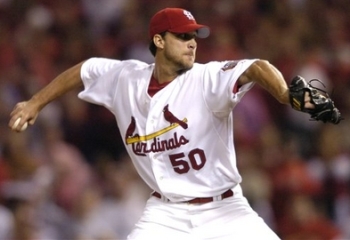
Not that I necessarily believe in the “Inverted W” theory of pitching mechanics … but Adam Wainwright certainly shows it. Photo: talksportsphilly.com

2/24/11 update: Wainwright is officially getting Tommy John surgery.  As other leading baseball columnists have mentioned, this could have some serious repercussions on the Cardinals both this season and in the future.

You hate to hear injury reports a week into spring training, but they’re starting to roll in.  Vincent Padilla is going to be out for an unspecified amount of time for elbow surgery (though this doesn’t hurt the Dodgers as much as an injury to someone like Kershaw or Billingsly would have), and now it looks as if St. Louis’ starter Adam Wainwright may have blown an elbow tendon.   I had not read previously the “slightly torn elbow ligament in 2010” item with regard to Wainwright.  Either way, the loss of Wainwright for the season adds to a growing list of concerns for the St. Louis franchise.

Just off the top of my head:

  • LaRussa‘s anti-union comments irritating his vets
  • LaRussa refusing to play Colby Rasmus for large stretches last year.
  • The team in general inexplicably not winning the NL Central last year despite having 3 of the best pitchers in the NL and a pretty good offense (6th in runs scored).
  • The team blatantly lowballs Pujols in FA talks.  By all accounts he was offered a contract that would have only made him about the 5th or 6th highest paid player.  Why in the world would your talks with Pujols not START with A-rod’s per-season figure?  Ok, perhaps 10yrs $300M is ridiculous but would you sign on for something like 7yrs $210M with 2 options based on performance year to year at the end of the deal?
  • Wainright’s injury: I havn’t seen confirmation yet of Tommy John, just seen news that says “significant elbow injury.”  There’s just no pitchers out there to be had as a replacement (just ask the Yankees) either.
  • St. Louis’ farm system has been down recently.  Most scouting establishments ranked it 29th or 30th in 2010 but in the 18-20 range for 2011.  So there’s not a lot of hope coming up.

The Cardinals under achieved as a team in 2010 (winning 86 but having a Pythagorean win total of 91) WITH Wainwright pitching at a Cy Young level.  Without him, the Cards could be sinking back to the middle of the pack, leaving the division for Cincinnati and Milwaukee to battle it out.

Rough waters ahead for the Cardinals.

Written by Todd Boss

February 23rd, 2011 at 2:03 pm

Whose Rotation Job is really at stake?

7 comments

If Maya really turns it on this spring ... will he be in the rotation? Photo via thenatsblog.com

Most Nats pundits (including this one, as posted here) seem to think the Nats opening day rotation is a foregone conclusion.  Livan Hernandez is getting the ball opening day, then will be followed in some order (probably close to the following order to break up Lefty-Righties) Jordan Zimmerman, John Lannan, Jason Marquis, and then newly acquired former Cub Tom Gorzelanny.  MLB beat writer Bill Ladson believes Yunesky Maya will win the spot and Gorzelanny will pitch out of the bullpen, but for the most part this is the agreed-upon opening day rotation.

This leaves 2-3 leading starter candidates (possibly $8M signee Yunesky Maya, former #1 draft pick Ross Detwiler and former 19-game winner Chien-Ming Wang) to fend for AAA or rehab starts.  Some even put non-roster spring training invitee Chad Gaudin into the mix (personally I do not; the last time he was a full time starter was in 2009 pitching in the cavernous San Diego park and he put up a horrible 5.13 era).

The question is; is JUST the #5 spot open for competition?  Here’s some quick thoughts and stats on the “leading 5” guys.

1. Livan Hernandez had a renaissance season, and a historic one among the opinions of the FIP/saber metric guys.  At various times during the season there was nearly a point and half gap between Livan’s actual ERA and his expected fielder-independent-pitching values.  This gap is normally attributed to “luck” by stat heads, who insist that pitchers eventually return to the mean.  By the time the season was over Livan had regressed backwards somewhat but still finished with an inexplicable gap between his actual and expected values.  ERA of 3.66, FIP of 3.95 and xFIP of 4.76 with a BABIP of .293.

Can he do it again in 2011?  He’s a year older and theoretically a year closer to obsolescence, but he isn’t the type of pitcher who ages badly.  He only throws mid 80s to begin with, and a combination of easy arm motion and zero injury history leds credence to his statement that he wants to be the “Jamie Moyer” of right-handers.   There’s no reason to think he won’t repeat his 2010 performance … until you look at his 2007-9 pitching stats.  There may be worry here after all.  He’s a survivor though and I can’t see him getting demoted out of this rotation.

2. Jordan Zimmermann has a lot of expectations on his arm this year.  We know what we get with him; mid 90s fastball, good movement on his off speed stuff, about 8.5 k/9.  What we don’t know is whether or not he’s closer to Matt Cain or if he’s closer to Garrett Mock.  Its hard to analyze his two MLB seasons because of the arm injury; in 2009 he was clearly hurt during his last few starts and he was clearly rusty at the end of 2010.  His 2nd game back he struck out 9 and only gave up one hit through 6 complete … and then got hammered in three straight games. He finished the season strong though; putting in a couple of really nice performances in late sept/early october (his last two game scores were both 60+)

Which Zimmermann will we see in 2011?  We are all optimistic that he’s healthy, that his time has come, and that he’ll be the strong #2 that we expect.  But temper your expectations; he’s yet to pitch a 100 innings in a season (and only maxed out at 134 in his only full professional season to date, 2008).  Until I see an injury-free, dominant season he’s just another prospect.

3. Jason Marquis.  His contract ($7.5M for 2011) earns him a spot right now, not his performance.  He was pretty good for Colorado in 2009, and decent in Chicago the two years before that.  Suddenly he gets to Washington and he forgets how to pitch.  Was it all the bone chips in his elbow or were there other things going on?

After his return post surgery in August, he had 10 starts.  Isolating just for those 10 starts (a neat little feature at baseball-reference.com, frankly) we discover that he was 2-6 with a 4.29 era and a mediocre 1.50 whip.  Most of that damage was done in an ugly game in Philly where he only retired one batter.

So, the question is, Is Marquis back to his 2007-2009 form?  If he isn’t, and he starts putting up lines like he did on April 18th of last year (7 batters up, 7 batters scored for an infinite ERA on the day) how short is his leash?

4. John Lannan.  Staff Aces usually don’t get sent to AA to work on their mechanics mid-season, but something was clearly amiss with Lannan’s game.  His last four starts prior to being sent down were awful; in one game he gave up 4 walks and 10 hits in fewer than 5 innings.  Luckily, Lannan’s time in the minors seemed to help; he only had two “bad” starts after returning in August and in his last 10 starts posted a 6-3 record with a 3.42 era and 1.24 whip.  These numbers easily eclipse his career numbers and eclipse his rather consistent numbers for the whole of 2008 and 2009’s seasons.

The question is (as it is with most of our starters): what version of Lannan are we getting?  Is it June 2010 Lannan or is it July 2009 Lannan (a day he shut out the Mets on 7 hits).  Lannan has one option remaining, so we could send him back down again if the train runs off the tracks.  More likely is that Lannan has figured out what was wrong and will be our most consistent starter for the 3rd year out of 4 running.

5. Tom Gorzelanny.  Cut loose by the Cubs for a relative bargain (one higher end but stalled prospect, one decent mature arm and one rough higher-ceiling youngster).  Why?  Partly because he was probably 6th or 7th in line for rotation spots on the North Side (Dempster, Zambrano, Garza, Wells and Silva followed by a promising rookie Coleman).  He’s not bad; 2010’s 7-9 season featured a 4.09 era but a bloated 1.496 whip for a slightly better than league average 106 era+.  He would have been our 2nd or 3rd best starter last year.

But which Gorzelanny are we getting?  2010’s version of passable production or 2008’s god-awful 6.66 era season with Pittsburgh?  There isn’t much wiggle room for him; he’s out of options and he’d block another deserving bullpen candidate if he falters.


Best Case for the team: Hernandez continues to pitch like its 1997, Zimmermann pitches league average or better and doesn’t get hurt, Lannan continues where he left off last fall, and Marquis/Gorzelanny product up to their capabilities.

Possible real-world case: We get career-norm results out of Livan, Lannan and Marquis (our leading vets), but Zimmerman suffers an elbow strain and Gorzelanny gets bumped to the bullpen in the spring training, giving both Maya and Detwiler immediate rotation spots.

Worst Case: Marquis gets released, Gorzelanny gets shelled, and Zimmermann gets hurt.  We’re calling up Maya, Detwiler and rushing Wang back from rehab.  And our safety net includes 3 guys we DFA’d over the winter and the likes of Stammen, Balester and Mock.

Lets hope we get some best case spring training results.

Written by Todd Boss

February 22nd, 2011 at 4:45 pm

Posted in Majors Pitching

Pettitte was a very good pitcher… but no Hall of Famer

one comment

Pettitte stares down another hitter. Photo noahhunt.org

Andy Pettitte‘s retirement (see my previous post for thoughts on its effect on the Yankees season) has lead to a series of inevitable posts about his Hall of Fame worthiness.  Si.com’s Joe Sheehan wrote this opinion piece after Pettitte’s retirement, saying that “Modern era of baseball demands Cooperstown find place for Pettitte.”  I won’t really go into his arguments except to say that he believed that Bert Blyleven was “wildly overqualified” for the hall, a position that I “wildly” disagree with and posted as much here about a month ago.  So its doubtful that I’d agree with his sentiments.

(Note; for the purposes of this article we will ignore the fact that Pettitte’s chances of getting voted into the hall in light of his PED usage admissions are somewhere between zero and nil anyway, and just think of his career in its merits).

So far, from what I’ve seen from the baseball columnists who have opined on the subject, there seems to be about a 50-50 split pro and con for the Hall.  Joe Lemire seems to agree with Pettitte’s own assertion that he is not Hall-worthy, Buster Olney thinks he’s a borderline candidate but th inks that he may be a Veteran’s committee inductee some day, and Jayson Stark thinks he’s not quite Hall worthy.

For me, Pettitte is NOT a Hall of Famer.  His career numbers show him to be a consistent hurler who was essentially a very good #3 pitcher on a number of very good Yankees teams.  He finishes his career with a 240-138 record, a career 3.88 era, 1.357 career whip and a 117 career ERA+.  His season-ending accomplishments include:

  • 3rd place in his Rookie of the Year voting (losing out to Marty Cordova and Garrett Anderson)
  • 5 years (out of 16) receiving Cy Young votes, though only one of those 5 years was actually meaningful in terms of the voting.  He finished 2nd to Pat Hentgen in the 1996 voting.
  • 3 all star appearances.

His enduring legacy is his post season career, where he has more appearances and more wins than any other pitcher.  He pitched in the post season in 13 of his 16 professional seasons, had 42 starts altogether, and compiled a 19-10 record with a 3.83 era and 1.304 whip.  These numbers are more or less in line with his career numbers, indicating that he was a good pitcher but not great.

I would be a stingy hall voter.  For me the qualifications of a Hall of Fame pitcher include all the analysis of career achievements, but also some semantical arguments:

  • Was the pitcher ever the best player on his team for a consistent period of time?  (no)
  • Was the pitcher a guaranteed shut-down hurler who was worth the price of admission? (no)
  • Was the pitcher regularly an all star and frequently STARTED the all star game? (no)
  • Were you, as a fan of the opposing team, ever “scared” to hear that Pettitte was going against your team? (not really).

At the bottom of Pettitte’s B-R page, his Hall of Fame Monitor score puts him at 42 .. which is better than Jack Morris but below the 50 range that generally qualifies a player as a HoFamer (this is Bill James‘ concoction and the one overall HoF score that I agree with).  But also more telling is the list of pitchers that Pettitte is most like.  Top two: David Wells, Kevin Brown. .  Ironic that these guys were also middle-of-the-rotation Yankees hurlers who gained many wins by virtue of being along for the ride on one of the best teams ever constructed (the late 1990s Yankees teams).

Bottom line; Pettitte was a good teammate and by all accounts a nice guy who made an awful lot of money in his career and goes down as one of the most decorated Yankees ever.  But he’s not one of the BEST ever.

Pettitte’s retirement spells doom for the Yankees season

one comment

Pettitte is done ... leaving a massive hole in the Yanks rotation. Photo: noahhunt.org

One of the last major off-season issues to resolve prior to the beginning of spring training (the status of lefty Andy Pettitte) was resolved with the pitcher announcing his retirement earlier this week.

The retirement leaves the Yankees rotation in serious trouble.  Pettitte may have only given the 2010 team 21 starts but he went 11-3 in those starts and was the Yank’s 2nd best pitcher.  They failed to acquire any of the marquee free agents or trade targets in the off-season and are going into 2011 with this as a rotation: Sabathia, Burnett, Hughes, Nova, and Mitre.  The problem is that after Sabathia, every one of these guys has serious question marks;

  • Hughes may have gone 18-8 but his accompanying numbers (4.19 era, 1.28 whip) only rated a 102 era+ for the season.  That’s essentially league average.  He benefited from some pretty amazing run support that probably cannot be sustained in the long term.  It was also his first year starting full time.  He has a great pedigree (1st round pick in 2004) and has pitched well.  But he may be a candidate for the Verducci effect of quickly increasing workload.  The Yanks have been burned in the past by young starters blowing out their arms (Wang).
  • Burnett may be the latest in a long line of quality pitchers who just cannot perform in the spotlight.  He was relatively awful in 2010; 10-15, 5.26 era, 1.511 whip.  Most teams would put up with this in a 5th starter if the guy was a promising rookie … but Burnett is a highly paid supposed ace starter.  He’s never been a complete lights out starter, sports a career 110-100 record and should never have been given a $84M contract to begin with.
  • Mitre is a 29-yr old journeyman pitcher with a career 13-29 record.  And he’s slated to be the Yankees #4 starter.
  • Nova looks like he could be a ok back of the end starter prospect … but he owns a grand total of 3 career major league starts.  And he’s slated to be the #5 starter.

New York has signed a couple of MLB veterans in Freddie Garcia and Bartolo Colon to minor league deals, and they may provide insurance/competition for Mitre and Nova in the spring.  But there is a reason these guys couldn’t catch on with even the worst teams out there; they’re more likely to put up a 6.00 era than a 3.00 era.  Perhaps Garcia’s decent 2010 season may land him a rotation spot, but Colon hasn’t pitched in the majors in over a year and was awful then.

Now, the Yankees are still one of the best offensive teams in the league and can slug their way to a number of 8-6 wins … but in a division where Boston has restocked and looks dominant and Tampa has a rotation that New York only wishes it had, 3rd place looks like it is in the Yankees future.  Writer Jon Paul Morosi thinks that the Yankees won’t miss Pettitte, but i think he’s crazy.  His article seems to just assume that a Fausto Carmona trade is a done deal (despite the fact that the Yankees have swung and missed on every pitcher acquisition this off-season).  He also assumes that 3 prospects that nobody has heard of (Dellin Betances, Manny Banuelos or Andrew Brackman) will magically come to the rescue.  Banuelos and Betances each are grizzled minor league veterans with 3 AA starts to their credit, and Brackman isn’t that far ahead of them (he was 5-7 with a 3.01 era in 15 AA starts in 2010).  Yeah; not exactly Jeremy Hellickson-esque prospects waiting in the wings.

2/7/11 update: Seth Livingstone at USA Today wrote about this same topic and reviewed some other possible prospects in the Yankees system that may be better options than the three mentioned above.

There are definitely some arms to be had in the trade market.  Joe Blanton is probably available, the Braves may have an extra starter in Kenshin Kawakami if their up and coming prospect Mike Minor blows it out in the spring, the Dodgers have 6 starters for 5 slots and may give up Vicente Padilla once the season starts, and even the Washington Nationals may have an extra arm or two worth gambling on (Maya, Wang and Detwiler are all slated to start in the minors right now).

Without a move though, I say “Welcome to 3rd place” and only the 2nd time you’ve missed the playoffs since the wild card era.