Nationals Arm Race

"… the reason you win or lose is darn near always the same – pitching.” — Earl Weaver

Archive for the ‘Majors Pitching’ Category

Divisional Series Matchups – By the Starters

4 comments

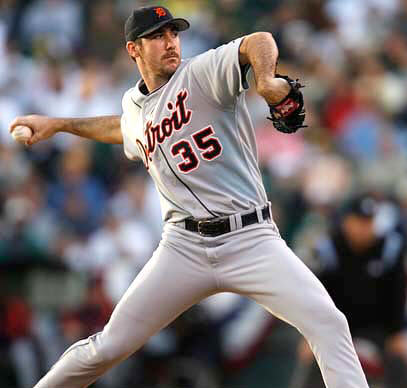
Verlander has already given the Tigers a huge leg up in their divisional series. Photo unknown via rumorsanddrants.com

As we have already seen in the playoffs thus far, predicting these coin-flip games, or predicting the outcome of individual games, is usually fool’s gold.  The first four games of the playoffs featured four Road-team wins.  You can argue that the higher-seeded teams in the divisional series are “better” than the home teams and this was to be expected … except that we’re talking about divisional winners/90+ win teams all around.  So far, the results have been surprising.

What’s also been tough this year is the lack of “announced” starters.  The Tigers seem to know exactly who they’re throwing for all 5 games of the series … but nobody else does.  Baltimore’s only announced starter (Jason Hammel) hasn’t pitched since September 11th and they have a handful of guys to pick from.  In last year’s version of this post I was able to do match-up analysis.  This year i’ll just look at the breadth of the starters to see who has an upper hand.


Washington-St. Louis:

  • Washington’s likely starters: Gonzalez, Zimmermann, Jackson, Detwiler
  • St. Louis’ likely starters: Wainwright, Garcia, Carpenter, Lohse

I’ve already talked at depth about this series in my previous post.  Just looking at starters, its hard not to see the Nats as the favorite.  Our Ace Gonzalez goes twice in the series, St. Louis doesn’t hit righties as well.  Carpenter could be a difference maker.


Detroit-Oakland:

  • Oakland’s likely starters: Parker, Milone, Anderson, Blackley
  • Detroit’s likely starters: Verlander, Fister, Sanchez and Scherzer

Justin Verlander is as close to unbeatable as there is, again evidenced by his game 1 dominance. (7ip, 3 hits one solo home run).  If he’s set to go in game 4, Oakland basically has to win out.  The rest of Detroit’s planned starters all sport sub 4.00 ERAs and all of them have at least a 113 ERA+.  In fact, how exactly is this only an 88 win team?  They have three unbelievable hitters in the middle of their order and plus starting pitching.  Max Scherzer and his dominating fastball apparently has recovered enough from a post-game celebration injury and should take the ball in Game 4.  Anibel Sanchez has been pretty effective since arriving from Miami in a mid-season trade (is Sanchez an off-season FA target of the Nats for their 5th starter?) and should give the Tigers a great chance to win his game 3 start.

Meanwhile, Oakland has a slew of rookie starters to choose from, all of whom sport sub 4.00 ERAs (the worst season ERA on the staff is Travis Blackley, who may or may not feature in the post-season).  Jarrod Parker threw game one and was effective, just not effective enough.  I was surprised to see Tommy Milone slated as the game 2 starter (perhaps chosen by virtue of his home/away splits; 2.74 ERA at home, 4.83 ERA away).  After that I honestly have no idea who we’ll see.  Oakland named 5 starters to its post-season roster, but AJ Griffen was pasted in his last outing and may be a long-man/emergency starter.  Brett Anderson is clearly the staff Ace at this point but only returned in late August.  Oakland’s been on such a tear though, its hard to bet against them.

Prediction: Verlander already gave Detroit the huge advantage with a game 1 victory.  Oakland needs more magic to advance.


New York-Baltimore:

  • Baltimore’s likely starters: Hammel, Tillman, Chen, Saunders
  • New York’s likely starters: Sabathia, Pettitte, Kuroda, Phelps?

Baltimore’s only announced starter as of today is Jason Hammel, who (as noted above) hasn’t thrown in 3 weeks.  After that?  The Orioles used 12 different starters on the season and at one point demoted 3/5ths of their rotation in a week.  They seem set to roll out the above named guys after Hammel, but this leaves out both Miguel Gonzalez and Steve Johnson, who were effective down the stretch.  I can’t find a link for Baltimore’s named divisional roster as of the time of this writing; which would have helped.

Meanwhile, looking at New York’s options past the above named three guys, I would initially guess that New York is going to a 3-man rotation for the playoffs.  What would you rather do?  See three effective veterans going on 3 days rest, or to give post-season starts to the likes of Phil Hughes or Ivan NovaFreddie Garcia lost his starting spot in September when Pettitte returned but isn’t an option because of how ineffective he’s been all season.  Would you give a game-4 start to rookie David Phelps?  It seems amazing to me that the highest payroll team in the league can’t find an effective 4th and 5th starter (getting Pettitte out of retirement?  Giving Garcia 17 starts after signing him off the trash heap?) and I think it continues to be their downfall (only one World Series appearance in 8 years).

New York swept the Orioles in the first series of the season, split a 2-game set in mid-season, but lost EVERY other series exactly 2 games to 1 on the season.  Is there any reason not to think they’ll do something similar in this series?  I see a split in Baltimore and then New York struggling to win 2 of 3 in New York.  Does Sabathia struggle going on 3 days rest?  More importantly, does Pettitte??  He should be on a golf course right now, not pitching in October.  It should be interesting to see if New York uses a 4th starter.


San Francisco-Cincinnati:

  • San Francisco’s likely starters: Cain, Bumgarner, Vogelsong, Lincecum
  • New York’s likely starters: Cueto, Arroyo, Latos, Bailey

We’ve already seen some interesting mishaps with Cincinnati’s best laid plans; Cueto out with bask spasms after just 2 batters, planned game 3 starter Latos forced into action.  Now it looks like Cueto will go game 3, with Bailey either pushed to game 4 or skipped outright since Latos only threw 4 innings in game 1.  Or perhaps Bailey goes game 4 with Latos pushed to a possible game 5.  Either way, the wild-cards here are Cueto’s health and Arroyo’s effectiveness.  If Cueto returns for a game 3 start, with Cincinnati haven already “stolen” a game against SF’s ace, the Giants are in trouble.

Meanwhile, has San Francisco made a decision on its starters?  They’ve named all 5 (the above four plus Barry Zito) to the post-season roster with an unnamed player dropping to the bullpen.  I think they’ll go with supposed ace Tim Lincecum as the 4th starter despite Zito’s numbers being superior. Meanwhile, Ryan Vogelsong has been vulnerable down the stretch despite good numbers on the season.

I think the back-end of the Giant’s rotation is a huge question mark, and if the Reds have already stolen a game against Cain, this series may be short.

Washington vs St. Louis – A tale of two Series

2 comments

We need Edwin Jackson to perform against his former team. Photo Nats team official via espn.com

Ok, I’ll admit to being (as one commenter said recently) the “Eeyore” of Nationals fans.  I was scared of Atlanta and thought we would struggle to beat them in a short series starting on their turf.  I posted my baseball predictions and the two teams I thought would make the series both lost under sometimes interesting circumstances.  The unbeatable ace Kris Medlen got beat, losing a start for the Braves for the first time in 24 times (not that he really pitched badly; I’ll take a 6+ inning, 3 hit, 0 walk performance every day of the week.  Think about how difficult it is to give up 5 runs on 3 hits…).  So perhaps I’ll understand if you don’t really want to trust my opinion on predicting the divisional series.

Anyway.  So the Nats are traveling to St. Louis to start the NLDS.  If you’re looking for a guess as to who has the advantage by looking at the two meetings between the teams this year, you may find definitive proof wanting.

  • The Nats took 3 of 4 at the end of August from St. Louis, bombing them for 31 runs in four games and really roughing up three of St. Louis’ best starters (in order Jaime Garcia, Adam Wainwright and Kyle Lohse, tagging each for 5-6 runs).  Only Jake Westbrook kept the Nats offense at bay, and as far as I can tell he’s not going to be on the playoff roster.  The one loss in this series was in one of the more amazing games the Nats played this year; they blew a 4 run first inning lead, fell behind 8-6 on Jordan Zimmermann‘s worst outing of the year, rallied to take the lead only to have the bullpen blow the game.
  • The Nats then traveled to St. Louis the last week of the season and were pretty much bombed themselves, with St. Louis scoring 26 runs in three games while taking 2 of 3 with our guys Edwin Jackson and Ross Detwiler having nights they’d rather forget.

So, which series is more educational to help predict what may happen now?  As commenters have pointed out, momentum means nothing and a shutout yesterday indicates nothing for today.  Fair enough.  We have learned that both offense are capable of really putting runs on the board, fast.  But that wasn’t exactly news either; the teams were 2nd (Cardinals) and 5th (Nationals) in runs scored in the NL this year.

What is fair to say is that the Nats probably have a more dangerous opponent in St. Louis; they’re a better offense, though they clearly hit right-handed hitters better than lefties (a 113 wRC+ versus right handed hurlers versus 104 versus lefties).  And they’re getting back a grizzled post-season veteran in Chris Carpenter just in time for the playoffs.  Carpenter is probably on most people’s short list for “guys i’d trust to start Game 7” in this league, and now the Nats seem set to face him in Game 3.

Lets look at the pitching matchups (some of this is a guess; official starters havn’t been named all the way through the 5-game series but the below should be what we see);

Series GM# Date/time (EST) Home-Visitor Home Starter Visiting Starter Advantage
NLDS 1-4 1 10/7/12 3pm Stl-WAS Wainwright Gonzalez Wsh
NLDS 1-4 2 10/8/12 4:30pm Stl-WAS Garcia Zimmermann Wsh
NLDS 1-4 3 10/10/12 ?time WAS-Stl Jackson Carpenter Stl
NLDS 1-4 4 10/11/12 ?time WAS-Stl Detwiler Lohse Tossup
NLDS 1-4 5 10/12/12 ?time WAS-Stl Gonzalez Wainwright Wsh

The good news: Washington has shown it can blast St. Louis starters.  As mentioned above, the team put up very big numbers on 3 of the 4 starters they anticipate seeing in this series.  Meanwhile, St. Louis gets to see our Ace Gio Gonzalez twice; the last time they saw him Gio pitched a 5-hit shutout.  They also see Detwiler in game 4, meaning three of their five potential series games are against Lefties (whom they are weaker against).  Zimmermann’s home-away splits favor him on the road, and I think Jackson will be looking for revenge for his poor outing against them the last time out.

I’ll admit; I was scared of Atlanta.  And I’m wary of St. Louis, especially after the late season spanking.  But, they didn’t see Gonzalez in that series and now are set to see him twice.  The Nats offense isn’t going to be afraid of any St. Louis starter (perhaps outside of Carpenter, who a lot of them havn’t seen in a while), and should put runs on the board.

Prediction?  I think the Nats have the pitching matchup advantage in 3 of the 5 games and may only be a pitching “underdog” in the Jackson-Carpenter start.  The goal is to get a split in St Louis and Gonzalez-Zimmermann gives them a great shot in both games.  I like our chances.

WC Pitching Matchup Analysis

one comment

Kris Medlen looks to get the WC win for his team. Photo unk via totalprosports.com

Here we go.  Baseball’s first wild card play-in games are set for tonight (at 5pm and 8:30pm eastern time), and its safe to say there was a surprise or two with the announced pitching matchups.  Lets look at the guys getting the starts and make some predictions on which team has the better chance based on the starter going.  I tried to do similar posts for the 2011 post season and, while they’re not always accurate, they’re fun to do and to read.

MLB Probable Pitchers are here, for tonight and the first few games of the playoffs.

1. St. Louis at Atlanta.  This is the game DC will be watching.  Match up: Kris Medlen (10-1, 1.57 ERA) versus Kyle Lohse (16-3, 2.86 ERA)

What more can we say about Medlen that we havn’t already said?  9 earned runs allowed in his 12 starts on the season, a 10-1 record with a 1.57 ERA.  He’s the modern day equivalent of Greg Maddux, a slight framed guy with beyond pinpoint control.   He achieved a bWAR of 4.4 despite getting just 12 starts on the year and pitching in middle relief until August.

Meanwhile, Kyle Lohse quietly had a great year.  Nobody’s mentioning his name in consideration of Cy Young despite a sterling record and great ancillary numbers (a 134 ERA+ is pretty good).  I think his selection is slightly surprising to go in this game; he’s probably the #3 starter on the team (behind Chris Carpenter and Adam Wainwright) but he’s clearly the best performer on the year.  As with Atlanta choosing Medlen over Tim Hudson, Cardinals Manager Mike Matheny is going with his hottest hand.

However, while Medlen is likely to pitch 6-7 innings of one-run ball, I think the Braves get to Lohse.  They’ve faced him once already this year and put 9 hits and 5 runs on him in May.  The Braves hit right-handers far better than lefties, but St. Louis really doesn’t have a great lefty starter choice.  Jaime Garcia may not even make the post-season roster (would you take Garcia ahead of Lance Lynn?).

The Pick: Atlanta in what could be a romp.


1. Baltimore at Texas.   Match up: Joe Saunders (3-3, 3.63 ERA after his trade to Baltimore) versus Yu Darvish (16-9, 3.90 ERA)

Saunders is another surprising pick for Baltimore, who has gotten by on smoke & mirrors all season when it comes to starting pitching.  The Northern Virginia Native Saunders (West Springfield HS and then Virginia Tech) is essentially a MLB-average starter for his career (a 103 ERA+) but pitched above his career stats in Baltimore.

Not to denigrate Saunders, but he’s essentially a less stable version of John Lannan.  He’s a softer tossing lefty who is about MLB average over his career, but with higher and lower extremes from season to season.  Would you trust a do-or-die situation in the hands of Lannan?  Problem is, who else would you go with if you were the Orioles?  I thought they’d go with the hot-hand Steve Johnson or their ace Wei-Yin Chen.  We’ll see if this gamble pays off; the Rangers hit left-handed pitching pretty well (108 wRC+, .285 BA).

Meanwhile, this is a national stage for high priced Japanese import Darvish.  He had a relatively effective season (16-9, a 116 ERA+) and got a ton of strike outs (221 in just 191 1/3 innings pitched).  The Orioles definitely have some higher-strike out guys in the middle of their order (Chris Davis, Mary Reynolds).    Darvish never faced Baltimore this season, but had a strong September and seems hitting his stride entering the playoffs.

The Pick: Texas in a struggle.

Nats Clinch on Lannan’s last Audition for 2013

8 comments

The Nats clinching was the story of the night. Photo MASN screen grab via Nats Enquirer blog

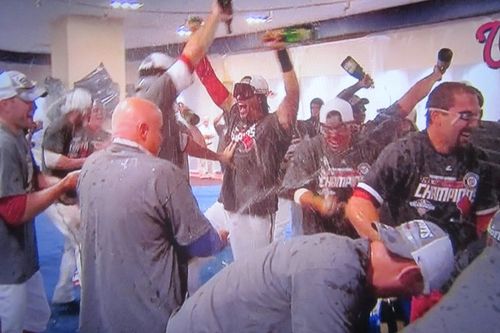
The story of the day is obviously the Nats clinching the NL East title, cementing a fantastic turnaround season for the traditionally moribund franchise.  This is a great achievement for a team that very few pundits gave a shot at competing for a playoff spot, with even the most ardent fans thinking that 2012 would be a great stepping stone for 2013 and beyond.  The team surprised us all with fantastic pitching all year (the pitching staff is in the top 5 in most statistical categories league-wide) and breakout offense performances from Ian Desmond and Bryce Harper.  The team boasts a lineup where batters 1-7 all have 20+ homer seasons on their resumes and have to be seen as a tough out by any eventual playoff opponent.

We were lucky enough to be in the stadium last night to see the clinch.  I can honestly say I’ve never seen the crowd as pumped up and vocal at any other time that I’ve been present at the stadium; not at the 2009 home stadium opener, not at the first game in RFK, not during the Yankees series over the years.  The crowd regularly came to its feet to cheer the team in critical situations, was loud and vocal from the first pitch, and (thanks to the proliferance of smart phones) knew the moment that the Atlanta loss was final.  The moment came just after the Nats got the last out of the top of the 9th, making for a very odd scene where the team was about to lose a game but was giving high-fives in the dugout ahead of their last at bat.

John Lannan took the loss, going 5 relatively mediocre innings and surviving 9 baserunners (3 by walk) to give up 2 earned runs on 6 hits.  Lannan was all over the plate; 80 pitches but only 42 for strikes and was lucky not to have given up more runs.  He got three double plays in his 5 innings, including a nifty first-to-home play from Adam LaRoche to get out of a bases loaded jam in the 4th.  It was an inauspicious final appearance from Lannan, who finishes the season with a 4-1 record, a 4.13 ERA and a slightly-worse-than average 97 ERA+ in 6 starts (2 spot starts during the season and 4 starts in September replacing Stephen Strasburg in the rotation).  The loss is slightly unfair to Lannan; the real story on the night was the offense’s inability to touch Kyle Kendrick, whom they had battered just 4 days ago in Philadelphia, allowing him to go 7 shutout innings and only allow 4 hits.  The team was 0-8 with runners in scoring position, and had several crucial called-3rd strike K’s in situations that called for clutch hitting.

The team didn’t end up needing Craig Stammen‘s amazing stint; 2 innings, 6 strikeouts.  Stammen has really surprised me; I never thought he’d go from 4-A starter to shutdown middle reliever in just a season.  But he is an excellent weapon for this team and I hope he continues his dominance into the post-season.

Where does Lannan go from here?  Clearly he’s not in the Nationals plans; he’s arbitration eligible and due to get a raise from his 2012 salary of $5M, meaning he’s a non-tender candidate since the team would rather get a Mike Rizzo preferred arm (i.e., a power pitcher, a high K/9 guy instead of a finesse lefty like Lannan).  I could see him getting cut loose and finding a one or two year deal for an AAV of $4M/year (maybe even more; remember the Nats signed Jason Marquis to a 2yr $15M deal after a series of comparable seasons earlier in his career).  Lannan is an effective 4th or 5th starter on most teams and likely would excel in an NL pitcher’s park like Los Angeles, San Diego or San Francisco. There will absolutely be teams looking for guys like Lannan on the FA market and he’d likely be a great fit for a team looking for Starter help (off the top of my head; Kansas City, Chicago Cubs, Cleveland and Minnesota).

Washington isn’t going to get to 100 wins like I predicted in August (they’ve sputtered in September, going just 16-12 after two great months preceeding it), but 97 or 98 should be good enough for Best in Baseball and (hopefully) a #1 seed in the playoffs.  Go Nats!

Can we find a 5th starter for 2013 internally?

32 comments

Could Garcia's great stuff translate into a starting role in 2013? Photo unknown via federalbaseball.com

I’ve been thinking about the rotation  for 2013, reading some early 2013 Free Agent rankings, and steeling myself for the reality that this team is more than likely to lose Edwin Jackson to free agency.  Two primary reasons we probably lose Jackson:

1. He’s one of the best available starters in this coming off season’s FA market

2. He’s likely to command a multi year deal at more money than this team is probably willing to offer.

Considering our “core 5 starters,” Jackson ranks 5th out of 5 in terms of ERA and ERA+, and he’s 4th of 5 in terms of Whip and FIP, and 3rd of our 5 (barely) via xFIP and SIERA.  He’s been clearly out pitched this year by our 5th starter Detwiler and isn’t ahead of the big three in anyone’s eyes.  So the question is; will the Nats make its 5th starter its highest paid pitcher?

I just don’t think so.

So we’re likely looking for a 5th starter for 2013.  The FA market is pretty bareZack Greinke is going to command a massive deal for a guy who, honestly, has had one stellar season in 2009 and since has been no better than a 3rd starter.  I think the Nats should stay away from him.  The Nats should also stay away from promising starters in 2012 but who have injury or inconsistency issues (Dan Haren and Jake Peavy, both of whom likely have their 2013 options declined).  Who else is out there that fits the Mike Rizzo mold (hard thrower, high K/9 rates)?  Shawn Marcum?  Brandon McCarthy?  Also injury concerns.  How about Anibel Sanchez, Jonathan Sanchez and Ervin Santana?  All three guys have good seasons in their immediate past but blew up (or were at best inconsistent) in 2012.

Maybe the above paragraph is even more support for re-signing Jackson frankly; he’s got no injury issues, apparently is a good clubhouse guy and meets Rizzo‘s starter criteria for veteran, hard-throwing innings eater.  So maybe this whole article is going to be moot.

Here’s a different take (and the point of this article); some news items came out this week that caught my eye; perhaps the Nats can find a 2013 5th starter internally instead?  Christian Garcia has really impressed in 2012, from his stellar minor league numbers to his good performances out of the bullpen in September.  And now word has it that the team is considering looking at him as a starter.

I love Garcia’s stuff; he’s a 3 plus pitch guy with a ton of movement on his decent fastball.  Here’s some Pitch F/X data for him this year; 95mph average (peaking at 97.8mph), 10mph delta between his fastball and change, and a ridiculous amount of movement on his 12-6 curveball.  He’s getting nearly a 20% swing-and-miss rate across all his pitches.  Fangraphs.com even did a post specifically on Garcia based on his September performance, featuring an animated .gif of  his “stupid good” curve.

That features as a pretty good starter line to me.  Perhaps he needs a 4th pitch (his over-the-top delivery could lend itself to a sinking 2-seam fastball, a cutter or even a split-fingered pitch that he could add to his arsenal) to be truly effective as a starter.

Meanwhile, the team has already started the Ryan Perry conversion to starter experiment, and his AA starting numbers in 2012 were pretty good.  Pulling this text from my AA-in-review post:

Ryan Perry, astutely acquired for Collin Balester (who failed to impress in Detroit and was DFA’d earlier this year) in spring training and he competed for the MLB bullpen.  He featured briefly, was ineffective and was optioned to AAA.  The team took a look at his repertoire and decided to try to convert him to a starter in AA.  The results?  Pretty good; a 2.84 ERA and 1.11 whip in 13 AA starts.  Outlook for next season: here’s the problem with Perry; he’s out of options for 2013.  He was added to a 40-man roster in April 2009, and burned options in 2009, 2011 and this year.   So he has to either make the MLB club or be DFA’d at the end of spring training.  So look for Perry to compete for the #5 starter job or be considered trade bait in the off-season.

Can Perry continue his starter performance in spring training in 2013?  Could Garcia win the job?  Will the Nats pursue a starter on the FA market?  Or, as they did in the 2012 off-season will they shock us with a trade that comes out of nowhere?

Wild Card Pitching Strategy

leave a comment

Kris Medlen is as close to an automatic win as there exists now. Should the Braves use him? Photo unknown via totalprosports.com

I was listening to the excellent Fangraphs.com podcast last week, hosted by Carson Cistulli and featuring excellent writer Dave Cameron, and Cameron (who writes the blog USS Mariner in addition to his Fangraphs work) proposed an interesting theory for handling a pitching staff in the wild card game.

Conventional wisdom states that the Atlanta Braves (who I’m using as an example here because I think they’re the best bet to advance in a wild card game right now) would throw their unbeatable ace Kris Medlen in the play-in game.  Reasoning: you can’t leave your best starter on the bench in a do-or-die game; you have to try to win it.  So you throw your best guy to win that game and then deal with the consequences the next round.

(Tangent: I’m pretty sure MLB assumed that a side effect of adding a second pitcher would result in a weakened wild card winner, which benefits the #1 seeded divisional winner and gives them an advantage going forward.  I certainly talked about this as a benefit when I lauded the 2nd wild card in this space earlier this summer.   But the roster loopholes in the wild card game that can be exploited as explained below and the first two home games on the road for the higher seeded team are both major issues that need to be addressed asap).

But what if the Braves decided to try something unconventional instead of just throwing Medlen??  Because of the scheduling of the playoffs, the wild card game winner will get a day off between Friday 10/5/12 and Sunday 10/7/12, meaning they could empty their bullpen and have every single guy down there throw his typical limit of innings and still have everyone available on Sunday for the first game of the Divisional Series.  So Cameron’s theory is; don’t start your ace; start your bullpen guys, who (especially in Atlanta’s case) are more efficient at getting guys out on a short-term basis.  Then, after a few innings of relievers throwing, you take a look at the game and decide then if your starter needs to go in.

What if Atlanta were to start some bullpen guys instead of Medlen in a play-in game, then suddenly Atlanta jumps out to a 4-0 lead.  You could then put in a different starter (say, the #3 starter, who could throw on 10/5/12 then be ready on normal rest for game 3 of the NLDS on Wednesday 10/10/12) to finish out the game.   You could keep some bullpen guys in reserve to stamp out any fires, but in theory you could manage a game in this fashion and preserve your best starter.  Plus, a major loop-hole in the playoff roster specification rules means that Atlanta could field a far different roster for just this wild card game than for the rest of the playoffs.  They could leave off basically their entire rotation and add in 4 more bullpen arms and continue parading out fresh arms all night like it was a spring training game.

Here’s a look at Atlanta’s top 7 relievers right now (stast as of 9/24/12):

Name W L W-L% ERA G IP H R ER BB SO ERA+ WHIP
Craig Kimbrel 2 1 0.667 1.08 58 58.1 25 7 7 14 106 374 0.669
Cristhian Martinez 5 4 0.556 4.04 51 71.1 79 33 32 17 64 100 1.346
Chad Durbin 4 1 0.8 3.19 73 59.1 51 25 21 28 46 127 1.331
Jonny Venters* 5 4 0.556 3.46 63 54.2 57 23 21 28 65 117 1.555
Eric O’Flaherty* 3 0 1 1.82 61 54.1 46 14 11 19 45 222 1.196
Luis Avilan* 0 0 2.25 27 32 26 9 8 10 28 181 1.125
Cory Gearrin 0 1 0 1.62 19 16.2 15 3 3 4 19 254 1.14

There’s some serious arms in that bullpen.  Kimbrel is obviously a known quantity and his 106 K’s in 58 1/3 innings are ridiculous.  But it also means he’s almost guaranteed to shut down whoever he may be pitching against (heard a great stat about Kimbrel recently; he has not pitched an inning all year where he gave up more than one hit.  That’s as shutdown as it gets).   Venters has had a slightly “off” season after being unhittable last year, but still greater than a K an inning.   O’Flaherty has been fantastic and could give you an inning.  Younger guys like Avilan and Gearrin don’t have a ton of experience but have performed excellently for the Braves.

Why wouldn’t you start off a game with (say) Venters going against the top of St. Louis’ order, then bringing in someone like Avilan for the 2nd and 3rd (he’s a 2-inning guy).  Bring in O’Flaherty when the big hitters roll around again in the 4th inning, then go with someone like Durbin for the next two innings.  You bring in Gearrin for the 7th and 8th, and then you’ve saved Kimbrel for perhaps 4 or 5 out save in the 8th and 9th.   And by virtue of the one-game roster setting loophole, this is just the first 7 guys out of the bullpen; one could add in 4-5 more arms as need be.

Honestly, I think this is a winning strategy.  Will the Braves (or the Cardinals for that matter) consider employing it?  No way;  Braves manager Fredi Gonzalez is well known in the baseball press for being “uber traditional” in the way he handles his pitching staff (lots of complaints about his leaving his best arm out there til it is a “save” situation instead of using him in higher leverage situations).  And the Braves have already manipulated their rotation to put Medlen in line for a wild card start.  Meanwhile St. Louis’ Mike Matheny is a rookie manager and such a strategy as laid out here is basically putting your job on the line for a coin-flip; if it doesn’t work out you’re fired.  Tony LaRussa could have pulled this off; he had enough respect and enough history to be given a pass if he tried something radical and it didn’t work out.  In fact, if LaRussa was still the manager I’d bet this is exactly what he’d do; we are talking afterall about the guy who essentially invented the modern bullpen.

In the end, it’ll be in the #1 seed’s favor if the Braves burned Medlen.  But it’d be great talking fodder if they tried the strategy above.

Nats Playoff Rotation & Bullpen Decisions

4 comments

20-game Winner Gonzalez is our likely #1 starter in the playoffs. Photo Joy Absalon/US Presswire via usatoday.com

The Nats rotation has been incredibly stable this year; only a mid-season experiment with Chien-Ming Wang interrupted a near season-long quintet of starters unmarred by injury or poor performance.  The shutdown and playoff unavailability of Stephen Strasburg is well, well documented, so we won’t talk about him here.  But two important decisions await Davey Johnson in terms of his playoff roster construction: playoff rotation and bullpen construction.  Lets take these questions one-by-one:

1. What is your playoff rotation?  Here’s the evolution of our rotation this year:

  • The year started off with your starters in this order: Strasburg, Gonzalez, Zimmermann, Jackson and then Detwiler. The starters went R-L-R-R-L.
  • After the All Star Break, Johnson shuffled the starters and re-ordered them to go Zimmermann, Gonzalez, Strasburg, Jackson, Detwiler (still R-L-R-R-L), ostensibly to give Strasburg a bit more rest and extend his season a few days.
  • On August 3rd (around a double-header) Zimmermann and Gonzalez switched places.  Now you’ve got Gonzalez, Zimmermann, Strasburg, Jackson and Detwiler (L-R-R-R-L).  All three RHSPs are in order, as are the two LHSPs.
  • On August 15th around an off day, Detwiler and Jackson switched places, probably to keep Detwiler on regular rest and probably to fix the aforementioned issue of 3 RHSPs in a row (starters now Gonzalez, Zimmermann, Strasburg, Detwiler, Jackson for L-R-R-L-R).
  • On September 12th, John Lannan replaces the shut-down Strasburg in the rotation.  Now we’re Gonzalez, Zimmermann, Lannan, Detwiler and Jackson for L-R-L-L-R.

If we play out the rotation the rest of the season, barring any more rain-outs or injuries, the starters will be (Starting 9/21):

9/21: Jackson
9/22: Gonzalez
9/23: spot starter Wang, to give the rotation its regular rest.
9/24: Zimmermann
9/25: Lannan
9/26: Detwiler
9/27: Jackson
9/28: Gonzalez
9/29: Zimmermann
9/30: Lannan
10/1: Detwiler
10/2: Jackson
10/3: Gonzalez

At this point I’m going to assume that the Nats will win the division and go straight to the divisional series, which (per MLB’s playoff schedule) starts either Saturday 10/6 or Sunday 10/7.  Which day the Nats start will be critical; if the Nats are the #1 seed they’ll start Sunday; if they’re the #2 seed they’ll start Saturday.

But in either case I think we’re going to see some manipulation of the above schedule, because I think the team wants Gonzalez to start the opener.   And he cannot start an opener on 10/6 or 10/3 if he throws 10/3.   We may see him skipped on 9/28 and then throwing a start 10/1 (which I’d be happy for; that’s the last game I have tix for this year), which would put him on regular rest for either a 10/6 or 10/7 start.

After that though, there’s some decisions to be made.  The NLDS ridiculously gives the lower-seed the first two home games, so I think Johnson may want to have some options available to him for his 2nd, 3rd, and 4th starter (I think its a pretty basic assumption that Lannan is being left completely off the playoff roster; more on this later down when talking about the bullpen options).  Here’s the home/away splits of our 4 likely playoff starters (numbers as of 9/21/12).

Interesting; Zimmermann is far more effective away, Detwiler is far more effective at home, and Jackson is just about the same either way.  This seems to imply that Zimmermann is your best bet to take the 2nd start, away from home, then line up Detwiler-Jackson-Gonzalez (or some combination thereof) at home.

Here’s another take; Johnson likes to play match-ups with certain teams.  Will the Nats opponent factor into the equation?  Assuming the Nats are the #1 seed, your likely wild-card winners right now are Atlanta and St. Louis (its hard to see a scenario where St. Louis loses its current 3 game WC lead in the next 12 days, but it could happen, but for the purposes of this article we’ll assume these two teams hold on).  How do these teams fare against lefty versus righty starters?

  • Atlanta is hitting .247 as a team versus Lefties with an 86 wRC+.  That’s bad.
  • Atlanta is hitting .251 as a team versus Righties with a 97 wRC+.  That’s certainly better than they do versus lefties.
  • St. Louis is hitting .275 as a team versus Lefties with an 113 wRC+.  That’s basically 2nd in the majors behind the uber-hitting Rangers.
  • St. Louis is hitting .270 as a team versus Righties with a 104 wRC+.  That’s roughly a 10% difference in Run Creation.

So, it seems like if we play Atlanta, we want to load up on Lefties while if we play St. Louis we want to load up on Righties.  This would seem to indicate that, if Atlanta is our opponent we’ll want to go Gonzalez-Zimmermann-Detwiler-Jackson-Gonzalez again, meaning Atlanta has to face 2 lefties in the first 3 games plus 3 out of 5.  If we play St. Louis, you’d think that we’ll want to switch up Detwiler and Jackson so that St. Louis gets L-R-R-L-L.  The idea being that once we get home, even though we’re lefty-heavy we’ll have the advantage.

However, with the #1, #2 and #3 seeds far from settled with a week and a half to go, lets also look at the same logic for both Cincinnati and San Francisco, since its conceivable at this point we could be playing either of these teams (use the same links in the Atlanta links above to see these statistics):

  • Cincinnati is hitting .268 as a team versus Lefties with an 107 wRC+.   Both Tied for 6th in the majors.
  • Cincinnati is hitting .248 as a team versus Righties with a 89 wRC+.
  • San Francisco is hitting .268 as a team versus Lefties with an 96 wRC+.
  • San Francisco is hitting .270 as a team versus Righties with a 98 wRC+.

Conclusions?  Cincinnati matches up very well against lefties and struggles against righties, while San Francisco is a pretty well balanced team with no real weakness against either side.

One last factor is post-season experience, of which this group has very little.  Jackson is the sole guy with any post season experience, it being last year with potential opponent St. Louis.  I cannot see Johnson bumping any of the guys who are pitching better than him though, at least in a short series, based on this veteran experience (we’ll revisit this though in a 7-game series, where the identity of the 4th starter is incredibly important, as he only goes once in that series).

In any scenario, I think your first two starters away are going to be Gonzalez and Zimmermann.  After that will depend on the opponent.

2. What is your playoff bullpen?  By virtue of the fact that we don’t need a 5th starter, the team can carry an extra player.  Here’s the bullpen as it sits now, divided into “regulars” and 9/1 call-ups:

  • Regulars: Burnett, Clippard, MGonzalez, Gorzelanny, Mattheus, Stammen, Storen
  • Sept 1 callups: Duke, Garcia, Wang (and technically Lannan).

I think this decision is pretty simple; you keep the 7 “regulars” and add in power arm Christian Garcia, who has been lights out since arriving, as an extra middle-relief guy.  There’s no reason to have minor league starters Duke, Wang or Lannan on the post-season roster; the only function they’d have is as long-men, but the regulars include two such arms already in Stammen and Gorzelanny.

The possibility exists that Johnson will opt for an extra bench guy instead of an 8th bullpen arm, but I doubt he’d choose that route.  Your “extra” bench guys right now are Leon (3rd catcher), Brown and Perez (ofs), and one of either DeRosa or Tracy (technically it was DeRosa who got added off the DL after roster expansion; he likely would have been delayed in the minors had this happened earlier in the season).  I can’t see any reason to keep any of these guys on a post-season roster at the expense of an 8th reliever.  Tracy gets a few ABs a week and can only play 1B, while DeRosa can provide cover at multiple positions and seems to have more value.  I could be wrong though; Tracy continues to deliver timely pinch hits in the clutch (as he did this past weekend).

Man, it feels good to talk about playoff baseball!

Golfing with Tyler Clippard

4 comments

Tyler Clippard and yours truly waiting to tee off on the back nine on September 17th, 2012. Photo; Gary Boss

My Dad and I play in the Diamond Dream Foundation charity golf tournament every year (held this year on Monday September 17th) and this year we had the fortune of being paired up with none other than Nationals closer Tyler Clippard.

Clippard is a pretty darn good golfer.  As we found out, he’s been playing since age 9 and lettered in both golf and baseball in high school (in Florida, golf is a fall sport while baseball is a spring sport, unlike here, so he was able to pursue both sports all the way through high school).  He routinely bombed his drives 310 or so, utilizing a nice draw most of the time.  He could shape his shots on the course nicely (hitting mostly draws but employing a couple of fade shots as needed) and could control the trajectory of his drives based on the wind.  I’d guess he’s somewhere around a 4-5 handicap right now (its really hard to get a read on his mid-iron and short game when you’re chipping off of mud all day).  For what it was worth, he said his older brother was a far better golfer than he, so the golfing bug runs in the family.

We asked Clippard all sorts of questions over the course of the day (it was a slow round so we were on the course nearly 6 hours).  Here’s some highlights:

– We expressed some surprise that he showed up at all; apparently the Nats plane didn’t get back from Atlanta til 2am and he didn’t get to sleep til 4am after the Sunday Braves-Nationals game was moved to be the National 8pm game.  Clippard said that he plays golf on all his off-days, so he was going to show up no matter what.

– He says the team isn’t worried about who they may play in the playoffs at all.  They are confident in their abilities and know they can hang with any team that they may face.

– He gave us his pro history, talking about the various stops he had in the Yankees organization prior to getting traded here.  He saw the entire Yankees system, from rookie all the way to AAA ball, with stops in Charleston, SC, Trenton and then Scranton for AAA.  He said that Battle Creek, Michigan (his Short-A stop) was an “interesting” place to play, to say the least.  I didn’t realize this, but he really rose quickly through the minors, debuting as a starter for the Yankees at age 22.

– He talked about the trade to the Nats; basically he was very grateful for the trade because he was “falling behind” some of the more well-known names in the Yankees organization (Ian Kennedy, Phil Hughes, Joba Chamberlin and the like) and he knew he’d be getting a better shot in Washington.   It was almost immediately after he arrived in DC that he got converted to a reliever (we didn’t talk about the conversion really, he just said something that I’ve always said; “All relievers are failed starters.”).

– He told us why he signed out of high school despite being just a 9th round pick; He grew up in Tampa (I forgot to ask him if he knew some of the guys that come out of the famous Tampa HS Hillsborough) and had committed to USF, which is in Tampa, and the  Yankees rookie league team is based in Tampa, so he’d have been playing baseball in Tampa whether he went to college or played pro, so he decided to play Pro.   By total luck of the draw, his rookie league, his spring trainings and his high-A teams were all based in his hometown, meaning he could live at home to play pro ball.

– He spoke very highly about new Nats reliever Christian Garcia, having played with him in the Yankees organization.  After two Tommy John surgeries and a knee surgery, Clippard says its fantastic to see Garcia getting a shot at the majors.  He has “electric” stuff, always has, but has never been healthy consistently enough to get his shot.

– I asked him about reliever usage vis-a-vis highest leverage situations versus being the closer, and which he preferred.  Unequivocally he said he’d rather be the closer.  Simply put, baseball teams value the closer and the “Save” over the 8th-inning guy and the “Hold,” and he’s at a critical position in his career earnings-wise (he’s entering his 2nd Arbitration year) for him to be having such a fantastic statistical year.   We didn’t talk money, but per Cot’s he’s at 1.65M this year and you’d have to think he’s getting a significant raise this coming off-season.  Some back-of-the-envelope comparables; Chad Cordero earned $4.1M and $6.2M his first two arbitration seasons, putting his FA market value somewhere right around $10M a year.  Clippard’s stats aren’t as good as last year’s, when he was historically tough, but he’s still comparable to the likes of Jonathan Papelbon, who’s earning $13M a year.   I’d guess Clippard could jump up to the $4M/year range easily in arbitration this coming off-season, assuming his agents put his valuation somewhere between $10M and the $13M that Papelbon got.

– The funniest thing we learned; Clippard lives in Capitol Hill (kind of in the “hood” he joked) and that most of the time he BIKES to the stadium.  Along DC streets.  Which implies that he’s biking home after the games, sometimes at midnight.  He laughed about it, saying that nobody knows who he is and he’s just some random dude biking around the city late at night.

Our golfing team, on the strength of Clippard’s length and some great short-game contributions from the whole group, powered its way through the Army-Navy course to a team -16, good for a tie for 3rd on the day.  Our downfall was parring two par-5s; on both occasions both of our big hitters missed the fairway with drives and had to rely on metal wood second shots from much further back.  The course was not in the best of shape, so any chip around the green was basically off of mud, and everyone struggled to put up-and-down chances close to the hole.  We putted fantastically on the day though, draining several very long birdie puts and even getting a chip-in for eagle from my dad.

All, in all, a great day of golf, and a great time hanging with Clippard.  He’s a great guy and I couldn’t say enough nice things about the guy.

ps: I hate approaching ballplayers to sign stuff, but I had to get Clippard to sign something fun after playing with him all day.  We’re expecting a son in mid-to-late October, so here’s a shot of Clippard’s signature to my yet-to-be-born kid.  🙂

The inscription, in case you can’t read it, is addressed to my son and reads “I hope to pitch against you one day!  Tyler Clippard.”  Awesome.  That’ll sit in my kid’s nursery for a while.

Written by Todd Boss

September 20th, 2012 at 10:02 am

Ewing theory and the Strasburg Shutdown

15 comments

How much will Strasburg's shutdown really affect the team? Photo allansgraphics.com

Here we are, September 1st, and every single columnist and blogger who covers baseball has, by law, added their 2 cents to the Stephen Strasburg shutdown debate. And as the imminent shutdown date approaches (I had predicted 9/12 being his last start either in a post or the comments section, and that date still seems to hold; 9/12 gives him 3 more starts, which seems to match what we’ve been hearing lately out of Davey Johnson and the front office), I’m honestly not looking forward to the coming blitz of additional opinions from the blogosphere talking about what idiots the Nationals are, blah blah.

My succinct opinion on the shutdown can be expressed in this metaphor; if you had open heart surgery, and your cardiologist says to you, “take it easy next season and only pitch 160 innings,” wouldn’t you follow his advice?   Both the doctor who performed Strasburg’s surgery (Lewis Yocum) and the famed James Andrews (together essentially the two leading experts on the injury and the surgery) have come out in support of the National’s conservative plan.  To every other pundit out there who says something like, “there’s no proof that shutting him down will protect him in the long run,” I’ll say this: I trust the guy with the M.D. behind his name over the internet dork sitting in his mom’s basement who thinks he knows better.

Even my wife has added her 2 cents; while watching Saturday’s game (a pretty amazing back and forth offensive outburst ending with St. Louis scraping a run against Drew Storen to take it 10-9), one of the telecasters added his opinion on the matter and my wife asked me why the Nats didn’t just “let him pitch less” earlier on in the season.  A common theme for Strasburg shutdown critics; to which I say this: if you think the whole shutdown thing isn’t playing will with the Veterans in the Nationals clubhouse, exactly how do you think it would have played out if the entire pitching rotation was manipulated all season on account of one guy?  Baseball is a team game; you have 25 guys out there who contribute to each win, and I’m pretty sure the veterans on this team wouldn’t have taken well to having their routines thrown off in an effort to squeeze 5 more starts out of a 24 yr old (no matter how promising he may be).

But I digress slightly from the point of this post.  I’m of the opinion that we may see an interesting phenomenon occur when Strasburg gets shutdown for the season.  We may see a theory that Bill Simmons has come to popularize called “The Ewing Theory.”  In essence, the theory says that teams with stars who receive an inordinate amount of media attention often perform better once that star has either left the team or gone down with injury.  Teams rally around each other after their star player either leaves or goes down with injury partly because of the “relief” they get from media questions, partly to show that they can win without the big name, and partly (in some cases) because the star player was “holding the team back” by virtue of his presence (this happens more in sports like Basketball, where one player can really command an entire team’s attention; less so in Football or Baseball).  It is named after Patrick Ewing because his 1998-99 New York Knicks ended up in the finals despite Ewing going down with injury.  The phenomena has repeated itself in a number of notable ways over the years; off the top of my head these situations fit the theory:

  • UVA basketball went as far in the NCAA tournament without Ralph Sampson in 1984 than they ever did with him.
  • The NY Giants won the super bowl the year AFTER Tiki Barber retired.
  • The Seattle Mariners won 116 games the year after Alex Rodriguez left as a free agent.
  • The Tennessee Volunteers won the National title the year AFTER Peyton Manning graduated.

I think this team may exhibit a bit of inadvertent Ewing Theory once Strasburg sits.  You have to think the players are tired of being asked about it; who’s to say they won’t just keep on rolling and play even better once Strasburg gets shutdown and the issue is done?  Plus, here’s some corroborating evidence that may help out;

1. After September 12th, the Nats will only miss three Strasburg starts.  The difference between Strasburg starting those three games and John Lannan is likely to be nearly negligible.  Strasburg’s Wins above Replacement (bWAR) figure for the season is 2.6 right now through 26 starts.  That’s .1 WAR per start that Strasburg gives the team over a replacement player.  And Lannan isn’t exactly a replacement-level pitcher; he owns a sub 4.00 ERA and a 103 ERA+ for his career.  Lannan’s WAR for his two spot starts this year?  Exactly .2, or the same .1 WAR contributed per game as Strasburg.

2. Lannan is the quintessential guy pitching for a contract, and in all likelihood will use these three spot starts to showcase himself for his eventual new team in 2013.  It isn’t that Lannan isn’t a good pitcher, its just that he isn’t the type of guy Mike Rizzo likes to have in his rotation (i.e., power arms with high k/9 rates).   So I’d bet dollars to donuts that Lannan pitches three quality games in mid-to-late September, then gets left off the post-season roster and eventually gets non-tendered at the arbitration offer deadline.

3. Of the 6 series that the Nats play between September 12th and the end of the season, at least 3 will be against teams with no playoff implications (home-and-home versus Philadelphia plus a 4-game home series against Milwaukee).  The Nats are also at St. Louis in the second to last series, by which time the Cardinals may very well be completely out of the Wild Card race.  If the end of 2011 showed us anything, its that teams out of playoff contention in September have a tendency to play really, really weak lineups of prospects and September 1 call-ups.  Look at some of the lineups that the Nats faced in September of last year (especially some of the New York line-ups): they were literally two regulars and 7 AAA guys.  There’s no reason to think that the Nats won’t improve on the .655 winning percentage they’ve had for the last two months despite not having Strasburg in the rotation.

But, the critic may say, wouldn’t you rather have Strasburg pitching Game 1 of your divisional series?  Well, yes of course.  In arguably putting out a playoff rotation of Strasburg-Gonzalez-Zimmermann-Jackson is better than Gonzalez-Zimmermann-Jackson-Detwiler.  But, our playoff rotation is still pretty darn good.  Using the probable playoff teams as of this writing, here’s how our playoff rotation would rank with other NL playoff teams (the ranking is league rank in ERA)

  • Washington: Gonzalez (12), Zimmermann (8), Jackson (17), Detwiler (13).  Strasburg, btw, is 10th.
  • Cincinnati: Cueto (1), Latos (27), Arroyo (29), Bailey (37).  Leake, their #5 starter, is 43rd.
  • San Francisco: Cain (4), Vogelsong (9), Bumgarner (11), Zito (42).  Except there’s no way they’d go with Zito in a playoff series, so you’d be seeing Lincecum, amazingly ranked 50th of 51 qualifying NL starters in ERA this year.
  • Atlanta: Maholm (14), Hudson (25), Minor (46).  Their likely 4th starter would be Medlen, who in 6 starts has a 1.71ERA.
  • St. Louis: Lohse (3), Wainwright (32), Westbrook (33).  Their likely 4th starter would be Garcia over Lynn, but Garcia’s era would rank him 45th or so if he qualified.

San Francisco’s rotation looks pretty tough.  Until you remember that the Nats swept them at home and just beat them 2 of 3 on the road for a 5-1 season split.  In fact, of probable playoff teams here’s the Nats current season records:

  • Cincinnati: 5-2.  We beat them 3 of 4 in April, then took 2 of 3 in Cincinnati in May.
  • San Francisco: 5-1.  Swept at home, took 2 of 3 on the road.
  • Atlanta: 10-5 at current, with 3 critical games in Atlanta in mid September.
  • St. Louis: 3-1 in the series just concluded, with a 3 game set in St. Louis in late September.

Wow.  I didn’t even realize just how well the Nats have played against the league’s best until I looked it up.  This has to give any Nats fan some serious confidence heading into a playoff series, no matter who we may end up playing.

Here’s hoping the Strasburg shutdown doesn’t affect the team as much as pundits seem to believe.

Mitch Williams on 106.7 inre Strasburg Shutdown, Mechanics

2 comments

Would you listen if this guy was criticising your pitching mechanics? Photo unknown via insidesocal.com

I just happened to catch former MLB pitcher and current MLB.com analyst Mitch Williams calling into the morning show on 106.7 this am.  And I felt compelled to immediately call into the show to rebut some of the more arguable statements he made.  Of course, this being Washington DC they only took 2 calls (one of which immediately changed the subject to golf; nice screening there WJFK) before moving onto a football-related segment, so I’ll exhaust my need to speak up in this space.

Williams had lots to say about Stephen Strasburg‘s mechanics, Mike Rizzo‘s decision to shut him down, and other fun stuff.

First off, I find it ironic that a guy with some of the worst mechanics in the last 25 years has the audacity to question Strasburg’s mechanics.  Williams nearly dislocated his left shoulder on every delivery and fell off to the 3rd base side so badly that he nearly hit the ground on each pitch (as is displayed in the photo above).  Strasburg, on the other hand, was considered to have impeccable mechanics upon hitting the draft and you really had to squint to find flaws in his delivery.  Google searches on the topic are so muddied with opinions that its hard to find actual scouting reports from his amateur days versus “hindsight is 20/20” pieces that look for flaws to explain his 2010 injury.  But its ironic that Strasburg suddenly has all these mechanical issues according to pundits, because he got injured.

Speaking of that 2010 injury, Williams intimated that the infamous “Inverted W” was the reason Strasburg got hurt.  I just have an awful hard time with that theory.  First, its a THEORY and is merely a coincidental piece of evidence in pitcher injuries.  You can find examples of pitchers who get into this position pre-delivery who have never had any injury issues just as easily as you can cherry-pick guys like Strasburg or Mark Prior who have suffered injuries.  More importantly, the Inverted W is more indicative of SHOULDER injuries in pitchers, not elbow ligament tears.  Shoulder injuries in pitchers are by and large wear-and-tear injuries, caused by over use and over-throwing over hundreds and thousands of pitches.  You don’t generally throw one pitch and tear completely through your labrum or rotator cuff.   However, elbow injuries to the UCL are almost entirely singular, acute injuries caused on a specific pitch.  We all can remember the exact pitch Strasburg threw to injure his arm and the grimace on his face after he threw it (as well as the blowhard Rob Dibble comments …. but we’ll choose to ignore those).

I wrote at the time my opinion on why Strasburg got hurt, and it had nothing to do with his pitching mechanics (my pet theory: Ivan Rodriguez fell in love with Strasburg’s change-up, had him throwing too many of them, and the vastly increased stress on his elbow caused the injury.  See the Aug 2010 post linked above for more detail).  I think its irresponsible for Williams to get onto a local radio show and opine that Strasburg “needs to change his mechanics” because of the injury, or else he’ll always be an injury concern.  Because in reality, nobody knows.  Personally I think teams trying to “change mechanics” in pitchers is a mistake; you throw one way your entire life, from age 5-6 onwards, and your entire shoulder/arm combination becomes inured to that method of throwing.  How can anyone think that suddenly as a 25 yr old you can even change the fundamental way you throw a baseball and be successful?  Adjustments, no problem.  Fix slight timing issues or slight changes to your wind up?  Sure.  Core changes to arm slots and arm loading?  Problematic.

Williams continued with the same tired themes we’ve been hearing from National writers (i.e., the Veterans aren’t going to like this, its a team game, the Nats should have managed this better, the Nats are foolish not to go for it, etc).  But he fails to mention what most fail to mention; Rizzo arrived at this shutdown decision with Strasburg the SAME way he did with Jordan Zimmermann last year; he talked with the surgeon who performed the surgery (Dr. Lewis Yocum in LA, the same doctor apparently about to pronounce the same fate on our 2012 #1 draft pick Lucas Giolito) and arrived at a prescribed, pre-defined innings limit.  You notice we’re in the EXACT same position as we were with Zimmermann in 2011, yet without any of the national media interest.  (And so far, that limit has worked out pretty darn well for the Nats and Zimmermann; right now, he’s 2nd best in the NL in several macro pitching categories; bWAR, ERA and ERA+, while being top 10 in WHIP, K/BB, and BB/9).

The way I look at it is thus: if you or I had Heart Surgery, your Cardiologist probably would recommend a course of recovery.  For the first X months, avoid any activity, then ease your way back to vigorous activity over a period of Y more months.  And you’d follow that advice, right?  Well, the pitching arm of a Major League Starter pretty much is equivalent to the heart of a normal person; without that arm, you’re not a major leaguer any more.  So when you get surgery on it, you listen to your doctor and do exactly what he says.  If someone told that same heart patient that, well because we’re really close to the World Series, you should really ignore your surgeon and just go for it for the betterment of the team, what would you say?  You’d probably say, “well, this may help the team make this one short term goal but I may be dead a lot sooner because of it.”  In my mind, that’s what Strasburg/Rizzo are doing; they’re following the same advice that has now led to Zimmermann having a fantastic (and healthy) 2012 season.

And one caller, to his credit, did point out a very important fact: the story on Strasburg hasn’t really changed all year.  There was a communicated shutdown expectation to Strasburg and the team in spring training.  Its only the National media that is now catching onto this and thrusting microphones into our players’ faces and asking for reactions that are getting over blown and taken out of context.   I guess this is what its like day in, day out in New York and Boston…

There are no absolutes in life; Strasburg could absolutely re-injure himself in 2 years time and turn into this generation’s Mark Prior.  Or he could be like Chris Carpenter, who had the TJ surgery in 2007 then recovered to a 17-4 record in 2009 as a guy in his mid 30s.  But anyone who thinks they know otherwise is just stating an opinion.  And everyone has an opinion.  I support the shutdown, I think its prudent for the longer term position of this team, and I don’t think 2012 is a once-in-a-lifetime shot for this franchise.  Of the “core 15” of the Nats (8 positional players, 5 starters and 2 relievers) exactly ONE guy is a free agent or not presented with at least an option for 2013.  Most of these guys are either signed long term or under team control for at least another FOUR seasons.  So this team isn’t going anywhere.  You play it safe and get ready for a 4-5 year run.

That’s MY opinion.  🙂