Nationals Arm Race

"… the reason you win or lose is darn near always the same – pitching.” — Earl Weaver

Archive for the ‘Majors Pitching’ Category

2011 FA Market Analysis and Predictions for Starting Pitching

11 comments

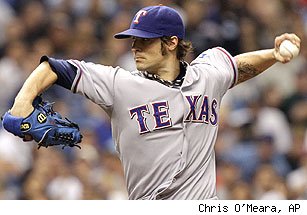
Is CJ Wilson worth a 9 figure contract this off season? We’ll see. Photo Chris O’Meara/AP via livesportsdb.com

As the World Series ends, and as clubs start exercising (or more importantly, declining) player options, the FA market for starting pitching is starting to really take shape this off season.

The Nats don’t “need” Starting Pitching as they have in the past, but a quality veteran starting pitcher would certainly be preferred to the question marks that we might have if we used the likes of Ross Detwiler, Tommy Milone or Brad Peacock as a 5th starter in 2012.

Lets take a look at the starters on the market, put in some predictions as to what kind of money they’re going to get, and discuss whether or not the Nats should (or might) pursue them.  For reference, here’s a list of 2012 FAs from mlbtraderumors, as well as the Elias rankings as of the end of the 2011 season.  Remember, thanks to their end of the season run, the Nats 1st round pick is NOT protected and would be forfeited if they signed a type-A free agent.  So the FA types will be of importance when talking about each of the pitchers below.

Category: Aces (or nearly Aces) and Type-A starters.

  • CC Sabathia seems certain to opt-out of his remaining Yankee contract and will almost certainly re-up with the team.  11/1/11: he has done just that.  5yrs, $122M, fewer years honestly than I thought he’d demand.  He raises his AAV from $23M in the last deal to $24.4M and gets one additional guaranteed year.  The structure of the deal pays him $23M/year for the first four years, then $25M the last.  There’s an option for 2017 at $25M that he most likely makes if he stays healthy.
  • CJ Wilson is also a type-A FA and seems set on testing the market.  I would too if I were Wilson; I don’t think he’s an ace but he’s certainly going to be paid like one.  He seems set to get an AJ Burnett type deal (5yrs $85M) or perhaps more.  I hope the Nats don’t over-spend and get him.  I’d guess he heads to Boston; his free-spirit personal seems to fit with that franchise and the team just got a shock bit of news that John Lackey, despite how bad he was in 2011, is out for the entirety of 2012 with Tommy John surgery.
  • Roy Oswalt had his team option for $16M bought out on 10/25/11, but I’m guessing this is just a procedural move to re-sign him and keep the “big 4” together for a few more years.  Oswalt’s on the wrong side of 30 and had a rough season of declining stats and missed starts, but still slots in as the best #4 starter in baseball and certainly didn’t come to Philadelphia for anything less than a World Series shot.  I’d guess he re-ups for 3 years, $36M with the Phillies.  Other pundits disagree and see him moving back to Texas to take over Wilson’s #1 spot on the Rangers rotation.
  • Edwin Jackson: another guy whose post season performances seem certain to hurt his FA prospects.  Big arm, good numbers, right age (only 28 hitting free agency), but a propensity to get hit hard and often.  Mike Rizzo loves him, tried to trade Adam Dunn for him in 2010, and it wouldn’t be a stretch to see the Nats go after him again.  Look for him signing with the Nats for 3 years and $28M.  Unless a pitching-starved big-money team like Boston or New York offers him a ton more than that.  I’m not really in favor of this deal for the Nats, but wouldn’t be surprised to see it happen.
  • Yu Darvish: as I opined here, I really do hope that the Nats do not spend fools money after Darvish.  A posting fee in the $40-$50M range, then at least that amount to sign the guy.  I know he’s got great numbers in Japan.  So did Dice-K.  There’s a halfway decent chance he doesn’t even get posted this year, so all ink spilled over Darvish could be moot.  Baseball Prospectus put out a great article about Darvish, including lots of analysis and links to others who share the same concerns that I do.  If you’re in the “pro-Yu” camp there’s a couple good articles on places like fangraphs that support your case.

Category: Mid-rotation/decent starting options.

  • Mark Buehrle is hitting the FA market, but i’d be shocked if he leaves Chicago at this point in his career.  I’m sure he’ll take a team friendly deal that extends his career out 3-4 more years, at which point he may very well retire a one-franchise guy with a surprisingly high number of career wins.
  • Hiroki Kuroda just finished off a sneaky-good season, going 13-16 with a 3.07 era.  The problem is that he’s 36 and had a ton of innings on his arm in the Nippon league prior to getting here.  He’d be a risk.  The Dodgers franchise is a mess but its the only team he’s known, and I’d guess he wants to stay on the west coast.  I’d guess he gets a decent 2-year deal from Seattle if the Dodgers can’t find the money.
  • Javier Vazquez looked washed up during last year’s FA market analysis, having lost 3-4 mph on his fastball and getting shelled in NY.  However, he had a great bounce-back season in Miami and i’d guess he re-ups there for the new season and new stadium.  However, there’s word out there that he may retire.  Hard to see a guy who just put in a decent, comeback season retire though, especially if guaranteed money is thrown around.

Category: Aging/Back of the Rotation starters

  • Bruce Chen has very quietly put together two pretty good seasons for the Royals all things considered, but will be 35 and may see a precipitous drop in production.  He’s not any better than the options the Nats face now, when you consider price and productivity.
  • Freddie Garcia had a revelation of a season for the Yankees; I’d think he stays there as insurance for 2012.   Still hard to believe the Yankees won 97 games giving no less than 51 starts to Garcia and Colon.
  • Bartolo Colon is in the same boat as Garcia, but is 38 to his 34 and may be cut loose to find another team willing to give him a shot with his stem-cell enhanced shoulder.
  • Joel Pineiro has never stayed healthy long enough to reach his potential, and he just laid an egg in his contract year in LA.  I’d be surprised if he got anything more than a 1yr $5M deal.
  • Aaron Harang: beware the veteran pitcher who goes to San Diego and suddenly looks like a #2 starter.  2011 numbers: 14-7, 3.64 era.  Home/Away splits?  3.05 era at home, 4.70 on the road.  I’m sure he’ll get some money, somewhere for a back-of-the-rotation job.
  • Livan Hernandez reportedly offered to move to the bullpen for the Nats, in order to stay here.  Unfortunately he pitched so poorly, and takes so long to warm up, that using him in extended relief really isn’t much of an option.  My guess is that Livan returns to his roots in Miami as the Marlins’ 5th starter on the cheap and enjoys one more spin around the league.
  • Jason Marquis, in a remarkable sense of timing by the Nats, was traded for Zack Walters and then promptly broke his leg.  Its too bad for Marquis, who clearly was using 2011 to regain some market value for his free agency this off-season.  At this point he certainly won’t be getting any 2year deals for 8 figures.  I’d guess he gets a 1yr $4M deal with some incentives, if that.
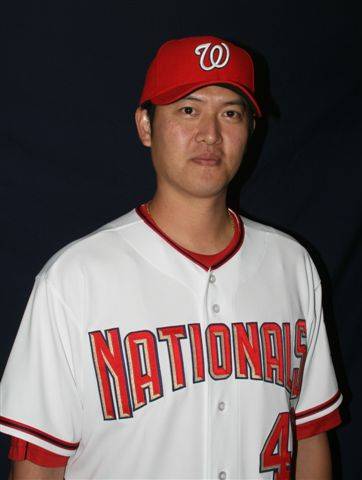
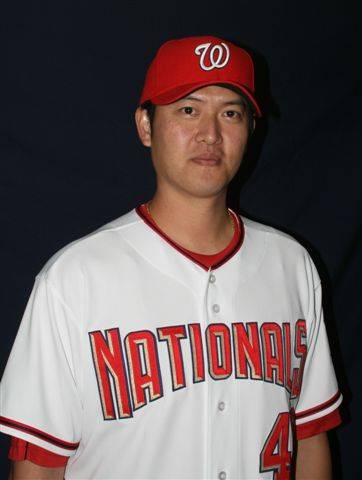
  • Chien-Ming Wang, by virtue of being in THIS section and not the next, has already had a successful 2011.  He is what he is right now; a guy trying to reclaim former glory and his former sinking fastball, and a guy who looks like a #4 starter who has capabilities of improving as he gets more and more innings into his repaired shoulder.  My guess is that he repays the Nats for nursing him back to health while providing him millions in salary and signs for a 2-year deal worth roughly $6-7M overall.
  • Tim Wakefield; I would have predicted him to possibly hang up the spikes until news of Lackey’s injury and Dice-K’s question mark.  Wakefield’s stats have really declined the past two years, but Boston seems in need of a back of the rotation guarantee that Wakefield’s $4M standing salary can fill, cheaply.
  • Brad Penny, Jeff FrancisPaul Maholm, Chris Capuano, Vicente Padilla, Rodrigo Lopez, Zack Duke, Aaron Cook, Kevin Milwood, Dontrelle Willis and anyone else not already mentioned: all of these guys were either so mediocre in 2011, went unsigned in 2011, or are so old, that i’d be surprised if more than just a few of them got major league deals for 2012.

Category: Reclamation Projects/Injury recovery guys.  The Nats have a history of pursuing former glory with recovering stars.  Would they try it again?

  • Adam Wainwright: his injury in spring training 2011 amazingly didn’t really cost the Cardinals, who marched right into the World Series without their #2 starter.  Wainwright’s injury couldn’t have been worsely timed in terms of his contract options; St Louis dodges a major payroll bullet by being able to opt out of millions of dollars of guaranteed money.  But Wainwright is free to look elsewhere.  Will he?  Doubtful: i’d guess he signs a one-year incentive-laden contract with St. Louis aimed towards regaining his career.  10/26/11 update: the team exercised its options on Wainwright, meaning he’s off the market.
  • Justin Duchscherer: had some lights out seasons, but missed all of 2009 and 2011 with injury.  Will anyone take a flier on him?
  • Chris Young and his 6′ 10″ faster-than-it-seems fastball only got 4 starts (2 against the Nats) before getting shoulder surgery.  Seems to run in the NY Mets family (see Santana, Johan).  It wasn’t as bad a surgery as it could have been, and he should return for 2012.  He’s now missed games in 4 straight seasons and its buyer-beware.
  • Jon Garland had season-ending surgery in July after just 9 starts, but when healthy is a 105 ERA+ guy, a 4th starter who can eat innings and be solid.  He had great durability up until this injury, having not missed a start since 2002.  But now its not clear if he’ll even be ready for 2012.
  • Ben Sheets is in almost the identical spot as Duchscherer; ironically both have a history of pitching in Oakland.
  • Rich Harden; mr Day Game split (or Mr. Unreliable Injury guy, if you play fantasy baseball) just finished yet another unproductive season with a 5+ ERA pitching in one of the best pitchers parks in baseball.  He seems set for a minor league contract for one last flier at a comeback.
  • Eric Bedard wasn’t half bad for Boston down the stretch, with a 9.0 k/9 rate on the season.  But at the end of the season he was yanked early in two critical games and i’d bet the team won’t be willing to roll the dice with him again.  We’ll see who overpays for his injury-plagued services in 2012.  With Boston’s sudden shortage of starters, look for Bedard to resign in Boston and start the year as Boston’s #4.
  • Brandon Webb: got some looks in spring training 2011, including from the Nats, but then went under the knife yet again.  You can usually come back from TJ surgery.  Shoulders are tougher.  He may be done.

Predictions:  I’d guess the Nats throw their name in the mix for Wilson but get scared off by his price tag.  Maybe we’ll post a respectable figure for Darvish.  But Rizzo goes hard after Jackson and we get him.  Meanwhile Rizzo also signs one of these injury reclamation projects to a nominal guaranteed contract to see what pans out.
What is the “ceiling” of the various Nats pitching prospects?

10 comments

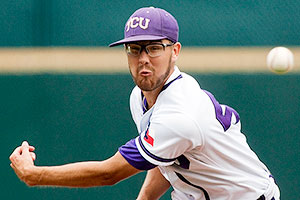
Will Matt Purke fulfil his former Ace-starter promise? Photo AP/Nati Harnik

Its nearly impossible to project high-end pitching prospects, the further they are from the minors.  Think of someone like Colten Willems, our #1 draft pick in 2006 who retired before ever getting out of high-A.  Or perhaps Josh Smoker, a supplemental 1st rounder in 2007 who struggled with injury and is now a situational lefty in the high-A bullpen, four-plus years into his pro career.

But, it is fun to think about the upper-end, best case scenario and what it would mean for this team.  I’m sure that this post will garner a ton of disagreement; feel free to make your case in the comments pro or against what i’ve posted.  I know that some people are already drinking the kool-aid on September call-ups Peacock and Milone, but I’m not (read below for more).  I’ve included all our current starters and most of the upper-end draftees over the past few years.

(post-publishing note: a commenter asked what I “meant” by a #1 or a #5 starter.  Here’s text pulled from the comments as to how i’m defining each of these level of starters:)

  • #1 starter is one of the best 15-20 pitchers in the league, someone who you’re genuinely surprised if he performs badly on a given day, mentioned in Cy Young conversations.  Verlander, Lincecum, Halladay.
  • #2 starter: a slight step down from your elite, but still a reliable starter.  The “robin” to the ace’s “batman.”  I’m thinking Matt Cain, Chad Billingsly, Cole Hamels, Clay Buchholz as examples.  Not the best guy on their rotation but a great #2 guy.
  • #3: better than your league average pitcher, someone who is solid, consistent innings eater and who routinely gives you quality starts but not much more than that.  I’m thinking someone like a Jonathan Sanchez, Derek Holland, Edwin Jackson, someone like that.
  • #4: is basically someone defined as someone who’s a slight step above the back-of-the-rotation guy, a mlb veteran guy who knows how to pitch but doesn’t have the best stuff to really go much beyond.  John Lannan is a great example of a #4 starter.  Freddie Garcia, John Lackey, Jon Garland, Jason Marquis are other examples.
  • #5: just good enough to fill out your rotation.  Starters at the back end who all you’re hoping for is 6 innings and keeping your team in the game.  On our team, Livan Hernandez, Tom Gorzelanny, Craig Stammen in past years.

Nationals Starter prospect Ceilings (per scouting reports, personal observations)

#1: Strasburg
#2: Zimmermann, Cole
#3: Purke
#4: Lannan, Ray
#5: Detwiler, Turnbull, Solis
4-A starter: Milone, Meyers, Rosenbaum
MLB bullpen: Meyer, Peacock, Stammen
Minors starter: Maya, Martis, McGeary, Jordan, Grace
Minors bullpen: Holder, Smoker

Discussion.

#1 Starters: Stephen Strasburg, in my mind, is already an “Ace” starter in this league, ranking up among the 15-20 best arms out there.  When he’s healthy.  In 2010 he posted MLB-best k/9 rates and would have clearly led the league in some sabremetric measures of pitching in his debut season had he qualified.  But health is the big question mark; is he going to become the next Justin Verlander or the next Mark Prior?  Only time will tell.

#2 Starters: Jordan Zimmermann has achieved Robin to Strasburg’s Batman in this rotation, and seems set to be a pretty good rotational guy for the next few years.  AJ Cole pitched well in his first full season, is a big kid who was touching 96 in HS.  He could be a big arm who slides into the rotation as a dominant arm.  Some think his ceiling is even higher than a #2 starter.

#3 Starters: Matt Purke was a 1-1 talent (1st round, 1st overall draft pick) before suffering shoulder bursitis, and the Nats took a gamble on him.  But its a great gamble; he has Ace material, throwing mid 90s from the left hand side with completely dominating stuff.  He was rated BA’s #14 prospect coming out of high school and had a $4M signing bonus deal turned down by MLB.  He allowed the Nats medical staff to do a dye-injection MRI and were satisfied with the results.  His deal could be remembered as a steal of the 2011 draft if he pans out.  However recent scouting reports have listed his stuff as “ordinary,” so a #3 starter seems like a good middle ground for now.  If his arm is really ok, he’ll start to show it next spring (hopefully at high-A) and he’ll rocket up the prospect lists soon enough.

#4 Starters: Perhaps one could argue that John Lannan is a #3 starter but I don’t believe so; I think he’s a solid, underrated #4 starter on a decent rotation.  If you compare Lannan to the #4 starters on a number of teams, he compares favorably, and you’d clearly take Lannan if given the choice.  The problem is; he’s just not flashy.  We’ll never get appropriate trade value for him because his W/L numbers are mediocre and his K/9 rate isn’t that impressive.  I’d guess that he sticks in our rotation until he reaches free agency, at which point its likely that some of our developing power arms will be ready to take over.   Robbie Ray had a fantastic debut season and may even be better than a #4 ceiling; certainly he put up as good of numbers as his 2010 draft classmate AJ Cole, but his stuff doesn’t project as highly.

Here’s where a number of arguments are probably to be had, starting at the #5 ceiling.

#5 Starters: Ross Detwiler really has yet to fully show his full capabilities, but lefties that throw mid 90s don’t grow on trees.  2012 is a make or break year for him with this organization, and it wouldn’t surprise me to see him moved in the off-season so that the team doesn’t have to deal with his option status when constructing the rotation next spring.  I put him with slightly better stuff than the 4-A guys below.  I’m still not sold on him as a MLB starter, but saw a lot out of him this season that shows improvement over where he was in the organization in 2010.   2011 draftee Kylin Turnbull was overshadowed by the high-end talents drafted ahead of him, but he’s lefty, throws well and is projectionable.  Thanks to Sean Hogan‘s excellent draft research, some scouting reports are here.  Right now it sounds to me like Turnbull has a bit more power than someone like Milone and perhaps can get more missed bats.  For now i’m listing him as a #5 starter ceiling; if he was a righty he’d probably be in the MLB bullpen category.  Lastly Sammy Solis projects thus far as somewhere between a a #3 range starter, a mid rotation guy who has 3 plus pitches and can be a lefty work horse out of the rotation and a back-of-the bullpen guy with mediocre stuff but good constitution.  He may not have the best stuff, but being lefty and being a solid, Mark Buehrle build could mean he’s a slightly better version of John Lannan for this team.  We’ll see how he does in AA in 2012.

4-A starters: (for those that don’t know what is meant by “4-A or AAAA,” it means someone who is better than a AAA pitcher but not quite good enough to get out major league hitters on a consistent basis).  Tommy Milone had a great September debut and has impeccable control in the minors, but I don’t see him having good enough stuff to consistently get major league hitters out.  Now, I could be wrong and he could have Greg Maddux-esque control, at which point he doesn’t need mid-90s heat.  But from what I saw in his September starts, I don’t think he’s got what it takes to stick in the majors.  Brad Meyers could end up in the same position as Milone; a guy who dominates in the minors but who can’t cut in the majors.  It doesn’t look like he’ll even get a shot at the 2012 rotation with the crowded 40-man roster.  Lastly Denny Rosenbaum seems cut from the same cloth as Milone; a softer-tossing lefty without great K/9 rates in the low minors but who is effective enough at getting guys out.

Bound for the bullpen (but good enough to stick in the majors): 2011 draftee Alex Meyer is going to go one way or the other: he’s either going to be a wild man out of the bullpen or a near #1 starter.  Scouts seem to be pretty split as to which way he’s going to go.  Right now, based on the struggles he had early in his college career, I’m guessing he struggles to maintain his forward momentum and ends up a Cole Kimball-esque hard throwing option out of the pen.  Meanwhile, what to make of Brad Peacock?  I know he just finished off a fantastic minor league season and had two effective September starts (giving up just one run in 12 innings over two starts).  But to me I see a guy with good life and heavy reliance on one pitch (a 4-seam fastball), a good 2nd pitch (change-up) no confidence in his third pitch (loopy curveball) and no fourth pitch.  To me, that says bullpen.  Lastly i’m clumping in Craig Stammen here, who couldn’t really cut it as a full time starter in 2010 and spent the entire 2011 season starting in AAA.  I think he can be an effective guy out of the MLB bullpen if he’s given the shot.  I like Stammen and perhaps this is a bit high of a ceiling for him; i wouldn’t be surprised a bit if he misses out on the 2012 bullpen and slips into minor league free agency frankly.

Minors starter: This list of guys looks like they’re destined to be “organization guys” for this team.  Yuniesky Maya was clearly not the pitcher the team thought he was when he got his 4-year contract; he’s gotten a couple shots at the majors over the past two seasons and has not capitalized.  I think he’s going to be ensconced in the AAA rotation for the near future, unless someone can figure out how to trade him.  He certainly isn’t a better MLB starting option than any of the guys listed above him.  Shairon Martis mostly earned this fate when he successfully passed through waivers and off our 40-man roster.  His worth ethic and conditioning came into question in the organization, and he went from a 22yr old starter in 2009 to a AA starter in 2011.  He had pretty good numbers in AA, but that doesn’t really prove much for a guy who was in a MLB rotation two years prior.  Jack McGeary is finally back from two years of mediocracy and Tommy John surgery, but faces a pretty steep climb back into future rotational pictures.  For now, i’m guessing he struggles to ever make it, topping out as a minor league starter once he hits his free agency period.  For now, i’m also classifying both Taylor Jordan and Matthew Grace as org guys, continuing to rise up as 4th or 5th starters but never really making an impact.

Minors bullpen: Lastly, i’m listing both high-end draft picks of the past few years Trevor Holder and Josh Smoker as topped out as minor league bullpen guys.  Smoker seems like he’s already there, having come back from an arm injury but still only having risen to high-A in his fourth pro season.  He put up good numbers as a loogy/bullpen guy this year, and perhaps his real ceiling is the MLB bullpen, but getting a loogy out of a first round draft pick is still a major disappointment.  Holder was clearly an over-draft in the Strasburg year, getting picked up in the 3rd round when he wasn’t even in some team’s top 10, and has done nothing to earn his draft position.  He posted a 5.77 era in high-A this year, repeating the level and leaving the team clearly in a conundrum as to what to do with him.  I think he is destined for a bullpen role in 2012, perhaps in high-A again, and may be short-lived for the franchise.

Is there someone I’m missing?  Agree, Disagree?  Discuss in the comments section.

Nats Off-season News Items Wrap-up 10/9/11 edition

leave a comment

With no more rotation reviews, I thought I’d post periodic news items picked up here and there related to the team.  I’ll focus mostly on the pitchers in the system but will note other newsworthy items.

Without further ado:

  • Our initial announced Arizona Fall League (AFL) participants, in addition to Bryce Harper, include arms Sammy Solis, Pat Lehman, Rafael Martin.  Solis is clearly a valued arm, but the selection of Lehman and Martin is interesting for the future of these guys.
  • A number of important minor league arms are in the Instructional League as we speak, a month long “league” that gives minor leagues a bit more time to play after the regular season ends.  In addition to high-end 2011 draftees Purke, Meyer, and Turnbull, the likes of AJ Cole, Robbie Ray, Paul Demny, and Jack McGeary are all down in Viera getting a bit more work.
  • Matthew Purke reportedly is throwing well in camp, though no mention made of his MPH.  News is that he’s heading to the AFL sooner than later, so we’ll be able to get some game-reports from him soon.
  • Tim Dierkes from mlb trade rumors posted the Nats Arbitration Eligible review, and we really don’t have that many tough decisions.  The team doesn’t have to make these decisions til (I believe) December 1st, so we’ll save a post til we get closer to the date.
  • Byron Kerr did a nice profile of Pat Lehman here, a local (GWU) product now playing in the prestigious AFL league (where 60% of players eventually make the majors).  Lehman had a great season, ending up as the AA closer, and he may continue his rise in 2012.  I project him being the closer in AA to start, with an eye towards a mid-season promotion to AAA.
  • Sammy Solisfirst AFL start was just soso; 3ip, 1r 2hits and 3walks.  Clearly he didn’t have his normal control.

Tampa Bay’s Matt Moore: wow

5 comments

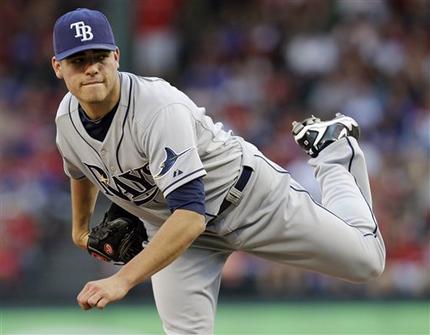
Matt Moore pitched far beyond his experience on Friday. Photo AP Photo/Tony Gutierrez via baynews9.com

When word came out that Tampa Bay’s manager Joe Madden had announced that his playoff game #1 starter on 9/30 (box/gamer) was recent minor league call up Matt Moore, I had a couple of quick thoughts:

  • I wonder how this played out in the Tampa clubhouse; you have starters that labored all year and helped earn the team the playoff appearance, and suddenly your game #1 starter is a guy with a grand total of 15 major league IP?
  • I especially wonder what this says about Jeff Niemann, who in my estimation was the scheduled starter for game #1 and now seems like he may be skipped altogether?

Nonetheless, Moore took the mound in game one against the Texas Rangers, by most measures the best or 2nd best offense in the league.  The game start was mid-afternoon, meaning the stadium shadows would be giving the pitchers a significant advantage.  However, this didn’t seem to bother the Tampa hitters, who battered CJ Wilson for 8 runs (6 earned) and knocked him out in the 6th.

Meanwhile, Moore was nearly as unhittable as he was in his first MLB start, an 11k, 5 inning start against the Yankees B-team.   His line against the Rangers in game 1: 7 shutout innings, giving up 2 hits, 6 k’s and 2 walks.  The two hits were both to Josh Hamilton, who stroked a first-pitch fastball in the first for a single, then nearly hit a solo-homer in the 4th.  Otherwise, Moore was dominant.   Despite “only” getting 62 of his 98 pitches for strikes, he was all over the plate and had numerous pitches called balls that were clearly over the plate.  Pitch F/X, which routinely has difficult times classifying new hurlers and properly categorizing their arsenal, lists Moore with 6 pitches but to me he looks to be a 3 pitch guy so far.  He has a 4-seamer that he commands amazingly well and that he can bring up to 98mph (technically, max of 97.9).  He sits a bit slower, averaging 94.37 on the night.  He also featured a decent changeup, with a 10-12mph difference off his fastball and which he uses as his secondary pitch.  Lastly he has a large off-speed overhand curve that may be a bit too loopy for now; he only threw it four times all night.  He has a very smooth, easy motion and it doesn’t look like he’s throwing nearly as hard as he does.  It isn’t surprising at all that his minor league numbers were so amazing (specifically, 210 Ks in 155 innings between AA and AAA this year).

He predominantly pounded fastballs on the night; 76 of his 98 pitches were fastballs that he moved in and out and commanded effectively.  I wonder if this heavy fastball use is indicative of his normal game plan, or if he was just so overpowering that his catcher just kept calling for the #1 until the Rangers proved they could hit it.  I have a tendency to think it may have been the latter; major league starters who have to go through the lineup three times will only show you one or two pitches if they can, saving the rest of his arsenal for later innings.  If you can get guys out by just using one pitch, you stick with that strategy until proven otherwise.

What does this mean for the rest of the playoffs?  Bad news for opponents: if the Rays could line up Moore along side their top 3 starters (Price, Shields, Hellickson) and skip their less effective starters (Niemann, Davis) then suddenly this is a much more dangerous team than what was predicted a week ago.

What does this mean for the Rays next season in terms of payroll and roster management?  Scary.  The Rays made the playoffs despite shedding $30 MILLION from their 2010 payroll.  Price is on a team friendly contract, Hellickson is pre-arbitration and will make near the MLB minimum.  Sonnanstine and Niemann are both arbitration eligible and could be trade bait to save some cash.  More likely is an off-season trade involving Shields.  He’s coming off a career year and has a $7M club option (along with relatively affordable options for 2013 and 2014).  $7M for a Cy Young candidate pitcher is a bargain and clubs would be lining up to trade prospect depth for him.

Written by Todd Boss

October 3rd, 2011 at 10:03 am

Nats Rotation Cycle #33: good/bad/soso.

2 comments

31 and Done for Michael Morse, capping a fantastic breakout season. Photo Jacqueline Martin/AP via federalbaseball.com

This is it; the last rotation cycle of the season.  And it will be a shortened one; with just 3 games remaining.  But we do get one more start out of Stephen Strasburg as the team improbably has a chance to finish the season with a winning record.  To do it, they’ll have to go into the lion’s den and beat a Florida team that has had its number over the past few seasons.  Here’s the Nats record against Florida over the past few seasons:

  • 2011: 5-10 (not including last three games)
  • 2010: 5-13
  • 2009: 6-12
  • 2008: 3-14 (!)
  • 2007: 10-8
  • 2006: 7-11
  • 2005: 9-9

That’s a total (since moving to Washington) of 45-77.  This clearly needs to improve, especially since in 2011 the team beat or was even with the rest of their NL east opponents.

Good

  • Stephen Strasburg finished off the season with a bang on 9/28 (box/gamer), absolutely dominating the Marlins over 6 innings.  Final line: 1 hit, 0 runs, 2 walks and 10 Ks in just 79 pitches.  Wow.  How’s that for a teaser for 2012?

Mediocre/Inconclusive

  • Tommy Milone labored through 4 1/3 innings before getting an early hook on 9/26 (box/gamer), leaving it for later heroics (aka, Michael Morse’s 9th inning 3 run shot) to get the win.  The mediocre start caps off a pretty good September for Milone, who has certainly staked his claim for the 2012 rotation.
  • John Lannan‘s final 2011 start on 9/27 (box/gamer) wasn’t too bad; 6ip 3 hits and 3 walks resulting in 2 earned runs and a no-decision.  As has been typical in September he was yanked an inning too early (he sat on 89 pitches) and could have gone 7.  None the less, he caps off a great season, his best as a pro, and is clearly the #3 starter on this team going into 2012.

Starter Trends

2nd half
Milone    bad,soso,good,good,soso
Lannan    good,good,bad,soso,good,bad,bad,good,soso,good,bad,soso,soso,soso
Strasburg    great,soso,good,bad,great
Detwiler    soso,soso,good,good,bad,bad,soso,great,good
Wang        bad,bad,great,soso,soso,good,bad,soso,soso,soso,good,good
Peacock    good,good,great

Relievers of Note and other News

  • Mike Rizzo was quoted on 9/25 as saying the team was “an outfielder and a starting pitcher” away from real contention in 2012.  This could be an indicator of the off-season plans of the team (definitely a future blog post).  Adam Kilgore guesses the team could sacrifice some of its starter depth to obtain a center fielder (perhaps again going after someone like BJ Upton).
  • Bryce Harper will play all three OF positions in the AFL, and presumably next season, in preparation for positional flexibility once he arrives in the majors.  This makes sense to me; he’s athletic enough to play some center and has a big enough arm to play right.  Meanwhile Jayson Werth is in the same boat.  Only Michael Morse has positional inflexibility.
  • Stephen Strasburg probably will have a similar 160ip limit in 2012 that Jordan Zimmermann had this year, per various national reports.  What may be interesting is this; if this team, which has already won 78 games and surpassed most people’s predictions of between 72 and 75 wins, continues its improvement into 2012, they very well may be in the thick of the wild card race right at the time when Strasburg is set to shut down.  Would the team shelve him for a month to save innings?
  • With the 9/28/11 victory, the team officially dropped to the 16th draft pick in the first round (here’s your Reverse Standings).  Adam Kilgore commented on this same topic here.  This officially means the team had an unprotected first round draft pick for the first time since the team moved here.  This automatically and drastically changes the nature of our off season FA plans.  Knowing we have to give up the 16th overall pick (even if its a weaker draft) certainly will give pause to the draft-pick coveting front office.  Is CJ Wilson worth losing this pick?
  • Hey, here’s a shock; Doug Slaten blew another game for the Nats on 9/27  This time it was the 2nd to last game, giving up a walk-off homer to a lefty who nobody’s ever heard of to lose the game.  I don’t get it; why was Slaten even in the game?  Here’s his game-log for 2011; since returning from the DL he has had exactly ONE “successful” outing (a one-pitch, one out appearance against Houston).  Every other time he’s given up hits, walked the guy he was brought in to face, or otherwise disappointed.  Here’s hoping the team has learned all they need to learn about him and gives him his walking papers as soon as the season is over.
  • The team and Laynce Nix have “exchanged salary figures” for 2012.  Interesting; if the team locks up Nix for 2012, suddenly there’s one less outfield position available for the slew of guys potentially in the mix.  That most likely means the end of Jonny Gomes tenure here (one that probably was guaranteed by his poor batting average anyway).  The problem is that we likely won’t get the benefit of Gomes’ compensation pick now; he probably would accept an arbitration offering, sticking the team with the player for 2012 and locking up two backup outfielder positions.  Nix had a pretty good year, mostly working in a platoon situation against RHPs, and has some positional flexibilty to play LF, RF and 1B.  He’s also played CF in the past, though he seems too bulky to really be a Rizzo-preferred defender there now.

Now that the season is over, I’ll do a wrap-up of the MLB pitching similar to the other levels, and follow that up with projected 2012 positions throughout the entire system.

Nats Rotation Cycle #32: good/bad/soso

2 comments

After Wang's latest gem, perhaps he'll be in a Nats uniform a bit longer? Photo via the team.

Good

  • Tommy Milone efficiently worked his way through a Ryan Howard-less Philadelphia lineup in the first half of  9/20’s twin-bill (box/gamer) for the easy victory.  Line: 6 scoreless innings giving up just 4 hits and no walks.  He was matched by Philly’s spot starter Kyle Kendrick so he got a no-decision on the day.
  • Brad Peacock looked pretty durn good on 9/22 (box/gamer) to help the team sweep the Phillies away.  5 2/3 innings, giving up just one hit (on a somewhat questionable scoring call giving Ruiz a hit and an error on a diving stop but errant throw from Ryan Zimmerman).   He absolutely dominated the lineup through 5, finishing those 5 innings on just 50 pitches.  He gave up a ton of fly balls (small quibble: as with last week he had 9 flyball outs versus just 2 grounders), but lots of the fly ball outs were pop-ups on balls where he simply overmatched the hitter.  He struggled in the 6th, seemingly trying to aim the ball versus Oswalt and ending up with a 4-pitch walk.  He couldn’t be tired; he was only on about 55 pitches at that point.  After giving up a second walk (losing the at-bat after having Rollins down 0-2), he got a flyball out before getting yanked on just 69 pitches on the night.  Had he been left in, he could probably have gone 8 complete, but Davey decided on a lefty-lefty matchup and brought in Gorzelanny to finish off the rally.  I’m still taking the “glass is half empty” analysis here, but Peacock looked pretty good.
  • Chien-Ming Wang put an exclamation point on his comeback season, getting the win on 9/24 (box/gamer) and dominating the Atlanta Braves, who (unlike the Phillies) were certainly playing a full-strength roster.  Final line: 6ip, 4 hits 1 run (on a solo shot in the 5th) and 4 strike-outs versus zero walks.  He was only sitting on 85 pitches and could probably have gone at least one more inning easily.  He had a 9/3 go/fo out ratio, showing his sinker working well.  I wonder how negotiations are going to go with Wang in the off season (per this report here … maybe we won’t even get to the off season if the team and Wang are already talking an extension.  Great news if this is true).
  • You can’t ask for much more than Ross Detwiler did on the game’s final home game of the year on 9/25 (box/gamer), just pitch 6 scoreless innings and give a shutout to his bullpen.  Line: 6ip, 4hits, 2 walks and 4ks against a Braves team that is hanging on to the playoffs for dear life.  His day was highlighted not by dominance, but by his getting out of a bases-loaded, 0 out and 3-0 count jam without giving up a run.  He got a bloop, a flyball and a grounder out of Chipper Jones to finish off the threat and preserve the victory.  Another great statement game for Detwiler going into 2012.

Bad

  • Stephen Strasburg really struggled to be comfortable on the mound in the first inning on 9/23 (box/gamer), getting touched up for 3 runs on 4 hits (all singles but a couple hit on the nose) and facing 8 hitters before getting his 3rd out of the game.  He was missing spots, fiddling with the mound, fiddling with his landing spot, shaking his hand and going to the resin bag over and again before getting out of the inning.  He then cruised through the next three innings, facing just one over the minimum before getting yanked.  His rough first inning cost him his 5th inning; he was sitting at 75 pitches through four.  He was somewhat controlling his speed, averaging 95.5 and humping it up to 97.6 on several occasions.  His change-up was fantastic on the night, if his four-seam control was off.

Mediocre/Inconclusive

  • John Lannan got the win on 9/21 (box/gamer) on somewhat of an off day for him; 5ip, 8hits, 3runs.  Not a great outing, but enough to get his 10th win of the season.

Starter Trends; Its hard to give some of these starts just a “good” rating, especially when you give the team 6 scoreless innings (as Milone and Detwiler did).

2nd half
Milone    bad,soso,good,good
Lannan    good,good,bad,soso,good,bad,bad,good,soso,good,bad,soso,soso
Strasburg    great,soso,good,bad
Detwiler    soso,soso,good,good,bad,bad,soso,great,good
Wang        bad,bad,great,soso,soso,good,bad,soso,soso,soso,good,good
Peacock    good,good,great

Relievers of Note and other News

  • I love the fact that 9/21’s win over Philadelphia guaranteed at least a season-split with them, and then we went and took the season series the next day.  That’s right; the Nats won the season series against the best team in the majors.
  • Likewise, 9/25’s win over Atlanta split the season series with them 9-9.
  • Is anyone else worried about the Nats losing a protected 1st round pick with this late season surge?   Here’s your reverse standings (normally a point of extreme interest for Nats fans looking to wrap up the first overall pick).  I guess its a good problem to have, but it will give the team some pause if they go after a type-A free agent.
  • I havn’t always been the biggest Henry Rodriguez proponent, but I’ll give credit where credit is due.  His 7th inning appearance on 9/25/11 was perhaps the most dominant 3 outs I’ve seen a reliever throw this season.  He was dialed in on his fastball, in complete control and absolutely overpowering hitters.  He punched out Jason Heyward on a pitch that was in the glove before he swung, then got the opposing catcher to actually attempt a bunt with 2 strikes.  He then put two 101-mph pitches on Jack Wilson before throwing an 88-mph hook to end the inning that had me saying “holy cow” to my TV screen.  JP Santangelo said it best; “that may have been the best inning i’ve seen a reliever throw all year.I concur.

Overall Summary

Here’s an “arbitrary endpoint” statistic; since Livan Hernandez‘s last start on Sept 4th, the team is 14-6.  Livan and Jason Marquis‘ starts have been replaced by guys who are making pretty good statements for 2012’s rotation, and the team is doing this without Jordan Zimmermann‘s stellar #2 starter capabilities.  Maybe 2012 is going to be more than the last transition year for this team.  I’m starting to believe in these up and coming starters.  Masn put up a graphic that showed our starters having the #1 ERA in the majors for the past few weeks and it has shown.

Nats Rotation Cycle #31: good/bad/soso

4 comments

Detwiler is really making a statement for his inclusion in the 2012 rotation. Photo Haraz Ghanbari/AP via federalbaseball.com

We’re getting down to the wire; There’s only three more of these posts coming, because the rotation only makes 3 more passes before the season is over.  Because of the off-day on 9/19 and the double-header 9/20, Milone pitched BEFORE Detwiler’s start in this “cycle” so the end of cycle #31 bleeds over into the beginning of cycle #32.

Good

  • Tommy Milone looked great on 9/15 (box/gamer), shutting down a weak NY Mets offense and getting his first MLB victory.  The Mets started 5 guys who were on their AAA roster a month ago, so its somewhat difficult to get a read on Milone’s capabilities on the day.  But he did go 5 2/3, gave up 1 run on 3 hits with 3 walks (one intentional).  The walks are surprising; Milone’s calling card and the way he’ll survive is by NOT allowing walks.
  • Day 3 of the return of Stephen Strasburg on 9/17 (box/gamer) went much better for the kid; his velocity was back, he was efficient (6ip on 61 pitches), he was accurate (0 walks and 45 of 61 pitches for strikes) and he was dominant (1 run on 4 hits and 3 Ks).  Can’t ask for much more than that.  Too bad he got a no-decision as his offense couldn’t get him more than one run against the Marlin’s #5 starter Volstad.
  • Ross Detwiler put in perhaps his best start in a Nats uniform in the back side of 9/20’s double header (box/gamer), holding an (admittedly weaker) Phillies lineup to just 3 hits over 7 1/3.  Ross was sitting on just 81 pitches when departing in the 8th, efficiently working through the lineup.

Mediocre/Inconclusive

  • John Lannan bounced back from a poor start last week with an improved on on 9/16 (box/gamer).  6ip, 3runs on 8 hits and a walk.  I think we know what we have in Lannan by now, and I’m sure he feels lonely as the sole remaining rotation guy from opening day.
  • A 7th inning homer turned Chien-Ming Wang‘s 9/18 start (box/gamer) from a good one to just merely a run of the mill quality start, but there’s definite promise in Wang’s performances as of late.  He went 6 2/3, gave up 3 runs on 6 hits with zero walks and 5 Ks.  Two homers hurt the sinkerballer.

Starter Trends

Milone    bad,soso,good
Lannan    good,good,bad,soso,good,bad,bad,good,soso,good,bad,soso
Strasburg    great,soso,good
Detwiler    soso,soso,good,good,bad,bad,soso,great
Wang        bad,bad,great,soso,soso,good,bad,soso,soso,soso
Peacock    good

Relievers of Note and other News

  • (not much in the way of links and notes here; I was gone all weekend and just did very rudimentary reviews.  A future post is in the works for my weekend trip, which will be of significant interest to baseball fans).
  • Drew Storen gets two saves in one day on 9/20: that’s pretty rare in this modern age of innings limits and coddling relievers.
  • Quick report that the team is scouting FA-to-be CJ Wilson.   The 2011 off season FA market is so thin on quality starting pitching that Wilson, who has had two pretty good seasons after pitching in relief the early part of his career, may be the leading starter out there on the market (i’m not counting CC Sabathia, who almost certainly opts out and re-signs for more money).  One complication: Wilson will be a Type-A free agent, costing the Nats a pick.  And guess what?  This little end-of-the-season run now has the team perilously close to having a non-protected first round draft pick.  Is CJ Wilson worth giving up the 16th overall pick in the draft?

Nats Rotation Cycle #30: good/bad/soso

5 comments

Brad Peacock gets his first turn in the rotation. Photo via bleacherreport.com

A reminder; the rotation is now Milone-Lannan-Strasburg-Detwiler-Wang after Detwiler got skipped when the last Dodger game was cancelled.   Plus we’ve found out that Brad Peacock will get a start at the end of this cycle, so this is a 6-man review.  We may be in a 6-man rotation the rest of the way as well.

Good

  • Brad Peacock‘s debut mlb start resulted in 5 scoreless innings and a win on 9/14.  Here’s much more analysis on the performance.

Bad

  • An ugly loss on 9/10 (box/gamer) from John Lannan, the one remaining rotational hold over from the beginning of the season.  2 1/3 innings, 8 hits, 6 runs (4 earned) to raise his season Era from 3.48 to 3.65.  Luckily the team has about a dozen relievers to pick up the slack now, and 5 guys combined to finish the game.  Of those 5, only Collin Balester impressed, pitching two clean innings.

Mediocre/Inconclusive

  • Tom Milone (or, as found out on Saturday, “Tommy Milone“) didn’t “appear” to be pitching badly in his 9/9 start (box/gamer), but by the time he got yanked in the 6th it seemed to be “death by paper cuts.”  He gave up 3 runs on 8 hits, had 3 Ks and (of course) zero walks in his tenure.  89 pitches, 64 of them strikes.  Pitch F/X is still struggling to properly classify his pitches, as were the Masn announcers, who routinely were claiming his cutter is the same speed as his fastball.  In reality he throws his four-seamer between 88-90 with good movement, and his cutter comes in at about 86.  He mostly as a 2-pitch pitcher last night, fastball and change-up, with five big curves thrown in and just a handful of cutters.  He really struggled to get his cutter on-target, but did get a great bat-snapping cutter for a weak grounder early on.  He worked the corners really well, but got punished when he missed over the plate.  A couple of guys flailed on curves and outside pitches for weak hits (hence my “paper cut” comment), and he was victimized each time a lead-off hitter got on base (3 innings with first batter retired?  0 runs.  3 innings with the lead-off hitter getting on base?  Scored each time).  Milone definitely works the corners well though, and throws a ton of strikes.  I continue to wonder if he will be a Greg Maddox-type pitcher (i.e., someone who doesn’t throw amazingly hard but has such great control and movement) or if he’ll flame out into a 4-A type starter, great in the minors but without good enough stuff to be successful in the majors.  We need more starts, more evidence.
  • Wunderkid Stephen Strasburg‘s 2nd start back was troubling against the Astros on 9/11 (box/gamer).  From the first pitch (a 94-mph fast ball) he clearly didn’t have the velocity that he featured in his first start (to say nothing of his 2010 velocity).  The Astros worked him for 30+ pitches in the first inning, and he was sitting at 57 pitches through 3 complete innings before getting the safety hook from the dugout.  He seemed to be struggling with the control of his 2-seamer and wasn’t throwing his curve nearly as much as he needed to.  On the plus side, his change-up was fantastic, and was directly responsible for 3 of his 4 Ks on the day.  And, he really only gave up one hard-hit ball (a liner to right field for an out).  Final line: 3ip, 3 hits and one run.  The next day, he talked about his lack of velocity, noting that his mechanics were “on and off.”  Lets hope its that and not something more serious.
  • Ross Detwiler looked great early on 9/12 (box/gamer), giving up just a hit and a walk through five complete, then getting the first two outs in the 6th before unraveling in the 6th.  Two quick walks and then two hits ended his night and spoiled an otherwise good looking night.  Final line: 5 2/3, 3 hits, 2 runs and 3 walks.  His ERA on the season now sits at 3.76, but his FIP stands nearly a point higher (though to be fair his xFIP is nearly in line with his ERA, a good sign for the longer term).  In any case, each decent start we see in September makes me feel better about the likely fact that Detwiler’s going to make the 2012 rotation.
  • Another start, another piece of the Chien-Ming Wang puzzle.  He went 5 innings on 9/13 (box/gamer), scattering 5 hits through 4 before giving up a 2-run single in the 5th.  On the night: 5ip, 9 hits, 2 runs.  The improvement this time around was the clean first inning (he had a 12.75 ERA in the first innings of his games this year).   He was only on 72 pitches when he was pinch hit for in the top of the 6th and could have easily gone 8 complete if the team had any sort of lead.
  • Sometimes its the little things that make a difference; apparently Sean Burnett‘s turn-around this season was due to changing his rubber location.  According to an excellent piece by Adam Kilgore, Burnett moved towards the first base side of the rubber about 18 inches.  Results?  As of July 19th he had a 5.67 era.  Since the move he has a 1.37 era.  Yeah, that’s a great adjustment.

Starter Trends

2nd half only:
Milone    bad,soso
Lannan    good,good,bad,soso,good,bad,bad,good,soso,good,bad
Strasburg    great,soso
Detwiler    soso,soso,good,good,bad,bad,soso
Wang        bad,bad,great,soso,soso,good,bad,soso,soso
Peacock    good

Relievers of Note and other News

  • The cancellation of the 9/8 Dodgers game means the team will flip-flop Wang and Detwiler’s next starts so that everyone continues on normal rest.
  • Wang, like every other FA that’s not necessarily entirely going to be in demand this off-season, has said he wants to come back to his current team.   See my thoughts on the team’s lack of a club option on him here.
  • Brad Peacock will get a start this week in NY, possibly putting the whole staff into a 6-man rotation.  Perhaps he’ll replace Lannan in the rotation to give the Nats a completely new rotation versus opening day.  More likely is that he’ll fit in between regular starters to give the team a 6-man rotation.  Can’t wait to see him stretched out to see his full arsenal of pitches.
  • Garrett Mock was outrighted to AAA after passing through waivers, meaning that he passed through waivers without another claim (similarly to what happened earlier in the year with Chico in December of last year).  On the positive; he stays in the system on the off chance that 2011 was a complete outlier and he can turn around the ship.  On the negative; a guy with a plus fastball but who has proven time and again that he can’t produce consistent results stays in the system to provide continual tempting of the club management (the leader of whom Rizzo has a soft spot for him, having drafted him while working in Arizona).  Lets hope he doesn’t take the job of someone more deserving.
  • Here’s Doug Slaten‘s 9/13 appearance: two batters, one walk and one HBP.  Is anyone surprised by this?  Why is this guy still getting the ball?  Hasn’t he shown enough failures as a loogy and in middle relief to show the team everything they need to know going forward?
  • Reverse draft standings update: As of 9/13 the team is projected to draft 12th overall in the 2012 rule-4 draft.  With a bad run of form we could easily rise to #8.  The 2012 draft is considered to be much weaker than 2011, but there’s still talent to be found.
  • 2012 preliminary schedules have been released and the Nats get the AL east next year!  Away to Boston and Toronto, home dates against the Yankees and the Tampa Bay Rays.  I’ll predict now that the Saturday Yankees game will break the attendance record at the stadium.  Or come darn close to it.
  • About 5 questions into Keith Law’s chat on thursday 9/15/11 (insider only), someone asked him about Peacock and Milone’s debuts.  His opinions thus far mirror mine: Milone may be a 4-A starter and Peacock may end up a reliever.

Thoughts on Brad Peacock’s debut start

2 comments

Brad Peacock fires in another fastball during his debut start last night. (Photo by Christopher Pasatieri/Getty Images via sbnation.com)

As a fan of the team, its always neat to see shots of the parents of an up and coming rookie and to listen to the in-game interviews done by Masn’s Debbie TaylorCollin Balester‘s dad was wearing a big hawaiian shirt and was clearly telling his entire section “that’s my son” while pointing at the field.  Craig Stammen‘s parents were a bit more reserved and mentioned their faith while praising their son’s performance.  Last night, Brad Peacock‘s dad (a retired cop) was jubilant (if ill-dressed for the occasion) but gave a great mid-inning interview while holding Brad’s son on his lap.  That kind of stuff reminds you about something you often forget about when following a team of highly-paid athletes; these guys are people too.  They have families, they have priorities, hopes and dreams, and their parents root for them just like your own parents rooted for you when you were a kid.  Anyway…

Last night 9/14, Brad Peacock got his first major league start against the Mets, in New York (box/gamer).  Though I posted some thoughts on his MLB debut a week ago, it was clearly not the most optimal debut for a rookie starter (brought in with runners on base and pitching from the stretch against an MVP candidate).  Last night is a much better indication of what kind of pitcher Peacock may be and what his capabilities are setting up hitters multiple times and working deeper into games.

Game Summary: On the night Peacock’s line was great: 5ip, 0 runs on 2 hits and 3 walks.  He had a wild pitch that *maybe* should have been caught by Jesus Flores but which didn’t hurt him.

Early on in the game, Peacock was clearly not getting calls when he missed his spots.  He had more than a few calls that were clearly in the “K zone” graphic that MASN uses, but he had missed the target that Flores set up for him.  One of the two hits he gave up was to  Reyes, who he clearly had struck out but didn’t get the call at the knees.  When he did give up harder-hit balls it was usually on pitches that he missed his location.  On more than a few occasions he missed out over the plate badly, but the velocity and/or movement on the pitch usually bailed him out, getting popups for foul balls.

After cruising through 3 no-hit innings (only blemish was a 2-out walk to the opposing pitcher), he gave up a decently struck single and then suddenly struggled to find the plate.  He had two walks and a wild pitch in the 4th to load the bases before getting a harmless popout.  He was more in control in the 5th, getting a nifty play out of Desmond and a one-pitch out from the opposing pitcher before having Reyes struck out (as mentioned before) but giving up the single before retiring Tejada on a liner to Werth.

Velocity: His fastball peaked at 95.1mph early, then he seemed to settle into a pattern of low-90s heat.  On the night he averaged 92.77mph on the 4-seamer.   This average MPH was a bit lower than during his MLB debut last week (pitch f/x for his debut here, where he averaged 94.15 and peaked at 95.8) and the commentators noted that Peacock’s velocity will average lower in starts than in relief efforts.  I’m not sure I believe that necessarily.  This team’s approach with its harder throwing starters has clearly been pitching to contact and working deeper into games at the expense of a couple MPH and a few strikeouts.  Was that what we saw last night?  Or was Peacock just tired from the adrenaline rush of his first start?  Or was an average of 94 versus 92 what we should expect during starts?  Everything we’ve heard from his stellar minor league season mentions a 95mph fastball, and you would have to think that implies a 95 average, not one 95mph heater every now and again while sitting consistently 92.  Yes, relievers can generally throw harder, since they go max-effort for an inning as opposed to having to protect their arm for 100 pitches over 6 innings, but it would be nice to know what to expect out of a starter.

Whatever the speed is on his fastball, the delta between it and his change-up is fantastic.  He threw a ton of change-ups (21 out of 94 pitches) and relied on it heavily.  His curve more often than not either bounced or started outside and kept on moving outside.  I’m not sure I ever saw an inside curve-ball attempt.

Pitch Counts: Through 5 complete innings  he was sitting at 94 pitches, needing 31 just to get through the fourth, and clearly his night was over.  94 pitches on the night, 61 for strikes for a pretty good strike/ball ratio.   However, 94 pitches to complete 5 innings is rather inefficient, especially for someone who only got two Ks on the night.  Lots of these strikes were foul balls, raising his pitch count and driving him from the game early.  He will need to find a way to avoid 30-pitch innings and 10-pitch at bats, and will need to work on getting through 6 or 7 innings on that same number of pitches.

GO/AO Ratios: More concerning was the very high ratio of air-outs versus ground-ball outs.  Of the 15 outs he recorded:

  • 9 were fly balls or line drives to the outfield
  • 2 were pop-ups caught in foul territory
  • 2 were groundballs
  • 2 were strikeouts.

(side note/complaint: the official box score lists ground-outs/fly-outs ratio as 2/6.  How do they possibly arrive at this ratio?  11 of his 15 outs were recorded via balls caught before they hit the ground, whether they were fly balls or pop ups.   I assume they don’t count foul-ball pop ups as “fly ball outs,” but do they not count the 3 fly-ball outs recorded that were more “line drive” than fly out?  At least they got the 2 ground-ball outs correctly tabulated).

That’s an air-out to ground-out ratio of 11/2.  That’s downright scary.  Conventional wisdom will tell you that a standard number of fly-ball outs turn into home-runs for normal pitchers, and “fly ball” pitchers therefore get tagged with a number of additional runs over their ground-ball pitcher compatriots.  This is one of the tenants of the xFIP stat (trying to adjust for “expected” FIP versus actual FIP by standardizing for typical fly-ball to home-run ratios) and sure enough Peacock’s Xfip sits at a monstrous 6.25 right now despite an ERA of 1.42.   Of course, we are talking about small sample sizes, and we’d need more information to really draw any conclusions going forward.

Repertoire: Peacock again showed that right now he’s a 2 and a half pitch hurler (here’s pitch f/x data on the night).  He featured a four-seam fastball that he relied on heavily, throwing it nearly 2/3s of the time, moving it inside and outside against hitters.  He has a pretty good change up that features a 10-mph difference from the fastball and that he commands pretty well and isn’t afraid to throw at any count.  And he has a big overhand “knuckle-curve” that features pretty true 12-6 movement but which he doesn’t command nearly as well (he threw 13 last night, only 5 for strikes, but one was an absolute beauty to Satin to get one of his two K’s on the night).

As has been noted by other scouting reports I’ve read, Peacock really needs to work on his curve and develop a 4th pitch if he wants to be a successful MLB pitcher.  I don’t perceive his 4-seamer to have enough movement to rely upon (think of Roy Halladay or Greg Maddux, both of whom had such great natural movement on their fastballs that they didn’t really “need” to develop their secondary pitches), and he clearly needs to work on his curve-ball command.  The over-hand throwing motion kind of precludes him from considering a cutter (perhaps) or from adding a slider to his arsenal.  He probably doesn’t use a 2-seamer because he’s not getting much movement on his 4-seamer now.  The overhand motion does lend it self to a couple of pitches he could try: a split-fingered fastball could come in a few mph slower than his current fastball but should exhibit sinking behavior similar to a 2-seam fastball.  Or a forkball could be a good pitch that tumbles and drops but which could be thrown a bit harder than a straight change.

Summary: I think he had a nice outing but had some clear areas of concern.  I am not sure he can stick as a MLB starter based on what i’m seeing, but could easily be a later innings relief guy (think Joel Hanrahan, and his conversion from 5-inning high ERA starter to effective closer).

Written by Todd Boss

September 15th, 2011 at 11:16 am

Did the Nats screw up by not getting a 2012 Club option on Wang?

7 comments

Did Rizzo mis-step by not structuring Wang's contract w/ a club option? Photo via Washington Nationals official photo day.

We’ve all been watching Chien-Ming Wang labor through his first few starts in nearly two seasons, having worked his way back through shoulder surgery.  August and September are clearly a “regular season tryout” for Wang, with the team having carried him for the last two seasons to the tune of $3m guaranteed.  Recently, details of his incentives were posted by foreign journalists that seem to indicate that Wang is likely to earn at least $1M more in roster bonuses, pushing the Nats outlay to $4M for the estimated 12 starts we’ll get out of him this year.  This isn’t exactly the worst $/start FA contract ever signed, and the amount of money spent isn’t exorbitant, but it is a lot of money for very few impactful starts.

Now, a quick caveat before getting into the meat of this post: I’m not convinced he’s really back, or that he’s going to be worth retaining just quite yet.  He’s not pitching that badly; through his first seven starts he has a 4.19 era, a 1.397 whip.  His advanced stats were a bit more troubling: he is sporting a 5.32 fip, a 4.99 xfip and a 5.11 SIERA as of the date of this writing, meaning his ERA is likely a mirage and likely will rise.  Even more concerning; he’s not getting any strikeouts; he was never a big K/9 guy (4.1/9 on his career), but he had THREE strikeouts in his first 21 innings back and 9 in 38 IP to this date: This the NL; you usually get 3-4 strikeouts per game by falling out of bed by virtue of the opposing pitcher and generally weaker lineups.  So perhaps this whole post is for naught.

Now, all that being said.  Lets say Wang throws 1.50 era baseball the rest of the season and the team wants him back.  Here’s the big problem: the Nats don’t have a club option on him!!  There’s nothing to prevent Wang from going back to the Yankees (his “home” club) after this season, having had our team pay for his rehab for the past two years and $3M dollars.  Yeah he’d probably accept a 2 or $2.5M offer … but the Yankees may double that because they don’t really care about payroll and need starting pitching and may be willing to roll the dice.

I know sportswriters and bloggers have been saying things like, “well maybe he’ll recognize the situation and give the Nats a fair deal.”  Maybe.  But certainly it isn’t in his best interest to do something like this.  Yeah the team just gave him $3M for a few 2011 starts … but baseball is a business and if a team comes in with a larger offer to take a flier on him, he’s not going to just give money away.  Especially on a team that has a slew of rising SP prospects and who just got done telling another veteran with a mid 4 ERA (Livan Hernandez) to shut it down for the rest of the season.

I think this was a team mistake: they had to know this situation would happen and the whole point of a club option is to protect the club’s interest.  A club option could have been done with $0 buy out, especially for a guy who had just gotten $2M in 2010 to basically have a year-long paid rehab assignment.

Written by Todd Boss

September 10th, 2011 at 10:18 am