Nationals Arm Race

"… the reason you win or lose is darn near always the same – pitching.” — Earl Weaver

Archive for the ‘lucas giolito’ tag

Ask Boswell 11/26/12 Edition

22 comments

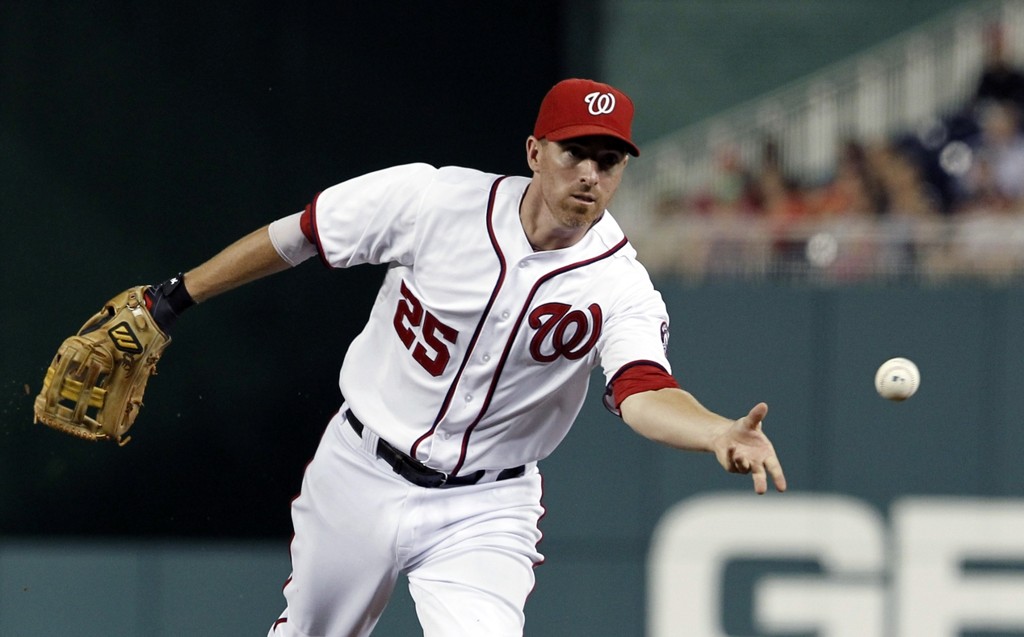
The Nats entire off-season plan revolves around what Adam LaRoche does. Photo Alex Brandon/AP via wp.com

I havn’t done a “how would I answer this chat question” from The Washington Post’s Tom Boswell in a while, but on the back of his 11/26/12 “Stay the Course” opinion piece in the Washington Post (where he basically advises that the team should stay out of the major FA market this off-season), I thought I’d chime in and read/respond to his 11/26/12 chat.

My opinion on Boswell’s piece; I don’t think you can stand pat in today’s baseball world.  Yes this team won 98 games last year.  But does anyone think we’ll win 98 games again by doing little to nothing to address the team’s needs?  Trying to replace Adam LaRoche and Edwin Jackson‘s departures internally has a large chance of weakening the team, and I believe we need to explore a significant FA purchase (or a trade) this off-season.  Now, inarguably TV deals and the rising revenue streams are fueling the FA market, and we’re already seeing contracts that heretofore would have been immediately labeled as “over pays.”  Therefore, even if the Nats go after a 2nd or 3rd tier player in free agency, they’re going to be compensated far more than we ever thought their value represented.  But this is just the way the baseball world is going; we can no longer say that someone is “overpriced” … we need to remember that everyone is going to be “overpriced.”  Perhaps Jayson Werth‘s $126M/7yr deal will look like a bargain in a few  years.

And this is before even addressing the impact that the amazing new Los Angeles Dodger’s TV deal, reportedly worth between $6 and $7 billion dollars over 25 years, will have on the baseball world.  Even at the low-end estimate, that’s $240M a year in RSN revenue.  $240M a year!  They could field a $200M team, pay luxury taxes and still have money to spare under this deal, and that’s before a single dollar in gate, game-day revenues, suites, parking or merchandising comes in.  To call this a “game-changer” is an understatement; I think this could be a serious issue facing Baseball in the coming years.  We’re already seeing what the new ownership group is capable of doing in terms of acquiring talent without much regard to payroll.  What happens if they also acquire the likes of Josh Hamilton and Zack Greinke this coming winter?  A quick check of Cot’s page shows that Los Angeles has $169.5M committed to its top 14 players right now, with three guys making > 20M and nine total with pay > $11M/year.  And they’re reportedly in the mix for the top FAs this off-season, potentially adding 20-30M more to that base number.  That’s amazing.  Just more revenue sharing for Jeffrey Loria to pocket I guess (Thanks Bud!).

Anyway, back to the chat responses.  As always, I write my response before reading his, and sometimes edit questions here for clarity/conciseness.  I’m only answering baseball-related questions, ignoring the slew of Redskins issues.

Q: Are the Nats positioning themselves to make a strong push in the next two drafts?

A: This is what I whittled down a long-winded, rambling “question” to.  The gist is that a comp pick from Adam LaRoche leaving, plus another potential comp pick if Michael Morse leaves next year could help re-stock the farm system.  I’d tend to say, “maybe.”  The Nats are no longer where they were in 2009 and 2010, getting franchise players by virtue of back to back awful seasons.  So the likelihood of finding an impact player is far less.  That being said, having multiple first and supplemental first round picks is a great way to find players and to get guys who “slipped” due to signability/injury issues (as Lucas Giolito did this year).

The Nats farm system has taken some hits in the last two seasons; one from trade (losing 4 top-10 players in the Gio Gonzalez trade) and then another from injury concerns for its top guys (Sammy Solis, Matthew Purke, Lucas Giolito, and Anthony Rendon all representing 1st and 2nd round talents who suffered either season-ending injuries or significant injuries curtailing their progression in the last calendar year, to say nothing of injuries to lower-level guys like Taylor Jordan who will provide depth rising up).  This thinned farm system may prevent Rizzo from making the kind of deal he made last summer, and he may want to focus on getting some more depth in the 2013 draft, as much as is possible from drafting so low.

Here’s the issue writing my own response before reading Boswell’s: he didn’t even talk about the draft portion of the “question,” instead talking about the FA pitcher angle.

Q: What do you think the team is planning on doing to replace Edwin Jackson?

A: I’d guess the team is working on two fronts: one looking at possible trade angles with teams that have surplus starting pitching (Arizona, Tampa Bay, Oakland, Los Angeles Dodgers and perhaps even Atlanta) and seeing if he can swing a deal.  Then I’d guess he’s looking at a 2nd tier of starters, looking to avoid the Greinke sweepstakes (despite his affinity for the hurler).  I do NOT think the team is going to tender John Lannan, instead looking to get a better pitcher for slightly more money than the $5M he’d likely earn at a minimum in 2013.  Of course, with the prices we’ve seen for lefties already perhaps we will tender Lannan and consider another $5M insurance policy a bargain.  Boswell scrolls through the same 2nd tier of starters, noting that there’s definitely someone out there who could work.  He also mentioned the team may look at re-signing Zach Duke, though I’d be surprised by that.  Why would we re-sign Duke but non-tender Lannan, if Lannan clearly is a better pitcher?

Q: Is the lack of a MASN deal hindering the Nats FA plans?

A: You have to think it is.  If the Nats knew what they were getting next year, they’d certainly have a better idea of how much they could spend.  The fact that Bud Selig has allowed Peter Angelos to hijack this MASN revenue negotiation for this long is deplorable.  Of course, by waiting this long with the negotiations Angelos has only cost himself money, as the price we can command as a franchise certainly skyrocketed between the end of 2011 and now.  So there’s that.  But its clear the team is getting a pittance as compared to other comparably sized markets (Houston, Philadelphia) and needs a larger share.  Boswell doesn’t think the lack of a deal is affecting the team’s plans, mostly because there’s not a $250M player on the market this year as there was last year.

Q: Were you invited to any of the seven off-season Nationals player weddings?

A: I wasn’t.  Boswell wasn’t either.  🙂

Q: Why did the MLB allow the Marlins trade to go through? It poisons Miami against baseball probably for a decade and will surely be seen as a cautionary tale for city governments for at least as long.

A: Simple reason: Selig is buddies with Jeffrey Loria and has enabled his crummy behaviors for nearly 2 decades.  More complex reason: on the face of it, from a purely baseball sense this trade was little different than the Boston-Los Angeles trade, and I’d guess you would have a hard time accepting one and denying the other.  Loria’s position with Miami is not Selig’s concern; he got the new stadium that Selig claims is necessary in every market and Loria clearly will continue to profit from the team.  To an owner, that’s the primary concern.  And Selig works for the owners.  All of us bloggers and columnists to deplored the trade and Loria in general (including me, in this space in September and again in November) and talk about the sanctity of the game are just blowing hot-air.  Selig doesn’t care.  Boswell didn’t really answer the question, just saying that baseball is dead in Miami for a long, long time.  Hey, it only helps the Nats to have a 110 loss team in the division, right?

Q: Is Adam LaRoche destined for the AL as an aging 1st baseman?

A: I don’t think so; the questioner compared LaRoche to Adam Dunn, who can DH and is more valuable in the AL.  Inarguably aging sluggers fare better in the AL … but LaRoche just won a gold glove for his defense at first base.  He isn’t exactly a plodding first baseman slowed by age.  He should be able to capably play the position for several more  years, through whatever contract he’s about to sign.  Boswell agrees that this is the trend, and says that Baltimore is a possible destination … but mentions nothing about LaRoche’s plus defense.

Q: Why aren’t the Nats making a bigger play for Edwin Jackson?

A: A good question.  I questioned the Nats lack of a Qualifying Offer being extended to Jackson and surmised it was because the team was afraid he’d take it (having a history of working on one-year deals).  So clearly the lack of the Q.O. indicates a new direction for the team.  I don’t think its related to his meltdown in the post-season; that can happen to anyone (see most of our pitching staff not named Ross Detwiler).  I’d guess that it relates somehow to Jackson’s maddening capabilities; shutdown power pitcher one night, gopher-ball machine the next.  I think they’re just going in a different direction.  Boswell says Jackson wants a 5-year deal … which if true even more reinforces my questioning of the lack of the Q.O.  I disagree with his sentiment that the team is “saving room” for the rising farm system arms; to me a prospect starter is not a solution until the day he arrives in the majors and gives you 30 starts.

Q: Why did Tampa extend Evan Longoria?

A: The team had him under baseball’s most team-friendly contract (6yrs, $17.5M with three team options, locking him to Tampa from 2008 til 2016).  One of baseball’s best players, he made just $2M and $4.5M in the last two seasons.  Which is just ridiculous.  I feel Tampa did the extension to show good faith to the player who was just so woefully underpaid.  Boswell didn’t really answer the question, just saying its a good move because hitters come back from injury better than pitchers.

Q: Should the team be worried about losing LaRoche and his lefty power?

A: Yes absolutely.  Which is why the team should either try to get him to sign a reasonable deal (3 years max) OR the team should let him walk and try to replace the lefty power on the FA market (perhaps in the form of someone like Nick Swisher, who won’t be cheap but also can stick in LF for a while and should fit in nicely to the clubhouse).  Or maybe the team swings a deal for a lefty outfielder in trade and sticks Morse at first.  Boswell agrees, thinking that LaRoche’s hot FA market will get him a 4 year deal for more money than the Nats are willing to pay.

Q: Is there any chance that MASN just cuts ties with the Nats and frees us from the awful deal?

A: No. Chance. In. Hell.  Angelos stands to get such massive, major profit from this deal that he’ll die before giving in.  There is just no way.  And more and more its looking like this pact with the devil, which enabled the team to move here, will be a limiting factor in the years to come.  People talk about how Atlanta has the worst TV deal in the MLB?  Well what about the Nats?  Boswell asked Selig about this and was told that “everything is on the table.”  I highly doubt that, but I’m not going to call Boswell a liar.  I’ll just say, “Don’t hold your breath” that the Nats will be allowed to extract themselves from MASN and create their own RSN.  This would be the absolute dream scenario, but I just cannot see Selig backpeddaling on this deal less than a decade after it was signed.

Q: Will the Nats learn the lessons heeded by other big-money teams who got saddled with old, expensive players?

A: Hopefully so.  Not giving LaRoche 4 years would be a signal to that end.  But it can be difficult; what happens when the whole core of our young team hits free agency?  That’s a lot of big checks to write, and the fan base will bemoan every star that is allowed to walk.  Boswell thinks LaRoche is consistent enough to warrant the contract, but also notes that he’s several years past the typical hitter prime.

Q: Is Morse really the better choice at 1B if it’s between him and Moore? Is he really just that bad in the OF?

A: I’m convinced this narrative is overplayed.  Morse was a shortstop coming up through the minors, so he’s not exactly immobile, and suddenly nobody remembers that Tyler Moore was a plodding minor league first-baseman who only tried LF for the first time in spring training of last year.  Now suddenly Morse isn’t the better LF option?  I don’t buy it.  Neither are great LF choices; Morse had a -23.3 UZR/150 in 493 innings while Moore had a -22.7 in 229 innings this past season (small sample sizes both).  So it seems they’re both awful out there.  But then again (as I’ve said many times) you can “hide” guys in LF if they’re big bats.  You take the lesser defense in order to get a middle-of-the-order hitter.  The last thing you want is a #8 hitter (think Xavier Nady) bumbling around in LF and hitting .190.  If we lose LaRoche, I think the team should put Moore back in his natural position at 1B and let Morse get one more season out there.  Boswell didn’t answer the question, instead rambling about something else.


September callups and the pending Nats Roster crunch

6 comments

Cole Kimball (remember him?) could be a victim of a roster crunch this off-season. Photo Rob Carr/Getty Images via zimbio.com

I took this discussion out of the comments section of the Giolito post in August and made it a separate discussion item, since the situation only got more “dire” with the 9/3/12 call-ups of both Christian Garcia and Zach Duke.

Before getting into the below analysis, let me say this: I’m absolutely supported all of the 40-man additions or the 9/1 call-ups; they were all required, important moves and, especially with the early-season catcher crunch, were vital to ensuring the continued success of the team through the September push.  Adding these two latest arms to a well-used bullpen, plus the 9/1/12 call-ups of of eventual 5th starter John Lannan, catcher depth in Sandy Leon and defensive replacement/pinch runner Eury Perez signal that this team used every avenue in its arsenal to win down the stretch and secure not only a playoff entry, but the #1 seed.

Garcia and Duke were new 40-man additions; to make room at the time the club put Henry Rodriguez on the 60-day dl (apropos since he just had season-ending elbow surgery).  The 40-man roster was filled to a full 40 active players, with an additional three on 60-day DL (Kimball and Ramos joining H-Rod on the 60-day list).

So, why am I worried about a future 40-man roster crunch?  Because with all these additions, we’re going to have to make some tough choices once it comes time to protect guys from the rule-5 draft.  Some have said that the expected Free Agents and Non-Tenders will immediately ease the roster crunch, but I’d counter that these players will have to immediately be filled through free-agency and aren’t going to offer the relief one may expect.

Lets do some analysis for the 43 guys (40 on 40-man plus 3 60-day DL) we’re talking about.   Here’s how these 43 guys are categorized in terms of contract status for next year:

  • Seven (7) guys under contract for next year.  Werth, Zimmerman, Morse, Gio Gonzalez, Maya, Tracy, Suzuki.
  • Eighteen (18)  guys who are pre-arbitration; Strasburg, Rendon, Purke, Harper, Espinosa, Ramos, Henry Rodriguez, Lombardozzi, Marrero, Mattheus, Kimball, Moore, Perez, Rivero, Solano, Garcia, Leon, Brown.  Some of these are non-tender candidates; we’ll get to them below.
  • Nine (9) guys who are arbitration-eligible but who are (in my opinion) not in Non-Tender jeopardy: Zimmermann, Clippard, Flores, Desmond, Storen, Bernadina, Detwiler, Stammen, Perry.  Both Perry and Storen may or may not actually hit Arbitration status per Cots, but the logic still stands that they’d be tied to the team regardless.  Are any of these guys non-tender candidates?  See below.  [Editor’s Note] we now know that Storen DID hit super-2 status, while Perry missed out on arbitration for the year.  Most of this post was written prior to this knowledge.
  • Four (4) pure FAs that immediately come off books: Mike Gonzalez, Jackson, Wang, DeRosa.
  • Two (2) more guys with mutual options that, as it turned out, declined their side and became free agents anway (LaRoche and Burnett).
  • Three (3) easy Non-tender guesses: I think the team non-tenders Gorzelanny, Lannan and Duke (but looks to bring Gorzelanny back as a long-man).  There are other possible non-tenders on this roster; we’ll talk about them later on.

So, on the day the FA’s clear and the 60-day guys get put back on the 40-man we’ll be at 43-6 FAs = 37 players.  So, assuming both 43-6 FAs=37 to start, perhaps down to 34 at the non-tender deadline. That leaves 6 spots opened up … but if my scenario plays out as described above with 6 FAs and 3 non tenders, that includes no less than FIVE of our primary 25-man roster all season. Which means most likely we’ll be active in the FA market looking for replacements for those five guys. First example: Who replaces Edwin Jackson? The next guys in line are Lannan and Wang; both likely gone. After that is perhaps Perry or Maya, both on 40-man but so far both proven not to be able to get out MLB hitters. So we’re going to be looking for another starter. Same goes with replacing Burnett and Gonzalez as lefties out of the pen, and replacing DeRosa as mlb-veteran utility infielder.

My point is that, yeah we have a lot of guys getting cut but we can’t just leave those spots open on the 40-man; we’ll need to immediately fill them with MLB deals in free agency. So we go from 34 open spots probably almost immediately to 38 or 39 with these eventual FA  replacement signings…. and boom, you have your roster crunch when it comes to rule5.

I have a draft version of the 2012 rule 5 pre-draft recommendations and it could get ugly, but to do some quick analysis here’s the Draft Tracker google xls: https://docs.google.com/spreadsheet/ccc?key=0AmkEIm1TLiXQdGhVRjRfNW81SG8xRlROQ1ZxZzNfbUE&hl=en#gid=0.  Yellow shaded cells are 2012 R5 eligible but don’t forget 2011 R5 guys who have stepped up and may need protecting. At first glance in the conversation to be protected has to include: Kobernus, Rosenbaum, Karns, Hood, and Demny. I’m not saying they all need to be protected, but some of them may.

My point is this; if the team wants to protect more than 1-2 guys, they’re looking at a one-for-one replacement on the 40-man roster.  Maybe they do DFA Marrero and Kimball, but they probably don’t want to.  Marrero is only 24.  Kimball was relatively successful before going down with shoulder surgery and is the kind of reliever that Rizzo loves.

This is the essence of the “roster crunch” that this team faces this off-season.

GCL/Rookie Pitching Staff Year in Review; 2012

one comment

The biggest story in the GCL was also its worst; Giolito injury. Photo Eric Dearborn via win-for-teddy blog

Click here for the 2011 version of this post, for a look at how things were last year.

Here’s the GCL version of the 2012 season pitching staff review.  I’m going down the line from top to bottom; AAA is here, AA is here, High-A is here, Low-A is here and Short-A is here.  As with the other reviews, we’ll look at the main rotation, the substitute and spot starters, then focus on key relievers.  Rehab appearances are generally not mentioned.  The lower you get in the minors, the harder it is to really pass judgement on a player’s real capabilities or career outlook, so take some of these evaluations with a grain of salt.  They say not to depend on small sample sizes and I agree; we’re doing after-the-fact analysis on a small sample size of a half a pro season in most cases.  This is especially true with Short-A and the GCL, where most of the roster are 2012 draftees.   So “outlook for next season” is almost entirely a guess for these players.  A ton of them will be left in extended spring to compete for next year’s short-season team, while a ton more will be released without much fanfare.

The rotations in the lower minor leagues are also not nearly as clean as in the upper-levels.  Lots of times the “starter” is slated to go as many innings as the “reliever,” a way to get two starter candidates longer stretches of innings.  We’ll try to take that into consideration as we move forward.

GCL starters.  The rotation started the season with Mieses, Barrientos, Pineyro, Vasquez, and Schwartz.   Lets see how the original rotation and other primary starters fared.

  • Adalberto Mieses put in his second poor rookie league season, posting a 5.05 ERA in 41 innings over 13 appearances and 6 starts.  He hasn’t appreciably improved over last year, which saw him put up similar numbers in the same league.  Outlook for next Season: GCL rotation competition or released.
  • Joel Barrientos pitched 45 innings as a swing-man/spot starter and posted respectable numbers (4-1 with a 3.00 era).  Especially considering that he turned 19 about a month ago.  The fact that he’s a tall lefty (though he must look emaciated; 6’2″ 145lbs?) is a bonus.  Outlook for next Season: Perhaps the low-A bullpen but more likely repeating GCL as a starter.
  • Ivan Pineyro dominated the GCL for 5 starts and got bumped up to short-A.  Outlook for next season: (from the Short-A post): Repeating short-A in the rotation.
  • Daury Vasquez was the GCL work horse, leading the staff in starts and IP.  The DSL grad actually improved on his 2011 DSL numbers (a hard feat), putting in work-man like stats of 4-6, 4.10 ERA in 52 2/3 inningsOutlook for next Season: He has  yet to turn 20, so I’d guess he repeats GCL as a starter.
  • Blake Schwartz didn’t seem to merit a two-level promotion, but he out-performed his 5 GCL starts in Hagerstown.  Outlook for next season: (from low-A post): high-A rotation, based on his status as a college senior grad.
  • Casey Selsor was drafted as an OF but threw 41 1/3 GCL innings in 2012 to a 6.10 ERA.   He was a college senior draftee who couldn’t get guys out in GCL; not a good sign for his future.  Outlook for next Season: low-A bullpen competition or released.
  • Wil Hudgins pitched mostly in the GCL after getting picked in the 22nd round this year and was pretty effective in 10 appearances and 6 starts.  4-3, 2.21 era and a great k/bb ratio of 25/3 in 36 2/3 innings.  Unfortunately, Hudgins is a college senior draftee throwing in the rookie league, so anything other than dominance is viewed as failure.  Outlook for next season: low-A bullpen competition.
  • Dixon Anderson threw a bunch of “rehab” innings in the GCL before finishing out the year in low-A.  Outlook for next season: (from Low-A post): competing for low-A rotation, dropping to bullpen.
  • Lucas Giolito, 2012’s #1 draft pick, threw 2 innings after rehabbing a partially torn UCL all summer and fully blew it out.  Tommy John surgery, see you in 2014.


  • Other guys who got spot starts here and there (non-rehab):
    • Anthony Marcelino appeared in one game, the 2nd GCL game of the season, pitched 4 innings and was subsequently released.  (?!).  I have no idea why.  Very odd; he worked through an injury all of 2011 and seemed ready to compete in 2012.
    • Kylin Turnbull, 2011’s 4th round pick who signed late and didn’t play in 2011, threw a few starts in the GCL to work out some kinks before returning to Hagerstown.
    • Wirkin Estevez threw three 3-inning rehab starts mid-season before returning to Hagerstown.
    • Ronald Pena made three “starts” of 2 innings each despite really being a reliever and then finished the season in short-A.
    • Andy Santana was relatively awful in 13 appearances and 2 starts; a 6.46 era in 23 2/3 innings.  It is hard to see a future for him after basically failing the rookie league two years in a row.
    • Gilberto Mendez looked pretty good in 33 1/3 GCL innings: 34/4 k/bb ratio and a 3.24 era.  He wasn’t nearly as effective upon reaching short-A.

GCL Relievers: taking a look at the relief corps at the end of the season.  These are done in order by IP for any reliever who didn’t get at least one start.  I’m basically ignoring any reliever who threw 9 or fewer innings in the GCL or who didn’t get a spot-start and is already mentioned above.

  • Inocencio Heredes threw 31 innings of good relief in the GCL this year, improving on his 2011 showing.   Outlook for next Season: maybe competing for a full-season bullpen spot but likely repeating GCL.
  • Kevin Dicherry was a college senior draftee who served as the closer in the GCL.  Good numbers, as you would expect.  He needs to be challenged.  Outlook for next Season: low-A bullpen competition.
  • Mike Mudron threw 24 relief innings in the GCL after he was drafted in the 32nd round as a college senior.  Outlook for next Season: low-A bullpen competition.

Summary

We all know by now that GCL is essentially used for two things: an entry point for graduating Dominican Summer League guys plus a first stop for the younger guys each draft class (High schoolers, juco guys and college guys from smaller programs).  Lots of guys never make it past the GCL, so there’s a lot of churn.  Records are nearly meaningless since so many rehab guys pass through working on a pitch or working out kinks.

Giolito to have TJ surgery; Not good

17 comments

Giolito scheduled for TJ surgery, to the surprise of few apparently. Photo Eric Dearborn via win for teddy blog

Frequent readers of this blog have told me lately that i’m too pessimistic, that I’m “not having fun” with the team and its best record in baseball.  Fair enough; its kind of difficult to write opinion pieces on a team in first place.  But even given that, i’ve tried to write some more positive stuff lately.

However, beware; this is going to be another negative post.  Because we just learned that our 2012 #1 draft pick Lucas Giolito needs to have Tommy John surgery after just TWO professional innings.

I made my point the day we drafted Giolito; you can read this June 5th post or read this executive summary; Giolito by himself wasn’t a bad risk, but combining him with Matthew Purke (on the DL all year) and Anthony Rendon (who has had significant injuries in 3 out of the last 4 seasons) puts all of this team’s proverbial eggs into one dangerous basket.  I thought it was negligent to draft an injury risk, given the major injury risk drafted just the previous year in Purke and the ongoing injury issues of Rendon.

Make no mistake; the Nats essentially sacrificed most of this draft for the express purpose of freeing up enough money to sign Giolito out of his UCLA committment.  Check out the known bonuses paid in the top 10 rounds; most of them were below-slot and a number of college seniors (with no leverage) were picked.  Now, every team in the majors was also doing this (an unanticipated side effect of the new CBA draft rules that are not are good for the game, at all, as with most of the new CBA when it comes to amateur players), but the consensus in the industry was that the Nats essentially “punted” the 2012 draft in the hopes of signing Giolito.

Which would be great, if Giolito was healthy.  But he wasn’t.  Here’s a tidbit that I didn’t know: I listened to a Baseball Prospectus podcast two weeks ago and one of Kevin Goldstein‘s guests was none other than Lucas Giolito’s father.  The conversation/intervew was great; Giolito talked about what it was like having a superstar baseball kid growing up, what it was like having a little leaguer who could throw 78mph as a 12yr old, and what it was like having a 16-yr old rising HS junior at the Area Code games.  He also talked through their whole spring of 2012, from the injury to getting drafted to the decision to sign.  All interesting stuff.

One tidbit I learned though, having not heard it anywhere else previously, was this: Lucas didn’t have a “sprained UCL” as was widely mentioned at the time.  According to his father, he had a PARTIAL TEAR of the UCL, NOT a sprain.  And the Nats drafted him anyway.  Knowing this, is it ANY surprise whatsoever that the kid blows out the elbow 2 innings into his pro career??   Lets get this straight; a kid who throws 100mph has a partial tear of the main tendon that allows him to throw 100mph, and we think this tendon is just going to magically heal itself?  A normal person may heal that tendon to the point where you can live your life and not be bothered.  A professional pitcher, upon tearing that tendon, is always going to have a weakness that eventually will require surgical repair.

Lets face it; the Nats have had some good fortune with their pitchers having TJ surgery lately and coming back.  Zimmermann and Strasburg examples 1A and 1B.  Former top prospect Jack McGeary had it and is still in the low minors, struggling to regain his form, an example of a guy who didn’t exactly come back roses from the surgery.  Taylor Jordan and Sammy Solis both had it earlier this year, one representing a promising underrated arm and the other representing a significant blow to the farm system depth, and they’ll be more test cases.  And now we have Giolito.

I read another nats blog this morning who cheerily said something along the lines of, “Well, he’ll get the surgery and we’ll have a 20-yr old in 2014 who can throw 100mph.”  That statement represents the absolutely 100% best case scenario here.  Tommy John recoveries are pretty high percentage wise, but they’re not 100%.  18yr olds pitchers who get cut aren’t exactly 100% to return to their prior form either.  He may never come back from this surgery, he may never regain his velocity.

Prospect development in baseball is already risky enough; a huge percentage of first rounders never even make the majors.  But that being said … first rounders who DO make the majors are the core of the stars in this league (don’t believe me?  Get a list of the 20 best pitchers and look at their draft position; more than half of the “Aces” in this league were first round picks).  My point is (and was in June) that we should have drafted a safer guy, a known quantity, so that we actually have something to show for the 2012 draft in a few years time.

Mitch Williams on 106.7 inre Strasburg Shutdown, Mechanics

2 comments

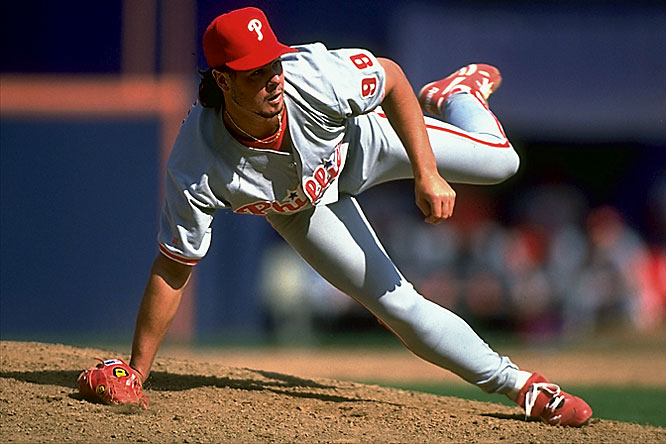
Would you listen if this guy was criticising your pitching mechanics? Photo unknown via insidesocal.com

I just happened to catch former MLB pitcher and current MLB.com analyst Mitch Williams calling into the morning show on 106.7 this am.  And I felt compelled to immediately call into the show to rebut some of the more arguable statements he made.  Of course, this being Washington DC they only took 2 calls (one of which immediately changed the subject to golf; nice screening there WJFK) before moving onto a football-related segment, so I’ll exhaust my need to speak up in this space.

Williams had lots to say about Stephen Strasburg‘s mechanics, Mike Rizzo‘s decision to shut him down, and other fun stuff.

First off, I find it ironic that a guy with some of the worst mechanics in the last 25 years has the audacity to question Strasburg’s mechanics.  Williams nearly dislocated his left shoulder on every delivery and fell off to the 3rd base side so badly that he nearly hit the ground on each pitch (as is displayed in the photo above).  Strasburg, on the other hand, was considered to have impeccable mechanics upon hitting the draft and you really had to squint to find flaws in his delivery.  Google searches on the topic are so muddied with opinions that its hard to find actual scouting reports from his amateur days versus “hindsight is 20/20” pieces that look for flaws to explain his 2010 injury.  But its ironic that Strasburg suddenly has all these mechanical issues according to pundits, because he got injured.

Speaking of that 2010 injury, Williams intimated that the infamous “Inverted W” was the reason Strasburg got hurt.  I just have an awful hard time with that theory.  First, its a THEORY and is merely a coincidental piece of evidence in pitcher injuries.  You can find examples of pitchers who get into this position pre-delivery who have never had any injury issues just as easily as you can cherry-pick guys like Strasburg or Mark Prior who have suffered injuries.  More importantly, the Inverted W is more indicative of SHOULDER injuries in pitchers, not elbow ligament tears.  Shoulder injuries in pitchers are by and large wear-and-tear injuries, caused by over use and over-throwing over hundreds and thousands of pitches.  You don’t generally throw one pitch and tear completely through your labrum or rotator cuff.   However, elbow injuries to the UCL are almost entirely singular, acute injuries caused on a specific pitch.  We all can remember the exact pitch Strasburg threw to injure his arm and the grimace on his face after he threw it (as well as the blowhard Rob Dibble comments …. but we’ll choose to ignore those).

I wrote at the time my opinion on why Strasburg got hurt, and it had nothing to do with his pitching mechanics (my pet theory: Ivan Rodriguez fell in love with Strasburg’s change-up, had him throwing too many of them, and the vastly increased stress on his elbow caused the injury.  See the Aug 2010 post linked above for more detail).  I think its irresponsible for Williams to get onto a local radio show and opine that Strasburg “needs to change his mechanics” because of the injury, or else he’ll always be an injury concern.  Because in reality, nobody knows.  Personally I think teams trying to “change mechanics” in pitchers is a mistake; you throw one way your entire life, from age 5-6 onwards, and your entire shoulder/arm combination becomes inured to that method of throwing.  How can anyone think that suddenly as a 25 yr old you can even change the fundamental way you throw a baseball and be successful?  Adjustments, no problem.  Fix slight timing issues or slight changes to your wind up?  Sure.  Core changes to arm slots and arm loading?  Problematic.

Williams continued with the same tired themes we’ve been hearing from National writers (i.e., the Veterans aren’t going to like this, its a team game, the Nats should have managed this better, the Nats are foolish not to go for it, etc).  But he fails to mention what most fail to mention; Rizzo arrived at this shutdown decision with Strasburg the SAME way he did with Jordan Zimmermann last year; he talked with the surgeon who performed the surgery (Dr. Lewis Yocum in LA, the same doctor apparently about to pronounce the same fate on our 2012 #1 draft pick Lucas Giolito) and arrived at a prescribed, pre-defined innings limit.  You notice we’re in the EXACT same position as we were with Zimmermann in 2011, yet without any of the national media interest.  (And so far, that limit has worked out pretty darn well for the Nats and Zimmermann; right now, he’s 2nd best in the NL in several macro pitching categories; bWAR, ERA and ERA+, while being top 10 in WHIP, K/BB, and BB/9).

The way I look at it is thus: if you or I had Heart Surgery, your Cardiologist probably would recommend a course of recovery.  For the first X months, avoid any activity, then ease your way back to vigorous activity over a period of Y more months.  And you’d follow that advice, right?  Well, the pitching arm of a Major League Starter pretty much is equivalent to the heart of a normal person; without that arm, you’re not a major leaguer any more.  So when you get surgery on it, you listen to your doctor and do exactly what he says.  If someone told that same heart patient that, well because we’re really close to the World Series, you should really ignore your surgeon and just go for it for the betterment of the team, what would you say?  You’d probably say, “well, this may help the team make this one short term goal but I may be dead a lot sooner because of it.”  In my mind, that’s what Strasburg/Rizzo are doing; they’re following the same advice that has now led to Zimmermann having a fantastic (and healthy) 2012 season.

And one caller, to his credit, did point out a very important fact: the story on Strasburg hasn’t really changed all year.  There was a communicated shutdown expectation to Strasburg and the team in spring training.  Its only the National media that is now catching onto this and thrusting microphones into our players’ faces and asking for reactions that are getting over blown and taken out of context.   I guess this is what its like day in, day out in New York and Boston…

There are no absolutes in life; Strasburg could absolutely re-injure himself in 2 years time and turn into this generation’s Mark Prior.  Or he could be like Chris Carpenter, who had the TJ surgery in 2007 then recovered to a 17-4 record in 2009 as a guy in his mid 30s.  But anyone who thinks they know otherwise is just stating an opinion.  And everyone has an opinion.  I support the shutdown, I think its prudent for the longer term position of this team, and I don’t think 2012 is a once-in-a-lifetime shot for this franchise.  Of the “core 15” of the Nats (8 positional players, 5 starters and 2 relievers) exactly ONE guy is a free agent or not presented with at least an option for 2013.  Most of these guys are either signed long term or under team control for at least another FOUR seasons.  So this team isn’t going anywhere.  You play it safe and get ready for a 4-5 year run.

That’s MY opinion.  🙂

Are you concerned about the state of the Nats farm system?

26 comments

Will Giolito become the Nats #1 prospect? Photo Eric Dearborn via Win For Teddy blog

I know it seems silly to criticize the team with the best record in the NL, but I thought the question was worth asking, given a couple things I read this week prospects related.  Given the drain of prospects in the last 6 months (through the Gio Gonzalez trade and through graduation to the majors for several of the team’s better prospects), its safe to say that our cupboard is relatively thin right now.  This point was highlighted to me by two recent online articles;

1. ESPN’s Keith Law posted a mid-season review of farm systems on the Rise or Fall (sorry, insider only), and stated the obvious about our system.  His summary: Yes we got Lucas Giolito but it was essentially at the expense of any other high-end talent in the 2012 draft.  And, a lot of our high-end guys are taking significant tumbles on boards due to lack of performance or injury (see later on for a look at our top 10 prospect performances).

2. Baseball America’s Jim Callis posted an updated Midseason top 50 prospects post 2012 draft and included where he’d put the top-end talents drafted (including international signees) in his weekly Ask BA feature on July 16th.   Of note to me was the fact that Washington, even with the signing of the high-end Giolito, does not have a SINGLE player in his mid-season 50.   Luckily for us, our NL East competition didn’t fare too much better, with a grand total of 5 players between our divisional rivals.  This compared to teams like Seattle (5), Kansas City (4), and the rich-keep-getting-richer Rangers with 3 guys likely to become impact players within a year or two.

Why is this a concern if the team is in first place?  Two primary reasons:

1. If you’re not going to matriculate your prospects and depend on them for production, then you need to utilize them in trade to acquire needed talent.  There’s plenty of trade rumors right now mentioning the Nats desires for a starter to cover for Stephen Strasburg‘s innings limit.  But who are we going to trade to acquire said pitcher?   I’d go as far as saying that there’s not one guy on our 2012 top 10 prospect list (not including Harper and Lombardozzi of course) who, at this point in 2012, could be the centerpiece of a marquee acquisition.  Who is trading for our #1 prospect Anthony Rendon right now? 

2. This team has a LOT of money committed to players over the coming years, and won’t be able to depend on hefty production from salary controlled guys forever.  They will need a stream of up-and-coming players to offer cheap alternatives to free agents and players who have become too expensive.  For example; in the year 2016 the team has $47M committed to just THREE players right now, before considering at least that much in arbitration for just Strasburg, Bryce Harper and Jordan Zimmermann.  $47M is nearly the team’s payroll just a few years ago!  Yes we will naturally grow payroll and revenues with success and the renegotiation of the MASN contract, but constructing a 25 man roster is about making choices.  The last thing we want is to see this team become the 2012 Philadelphia Phillies; a bloated, old team with a ton of injuries and the 2nd highest payroll in the league at $175M, but mired in last place.

For context of this discussion, here’s a list of Baseball America’s top 10 prospects for this team for 2011 and 2012 (compiled after the Gonzalez trade), and a status of where they are as of now:

Year Nats Rank Name, pos Status
2011 1 Bryce Harper, of In majors
2011 2 Derek Norris, c Traded
2011 3 Danny Espinosa, ss/2b In majors
2011 4 A.J. Cole, rhp Traded
2011 5 Wilson Ramos, c Out for Season (two knee surgeries)
2011 6 Sammy Solis, lhp Out for Season (Tommy John)
2011 7 Cole Kimball, rhp 60-day DL (shoulder surgery)
2011 8 Eury Perez, of .299/.325/.342 in AA Harrisburg in his 6th pro season
2011 9 Chris Marrero, 1b 60-day DL (torn hamstring)
2011 10 Brad Peacock, rhp Traded

That’s 2 guys who are starters in the Majors, 3 traded for Gonzalez, 4 guys on long term DL stints and Eury Perez with his meager .667 OPS in AA, in his 6th pro season.  How about 2012’s list?

Year Nats Rank Name, pos Status
2012 1 Bryce Harper, OF In majors
2012 2 Anthony Rendon, 3B Out for Season (broken ankle, his 3rd major leg injury in 4 years)
2012 3 Brian Goodwin, OF .324/.438/.542 in low-A.  Stellar season so far
2012 4 Alex Meyer, RHP 7-4, 3.10 Era, 1.13 whip and 107/34 k/bb in 90IP in low-A Hagerstown.  Just promoted
2012 5 Matt Purke, LHP Long term DL (Shoulder concerns); hasn’t thrown in 5 weeks.
2012 6 Sammy Solis, LHP Out for Season (Tommy John)
2012 7 Steve Lombardozzi, INF In Majors
2012 8 Destin Hood, OF .223/.296/.313 in AA Harrisburg, in his 5th pro season
2012 9 Chris Marrero, 1B 60-day DL (torn hamstring)
2012 10 Michael Taylor, OF .225/.314/.333 in High-A Potomac in his 3rd pro season

2012’s list includes 4 major injury concerns, two guys under-performing (Hood and Taylor), and two guys matriculated to the majors.  The two players putting up good statistical seasons may come with astericks though; Alex Meyer was compiling his stats in low-A, going against guys 2-3 years younger than himself.  His promotion to High-A was overdue and should be telling, to determine if his future lays as a dominant 12-6 starter or a high-leverage reliever.  Brian Goodwin’s excellent season is a great sign of things to come … but again, in Low-A.  I know he was a Juco signee, but he’s 21 now, turning 22 in November and is the same age as college juniors getting drafted now.  If he continues to produce upon promotion to better competition, I’ll feel better.

Now, I know there’s guys in our system who are coming back from injuries (i.e. Nathan Karns), or who are putting up good numbers despite being lower draft picks (i.e. Matt Skole, Cameron Selik, Danny Rosenbaum), and we have some guys who we acquired through trades and who are having surprisingly good seasons in the minors (i.e., Zach Walters, Ryan Perry and Corey Brown) but are these kinds of players going to step up and either be a) next year’s top prospects or b) eventual productive major leaguers?  I know we all love Rosenbaum for example, but most scouts think he’s a marginal prospect at best (and his lack of inclusion on our top 10 lists reinforces that notion).

This sudden lack of depth was one of the reasons I wasn’t the biggest fan of drafting Giolito.  With the new draft rules and specific limits on bonuses, combined with the significant injury issues we’ve had with high end draftees Rendon and Purke in 2011’s draft, I thought the team should have gone the safer route.  Yes I’m sure Mike Rizzo did a ton of due diligence and was confident in Giolito’s long term health.  But missing on three first rounders (or in Purke’s case, a first round talent given a significant bonus and a 40-man deal) could lead to a significant hole in player development for this team right at a time a couple of years from now when they desperately need a MLB-minimum impact guy.

Too many injury concerns in Nats recent drafts?

22 comments

As most Nats fans know by now, the team took a big risk and drafted prep RHP Lucas Giolito in the first round despite his having suffered a sprained Ulnar Collateral Ligament (that of Tommy John surgery fame) this spring.   Most pundits have stated the obvious; this is a high risk, high reward pick for sure.  Baseball America loves the pick, as did the notoriously prickly Keith Law.

The team left two rather big names on the board by making this pick, namely Chris Stratton and Devin Marrero.  Marrero’s stock has dropped considerably this season after mashing his first two years in college, while Stratton’s stock has risen mightily and seemed to fit Mike Rizzo‘s typical MO for drafting; big powerful college arms that are close to the majors.

Here’s the question; was this TOO much of a risk?  Anthony Rendon fell to us in 2011 after being the consensus 1-1 pick in his draft class for nearly two years after suffering multiple injuries in college.  And it didn’t take him but about a week of professional games before suffering yet another leg injury, one that (depending on who you ask) seems set to sideline him for the entirety of the 2012 pro season (with the off-chance of returning for the Arizona Fall League).  Meanwhile the team took an even bigger gamble on Matthew Purke, a lefty starter with shoulder concerns in college that have continued into the pros (he was kept in extended spring training for nearly 2 months, having only recently made his pro debut in low-A, where he promptly got hammered).  Small sample sizes, I know.  But stats are stats.

Giolito, if healthy, was in the mix for 1-1.  As was Purke.  As was Rendon.  All three fell because of injury concerns.  So clearly these are top-end talents, each individually worth the risk.  But all three within two draft classes?

There seem to be two common mantras in baseball drafting; You don’t draft for need, and Get the Best Player Available.  Right now the Nats need hitting, both at the MLB level and throughout its farm system.  Maybe the team didn’t like what it saw out of Marrero, or maybe the team is convinced that Giolito’s injury was nothing major and feels like they got a massive steal as the best player on the board at #16 overall.  Fair enough; i’m certainly not privy to Rizzo’s interviews or Giolito’s medical records.  But if none of these three guys pan out, the Nats are looking at a pretty gaping draft hole rising through its system within a few years.

Agree?  Disagree?

Written by Todd Boss

June 5th, 2012 at 1:31 pm