Nationals Arm Race

"… the reason you win or lose is darn near always the same – pitching.” — Earl Weaver

Archive for the ‘michael gonzalez’ tag

Ladson’s inbox 1/7/13 Edition

7 comments

r

Readers ask creative questions for keeping Morse around. It won't matter. Photo Cheryl Nichols/Nats News Network

Slow week for baseball news; I’m sure that will end tomorrow when the Hall of Fame class (or lack there of) is announced.  Meanwhile MLB.com’s Nats beat reporter Bill Ladson published a mailbag on 1/7/13.  Here’s how I would have answered his questions.

Update: after I wrote this, LaRoche signed.  So much for a slow news week for our Nats.  Some of the below may now be slightly dated analysis.

As always, I write the response here before reading his, and edit questions for clarity/conciseness.

Q: If Anthony Rendon stays healthy, could you see Ryan Zimmerman moving to first base and Rendon playing third base?

A: Yes, absolutely.  I’m now firmly on the following succession plan: Rendon hits his way to the majors, proves he can play excellent 3B defense, and we move Zimmerman and his nearing-Chuck Knoblock/Steve Sax issues with his throwing arm to first base.   Zimmerman would save the wear and tear on his body by not having to field bunts and dive for as many grounders, and would not have to make any more casual throws across the diamond (he’s proven that under duress or when hurried that he is very accurate, a clear indication that when he doesn’t think about the throw, he makes it).   And we install Rendon at third where by all accounts he’s just as good a defender as Zimmerman is.

However.  There’s a few things that need to happen for this plan to work.  Rendon (as the question mentions) needs to stay healthy.  He needs to prove he can hit MLB pitching.  And the Nats need to NOT lock up first base for the next three seasons with Adam LaRoche, else the position is blocked, Zimmerman stays at 3B for the duration of LaRoche’s deal and Rendon will have to push someone else off their position (Espinosa at 2b is the likely target … but Espinosa is nearly a 4 win player despite his strikeouts.  They don’t grow 4 win players on trees).   So Rendon may be stuck until another solution presents itself, perhaps by way of injury.

Update: with LaRoche’s signing,  we now know that Zimmerman isn’t moving to 1B for at least two  years, so now Rendon’s path is more complicated.

Ladson kind of hedges and says “well, lets just see what happens.”

Q: Why the talk of trading Michael Morse when trading Jayson Werth would be far better for the team? Besides all the money it would free up, Morse is three years younger, hits far better, especially with men on base, and has more power.

A: Because who in their right mind would take Jayson Werth with the massively backloaded contract he’s currently on while he’s in his decline years in his mid 30s and has shown himself suddenly to be injury prone??  That sentence is exactly the reason that the Werth contract was and is criticized as being one of the “worst in the game.”   Because its unmoveable.   He’s going to be paid $21.57 million dollars in the year 2017 when he’s 38.   If Werth was still producing at his last Philadelphia year level (he posted a 4.3 bWAR in 2010, which using a rough FA estimate of $5M/war would mean he was “valued” at exactly $21.5M), there wouldn’t be as much complaining.  But in the first two years of the contract, he hasn’t produced anywhere near that WAR value (bWARs of 1.0 and 0.6 in the first two years of the contract).  Yes he was hurt in 2012, but its not like he’s giving back the money for the 81 games he didn’t play.

This is such an ignorant question, you wonder why Ladson took it.

All that being said, yes I understand why the Nats made the Werth deal.  I think it was done fully well knowing what an albatross it was to be.  It was done to acquire the competitive nature of Werth and to send a message to the league that the Nationals were a new regime post Jim Bowden.

Ladson talks about Werth’s “non number” contributions to the team, saying he’s more valuable than numbers suggest.  I think that’s a really myopic viewpoint of Werth’s contract, his production and the point of the question.

Q: Any worries about losing three left-handers out of the bullpen? That was a big strength last year. What are the options?

A: Was our three lefties really that big of a strenth last year?  Other readers here have pointed out Michael Gonzalez’s complete inability to deal with right-handers (they hit him for a .297/.378/.484 slash line in 2012), meaning that the team really could only trust Gonzalez for solely lefty-lefty matchups.  Tom Gorzelanny was the 7th guy out of the pen, the long-man/mop-up guy whose large majority of IP were defined as “low leverage,” implying that despite his excellent ERA in 2012 his production can be replaced relatively easily.  Sean Burnett was inarguably great … but also was commanding 3 year guaranteed contracts in a baseball management era where we now know that relievers should be treated as fungible assets and never guaranteed major money to.  So allowing him to leave was the right decision to make.

Gorzelanny has been replaced by Zach Duke, who (as I’ll begrudingly admit that “peric the troll” was right about, stemming from a conversation here last September) seems to be a better option and who seems to have been given all of Gorzelanny’s appearances last September (Gorzelanny didn’t appear in a game for nearly two weeks in the middle September).

However, I will admit that I am slightly worried about the fact that we seem set to replace the value of both Gonzalez and Burnett at this point with Bill Bray, who may or may not even make the team.  I really thought we’d win the J.P. Howell FA sweepstakes.  Now at this point, I’m guessing perhaps the team just trusts the matchups and remembers that Tyler Clippard is lights out against lefties despite being a RHP (lefties hit him for a .170/.260/.259 slash line in 2012, a year when Clippard was significantly worse than in 2011).  Maybe the team finds a MLFA or a career reclamation project out there (much as they did with Gonzalez and Duke last year).   Or (most likely) maybe the team demands a lefty bullpen arm in trade for the eventual Michael Morse transaction once LaRoche signs on for 2013 and beyond).  We’ll see; lots of hot-stove league left.

Ladson thinks there’s more acquisitions coming.

Q: Morse was drafted as a shortstop, so is there a way the Nationals could convert Michael into a second baseman?

A: If Morse’s mobility is that poor in LF, he’d be considered a statute at 2nd.  There’s just no way he could possibly move there at this point.  Besides, Espinosa is considered a very good defender and the Nats regime values plus defense.  He may have been a shortstop once, but that was long ago.  Ladson says its never going to happen.

Q: What are the chances the Nats try to make a trade for Giancarlo Stanton? Then they can put Werth or Bryce Harper at first base.

A: Hah.  Well, I’m sure the Nats (and most every other team in the league) would kill to have Stanton.  But Stanton is probably the most valuable resource in the game; a pre-arbitration premiere slugger.  The only thing more valuable probably is a pre-arbitration Ace starter (think Tim Lincecum before he hit arbitration).   Stanton is under team control for four more years and isn’t even arbitration eligible yet.  On the open market he’s worth $25M/year; he’s set to earn somewhere in the mid $500,000 in 2013.   It would have to take something well north of the prospect haul that Tampa Bay got in the James Shields trade, and that trade netted Tampa Wil Myers, basically the best propsect in the game.

The Nats (and most teams in the game) simply do not have enough prospect depth to pry Stanton away.  And, the Marlins would have to be crazy to trade him intra-division.  Just isn’t happening.  I think the penny pinching Marlins keep him for another year and trade him before he hits arbitration, making him someone elses’s escalating salary issue.   Ladson says that the team wouldn’t trade for Stanton because their outfield is set for the next two seasons.  Really!?  You wouldn’t trade away Span or Werth, even if you paid their entire ride, to acquire someone with the talent of Stanton?

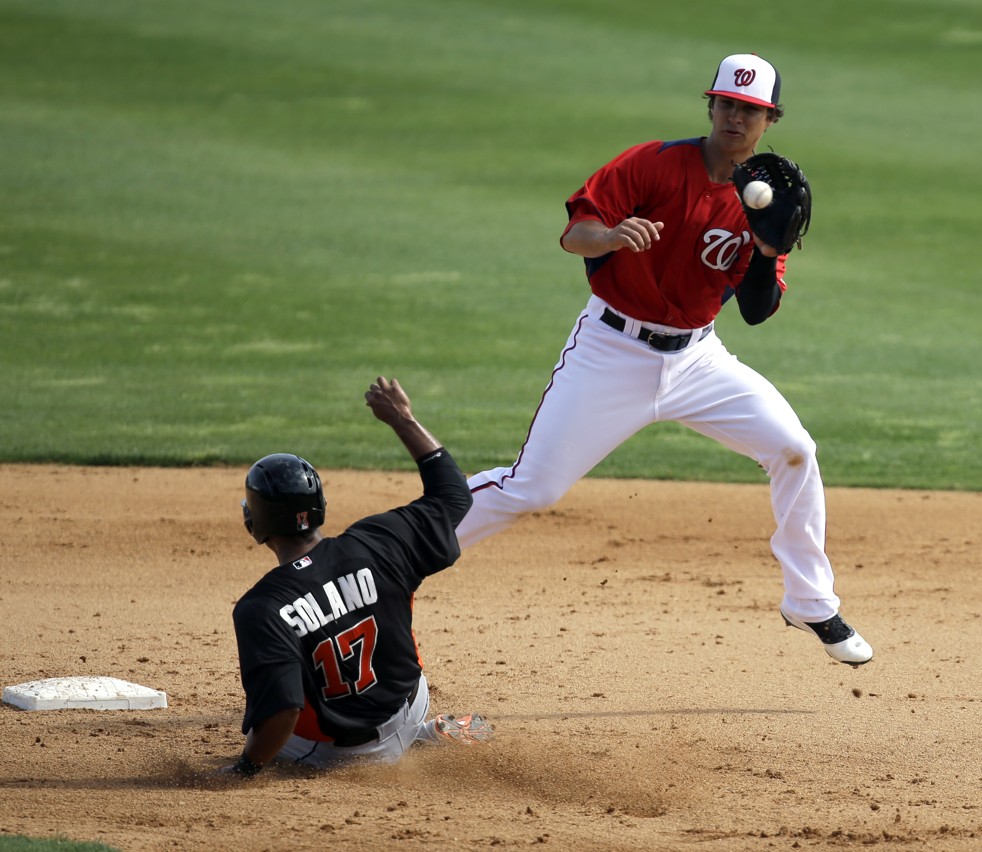
Q: What are the Nats’ plans with Jhonatan Solano going forward?

A: Catcher depth.  Despite his .300+ BA in his short MLB stint, I don’t think he’s anything more than a 4-A player.  We keep him on the 40-man until his options expire and then DFA him, all the while he serves as a 3rd catcher in case Ramos/Suzuki gets hurt.   Ladson points out that Suzuki is a FA after 2013, so perhaps Solano becomes the #2 in 2014 and beyond.  However, Suzuki has a club option for 2014 that could move this schedule out a year.

Ask Boswell 12/31/12 Edition

13 comments

Where did all our 2012 lefties go? Photo Nationals stock.

Even in the basking glow of the Redskin’s first NFC East title since 1999, there were still a few Nationals questions thrown into Tom Boswell’s 12/31/12 Chat at washingtonpost.com.  Here’s a mini chat-response edition.

As always, I edit questions for clarity and answer here as I read down the chat before reading Boswell’s response.

Q: I can’t understand why the Nats have allowed all three of their lefty relievers to depart without serious efforts to re-sign them.

A: I think you have to look at all three guys individually.  Tom Gorzelanny was replaced by Zack Duke, who likely was cheaper than the 2yr/$5.7M contract Gorzelanny got from Milwaukee (we have no terms of the Duke deal available, but I’m guessing its around a 1yr $1.5M deal).  I just get the impression the team liked Duke better than Gorzelanny by the end of the 2012 season.  This, ironically, was also the position that “peric the troll” argued for at the end of last season, to give credit where credit is due.  Sean Burnett got 2yrs/$8M with a vesting option at $4.5M if he appears in 110 games over the next two seasons (a relatively easy option to attain considering he has averaged more than 70 games a year each of the last four seasons).   And the Nats likely believe that a 3 year contract for a reliever is too much.  Lastly, the team probably wanted Michael Gonzalez back but got out bid by Milwaukee for his 1yr/$2.2M deal.   So they’re now back on the market, possibly in on J.P. Howell on a deal for less than what Gonzalez want, but also have Bill Bray in the fold on a minor league deal.  I know these aren’t eye-popping numbers, but the way to build teams is to save money where you can and to stick to a methodology.  Mike Rizzo’s methodology for building bullpens seems to be to save money where you can, knowing that more bullpen arms are available in the minors.   Boswell thinks the team has ably replaced at least two of these guys, but also says the team NEEDS to get Howell.

Q: If I got in a time machine and went back to December 31, 2011 and told you to bet your house that both the Redskins and the Nats would win their respective divisions, would you have believed it? Furthermore, if I traveled to December 31, 2013, what is your guess regarding what the talk would be about?

A: Just talking about the Nats; if you had told me the 2012 Nats were winning the division I would have laughed.  I thought the team was improved from 81 wins, but not improved by 17 games.  Mark Zuckerman had a nice WAR-analysis piece after the Gio Gonzalez trade that showed that the team could be improved by 12 wins or so, but nobody thought the team would explode for 98 wins.  What’s a good prediction for 2013?  Well, borrowing on Zuckerman’s WAR analysis piece, you can make a legitimate argument that the team is setup to be improved again in 2013.  This is a teaser for a blog post coming this week, but the proof is out there.  If you eliminate the negative WAR guys (which, for the most part we already have) and then account for improvements from guys playing full seasons … we could easily be a 100+ win team.  Boswell says he wouldn’t have believed that both teams would win the divisions in 2012.

Q: Couldn’t the Nats sign LaRoche and keep Morse as their number one guy off the bench, sending Moore to AAA to play every day?

A: They could, but that would be a monumental waste of Michael Morse’s abilities.  He’ll be healthy in 2013; when he was healthy in 2011 he hit 30 homers.  There’s no reason to think he won’t return to that form.  So, if the team retains Adam LaRoche, the prudent option is to move Morse for some farm system depth (depth which we desperately need).   Tyler Moore has nothing to prove in AAA; he NEEDS MLB at-bats.  I don’t have a problem with Moore being the super-sub he was in 2012 again, but he’s another guy who might be better served being traded as well.    Boswell points out Morse’s .857 OPS as a Nat and rightly points out that this is too big of a bat to sit idle.

Ladson’s Inbox 12/28/12 edition

12 comments

Rodriguez getting ready to fire in another pitch he has no idea where its going. Photo via humorfeast.blogspot.com

Holiday edition mailbag from MLB.com’s Nats beat writer Bill Ladson for 12/28/12.

As always, I write my response here before reading his, and sometimes edit questions for clarity.

Q: Where does Henry Rodriguez fit in the Nationals’ plan this upcoming season?

A: A good question; Mike Rizzo loves Rodriguez but I find him completely frustrating as a fan.   In 2011 he led the league in wild pitches despite only throwing 65 innings, and in 2012 he had a -0.7 WAR and a 69 ERA+ before hitting the DL for season ending surgery.  He’s got no minor league options and thus has to be either carried on the active roster or be subject to DL shenanigans.  Davey Johnson also loves him, and said he was the Nats best pitcher last spring training.  My guess is that Rodriguez holds it together for another spring, breaks camp with the team and then plays his way into a DFA.  The team can replace his 7th/8th inning innings with Christian Garcia rather easily (assuming of course that the team realizes that Garcia’s arm is too fragile to reliably be depended upon as a starter).  Ladson predicts he’ll be a middle reliever for this team in 2013.

Q: What are the Nats going to do with first baseman Chris Marrero?

A: Great question; he has one more minor league option, is clearly behind the likes of Chad Tracy and Tyler Moore on the first base backup pecking order, but really hasn’t got much left to prove in the minors.  He hit admirably enough at AA and AAA in 2010 and 2011.  I think Marrero’s problem is that he’s stuck at first base but has limited power capabilities.  If he played LF, perhaps you could deal with someone who didn’t look to hit more than a handful of homers at the MLB level.  But he plays a position that needs 25-30 homers of production.  I think he’s trade bait ultimately.  Ladson says the team’s bench is set and that Marrero may be traded.

Q: Isn’t it time to make Ross Detwiler the No. 4 starter? Also, what do you think of Nats’ rotation?

A: I’m not exactly sure what the questioner wants; does it really matter if Detwiler is #4 or #5?  Not really (not until the playoffs anyway).  Detwiler is the 5th starter inarguably on this team, looking at the accomplishments of the 4 other guys.

I think the rotation is either the best or competing to be the best in the sport.  I’ve got a future post ranking all 30 rotations (I’m more or less waiting for the last of the impact free agents to sign before publishing it), and (teaser) the Nats are in the top 3 without question.  However, the Nats rotation is very, very thin.  If one of the 5 guys goes down, I really don’t know who is going to step up to make starts.   Zach Duke?  Ryan Perry?  Lets pray for a healthy spring training.  Ladson says Detwiler is the 4th starter entering spring training, and that he likes the rotation.  Not a very deep answer.

Q: Bill Bray was an OK pitcher in his last stint with the Nationals. Do you think he will be anywhere near as good the second time around?

A: It all depends on his health.  A groin strain and then a back strain cost him more than 100 games last year.   Those injuries should be healed up well enough by now; if he was recovering from an arm injury I’d be more worried.  He posted a 133 ERA+ in 2011; i don’t see any reason why he couldn’t repeat that performance in 2013.  However, I still think the team needs to pursue one more lefty out of the pen.  Michael Gonzalez just signed with Milwaukee, meaning that all three of our lefty bullpen guys from 2012 are gone.  J.P. Howell remains available but competition is fierce for his services.  Ladson says it all depends on his health.

Q: Should the Nationals be concerned with the way Ryan Zimmerman was releasing the ball at the end of 2012 season?

A: Yes.  They should be concerned with the way he’s been throwing the ball for several years now, AND they should have been concerned with the effects of the shoulder injury that was bothering him all season.  Off-season surgery fixed the latter part.  As for the former … I think its just inevitable that Zimmerman moves to 1B.  At some point I feel his arm action is going to turn into some sort of Chuck Knoblock mental block.  Ladson reminds of Zimmerman’s surgery.

Q: Why don’t the Nationals just give Adam LaRoche a third year? If things don’t pan out by the third year, the team could trade him.

A: Good question.  The core of the team is locked up for 3 more years, why not extend the offer?  I think perhaps the answer relates to the massive amount of arbitration salary the team is looking at by 2015.  They might have 12-13 arbitration cases with escalating salary by then.   And its no guarantee to be able to trade Adam LaRoche in 2015; what kind of return would we get?  We’d likely get marginal prospects AND have to pay most of his salary.  I’m not even mentioning the obvious; he just turned 33; do you want to guarantee a 3rd year 8-figure salary to a 35-yr old?  Isn’t that exactly the kind of contracts that are killing the Phillies right now?  Plus, signing LaRoche locks of 1B for 3 years … meaning no room for Moore for 2 more years AND no room to move Zimmerman if his arm turns into mush.  I know the team likes LaRoche, but it makes more sense for the future of the team to let him walk.  Ladson echos my comments on age and having to eat money on a trade.  He also mentions that the team would like Matthew Skole at first by 2015, which I don’t necessarily think will happen (but we’ll see).

Ladson’s inbox 12/18/12

10 comments

Lots of loogy talk in this off-season; Burnett's a hard man to replace. Photo: masnsports.com

Another edition of mlb.com’s Nationals beat reporter Bill Ladson’s Inbox, this time from 12/18/12.

As always, I write my response before reading his, and sometimes edit questions for clarity.

Q: Who will replace Sean Burnett as the lefty specialist in the bullpen?

Q: Is there any chance of the Nationals getting J.P. Howell to fill Burnett’s spot? Do you think the club needs him?

A: The Nats 2013 Loogy right now is likely to be minor league acquiree and former franchise 1st round pick Bill Bray.  If he’s healthy, and if he makes the team.  He’s the leader in the clubhouse right now, given the real lack of left handed relief in the farm system right now.  Clicking on baseball-reference’s great franchise pitching depth chart, there’s really not a single viable option that pitched above AA still in the system (I like Patrick McCoy, who did decently in AA, but he wasn’t picked up in Rule 5, which implies to me that he’s definitely not MLB ready).  Zach Duke seems set to be the Tom Gorzelanny replacement; the long-relief/spot-start/mop-up guy, and not necessarily the one-out guy.  The team is still involved with rumors of signing J.P. Howell, and of course could still re-sign Michael Gonzalez, who did so wonderfully for is in 2012.  However, lots of teams are in on lefty specialists right now and we may get out-bid.  I’m partial to Bray; he is a Virginia guy, went to William & Mary, and is the cousin of a buddy of mine (who, when I saw him last weekend, promised to have access to tickets if Bray makes the team).  Lets cross our fingers (stated completely selfishly).

Do we “need” Howell/Gonzalez?  I don’t know if we “need” another lefty, but I’d like another lefty in case Bray isn’t ready to go.  So I’d like to see another acquisition of someone for depth.  I think the bullpen looks better with a second lefty late-innings guy.  Ladson wrote almost exactly what I just wrote, naming all the same points.

Q: When looking at the 40-man roster, could you tell me what Yunesky Maya has to offer?

A: Maya still serves as last-ditch starter help, in case of a rash of injuries at the MLB level.  Despite his poor performances in two prior MLB stints, he’d still be preferable to other career minor league veteran options we probably will have in AAA this year (thinking the likes of Roark, Broderick, or Mandel).  His salary is guaranteed; we might as well keep him around as insurance.  If you’re looking to complain about a 40-man spot being wasted, look no further than Carlos Rivero.   Ladson calls the Maya signing Mike Rizzo’s worst, and says the same thing I do about starter insurance.

Q: Who do you think has more of an upside: Michael Morse or Adam LaRoche?

A: An oddly worded question; I’m not sure either guy truly has upside at this point in their careers.  Michael Morse is in the last year of a contract, his sub-par defense has him outside of Rizzo’s vision of a pro-defense team, and there’s no guarantee that his 31 homer performance in 2011 wasn’t a complete one-off.  Adam LaRoche is already in his decline years and any guaranteed money is considered a big risk.  The best thing to do for the team would be to get LaRoche to return on as short of a guaranteed contract as he’ll take, and to flip Morse for some farm system depth (vastly depleted in the last 14 calendar months).   But, life isn’t that simple.  LaRoche has to be thinking for himself, and knows that this is the best and last time he’ll have to earn an 8-figure guaranteed deal.  So he has to max things out.  If someone else offers him 3 guaranteed years, he just has to take it.  He’ll never get $13M/year offered to him again.  Which would leave Morse in a contract year playing an easier defensive position (1B), and hopefully being 100% healthy he puts up another 2011 season.   Ladson is a pro-LaRoche guy.

Q: Considering his last outing in the postseason against the Cardinals, is Drew Storen the Nationals’ closer entering Spring Training, or will he have to win the job?

A: One badly timed blow-up won’t cost Drew Storen his job; he earned it back after taking a back seat to Tyler Clippard all summer, and that’s how things will stand going into 2013.  Clippard really struggled down the stretch in the role, and I cannot see any spring training competition at this point.   One thing that wouldn’t surprise me would be a trade though; only one guy can close, but both Clippard and Storen are closer-quality arms.  It could be lucrative to the team in terms of prospect depth to move one or the other to a team in need of a closer (and a team that values saves).  This move may not occur until next off-season though, when Clippard’s salary expectations will be far higher than the team may be willing to stomach for a non-closer.   Ladson says he expects Storen to be 100% and to get 30-35 saves.

Q: Burnett, who was a valuable asset in the bullpen, signed a two-year deal with the Angels. Couldn’t the Nationals have matched that kind of deal?

A: Yes they could have matched the Angel’s offer for Sean Burnett; it really wasn’t that much money.  But, by saving a few million here and there suddenly you have enough to buy a front-line starter.  That’s the right way to build a team in a fiscally responsible way.  That being said, I think perhaps the team was surprised that Burnett “only” signed a 2 year deal, given Jeremy Affeldt’s 3 year contract for more money (Burnett’s deal has a 3rd year club option).   But Rizzo belives in the same thing that I believe in; bullpen arms are a commodity, can be found for relatively little money and you can get great performance for your dollar.  Think about Gonzalez last year; he was a minor league signing mid-season, and he posted a 132 ERA+ for us in 35 2/3 innings.  I think Bray could absolutely be this year’s version of Gonzalez.  Ladson has a good point: he thinks the Nats were slightly scared off by Burnett’s off -season elbow surgery and didn’t want to guarantee 2 years.

Q: Johnson’s favoritism drives me crazy, and I’m weary of reading about him trying to coax LaRoche into signing. Doesn’t favoritism bother the rest of the team, perhaps cause discord? And does the ballclub truly believe LaRoche can achieve the same numbers next year? I am dubious.

A: A great question; I’ve said in the past that Davey Johnson’s overt recruiting of LaRoche in the media has to be grating to Morse.  If LaRoche signs elsewhere, I would absolutely believe there may be some discord in the clubhouse between Morse and Johnson that will need to be addressed.  Other readers on this blog don’t necessarily believe this is the case, saying that Morse has to know that “its a business.”  But how would you feel if your boss was overtly recruiting your replacement?  I’d be pissed.  Can LaRoche match his 2012 numbers in 2013?  Sure.  The odds are against him though.  Its more likely to expect declines in production natural with his advancing age.  Ladson says the players love Johnson and would never question him, but didn’t even mention Morse’s name.

Q: Do you think Ian Desmond can pull off another incredible year in 2013?

A: Sure!  Do I think Ian Desmond could also regress at the plate to his pre 2012 numbers?  Yes I do.  I really have no idea what to expect out of guys like Desmond and Roger Bernadina, who both had career years and significantly improved their offense over their career norms.  Are these one-time improvements?  Meanwhile, a guy like Danny Espinosa is in the reverse situation; he’s regressing year to year, and needs to make a leap like Desmond made.  Predictions?   I think all three players stay roughly where they are, Espinosa starts losing ABs against lefties to Lombardozzi, and Rendon starts to force the team’s hand by tearing up AAA in early 2013.   Ladson is really pro-Desmond, saying that he’ll go down as one of the great short-stops in baseball.  That’s heavy praise.

Dan Haren; another excellent signing

7 comments

Dan Haren fulfils the team's need for a 5th (but not a #5) starter. Photo unknown via wikipedia

The Nats filled their 5th starter hole today, signing Dan Haren to a 1yr/$13M deal.

Haren looks like a possible fantastic pick-up for this rotation, giving them a legitimate #2 MLB starter capable pitcher to supplement the four returning rotation members from 2012.  He’s a sinker-ball pitcher (throws the sinker 34% of the time) who can reach 90-91 and throws a large variety of pitches en route to a career 7.6 K/9 rate.  I think he just may be fantastic in the NL east.  Even Keith Law likes the deal, a surprise since I can’t remember the last time he “approved” of a deal the Nats have made.

Haren struggled with back issues off-and-on in 2012, depressing both his numbers, his velocity and his free agency value, but heretofor was an incredibly durable pitcher (he’s averaged 219 innings per 162 games over his entire career, throwing 238 1/3 in 2011) with a penchant for putting up lights-out numbers (he had a 1.003 WHIP for an entire season in 2009 for Arizona, pitching in a hitter’s park).  Law noted that back issues all year were the cause of both his dropped velocity and his rising sinker, leading to his elevated ERA, and that a healthy Haren should have no problems returning to his typical form.  Some have noted concerns about his hip (sportswriters tweeting that Boston reviewed his medical records and passed on signing him), but others have noted that the Angels (who seemingly know his medical history the best) had a 2-year deal on the table.  If the Angels wanted him back, I’m more confident that the Nats don’t have damaged goods on their hands.

I really like this deal.  Haren was on the second-tier of free agents that I thought would be good fits here (Dempster, Sanchez, McCarthy being other examples) but I never thought he’d leave Los Angeles.  I understand why he was forced to sign a one-year deal (a very ill-timed injury plagued season, in his contract year), but he now has a chance to move to the NL, rebuild some FA value and springboard into 2013 free agency much as Edwin Jackson did last year.  I have always considered him a near-Ace pitcher in this league, and it may be the Nats great fortune to get him on a one year deal.

With this piece of business, I only see a couple more moves/decisions required this off-season:

  • Re-Sign Adam LaRoche and/or install Michael Morse at first for 2013.
  • Maybe sign one more lefty, possibly Michael Gonzalez (or not, if you’re confident that Bill Bray is healthy).
  • Maybe pursue some middle infield depth, looking to replace the Mark DeRosa role from 2012.

Coincidentally, does Haren’s signing mean the team is no longer looking to move Morse?  Lots of the talks with Tampa and Baltimore seemed to surround trading for MLB starting pitching.  But now there’s no room in the rotation.  Maybe now we’re looking to trade Morse for prospects instead of MLB ready guys, a move I’m completely on-board with given the farm system drain of our starters lately.

Duke, Bray signings: excellent, under the radar moves for Rizzo

9 comments

Zach Duke seems an easy one-for-one replacement for Tom Gorzelanny. Photo AP Photo/Jeff Roberson via rr.com

It was clear that the Nats stood to lose all three of their left-handed relievers this off-season, either by free agency (Sean Burnett, Michael Gonzalez) or by salary-driven non-tenders (Tom Gorzelanny).  And it also became pretty clear that the price for quality left-handed relief is on the rise, on the backs of Jeremy Affeldt’s 3yr/$18M deal to remain with San Francisco.  The Nats have all-but-announced that Burnett is going to be too expensive for them as a result.  Furthermore, the Nats farm system faces a specific lack of quality left-handed reliever options in the upper minors (2012 Nats farmhands Atahualpa Severino having been DFA’d off the 40-man roster in 2012, Corey VanAllen posting a 6+ ERA in 2012, and Patrick McCoy only having reached AA.  Plus both Severino and VanAllen are minor league free agents to boot), so the team clearly was on the market for FA lefty relief.

Mike Rizzo took two nice steps towards rebuilding this lefty reliever depth with the 12/3/12 signings of Zach Duke and Bill Bray to one year deals.  Duke salvaged his career in 2012 by putting in a 15-5 season in AAA starting, then providing decent (albeit generally low-leverage) relief for the big club in September.  He signs a major league deal, significant because he has 6+ years of service time and thus cannot be sent back to AAA without consent; clearly Duke is meant to be in the bullpen in 2013.  He seems to be a perfect like-for-like replacement for Gorzelanny, a lefty ex-starter who has the flexibility to pitch anywhere from one-batter to 5 innings as needed.  Its tough to draw a ton of conclusions from Duke’s 13 2/3 September innings (short sample sizes), but his numbers were great (1.32 ERA, 1.098 whip and 10/4 k/bb in those innings).  I don’t think I like Duke as much as Gorzelanny, but at the likely price (terms were not announced but I’d be shocked if this was for much more than a $1.5M deal) compared to what Gorzelanny likely makes in arbitration ($3M or more) this represents a good bit of business.

Meanwhile, re-obtaining Bill Bray returns a special player to the fold; Bray was the franchise’ #1 draft pick in 2004.  He’s a local kid (grew up in Virginia Beach, went to William and Mary, and he’s the cousin of a buddy of mine.  Apologies for the name dropping :-) ), and he represents a pretty good gamble by the team.  His numbers with Cincinnati are very up-and-down, but when he’s on, he’s good.  Signing Bray on a minor league deal allows him to compete for the 2nd lefty spot in the bullpen, but also gives the team 40-man roster flexibility to stash him in AAA to start the year if he’s still not recovered from his 2012 injuries (he missed most of 2012 after two separate muscle strain issues).  Or, if he’s looking like he’s in a 5.00 ERA form versus a 2.90 ERA form, there’s no damage in letting him work out kinks in Syracuse.  I like this move a lot.

Two good pieces of business to start the Winter Meetings for Rizzo.

As a side note, the Adam Kilgore article in the Post this morning reports a couple of interesting points:

  • The Nats plan on working Duke out as a starter this coming spring.  Now, as mentioned above Duke cannot be optioned to the minors by virtue of his service time, so I’m hoping that this move is merely as insurance against a spring training injury to one of the rotation members.  I’m not worried about Duke’s ability to adapt to a drop to the bullpen though; he did so admirably enough in September of last  year after starting in Syracuse the whole summer.
  • Christian Garcia is once again reported as “taking on a starter’s workload” in 2013 Spring Training.  I had an email chat with Luke Erickson about this topic and may turn it into an opinion piece.  What do we make of Garcia’s constantly reported conversion to being a starter?

Nats 2013 Salary Status – Post Span, Post non-Tenders

8 comments

Werth is the highest paid Nat ... for now. photo: Mitchell Layton/Getty Images NA

Now that Denard Span has been acquired and the Nats have cut loose the expected non-tender candidates (saving about $9M in estimated arbitration salary), the next phase in the Nats off-season can commence.

A couple of larger question remains; is the team pursuing a major starter, either via free agency or in trade?  And, is the team going to commit large payroll dollars to Adam LaRoche? Perhaps that question can be answered by looking at the team’s payroll commitments and making educated guesses as to how large a 2013 payroll Mike Rizzo will be given to work with.

The Nats payroll as risen from roughly $66M in 2010, to $68M in 2011 to $92M at the beginning of last year.  $92M only ranked the team 20th in the league in payroll and we were rewarded with the best record in baseball.  Is it safe to assume that payroll will be allowed to rise again?  I think it is; Rizzo’s Span trade was clearly a “win now” move, looking to capture the team’s current shape (which is mostly locked in place for at least 3 years) and build on it towards a World Series title.  To that end, I think it is safe to say we can expect at least a rise to the $110M payroll plateau for 2013’s team.  Perhaps even higher.  (If you disagree, definitely discuss in the comments section).

Where do we stand now?  Using a combination of Cot’s pages and MLB Trade rumor’s arbitration salary estimates, here’s a guesstimate as to where the team stands, right now, in terms of 2013 payroll:

(note; this XLS is available in the Links section of this blog, as well as directly via this link.  There’s a bit more information online than I cut-n-pasted into the tables below, including salary workings for previous years).

Players currently under contract for 2013 under existing contracts: 12 players

Under Contract for 2013 (12) Current or 2013 Contract 2013 Salary
Werth, Jayson 7 yr/$126M (11-17) $16,571,000
Zimmerman, Ryan 5 yr/$45M (09-13) $14,100,000
Morse, Michael 2yr/$10.5M (12-13) $6,750,000
Suzuki, Kurt 4 years/$16.25M (2010-13), plus 2014 option $6,450,000
Gonzalez, Gio 5yr/$42M (12-16)+17,18 options $6,350,000
Span, Denard 5 years/$16.5M (2010-14), plus 2015 club option $4,750,000
Strasburg, Stephen 4 yr/$15.1M  (09-12) + 3.9M for 2013 $3,900,000
Maya, Yunesky 4 yr/$8M (10-13) $2,000,000
Harper, Bryce 5 yr/$9.9M (11-15) $2,000,000
Rendon, Anthony 4yr/$7.2M ($6M bonus) (12-16 w/ 17 opt) $1,800,000
Purke, Matthew 4yr/$4.15M (2.75M bonus) (12-16) with 2 club opts $1,037,500
Tracy, Chad 1yr/$1M (2013) $1,000,000

Total amount of payroll guaranteed here: $66,708,500

Arbitration Cases for 2013: 7 players.  Note that I don’t entirely agree with all these estimates, thinking some are high (Clippard) and some are low (Storen), but the model that estimated them is pretty good, so we’ll go with these numbers.

Arbitration Eligible Players for 2013 (7) 2013 MLBtraderumors Arbitration Salary Estimate
Clippard, Tyler $4,600,000
Zimmermann, Jordan $4,900,000
Desmond, Ian $3,200,000
Storen, Drew $1,700,000
Stammen, Craig $900,000
Detwiler, Ross $2,200,000
Bernadina, Roger $1,100,000

Estimated amount of payroll here: $18,600,000

Pre-Arbitration players with club-Assigned Salaries: 7 players.  I believe the 2013 MLB minimum salary is $490k; i’m guessing that the team will “give” a bit more salary to some of these guys, but the difference between $490k and $515k isn’t much in the grand scheme of things.

Pre Arbitration MLB players (7) Rough 2013 Salary estimate
Espinosa, Danny $525,000
Ramos, Wilson $505,000
Rodriguez, Henry $500,000
Lombardozzi, Steve $490,000
Marrero, Chris $490,000
Mattheus, Ryan $490,000
Moore, Tyler $490,000

Total amount of payroll guaranteed here: $3,490,000

Other 40-man Players pre MLB service (10): The list of guys below are all on minor league deals and (I believe) don’t collect a full MLB salary, and I don’t project any of them on the 2013 opening day roster.  They’re listed here to complete the 40-man roster members.

Other 40-man Players pre MLB service (10)
Davis, Erik 1yr Minor League deal
Garcia, Christian 1yr Minor League deal
Karns, Nathan 1yr Minor League deal
Kimball, Cole 1yr Minor League deal
Perry, Ryan 1yr Minor League deal
Leon, Sandy 1yr Minor League deal
Solano, Jhonatan 1yr Minor League deal
Rivero, Carlos 1yr Minor League deal
Brown, Corey 1yr Minor League deal
Perez, Eury 1yr Minor League deal

Total estimated 2013 payroll right now: $66,708,500 + $18,600,000 + $3,490,000 = $88,798,500.

So, going on the assumption that the team has about $110M to work with, can Mike Rizzo still acquire a 5th starter, a left-handed reliever and possibly Adam LaRoche with about $20M of free agency dollars?  I don’t think they can.  Now, if payroll were to rise to about $120M?  That’s $30M right now to acquire those three resources.  LaRoche at $15M/year, a lower-tier starter at $10-12M/year, and a lefty reliever at about $3M/year would fit perfectly.

Or, you trade Michael Morse, shed his $6.75M/year, and you could pursue a $16-$18M/year pitcher with the same $120M budget.

Or, you trade Morse for your 5th starter, assume the payroll implications are neutral, bring back LaRoche and a loogy, and you’re closer to a $110M payroll figure.

Or, you keep Morse, put him at first, let LaRoche walk and then go full-bore for Zack Greinke and use the whole of the $20M/year left right now on your FA starter.  We fill the loogy from within (re-sign Tom Gorzelanny or Michael Gonzalez?) and make do with the offense as it stands.

Which way will the team go?

Other 40-man Players pre MLB service (10)

Written by Todd Boss

December 3rd, 2012 at 2:41 pm

MLB 2012-13 Off Season calendar

2 comments

Just as an FYI, I’ve created a link to a spreadsheet of key events, dates and deadlines for this coming MLB off-season.   A quick summary of those dates is listed below.  With the new CBA and new rules regarding contracts and options, I still have some guesses as to when the exact date for some contract specific items are.  Feel free to comment/provide feedback if you know the exact date.

Bolded/Italicized Events are post-2012 season awards, official or otherwise.

Date Event Nats Specific Impact
Oct 19th, 2012 MLB Comeback Players of the Year AL and NL Adam LaRoche possibly getting some votes?
Oct 23rd, 2012 Sporting News Comeback Players of the Year AL and NL Dunn, Posey winners
Oct 25th, 2012 Fielding Bible Awards given
Oct 28th, 2012 Roberto Clemente Award given Zimmerman nominated
Oct 28th, 2012 Last actual day of 2012 World Series; official end of 2012 season n/a
Oct 29th 2012 Official start of FA period (12:01am the day after the last game of the WS) LaRoche, Jackson, Burnett, Gonzalez, Duke, DeRosa
October 30th, 2012 Rawlings AL & NL Gold Glove Announcements Desmond, LaRoche are finalists
Nov 1st, 2012 Team and player options must be decided three days after the end of the World Series.  10/31/11 at midnight LaRoche, Burnett have options from the Nats.
Early November? Clubs have to re-set their 40-man rosters, moving all 60-day DL players back to active.  Happened in the past about 11/9.  May be changed date w/ new CBA
Nov 2nd, 2012 5pm: Deadline to make Qualifying offers for your own Fas (average of top 125 salaries or $13.3M for 2012).  5 days after end of WS Nats likely to make Qos to both Jackson and LaRoche, neither of whom is likely to take the deal and thus guaranteeing the Nats draft pick compensation if we lose both guys.
Nov 2nd, 2012 HoF “Veterans Committee” releases ballot.  Officially announced12/3/12
Nov 3rd, 2012 5 days after WS ends: Free agent filing period and exclusive negotiating window ends at 12:01 a.m. ET. Free agents can sign with any team. LaRoche, Jackson, Burnett, Gonzalez, Duke, DeRosa
Nov 3rd, 2012 Free Agency granted to all eligible Minor League free agents (5 days after the end of the WS).  Eligibility done on service time; 6 years ML service for college draftees or 7 years ML service for HS draftees or free agents under the age of 18. http://www.baseballamerica.com/blog/prospects/2012/11/minor-league-free-agents-2012/ has full list; notable names include Arneson, Pucetas, Severino, VanAllen
Nov 4th, 2012 Wilson Defensive Player of the Year awards, given by MLB to best defensive player on each club. Adam LaRoche wins the award for the Nationals.
Nov 5th, 2012 MLBPA announces “Players Choice” awards: Player of the year, Comeback Player of the year, etc No Nats awarded MLBPA’s version of the BBWAA awards.
Nov 7th, 2012 BBWAA Award Nominees announced on MLB networks
Nov 7-9, 2012 GM Meetings, Palm Springs, California for 2012 Rizzo may be laying groundwork for big FA signings.
Nov 8th, 2012 Last day for players to accept arbitration from current club. Would the Nats offer arbitration to its Fas?
Nov 8th, 2012 Louisville Slugger Silver Slugger Awards LaRoche, Desmond likely candidates.
Nov 9th, 2012 12 Days after WS ends: Players must accept or reject Qualifying Options LaRoche only Natioanls FA to get a QO.
Nov 12th, 2012 AL, NL Jackie Robinson Rookie of the Year Awards Harper or Willey?  We’ll see if Harper’s great finish gets him the award.
Nov 13th, 2012 AL and NL Manager of the Year Johnson should get the NL manager of the year for the Nats winning 17 more games than 2011.
Nov 14th 2012 AL and NL Cy Young Gio Gonzalez in the discussion but likely to lose out.
Nov 15th 2012 AL and NL Most Valuable Player No real Nats MVP candidates; perhaps LaRoche gets some top 5 votes.
Nov 15-18th, 2012 WBC Qualifier #4, Taiwan (Chinese Taipei, New Zealand, Phillipenes, Thailand)
Nov 15-19th, 2012 WBC Qualifier #3, Panama City (Brazil, Columbia, Nicaragua, Panama)
Mid November, 2012 Sporting News Executive of the Year announced I think Mike Rizzo is NL GM of the year.
Mid November, 2012 Owners Meetings, ? Location for 2012
Nov 20th, 2012 Day to file reserve lists for all Major and Minor League levels.  In other words, Last day to add players to 40-man to protect them from the Rule5 Draft A host of rule-5 eligible decisions pending for Nats; Rosenbaum, Karns, Kobernus, Hood, etc.
Nov 30th, 2012 Midnight: Deadline for teams to Tender contracts to arbitration eligible players.  If not tendered, those players immediately become free agents. Lannan, Gorzelanny, Flores possible non-tenders here.
Early December, 2012 Last day to request outright waivers to assign player prior to Rule 5 Draft
Dec 3rd-6th, 2012 Winter Meetings, Nashville, TN for 2012
Dec 3rd, 2012 HoF “Veterans Committee” officially releases ballot that was made public 11/2/11.
Early December, 2012 Baseball America announces its Executives of the Year
Dec 4th, 2012 MLB Balloting results announced for Hall of Fame Ford C. Frick Award for excellence in baseball broadcasting
Dec 6th, 2012 Rule 5 Draft.  Occurs at Winter meetings Nats are likely to at least participate in the Rule5 draft, but their draft position leaves them picking last of the 30 teams.  A utility infielder or a bullpen arm could be had here.
Dec 31st, 2012 Deadline for BBWAA ballots for HoF voting.
Jan 9th, 2013 Hall of Fame BBWAA voting announced; the HoF class of 2013.
Jan 5-15, 2013 Salary arbitration filing period Nats could have as many as 10 arbitration cases to settle (but more likely 7 or 8).
Mid January 2013 Salary arbitration figures exchanged
Feb 1-21, 2013 Salary arbitration hearings (actual hearing date per player picked at random)
Mid February 2013 Mandatory Spring Training reporting date for Pitchers and Catchers
Mid February 2013 Voluntary Spring Training reporting date for non-pitchers and catchers
Early March 2013 Contracts of unsigned players who are not yet eligible for Arbitration may be renewed
Mar 2-5, 2013 WBC First Round, Pool B in Taiwan (Korea, Netherlands, Australia, tbd)
Mar 2-6, 2013 WBC First Round, Pool A in Japan (Japan, Cuba, China, tba)
Early March 2013 First Spring Training Game for the Nats
Mar 7th-10th, 2013 WBC First Round, Pool C in Puerto Rico (Venezuela, Puerto Rico, Dominican Republic, tba)
Mar 7th-10th, 2013 WBC First Round, Pool D in Phoenix (USA, Mexico, Italy, tbd)
Mid March 2013 Last day to place a player on unconditional release waivers and pay 30 days termination pay instead of 45 days.
Mar 17th-19th, 2013 WBC Championship round, San Francisco, CA
Late March 2013 Deadline to request unconditional release waivers without having to pay the player’s full salary
March 31st, 2013 2013 Season Opener
April 1st, 2013 Traditional Opening Day (Cincinnati) Nats open at home to Miami
April 15th, 2013 Jackie Robinson Day

Washington/MLB Pitching Staff Year in Review; 2012

leave a comment

The Nats staff was led start to finish by 21-game winner Gio Gonzalez, even if Strasburg was the lead story all year. Photo Joy Absalon/US Presswire via usatoday.com

This is the final post in a series of posts reviewing the Nats pitching staffs at various levels, and has been about 5 weeks in the making.  Since the minor league seasons end September 1st, all the minor league versions have already been posted.  Here’s links for the farm system: AAA is hereAA is hereHigh-A is hereLow-A is hereShort-A is hereGCL is here. Tomorrow I’ll post the organization-wide far-too-early predictions for who will be at what level (and in what role) in 2013, summarizing all of the “Outlook for Next year” points for every pitcher in the system.

Washington starters.  The rotation started the season with Strasburg, Gonzalez, Zimmermann, Jackson and Detwiler.  These 5 starters ended up making 150 of our 162 starts, a number that could have risen to somewhere in the 159-160 range had Strasburg not been shut-down and had the team resisted the Wang experiment.  This starter consistency is a huge part of why Washington was so successful this year.  Lets review each pitcher’s season:

  • Stephen Strasburg:  Somewhat lost in the season-long soap opera of “Shutdown-Gate” was the excellent return that Strasburg had.  Final season stats:  15-6, 3.16 ERA and 1.155 whip in 159 1/3 innings, good for a 125 ERA+.   His FIP and xFIP were 2.82/2.81 respectively, meaning his ERA was slightly unflattering on the season.  He dialed back his fastball a little bit as compared to the past two seasons, but can still throw a 95mph 2-seamer and an 88.7mph change-up with 8 inches of horizontal break, leading him to an 11.1 K/9 rate (which would have led the NL by nearly 2 K’s per 9 had he qualified).  Just a few stats for you in case you forgot just how awesome Strasburg can be.   He tired towards the end of the season (4.50 ERA in his last 5 starts combined, including a couple of downright ugly outings) and the shut-down probably came at just the right time.  Yes its too bad we don’t have him for the playoffs; we just have to hope this was the right decision and hope the team continues to make the playoffs. Outlook for next season: Washington’s 2013 opening day starter.
  • Gio Gonzalez came over in the much maligned trade in the off-season and promptly dropped his bb/9, increased his K/9 rates, dropped his ERA and finished the year leading the league in wins.  Final 2012 line: 21-9, 2.89 ERA, 1.129 whip.  He led the league (among qualifiers) in K/9.  He led the league in terms of fewest home-runs allowed.  He should get some consideration for the Cy Young (I’m predicting he comes in 3rd).  Just an all around fantastic debut for Gonzalez in Washington.  His goal in 2013 should be to improve on his post-season performances.  Outlook for next season: same as this year: Robin to Strasburg’s Batman.  Washington #2 starter.
  • Jordan Zimmermann toiled in the background of Washington’s two more well known aces and put up a season that had him being mentioned in Cy Young talks mid season.  Final numbers: 12-8, 2.94 ERA, 1.17 whip.  Some of his ancillary numbers were slightly worse in 2012 than in 2011 (his BB/9, his fip and xfip and his BABIP all trended the wrong way) and he seemed to drift on the mound in the latter part of the season.  It is perhaps explained by his increased workload two years removed from Tommy John surgery, or perhaps just the randomness that baseball is known for.  Either way, Zimmermann is tied to the club for at least 3 more seasons and forms the core of one of the best rotations in baseball.  Outlook for next season: same as 2012: #3 starter and underrated Matt Cain-esque performances for years to some.
  • Edwin Jackson was the man that Mike Rizzo wanted, and he got him, surprisingly signing a one-year deal for 2012 in the face of other multiple year offers and sliding into the Nats #4 starter role (despite being its highest paid pitcher).  Jackson’s military background and frequent moves seem to have led to his itinerant baseball career: he’s now pitched for 7 teams in 10 seasons.  The Nats got pretty much what was expected out of Jackson in 2012: hard-throwing MLB average production with flashes of brilliance (a 2-hit shutout against Cincinnati in April) and flashes of awfullness (8 earned runs given up in just 1 1/3 innings in St. Louis in September), and a .500 record inbetween.  Final year stats: 10-11, 4.03 ERA and a 1.218 whip.  Jackson switched agents this season, possibly indicating a disagreement over the way that Scott Boras has been handling his affairs, and seems set to finally cash in on his stability and fastball in a very weak starter market this off-season.  Which is what makes the team’s decision to NOT give him a Qualifying Offer this past week slightly curious; perhaps the team was worried that Jackson, having lived on year-to-year deals and seemingly comfortable gambling his long-term financial future by accepting these one-year deals, would have just taken them up on the $13.3M offer (it representing a nice raise from 2012’s $11M) and suddenly the Nats would be “stuck” with a guy they didn’t want.  That’s the only way I read the tea-leaves here.  Other than that, perhaps it just wouldn’t play well in the locker room to have the team’s highest paid pitcher as its 5th starter (though, that didn’t hurt the San Francisco Giants much as they won two of the last three World Series in the same boat).  Outlook for next season: pitching somewhere else.
  • Ross Detwiler surprisingly won the #5 starter job out of spring training, struggled in May, leading to his being replaced in the rotation by eternal experiment Chien-Ming Wang, then playing the good soldier and waiting out Wang’s inevitable injury relapse to regain his starting spot and keep it the rest of the way.  He pitched relatively effectively most of the season, resulting in a 10-8 record with a 3.40 ERA and 1.223 whip in 164 1/3 total innings.  Detwiler, after years of ineffectiveness and injury-prone disappointment, seemed to finally put things together for the team in 2012.  Unfortunately, a ridiculous 2007 call-up from Jim Bowden pre-maturely is forcing the Nats hand on Detwiler in terms of options status (he’s out of them) and arbitration pay (he’s a first time arbitration eligible player perhaps a couple seasons before he needed to be).  Nonetheless, even his escalating pay for next year will make him a bargain if he produces at this level again.  And we havn’t even mentioned the fact that he was the SOLE nats starter who redeemed himself in the post-season, a point that won’t be forgotten in subsequent years.  Outlook for next season: firmly entrenched as the #4 starter, pending any major subsequent FA or trade acquisitions.

Other guys who got spot starts here and there (non-rehab):

  • Chien-Ming Wang suffered a fortuitiously timed “injury” at the end of spring training and spent the first 6 weeks pitching in the minors on “rehab.”  He was recalled, replaced Detwiler in the rotation and gave the team four increasingly awful starts before the team realized that Detwiler was the solution all-along.  Wang hung around long enough to prove he was incapable of pitching out of the bullpen, had another injury, and spent the next two months touring Washington’s minor league affiliates (Wang ended up making no less than 15 minor league starts this year, more starts than he had major league appearances) before getting recalled for a few late-season outings.  I think it is safe to say that the Wang experiment, after 3 years, $7M in pay and probably nearly that much in airfare taking Wang to-and-from his various rehab assignments, is officially over in Washington.  Outlook for next season: Minor League Free Agent with another organization.
  • John Lannan was Washington’s starter insurance policy this year, surprisingly getting beat out for the #5 starter job in spring training (this, two years removed from being the Nats opening Day starter) and then spending most of the year pitching ineffectively in Syracuse.  Lannan made two double-header starts during the season and then four “replacing Strasburg” starts in September, finishing up with a 4-1 record, a 4.13 ERA and a 97 ERA+ for the year, numbers slightly lower than his career averages but pretty typical for Lannan.  Lannan is who he is; a softer-tossing lefty with a clean medical record (the only time I believe he’s ever missed was in 2010 when his elbow was sore; he never went on the DL and only missed one start).  Lannan just doesn’t seem to be Rizzo’s kind of starter, and the rotation will undoubtedly be weaker just replacing Jackson one-for-one with Lannan.  Plus, Lannan’s arbitration cost will certainly be north of his 2012 $5M pay, which virtually guarantees that Lannan will be non-tendered on or before November 30th of 2012.  Lannan stated publically he wanted to be traded when he was demoted in April, and his non-tender opens a clean path for him to sell his wares to another organization that would guarantee him a rotation spot.  Outlook for next season: I believe Lannan’s time in Washington is done; look for him to sign a 1yr, $3M offer to be a back-of-the-rotation starter on a rebuilding team (Houston, Kansas City, Chicago perhaps).
  • Tom Gorzelanny got a spot start the last week of the season to save Gio Gonzalez’s arm once the Nats clinched the NL East.  We’ll talk about Gorzelanny in the reliever section.

Washington Relievers: taking a look at the relief corps at the end of the season.  We’ll review from the back of the rotation “forward,” starting with the closers and ending with the mop-up guys.

  • Drew Storen missed the first 3 1/2 months of the season from surgery to remove bone spurs from his elbow (which may or may not be related to his inverted-W mechanics, a tease on a future blog post on the topic…).  Upon his return, he patiently waited for his chance while roommate Clippard struggled in the closer role and entered the post-season as the established closer.  We all know what happened in Game 5 of the NLDS unfortunately, but a 4-run blow-up looks like an aberration for Storen’s season in general: a 2.37 ERA and sub 1.00 whip in 30 1/3 mostly high-leverage innings.  His achieving super-2 status is worrisome for the team in perhaps 2015 when his salary has escalated, but for 2013, he will remain a relative bargain in the estimated $1.7-2M range.  Outlook for Next Season: unlike in previous seasons, I think Storen’s injury makes him less likely to be traded; teams would want to see a full injury free season.  He remains with the team as the established closer heading into 2013.
  • Tyler Clippard grabbed the reigns of the closer job after others failed to do so and stuck with it most of the season, collecting 32 saves in 37 save opportunities.  However, two losses and a bad blown save in September ballooned his ERA a full point in just 3 weeks and resulted with Clippard reverting to his 2011 role as 8th inning specialist.  He gave up a critical solo home run in the fateful game 5 NLDS loss but otherwise looked decent in the post-season.  The big decision the team now faces with Clippard is a large potential arbitration award; he will argue that he should be paid like a closer and will point at 32 saves as evidence that he’s a closer-quality player.  MLBtraderumors estimates Clippard’s salary rising from 1.625M to $4.6M on the strength of his season.  I suspect the team will return a far lower value and there could be an ugly arbitration hearing as a result.  Clippard’s decline in form from 2011 also cost him some trade value, though the Nats could still make the argument that he’s a closer-quality guy and look to move him to a team needing a closer.  Of course, that being said he’s an incredibly valuable member of this bullpen, a big reason the team won 98 games, and there’s no urgency to move him unless offered something great. Outlook for next season: Back in the 8th inning role, barring a surprise trade.
  • Ryan Mattheus’s first full season with the club resulted in an excellent find for the bullpen, providing great RHP middle-relief in the 6th and 7th innings.  Final results: a 2.85 ERA, 1.146 whip and a 139 ERA+ in 66 1/3 innings.   I think Davey Johnson will be rueing the decision not to use Mattheus in the NLDS game 5 middle-relief situation for the entirey of the off-season.  Outlook for next season: firmly entrenched in the MLB bullpen.
  • Craig Stammen’s conversion from 4-A starter to excellent middle reliever is complete; his 169 ERA+ showing in 88 1/3 2012 innings was fantastic.  As with a number of the Nats prominent bullpen arms, Stammen’s arbitration eligiblity may force the team’s hand at some point, but he seems set for a reasonable pay increase in 2013.  Outlook for next season: also firmly entrenched in the MLB bullpen.
  • Sean Burnett rebounded dramatically in 2012, returning to his excellent 2010 numbers and was an effective middle-to-late innings lefty reliever for the team.  2012 numbers: 2.38 ERA, 1.235 whip and a 167 ERA+ figure in 56 2/3 innings.  Burnett pitched out his contract year as best as could be expected, and subsequently declined his side of a mutual option for 2013.  This was an expected move; Burnett is arguably the best or 2nd best lefty reliever on the FA market (along with Jeremy Affeldt) and should look to cash in.  Will the Nats match his price on the open market or will they look elsewhere for solutions?  The team really doesn’t have much in the way of quality lefty relievers in either AAA or AA and face losing both Burnett and Michael Gonzalez this off-season.  Outlook for next season: Washington re-signs Burnett to a 3 year deal, possibly overpaying him but ensuring he remains with the team.
  • Mike Gonzalez was on the street in May, signed a minor league FA deal and ended up giving the Nats nearly a full season of high-quality lefty relief.  What a great signing.  Final 2012 numbers: in 35 2/3 innings he had a 3.03 ERA, greater than a K/inning, and a .179 BAA versus lefties.  I think it is safe to say Gonzalez made himself some money this season; apparently 10 teams have already inquired about his services.  Outlook for next season: Washington backs out of a FA bidding war for the 34-yr old and he signs a 2  year deal elsewhere.
  • Tom Gorzelanny served as the long-man/mop up guy for the year and continued his trend of excellent relief appearances (as compared to his numbers as a starter) in 2012.  He gave the team 72 innings, posted a 2.88 ERA and was constantly available for spot starts if needed.  The problem with Gorzelanny is the same problem the team probably will have with Lannan; he’s going to command more in arbitration than the team wants to pay.  Gorzelanny made $3M in 2012 and clearly will earn a raise after his 138 ERA+ season.  However, you just cannot pay mop-up guys that kind of money.  Look for the team to non-tender Gorzelanny on or before November 30th.  From there, once he hits the open market anything could happen, but teams know he’s no longer a starter.  Outlook for next season: Washington brings him back on a contract of similar value to the one he played under this year.
  • Henry Rodriguez continued his Jeckyl-and-Hyde career with this team, mostly on the “Hyde” side in 2012, pitching 29 1/3 mostly awful innings before hitting the DL to remove bone spurs from his elbow in August.  His injury report for 2012 is all over the road; he slammed his fingers in a bathroom door, then subsequently hit the 15-day DL for a strain in that same hand, then hurt his back (which is why he was on the 15- and then 60-day DL), then finally had the elbow procedure at the end of August.  Was his performance all related to his various maladies this year?  Possibly.  But it is safe to say that my patience has run out with H-Rod, and possibly management’s has as well.  He’s out of options and faces the competition of a slew of high-performing right-handers with great stuff and better control for the likely 5 bullpen spots in 2013.  Outlook for next season: Rodriguez fails to make the MLB bullpen out of spring training, gets stashed on the DL again, and eventually gets DFA’d as he shows a Steve Dalkowski inability to find the plate.

Other Relievers who appeared for the Nats in 2012

  • Brad Lidge signed a 1yr $1M deal in the off-season which I thought was a steal.  However, the 35-yr old wasn’t able to hold onto either the closer job or a bullpen job in general after posting a 9.64 ERA in his first 11 appearances.  Lidge was released in late June and (as far as I can tell) did not get picked up by another team.  Outlook for next season: Likely out of baseball and facing retirement.
  • Christian Garcia blew through the minors, earned a 9/1 call up after years of injury issues and pitched well enough to earn the 8th bullpen spot on the post-season roster.  That’s quite a rise from where Garcia was in July 2011, when the Nationals signed him as a minor league free agent after the Yankees gave up on the once electrifying prospect.   He threw well enough in his short MLB stint that the team has made noise about converting him back to a starter.  While I’d love to see Garcia’s stuff in a starting role, the odds of him converting back successfully are slim; he has twice had elbow surgery (2009 and 2010) and had an additional knee issue before that.   I think the team will take the safer route and keep him as a middle-relief candidate who throws his nasty stuff.  Outlook for next season: MLB middle reliever.
  • Ryan Perry was ineffective in 7 appearances in relief and was subsequently dumped to AA and converted back to a starter.  His AA season was reviewed here: he was good in AA, but how does that translate to his 2013?  His lack of options and probable lack of a 25-man roster spot may  conspire against him unless he gets an extra option.  A commenter here claims that Perry will get a 4th option because he got to the majors so quickly.  A quick google of the rule indicates this may be the case; the rule is explained here by BaseballAmerica’s Jim Callis, and Perry, by virtue of being drafted in 2008 and then making the majors by 2009 may indeed qualify.  Lets hope so.  Outlook for next season: (assuming he gets an extra option): AAA rotation.
  • Zach Duke was awareded a 9/1 call-up after an excellent season toiling in AAA for the club.  He was a minor league FA signee and seems to have done enough to earn another shot at a major league starting job.  Just not for Washington.  Outlook for next season: MLFA with another club.

Summary

The Nats pitching staff led the league in ERA while being its 3rd youngest squad.  The 5 core starters made 150 of 162 starts and we used just 8 starters all year, a fantastic turn around from the likes of 2010 (14 different starters) or 2009 (12 different starters).  Consistency in the rotation is a huge key to success for major league teams, and the Nats experienced just that in 2012.

Tweaks are needed for 2013.  We’re potentially losing all three of the lefties in the pen.  We have two closer-quality arms but only need one.  And we’re likely looking for a 5th starter.  Our AAA and AA teams aren’t quite ready to deliver replacements, so one-year deals may be in order.  Not much else to complain about after a 98 win season.

September callups and the pending Nats Roster crunch

6 comments

Cole Kimball (remember him?) could be a victim of a roster crunch this off-season. Photo Rob Carr/Getty Images via zimbio.com

I took this discussion out of the comments section of the Giolito post in August and made it a separate discussion item, since the situation only got more “dire” with the 9/3/12 call-ups of both Christian Garcia and Zach Duke.

Before getting into the below analysis, let me say this: I’m absolutely supported all of the 40-man additions or the 9/1 call-ups; they were all required, important moves and, especially with the early-season catcher crunch, were vital to ensuring the continued success of the team through the September push.  Adding these two latest arms to a well-used bullpen, plus the 9/1/12 call-ups of of eventual 5th starter John Lannan, catcher depth in Sandy Leon and defensive replacement/pinch runner Eury Perez signal that this team used every avenue in its arsenal to win down the stretch and secure not only a playoff entry, but the #1 seed.

Garcia and Duke were new 40-man additions; to make room at the time the club put Henry Rodriguez on the 60-day dl (apropos since he just had season-ending elbow surgery).  The 40-man roster was filled to a full 40 active players, with an additional three on 60-day DL (Kimball and Ramos joining H-Rod on the 60-day list).

So, why am I worried about a future 40-man roster crunch?  Because with all these additions, we’re going to have to make some tough choices once it comes time to protect guys from the rule-5 draft.  Some have said that the expected Free Agents and Non-Tenders will immediately ease the roster crunch, but I’d counter that these players will have to immediately be filled through free-agency and aren’t going to offer the relief one may expect.

Lets do some analysis for the 43 guys (40 on 40-man plus 3 60-day DL) we’re talking about.   Here’s how these 43 guys are categorized in terms of contract status for next year:

  • Seven (7) guys under contract for next year.  Werth, Zimmerman, Morse, Gio Gonzalez, Maya, Tracy, Suzuki.
  • Eighteen (18)  guys who are pre-arbitration; Strasburg, Rendon, Purke, Harper, Espinosa, Ramos, Henry Rodriguez, Lombardozzi, Marrero, Mattheus, Kimball, Moore, Perez, Rivero, Solano, Garcia, Leon, Brown.  Some of these are non-tender candidates; we’ll get to them below.
  • Nine (9) guys who are arbitration-eligible but who are (in my opinion) not in Non-Tender jeopardy: Zimmermann, Clippard, Flores, Desmond, Storen, Bernadina, Detwiler, Stammen, Perry.  Both Perry and Storen may or may not actually hit Arbitration status per Cots, but the logic still stands that they’d be tied to the team regardless.  Are any of these guys non-tender candidates?  See below.  [Editor's Note] we now know that Storen DID hit super-2 status, while Perry missed out on arbitration for the year.  Most of this post was written prior to this knowledge.
  • Four (4) pure FAs that immediately come off books: Mike Gonzalez, Jackson, Wang, DeRosa.
  • Two (2) more guys with mutual options that, as it turned out, declined their side and became free agents anway (LaRoche and Burnett).
  • Three (3) easy Non-tender guesses: I think the team non-tenders Gorzelanny, Lannan and Duke (but looks to bring Gorzelanny back as a long-man).  There are other possible non-tenders on this roster; we’ll talk about them later on.

So, on the day the FA’s clear and the 60-day guys get put back on the 40-man we’ll be at 43-6 FAs = 37 players.  So, assuming both 43-6 FAs=37 to start, perhaps down to 34 at the non-tender deadline. That leaves 6 spots opened up … but if my scenario plays out as described above with 6 FAs and 3 non tenders, that includes no less than FIVE of our primary 25-man roster all season. Which means most likely we’ll be active in the FA market looking for replacements for those five guys. First example: Who replaces Edwin Jackson? The next guys in line are Lannan and Wang; both likely gone. After that is perhaps Perry or Maya, both on 40-man but so far both proven not to be able to get out MLB hitters. So we’re going to be looking for another starter. Same goes with replacing Burnett and Gonzalez as lefties out of the pen, and replacing DeRosa as mlb-veteran utility infielder.

My point is that, yeah we have a lot of guys getting cut but we can’t just leave those spots open on the 40-man; we’ll need to immediately fill them with MLB deals in free agency. So we go from 34 open spots probably almost immediately to 38 or 39 with these eventual FA  replacement signings…. and boom, you have your roster crunch when it comes to rule5.

I have a draft version of the 2012 rule 5 pre-draft recommendations and it could get ugly, but to do some quick analysis here’s the Draft Tracker google xls: https://docs.google.com/spreadsheet/ccc?key=0AmkEIm1TLiXQdGhVRjRfNW81SG8xRlROQ1ZxZzNfbUE&hl=en#gid=0.  Yellow shaded cells are 2012 R5 eligible but don’t forget 2011 R5 guys who have stepped up and may need protecting. At first glance in the conversation to be protected has to include: Kobernus, Rosenbaum, Karns, Hood, and Demny. I’m not saying they all need to be protected, but some of them may.

My point is this; if the team wants to protect more than 1-2 guys, they’re looking at a one-for-one replacement on the 40-man roster.  Maybe they do DFA Marrero and Kimball, but they probably don’t want to.  Marrero is only 24.  Kimball was relatively successful before going down with shoulder surgery and is the kind of reliever that Rizzo loves.

This is the essence of the “roster crunch” that this team faces this off-season.